Leaders in Business
  • Membership
  • Events
  • Content
  • Virtual Learning
  • Connections
  • Partners
Login
  • Leaders Meet: Innovation
  • Events
    • Leaders Week London
    • Leaders Sports Awards
    • Leaders Club Events
    • Leaders Performance Institute Events
    • Leaders Meet: Innovation
  • Memberships
    • The Leaders Club
    • Leaders Performance Institute
  • About
    • Careers
    • Contact
I’m a sports leader:
  • Off The Field For those focused on the business of the sport View more
  • On The Field For those working with an athlete or elite team View more
  • Login
    • Leaders ClubThe membership for future sport business leaders
    • Leaders Performance InstituteThe membership for elite performance practitioners
  • Newsletters
Performance Institute Leaders Performance Institute Logo
  • Membership
  • Events
  • Content
  • Virtual Learning
  • Connections
  • Partners
Login
Members Only

16 Jun 2025

Articles

How Leaders in Sport Are Navigating the Industry’s Dominant Trends

Category
Coaching & Development, Data & Innovation, Human Performance, Leadership & Culture, Premium
Share
Facebook Twitter Email Copy Link
https://leadersinsport.com/performance-institute/articles/how-leaders-in-sport-are-navigating-the-industrys-dominant-trends/

Dr Edd Vahid and Ben Baroody led a conversation into the five trends highlighted in The Winning Formula for the Future of Performance Sport

By Luke Whitworth
The coaches and practitioners who downloaded The Winning Formula for the Future of Performance Sport were given the opportunity to share their thoughts at a recent Virtual Roundtable.

The session was led by two report contributors, namely Edd Vahid, the Head of Academy Football Operations at the Premier League, and Ben Baroody, the Executive Director at the Center for Sports Leadership & Learning at Abilene Christian University.

Firstly, the duo asked the virtual room to select which of the five trends highlighted in the Trend Report resonated most with them. This is what the poll revealed:

  1. Alignment is more integral to success than ever before – 42 per cent
  2. Leadership is stagnating – 16 per cent
  3. Resourcefulness continues to trump resource – 16 per cent
  4. Psychology is increasingly game-changing – 16 per cent
  5. Smart teams are leading the tech arms race – 11 per cent

We now had the basis for our discussion of the five.

Trend No 1: Alignment is more integral to success than ever before

The clear winner in our poll. Baroody suggested that while ‘alignment’ is a commonly-used term, its practical application is often vague; additionally, silos persist. There are several common factors that hinder alignment:

  • A lack of clarity, including board-level understanding (and support).
  • The growth of multidisciplinary teams and the complexity of performance mean there is often tension between organisational purpose and departmental goals. This can lead to unresolved interdepartmental tensions.
  • The increasing commercialisation of sport as business and performance operations converge.
  • The post-Covid transition to hybrid working continues and the comparative lack of in-person interaction means teams must be more deliberate in their efforts.

Baroody stressed the need for clarity in daily operations, especially in decision-making and strategic direction, if alignment is to be brought to bear. Vahid also praised practitioners who can simplify complexities and present ideas in a clear manner that promotes unity.

Trend No 2: Leadership is stagnating

The Trend Report revealed that 57 per cent of practitioners believe that leadership within their organisation has stayed the same or got worse in recent years.

The primary factors appear to be the shift towards task orientation and the pressure to ‘win now’, which can act to stifle innovation and long-term thinking. Leaders, as the floor pointed out, have less bandwidth, less time for staff development and even less time for staff onboarding.

Baroody observed that even at organisations that prioritise leadership development, stagnation is still reported.  For him, this is compounded by what he sees as the link between alignment and (high) quality leadership.

Vahid questioned whether leaders are giving themselves enough capacity to lead effectively and, as such, he is an advocate of distributed leadership models and leaders who invest in their own development as well as that of their people.

The virtual floor highlighted the importance of skills including influencing, an ability to hold honest conversations, and active listening.

Trend No 3: Resourcefulness continues to trump resource

Performance programmes are impacted in all directions whether it’s by ownership, internal politics or resource allocation.

As Vahid illustrated, your people remain your central competitive advantage. He argued that success is less about having greater resources than prioritising more effectively. Both he and Baroody emphasised a leaders ability to adapt, which comes from greater alignment around a clear purpose. With clarity comes a greater ability to prioritise.

Trend No 4: Psychology is increasingly game-changing

The Trend Report identified psychology as the most underserved area across the human performance disciplines in sport.

More than 40 per cent made that point despite a full 80 per cent stating their belief that psychology is ‘very important’ to the enhancement of human performance.

So if we know psychology is vitally important, why is the consensus that it isn’t working effectively across parts of the industry? There are several commonly cited reasons:

  • Too often psychology is perceived as a tool only for when things go wrong.
  • A lack of understanding in how psychology interacts with adjacent disciplines such as player care and wellbeing. This leads to inconsistencies for both the psychologist in their practice and stakeholder understanding.
  • Mental skills, as an element of psychology, were described by one participant as a “side dish” rather than as a core component of their programme.

There are, however, steps that teams can take:

  • Adopt a strengths-based, proactive approach that integrates psychological skills into daily routines for both athletes and staff.
  • Better integration stemming from clearer role definitions and broader access to psychological services.
  • Psychological services can be hard to measure. Find metrics that enable psychologists to demonstrate the efficacy of their work.

Trend No 5: Smart teams are leading the tech arms race

Vahid stated that while we remain “data rich” we are still “insight-poor”. In the Trend Report, only 43 per cent of practitioners reported having a clear decision-making process for adopting new technologies, which means the rapid pace of development is not always matched by effective integration.

Vahid, Baroody and the wider table offered a series of tips:

  • First understand the performance questions you are trying to solve before engaging with tech; be more evidence-based and solution-focused.
  • Not all tech is created equal and it is too easy to accumulate unused tools (which add to the inefficiency). Promote rigorous evaluation processes that take into account your organisational goals.
  • More sports and teams are hiring chief technology officers or R&D leads to oversee their tech strategy and to guard against siloed adoption. It’s worked in other industries and sport should pay heed.

Other trends in your sport, discipline or environment that are not mentioned in the Trend Report:

  • A lack of diversity in leadership. The hiring of the same people for the same roles. Perhaps this contributes to stagnating leadership. Recruitment methods must evolve to meet the changing landscape and more time must be spent identifying good leaders.
  • Similarly, there is a lack of suitable mentors. Teams must invest more in their staff and mentorship schemes to ensure healthy levels of both challenge and support.
  • A lack of resource and clarity around wellbeing and belonging. Both are crucial as work environments evolve.
  • More openness to learning. People are increasingly looking beyond sport for inspiration.
  • The increasing need to demonstrate ROI. It is important to find suitable mechanisms.

And if you haven’t read the Trend Report yet:

The Winning Formula for the Future of Performance Sport

12 Jun 2025

Podcasts

Teamworks Podcast: ‘Problems Can Emerge Simply Because People Have the Best Intentions’ – Simon Rice, Philadelphia 76ers

Share
Facebook Twitter Email Copy Link
https://leadersinsport.com/performance-institute/podcasts/teamworks-podcast-problems-can-emerge-simply-because-people-have-the-best-intentions-simon-rice-philadelphia-76ers/

In the first episode of our special three-part series, the Sixers’ VP of Athlete Care discusses the importance of the performance director’s role in establishing clear communication lines, engendering trust and shaping the team’s culture.

A podcast brought to you by our Main Partners

They say the road to hell is paved with good intentions, but does that hold up in the world of elite sports performance?

“The issues I’ve seen here, they’re very rarely – almost never – [a result of] things getting missed,” Simon Rice, the Vice President of Athlete Care at the Philadelphia 76ers, tells Teamworks’ Director of Athlete Performance Andrew Trimble and Leaders Performance Institute Editor John Portch.

“Where we run into slight problems is everyone trying to do the right thing with really good intentions,” he continues, citing the hypothetical example of three practitioners on the Sixers’ Health & Performance group prescribing the same loading plan to an athlete and inadvertently tripling their load.

“It often comes back to communication and it comes back to this idea of fitting the puzzle pieces to fully support that player.”

It takes mutual understanding and trust between athlete and coach, as Simon touched upon in the recent Teamworks and Leaders Special Report, entitled High Performance Unpacked: Interconnected Performance Teams, and it was a theme he expanded upon in the first episode of our new three-part series.

Elsewhere, Simon also talks about the role of the performance director as a cultural leader [4:00]; the importance of establishing what’s best for the athlete right now [15:30]; the work of the Health & Performance group with external clinicians [34:00]; and how his team can give athletes confidence in their bodies through its joint decision model [55:00].

Listen above and subscribe today on iTunes, Spotify, Stitcher and Overcast, or your chosen podcast platform.

Members Only

11 Jun 2025

Articles

Do you Feel your Team Has Plenty of Clarity But Still Suffers from Misalignment?

Category
Leadership & Culture, Premium
Share
Facebook Twitter Email Copy Link
https://leadersinsport.com/performance-institute/articles/do-you-feel-your-team-has-plenty-of-clarity-but-still-suffers-from-misalignment/

Dr Edd Vahid of the Premier League outlines the importance of a unified purpose, regular feedback and carefully chosen words.

By John Portch
John F Kennedy’s 1962 visit to NASA is remembered chiefly for his conversation with the janitor.

The US President asked him what he did for NASA. “I’m helping to put a man on the Moon,” the janitor replied.

The Leaders Performance Institute is reminded of the moment by Edd Vahid.

“The janitor did not talk about his day-to-day tasks,” says the Premier League’s Head of Academy Football Operations, “but his contribution to the overall mission”.

This famous line resonates with Vahid and, in Leaders’ recent Trend Report, clarity and alignment were both cited as major influences on the quality of leadership by coaches and practitioners across the globe.

“We know that alignment often comes down to the clarity of expectations and that comes from a strong, unified purpose,” said Vahid, who noted that even well-meaning individuals can be drawn into silos without a guiding hand.

The report also revealed that sport is obsessed with the topic and, in the grand scheme of things, does alignment quite well: almost 50 per cent of respondents saw their teams as ‘somewhat aligned’.

“It’s worth noting that the figure sits at about 20 per cent in other sectors,” said John Bull, the Director & Lead for High Performance Research at Management Futures, in the report.
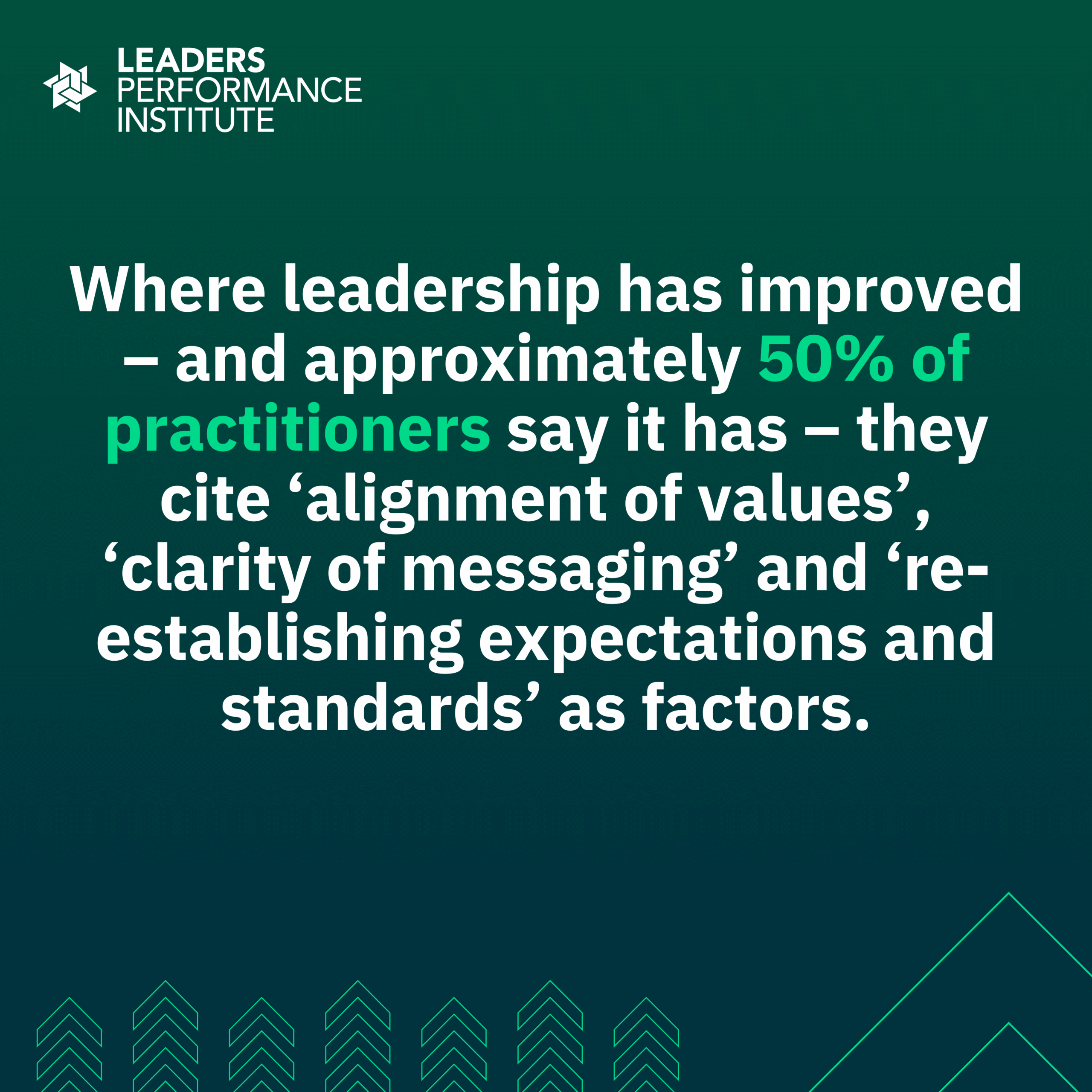
There is still room for improvement: only 12.6 per cent said their organisations are ‘well aligned’.

As Vahid explains, teams could start with the following.

Establish a regular and consistent theme

“Alignment is done best when it’s regular and not just your annual ‘here’s what we’re going after, see you again in 12 months’ time,” says Vahid. “It’s got to be constant. In every meeting there needs to be a regular and consistent theme that people are working towards and, importantly, they know their contribution.”

In 2024, Vahid published A Cultural Hypothesis, which explored the factors that enable a sustained culture of success. One element stood out as a ‘super enabler’ for Vahid: cultural leadership. The term acknowledges that leadership exists on three levels within an organisation:

  1. Sponsors: those working at ownership or board level; they give permission to architects and guardians (who have a more active role) to deliver the culture. They are typically one or two people.
  2. Architects: those responsible for the design of the culture, ensuring it is set up in a way that can allow people to thrive. They are typically a small number.
  3. Guardians: the individuals on the ground, delivering daily, ensuring alignment to the articulated culture which they can translate to individuals working in that space. There can be multiple guardians.

The guardians, Vahid argues, are critical to alignment. “The reality is that if you’re a senior leader, you’re not going to be on the ground, you’re not going to be able to influence every different scenario – that’s where you need your guardians, your foot soldiers on the ground who are able to distil your message and ensure there is direct alignment to the organisation’s aims.”

NASA’s janitor was a cultural guardian in Vahid’s eyes.

Find the right repeatable words

“Language offers you the opportunity for shared understanding,” says Vahid, “and shared understanding is crucial in alignment, so people know what they’re going after. A leader might not necessarily use the word ‘alignment’, but they’ll be talking about their overall purpose.” NASA’s purpose was simple but powerful. “Your language must be repeatable and resonate with people.”

Vahid also says that high-performing organisations tend to have goals that transcend winning. “It’s important to get everyone behind it. Everyone must believe it is attainable, and it must drive them to want to get out of bed in the morning and come to work.”

What if there’s clarity, but still misalignment?

Vahid explains there could be a few factors at play, all of which point to the importance of feedback:

Staff development needs. If a staff member commits an error of execution, it is an opportunity to deliver developmental feedback. Vahid says: “Does everyone understand what we’re going after? If they do and they step outside of that, then feedback is warranted.”

Psychological safety. “It’s a buzz term,” says Vahid of the commonly used phrase, “but it’s crucial for people to feel they are in a feedback culture.” The leader must show that the intent of feedback is to help the individual to progress. “You’re taking time to give them feedback because you care,” he adds. “You’re then seeking to work with the individual to create that development.”

The leader’s behaviour. Leaders must also demonstrate their willingness to listen to feedback. “They need to provide ‘speak up’ signals,” says Vahid with reference to the work of psychologist Megan Reitz. “The leader needs the skill to understand the position they’re in and the power they carry in that dynamic.”

What to read next

The Brisbane Lions Have Turned Female Athlete Health into a Performance Question. Here’s How

4 Jun 2025

Articles

Performance Under Pressure: Four Lessons from a Big Wave Surfer

Category
Coaching & Development
Share
Facebook Twitter Email Copy Link
https://leadersinsport.com/performance-institute/articles/performance-under-pressure-four-lessons-from-a-big-wave-surfer/

Ian Walsh of Red Bull is renowned for his meticulous approach to tackling some of the biggest waves on the planet. Here he shares his wisdom with the wider sporting community.

Main Image: Fred Pompermayer / Red Bull Content Pool

By John Portch
“Time really slows down,” says Red Bull surfer Ian Walsh of the moment he rides a big wave.

“In every other part of my life there’s a million things going on. I feel like I always have ten balls in the air. Did I forget to take the laundry out? Did I put it in the dryer? I have bills to pay, groceries to buy. And surfing is one of the few places in the world where that all just drifts away.”

This level of focus may sound familiar to athletes, but the stakes of big wave surfing are something else entirely. One false move and Walsh risks serious injury every time he mounts his board.

Walsh has built a career on his coolness under pressure, which is why he was invited to share his insights at the Leaders Sport Performance Summit at Red Bull Media House in Santa Monica last year.
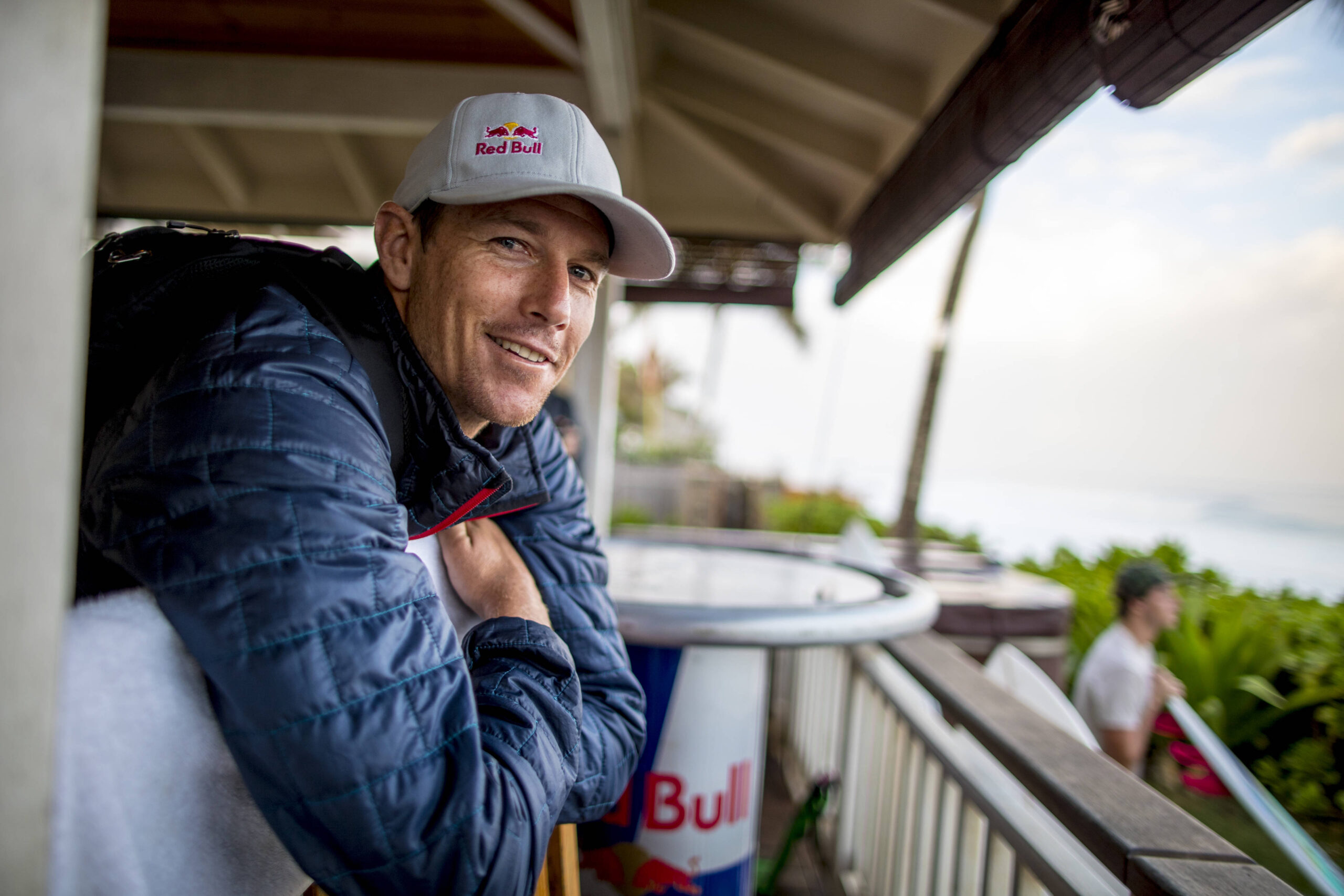
Ian Walsh poses for a portrait at the Volcom Pipe Pro on 4 February 2018, on the island of Oahu, Hawaii, USA. [Zak Noyle / Red Bull Content Poo]l

Four factors stand out in his approach.

1. He acknowledges and harnesses his fear

“Those nerves and everything you fear are natural, and you can use that to elevate your performance,” said Walsh. “It commands every ounce of your being and your focus to deal with what’s coming at you and how you want to navigate it to try and finish on your feet.”

This ability comes with “repetitions and time”. Walsh was in town for a training block at Red Bull’s state-of-the-art Athlete Performance Center ahead of the northern hemisphere summer season. “I’m going to take full advantage of having this amount of time in a facility like this,” he added. “It gives me the chance to push myself in a controlled environment.”

2. He keeps his ‘smart brain’ online

Walsh can keep his ‘smart brain’ online under pressure. It is a term often used by high-performance specialist Rachel Vickery. “Have you got enough buffer in the system to absorb that natural increase in arousal state peaking?” she said on the Leaders Performance Podcast in 2023.

“Every human has a threshold that basically says if my arousal stays below my threshold or below my red line, I can perform in a way that I’ve got a lot more control of. If I’ve got more buffer in the system, so to speak, then when I get the normal increase in arousal it’s still under control and it’s not shooting me across the red line.”

In Walsh’s case, he de-escalates and grounds himself through the ‘breathe-up’ technique, which is a cycle of diaphragmatic breathing aimed at lowering his heart rate and preparing his body to stay relaxed underwater for an extended period.

Additionally, thanks to training alongside Red Bull freediver Kirk Krack, Walsh has learned to hold his breath underwater for up to five minutes. “It’s creating situations where I could elevate my heart rate and then get into a breath hold and understand how my body is going to react and eventually adapt to those scenarios.”

“It’s a skill in and of itself to then go, ‘how do I apply that once this physiological threat response kicks in? How well am I able to adapt and adjust and execute when all those changes happen?’” said Vickery, who would no doubt approve of Walsh’s strategies.

3. He already knows what to do when things go wrong

Walsh has long had a firm interest in meteorology and bathymetry [the study of the seabed, lakebeds and riverbeds]. He can pinpoint with reasonable accuracy when and where the most suitable swells will appear during both the northern and southern hemisphere surfing seasons. He said: “The reason it evolved to so much precision is to give myself as much of an opportunity on those special days as I can, because those days are rare and everything can change so fast on those mega swells.

He then readies his equipment and support team. “By having my preparation done, I can get absolutely smoked on a wave, break my board, everything gets washed onto the rocks, but I have everything ready to go again. I can go right to the boat or the jet ski, get my second board, catch my breath, make sure everything’s good and then get back into the lineup within 15-20 minutes.

“If you don’t have that ready, you could spend two hours dealing with it and it could be another month to six weeks or even the next season when you get another opportunity to push yourself in that calibre of surf.”

His meticulousness extends to listing and ranking restaurant menus in different locations. It drives his partner up the wall. “I take it into my normal life and my girlfriend can attest to how annoying those details are.”

Jokes aside, Walsh’s approach calls to mind the words of mountaineer Kenton Cool, who once told an audience at a Leaders Sport Performance Summit: “People often think of extreme adventure athletes as possessing a ridiculous appetite for risk, that we’re reckless, foolhardy and make illogical decisions. In reality, it’s quite the opposite.”
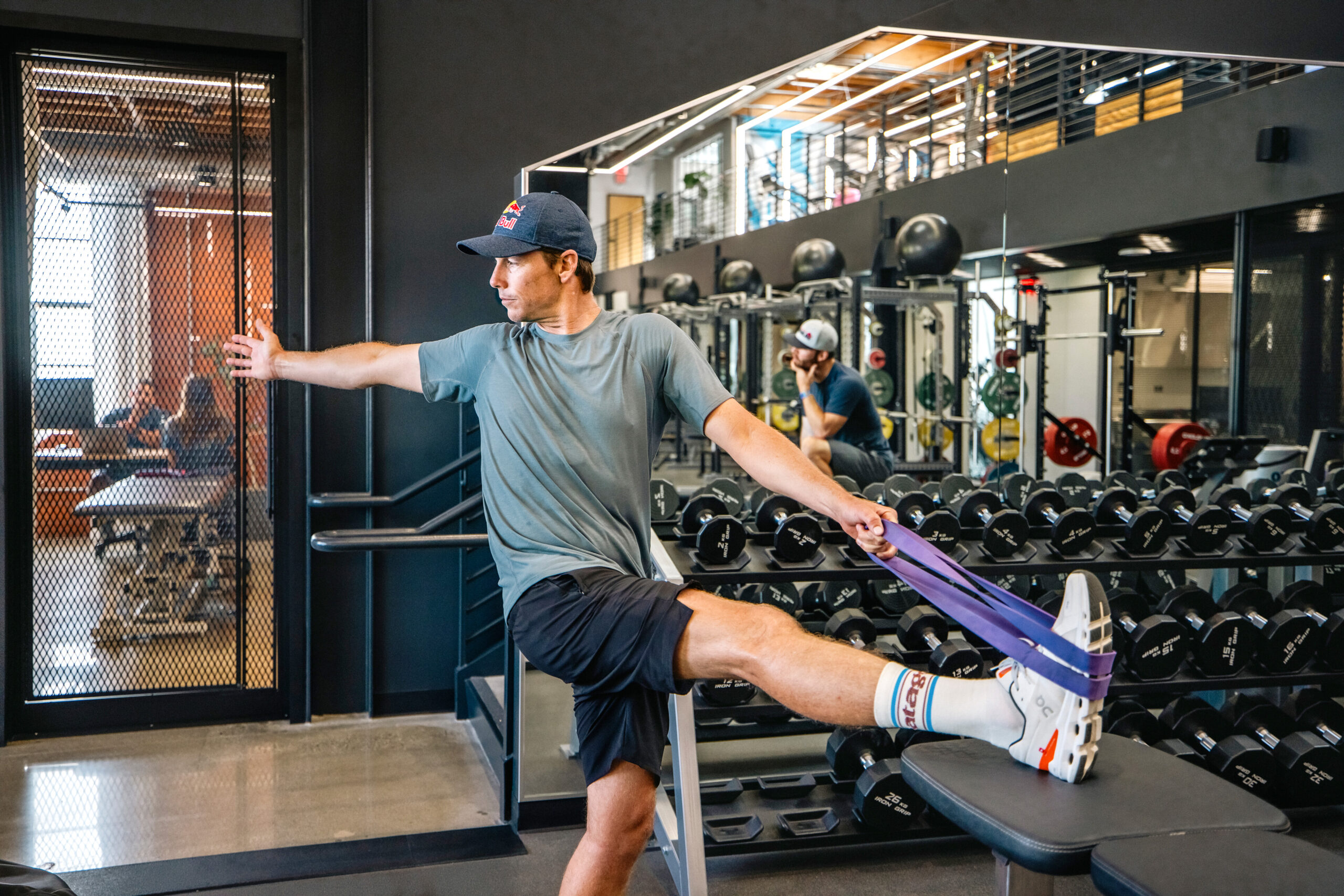
Ian Walsh photo session for The Red Bulletin, Los Angeles, 19 July 2024. [Maria Jose Govea / The Red Bulletin]

 4. He goes for progress over perfection

Walsh’s near-catastrophic failures have taught him to be humble when ironing out creases in his performance. “Letting go of some of your ego will create a lot more latitude for opportunities,” he said. “Maybe I did get annihilated on that wave, but I was also an eighth of an inch from making it.”

Walsh studies film of his efforts. He is also a comprehensive note-taker. “I can go back and be like ‘this swell angle, these winds, these tides are shaping up like January 10, 2004 [a date on which he suffered a severe injury – one of several throughout his career]’.” He can then tell himself “maybe I should have ridden this forward or tried those fins. Maybe our water safety protocol could have been a little more buttoned-up.”

What to read next

Neurodiverse Athletes: Some Key Coaching Considerations

2 Jun 2025

Articles

The Debrief – a Snapshot of Powerful Discussions Happening Right Now Across the Leaders Performance Institute

Category
Leadership & Culture
Share
Facebook Twitter Email Copy Link
https://leadersinsport.com/performance-institute/articles/the-debrief-a-snapshot-of-powerful-discussions-happening-right-now-across-the-leaders-performance-institute-15/

May shone a spotlight on ‘influencing skills’, leading in complex environments, coach development and finding the right ways to test tech solutions.

By John Portch
Even at the moment of her greatest coaching triumph, Arsenal Women Head Coach Renée Slegers was thinking about the future.

“We want to keep on building from this,” said Slegers after her side had defeated Barcelona Femení 1-0 in May’s Uefa Women’s Champions League final.

“We believe in who we are and what we do and we want to keep on building and keep on going next season.”

Slegers, who is less than a year into her first head coaching role, knows the risk of standing still, both as a team and as a head coach.

Throughout the fifth month, the Leaders Performance Institute was on hand to deliver a selection of sessions to help members further hone their leadership skills, from the art of influencing to introducing and managing more efficient processes for testing tech.

Here are some of the choicest cuts.

To influence, you need to listen

Jeff Pagliano of Management Futures hosted an ‘influencing skills’ session for Leaders Performance Institute members as part of our Leadership Skills Series.

He introduced the topic of ‘listening well’, which supports influencing in two specific ways.

“It helps the intimacy part of the trust equation and it gives you the context for a person’s point of view,” he said. “You’re more prepared when the time comes for you to share your knowledge and suggest a course of action.

“Active listening is when you’re not only tuned into what someone says but also what they feel and believe picking up on both their verbal and non-verbal communication is the foundation of intimacy and the antithesis of self-interest.”

He shared the following image to illustrate his point:
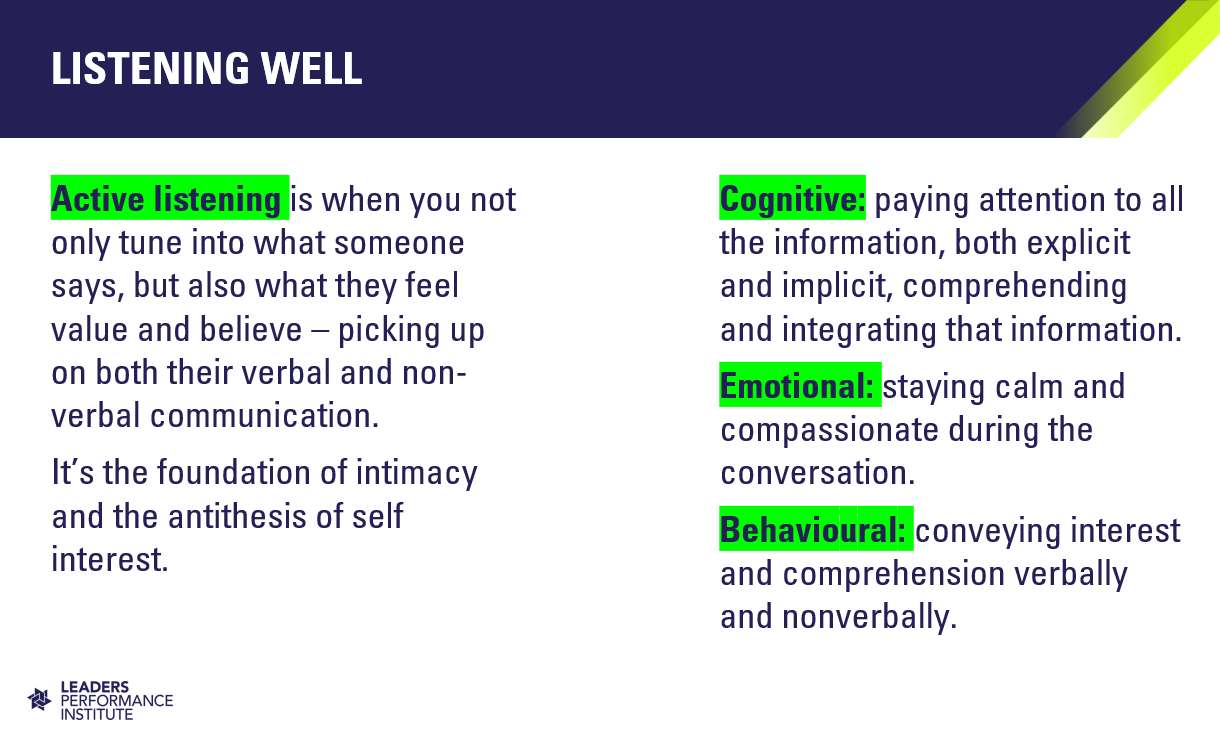
When you’re talking to someone you are hoping to influence it’s always useful to reflect on the goals of each conversation, both what you want and what the other person needs as a way to determine the best way to listen at the moment. And you may realise that a different mode or combinations of modes would be better.

Jeff Pagliano, Management Futures

Top tips for leading in complexity

In May, we also launched a Learning Series that explored adaptability in the complex world of high performance. In the first session, Tim Cox of Management Futures offered a series of seven tips, including: prioritise time for analysing what is changing.

Here’s what that entails:

  • Internal and external scanning. “We have our senses, we’re hardwired to pick up on change and be aware of what’s going on within the environment, whether close to us or outside,” said Cox, with regards to such elements as team morale or performance trends, “but what are the mechanisms for systematically analysing how the wider environment is changing?” These could be shifts in policy, competition rules or tech advancements.
  • What are your existing mechanisms? These matter. “There will be ways in which you’re doing that already. There may be player leadership groups who understand what’s changed within the squad. You may even have player liaison roles.”
  • ‘Upstream’ thinking. Dan Heath’s book Upstream offers a provocation to people working in sport: it challenges us to stop reacting to problems and instead start preventing them. In sport, people pride themselves on being problem-solvers, but how often do we step back to ask why the problem exists in the first place?

Read all seven tips here.

Are you able to thoroughly assess tech solutions?

At the beginning of May, we published our Trend Report entitled ‘The Winning Formula for the Future of Performance Sport’.

The report delves into the barriers that prevent organisations adopting new technologies and is informed by more than 200 individuals from nearly 40 sports. While cost was predictably high on the list, three other challenges emerged as equally, if not more, critical.

It was the perfect opportunity to run a virtual roundtable discussing the systems and processes that members have in place at their teams. The table identified a number of critical success factors.

While much of the conversation focused on systems and structures, several participants emphasised the importance of culture and communication as critical to the success of these processes. One high performance manager noted that their organisation is “risk-averse” when it comes to new tech, not because of a lack of interest, but because of a desire to protect core business functions. “If there’s anything we can use to get all the noise out of other people’s way so they can actually do the day-to-day job better, then we’re normally onboard with that.”

Another pointed out the generational divide in digital fluency. Younger staff are digital natives and eager to adopt new tools. Older staff, by contrast, may be more cautious or feel overwhelmed. Bridging this gap requires not just training, but empathy and thoughtful change management.

Additionally, performance sport may need to rethink its leadership structures. In other industries, CTOs and innovation directors play a critical role in aligning technology with strategy. In sport, these roles are rare but increasingly necessary.

Without someone to “own” the innovation agenda, organisations risk falling into reactive patterns and chasing shiny new tools without a clear sense of purpose. As one contributor put it, “We need someone who can sit above the noise and guide us forward.”

Coach development cannot be separated from athlete development

Another virtual roundtable looked at helping athletes to bridge the gap from the youth to senior ranks.

While discussing an array of approaches, the table underlined the importance of investing in coach development as a key influence on transition experiences for athletes. One element of this is ensuring coaches are equipped to recognise and understand different transitions as they occur in different contexts and, therefore, deal with them more effectively.

An environment within the Olympic system explained how their decentralised programme has witnessed new performance records at junior level due in part to their consistent approach to coach development. Their heightened emphasis on coach support and development extends not only to their current athletes but those next on the pathway.

Also, coach-to-coach exchanges enable individuals to discuss both common transitions and those lesser-considered transitions that are nevertheless challenging, such as injuries.

Additional reporting by Luke Whitworth.

Read the Trend Report now

The Winning Formula for the Future of Performance Sport

Members Only

29 May 2025

Articles

As Sport Grows More Complex, Adaptable Leaders and Teams Will Change the Game

Category
Leadership & Culture, Premium
Share
Facebook Twitter Email Copy Link
https://leadersinsport.com/performance-institute/articles/as-sport-grows-more-complex-adaptable-leaders-and-teams-will-change-the-game/

In the first of a three-part virtual Learning Series, we explore why adaptability is becoming a crucial modern leadership skill.

By Luke Whitworth
“An unwillingness to adapt and evolve is one of the things that stifles great cultures – it stifles great coaches too,” said Dan Jackson.

The General Manager of Player Development & Leadership at the Adelaide Crows was speaking in The Winning Formula for the Future of Performance Sport, our recent Trend Report.

The sentiment struck a chord with Jackson’s fellow contributor, Tim Cox of Management Futures.

“We work in sport and other sectors, and there is that feeling of stifling,” Cox told a recent leaders virtual roundtable. “The pace of change, the demands on us are increasing, and it can feel almost suffocating for leaders sometimes. What do we do here? How can we respond effectively?”

Cox, who co-hosted this Learning Series with the Leaders Performance Institute, hinted at the growing complexity of sport and the ever-increasing importance of being able to lead through complexity, which is the overarching theme of a three-part virtual roundtable series that seeks to help leaders develop the necessary skills.

To follow up, we shared five areas where complexity continues to grow in sport. Most if not all will be familiar to athletes, coaches and practitioners alike:
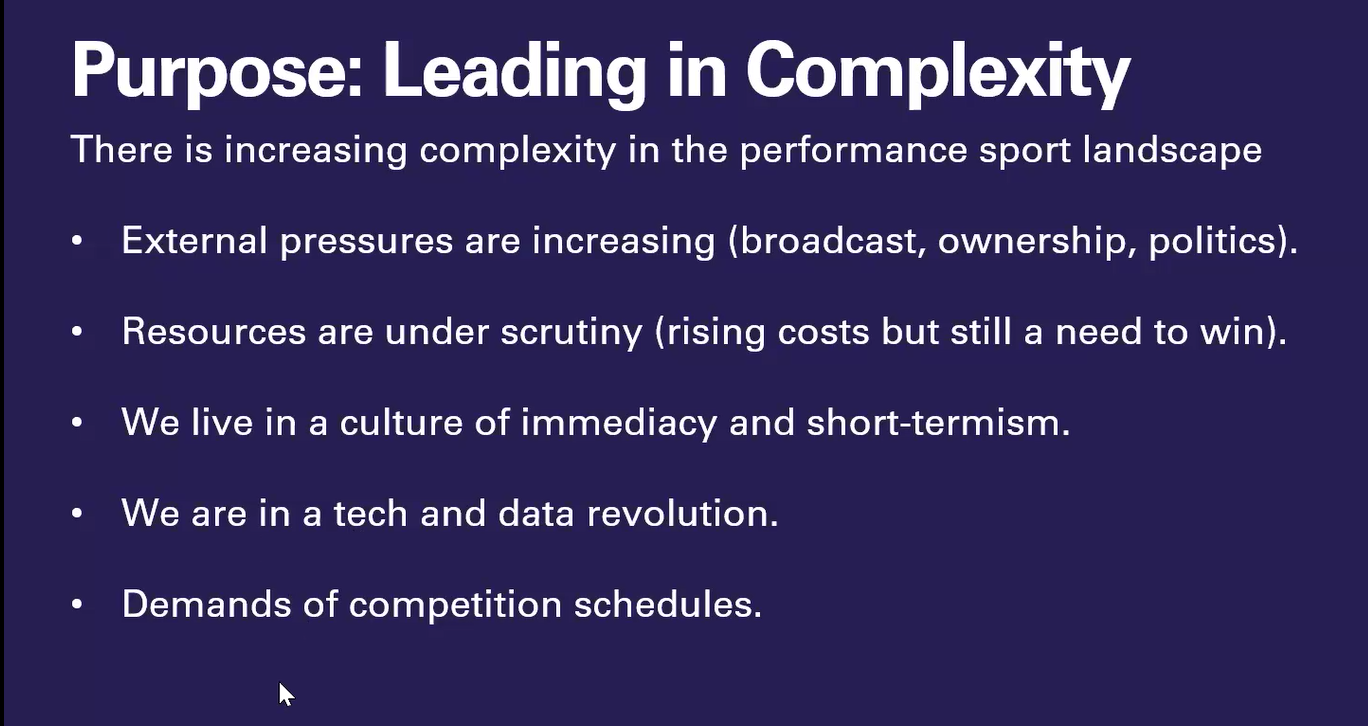
 

Adaptability: a vital skill

Session one explored the concept of adaptability and how leaders can increase the chance of an effective response from their teams. This came up in the Trend Report. The following also stood out from the report’s findings:
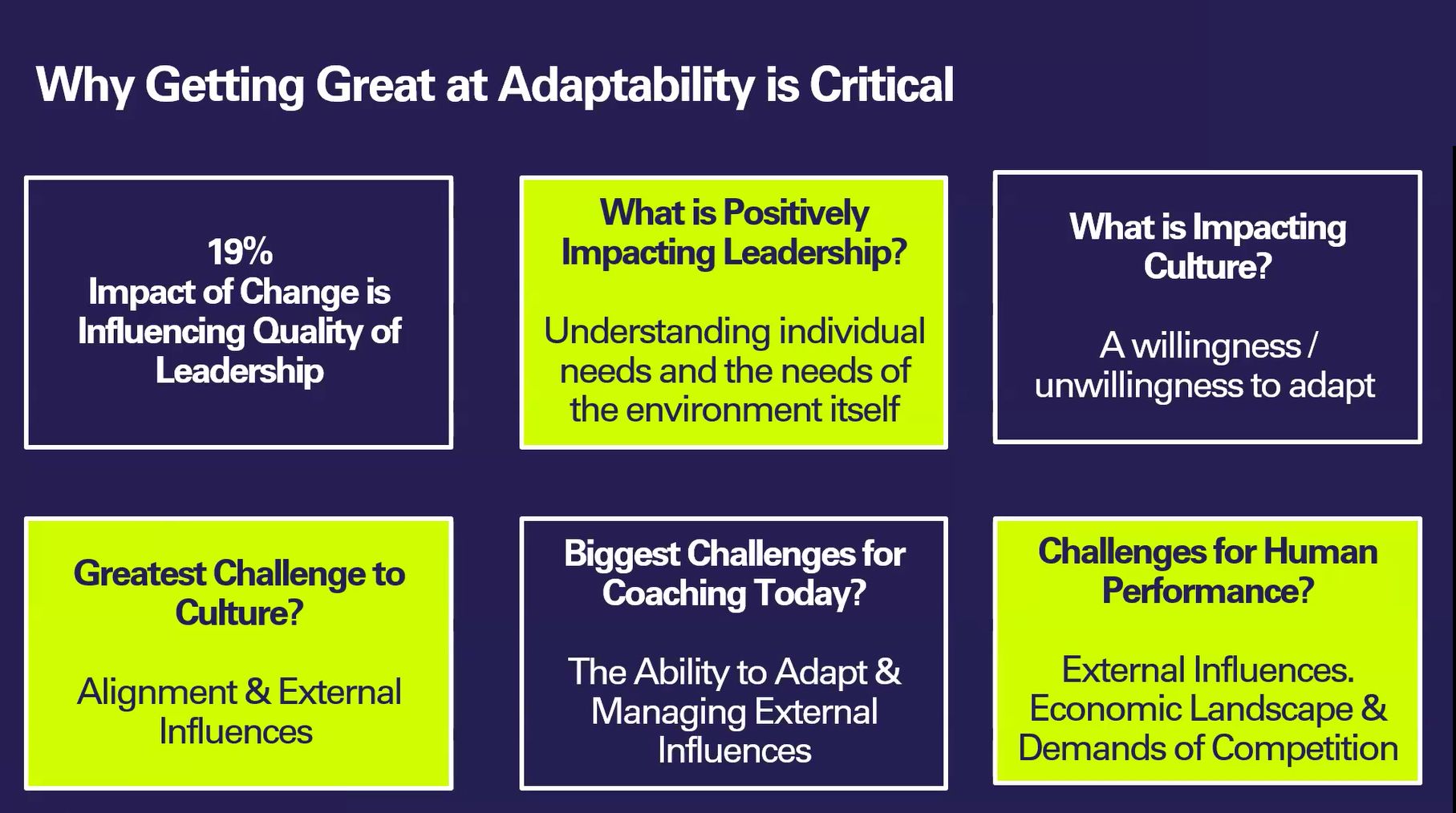
 

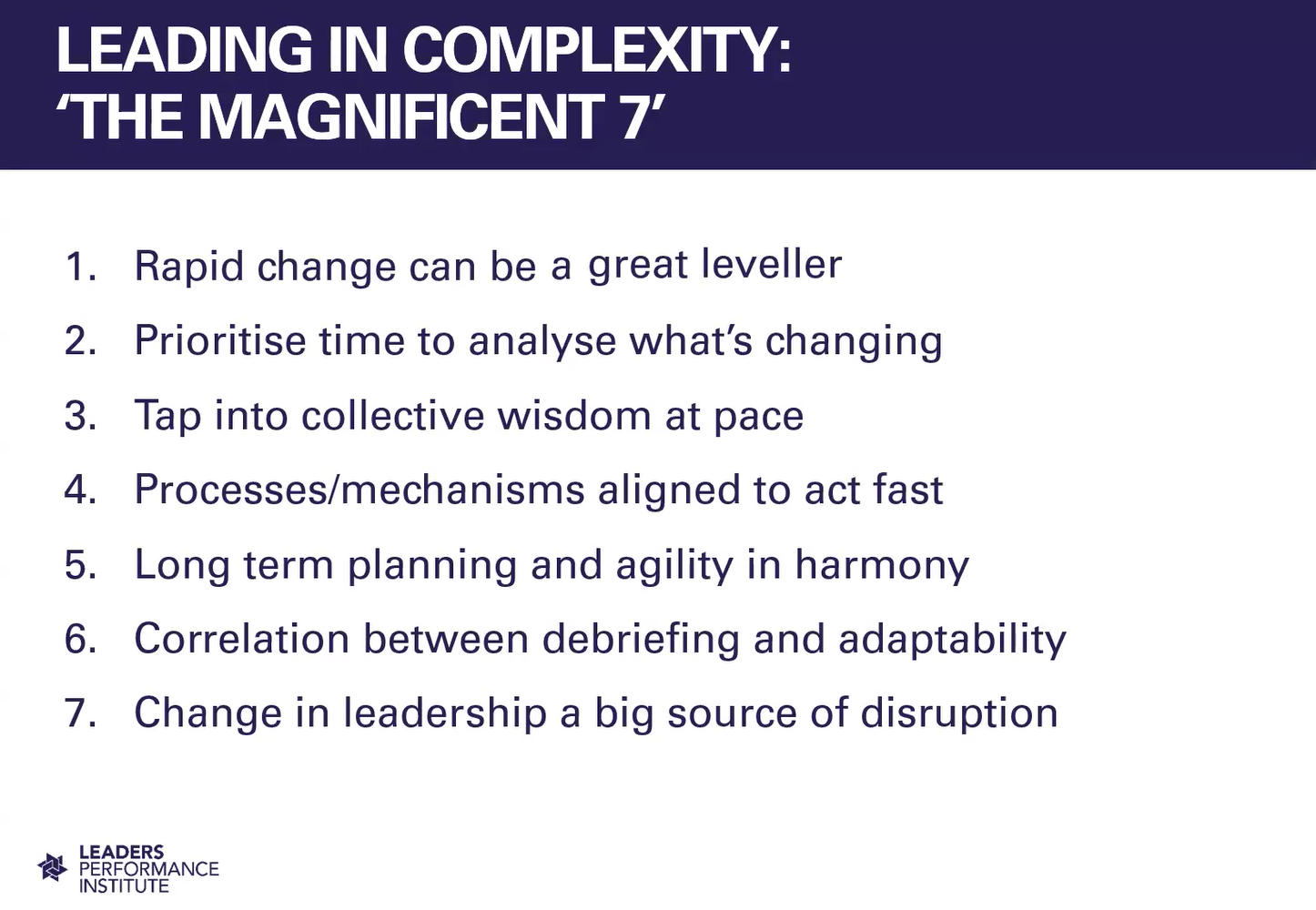
The Magnificent Seven: tips for leading in complexity

Cox distilled his thoughts on the topic into seven ‘magnificent’ areas. “Whether they’re magnificent or not, you’ll be able to make a call on it,” he said.

  1. Rapid change can be a great leveller

In a world where change is constant, smaller or less-resourced teams can gain a competitive edge by being more agile.

  • Mindset is important. Cox said: “We can respond to the disruptions that are there in our world, whether they be internal or external… there’s something to be said for going on the offensive wherever we can, when we’re able to actually disrupt things, certainly in a competition environment. Others are going to have to deal with the disruption that we’re bringing.”
  • Resourcefulness beats resource. Cox shared the example of a fintech CEO with whom Management Futures work. “We’re working with the senior team and he was saying. ‘Do you know they’re doing my head in. They want the pace of change to slow down, they keep saying “we just need to pause, we just need to focus, we just need to do this”. And actually, they’re missing the point: our survival as a smaller player with fewer resources than others actually depends on disruption. It depends on us being really fast and being the drivers of disruption’.”
  1. Prioritise time to analyse what is changing

“This is a simple one: it’s really prioritising time to actually analyse what is changing.”

  • Internal and external scanning. “We have our senses, we’re hardwired to pick up on change and be aware of what’s going on within the environment, whether close to us or outside,” said Cox, with regards to such elements as team morale or performance trends, “but what are the mechanisms for systematically analysing how the wider environment is changing?” These could be shifts in policy, competition rules or tech advancements.
  • What are your existing mechanisms? These matter. “There will be ways in which you’re doing that already. There may be player leadership groups who understand what’s changed within the squad. You may even have player liaison roles.”
  • ‘Upstream’ thinking. Dan Heath’s book Upstream offers a provocation to people working in sport: it challenges us to stop reacting to problems and instead start preventing them. In sport, people pride themselves on being problem-solvers, but how often do we step back to ask why the problem exists in the first place?
  1. Tap into collective wisdom at pace

As one participant said, “adaptive cultures are the ones where everybody has a voice. They can voice feedback, they can push back on ideas, and ultimately, that helps you get to the right idea.”
  • Psychological safety. As Megan Reitz and John Higgins once argued in the Harvard Business Review, managers are more intimidating than they think. Cox cited then built on their point. “I’ve been in lots of environments where just a look from a senior player, just a look from a coach, or a manager, or someone in a senior position has stopped somebody from sharing an opinion that they might have had,” he said. “I’ve also been in environments where I’ve been able to call that out, to stop the conversation and ask ‘what’s just happened?’ and understand from the individual who was just about to share their opinion ‘what was it?’ Very often it is not what the person, the leader, or the senior coach, or the senior player thought it was going to be. It’s much more valuable and it often takes the conversation in a different direction.”
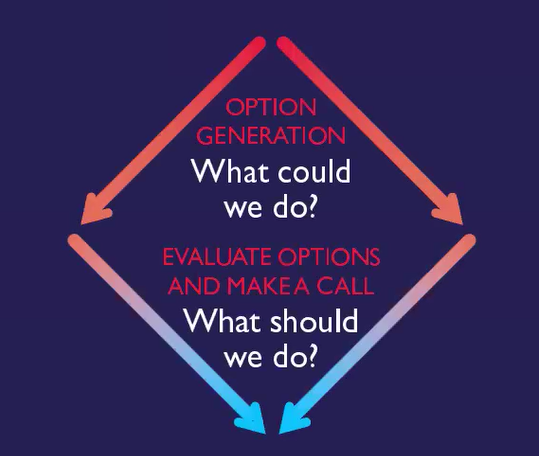
  • The ‘diamond’ tool. Cox proposed the following series of questions as a way of ensuring teams hear from each and every member. It opens up the discourse and then closes it when a decision needs to be made:


  1. Processes and mechanisms aligned to learn fast 

While tapping into collective wisdom is essential, it must be balanced with the ability to make decisions and act quickly. Yet while on-field decisions can be taken in minutes, “off the pitch,” as Cox said, “we can often be inordinately slow in adapting and responding to change.”
  • What processes and systems help your team to align? Cox argued that we might marvel at the organisation and agility of a school of fish, but struggle to replicate such manoeuvres in our own workplaces. “The processes and mechanisms that we’ve got in place can help us to respond much more naturally and much more quickly over time. Whatever you’re using, how can we come together, make decisions, and adapt really quickly?”
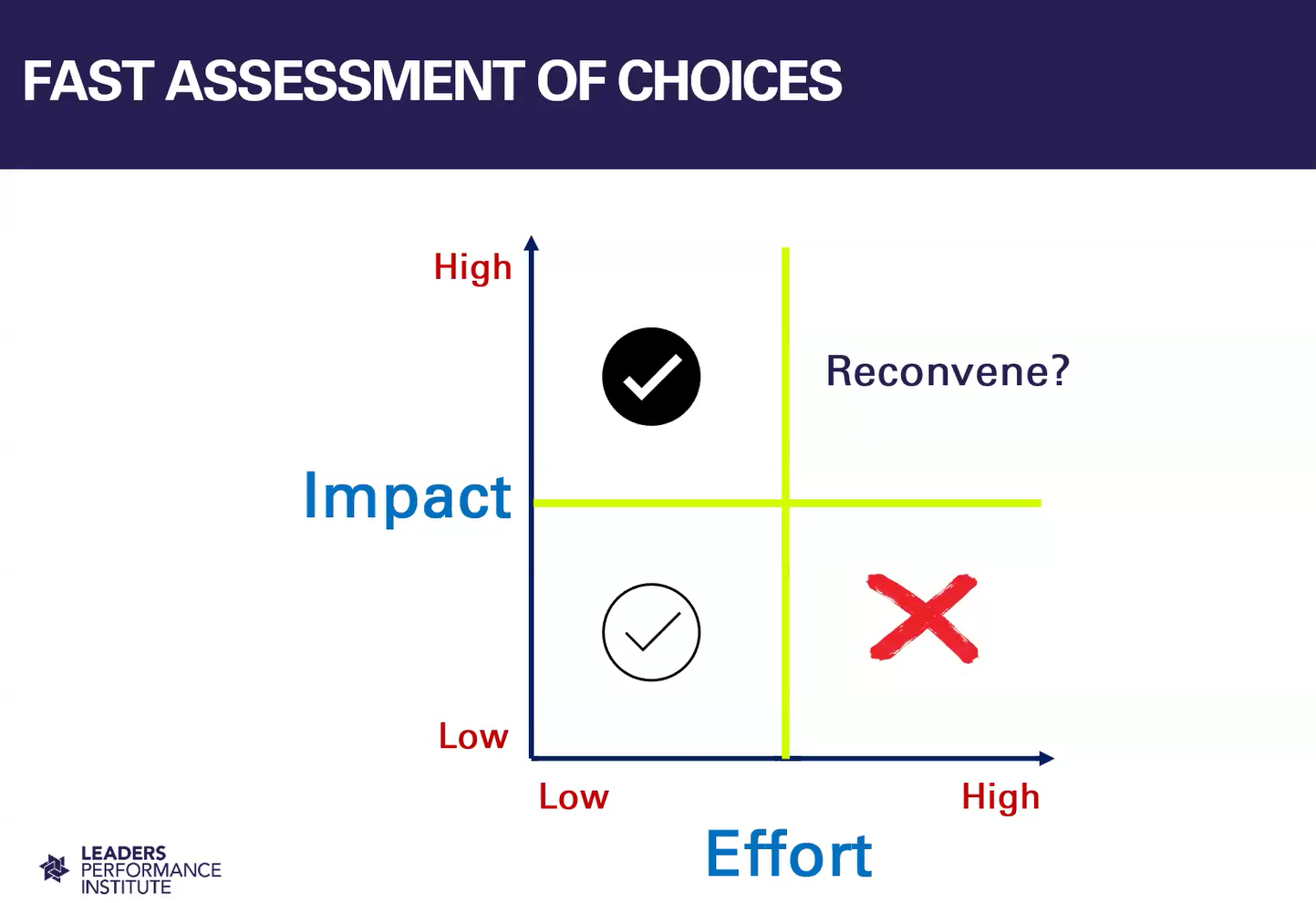
  • Teams often fear that hearing from everyone will slow down decision making. However, this simple matrix, which assesses effort and impact, can help you to arrive at swifter decisions:

The ideal choices are those that are high impact and low effort. These are the quick wins. Conversely, high effort and low impact choices should be avoided as they are distractions and drains on resource.

  1. Long-term planning and agility in harmony

Agility requires action, even in the face of uncertainty. Not knowing everything shouldn’t prevent progress.

You can, however, take a structured approach by recruiting wisely, implementing training programmes and pivoting smartly. Teams, Cox suggested, can ask themselves “what are our skill gaps for now or where are we strong now? What are the skills we’re going to need to make this pivot?”

  1. Correlation between debriefing and adaptability

“To adapt, we’ve got to learn,” said Cox with specific reference to the special forces, “and the better we are at debriefing, then the better we are at learning and then adapting.”

He explained that debriefing should be a deliberate, embedded practice. It’s not just about reviewing what happened – or when responding to a crisis – but extracting lessons to fuel future action.

  1. Leadership change is a big source of disruption

“To what extent can we get these transitions right?” asked Cox. “Because obviously they have big organisational and team impacts, not just on the individuals close to them, they can filter down to the whole organisation.”

Who are your cultural guardians? Cultural guardians, as discussed by Dr Edd Vahid, are the individuals or mechanisms that ensure core values and practices are preserved during leadership changes. They are, as Cox explained, indispensable. “Any new leader is going to want to change things,” he said, “but what are the pieces that we need to absolutely hold on to? What is handed over to the leaders that we know to be true about this culture in this organisation?”

To sum up…
Looking ahead

This session was the first in a three-part series. Future discussions will explore:

Part 2: Inhibitors to adaptability – what gets in the way?

Part 3: Building a collective playbook for leading in complexity

21 May 2025

Articles

Your Ability to Hold a Room of Athletes or Support Staff Can Make or Break you as a Coach

Category
Leadership & Culture
Share
Facebook Twitter Email Copy Link
https://leadersinsport.com/performance-institute/articles/your-ability-to-hold-a-room-of-athletes-or-support-staff-can-make-or-break-you-as-a-coach/

In this exclusive column, performance specialist Iain Brunnschweiler outlines how he fights the inevitable nerves with tools he has picked up during a career spent in elite sport.

By Iain Brunnschweiler
A 15-year-old boy stepped onto the stage. His palms were sweaty. His heart rate elevated. He was about to speak in front of his entire school of around a thousand children for the first time.

The anxiety felt almost totally consuming. His legs felt heavy, and he doubted that any words would come out of his mouth when and if he did attempt to start speaking. His brain was scrambled with a hundred thoughts, which seemed impossible to coordinate into anything helpful.

The year was 1995, and that boy was me.

I honestly cannot remember what I spoke about, but I sure remember how it made me feel.

Everyone was looking at me. I felt so insecure and so nervous it was almost unbearable. It felt very different from the sports field, where I felt at home. On the field of play I felt like I had permission to be myself. But I did not feel it there on that stage.

Fast forward 30 years, and I stepped onto the stage at the Royal College of Music in front of more than 120 sports leaders from around the world at Leaders Meet: The Talent Journey. I was privileged to be afforded the opportunity to facilitate the event for the Leaders Performance Institute.

The nerves were there again, however, over the past 30 years, I have developed a range of resources to allow me to adopt a more preferable state to be able to speak in front of people.

Confidence and humility: a tricky balance

Humans are remarkable things, aren’t they. We’re all individual, all experiencing the world in a unique way, all dealing with themselves on a daily basis and simultaneously seeking to demonstrate something to the outside world. We all have varying levels of self-awareness and varying levels of skill in dealing with the questions being asked of us in our own contexts.

Consider some of the situations a sports leader might find themselves in: starting in a new leadership role, rallying your team during difficult times or times of change, seeking to inspire others through your words or actions. Now for those of us who have seen skilful leaders or coaches in practice, some of these skills can seem effortless. However, behind that skilful act is undoubtedly someone who has wrestled with their own feelings of doubt or insecurity and drawn upon their own experiences in order to choose and deliver an appropriate response to their audience.

Being able to speak up with a balance of confidence and humility can be tricky. And it is a skill that may be the difference in the career trajectory or simply contentment of any aspirational individual.

Actors, agents and authors

I remember being shown some research by a fabulous person, colleague and psychologist, Malcolm Frame, called ‘The Psychological Self as Actor, Agent, and Author’. The paper is written by American psychologist Dan McAdams, whose work talks to the developmental journey of any human. My interpretation of McAdams’ work is that the ‘Actor’ is the social self, the ‘Agent’ is the motivated self, and the ‘Author’ is the narrative self.

As Malcolm told me: “Embracing this cycle each day isn’t just self-improvement – it’s building an unshakable architecture of strength, capacity and resilience within our very operating system.”

As a more novice practitioner I was certainly an Actor. Concerned almost solely with how I was perceived and wanting to be liked by everyone.

For example, when I first accepted the role of a national coach within the England Cricket pathway, I was unsure how to be. I struggled to understand what was required of me. Having to stand up and speak in front of some of the most talented young players in the country, as well as the brilliant support staff that I was working with, felt like a huge stretch.

I felt high anxiety when I was ‘on show’ and witnessing the show going on around me. As I developed and became more experienced, I realised that my motivations and aspirations could not be reached if I was not able to override my anxieties and take action towards my desired outcomes. As an Agent, I was able to step onto ‘the stage’ and make choices that were my own.

After more than 25 years of striving in the elite sporting context, I finally feel that I am able to become more of an Author in my own context. I can control the narrative more effectively to serve me in the way I find helpful. It helps for me to have reflected on my past experiences. Successes and failures, taking learnings from them that can help me in the present, as well as support me in the future.

Nerves are not necessarily a bad thing

Having reached a senior role at a Premier League football club, I was interacting with directors and owners and being asked to make major decisions that would affect numerous people. Whilst never easy, I was more comfortable in doing so, having been on such a journey. The moments of bravery earlier in my career which felt incredibly tough, were now serving me in the moment.

The stories that I now tell myself about my past, help me to feel more well-resourced in the moment. I have accumulated a broad range of experiences which I can draw upon now, and allow me to both enjoy it and embrace however I am feeling. Tactics such as self-talk, the use of perspective, and an acceptance that I prefer to be playful rather than serious, all serve me and allow me to accept my emotions. I have certainly not solved this! However I am very clear on the progress that I have made.

So, as I stepped onto that stage in 1995, my nerves were similar to my nerves in 2025. However, I was now more well-resourced to acknowledge and accept them and even use them to my advantage. Being nervous now lets me now that I care about what I am doing. That it is important to me. And that’s OK.

I don’t think any advice would have helped that boy in 1995. It was stepping up onto that stage that he needed.

Iain Brunnschweiler runs the Focus Performance Consultancy. He is a former professional cricketer, has authored two published books, and previously served as the Head of Technical Development at Southampton Football Club.

What to read next

The Four Phases of Talent Development Decoded


Members Only

12 May 2025

Articles

‘The Best Influencers Listen Carefully, Ask the Right Questions, and Communicate a Compelling Vision’

Category
Leadership & Culture, Premium
Share
Facebook Twitter Email Copy Link
https://leadersinsport.com/performance-institute/articles/the-best-influencers-listen-carefully-ask-the-right-questions-and-communicate-a-compelling-vision/

In a recent Leadership Skills Series Session, Jeff Pagliano of Management Futures set out a series of tools, including the trust equation, active listening and ‘flows of knowledge’.

By John Portch
If you’re a coach you’re also an influencer. But what do we mean by ‘influencing’?

“Influencing is often strictly correlated with the level of knowledge or technical insight we can offer in any given situation and our ability to communicate that knowledge effectively,” said Jeff Pagliano, a consultant with leadership specialists Management Futures.

“However, influencing we believe is much broader than this.”

Pagliano was hosting an ‘influencing skills’ session for Leaders Performance Institute members as part of our Leadership Skills Series.

“A lot of you are employed to lead or influence outcomes, not for your technical knowledge but for your ability to build trust, grasp complex ideas, think rationally, and motivate,” he continued.

“The best influencers are often those who listen carefully to the needs of those around them, ask the right questions, and then communicate a compelling vision. And this has as much to do with credibility as knowledge does and, interestingly, the further you go up in an organisation, the less useful your IQ, your technical knowledge, is and the more useful your EQ, your emotional intelligence.”

Over the course of an hour, Pagliano explained why your ability to build trust, actively listen, and communicate compellingly – areas in which we can all improve – underpins your ability to influence.

‘The trust equation’

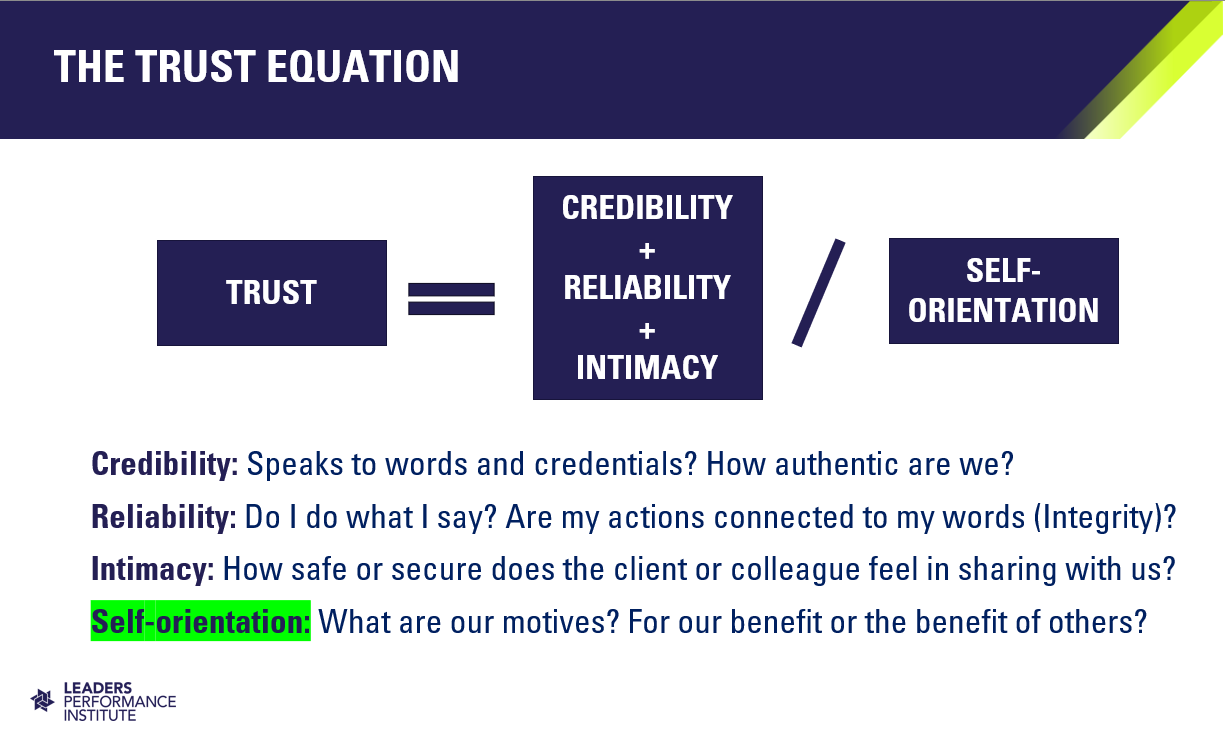
To start, Pagliano presented the trust equation to the group:

He then explained his thoughts on each:

Trust =

Credibility: “This speaks to both words and credentials. People should be confident that you know what you’re talking about, but it may not be just about the content, it could be how you show up as well. Credibility is a blend of what you know and how you present yourself.”

+

Reliability: “You do what you say you’re going to do. Your actions are connected to your words and your follow through. One thing that’s interesting to note is that people will sometimes over-promise and under-deliver; and it’s a very natural instinct to do that because we naturally want to please or we want to show the best of ourselves but, actually, over the long term, this can really work against you.”

+

Intimacy: “If credibility and reliability are the sort of things that are quite concrete, intimacy is a little more ambiguous. It’s more to do with the sense you have that someone will be there for you, and you try to gauge how emotionally intelligent they are. You’re noticing how well they listen, how much they connect, how much warmth they have, how much understanding. It’s less concrete, but equally important.”

/

Self-orientation: “Anytime you are building trust you do have to have some self-orientation because in any kind of negotiation or where you’re looking to influence, it would feel suspicious if someone thought you were entirely magnanimous about everything and you had no vested interest in anything. It’s about getting the right amount and not letting it overwhelm the other three. That’s why you have the first three divided by self-orientation.”

When you’re focused on being more genuine and interested in the other human being good things are going to flow for that, opportunities flow from that, but if the opportunity is so prevalent in the conversation that you’re trying to jump on it constantly, the other person’s going to feel it.

Active listening

Pagliano then introduced the topic of ‘listening well’, which supports influencing in two specific ways.

“It helps the intimacy part of the trust equation and it gives you the context for a person’s point of view,” he said. “You’re more prepared when the time comes for you to share your knowledge and suggest a course of action.

“Active listening is when you’re not only tuned into what someone says but also what they feel and believe picking up on both their verbal and non-verbal communication is the foundation of intimacy and the antithesis of self-interest.”

He shared the following image to illustrate his point:

When you’re talking to someone you are hoping to influence it’s always useful to reflect on the goals of each conversation, both what you want and what the other person needs as a way to determine the best way to listen at the moment. And you may realise that a different mode or combinations of modes would be better.

Flows of knowledge

“If the trust equation is where it should be and you have been listening well, you have laid the groundwork to engage with the person you are trying to influence in conversation,” said Pagliano in taking the conversation further. “We have a great framework for you to use: it is called “flows of logic.” Pagliano cited former BBC presenter Stephanie Hughes in his explanation:
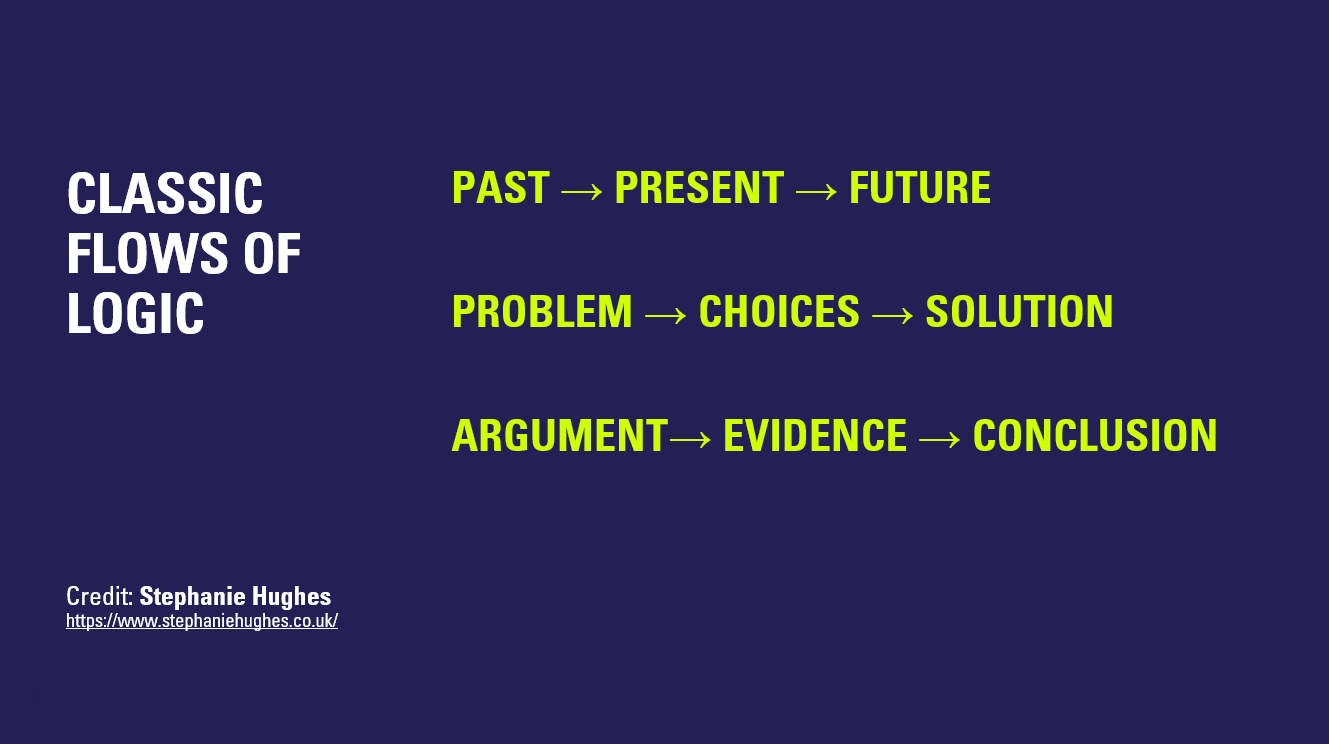
Pagliano explained their value, particularly in non-rehearsed, spontaneous conversations:

Past → Present → Future

“When you go through these phases of logic, it’s the middle word that is important. Like in the first one, if we just say, ‘in the past we did this’ and ‘then in the future, we’re going to do that’ and you don’t give any context for the present, it’s less powerful.”

Problem →  Choices →  Solution

“[To say] ‘here’s a problem or solution’ – that’s not an influencing tool – that’s just a command. To present choices shows your credibility.”

Argument →  Evidence →  Conclusion

“The third could happen when you’re pushing back at someone who’s come at you with a different opinion, and here this is where the middle word is important, because if you just say, ‘I believe this and here’s a conclusion’, it’s just an opinion. But if you add evidence, it becomes more than an opinion. It becomes a fact, and it becomes far more concrete. It’s much more objective because it’s based on evidence.”

You want to sound like you know what you’re talking about and you’re not floundering and, if there’s a logic to what you’re saying, the information is more easily understood and retained, so these serve a multitude of purposes.

The final factor: push and pull skills

Pagliano presented a final slide:
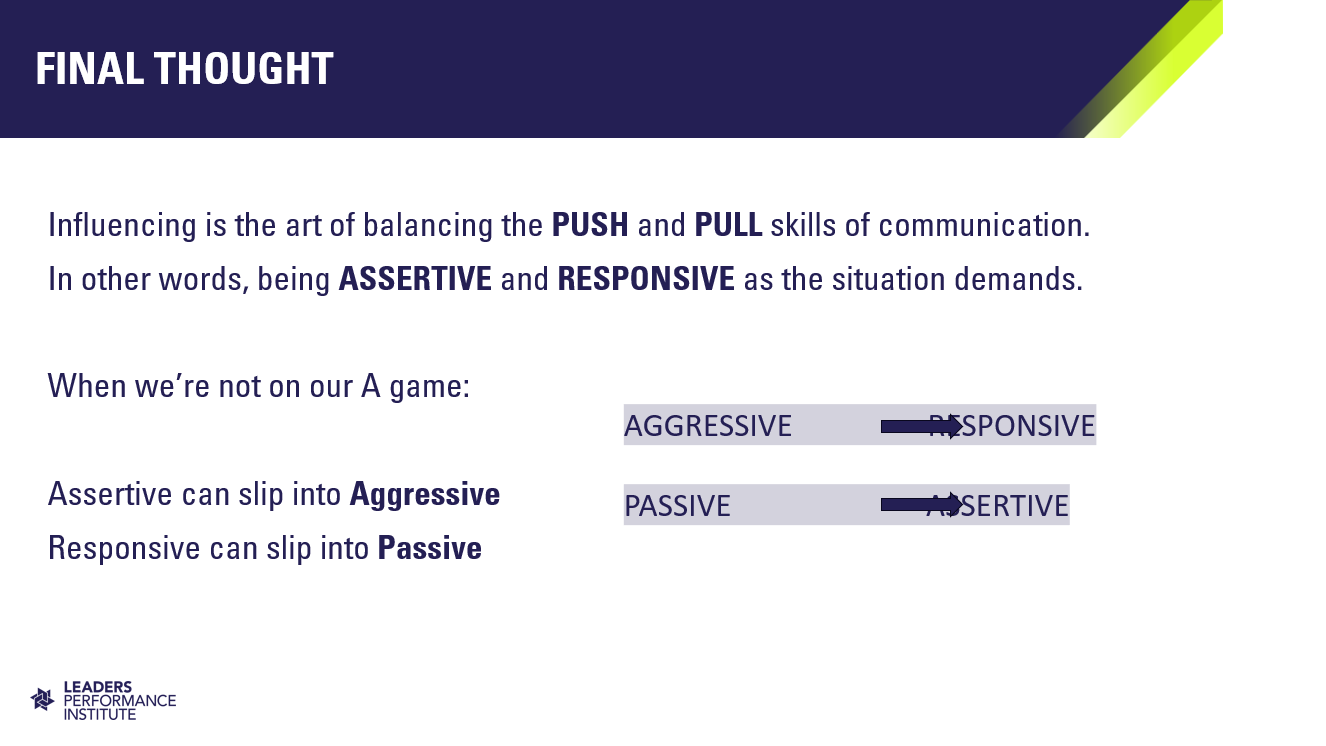
“Effective influencing is our ability to balance those push and pull skills,” he said.

“The ‘push’ would be that flow of logic. When you’re a subject matter expert and you’re trying to communicate your point of view in a way that moves the other to take a recommended course of action, those pull skills [build] that trust equation, the active listening, and it’s good to reflect where we need to focus more.

“Often, ‘push’ comes more naturally for people, and when we’re not on our A game, those of us who have a propensity to be more responsive can slip into passive; and those of us who are more assertive can slip into aggressive.”

Aggressive: go to responsive. Passive: go to assertive. And make sure you’re constantly aware of those push-pull dynamics.

What to read next

The Winning Formula for the Future of Performance Sport

8 May 2025

Articles

Female Leaders in Sport: Unheard Voices and Untold Stories

Category
Coaching & Development, Leadership & Culture
Share
Facebook Twitter Email Copy Link
https://leadersinsport.com/performance-institute/articles/female-leaders-in-sport-unheard-voices-and-untold-stories/

Former netball player Vicki Wilson describes her journey from the court to coaching, high performance and sports administration and offers advice to aspiring female athletes.

By Rachel Woodland
The Women in High Performance Sport Community group aims to provide space to women in the sporting world to tell their stories and to shine a spotlight on some excellent people and their work.

In April, Vicki Wilson, Director at the Brisbane Broncos, joined our group call. Women coaches and practitioners from across the globe gathered to listen to Wilson tell the story of her journey from athlete, to coach, to high performance manager, and now a member of the board of directors at the Broncos. Hers is a story we wanted to share more of and to learn from.

What has propelled Wilson’s career?

From Wilson’s perspective, she believes she has an eye for detail and an ability to plan, whilst wanting the best for athletes. She enjoys imparting knowledge, as well as gathering knowledge to extend her perspectives. She has also always been determined to be better. Having been an international athlete herself, Wilson can also lean on those experiences to guide her work. She’s also adaptable and, since her days playing netball, has always asked questions and seeks to understand ‘why’.

A key lesson was when she was dropped at an early stage in her playing career. It came just as she thought she would be made captain. The lesson she took was to never take anything for granted. This has resonated with Wilson every time she has applied for a role since. It also means she will quickly move on to the next challenge.

What drives success?

To help people succeed Wilson shared some tips:

  1. Your high performance manager and administration team will make you or break you. So pick wisely – always look at who is running the show.
  2. Surround yourself with support – informal mentors, peers etc. and treat them well.
  3. Always have people smarter than you on your team – then let them use their expertise, whilst asking them ‘why?’ too.
  4. Don’t over-commit. Give yourself time to switch off.
  5. Ask questions of people around you e.g. what would they do? How would they find that?
  6. Add perspectives to the pool that you draw on. Change your own if needed.
  7. Share your own learnings with others.
  8. Recognise good work. Celebrate success.

Support your high performance managers

Contrary to instinct, Wilson believes sitting with high performance managers and helping them with their planning is critical. Many will have come from a coaching background and might not know the role fully. It shouldn’t be assumed that they know what’s expected and what needs to be done. Expectations need to be shared clearly before a season starts. It’s about shaping this support around learning, and being their ally and not wanting them to fail, rather than trying to catch them out and needing them to show they know everything already. It really is about eliminating all assumptions.

Wilson’s inspiration

Wilson wanted to mention the women head coaches who were part of the original Australian Institute of Sport. There weren’t many, and they experienced difficult moments. However, they paved the way for others by challenging and contributing when in shared spaces between sports. They were avid readers and learners, many working in academia. They also showed that women coaches can be as successful as men. Wilson has been inspired in particular by Wilma Shakespeare, who was an international athlete, captain, coach, administrator, Queensland Academy of Sport CEO, and eventually travelled to the UK to be the founder and first National Director of the English Institute of Sport [now UK Sports Institute] in 2002. It is Shakespeare that inspired Wilson to explore administrative roles.

Thinking of joining a board of directors?

Wilson spoke about her advice for those who are interested in joining a board. She recommends sitting with someone who has done the role. This will help you fully understand what’s expected, and what’s your purpose in that role. From her experience, it’s about challenging management; making sure they’re doing what they said they would and asking them if it could be done better. It’s also about managing staff and athletes, and getting to know everyone in an organisation at a personal level.

Wilson fielded questions from the group too. They asked about:

Her challenges along the way

Wilson was open enough to share where some of the biggest challenges have laid – fortunately our previous community call attests to changes in ways of working. It has happened that athletes who are closing in on retirement have wanted the decision to be made for them. As you can imagine, that hasn’t made it easier for them to accept said decision. Wilson has also learnt the importance of an administrative team who are supportive and aligned to your values, having lost a role, alongside others, when strong decisions were needed. She is also grateful for the work done by many to have changed the way athlete pregnancy is treated.

Planning for the logistical realities

It’s not always spoke about, but coaches and other staff will make decisions, and have decisions made for them that can leave them unsure of their future and exposed financially. Wilson shared that she has found that when it mattered, things gained positive momentum quickly for her. Small contracts came in, moves to different countries weren’t as terrible as feared. She learnt to be open and once she’d accepted something be all in. Wilson has learnt to not panic, and importantly, to back her own skillset. It helps that she has a positive mindset, and that she’s always been a naturally good connector.

The group reflected on…

1. What their organisations are doing to support them. Answers included:

  • Encouraging them to attend conferences
  • Connecting across sports and organisations
  • Finding the right level challenge – frame it as a positive, even when difficult
  • AIS Women in Leadership Programme Talent Programme (for women executives)
  • WhatsApp groups that support programmes like the one above well beyond their official run dates

2. What they would like to see in a dream world:

  • The head coach, high performance manager, and CEO are connected and aligned to others, and know the value of each other’s skillsets (as well as those of the other staff members)
  • Time protected for CPD
  • Specific roles in projects, to support specific development goals
  • Space to get things wrong and test learnings – for failure to be okay
  • More space given to knowing yourself, as early as possible in your career

3. How they’re supporting others:

  • Through mentoring
  • Supporting and connecting with staff, athletes, and administrators
  • Encouraging people to understand themselves, to know how to work with others
  • Giving people the same time that was given to them, to support them in their careers
  • Celebrating the successes

4. Resources recommended for learning outside of sport:

  • Acting courses
  • Spotlight – profiling from Mindflick
  • Skill development delivered through a different lens:
    • Negotiation skills – from a lawyer
    • Difficult conversations – from the emergency services
    • Leadership skills – from a generic or business perspective

What to read next

The Winning Formula for the Future of Performance Sport

6 May 2025

Articles

The Debrief – a Snapshot of Powerful Discussions Happening Right Now Across the Leaders Performance Institute

Category
Coaching & Development, Human Performance, Leadership & Culture
Share
Facebook Twitter Email Copy Link
https://leadersinsport.com/performance-institute/articles/the-debrief-a-snapshot-of-powerful-discussions-happening-right-now-across-the-leaders-performance-institute-14/

This month we alight upon talent development, courageous conversations, and career pathways for women athletes.

By John Portch
There is only one place to start this month.

The Leaders Performance Institute trend report is available to download.

The Winning Formula for the Future of Performance Sport sets out the trends that are shaping the sports performance landscape.

Over the course of several months, we asked performance leaders and practitioners far and wide to complete an unprecedented survey of the high-performance landscape. More than 200 individuals from nearly 40 sports shared their views on a range of topics from leadership and culture to coaching and human performance.

Providing you with expert analysis into the current and future state of high performance, this report sheds a light on the high-performance conversations that are happening today, that will shape the sport world of tomorrow – helping you to stay ahead of the performance curve.

Download it here.

Right, let’s dig into April happenings here at the Leaders Performance Institute.

The four phases of talent development decoded

The Royal College of Music provided a fitting venue for Leaders Meet: The Talent Journey.

More than 120 members of the Leaders Performance Institute gathered to hear insights from Bundesliga champions Bayern Munich, the Premier League’s Brentford, the Royal Academy of Dance, and F1 talent developers More than Equal.

The focus were the four phases of talent development:

  1. Talent identification and profiling
  2. Preparation and holistic development
  3. Transitions and moments
  4. Continuous improvement

Stephen Torpey, the Academy Director at Brentford, spoke to the second. He explained that Brentford have been innovative in their efforts to compete with better-funded, more renowned academies.

Theirs is a ‘less is more’ approach. Torpey explained that the academy has:

  • Reduced the number of age groups from ten to six. Brentford have merged their under-9s and under-10s; the under-11s, 12s, 13, and 14s compete as one, as do the under-15s and under-16s.
  • Reframed the club’s approach to bio banding. “We don’t say ‘play up’ or ‘down’ because there’s either a negative or positive connotation to that. We talk about playing across,” said Torpey.
  • Reduced the number of players by 40 per cent. Crucially, they haven’t reduced the number of coaches. “Our aim is to work on a one-to-five ratio. We believe that by working in the same way as an independent school with low player-to-staff ratios with high-level people, then we’re going to accelerate the development.”
  • Argued that ‘less is more’ should lead to stretch not stress. “We’re looking at the right experiences, the right challenge, and we don’t want stretch to become stress.”

Read more here.

We can all have ‘courageous conversations’

Courageous conversations came up in the trend report so it was only fair that we dedicated a Leadership Skills Series session to the topic.

There are five key skills to enable your preparation, delivery and summary of a courageous conversation.

  1. Check your assumptions: we make up a lot of stuff about people. We imagine what’s going on in people’s lives, what they think about us, what their motives are. We imagine what they’re going to say in that conversation and how they’re going to react. And then we work our responses around that where we can tie ourselves up in knots, and we’re having a conversation in our heads rather than what’s truly happening. So strip out your assumptions.
  2. Have a clear outcome: declutter the nonsense. What is the outcome that you want to have and what is a good outcome for this conversation? This will help you get an actionable insight.
  3. Manage your body language and tone: so many of us are so busy that we just leak out impatient, stressed and busy signals. Nonverbally, we’re sending out some different signs, so it is important to be present, be composed and give high quality attention. What we don’t want to be doing is to be half in a conversation and half out as people pick up on it. Giving someone your full attention is a gift, and they will feel it, and they will trust you.
  4. Maintain a two-way dialogue: difficult conversations should be two-way. What are your thoughts? This is how I feel. How do you feel? This is what I would like to happen in the future. What are you going to do? What help do you want? Make sure you’re really using your active, listening and really great, powerful, open questions as well.
  5. Agree specific next steps: what are you going to do differently? How are you going to make sure it happens? What support do you need and make sure that it’s specific? Get right down into detail with the actionable insights.

Read more here.

Successful career transitions for women in sport

The first Women in High Performance Sport group call of the year spotlighted three former athletes who have gone on to further build a career in sport.

They were former GB hockey players in Giselle Ansley, a Senior Account Executive with Specialist Sports, and Emily Defroand, the Football Communications Lead at West Ham United.

Joining them in conversation was Women’s Rugby World Cup winner Emma Mitchell, who recently left her position as a Performance Lifestyle Advisor at the UK Sports Institute and who worked directly with the duo during their playing careers.

Over the course of an hour they illustrated the importance of:

  • Support systems: Mitchell, who in her role as a performance lifestyle advisor essentially became a role model to these younger women, was able to support the pair at every turn.
  • Personalised approach: Mitchell worked to understand their individual journeys and provided tailored support. She emphasised the importance of planning early and managing transitions effectively.
  • Transferable skills: athletes will possess valuable skills learned through sport, such as discipline, teamwork, and leadership. All are transferable in careers beyond.
  • Cultural impact: having a performance lifestyle advisor deliver emotional and psychological support helped Defroand and Ansley to better manage their stress and uncertainly, which in turn positively impacted their performance on the field. Moreover, by ensuring athletes were well-prepared for their post-sports careers, Mitchell contributed to the long-term success and stability of the team, as athletes were more likely to remain engaged and motivated during their sporting careers.

Read more here.

And don’t forget to read…

The Winning Formula for the Future of Performance Sport

Go to home
Follow us on Instagram Follow us on LinkedIn Follow us on X

Contact

Leaders UK

Tuition House
27-37 St George's Road
Wimbledon
SW19 4EU
London
United Kingdom

Enquiries Line: +44 (0)207 806 9817
Switchboard Number: +44 (0)207 042 8666

Leaders US

120 W Morehead St # 400
Charlotte
NC 28202
United States

Enquiries Line: +1 646 350 0449

Leaders

  • Contact
  • About
  • Careers
  • News
  • Privacy Policy
  • CA Privacy Rights
  • Cookie Notice
  • Website Terms of Use

Performance Institute

  • Membership
  • Events
  • Content
  • Virtual Learning
  • Connections
  • Partners

Latest

Intelligence Hub
High Performance Future Trends Research Elite Performance Partners continue to drive the potential in high performance forward through renewed Leaders partnership
Your Privacy Choices

© 2026 Leaders. All rights reserved

  • Privacy Policy

Attendees

x