Leaders in Business
  • Membership
  • Events
  • Content
  • Virtual Learning
  • Connections
  • Partners
Login
  • Leaders Meet: Innovation
  • Events
    • Leaders Week London
    • Leaders Sports Awards
    • Leaders Club Events
    • Leaders Performance Institute Events
    • Leaders Meet: Innovation
  • Memberships
    • The Leaders Club
    • Leaders Performance Institute
  • About
    • Careers
    • Contact
I’m a sports leader:
  • Off The Field For those focused on the business of the sport View more
  • On The Field For those working with an athlete or elite team View more
  • Login
    • Leaders ClubThe membership for future sport business leaders
    • Leaders Performance InstituteThe membership for elite performance practitioners
  • Newsletters
Performance Institute Leaders Performance Institute Logo
  • Membership
  • Events
  • Content
  • Virtual Learning
  • Connections
  • Partners
Login
Members Only

18 Sep 2024

Articles

A Case Study in Change Management: ‘We showed them the numbers and it hit them between the eyes’

Category
Leadership & Culture, Premium
Share
Facebook Twitter Email Copy Link
https://leadersinsport.com/performance-institute/articles/a-case-study-in-change-management-we-showed-them-the-numbers-and-it-hit-them-between-the-eyes/

As Head Coach of the Australia Women’s cricket team, Shelley Nitschke was tasked with changing a winning side. She did so in four steps.

By John Portch
When Australia retained the Women’s Ashes in the English summer of 2023, there were mixed feelings for future captain Alyssa Healy.

“It feels a bit dirty in a way, but we got the result we were after,” said Healy in the aftermath. “I think the gap’s not necessarily been there as much as everyone has spoke about.”

There was a sense amongst Australia’s players that their success owed to a quirk in the format. Yes, they had won the series’ only Test match, but they had lost both limited-overs series 2-1 to England. Nevertheless, the scoring system was weighted in favour of the Test and, at the series’ conclusion, the teams were tied on eight points each, which meant Australia retained the Ashes as holders.

It was not the type of emphatic victory to which Australia and their Head Coach Shelley Nitschke had become accustomed. After years of blazing a trail and lifting trophies galore, Australia’s rivals were beginning to bridge the gap.

“There were just a few signs along the way that the game was changing and other teams were getting close to us,” Nitschke told an audience at February’s Leaders Sport Performance Summit at Melbourne’s Glasshouse.

She also spoke of her team’s resilient but laboured performances in their 2022 Commonwealth Games semi-final and final. Those matches against South Africa and India, respectively, could have gone the other way were it not for decisive moments of inspiration from Australia’s serial winners.

“We were finding ourselves in those positions more often than I would have liked,” Nitschke continued.

She had led Australia into the Commonwealths as Interim Head Coach and was appointed on a permanent basis after the competition. For all the planning that went into retaining the Ashes, the drawn series rang alarm bells in Nitschke’s mind, and the post-tour debrief was not going to her liking.

“We were happy to bring the Ashes home, but we knew there was work to do heading into the T20 World Cup [taking place in the UAE in October] and the discussions just weren’t moving the dials as much as I was hoping.”

Nitschke responded by pushing for change and her efforts have so far been vindicated by Australia’s subsequent results. The holders enter the World T20 as the favourites to defend their title.

Here, we explore the four steps Nitschke has taken to keep Australia ahead of the chasing pack.

1. She found the reason for change

Nitschke had noted Australia’s opponents’ increased aggression and strategic use of powerplays [ten-over spells in an innings where the fielding team is restricted in the number of players they can place outside of a 30-yard circle around the batting team’s wicket]. Without adaptation, Australia’s approach would not cut it at the highest level for much longer. “I went to the analysts and started to crunch the numbers and have a look at what other teams were doing and where we fared in regards to the rest of the world,” said Nitschke. “We like to think that we would have been ahead of the game, particularly around powerplays, but there were certain parts of the game where we just weren’t.” It led to a fresh set of winning measurements and KPIs; and Nitschke had her vision for change.

2. Then she found the right words

It would not be what Nitschke said but how she said it. As she prepared her pitch for change she first presented to her Team Psychologist Peter Clarke, a popular figure within the playing group. Nitschke said: “He was really useful in recommending the language to use; saying ‘don’t dumb it down and ‘don’t say it’s not a huge challenge’ or ‘just a few tweaks’.” Clarke guided Nitschke in her use of words and reassured her that in several key elements, such as assessment, stakeholder analysis and change strategy, she and Australia had already made a start. Armed with the right delivery, Nitschke could begin to instil the team’s revamped style and strategy.

3. She asked for input

After the initial pitch, Nitschke would deliver a data-informed dossier to every player during Australia’s October 2023 series with the West Indies. The coaches had already decided it was not the moment to implement wholesale change. “We contacted them and just let it stick with them for a while – it probably would have hit a few between the eyes.” It was a frank admission and not without risks. The trick was to ask each player for their opinion. “It led to some really good suggestions,” said Nitschke, who also consulted her staff, several of whom chipped in with ideas from beyond cricket.

4. She identified her change agent

When leading a transition, you need influential people to have your back when enduring setbacks. “We’ve lost a few games we ordinarily may have won,” said Nitschke, who was keen to take advantage of the relatively low stakes series following the Ashes. She would lean heavily on Alyssa Healy, who was appointed Australia captain in December 2023. “Alyssa was involved from the start in driving [the change] through the playing group.” Nitschke would need to call upon every bond of trust developed between the duo in their six years working together. She continued: “There were some senior players that were probably challenged a little bit through being asked to play a little differently than what they had been for the last few years, even though they’d been successful. It could have gone in a completely different direction because if we didn’t have buy-in from the captain then we probably weren’t going to get buy-in from the rest of the team.”

Members Only

11 Sep 2024

Articles

Debriefs and Accelerated Learning: Transferable Lessons from the World of Medicine – Part II

Category
Coaching & Development, Premium
Share
Facebook Twitter Email Copy Link
https://leadersinsport.com/performance-institute/articles/debriefs-and-accelerated-learning-transferable-lessons-from-the-world-of-medicine-part-ii/

In the second of a two-part series, Sonal Arora, an experienced surgeon, outlines how teams can do more to help their athletes as learners.

By John Portch
“What is the difference between feedback and debriefing?”

Sonal Arora, a Consultant Emergency Surgeon with the Chelsea & Westminster NHS Trust in London, posed the question to an audience at last year’s Leaders Sport Performance Summit.

“Feedback is when I am telling you what you should do,” she said following a pause. “Debriefing is a two-way process.”

Over the course of 30 minutes onstage, Arora laid out how, in a joint research project, Imperial College and its peers working in operating theatres across the United States and Australia alighted on better feedback and debriefing as the solution to improved learning and performance.

She spoke about the OSAD [Objective Structured Assessment Tool for Debriefing] and how coaches in sport might learn from the way debriefs are conducted post-surgery.

“The real secret is to try and get [the learner] to identify what their performance gaps are and how they feel, or how the team feel, they can work better to improve it for next time,” Arora continued.

“Your role as a facilitator is to wrap all of this up at the end and determine how they are going to take what they’ve learned from this session and apply it to their future practice.”

“Now let’s come back to the real world.”

OSAD, she admitted, is too detailed for working surgeons who need something accessible and appealing if they are going to open themselves up to a debrief during a busy and often chaotic day.

“How can we take those lessons [from OSAD] and translate them into something short and simple that anybody can understand?”

Arora and her peers settled upon the SHARP tool.

What is SHARP?

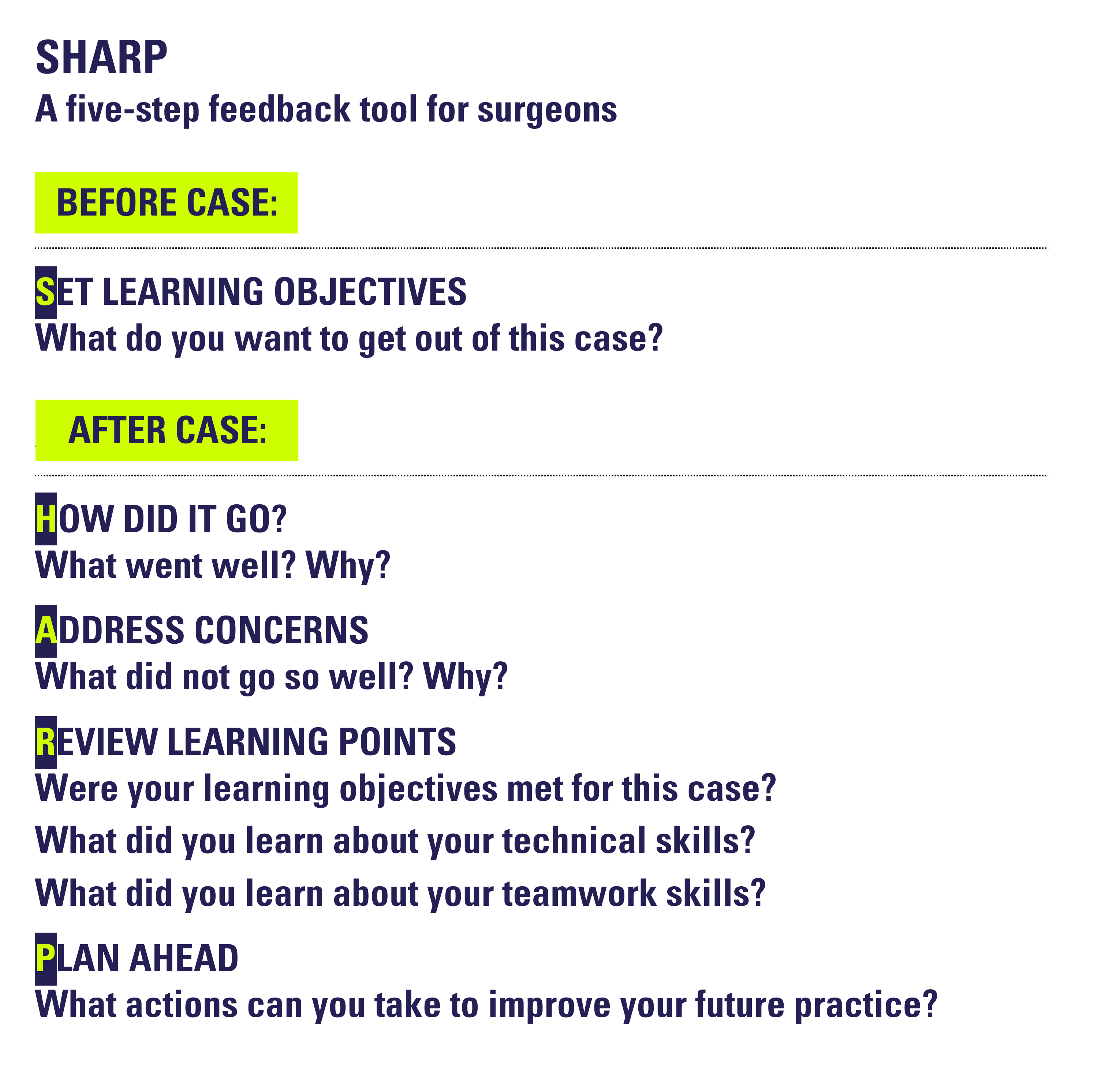
SHARP was first use in 2013 and remains popular in surgical settings; there are written and verbal elements. The acronym stands for:

S – Set learning objectives

H – How did it go?

A – Address concerns

R – Review learning points

P – Plan ahead

Why is SHARP effective?

It’s quick. “It takes two minutes; so it really stops that ‘I don’t have time for this’,” said Arora, mindful that athletes and coaches are often time-poor. “We looked at feedback, debriefing and performance for cases before we introduced SHARP as a baseline; then we measured all of those outcomes afterwards. What we found was that feedback significantly increased, much more feedback was provided, learning objectives were set, but also the quality of debriefing significantly improved.”

Here is a typical structured assessment using SHARP:
How does SHARP differ from standard feedback?

As Arora said, feedback is too often a one-way street. “We could see beforehand if there was feedback, it was just ‘yes, that’s great’ or ‘no, we should have done this’ or ‘next time, just do it’,” she said. “It was very didactic, very unidimensional, very much one person or 10 dressing down another.”

SHARP encourages learner engagement. “It was much more, ‘what do you want to take away from this?’ And afterwards it’s ‘OK, you did this bit very well. It was a difficult case, but next time try and make a better use of your assistants’.”

There is an element of feedback but “you can pick up what’s important to them, not what I think they didn’t do right.”

Doesn’t surgery use ‘hot debriefs’?

Yes, usually at the end of the day. There will also be a hot debrief within 15 minutes of a catastrophic or fatal event. “If it’s so awful that the patient dies on the table unexpectedly, the rest of the list is cancelled because nobody in the team is in the right frame of mind; it’s not fair and it’s not safe to operate on people when you are thinking about what’s gone on,” said Arora.

In such scenarios, a SHARP debrief is held seven days later. “That’s critical following a terminal event.”

Members Only

5 Sep 2024

Articles

Debriefs and Accelerated Learning: Transferable Lessons from the World of Medicine – Part I

Category
Coaching & Development, Leadership & Culture, Premium
Share
Facebook Twitter Email Copy Link
https://leadersinsport.com/performance-institute/articles/debriefs-and-accelerated-learning-transferable-lessons-from-the-world-of-medicine-part-i/

In the first of a two-part series, Sonal Arora, an experienced surgeon, outlines how any coach can become a better facilitator.

By John Portch
Sonal Arora’s description of an operating theatre during surgery is, frankly, alarming.

“You would think that the environment in which we do this is very contained, very prescriptive, nice and quiet; that you’re allowed to get on with it and everything works,” she said. “Unfortunately, that’s not the case.”

Arora is a Consultant Emergency Surgeon with the Chelsea & Westminster NHS Trust in London. She told an audience at last November’s Leaders Sport Performance Summit at the Kia Oval that the picture can be particularly bad during emergency procedures.

“Lots of research looking into stress in surgery has shown that things break down in almost all cases,” she continued. “We have the door to the operating theatre opening and closing every other minute. You are trying to do this difficult procedure. The patient is bleeding. The anaesthetic machine is beeping and somebody is just coming in and out talking about whatever it is that they want to talk about. The noise can be so loud it’s almost as much as a motorway. So it’s not that sterile setting that you would think.”

Inevitably, as Arora explained, this has consequences. “One in ten patients who come into our hospital will suffer from iatrogenic harm – that means harm due to the healthcare that they are receiving, not the pathology.” In some cases, iatrogenic harm can be fatal.

Despite improved simulation tools, the situation persists. “We thought: how can we accelerate this learning? How can we get people to perform better, faster, safer in a way that would take little resource and maximise what we were already doing?”

Over the course of 30 minutes, Arora laid out how, in a joint research project, Imperial College and its peers working in operating theatres across the United States and Australia alighted on better feedback and debriefing as the solution to improved learning and performance.

Here, the Leaders Performance Institute returns to her presentation in a two-part feature. In part one, we set out how Imperial’s OSAD [Objective Structured Assessment Tool for Debriefing] can assist those individuals responsible for facilitating post-performance reviews.

In part two, we will shift the focus to Imperial’s SHARP [Structured, Healthcare, Assessment, Review, and Performance] tool, which is more geared towards the learners themselves.

‘Why not optimise learning that’s already happened?’

As mentioned above, Imperial settled upon revamping its approach to feedback and debriefing. “Why not optimise the learning that has already happened?” said Arora. “We had the perfect setup; we had all the recordings, we used to video everybody’s performance and simulation, but we were doing nothing with these videos. People would just turn up, have their simulation, a quick chat. ‘How was it?’ ‘Alright.’ ‘Great. See you next time.’ Ad infinitum.

“So we all know that debriefing is crucial; we know it’s part of the learning process; we know that it’s a way of reflecting upon performance.”

Yet it is too readily dismissed as a soft skill. “We look so carefully at our performance in so many different domains, but nobody’s looking at how well we are performing in giving effective feedback; and the idea was that if we can improve the quality of our feedback, we could improve performance.”

The process also needs to be embedded. “People need ring-fenced time for this. It can’t just be an add-on that somebody is doing well, other people are doing it off the cuff at the end of the game, at the end of an operation, at the end of the week. It needs to be given the time and the importance, and that comes from the top down.”

OSAD: the Objective Structured Assessment Tool for Debriefing

In 2012, Arora was part of a team that developed the OSAD tool. It was designed to improve debriefing practices in surgery and other areas of healthcare by providing a structured, evidence-based approach to evaluating the quality of debriefings.

To this day, it remains a useful tool. “The real secret is to try and get [the learner] to identify what their performance gaps are and how they feel, or how the team feel, they can work better to improve it for next time,” said Arora. “Your role as a facilitator is to wrap all of this up at the end and determine how they are going to take what they’ve learned from this session and apply it to their future practice.”

OSAD, which is based on eight elements enables people to reflect on their own debriefing practice and train others to more effectively deliver feedback. Those elements are:

  1. Approach: The method and style used to conduct the debriefing.
  2. Learning environment: The setting and atmosphere that facilitates learning.
  3. Learner engagement: The involvement and participation of learners in the debriefing process.
  4. Reaction: The immediate responses and feedback from learners.
  5. Reflection: Encouraging learners to think critically about their performance.
  6. Analysis: Breaking down the events and actions to understand what happened and why.
  7. Diagnosis: Identifying the strengths and areas for improvement.
  8. Application: Applying the lessons learned to future practice.

Facilitators are invited to score themselves on a scale of one (poor) to five (very good) on each of those elements.

Using OSAD, Arora explored each element in setting out the characteristics of an effective debrief:
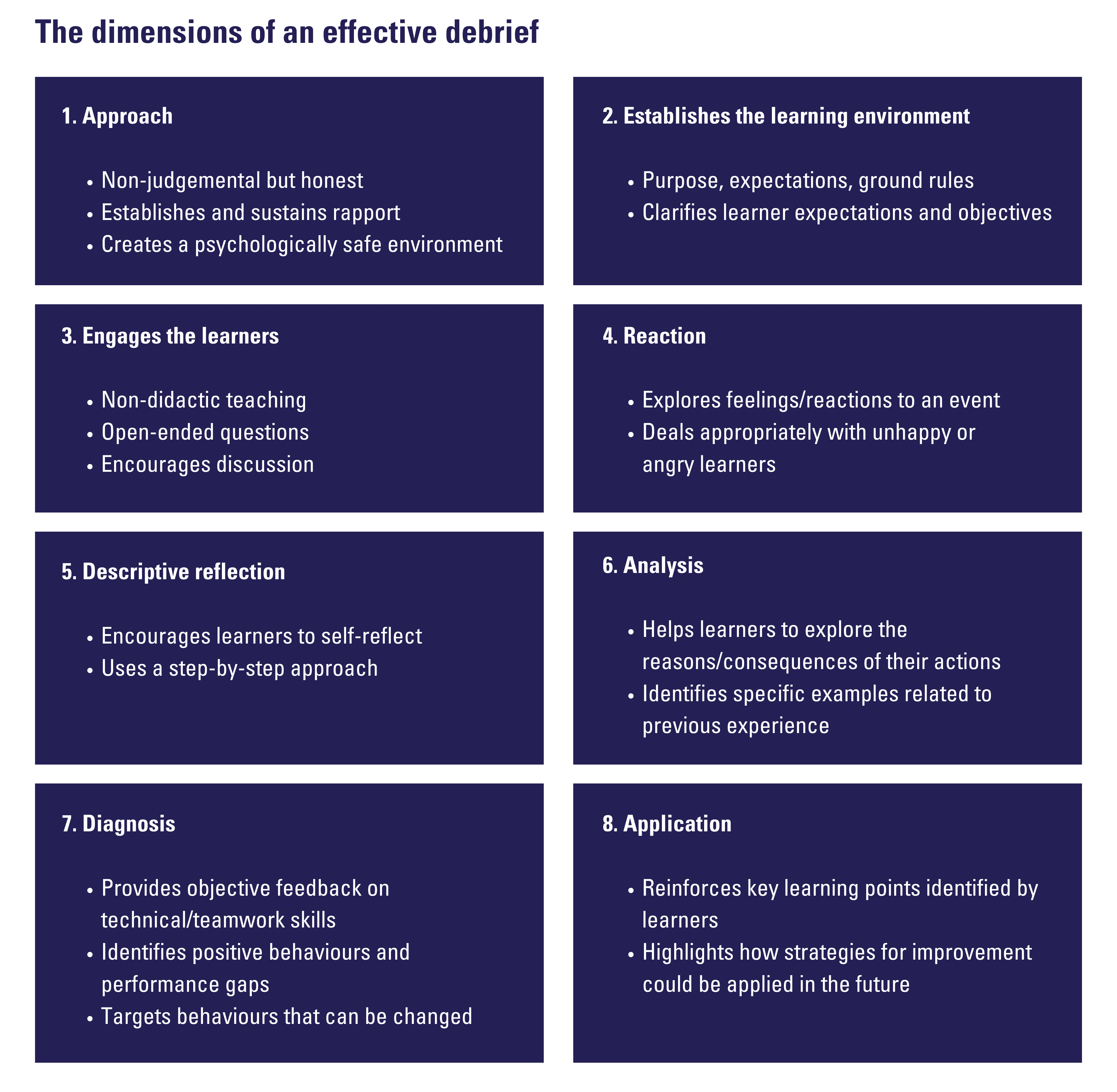
OSAD can be used and adapted as required, whether you are new to the space or a seasoned debriefer. It has proven to be a game-changer, but it is not perfect. Not if you’re a learner anyway.

“If we tried to give that eight-thing item with lots of small writing to our surgeons who are in the middle of life-saving surgery, they’re going to tell you to get lost,” said Arora.

“How can we take those lessons and translate it into something really short, really simple that anybody can understand?”

In part two, we explore how Imperial answered that question through the development of its SHARP tool.

Members Only

1 Aug 2024

Articles

Why ‘Marginal Gains’ Came at a Cost for British Cycling

Category
Coaching & Development, Leadership & Culture, Premium
Share
Facebook Twitter Email Copy Link
https://leadersinsport.com/performance-institute/articles/why-marginal-gains-came-at-a-cost-for-gb-cycling/

Head Coach Jon Norfolk reveals why performance planning was perceived as the programme’s true competitive advantage going into the 2024 Games and beyond.

By John Portch
Since Beijing in 2008, British Cycling has topped the medals table in cycling at each subsequent Summer Olympics and Paralympics.

The ‘marginal gains’ philosophy of Sir Dave Brailsford, who served as British Cycling’s Performance Director between 2003 and 2014, was at the heart of this success throughout.

It was Brailsford’s “daily bread” said Jon Norfolk, the Head Coach at British Cycling, at last year’s Leaders Sport Performance Summit in London.

British Cycling, long after Brailsford had departed, continued to focus on maximising the one percenters – and it worked.

“These were really exciting times for the organisation,” Norfolk continued. “We were quick, we were agile, we were really detailed.” There was, however, a price to pay.

“I think I’m going to call it a ‘cost’. I think a cost of that agility and that speed was that we were moving very quickly. I’m not sure at each point we understood genuinely what created that performance.”

By January 2020, Norfolk and his colleagues had identified that cost and decided that the solution lay in better performance planning. They hoped to implement a change in emphasis after the Tokyo Games but, when the worsening pandemic caused their postponement in March 2020, they could begin that process earlier than anticipated.

Here, we explore British Cycling’s motivations and their rationale for ripping up a way of operating that was working – and still worked – in favour of a new approach weighted in favour of collaborative performance planning.

What was wrong with the ‘marginal gains’ philosophy?

Three factors rendered the philosophy unfit for purpose, even as the team continued to be successful:

  1. British Cycling was so focused on the one-percenters that it couldn’t fully account for the performance of its riders.
  2. The International Cycling Union [UCI] shifted its Olympic programme away from straight-line to more volatile competitions, with fewer of the ‘controllables’ beloved of GB Cycling.
  3. The team was forced by an UCI law (introduced in 2023) that declared any equipment used in competition must be commercially available. The secrets born from marginal gains had to be shared with Great Britain’s competitors.

Why was performance planning British Cycling’s first port of call?

An internal audit revealed an inconsistent approach to planning across its numerous disciplines that too often did not harness the talent in the building. Some performance plans were good but too often people had little scope for influencing a rider’s plan because it was too protected. Sometimes the plans were downright unclear. “People were struggling to get their handprints on the plan, to make an impact, to improve the plan,” said Norfolk.

What needed to change?

A good performance plan will tell an athlete where they’re going and how to get there; coaches will use that plan to stretch their athletes and be bold in their approach; and, if the plan is clear, leaders will be able to ask how the plan is tracking and where they can support the athlete and the coach. If British Cycling gets that right then the sky’s the limit. Said Norfolk: “I want an environment where coaches can leverage their plan, stretch athletes, and aim for things they may not be able to reach; but as a consequence, we’ll get a lot further because we’ve set clear, brave and long-term targets.”

Was there any resistance?

Plenty. “It’s a really tricky thing to encourage someone to let go of something which has worked,” said Norfolk. Some coaches carried the plan in their head and found it difficult to communicate their thoughts to a multidisciplinary team; others felt threatened and exposed when laying a plan out on the table for others to check and challenge. For some coaches, it was, as Norfolk explained, a “stick”. On top of that, he explained that some environments, such as BMX, were seen as “plan-resistant” given their “free-form”, “pack-like” approach to performance. Any approach would need to consider the environment as well as the demands of the discipline.

What was the answer?

Turn that stick into a carrot. British Cycling chose to encourage performance plans that actively separate the coach from the performance outcome. It made sense. “We’ve all been in a spot where we’ve seen great coaching but the athlete hasn’t performed for a particular reason; and we’ve also seen athletes perform and it’s not really due to the coach,” said Norfolk.

If the coach is armed with a well-considered, clear and powerful plan, it will amplify their coaching. It also makes things easier on the senior management at British Cycling, who are juggling multiple individual performance plans at any given time. “The clearer your plan is, the more people can access it, the more people understand it, and the more people you’ll have back your plan.” It’s also a useful way of removing the biases of an individual in pursuit of a more compelling proposition. “When we’ve got 20 plans in front of us, we’ll back the clearest plan with resource and time.”

Have there been positive outcomes so far?

The proof will be in the pudding in Paris, but Norfolk cited some initial successes, including the greater clarity enjoyed by the British Cycling leadership team and coaches freely admitting to missteps in management meetings. Norfolk and his colleagues can now watch events and the planning is evident in the execution. “It’s not perfect, we’re not finished,” he said, “but it’s exciting because we’re learning, stretching and growing and we’ve got a systematic path towards great performance.”

17 Jul 2024

Articles

How Sport Wales Is Challenging the Lack of Support and Education Around Female Athlete Health

Category
Human Performance, Leadership & Culture
Share
Facebook Twitter Email Copy Link
https://leadersinsport.com/performance-institute/articles/how-sport-wales-is-challenging-the-lack-of-support-and-education-around-female-athlete-health/

As Dr Natalie Brown tells us, Sport Wales’ Female Health and Performance Team is putting the female athlete health at the forefront of performance conversations.

By Rachel Woodland, Lottie Wright & Sarah Evans
There needs to be more support for practitioners, coaches and others working in sport when it comes to better understanding women’s health.

That is the consensus across our Women’s High Performance Sport Community, from ongoing conversations to a recent mini survey conducted during our latest Community call, where the focus turned to education for staff.

We were joined by Dr Natalie Brown who is a Research Fellow working as part of a collaboration between Sport Wales and Swansea University with the Welsh Institute of Performance Science [WIPS].

Brown leads the Sport Wales Female Health & Performance Team, which has grown to seven members and is responsible for supporting all staff at Sport Wales in their journeys towards better understanding women’s health.

Brown’s own reasons for her specialism in women’s health stem from her time as a performance scientist with Welsh and British Swimming. She wanted to know more about what she didn’t know and to support the female athletes as best as possible to optimise their performance. It was an early nod to the relevance and interconnectedness of women’s health for practitioners.

Support for female athlete health at Sport Wales

In Brown’s time, Sport Wales’ approach to female athlete support has progressed from being wrapped around individuals to three areas of focus:

  1. System level support
  2. Individual athlete support (and support for practitioners too)
  3. Sport-specific support

There are also three key themes that span everything Sport Wales do: athlete development, health & wellbeing, and athlete environment. Where once Brown worked alone, she now oversees a multidisciplinary team of seven, with specialisms in physiotherapy, physiology, medical, nutrition, strength & conditioning. The work has gone from focusing on the menstrual cycle to include puberty, relative energy deficiency and more to fully encompass female health support.

It is critical for those practitioners to be a good fit and Brown’s team was put together by grouping those who had an interest and the drive and motivation to work in this area of sport. Across the Welsh system, it enabled a network of voices to be created, rather than a single voice; making it more embedded and more natural.

The team work both in overseeing projects and research into specific areas of women’s health and in supporting the athletes, practitioners, coaches, and sports in applying knowledge to their performances. As Brown said, “we’ve got a knowledge development, but we’ve also got application and those two things run in parallel.”

Their efforts to speak to athletes help them to better understand areas where there was suitable support and where there was not. It enabled the sports science and medicine teams to adapt their athlete support. Concurrently, Brown and her colleagues captured all this information to help inform their progress.

Surveys to better understand ways of working

Seven years ago, Brown’s team circulated a survey for all of Sports Wales’s sports science practitioners. It asked:

  1. Did practitioners have conversations about the menstrual cycle in their sports, with their athletes, with the coaches?
  2. How confident are they talking about the topic?
  3. What is their knowledge level?

The survey was circulated at a time before women’s health proliferated as a topic of interest. It identified gaps, highlighted the steps needed to effect change, and what practitioners were requesting. And so the team came together that now works within Sport Wales.

Having a dedicated Female Health & Performance Team allows planning around how to move forward in support of both female athletes and performance practitioners; and as staff members have changed, so Sport Wales has continued to survey its people. They continually assess people’s comfort levels discussing multiple topics within female health and the factors that influence that comfort.

Brown was also particularly interested in whether or not practitioners know where to go to seek further support. The figures are startling. “20 percent still say no, which is too big,” said Brown. That 20 percent is therefore part of her team’s plan. All practitioners need to know that the Female Health & Performance Team is there to support them, and also direct them to other resources and, just as importantly, emphasise that the whole of a team behind a sport need to have this information shared with them.

A more recent survey enabled Sport Wales to better understand how it can support its system’s network of coaches and practitioners. Indeed, there is a growing cohort that see the relevance of a female health lens in addressing issues such as injury risk and performance improvements. This information has helped Brown’s team ask for additional resources and support. It also helps build the full story and picture.

The emergence of a common practice

Sport Wales conducted the survey, put together a team, worked across its sports, and what has emerged are common practices that help to embed female health as a topic within the Welsh sport system.

For example, as Brown said, “across the three themes [see above] there are always at least two people from the team asking how does that apply from a female perspective? Have we considered XYZ from a female-specific angle?”

The current approach is praised for creating an open culture. The Female Health & Performance Team have worked with the sports to normalise conversations around women’s health and how it relates to performance.

Potentially the most interesting piece to emerge from their most recent survey was around knowledge improvement and how the team want to receive information. The two highest reported options were athlete stories & experiences and resources to read. This has led to a shift in how Brown and the team are supporting practitioners and prevented them from heading down the wrong route. It also means that Sport Wales can also think about how to use the stories and experiences to support wider practitioner development. For example, what would it look like for a new starter?

It’s standard practice for all Sport Wales projects to be evaluated as they happen, which means that check-ins keep the team challenged and relevant, as well as aligned to organisation’s wider aims. Their purpose and rationale remains clear.

Another positive consequence is that Welsh sports proactively approach Brown and her team to request help and support. There’s also now an induction for any athlete joining Great Britain’s World Class Programme. It looks across all areas of female health and includes screening from an MDT approach, which then means specific areas can be addressed for the individual, as well as from the perspective of their sport. The overall goal is to ensure that female health considerations aren’t an extra thing or a tick-box exercise that’s added on but are standard, truly embedded and normal practice for providing individual holistic support.

Compared with how things were done previously, one of the biggest changes for Brown has been planning ahead and thinking about how you upskill practitioners and how to engage with sports, as well as identifying which elements are sport-specific and require different support or consideration; and how to provide those resources for athletes, coaches, and practitioners. This is all with the key moment in mind: ‘the doing of it’.

In monthly meetings Brown’s team create scenarios and engage the practitioners in conversations around topics such as energy deficiency or puberty. It provides the space to address meaningful questions as part of the conversation, such as ‘how does that apply in practice?’ or ‘what does that mean?’ This space has potentially been the most impactful development, according to Brown.

Beyond the work that she and her team are completing, they’re linking in with the other parts of the Welsh network across other universities supporting WIPS and Sport Wales, as well as the other Home Nations of the UK. “So in terms of staying ahead of the curve, it’s always a challenge, especially with the pace at which female sport is currently moving.”

How to make female health a performance priority at your team:

  • Invite people external from your female health and the performance team to come in and join the conversations, raising different questions.
  • Balance individual needs versus sport specific challenges with whole system support.
  • Specialist areas need to consider the female specifics as normal, for example nutrition is thought about with that lens too.
  • If you’re working as a lone ranger in this space, consider how things are being embedded, knowledge is being passed on, and progress to creating a team is happening.
  • Language is a really important area too. Don’t exclude anyone, but also correct. Underpinning language with evidence has been effective. Language can also be the key to confidence to talk about the topics and roll it out with athletes.
  • Consider behaviour changes and the role of psychology in female health.
  • Always provide the evidence of why behind knowledge, advice, support. Especially considering the volume of information, including misinformation, being shared around these topics at the moment.

10 Jun 2024

Podcasts

Five Years on from the USWNT Introducing Menstrual Cycle Tracking, Sports Science for Female Athletes Remains Under-Developed. So What Can Athletes and Practitioners Do about it?

Category
Data & Innovation, Human Performance
Share
Facebook Twitter Email Copy Link
https://leadersinsport.com/performance-institute/podcasts/five-years-on-from-the-uswnt-introducing-menstrual-cycle-tracking-sports-science-for-female-athletes-remains-under-developed-so-what-can-athletes-and-practitioners-do-about-it/

Ellie Maybury of Soccer Herformance discusses the obstacles that face females in high performance in the second episode of the latest People Behind the Tech series podcast. For all the issues, she remains optimistic about the steps that can be taken.

A Data & Innovation podcast brought to you in collaboration with

sport techie

When the US women’s national soccer team started tracking their menstrual cycles, it was seen as groundbreaking.

At least part of their success in claiming back to back World Cup titles in 2019 was attributed to the fact they could adjust individual training plans and nutrition based on the data.

Ellie Maybury was part of the USWNT backroom team that introduced this initiative and, more than half a decade on, tech support for female athletes doesn’t seem to have progressed as much as she’d have hoped. At least in soccer.

“A lot of the technology we have absorbed into the women’s game has come from the men’s game or men’s sports environments,” she tells the People Behind the Tech podcast.

“And maybe some of the processes and metrics that come with that get transferred as well.”

Maybury, who recently founded Soccer Herformance, a performance consultancy for female soccer players, is in the hotseat on episode two of this series.

She addressed the issues that hold back female high performance, from managing the lack of objective datapoints [4:50] and the importance of education for athletes who often misunderstand their own bodies through no fault of their own [26:20], to the need to take athletes on a journey while remaining honest about the limitations of research at the present time [17:00].

Check out episode one:

Paige Bueckers Proved Her ACL Injury Was Behind her at March Madness, but, as Andrea Hudy tells us, Questions Must Still Be Asked about the Injuries that Afflict Female Athletes

Joe Lemire LinkedIn | X

John Portch LinkedIn | X

Listen above and subscribe today on iTunes, Spotify, Stitcher and Overcast, or your chosen podcast platform.

Members Only

4 Jun 2024

Articles

How to Demonstrate an ROI on Mental Skills Work

Category
Coaching & Development, Human Performance, Premium
Share
Facebook Twitter Email Copy Link
https://leadersinsport.com/performance-institute/articles/how-to-demonstrate-an-roi-on-mental-skills-work/

What gets measured gets done, but charting the impact of mental skills has proven particularly tricky for teams across the world of sport.

A Human Performance article brought you by our Main Partners

By Luke Whitworth
In the modern landscape of high performance sport, we often here the phrase ‘everything that is managed is measured’.

Such is the desire to show impact and return on investment, we are indeed measuring much of what can be measured.

Nevertheless, it can be difficult to measure the impact of areas such as coach development work or, as discussed in a recent Virtual Roundtable for Leaders Performance Institute members, mental skills work.

A number of environments on the call were already in the process of measuring their mental skills work, some to a high success level, whereas others were closer to the start of their journey.

In any case, it is fair to say that there are no teams with all the answers, but here are some points to consider.

Measuring the success of your mental skills work

While it is easy to jump into the measuring process, it is important to first build some pre-requisites.

We can’t be trapped into the tendency to measure for measure’s sake. Have you defined and discussed what you are measuring and why? Is it and will it impact performance outcomes? On the roundtable, some members suggested positioning mental skills as a development tool to impact performance; it presents a more positive and forward-thinking narrative.

Make sure you are capturing the data and insights in a valid and reliable way. Also, make time to debrief and discuss results to understand how stake holders are interpreting data.

Does trust exist in the environment between staff, players and the coaches? When we think of the success of effective mental skills or sport psychology support, trust is a cornerstone of a well-functioning approach. Build up the trust before jumping into the measurement or else the data or insight you collate may lack purity. Involve the athletes early in the process as well – working with the athlete on a version of self-evaluation that can be trusted.

Additionally, how can you work through your coaches to get athlete buy-in while garnering their feedback on the athletes’ growth and improvement?

How to capture the impact of mental skills more effectively

Separate the process from the outcome. There is a combination of quantitative and qualitative data in all evaluations of outcome or impact.

One member shared that they combine goal-setting information gleaned from their athletes and ‘progress’ notes within their athlete management system. As part of this process, there have group evaluations centred around athlete makeup twice a year.

Athletes need to have personalised baselines and, therefore, baseline profiling can enable teams to identify the individual’s unique characteristics. Athlete profiling can entail a battery of behavioural observations and group debriefs, which allow you to crowdsource your staff members’ insights into the key areas in which you are trying to measure impact. Psychometric tests may also prove a useful tool. A member at the roundtable outlined how their organisation has started to ask their coaches to provide feedback and rate their mental skills programme.

If you can identify patterns, then your programmes will be much easier to scale. An organisation at the roundtable, an environment with a large number of multisport athletes, has developed a custom in-house tool that enables them to highlight performance gaps, opportunities and focus areas.

Members Only

28 May 2024

Articles

No Money, No Problem: Six Ways to Sustain Innovation on a Budget

Category
Coaching & Development, Data & Innovation, Leadership & Culture, Premium
Share
Facebook Twitter Email Copy Link
https://leadersinsport.com/performance-institute/articles/no-money-no-problem-six-ways-to-sustain-innovation-on-a-budget/

While we all crave larger budgets, there are tangible steps you can take to make what you do have go much further.

By Luke Whitworth & John Portch
Remember: innovation doesn’t necessarily mean the introduction of new technologies but can also be simple changes to existing methods.

In high performance sport, there is increasing pressure on expenditure and efficiency of resource, but innovating within a constrained budget isn’t about cutting costs indiscriminately, it’s about strategic allocation of resources.

The topic was discussed at length during a recent Leaders Virtual Roundtable and has long been on the agenda for members of the Leaders Performance Institute.

Here, we draw on those discussions to bring you six ways to sustain innovation on a budget.

  1. Set realistic targets and align with strategic objectives

Prioritise initiatives that directly contribute to your mission and long-term success. You should evaluate existing projects and programmes rigorously. One programme whose members joined the roundtable spoke of the value of simple and consistent performance planning using a ‘plan, do, review’ approach. You can also set realistic timelines for identifying trends that enable you to cut through the white noise and better support internal decision making.

  1. Leverage existing resources creatively

Evaluate your projects rigorously. An attendee at the roundtable explained they are looking into efficiencies around athlete monitoring and tracking. It speaks to the constant challenge of optimising the efficiency of data inputs, with several members highlighting the collaboration within their teams of different departments around data capture and assessment. It has led to a clearer way of leveraging information and influencing delivery across coaching and other elements of their programmes.

It calls to mind Richard Burden’s presentation at Leaders Meet: Driving Step Change in Female High Performance last September at the Etihad Stadium in Manchester. “What can you do with information that you already have?” he asked an audience of Leaders Performance Institute members. From his position as Co-Head of Female Athlete Health & Performance at the UK Sports Institute [UKSI], he discussed the notion of rethinking existing evidence and spoke of the UKSI’s drive to centralise all blood screens across the British high performance system. It enabled that information to be used in a more informed and impactful way for Great Britain’s athletes.

  1. Measure, prioritise and adapt

You need to continuously monitor the impact of your innovation efforts. Use data to assess progress, adjust strategies, and reallocate resources as needed. This has been the approach in climbing, which is a new Olympic sport for Paris 2024. Budgets are small and creativity is a must. Representatives from the climbing world spoke on the roundtable about their key focus being the identification of impactful performance metrics and a more highly attuned understanding of the sport’s demands. It is important to identify projects that have the potential to create significant value or solve critical problems. The roundtable raised the question of coach development support, a “cornerstone enabler of our programme”, as one attendee put it, in environments where money is more constrained.

Similarly, an organisation in cricket on the roundtable spoke of the introduction of small-sided training matches. Though the training ground had to be modified, cricket is notorious for players in training environments inadvertently left standing around. By tweaking the design of training, players in that environment are better engaged.

  1. Collaborate and share

Partner with other organisations, universities, or research institutions. Collaborative efforts can pool resources, share costs, and, ultimately, accelerate innovation. On the coach development question, an attendee at the roundtable spoke of collaborating with an academic institution with a speciality in that field. It requires less investment and all sides are reaping the rewards.

This approach has been of benefit to numerous organisations, including British Rowing, whom Burden spoke of during his presentation in Manchester. They worked with Manchester Metropolitan University and the UKSI to ask: how is the menstrual cycle influencing British Rowing’s ability to deliver training and what impact is it having on internal load, competition and the performance of athletes?

“It’s their question – it hasn’t come from research or a university – it’s come from the sport,” said Burden of the project. “We’re there to provide some of the research and innovation expertise to help them formulate the question and work out a path to answer it.”

  1. Meet your people where they’re at

This goes for so much more than innovation. You have to tap into the creativity of your coaches, athletes and staff – they will often have valuable insights and ideas. Several roundtable attendees, particularly at talent pathway level, explained how they have taken steps to better engage and support their athletes, enabling them to thrive.

It called to mind the recent efforts of the Lawn Tennis Association [LTA]. Last year, Kate-Warne Holland, the Under-14 girls’ captain at the LTA, told the Leaders Performance Institute that UK pandemic restrictions compelled them to host the majority of competitions in the midlands of England where all players and coaches could travel with relative convenience. The LTA has kept these tournaments due to their transformative performance and development benefits.

“They were so valuable and they were encouraging the private coaches to be there and coach on court,” said Warne-Holland. “It provided an opportunity for the coaches to develop the players right in front of them. So they weren’t on a balcony, watching four matches, and then going home and working on it. We allowed and encouraged them to sit on court so they were able to impact on the player immediately.”

And it’s not just athletes. Performance programmes can be so much more effective when the leaders understand their people’s motivations and how they are doing away from the practice facility. Innovations can emerge from all quarters through the right levels of challenge and support.

  1. Fail cheaply and learn fast

Instead of large-scale, resource-intensive projects, focus on failing cheaply in lower stakes environments and learning quickly. As a roundtable attendee suggested, you could have small cohorts of people testing and working on projects safe in the knowledge they have not been tasked with finding the ‘perfect’ solution prior to testing.

Members Only

23 May 2024

Articles

The Pandemic Forced a Reset at New Zealand Rugby. Here’s their Plan for 2025

Category
Leadership & Culture, Premium
Share
Facebook Twitter Email Copy Link
https://leadersinsport.com/performance-institute/articles/the-pandemic-forced-a-reset-at-new-zealand-rugby-heres-their-plan-for-2025/

Head of High Performance Mike Anthony discusses Strategy 2025, which aims to deliver success on and off the field.

By John Portch
When Mike Anthony, the Head of High Performance at New Zealand Rugby, spoke at the Leaders Sport Performance Summit in Melbourne in February, the new All Blacks Head Coach, Scott Robertson, was sat in the audience.

Robertson then, just as now, had yet to take charge of a match. His first opportunities will come against England in a two-Test series in July, shortly after conclusion of the club rugby season.

“He’s got nine days to prepare for two Tests against England and, obviously, they can start their planning now, but they won’t get those athletes till then,” said Anthony with the tone of a person well-versed in the public scrutiny that greets the All Blacks and the New Zealand women’s national team, the Black Ferns, at every turn in their homeland.

“There’s an expectation on our teams in black that they should win everything all the time.”

This idea was prominent in the minds of New Zealand Rugby when, in 2022, the organisation launched its Strategy 2025. Their aim is for the Black Ferns to retain the Women’s World Cup in 2025 and the All Blacks to continue building towards winning the 2027 World Cup. It’s world domination, but not at all costs.

“There’s an expectation that we will continue to win, so while that’s really important to us, the way we win is critical,” added Anthony.

Strategy 2025 is New Zealand Rugby’s post-pandemic reset and, as their website states, a ‘launch pad to be bold in reimagining rugby – to look at every aspect of the game and ensure it is enjoyable, sustainable and well-positioned for any futures challenges’.

Here, the Leaders Performance Institute sets out what that looks like in practice.

The Rugby Way

As part of Strategy 2025, New Zealand Rugby is promoting Te Ara Ranga Tira, which translates from Māori as ‘The Rugby Way’. Anthony said: “This is how we want to operate as an organisation, not just within New Zealand Rugby but in rugby across the country.”

The Rugby Way sets out four guiding principles that are not just about how the game is played on the field but how it is represented, managed and integrated into the community.

  1. Be welcoming (Te pou maioha): rugby is a game for all, regardless of backgrounds, beliefs or identity.
  2. Be our best (Te pou hiranga): a striving for excellence on and off the field, driven by a belief that rugby can improve people’s lives.
  3. Be passionate (Te pou ihilhi): a belief that rugby builds communities and fosters a lifelong love of the game.
  4. Play fair (Te pou tika): this means acting with honesty and integrity at all times.

These all emphasise the importance of respect, unity, passion and fairness, which are fundamental to the spirit of rugby in New Zealand. Underneath those values are Strategy 2025’s four strategic pillars across the sport, namely:

  1. Winning with mana: the bringing together of on and off-field support structures to allow for optimal performance.
  2. Rugby at the heart of our communities: growing rugby at the grassroots level – its source of strength.
  3. Loved game, loved brands: through increased understanding of fans and customers, creating elite sporting experiences and lifelong attachment to teams and brands.
  4. Unleashing rugby’s commercial potential: seeking increased investment and developing a sustainable operating model for the future.

Anthony largely focused on the first in Melbourne – winning with mana.

What is ‘winning with mana’?

Strategy 2025 promotes the notion of ‘thriving people, thriving game’; and mana is central to that aspiration. It is a Māori concept encompassing honour, status and spiritual power – and it can only be earned. “It’s something bestowed on you,” said Anthony. ‘Winning with mana’ means winning in a way that enhances the mana of all those involved through actions on and off the field. “We want to be ruthless on the field; we want to be a team that’s feared and respected. But also off the field, that’s the humility piece; how we’re perceived.”

‘Winning with mana’ tends to manifest itself in five ways in New Zealand Rugby:

  1. Smooth inductions and soft exits

New Zealand Rugby seeks to induct people in the right way while ensuring their connection to the team endures. Anthony cited the example of the New Zealand men’s rugby sevens, where the co-captains will routinely go out of their way to meet new young players – most just out of high school – at the airport. The other end of the cycle is just as important. Scott Robertson is set to lose players from his squad with more than 150 appearances between them. “How do you retain some of that DNA? What are some of the things you’re retaining in that environment?” Expect All Blacks and Black Ferns alumni to be part of the future picture.

  1. Teams rooted in their community

While not all examples are so extreme or prominent, the All Blacks delivered on their commitment to their community following the flooding at Hawke’s Bay in February 2023. They participated in the clean-up efforts and provided both community and emotional support while raising public awareness.

  1. Learning, stimulation and fun

While Anthony explained his view that true performance cultures are tough places in which to survive, there is a balance to be struck between learning, stimulation and fun. During a match week, the All Blacks’ schedule will be front-loaded, with intense work and analysis done on Mondays and Tuesdays, before giving way to opportunities to socialise, decompress and eat meals together ahead of the weekend.

  1. Learning that goes beyond classroom

Anthony explained that recruits to rugby in New Zealand are not necessarily “students of the game.” It is an increasingly common observation across other sports too. They will do as they are told without necessarily seeking out information. As such, New Zealand Rugby has worked to manufacture more organic learning environments. Anthony is full of praise for the Auckland-based Blues in Super Rugby, who reacted to their empty analysis suite by starting to put laptops in their café. “Players could grab a coffee and something to eat and sit around and you’d just start to talk about the game.”

  1. Family voices heard

A Rugby World Cup campaign can mean players spending up to ten weeks away from their loved ones. It is not conducive to stable home environments. New Zealand Rugby invites families into the team environment and sets out expectations and demands. The families can also feed back and, thanks to this process, they now spend a couple of nights inside the camp on each tour.

16 May 2024

Articles

Plenty More Can Be Done to Support Women’s Talent Pathways – Never Let a Lack of Funding Be an Excuse

Category
Coaching & Development, Leadership & Culture
Share
Facebook Twitter Email Copy Link
https://leadersinsport.com/performance-institute/articles/plenty-more-can-be-done-to-support-womens-talent-pathways-never-let-a-lack-of-funding-be-an-excuse/

Emma Springham and Matt Jefferson of British Triathlon speak of their organisation’s efforts to level the playing field for coaches.

By Rachel Woodland and Lottie Wright
When Emma Springham was promoted to British Triathlon’s Olympic Pathway Coach in January 2023, her appointment was seen as a no-brainer inside the organisation.

“Emma was an exceptional coach who was a perfect fit for the role she applied for,” said Matt Jefferson, who serves as British Triathlon’s Head of Performance, People, and Culture Development.

“We didn’t compromise on having the right coach with the right athletes to meet a ‘quota’ or strategic aim,” he continued. “We took her development seriously, worked with her and supported her as a person and a coach.”

Many of you will know from experience that this is not always the case for women coaches and practitioners at numerous organisations across the high performance world.

Springham and Jefferson joined the Leaders Performance Institute for the April Women’s High Performance Community call so they could share their insights into equality of opportunity at British Triathlon.

Setting the scene

Triathlon is founded on equality – men and women compete in the same activities over the same distances. It’s also a relatively young sport, which frees it of the history and shackles that hinder some other sports.

Whilst there’s wider work happening at British Triathlon around participation, for the team approaching representation within coaching, their first step is to match the athletes that they’re working with.

A strand of the recently launched High Performing Coach Strategy is ‘to build a coaching workforce that is representative of the wider triathlon community.’

British Triathlon’s female coach mentoring programme

To action this, Michelle Hayden, British Triathlon’s Head of Coaching, led the creation of a female coach mentoring programme that used existing performance team members and those known to the organisation as mentors. The programme involved a series of engagements, with some access to high performance environments and coaches. It also included giving access to high performance coach development work, specifically during British Triathlon’s annual Performance Learning Week. A WhatsApp community for the group was created, as well as one for all the female coaches who applied.

British Triathlon requested applications to be submitted in a video format with applicants explaining a bit about themselves and why they felt the programme would support their development. Over 30 people applied, generating over six hours of video. British Triathlon watched each and every video so they could give each applicant feedback.

The videos also helped Jefferson gain an understanding of perceptions of high performance coaching and barriers to female coaches progressing within the sport; and people’s previous experiences revealed that part of making performance coaching roles attractive is to make sure they are fully understood.

‘Never compromise the person for performance’

Springham, Jefferson and the wider system have become increasingly aware of the potential barriers for women entering an elite environment. For example, three athletes on their programme took time out to have children during this shortened Olympic and Paralympic cycle. For coaches, there is the question of access and opportunity.

To address the question for coaches, British Triathlon, before they assume there is something wrong with the coach as an employee or prospective employee, will consider whether their jobs were attractive to women, and, if not, how do they make them more attractive? Considerations included:

  • Acknowledging that the barriers can change; and subsequently being proactive in reassessing and reflecting on how to approach these in their environment.
  • Discussions around role adverts – part-time working, flexibility, being more upfront about the requirements of a role. For example, swimming at specific times isn’t negotiable, hours worked outside fixed session times are very flexible.
  • British Triathlon’s philosophy continues to reaffirm no one has been hired because of compromise in the expectations placed on the person earning the role, it is always the right coach, in the right place, at the right time.

Wider questions that British Triathlon have considered in their talent pathway relate to all environments:

  • Is your organisation somewhere that everyone can find their place within? Do people belong there, how do you know and why do, or don’t, they?
  • What could this look like in your sport or organisation if you didn’t have to fight the barriers presented by the history of the sport?

For example, Jefferson re-emphasised that Springham’s employment serves as a testament to the organisation’s commitment to supporting female pathway development.

The power of mentors and sponsors on female talent pathways

British Triathlon recognises that female coaches often lack the advocacy and networking opportunities afforded to their male counterparts. Jefferson strongly identified a barrier to this as women feeling uneasy about seeking out a career ‘sponsor’.

Recognising Springham’s dedication, British Triathlon believed it imperative to proactively facilitate opportunities for her, championing and supporting her journey to prevent her from having to forge ahead alone. This commitment stems from the understanding that showcasing exceptional female coaches as role models is pivotal for inspiring future generations. As Jefferson highlighted, “if they don’t see it, they can’t believe they can be it.”

It’s been important to work on the perceptions around a woman asking for help, this shouldn’t be seen as a negative. Providing support is integral to keeping people in the building once they have pushed open the door.

Both British Triathlon and Springham have been aware that a pragmatic approach and willingness to compromise in suitable areas is important to making it work too. Questions often asked include ‘what do you need?’ but when it’s new ground being broken, that can be difficult to answer. However, if the culture reinforces that there is support and an appetite to help make it work, it’s easier to collaborate to work out what is needed. The stories shared during the mentoring programme agenda helped to shape expectations and provide clarity to all sides.

As such, leaders who role model behaviours, such as leaving to pick up the children or openly talking about other family tasks to be completed, help, especially at British Triathlon where there are men taking this approach too.

Helping women coaches to fight impostor syndrome 

Springham candidly shared her thoughts around dealing with impostor syndrome, which is all too common in prospective female coaches in particular. She admitted that it might never go away, but that we can use it in the right way to remind ourselves of the work and successes that have been achieved to get to where we are. She has a support network that will help to remind her of this, and she will take five minutes out to remind herself if need be.

As Springham said, we have to train ourselves to think of the positives if the negatives creep in.

An exercise to consider: “Take five minutes to remind yourself through written word or in your head, the journey you’ve taken to get where you are. This rebuilds your confidence and resilience.”

Reflections

Jefferson highlighted the importance of not letting resources and funding be a barrier to change. Much of the programme that British Triathlon introduced didn’t cost anything, or didn’t cost very much, such as the WhatsApp group, or visits to elite environments. Jefferson and Springham suggested starting tangible initiatives to help every organisation to build communities organically, such as women’s support groups, coffee mornings, group chats, or community channels.

The community had the opportunity to ask the duo some questions on this topic and engage in meaningful discussions about their experiences in their own organisations, from the likes of UKSI to Scottish Golf.

British Triathlon encouraged the community to consider the following questions for their future development:

  1. Is our organisation somewhere people can find a sense of belonging?”
  2. “What do we want our organisation to look like in the future? What’s the tangible step we can take in that direction?”

You can read more about Springham’s journey and her involvement with the Women’s Performance Coaching Programme here.

Final thoughts

Representation matters: cultivate coaching teams that reflect the diversity of your community.

Supportive environments: foster cultures that prioritise work-life balance and support female coaches.

Combat imposter syndrome: looking inward as an organisation, regularly celebrate achievements and the journey to help bolster confidence and resilience.

Resourceful solutions: meaningful change doesn’t always require significant financial investment; prioritise simple, effective initiatives.

Community engagement: create spaces for open dialogue and reflection to drive meaningful progress.

Go to home
Follow us on Instagram Follow us on LinkedIn Follow us on X

Contact

Leaders UK

Tuition House
27-37 St George's Road
Wimbledon
SW19 4EU
London
United Kingdom

Enquiries Line: +44 (0)207 806 9817
Switchboard Number: +44 (0)207 042 8666

Leaders US

120 W Morehead St # 400
Charlotte
NC 28202
United States

Enquiries Line: +1 646 350 0449

Leaders

  • Contact
  • About
  • Careers
  • News
  • Privacy Policy
  • CA Privacy Rights
  • Cookie Notice
  • Website Terms of Use

Performance Institute

  • Membership
  • Events
  • Content
  • Virtual Learning
  • Connections
  • Partners

Latest

Intelligence Hub
High Performance Future Trends Research Elite Performance Partners continue to drive the potential in high performance forward through renewed Leaders partnership
Your Privacy Choices

© 2026 Leaders. All rights reserved

  • Privacy Policy

Attendees

x