25 Apr 2024
ArticlesThe Australian Institute of Sport faced this very problem. Here’s what they did and how it impacted their wellbeing work with coaches.
In 2022, the Australian Institute of Sport [AIS] began to devise its High Performance 2032+ Sport Strategy. It launched at the end of that year and would align all peak bodies associated with Olympic, Paralympic and Commonwealth Games sports in a national high-performance strategy; more than 50 organisations united behind one vision, purpose and mission as Australia builds towards success at the 2032 Brisbane Games on home soil.
Yet six weeks into the development of the strategy, a cohort of Australian Paralympians, past, present and future, approached Matti Clements, the Executive General Manager of Performance at the AIS, and told her they would not commit to the strategy because they felt like an afterthought.
“Our system has been created around able-bodied athletes and they felt they were just a consideration once everything else had been done,” Clements told an audience at the 2023 Leaders Sport Performance Summit in London. “For them to belong to this, they needed to see themselves as part of the strategy, so we made a very considered commitment to them to ensure inclusive design for all our programmes and frameworks.”
Coaches and their wellbeing were another common afterthought. “Athletes are at the centre of high performance, but it’s coach-led and coach-informed,” said Clements. If Australia is to find, develop and retain their best talent, then coach wellbeing is a prerequisite to performance.
It’s a topic addressed by the system’s Win Well Pledge (a component of the 2032+ Strategy), which aims to create an inclusive and sustainable high-performance sporting system that prioritises both performance and wellbeing.
“Our vision is really simple: we win well to inspire Australians,” Clements added. “People think it’s a) expensive; b) hard work; c) someone else’s responsibility – it’s none of those things – if we can all commit to it, we can all achieve it.”
The AIS has adopted an “ecological” wellbeing model that considers four sets of challenges: the individual, organisational, interpersonal and the wider Australian system. Here, we look at each in turn through a coaching lens.
The individual
Whatever the situation, the AIS is there to help every individual. For example, Australian coaches concerned about their mental wellbeing can use the AIS Mental Health Referral Network. It is a national service where athletes, coaches and high performance support staff can see a mental health professional for free confidential support. It was launched in 2018 primarily for athletes but is increasingly used by coaches. That said, coaches do not necessarily need help with their mental health. It could be a single parent with two children or a coach that needs help to improve their diet, nutrition and lifestyle.
The organisation
National governing bodies are increasingly aware of issues for coaches at home, or indeed abroad. They tend to be away for 16-18 weeks a year and, to compound matters, long haul flights invariably await them. That typical scenario comes with a sense of guilt because families are being left behind but coaches are excited travel and compete. As part of the redress, the national governing bodies of Australian sport started to involve families in discussions around coaching schedules.
The interpersonal
Conversations and connection are everything. Too often Australia’s coaches speak of being ill-equipped to manage the pressures of their role or the isolation they experience. Now, the national governing bodies arrange for coaches to meet and share challenges and experiences in facilitated forums. Bill Davoren, the AIS High Performance Coach Development Manager, who joined Clements onstage to discuss their strategy, spoke of a coach at the 2022 Commonwealth Games in Birmingham, who came under intense media scrutiny following adverse results for her athlete (who nevertheless went on to claim gold). He said: “That coach spoke openly about the support that she got from others through the connections and experiences that she had.”
The system
The system is Australian and, on one hand, that means doing things in a “uniquely Australian way,” as Clements put it, which also means calling upon the nation’s rich Indigenous culture in an effort to emphasise sharing, vulnerability and support. She added: “We have the longest living culture in the world, yet we are white and middle-class and we do not utilise the knowledge of our Aboriginal and Torres Strait Islander peers about passing on knowledge from generation to generation.”
10 Apr 2024
ArticlesAs such, his job title appears to cover every base: Director of Leadership & Staff Development, Player Enrichment Programs, & Mind Health.
“It’s a little fancier in title than in execution,” Baroody told the Leaders Performance Podcast of his role in January. “I think it comes down to a big emphasis on personal growth and development.”
Other elements of his work have been covered elsewhere. Below, we focus on staff development, which is too often neglected across MLB, although the league is not alone in that regard.
“We coined the phrase holistic human development,” Baroody continued. “Our business model as an organisation is to go out and win baseball games and I think helping the individual grow and develop translates to on-field success as well.”
The Rangers’ approach to staff development raises three questions that all teams can ask themselves.
Baroody’s department stands alone in several regards but it is not an island. His team collaborates with other areas of baseball ops and the Rangers front office to ensure their staff development efforts resonate. “Most of the leadership on the baseball side have been players or coaches, so they understand the pressure,” he said, adding that they work together to establish priorities and emphases. “I collaborate with them on what kind of programmes we’re developing or what type of questions we are facilitating for individuals or group discussions knowing that their perspective on being a player or a being coach is priceless.”
Burning the candle at both ends is a road to nowhere. Baroody suggested focusing on the habits and routines that build in balance and self-care. “Being at the ballpark 14 hours a day probably doesn’t help if you’re burnt out by mid-season,” he said. He vividly recalled a time when he skated close to burnout. “On paper I may have been successful but my wellbeing may have been suffering. I didn’t have balance, I didn’t have the security, I was compromising a lot, but when I really dedicated and focused on my wellbeing it tapped into parts of me that I never knew I had.” How balance and self-care look depends on the person. “Every individual must find and determine that for themselves is when I’m at my best. What does it look like? What helps me be the best version I can be or what detracts from me showing up consistently? It comes down to what’s most important and how to prioritise [those things] and build a system in which you can stay consistent with them.”
Baroody said it is important for staff members to know the resonant and beneficial elements of their work so that they can have an “exponential impact on the players”. This does not happen automatically. The Rangers took their staff on a week-long development retreat in the off-season. It was, as Baroody explained, “about posing different questions and helping guys understand who they are what they do well and [then] lean into those items.” Each and every staff member could probably write a long list of areas where they could improve, but Baroody told them: “‘let’s focus on the ones that are critical to the impact of your role and responsibility rather than chasing every white rabbit in every opportunity’.”
Ben Baroody also features in our Performance Special Report Human Flourishing: a Snapshot of Wellbeing in the High Performance Landscape. He is joined by the AFL, Australian Institute of Sport and Harlequins to discuss wellbeing as the centrepiece of their performance planning.
6 Mar 2024
ArticlesHow members of the Leaders Performance Institute are meeting the medical, cultural and financial challenges in better preparing their female athletes.
There is sure to be an element that hones in on female athlete health, a topic that brought together members of the Leaders Performance Institute for a virtual roundtable at the end of February.
While there are gains being made in high performance environments across the world of sport, there are enduring challenges in addressing female athlete health that require more time, resource and expertise.
The first part of the group discussion highlighted five common areas of focus. They were:
Policy around pregnancy, particularly in the case of athletes, is an issue that came up in all quarters. One of the primary concerns is that policies are dependent on your context or sport. For example, it is proving challenging to implement a single, coherent policy across the multisport and multidiscipline Olympic or Paralympic system. One attendee made the point that a clear policy provides the basis for education within high performance environments.
RED-S [relative energy deficiency in sport] is a condition that occurs when athletes do not get enough fuel to support their energy demands. Research has found that if RED-S isn’t treated sufficiently, there can be possible negative impacts on reproductive health, bone health, immunity, metabolism, cardiovascular and psychological health. Insights from the call outlined that the reason why RED-S is a large focus in many sports is the lack of education and expertise within teams to sufficiently support athletes. A number of attendees shared that they are implementing formal screening for RED-S across both female and male athletes – RED-S can also affect the male population – and formal education for both athletes and staff. As well as providing opportunities to learn about RED-S, this approach is beginning to create an environment where people feel more comfortable talking about the topic. Finally, it was not lost on the table that there’s an opportunity to work with younger age groups, to begin education early, especially as they go through puberty.
There is an increasing amount of research into the impact of the menstrual cycle on performance output. People are investing time and resource in data collation to better understand athletes’ cycles. This enhanced understanding then informs athletes’ development programmes and provides better education opportunities for both athletes and, just as importantly, the staff that are responsible for the design and delivery of athlete development programmes.
Conversations on female athlete health have tended to focus on the menstrual cycle, which is important, but pelvic floor health has often been overlooked, as some attendees admitted. There is an increase in high performance discussions around pelvic floor health but, given that it has rarely been a focus, some are starting at the bottom when it comes to those conversations and finding opportunities for education.
While breast health was not discussed in such depth, it remains a cornerstone of female athlete health strategies. One attendee spoke of their environment investing time into bra fitting (taking an individualised approach) and, again, education.
Other factors that impact on female athlete health strategies
Firstly, without sufficient education, we aren’t upskilling everyone in our environments. Foundational health education for coaches and athletes is an important tool for raising awareness, improving understanding and helping people to recognise and act, both in a preventative and proactive manner. Also, we shouldn’t be blindsided by the idea of just focusing on athlete education at the upper end of the pathway. There is an opportunity to embed a clear education strategy throughout an entire pathway.
Secondly, entry screening should be a core component of our programmes in order to provide baseline data and insights where we can tailor opportunities for our athletes over time.
Thirdly, the importance of creating spaces for discussion. Some attendees shared that there are still challenges with pushback from other disciplines, notably coaches when it comes to female athlete health. With this challenge in mind, a number of sports shared how they are trying to create organic, open spaces for both athletes and staff to come together to engage in discussions around topics such as the above in order to make a positive impact.
Environmental and resource-based challenges in female athlete health
Environmental and resource-based challenges persist for female athlete health strategies. Those explored by the table in the second part of the discussion can be broadly divided into three areas:
One trend is a lack of openness to engage in discussions around female athlete health in an environment due to insufficient education and alignment. A couple of different sports shared that despite a baseline understanding of the importance of female athlete health, there is still pushback around certain education resources and adapted training programmes. Whilst we were discussing some of the cultural challenges that still remain, it was also noted how improving engagement and breaking down communication barriers are also challenging, particularly in enabling a combination of knowledge and skills training for athletes and staff.
One participant shared that the big question around education for them is how to make knowledge stick and how to know if we are being impactful. This is certainly relevant for athletes and staff, although it was noted that education in their environment is particularly important for staff. It is fair to say that there was an agreement that we are still searching for the best methods of education to make the most impact. As noted above, the wider notion of policy and guidance seems to be proving to be a challenge.
Many sports are still trying to build sport-specific guidance on female athlete health and best practice. Although research in this space is becoming more apparent, there is still a paucity of clear guidance available, especially due to the specific sporting contexts we are operating in. Another popular response was simply a lack of in-house expertise in our environments – some sports are looking for the right signposts and opportunities to bring experts in to provide continued professional development. Funding and financial challenges are also being felt – that to be ‘doing female athlete health well’, more research, guidance and, in some instances, financial support, is required. In some women’s sport, that opportunity isn’t currently present.
29 Feb 2024
ArticlesHow the AFL and High Performance Sport New Zealand are seeking to provide opportunities on women’s talent pathways.
We’ll be exploring this topic throughout the year, but took time at The Leaders Sport Performance Summit in Melbourne in early February to learn from the AFL [Australian Football League] and High Performance Sport New Zealand [HPSNZ].
Helene Wilson, the Women in High Performance Lead at High Performance Sport New Zealand, took to the stage at the Glasshouse alongside Tarkyn Lockyer, National Academy Manager & Coach at the AFL. Knitting together the conversation was moderator Sonya Thompson, the Head of National Development at Cricket Australia.
The current landscape
The AFL have set their sights on supporting athletes in their pathways so that, as Lockyer said, “when they get their opportunity [in the senior game] they can step in and thrive – and change the game.”
Given their purpose, the AFL’s pathway programme is developing athletes to be adaptable and malleable so that they will be prepared for any one of the 18 different club environments into which they may be drafted.
Whilst funding levels are the same for the men’s and women’s pathways, the structure of the programmes has focused on different elements. To this point in time, for example, the women’s pathway has had to cover gaps in knowledge when it comes performance support in areas such as recovery and preparation.
At HPSNZ, as Wilson told us, they’re supporting regionally-based teams who might include aspirational, podium, or team athletes. This, combined with other factors, means that across their programmes “how we get there has to be different.”
Specifically, when it comes to supporting women’s needs in the pathway to perform their best, the focus is holistic support. The reality is that the pathways are supporting the athletes in their pursuit of developing transferable skills as they can’t guarantee their athletic career will generate enough earnings.
Staff pathways
It’s important that we don’t neglect the importance of staff roles within pathways. The AFL, as Lockyer told us, are hopeful that there’ll be more opportunities for women in coaching in the future. Women coaches provide a different perspective, and the AFL don’t underestimate the importance of a well-rounded coaching body. This is true regardless of whether it’s the women’s or men’s programme.
As well as providing the opportunities, the support around the women coaches, once they are in their roles, needs to be put in place. “We have to set them up to be successful,” said Wilson, whose experiences teach us that women coaches tend to bring more emotional intelligence to their work. The staff as a collective need to each have their points of difference, especially as a head coach can’t be everything to everyone.
Wilson also reminded us that part of this is the education of the athletes too. For example, at the moment, numerous male athletes don’t know of many women who hold coaching positions. In addition to her primary duties at HPSNZ, Wilson holds the role of the New Zealand men’s netball team Head Coach too. She firmly believes that if you can apply your coaching practices in a different setting you’ll become a better coach. In coaching the men’s team, Wilson has witnessed how the men apply and execute the same skills differently, which requires a different approach from her as their coach.
Pathway frameworks
Regardless of who the staff are we need to provide clarity to the athlete and find ways to integrate, not duplicate, the different areas of expertise within the staffing team. We need everyone pulling in one direction, and that is the direction that is best for the player.
At the AFL, a formal instrument underpins this, through their athlete management system. Within the HPSNZ network, it’s important that there’s connection down and up the pathway to the national level. They also approach the emotional space first and help athletes navigate learning, so that they have had a brilliant learning opportunity even if it transpires that they aren’t good enough to progress through the pathway. Each athlete needs someone who’s providing personal and learning support, and at each transition the learning needs to be anticipated.
The AFL’s frameworks support fundamentals and creativity within the game as well as an environment of high support and high challenge – all whilst not forgetting that creating an atmosphere that is fun shouldn’t be overlooked.
Wilson shared how important it is to get repetitions of training and execution; and to learn through others and in playing up. We can learn so much, and gain so much, by playing with those who are at different points of the pathway. It’ll support athletes in their transition moments; and casual conversations are powerful in creating lasting motivation and establishing role models.
Both Wilson and Lockyer emphasised the importance of reducing the pressure to be perfect, and making sure there are structured play sessions within the programming. How can we stretch these talented athletes through creativity? Balancing progress with deliberately forcing them to fail. All whilst creating an environment that lets each athlete be themselves.
Future-focused
For Wilson, the dream is that we won’t be talking about women in high performance coaching. We’ll have diverse staff teams and aiming for points of difference through the coaching team. We need to have ways for athletes to stay in high performance sport outside of playing. We will get to 50:50 splits in funding in those roles, but that will come through equity not equality.
For Lockyer, the language will change to ‘one game, our game’ and the women’s league will be one of the competitions, not the women’s. The more rounded we can be as a team, with the diversity of thinking across the team, a better platform will be created for everyone.
To achieve this Wilson added that women have a responsibility to know, articulate and show their value; and it’ll take mentoring to achieve that aim.
28 Feb 2024
ArticlesRobin Eager tells us that the team’s development work at St George’s Park is helping to set them up for another tilt at glory.
Main image: England Rugby

In January, the Red Roses’ new Head Coach, John Mitchell, announced a 38-player squad for their first training camp of 2024, which took place at St George’s Park in Staffordshire.
“We had what we call our ‘alignment camp’,” says Robin Eager, the England’s Women’s Athletic Performance Manager, of the week-long camp. “It was an opportunity for our group to reconnect for the first time since November.”
He refers to the end of the inaugural WXV 1 competition, which England won courtesy of comprehensive defeats of Australia, Canada and hosts New Zealand. Mitchell took the reins full-time at the tournament’s conclusion and the team now begins its pursuit of a sixth consecutive Six Nations title.
The Red Roses left no stone unturned at St George’s Park which, in addition to England’s 23 football teams, regularly hosts a range of elite athletes and sports teams at its 330-acre complex. SGP boasts 14 state-of-the-art pitches, which can be configured for a variety of sports, and indoor facilities including a full-size 3G pitch, a multifunctional sports hall, a strength & conditioning gym, hydrotherapy pools and a cryotherapy chamber.
“We could get some early learning done around how we want to develop our game and how we want to play,” Eager continues. “It also allowed us to complete some physical profiling on the back of reviews from the last campaign, which then informed the development plans of individual players.”
He offers an absorbing insight into the world of serial winners. In keeping with others in that bracket, it starts with their environment. “First and foremost, you’ve got to define what you want your culture to look like.”
Eager, who joined the team in June 2022, cites the platform provided by the Red Roses’ values, the specifics of which are kept in-house. “They might not translate to another team but they’re ours that we live by, constantly refer to, constantly judge ourselves by, praise positive examples of.”
The coaches look to create a psychologically safe environment that balances challenge and support. “If we want players to be the best they can be, they’ve got to push themselves to learn. If you push your boundaries then there will be times when you’re going to fail, and if you fail you’re probably going to feel vulnerable. You have to create an environment where players feel like their voice is heard, that it’s OK to feel vulnerable, and they feel safe to push themselves, as this is the only way we will grow both individually and collectively to become the team we aspire to be.”
Eager and his colleagues try to role model the blend of hard work and vulnerability they expect of the playing group. “As a management team, you must demonstrate that you’re also putting yourself in that position.”
Returning guests
The Leaders Performance Institute was at St George’s Park during the Red Roses’ alignment camp. As we strolled through the foyer of the adjacent Hilton Hotel we saw several groups of players and staff relaxing.
“Beyond preparation work, SGP provides a wonderful casual space for socialising, bonding and unwinding together as a group,” says Eager, who is talking to the Leaders Performance Institute on Teams approximately three weeks after the camp.
“We don’t just allow it to happen by accident. A lot of relationships are built on informal conversations – they’re not always built in meeting rooms – you can create environments that allow those incidental coffee and corridor conversations to happen. If you’re in the wrong venue or facility, it can detract from that effort.”
This was neither Eager’s nor the Red Roses’ first time at St George’s Park. They are regular guests and will return in March ahead of England’s first Six Nations match away to Italy. “St George’s Park is a great facility for us because it allows us to put together our best preparation model for how we want to approach a competition. This includes elements such as facilities, flow and food provision, which are absolutely vital.”
St George’s Park, as Eager explains, has a range of training and recovery modalities that satisfies the preferences of an international squad drawn from different clubs. “Having that breadth available so that players feel they have everything they need to best prepare themselves on a week to week basis is invaluable. If you’re used to preparing in a certain way and we can’t provide that then it brings anxiety.
“Ultimately, we want our players to feel like they’re the best-prepared players contributing to the best-prepared team so that when they go out on the field, they can feel confident that they’ve prepared properly to deal with the game when it’s got a bit messy.”
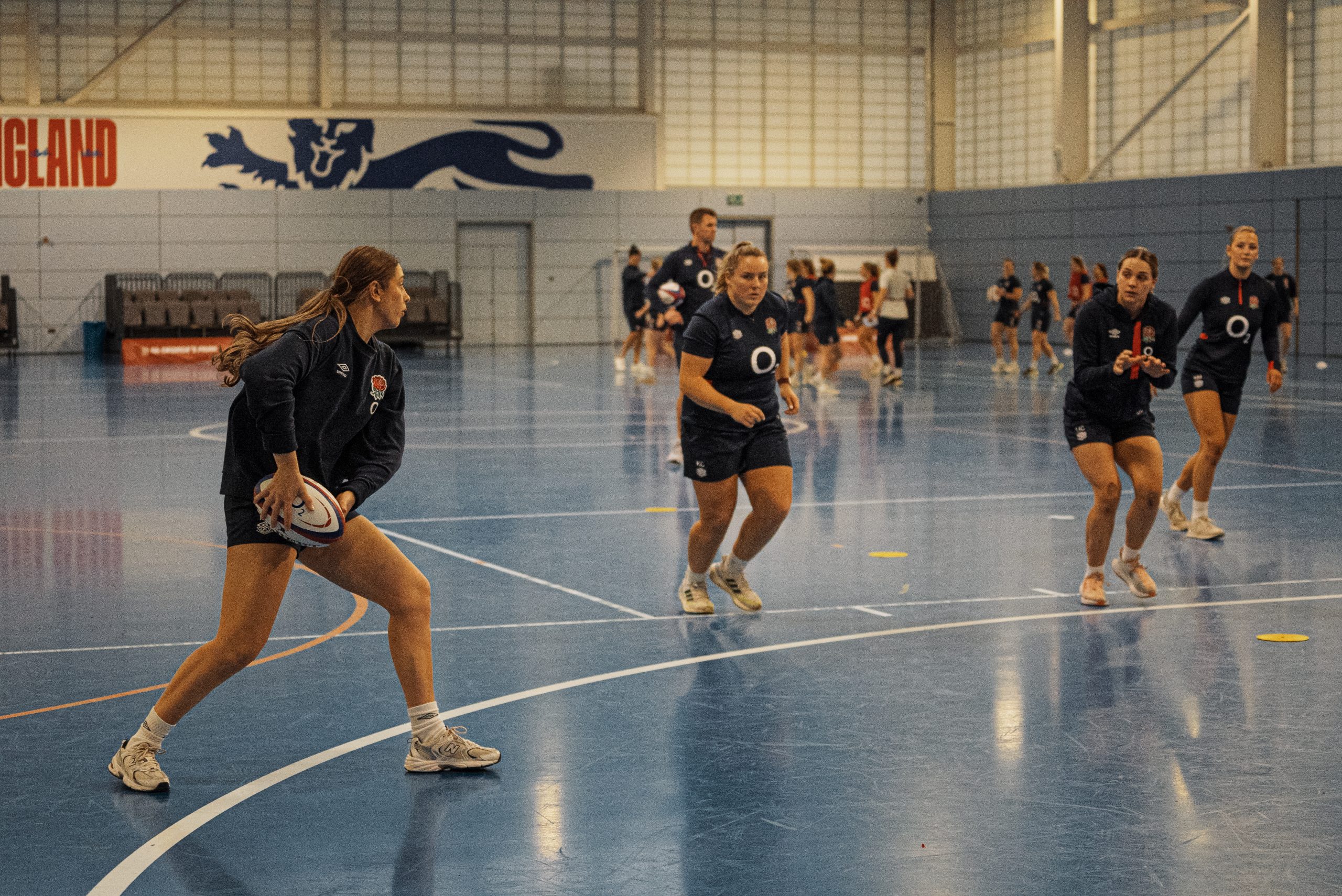
Image: England Rugby
How the Red Roses execute their plans
As Eager points out, in international rugby, there can be relatively large gaps between series and campaigns.
“One of the benefits of international environments is that you have periods where you’re completely on it and you’re executing your plan,” he says. “Then you’ve got time when players are back at their clubs and you can review and plan for the next campaign. We’re continuing to develop how we go about that process and make it as effective as possible.
“Plans enable us to align as a staffing group around what we’re trying to achieve; vision, purpose and clarity. For every session, we have clear objectives and everything in the programme has a clear rationale.”
Events will not always run smoothly but there is a firm idea of the team’s development priorities and so England can pivot swiftly. “Certain sessions can go perfectly to plan, certain other times you have to adjust around what you’re seeing in front of you.” Where appropriate, some elements are gamified. “It is a strategy that ultimately drives energy, competition, intent, memories and laughter.”
England’s plans are aligned to the playing style of Mitchell, who is striving to construct a team capable of winning the 2025 Rugby World Cup and build on the platform bequeathed by his predecessor Simon Middleton.
“We need a clear understanding of how we want to play the game,” says Eager. “Once we define that, what are the key elements that contribute to us playing our best game? For example, if we’re a team that relies heavily on moving the ball, kicking the ball, we’ve got to have the players with the capability to do that. Their passing skills and kicking skills have got to be good. A lot of ball movement comes with a lot more running, so you’ve got to be running fit. So you can see how that starts to layer in.
“From there, we’re able to say where a player’s profile sits from a rugby perspective, a physical perspective, an injury perspective, and ask: is there a gap between where they are currently at and what they need to do in order for the team to perform? And if there is, that ultimately forms their development goals. So there’s a clear link between what we need to do and why that’s important.”
Constant communication
There are key principles in the way England play that enables players to transition smoothly from the club environments to the national team, but equally essential are the relationships the Leaders Performance Institute witnessed first-hand at the Hilton.
“Unless you can connect with people first, your coaching is limited,” says Eager. “You’re never going to have close relationships with every single player, that’s just not possible, but you’ve got to make sure there are some key people within the management group that have relationships so you’ve got most bases covered with most players. You’ve got to take the time to get to know the players as people.”
He cites business professor John Maxwell’s ‘students don’t care how much you know until they know that you care’ and author Maya Angelou’s ‘I’ve learned that people will forget what you said, people will forget what you did, but people will never forget how you made them feel’ as maxims for effective coaching.
Coaches and performance staff will proactively speak to players outside of international camps but, again, there must be a rationale. “There’s a real balance between having contacts and connection with the players at their clubs versus overdoing it,” Eager adds. “That’s their club time, they’ve also got lives to live, but connection is important to continue our growth as a group. We’re fortunate to have a relatively big coaching group, ensuring that there’s always avenues for conversation outside of camp.”
Critically, as Eager says: “you’ve got to be able to connect on a level beyond just a transactional coach-player piece, particularly with the modern player. The players have got to have confidence and trust in you and what you’re delivering because sometimes you’re pushing them to places they may not be comfortable going as part of training. When developing players, you’re pushing them, stretching them and encouraging them to fail so that they can learn. It takes a leap of faith from players to know that they won’t be judged. It’s really important: if you want to stretch players to their maximum potential you work on those relationships.”
Eager has worked with both male and female groups during his career. He notes numerous similarities across men’s and women’s rugby, as well as some subtle differences. “The women’s game is a little bit less defence and kick-dominant. There’s more open play,” he says.
Beyond rugby, some differences are sociological. He is not alone in noting that female athletes tend to ask coaches ‘why?’ more often than their male counterparts. “That shouldn’t be a bad thing. In my role, I’m ultimately responsible for how tired or fresh they feel because I’m the one pushing training loads and physical capacity. I need to make sure that my communication and rationale are on point so that when I’m asking them to go to places where they’re working hard or they’re sore, they don’t lose confidence. They understand the purpose, the benefit, and that it’s going to reap rewards on the back end of tournaments.”
Other differences are physiological, relating to factors such as hormone levels and the menstrual cycle. “That brings differences week to week which shouldn’t be seen as a negative because with that comes huge opportunities as well.
“We’re really trying to work with players on an individual basis to understand what works for them and, ultimately, it’s not a one-size-fits-all approach. At the same time, it’s a team sport, so you try to find the balance of what’s consistent from a team perspective and what flexes from an individual perspective to put people in the best position to perform.”
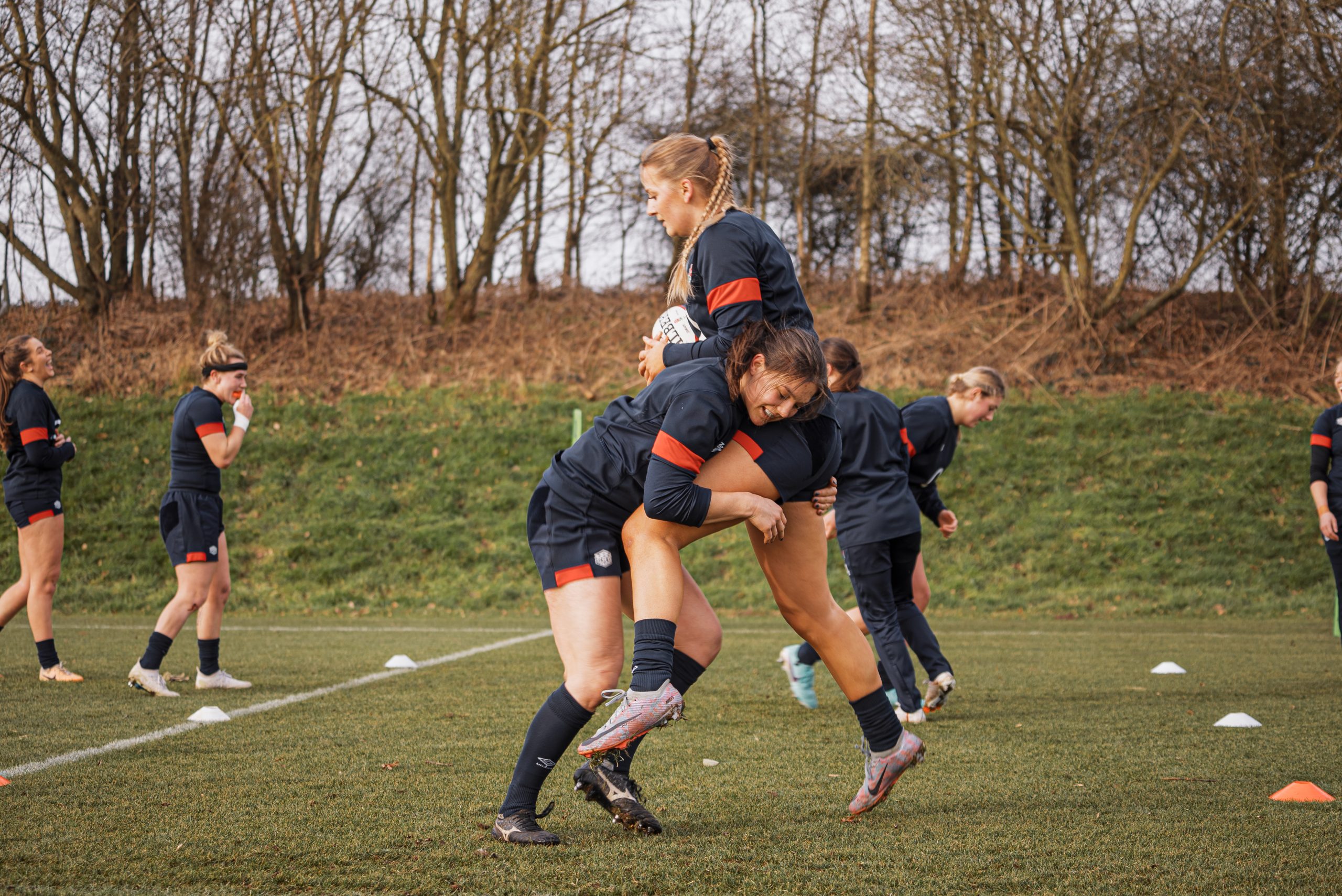
Image: England Rugby
The return to St George’s Park
The Red Roses will return to St George’s Park for a two-and-a-half-day camp in early March. “We’re constantly trying to layer in the developments in our game,” says Eager. “This camp will have a different theme with regards to what we’re trying to develop from a technical perspective, tactical perspective. Physically we’ve got a slightly different objective as well.
“In the alignment camp, we were looking at doing a lot more profiling and testing whereas now we’re trying to get the girls settled into more of a rhythm for our typical training weeks.
“Physically, it’s week one of eight for us. We’re back into running their athletic development programmes, we’re taking on their rugby development for the next eight weeks whereas the alignment camp was dipping our toe in, giving them some of the early information and getting engaged in where players are at. We’re starting to put the meat on the bones now.”
Eager’s excitement is palpable. “Change initially brings unknowns but it also brings huge opportunities. We’ve got a coach who’s got so much experience and we know that from a staff perspective and player’s perspective that’s only going to make us better. We’re going to learn a hell of a lot but what’s also refreshing is that Mitch recognises he’s coming into an environment that’s new for him as well, having predominantly worked in the men’s game. He’s also learning in that space.
“We’re all really excited to be able to continue to build on our last campaign. We have an opportunity to revisit the purpose of the team, our vision, what’s important to us in terms of our values, and how we want the environment to be. That sets the validation for everything else; training sessions, structures. It’s hugely exciting.”
Crucially, when the players return to St George’s Park they will all want to be there. “You can create an environment so players say ‘I can’t wait to get back in, it’s going to be great, I’m looking forward to these eight weeks’. That’s ultimately what we’re after and what we’re working hard on.”
St George’s Park provides a world-class elite training camp environment for any team or athlete wanting to optimize their performance. To find out more click here.
19 Feb 2024
ArticlesDawn Airton and Emma Groome outline the services that are available to British athletes during and beyond their time on a World Class Programme.
An article brought to you by our Partners at the

“A retired athlete might say ‘I thought I was the only one who couldn’t watch the next Olympics or Paralympics after I retired because it was just too painful’ or ‘I thought I was the only one who struggled with how my body and physical identity changed’,” says Emma Groome, Futures and Senior Performance Lifestyle Coach at the UKSI.
“But they’re not alone,” she continues. “Many athletes have been in their sport for years and years and they can say ‘can I ask you a question: is it normal to think this?’ You’re like ‘yeah, totally. We hear that a lot’.”
The UKSI Performance Lifestyle team numbers 38 staff members currently. “Every sport in receipt of World Class Programme funding from UK Sport is able to access core Performance Lifestyle services and some sports have chosen to invest further beyond their core allocation,” says Dawn Airton, the UKSI’s Futures Lead and Senior Performance Lifestyle Coach, who has joined Groome to speak to the Leaders Performance Institute.
“We’re one of the largest practitioner teams in the Institute,” adds Groome. “It’s quite impressive compared to where we started.”
Previously, athletes could receive support for up to six months after they had left a World Class Programme [WCP]. From athletes sharing their experiences, Groome and Airton realised that a change was needed, successfully pushing for this support to be extended for up to two years.
“It just didn’t feel long enough to provide that duty of care for athletes while they’re still coming to terms with those practical, emotional and physical changes that all athletes go through,” says Airton. “They need more time to make sense of their sporting journey and experiences and ask themselves: ‘what does my next chapter look like? Where am I going to thrive?’ Or even ‘who am I?’”
Airton and Groome have worked together on developing the Performance Lifestyle team’s support to athletes as they transition away from a WCP.
Here are five factors they want all British athletes on a World Class Programme to consider about the transition support services on offer at the UKSI.
1. It is now for two years and not just for retiring athletes
The UKSI Performance Lifestyle team will be there for an athlete and their holistic needs as they journey in, through and beyond elite sport. “It’s really important for athletes to know and to feel that the support is there for them, no matter their circumstances and, crucially, they can access this for two years after they leave a WCP,” says Groome. It could be that a programme has had its funding cut. Maybe an athlete has been deselected. It could even be that they have made the decision to turn professional, as is the case in a number of sports. Entering a WCP entails a number of choices on the part of the athlete and is a major transition in itself. “More often than not, athletes make the choice to move to an elite sports training environment to receive the best training, coaching and support services in the world. What that means is they often have to move home, move away from family and friends and the social and emotional support mechanisms they had in place’. Change and transition is part of every athlete’s journey, we are there to help them understand and manage those changes.” adds Airton.
2. Performance Lifestyle support is holistic and collaborative
The UKSI Performance Lifestyle team will support athletes throughout their time on a WCP and for up to two years afterwards across six ‘pillars’. They are: transitions, mental health & wellbeing, career development, financial health, learning & development, and education. “During and beyond their time on a World Class Programme, we’re supporting our athletes through change,” says Groome. “They’re going from being a funded athlete to not being a funded athlete and that brings them potential change and gives them decisions to make. What do they do next, practically-speaking? Do they need a job? Is this a transition into their next career? Is this the point at which they are going to self-fund? They may need to relocate and their income may be different.” In addition to these ‘external’ considerations come a range of ‘internal’ factors. “We’re talking in terms of their identity; who they are,” Groome continues. “One of the things we hear is what should a former athlete say when someone asks ‘what do you do?’ They tell us ‘I don’t know what to say anymore.”
It is paramount for the Performance Lifestyle team to raise the awareness of their work with current and former athletes, including those eligible athletes that may have left the high performance community. “We’re working closely with UK Sport and the British Elite Athletes Association [BEAA], who are developing an alumni community of athletes who have transitioned from a World Class Programme.” Support available to athletes includes access to the UK Sport-funded and UKSI-facilitated Personal Development Award, which assists athletes with personal and professional development; access to Health Assured, a free health and wellbeing provider who offer help with issues from legal advice through to counselling; and the BEAA alumni app. Airton says: “We want athletes to know that more support than ever before is available and it’s OK to ask for trusted and individualised help and support – people are genuinely there who want to help you with whatever that transition means for you.”
3. It is not one size fits all
The Performance Lifestyle team have tried to make things as simple as possible for transitioning athletes by identifying five areas where they focus their support: ‘understanding change’, ‘understanding self’, ‘understanding the world’, ‘making it happen’, and then ‘review’. “It’s not sequential or absolute that you have to progress through all of those areas, but they’re recurring themes in our conversations with athletes,” says Groome. “With ‘understanding change’, for example, we might come back to financial or professional development. ‘Understanding self’ is often linked to the athlete reconnecting with who they were or connecting with who they are now. This might be around discovering your strengths, values and passions or exploring the timeline of your life and career to this point.”
Athletes will engage with these support services to differing extents and may not engage with some elements at all. “It’s ‘the path of a meandering river’ as one of our Olympians described it to us recently,” says Airton. “It was the journey they’d been on to this point and how it aligns to their strengths, values, who they are as a person, the support mechanisms and the people who have got them through those experiences.”
The priority differs from athlete to athlete. “If it’s finding a job you would hone in on that,” says Groome, “but it could be the emotional component because no practical or sensible decision-making can be made at that time.
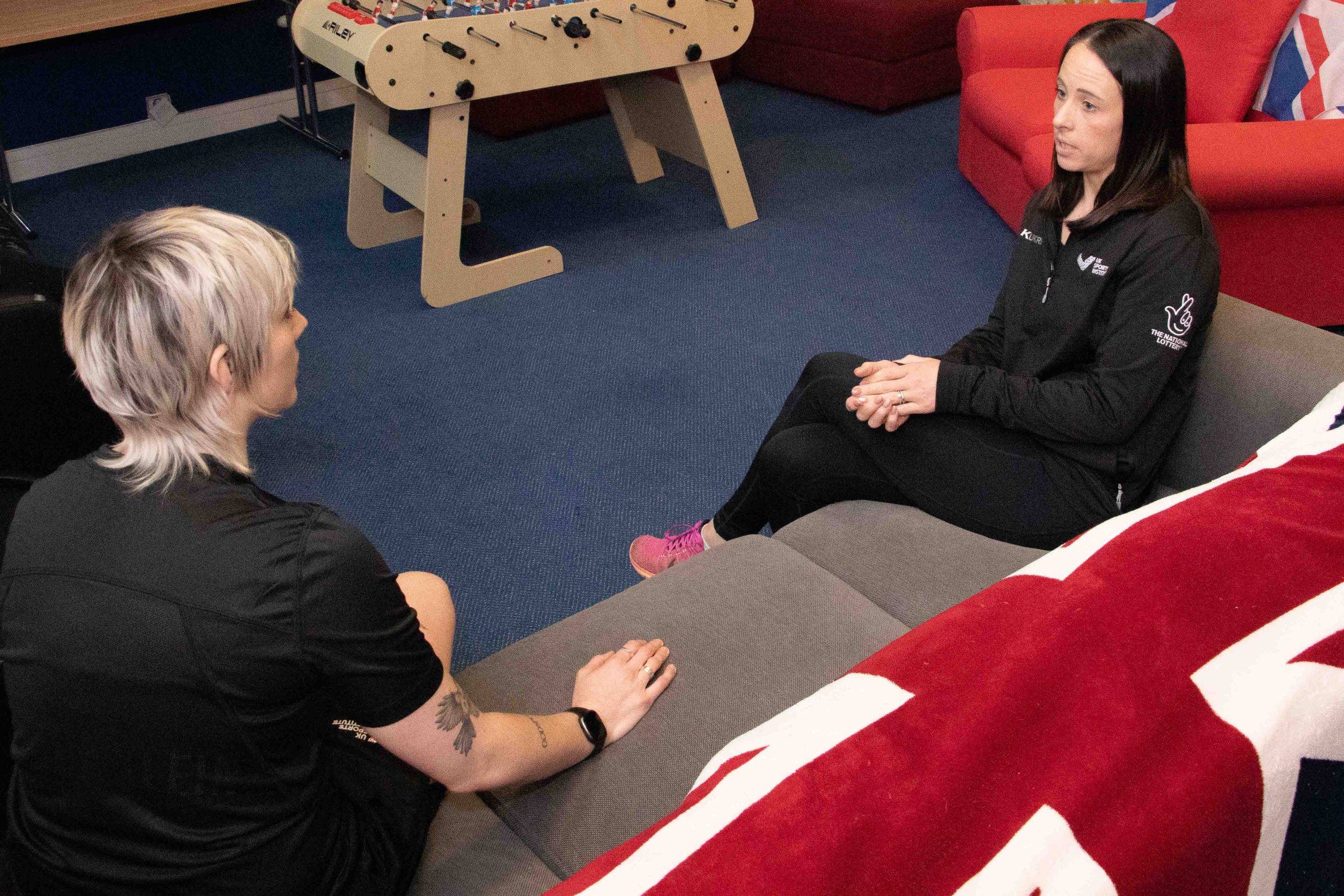
Image: UK Sports Institute
4. Performance Lifestyle can help you rediscover your purpose in a time of uncertainty
The removal of an athlete’s routine can be a major source of disorientation. “There was a gold medal-winning athlete I had worked with who had actually done a lot of planning ahead of their retirement and they told me ‘I turned the page in my diary and the page was blank’ – and that was the best-prepared athlete,” says Groome. “Normally, your structure is based around your training. More often than not, that determines when you go home, when you go on your holidays, all of those things. When you take away the reason for that structure it is something that Dawn and I find we have to support athletes with – without it, the impact on mental health can be significant. The Performance Lifestyle team witness snapshots of how athletes feel and they can share those insights with others in transition. “Athletes say it’s so good that another athlete felt like that,” Groome adds.
While an athlete cannot plan everything, there are elements from their athletic career that will aid their transition, as Groome explains. “They have a lot of these strengths and skills and they can apply elements of how they’d plan their performance, to problem-solve it, being resourceful, being creative.”
“They understand the uncertainty. Uncertainty is a big part of sport and any transition,” adds Airton, “but even just feeling like you’re taking action towards something has a big impact, I’ve found. The athletes we support have said ‘If I’m taking action, in my week, in my month, I feel I’m really making progress’ and we can then reflect on and review the progress being made. We do a lot of reflective practice over that two-year period to outline what you have understood about yourself, what you have achieved, and we highlight the strengths that people have.”
5. Planning your transition can help your performance
The growing reputation of the Performance Lifestyle team is down to its advocates, who all see the performance benefits. “We’ve got a lot of advocates across the performance directors, coaches, wider UKSI support teams and colleagues at UK Sport and the BEAA. This really is a system-wide approach to supporting athletes,” says Groome. “A colleague might say ‘I’ve got an athlete who could really do with having something else and I’ve sent them your way’. These advocates in the system help promote the belief that it helps rather than hinders your performance. Often that’s the hook for athletes who would not want to invest their time in something that doesn’t help their performance.”
If you are, work with, or know an Olympic or Paralympic athlete who is on a World Class Programme, or has left a World Class Programme in the past two years, contact [email protected] for more information on the support available.

22 Jan 2024
ArticlesHelene Wilson led the Northern Mystics to the ANZ Premiership in 2021 but not before taking her playing group on an individual and collective development journey.
“We were bottom of the table and we made it to the top by literally changing the way we practised and our environment,” Wilson told an audience at September’s Leaders Meet: Driving Step Change in Female High Performance.
Wilson, who currently serves as Manager of High Performance Sport New Zealand’s [HPSNZ] Women in High Performance Sport programme, was primarily at the Etihad to discuss her five years as Head Coach of the Northern Mystics, a netball team in New Zealand’s ANZ Premiership.
The Mystics won the first national championship in their franchise’s 24-year history on Wilson’s watch in 2021. They went close again in 2022, her final year, and won a second Grand Final in 2023.
Yet in 2019, as Wilson explained, they finished bottom of the ANZ Premiership. At the time, the Mystics were infamous for their disunity and underachievement.
The talent and potential was there, but Wilson knew it could not be unlocked without an environmental overhaul. She started with one simple question: “how do we create an environment where high performance comes from out-learning your opposition and people are on a journey together to get there?”
Find a suitable framework for addressing performance questions
Central to their transformation was the Mystics’ belief in the Māori concept of ‘Wānanga’. “It’s a word that means coming together and meeting to discuss, collaborate and consider,” Wilson told the Etihad audience. “It could look similar to a team meeting but it can take many forms and Wānanga happens in many ways.”
A fuller account is provided here but, in summary, a Wānanga provides a space for collective, inclusive, reflective practice (‘Rongo’ in Māori) that enables people to reengage with problems in the world beyond (‘Tū’) having formed a consensus on the best solutions.
“There is an energy about it,” said Wilson. “The process and energy is like a coming together and moving apart in a state of clarity, which is collectively built together. The process of ‘Karakia’ – transitioning from one realm to another – takes us from the worlds of Tū and Rongo.”
These Māori concepts and traditions resonated with her staff and playing group, but Wilson emphasised the relevance of the framework rather than its local aspects. Coaches, she argued, should use cultural artefacts germane to their context. “There’s stuff around us everywhere that you can apply in different ways and it’s the framework that is key.”
The players and staff bought into the idea and it meant the team could get to work on what was needed to take them from last to first place in the space of two years.
Improve the quality of your interactions
Ahead of that triumphant 2021 season, Wilson and her coaches convened to establish what it would take for the Mystics to win that season’s Grand Final. They also invited the playing group to do the same.
“We tried to define the standards that we needed to shift to win the Premiership,” she said. “I remember specifically at this time we would Wānanga in the gym and we were talking about the standard of performance that we needed to put down on the court in pre-season to ensure that we could win the Premiership.”
The players and coaches often had contrasting views. “We had all the data and the information and knew what we needed to do, but we had to hold that back and let the players lead it,” she added.
In one particular pre-season Wānanga, Wilson addressed the Mystics’ reputation for throwing away possession cheaply. The players sought a measurement for tracking their improvement but one wasn’t forthcoming. “How do we measure it? How do we know we’re doing well? We couldn’t agree, we couldn’t align, so we had to go out and learn.”
That Wānanga preceded a public pre-season game and Wilson used the opportunity to pose further questions: if you make mistakes on the court what does that look like? How many mistakes is OK? What’s your key role in your position? For example, if you’re a goal attack and your main role is to get the ball to the goal shooter as accurately as possible and you want to throw it from the first phase in the centre, how am I to determine that you will get that ball there? Tell me what you need to do. And they will tell me how they believe they will take this skill and execute it to the level we’d accept, as well as how many mistakes we were allowed. They defined what they were going to put on court and what they were going to get right.”
Each member of the team would set personal limits. “It looks like ‘I won’t make the same mistake twice in a row’. OK then, if you do, then you’re off. You’ll work with the S&C on the side line in front of the public, practising that mistake for two minutes, then you’ll go back on court and we’ll see how you go.”
The continuous Mystics substitutions made the game a strange spectacle. “You can imagine the first half the first time we tried this,” said Wilson. “It was like a yoyo. My opposition coach said to me ‘what the eff are you doing?’”
“There was a lot to unpack in our changing room after that and our psychologist was a great help.” The subsequent Wānanga went on for an hour and a half. One of the key questions was the matter of each individual’s role in the team. “Even if I’m only on the bench how do I still contribute? It was the benchies’ job to pull their teammates up when they weren’t executing the skillset they said they would more than two times in a row. That then formed a drive for individual performance.”
As Wilson said, the Mystics changed the way they practised. “It wasn’t just making an effort to say it – it wasn’t as simple as that – it was the quality of the interaction that happened.”
Increased energy and confidence
At the Etihad, Wilson shared an image of her team lining up backstage ahead of the 2021 Grand Final and noted the sense of “energy and confidence; that they each had each other’s back as they go out and do it.”
She said: “Then we joked we were doing this hard work as people so I could get to drink a piña colada on the bench while I was coaching; knowing I had done my job. I wish I had one, because they were driving the performance on that day.” The Mystics quickly established a two-goal lead over their opponents, the Mainland Tactix, that they never relinquished in a 61-59 victory.
“We made seven errors in the entire game,” Wilson continued. “And when we had that Wānanga at the start of the season, the players said they should be able to make 64 errors in a game. We [the coaches] knew they needed to make under 15 [to win the Premiership] and they made seven. It shows how they drove their own performance.”
To further underline how the Mystics transformed their environment, Wilson referred to Grace Nweke, a 21-year-old New Zealand international and one of the rising stars of the sport. She joined the Mystics in 2019 while still at school but, thanks to Wilson encouraging her players to have a voice, Nweke immediately had the platform to speak up when she felt things weren’t working for her.
“She was 16 years old and didn’t quite think her S&C programme was quite right for her and she asked how we could discuss how it might be changed – that’s powerful for an athlete to have that support [especially] when the S&C said ‘well, I’ve been doing this for 20 or 30 years’ – but then it’s also powerful for the S&C to say ‘how are we going to work together to make this better?’”
In the first part, we delved deeper into Helene Wilson’s role in creating a culture that enabled the Northern Mystics to ‘out-learn’ their opponents.
18 Jan 2024
ArticlesRichard Burden of the UKSI’s Female Athlete Health & Performance team reflects on their ability to overcome indifference, limited resources and internal politics.
Though the UKSI is but a small cog in the wheel, the institute’s Female Athlete Health & Performance team has been astute in dealing with the typical challenges present in a high performance system, as Richard Burden, the UKSI’s Co-Head of Female Athlete Health & Performance, told an audience at September’s Leaders Meet: Driving Step Change in Female High Performance at Manchester’s Etihad Stadium.
“We don’t have a lot of resource,” he said of his team, which he leads alongside Dr Anita Biswas. They work closely with Dr Kate Hutchings, who leads the UKSI’s female athlete clinic. It is quite an undertaking for a system that serves up to 800 athletes, numerous coaches and a wealth of different interests.
“Between the three of us,” he continued, “we have four days a week to try and do some of the things that we do. That’s a step change – that’s good compared to previous cycles – I’m not complaining. I’m just giving a little bit of context because a lot of the time when people who don’t have experience look at the system we’re in, they think that’s amazing, that you’ve got a tonne of resource, that you must be able to do some really cool stuff.
“The fact is that we don’t have [unlimited resources]. But we’ve got quite good at working with what we do have.”
Part of their success can be attributed to bringing coaches and athletes on what Burden refers to as a research and innovation journey. Too often sports scientists and practitioners fall short on that front.
In June 2023, Burden and Biswas spoke onstage at the Female Athlete Conference in Boston about the “needless tug-of-war” between female athlete sports science and applied practice. They were joined by exercise physiology and nutrition specialist Professor Anthony Hackney of the University of North Carolina. Together they asked an audience of physicians and practitioners who or what they saw as the greatest barriers to research and innovation. “Coaches” was a common response “because of the perception that they lack engagement in research and innovation”. Three months later, at the Etihad, Burden turned that idea on its head.
“Sports scientists and practitioners are really poor for this,” he said. “If a coach doesn’t want to listen to their idea it’s the coach’s fault.”
Burden suggested it could be a problem with how the idea is pitched. “If coaches are suggested as a barrier, what are we doing about that? Do people know why a coach might not engage in science, research and innovation? Are we giving them a reason to change? Are we giving them something they can use that’s actually going to make a difference?”
People often point to the limited budgets in high performance. “Yeah, funding is tight, but it’s probably not going to get any bigger. Maybe we’ll get a bigger slice of the pie but the pie is unlikely to get any bigger,” he continued. “So how can we be more resourceful?”
Time-poor coaches is another suggested issue. Again, it doesn’t wash with Burden. “How can we create more time with what we currently have? Everyone is super busy. We need to get stuff done – so how are we going to do that? And the translation: how can we improve the practicality of doing research and innovation in elite environments so we can actually give out something useful?”
The UKSI Female Athlete Health & Performance team have focused on four areas.
Any potential innovation has to add value. “There is always an interesting-versus-important question that we ask ourselves,” said Burden. “We can’t just do stuff that’s interesting – we have to do things that are interesting and add value – that’s our sense-check.”
The Female Athlete Health & Performance team answer that question by spending time talking to coaches and athletes with a view to understanding their needs. In 2019, the English Institute of Sport (EIS; the former name of the UKSI) launched their SmartHER campaign to encourage female athletes to speak about their challenges and concerns in a safe setting. It led to a roadshow series where education sessions were provided for coaches and athletes across the UK. “That gave us momentum because it just started conversations,” said Burden. “It was only basic level education but it was things that people hadn’t heard before, and the conversations started to grow within sports and between sports, and back and forth between the UKSI and the sports. Better conversations would happen.”
This opening up of communication lines led to the development of the UKSI’s internal learning platform, known as the Performance Hub, with modules including ‘The Basics of the Menstrual Cycle’ and ‘Additional Considerations for the Female Athlete’. “It’s always available to practitioners in the UKSI so they can upskill themselves on their own time,” said Burden. “It is aimed at giving people more awareness and confidence in their conversations.”
He quickly learned not to assume knowledge. “A lot of this comes from the eyes of a bloke who is quite a lot of the time the only bloke in the room. It is not a given that a female coach will know about bra fit, whereas a middle-aged male coach may be comfortable discussing such issues.”
Increased athlete-coach engagement has eased another common concern from researchers: access to the athletes and coaches themselves. “You have to bring them on a journey,” said Burden. “You bring them along, you increase accessibility. Researchers and academics often complain that athletes are protected, that you can’t access them – but what have you done to try? By doing your research in a lab? They can’t relate to that. Go into their environment, see how they live, see how they train, and co-design the questions.”
As conversations about topics such as menstrual cycle tracking developed within the British high performance system, it led an increasing number of athletes, coaches and researchers to ask if there was a less invasive alternative to needle and blood sampling in hormone data collection.
In 2021, the EIS trialled Hormonix, which collects hormone data through saliva sampling. The technology was designed in collaboration with Mint Diagnostics. Later, Hormonix was trialled at Manchester City Women, where it has led to further research projects around female athlete health.
Burden also spoke of a UKSI research collaboration with Manchester Metropolitan University and British Rowing, who had a question. “They called it Project Minerva,” he said. “It’s something they’ve been developing about the influence of training load and the delivery of training on female health. So how is the menstrual cycle influencing their ability to deliver training and what impact is it having on internal load, competition and performance? It’s their question – it hasn’t come from research or a university – it’s come from the sport. We’re there to provide some of the research and innovation expertise to help them formulate the question and work out a path to answer it.”
Co-designed research and innovation can accelerate the UKSI’s ability to provide support to athletes. “Get the practitioners involved, get athletes, get the teams and bring them along with it because if they’re onboard you get easier access to them and you’re going to produce something that’s more translatable, meaningful and applicable to them.”
When the UKSI Female Athlete Health & Performance team proposed a collaboration with the Australian Institute of Sport [AIS] and the United States Olympic & Paralympic Committee [USOPC], it had never been done before.
“It’s across traditional lines,” said Burden. “When you talk about competitive advantage, why are we talking to the Aussies and why are we talking to the Americans? But that’s not how we’re looking at it. The Aussies have done some really good stuff that we haven’t. We’ve done some really good stuff that they haven’t. The same with the Americans.
“If we combine resources to stop duplicating effort, because we’ve done educational stuff, the AIS have done some brilliant educational stuff, the USOPC have done some really good educational stuff. We’ve all done the same educational work. What’s the point when we can do it all together and focus on other things?
“I thought I was going to have a really hard time when I took this to the directors. I thought there was going to be some sort of major health event for some of them when I said ‘I want to work with the AIS, I want to work with the USOPC’ but it was actually really easy and we put together a fairly compelling reason why, but it was quite easy because this isn’t about performance advantage, this is about advancing female athlete health and performance.”
“What can you do with information that you already have?” asked Burden. To illustrate his point, he referred to the UKSI’s drive to centralise all blood screens across the British high performance system. It enabled that information to be used in a more informed and impactful way.
“The information was being held in UKSI silos, but there was potential if we could aggregate it all,” he continued. “That was a few years ago and it wasn’t the easiest conversation to have with the sports because they had their own suppliers. There was some politicking to convince everyone that it was going to be really beneficial.
“The vast majority of our sports now use the same supplier, which means we have a database of blood screens that is continuously being populated. Because of that, we can start to unpick some of the things that we need to understand.
“We’re starting to understand sport by sport differences, sex differences and, over time, we’re going to be able to start to individualise between sport differences, in-sport differences, individual differences. Being able to do that, we can inform our practices and inform the treatment or our understanding of the biggest health problems in a much more informed and precise way because we’re using what we already have in a much better way.”
In Burden’s view, this pooling of evidence has the potential to lead to the greater individualisation of support services. He contests the perception of case studies as low in the traditional hierarchy of evidence due to them being small in sample size. “We’re in elite sport and I don’t want to generalise – I don’t care what the mean for the whole group is – I need to know why athlete X is different from athlete Y. Case studies are really impactful for us – if you can collect case studies then you start to build an evidence base. When trying to understand things like the menstrual cycle, generalised approaches just aren’t going to cut it.”
16 Jan 2024
ArticlesIn the first Leaders virtual roundtable of 2024, we delved into an ever-timely topic and asked members for their approach to a complex issue with no simple solutions.
This roundtable discussion was timely given the news that the New England Patriots in the NFL would replace legendary Coach Bill Belichick with Jerod Mayo who had served as the team’s Linebackers Coach and joined the organisation in 2019 – at 37 years old he is the youngest Head Coach in the league. It was a classic example of internal promotion and coach succession planning.
Prior to the roundtable conversation, we also took a look into some of the literature and industry insight from the business world around this topic.
The University of Washington Human Resources department define succession planning as:
The process of identifying the critical positions within your organisation and developing action plans for individuals to assume those positions. Taking a holistic view of current and future goals, this type of preparation ensures that you have the right people in the right jobs today and in the years to come.
In the long term, succession planning strengthens the overall capability of an organisation by:
According to the National Association of Corporate Directors, ‘fewer than one in four private company boards say they have a formal succession plan in place. However, those that do succession planning well are efficient in developing leadership skills, exposing executives to a broad variety of industries and help them develop skills that can be transferred to different business environments’.
Some of the statistics and literature digested ahead of this roundtable suggest there is a lot of organisations who don’t do succession planning well. To provide some structure to the conversations around succession planning, two questions were posed to provide direction to the discussions, with the first question consuming most of the conversations:
Having a clear process and philosophy
Before we get into some of the things members on the call are doing to aid succession planning in their environment, having a clear process and approach to succession planning was the first real takeaway and consideration for all organisations. As the statistic above shows from the corporate world that only 25% of organisations have a formalised plan. With this in mind, do you have a clearly defined and agreed plan on your approach to succession planning?
If a member of the team leaves, what is your approach? In the discussions the group were largely in agreement that their organisations intent is to promote or hire internally, which tends to yield better results. The caveat is that it might depend on the specific role.
Succession planning requires clear intention, with alignment to your mission, vision and values of the team. Some of the work of Professor Alex Hill in his 2023 book ‘Centennials’ suggests that organisations who sustain success find a strong balance between ‘a stable core and a disruptive edge’. The stable core is the mission, vision and values of the team – the intention that helps to retain knowledge, the ethos and culture. The disruptive edge comes from people helping us to acquire new knowledge from different spheres. Although the group stated the impact of providing a pathway internally for new hires or role progression, we must always consider the importance of diversity of thought and new thinking. What is your philosophy?
Finally, how robust is your system around your process? One environment explained how they have key ‘authorised documentation’. Some of these documents have been through nearly 100 revisions to ensure that experiences and learnings in the past are captured. These are also a powerful reference for new starters and outline how we do things. This documentation is an effective fail-safe for knowledge retention and mapping skills analysis as you are able to identify past and possible trends. Succession planning as a concept provides the opportunity for you to retain knowledge, but also look at how we can acquire new knowledge.
Identify key positions in the organisation
When considering the question of the cornerstones to effective succession planning, the most common response from the group was the understanding and clarity around key positions in the organisation and their required skillsets. Do you have a skills matrix for each key role and regularly revisit these to better understand what the position needs both today and tomorrow? Making this part of the process provides you with an opportunity to remain on track in the short-term but to also evolve thinking around the future of a role or your work.
Who are the linchpin people in the organisation – do you have clarity on who they are? In most organisations, there are key people that if we lose them it is going to cause a real issue for continuity. Are you frequently revisiting this and ensuring an agreed plan is wrapped around that individual should they move on?
One of the environments on the call stated how they look at their staffing as a roster and the need to remain on the pulse of its composition through diversity, required skillset and knowledge. Know what your composition is, continuously check in on it and the development of your people within it. This will allow you to identify high potential individuals but also have sight on those that may leave the environment for pastures new.
Set yourself up for success through onboarding
One of the attendees as part of the discussion shared their experience in the importance of well structured onboarding to the success of the succession planning process. That particular environment has leant on the work of Michael Watkins in ‘The First 90 Days’ to hone this approach. How well we onboard someone when they do arrive and even before they arrive, can be a determinant in giving the best a chance to succeed, which hopefully means we won’t be looking for another successor in a short period.
Identify high potential individuals
Being aware of key positions in the organisation dovetails with the need to identify those high potential individuals. Most organisations on the call are already doing this but it’s a good reminder to dedicate specific time in your teams to ensure there is awareness and alignment of who these individuals are and what the plan of action is for them.
When considering high potential individuals, one of the key discussion points on the call was the importance of providing them with exposure as close as possible to the potential position they could develop into in the future. Putting them on a development programme is impactful, but immersing into the nature of the role and skillset is arguably more powerful according to attendees on the call.
Despite the power of exposure, it was also agreed that future leaders training that aims to support the education and knowledge around the organisational culture and behaviours is another key cornerstone of effective succession planning. A final point surrounding high potential individuals was ‘expectation management’. One of the threads of discussion suggested that some organisations can shy away from formalised programmes for high potential individuals because they fear the risk of educating and developing someone will lead to them outperforming others – it reinforces the message around having a clear approach and philosophy to succession planning that aligns to your culture to remove this fear and risk that could be present.
Recruitment
Naturally when discussing the theme of succession planning, there is both an internal and external perspective when it comes to recruitment. One of the environments on the call shared that their philosophy towards recruitment is ‘people as opposed to expertise’ and they value those that are passionate, selfless and curious. On a similar note, an environment in North America shared that they both internally and externally target curious and driven individuals who are strong communicators. Regardless of whether you will be recruiting externally or promoting internally, the discussion was a strong reminder to ensure you are clear in the characteristics you want from your people.
As discussed on this virtual roundtable, it has to be more than a tick-box exercise if you’re going to reinforce a culture of continuous improvement.
Two questions underpinned the groups’ conversations on the day:
Having a clear philosophy and intent
In summarising all of the responses and suggestions from the group, it became clear that the effectiveness of your approach to learning and development starts way before the actual practicalities. A reflective question for all is whether your team or organisation has a clear philosophy and intent on learning or if it is just a tick-box exercise because you know it is something that generally needs to be done? Put simply: if you don’t have this philosophy and statement of intent clearly mapped out, it isn’t likely to be effective. We also discussed around reinforcing a culture of continuous improvement, of which clear approaches to learning form a large part of this outlook.
Firstly, start off with outlining key principles. Instilling a set of clear principles that sit behind your learning and development work allows you to find the balance between short and long-term focuses. There is a natural tendency in many high performance environments to be reactive, which can minimise long-term growth. Thoughts from the group suggested that your principles should cover both bases so there are clear expectations from the here and now, but also the future.
Be intentional, often less is more. There is a vast amount of learning and development opportunity for staff and also athletes, so much so that it can be overwhelming. So with this in mind, ensure you are intentional with what is being focused on, how much time you are dedicating to it and perhaps most importantly, how will it drive positive change. One of the comments on the call that summarised this point well was the importance of creating the need and desire for change.
Have a needs-based approach. This is a natural follow on from the point above and will support the intentionality of what you or your team engages in. The key element of the needs-based approach is making sure you are participating using the right stimulus.
With any learning and development experience you engage in, do you have a clear commitment to action post-engagement which highlights what you are actually going to do differently or to deepen the quality of that learning?
Finally, how do you think about developing an organisational system that facilitates learning and development? A reflection is that learning can often take place in silos and learning isn’t shared organisation-wide. Environments that create a true culture of learning have clear systems and strategies in place to create opportunities for the sharing of practice. Intention and organisation will also help to elevate the quality of your learning.
Peer group opportunities
When aggregating all of the responses from the group conversations, unsurprisingly the most common response when thinking about effective learning and development strategies were aligned to peer group opportunities. There were a few specific examples of this in how you are able to facilitate these opportunities for staff or your athletes.
Other impactful strategies
Although a large number of effective strategies aligned to peer-group opportunities, there were also some excellent thoughts and considerations that sat outside of this bucket. Some of these strategies are well-known and utilised well in environments, but it was a good reminder of the impact they can have when focused on consistently and strategically.
Unsurprisingly, experiential learning was identified as a really impactful strategy for learning. To get this right, create a space for the learning experience, mixing theory and practice and then make the learning activity experiential in nature.
There was also a thread of discussion around after-action reviews and debriefing. These tend to be strategies that are not utilised as well across high performance sport, largely due to the fast-paced nature of the industry – it’s often onto the next game. However, one environment shared how much they have gained by having reviews every week on decision-making processes and having this consistent approach has yielded some really positive results. How consistent are you with reviewing?
‘Question-based leadership’ was something the group felt was an opportunity when considering effective learning and development strategies. Question-based leadership refers to the notion of communicating through open, targeted questions more often than in closed statements. In a number of recent conversations across the Leaders Performance Institute, several members have shared how quality questioning is an under-utilised skill in many environments.
Finally, the group also touched on the importance of psychological safety in the environment and celebrating a ‘beginners mind’ to help reduce fear, noise and impostor syndrome.