The seven-weight world champion spoke to SBJ Tech ahead of her second fight with Ireland’s Katie Taylor.

You can’t have a discussion about sports technology today without including athletes in that conversation. Their partnerships, investments and endorsements help fuel the space – they have emerged as major stakeholders in the sports tech ecosystem. The Athlete’s Voice series highlights the athletes leading the way and the projects and products they’re putting their influence behind.
* * * * *
Two of her losses included the tightly fought split decision against Katie Taylor that headlined Madison Square Garden two years ago. Their rematch last month, which Taylor won by a controversial unanimous decision, was as the co-headliner with Jake Paul and Mike Tyson in the Most Valuable Promotions card was held at AT&T Stadium in Texas and streaming live on Netflix.
Also in November, Serrano, 36, partnered with Total Wireless, a no-contract 5G provider that runs on the Verizon network — and received her very first mobile phone. Citing an unwavering, distraction-free focus on boxing, Serrano had resisted owning a phone until now. She will host a meet-and-greet with fans at a Total Wireless store in Brooklyn on Dec. 1.
On not owning a mobile phone…
No, never. It’s going to be my first one. All my communication has been through my trainer, my brother-in-law, which is Jordan Maldonado, and every now and then, I’ll steal my sister’s phone and do everything there. I do have an iPad, but this would be my first phone.
On who she’ll call or text first…
I think it’s going to be my sister, and I’m going to talk. She will be happy that I don’t take her phone anymore. Now I have my own.
On working with Total Wireless…
Total Wireless definitely has a good commitment with the Latino companies, Latino athletes. What really got me was because their plans, and then they’re associated with Verizon. I needed a plan and something that’s not going to slow me down. Because I’m always high pace, and I needed something that’s going to do that for me.
On how she evaluates brand partnerships…
If I truly believe in it, if I’m happy with them, if I see their work and what they’ve done for others, and what they’re doing for in general — yeah, that’s how we partner up. If I believe in it wholeheartedly, then I’m going to go with them. There’s people that we’ve gotten offers from, and I said I don’t agree with what they’re doing, or I don’t get what they their motives are. So I will not represent them.
On being on co-headlining with Jake Paul and Mike Tyson…
Obviously the fans wanted this fight. I believe I won the first fight. So it was really easy when my team came up to me and said, ’It’s going to be on Netflix in a big stadium for 80,000.’ I said, ‘Let’s do it.’ We gave an iconic first fight, headlining Madison Square Garden, selling it out. And I think we’re just going to do a better fight this time. And I think we’re both deserving of this platform to go out there and represent for the women in the sport.
It’s truly an honor. I’m super proud. I have an amazing team that even thought of me to put this fight on. I can’t wait. I know I’m going to put on a show. I’m ready. I know Katie’s ready. And you’re going to witness women’s boxing at its finest.
On her training methods…
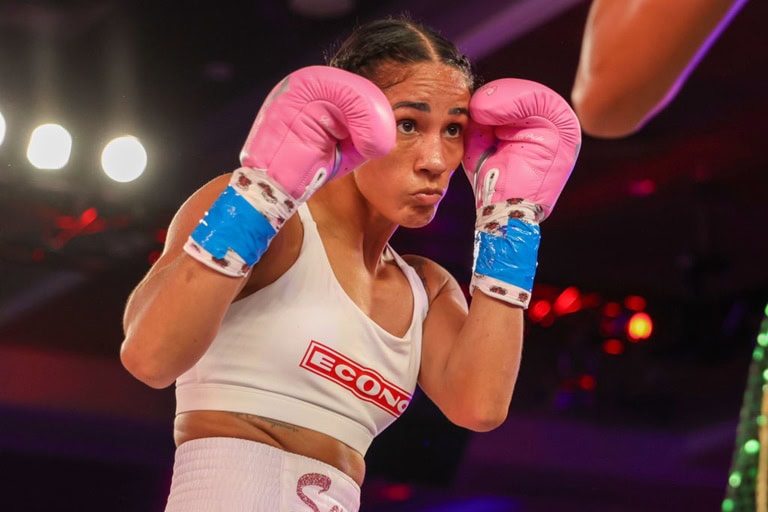
I’m old school. I have an old school trainer. We’ve been doing it for 16 years this way. It’s been working for me for 16 years. I’m one of the most accomplished female fighters in the world, and that’s only [after] having nine amateur fights. I have 50 pro fights. And if it ain’t broke, why fix it? But we definitely train smarter this camp. I train hard for all my fights. So I’d be lying if I you that I trained harder. No, we just trained smarter. I’m ready to become undisputed champion at 140.
View this post on Instagram
On how she’s evolved…
I never really, in the beginning of my career, thought of recovery as part of training, but that was definitely a plus for this fight. As you get older, your body gets a little more wear and tear, so you definitely have to concentrate on that and just eating good and just going out there and performing, making sure you’re training hard and running the miles you have to run, putting in the work, and you’ll do good at fight time.
On her team…
My team is very small. It has been my brother-in-law [who is] my manager and my trainer, which is Jordan Maldonado; and my sister [Cindy]. We’ve been together. It’s been us three. I do have a pad coach, but he does what my main coach, Jordan, tells him to do. I had a nutritionist, and I learned things from him. So I moved it over to this fight. I try and cook for myself, but I’m I don’t like too much. I don’t like an entourage. I don’t like too many people around me. So it’s been my small team, and I’m happy. They just bring the best out of me.
On what she learned about fighting Katie Taylor…
Katie is definitely a warrior. She’s tough as they come. She’s not going to go down easily, and she’s going to fight every minute, every round, and that’s what I I learned. I gained more confidence after that first fight. I know I hurt her. I’m capable of hurting her again this fight. And that’s what we’re going to try to do.
On the growth of women’s boxing…
It’s been a long journey. Definitely people had their doubts in us, but now that they’ve seen that champions are fighting champions, we’re putting in on great shows — I’m not the type to brag, but when I do express how much money I’m making in my fights, that’s to motivate these young girls and show them, inspire them. There’s a light at the end of the tunnel, like ‘I can make this type of money if I continue to fight, work hard.’ Now, with this type of money, women are coming into the sport more. They’re putting on shows. They’re fighting, they’re getting in shape, and we have amazing talent, amazing champions, and I think it’s only getting better.
This article was brought to you by SBJ Tech, a Leaders Group company. As a Leaders Performance Institute member, you are able to enjoy exclusive access to SBJ Tech content in the field of athletic performance.
Lachlan Penfold, the Head of Performance at the Melbourne Storm, describes his conversion at the sight of one of the NBA’s greatest players enjoying what he does. It’s rubbing off on his current work in the NRL.
A podcast brought to you by our Main Partners

Chief amongst them was his realisation that joy is crucial in a high performance environment.
“Joy in a professional sport? That’s a bit strange,” thought Penfold, but it was one of the team’s trademarks and no-one embodied it better than their Head Coach Steve Kerr and illustrious point guard Steph Curry.
“The player that embodies it better than anyone in world sport is Steph Curry in terms of just the absolute joy he gets from playing the game, from training the game,” Penfold continues, “not only from his perspective, but from seeing his teammates have success and do great things, the joy that he gets really invigorates a sporting team.”
It has fed into his work with the Melbourne Storm, who reached the NRL grand final in October. No doubt they’ll go again in 2025, inspired by the family environment described so vividly by Penfold [10:00].
We also spoke about his approach to training and recovery [17:30] and the importance of individualised work [22:30]. Last up, we discussed the year ahead [28:10].
Listen above and subscribe today on iTunes, Spotify, Stitcher and Overcast, or your chosen podcast platform.
A UPenn study found that Lena Blackburne Baseball Rubbing Mud improved friction – and performance – in Major League Baseball
Main photo courtesy of the University of Pennsylvania
Researchers at the University of Pennsylvania have completed the first study demonstrating that the special mud Major League Baseball uses to rub all of its game balls does, in fact, enhance friction and ensure pitchers have a consistent grip.
While questions remain about the compositional qualities of the South Jersey mud that create this effect, the new paper published today in the Proceedings of the National Academy of Sciences concludes that the Lena Blackburne Baseball Rubbing Mud — harvested by the Bintliff family for generations — spreads like skin cream and grips like sandpaper.
“The non-complicated headline, is that, in general, the friction is enhanced with the mud on the ball,” said Douglas Jerolmack, a Penn professor of engineering and environmental sciences, who said the combination was “kind of magical” how it spreads smoothly and still has grit. “The thing, though, that makes it delicate and complicated is that the sliding speed matters.”
The lead author of the paper is Shravan Pradeep, a postdoctoral researcher working in Jerolmack’s lab. He worked closely with a student, Xiangyu Chen, to design the experiments. Jerolmack and Paulo Arratia, a professor of chemical and biomolecular engineering, supervised the work.
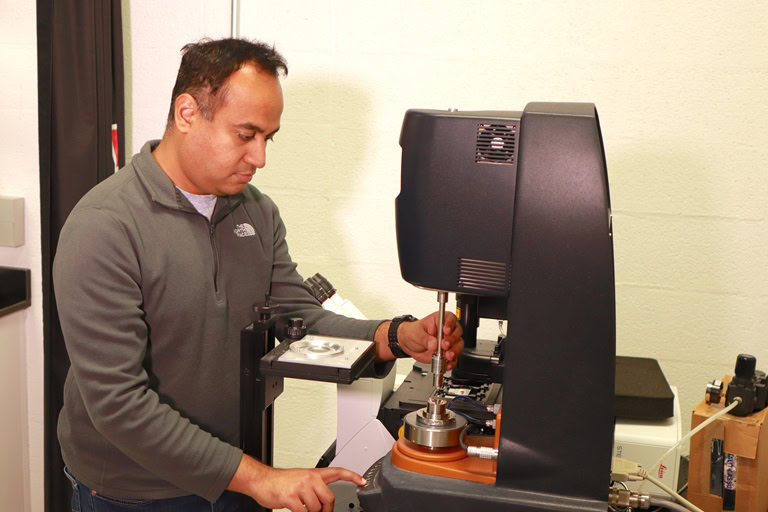
Photo: University of Pennsylvania
Much of their recent, grant-funded work studies the behavior of natural mud in debris flows — “catastrophic landslides,” as Jerolmack put it — but the baseball mud became a passion project after learning of its existence when approached by a journalist for comment in 2019.
The Bintliff’s mud is a quirky but essential part of baseball lore and logistics. It used to prepare every baseball to ensure the proper tack and feel of the ball. MLB has previously contracted with material science giant Dow to create pre-tacked baseballs, which were tried in the minor leagues but didn’t behave the way a traditional baseball does.
Mud procured by the Bintliffs is found along the Delaware River and is unique, even if it initially looks and feels the same, with Pradeep explaining, “When you try to spread it between your fingers, it looked and it felt like a face cream, like these clay masks we have you put on the face.”
“It allows you to spread a very thin and fairly uniform coating because it spreads so well,” Jerolmack added. “It makes this exquisitely thin layer.”
Based on published reports, the Bintliffs do treat the mud some, draining some water out to a certain consistency, sieving it to remove a particular fraction of larger particles and putting in a secret additive. The Penn researchers did some compositional analysis that identified the concentration of elements but not how they are combined. An area for further research is to examine the biological materials. They did note the product included “little bits of twigs and leaves and stuff because it’s actually natural mud from a real creek,” Jerolmack said.
“It behaves like a material that’s been optimized to do this,” he added. “They must have a very good working knowledge of this mud. . . . It appears that the ingredients don’t seem special, but the proportions of these ingredients are dialed in perfectly to make it have this behavior.”
The first of three tests conducted by Penn was the use of a rheometer, which measured its viscosity and found that it behaved similar to commercial skin creams. The second involved an atomic force microscope, which is essential a pin prick that measures the resisting force needed to pull the needle away — it assesses the stickiness of the substance, which Pradeep saying the Lena Blackburne mud-rubbed baseball was twice as sticky as an untreated ball.
The third test was the novel one involving the creation of artificial fingers for consistent force application. Pradeep and Chen used a silicone polymer called PDMS that has the same elasticity as human skin. They then added squalene, a fish oil that replicates what’s naturally found on fingertips. The scientists applied pressure on the baseball with these fingers and then created a shearing force by sliding the ball at various velocities.
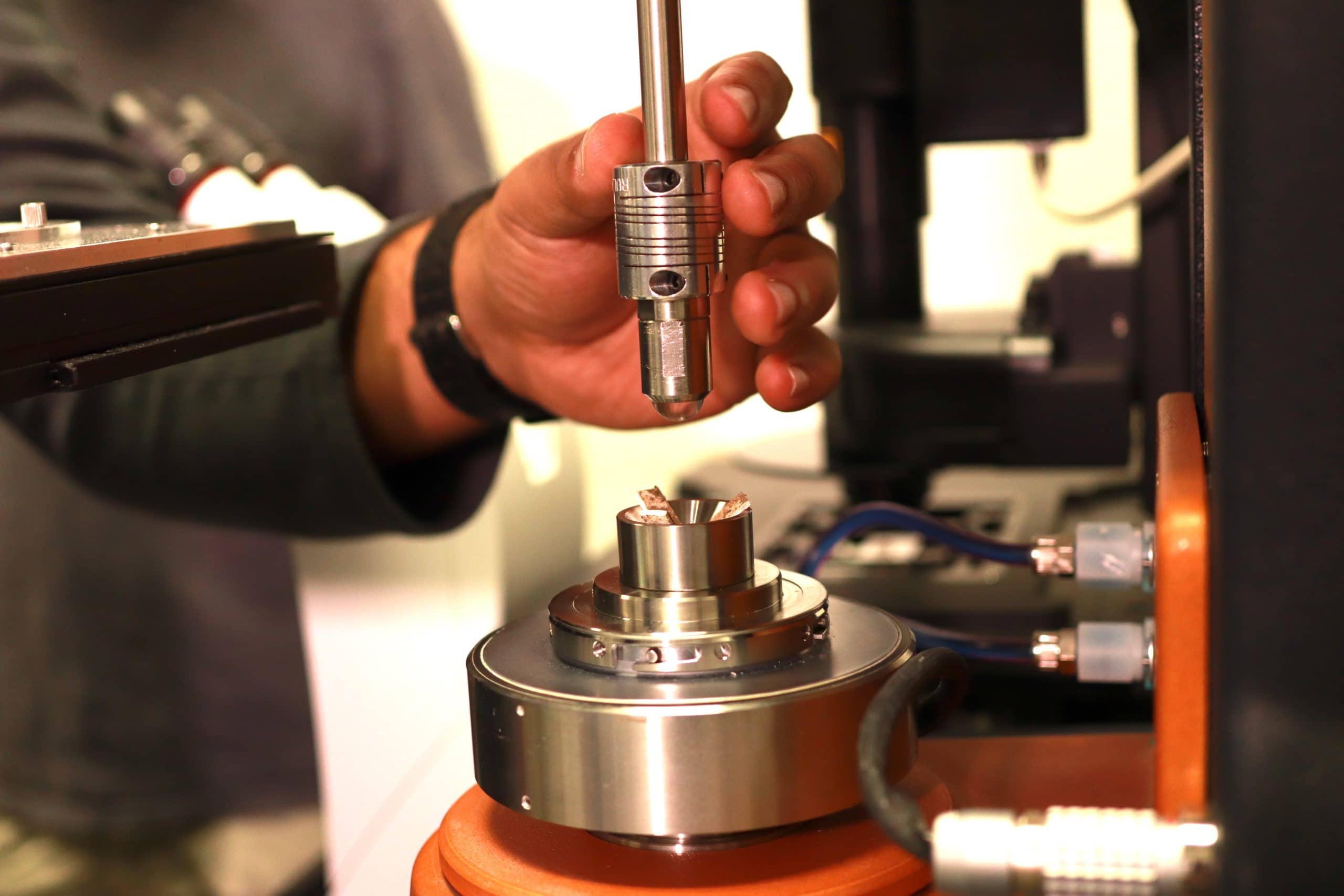
Photo: University of Pennsylvania
What they found was that the mud created only a small amount of friction at slow sliding speeds and that the friction disappears at very fast speeds, presumably because the small sand particles in the mud are knocked off the ball’s cover. But, in the Goldilocks zone in between the extreme speeds, the friction is notably enhanced by the mud.
“Over the past decade, we have worked with many types of cohesive mud, frictional mud, different type of muds that are out there,” Arratia said, “and in our experience, none of them has those properties that we saw with this particular mud.”
The researchers bought the mud and the baseballs on the internet and were not in touch with the Bintliffs to avoid any conflict of interest. They were just keenly interested in how the mud works more than any business implication of how their findings might affect the family business or the progress of a chemically enhanced, tacky ball.
But Jerolmack said his team ultimately did develop a stance — which was to endorse the continuation of the Lena Blackburne Baseball Rubbing Mud.
“It seems like the consistency of this mud has been more consistent than any other aspect of the manufacturing of these balls,” he said. “And our take now is that it’s 2024 and there’s a lot of people in material science and chemistry and other industries that are looking for sustainable and green solutions to replace synthetic and petroleum-based things. And here is a baseball tradition that is a material sustainably harvested, that’s replenished with the tides and takes very little of it to have this desired effect, and it’s a consistency for the pitchers — and I’m like, why would you try to change this?”
This article was brought to you by SBJ Tech, a Leaders Group company. As a Leaders Performance Institute member, you are able to enjoy exclusive access to SBJ Tech content in the field of athletic performance.
Dr Karl-Heinrich Dittmar of German champions Bayer Leverkusen is joined by Yael Averbuch West of Gotham City and Kitman Labs’ Stephen Smith to discuss the power of a data-informed performance strategy.
A podcast brought to you by our Partners

They demonstrated to Dr Karl-Heinrich Dittmar, Leverkusen’s Head of Medical, the optimal range of player availability to top the table during a meet in Dublin, four or five years before Die Werkself actually won the title.
“I kept this data; and last year we did it,” Dr Dittmar told the Kitman Labs podcast with evident pride. It turns out the data scanned almost perfectly across the numbers posted by the club during their unbeaten title-winning campaign.
“They found out what we need from the medical point of view, from player availability, and it was perfect – the data predicted what would happen in the future.”
It demonstrated the value of clean, consistent datasets – something that has given Leverkusen an edge over more celebrated rivals – and something that Yael Averbuch West is trying to build in her role as GM at 2023 NWSL champions Gotham City.
“We’re still in the data collection stage in the women’s game,” she tells the podcast, while also explaining that the work to bridge that gap is well underway in this corner of New York City.
In the third and final episode of this series, West and Dr Dittmar are joined by Kitman Labs Founder Stephen Smith to discuss how data strategies can help teams in their quest for greatness.
Elsewhere, the trio discuss a range of topics, including why learnings tend to emerge as data collection grows ever more sophisticated [17:30]; the importance of a centralised system for consistency [24:15]; the balance between using data to unearth ‘hidden gems’ and jumping on something misleading [33:00].
Episode one is available here and episode two is available here.
Further listening:
Kitman Labs Podcast: ‘Women Players Need to Feel Safe and they Need to Have Access to Support’
Listen above and subscribe today on iTunes, Spotify, Stitcher and Overcast, or your chosen podcast platform.
Former NFL star Greg Olsen discusses the second season of his show with Michael Gervais, Youth Inc., and the apps helping young athletes with their mental health.
You can’t have a discussion about sports technology today without including athletes in that conversation. Their partnerships, investments and endorsements help fuel the space – they have emerged as major stakeholders in the sports tech ecosystem. The Athlete’s Voice series highlights the athletes leading the way and the projects and products they’re putting their influence behind.
* * * * *
Former NFL TE Greg Olsen has stayed busy since retiring from the league after the 2020 season. He made a fresh name for himself as Fox Sports’ lead NFL color commentator over multiple years, and now anchors the network’s No. 2 booth following its addition of Tom Brady. In 2022, he partnered with former Panthers teammate Ryan Kalil, actor Vince Vaughn and LA-based venture firm Powerhouse Capital to launch podcast production house Audiorama, which has since spun off youth-sports-focused interview show Youth Inc. into a media company that is adding a digital commerce platform in 2025 and raised $4.5M earlier this year. On top of it all, he is also a dad and youth football, basketball and baseball coach.
“It’s hard,” Olsen said of juggling those responsibilities in a recent interview. “I try to coach one season per kid.”
The first episode of season two of Olsen’s Youth Inc. Podcast releases today with a new co-host in sports psychologist Dr. Michael Gervais. Earlier this week, SBJ Tech caught up with Olsen to discuss Youth Inc., working with Brady and sports technology trends that interest him.
On what to expect from season two of the Youth Inc. Podcast…
Season one was really almost testing the market. When we approached season one, our plan was, let’s cast a wide net, let’s have a big variety of conversations with all different aspects of the youth sports experience – whether it’s parents, coaches, Olympians, professional athletes, college, sports psychologists, performance coaches. Every aspect of what the landscape looks like, let’s have surface-level conversations, cast a wide net, and let’s test the interest level, let’s test which areas of the system people most gravitate to and respond well to.
It became very evident through those 40-some-odd episodes that there were certain areas that people had strong interest in. Season two is going to be a lot more of hyper-focused episodes that are more of a deep dive into different conversation with guests, but all have the same storylines.
For example, me and Dr. Michael Gervais, who’s one of the leading sports psychologists in sports from the youth level all the way up through professional athletes and Olympians – I met him when I played for the Seahawks and have gotten to know him – we sat down with a bunch of different guests. And while the conversations all covered different sports, different ages, different levels, different detail, they all had common threads around mental health, sports performance anxiety, best practices of parenting youth athletes, best practices for being a youth or college or professional athlete.
View this post on Instagram
On how technology is changing youth sports…
It’s a great question, and obviously [with Youth Inc.’s digital commerce platform] we’re trying to tackle one of the big areas, which is a very complicated and fragmented e-commerce experience. We spend all week very much on our phones or on our computers with the ability to process buying in a seamless one-touch, whether it’s Fanatics, or Amazon, and all these big e-commerce platforms that we’ve all become very accustomed to. And then when it comes to, you know, buying a hoodie for your kid’s middle school football team, it seems like you’re jumping through hoops.
With sports performance and mental health, there’s a lot of good apps and programs that people are investing in that are right on kids’ phones, take them step by step through performance anxiety, best steps to handling pressure, the best steps of handling failure – and they’re almost bringing a mobile sports psychologist into the palm of their hands. There’s scheduling apps that best process how to pick the best baseball tournaments and best volleyball tournaments. [The technologies are] all geared towards – yes, capitalizing on a big market, capitalizing on a big opportunity financially – but more so just trying to make the experience better.
On working with Tom Brady at Fox…
It’s been great. We’ve had a good relationship, and obviously we’ve had a lot of conversations as he’s transitioned to this role. He’s been really good to work with, super humble and open-minded to asking questions and wanting to learn and realizing that when you start anything new – it’s no different than when I first started – you don’t know what you don’t know. I give him a lot of credit. He’s been very upfront and humble and honest about wanting to learn and wanting to get advice from other people. And you’re talking about the best guy who’s ever played the sport. So, it’s a credit to him. I’m sure if you asked him, he feels a lot better now than he did in Week 1, and he’ll feel a lot better in five weeks than he did yesterday, and that process just continues to get more and more comfortable the longer you do it. No different than how it was when we all first came in the [NFL] as players. There is a learning curve and there is a process of getting comfortable as time goes on.
View this post on Instagram
On the keys to his transition from player to broadcaster…
Early on for me, what I tried to remind myself is: there was no learning curve for football. I knew football. The learning curve came through the technical part. The learning curve came through communicating on live broadcasts and communicating with producers in your ear and understanding replay sequencing and all the specific things to a broadcast were where I had to do a bunch of my learning.
To this day, I don’t know exactly all the camera angles, official names. When I ask for a replay, I’m probably calling it the wrong name, but they by now know what I’m talking about… At the end of the day, when you get your 20-second sound bite to get in there, talk about what you know. We’ve lived this sport our whole lives. We know it. We see it. Describe it to someone at home in a way that keeps it interesting, keeps it informative. The complexity of football is what makes it so special. But also you can’t talk like you’re in the locker room. You can’t talk like you’re talking to another 20-year veteran at the position. So, there is a little balance.
To sum it up, keep the football part. That’s the part you know. Don’t let the transition of the technical broadcast component paralyze you. At the end of the day, you’re talking football. Don’t complicate it. Talk what you know. Talk what you see. You can figure out the mechanics of a broadcast, figure out the mechanics of television along the way.
On the NFL’s in-game authorization of Guardian Caps in 2024…
I think anything that can continue to improve the health and safety of players while keeping the game the game is something worth looking into. So, I’ll always be a supporter of any of that.
I think helmet technology has come such a long way. I mean, I look back, I had my rookie year Chicago Bears helmet and when I look on the inside, let alone when I look back at what I wore in high school compared to what I wore at the end of my career, you talk about the technology growing and getting better with time. And then you factor in what the Guardian Caps are able to do and the extra layer. I know everybody wears them in practice. And I’m sure there’s some adjustment getting used to it. But I think everybody has the decision, what helmet they wear, whether they wear the Guardian Cap in practice or also in the games.
I don’t know if I would wear one. Obviously, I’m probably on the older side. By the time it was introduced I was like that ‘can’t teach and old dog new tricks’ kind of person. But for guys who wear it, I’m sure there’s a level of comfort, a level of protection. I wouldn’t be shocked if some of that technology Guardian is developing gets incorporated into some of the helmet design, and one day you get the combination of both things all wrapped up in one.
This article was brought to you by SBJ Tech, a Leaders Group company. As a Leaders Performance Institute member, you are able to enjoy exclusive access to SBJ Tech content in the field of athletic performance.
We bring you the views of the International Football Group’s Paul Prescott, Aarhus’ Morten Larsen, who sees one of Denmark’s best academies up close, and Kitman’s own Stephen Smith.
A podcast brought to you by our Partners
It wasn’t always thus. “English clubs were basically funding talent development models in Spain or in Brazil because English talent wasn’t seen to be at the same level as players from those countries,” Paul Prescott, the Managing Director of the International Football Group, told this Kitman Labs podcast.
That situation persisted until recently and is starting to change in part due to the introduction of the Elite Player Performance Plan [EPPP] in 2012.
“We are seeing that some of the decisions that were made maybe 10-12 years ago are beginning to bear fruit,” added Prescott, who was joined by Morten Larsen, the Head of Methodology & Development at Danish Superliga club Arhus, and Stephen Smith, the Founder of Kitman Labs.
Aarhus share the Premier League’s emphasis on talent development, albeit in different circumstances, as Larsen explains [5:30].
“Denmark is a small country and the league is a small league,” he says. “So there’s only one thing we can do to compete with the other clubs in Europe.”
Elsewhere, Smith sets out the differences in approach between leagues and clubs [16:25]; Larsen explains the impact of data on decision-making processes in the Aarhus academy [24:10]; and Prescott ponders whether EPPP was an outcome or a catalyst [36:30].
Listen above and subscribe today on iTunes, Spotify, Stitcher and Overcast, or your chosen podcast platform.
Prevent Biometrics’ new device has been introduced to augment World Rugby’s Head Impact Assessment protocol and lay the groundwork for long-term study of head impacts in contact sports
Main photo courtesy of World Rugby
It’s why he calls Prevent’s sensor-embedded mouth guards, which track linear and angular accelerations, providing what experts say is a more accurate measure of head impact than other methods such as helmet sensors, “the most important technology in sports.”
“We’re the data. We are not diagnostic,” Shogren said. “But if you don’t have the data, you can’t do much.”
As a focus on head impact reduction in collision sports — e.g., the NFL’s in-game authorization of Guardian Caps for this season — grabs headlines domestically, Prevent and years-long collaborator World Rugby are embarking on their largest data collection effort on the subject yet, and on a global scale.
Since January, World Rugby required that athletes competing in its elite-level competitions wear Prevent’s instrumented mouth guards, a deployment that will ultimately encompass 8,000 players. The aim: to both augment World Rugby’s Head Impact Assessment protocol and lay the groundwork for long-term study of head impacts in contact sports.
Dr Joe Maroon co-developed the ubiquitous ImPACT concussion management protocol, worked as the Pittsburgh Steelers’ team neurosurgeon for more than three decades and is now a Prevent adviser. He said World Rugby is “leading the charge” in concussion management, adding that smart mouth guards could eventually permeate contact sports such as American football, wrestling, lacrosse and soccer.
“We took ImPACT and other management tools to World Rugby 10, 15 years ago,” Maroon said. “World Rugby now is bringing another tool back to the sports in the United States.”
■ ■ ■ ■
The mouth guard mandate necessitated a $2.4 million investment from World Rugby, which covered fitting (via teeth scans), producing and delivering the gear, plus equipping teams with support staff to help operate the technology and analyze the data collected. The custom-fit mouth guards typically price between $225 and $250, Shogren said.
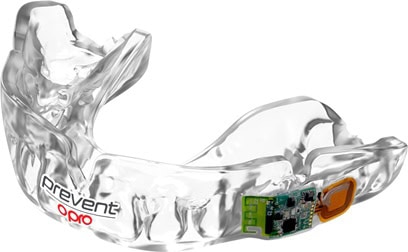
The mouth guards detect hard impacts as an early warning of possible concussions. [Photo: Prevent Biometrics]
“To draw any kind of meaningful analysis, you need to have hundreds of these [concussive] events, not tens,” said Falvey. “Our first priority at the moment is making sure the [impact] threshold is as clinically relevant as it should be.”
Prevent’s mouth guards trigger a Bluetooth alert upon registering a linear or angular acceleration above thresholds set by World Rugby, at which point the player is pulled from the game to undergo evaluation for a possible concussion. (Players can still be flagged for assessment based on observable clinical symptoms, independent of the mouth guard.)
“We’re not using this as a concussion detection device. We’re using it as a device that picks up a large impact,” Falvey said. “A concussion actually is a clinical diagnosis. There’s more to it than just an impact. There’s how the player is, what their previous exposure is, what their age is, what their concussion history is.
“It’s never going to be just about the impact. But that impact is putting the right players in front of us to have a look at.”
So far, unique alerts triggered solely by a mouth guard are adding an average of one extra stoppage every three games, he said. He added that 43% of total concussions logged across World Rugby competitions have triggered a mouth guard alert, and 35% of mouth guard alerts have ultimately correlated with a concussion diagnosis. According to Falvey, that 35% rate is in line with other individual subtests within the head injury assessment protocol, which include assessments of symptoms, memory and balance.
The hope is that having as many guardrails as possible in the protocol will continue to increase its overall accuracy and mitigate cases in which athletes continue to compete with a concussion. Citing research conducted by the University of Pittsburgh, Falvey noted that every 15 minutes a player continues playing after a concussive event, their recovery time is lengthened by three days. That comes with medical risks — for example, issues with non-resolving concussions — and, of course, the business impact that dovetails off player absences.
“None of the subtests on their own are fantastic, but the diagnostic accuracy of the HIA protocol [as a whole] is about 88%,” Falvey said. “That’s as good as an MRI for tendinopathy in your shoulder. When we are able to look back on this year, we feel this is going to have improved the accuracy above 88%. It’s another piece, which is as good as any of the other subtests so far.”
■ ■ ■ ■
Ultimately, World Rugby hopes to leverage the wealth of impact data it is collecting, high-impact and otherwise, to inform rule changes or best practices for competition and training. Falvey cited a dataset of 35 players who play the same position from a recent competition as an example.
“One player was getting nearly six times the number of impact events that a player in their position was getting in the same tournament,” he said. “It may be that they’re involved in more tackle events. But it also might be that their technique isn’t as good as it should be. Doing something about that can significantly improve that player’s health and welfare and make playing the game safer.”
Falvey will present findings from the first year of the mandate in early 2025 at a meeting of the International Collision Sport Group, a collection of collision sports medical leaders, including from the NFL and NHL.
“It’s a scenario where everybody helps everybody out in this space,” Falvey said. “It’s all about getting to the right answer as fast as we can.”
This article was brought to you by SBJ Tech, a Leaders Group company. As a Leaders Performance Institute member, you are able to enjoy exclusive access to SBJ Tech content in the field of athletic performance.
The former NBA small forward talks to SBJ Tech his new tool, which helps players to shot and offers instant feedback.
Main photo courtesy of Form
You can’t have a discussion about sports technology today without including athletes in that conversation. Their partnerships, investments and endorsements help fuel the space – they have emerged as major stakeholders in the sports tech ecosystem. The Athlete’s Voice series highlights the athletes leading the way and the projects and products they’re putting their influence behind.
* * * * *
Even though he was an above-average shooter — Hayward hit 1,111 career three-pointers at a .370 rate, and his .950 playoff free-throw percentage is No. 1 in NBA history — he kept seeking new ways to improve, which led him to an entrepreneur named Charlie Wallace. Hayward, 34, and his former Butler teammate, Emerson Kampen, acquired most of Wallace’s company, redesigned a few things and rebranded it as Form, which they launched this month.
Form makes a basketball shooting aid. The product is a flat-sided cube whose shape helps encourage proper shooting form and the development of muscle memory. The pro ambassadors for Form are nine-time NBA All-Star Paul George and the WNBA’s Lexie Hull, who’s currently a starter for the Indiana Fever.
On how he got involved with Form . . .
The creator of Form was this guy named Charlie Wallace, who created what was called Qube. I’m somebody that’s kind of a perfectionist, and I was scouring the internet looking for something for hand placement on a basketball and where to position it. And I came across Charlie’s YouTube and saw this device, saw him shooting it, and thought, ‘I might as well try it out.’ So I ordered one for myself. He came across on his sheets that Gordon Hayward bought one, so he messaged, asking if it was the real Gordon Hayward — it was.
I got the product. Then he sent me his number. We talked and chatted about it. Then we decided — my partner and I, Emerson Kampen — that we wanted to push forward with it and rebrand and relaunch the company. We designed a few different things about it and changed some stuff a little bit, and here it is now.
On the target demo for the product…
It was something that I loved using during the last couple years of my career, and I felt like this was a product that could really help a lot of young kids, especially. It’s really a tool that’s geared more towards younger kids that are just [wondering], How do you learn how to shoot? How do you shoot a basketball? You would start with a tool like this. I have young kids myself and felt like it was something that could really help them.
On what interested him originally…
For one, I saw Charlie, who’s this unassuming, middle-aged guy just draining jump shots from almost half-court. And it was like, ‘What is he doing?’ Shooting it straight every time. The ball is rolling back to him.
Now, at this point in time, I obviously still was a good shooter, and it’s not like I wanted to change my shot at all, but certainly felt like I used my left thumb a little bit and wanted to perfect it even more. So I think that’s what initially sold me on it, and then once I got it, just [saw] how simple it was. I used it more shooting around the house than anything. I didn’t really shoot it on a goal. I would warm up with it on a goal, especially during my offseason workouts, but more than anything, it was something that, I could be on the couch and just shoot over and over and over. It just locks in your form.
You can’t be on the basketball court at all times. But you’re sitting around watching TV and you’re just shooting this thing up and down on the couch. If you’re thinking about basketball and thinking about your shot and thinking about your game, it’s something that you can do, like I said, not even on a court. And that was another thing: I know a lot of people don’t have access to courts all the time, and you can use this anywhere and everywhere.
On whether he always wanted to become an entrepreneur…
I honestly didn’t ever think about it. I wanted to be a basketball player, and I was blessed and lucky enough to be able to play in the NBA and have a long career in the NBA. And I was just thinking each year about how I could get better as a basketball player, and this kind of fell into my lap. As I got older and older, you do have to start thinking like, at some point in time, this is going to end. The NBA always has a lot of meetings about that, and they’re trying to help players because your career is usually a lot shorter than you think it will be. And so you’ve got to have something that you can do afterwards.
This was something that fell into my lap, but it’s something that we quickly became passionate about because it allows me to still be around the game and help young kids learn how to shoot and but it’s also the other side of it. It’s the business side of it, and that’s fun. Obviously business is competitive. It gives you a chance to compete.
On his other post-basketball business interests…
My portfolio, in general, I wanted to make sure it had a lot of variety in it. I just also released a movie — I was the producer of a movie. So that’s another thing, and it certainly has helped me. As preseason games get started, I’m kind of missing it a little bit, but this has helped me bridge that gap. They always say retired athletes start to get bored and all this, but this has helped me jump right into it.
On the first film from his production company, Whiskey Creek Productions…
We made the movie [Notice to Quit] in September of ’21, over the course of that year. I was obviously still playing, so I wasn’t extremely involved on a day-to-day standpoint, but as the producer, I was sent dailies. I was able to go to Skywalker Sound and do some editing there, and I think, moving forward in the future, I would love to get more involved with that as well.
On other shooting tech…
I used Noah when it first came out. My shot was actually pretty flat, and we used that for a little bit just to work on the arc of my shot. Noah is good because you want to be consistent in your shot more than anything, and it helps you just realize your arc is not as high as you think it is. And so I used that. We used the gun when I was in high school — the gun is just the thing where you’ve got the nets that go right around the goal, and when you shoot it, the balls drop down, and then it passes it back to you.
On how youth can learn to shoot…
Another thing I thought was really amazing about Form: There’s never been and there’s not really a tool that helps you learn how to shoot. A lot of tools these days are data-driven, and they’re showing you all the data about your shot, the arc, the rotation of the basketball, the depth, how far you’re shooting it. It counts your misses and your makes, and all that stuff is really good, but it doesn’t help you learn how to shoot. It doesn’t tell you about your form.
There’s so many tools in other sports, like golf and baseball, for example, that everyone’s all-in on and learning to do the fundamental part of whatever you’re trying to do. [Basketball tools] show you your data, but they can’t help you fix it. You would have to do that on your own. This, if you don’t shoot it the right way, it’s going to spin because it’s a cube. It’s not going to spin on that singular axis. And so if you do it correctly, you see its instant feedback. You see it right away. It spins beautifully, and if it’s not, it’s going to be wobbly.
This article was brought to you by SBJ Tech, a Leaders Group company. As a Leaders Performance Institute member, you are able to enjoy exclusive access to SBJ Tech content in the field of athletic performance.
As Fabio Serpiello of Central Queensland University suggests, a structured approach to innovation – and a supportive environment – could be the critical edge.
“One of the issues we have in our organisations is that sometimes that definition is not set at the beginning; and that creates problems,” said Professor Fabio Serpiello, the Director of Sport Strategy at Central Queensland University in Australia.
“If there are different expectations of what ‘innovation’ is and they are not discussed properly – I don’t want to say ‘agreed upon’ but at least discussed – then we can have an issue appraising the results of innovation.”
It is just one of the pinch points discussed in the first instalment of this three-part virtual roundtable series titled ‘How to Approach Innovation’.
Serpiello, having previously served as Director of Sports Innovation at Victoria University in Australia, is the ideal host for a discussion based on the challenges facing Leaders Performance Institute members in this space.
In the first session, the group explored how a structured approach and supportive environment can make all the difference.
What innovation meant to the group
There were some common definitions:
The difference between creativity and innovation
The idea of putting creativity into practice chimes with the work of American psychologist Daniel Goleman, who alighted on distinct, but interconnected, definitions for each. Serpiello shared them in his presentation:
Creativity: defined by Goleman as the generation of new and useful ideas. It involves the ability to think outside the box and produce original concepts, whether they are ideas, products, or performances.
Innovation: defined by Goleman as the successful implementation of those creative ideas. It’s not just about having a great idea, it’s about executing that idea effectively to create value. To do that, the environment must support those tasked with innovation.
The last point about organisational support is critical: creativity can happen without innovation, but innovation can only follow creativity.
Greg Satell’s Innovation Matrix
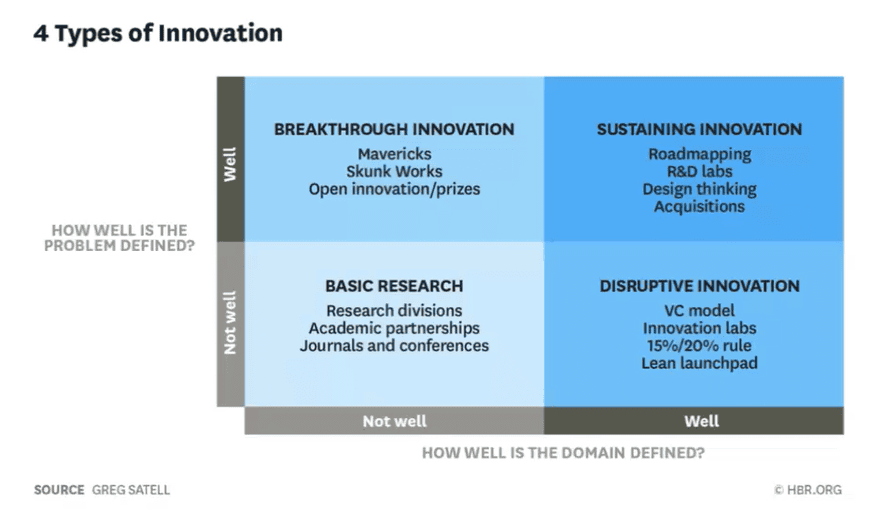
As leaders, we can better support innovation in our teams when problems are clearly defined and the skills needed to solve them are just as well defined. This is because effective problem-solving and innovation requires a suite of strategies tailored to the specifics of a challenge.
To address this challenge, Serpiello cited business and organisational consultant Greg Satell’s Innovation Matrix, in which he outlines four distinct types of innovation:
The group wrapped up the session with some reflections on their persistent challenges and the steps they can take to address those.
Identifying performance challenges can be tricky: Problems need to be clearly defined; and yet numerous organisations struggle with this initial step, which can lead to misaligned efforts and ineffective solutions. What specific challenges do you currently face? Which type of innovation might be most applicable?
Practicality can be elusive: Creativity is essential but must always be aligned with practical outcomes that address real-world problems faced by athletes and coaches.
Collaboration is crucial: Collaboration between end-users and innovators is essential in ensuring that relevance and practicality. Without this, there can be an over-reliance, as one attendee observed, on disruptive innovation.
Assess your skills and resources: Evaluate whether you have the right skills and resources available to address the problem. Do you have the in-house expertise or might you require external help?
Encourage open discussion: A collaborative approach can lead to a richer understanding of the challenges and potential solutions.
Integrate research into practice: Can research and innovation strategies be integrated into daily training environments? This helps solutions to progress from the theoretical to applicable in practice.
Avoid silos: As one attendee pointed out, there is a risk in assigning multiple innovation responsibilities to a single individual. This can lead to inefficiencies. The answer lies in greater collaboration.