The Olympic gold medalist is sits down with the Athlete’s Voice to discuss her new venture with Always Alpha
Main photo: Always Alpha
A Data & Innovation article brought to you by

You can’t have a discussion about sports technology today without including athletes in that conversation. Their partnerships, investments and endorsements help fuel the space – they have emerged as major stakeholders in the sports tech ecosystem. The Athlete’s Voice series highlights the athletes leading the way and the projects and products they’re putting their influence behind.
* * * * *
The Los Angeles native competed in the 100, 200 and 400 meters, with an individual gold at the 2012 London Games in the 200. Felix also won 21 medals in the world championships before retiring at the end of 2022.
Felix has been active across a wide range of interests in recent years, as an advocate for Black maternal health, as the Co-Founder of women’s footwear brand Saysh and, as of today, the Co-Founder of Always Alpha, the first talent management firm exclusively dedicated to women’s sports.
For Always Alpha, Felix partnered with her brother, Wes — a former elite runner who has served as his sister’s agent — as well as former Wasserman executive Cosette Chaput and Dolphin Entertainment CEO Bill O’Dowd. Always Alpha is a subsidiary of the NASDAQ-listed Dolphin and will work with women athletes across all sports and support them in a variety of ways, including brand partnerships, media production and entrepreneurship.
On the motivation to start Always Alpha…
What led to it really was my experience in my career. My brother managed me, and we really had to kind of piece things together. There wasn’t really a cohesive strategy starting out to bring all the things that I was interested in and make all the work seamless. And so we had missteps and struggles, and when other athletes would come to me and ask, ‘How did you do this or that?’ Or how to start a company, or if they were interested in writing a book — whatever the thing is — where do I point them where they can do all the things and show up as themselves?
That was the inspiration — that it didn’t exists — and especially something focused on women’s sports, obviously, with all the momentum that we have now, but I think there’s just a unique way that you show up for a woman, and so we are excited to do that at Always Alpha.

Photo: Always Alpha
On an example of the marketing challenges she faced…
It was an idea of always wanting to get outside of track and field and break through to the mainstream. That was always the big fight. I felt like, through my career, we learned so much, and I always told Wes, ‘I wish we could do it again.’ Now we have all the pieces, and we have the things to take advantage of, the relationships and all of that. That would have made that path so much easier, as I was interested in business, and it just wasn’t there.
Now that I understand things so much clearer, I feel like a big piece of this is this legacy and mentorship. And how do I give back? And I really see this as a vehicle, also, to be able to do that and to say, ‘Let me help you avoid some of the hardships that I went through.’
On connecting with Dolphin to launch Always Alpha…
Cosette and I met working on the LA bid in 2016. Then we met Bill from Dolphin [earlier this year], and he really just shared the vision. He understood that what we were trying to create didn’t exist and that we needed to have something fully focused on women.
It was just being aligned — Wes, myself, Cosette — and talking to Bill. He got it. And that doesn’t always happen. So to be able to bring this into the world at scale, and to be able to have amazing resources that Dolphin provides is a unique experience.
On Allyson’s daily role with the agency…
It’s really that piece of guidance and [having], conversations with athletes and coaches broadcasters about, not only my experience, but what are their goals and what would they like to achieve? Being that piece of it, but also on a personal level, being available, being an open book and transparent about my journey and how I can help others with theirs.
On the roots of her entrepreneurship…
It’s funny — growing up, Wes and I used to collect things around our house, and then we would create a store and actually sell back our family’s items to them. And so we’ve always had that bug. We had a lemonade stand — it was actually a Kool-Aid stand — on our lawn. So we always had that spirit in our family, but we also weren’t really exposed to it in a real way. We didn’t know people close to us who had done it, and so being two kids from the inner city of LA, it didn’t really ever seem like a real possibility.
It wasn’t until right before starting Saysh [that we found] the confidence. I struggled with imposter syndrome, all those things, but getting the courage to just go for it. Launching Saysh was like, ‘OK, we can do this.’ To me, this is the next step in that journey that I’m on, just to make things better for women and make it an easier path.
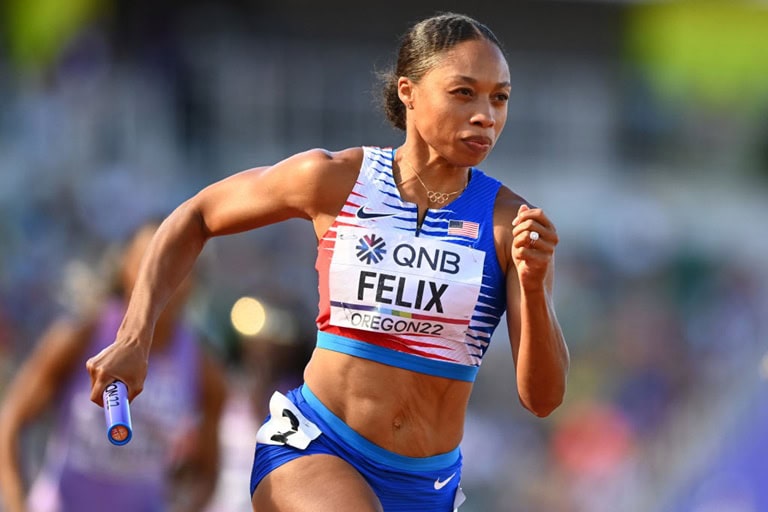
Photo: Hannah Peters/Getty Images for World Athletics
On preparing for a post-competition career…
It was such a natural progression with Saysh because it happened organically. At that point, I wasn’t really focused on what was the next thing. It was, ‘Well, I don’t have shoes, and I need them, and so we’ve got to build this thing.’ Throughout my career, Wes was always really hounding me on, ‘You need to make these connections and these relationships, and we don’t know what it’s for, but it could be useful later on.’ And so I was really heavy into that and into mentorship. I wasn’t sure what the thing was going to be, but I was constantly trying to prepare for my next move.
On her mentors…
Jackie Joyner-Kersee has been my athletic mentor, and she’s been incredible. Mary Erdoes has been someone who has been really just transparent — one of those relationships that I didn’t know where it was going, but she’s provided so much business advice to me through the years, but early on in sport, she’s just shown up for me.
Yesterday, I was speaking at the NASDAQ Forum, and Fawn Weaver was one of the other speakers. Fawn has also been incredible in my life, helping me with that confidence piece, as someone who’s built an incredible business with Uncle Nearest, but just showing up in my real life and being that sounding board for me. I’m huge into mentorship. I think that if you haven’t done something before, talk to someone who has.
On the tech that she and coach Bob Kersee used to help her training…
That’s another one of those ‘I wish that I was at my prime now’ because I think there’s so many more tools, but we used a lot of filming and models — overlaying a model on top of the film that we take. You can set those models to like a world-record pace, and you can look at all of your mechanics. You can learn so much and adjust your [joint] angles and different things from that. So that was a huge piece while I was training that was helpful.
This article was brought to you by SBJ Tech, a Leaders Group company. As a Leaders Performance Institute member, you are able to enjoy exclusive access to SBJ Tech content in the field of athletic performance.
NFL Player Health & Safety Innovation Advisor Jennifer Langton sets out the ways in which AI, AWS and the NFL’s Digital Athlete Program has had a positive impact.
Main Photo: CNBC
A Data & Innovation article brought to you by
Lower-extremity injuries have become a major focus for the league, with the first two weeks of preseason training camp – a period of re-acclimation to the sport – as the period of greatest risk, yet for the first time ever, the NFL saw a reduction in leg injuries in consecutive summers.
NFL Player Health & Safety Innovation Advisor Jennifer Langton shared that finding on stage at CNBC Evolve: AI Opportunity in New York City in October. She attributed that success, as well as changes to the kickoff rule, to the league’s work with AWS on the Digital Athlete, in which data about every rostered player on every team is anonymized and analyzed. Positional benchmarks are shared league-wide to help inform player training and usage.
“When you can integrate and aggregate data across all 32 [teams] for all 53 [players], you have more power in the data that you are generating to model,” said Langton, who for years helped lead player health and safety efforts as an SVP in the league office before leaving her full-time position for personal reasons in August.
Other work Langton highlighted was the use of computer vision triangulated with the Next Gen Stats RFID sensors to calculate the severity of head impacts, which for the first time last year was distributed to offensive and defensive line coaches on a weekly basis so they can “put in injury prevention strategies to get the head out of the game,” she said.
The reformatted kickoff was a direct result of the league’s biomechanical consultants at Biocore collaborating with AWS to run 10,000 seasons’ worth of data on rule variations to determine the best combination of a rule change that would be safe but also encourage on-field excitement.
The NFL has crowdsourced innovations in computer vision and worked with AWS on collecting more accurate tracking data. The investment in data capture is paying dividends and, Langton noted, will expand in the future to full-body limb and joint tracking. It has been a challenge to get the necessary precision for actionable insights, particularly with the high rate of occlusion in a contact sport like football.
“With the new AWS deal, that’s the focus, to build that pose estimation so that we can get to that true Digital Athlete on quantifying body movement,” Langton told SBJ in a post-panel interview.
Much of the efforts to date have been in creating operational efficiencies. A half-dozen years ago, for example, staff would take four days to manually tabulate head impacts through painstaking film review. That’s now done in real-time. Similarly, injuries would be listed in the league’s electronic medial records database as happening only in a particular quarter, so officials would have to review game film to find the specific cause. Now, those injuries are automatically tagged with a clip of the play in question.
“The infrastructure and the data to fuse that together is power,” Langton said of the work with AWS. “If you can standardize them and then synchronize, then we can integrate and aggregate across the league.”
The acclimation period was instituted in 2022, with leg injuries down 27% in 2024 compared to the year prior, in 2021. Langton had noted that the league saw declines in consecutive years for the first time.
“The decrease in the lower extremity injuries that we saw in the preseason last year led to the savings of more than 700 games that players did not miss during the regular season,” Miller said. “And so those benefits of the fewer hamstring strains or soft tissue injuries pull through into the regular season. Those injuries don’t recur as often, and the fact that the players don’t suffer the injuries in the first place mean that they’re healthier for the regular season.”
The new dynamic kickoff helped encourage 70% of kicks to be returned in the preseason, up 15% from last year. The injury rate on those played declined by 32%, with Miller noting that player speeds — which are calculated by the Next Gen Stats RFID chips in players’ shoulder pads — were about 20% lower on average in the reformatted version of the kickoff, in which most players line up 5-to-10 yards away from each other.
“Because we eliminated some of the space and therefore decreased some of the speeds, that led to a substantial decrease in the injury rate,” Miller said. “In fact, we saw zero ACL injuries on the kickoff. We saw zero MCL injuries on the kickoff. And those huge time-loss knee injuries are going to substantially save a lot of players, a lot of time.”
This article was brought to you by SBJ Tech, a Leaders Group company. As a Leaders Performance Institute member, you are able to enjoy exclusive access to SBJ Tech content in the field of athletic performance.
Springbok Analytics uses AI to create a tool with the potential to help all 450 players.
A Data & Innovation article brought to you by
A graduate of the NBA Launchpad, Springbok Analytics has been scanning players for more than three years and has grown its team partner list to 10. To date, performance and medical staffs had used the product to detect muscle asymmetries and fatty infiltrations into the tissue, both of which can be early signs of injury risk.
But teams didn’t gain value from Springbok’s normative database because, even though there is a large proportion of elite athletes to go along with recreational competitors, most NBA players are outliers for their height and ability.
Utah Jazz Director of Performance Science Barnett Frank said the new NBA database “allows us to really be a little more strategic with our information.”
“One of the biggest challenges I have in the space is always getting asked, ‘Well, what does that mean for an NBA player?’” he added. “There’s 450 of them. When we’re comparing them to the general research or what’s out there in the population, it’s really hard to make any specific conclusions for them. So knowing that it’s NBA-specific for us, that really gives me a little more juice, for lack of a better term.”
This feature has been requested by teams for a while, said Matt Brown, Springbok’s Director of Sales & Business Development.
“It’s the first time they’ll really use the comparison mode,” he said. “Now they’re going to have a better pathway forward of team-wide analysis, understanding how strength and development is working for their players, and what metrics that means, and what that looks like, and is there an attainable phenotype that they’re going after in comparison to other players?”
Brown added that other sport-specific databases are in the pipeline. A pro soccer database is next — consisting of players from MLS, the English Premier League and Championship and other European leagues — and slated for this fall. American football would follow that, primarily of college football players who participated in the NFL-funded hamstring injury research study. Similar datasets for women’s soccer and the WNBA are also progressing toward possible 2025 launches.
In 2023, Springbok Analytics was one of SBJ’s 10 Most Innovative Sports Tech Companies and also won Best in Athlete Performance Technology at the Sports Business Awards: Tech. Nominations have opened for this year’s awards, with the nomination window closing on Oct. 21. You can review the categories and make nominations here.
This article was brought to you by SBJ Tech, a Leaders Group company. As a Leaders Performance Institute member, you are able to enjoy exclusive access to SBJ Tech content in the field of athletic performance.
In the latest edition of SBJ Tech’s Athlete’s Voice series, champion triathlete Matt Hanson discusses his approach to AI, both as an athlete and a coach, as he prepares for the world championships in Kona in October.
A Data & Innovation article brought to you by
You can’t have a discussion about sports technology today without including athletes in that conversation. Their partnerships, investments and endorsements help fuel the space – they have emerged as major stakeholders in the sports tech ecosystem. The Athlete’s Voice series highlights the athletes leading the way and the projects and products they’re putting their influence behind.
* * * * *
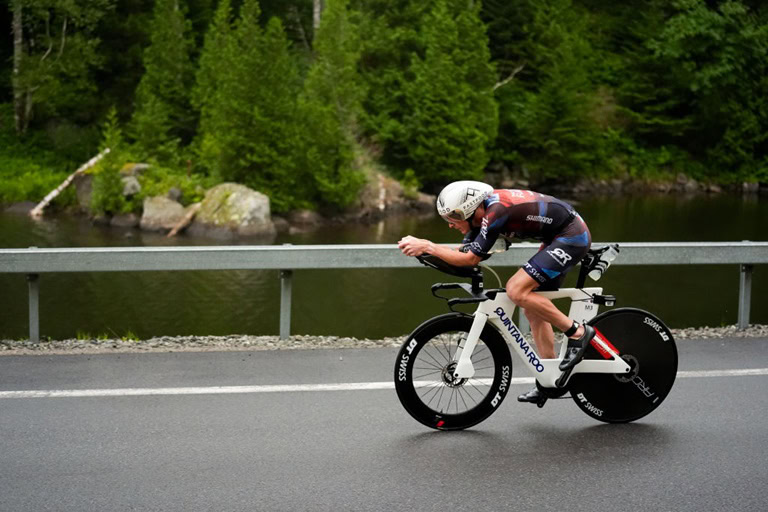
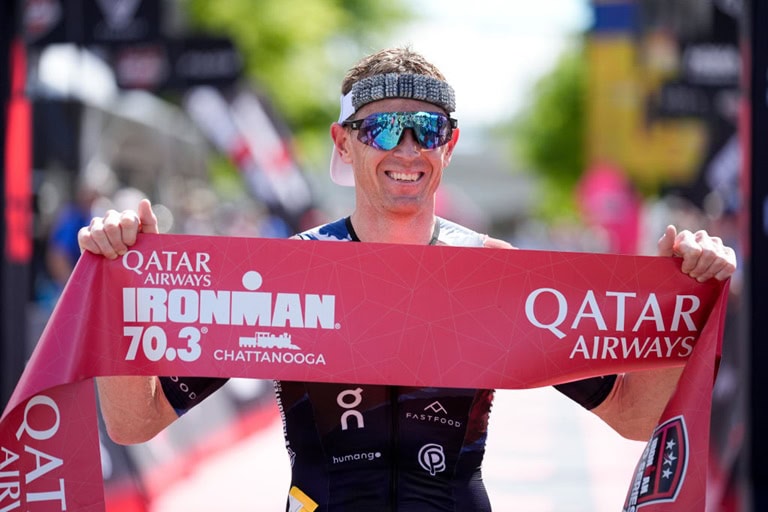
Triathlete Matt Hanson leads the Ironman Pro Series standings as the circuit gears up for the men’s world championship in Kona, Hawaii, on October 26. That’s the full 2.4-mile swim, 112-mile bike and 26.2-mile run in notoriously challenging conditions. Hanson races both full- and half-Ironmans, winning 13 races dating back to 2012, including four North American championships.
Prior to becoming a full-time triathlete, Hanson earned his PhD in exercise science and was a professor of exercise science and the director of the human performance program at Buena Vista University in Storm Lake, Iowa. In addition to his career as a professional athlete, the 39-year-old Hanson also coaches other triathletes. He recently partnered with Humango — an AI coaching platform — to advise on the creation of its algorithms and use the platform to assist his own coaching.
On getting his start in Ironman…
Kind of by accident. I definitely didn’t plan on this being my full-time gig, but that’s how it turned out. I was a college professor, and I was just doing the triathlon thing as a hobby. Then I turned into a quasi-professional, where I was still teaching full time and competing as a pro. Then I started winning some big races and decided to walk away from a tenured position and chase this dream in triathlon.
On his academic background prepared him for his athletic career…
In the early years, I was doing everything myself, so it gave me the information that I needed to know how to write my own programming, even though I knew nothing about triathlon. I knew how the human body adapts to exercise, and that actually formulated a lot of my views in terms of triathlon coaching. Triathlon is a really young sport relative to running, swimming, biking, and especially until very recently, most coaches were treating triathletes as runners, swimmers and bikers — and not triathlon as a sport in itself.
On how he monitors himself…
My role as an athlete is to execute sessions and give qualitative feedback. So I’m giving quantitative data and qualitative feedback and trusting the process of the people that I pay to be in my corner to do that. But obviously we’re monitoring power, heart rate, pace.
I’ve gone back and forth with monitoring HRV — currently, I’m kind of off that bandwagon right now, not really paying too much attention to that. I’m just trying to do things like quarterly blood tests and make sure that nothing’s getting out of whack. I’ve been using a company called BellSant this year, which is a little more of a holistic approach. I’ve definitely used InsideTracker in the past. Both are great companies, just a little different approach to the data. I think that’s an injury prevention thing as much as anything else. And then making sure we’re getting quality sleep with the Coros watch.
Patrick McDermott/Getty Images for IRONMAN
On partnering with Humango…
I’ve always wanted to skate to where the puck is going, instead of just sitting and reacting and trying to chase it. Obviously AI has been a big buzzword lately in all aspects of life, not just triathlon, but there’s definitely been a couple of companies that have come and really spent a lot of money to push what they’re calling AI programming. There were a couple things that were really important to me. One was, if I was going to partner with an AI company, it had to be somebody that was using true AI, or willing to push to use true AI, rather than algorithms and using historical data to set plans.
I felt a lot of the past practices were not treating us as triathletes or treating us as three separate sports, and if the approach of the programming is going to be based on all historical data, then we’re never going to adapt and be relevant and current with research. The first couple of meetings I had with other companies were very much that direction, and so it was just a non-starter.
I met with [CEO Eric Abecassis] a couple times and really appreciated how he wanted to incorporate me in having discussions about what’s current and what’s relevant in research and what the elite athletes are doing now, and how they could write programming to make plans that are based on that, rather than just, ‘Oh, we’ve got 20 years of other people’s Garmin data, so we’re going to make programs based on that.’ That was encouraging me enough to make the leap and start partnering with Humango and start using them as part of my coaching program.
On how he views AI when coaching other athletes…
The way I view it is that AI is a tool, not a crutch, so I can’t just let it do the work for me. I’m on the back end giving it the rules that I want the program to follow, and then I let it push out the program. Then I’ll go in and look at it and tinker with it a little bit and make sure that I’m happy with it. I’m not letting it coach for me at all. There’s definitely some benefits of doing that because obviously a fair amount of time is spent writing programs every week, and so in its current early stages of it, it just improved the access. Where a lot of people might have been searching for a pre-made program to buy online that may or may not be even remotely catered to them, where, for a similar price point, they can now get a program that is made for them.
That’s the no-touch model where I go in, set the rules and answer questions. Then I let Hugo, the Humango bot, take it from there. And then you can do the medium touch where I’m there every couple of weeks to touch base and answer questions, and then I’m still doing full, custom coaching, where I’m driving everything and still writing the plans completely. And so it just increases access, and it’s allowing a lot of people who probably couldn’t afford my previous rate, a way to have access to somebody who’s been around the block a few times.
Patrick McDermott/Getty Images for IRONMAN
On the future of how AI will shape coaching…
I don’t think that I’ll ever lose my job as a coach to AI, but I might lose my job as a coach to somebody who knows how to use AI better than I do. And so I need to be involved and keep my nose on the ground. At some point when I can’t keep up with the young bucks anymore, coaching is going to be my full-time gig. I need to have a good understanding of where AI is now, where it’s going in the future and how to use that appropriately.
On the Ironman world championship in Kona…
If you go in with a target time into Kona, you’re setting yourself up for the potential of a really bad day. You can’t predict the weather there, even the morning of the competition. It’ll look great on hourly weather report, but the winds change there so fast. If you go in there thinking that you know exactly how the wind’s going to respond, maybe you get lucky, but more than likely not. So you just have to really take the conditions as they come and be prepared. It’s having somewhat of a plan, but definitely not being too stubborn to not adjust.
This article was brought to you by SBJ Tech, a Leaders Group company. As a Leaders Performance Institute member, you are able to enjoy exclusive access to SBJ Tech content in the field of athletic performance.
TempleOrthotics believe their proprietary compound could be the crucial difference in helping a player return to their peak post-ACL injury.
A Data & Innovation article brought to you by
Temple OrthoBiologics has created a proprietary compound called TX-33 that has shown good results in preventing fibrosis in abdominal and pelvic surgeries and is on track for human trials in knees as part of the FDA approval process in late 2025 or early 2026.
ACL tears rank among the most devastating injuries to athletes, particularly among girls and women, typically requiring a year of rehab and no guarantee of a full return to pre-injury performance. Understanding the mechanism of injury is a growing focus among researchers, with FIFPRO and the Women’s Super League among those who recently commissioned a study.
Temple OrthoBiologics is announcing its formation on International Arthrofibrosis Awareness Day. It has been privately by its co-founders to date.
“We have a technology that can make a difference in the knee,” said Temple OrthoBiologics CEO Sanj Singh. “The scar tissue that forms in the knee does several things. It prohibits proper function. The stiffness leads to pain and also inhibits good rehab.”
Renowned orthopedic surgeon Dr. Riley Williams — who practices at the Hospital for Special Surgery and leads surgical care for the Brooklyn Nets, New York Liberty and New York Red Bulls — is such a strong supporter of the drug’s potential that he joined as a co-founder.
Williams said he completes between 100 and 115 ACL reconstructions annually. The typical post-operative scar rate is 4-5%, but he noted the importance of reducing it further because, among his patients, “that’s four people” who might have that excessive scar response.
“The formation of scar in and around these surgeries is a very poorly understood phenomena, but it has real-life consequences in surgery,” Williams said, adding: “It’s very exciting because that in a very clean and unfettered way can help to dampen that [inflammatory] response without dampening the natural immune response.”
TX-33 can be injected after an injury or at the time of surgery and, by inhibiting excessive scar tissue from forming, healthy tissue can regenerate instead. Williams predicted that, following a successful trial and FDA approval, it will “become standard care very quickly.”
Another orthopedic surgeon backing the Temple drug is Dr. Vinod Dasa, who chairs the orthopedic surgery department at LSU, and has joined the company as an advisor.
“From a sports perspective, reducing scar tissue will definitely enhance return to play and faster recoveries,” Dasa said. “If it’s an issue in terms of scar formation, in terms of that ligament healing after a sports injury, maybe this will allow that natural healing to progress more appropriately.”
Retired Canadian Olympic bobsledder Neville Wright, who now owns and operates Wright Performance & Therapy, is a speed consultant and trainer for the Canadian men’s World Cup team who now advises Temple OrthoBiologics. (Bobsledder Emily Renna is the other athlete advisor.)
“Surgery is always a fear for a lot of athletes.” Wright said, noting the concern of post-traumatic osteoarthritis and its impact on full-fledged return to performance. “If I’m off a degree in regards to flexion of my knee, that can be a difference of running a really fast time to being outside of that high-performing category.”
Interest in sports is acute, but there is broader potential to help the general population, particularly with total knee replacements. “The age demographic of arthritis is slowly moving to the left,” Dasa said, referring to a trend of younger patients needing interventions.
Big Pharma doesn’t typically get involved in orthopedics, he added, noting the large opportunity for a drug like Temple’s. Dasa also noted that “non-surgical management of arthritis has essentially been non-existent. The lack of treatment options has implications on particular demographics, too.
“We see differences in fibrosis based on health disparities, so based on race, socioeconomic status, and a few other things,” Dasa said. “So if we can improve fibrosis, we may actually improve some of the health inequities and disparities that we see as well.”
This article was brought to you by SBJ Tech, a Leaders Group company. As a Leaders Performance Institute member, you are able to enjoy exclusive access to SBJ Tech content in the field of athletic performance.
Four staging posts to help you follow through on your wellbeing aims when reality starts to bite.
A Human Performance article brought to you by our Main Partners

You may want to go for that walk or a run, but perhaps there’s still so much that needs to be done before your team’s next training session. You know you’ll feel guilty if you step away from your desk for more than a few minutes.
To compound matters, you may silently chastise a colleague for stepping away from their desk and ask yourself ‘where are they finding the time?’
“There is not a single person in this room who has not felt guilt daily,” said Sonia Boland, the National Wellbeing Manager at the Australian Institute of Sport [AIS].
She was addressing an audience at the Leaders Sport Performance Summit in Melbourne in February where the question of guilt, and the fear of fostering an ‘excuses culture’, were raised.
“In those moments where I absolutely feel that, if you know it’s going to help you do your next thing better, ask yourself: what’s the worst that’s going to happen?” she continued, making the point that performance won’t instantly collapse because you’ve gone for a stroll.
“You’ve got to have something around you to allow you to take that step out of the door.”
Boland is echoed in her sentiment by Emily Downes, the General Manager of Wellbeing & Leadership at High Performance Sport New Zealand [HPSNZ], who admitted to the same feeling.
“We all probably struggle with that at one point in time or another,” Downes said. “Who else do you need to have on your support crew that helps give you that permission?”
“It’s not doing new things, it’s not creating new programmes,” added Boland. “It’s just giving more focus to how we do what we do, not what we do.”
Boland and Downes suggested four key staging posts in reaching this goal.
1. Establish what you mean by ‘wellbeing’
Establish the framework for how you want to talk about wellbeing before all else.
Boland will not define ‘wellbeing’ in sport. “What became really clear is that we’re all talking about slightly different things,” she said of her time at the AIS. “When we’re talking about wellbeing, are we talking about your wellbeing or my wellbeing? Or are we talking about the wellbeing of everyone in this space? Are we talking about the environment that enables us to be who we need to be? If you don’t know that, it’s probably the first step.”
2. Consider an ‘ecological’ approach
The wellbeing conversations at the AIS, HPSNZ and beyond are shifting from simply duty of care and risk management for athletes (and increasingly coaches) towards wellbeing as a performance enabler. It’s an encouraging development, but Boland argued that it needs to go beyond a focus on the individual.
“We can throw heaps of money to help athletes and coaches do wellbeing better, we can talk to them to the cows come home about how to deal with burnout, how to lower your stress levels, but none of that means anything if the things happening above and around them are continuing to compound how that stress is coming,” she said.
The Australian system promotes an “ecological model”, as Boland explained. This means there is a focus on relationships, structures, policies and even job descriptions – because job descriptions can help people to set boundaries and feedback mechanisms.
“People want feedback, they want to learn and grow from when it’s not working,” she added. “We need to have the opportunity to fail and we need to have the environment where we can do that. And all of those things contribute to the wellbeing of the individual.”
3. Support self-care
We return to the question of guilt over self-care despite growing awareness of its performance benefits.
“The challenge around this is: are you asking for it?” said Downes. “Are you communicating to your manager what support looks like for you or what you might need to be at your best?”
She addressed the leaders in the room directly. “Have you set up systems within your environment to enable people to [step away from their desk]?”
There is similar thinking across the Ditch. “[If you get up and leave] think about the poor person next to you who’s got the same level of guilt,” said Boland. “They might look at you and say ‘yeah, maybe I’ll give that a go tomorrow’. It creates the culture where we prioritise what we need to do to perform at our best.”
4. Make it make sense to your people
Different words will resonate with different groups, so choose your terms smartly when discussing wellbeing.
“Find language that makes sense to you and your people,” said Boland. “If I think about the Olympic and Paralympic system, the language that needs to be used in skateboarding needs to look different in equestrian, and it’s going to look different in rowing. It’s not one-size-fits-all.
“Find the stuff that’s going to resonate, that connects to the meaning and purpose.”
SportAI’s system can be used in conjunction with phone or camera footage to generate overlays that chart swing curves in tennis.
A Data & Innovation article brought to you by
Through the agreement, SportAI’s offerings will be available on the MATCHi TV streaming service, which is underpinned by cameras installed at 2,000 of MATCHi’s tennis and padel courts. The integration lets players access highlights and technical analyses of match footage on their phones. In all, MATCHi has a network of more than 1M users across 2,600 venues and 14,000 courts in 30 countries.
Financial and duration terms were not disclosed.
Oslo-based SportAI was co-founded by Lauren Pedersen, a New Zealand native who is combining passions for sport and technology to democratize access to swing technique analysis – first in racquet sports but with the aim to eventually expand into the likes of cricket, baseball and beyond.

Image: SportAI
“Technique coaching, specifically, is still very subjective and expensive and unscalable,” Pedersen told SBJ in a recent interview at the USTA Billie Jean King National Tennis Center, where she spent time during the U.S. Open pitching prospective clients. “If you have a tennis lesson pretty much anywhere, it’s easily going to cost $100 – and you might have a good coach, but if you had three or four good coaches looking at your technique, they would all say something different, and there would be no data to back up what they’re saying.”
SportAI’s system is hardware agnostic; its algorithms can be applied to phone or camera footage and generate overlays that chart swing curves (and compare those curves to professionals), ball strike timing and other statistics like hip or shoulder rotation and swing velocity. The system also provides textual feedback, which as of now is pulled from a matrix of preset options but could in the future tap into a large language model, Pedersen said.
Here, Pedersen demonstrates the technology analyzing her one-handed backhand.
“To get to technique analysis, the computer vision, the platform itself, has to identify the boundaries of the court, identify different players on the court, be able to pick up all the biometric movement,” Pedersen said. “Before we even get to the technique analysis, we’ve got a lot of the technical data, which provides heat maps and statistics as well. We can deliver all that, and then technique analysis or coaching on top of it.”
Pedersen is charting a B2B model for the company, wherein SportAI licenses access to its software to three key segments: racquet sports clubs and coaches, broadcasters, and equipment manufacturers. She did not disclose pricing but noted it is variable based on which analysis modules businesses subscribe to.
As a coaching tool, Pedersen asserts that SportAI can reinforce instruction with empirical data, expand coaches’ influence outside of traditional lesson hours by making swing analyses accessible remotely, and unlock incremental revenue by creating a premium digital offering coaches or clubs can charge members to use.
For broadcast, Pedersen envisions the potential to improve the less objective niches of common tennis analysis and introduce technique comparisons between players or digital twin visualizations.
Integrating with equipment manufacturers, Pedersen added, would bring the opportunity for increased personalization in matching players with the appropriate racquet for their skill level and play style.
This article was brought to you by SBJ Tech, a Leaders Group company. As a Leaders Performance Institute member, you are able to enjoy exclusive access to SBJ Tech content in the field of athletic performance.
The NYCFC custodian recently featured in SBJ Tech’s The Athlete’s Voice series where he discussed his career, education and forays into the business world.
A Data & Innovation article brought to you by
You can’t have a discussion about sports technology today without including athletes in that conversation. Their partnerships, investments and endorsements help fuel the space – they have emerged as major stakeholders in the sports tech ecosystem. The Athlete’s Voice series highlights the athletes leading the way and the projects and products they’re putting their influence behind.
* * * * *
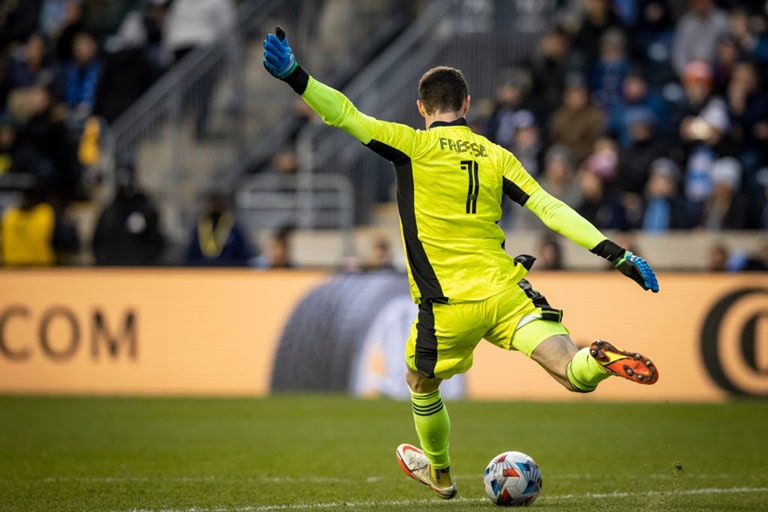
NYCFC goalkeeper Matt Freese has started all 30 of his club’s matches this season in MLS and has a 73% save rate, stopping 102 of the 140 shots he’s faced. This is his second season with NYCFC after beginning his career with the Philadelphia Union. A native of Wayne, Pennsylvania, Freese signed a homegrown contract with the Union and, after two seasons at Harvard, made his MLS debut in 2019.
Freese, now 26, had an opportunity to begin playing pro soccer after graduating from the Episcopal Academy in suburban Philadelphia but elected to attend Harvard first. Though he left early, Freese completed his degree remotely, balancing Ivy League studies with professional soccer, which is something he actually considers an advantage for his athletic career. A curious mind and avid follower of sports business — and a reader of Sports Business Journal, he revealed — Freese wrote independent research projects on MLS franchise valuations and advanced analytics for expected goals.
On opting for college, not pro soccer, right after high school…
The first and most obvious [reason] is just the fact that I wanted to honor my parents’ wishes to go to college. When I got into Harvard, they pushed even harder. I was really fortunate and lucky for that to happen. My dad had gone there, and he really wanted me to make sure I got a degree. The really awesome thing about Harvard, or most colleges at this point, is if you go for a semester or two, you pretty much lock in the ability to go back and finish your degree at some point.
On a more personal level, I don’t know if I was ready to be an adult and live on my own outside of the college setting when I was 17, 18, signing a homegrown contract. Also, goalkeepers usually develop a little bit later, so there wasn’t as much of a rush, if that makes sense. Seeing now the way my career has unfolded and changed, maybe I’d make a different decision and start it earlier, rather than waiting that year.
Ira L Black – Corbis/Getty Images
On balancing school and sports…
I would [attribute] most of my on-field soccer career development to my off-field academic efforts. This was at a time when I was 19, when structure and schedule is so important for a 19, 20-year-old who’s now a professional athlete making good money and getting pulled to do things that that most 19, 20-year-olds are getting pulled to do. Having the structure, having a few hours of work every night after training, making sure I had to be on a good sleep schedule, it all really allowed me to focus on soccer and not get distracted with other things. It really grounds you. It humbles you.
The other thing that I really liked about it was that it gave me a de-stressor off the field. As a 19, 20, 21-year-old, you’re now competing for your career every single day that you’re playing, and it becomes stressful, and as a young guy, you don’t really know how to handle that. So when I got home, and I would be doing work, reading a textbook, doing whatever — my mind was able to get away from soccer, which is super important.
And then the third thing that’s also quite interesting is that there’s a lot of research out there that really supports cognitive development, especially at that age, and your ability to solve problems, lead and organize and be a team leader. A lot of that is correlated with academic and intellectual stimulation. As that was continuing to grow, as my brain was continuing to be pushed and grow, it allowed me to, in my opinion, learn more quickly on the field. Learning quickly, learning on the fly, is completely necessary for a professional athlete.
On writing an undergrad thesis on MLS franchise valuations…
It was my last semester. I had finished all my core requirements, and I was doing everything remotely and then flew up to take exams in the offseason. And so I was able to do two independent research projects as my last credits. The title of one was “The theoretical analysis of the rise of MLS valuations.” Since 2010, they just completely skyrocketed, and the whole point of what I was discussing is that demand was going up. The supply was very limited. It was very constrained for several reasons. The primary one is expansion is limited within the MLS.
Probably the bigger focus was just talking about how demand, from an ownership perspective as well as from a fan engagement perspective, is going up. The academy situation has really changed everything. People want to go see kids or teenagers from their hometown that they knew growing up. They want to go see them play. They want to see them succeed. The US team is obviously getting more and more attention year over year, and that impacts the way fans look at MLS games.
People want to buy into these teams. They’re becoming more and more profitable. Revenues are going up. Operating expenses are also going up, and salaries continue to increase, and transfer fees just always are rising. But in general, they’re just becoming more profitable and easier to operate.
On writing MLS papers while a player for the Union…
I was in my third year. I’d always go to this one coffee shop in Philadelphia and work on that paper. The other independent research project I should probably mention because it’s somewhat related was, I created an expected goals model using data from MLS over the last five, six years, which was also really cool.
Goalkeeper is a weird position [for analytics] because essentially the only one that matters is the post-shot expected goals model and how that relates to the goals conceded. Goalies are a little bit of an anomaly, but in general, yeah, I love looking at data. I love talking to our data analytics team in the organization about these things. I just think it’s really interesting. It can shape a strategy of a team to a degree.
It can’t completely take over what the philosophy of the team is, but it can point you in the right directions or show you what type of cross has the highest percentage of expected goal coming from the end result of, leading you to probably want to look at getting into the cutback scenario more than these long, high crosses. We’re a relatively younger team. Our height and our strength isn’t as much so fighting against these big center backs might not be as successful as getting into that cutback zone, which is something we’ve worked on a lot. This is not me driving that, by the way. [laughs] This is the coach, the data analytics team making those decisions, obviously.

Jeff Dean/Getty Images
On not looking too deeply into his training data…
I am into that, but I just trust our performance director and the medical performance side of things on the team. They handle all that, and they make sure that my dive count is not too high, my explosive [actions] count is not too high. I am hitting the numbers that they want, and I just trust them to do that. They’re very good at their job.
On his interest in sports business when he retires…
I do think about it. The clear priority right now is playing, and I want to play for a very long time and have a good career and get my name into the that top tier of MLS, goalkeepers. But at the same time, I also take a serious interest in what my post-playing career will be. I believe one avenue would be to stay in the sports realm, whether that’s on a business operating side, being on the finance or marketing side of an organization, or the sporting side —GM, Assistant GM, sporting director, that type of thing — is really fascinating as well.
And then there’s also the investing side. I have a background in investing as well. I took several classes and audited some MBA classes at Wharton when I was in Philly. So I’m comfortable and really enjoy that type of stuff. A lot of it also depends on how my playing career goes.
On his game prep…
As a goalkeeper, the routine really is everything. And I’ve become somewhat psychotic about my routine before every game. There’s a lot of research that has indicated that, for an athletic event, your sleep two days prior is actually more important than the sleep one night prior. So my routine really starts two days before the game. I try to get as much sleep, like 9, 10, hours two nights before, and then I usually do a series of meditations leading up to the game. I do the same type of film, just very serious about my routine.
This article was brought to you by SBJ Tech, a Leaders Group company. As a Leaders Performance Institute member, you are able to enjoy exclusive access to SBJ Tech content in the field of athletic performance.
Data Analysts Julia Wells of the UKSI and Mat Pearson of Wolverhampton Wanderers deliver a series of practical tips to help address one of sport’s notorious blind spots.
An article brought to you in collaboration with

That is according to a straw poll of attendees at a recent Virtual Roundtable hosted by the British Association of Sport & Exercise Sciences [BASES] and the Leaders Performance Institute.
The perception is worse when it comes to analysis and recruitment, with over 60 per cent of attendees suggesting that their analytics and recruitment teams do not work closely at all.
Yet 63 per cent also believe that improved data and computer literacy across their staffs would directly impact performance.
The sense that there is room for improvement gave the session its title: ‘Mobilising Performance Analysis in Practice’. It was the second in our three-part collaboration with BASES called Advances in Performance Analysis and centred around two case studies.
The first was delivered by Julia Wells, the Head of Performance Analysis at the UK Sports Institute [UKSI], and the second by Mat Pearson, the Head of Performance Insights & Data Strategy at English Premier League side Wolverhampton Wanderers.
Five areas where data literacy can improve performance
Before Wells and Pearson delivered their insights, attendees were set a further task: ‘as a consequence of improving data or computer literacy, describe what you would see as being the most significant impact on performance’.
The responses were varied but five stood out:
How the UKSI are mobilising performance analysis work-ons in meeting common challenges in data analysis
The first session highlighted the four biggest challenges facing people who use data analysis in sport. To kick off her presentation in the second, Wells explained how the UKSI is trying to tackle those four challenges (plus another).
Challenge 1: integration
Go back to basics. That’s the approach of the UKSI, who have placed an emphasis skill development, support structures and a clear data strategy.
It goes like this: the relevant staff members are upskilled in areas such as collecting the right data, using the correct formats in the right places before the interrogation and analysis even begins. This is then supported by a clear data strategy geared towards performance planning. For example, roles such as the data & insight lead and the performance data lead are embedded within the organisation to better help those leading programmes with the direction and the integration of their data. Thus, the strategy can come to the fore and everyone can better understand what needs collating and why within the team.
Challenge 2: data collation
Wells described how easy it can be to stay on the “hamster wheel” of collecting data without taking the time to critically reflect and pause. Can you, for example, call upon efficient processes for collecting data and wade through the myriad datasets potentially available? She recommended asking “quality questions”: why are we creating the data, what is its purpose, what decisions is it informing, particularly in the coaching process? Teams should do this periodically and continue to plan, do and review. Wells also encouraged engaging in conversations with key leaders in the environment to discuss what to start, continue and stop. It’s important to intentionally carve out those opportunities as part of your performance planning.
Challenge 3: communicating data insights
Wells stressed the critical nature of human engagement in the process and regards communication is a highly technical skill, despite the views of those who might see it as a ‘soft’ skill.
She shared that the different performance departments within the UKSI work closely with the psychology team to help elevate understanding of self and others. Wells said, if we can better understand the people we work with, it will support how people can get the best out of each other. As part of this process, they’ve tapped into better understanding one another’s preferences in order to be more impactful in how they support each other.
Challenge 4: buy-in
It is not uncommon for senior stakeholders to not perceive the value of the work being done. This makes it incumbent on analysts to critically assess their impact and share the meaningfulness of their work. “It’s our job, and it’s our role to be critically analysing why and presenting that back,” as Wells said.
On that note, alignment to the sport’s strategy helps to provide a clearer connection. If this alignment and connection isn’t there, you’ll naturally get disconnection so it will be more challenging to get the buy-in.
In addition, relationships are just as critical when generating buy-in. Wells advocated inviting leaders and key stakeholders into your world and shadowing them. When they immerse themselves in better understanding the process you’ll find that it can quickly lead to them becoming a voice for you in wider conversations.
Challenge 5: data illiteracy
Too often, practitioners can suffer in silence when looking for solutions. In the latest Olympic and Paralympic cycles, Wells and her colleagues are seeking to increase data literacy across the board. They have introduced an internal online data community that provides access to resources, promotes connection, and leads to the sharing of good practice.
Wells’ team also put together a ‘Data Leadership Programme’ which is focused on pulling together the data leaders in the various sports with whom the UKSI work to look at opportunities, challenges and future direction. Courses, with titles including ‘Data Camp’, ‘Project Automate’ and ‘Code School’, were created to improve skills and processes for coaches and practitioners to help them be more efficient. In her mind, this has been crucial to enable people to be upskilled; and all support staff should be able to ask a good question and have the data skills to answer them.
How data analysis is supporting coaching and recruitment at Wolves
Pearson explained that he and his colleagues at Wolves are trying to align the club to ensure there is consistent evidence available and better identification of the trends impacting decision making from a data point of view.
He focused on two key areas: coaching and recruitment.
In the environment, the analysts are part of the multidisciplinary team. They are very much now voices in the room and, with it being a specialised discipline, all analysts must have an impact on decision making.
To that end, Pearson’s team have moved away from leaving the coaches to find the solutions themselves. Instead, analysts are encouraged to go and find solutions, present them to the coach, and then have good conversations to better find the optimal outcome.
Part of the challenge we can face, said Pearson, in particular with performance analysis at first-team level in professional football, is that many environments can be quite coach-led, which is in keeping with the nature of short tenures. The coaches will lean into their viewpoint as a way to exert their control. Therefore, education is important and, in particular, how you communicate with them to ensure the message lands. That said, Pearson observed that coaches in modern day football are more attuned to data and performance analysis and are much more data literate and comfortable with technology.
A key learning when integrating performance analysis and data work with coaching is to make insights as contextual as possible. If you provide insights to a coach that are out of context, you’ll lose them straight away.
Pearson told attendees that some of the biggest strides in performance analysis and the wider data team have been in the field of game modelling, recruitment and selection decisions, with the obvious caveat that subjective input is still valued immensely.
The team have worked to create objective measures against the game model. In better understanding this, it has provided an additional layer of information related to individual player requirements for the game model. These insights are helping to inform both selection for matchday but also the recruitment of new talent. When thinking about the recruitment process in particular, Pearson said this process has helped to educate scouts and other recruitment personnel in the attributes for which they should be looking.
Visuals have played a key role in this process too, particularly in being able to show what it looks like to play in this particular style that the coach or manager wants. They’ve worked to make the playing style more objective.