SBJ Tech’s Joe Lemire takes it upon himself to answer the question for himself and ponders the lessons should elite athletes ever do the same.
A Data & Innovation article brought to you by

We know this because data from his Whoop, a wearable performance tracker, was shared publicly through a PGA Tour partnership. McIlroy’s heart rate was 128 as he struck the ball before it escalated to 152 when he hurled his golf ball into the crowd and celebrated at the Wells Fargo Championship.
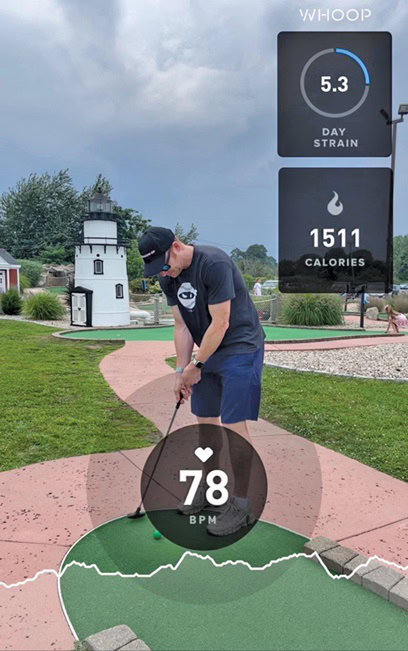
Wearable tech such as Whoop allows 40-something suburban dads to compare biometrics to the pros (below).
Before you say “the pros are just like us,” I submit this counterargument: On the 18th green of Saybrook Point, my own Whoop reported a heart rate of 78 as I took my final shot. Mine only rose to 81 as I contained my disappointment while failing to convert the hole-in-one for a free round.
This is probably where I should mention that Saybrook Point, as distinguished as it sounds, is a mini-golf course where I went on a recent family outing. We didn’t keep score that day, although I suspect my father-in-law edged me by a stroke or two.
OK, so I didn’t really learn anything about my physiology in that example — except my coolness under a lack of pressure — but I certainly have gleaned more than a few helpful tips over the past three years of continuous wearable usage, alternating between Apple Watch, Oura and Whoop.
Most of the time, I wear the Apple Watch during the day as my activity tracker and the Oura ring at night for sleep, but for several weeks this summer, I wore all three devices simultaneously, every waking heartbeat tracked in triplicate. Overkill, but enlightening.
The technologies are similarly accurate on resting heart rate. Oura and Whoop agree on my total sleep and heart rate variability, although they differ widely on sleep cycles: They mimic each other on REM sleep, but Whoop gives me credit for way more deep sleep (the more physically restorative cycle). They were directionally accurate, at least, and cycle identification is a fickle exercise outside of a sleep lab.
My own data has been living proof of the growing body of advice from wellness experts. My sleep and recovery scores are better if I don’t eat within a couple hours of bedtime and when I refrain from alcohol — but if I do drink, earlier is better. Think happy hour, not nightcap.
My latest midlife crisis sporting foray is registering for a 5-mile trail run around some local farm fields. While I keep abreast of the latest running principles — such as doing a majority of my runs in Zone 2, a low-intensity heart rate region, and the rest in high-intensity Zones 4 and 5 — and I do have the privilege of speaking with sport science experts for this job, I don’t have a coach or any formal training plan to follow. So I decided to try the artificial intelligence functionality of Whoop Coach and Oura Advisor.
Both remain in beta and were built by layering their algorithms on top of existing large language models. Whoop partnered with OpenAI on a ChatGPT implementation; Oura declined to identify its foundational LLM.

I wrote identical prompts to each about my plan to run a 5-mile race in two months and prodded for more detail, asking, “Can you write a weekly running program for me based on my data and this goal?”
Pulling on my own data as well as best practices — or at least the best practices embedded in the AI models — Whoop and Oura offered me similar plans. Both featured Saturday long runs, midweek interval runs at faster paces, a couple days of rest or light activity and recommendations for strength or cross training, such as cycling. Whoop offered more detail and suggested certain heart rate zones. (Oura is less precise on activity tracking anyway and imports my Apple Watch data for exercise.)
When I asked Whoop Coach how much faster I could get by training for my race, it alerted me to Project PR, a feature using Whoop and Strava to personalize eight-week running programs. The 2,772 users to complete the program reported an average improvement of 2 minutes, 40 seconds over a 5K. With that kind of a gain, maybe I can compete for the podium — of the 40-something suburban dad age group, of course.
Race day is October 27, after which I hopefully can report a fast time, though I suspect my heart rate won’t be quite as cool as it was at Saybrook Point.
This article was brought to you by SBJ Tech, a Leaders Group company. As a Leaders Performance Institute member, you are able to enjoy exclusive access to SBJ Tech content in the field of athletic performance.
The ABT CUPRA star is promoting sustainability and innovation through his company Zero Summit.
A Data & Innovation article brought to you by
You can’t have a discussion about sports technology today without including athletes in that conversation. Their partnerships, investments and endorsements help fuel the space – they have emerged as major stakeholders in the sports tech ecosystem. The Athlete’s Voice series highlights the athletes leading the way and the projects and products they’re putting their influence behind.
* * * * *
Di Grassi, 39, is a multi-lingual native of Brazil who is close to completing a degree program at Harvard Business School. He co-founded the Zero Summit to promote sustainability and innovation of zero-carbon technologies and serves as a Clean Air Advocate of the United Nations Environment Program.
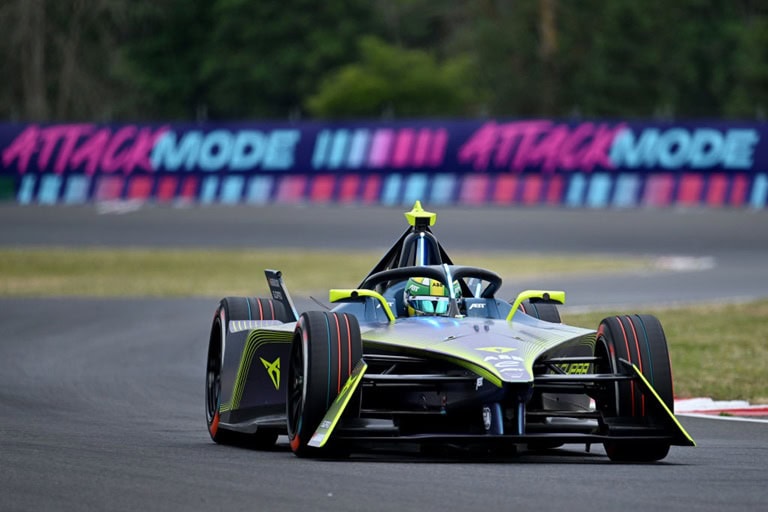
Most recently, Di Grassi partnered with Rubicon Carbon, a management firm for carbon credits. Rubicon’s logo has adorned the driver’s car and helmet at the Hankook Portland E-Prix in Portland, Oregon in June. Di Grassi has personally offset his personal carbon emissions for the entirety of his Formula E career, matching what the racing circuit has done since inception.
“When I met Lucas the first time, I said, ‘This guy is so switched on and is so into this,’” Rubicon CEO Tom Montag said. “He is such a good guy and what a great person to partner with in trying to get the message out to people about the value of this. He has a global basis, and he drives a car for a living.”
On partnering with Rubicon on carbon offsets…
So I’ve been racing in Formula E and, in parallel, I created this summit on technologies that will mitigate carbon emissions called Zero Summit back in 2020. We have a very strong partnership with Bloomberg, and through the partnership with Bloomberg and a friend in common, I met Tom and Rubicon. One of the core principles of Formula E, the racing series that I race, is to be net zero from inception and to develop the electric technology that we will see in electric cars.
The only way that we can be net zero from inception is that we need to offset some of the carbon. You cannot travel to races by sailing a ship all over the world. So I wanted to be the first racing driver to be net zero all my career in Formula E, personally. The team offsets some of their emissions. Formula E offsets the whole emissions from their own, and speaking to this friend of mine in Bloomberg, the conversation was, how could we do that with a credible company, with somebody that has been doing that for a long time and is the best in the market?
We want to work with the best and Rubicon’s name came along. I met Tom, and then we organized the way for me to buy this offset. So we calculated the offsets of these 10 years, and then I bought these offsets, which are carbon removal projects that are listed as S&P 500 companies. It is a great thing for the world of carbon removal projects, and carbon credits are somehow still not very known by the average person, especially on the personal level. And I think sports and entertainment is a great way to communicate, saying, ‘Look, this is how it works. This is how we can not only offset ourselves, but everybody can actually contribute their part, if they are willing to.’
On his initial interest in sustainability…
I always raced my whole career, and my target was to go to Formula 1. When I was in Formula 1, they were starting to introduce hybrid technologies into F1 cars, and then I raced endurance cars. And I’m not an activist. Of course, I think to try to preserve the environment is a positive thing. Trying to control negative externalities is also positive thing. But I’m not an activist. I’m not a tree hugger. I don’t try to mitigate my lifestyle in exchange of some greater good. No, I’m a very pragmatic guy, and motorsport has been a laboratory for technologies.
My assumption, being pragmatic, is technology is what’s going to save humankind. Humans are always going to use more energy, more resources. As people go out of the poverty, they want to eat more meat. They want to drive better cars. They want to have AC in their houses. They want to have three TVs instead of one. It’s a natural progress of humankind to use more goods and use more services. So the only way for us to have a sustainable planet, or let’s say, a stable environment, is that we should gain efficiencies. And the way to gain efficiency is basically to develop technologies.
On why auto racing is a good driver for the cause…
Therefore motorsport is probably one of the only sports in the whole world that actually we are doing the entertainment, which people like cheering for the driver, A or B, but the technology that is there actually is going to go into a commercial car, is going to be cheaper, better, is going to change mobility. And that was the case for combustion engines in F1 and the hybrid systems.
That was the reason why I decided to start in Formula E. I was the first employee of Formula E back in 2012, and this reasoning led me to say, ‘OK, the next step in racing will be electric, and therefore I’m going to bet on Formula E to be successful.’
On starting his sustainability summit…
I was already in Formula E since the very beginning, and in 2019 I decided to go back studying a bit. So I went to study at Harvard University. I’m doing this three-year MBA there, and the discussion in the classroom with my colleagues was always about how to adapt their businesses to mitigate their negative externalities, and to adapt to this new world, to create efficiencies. And there was not a summit about it.
There was no discussion about it. Latin America, especially Brazil, which is, I would say, one of the main countries in the world that could lead this, let’s say, low-carbon economy — because we are already a low-carbon economy right now — there was nothing about it. So I said, ‘Why we don’t have this discussion with the key people in Brazil?’ So that’s why I decided to do the summit.
On offsetting his career carbon consumption…
It’s done now for my entire career of Formula E. wow, my entire career, often my I haven’t calculated since inception yet. That’s going to be the target, I think, since day zero. But it’s quite funny, because the first go kart I drove — F1 is talking about synthetic fuel right now. ‘Are we going to go to 10% synthetic fuel?’ And I was listening to them talking. I was like, in ‘95 when I was nine years old, when I started go kart, I already used biofuel. We used 100% ethanol because it gave more power to the go kart than gasoline. And in Brazil, we have available ethanol. It is the same price as gasoline, and you can buy it any pump, so we use ethanol in go kart. So I was like, ‘OK, so the new breakthrough technology that you guys are doing is actually my go kart experience from ’95 when I used 100% biofuel.’
On the costs of offsetting his career…
It’s surprisingly not so expensive, and I’ll share the number: it was $30,000, more or less. Most of it is air travel. It is the biggest impact, and if you think about it, it is not that expensive, and that’s the reason why it is actually so easy to do it right now. But as more people actually start offsetting and the supply of carbon credits into the market starts to become less than the demand, this price needs to go up. And if there is, let’s say, a multinational or transnational entity controlling all these carbon credits, it will be very interesting to see how the dynamic flow of these projects and the offsetting and the price structure evolves.
As the moment it is almost zero burden financially — it’s $3,000 a year of offsetting my season in Formula E. It is not so much. But if every season, the price starts to go up and it becomes a financial burden to offset this carbon more and more, I will start thinking, ‘OK, how can I emit less carbon?’
On how the carbon offset market could evolve…
If more people buy those credits, and the market goes from, let’s say, $2-3 billion, to $200 billion, or $2 trillion, it starts to really go up. All the companies, they’ll be financially incentivized to look to increase their efficiency, and to start really thinking about, ‘OK, I’m going to fly this much, but maybe I take a train the next leg because maybe the carbon pricing starts to make financial sense for more people.’
This process creates this financial burden. At the moment it is voluntary, but if it’s a regulated market and the market starts to actually demand this for the companies and people to actually start offsetting themselves, it will push everybody to be more efficient, and new technologies to be financially more available. You can actually scale the production of batteries, making it even cheaper, and then electric cars would be even cheaper. So it helps the trend towards, let’s say, a net-zero world in terms of carbon output and input.
This article was brought to you by SBJ Tech, a Leaders Group company. As a Leaders Performance Institute member, you are able to enjoy exclusive access to SBJ Tech content in the field of athletic performance.
MMA champion Dakota Ditcheva discusses her use of wearables, their influence on her training regime, and the benefits of playing multiple sports in her youth.
A Data & Innovation article brought to you by
You can’t have a discussion about sports technology today without including athletes in that conversation. Their partnerships, investments and endorsements help fuel the space – they have emerged as major stakeholders in the sports tech ecosystem. The Athlete’s Voice series highlights the athletes leading the way and the projects and products they’re putting their influence behind.
* * * * *
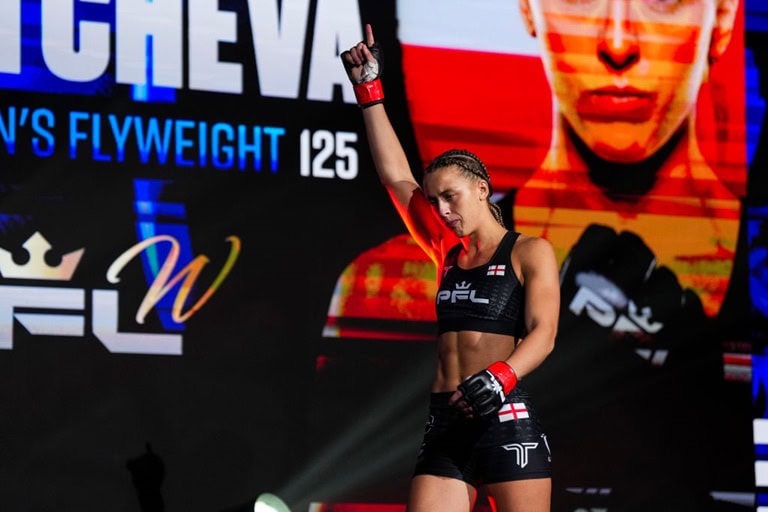
Ditcheva, 25, is undefeated as a pro (13-0-0 with 11 wins by knockout), including August’s first-round TKO of Jena Bishop in their PFL [Professional Fighters League] semi-final match in Nashville. She is a Manchester, England native known for replicating Man City goal celebrations after winning bouts. Her mother, Lisa Howarth, was a World Kickboxing Association champion, so Ditcheva grew up in a gym and later won a gold at the 2016 International Federation of Muaythai Amateur World Championships before switching to MMA.
Now training at American Top Team in Coconut Creek, Florida, Ditcheva won the PFL Europe tournament in 2023 to claim a $100,000 purse and gain entry into this year’s larger PFL draw. She has rapidly gained a large social media fanbase after a video of her weighing in last December was viewed nearly 19 million times and gained her 100,000 new followers.
On getting started in kickboxing at her mom’s gym…
It wasn’t something that I would say I always wanted to do from being young. I was involved in it straight away because my mum had a gym before I was born. So as soon as I was born, I was in the gym, pushing my little dolls’ prams while she was coaching and things like that. So it was always something that I was around.
I did train when I was, like, four years old. These like videos and photos of me fighting and stuff I did two, three fights when I was four, and then from that point, I didn’t do it at all until I was 13. It wasn’t really something I was interested in. And my mum was never one to say, ‘I was a fighter. Now, I want you to be.’ She actually didn’t want me to fight.
It just so happened that I came back to it myself when I was 13, after trying loads of different sports. I did netball, football, I did basketball, I did gymnastics, I did everything. To be honest, I tried so many different things. My mom and dad are the type of parents that are like, ‘Stay involved in sport. And it doesn’t matter what you choose to do. Just stay active, stay fit.’ So that’s what I did. But then when I was 13, I was, like, starting to train again. Obviously, my mom, still having a gym, I was older, understood it a little bit more, and that’s where it just went from there.
On the benefit of playing multiple sports…
Definitely, 100%, especially in martial arts like this. You need so many different qualities for this sport. And you get that from other sports. [From] gymnastics, you need the balance. You need the weight, the sense of gravity in this sport you need, which I probably got from gymnastics. I got loads of different things from playing sport.
And I think, as well, it just made me realize how much I wanted to do it. That was the main thing. It was something that I came back to myself, so being able to try different sports, see what I enjoyed, what I didn’t enjoy, what I loved. And that’s probably why I stuck to it so much now, because I wasn’t forced to do it. Doing all different sports built me to the person that I am today and showed me what I love the most.
On choosing to sign with the PFL…
When I signed a few years ago, 2022, I was at a point in my MMA career, where I was fighting on different shows, and even though I was winning and getting a lot of exposure from the shows, I didn’t feel like I was building up a set fan base with a promotion. So I felt like it was the right time when they approached me, especially with them approaching about the European season.
First, I wanted to stay close to home and build good support closer to where I’m from, in the UK. So it just really appealed to me at the time. And obviously the tournament money, the format and things like that was good for me because I like to fight quite regularly. And obviously, with this tournament, it’s back-to-back fights throughout the year, so just loads of things that really appealed, and it was lucky for me to get a promotion that said they would get behind me and push me as the brand for myself and not just get me fights.
On moving to Florida and training at American Top Team…
I was going through quite a difficult stage in my career and in my life in general. This is a really tough sport, a very selfish sport. I was probably a little bit lost. I was having great success in my career, but I was struggling to accept the fact that it’s a very different life to what my friends have. A few things at home, like relationships and things like that outside the sport just weren’t working out. I was feeling like I didn’t know what direction I was going.
It was hard to get the balance inside the sport as well. I was traveling a lot to different gyms to get the right training up and down the country. So it was just perfect timing for me to go over to America before I sign with PFL and just find that one base that I really felt at home at. And as well, the sunshine — in the UK, we don’t get much sunshine. Now, this is a tough sport, and people like said to me, ‘You can’t make it easy for yourself just because you’re waking up in the sun.’ And I’m like, ‘But why would I not want to better my life if I’m still working just as hard, waking up in Florida sunshine and still having a few sessions a day and working really hard, like, why wouldn’t I do that?’
On tracking sleep and recovery…
I’ve actually got a Whoop on. I do [track] a little bit. I got out of a bit of a routine because it’s difficult to wear this under my gloves sometimes because it can be a bit hard, but I do like to track it, mostly the sleep and the recovery. I think that’s a really important part for fighters, rather than the actual exercise. We know we work hard and we burn the calories, there’s no denying that — that’s not necessarily what I use it for — but the recovery and how well I’m sleeping and things like that is what I tend to track. That’s why I try and get in a routine of wearing something like this or other monitor [devices]. People just think we base everything off training and how hard we’re working, but, actually, it’s the recovery that we need to get on point as well.
On a habit she has changed based on the data…
Caffeine probably being one of them. My nutritionist has put a cap on what time I’m allowed caffeine now. So I actually see a lot difference in the amount I sleep, and the way I sleep when I’ve had caffeine too late. So that’s quite an interesting one to see. But you can check if I tend to have this [Celsius energy drink] a little bit too late, then I see a little bit of a difference in my sleep pattern.
This article was brought to you by SBJ Tech, a Leaders Group company. As a Leaders Performance Institute member, you are able to enjoy exclusive access to SBJ Tech content in the field of athletic performance.
CEO Mike Cazer spoke to SBJ Tech about the team’s efforts to bring the ‘Auld Mug’ back to the US.
A Data & Innovation article brought to you by
The defending champion of the America’s Cup is given wide latitude to establish the design parameters for the next competition’s sailing yachts, with strict limits on testing and prototyping. That “can limit your ability to take big technology risks, because you’re going to make sure that you’ve got a boat that works,” said Mike Cazer, CEO of the American Magic, the US entrant in the global regatta.
In order to explore new ideas within those confines, American Magic contacted a dozen engineering firms specializing in AI and simulations and partnered with Altair to build a digital twin of the AC75 yacht to serve as the basis for prediction models on how the boat will perform and how it can be sailed most effectively.
“Coming out of the last America’s Cup, we saw a huge opportunity in the area of advanced simulation, high performance computing and AI,” Cazer said. “We had some experience, particularly on the on the simulation side, but it was really more rudimentary. We thought that this could be a big part of this campaign and especially going forward.”
Altair has deep experience with the America’s Cup, dating back to 1995 — it most recently supported the Italian boat, Luna Rossa Prada Pirelli, in its runner-up finish during the previous competition. Altair technical manager of simulation and design Julien Chaussee said the inputs are “all-encompassing” and include historical data from prior America’s Cups, design tools, fluid dynamics, structural analysis and also digitally-generated simulation data. (Altair has also done significant work in golf manufacturing, among sports ventures.)
Cazer noted the complexity of the challenge with the sailing yachts that must contend with the environmental conditions of both wind and water, which requires pulling from the fields of both aerodynamics and hydrodynamics. The AC75 can hit speeds of 55 mph and briefly become airborne.
American Magic has a simulator at its training site in Barcelona, (where the races began last week), which enables the sailors to test the boat in all conditions. They can complete an entire race in the simulator under the precise details of that day’s weather and that opponent’s typical strategy. The simulations can also help brainstorm new tactics through artificial intelligence.
“When we use the AI bot to sail 24/7, it’ll start exploring areas of data that the sailors may not intuitively go to, and it’ll start recommending, ’In this condition pattern, here’s a way for you to sail the boat differently and potentially better,’” Cazer said. “A lot of times it’s wrong because the algorithm doesn’t quite have it exactly right, but a couple of times it’s pushed their thinking on how to actually control the boat and maneuver differently. And so then we start exploring that on the water, and ultimately it helps us get to be a better sailing team.”
The Preliminary Regatta was last weekend in Barcelona and it will be followed by the Challenger Series and final, best-of-13 series taking place between October 12 and 21.
“From a technical point of view, I always like to say, ‘There’s only one way to find out if you’re the best, and it is to go measure yourself with the best.’ You can’t just hide in an environment like the America’s Cup,” Chaussee said. “It’s really enabled us to push the tools and push the technologies and, in some cases, uncover limitations that we were able to overcome.”
This article was brought to you by SBJ Tech, a Leaders Group company. As a Leaders Performance Institute member, you are able to enjoy exclusive access to SBJ Tech content in the field of athletic performance.
The IOC’s pilot scheme was another branch of its holistic support for the athletes competing in Paris.
A Data & Innovation article brought to you by
In April, the IOC launched its Olympic AI Agenda, an initiative full of innovation that could dramatically affect future Games.
A pilot project in Senegal is using AI to identify athletic talent and improve access to athletic opportunities for future generations. Judges for sports such as gymnastics can use computer vision that will bring more structure to the scoring process.
But at the Paris Games, one such AI effort was of immediate benefit to all the world’s best athletes — a monitoring system to protect them from abusive comments on social media. Kirsty Burrows, the Head of the Safe Sport Unit for the IOC, told SBJ this is part of the organization’s greater mental health efforts, and its constant evolution helps creates holistic athlete support.
“We know the enjoyment people get from competing and participating in sport,” Burrows said in July. “But ensuring athletes have a positive, healthy experience where they can thrive on and off the field of play requires specific actions to be taken to support that and to make it so.”
The service, provided by a third party the IOC declined to name, scanned all major social media platforms to flag potentially abusive or harmful messages — an immediacy that hopes to address them and have them taken down before athletes can even see them. Specifically, Burrows said, the system uses AI to look for posts that are either criminal in nature or conflict with community guidelines — for example, guidelines on X include stances against abuse/harassment and hateful content. This service can also pick up emojis and other imagery while navigating more than 35 languages for the 206 delegations (10,000-plus athletes and 2,000 officials).
Burrows highlighted that the IOC wanted to be helpful with this protection but not overly intrusive. It didn’t scan athletes’ DMs, maintaining their privacy. They can opt out of the service as well.
This tech was tested during Olympic Esports Week last March, with the IOC saying that more than 17,000 social posts were analyzed from various platforms. Of those, 199 were highlighted as potentially abusive, flagging 49 of them.
Burrows pointed to the need for social media monitoring around esports because online abuse can be endemic in competitive gaming. The positive learning that came out of that, though, was the flexibility of the system — Burrows said the IOC tried to anticipate issues while also having the capability to swiftly respond to a situation, such as when a player suddenly starts receiving a barrage of targeted abuse.
She feels that this will be an evolving protection that hopefully improves with time and more data. And the need for this learning is only growing — when unveiling the AI monitoring system in April, Burrows estimated that the Paris Games would produce roughly half a billion social posts.

Kirsty Burrows (r), who heads up the IOC’s Safe Sport Unit, speaks with Lindsey Vonn about protecting athletes online.
A former athlete’s take on this system
Emma Terho is uniquely positioned to talk about the need for athlete protection from abuse. She is the chair of the IOC Athletes’ Commission, as well as a two-time bronze medalist (and five-time Olympian) with the Finnish women’s hockey team.
In her playing past, coaches suggested avoiding all outside messaging — whether that was media coverage or, later, social media platforms — during the team’s biggest competitions. “Reading the wrong comment can be detrimental to your self-confidence,” she said.
But so much has changed about social media and the way athletes use it for personal branding and fan outreach. It’s not something that they can brush off. Quite frankly, it’d be detrimental to do so, especially for an athlete who only gets to compete on such a large stage every four years.
Terho’s online experience includes interactions with negative comments. She remembers harsh responses after losses that featured her mistakes on the ice. There’s also the experience of teammates and fellow athletes, some of whom were attacked based on their appearances.
Her recollection resonated ahead of Paris, the first Games with full gender parity. Earlier this year, England’s Loughborough University released an IOC-commissioned study showing that social media abuse toward athletes is rising.
More troublingly, a third of social media posts observed during the study featured negative content directed toward athletes after triggering events (which can be performance-based, social issue-based or reactive-based, according to the Loughborough research). It also discovered that female athletes were especially targeted by “hateful, discriminatory and emotional forms of harassment.”
Factor in the broader conversations about the recent mental health battles of the biggest female star athletes — like Naomi Osaka’s withdrawal from the French Open in 2021 or Simone Biles’ experience at the Tokyo Games — and the need for this AI rings even more clearly.
“Our main goal is to make sure that the Olympic experience is the best possible for the athletes,” Terho said, “and allow athletes to focus on the performance and that they’re not going to get abuse in the wrong moment.”
Burrows mentioned that the IOC has steadily built out its mental health support since 2016. The Summer Games in Rio were the first Olympics to feature safeguarding officers, providing human resources on the ground.
The Safe Sport Unit was established in 2022, and the support effort has continued to grow. Another new tech-bolstered feature of these Olympics was the Athlete365 Mind Zone, an activation sponsored by Powerade that will utilize VR mindfulness exercises in “disconnection pods.” The space, which was in the Olympic Village’s fitness center, was also staffed with members of the Safe Sport team.
“We want people to experience the broad benefits of sport participation,” Burrows said. “And that means ensuring a healthy and safe environment through which they can participate in sport.”
This article was brought to you by SBJ Tech, a Leaders Group company. As a Leaders Performance Institute member, you are able to enjoy exclusive access to SBJ Tech content in the field of athletic performance.
BreakAway Data’s new app aggregates health information from clubs, national teams and private consultants.
A Data & Innovation article brought to you by
The new product, BreakAway Pro, aggregates health information from all practitioners — all clubs, national teams, private consultants — through an athlete’s career where it can be displayed and compared against game stats, tracking data and training workload. It is available for all interested leagues and unions, with a custom-build for a first, unnamed partner almost complete.
Since launch, BreakAway has secured deals with the NFLPA, NWSLPA, WNBPA and Athletes Unlimited, among others. Its founders, Dave Anderson and Steve Gera, regularly heard from agents, athletes, investors and other stakeholders that adding EMR capabilities would be a helpful addition to the product.
“We didn’t know we needed to move this mountain in order to give all athletes access to their data, but this was the key piece and the key thing that was missing in sports that we’ve now got,” Anderson said, adding that the topline benefit of this fingertip retrieval is ensuring that what “costs them time, money and effort are now guaranteed and done quickly and swiftly.”
While the data infrastructure was largely in place, meeting the standards for EMR access required significant outlay from BreakAway — a 2023 SBJ 10 Most Innovative Sports Tech company honoree — to add higher levels of insurance, meet HIPAA compliance and build maximum digital security, including a revamp of its AWS storage. Anderson estimated that this project consumed about 75% of the company’s time, money and effort for most of the past year.
Athletes register using multi-factor authentication that is verified by government ID, and all records are stored in a secure server, with none of the information stored locally on a mobile device. Users can manage settings over who has access to what information, toggling permissions on and off as they change teams or seek additional opinions.
“Players have been advocating for better access to their data for a long time, and BreakAway was the first company to build a product specifically tailored for players,” Meghann Burke, NWSLPA Executive Director, wrote to SBJ. “They have set a new standard for what, how, and when information should be delivered. It’s no surprise that they continue to innovate in the digital space, providing players with functional and accessible data solutions.”
Anderson, who had a six-year career as an NFL wide receiver, recounted his own experience attending NFLPA-backed health and wellness testing at the Cleveland Clinic. When he returned to the same facility three years later for an additional checkup, the computer systems had changed, and the doctor couldn’t easily see his past records. Anderson had to bring his own paper copies, making him think, “There’s got to be a better way to do this.”
While that’s an acute pain point in elite sports, it’s also an issue for everyday people who change medical practices.
“We’re the first company that is daring enough to take it on. We built this for players, and let’s see how it works because this really doesn’t even exist in the normal world,” Anderson said. “It’s a huge build, and something hopefully that resonates well beyond just sports.”
Intelligence within the app helps provide context and comparisons to normative datasets. Visual tagging of joints and muscles is one of several ways to filter the information a user is searching for. BreakAway Pro also is agnostic to other EMR providers and supports all types of medical imaging as well.
“We heard from enough leagues and we heard from enough people that we were like, ‘All right, let’s just go all in. Let’s bet the farm on our company on this,’” Anderson said. “We claim to be the athlete data company and to have the app where they put all their information, and if this is the most important piece of information that they want, what are we doing here? It is the core piece that ties everything together.”
This article was brought to you by SBJ Tech, a Leaders Group company. As a Leaders Performance Institute member, you are able to enjoy exclusive access to SBJ Tech content in the field of athletic performance.
The Canadian also relied upon a metabolic cart and EMGs to ensure she is best-equipped going into next week’s race.
Main image: Saucony
A Data & Innovation article brought to you by
Saucony staff affixed 80 motion capture markers to her body and shoes to detect her movement to sub-millimeter accuracy in front of two Vicon camera systems. They placed a mask and air tube over her face to measure oxygen intake and exhalation. And then they asked her to run 11 miles per hour on an instrumented treadmill that can collect force data — and do it four times, each while wearing a different pair of sneakers.
Ultimately, the best fit for Elmore proved to the Endorphin Elite 2, which Saucony bills as its “most aggressive race-day performer” thanks to a carbon fiber plate and responsive foam cushioning.
“We saw how her body reacts, and we saw how much of a percent decrease in energy she uses per shoe,” Saucony Product Performance Analyst Andrew Lynch said.
Saucony Performance Engineer James Allen described that as her “metabolic savings” and explained that the preferred shoe was determined by a combination of Elmore’s biomechanics and physiology, her subjective feedback and the shoe’s mechanical response.
“One thing we try to do here a lot is trying to match subjective opinions to actual objective measurements,” Allen said, with Lynch adding that, in Elmore’s case, the two lined up well.

Ultimately, the best fit for Elmore proved to Saucony’s Endorphin Elite 2, which features a carbon fiber plate and responsive foam cushioning. (Photo: Saucony)
The eight Vicon Vero cameras track the motion of the reflective markers. That data is processed by Vicon Nexus software and syncs to the force data from the treadmill, which is considered alongside the VO2 datapoints of energy expenditure — which quantifies the effort needed to sustain that 11-mph pace. EMG wearables monitor muscle activation.
A separate markerless motion capture system from Vicon is easier to use and, with advances in computer vision and processing from Theia3D, its accuracy and usefulness is growing closer to the gold-standard marker-based mocap.
Elmore, a Stanford All-American who competed in the 1,500 meters in the 2004 Games and will have run the marathon in the 2020 Tokyo and 2024 Paris Olympics, holds the Canadian national record in the marathon with a 2:24:50, which equates to a pace of nearly 10.9 mph for the full 26.2 miles.
“Testing shoes is really a fun and rewarding process, seeing the changes over time and getting on the treadmill,” Elmore said in a video shared by Vicon. “You’re trying to understand the nuances between the different shoes and what the small, subtle changes are that could make a big difference over the course of a marathon.”
In this case, Saucony used its Innovation Lab to fit Elmore, a service available to all its brand ambassadors, although she is the lone Olympian among the group. But the high-tech data collection is also used to make improvements in shoe design.
Allen and Lynch noted that innovations in foam to reduce impact and preserve energy have been a big focus for the Wolverine Worldwide-owned company. That’s been beneficial as they ensure the sneakers serve all wearers and not just the elites.
“In testing those foams and trying to match and see, if we exert a certain additional amount of force, does that change the foam’s mechanical property, looking at the duration of that force, trying to match it to how much time the foam is under compression during a gait cycle,” Allen said. “Of course, that’s going to be different for everyone. But just testing these various things to see how the mechanic properties will change for different variables.”
This article was brought to you by SBJ Tech, a Leaders Group company. As a Leaders Performance Institute member, you are able to enjoy exclusive access to SBJ Tech content in the field of athletic performance.
