Former Seattle and Montreal running back Kerry Carter and his company Atavus is using technology to change the game.
A Data & Innovation article brought to you by

The Stanford grad went on to work for business-to-business mobile solutions company Viva Vision before starting a pair of consultancies. The first, JumpIt Media, Carter began with former NFL teammate Joe Tafoya, and the second, Apex Agency, he started on his own.
In 2016, Carter, now 43, joined Atavus, a tackling analytics company that had roots in rugby before expanding to football. He was promoted to COO in 2020 and to CEO in January this year. He recently spoke to Sports Business Journal about getting his start in the business world and his plans for growing Atavus through AI.
On preparing to transition out of pro football…
I played NFL first, went up to the CFL, and that whole experience offered me a little different perspective on things because of the schedule. At the time I was playing, we didn’t do a lot in the offseason. You were there from June to November, and then you were off pretty much until the next season.
I’m a pretty curious guy. So every offseason, I just tried something new or different. I did insurance and financial services. I did some marketing stuff. I did some event stuff. And the last couple years of my career, I really got into technology. An old teammate of mine, Joe Tafoya, was out here in Seattle, and we reconnected. I was just learning about what they were doing in the technology and mobile space. So that was my first foray into, “OK, what can I do as I transition?”
On his first business job after his playing career…
We put together a group to acquire Viva Vision that was a software development company that already had clients in a bunch of different spaces. They were working with some big brands, but they were transitioning over to smartphones. This was in like 2008, ’09, ’10, around there. Obviously social media was continuing to ramp up in different ways, so I just dug into that. We started to do some work there — learned a lot, but I really wanted to do something in sports.
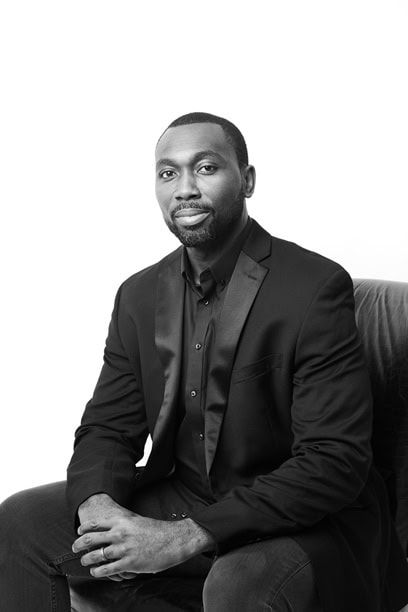
NFL and CFL veteran Kerry Carter’s path to technology came through other industries. [Photo courtesy of Atavus]
At the time Joe and I decided to step out on our own, we started our own marketing consultancy where we worked with athletes and helped them with technology, digital media, social media, events, nonprofits — we combined all those things. And, man, we did a lot of crazy things. We went for the Guinness record for the loudest cheer in the stadium, and so we actually put that together here for the Seahawks’ stadium. I think we did it first, and the Kansas City Chiefs came and beat it. And then we went back and we did it again. All of that was just learnings around fan engagement and digital and social, and how do you inspire and push fans and players and athletes?
We built up brands like that. We worked with athletes directly. Where it all came together for us, we did this celebrity softball game to launch Richard Sherman’s nonprofit. And this was 2013. We partnered with Richard. We produced the event. We did all the digital and social and website. Coming out of that, we got a lot more requests from athletes, from brands. That was our business, where we were connecting the two on the event side, and there was always a charitable component to it.
For a while, we owned the Legion of Boom trademark, and we licensed that to Nike. That’s back when Richard, Kam [Chancellor], Earl [Thomas], Brandon Browner were doing their thing. I did some of that while I was finishing my [playing] career. I was in Year 9 — my goal was always to get to 10 years — but I had to make a decision back in 2012.
I always say it’s the best decision I made because Montreal had just released me, and we had started to move things along with the company. I had other teams call me. Do I go back [to football] or do I continue what we’re doing here because we have good momentum? I decided this was probably the right time, so I stepped away. And another reason why it’s the best decision I made: A week later, I met my wife.
On getting started with Atavus…
After having our second daughter in 2016, we were doing so much. I actually wanted to slow things down a little bit. A friend of mine was doing PR for Atavus at the time. They [started] in rugby and were making the transition into the football world. I went to an investor event that they had, and I really got to understand what they were doing. I was like, ‘Man, this is really cool, unique, different and adds value to the game that I love and protects athletes and kids.’ It’s funny, I wanted to slow things down, so I joined a startup — that’s not usually the way it goes.
I started on the business development side, and they really gave me carte blanche to be able to explore every aspect of the business. I really love marketing, so I did a lot on that side. Operations, design. I helped us launch our first SaaS product into the market, Digital Tackling Academy. We designed our training for our analysts, and then we built our entire grading and reporting platform. Then I even got to go out and pitch and raise money for the company.
On how Atavus does its analysis…
It’s honestly still a very manual process in terms of our tackling technique. There’s a lot of stuff you can pull from third-party data — you can pull down-and-distance information, yards gained, all those things — but when it comes down to our actual [evaluations], we still have a team of analysts that we bring in every year, similar to what PFF [Pro Football Focus] does. They’re breaking down film, they’re tagging it and then we’re scoring it. We don’t just give data, but we actually give insights by position group, by the entire defense, and then we have a tackle plan. Here are the things that you need to focus on going into the next week, into the offseason, into the preseason.
On what they assess…
On a weekend, we have bunch of high school clients, college clients and we’ve had NFL clients — we don’t have any at the moment. It really only takes about a couple of hours to do it, but we get it back to the team within 24 hours with a full breakdown of every tackle made or missed. Anyone that’s involved in the tackle gets analyzed, and we’re looking at pre-contact and contact. Are they continually moving towards a ball carrier? How are they avoiding blocks? Are they maintaining their leverage? Are they taking a good angle towards the ball carrier, and then, once they get closer and into the contact zone, now we’re looking at footwork. We’re looking at which shoulder they are using. Is your head involved? There are a lot of safety components.
If you involve your head a lot of times, then it’s higher risk. Because of what we do and how we break it down, we’re able to show that performance and safety are not mutually exclusive. You can actually do both. So when you’re in contact, you’re using your shoulder, you’re driving your feet, you’re punching through the ball. The higher incidences of shoulder contact lead to less yards after contact, higher performance on defense — and we don’t say reduction in injury, it’s just reduction in exposure.
On how AI can help…
How do we improve speed, accuracy and all those things with our analysis? We’re looking at, No. 1, computer vision. How can we leverage computer vision to speed up our process? We’d reduce our grading time and efficiencies, which obviously reduces cost for us.
You can get to a mass market with that. Right now the NFL, obviously, has wearables, so everybody’s using it. It’s a lot easier to track all those things. You can get the most data. But it’s not everywhere in college. And when you get down to high school, which is our biggest market, you don’t get that at all. So we’ve been looking for a solution that will fit into that market. Where we start with computer vision is using pose recognition to try to identify what’s happening on a play, track where athletes are at the start of a play and the end of the play, how far they’ve traveled, their angles — leverage all those things.
And then the generative AI piece, for me, I want to look at how we future-proof the business. What we call our tackling analytics engine — that’s our grading and reporting tool — as we look at expanding that, it’s, “How can we take in as much information as possible?” Whether it’s our analysts manually putting it in, or we’re getting third-party data, or some wearable data or computer vision data.
So how do you take in multiple input points and use this generative AI process — where we’re training a model specifically on our style of tackling and the way that we grade it and the things that we look for — to produce the outputs of an individual tackle for an individual athlete? Then that just scales up to the position groups and gets up to the entire defense.
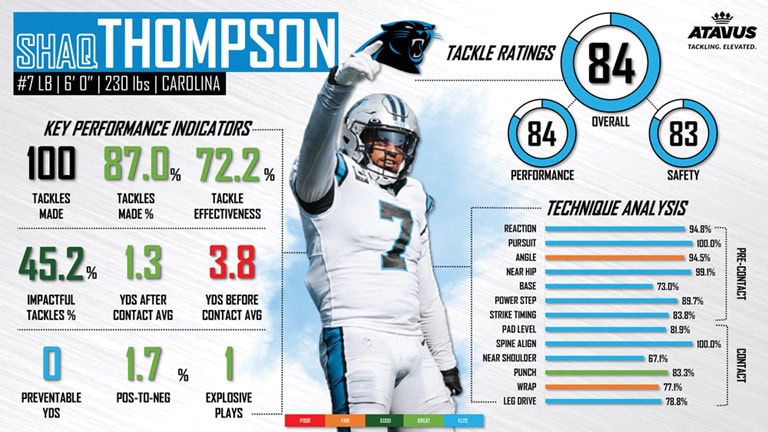
The company breaks down a player’s tackling technique and overall performance. [Courtesy of Atavus]
Sportsbox AI utilizes a single smartphone camera to capture, measure, and analyze swing mechanics in 3D.
A Data & Innovation article brought to you by
Among those DeChambeau identified were his agent, manager and friends before mentioning his swing coach, Dana Dahlquist — and then a tech startup called Sportsbox AI. The company can extract 3D swing mechanics using only a single smartphone camera.
“I’m continuing to use technology to my advantage with my golf swing,” DeChambeau expanded in a Golf Channel interview. “Sportsbox AI has been great. Dana Dahlquist has been awesome helping me figure some things. Just really dialing in — when I’m hitting my best, what am I actually doing?”
While struggling at LIV Golf Houston the prior week, at least by his standards, DeChambeau began collecting Sportsbox AI swing data, which was paired with ball flight data collected by a Foresight launch monitor. (That partnership went live to the public on June 17.) Cause and effect were now tidily married together.
Dahlquist, who has been using Sportsbox as a coach for a couple years, noticed a trend in DeChambeau’s data causing his drives to miss out to the right. In short, DeChambeau’s chest-to-rib cage rotation and side bend were too great.
“I want to make sure that I can give the best possible, simplified answer, so that he can perform as the best athlete as he can,” Dahlquist said.
With several members of the Sportsbox team on site at Pinehurst No. 2 for the US Open — including VP of business operations Paul Park, director of sales Edwin Fuh and, for the practice round, CEO Jeehae Lee — Dahlquist and DeChambeau had support in collecting the data that played a role in DeChambeau’s victorious weekend. Sportsbox had already planned to be on site as part of a brand activation with Lexus even before work began with the eventual tournament winner.
Lee noted that DeChambeau’s practice round and range sessions on Wednesday, as well as first-round score of 67, helped create a gold-standard baseline for the sport’s most data-driven golfer.
“Everything is now going to be compared against his Wednesday and Thursday swings because he literally just hit it perfect,” said Lee, herself a former LPGA Tour player. “Thursday was one of the best ball-striking rounds ever in US Open history. He hit 86% of fairways and 83% of greens, hitting it at 350 off the tee — that’s unheard of.”
After DeChambeau name-checked Sportsbox over the weekend, Lee said inbound interest has already started from others seeking similar support. The company originally launched as a coaching tool, before adding a consumer-facing app, 3D Practice. It then had B2B2C and direct B2C touchpoints. Now, it’s considering an elite consultancy for LPGA and/or PGA Tour players and, maybe eventually, junior golfers and college players.
“We’re already getting a lot of inquiries, so we’re trying to formalize it because what we did for Bryson was not a business that we planned on building so, but I do think it’s the best use case for our technology,” Lee said. “He demonstrated that it can be really helpful for the right athlete.”
A day after DeChambeau hoisted the US Open trophy — and lingered on the course for hours after, signing autographs and crashing interviews — Dahlquist was set to give eight hours of lessons on a public driving range in Long Beach. He said he uses Sportsbox “every day” and that the best part is that his students can use it to monitor themselves when practicing outside of lessons, to ensure they use their time effectively.
“This is where the future of the instruction industry is going,” Dahlquist said.
This article was brought to you by SBJ Tech, a Leaders Group company. As a Leaders Performance Institute member, you are able to enjoy exclusive access to SBJ Tech content in the field of athletic performance.
The double world champion also spoke about how she uses data monitoring in her daily life and the new series of the podcast she co-hosts with USNT teammate Tobin Heath.
A Data & Innovation article brought to you by
You can’t have a discussion about sports technology today without including athletes in that conversation. Their partnerships, investments and endorsements help fuel the space – they have emerged as major stakeholders in the sports tech ecosystem. The Athlete’s Voice series highlights the athletes leading the way and the projects and products they’re putting their influence behind.
* * * * *
After tearing her ACL in June 2022, Press required four surgeries and an arduous recovery. She returned to her first training session in early June, after which she spoke to SBJ about her rehab and the new season of her podcast. Along with Tobin Heath, Megan Rapinoe and Meghan Klingenberg, Press founded a media and lifestyle brand called RE—INC in 2019. She and Heath are the co-hosts of the The RE-CAP Show podcast, which returned for its third season on June 13. The first episode includes appearances by USWNT legend Abby Wambach and author and podcast host Glennon Doyle.
On returning to the pitch…
I am currently in the car driving home from my first training. I would say the road to recovery happens very slow, and then yet it happens all at once. I have been back in the team environment for almost four months. So it’s been a long time that I’ve been integrated into the environment, and it took four months for me to get ready to be in a warmup and a passing pattern — really simple, basic stuff. And I felt very ready for it. I felt almost underwhelmed by how easy it was because I’ve done a lot more complicated things, and yet it was also entirely overwhelming and joyful to be so connected to my teammates and be celebrated in the way that I have been these last two days.
I’m very grateful for that. They say it’s the hope that kills you, and as I drive home, I just have this big smile on my face because I can’t help it. I can’t help hoping. I can’t help believing that I’m going to make it back, and it’s going to be everything that I see in my head. I’m relentlessly optimistic, I’m naively positive, and I like that about myself, and I don’t intend to change it. I think the way that it left me feeling was just like, yes, I can do this.
On monitoring her rehab…
I’m a person of devices, so I have quite a toolkit, I’d say, of ways that we’re tracking and measuring. The truth is we’re really still working through issues with my knee, and I have chronic scarring of the knee, so I can experience some discomfort and some swelling that could lead to more scarring, which is incredibly rare, because most people don’t scar after a couple months after their surgery. I’m now over nine months for my surgery and still at risk of scarring. So it just means that I have to try very carefully with how much impact my knee can take.
We’re being careful, but we’re progressing. In terms of my overall fitness, what my GPS has said is that I’ve got to like 60% of a match load, which is all that I really need to get in terms of volume. And yet, in the warmup and the passing pattern today, it felt like I played a 90-minute game. I was so fatigued. There’s training, and then there’s really training. There’s no way to get fit for football, except for playing football. And I’ve done a ton of running, I’ve done a ton of lifting, and now it’s time to play.
On how deep she gets into data…
My performance staff would laugh because they said they’ve never worked with a player that cares so much. So right now, I wear a Polar Watch that I was given in like 2015 from the national team. It’s just old school. And I wear my Apple Watch, which is connected to my GPS so I can see all my data live, from heart rate to distance to speed to all that. And then I do sleep with an Oura ring — although I’m not endorsing any of these products, I’m not connected to any of these products — but I do sleep with an Oura ring and track my sleep and my stress levels.
On season three of the podcast…
Our show really is about authenticity, and it’s about creating a more inclusive space for sports and including diversity of perspective. And so that means we have hard conversations, and we have honest conversations and we have vulnerable conversations, and we have a lot of fun — the same spirit and joy that you saw last year during the World Cup edition of the show. We’re back, and we’re bigger than ever.
On the origin of the creating the podcast…
I never thought I would be in media. I think that’s even more true of Tobin. There’s two typical paths for athletes after soccer, and it’s coaching and broadcast. ‘So Christen, do you want to be a coach?’ ‘No.’ ‘So Christen, then you must want to be a broadcaster? I was like, ‘No.’
That’s an interesting part of the story, but first and foremost, we decided to launch this show as current and active players, and that’s unique and different. It’s not really a stepping-back-from-soccer thing. It’s current players trading stories and having a little bit more space to dictate the narrative.
And then secondly, we really approach this as business leaders. This is our business, this is our company. We are a 3C company: content, community and commerce. The most amazing thing about women’s sports is the community, and we’re trying to build the coolest women’s sports community in the world in our membership, and we’re feeding that with amazing content.
And I think because we have such an authentic and vulnerable relationship with our audience that we’ve developed over the last five years that we’ve been building this business, it made sense for Tobin and I to be our first piece of content that was really more large scale and more widely accessible. But the plan will be to find like-minded people that sit at the intersection of sports, progress and equity, to continue to hear stories from an insider’s perspective. It really disrupts the industry in that way.
On topics they plan to cover in season three…
We’re going to be talking about women’s health, particularly in sport, which is obviously a really hot topic, and representation in sport — how we make it more diverse and equitable for more people, be it across the gender spectrum, the orientation spectrum, across different races and classes. I think that’s incredibly important. Soccer in America is an upper-middle class sport, and almost everywhere else in the world, it’s a very accessible sport that’s found on the street. That’s really the spirit of football, so that’s really important to us.
On the role of athletes as activists…
The interesting thing about the community that surrounds women’s sports in particular is they care about a lot more than the sports, and the values transcend beyond the pitch. And that’s about diversity, inclusion, progress. And I think that’s just inherent because it is disruptive in itself to see women embodied, powerful, unapologetic and also very celebrated the way that you do in the professional sports world today. The people that it’s drawing in are the same people that want to march, and they want to create change and they want to stand up for what they believe in.
It’s so embodied in the Angel City culture. The professional team that I play for has just nailed it. And when you’re in the stadium, it’s electric, and win or lose, it’s a different type of vibe than any other sports arena I’ve been in because there’s a connection point for all of the audience. They care about more than the X’s and O’s. They care about what we represent to them, the progress and the opportunity that we as women athletes represent.
On the versatility of women athletes…
It’s always been that way in women’s sports, and it’s just becoming more popularized. I think the expectation is that we would always be multifaceted as women and expected to do multiple jobs in multiple roles, if we were going to have careers. And so it really did take to me and my personality to be a player and also be a leader off the field, on the US women’s national team, going through the Equal Pay lawsuit, going through the reestablishment of our players association.
For me, it was such a balancing sense of purpose that I continue to create space in my life for that, and I think that’s what we’ve done with our business, RE—INC. RE—INC is reimagined, incorporated. We set out, in 2019 when we started this company, to reimagine the status quo, to reimagine the way women are seen and experienced in sports. And it’s a very bold and ambitious goal, and we do it in a multifaceted way. And I’m really, really proud of that.
This article was brought to you by SBJ Tech, a Leaders Group company. As a Leaders Performance Institute member, you are able to enjoy exclusive access to SBJ Tech content in the field of athletic performance.
SBJ Tech’s Joe Lemire finds out in real time why baseball players tend to swing a golf club in a particular way.
Main Image: Joe Lemire / SBJ Tech
A Data & Innovation article brought to you by
The Sandbox series is where we share our experiences testing products, gear, solutions and more in the sports tech space. Previous iterations have included demoing Apple Vision Pro apps from MLB and MLS, taking the new F1 Arcade for a spin, trialing AiFi’s cashierless checkout at the Prudential Center, using Nextiles and Rapsodo for improved pitch velocity and physiological testing at the Gatorade Sports Science Institute.
* * * * *
They were smart to do so. I was flatly incapable of hitting a groundball to the right side. (I also usually hit the ball in the air, so I don’t think I actually lost many hits as a result of the shift.)
The irony, it seemed to me, is that my golf swing produces almost exclusively shots to the right. I have since learned, however, that a slice is a common ailment of former baseball players: the left wrist (for a righty batter) needs different positioning for golf — more of a flexion than an extension.
Could an app and an Apple Watch help me overwrite four decades of motor learning? I put Golfshot to the test on a recent evening at the Chelsea Piers driving range in New York City.
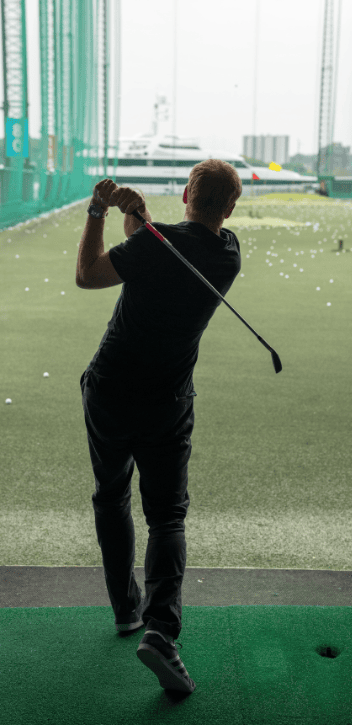
SBJ Tech’s Joe Lemire puts his swing to the test. (Ash Gilbertson)
And this wasn’t just any Apple Watch but the Ultra 2, whose myriad features include a high frequency motion API that can collect data at 800 hertz and dual-frequency GPS. The former allows the accelerometer and gyroscope to sample at four-to-eight times the precision of what Golfshot used to receive of 100 to 200 times per second from the motion sensors.
“As hardware gets better, we can also get better,” Golfshot CTO John Hawley said. “So Apple Watch Ultra and really this high-frequency motion API that came out is something that was a gamechanger for us. These metrics just get much cleaner, much more accurate.”
The enhanced GPS permits more accurate shot lengths, locating where each shot was taken and calculating the distance between them, though on this day the focus was the driving range.
At Apple’s invitation, a select group of reporters tried out Golfshot’s new Swing ID On-Range experience. The app, which is developed by a core group of about 25 people within a larger company called Golf Genius, has been around since 2008, with Apple Watch features introduced in 2015.
The Apple Watch Ultra 2 and accompanying watchOS 10 both were released in September 2023, helping power Swing ID, which is the ability to track swing mechanics. Golfshot first offered that feature on courses where the number of non-putted shots can be about 40 or 50 for competitive players. The range was a scale problem, requiring a new data architecture and storage plan with ardent players logging 10 times as many practice shots.
I only took 34 shots recorded in the app — eight with a six-iron, nine with a driver and then 17 with a three-wood — but that was a sufficient sample to realize that, yes, I do swing with a wrist rotated too far open and, mercifully, the issue seems to be somewhat corrective for me. And I’ve been told I have the raw tools for golf, even if my technique remains barely molded clay.
There are nine key metrics generated on every swing by Golfshot. Some, like tempo and backswing arc, could be improved, but they don’t appear in critical red coloring in the app the way wrist path and wrist rotation do for me. (Of note, the Apple Watch is obviously affixed to my wrist, not the club face, but it’s a helpful, albeit imperfect, proxy.)
On the watch, I was able to select a metric of focus and, after every shot, that datapoint and a visualization of the swing — showing, for instance, my swing path versus the suggested path — would appear on my wrist. It was a helpful way to track progress (or lack thereof) without fiddling with my phone each time. A tripod nearby held the device, where I could use the app for more detailed review of my metrics.
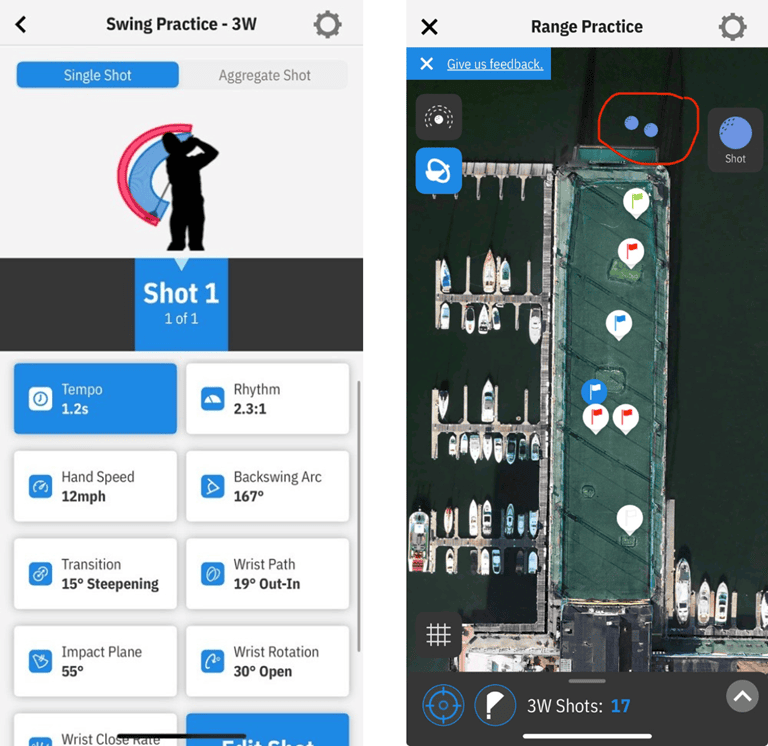
SBJ Tech’s Joe Lemire was able to review his swing metrics on Golfshot (Ash Gilbertson)
Golfshot’s app only offers normative datasets in broad strokes (pun intended), because it has found that swings are too individualized for hard guidelines to be helpful. But reviewing what data I saw — plus a short consultation from PGA professional Jonathan Doctor, the Northeast sales director for Golf Genius — helped mitigate my wrist supination, at least for a few fleeting moments.
My wrist path, which should be 0 degrees for straight contact, usually ranged between 15 and 20 degrees out-in; again, that can work in baseball, but less so in golf. And my wrist rotation, which should also be around 0, instead averaged around 30 to 40 degrees.
As Aristotle should have once said, the whole shot can be greater than the sum of its poor component metrics. In my case, I hit a handful of good golf shots interspersed between a larger number of bad ones. But at least I felt encouraged when, near the end of my session, I hit back-to-back three woods on a straight line into the netting 200 yards away.
It’s a helpful start, but I’ll need more monitoring and instruction to keep it up, which, conveniently is on the Golfshot road map.
“Going out and practicing is one portion of it, but making a plan to practice is really the greater aspiration here,” Hawley said. “Part of this developing practice plans is also going to be integrating with apps like [Golf Genius-owned] CoachNow, where you can communicate directly with your coach. Your coach could even get alerted after you play a round. ‘Here’s the round, let’s review his shots.’”
Hopefully alerts of my play include trigger warnings, but maybe someday I’ll work up the courage and play on a course. I take solace knowing that the Apple Watch Ultra 2 is chockfull of safety features — Emergency SOS, Backtrack GPS, siren and international orange action button that can be used for compass-based wayfinding — so no matter how deep my slice goes into the woods, I won’t get lost.
This article was brought to you by SBJ Tech, a Leaders Group company. As a Leaders Performance Institute member, you are able to enjoy exclusive access to SBJ Tech content in the field of athletic performance.
Orreco.AI can plan training sessions based on expected workload, model injury risk automatically and even guide return-to-play protocols with an auto-pilot drone.
Main Image: Orreco
A Data & Innovation article brought to you by
It became a leader in supporting women athletes through its pioneering free app called Fitrwoman. It developed a holistic athlete management system called Recovery Lab and devised machine learning algorithms to identify injury risk based on an athlete’s movement signature.
All those modules and have been built in-house from the same data architecture, laying the foundation for its newest innovation, Orreco.AI, to improve efficiency for performance coaches. They can now interact through voice and text prompts, plan training sessions based on expected workload, model injury risk automatically and even guide return-to-play protocols with an auto-pilot drone.
“We built it from the ground up so that the AI layers through it all,” said Orreco CEO Brian Moore, whose company won SBJ Tech’s Best in Athlete Performance award in 2023. “It’s the operating system, really, for the body.”
Built under the direction of Orreco’s Head of Engineering, Matt McGrath, the new AI products rely on custom-built large language models that can generate its own recommendations of athletes who need additional attention, complete with relevant video clips, datapoints and relevant research to guide the practitioner. Educational resources can then be sent to the relevant player via his or her use of the accompanying @thlete app.
“It’s surfacing that information for you in real time, and it’ll tell you what to look at,” Moore said. “So rather than having to go into each of these different systems, now it’s just telling you this is the athlete to look at, these are your priorities and this is why. It’s also giving you suggested outcomes for the player.”
Image: Orreco
The generative AI also enables someone to type or dictate a command such as “show me Player X’s high-speed running as a bar chart” and see exactly that rendered within seconds. Add prompts for inflammation levels or number of decelerations, and those lines get superimposed over the graph to help connect trends.
A new Drill Planner enables users to select any number of athletes from a roster, select the focus for training, the number of sets, duration, field size and other variables to predict the expect load for each player and the group, to help create an appropriately targeted session based on the club schedule.
The most dramatic application of AI is in the use of drones to help rehabbing players. Current RTP plans can’t fully replicate an athlete’s distinct movement patterns, but the drone can be programmed to mimic his or her typical running based on position and preference — and all done with ascending intensity. As the drone flies, the athlete tries to keep pace, cutting and pivoting to stay close.
“The return-to-play [protocols] are typically in a straight line, but we haven’t been able to understand the twisting and the turning,” Moore said. “So it’s basically being able to hyper-personalize and say, I think you’ll be able to get more efficient with your training. You need to do these very specific moves at these very specific times. It’s like an inoculation dose.”
By combining inputs from wearables, biomarkers, in-game tracking systems, medical notes and more, Orreco.AI is seeking to personalize at scale by marrying an understanding of an athlete in context with advances in computing power, cloud storage and generative AI.
While the sports industry is grappling with future uses of AI, Orreco, is deploying these new products as a way of signaling what can be possible now with its human operating system.
“This is real, and it’s live,” Moore said. “We just wanted to show what’s possible. And what we’re showing is just the tip of the iceberg.”
This article was brought to you by SBJ Tech, a Leaders Group company. As a Leaders Performance Institute member, you are able to enjoy exclusive access to SBJ Tech content in the field of athletic performance.
In the last episode of this series of the People Behind the Tech podcast, the Magic’s Harjiv Singh discusses smart practice design, targeted data visualization, and the cognitive elements of motor learning.
A Data & Innovation podcast brought to you in collaboration with
Hot on the heels of Andrea Hudy, who recounted her own story of ACL troubles in episode one, Harjiv told the tale of a pickup basketball game that ended with him tearing his ACL and meniscus while also suffering an avulsion fracture.
The 16 months of rehab stoked an interest in sports science that not only led him to the NBA but, since January, roles at the Grand Rapids Rise women’s volleyball team, as Director of Performance Science, and the University of Michigan, where Harjiv teaches out of the Human Performance and Sports Science Center.
John Portch and Joe Lemire could not have wished for a more engaging guest on this finale to this People Behing the Tech podcast series, where Harjiv delved into the sports science principles that define his work.
He also shared his thoughts on training drill design [15:39] and the transferability in competition – a relatively new area of enquiry. “It could be as simple as, in basketball, you’re putting a defender in front of you,” he says. “But it can also be as complex as the angle and the approach of that defender, the people in the vicinity of the athlete, where the athlete is starting from, their position on the court. And that’s merely the introductory part of this.”
Then there’s his thoughts on the “neglected” cognitive component to ACL injuries [6:41]; the need to know your audience when visualizing data [27:38]; and his ability to ask applied questions in the lab at Michigan.
Check out episode two:
Five Years on from the USWNT Introducing Menstrual Cycle Tracking, Sports Science for Female Athletes Remains Under-Developed. So What Can Athletes and Practitioners Do about it?
Listen above and subscribe today on iTunes, Spotify, Stitcher and Overcast, or your chosen podcast platform.
The Australian spoke to SBJ Tech about his cognitive training, using the simulator, and the data he seeks before and after a race.
A Data & Innovation article brought to you by
You can’t have a discussion about sports technology today without including athletes in that conversation. Their partnerships, investments and endorsements help fuel the space – they have emerged as major stakeholders in the sports tech ecosystem. The Athlete’s Voice series highlights the athletes leading the way and the projects and products they’re putting their influence behind.
* * * * *
The native Australian driver spent 2022 as Alpine’s reserve F1 driver, while also testing with McLaren and then joining McLaren’s Formula 1 team as a full-time driver in 2023.
In his rookie season, Piastri claimed two podiums — third in Japan, second in Qatar — and he claimed a further second-place in Monaco last month. Piastri, 23, currently sits in sixth place overall in the driver standings, and he spoke with SBJ last month just before the Miami Grand Prix, at which he finished in P13.
On what makes the Miami Grand Prix unique…
It brings a lot of star power to the calendar. Now that we have Vegas as well, we have two American events that are in pretty prime locations. We have Austin as well, which is, let’s say, a more traditional circuit. But yeah, having Miami on the calendar is very cool. It’s a place where a lot of people want to go. There’s a lot of celebrities and stuff, and it just adds a lot of stardom to the event, really.
On the start to the season…
It’s been a pretty good start to the year, I think, for the team. It’s been very positive. We’ve established ourselves as the third-quickest team at the moment on average. And for me, personally, it’s been a pretty good start. The last couple [before Miami] were a little bit more of a struggle in certain areas. But on the whole, it’s been a nice, clean start to the year. Definitely a much better place than we were 12 months ago.
On being teammates with Lando Norris…
You always utilize your teammate to try and go quicker. With Lando and especially his experience knowing how to drive a Formula One car in the best way and knowing how to drive a McLaren F1 car in the best way as well — because all the cars are going to be a little bit different across the grid — he’s been very useful for that. There’s certainly been things I’ve learned from him along the way.
We’ve been both pushing each other to become quicker, and that’s what you want out of out of a teammate, really, is to be able to push each other and find little bits and pieces here in different corners. Every driver on the grid is going to be looking at their teammate’s data. It’s how you go quicker, especially if there’s corners where they’re there quicker than you. It’s a good idea to look at what they’re doing and try and learn from that.
On the data he checks first after a race…
The first thing is you just look at where everyone’s finished in the race because you often don’t really know how exactly it’s gone. We make a graph of how everyone’s race has gone, so there’s a bunch of different lines, and you can see where people have been quick in their stint, where they’ve been slow in their stint, what their tire degradations look like. And the next thing is then looking into the data itself. You’re looking into what you do in every session like in practice and qualifying the race, looking at which corners you’re better in which corners you’re worse in, looking at how the tires are being used and stuff like that.
On his points of emphasis in development…
It can change a bit from weekend to weekend. For me, managing tires is probably the biggest thing I’m working on at the moment, which is difficult because you need to go as fast as you can but use the tires in a way that’s as friendly as possible for them. So that’s probably the biggest thing I’m still getting to grips with.
On simulated race time…
We do a lot of dedicated simulator work at McLaren trying to prepare the weekends, so the track is as close as possible to the real thing. We’re trying stuff with the setup, trying to get used to the track again, build up some references. I play some iRacing every now and again, as well, but more just for fun, because I enjoy driving racecars. So that’s more what I use that for, rather than actually using it to train or anything like that. It’s more just for a bit of fun in my free time. So yeah, mainly the sim work at McLaren to get a bit of a starting point for the race weekend.
On his fitness training…
Data certainly influences it, for sure. There’s certain metrics that you want to improve, which is, I guess for everyone, trying to get your muscle up and your fat down. But there’s some specific things as well. The biggest strain for us as a driver is our neck, so trying to build that up. And it’s not just your neck muscles that you need but the supporting muscles around it as well, to try and to build that up and see progress in the numbers that you can sustain when you’re training it.
We always log that and monitor that and see where I’m at. Same with my running and cardio side of things, always trying to improve your VO2, trying to get your pace down for a similar heartrate. We monitor all of that kind of stuff, just trying to improve your general fitness because you use a few weird muscles that you wouldn’t normally use in everyday life. But even just with the schedule, with all the jetlag, having a good cardio base is also important. Just so you stay healthy, and you’ve got to get to be able to concentrate for a long time.
On cognitive training…
Everyone’s a little bit different with that. You train your reflexes just by driving in some ways, and we drive so often that you’re always keeping it topped up. I do a bit of reaction training before the session, with tennis balls or whatever, just keeping your mind and hand-eye coordination switched on. We always try to improve our reactions for the start as well, but for me, a lot of that is the state of mind that you’re in, rather than actually training for it. You gain more by knowing whether you need to be revved up or relaxed, or whatever you need to be.
On help from McLaren’s partners…
All of our partners are pretty incredible. To be working with the likes of Google, with Coca-Cola, Dell, just to name a few, working with those kinds of big brands is pretty special. It’s good fun. Of course, they support us in going racing, in all kinds of ways — through financial support, of course, but especially with a lot of our tech partners, with a hands-on approach to helping us, whether it’s through computers or better ways to analyze our data, quicker ways to analyze it. That’s all very important to us. I always enjoy that side of things, the data and, and tech side of things. So yeah, being able to work with some of those big companies like that is very special.
We rely a lot on our partners, especially for our simulator, which we completed not that long ago in the grand scheme of things. Having all the computing power for that, being able to run the graphics well enough, being able to update the model quick enough in real time — I know exactly how important that is when I’m driving it because you know, when you’re lacking in that area.
On Netflix’s Drive to Survive…
I’m still pretty new to Drive to Survive. So I think people are still catching up with me on that. But it’s cool. The benefits it has brought to the sport are pretty incredible. All the sort of new fans that is brought in is very, very cool and positive for the sport. They’re not particularly intrusive on our weekends, so it’s OK. At the end of the day, it’s a good way of getting our sport out there more, and it’s exciting to watch as well.
This article was brought to you by SBJ Tech, a Leaders Group company. As a Leaders Performance Institute member, you are able to enjoy exclusive access to SBJ Tech content in the field of athletic performance.
LLume’s Light Lace technology measures respiration, heart rate, joint motion and impact detection.
A Data & Innovation article brought to you by
The core IP is the “LL” in the product name: Light Lace. Spun out of Professor Rob Shepherd’s Organic Robotics Lab at Cornell, LLume uses red LED light to measure, for starters, respiration, heart rate, joint motion and impact detection. It’s an exceedingly versatile tool when inhibited only by the speed of light.
“We are right now the only solution that has such high precision, and that’s because we’re using fiber optics instead of electrical sensors,” LLume CEO Ilayda Samilgil said during a recent SBJ visit to its workspace in the Charlestown neighborhood of Boston.
Following several years of development — during which time it won the NFL’s First & Future innovation contest, received grants from the Department of Defense and did early testing with an MLB club — LLume is now launching its first commercial product in beta.
The LLume strap resembles a standard chest worn heart rate monitor, only it doesn’t need to be worn directly on the skin and its initial focus is respiration. (LLume does monitor heart rate but initially won’t report that in the app until it has more time for validation.)
Most measurements of VO2 and — VO2max, a limit of oxygen consumption during exercise that is increasingly understood to be the single best predictor of fitness and longevity— need to be done either in a lab setting or else with expensive portable equipment, such as the VO2 Master that retails for $6,295.
LLume’s beta price tag is $199, with possible discounts for high usage. The early target market demo is the cycling community, with a preference for those near Boston for additional support testing.
“We’re going to start direct to consumer mainly to get feedback from the customer, but I think eventually — whether it’s with apparel companies or something like Peloton or iFit equipment or gyms — we’re definitely very open to going B2B2C instead,” Samilgil said.
The LLume strap doesn’t use a mask to quantify oxygen intake and carbon dioxide exhalation but rather uses its high sample rate to detect minute changes in the chest as a proxy for lung ventilation. (Though capable of higher sample rates, the team realized anything over 400 hertz is overkill for biometrics.) The idea is to provide personalized exertion monitoring that’s more precise than the standard wearable’s heart rate zones.
“Heart rate is affected by how you breathe,” LLume biomechanist Riley Edmonds said. “So that zone can change quite quickly if your breathing is not controlled. So if you want to look at the step behind what’s powering your heart, breathing is what does that so it gives you a more accurate, precise control over your zones.”
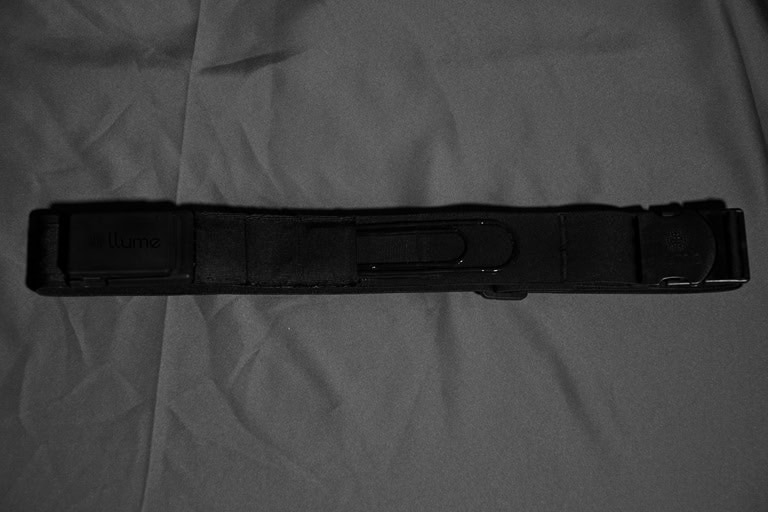
Image: LLume (Melanie Lyons)
This chest strap for endurance athletes is a starting point, but future adaptations are nearly limitless. With its baseball partner, LLume has been working on sleeves to track pitchers’ elbows and shirts to monitor their shoulders — those motions might be tracked at 20 kilohertz, they said. It can capture rapid accelerations in the joints, which Edmonds said is a more actionable datapoint than torque.
The 250 kHz measurements have been used by the military in research contracts to measure impact and trauma. LLume has developed algorithms that enable the device to sample at moderate rates continuously but then automatically increase when triggered by, say, a potentially concussive explosion.
Impact monitoring is, of course, applicable to sports such as football, hockey and rugby. The potential for embedding Light Lace into helmets or uniforms is possible but it hasn’t attempted that yet. The company’s winning pitch in the NFL competition — for which it received a $50,000 grant — was for tracking respiration and muscle fatigue.
At the time, LLume was doing business as Organic Robotics Corporation in a nod to its roots, especially with Shepherd remaining with the company as co-founder and CTO. But the name proved confusing to the marketplace, leading to the change. LLume has that double L, is pronounced as “loom,” which is relevant for its ability to be embedded into textiles and “llume” also means “fire” in Asturian, a regional dialect in Spain — fitting for a company whose core technology is red light.
There are future opportunities to make the Light Lace glow either as a fashion accessory or as an indicator — maybe it blinks twice when you reach a set respiration target. It’s another idea yet to be realized, on a long roadmap of possible destinations for the adaptable technology. And often when Samilgil looks at her iPhone, the auto-generated memories will be a picture of earlier product form factors.
“I’ll get a photo of an older prototype,” she said, “and I’ll be like, ‘Oh, my God, this is only like three months ago. We’ve come such a long way.’”
This article was brought to you by SBJ Tech, a Leaders Group company. As a Leaders Performance Institute member, you are able to enjoy exclusive access to SBJ Tech content in the field of athletic performance.
