Neurodivergence is not the blocker that some coaches perceive it to be and neurodivergent athletes are some of the best-equipped to perform – with the right coaching.
The term ‘neurodivergence’ can often be perceived to be a blocker in sport, but as Dr Julie White, Head of Learning Support at Millfield School, put it to our members at Leaders Meet: Teaching & Coaching, “neurodivergence is when there are differences from the ‘neurotypical’ as opposed to perceived weaknesses”.
In fact, neurodiverse learners have been known to display high levels of perseverance and demonstrate transferrable resilience into the classroom. They embody the words of Harvey Blume, who was one of the first journalist to cover neurodivergence. In 1998, in the Atlantic, he wrote:
Neurodiversity may be every bit as crucial for the human race as biodiversity is for life in general. Who can say what form of wiring will be best at any given moment?
You may be familiar or have heard of neurodivergence through familiarity with such terms as dyslexia, dyspraxia (cognitive learning and gross motor skills), autism (speech, communication and language processing), ADHD (social, emotional and mental health difficulties). But, a lot of the time, the signs and symptoms of these conditions are hidden or less obvious for coaches to pick up on.
It’s critical for coaches and practitioners to have a baseline understanding to ensure they know a) what to look out for; and b) how the various conditions affect decision-making and subsequent performance.
White breaks down one of the core neurodiverse challenges into two areas related to speed of thinking and recall:
Many neurodivergent people will have a weakness in one or both of these areas, regardless of their label.
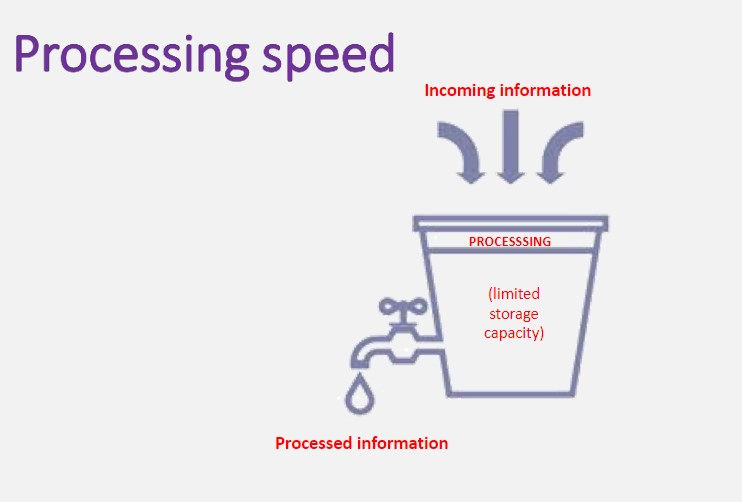
It’s easiest to think about it as a bucket.
For most of us: information comes in the top, there’s a steady flow. It’s being processed in the middle section at a good speed, and it comes out of ‘the tap’.
But if your processing speed is slow, your ‘tap’ lets out a lot less water. The info comes in at a fair speed, the bucket fills up very quickly, it can’t drain quickly enough and so it overflows. That’s what happens in young people’s brains where they can’t take in any more information, and they feel overwhelmed.
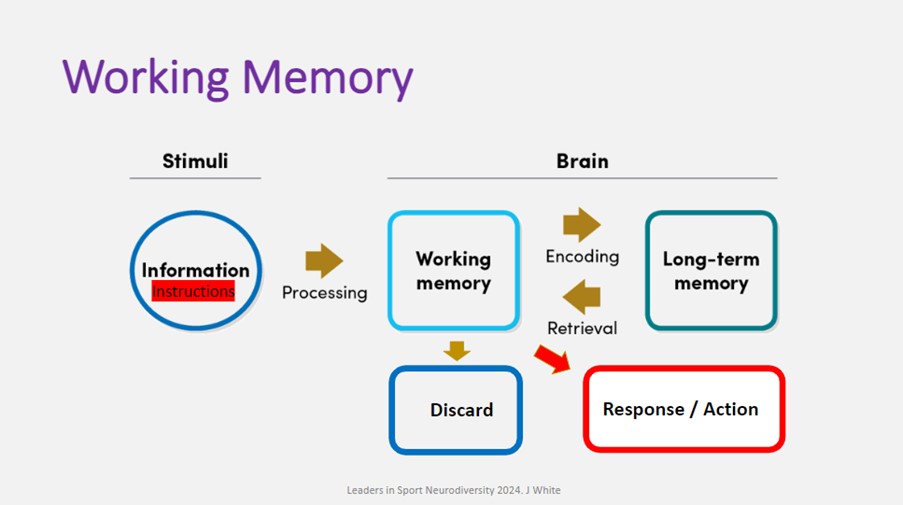
On the field/pitch/training, you might see this as:
As a coach, you need to…
Pay attention to the language you use and the quantity of information you give:
You have to make adaptations. We’re not all the same. It’s about equity and giving them equal access.
Dr Julie White, Head of Learning Support, Millfield School
Coaching checklist
Don’t assume you know the full picture – many players will not acknowledge that they have a difficulty, because:
A coach should:
WorkRate is a startup seeking to address issues with lack of movement skills and neuromuscular fatigue in athletes.
A Data & Innovation article brought to you by

* * * * *
Our Startups series looks at companies and founders who are innovating in the fields of athlete performance, fan engagement, team/league operations and other high-impact areas in sports.
* * * * *
World’s shortest elevator pitch: “WorkRate translates athlete-centered research into practice through diagnostics and evidence-based training to reduce injury and boost performance.”
Company: WorkRate, Inc.
Location: New York, New York
Year founded: 2020
Website/App: https://workrate.fit/
Funding round to date: “Self-funded.”
Who are your investors? “We do have some family and friends investments and that was up to around $30,000.”
Are you looking for more investment? “Yes. That would expand our capability development.”
Tell us about yourself, founder & CEO WorkRate Rondel King: “I was born and raised in the twin island republic of Trinidad and Tobago. In my formative years, I had a deep passion for science and sport. I co-founded a soccer team in my neighborhood that competed in the official youth league in Trinidad and Tobago. After one year of competing as a founding player, I migrated to New York. I studied exercise science at Brooklyn College and continued my sporting career by joining the soccer team at Brooklyn College. I experienced a series of injuries which severely hindered my development. I experienced sub-optimal results with my athlete care team, which included pain doctors, athletic trainers and physical therapists. This frustrating experience galvanized my passion for research. I made investments in continuing my education and completed my Masters in exercise physiology and sports nutrition at LIU Brooklyn. It was at this point I gained a deep understanding of my biomechanics and physiology, and I was able to solve my own problems that my care team wasn’t able to solve. After my personal success, I started asking questions. Why was my care team unsuccessful? What was missing in my care approach? Ultimately, I learned a huge disconnect exists between evidence and practice in athlete care. I started WorkRate to narrow this gap and improve athlete-centered care.”
Who are your co-founders/partners? “My co-founder and COO is Janna Szangolies. Janna is special in many ways, but if I had to choose one way that makes her stand out it’s her versatility. Not only is she a problem solver, but she also plays a pivotal role in translating the deep science into a customer-facing narrative. As a scientist, it’s sometimes difficult to cut the jargon. Janna helps keep me in check and to ensure we are communicating effectively with our users and collaborators.”
How does your platform work? “WorkRate designs and builds data models to enhance human performance. We have developed two diagnostic models and a training recommendation model to address two pertinent risk factors identified by the WorkRate scientific team – lack of movement skill and neuromuscular fatigue. The primary goal of WorkRate diagnostic testing is to obtain objective information to guide the training process properly and systematically. From a movement skill perspective, we developed a self-guided biomechanical analysis algorithm that objectively measures movement quality. The data from this analysis is manually entered into our platform by the user to individualize corrective exercises and identify orthopedic abnormalities. To diagnose neuromuscular fatigue, we invented a graded exercise test (GXT) that evaluates the integrated cardiovascular, pulmonary, musculoskeletal, and neuropsychological systems. We accomplished this by leveraging commercially available heart rate monitors – i.e. Polar H10 – and Inertial Measurement Units like Garmin and Apple smartwatches. The 21-stage running protocol is designed to objectively measure locomotor performance in free-living humans through the utilization of Human Activity Recognition (HAR). HAR is the art of identifying and naming activities using Artificial Intelligence. The rapid proliferation of wearable technologies and advancements in sensing analytics have greatly enhanced our capability development over the past four years. Our novel analysis functions similarly to lab-based graded exercise tests, whereas it can analyze critical running dynamic metrics such as ground contact time (GCT), cadence, stride length and vertical oscillation. Furthermore, the protocol calculates running economy and identifies heart rate zones – i.e. Zone 2 – to fine-tune aerobic and anaerobic metabolism for enhanced performance and fatigue mitigation. Data analytics from our diagnostic models are used to create our training recommendation models, which include respiratory muscle training, corrective exercises, gait training, neuromuscular training and zone-based conditioning. Ultimately, our product is the way we harness human performance data. Our model-based system promotes a classification of athlete performance that helps us to understand and analyze how various training methodologies affect performance and injury. WorkRate models are housed and delivered through the WorkRate Performance App for individual athletes, coaches and organizations.”
What problem is your company solving? “Athletes are still getting injured at a very high rate, from professional soccer all the way to your everyday runner. Research shows a significant gap exists between practice and scientific evidence in sports science that restricts the advancement of effective injury prevention and performance enhancement strategies. At WorkRate, we take a very evidence-based approach. We have curated a powerful, problem-solving model for sports science practice that incorporates the best evidence from well-designed studies, athlete and coach perspectives, documentation, performance diagnostics and the knowledge of the WorkRate Scientific Team.”
What does your product cost and who is your target customer? “We are pre-market. We are targeting soccer athletes and runners as our primary target market to start with.”
How are you marketing your product? “We are marketing our product through collaborative channels with our partners, such as InjureFree and Gateway Athletics Trinidad & Tobago. We have tapped into running communities throughout New York City. We’ve conducted pilots within these ecosystems. We’ve launched soccer performance ecosystems in Tampa, Fla., through collaboration with Flex Soccer. It’s very much a controlled and systematic deployment of our technology, and we do this to ensure our models are scientifically valid before we go into scale and a wider market. These collaborations will be guided by WorkRate Labs. WorkRate Labs is a boutique-style research and development hub that was built to bridge the gap between athlete-centered research and practice. The fully portable laboratory was designed to ensure that WorkRate diagnostics and interventions are scientifically validated via medical-grade diagnostic testing. WorkRate Labs is the cornerstone of the WorkRate evidence-based practice model.”
How do you scale, and what is your targeted level of growth? “We will scale through our collaborative channels where we intend on acquiring up to 60,000 individual athletes and 5,000 coaches within the next 12-24 months.”
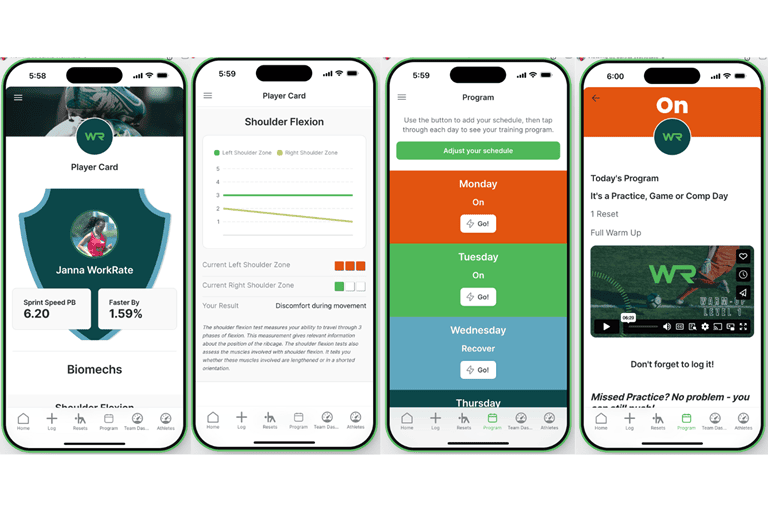
Image: WorkRate
How does your platform work? “WorkRate designs and builds data models to enhance human performance. We have developed two diagnostic models and a training recommendation model to address two pertinent risk factors identified by the WorkRate scientific team – lack of movement skill and neuromuscular fatigue. The primary goal of WorkRate diagnostic testing is to obtain objective information to guide the training process properly and systematically. From a movement skill perspective, we developed a self-guided biomechanical analysis algorithm that objectively measures movement quality. The data from this analysis is manually entered into our platform by the user to individualize corrective exercises and identify orthopedic abnormalities. To diagnose neuromuscular fatigue, we invented a graded exercise test (GXT) that evaluates the integrated cardiovascular, pulmonary, musculoskeletal, and neuropsychological systems. We accomplished this by leveraging commercially available heart rate monitors – i.e. Polar H10 – and Inertial Measurement Units like Garmin and Apple smartwatches. The 21-stage running protocol is designed to objectively measure locomotor performance in free-living humans through the utilization of Human Activity Recognition (HAR). HAR is the art of identifying and naming activities using Artificial Intelligence. The rapid proliferation of wearable technologies and advancements in sensing analytics have greatly enhanced our capability development over the past four years. Our novel analysis functions similarly to lab-based graded exercise tests, whereas it can analyze critical running dynamic metrics such as ground contact time (GCT), cadence, stride length and vertical oscillation. Furthermore, the protocol calculates running economy and identifies heart rate zones – i.e. Zone 2 – to fine-tune aerobic and anaerobic metabolism for enhanced performance and fatigue mitigation. Data analytics from our diagnostic models are used to create our training recommendation models, which include respiratory muscle training, corrective exercises, gait training, neuromuscular training and zone-based conditioning. Ultimately, our product is the way we harness human performance data. Our model-based system promotes a classification of athlete performance that helps us to understand and analyze how various training methodologies affect performance and injury. WorkRate models are housed and delivered through the WorkRate Performance App for individual athletes, coaches and organizations.”
What problem is your company solving? “Athletes are still getting injured at a very high rate, from professional soccer all the way to your everyday runner. Research shows a significant gap exists between practice and scientific evidence in sports science that restricts the advancement of effective injury prevention and performance enhancement strategies. At WorkRate, we take a very evidence-based approach. We have curated a powerful, problem-solving model for sports science practice that incorporates the best evidence from well-designed studies, athlete and coach perspectives, documentation, performance diagnostics and the knowledge of the WorkRate Scientific Team.”
What does your product cost and who is your target customer? “We are pre-market. We are targeting soccer athletes and runners as our primary target market to start with.”
How are you marketing your product? “We are marketing our product through collaborative channels with our partners, such as InjureFree and Gateway Athletics Trinidad & Tobago. We have tapped into running communities throughout New York City. We’ve conducted pilots within these ecosystems. We’ve launched soccer performance ecosystems in Tampa, Fla., through collaboration with Flex Soccer. It’s very much a controlled and systematic deployment of our technology, and we do this to ensure our models are scientifically valid before we go into scale and a wider market. These collaborations will be guided by WorkRate Labs. WorkRate Labs is a boutique-style research and development hub that was built to bridge the gap between athlete-centered research and practice. The fully portable laboratory was designed to ensure that WorkRate diagnostics and interventions are scientifically validated via medical-grade diagnostic testing. WorkRate Labs is the cornerstone of the WorkRate evidence-based practice model.”
How do you scale, and what is your targeted level of growth? “We will scale through our collaborative channels where we intend on acquiring up to 60,000 individual athletes and 5,000 coaches within the next 12-24 months.”
This article was brought to you by SBJ Tech, a Leaders Group company. As a Leaders Performance Institute member, you are able to enjoy exclusive access to SBJ Tech content in the field of athletic performance.
Edge3 and Kenyon Rasheed are using data to help athletes navigate the complex recruting process in college football.
A Data & Innovation article brought to you by
* * * * *
You can’t have a discussion about sports technology today without including athletes in that conversation. Their partnerships, investments and endorsements help fuel the space – they have emerged as major stakeholders in the sports tech ecosystem. The Athlete’s Voice series highlights the athletes leading the way and the projects and products they’re putting their influence behind.
* * * * *
Kenyon Rasheed captained the University of Oklahoma football team before playing three seasons in the NFL as a fullback, starting 10 games for the New York Giants in 1993 and 1994. When his playing career ended, Rasheed began a career in tech. He started at Oracle, then ventured out on his own, licensing sports data to media in a quarter-billion-dollar deal and building a HIPAA-compliant medical record system for players at the NFL Draft Combine.
Rasheed, 53, later consulted for Opendorse and worked for Global Payments, Inc, helping the company become the official commerce technology provider for Atlanta’s Mercedes-Benz Stadium.
His latest project is Edge3, an athlete intelligence and advisory firm that recently partnered with IBM to leverage Watsonx AI to create a data-driven college recruiting service. Co-founded with a fellow NFL alumnus, Brian Jones, who is also a CBS Sports analyst, Edge3 raised a friends and family seed raise in 2022 and signed with Next League to develop its product strategy and business model. Other retired NFL and NBA stars — Warren Sapp, Gary Payton, Horace Grant — joined as advisors, and Edge3’s first client was Will Anderson Jr, a national champion at Alabama who recently was named NFL Defensive Rookie of the Year with the Houston Texans.
On the idea for Edge3…
I was running a podcast and was having on a lot of retired athletes, Jonathan Hayes, Rod Woodson. I heard a coach in them as they were being interviewed — a need to give back this intelligence and knowledge that they had. And my question was, ‘Why are you not coaching? You’re Hall of Famers.’ And they had the same question, ‘Why are we not coaching because we’re Hall of Famers?’ What I found is, there’s really only 32 opportunities to do that — or broadcasting — to really give back what you know. And as you get older, your name loses a lot of relevance. So what doesn’t always fade is that intelligence.
Instead of trying to coach 32 teams, what if they could coach 1000s of teams because of the information? Well, I looked at technology and said, What a great way to scale it. If I can take all of this information and stories and intelligence of all of these players that have been through, the recruiting process, college, pro, financial planners, agents, NIL deals, all of that, and then give it to the generation that actually needs it, which are these young athletes and parents that are coming up.
On proving the idea…
To test it out, I went out and said, I’m not an agent. Let me see if I can go sign a first-round pick and have them be our first client. And that happened to be Will Anderson Jr. And all we did was [say] we didn’t really know if we could help you at the time, but let us try to add our intelligence and advisory position to help you choose an agent, to help you choose a financial planner, teach you how the marketing game actually runs for an athlete. And we were able to do that and really kind of standardize his search around picking an agent. So we were interviewing CAA and Klutch and Octagon, and all of these under the parameters of what are the requirements for the family.
On convincing his first client…
This is where I realized this was different. Because whereas CAA and Klutch are spending hundreds of thousands of dollars recruiting players to get them to sign with them, I did it on a Zoom. But on the Zoom, I had Warren Sapp. I had Horace Grant. I had Gary Payton. I had Brian Jones. When his mom and dad turn on the Zoom and sees us, I tell Mr Anderson, ‘[I see] the scowl on your face. You’ve probably met with a thousand agents — we’re not agents. We don’t want anything from you. We want to be able to see if we can help you. These guys have been through the same thing your son’s going to go through. Our parents went through the same thing you guys are going through, trying to figure out who’s real, who’s not. And we would love to help you. And the difference is, it’s us. This is not a third-party coming through. You’re working directly with the guys who have actually been through it.’ Literally Mrs Anderson was in tears at the end of the call because she was so overwhelmed from the agents.
“All of this information and stories and intelligence, the recruiting process, college, pro, financial planners, agents, NIL deals, all of that, [Edge3] gives it to the generation that actually needs it.” Image: Edge3
We started to build out a plan for them that got them to the draft. It was really amazing because we were sitting in rooms with Klutch and CAA, listening to pitches that we heard 30 years ago. Our thing was, well, with all of this data available, we already know what Will’s going to make based on his draft position because we have enough information to know that these days — thanks to fantasy, thanks to betting — any datapoint that can possibly be had on a player, we have. So why are we not interpreting that for the athlete and the parent to understand, This is what the agent actually does. This is the value of what he brings. And understand that it’s a marketing game. And by that I mean this, the athletes on the field get their money. Agents are there to represent and present that in a way that leverages more opportunity for them.
But the data is the same. So if I have access to the data, you have access to the data. Why am I paying you 3%? And I’m not to say that they don’t deserve a fair shake. But at the end of the day, every vertical has changed. I looked at the finance industry, I looked at the legal business — I look at Legal Zoom, for instance. And as I said, 15 years ago, you had to walk in and to a lawyer’s office to create an LLC. Now I can go on LegalZoom and do with the templates, and if I need an expert, here’s a attorney and expert there. So why are we not doing that in sports when all of this information and data is available?
On how coaches benefit…
We believe it’s a lead generation for the schools as well. Because as we were talking to coaches, what they were trying to say is, ‘If you look at all of the media platforms that cover recruiting, one kid may be 6’2” on one site and 6’5” on another. He may be running a 4.8 [40-yard dash] on one site and 4.5 on the other.’ They have to sort through all of that data as well. So why are we not narrowing down the scope?
[They are] looking at this, from their perspective, as a roster management [tool] and the more information we take on kids, and the more information we understand about what they’re doing in their systems, we can figure out a better match. That’s really where IBM Watsonx has come in because it’s able to actually put into machine learning a lot of these data points because we’re asking the right questions from both sides. What does an athlete want? What does a coach want? What is the school looking for? What is a parent looking for? All of those things are what we’re putting together in the engine.
On developing the product with Watsonx…
We also worked with Next League who handled our discovery. Dave Nugent and those guys were awesome because they gave us a roadmap on how we can build this out and conceptually understood what this looks like. Because I have seen so many different platforms — I’ve worked with Opendorse, I’ve worked with Teamworks, I’ve worked with Microsoft — I’ve seen all of these technologies in bits and pieces. And they may have one piece of the solution, but not the totality of it, which is why we don’t see a lot of new technologies being implemented in sports.
One of the things I was talking to IBM about was, ‘We see the probabilities around tennis. What if we could take that predictive engine that you already are using and apply it to this industry the right way? By having subject matter experts sitting here telling you, no, here’s the information we need to retrieve from all of this data. You figure out how to get it to me and give me the answer.’
On the business proposition for college programs…
To be able to go into an athletic department, sit down with the AD, figure out their financials, and where they’re spending money on recruiting, being able to sit down with a position coach and say, ‘OK, how are you narrowing down your field and communicating who you want to offer to the head coach?’ Going to the front end analysts saying, ‘How many players are you evaluating? How are you bringing that data in and communicating that upstream to a CEO, which is, at the end of the day, a head coach making a decision?’ So we approached this from just a business standpoint, with information needing to be gathered, needing to be analyzed, and needing to be collaborated with within the organization.
Thanks to the transfer portal, we found that schools now have 48 hours to decide, ‘Do I keep recruiting this high school kid? Or should I take a kid out of the portal?’ And from athlete side, what we now know is, let’s look at the average age of a roster. If the average age of a starter is 23 years old, and I’m 17, 18, it says a lot. So when we talk data, it doesn’t really need to be this complicated process. We’re talking, simplify things that can give an athlete a better sense of my success at a particular school and on the other way around: what’s the risk of me taking this athlete and him being on my roster for three or four years and being productive within my system? And so we believe those are two core questions that we can help answer on both sides.
On leveraging playing experience…
Everyone’s got access to the same data. It’s how we look at it, and there are certain traits that every coach is looking for, no matter what the positional room, no matter what the team. This is a poll that I did with a lot of players: I would send tape out of a kid, and just say, ‘Give me five things that you see.’ They were all consistent with what they all saw. It was the same terminology — hip mobility, feet, I want to see his eyes, things like that — that I was like, ‘Well, what if we standardized those things?’
If Warren Sapp could develop an assessment for defensive tackles based on his eyesight — and what people didn’t realize is that Warren on a Saturday is watching multiple college football games with a Telestrator, sending me and the other partners on my team clips of what a defensive tackle is not doing. And I’m like, ‘Warren, first of all, you’ve got to stop this.’ But that’s how deeply we watch games. My wife gets irritated with me because I can see two plays and be like, ‘He doesn’t bend fast enough. He doesn’t work his head.’ Just automatically. And if you talk to any former player, they’ll tell you the same thing. They watch the game differently. I want linebackers that understand the linebacker position to evaluate linebackers.
On projecting college recruits’ performance…
We live in a world that a star system has been created by media companies to determine the value of a player. We have all ingested that as the standard. What I will ask you is, if a five-star is truly a five-star, how come all of them are not first-round picks? Because a five-star to one roster may be a three-star to another, based on the system, based on who they’re playing with, based on historical look at the coach, based on the fact he may be going out of state — there are so many other factors to determine the success.
We have a history that we can baseline now and then backtrack to start predictive models around the kids that are coming in today. [We have] a group of guys that we know who can actually dig in and understand the game and then look at it and re-engineer the solution backwards. Start with what we look for in a position and then build out from there. We haven’t even touched the surface yet. Yeah. Because everything that we’re looking at now is from what we know. I believe, with the help of IBM and Watsonx, that’s going to start to tell us things that we can’t see within those data patterns.
On how he started his career in tech…
When I retired, I didn’t know what the hell I was going do like any other athlete. I met a guy on the plane who worked at Oracle. He said, ‘Hey, I think you’d be good at sales.’ I said, ‘I don’t know anything about technology.’ He said, ‘I can teach you technology. What I can’t teach you is what you already know, and that is an understanding of people and markets.’ So I went to work for Oracle, which then taught me that there was software being built for individual verticals based on the processes of those verticals. Well, sports is as a vertical so who would know those processes better than me?
And so I took a gamble on myself. And in 1999 I started with what was called Rasheed & Associates. My first client was Interactive Systems Worldwide, which provided a real-time, play-by-play betting system that was in Las Vegas. I introduced them to the NFL, NBA, Concacaf , and all of them said, ‘Too closely resembling gambling. We will never touch it.’ This was at the NFL offices when I was 27 years old. Then I said, ‘OK, what if we had a game and a contest piece off of that,’ and I got to Kirch Media through Concacaf, and [Kirch] ended up licensing the technology for $250 million [over 14 years]. We were using it in SkyBet overseas as an interactive betting system.
On his next career steps…
So I was in betting well before and then two years later, someone asked me about a health smart card. Can we put our medical records on a card and take it with us? This was in 2002. And I was like, ‘What if the NFL players had their medical records on their player card?’ So I started polling trainers, then I found out about HIPAA, and then I started going out to teams.
I created what they called the Player Record Library System. I got everybody at the Combine, all 32 teams, to use the system. I took all of their medical information and put it into an API that they could access during the draft. Prior to this, they were FedExing medical records back and forth. I did not know anything about technology. I didn’t understand programming, and I wasn’t in the medical industry. But at 28 years old, I’m presenting to Paul Tagliabue, [NFL EVP and Chief Legal Officer] Harold Henderson, the medical council, and it changed how the Combine operated.
It taught me how to commercialize a product from concept, which is what we’re doing today. And then in 2015, when everyone was talking about fan engagement, I got into Global Payments. Mercedes-Benz Stadium is the first stadium that did a direct deal minus Ticketmaster, established payment and fintech within the sponsorship divisions within the sports industry. And now look at where we’re at right today with cash-less stadiums. So all of these purviews have given me an understanding of how this stuff actually works, how it can be commercialized, how we can build a product, and how to actually sell it, and have an instance where they can actually use it on a wide-scale basis.
This article was brought to you by SBJ Tech, a Leaders Group company. As a Leaders Performance Institute member, you are able to enjoy exclusive access to SBJ Tech content in the field of athletic performance.
The Leaders Performance Institute delved into the concept with David Dunne of AI-powered nutrition app Hexis.
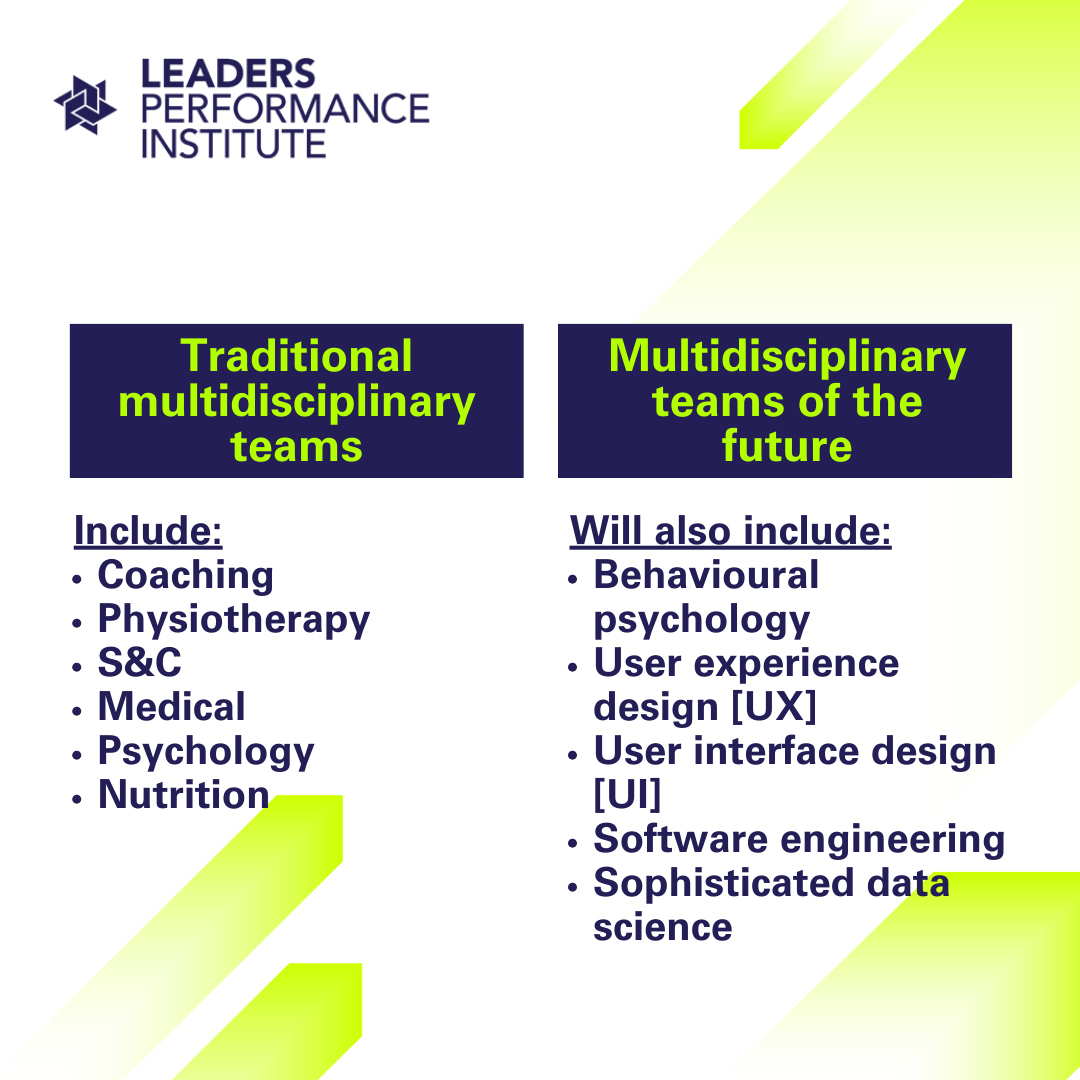
“We expect a nutritionist, coaches, S&C, psych and physio – that’s what we consider a multidisciplinary team,” he told the People Behind the Tech Podcast in April.
“However, now [a multidisciplinary team includes] behavioural psychology, UX [user experience design], UI [user interface design], data science, software engineering, performance science. It’s a whole other world that has opened up new possibilities that we didn’t know were there as a practitioner.”
Dunne, who is the CEO and Co-Founder of Hexis, an AI-powered predictive nutrition service for elite athletes, has made an almost full transition from high performance sport. He previously served as Head of Nutrition at English Premiership rugby club Harlequins and still works in a similar capacity with Ryder Cup Team Europe.
While his assessment of tech’s role in high performance is unsurprising, his views on those “possibilities” now open to practitioners provide some food for thought – and not only for nutritionists or dietitians.
“What we’re going to see is the evolution of the hybrid practitioner,” he continued.
What are the implications for you and your team? Below, we set out a HYBRID framework to illustrate the concept.
H – Haste – “[Going] back to Quins, you spend a lot of time behind the laptop,” said Dunne. “You got bogged down in a spreadsheet. It’s tedious.” However, a hybrid practitioner will “use tech for tasks that can be algorithmically delivered at scale.”
Y – Yield – this can mean being receptive to others; and a hybrid practitioner “uses technology for what it’s good at” while people can focus on what they’re best at, which is “being human”. As Dunne explained: “Humans are good at building relationships, learning how to have conversations, and listening to people and actually helping them change their behaviours and change their beliefs about certain consequences or their own abilities over time.”
B – Balance – Dunne’s Co-Founder at Hexis is Sam Impey. “A brilliant scientist,” as Dunne said. “A far greater academic than I’ll ever be.” Nevertheless, Dunne is aware of his own assets. “My personal strengths have always been on the coaching side – put me in any locker room, put me in any team setting, I love to have conversations, I love to listen.” In truth, a successful practitioner needs both sets of traits. As Dunne put it, “let’s call it practitioner tacit knowledge and actually the application on the frontline.” The best example of this in Hexis’ work is how their app has been influenced by the COM-B model, which is a framework for understanding and changing behaviour – both key factors in performance nutrition. For a behaviour to occur, a person must have the capability, opportunity and motivation to perform it. Practitioners aiming to change behaviour should therefore target one or more of these components.
R – Roadmap – practitioners are too often constrained by tech being restricted to trackers. “It’s retrospective”, said Dunne, specifically of nutrition trackers. But with predictive AI entering the market, the role of the practitioner is likely to be more forward-facing. “We always need to know [and] we always want to help them know what to do next,” he added. This is particularly important in light of Hexis-sponsored research suggesting that most athletes are ‘confirmation seekers’, meaning they want to lead on “making the decision but then they want something to help verify that they’re going in the right direction.” A hybrid practitioner can cater to this need.
I – IT / MI – “I think what we’re going to see more of is a more highly-skilled human practitioner with a lot more software skills and [skills such as] motivational interviewing [MI] on the frontline, and then technology systems that ensure a standard of care across the whole organisation, 24/7, 365 days a year,” said Dunne. Key to that is reducing the “noise” around the athlete. With the right plans and structures, the hybrid practitioner can “deliver impactful value to the athlete.”
D – Data – with apps such as Hexis allowing for data integration – their collaboration with training app TrainingPeaks is a prime example – there is the opportunity for practitioners to make better use of existing data rather than merely seeking the next thing. With the right blend of skills, the hybrid practitioner is well-placed to ask: what can we do with the information we already have?
Listen to the full interview with David Dunne below:
Second Spectrum underlines the league’s status in the vanguard of player tracking and analytics in women’s pro sport.
A Data & Innovation article brought to you by
This multi-year, league-wide agreement with Second Spectrum marks the latest milestone in the rapid growth of the WNBA and could signal a new era of personnel decisions, game strategy and sports science for the teams. The NBA’s analytics revolution followed the installation of its first league-wide optical tracking system back in 2013. And such 3D tracking underpins so many modern fan engagement activations — everything from MLB’s 3D Gameday to ESPN’s Big City Greens NHL game and the Toy Story NFL game.
“Our teams are obviously very enthusiastic about this and that the league is making the investment on behalf of the teams,” WNBA Head of League Operations Bethany Donaphin said. “It’s really a statement to the importance of developing our basketball technology capabilities as the league continues to grow and as the game continues to evolve.”
One of the key criteria for the WNBA system was that ability to collect the raw x-y-z tracking data as well as being able to generate an “end-to-end suite of analytics,” added NBA VP Tom Ryan, who oversees technology initiatives. Such second-level metrics include assessing quality of shots and advanced defensive proficiency evaluations.
“Probably the most exciting thing about the deal for us is that this the first time, to our knowledge, that a women’s pro sports league is going to have this level of tracking and analytics,” Second Spectrum Chief Commercial Officer Mike D’Auria said. “We’re going to take the cutting-edge technology, not just from the tracking side, but going through the analytics, data and software that is the cornerstone of NBA workflows. We’re excited to level up the women’s game, which is something we’ve wanted to do for ages.”
This follows a major digital transformation from the WNBA before the 2023 season in which the league rebuilt its app and website following a $75 million infusion of capital. That enabled the W to assemble its own in-house digital team to better serve its fans. That group will now have considerably more data to power leaderboards, highlights and immersive experiences.
Ryan noted the value in finding a partner who will “be able to evolve with the WNBA. It’s at an incredible inflection point as a property. The first phase is really about advancing the game and the core product, but then over time, we’re obviously going to want to innovate the fan experience and add a new media element.”
“What people are starting to discover — hopefully more and more — is how elite our athletes are, how talented they are, how really skilled they are,” Donaphin said, “and I think it’ll be impactful to be able to tell stories around that with data supporting it.
Some of the media tools will need to be negotiated directly with each broadcaster in the coming months. Genius and Second Spectrum have a stable of AR and other visualizations tools that they’ve used in, for example, NFL coverage on CBS and NFL+.
“I really think some of the data information and graphics can really start to accentuate the women’s game in a different way and give a unique look and feel to the game,” D’Auria said, namechecking the potential of analyzing Caitlin Clark’s shooting in a new way.
“The WNBA is growing so much, which means they have a lot of new fans coming to them,” he added. “What we hope is that we can really help that process of driving new fans.”
Second Spectrum was the longtime provider of NBA tracking data until that deal concluded prior to this season, although it remains a provider of basketball analytics and broadcast augmentation for the league. The WNBA first tested tracking data at the inaugural Commissioner’s Cup in 2021 when it leveraged a combination of Kinexon sensors and Hawk-Eye cameras.
Soon after that game, WNBA Commissioner Cathy Engelbert shared her vision for tracking data in a keynote conversation with SBJ Tech.
“It’s really important to provide that to teams and players about workload and stuff like that, but it’s important also to integrate some of that data into broadcast to make it very interesting — and then integrate it into a second screen experience,” she said at the time, discussing the value in “finding ways to engage fans differently.”
On Tuesday, she reaffirmed that value proposition in a statement, saying, “Technology continues to fundamentally change the sports landscape. Deploying state-of-the-art optical tracking technology through Genius Sports will deliver rich data to our teams that they can leverage to enhance player performance while informing in-game strategy and enable a new wave of insights and media elements for fans.”
This article was brought to you by SBJ Tech, a Leaders Group company. As a Leaders Performance Institute member, you are able to enjoy exclusive access to SBJ Tech content in the field of athletic performance.
The Co-Founder of Hexis discusses the pinch points for athletes, practitioners and technology.
A Data & Innovation podcast brought to you in collaboration with
“There’s a fundamental mismatch between what practitioners can deliver and what athletes actually want and desire,” he told Joe Lemire and John Portch on the People Behind the Tech podcast.
“So we pivoted towards the COM-B model.”
During this episode we spoke at length about Hexis’ continued growth following a successful seed round, technology’s ability to influence the evolution of the practitioner, and the fundamental union of academic rigour and those so-called softer skills.
COM-B was a major part of that conversation. It has been integral to Hexis’ growth. The company used it in tandem with elements of design thinking which, as Dunne explains, stems from his time working for teams including Harlequins and Ryder Cup Team Europe.
The model is a framework for understanding and changing behaviour. It was developed by Susan Michie, Maartje van Stralen and Robert West in 2011. The model posits that behaviour (B) is a result of an interaction between three components:
Capability (C): this refers to an individual’s psychological and physical capacity to engage in the activity. It includes having the necessary knowledge, skills and abilities.
Opportunity (O): this encompasses all the factors outside the individual that make the behaviour possible, including social and physical environmental factors.
Motivation (M): this includes the brain processes that direct behaviour, such as habits, emotional responses, decision-making and analytical thinking.
Listen to the full conversation:
Listen above and subscribe today on iTunes, Spotify, Stitcher and Overcast, or your chosen podcast platform.
The Northern Irish startup Movetru offers solutions to both teams and individual athletes.
Main image: Movetru
A Data & Innovation article brought to you by
* * * * *
Our Startups series looks at companies and founders who are innovating in the fields of athlete performance, fan engagement, team/league operations and other high-impact areas in sports. If you’d like to be considered for this series, tell us about your mission.
* * * * *
World’s shortest elevator pitch: “Real-time biomechanics for on-field and on-court injury mitigation.”
Company: Movetru
Location: Belfast, Northern Ireland
Year founded: 2020
Website/App: https://www.movetru.io/
Funding round to date: “Angel, plus UK government funded.”
Who are your investors? “Movetru’s notable investors include: Jack Butler, entrepreneur, CMO, CFO; Mary McKenna, UK & EU Angel Investor of the Year; Rob Hargrove, VP of R&D; Andrea Sinclair, UK Angel Investor of the Year; and Alastair Moore, PhD, a serial entrepreneur with a focus in AI.”
Are you looking for more investment? “Yes, we are in discussions with athlete investors and VCs.”
Tell us about yourself, founder & CEO Naomi McGregor: “In pursuit of a ballet career at 14 years old, I injured my knee. It took three years and eight different specialists to finally diagnose. At this time, I was told I should never dance again and that my injury was completely preventable. After this, I pursued a degree in engineering. During my Master’s in product design engineering from Queen’s University in Belfast, I put forward the idea of a device to prevent injury. This allowed me to combine my frustration of injury, passion for dance and knowledge of engineering into my dissertation. After graduating as a First Class Masters in engineering scholar, I went full-time into the development of Movetru. Coming from a family of entrepreneurs, I was excited to begin the adventure of entrepreneurship. Since then, I’ve learned how to grow a team, raise over half a million in government funding and raise angel investment.”
Who are your co-founders/partners? “I am the solo Founder of Movetru. However, I am fortunate to have a fantastic team supporting me, along with invaluable guidance from incredible advisors and the backing of the best angel investors. While I may be the sole Founder on paper, the collaborative efforts of this talented group have been instrumental in bringing Movetru to where it is today.”
How does your product work? “Movetru is a wearable technology for real-time biomechanics for injury mitigation and performance improvements. This is done through smart activewear that allows the athlete to understand their movement quality from anywhere through their smartphone. Information is given to athletes, coaches and medical staff with an automated data pipeline. This means no additional data analysis is required. Movetru provides athletes the ability to understand improvements on injury rehabilitation and performance.”
What problem is your company solving? “As I’ve seen from my own experience, preventable injuries are all too common. They are caused by inadequate training, poor movement quality, overloading and lack of personalized training techniques. This results in both physical and psychological harm, along with financial burdens and long-term health implications. In the U.S. alone, $20 billion is lost due to sports-related injuries in U.S. high school and collegiate levels, and 33% of professional athlete salaries are lost due to injuries. Movetru targets preventable injuries to reduce this burden and keep athletes where they belong — on the field. One hundred participants have taken part in product trials to date. These focused specifically on injuries in the anterior cruciate ligament (ACL). We found that the participants who suffered an ACL rupture and received rehabilitation plans had better biomechanics compared to those who did not. This highlights injury can be reduced with improved biomechanics and early intervention.”
What does your product cost and who is your target customer? “Movetru is a SaaS-based platform offering two subscription models, differing between team sports and individual athletes. A beta launch this year will target individual athletes and teams across collegiate and professional leagues.”
Image: Movetru
How are you marketing your product? “We’re marketing our product by engaging directly with beta users across NCAA, leagues and amateur sports teams, ensuring we develop a product they love. Our emphasis has been on early user conversations, rather than heavy marketing. As we expand, I’m excited to broaden our athlete base and welcome athlete ambassadors to join the Movetru team.”
How do you scale, and what is your targeted level of growth? “We plan to scale by expanding across the NCAA and leagues while onboarding exceptional athlete ambassadors along the way. Additionally, as we continue to grow, we already have plans to develop a consumer version of our product to democratize information for athletes at all levels.”
Who are your competitors, and what makes you different? “Currently, teams are required to use multiple devices, or attend biomechanics laboratories, with time-consuming data analysis. These include motion capture, force plates and computer vision. However, Movetru will be the first of its kind within the wearable technology market, encapsulating the capabilities of these existing products and integrating them into one product. Competitor products are limited in their ecological validity, as they are confined to laboratory analysis only. Movetru takes this one step further and provides useful insights and athlete profiling from on-field performance.”
What’s the unfair advantage that separates your company? “Female athletes are often overlooked in the male-dominated research area of sports technology. Female physiology, body structure and movement characteristics are under-researched and therefore not implemented sufficiently. Movetru seeks to counteract this injustice and our technology has been designed with all bodies in mind. Female athletes have been considered in every stage of design and development to ensure optimum performance and usability. Movetru is set apart with our multidisciplinary team of engineers, all-star athletes, textile designers, biomechanics specialists and psychologists. Together with our expert board of advisors, we are wholeheartedly committed to making a difference with our custom technology. Movetru will provide live on-field analysis with proprietary data algorithms that transform raw data into a biomechanical model representative of the user.”
What milestone have you recently hit or will soon hit? “The team is preparing for our beta launch in 2024. This comes as a result of our 100 athlete trials in Movetru’s Innovation Lab. We tested with participants who suffered ACL injuries, as well as control subjects to conduct thorough ACL research. On-court studies have also taken place with several sports teams to ensure ecological validity. We will also be closing a seed raise this year.”
What are the values that are core to your brand? “At Movetru, we are passionate about diversity. The composition of our project team and advisory board underscores this dedication. With backgrounds in technical, commercial, and legal domains, our team comprises over 50% women. This intentional diversity ensures a broad spectrum of perspectives, enriching discussions and decision-making processes. It aligns with our belief that diverse teams drive innovation and creativity. Stakeholder and athlete engagements are also approached with this lens. We actively seek representation from diverse stakeholder groups, including underrepresented communities, to ensure their voices are heard and needs considered. This inclusivity and consideration of different end-user groups enhances the relevance and effectiveness of our product. Another value of ours is athlete well-being. In preventing injury, we improve an athlete’s physical health and their psychological health will be significantly impacted. Injuries can end careers and completely reroute lives, Movetru is passionate about protecting athletes from this burden and improving their quality of life.”
What does success ultimately look like for your company? “Success for Movetru is defined by finding a way to ensure that we prevent athlete injury, and unlock an understanding of the human body that we currently do not have. I am specifically passionate about female athletes, a population that has been understudied, underrepresented and underfunded for far too long. As a result, women are up to eight times more likely to suffer an ACL injury. My personal hope is that Movetru can be an inspiration to the next female sports technology founder and to the next female athlete. I intend to see Movetru become a household name for wellbeing and wearable technology. We want to be the next gold-standard approach within sports technology.”
What should investors or customers know about you — the person, your life experiences — that shows they can believe in you? “Coming from a family of entrepreneurs, I’ve seen first hand the hard work it takes to create a successful business. Every single step of this journey has presented me with challenges for being a young female engineer in sports technology but I’ve overcome every barrier. I’m excited to be able to counteract social norms through the success of Movetru and be the next inspiration for women in STEM and sports. All technical challenges the team has faced have been overcome to be ready for our beta launch this year. We are ready to highlight the capabilities Movetru brings to athletes, coaches, and medical staff on and off the field. Movetru has come a long way — I started during the COVID-19 pandemic with the first product developed in my garage, and we now have custom hardware, proprietary data algorithms, and an incredible user experience. We have defied all odds of success and we will continue to do so for the rest of 2024.”
Is it challenging trying to stand out in the wearable device market? “In a crowded wearable device market, Movetru understands that users seek more than just superficial features. While many perceive wearable devices as interchangeable, the data they provide varies significantly. That’s why at Movetru we prioritize a clear USP and offer unique data points that truly enhance user experiences. With a relentless focus on user-centric design, rigorous validation processes and a commitment to on-field and on-court performance, we elevate data analysis beyond the laboratory, enhancing ecological validity and ultimately improving the athlete’s experience. Our approach ensures our products stand out, deliver tangible value and forge meaningful connections with our audience, driving long-term success in this competitive landscape.”
This article was brought to you by SBJ Tech, a Leaders Group company. As a Leaders Performance Institute member, you are able to enjoy exclusive access to SBJ Tech content in the field of athletic performance.
Al, the art of persuasion, and the habits that hinder performance – just some of the topics that filled the air in March.
Leaders Meet: Teaching & Coaching, an in-person member event, is just around the corner so, if you haven’t already, do check it out and register to join us at Millfield School in Somerset. We have some excellent topics on the agenda, including pedagogy & andragogy, non-directive coaching, coaching neurodivergent athletes, the language of coaching, complexity science and much more besides.
The day will be most relevant to anyone working with athletes on a day-to-day basis, whether in a first team environment or within the pathway. There’s just a couple of weeks left to register so don’t miss out.
Our Debriefs are designed to set you up for success. We’ll keep you on the pulse of contemporary thinking across the high performance space and provide members with the inspiration to engage with the variety of opportunities on offer through their membership. Do check out some of our upcoming events and virtual learning sessions to connect, learn and share with fellow members from across the globe.
And now, let’s reflect on the pressing performance issues of the day.
Virtual roundtables
March was a busy month for roundtables. From topic-led conversations around Sustaining Team Culture and the Influence of AI on Performance Programmes, to a Leadership Skills session focused on Building Persuasion and, last but definitely not least, part two in our series of learning around Wellbeing and what is having the most impact.
These are the insights that resonated with us most.
The potential impact of AI
We identified some of the enablers and outlined some of the key questions we still have around the technology.
So, where do we think AI can have a positive impact on our programmes?
All sounds good, doesn’t it? However, we still have some questions that need answering. Have you explored and come up with answers to these in your environments?
Why persuasion is an important skill in modern day leadership
How can you master the art of persuasion? We have some tips for you. Having good ideas is not enough. In order to change thinking and enact change, we need to be able to persuade people.
The Trust Equation
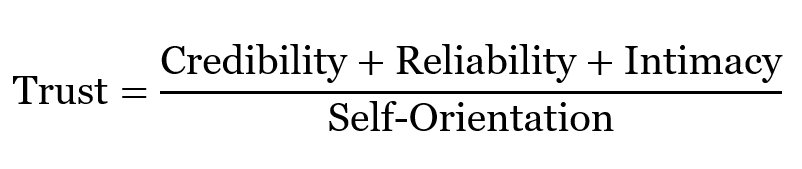
The equation is a conceptual formula used to describe how to build and elevate trust. To go into a big more detail, Credibility speaks to words and credentials and simply put, how authentic are we? Reliability is the perception of someone’s integrity, are your actions connected to your words? Are you credible in how you present yourself? Intimacy refers to the feeling of safety or security in the sharing of information and how safe and secure others feel in sharing with us. Finally, Self-Orientation reflects an individuals focus and where it is directed – is it towards themselves or others?
Essential steps in mastering persuasiveness
There was lots of gold in this skills session but as we reflected on the essential steps to impact the notion of persuasion well, there were four steps to reflect on in developing your persuasion muscle:
Additional reporting by Lottie Wright
Something a little different…
As many of you will know, we at the Leaders Performance Institute pride ourselves in exploring the world of high performance outside of the elite sporting context. With this in mind, we wanted to push your attention to some golden insights from the Royal Academy of Dramatic Art and their Director of Actor Training. To read more on their approach to elevating performance here and also how they’ve worked to redesign their curriculum here.
Skilbeck shared with us five factors that underpin their process to developing their talent. Are yours similar?
Additional reporting by John Portch
Community groups
In March, our Performance Support & Science community group took centre stage.
With 2024 bringing new projects and streams of work, we looked into the pressing questions and topics that are currently occupying the minds of those in this group.
Some of these will look familiar. How are you trying to approach some of these issues in your environment?
Sustaining staff health & energy
A few different people as part of the group discussion alluded to the topic of staff energy and sustainability, from the lens of the performance support and coaching team. Some of the spin off questions referred to how do we best integrate support and what does that look like, particularly due to the intensity of competition and in some environments, where there is uncertainty.
AI is coming, so how do we prepare?
Firstly, we’d recommend revisiting some of the bullet points above on what came out of the conversations of this topic in one of our roundtables. A lot of performance teams are evaluating it’s possible impact and the input it could have into our worlds. Will you be an early or late adopter and do you have a clear strategy in place to ensure there is clarity and preparation for how you will use it when that day comes?
Are you collaborating with external practitioners?
Arguably the most common response from the group when it came to current challenges. Such is the nature of modern day elite sport, performance support networks around our athletes are growing, including independent specialists who are not employed by the organisation. The crux of the conversation was, if we are to work with them, how do we do it best? Or do we not look to collaborate with them at all?
Balancing long-term planning and short-term delivery
This is a constant battle for performance support teams, such is the nature of the work that takes place in this field. The group brought to the table the question of how others are finding the balance to ensure they are moving at the ‘pace of performance’ in the day-to-day environment, but a nod to the future exists when it comes longer-term programme planning. We also discussed how to keep senior and experienced staff growing as it can be very easy to slip back into the short-term mindset, thus stifling longer-term development opportunities.