‘The soft skills – I call them essential skills’
A podcast brought to you by our Main Partners

“You have to be out there with the team on a daily basis, you have to have those soft skills – I actually call them essential skills – we have to recognise that we have to make ourselves completely valuable to the team.”
Johnny, who was recently appointed Associate Head Coach of the men’s tennis program at the University of South Carolina’s men’s tennis program, is the third and final guest on this Keiser miniseries, which seeks to understand the world of S&C through a leadership lens.
He is both an S&C and a tennis coach out on the court and, in his dual role, is in no doubt about what it takes to develop the essential skills of which he speaks.
He adds: “That might mean going out there for extended periods of time, watching practices, going above and beyond and staying later after an S&C session because a guy needs to work on their hip mobility a little bit more as opposed to just shutting the practice down.”
Also during this episode, we discuss:
Previous episode:
Emily Hall – Queensland Rugby League
Listen above and subscribe today on iTunes, Spotify, Stitcher and Overcast, or your chosen podcast platform.
Volley’s AI-enabled trainer seeks to revolutionize platform tennis, padel and pickleball skill acquisition.
Main Image: Volley
A Data & Innovation article brought to you by

The racket sports training system that uses vision algorithms and machine learning to simulate practice programs was founded by CEO John Weinlader, who crafted the original contraption to refine his platform tennis game – but quickly grew frustrated with the device’s rigidity.
“It was good for certain things. But platform tennis, you’ve got to be able to throw a lob 50 degrees high up in the air,” Weinlader told SBJ. “No tennis machine does that.”
After three years of development and eight prototypes, Volley went to market with its high-tech Trainer in 2023 and now has machines at around 45 platform tennis courts – mostly country clubs in the northeast and Chicagoland area. Its latest expansion comes via a partnership with the American Platform Tennis Association (APTA), which boasts 32,000 members and hosts more than 250 annual tournaments. The partnership will make Volley the presenting sponsor for the APTA’s match livestreams. Volley will also demo its Trainer system at the association’s events circuit.
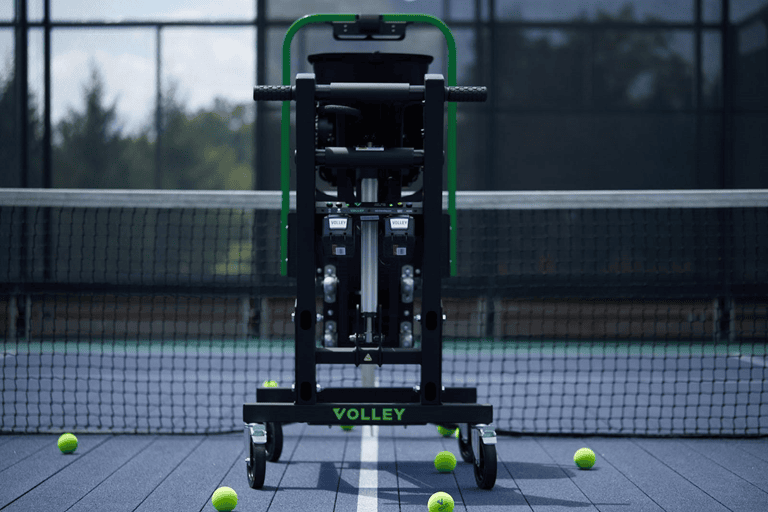
Image: Volley
The Trainer is more dynamic than your typical ball machine. Powered by a rechargeable battery with three-and-a-half hours of life, its height is adjustable up to 87 inches high, and its tilt between 56 degrees up, -38 degrees down and 34 degrees left/right, to simulate a wide array of shot angles for players to train against. It is equipped with multiple stereo cameras and an NVIDIA computer vision system to track player and ball movements, plus an LED screen and speaker to guide workouts. Through the company’s mobile app, players can program the Trainer to execute its desired practice program, watch film, or review play time statistics (i.e. balls hit, time on court).
“We have this model that we’ve built in the cloud of what the platform tennis court should be, where people are positioned, what all the shots might be. And we’ve analyzed through match play based on people at different levels a schema of what they would see at that level. You’re not going to go out there as a beginner and get a 120 mile per hour serve thrown at you,” Weinlader said. “You would go out there as a beginner, and we already have a profile built up, from watching match play, of what beginners typically would hit… That’s the first part of the AI side of this.”
The vision system can also track shots hit towards it, which, in a development coming “very, very shortly,” according to Weinlader, will allow users to play out entire points against the Trainer, with the machine’s return shots timed precisely to when a human on the other side of the net would strike the ball.
The company does not charge clubs anything upfront to carry its Trainer. Users instead can use the system once ($30) or purchase a monthly ($40 per month) or yearly subscription ($300), which is revenue-shared with client clubs.
“It’s all cell phone controlled,” Weinlader said. “The machine lends itself very well to an account-based model. This is a bit of a shift from typical ball machines.
“We give the machine away to the club and then members subscribe to it. In subscribing, they get their own account and that tracks their number of workouts that they did, it tracks their history, it tracks their video clips that they can then share with their pro for virtual coaching.”
As of now, Volley is available for platform tennis and padel, with pickleball coming soon. Weinlader hopes partnerships like the latest with the APTA will raise their profile even more.
“We’re looking to get some experience with customers, interfacing the machine that way, to help build our awareness,” Weinlader said.
The club design process can take up to a year and shares several elements with manufacturing in Formula 1, from AI-powered software to generative design tools.
A Data & Innovation article brought to you by
Altair’s engineering started in the automotive industry when it launched 38 years ago, which Benhayoun called one of the “most complex industries.” That complexity allowed Altair to grow and touch many other facets of engineering technology, such as the design of golf clubs.
To illustrate the intricacies of a golf club build, Benhayoun points out that the average car design takes roughly two years. Golf clubs can take between nine and 12 months. So while the club may look much simpler than your average vehicle, both have to account for so many variables. F1 is also using the same technology to develop faster cars. “You’re designing a product that has multiple needs and multiple expectations and multiple factors around it,” Benhayoun said. “When you look at golf clubs, there is the human factor. There’s the technology performance factor of things: how fast it is, feel, how beautiful does it look, etc.”
With all of that to consider, Altair’s software helps streamline the entire design process. AI-powered simulations and generative design tools (through Altair’s simulation/design platform called HyperWorks) can run prototype clubs through numerous projected test swings and cut down on production waste. They’ve also developed digital twin tech to help visualize the data.
Benhayoun has been with Altair since 2012, and in that time, he’s watched the golf club conform to include two significant elements. The first is forgiveness for the golfer, no matter their skill level. The forgiveness of the clubs now, he said, is far superior due to the massive number of digital tests a club set can go through before mass production.
The second has been resilience to the strain caused by the top-level athlete. Case in point: The average drive on the PGA Tour is 299.8 yards (274.14 m). Carbon shafts and club heads have been tested in Altair’s software too before they hit the market.
“We are delivering that software that allows you to do things digitally,” Benhayoun said. “Instead of testing in your (golf club manufacturing) lab, you’re testing on your computer. And now instead of testing one club a day, you’re testing thousands of designs a day for different players, the amateur and the professional.”
‘Sometimes it is the strength coach that has to bring the energy to a session’
A podcast brought to you by our Main Partners
“You have to be able to read your athletes and know your athletes,” says the Strength & Conditioning Coach, who works with various women’s teams at Queensland Rugby League, including the U19s.
“[You need to] have those relationships with your athletes so you can say the right thing or make the right call in those situations,” she tells this Keiser Series Podcast.
In episode two of this series, we speak to Hall, a proud Wiradjuri woman, about topics including:
Previous episode:
Listen above and subscribe today on iTunes, Spotify, Stitcher and Overcast, or your chosen podcast platform.
Brave Virtual Worlds will be seeking to solve the challenge in 2024 with the aid of a $275,000 research grant.
A Data & Innovation article brought to you by
Brave’s core product, called Valor, is wearable technology that produces 4D motion capture with 10 inertial measurement unit sensors. The software measures human motion with corresponding data. This grant, which is for a year and could result in $1 million of additional funding, will allow Brave to enhance its motion-capture system and build an AI engine. Dhyey Parikh, COO and cofounder, told SBJ that Brave is hoping the company’s work can develop a closed biofeedback loop.
“The field of clinical biomechanics has grown expansively the last 20-25 years through motion capture,” said Parikh. “How do you transmit that data in a language that anybody can understand?”
Parikh said the overall process will break into three steps:
William Kodama, Brave’s CEO and cofounder, said the process required an extensive application that resulted in the creation of both a technical and commercial roadmap. They initially applied August of last year. That first attempt was declined, Kodama said, but it came with valuable feedback this February, when Brave was participating in the second class of The Minnesota Twins Accelerator by Techstars.

Image: Brave Virtual Worlds
Prompting from the NSF program director led to Brave’s second application attempt, which Kodama said featured an effort to refocus, change the program language and add more details to the technical and commercial routes of the research.
Brave had a built-in advantage: a product in Valor with prominent users. The company has also decided to push more of its marketing focus on the Valor name, changing social media accounts and webpage to place the prominence of the tech.
CTO and CFO Evan Magnusson said that the program looks for impact, innovation and ability to scale the product for a need in the market. Having partnerships, such as Brave’s work with the Minnesota Twins’ farm system, was a helpful boost.
Kodama said this process could yield big opportunity for Brave. That is reflected in the company’s future client goals.
“We are trying to rapidly expand right now,” Magnusson added. “Try to get to 25-plus clients by the end of the year, and definitely well over 100 next year.”
The five-time grand slam champion on the evolution of technology in tennis both on and off the court.
A Data & Innovation article brought to you by
You can’t have a discussion about sports technology today without including athletes in that conversation. Their partnerships, investments and endorsements help fuel the space – they have emerged as major stakeholders in the sports tech ecosystem. The Athlete’s Voice series highlights the athletes leading the way and the projects and products they’re putting their influence behind.
* * * * *
Sharapova, now 36, retired from tennis in February 2020 and became a mom in 2022. She also has been active in business, starting her own confectionary brand, Sugarpova, as well as reportedly investing in the UFC, Therabody, Tonal and more. Sharapova recently made an appearance at the US Open on behalf of IBM to discuss its latest innovations and held a small roundtable with a small group of reporters.
On evolution of technology and tactical analysis during her career…
Huge, and also for the teams that are surrounding the player. So imagine you have a coach that looks at the draw, he sees you’re playing against someone and maybe you’ve never faced them before, but he immediately knows how your opponent has performed on the surface against other players. So that analysis is done so much quicker than him having to go out and find videos. ‘What surface did that player play on? OK, well, maybe that doesn’t apply to my player’s match at the US Open.’
Providing tools for your team is also [important]. As a player, you go out there and you play on instinct, and you just become a competitor. When it’s 6-all in the third set, you’re most likely not thinking, ‘Unfortunately, looking back to the analytics, they said I was going to win. It was supposed to be in two sets, and now I’m deep in the third set and we’re in a tiebreaker. This isn’t how I planned my day.’
On key datapoints she sought out…
One stat that was quite good and I was actually very interested in and like to know about: When a player is down breakpoint and they’re serving, what’s their comfortable serve? Are they doing down the T or are they going out wide? And if, down break point, this player goes out wide 80% of the time, as a returner, you take a couple steps to that side to give yourself a chance to not be late to that first serve. So those types of stats really, really helped.
That’s part of the homework that you do with your coach in looking through those tools. But one in particular was second serve percentage. So if an opponent had a weaker serve, you most likely identified it in the stats, so what does that mean? As someone that was quite an aggressive and powerful player, I could maybe take two steps in front and attack that second serve. If a player has a really good second serve, maybe I don’t go for that first ball so much. So there’s absolutely technical aspects [of interest]. It’s one thing to have analytics, but it’s how do you apply to them and what you’re doing that’s most important.
On the timeliness of scouting data…
Recency is really important because the tour is basically cut into almost — I see it, as a former athlete — four parts. You start with the hardcourt season in Australia through Miami, and then you go onto the clay, then you go onto the grass, and then you go back onto the hardcourt. So within those periods, you have sections of success for different types of players based on their weaknesses, based on their preferences. Some players didn’t enjoy playing on clay. They’d skip those four or five weeks of competition and move on to the grass.
It’s a long season, so you have to pick and choose where you believe your game will most likely succeed. So recency, in terms of, what is the surface that this little chunk of time requires you to be on? Are you injured? Have you been competing for the last several weeks? So all that goes into play whereas [the global] ranking most of the time, because it goes back to points on how you performed a year ago, it’s not very relative to today.
On fitness monitoring devices…
I actually didn’t use many wearables. During practice, I would have a heart rate monitor, but [compared to] right now, that’s like nothing. I’d say I was fairly old school in my approach. My team relied on a lot of that — they wanted to know my HRV. But I was more focused on getting out on the court, and that’s why I was emphasizing the team if you can. If you as a player can gain confidence in all these tools for your team, the level of engagement that you will then indirectly have with those tools is significantly positive.
On the growth of fan interest and access…
I remember, the Tour was questioning whether you have fans in the stadium to watch you practice. Right now, as I came to the US Open and I was just flying over here, there was a live feed of the practices. Players are being mic’ed. The evolution of where the game is to where I started — I remember speaking to my manager on whether I needed a social media account.
But there is a part of sport — and then tennis in particular — where it’s down to heritage and tradition. And now I’m on the other side from being a player to being a fan and loving the game so much and wanting more access than just the players playing, the hour-and-a-half or two-hour match. I want more insights, I want to know about their matchups. I don’t see that on a day-to-day basis. So by having these tools in front of me, it’s such a quick way of accessing information and just makes it for a better experience.
On her pre-tournament pick at this year’s US Open…
I hope it’s Coco [Gauff]. If I’m predicting, I think she has an amazing head on her shoulders, I think she has a great vision of the game, and she also has this amazing voice as a young woman for change. She’s created a platform for herself. She’s way above her age in terms of her thoughts and how she speaks, and I find that professionalism so impressive. And that’s hard to find.
On her victory at the US Open in 2006…
The victory here was very special. Besides holding the trophy, in the final I beat Justine Henin, who, when I was growing up, was a huge idol but also the most challenging player that I played against because of her game, just talking about matchups. I think that was my first victory against her was at the finals in the US Open. If IBM was around [with predictions] then, it would have said, ‘Maria has no chance.’
I went into that match just so confident because I was having this great run but also knowing that this opponent in front of me just clearly knew my game so well. And looking across the net and seeing like someone so accomplished, I had only won one Grand Slam, prior to that year’s Open. So there’s a lot going on in your mind. I was only 19 years old. I was still kind of young on Tour, figuring things out. When you are that young — this young success, this fresh success — it is a fresh breath of air because you come from having no experience of these large victories.
[I loved] every little piece of it, I mean, being giddy in the press conference after and like when they offer you champagne, you’re like, ‘Do I drink it?’ When I started, New York was very intimidating. I think for many people, when they arrived in the city, it was overwhelming. And from an athlete’s perspective, when you’re not playing, you’re always recovering, and you’re in a city that never sleeps, so how do I recover? Your mind is always on. And then you just appreciate falling in love with what it brings you, from a fan perspective, from arriving at the US Open and feeling the energy and allowing that to lift you up, especially when you’re having a bad day. As an athlete, it is the best feeling in the world. And there’s no one that does it better than a New York fan.
On the pickleball phenomenon…
I signed up for pickleball, and I’m playing you. You want something? I’m actually I’m playing with John McEnroe in February against Andre Agassi and Steffi Graf. So I have no choice but to get my stuff together. It’s funny how, if you’re a tennis fan, when I mention pickleball, I’m seeing it from the outside because there’s so many racquet sports now. When you’re in Europe, everyone is talking padel. And then you’re in the States, and everyone’s talking pickleball.
So what I like about pickleball is the entry level element of it. Tennis is a very difficult entry level sport. That’s not a secret. For you to feel like you’re competitive, it’s going to take you a few months, so you can get discouraged. Pickleball, you can pick it up and you feel fairly natural soonish. So I love that about it because, thinking from a business perspective with partners and engagement, it’s just easier. It’s also very social.
If I ask my friends to play tennis with me, they’re like, ‘Forget it. Let’s go play pickleball.’ I’m like, ‘I really don’t care [about competition]. I just want to spend time with you.’ They’re like, ‘I’m not going to play tennis with you.’ ‘I’m really not that good anymore.’
Pickleball has become like my entry level with my friends. So yeah, I love the future. I love this future of racquet sports, and it’s another way to engage with the youth. Which when you think about getting children off their screens, and I’m a young mom, so I start thinking about that, how are all the screens impacting my engaging my child to be outdoors and adventurous and having fun and being playful? If that’s pickleball or something else, I’m all for that.
This article was brought to you by SBJ Tech, a Leaders Group company. As a Leaders Performance Institute member, you are able to enjoy exclusive access to SBJ Tech content in the field of athletic performance.
Samford University is winning championships and is being assisted in its efforts by the athletics department’s renewed focus on data.
A Data & Innovation article brought to you by
Now he’s two years into his role at Samford University as Assistant Athletic Director, Sports Performance. Mathers oversees Project SAMson, a universitywide effort to infuse a data-focused approach into the entire athletics department.
In its short life so far, the project has helped to produce the greatest sports season the university has ever seen: a total of 11 championships, counting regular-season and conference tournament crowns. That included the school’s first outright Southern Conference championship in football, an 11-win campaign that set a school record.
In the battle for competitive advantage throughout college athletics, biometrics and sports science have often been treated as an effort to keep up with the Joneses (or in this case, the Sabans and Smarts). A lot of big programs have data. But schools like Samford, which kicked off its football season last week with most of the nation’s programs, show how data digestion could become a new divider between winners and losers.
“I think people are starting to use it in ways that really help them to structure and manage what they’re doing with their athlete loads every day,” said Mathers, a day before Samford’s game with Division II Shorter University. “I would say five years ago, 90% of people had it as a recruiting tool. It was the shiny thing.”
That’s a progression that Matt Bairos has observed as well. Bairos is the Chief Product Officer at Catapult. The sports performance analytics company, notable for its wearable vest that features GPS tracking, works with every Division I school in the country.
Catapult introduced two new products for football teams ahead of this season: Catapult Scout and Catapult Hub. The former allows for the quick generation of scouting and recruiting packages, as well as transfer portal monitoring. The latter improves video creation and sharing abilities to incorporate more teaching and data infusion.
Through Catapult’s partnerships with the likes of Formula One, Bairos points out, rich data sets have become descriptive, prescriptive and predictive. College football may never be that sophisticated analytically, he said, but he sees the room available still to grow for the sport.
“I think there’s a lot more variables as it relates to sports that involve humans running around,” Bairos said. “But the more pieces of data that we put together, it’s almost like we’re putting that map together of what’s going to happen next.”
Samford University has taken that notion and proliferated it. The private university, with a total enrollment of just under 5,700, houses the Center for Sports Analytics. The center has partnered with professional leagues and teams, as well as brands like Nike and Coca-Cola, as an integration into student curriculum that features three focuses: business, statistical analysis and sports science.
According to the center’s Executive Director, Darin White, the idea for Project SAMson originated from former Samford football player and donor Gary Cooney. Between the programs on campus, plus the school’s existing partnerships with Andrews Sports Medicine (the team doctors for Samford) and the American Sports Medicine Institute, the pieces were in place. A $1 million grant to the school supported the tracking of all Samford athletes. “It’s rare to find a team that has no data being collected,” White said. “But I’d also say the vast majority of teams are only utilizing that data in summary fashion.”
Project SAMson enhances the strength training and injury prevention efforts. Phase 1 consisted of a workout equipment overhaul. In total, Mathers estimated, it was roughly $250,000 in total enhancements. Samford uses EliteForm, a motion-camera system, on all of its weight room racks. Those systems track the movement of the bar, measuring how fast the player moves it through a lift. Players can enter login information on a touchscreen and record video for review with strength coaches.
Mathers said they also utilize VALD Performance equipment, mainly the company’s NordBord for hamstring strengthening/testing, ForceDecks for strength and movement testing, and timing gates for sprinting. Catapult is used by the Bulldogs, too. Mathers and his staff can use all these tools as part of their effort to measure player load. The staff can forecast how future adjustments to practices and activities could even affect the energy an athlete has for output.
Soon Project SAMson will take another big step: Samford will start using Smartabase, a platform that houses all performance data from multiple sources in one place. Samford’s sports performance unit has five full-time staffers and two graduate assistants, and also draws upon an intern group of about 35 to 40 students.
Such a drastic, long-term change can be a hard sell in a results-now business, Mathers said. Project SAMson established itself in a time when health monitoring was desperately needed: Samford, along with many other FCS schools, played a spring and fall season in 2021 due to COVID’s postponement of 2020. The team played 18 games in that calendar year, producing data that couldn’t reflect a year with normal preparation and recovery times.
Fortunately, Mathers said, he works with a head football coach in Chris Hatcher who trusted the vision for the project. That trickled throughout the program. “I think the SoCon championship is the result of everybody doing their job really well,” Mathers said. “I think we were able to give objective data to them. It helps the coaches do their jobs better, and it helped the athletes do their jobs better.”
This article was brought to you by SBJ Tech, a Leaders Group company. As a Leaders Performance Institute member, you are able to enjoy exclusive access to SBJ Tech content in the field of athletic performance.
A Data & Innovation podcast brought to you in collaboration with
He spent two years as an S&C at the Orlando Magic, a further six years as Director of Science & Research at the Houston Rockets, before spending almost nine years at the National Basketball Players Association [NBPA].
Since 2022, he has served as Chief Medical Director of the National Basketball Retired Players Association [NBRPA], a non-profit organization comprised of former professional basketball players of the NBA, ABA, Harlem Globetrotters, and WNBA.
Rogowski was at the NBPA in 2015, the year the league introduced its wearables committee and his views were informed by his time in Orlando and Houston.
As he tells Joe Lemire and John Portch, he worked with players wary of wearables as well as those mor willing “guinea pigs”, as they refers to them, such as retired Magic point guard Jameer Nelson.
Rogowski would ask himself of the latest devices: “Is it practical? Is it something that you can wear in a practice? Is this something that I can consistently do? Or is this a one-time thing and you collect the data and move on?
“I had plenty of those devices that actually changed how I think about training these guys or how I’d help them with recovery. But it is a sale because, with the players, you only have so many asks.”
Rogowski recalls those moments working with players as well as:
Listen above and subscribe today on iTunes, Spotify, Stitcher and Overcast, or your chosen podcast platform.