The program’s Director of Football Performance Nutrition discusses the dietetic practices of the back-to-back national college champion.
A Data & Innovation podcast brought to you in collaboration with

“He used that next year to really focus on nutrition,” she tells Joe Lemire and John Portch. “[He] got down and dropped his body fat percentage by 7%, lost 45lbs [20.4kg], and he was a first-round draft pick.
“He just did such a good job at buying in and it made him a faster, more explosive person. He never lost any muscle mass, which meant he was really focusing in on eating enough of just the right things so that we were able to retain that muscle and focus on losing that fat.”
Collier’s pride is palpable, particularly as a native of Athens, Georgia, and long-term Bulldogs fan. “It’s so much fun to see them buy-in and then say ‘C, I feel so much better in practice’. ‘C, I didn’t know I could have this much energy’. It’s probably the most rewarding part of my job.”
In this edition of The People Behind the Tech podcast, Collier lifts the lid on her work as the Director of Football Performance Nutrition at the Georgia Bulldogs, who retained the NCAA national championship in January.
During the course of the conversation, we covered:
John Portch Twitter | LinkedIn
Listen above and subscribe today on iTunes, Spotify, Stitcher and Overcast, or your chosen podcast platform.
Here are 10 factors that can increase the effectiveness of your recovery practices.
An article brought to you by our Partners

Those two are inseparable as far as Skylar Richards is concerned. He says: “As technology has improved, to allow us to have interventions to help the best they can off the field, that has really given us the ability to look into what’s effective, what’s efficient, and how we can individualise those sorts of treatments to make sure we’re as optimal as possible.”
In Early August, Richards who is an Athletic Trainer with the US Soccer Federation, spoke at a KYMIRA Webinar titled ‘The Evolution of Athlete Recovery’ where he was joined by Mark Pavlik, the Head Coach of the Penn State men’s volleyball team, and session moderator Johnny Parkes, the Lead National Coach at the United States Tennis Association.
“So much in sports science and medicine, we worry not so much about the medicine side of things as much as the optimisation,” Richards continues. “And so really keeping people as healthy as possible is the focus with recovery but also then the art of how to do that consistently within their regime.”
Here, we discuss 10 factors raised during the webinar to consider when seeking to establish optimal, consistent recovery practices with your athletes.
Do you need to prioritise passive or active modalities? Your athletes’ culture of recovery – practices and habits – should tell you. In his time at FC Dallas between 2012 and 2019, Richards noted differences between his younger players, who were happy to visit the recovery lab while they watched tape, and those players in their mid-30s who had families and, frankly, far less time and cognitive capacity. “Those become the tricky puzzles to figure out,” he says. “How can I help them recover in their lives and support them in that? That can be the difference between applying an active modality versus a passive one, a wearable or something like that. It helps them to do it all the time no matter what life throws at them.”
Whatever an athlete’s preferred combination of recovery modalities, there is an important question to ask. “What gives you the biggest dosage of all those things put together in one package, which is easy to manage and to be consistent?” says Richards. “You don’t want them to burn out having to think about stuff all the time.”
A veteran may have a busy life but, as a cohort of largely self-driven individuals, Richards can work with soccer players to “scratch that itch” around self-improvement. “Something that I’ve found I can do well with my older athletes: I’ll say ‘why don’t we try to instal a recovery room at your house? It gives you an hour away from the kids and the craziness to go in, watch some videos, and now read a book. Whatever you need to do justify it as your job’.” Now, the athlete has a consistent pattern of recovery and doesn’t feel the need to, say, go on an evening run that may well clear their minds but has a detrimental effect on their physiology. “We scratch the same itch by helping you rather than sacrificing something.”
The success of Richards’ approach with his veterans has enabled them to take that message to the rest of the team. “Getting them to talk about that approach to the younger players really helps them to buy-in,” he says. With men’s volleyball at Penn State, it sits with Pavlik and his colleagues to educate the archetypal 18-year-old who “doesn’t know what they don’t know yet from a recovery standpoint”. He says: “They’re coming off of club or high school practices at most three times a week, they’re living at home with mum and dad when they wander into our gym, it’s my job to ensure that the educational points that we’re trying to drive home so they can have a longstanding, successful collegiate career, and those that continue to move on through the professional ranks and international ranks with men’s volleyball have something in their background.”
That aforementioned education is best delivered by a friend. In that regard, Pavlik ensures that his student-athletes are surrounded by smart and passionate people who make an effort to build relationships. “We do a pretty good job of getting these people around my team early in their career and, let’s face it, the adage of ‘the team doesn’t care what you know until they know that you care’ [is true],” he says. “When you have these types of experts having relationships with our players; coming to practice, just being around the water cooler during water breaks, being able to just say ‘how’s it going?’ Then when the guys are in a position to listen to what the expert is saying they’re no longer experts – they’re friends, they’re buddies.”
Are there opportunities for you around game day? “It’s always been crazy to me that we control every other variable with athletes all the time, but the one day we completely flip the schedule is game day,” says Richards. “Those older guys love those moments of recovery on the road. For them, it’s less chaotic, it’s easier to focus. So much so that we’ve had a lot of success with having players to stay at a hotel the night before a home game or have that option, so that they can get into that rhythm and we change those practice times to the same as game times so they can get that day before the game rhythm into their bodies and their minds.” The benefits are palpable. “Allowing them to get into that rhythm early on, sleep, get out of that chaos, get their recovery mode early and have time to do any modalities that they want is crucial.”
Customisation is important and, at Penn State, it goes beyond age (i.e. an athlete at 18 versus an athlete at 23). “We look at the age and the experience of the athlete, then we take a look at what their on-court responsibilities are,” says Pavlik. “Some max jump much more often than others on the court during the match or practices. There are going to be some that have to get up the floor a lot more than other guys. What we try to do here is make sure with our training staff and med staff that we understand what we’re asking them to go through.” For Richards, it involves asking better questions. “What is the question for that athlete that we can solve the best? All physiology is too much of a blanket statement,” he says. “Is it overall energy? Is it mental fatigue? Is it truly physical fatigue? Is it something masking as another [marker]? And how can we hit those?”
As moderator Johnny Parkes says, “With all these physical modalities we can use, I think we sometimes forget about the things we can control the most, which is our level of sleep recovery, hygiene and the effect of resetting the body for the next day.” For Richards, good sleep can be an outcome of a holistic approach to recovery. “That’s when you get the most synergistic effect out of all of them,” he says while asking, “Can we create that cycle of measurements to enhance individualisation and effectiveness?” He once again cites the idea of players staying in hotels the night before a game. “It really ties this together in a practical way in terms of ‘let’s get you good sleep in an environment I can go in early and control, make sure the sleep hygiene is there, giving you the time to implement those things well and then tie-in any other recovery modalities you want at the same time’.”
According to Richards, both younger and older athletes are interested in the gamification of recovery, but in different ways. “Younger players thrive for the most part on comparing what they’re doing and being effective versus their peers,” he says. “For an older athlete, I’ve found they’ve passed that point in their life, they’ve been saturated by that already and what you come to is the gamification comes from comparing them to themselves. Can they get a high score? Can they see what’s most effective for them? What patterns help them to be the most consistent over time? Scoring that on a streak becomes the better motivator for them.”
What don’t teams consider as much as they should in recovery and how do we overcome them? “Anything is better than nothing,” says Richards. “We have a huge market for recovery tools and methodologies but I haven’t seen a huge move towards a blend of that. That’s where I’ve been pushing a lot of companies on their research. Can we let the monitoring devices drive the intervention; the duration, the velocity, the frequency and occurrence? Can we use measuring sticks to drive it for individuals; its appropriateness, effectiveness and sufficiency on an individual level? Until we do that I don’t think we’re doing the best we can do to figure out the puzzle, which is an athletic body.”
The pitcher explains why wearables have their limits in his eyes and how biomechanics have transformed his approach to strength training.
A Data & Innovation article brought to you by
You can’t have a discussion about sports technology today without including athletes in that conversation. Their partnerships, investments and endorsements help fuel the space – they have emerged as major stakeholders in the sports tech ecosystem. The Athlete’s Voice series highlights the athletes leading the way and the projects and products they’re putting their influence behind.
* * * * *
Cole is 10-3 with a 2.27 ERA [Earned Run Average] over 150 innings so far this season. He has twice led the majors in strikeouts, including in 2022, and also led the AL in ERA back in 2019. He has finished in the top-five in Cy Young voting five times and twice been the runner up.
A Yankees first-round pick out of Orange (California) Lutheran High, Cole turned them down to attend UCLA, after which he was the Pirates’ No. 1 overall pick in the 2011 draft. His nine-year, $324 million free agent deal with New York prior to the 2020 season remains the largest contract ever awarded a pitcher — nearly $80 million more than anyone else.
On how he recovers the day after a start…
I try to sleep as best I can, but I don’t always sleep great. And then if I need to catch up on sleep, I just I try to find some time to maybe take a nap. I’ll try to put down some electrolytes and about four liters of water. I’ll do a recovery walk either at the house through the woods or on the treadmill. I’ll get a little bit of treatment in the training room just to make sure things are roughly in the right place so that I can walk better
To me, [soreness] is always a whole body experience. And then sometimes, hot or cold tub therapy, just depending on how life’s going, I guess. And I’m hungry. I’m going to eating all day.
On his previous use of Whoop…
Basically, I’m in the green pretty much all the time, and so I thought it validated my process. And I thought after I collected four or five years worth of data on it that it validated some of my practices and my routine, and going a little bit too much into the micro aspect of it, I’m not sure it’s so beneficial.
So there’s stuff you can’t control, right? Like we’re going to fly to the West Coast, and I’m probably going to be red for three days after that. And we’ve got to play. Sometimes I’ve got to pitch. Do I need something to tell me I’m in the red all the time? Or do I just need to know that I need to be on top of everything that I possibly can be to give myself the best chance?
On heart rate variability (HRV)…
HRV fluctuates throughout the day. There are different breathing cadences. There are different physiological things that evolve throughout the day in terms of exercise, how stimulated your nervous system is, caffeine [consumption] — all these things fluctuate HRV positively or negatively throughout the day. Obviously alcohol and dehydration negatively affects it, but sometimes those are quality of life [decisions].
But the algorithm the Whoop uses is at a specific time, right [before] you wake up. So it’s not like you’re a 50 HRV for the whole day. It’s just when you wake up. So depending on how you slept, depending on what your routine is for the rest of the day — let’s say you had to perform at 7 o’clock [p.m.], your HRV could be back to normal. I wore it for a long time. I wore it through a lot of stuff — starts and workouts and vacations and everything. There are some things that we learned, for sure. I definitely tightened some stuff up, but on the whole, it just validated that you’re pretty good.
On nutrition…
I’ve done a lot of food allergy and blood work over the last, I don’t know, forever. So I pretty much know what I’m sensitive to, what causes systemic inflammation and how to try to manage those levels by just regulating the exposure to those things: gluten, dairy and some other random stuff. Sometimes they change, too, depending on how much you avoid them or where your tolerance is.
I would expect a player to have things be more inflammatory, inadvertently, at the end of the year when your immune system is depleted, and you’re at the end of your rope and your at high-level stress. Just your tank is not full, so in a sense you’re overall less resilient. But at the same time, if you focus all of that resiliency on your performance, you can maintain, or even sometimes improve, regardless if all the other stuff is falling low. So t’s always an ebb and flow. It’s always a balance.
On strength training after a start in season…
Day two, day three depending on if it’s five or six days [between starts]. I would say definitely trying to maintain power, elasticity, control. Through that control, the proper mobility. You build a tank up in the offseason, and you just put as much gas in there as you can. And then during the [season], you’ve got to make sure you treat your performance as load, and your weightlifting as a supplement to that load. So I am gaining strength by pitching, I am gaining more efficiency the more I pitch.
These things are allowing me to operate at a more efficient level, and the supplementation of the lift maintains the integrity of the tissue, maintains the power, maintains the routine in terms of when your central nervous system is recovered and spiking and peaking on the fifth or on the sixth day. It’s different than position players, very much so. It’s very much almost like horse racing, football [when you have one shot kind of thing].
On how his approach to training has changed since the beginning of his career…
Total strength, we build in college. We build when those growth plates are just about ready to be closed up, and then you go through life and you start maturing and, again, you’re trying to find ways to maximize power with the least amount of wear and tear because you only get one joint. And then you have kids, and then you carry you carry your kid around. So then you get the dad strength, so your load goes from just your body all day to another 10 pounds for about 10 months, and that has a cumulative effect. And then you have two, and then your 10-month-old turns into three and he’s 40 pounds.
You definitely mature as you get older, and you realize that you want to take all that tissue and strengthening stuff that you built early in the career and make sure that functionally you’re rock solid because that preserves the joints, preserves the tissues, and maximizes power.
On how much he analyzes biomechanics…
The Hawk-Eye stuff is super helpful. At this point, I just think the more data we get is even better. AJ Burnett told me once you’re never going to throw two pitches the same way even if they land in the same spot. And I think, to a certain extent, do we want to be ultra-repeatable? Yes. So do we need to be adaptable at the same time and still be able to produce the same output? It’s going to be hot, could be a hard mound, could be wet, sloppy, it could be slipping, I could be pushing through an injury in a certain area.
There’s all these different variables that are going to contribute to the release point having some variance and the delivery never being the same back-to-back outings. Always being able to be resilient while you have those uncontrollable things changing. Your body’s always adapting to this and that. You can look at one delivery in slow mo and look at another delivery, and that’s not always very helpful.
What I find will be probably really helpful, especially it continues, just the more and more reps that we get on the Hawk-Eye and finding the centration of the joints and the centers of the joints and how biomechanically they’re moving over and over again. Where’s my window for performance? And how do I use that to my advantage? I don’t really know yet. But how do you use that to your advantage as you as you start to gain [more data]? Gill’s great and David’s great, and they’re on top of it all the time. [Gillian Weir, Senior Biomechanist, and David Whiteside, Director of Performance Science.]
On childhood pitching mechanics and throwing load…
I built my mechanics as a kid, just basically trying to be as close to some form of Clemens, Pedro and Maddux. Just simple and repeatable and putting myself in position to minimize load and also giving myself time to recover as a youth. My dad only let me throw six months out of the year until I was 18 at UCLA.
You’re going to stress the ligaments, you’re going to stress the labrum and all that stuff, but then you’re going to give it six months while you’re still producing large amounts of GH and growing and your growth plates [close]. So it gives your tissues time to adapt and lay down those adaptations.
They should look asymmetrical left to right, but they shouldn’t necessarily look worn down, to a certain extent, because you’re pushing, you’re pushing and pushing, and then you’re recovering. A lot of kids these days, just push, push, push, push, push. [Pitching] being a unilateral move, the more fatigued you get, the more you just end up putting too much load in the wrong areas.
On the importance of training the deceleration muscles…
They always used to use an analogy of ‘you can’t have a Ferrari V12 engine and Honda Civic brakes.’ The car’s not going to go very fast, and it’s going to crash.
On tracking his spin rate and other pitch tracking metrics…
I have general parameters that I keep an eye on, I would say, but that’s not at the expense of performance. So if the fastball is spinning high, but it’s getting hit, or if a fastball is sitting low but it’s not getting hit — I’m in for not getting hit, you know what I’m saying? In terms of introducing a new pitch, I would only start that in the offseason, and it probably will take a year or two at this point for it to really even settle in. I feel better with the cutter this year than I did last year, but I guarantee you that next year I will feel even better.
This article was brought to you by SBJ Tech, a Leaders Group company. As a Leaders Performance Institute member, you are able to enjoy exclusive access to SBJ Tech content in the field of athletic performance.
The McLaren driver joined a panel discussion at the Tribeca Festival in New York City and described his use of the simulator and how the team behind his team continues to iterate the tech on his MCL60.
A Data & Innovation article brought to you by
You can’t have a discussion about sports technology today without including athletes in that conversation. Their partnerships, investments and endorsements help fuel the space – they have emerged as major stakeholders in the sports tech ecosystem. The Athlete’s Voice series highlights the athletes leading the way and the projects and products they’re putting their influence behind.
* * * * *
In addition to his racing credentials, Norris is the founder of Quadrant, an esports team and lifestyle brand partnered with Veloce, a racing and gaming media brand. In June, Norris appeared alongside McLaren Racing CEO Zak Brown at the Tribeca Festival in New York City, which was sponsored by McLaren crypto partner OKX.
Norris and Brown discussed how technology is permeating the racing industry, from the extensive use of simulators to weekly enhancements to the car; Brown estimated that 80% of the livery changes over the course of a season. The car is packed with 300 sensors and produces about 1.5 terabytes of data during a race weekend, with McLaren having enlisted DataRobot to help apply AI algorithms to make the best use of that information. (Note: This Athlete’s Voice is primarily derived from a post-panel interview, with some of his on-stage thoughts included as well.)
On playing racing games as a kid…
I started when I was a kid, like a lot of kids do. I was never into the bad games, shooting and all of this. I never played any of these games, my parents didn’t let me. But driving [games], my parents allowed me to do. I guess the basics, understanding the very simple things of how to drive a car — lines, techniques — you learn such simple things at a very early age.
These skill sets develop and continue to develop even to where I am now. I’m still learning things. I’m still trying to perfect whatever I can perfect. And for me, I think it’s an advantage that I played these games, and I did at such an early age — six, seven, eight years old — and that definitely helped me become the person I am and the driver I am today.
On his extensive use of a simulator…
I don’t have to fear driving a simulator compared to real life. Cost is a lot less. So I’m not scared of crashing and not scared of Zak telling me off or something. And the [simulator], you don’t have a different approach to how you want to go and do things. But you’re still learning in every single thing that you do, whether it’s real or fake or whatever. You’re still learning good things and bad things. And then you take that to the track to improve.
I use it, the whole team use it. So many things now are prepared in a simulation before they’re actually done for real because you’re always going to want to test everything you do. Because you can’t afford to make mistakes. Any way you can test something to see how authentic it is and how correct it’s going to be, from driving to designing your front wing and designing the whole car or making decisions on race day. Things are always checked as many times as possible until they actually get into action.
On his involvement with iterating technological changes on the car…
I’ve tried, in a way. I stick to do my job at the end of the day, so I just drive the car. But you try in as many ways as possible to help give whatever indication of advice you can give to the guys, who are some of the smartest guys in the world. These are people who are creating things that have in a way never been created, that are coming up with ideas.
Formula One is all about innovation. There are so many things in normal life now in road cars that everyone drives on a day-to-day basis, which these guys have come up with within Formula One. So in the end of the day, you can use all this information. But it’s only helping us make the decisions — us as humans who are still the ones that are applying it to our everyday work, who are coming up with the actual ideas. And therefore, I still stay firmly in my position on driving the car, but just being as helpful as I can when my words and my advice are needed.
For me, the most important thing is the minds of the humans, us as people who are still the ones who are applying this information, using the information, using AI. But how we apply it, how we use it in filmmaking or designing cars or driving cars. It’s all us in the end of the day, we’re actually doing it. So I think that’s the thing you can never forget.
On whether he can feel the dramatic changes to the car over a season…
It depends. Sometimes you have things which are there to change the driving style. Sometimes that’s where the improvement comes. An improvement can also be something that you don’t even recognize: you just go a little bit quicker when straight, or you just go a little bit quicker in the corner because you just have a bit more grip. So sometimes you’ll notice a massive difference. Sometimes you’ll hardly notice the difference. But it’s also gradually, it’s rare that you bring something in that’s just like, so noticeable. And also, when you do put something on, drivers are, within a few laps, make that feel like it’s normality again.
So when you go from the beginning of the season to the end, because it slowly happens over that whole period, we don’t really notice that much. But if we were to jump back in the car at the beginning, and you’re like, ‘Oh, wow, this has changed a huge amount.’ So you’re reacting to what’s happening and what’s changing, and you’re just getting on top of that. And because you do it so quickly, things become normal very quickly at the same time.
On managing decision-making in the car…
You train yourself. You learn from a really quite an early age, so you kind of get used to it over time. But there’s still times now where there can be an information overload. And I guess it just has to be said to the team, if they’re talking to me too much, or telling me to do too many things. We go to Monaco where you don’t have really any time to think of changing all these dials. You think your strategy, you think of tires, you also just trying to focus on not crashing. There’s a lot of times when there is still so much information, it’s still like, how can you get the most important bits of information across? But it’s just understanding, I guess, everyone has their own limitations or abilities. Maybe sometimes some people can do more, some people can do less, but I’m just making it known when it’s too much or when I can accept more.
On reaction time training…
Yeah, of course, [it’s] one of the most important things, just for natural driving. The start is one of the most important parts of the race so reacting to the lights, the pit stops. Reactions are probably one of the most important things that create a Formula One driver, but it’s also not just a reaction. A lot of people who can’t drive a car can have quick reactions. It’s the knowledge of knowing what you’re reacting to and how to then apply whatever the correction is.
On how he reaches his peak performance…
It is trying to understand how I drive in the best way that I can, whether that’s getting really pumped up before a race or qualifying. For me, it’s more the opposite, the more relaxed, more chilled I can be, the better. The more subconscious I drive, the better. So if I’m consciously thinking, ‘OK, I need to try and brake here, and do this and do that’ — game over, I’m terrible. So the more I can just know subconsciously what I need to do and just not even think of it, the more I can feel like I’m just going for a drive, then you look down, Wow, you’ve done such a good lap. The more you can feel like that, the better it’s going to be. So trying to recreate that and get in that space as many times as often as possible.
I’m just using the people that I have around me — simple as that. I have a very good team, starting with the McLaren side with my engineers, my mechanics, [team principal] Andrea [Stella], Zak. Using everyone in the best way possible, using their connections and relationships. And then from my side, my manager, to my trainer. to my parents. Using the people I have beside me to get the best out of me, with the training with all of these things. I hate training so much. But it’s part of what you’ve got to do if you want to achieve that one goal, which you know will satisfy you more than anything, which is to win a championship. You have to reach these other targets in order to achieve that, and you’ve got to make the sacrifices along the way.
On the vision for his brand Quadrant…
It’s in an early phase, I would say. From what I would love to achieve with it, it’s still got to grow a lot more in several spaces. One, which is the teams that represent Quadrant in various games. At the minute, we have Halo, we have a team for Call of Duty, we have Rocket League. So having, I guess, like a McLaren but within all these different categories, all these different games, because I love them. I’m terrible at a lot of these games, but I know I get very excited watching my own team. I get very nervous, like my heart starts pumping when they’re in a game and so on.
Expanding on the apparel side — that’s probably one of the best things. Just creating stuff that people like to wear. Hats off to [Veloce CEO Daniel Bailey]. Daniel has done a very good job with this side of it. Creating stuff that you or anyone would happily wear it’s just something that’s cool, but trying to sometimes keep racing involved in it, but also sometimes not.
And expand a lot more on the opportunities of working with different people. Whether that’s within programs or different athletes and different things, expanding to working and creating cool things, events or whatever it is. And not just being, say, an esports team that plays games or just makes a video or does that — but expanding much more beyond that and helping athletes discover their talents or further their talent and just creating content out of a lot of these things at the same time.
On his interest in gadgets and tech…
Since I was a kid, I loved and I always was really into computers and games and things. And I loved it probably too much when I was a kid — my parents hated it. But anything, I just find it very fascinating, how just pieces of metal and stuff comes together, and it creates such incredible things. I also enjoy taking it all apart and destroying it at the same time. It’s just that I enjoy it. Puts a smile on my face. It’s fun. Often sharing it with friends, whatever it is, creating competitions out of it, those kinds of things. Just something that brings me joy, so simple as that.
On storytelling via digital media…
You have the two sides. I guess [there’s] the social media side, which is very much just me, who I am — behind the scenes a little bit, things that you don’t probably ever see on Netflix, even on Formula One TV, documentaries. It’s even more just me and what I do, and even though a lot of it is still Formula One-based and pictures of me driving a car, blah, blah. And then I even have my photography page, which is just more me taking photos here, what I do here when I’m just being an old person, and I’m not even in a race car.
And then you have the Netflix side, which is still trying to capture the difference of you as a Formula One driver, and as an athlete, and then you as a person at home with your family, friends, and so on. So I wouldn’t say I do anything different, but it’s how things are captured and portrayed, which is different.
This article was brought to you by SBJ Tech, a Leaders Group company. As a Leaders Performance Institute member, you are able to enjoy exclusive access to SBJ Tech content in the field of athletic performance.
Leaders Performance Advisor Dr Megan Popovic sets out her requisites for a wellbeing strategy that creates a culture of care, resilience and excellence.
A Human Performance article brought you by our Main Partners

A memory
The energy in the building has dialled down, music in the gym turned off. Our players have gone home after a practice day and the remaining staff members in the building are quickly shuffling to finish their tasks and head home early as playoffs are around the corner and time will be a fluid flow of ‘rinse and repeat’ until the end of the season.
I decided to stay late and bypass the rush hour traffic, sitting upstairs in my office and hear a knock on the door and look to see who may be there. A respected, veteran player with a gruff demeanour and hardened external shell, whom I have always had a jovial, albeit distant relationship with, is there. His massive physique fills the doorway. “Do you have minute to talk?” he asks in an atypically soft way.
I see his beyond his professional shield, calloused from decades in the league, that serves as a barrier for emotional safety into his wild blue eyes that reveal the depth of emotion in their stillness. He almost collapses in the chair and takes a few breaths before the words cascade from his heart.
The moment
“I have a good friend from home that I’m really worried about,” he releases into the space. “I don’t know if you can help, but I don’t know what to do.”
The softness in the building, plus space and time to speak, allowed us to talk until he all details on his mind released. A crumbling marriage, drinking to excess every night, the distance from family who he could lean on in this dark time, the deterioration of a career and panic that lies within thoughts of the future, and the obsessive thoughts that his life may not be worth living.
My player was deeply concerned for his hometown childhood friend who lived hours away in a different country. He wanted to help and yet did not know where to start, what to do, or what his role in this relationship should be. His empathy was palpable and I now wonder if his friend’s raw vulnerability allowed him to access fears and pain that he himself had buried deep inside himself for many years in the league.
I assured him that even if I am unable help his friend directly, I will provide him with information to pass along for his friend to consider and make the necessary steps to mend their challenges and find peace.
Creating a method
While this circumstance was different than the day-to-day mental health and wellbeing issues that came forth from players and staff in my role, it did not come as a surprise. What rang the bell of truth was the stark reality that if and when you create a space for people to come forth with their struggles, it is impossible to predict who or what real-life situation will stand in your doorway and trust you to help them find healing.
A few years prior to this moment, when I launched into the role of ‘wellbeing and performance’, it became apparent immediately that our club needed a system in place that would ensure a greater level of care, education, and knowledge of supports available. We had intentionality and energy to cultivate a new high-performance culture at the club, team-of-teams, and individual levels, yet a clearly articulated infrastructure of what, who, when, and how to respond to this newfound openness toward emotion, wellbeing, and mental health was yet to be constructed or implemented. Quite simply, if we build it and they come forth, what will we do? How can I/we create mental health and wellbeing processes that support players and staff in efficient and emotionally safe ways that make sense for the temporal, transactional, political, and employment realities of professional sports?
I knew that not all players or staff would open up to me, which in fact was both humbling and freeing. It was a beautiful thing to know that an improved workplace culture would invite stronger connections within the organization and potentially multiply the bonds amongst players and staff that could hopefully create a safer and trusting professional environment. The challenge though was similar to the player scenario above, how do I help upskill and train our player and staff to both understand themselves more fully and also know what to do if and when struggle occurs?
What I believed was needed at the maturation stage of the club to do was come up with a clear system – a simple method – that all players and staff could follow to feel more comfortable if and when another teammate and colleague opened up about their struggles. I needed to craft a manual that I have since called the Organizational Wellbeing Strategy: Creating and Sustaining a Culture of Care, Resilience, and Excellence. In the segments below, I am sharing the three sections from this manual that I believe will help any club design and implement their own wellbeing system.
Phase 1: identification
Player identifies concern for his own mental health OR someone else identifies concern for player’s mental health (e.g., team doctor, medical staff, coaches, management). Try to objectively connect what they are saying and doing to the Red Flags (see Red Flags below).
Phase 2: connection
Player is pointed via text, phone call, or in-person to club’s key point person on staff to discuss options for next steps. This person needs to be consistent and all staff should know that they are the hub of resources, education, and information. The person in this role should receive additional training to support their knowledge and skillset.
Phase 3: education of options
The club’s point person has conversation with player or staff member in crisis in-person (ideally) or over-the-phone about their options: It is also important that they player or staff member in crisis understands the limits of confidentiality within this professional setting and how each option could influence their career. While this is atypical for high performance sport, to educate a person so that they consent to whatever form of care they choose, they must know that ramifications upfront to make an informed decision. This knowledge and truth must by shared as a standard of ethics.
Phase 4: action
The player or staff member goes forth to take action in their lives.
Phase 5: follow-up
The club’s point person should follow up as necessary to support the person and be a resource, as requested by the player or staff member in crisis.
It is very important that all players and staff in the organization are knowledgeable and educated on the most common ‘red flags’ that occur in high performance sport. This could be done via an in-person training session; however, I believe it is very important that these red flags are accessible to the players in their private moments. Thus, if your club has a team app (e.g., Kairos, Teamworks), it would be wise to have a tab for wellbeing/mental health resources.
By creating awareness, what you want to avoid the progression to the aforementioned and worsening if the player is already presenting with these symptoms. These were the Red Flags that we created with the focus of being objective, observable, and rooted in our sport cultural norms.
i) Thoughts of suicide (most serious)
ii) Changes in behaviour
iii) Changes in thinking
iv) Behaviour and thoughts on games days (on ice, in dressing room)
For the complete wellbeing program to work, players and staff need to become more comfortable knowing what options are available for them to take action if and when challenges arise within the club. It is inevitable that within a season, multiple players and staff have struggles. The greater familiarity everyone has with the club’s process, the more seamless the provision of care can be and also a sense of calm in the heightened times of chaos and emotion.
Below is an example that we generated for ‘Substance Use (Drugs and Alcohol)’.
Step 1: identification
The player either:
a) Self-identifies to the Director of Wellbeing, team medical doctor, another staff member, or a teammate
b) Is screened by player’s union and tests positive for prohibited substances
What would players say that is considered “self-identification”?
Step 2: connection
Invite the player to go speak with the key individuals in the club who are trained to corral and direct the player of his options. This is typically a player wellbeing / welfare role, team doctor, or mental health consultant.
Step 3: educate player of his options
Communicate with the player his options in a way that he receives the details and can make an informed decision that aligns with his values, wants, and career.
The options I presented to players (in this order) were:
A very important component to the ethics of this communication with the player is their understanding of the limits of confidentiality. For instance, if they work with the team doctor or psychologist, what must be shared with the GM/coach and/or on the medical technology platform file that goes with the player to every club he plays for? If he works with the union, what is the club’s relationship to that external body and how can we / not engage unless he shares information? What is the league’s TUE process and its connection to the team and medical director?
Step 4: player (hopefully) takes action
From here, the key is to support his decision fully and without veiled personal interest. Too often I have heard of staff members in elite clubs using ties to the athletes (and insider knowledge provided to them in this trusted relationship) for their own personal and professional benefit. It is fundamental and ethical to encourage to player to make informed actions that align with his values and goals, and to be there to support him, if and when asked.
Step 5: follow-up
The subsequent relationship will be contingent upon the player, his or her needs, how much he wishes to engage and the severity of need. Follow-up could look like:
Being in service of momentum
After the player left my office, I sat still in a long pause to consider the ways in which our conversation landed for him and if I was moderately helpful in his state of unknowing. What I knew for sure is that my player relaxed within himself by having a listening ear, some advice, and that he had something tangible to bring to his hometown buddy. It was a start.
A few weeks later I check in with my player to see how his friend was doing. This conversation was more succinct, a blend of the original professional guard combined with a known feeling of connection through shared experience. He told me that he reached out to his friend shortly after our call to talk. The nervousness of not knowing his role or what to say was softened by his understanding of the Red Flags. He shared these with his friend and encouraged him to speak with someone trusted as soon as possible. This gesture of support was the life preserver his friend needed, at the right time, to be of service to stop himself from drowning. His friend called his parents and asked for their support. What he was hiding from them the last few years, as he lived in a different city, tied to keep his marriage afloat and be somewhat together as a father, was no longer a silent source of shame and pain.
The healing process had begun.
‘Our core is working with the coaches to give actionable insights to the player and coaches between pitches,’ says former MLB pitcher Zach Day, who helped launch NewtForce Mound.
Main Image: NewtForce
A Data & Innovation article brought to you by
A key reason he chose to join LSU’s program was the chance to work with Pitching Coach Wes Johnson and the advanced technologies at his disposal. One of the tools Skenes has credited for his improvement this season is the NewtForce Mound, a sensor-laden, turf-covered slope that tracks a pitcher’s ground forces throughout their delivery.
It’s similar to work Johnson did in his prior role as pitching coach for the Minnesota Twins. After the club traded for pitcher Kenta Maeda in 2020, Johnson recognized that the right-hander’s mechanics were much less efficient out of the windup than out of the stretch. Using NewtForce to quantify the discrepancy, Johnson helped Maeda improve his tempo out of the windup and ultimately finish the season as the AL Cy Young runner up.
Johnson identified the need for the NewtForce Mound as a pioneering coach in the tech-savvy Dallas Baptist baseball program, at a time when ball-flight tracking and motion capture technologies proliferated in the sport, leaving the foot-mound interaction as an unexplored frontier.
“My mind doesn’t stop a whole lot, so I’m constantly trying to find an edge for our guys,” Johnson recounted to MLB Network. “The piece we were missing was ground force.”
For help in solving this need, Johnson turned to one of his oldest friends, Kyle Barker, a former Sylvan Hills High School classmate in Arkansas who started his own aerospace engineering firm, AeroNatique. Former MLB pitcher Zach Day, who met Johnson through his work at TrackMan, joined the founding team and helped launch NewtForce.
The smart mound is used by seven MLB clubs and five college programs, including LSU, who competed in Omaha last month. (Johnson, who recently accepted the head coaching job at Georgia for next season, is not officially affiliated with NewtForce but has been a big supporter of the effort.) There are also installations at private facilities such as P3 in Atlanta and the Florida Baseball Ranch.
The NewtForce mound collects ground reaction data while synced to two high-speed cameras for careful review of granular mechanics. The data and visualizations are available immediately after each pitch so that pitchers can still remember the feeling of that last delivery.
“Real and feel, combined, make all the difference for development,” Day said, referring to the objective data and subjective experience of the pitcher. “Like TrackMan, we provide the actionable data in between pitches. So that’s our foundation, our core, is working with the coaches to give actionable insights to the player and coaches between pitches.”
Unlike competing products available, NewtForce doesn’t use embedded force plates but rather a “cousin technology,” Barker said, that enables the mound to collect force data no matter where the pitcher’s lead foot lands. Barker acknowledged that there were several developmental missteps along the way, but a project in his day job using sensors to gauge reactive forces in aerospace components led to a breakthrough.
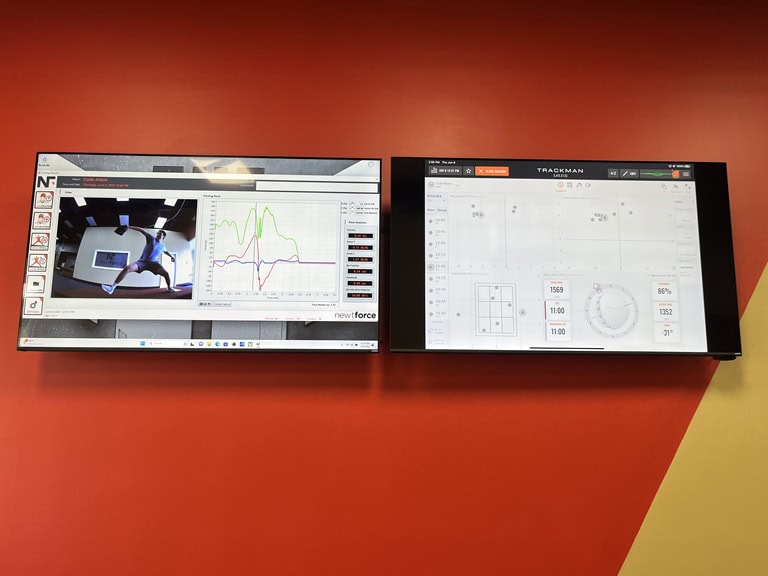
Image: NewtForce
“We were doing some testing for a major aviation manufacturer, and if you took a deep breath and cleared your head and backed up far enough from it, you can envision a way to get ground force reactions out of a surface with what we thought was infinitely more reliability,” Barker said.
Barker declined to get too specific about the company’s proprietary competitive advantage but said the concept of stiffness-to-weight ratio on an aircraft wing — heavily engineered to be strong, yet light — was critical, as was the collaboration of his lab manager, Paul Wanamaker, who is now NewtForce’s hardware lead.
“My aviation background, oddly enough — and it makes no sense to many people — was just perfect for an instrumented pitching mound,” Barker said.
Among the two dozen metrics collected by NewtForce are acceleration and deceleration patterns, impulse (total force over a period of time) and what they call the clawback, which is the duration of time the lead leg is planted on the ground.
Some early machine learning research using data from the NewtForce mound by Randy Sullivan and his team at Florida Baseball Academy suggests that impulse is a key metric for velocity production.
While progression typically takes time, Barker recalled witness some fairly immediate improvement in one particular pitcher during a site visit to an installation at Vanderbilt.
“I’m no coach, but I’ve seen Vanderbilt’s coach take a kid that was, call it 92 and minus command, and intuitively, after seeing the force charts, have some idea about what his kinetic chain was to cue him verbally,” he said. “And then in two or three pitches, you see better velocity, ballistic spin efficiency.”
Particularly younger pitchers, Day said, tend to have under-developed deceleration patterns in their lower halves. Building arm strength is less the issue than efficient movement in the legs and hips.
“Sometimes the eyes are going to deceive us,” Day said. “There’s times that you’re going to think a guy is using the ground well, and the data is just not saying that. So the way guys move can be deceptive. That’s one thing we’re learning is, Yeah, it looks good, and often it actually is good. But there are times that it looks good, and it’s not. And there are times that it looks bad and awful, and it’s like, you have the best lower-half efficiency out of anybody.”
This article was brought to you by SBJ Tech, a Leaders Group company. As a Leaders Performance Institute member, you are able to enjoy exclusive access to SBJ Tech content in the field of athletic performance.
The Gatorade Sports Science Institution will enable athletes to drill down into their unique fueling, rehydration and recovery needs.
A Data & Innovation article brought to you by
The sports drink that became Gatorade was invented nearly 60 years ago, in 1965, but that initial thirst-quenching rehydration solution has evolved into a multi-billion business with more than 50 flavors across a broad portfolio of products supporting active lifestyles before, during and after exercise. The AI-powered algorithms in the Gx app and company website offer more than 91,000 variations of the Gatorade Fuel Plan.
This new facility is GSSI’s clinical research headquarters, situated in the sleepy suburban town of Valhalla, as part of a larger R&D facility operated by parent company PepsiCo. Life sciences is one PepsiCo’s four pillars, and the GSSI is “one of the crown jewels” within the division, Chief Medical Officer Dr Pietro Antonio Tataranni said.
“It’s a group of highly skilled individuals who look at the science out there and tries — most of the time, successfully — to translate it into products, technologies or services,” he added.
The multiple laboratories at the GSSI can assess athletes’ physiology, biochemistry, exercise performance, energy metabolism and mental performance. The research conducted here will support Gatorade’s burgeoning product line, which includes drinks spanning several categories: lifestyle (Propel), energy (Fast Twitch), rehydration (Gatorlyte), refuel (classic Gatorade) and recovery (Muscle Milk and its plant-based protein counterpart, Evolve).
SBJ Tech’s own Joe Lemire underwent several of the aforementioned assessments at the GSSI. You can read his takeaways here in the latest edition of our Sandbox Series.
This shift to a broader Gatorade portfolio was first revealed in a Super Bowl ad and reflects a shift in marketing tone. Brand affinity is born from “a mix of aspirational and attainable,” said Carolyn Braff, Gatorade’s Head of Brand Strategy.
“When Gatorade puts a whole bunch of sweaty football players on all of our ads, we’re excluding half the population,” she said. “We don’t work that way now. So you’re going to see a big step change from us in how we think about athletic performance, athletic wellness, speaking to everyone who’s moving their body with purpose and welcoming them into the Gatorade family.”
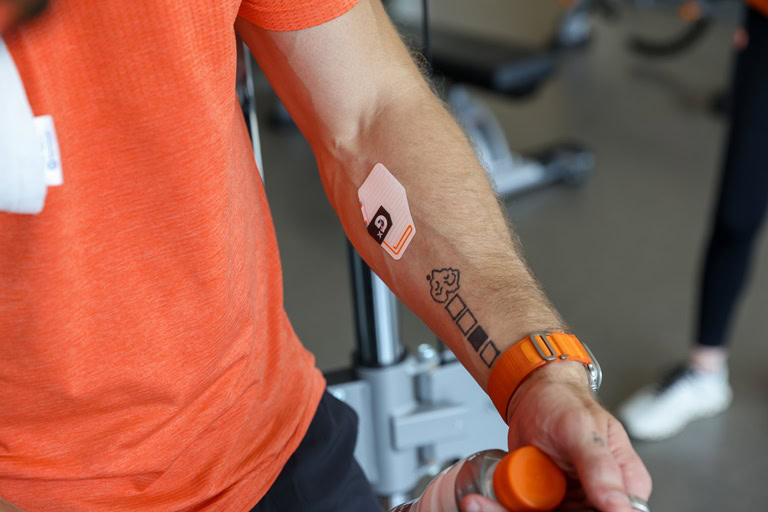
Image: Gatorade
On a recent morning, the two-time Olympic gold medalist and two-time World Cup champion Lloyd visited for an assessment. At one point, she was strapped onto a treadmill, with a respiratory flowmeter affixed around her mouth. Measuring her exhalation can identify the type of energy she’s burning, fat or carbohydrate. (Asked later what she learned, she quipped, “I learned that I’m retired.”)
But Lloyd, a former FIFA World Player of the Year who hung up her cleats in 2021, is a poster child for proper fueling. Overhauling her nutritional intake after criticism from the former US women’s national team coach gave her more energy and led to better performance.
“I remember, it was Pia Sundhage, she was not going to renew my contract in 2009,” Lloyd said. “So I had to do something to make myself better and change. And 2009 was when I really started to change my diet, eating organic, eating healthier — I noticed a huge difference.”
Gatorade’s ambition is to democratize sport science. Members of the media were invited to undergo a similar battery of assessments, testing force production, body composition and muscle fatigue. The Gx Sweat Patch and Gatorade Fuel Plan are mass-market attempts to put, as they say, “a sport scientist in your pocket.”
Matt Pahnke leads the GSSI innovation program, meaning he may be the proverbial sport scientist in everyone’s pocket, has tested elite triathletes competing at the Ironman world championship in Kona. He determined that the average participant lost between 40 and 45 ounces (1.2 and 1.3 liters) of fluid per hour — but individuals ranged from 10 ounces (0.3 liters) to 85 ounces (2.5 liters), a huge discrepancy washed away by the mean.
“That’s why we developed the patch system so that an athlete, on their own, can understand what their individual needs are,” Pahnke said.
Ironmans are grueling affairs, no matter the conditions, but Kona is especially harsh due to the heat. Football players wearing pads during summer two-a-days can relate, whether they are in high school or the NFL. The GSSI includes an environmental chamber to enable heat testing up to 40 degrees Celsius (104 Fahrenheit) with 80% humidity. “Basically, we can mimic any environment,” said GSSI R&D Director Lindsay Baker.
The updated GSSI is now fully open for business, and the broader Life Sciences team is conducting a series of pilots through PepsiCo’s Advanced Personalization Ideation Center. “We have what we aspire to be a platform, and from there, you can bolt on different technologies,” said Tristin Brisbois, noting tech’s potential to “bring a differentiated consumer experience.”
The API Center seeks to operate as a startup within broader PepsiCo, relying on partners in technology and academia and utilizing AI, wearables and more. Its mantra is to “learn first, scale second” with early prototypes undergoing testing.
While the results of the Sweat Patch and Fuel Plan will, of course, refer users back to Gatorade products, it won’t do so exclusively.
“You don’t want your recommendation engine to just push out Gatorade products — you’re going to lose credibility immediately,” Brisbois said. “The products are designed to give you the nutrition and hydration that you need in a short period and a very convenient way. So you could get there with water, banana, and 10 soda crackers, or you could consume this Gatorade. But there is the option there for the consumer to make the choice.”
Her team is concerned not just with innovation but consumer behavior. Users need to find enough value to share data, but the tool can’t require so much that it turns them off either. There’s a “tipping point” they need to find, Brisbois said, adding, “If you’re working in the personalization space, it’s almost like you can over-engineer it. And for a lot of these things, the more complicated it becomes, the more niche it becomes, too.”
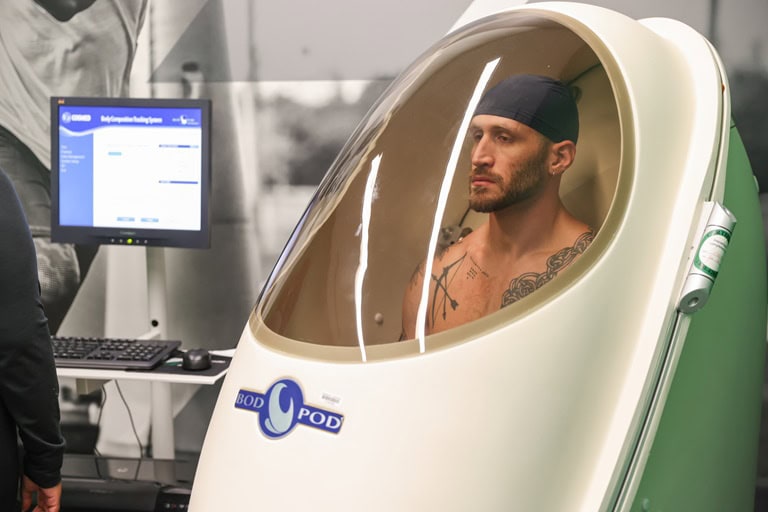
Image: Gatorade
And Gatorade is cognizant that it can’t make its portfolio too convoluted or involved, or else the messaging won’t resonate with the fleeting attention of the average consumer strolling through the grocery aisles.
“Honestly, we learned that when we launched the G series in 2010. We had 01, 02, 03, Prime, Perform, Recover, G Series Fit, G Series Pro, Classic G Series — it was way too complicated,” Braff said. “And so we’re not going to do that again. The best thing we can do is tell consumers what’s in the product and let them choose for themselves. And so our billboarding on the front, primary display panels for all of our products is really simple.”
This article was brought to you by SBJ Tech, a Leaders Group company. As a Leaders Performance Institute member, you are able to enjoy exclusive access to SBJ Tech content in the field of athletic performance.
This recent Leaders Virtual Roundtable gave Leaders Performance Institute members the opportunity to define mental skills and discuss their application in their environments and what we can all be doing to optimise their implementation.
A Human Performance article brought you by our Main Partners
Providing some additional content and provocation for the start of the roundtable, we listened to some of the thoughts and experiences of Dr Duncan Simpson who is currently serving as the Director of Personal Development at IMG Academy – Duncan is also on the Executive Board for the Association of Applied Sports Psychology in a Research & Practice position. The premise of the first section of the roundtable was to engage in some stimulus around the ’what’, ‘why’ and ‘how’ as it pertains to mental skills training.
The ‘why’ of mental skills
Simpson kicked us off by sharing this definition of mental skills training: ‘The systematic and consistent practice of psychological skills aimed at enhancing performance and personal well-being’ (Vealey 2007). There are two key components to this definition – the systematic and consistent practice and the other focusing on what is the purpose of that practice? When we think about mental skills, if you just do it without an intended outcome or purpose, it will lack any impact or substance.
Now we’ve explored a definition of mental skills and some core considerations, why is this topic of much interest and relevance to the high performance sport industry?
Recent meta analyses corroborate decades of research regarding mental skills training having a positive effect on sports performance and vital psychological factors (Brown & Fletcher, 2017; Lochbaum et al., 2022).
However, some coaches and athletic directors have not adopted mental skills training due to perceived barriers, such as lack of time, cost, and concerns over relinquishing control (Wrisberg et al., 2010; Zakrajsek et al., 2013).
To summarise this first segment of the roundtable – we know that mental skills is important because there is a significant body of research outlining the positive impacts, but we also know it’s not being implemented across all levels of sport consistently.
What? ‘Questions are the shepherds of your mind’
We have to begin thinking about the implementation of mental skills. We may want to ask ourselves some questions because these will help direct where we want to go without on programming. Below are some considerations Duncan shared when thinking about the programming of our mental skills training:
What does the athlete or team want? What are we hearing from them around what they want? Do they want to become more resilient, confident or focus – what are the areas they want? This is a really important step, in particular having the connection with the athlete to collate that feedback. Where we have seen mental skills not work is when we put the programming to the athlete and try to make them receptive to it.
What does the athlete or team need? An audit or a needs analysis, working with coaches and support staff to understand what they actually need. When we start to collate the information around what they want and need, we are much better informed around what the programming and training needs to look like.
When you think about the sport in the context in which you work, what’s the greatest return on investment? If we want to improve the resilience of the team, is that going to have the biggest impact upon performance and wellbeing? Are we strictly focused on performance or is it a combination of both? We need to evaluate what is actually going on in order to make a difference.
It’s also worth thinking about an opposing question such as ‘what’s the lowest hanging fruit?’ What’s the easiest thing, not just the greatest thing? What are the things that are no brainers?
Addition and subtraction. When we think about organisations and teams, a lot of times coaches have this idea of needing to do more; and mental skills training is another one of those things we have to do, work and focus on – it’s an addition. We can actually reframe this. Mental skills and psychological work can actually be about subtraction. Here’s an example to bring this to life – if we are to focus on team building and culture working through the lens of subtraction, an element of this might be that when we make a mistake, we don’t criticise each other. We’re not doing anything extra, we’re just stopping criticism.
Finally, and when thinking about the ‘what’ behind mental skills’, what can you provide? What are your areas of competence?
What do we mean by ‘mental skills’?
Skills, in this case mental, is an ability and capacity acquired through deliberate, systematic, and sustained effort. Below are a number of key mental skills we often seen aligned to the practice.
Mental attributes
Attributes are qualities or characteristics of a person or team. Below are some of the things you may hear from coaches or support staff around how we want our athletes to be. The below examples are the outcome, this is what we are leading towards and we’re going to practise some mental skills in the aim to reach these outcomes:
Behaviours
A behaviour is the way a person acts or reacts in response to a particular situation or stimulus. They are observable actions that express psychological attributes. What does it look like when somebody is confident, when somebody is resilient?
Collaboration and agreement between performer, coach and support staff is an important aspect here. Ultimately, it doesn’t matter whether your definition of an attribute is slightly different to another member of staff or the athlete, the collaboration and agreement is the most important.
It’s also important to be sport-specific. What does that behaviour look like in your context? We are also in a position now where we can be objectively recording and capturing data based on these behaviours.
Skill learning is a relatively permanent change in behaviour as a result of practice (Magill, 2016). If we are just psycho-educating our athletes and they don’t actually change their behaviours, they probably haven’t learned it. Seeing a change in behaviour is key.
Consider this flow: one of the outcomes is that we want an athlete to take more calculated risks. When we can define what that means based on the sporting context, what do we need to allow that to happen? We need the athletes to be more confident (the attribute), what are the skills that can support that confidence (self-talk)?
Skill = Self-Talk → Attribute = Confidence → Behaviour: Take More Calculated Risks
In practice reflection
Think about reflection. Below are some questions we can ask ourselves as performance support staff and coaches.
Ultimately, when you are looking at your team, organisation and athletes:
Group reflections & insights
At the end of the call, attendees were asked to share a key reflection from the roundtable that they’d like to take forward:
Smith’founded Crux Sports, a consultancy for women in sports, with a view to grow women’s football and give females the support they need whether in the boardroom or out on the field.
A Data & Innovation article brought to you by
You can’t have a discussion about sports technology today without including athletes in that conversation. Their partnerships, investments and endorsements help fuel the space – they have emerged as major stakeholders in the sports tech ecosystem. The Athlete’s Voice series highlights the athletes leading the way and the projects and products they’re putting their influence behind.
* * * * *
Rebecca (Bex) Smith is among the most connected people in women’s soccer. She captained teams for Duke University, Vfl Wolfsburg and the New Zealand national team, competing with the Football Ferns at two World Cups (2007 and 2011) and two Olympic Games (2008 and 2012). Smith also played professionally in Sweden and Germany before her career ended in 2013 due to a knee injury.
Smith, now 41, went on to work at FIFA for nearly five years as Competitions and Event Manager for all FIFA Women’s World Cups — the flagship event as well as the Under-17 and Under-20 versions. She went on to become the Global Executive Director of the Women’s Game at Copa90, a podcast host co-produced by the BBC, UEFA venue director and now Founder/CEO of Crux Sports, a women’s sports consultancy. In May, Crux Sports published research, in partnership with YouTube, on the value and impact of DAZN making the Women’s Champions League available for free on the social streaming platform.
She earned three degrees, speaks four languages and is either a board member or advisor for numerous companies and programs, including AI-powered injury risk platform Zone7 and the Isokinetic Conference, the largest football medicine conference in the world. Smith will also co-host the daily morning show for Australian broadcaster Optus at the upcoming Women’s World Cup being held in Australia and New Zealand.
On what she’s building with Crux Sports . . .
My company was born out of the fact that I had a very diverse background coming from playing to then governance and managing one of the biggest women’s sporting event on the planet to then going into media content production to then working with big brands to doing branded content and working with athletes. So I really just wanted to have a place where we could help all stakeholders so whether it is brands or governing bodies or content production or athletes themselves to either get into the women’s game or to help fuel it.
So it’s really about driving sustainable positive growth into the women’s game, but then helping stakeholders to increase their bottom line or to work on their marketing or figure out their strategies for integrating women’s sports and female athletes into their propositions as well. So it’s very diverse. I work with YouTube and Google and helped them do a research project, all the way to Champions League to working with big brands like Xero on their partnerships with the FA or FIFA to working with on content production or working with athletes directly, helping them work on their post-career transition and maximizing their commercial opportunities during their career.
On her interest in player health and wellness . . .
It comes from my own experiences in football and sort of more negative experiences, I would say, throughout my career where I found that there was a lack of support. Despite the fact that I had three degrees on the side and was trying to work at the same time — because I was trying to just set myself up for post-[playing career] — I still felt really unsure, insecure, going into that post-career, post-football life and having to do so with a really bad injury. I hurt my knee, and then it was not very properly looked after at my club. And I was continually playing on a very swollen knee. And in the end, I can’t run anymore. So for me, it was really important.
When I was at FIFA, we did a whole medical study on the athletes and players, and what their medical setups were. And in the end, we couldn’t publish it. So I gave it to my buddy at FIFPro. So they did the very first employment study. So it was based off of a lot of the data and research that we had done. And yeah, it’s just really about trying to better the situation for the next generations. And it sounds so hokey, and so cliché, but it’s so important that we continually improve the game for the athletes because they are at the heart of the game.
On her work with athletes . . .
So many people work in and around sports, and they run this or they run marketing, or they run broadcast, and they’re very important, they make loads of money, but at the end of the day, if the athletes are continually getting burnt out and injured and aren’t taken care of properly, then it won’t be sustainable. So for many reasons, one, the health and mental health and safety of athletes because they’re human, but secondly, because it’s a business, and it needs to be sustained as well. And you have to take care of your people in the business. So they’re at the core.
Do I think it’s gotten better? No. I wish I could say that it has. I think in some areas, in some clubs, there’s better medical care and a little bit more investment in that, but I still think that it’s a huge gap, which is one of the reasons why I work with a lot of athletes. I don’t really market it, they just come and I work with them to help them get prepared mentally and also just physically — what are they actually doing to prepare for it. So, ya know, there’s still a really long way that we need to go for that.
On Zone7 . . .
Not just because I’m a strategic adviser to them, but I think something like a Zone7 [can help]. I really wish it was around when I was playing. And I’ve said that before. But to have the technology that we have now — AI — that did not exist when I was playing, or was not, let’s say, mainstream when I was around, and to be able to have those types of algorithms where so much data is going in that is being perfected constantly and tinkered with and filtered down, that you can really get to the point where you can say, ‘This is the percentage of risk that you are at for this type of injury, and therefore you should change your training to do this, this and this.’ It’s mind-blowing.
I come across lots of tech companies or people trying to help out with athletes, and it’s all — even what I do — very time-consuming and very one-on-one, whereas this is a mass market product that that can really help. Now they’re in leagues as well, so it’s not just with individual clubs or teams.
So far, that’s the most incredible thing that I’ve seen that I think would just really help reduce injury in a huge way, really quickly and very significantly. But other than that, there needs to be a lot more investment by clubs and leagues and those that are making money off of athletes. They need to have a certain percentage invested back into the athletes, that would be my standard approach to things. But good luck trying to get them to invest back into their players.
On her recent project for YouTube and Google . . .
I did a research project with them around the Women’s Champions League. So because they put the Women’s Champions League, through the rights with DAZN, on YouTube free-to-air and global, it meant that there were a lot of knock-on effects. What they were measuring was traditionally just the live match number — what’s the audience watching this live match? Which is obviously lower than if it’s on normal TV in in France, but that’s because a lot of people didn’t know it was on YouTube.
So we were really looking at the value and impact more broadly on the different stakeholders. So from media, players, the teams — so I interviewed 15 out of 16 teams that participated in the group stage — got their opinions on things, talked to the players that were involved, talked to media and then we did a big fan survey.
On her work with the Global Esports Federation . . .
That’s quite fun. I sit on the players’ commission, and that’s really interesting because I’m learning more than anywhere else, I’d say. It’s really understanding how athletes in the gaming space are being treated, what their challenges are, how the Global Esports Federation can help support athletes better. From my former career as an athlete, but really looking at gaming as one of the biggest, fastest growing industries on the planet. And my goodness, every kid is involved in it.
On the importance of New Zealand co-hosting the Women’s World Cup . . .
It’s pretty massive and not likely to ever happen again. It really is a one-off opportunity, I think, for a country the size of New Zealand that always punches above its weight anyway in its sports teams, but in terms of the size of the country and being able to host such a massive event, it’s huge. And obviously, co-hosting with Australia has been a large part of that as well and will be truly beneficial for both parties. You still have some of the beauty of New Zealand and a totally different vibe and a little bit closer to be able to travel within the country, as opposed to Australia. I’m hoping that all the fans are going to come and turn out and really support the teams down there.
On the broader growth of the women’s game . . .
What the women’s game has suffered from prior is that we have big, big moments, and then it really drops off. So you have the World Cups and obviously the women’s Euros this last summer in England — and then with England winning, that really pushes everything forward quite quickly. You have 1 billion viewers from the last FIFA Women’s World Cup in France, but then we really have struggled to translate that into the [domestic] leagues and Champions League.
I think this year has been one of the first years where we’ve really seen massive pickups of numbers of people in stadia of sellout crowds. Literally every single week, I’ll open something on my phone, and it’s a record being broken of some club or some stadium being sold out. We had the Arnold Clark cup here. They had it in Coventry, and it was the biggest game they’ve ever had in sports — and that happened to be women’s football.
So it’s just it’s growing massively. So I really think that this Women’s World Cup is no longer going to be just another pinnacle event that will see the drop off after. I just think it will help to increase that level so that the trajectory just keeps going up. Obviously the time zone is going to be a challenge. So I think the on-demand elements of it, the highlights and things will be really, really important.
This article was brought to you by SBJ Tech, a Leaders Group company. As a Leaders Performance Institute member, you are able to enjoy exclusive access to SBJ Tech content in the field of athletic performance.