The Leaders Performance Institute explores approaches at Notre Dame, Penn State and in European Soccer.
An article brought to you by our Partners

“Broadly, one of the gaps is cultural,” John Wagle, the Associate Athletics Director of Sports Performance at the University of Notre Dame, tells the Leaders Performance Institute.
“Highly competent, well-intentioned people who are tasked with providing best-in-class support to athletes in development or preparedness mistakenly use time spent as a proxy for the value of their contribution.”
“If you have a high performance team all operating in that manner you can appreciate quickly that the athlete’s time becomes limited; and that loss of autonomy, that loss of educational opportunity, that loss of ownership leads to a lot of sub-optimal outcomes.”
Athlete recovery is a potential casualty and the situation can be compounded in team sports, as Carwyn Sharp, the Head of Human Performance at Italian Serie A side AS Roma, explains. “Implementing change in a large organization is much more difficult than going to an individual athlete and individual coach,” he tells the Leaders Performance Institute. “Here at Roma, we’ve got to think about how it affects numerous players.”
Sharp currently works with a larger staff than he did during his time working at the United States Olympic & Paralympic Committee between 2018 and 2021. “With the Paralympics, I could just go downstairs and talk with medicine. Here, I’ve got to talk to many individuals in many departments, even though they’re all under my umbrella. Take something like compression wear, I’ve got to talk to IT about how we’re going to implement and monitor its use. As well as the kitmen who will manage handing it out and washing it, as well physiotherapists that will note if the Players are wearing it, and obviously the Sport Science staff and Players.”
The NCAA is a world away from Italian football, but Sam Marsh, who recently finished playing with the Pennsylvania State University men’s volleyball team, had access to a similar array of recovery modalities and needed similar advice, particularly as a student-athlete balancing playing and studying. “It would be wrong to say I knew exactly what to do all the time in terms of preparation and recovery,” he admits. “We have a lot of guidance, resources. The help is there if you need it.”
Here, we explore the steps taken by Notre Dame and Roma to create efficiencies in workflow management, while providing athletes with education and development opportunities around recovery. We also reflect on Marsh’s recent experiences with Penn State as a varsity athlete.
Victory by a thousand conversations
When it comes to recovery modalities, “it tends to be the older or younger guys to engage the most actively in the process,” says Sharp. “We have a number of guys who come here from the primavera, the under-19s. They know it’s tough to get in so they’ll do everything. They’re in the gym doing extra weightlifting, the prehabilitation. I talk to them and they ask ‘what else can I do?’ Then it’s most of the older guys who are at the point where they’re thinking they want to stay as long as they can.
“For these people, we can improve our processes because we’re getting the feedback and it’s easier to monitor them, collect the data, and make sure it’s accurate.”
At astute programs, there are opportunities for education. “We start by identifying student-athletes at higher risk of being fatigued. Using a variety of data from different disciplines, we have processes that help us classify the student-athletes accordingly,” says Wagle of Notre Dame’s approach. “If fatigued, they are directed to a recovery points system that scales up based on severity. We assign more point value to modalities that are more rooted in empirical support and less point value to those that are not as well-studied or have a small effect. We can build systems that simply nudge behavior rather than prescribe in a more transactional or passive manner. That’s a lot more powerful and sustainable because it creates productive conversations. If they ask ‘why is getting eight hours of sleep more points than something else?’ then you get an educational opportunity around sleep hygiene. Maybe prior to that they didn’t have a realization of its impact. It fosters more victories by a thousand conversations than this one-time transaction that happens in many environments.”
At Penn State, Marsh and his teammates understood the value in recovery but favored modalities often depends on your peers. “It generalizes around which guys live together,” he says. “The guys that I came in with, we all lived together. So when we decide we’re going to go into our facilities and get in the contrast tubs or stretch for a little bit, we all go together. It was like a group mentality in that regard because other guys that lived together may do different things.”
Familiarity was not a barrier. “I came here and was using things for recovery that I’d never done,” Marsh adds. “Contrast tubs, compression boots, stretches that our strength & conditioning coach gave us that feel very good in the long run but hurt when we do them. It was new but we were willing to try a lot of things just because of the amount of stress and pressure that we put on our bodies.”
To provide scalability in its processes, Roma introduced its ‘One Roma’ concept across all of its age-group and senior men’s and women’s teams. “We are big believers that the health and viability of our first team doesn’t just sit with our first team,” says Sharp. “We’re going to have a much bigger impact on the health of this club if it’s something we can scale for.”
It also helps with player education and is gradually shifting the culture around recovery. Sharp adds: “With ‘One Roma’, when players move up towards the first team, we want them to know that what they’re doing at 17 or 18 is very close to what the first team are doing. It’s not a big jump and it’s easier to make that transition.”
For the 2022-23 season, Roma also introduced its own internal athlete management system. “We’re now much better at monitoring our recovery strategies on a daily basis and in real time.” This has facilitated better conversations with players, with data complemented by their subjective feedback. “With a better relationship we can ask more of the players and they are willing to do more too.”
Managing trade-offs
Of the potential trade-offs, Wagle returns to the idea of incentivizing athletes. “We’ve been very careful to evaluate the recovery modalities that we deploy alongside the commitment they require,” he says. “Just as we try to incentivize those things that have a greater impact or the most empirical support, when all is equal, we will then prioritize the tactic that takes less time as a secondary feature of sorting for student-athletes.”
However you approach workflows within your organization, Wagle stresses the need for “personal humility and shared ambition”. “Those ingredients together are really going to be meaningful to our athletes because they let you achieve excellence but they also let you sustain it.”
Sharp concurs. “It gives us an opportunity to look at ourselves and say ‘we’ve done a good job educating this player or athlete, because maybe their sense of whether it’s working or not depends on how well we’ve educated them’.”
Are there other metrics of success? “Finding out what the question is,” says Wagle. “Too often we skip ahead and think that we know the right question to ask and the impact ends up being smaller because it was misdirected.”
Sharp believes it comes back to how Roma players feel. “If an injury takes 7-14 days to recover from, based on the literature, and the player recovers in three, we’re beating the average so that’s meaningful,” he says.
“Whether we quantify this with them in some way or not, part of all of this is how they feel about and the job we’re doing. If they feel like they’re improving and getting better, they’re going to have trust and faith in us in the things we’re asking them to do.”
Marsh, for his part, placed his trust in his Assistant Athletic Trainer at Penn State, Brianna McDuffie. He says: “The amount of times we can just go in and say ‘alright Bri, my shoulder’s hurting again. Can we do some rehab?’ And you’ll end up spending every day for the next two weeks with her.”
The messaging was always clear for Marsh and his teammates. “If you put the work in that’s all well and good, but you have to do the other stuff that some people don’t want to do to be able to reap the benefits.”
The startup’s InFlow product can be installed in toilets to measure hydration in real time for users.
Main image courtesy of Intake Health.
A Data & Innovation article brought to you by

SBJ Tech’s Startups series looks at companies and founders who are innovating in the fields of athlete performance, fan engagement, team/league operations and other high-impact areas in sports. If you’d like to be considered for this series, tell us about your mission.
* * * * *
World’s shortest elevator pitch: “Intake Health automates hydration testing for elite sports.”
Company: Intake Health
Location: Raleigh, North Carolina
Year founded: 2016
Website/App: https://www.intake.health/
Funding round to date: “We are self-funded.”
Who are your investors? “We have no external investors. We’ve been invested in with grants, SBIR funding from the National Institutes of Health and National Science Foundation, as well as founder funding. We’ve raised about $2-$3 million.”
Are you looking for more investment? “Not at the moment, but we will need some in probably 12-14 months.”
Tell us about yourself, Co-Founder & CEO Michael Bender: “I’ve always been drawn to technology – I had a computer in the early days – as well as entrepreneurship. Creating, selling things to buy what I needed to as a child. I was always excited about the option of software being low cost and something you could build and solve problems for others. I started companies in college, as well as right out of college. I started working for a software company right out of school for about four years and became an owner of that company. We sold that company three times. I created another software company I ran for 10 years before starting Intake Health. After doing software for so long as an electrical engineer, I thought it might be nice to get back to building physical things and use some of that education. I teamed up with my brother, who is a biomedical PhD engineer out of UCLA. He brought the science to the table, I brought some business experience and funding and electrical computer experience. We merged that together to build Intake Health.”
Who are your co-founders/partners? “My younger brother, Brian, is my Co-Founder. He has a material science undergraduate degree and has a PhD in biomedical engineering. I have experience in entrepreneurship, successful companies. Other people looking to start companies seek you out when you have that kind of background and most people just want you to do it for them. I gave him advice to quit his job. He had come to the table looking to measure his dietary intake. He thought there would be a better way to do it than blood tests with doctors and waiting and scheduling appointments and ‘What am I eating today? I can’t just take pictures and track it.’ That was the genesis of the company – to make it easier to track your intake. I told him to quit his job, he had some interesting ideas and concepts, and to double down on those and research those. That’s where I put up some of the initial funding. We created benchtop results that were successful enough to start landing the grants. What makes him special is his aptitude for science, his ability to understand the bigger business picture in conjunction with that and being a very easy guy to work with.”
How does your product work? “It’s a physical product called InFlow. You buy it and it measures hydration in real time for users. It’s installed in a urinal in just a couple of seconds with suction cups. You get it out of the box, install it in the urinal by pressing it into the back wall. In the locker room, as athletes are coming in and using the bathroom, they urinate on it and it fills up with a little bit of urine and they instantly get a very bright green, yellow or red indication of their hydration status, along with a graphic that goes over the urinal that tells them the next step depending on what that result is they got.”
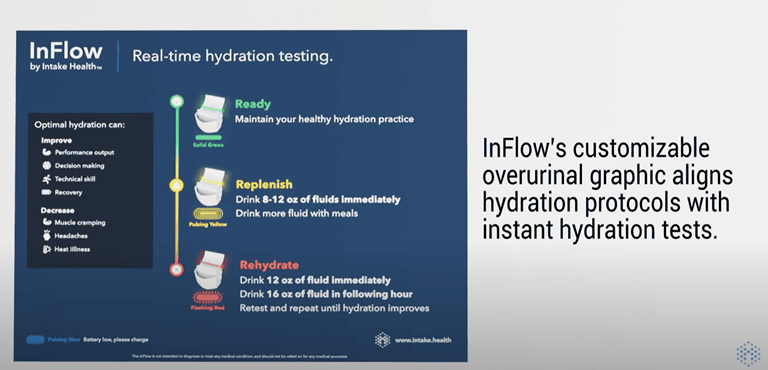
Image: Intake Health
What problem is your company solving? “Hydration testing happens quite a bit in these environments already. Some teams don’t actually have the capacity or resources to do it, even though they would like to do it. Others that have the capacity to find time for hydration testing with their staff can’t really do it frequently enough to change the behaviors of the athletes and keep it top of mind frequently enough to improve the hydration behaviors of their athletes. Proper hydration is really critical to get that extra 1, 2, 3% out of athletes. It improves decision making, keeps them healthier on the field and playing longer. It reduces cramping and injuries and improves recovery. All these things that very elite teams are looking to do is why they have these hydration protocols. Frequently, it starts to become deprioritized or they can’t get to it as often. Our technology allows them to distribute that and automate that process. Now, you have hydration testing in every urinal and the athletes are aware of their results and can act on them immediately instead of waiting for a large number of staff to collect urine samples, do all the testing and write those answers down. There’s a significant lag between existing processes for hydration testing compared to having the instantaneous, hands-free hydration testing in the urinal today. We’re able to bring hydration awareness to the top of mind for athletes and actually change the hydration culture among the team. We’re seeing great results.”
What does your product cost and who is your target customer? “The product is sold primarily through distributor channels. It retails for $2599 for a four pack. Our target customers are elite athletic programs. We sell globally, so professional sports, Division-I universities. Any sports program that can leverage these effectively to improve hydration.”
How are you marketing your product? “For marketing, we started with targeted emails and standard outbound tactics like LinkedIn and calling on people listed on desired customer websites. Since gaining traction, we now see a lot of organic inbound from word of mouth and are shifting to rely on our new distribution partners – Henry Schine, School Health, and Alert Services in the US and Perform Better in the UK – to increase awareness. We also go to conferences quite a bit. You’ll see us at a lot of sports conferences and our distributors will be representing the product. A lot of times, we’ll install the technology at the conferences so people can use it.”
How do you scale, and what is your targeted level of growth? “To scale the company, we are relying on distributors. We’re bringing on more distributors globally to help push the product out. As far as working with our partners to ensure product availability, we have manufacturing partners we’re ramping up to produce the product with the quality we demand, as well as support the customers with the support they deserve as we scale up. There’s a pathway of additional products in what we plan to do next and new markets we intend to take the market to. The sports world is interesting. We want to support it and we’re dedicated to supporting that industry and it’s a very large, global industry. When you’re looking at the elite and the top levels, it’s on the edge of a venture-backable business. Our intent is to get technology that measures wellness on the toilet of everyone in the world. Right now it’s hydration, but there are other indicators. Our strategy is to figure out: ‘How do we get this on everyone’s toilet?’ With hydration products specifically, we are just now looking into workplace safety markets, so construction, mining, warehouses, agriculture. We can have a large impact there keeping people healthy and safe by improving their hydration. We’re also looking at military and tactical environments, like fire, police, first responders. They also have existing hydration protocols and understand and need their people to be hydrated to perform at the level they’re working at. We’re expanding into those markets.”
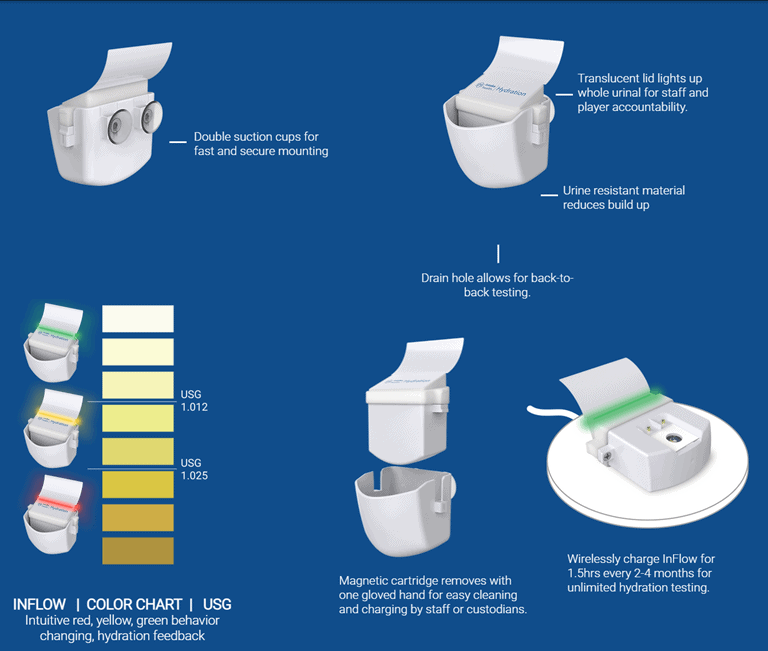
Image: Intake Health
Who are your competitors, and what makes you different? “When it comes to hydration testing, there are competitive options. Most of them are devices, so people are just selling products that help you measure your hydration. I don’t think there is anyone doing real-time hydration monitoring for professional sports in the toilet. Our competition seems to be more status quo, what people are doing today than an actual company producing a competitive product. Our product, when it comes to measuring hydration, whereas for a dipstick or an optical or digital refractometer you don’t have to use your hands. It’s hands-free. No one has to collect a urine sample to use our system to test hydration. The results are instant, so there’s no lag time between running a hydration program and delivering that information and acting on it with the athletes. They can act on it in real time and produce impact before they get to the field instead of often after they hit the field with existing products. The sweat patches can help give a one-time understanding of a person’s sweating capacity and what happens, but it’s not really an ongoing use case that keeps hydration top of mind. That may be more of a symbiotic product instead of a competitive product with a slightly different use case. When looking at other companies that are trying to measure stuff specifically from the toilet, like health indicators not specifically hydration, one thing that sets us apart and is important is privacy. Our technology is standalone, you install it and it does not collect personal, identifiable information nor health data. It’s meant to empower the user in real time. We’re able to bypass a lot of the privacy concerns that some people may have as they’re collecting the data and bringing it up to the internet and doing things like that.”
What’s the unfair advantage that separates your company? “We definitely have patent-pending technology around measuring health indicators from the toilet. The team we’ve built is pretty impressive. We have people from the industry and the sports world specifically that are trying to solve this problem. We have customers that want to come join the team. That’s what it comes down to. We have a good team and novel technology.”
What milestone have you recently hit or will soon hit? “Bringing on the distributors was probably our first milestone. We’ve been able to launch a product, get early traction and then attract distributors. You have to have a product the market cares about in order to have distributors place larger stocking orders. We’ve been able to create a product and validate it. We only launched the product last September, so it hasn’t been very long that we’ve been selling the product. In a very short time period we’ve been able to prove market demand and we have something useful for the market and for our distributors.”
What are the values that are core to your brand? “Transparency and trust are critical. We publish papers and make our data well-known. That is important in this industry, especially where a lot of people try to maybe sell you snake oil. Everyone is looking to get that 1-2 % and some companies take advantage of that. We want to put this on everybody’s toilet and improve health for everyone. Our mission is to help people live healthier longer, instead of us having decades of life at the end of life and degraded health where we can’t do stuff with our grandchildren or we’re going to the doctor’s all the time. We want everybody to be healthy until their final days. Hydration is our starting point but, to get there, trust and transparency is absolutely critical. That’s also why our device does not collect, store or transmit any data. We don’t want to muddy the waters with, ‘What are we doing with all this data we could be collecting on health indications?’ We’ll roll out data collection and connectivity later as customers demand it. Medical rigor is another one. We are not a medical product today, that’s definitely in our future. We appreciate the level of intentionality behind building a medical device and medical product and how the medical industry treats health information and rolls out products to make sure they are safe and efficacious. That’s really critical to us as well.”
What does success ultimately look like for your company? “The entire world living healthy until their final days.”
What should investors or customers know about you — the person, your life experiences — that shows they can believe in you? “We have a good bit of experience already. We’ve built successful companies and I’ve built successful companies. We have customers using the product. We have a history of doing what we say and delivering on what we say, whether that be with this business or previous businesses or life experiences. The team we’ve built is a very credible team with lots of experience in the industry for customers. You don’t get that far in life and build up a reputation without being trustworthy. That goes back to trust and transparency. We’re not new, we’re not the 17-year-old founders out there. We’re 40 years old and have been doing this for a while.”
What examples are there of how Intake Health has benefited a team or partner? “We have a case study with Millwall FC. They adopted our technology. That had an existing hydration protocol in place. After using our technology for a couple of weeks, they saw those results go up and decided they could stop doing their hydration protocol which was time-consuming. They improved their hydration, improving time and money for the organization, which is what we are hoping to do for all teams.”
This article was brought to you by SBJ Tech, a Leaders Group company. As a Leaders Performance Institute member, you are able to enjoy exclusive access to SBJ Tech content in the field of athletic performance.
Hyperice Founder and President Anthony Katz brainstormed his products with a little help from some of the league’s most influential players.
Main image courtesy of Hyperice
A Data & Innovation article brought to you by
During the NBA Playoffs , TV cameras constantly caught marquee players wearing futuristic massage wraps around their backs and knees. It was not to hold their shorts up.
Hyperice and its latest heat + vibration wellness technology has cornered the NBA market more than ever, even though the relationship goes back to an inspirational conversation with the late Kobe Bryant in 2011. The company’s new Venom 2 product has swept through the league this past season with its reverberating, pliable, granulated copper-like material that generates up to 130-degrees of heat — with a who’s who of all-stars on board.
The Lakers’ LeBron James and Anthony Davis and the Celtics’ Jayson Tatum are investors, but that’s not why their respective teams have faltered — the surging Kentavious Caldwell-Pope of the NBA champion Denver Nuggets wears it, too.
“Well, 130 degrees is the maximum heat allowed in a commercial product,” says Anthony Katz, Hyperice’s Founder and President. “Athletes, they always want to push it. If it’s something hot, they want it hot. Or they want it really cold. And if it’s pressure, they want a lot of pressure. If it’s vibration, they want a lot. They want to push their body.”
Hyperice’s journey to the top only proves that everyone’s an entrepreneur at heart and that Katz is open to any and all suggestions. His products — from an original ice simulator to a novel Hyperice X hybrid device just out of the lab — were in part brainstormed by NBA players.
Back in 2011, in an era when players wore sloppy bags of ice late in games on the bench, Katz had already devised a proprietary Velcro cold wrap for his own balky knees. At the time, he was constantly playing pickup games alongside college players at UC Irvine and inevitably would see guys eye-balling the knee contraption. One of his former high school teammates, who happened to be a UC Irvine assistant coach and was charged with letting Kobe Bryant into the gym for 4 a.m. workouts, had a superlative idea.
Show it to Kobe.
Bryant liked Katz’s concept but made suggestions on how to improve it and — if applied — promised to wear it/flaunt it on the Lakers bench. “Inspired me to start the business,” Katz says. “That gave me the motivation to say… I gotta do this now because if he’s gonna wear it, that will trickle down. And if it’s good enough for him, it’ll be good enough for anybody.”
Soon, it was good enough for Blake Griffin and LeBron James, who showed it to his buddies Dwayne Wade, Carmelo Anthony and Chris Paul. Before long, Katz never had to pay for a game ticket again. Griffin and Paul regularly invited him to Clippers games — back when Paul was playing there — and that’s how Katz had his next entrepreneurial moment.
Given access to the Clippers training room, circa 2015, Katz saw how players relied on three modalities: foam rollers, soft tissue massage and vibration. His revelation was to combine them, and he launched the Hyperice Vyper, a product that fitted high amplitude and high frequency vibration into the core of a foam roller. “We went from a company doing not even a million in sales to almost $5 million,” he says.
The next year, in that same Clippers locker room, came his company’s seminal moment. Paul and teammate Matt Barnes told him to think heat, not ice. They said players were now wearing damp hydrocollator pads to stay loose during games, but problem was, they said the pads were “nasty” and would “stink.” They suggested he devise an alternative.
Voila, he developed a vibrating heated pad product, the Venom, that wrapped conveniently around backs, knees and shoulders. The battery, however, would dissipate or detach during games, which was a problem. But Katz was always unafraid to go back to the drawing board. He purchased a company called RecoverX and had engineers incorporate RecoverX’s seamless heating technology into a new completely redesigned vibrating Venom 2.
That product officially launched in August of 2022, in time for this season, ensconcing Hyperice’s role as an official NBA product. During the 2020 Bubble, players were openly using the Hypervolt percussion instrument on the sidelines during games, especially big names such as Milwaukee’s Giannis Antetokounmpo and James. James was also the most prominent proponent of Hyperice’s Normatec air compression system, a lower torso covering that is essentially a lymphatic circulation pump. Post-game, James commonly wears it at home in an easy chair while sipping a glass of wine.
But it was the power-plated Venom 2 back pad that gained the most steam throughout the 2022-23 NBA season. The combination of heat and vibration helped players loosen up swifter — and stay loose. Nearly the entire New York Knicks team took the court wearing it every night. Stars such as Atlanta’s Trae Young couldn’t function without it, while Tatum, Griffin, James and Davis went one step further: they helped bankroll it.
But Denver’s Caldwell-Pope may be the face of the product this June. Or the voice of it. Mic’d up by ABC/ESPN during the NBA Conference Finals, he was on camera wildly exhorting his teammates up and down the sidelines.
Venom coming out of his mouth, Venom 2 wrapped around his back.
This article was brought to you by SBJ Tech, a Leaders Group company. As a Leaders Performance Institute member, you are able to enjoy exclusive access to SBJ Tech content in the field of athletic performance.
Perch’s 3D camera has become a feature in the weight room of the college football champion, the Bulldogs.
Main image courtesy of Perch.
A Data & Innovation article brought to you by
The days of walking around a weight room with a clipboard are long over. At Georgia — not to mention other SEC schools such as Auburn, Ole Miss, Mississippi State and Mizzou — Bulldog players got stronger and stayed fresher last season through an automated velocity-based weight training platform from the fitness tech company Perch.
Saturdays were the gamedays in Athens, Georgia, but every other day of the week for the national champions was a Perch day. The school’s 24,000 square-foot weight room contains a ‘DawgTron’, a 25-foot-by-10-foot digital screen that displays a strength and power leaderboard. That meant players could lift, but not hide — which created a competitive environment that Georgia’s lead strength and conditioning coach Scott Sinclair attributes to Perch.
“Our players now see who’s moving the bar fastest,” Sinclair says.
Perch’s premise — and now about half of the NFL teams are on board, as well — is that computer vision, machine learning and artificial intelligence can inform players of their lifting data and consequently how hard to push themselves. In theory, it’s all about the speed of a lift, which is what Perch is able to quantify and display in real time.
The company’s co-founder and CEO Jacob Rothman is a former MIT baseball player who herniated his disc while squatting in a weight room — not realizing he’d been overexerted — and brainstormed a smart gym that could reduce the risk of injury. After internships with the virtual reality company Oculus and the corporate behemoth Apple, he entered the business world as an entrepreneur and made it happen.
“This is like 2016-ish,” Rothman tells SBJ. “Wearables were really, really popular. Apple Watch had just come out. Fitbit was popular. But there was nothing that collected a similar type of data for the weight room. So how do you complete the picture? How do you provide a similar experience for the people that prefer to strength train or who are augmenting their cardio with strength training? So we kind of set out to build an experience, and we discovered that elite athletics is an amazing use case for that product. So we just started building in that direction. And you know, the rest is history.”
Perch would solve the problem of athletic load and the inherent risk that comes with it. If a player or a team had a physically taxing game or practice the day before, typically their strength coach would assign perhaps a lighter day of lifting. But with Perch, that would all be determined by lift velocity. If Perch’s numbers prove a player can’t move a barbell fast enough, it means the weight is too heavy or they’re too tired to do so. The decision can then be made to back off. But if the player is moving the weight too swiftly, then they are alerted to add more weight to optimize what can be a sterling day.
“So basically, what [Perch does] is we tell the coach how the athlete is performing, and the coach can make real time adjustments based off of that,” Rothman says. “So it really is closing that feedback loop, and what that results in is reduced risk of injury and basically like athletes getting stronger, faster. You can get a lift in, and you can guarantee that you’re not over training or under training.”
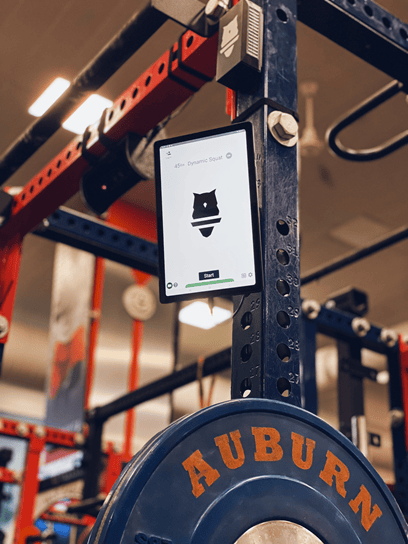
Image courtesy of Perch.
Computer vision cameras are attached, or “perched,” on top of the weight equipment, and through the machine learning and AI, can recognize and calculate the number of reps while charting the corresponding speeds of each lift. The analytics then emerge in real-time, and players can see their body outputs on a small screen or, in Georgia’s case, on the DawgTron.
MLB teams such as the Phillies leaned on it last season because, over the course of 162 games and cross-country travel, the team’s strength coaches were concerned about both muscle atrophy and exhaustion. To balance that properly — lifting without overexerting — the team leaned on Perch’s metrics.
“They wanted [Phillies] players to maintain strength or even get stronger and do that safely while in-season,” Rothman says. “So I think one of our huge benefits for baseball is managing fatigue.”
Other endurance-conscious teams such as the NBA’s Miami Heat and Orlando Magic and the MLS’s L.A. Galaxy and San Jose Earthquakes are also clients for similar reasons. But football players are still Perch’s most prominent use case. And as the season was starting last September, the company closed what Rothman called a “$4 million Seed Plus” round to help them hire a larger staff to keep up with demand.
For instance, NCAA schools such as Wake Forest, Maryland, Virginia, Duke, North Carolina, Boston College, West Virginia and Stanford have all gone public with their Perch usage, while NFL teams such as the Chargers, Patriots, Jaguars, Dolphins and Titans are also on board. Rothman hopes that perhaps the Philadelphia Eagles, Georgia’s football subsidiary, can end up joining next.
With one caveat, though. DawgTron is sold separately.
This article was brought to you by SBJ Tech, a Leaders Group company. As a Leaders Performance Institute member, you are able to enjoy exclusive access to SBJ Tech content in the field of athletic performance.
Leaders Performance Advisor Rachel Vickery explored breathwork and ‘default breathing’ in the third and final session of her Performance Support Series.
A Human Performance article brought you by our Main Partners

Part one, which looked at better understanding athletes’ physiological responses under pressure, is available here.
Part two explored how you can train your athletes’ physiological responses to pressure and can be found here.
We moved into the third and final session where the focus shifted to thinking around:
Relationship between breathing & performance
Before exploring some specific elements around how effective breathing can help to control arousal state and support performance, do we actually understand how pressure can influence breathing and vice versa?
In high pressure environments, inevitably we will see changes in breathing mechanics. If we want to be intentional and strategic in setting teams, organisations and ourselves up to be able to execute really well under pressure, efficient breathing is a powerful tool to support the control of operating state and to optimise physical, mental and emotional performance under pressure.
We need to avoid situations where things fall apart and then try to fix the problem – we will talk about the importance of front loading below, but to witness positive developments in this space, it takes time to become effective and second nature. We are seeking to keep our arousal state below the threshold for performance where you can perform well and in your sweet spot, as opposed to ‘crossing the red line’ where performance starts to fall apart. Approaches to breathing and other physiological support mechanisms can help to calm the nervous system for a more sustained approach to performance.
A really critical piece that’s often missing for teams and for individuals, is that we don’t get the chance to work with the arousal state in an environment that is not actually the performance arena whenever – whenever it is practised, there tends to be other things to be thinking about.
Importance of ‘front load buffer’
Throughout this series, we have reinforced the notion that performance under pressure is less to do with what you do in the moment of pressure. The concept of ‘front loading’ is something Rachel has woven throughout the sessions – it’s something she believes is a key determinant in controlling the pressure that will inevitably occur around competition time.
When we consider ‘front loading’, we are talking about the techniques and tools that can be used before a game or away from competition. Around ‘go time’ there is always going to be an increase in arousal state, driven by uncertainty, the unknown, high consequence, responsibility of outcome, being outside of the comfort zone and, even from a physiological perspective, the respiratory response to exertion.
A technique that can have a real positive impact is the ‘Theory of Fours’ breathing technique. This is a technique lasting four minutes, and includes breathing in for four seconds and out for six seconds across the four-minute period. There is strong evidence behind the science around its ability to bring the heartrate down. In high performance environments, it can be a useful practice to be used in the locker room both before and even after a game to reduce arousal. It’s also important to understand that the biomechanics of performance can be supported through effective breathing – there are more performance factors to be impacted than just heartrate control.
Front loading and giving yourself ‘buffer’ techniques can also help to manage arousal state in other instances, for example managing difficult conversations or other interactions away from the field. In the moment, if you are breathing calmly, your shoulders will relax, tone of voice lowers and the body doesn’t give a signal of stress. If you are able to do this, the other person you are interacting with doesn’t perceive the interaction as a threat and the communication is going to stay calmer and a lot more open. If you are carrying a lot of stress, you can carry it into a conversation with someone else.
Distinguishing breathwork & default breathing
Breathing isn’t just a key part of controlling arousal state, but it plays a significant role in optimising the physical and biomechanical aspects of performance, alongside mental and emotional performance under pressure. When it comes to breathing, there are two types to consider: breathwork and default or automatic breathing.
Breathwork in Rachel’s words is the ‘vitamins’, helping to give you a boost to more effective breathing. Default or automatic breathing is the ‘nutrition’, day-to-day breathing which is going to have the most impact in terms of optimisation – ‘if you have good nutrition, the vitamins can give you an additional edge’. There are huge performance gains through optimising breathing, which is different from breathwork.
If you have an athlete or are an inefficient breather yourself, you can miss out on the three factors below:
The final point in this section is the potential parasympathetic backlash that can occur for people operating in high pressure environments consistently. This is more commonly known as burnout. This is a downside of high performers who are typically very emotionally, mentally, physically, and virtually resilient. They can keep pushing a long way down the road before their physiology finally goes. Effective breathing, starting with default and topped up through breathwork, has been shown to help control the possible parasympathetic backlash that can occur.
Getting the basics right: what are the non-negotiables?
We have discussed the effectiveness of breathing techniques in helping to control responses to stress and pressure. There are a number of other factors that are important to get right to optimise human performance – they are the basics and non-negotiables which need to be focused on consistently. If we have these foundations well squared away, we can operate in a calmer nervous system state.
How can we de-escalate arousal states intentionally?
Rachel encouraged the group on the call to think about the importance of consistent de-escalating, especially in sports where there are repeat events, which is most. If we don’t strategically de-escalate between each game or aspect of the game, the arousal state will continue to creep up. This is where we can begin to see more mistakes occur. We can also do this for post-game to bring the arousal state down.
What are some of the things you can consider or implement to support this process:
De-escalate, don’t distract / escape.
All MLS first team clubs, as well as MLS Next Pro and MLS Next teams, will have access to the platform to scout players who can upload videos and metrics to the app for free.
A Data & Innovation article brought to you by
“That’s why we think this technology is so powerful because all you need is this [smartphone],” MLS SVP Emerging Ventures Chris Schlosser said, “and suddenly, you can be scouted anywhere at zero cost. You can go do drills in your backyard or your driveway or local park, and that would allow you to get on MLS’s radar.”
MLS and ai.io will begin collecting data this fall to create appropriate benchmarks for evaluating players at various levels before all players gain access to aiScout in January 2024. The aiScout app uses Intel’s 3D Athlete Tracking computer vision technology and assess users’ physical and technical skills. Premier League clubs Chelsea and Burnley, which recently clinched a return to the top tier next season, are both R&D partners.
Fred Lipka, the Technical Director at MLS Next, helped champion the use of technology to eliminate the barriers of cost and geography from talent identification.
“Players’ pathways, as they journey through youth sport, is not necessarily soccer first,” Richard Felton-Thomas, aiScout’s COO and Director of Sport Science, said of the US. “And they didn’t just want to be an organization that’s picking up talent because they haven’t made it somewhere else. They want it to be at the forefront of talent identification, and he very early saw that the way to do this is to be able to make sure we can look at everybody in the country simultaneously and fairly.”
The founding story of ai.io originates from the experience of Founder Darren Peries and his son who, after being released from Tottenham’s academy, had no digital CV — data or video — to share with scouts of other clubs. And that was the case for a promising player who had been competing under the purview of a top-flight club. Many multiples more youth had even less access to the typical sporting infrastructure.
Perhaps the best case study of aiScout’s efficacy is its use by another early client, the Reliance Foundation Young Champs, a leading academy in India. During the pandemic when its scouts were unable to travel, RFYC used aiScout to evaluate 12-year-old players. AiScout was used to whittle down the number of candidates for a tryout — and led to the academy inviting four players from rural areas who weren’t even playing organized soccer at the time and thus never would have been on the radar.
“The nature of talent development can be a bit random,” Ben Smith, formerly Chelsea Football Club’s Head of Research and Innovation, told SBJ last summer before joining BreakAway Data full-time. “So if we can have a technology to work at scale across vast areas, then that our scope and our reach is potentially very substantial.”
MLS clubs will be able to search for talent globally, but the primary goal is to consider continental talent, given some of the regulations around homegrown players and international visas.
The aiScout app was part of FIFA’s innovation program and underwent validation testing at Loughborough University, London and Kingston University. A revamped version of the app was released last year to include more gamification and more content geared toward player development, as opposed to just evaluation.
“We wanted to prove that we were a trusted tool first with the clubs,” Felton-Thomas said. “What the new app does is it brings in more of those elements that players get to see, ‘OK, how do I get better if I’m not good enough today?’ We’ve got a bit more player focus to that journey of development, not just trialing.”
The aiScout app will be the focal point, especially early in the partnership, but the company also maintains mobile sport science centers, aiLabs, that has additional evaluative tools for biomechanics and cognitive function.
As the partnership progresses, each MLS club will be able to customize their use to include additional tests, datapoints and benchmarks that are bespoke to their needs. Schlosser said, to his knowledge, none of the league’s clubs have harnessed computer vision at the amateur level before, but he said they are eager to get started.
“The system is up and running in the UK,” he said. “They’ve done some trials with a couple of UK-based teams, so we have some confidence that this isn’t just fly-by-night stuff. This is real. And we’re excited to roll up our sleeves and then roll this out across the country. We think there are many, many kids that we haven’t seen yet.”
This article was brought to you by SBJ Tech, a Leaders Group company. As a Leaders Performance Institute member, you are able to enjoy exclusive access to SBJ Tech content in the field of athletic performance.