Leaders in Business
  • Membership
  • Events
  • Content
  • Virtual Learning
  • Connections
  • Partners
Login
  • Leaders Meet: Innovation
  • Events
    • Leaders Week London
    • Leaders Sports Awards
    • Leaders Club Events
    • Leaders Performance Institute Events
    • Leaders Meet: Innovation
  • Memberships
    • The Leaders Club
    • Leaders Performance Institute
  • About
    • Careers
    • Contact
I’m a sports leader:
  • Off The Field For those focused on the business of the sport View more
  • On The Field For those working with an athlete or elite team View more
  • Login
    • Leaders ClubThe membership for future sport business leaders
    • Leaders Performance InstituteThe membership for elite performance practitioners
  • Newsletters
Performance Institute Leaders Performance Institute Logo
  • Membership
  • Events
  • Content
  • Virtual Learning
  • Connections
  • Partners
Login

8 Jun 2023

Podcasts

The People Behind the Tech Podcast: Keke Lyles – Uplift Labs

Category
Data & Innovation
Share
Facebook Twitter Email Copy Link
https://leadersinsport.com/performance-institute/podcasts/the-people-behind-the-tech-podcast-keke-lyles-uplift-labs/

The man who helped save Steph Curry’s ankle explains that there are times when athletes can train their movement patterns in the name of performance.

A Data & Innovation podcast brought to you in collaboration with

sport techie

Not a member and want more content like this? Speak to our team.
“With technology now, we’re starting to understand movement in a way that we didn’t really understand before,” Keke Lyles tells Joe Lemire and John Portch.

The Director of Performance at Uplift Labs was on the pod to discuss how the company’s AI can reduce injury risk in athletes.

There is no better candidate to delve into injury prevention and mitigation than the man often credited with saving Steph Curry’s ankle.

We made a whistlestop tour of his work at the Minnesota Timberwolves, Atlanta Hawks and, of course, the Golden State Warriors.

Also on the agenda were:

  • How the stress of a season can affect movement quality, tissue quality, and range of motion [14:00];
  • The often misunderstood elements of load management [17:00];
  • Keke’s jump from the world of sport into the tech space [31:20];
  • Why he believes the next performance frontier will be in player development [34:30].

Joe Lemire Twitter | LinkedIn

John Portch Twitter | LinkedIn

Listen above and subscribe today on iTunes, Spotify, Stitcher and Overcast, or your chosen podcast platform.

Members Only

2 Jun 2023

Articles

How Full Swing Helped Turn Masters Champion Jon Rahm’s Minor Weaknesses into Strengths

Category
Data & Innovation, Premium
Share
Facebook Twitter Email Copy Link
https://leadersinsport.com/performance-institute/articles/how-full-swing-helped-turn-masters-champion-jon-rahms-minor-weaknesses-into-strengths/

The company’s Virtual Greens demonstrate that golfers not only win majors with the clubs in their bag, but with actuator modules, infrared line scan cameras and proprietary apps.

Main image courtesy of Full Swing

A Data & Innovation article brought to you by

sport techie
By Tom Friend
Jon Rahm may have won the Masters weeks and months ahead of time… in his basement.

Leading up to his four-stroke victory in Augusta in April, Rahm relied on a trio of tech-savvy products from Full Swing that helped turn his borderline weaknesses into strengths. It only goes to show that golfers not only win majors with the clubs in their bag, but with actuator modules, infrared line scan cameras and proprietary apps.

“I had been looking into the best way to practice all aspects of my game at home,” Rahm has said of his decision to install Full Swing’s devices, and, as a result, his sprawling home in Arizona is now one of the epicenters of golf.

In one corner of his house sits an approximate 4-by-8 sliver of sophisticated turf that is actually a high-tech “Virtual Green” simulating the quick 12 to 14 breaks of Augusta National. Immersed with dozens of actuator modules — which move to recreate downhill, uphill, right breaks, left breaks, crests, valleys and hills — the interactive putting green enabled Rahm to zero in on one of his main concerns heading into the Masters.

“Jon just wanted to work on little short left or righters,” Ryan Dotters, CEO of Full Swing, told SBJ. “Because that’s what he kind of struggled with in the past. So we put a smaller Virtual Green in for him. He wanted a nice little square one.

“That’s just what he wanted to focus on to get better: these four to five foot putts that are left or right breakers. And we got [the Virtual Green] down to where it’s super fast, it’s Augusta fast in there…We got that one to the 14 [break] that he needed for the Masters.”

Other adaptive putting greens on the market can tilt left and right or forward and back. But none are said to have Full Swing’s patented actuator modules that can simulate any break on any course in the world with the click of a button. The Virtual Greens, which vary in size and are priced between $70,900 and $95,400, are equipped with an accompanying computer, whose software can replicate subtle, moderate or severe breaks on request.

Only about 400 of them have been on the market so far — “It’s expensive to make, expensive to ship, expensive to install,” Dotters said —but Rahm, Tiger Woods and Jason Day actually own three of those 400 — and have all become Full Swing ambassadors. Woods, in fact, has equity in the company.

In another corner of Rahm’s basement is what had Woods originally buying in: the Full Swing simulator. The company, in fact, was birthed circa 2019 with simulators in mind, and early iterations that included highspeed ION3 cameras drew the interest of Rahm’s tech-centric coach Dave Phillips.

As co-founder of the Titleist Performance Institute in Oceanside, Calif., Phillips began offering his insights to Dotters and the company’s engineers on how to advance their Full Swing simulator further. At around the same time, Rahm was living in his home overlooking an Arizona golf course, baking through 110-degree practice rounds. Looking for a cooler, indoor solution, Phillips steered Rahm to the Full Swing simulator, as it continued ideating the latest technology.

Then, last September, the company released its Pro model simulator that leveraged infrared line scan cameras to create virtually a latency-free experience. The overhead ION3 camera tracks the golf ball on impact, and as the ball crosses the infrared line, it triggers the computer to instantly mimic the shot — producing ball speed, launch direction, launch angle and a visual of the ball flight in real time.

Other simulators generally do not have the ability to track a ball without delay because the devices first calculate ball flight, then rotate the screen to where the ball should land and then provide an image. The difference in elapsed time may seem minor, but to a pro like Rahm the Full Swing Pro was a breath of fresh air…less than 110 degrees.

As a result, he was able to replicate Amen Corner at Augusta over and over to prepare for the Masters, and when the weather was amenable, he’d then retreat outside to train with Full Swing’s third and most recent innovation, the KIT Launch Monitor.

Released originally in December of 2021 with incremental input from Woods, the KIT Launch Monitor — placed in close proximity behind the golfer — used a dual radar system to track a ball from impact-to-landing-to-roll while also identifying the dimple dispersion off the front face of the ball along with rotation and seam. The litany of metrics included spin rate, spin axis, ball speed, attack angle and more. But the statistic Rahm most cared about was: carry.

Dotters asked Rahm questions such as: “How can we make these better? What does the interface look like? What’s the app looking like?” Rahm provided feedback, and a new, improved version. “[It was] a 3-to-4-year project that took a lot of testing and a lot of capital to get right,” Dotters says. It was delivered to Rahm months before the Masters.

“The screen was a big one for Jon,” Dotters says. “He wanted to just turn around look and see what the numbers were. But it really came down to carry numbers for him. He needed those to be exact. And we’ve done a really good job of being pinpoint accurate with carry. Whether it’s 350 with a driver or 60 yards with a wedge, carry is just Jon’s biggest metric.

“Sometimes he doesn’t need to hit it 320, he needs to back it down. So he needs to know those carry numbers and we’ve learned we are really good at this. So I think what I can relay —through his conversations with me and his testing — is that it gave him a leg up at the Masters.”

And a certain green jacket.

This article was brought to you by SBJ Tech, a Leaders Group company. As a Leaders Performance Institute member, you are able to enjoy exclusive access to SBJ Tech content in the field of athletic performance.

31 May 2023

Articles

MLS NEXT: the Program’s First Steps Towards Successfully Tapping into North America’s Considerable Soccer Talent Pool

Category
Coaching & Development
Share
Facebook Twitter Email Copy Link
https://leadersinsport.com/performance-institute/articles/mls-next-the-first-steps-towards-tapping-into-north-americas-considerable-soccer-talent-pool/

Justin Bokmeyer, MLS NEXT’s first GM, is the person tasked with developing the region’s talent identification and development programs.

By John Portch
Justin Bokmeyer was announced as the first General Manager of MLS NEXT in February.

The New York-based MLS NEXT was founded in 2020 as a youth soccer league in the United States and Canada with a view to establishing itself as the premier talent identification and development program in North American soccer.

It is well on the way to achieving that aim. In a little over three years, MLS NEXT has grown to consist of 137 clubs, 628 teams and more than 13,500 players.

Bokmeyer was seen as the ideal candidate for the GM position following his sterling work at the NBA where as the Head of Strategic Initiatives he helped to found the Basketball Africa League. Earlier in his career, he also served as the Director of Lacrosse Operations at the United States Military Academy at West Point for two years and spent 11 years on active duty in the US Army.

The Leaders Performance Institute asks Bokmeyer if he was attracted to MLS NEXT because, much like the Basketball Africa League, it is a new venture.

“Absolutely,” he replies. “In my military career and in working in the NBA, I was working in new things and got to build them from scratch.” He cites examples from the athletic department at West Point, where he helped to establish programs, as well as the numerous NBA academies set up on his watch. “That was one of the exciting things about me taking this MLS NEXT role. I don’t know if I can jump into something that’s set for 20 or 30 years. That’s a very different mindset and a very different leadership skill.”

MLS NEXT’s aim is to provide the requisite coaching contact and a unified approach akin to the English Premier League’s Elite Player Performance Plan that taps into the region’s large talent pool.

Here, the Leaders Performance Institute outlines Bokmeyer’s first steps.

Year one, hands-on

Bokmeyer explains that he feels he needs to be heavily involved in his first year as GM. “I’m very hands-on this year but then, leading into next season, people should feel very empowered,” he says. “They’ll know our culture, the standards, our norms. They’ll know which decisions they can make.” There are, at present, ten people on his staff who share responsibilities for operating and executing the program, player engagement and experience, and commercial opportunities.

Bokmeyer has ensured that roles and responsibilities are clearly defined across the team. “It’s the focus on how we work,” he continues. “It’s being very deliberate in the platforms we use, how we communicate, when we meet, what decisions need to come to me, being very deliberate in how we work.”

MLS NEXT has made inroads but brought onboard its first GM because the league understands there is still a ways to go. “One of the things that I pride myself on is being able to piece things together; really diving into how we make those decisions and what the long-term effects are. Are we solving the problem we need to solve? The ability to think through second and third order effects is one that I pride myself on, making sure that we stay focused on what we’re trying to solve for.”

Development tools

Bokmeyer has introduced a series of tools to support his staff’s development. “We held a staff meeting on the theme of decision making and so we introduced the idea to them around a decision journal and why that’s important for different decisions,” he says.

He also introduced the Questions & Empathy card deck to his team. It is a 56-card companion to Michael Ventura’s book Applied Empathy. “Seeking clearer understanding or deeper connections?” asks the Questions & Empathy website, “Let these cards guide your conversation and exploration.” The deck is: “designed to help inspire empathic exchanges among individuals, teams, and communities alike.”

Says Bokmeyer: “How do you have deeper conversations and get to know people so you develop that trust quicker? You really speed up that learning; and so I use those questions and empathy decks often within our group to open up conversation.”

The work of Daniel Coyle, author of the Talent Code and Culture Code, has proven useful too, with some tools freely available on his website.

‘What keeps you up at night?’

Bokmeyer and his staff will endeavour to visit each of MLS NEXT’s 137 clubs at suitable moments. “I’ve told my team several times that we cannot lead and be actual leaders from the New York office,” he says. “We have to be out to see the environments and talking to people. We’re in this initiative now over the next couple of months visiting all parts of the country, seeing the clubs, MLS clubs, non-MLS academies, anybody and everybody, getting out there, talking to them, and meeting them in their environment and not over Zoom. That lowers the defences, it creates more trust, and so we’re absolutely committed to getting out there.”

He runs through his itinerary at the time of our interview. “We’re going to hit the four clubs in San Diego next week; a couple of weeks ago I was at a site visit in south Florida for an event and visited the local clubs, five clubs in Miami, to make sure that I attend matches, training and see their facilities. Really trying to understand it is critical. You lose so much if we say we’re going to make these policies from the New York office.”

What is the first thing he asks those stakeholders? “What keeps them up at night?” he says. “That’s the biggest thing. Absolutely understanding that. Everybody we’re visiting, they’ve got to play the long game and we’re requiring them to play the long game and focus on that while they have to produce short-term results. And I know that they have families – their jobs and livelihood depend on that. So trying to balance that. Understanding what keeps them up at night is critical, whether that’s they don’t have enough players, their talent ID process is wrong, who they’re hiring, anything like that, we want to know. Then really focusing on what we can do to improve.

“Tell us your recommendations, competition schedule, talent ID, roster numbers, any of that. We’ve got this blank slate. ‘Tell us, if you were in our role, what would you do? What would you be looking at?’ That really brings out some good insights across the board from all these clubs.”

The role of college soccer

Bokmeyer believes that young players growing up in North America may have a unique opportunity to sample different sports to a competitive level. “I think the benefits of being exposed to a lot of different sports in the United States and Canada can provide a unique athletic skillset that other countries may not have,” he says.

Tapping into the large talent pool remains the primary goal. “How can we access that talent pool better? We’ve got some things in the works with technology and AI, but we want to be able to canvass the entirety of North America and find the players that could be hidden in different parts of the country.”

He also feels that the unique North American college system can complement MLS NEXT’s goals. “We know that 90% of our players won’t go pro pathway right away,” he adds. “Everyone is looking to go to college unless you’re going pro, so we have to ensure that the right conversations are happening, that the players are deciding what’s best for them and their development and not pushing them either way.

“We still see the college pathway as being a unique ecosystem for late developers or bloomers. If you look at Matt Turner, who played university college soccer in the US and now look at him playing in the Premier League with Arsenal. He’s one of those guys. We had 19 players who played at NEXT, went to college, and then were drafted in the MLS SuperDraft this past year. So there is still a viable pathway for NEXT players to go to college and then get drafted at some point during their college career and still get that chance.”

What’s next?

The research on athlete maturation by Sean Cumming at the University of Bath is of considerable interest to Bokmeyer, as is biomechanics, but, beyond specific physical markers, his immediate interest is to stimulate MLS NEXT’s development.

“We’re very clear on what we want to accomplish, we know how we’re going to do that, and we’ve got the things in place to do it and we’ve got the right clubs in place as well,” he says. “That’s through our standards and governance, that’s through clear communication and trust between the league and member clubs. And what it looks like is absolutely athlete-centred, and that’s putting player’s rights, whether it’s their data, first and foremost. We want to be aligned in our behaviours and in what we do – and we won’t have to be talking about that because it’ll just be known that we are athlete-centred. They’ll see that it’ll just be part of the behaviour and culture that we’ve set.”

Members Only

30 May 2023

Articles

Does your Data Help you to Adapt and Avoid Biases?

Category
Coaching & Development, Data & Innovation, Premium
Share
Facebook Twitter Email Copy Link
https://leadersinsport.com/performance-institute/articles/does-your-data-help-you-to-adapt-and-avoid-biases/

Scott Hann, the Head Coach of Olympic champion Max Whitlock explains his relationship with data and where it supports and challenges him as a coach.

By John Portch
“Leading into Rio, I could have counted on one hand the amount of mistakes that Max made on the pommel,” says Scott Hann, the Head Coach of three-time Olympic champion Max Whitlock.

“However, leading into Tokyo, I could have counted on one hand the amount of clean routines Max did. They were polar opposites.”

Hann is smiling as he tells this tale to the Leaders Performance Institute, because both Games proved to be a success for Whitlock.

In 2016, in Rio, he claimed gold in both the floor exercise and the pommel horse, while also earning a bronze in the men’s all-around event. Five years later, in Tokyo, Whitlock retained his gold on the pommel horse.

Those four medals go alongside the two bronzes Whitlock won in the team and pommel horse at the London 2012 Games.

Whitlock has been on the senior men’s scene for more than a decade and recently stated his desire to compete at the Paris 2024 Olympics – a decision Hann discussed during his recent appearance on the Leaders Performance Podcast – and that journey has seen him develop from a talented youth to a seasoned champion.

Whitlock’s body and mind have developed with each Olympic cycle.

“I have to do things completely different with Max,” says Hann, building on his earlier point. “And I have to accept that the small successes on the way are going to be different.”

The contrast between Whitlock’s preparations for the 2016 and the delayed 2020 Games were almost besides the point. Hann adds: “I had to have the confidence in that programme, even though there were struggles and adaptions, I had to have the confidence that what we were doing was right because that gave Max the confidence to trust the process.”

The Leaders Performance Institute has asked Hann about his relationship with data; how he uses it and any preferences he has as a head coach.

Says Hann: “There’s two sets of data that I think about: what repetitions need to be done to perform for a competition or to achieve a skill and, of course, the data that you gain from competitions in terms of scorings, deductions etc.

“Over the years, you do multiple preparations before a competition so you get a guide of what numbers you need to be doing; but you need to be able to adapt at every single different preparation because there might be a small injury, there might be different level gymnasts, you might have an older gymnast now.”

Video analysis is a regular feature of Hann and Whitlock’s training routine thanks to British Gymnastics’ relationship with the UK Sports Institute. “We’re doing that all the time, but you don’t realise you’re doing it because it’s usually on your mobile phones,” says Hann. “They’re so advanced these days. But we do have a great analyst at British Gymnastics so that when we can access her data it’s really useful and she’ll pull together all of the different scores and all the different starter scores so that we can take that and pitch where we want the routines to be at and it helps you develop and choose a team as well, if you’ve got all that data.”

Gymnastics is a discipline where Hann’s coaching intuition necessarily comes to the fore. “Once you’ve got your fundamentals in place, you adapt along the way using your coaching intuition and those small nuances of what you see because it’s not a timed sport. It’s not running, it’s not a strength sport, it is so intricate, with so many little details.

“If you think about it, on the men’s side of the programme, you’ve got six different apparatuses, six different events, and in an event, in a routine you do ten different skills, but to develop that, each skill you could have ten different techniques depending on ten different body shapes of athlete to learn that skill.

“Then you’ve got the strength & conditioning, the physical preparation, the mental preparation, the flexibility, all of those things that go into preparing all of those different skills, and then you’ve got to practise them individually, in combinations, and in routines to build that robustness and that physical preparedness to be able to do a full routine.

“Then, of course, you’ve got to do the numbers of a full routine to make sure that they’re prepared. There’s so many things that go into preparing an athlete that you can’t just have a bit of data that tells you how to do it. You should have a guideline of what works and then build on that.”

In Hann’s case, he uses all available sources of information to inform his judgments and overcome his inherent biases.

“In terms of the data from the competition, it’s important to look at where those deductions are because sometimes as a coach you do look at things through rose-tinted spectacles,” he says. “I’ve been guilty of that lots of times. ‘Where on earth did you get those deductions from?’.”

In the pommel horse, routines are scored by two judging panels. One begins with a score of zero and adds points for requirements, difficulty and connections. The second panel has a score starting at 10.0 and subsequently deducts points for errors. The difficulty and execution scores are then combined for a gymnast’s overall score.

“It’s important that you understand those deductions because you have to bring that into your training and make those small changes along the way. So the more data you get from that, the better.”

Injury prevention is another area of intense focus for Hann and British Gymnastics. “I haven’t had to do this with Max – touch wood – but identifying where common injuries occur and look at data to help avoid or mitigate those potential injuries. At British Gymnastics at the moment, they’re doing a lot of work on loading and trying to come with policies and guidelines to make sure that we’re avoiding or at least doing as much as we can to avoid any potential overload or over-use injuries. Acute injuries are going to happen, that’s the nature of the sport, but any over-use injuries so that we can get the athletes to have longevity in the sport, a healthy exit of the sport when they’re ready, so they’re not being held together at the end of it and, of course, a lot of that will link into their mental health. If their body feels good then they’re going to feel good.”

The Leaders Performance Institute asks how, for example, Hann will discuss data with a strength & conditioning coach. “Again, because gymnastics isn’t doing something specific like running where a strength & conditioning coach is almost part of the front, lead coaching team, it’s almost about building a robust muscle core to help protect the body as it goes through the specifics of gymnastics. So it’s helping the strength & conditioning coach understand what those specifics are so that they can design their programmes to make sure that the gymnast is robust and safe in their training.

“That’s where that communication between everyone is key. Because they can also bring advice to you and if you’re open and able to take that advice onboard, you can reflect actually you can find new ways of doing things, but that’s the future, right?”

Listen below to the full conversation with Scott Hann:

Members Only

26 May 2023

Articles

The Insole that Could Benefit 85% of the Athlete Population

Category
Data & Innovation, Premium
Share
Facebook Twitter Email Copy Link
https://leadersinsport.com/performance-institute/articles/the-insole-that-could-benefit-85-of-the-athlete-population/

Move Insoles have been developed by pedorthists who rely on video-motion and automated gait analytics to optimize orthotics for NBA players.

A Data & Innovation article brought to you by

sport techie
By Tom Friend
A fresh-faced teenager asked Brandon Ingram for his game shoes one night in March, and the New Orleans Pelicans forward answered: “Yes, but…”

Yes, the kid could have his sneakers. But… he couldn’t have the Move Insoles that were biomechanically designed based on 120,000 foot scans and tedious algorithms for stellar arch support and injury prevention.

So Ingram calmly slipped out the insoles, signed the sneakers, handed them over, received a gracious thank you and found out later the NBA had posted the whole scene on Instagram.

The video went somewhat viral, leading to this random comment underneath: “why do players take out the sole in the shoes then give them away….help me understand.”

Answer: footwear technology.

Move Insoles are an emerging product developed by credentialed pedorthists who rely on video-motion and automated gait analytics to democratize orthotics for NBA players — not to mention the general public — so they don’t have to wear more-restrictive custom inserts.
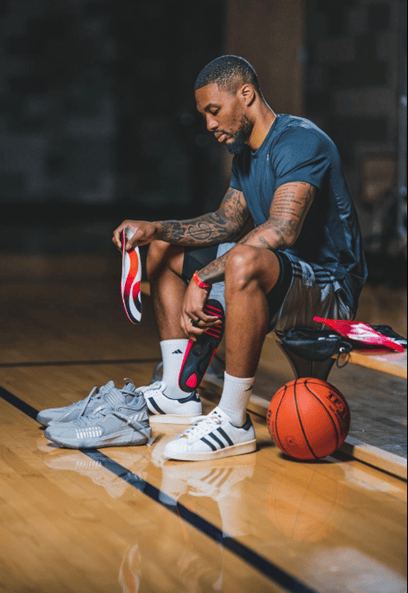
Image courtesy of Moves Insoles.

Roughly a dozen NBA teams have already acquired the insoles in bulk for their respective rosters — the Pelicans purportedly being one — but the company’s Co-Founder and Co-CEO Nate Jones wasn’t sure players such as Ingram had actually adopted the product until the video of the giveaway.

“It was an illuminating moment for us,” Jones said, who brainstormed the business after dealing with his own plantar fasciitis. “We’ve seen players pull out custom orthotics before. But for a player to hold onto our $60 insole — which is not prohibitively expensive for them, they can always order more — because they’ve broken in a pair and want to carry them on to the next game, that was a great story for us.”

Before launching the company, Jones’s goal was to produce an over-the-counter insole for younger, active athletes that was based on data and podiatry science. “I mean, you wouldn’t ever see Dr Scholls in an NBA locker room,” he says. As a long-time sports marketer working under the prominent NBA agent Aaron Goodwin, he fortuitously had access to league players and league intel — and found out which company was doing proprietary foot scans for NBA teams.

That firm was Miami-based Footcare Express, which had performed 120,000 foot scans to create an algorithm for a universal insole that would benefit about 85% of the athletic population.

Leveraging Footcare Express’ video and gait analysis and the company Mat Market’s original equipment manufacturing, Jones recruited former Director of Nike Innovation Aaron Cooper to help with the final design and implementation.

“This is 100% based on the data,” Jones says. “If you have a flatter foot, this will bring your feet into a better position. Basically, there are all kinds of biomechanical issues that could potentially get your feet off kilter: if you’ve got a flatter foot or some other potential issue. Our insoles help aid against those potential issues.”

It also helped that Jones had the perfect person to trial the insoles with: Portland Trail Blazers all-star guard Damian Lillard.

Lillard had broken his foot as a collegiate player at Weber State and had dealt with nagging plantar fasciitis during his fourth season in the NBA. Hyper-sensitive about footcare, Lillard — an Aaron Goodwin client — agreed to wear the Move Insoles during the Tokyo Olympics, which took place in 2021. He left with a gold medal and healthy feet.

Lillard invested in the product, as did fellow NBA All-Star Chris Paul, and the common refrain from both was that Move Insoles’ $60 over the counter Gameday Pro product gave them enough arch support without sacrificing “the feel” of the court.

This article was brought to you by SBJ Tech, a Leaders Group company. As a Leaders Performance Institute member, you are able to enjoy exclusive access to SBJ Tech content in the field of athletic performance.

Members Only

19 May 2023

Articles

‘There Will Be an AI or Machine Learning Assistant Coach on the Bench Within Three to Five Years’

Category
Data & Innovation, Premium
Share
Facebook Twitter Email Copy Link
https://leadersinsport.com/performance-institute/articles/there-will-be-an-ai-or-machine-learning-assistant-coach-on-the-bench-within-three-to-five-years/

Swansea City Head of Performance Thomas Barnden believes that true innovation will blend AI and human input.

A Data & Innovation article brought to you by

sport techie
By Joe Lemire
As Head of Performance at Swansea City AFC, Thomas Barnden has a wide remit that includes oversight over physical performance, sports science, sports medicine, nutrition and psychology. His works touches everything from player health to talent development and match day analysis.

Barnden arrived in June 2022 with a pedigree of analytics through his time at forward-thinking clubs like Brighton, where he spent seven years, and Manchester City, where he led an academy program. He’s well-versed in the latest innovations in soccer. Swansea, for instance, has added partners such as infrared recovery apparel marker KYMIRA, blood-flow restriction wearable Hytro, a HydroWorx training pool, cryotherapy and many standard devices such as GPS trackers.

From this perch, the biggest tidal wave coming in sports, Barnden believes, is the proliferation of artificial intelligence and machine learning. It’s already a big part of player recruitment, he noted in a recent interview, and growing toward improved recommendations for training programs.

“I think we do the prediction bit quite well, but I think the future is the prescription,” Barnden said, before he continued with his boldest projection.

“The way I see it is that there will be an assistant coach — an AI or machine learning assistant coach — on the bench within three to five years,” he added. “And I know that might sound mental, but I truly believe that we could see a position like that an assistant virtual coach or an automated assistant coach on the bench. What that looks like physically, I’m not 100% sure, but it would have a capacity to communicate tactical strategies, technical strategies, recommendation of substitutes.

“I know that sounds a little bit far-fetched, but I truly believe that is kind of the way it’s going. I’m not going to say that human behavior and human connection is going to be lost because that won’t happen. But I think there’s going to be a definite need for this integration of human and AI working together. I don’t think that the human will ever be replaced. That’s not the point. It’s for the integration of human and AI to work together.”
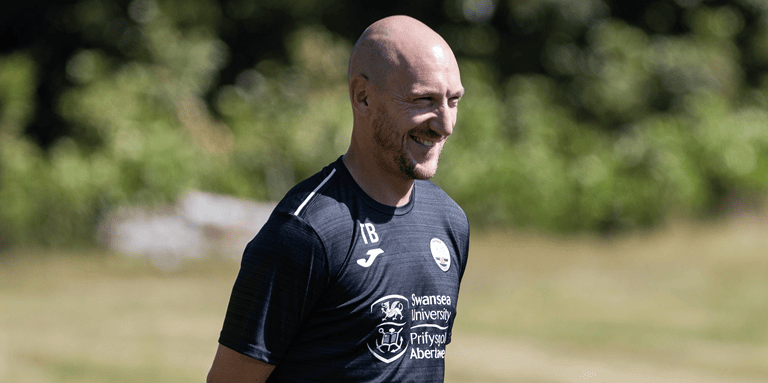
Swansea City Head of Performance Thomas Barnden is well-versed in the latest innovations in soccer and utilizes tools from KYMIRA and Hytro for the club’s recovery. Image: Swansea City

Generative AI solutions, such as ChatGPT, have phenomenal potential, Barnden added, while noting that there “are still some limitations with it.” What becomes crucial with the influx of all this data is making sure it is understood and used by all relevant parties.

“In many organizations, there remains a consistent disconnect between the data scientist and the executive decision makers they support,” Barnden said. “There’s a significant, what I would call, ‘interpretation gap’ in a lot of clubs. Where my role comes into the forefront is being this data translator. So it’s having effective interpersonal skills, and an ability to story tell the narrative of the message to the right people.”

One area that Swansea City — competing in the second-tier Championship this season — has emphasized is mitigating travel fatigue and promoting readiness. Swansea is a port town in Wales whose opponents are primarily in England. By one accounting, the club must travel the most miles (4,965 miles) this year, about 400 more than anyone else.
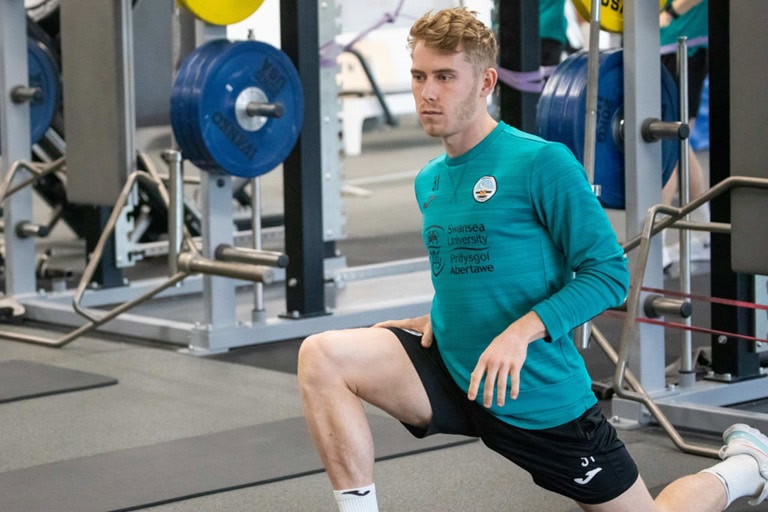
Sleep and nutrition are the two cornerstones for recovery at Swansea, adding in the specialized components like compression or cryotherapy to round out the recovery, Barnden tells SBJ Tech. Image: Athena Pictures/Getty Images.

Most recently, Swansea partnered with KYMIRA, which makes compression apparel infused with Celliant materials that turn body heat into infrared energy that is said to increase local circulation and cellular oxygenation. Such physiological change can boost recovery and improve sleep and performance.

While objective assessment of its impact is challenging — there are numerous confounding variables — but Barnden said the athletes have regularly been wearing the compression leggings and socks when traveling, as well as at other times for recovery. The team has reported positive subjective feedback. And the club is playing at a high level late in the season, having won four and drawn once in its last five matches.

“The two cornerstones that we use at Swansea really for recovery are sleep and nutrition,” Barnden said. “You add the little bits around it like the blood flow, the compression garments, the hydroworks or the cryotherapy — the active recovery part. They all add the whole package to promote recovery and regeneration.”

This article was brought to you by SBJ Tech, a Leaders Group company. As a Leaders Performance Institute member, you are able to enjoy exclusive access to SBJ Tech content in the field of athletic performance.

18 May 2023

Podcasts

Performance Perspectives: Coach Wellbeing – Seeing the Coach as a Person Too

Category
Human Performance, Leadership & Culture
Share
Facebook Twitter Email Copy Link
https://leadersinsport.com/performance-institute/podcasts/performance-perspectives-coach-wellbeing-seeing-the-coach-as-a-person-too/

Mark Gannon, the CEO of UK Coaching delves into the steps teams and individuals can take to protect the wellbeing of their coaches.

Mark Gannon, the CEO of UK Coaching, feels that it is about time that coaches were perceived as people too.

UK Coaching is an association that connects and supports approximately 180,000 coaches from grassroots to elite level through its UK Coaching Club.

“Coaching is all about the right environment,” he tells the Leaders Performance Podcast. “So we’ve got psychologists, nutritionists, that sort of athlete support personnel that we wrap around the athlete and I think what we need to start thinking about now is that coaches are people too and how do we wrap the same sort of support, differently, around the coach?

“If you work for a financial organisation, you’ve got a head of culture or people or HR, and there’s certain things in place in your work environment. Well, that shouldn’t be any different in our sector, maybe in our sector there’s a bit of catching up to do.

“It’s twee, but people are your greatest asset and the more that we can look after people and the more we can make the environment the right environment, the more people are going to succeed.”

Ahead of UK Mental Health Awareness Week, which runs 15-19 May, Henry and John caught up with Mark, who discussed how teams and organisations can better help their coaches. He also touches upon:

  • The notion that we all tread a fine line when it comes to our mental wellbeing [9:00];
  • The perennial question of job security and its impact on coaches [10:30];
  • UK Coaching’s work with partners to help identify changes of behaviour in coaches [18:00];
  • How coaches can protect their own wellbeing [25:00].

Henry Breckenridge Twitter | LinkedIn

John Portch Twitter | LinkedIn

Listen above and subscribe today on iTunes, Spotify, Stitcher and Overcast, or your chosen podcast platform.

Members Only

17 May 2023

Articles

‘The Olympics Were Done, I Was on my Own, and it Was Really Hard’

Category
Human Performance, Leadership & Culture, Premium
Share
Facebook Twitter Email Copy Link
https://leadersinsport.com/performance-institute/articles/the-olympics-were-done-i-was-on-my-own-and-it-was-really-hard/

Scott Hann, the Head Coach of treble Olympic champion gymnast Max Whitlock, discusses the coach’s role in helping athletes with their mental health while safeguarding against their own struggles.

Not a member and want more content like this? Speak to our team.
By John Portch
Max Whitlock, a three-time Olympic champion, spoke candidly about his mental health upon his return from the delayed 2020 Tokyo Games.

“I fell into a place, into this rut where I just lost all motivation for everything,” he told BBC Breakfast in September 2022, just weeks after retaining his Olympic title on the men’s pommel horse. “I felt sluggish every single day. I was in this place where I just didn’t want to do anything.

“I even got a blood test because I was just feeling awful every single day. The blood test came back and I was absolutely fine. I think that is what proved to me that it was all in my head.”

Whitlock, who said he felt like a “complete waste of space”, explained that his wife, Leah, was worried and he was unable to process how he felt. “A lot of people say it, talk to people, get it out it helps,” he continued. “But I think I’ve never been that person. I’ve always been the person to just keep it in and plough on through. I’ve done [that for my] whole career of almost putting a mask up.

“I think as I started to talk to Leah or started talk to my parents more and the people around me, I started to actually realise how I was feeling.”

One of the people in whom Max confided was his Head Coach, Scott Hann, who viewed himself as a sounding board rather than as a dispenser of advice.

“Making sure that you’re able to have those conversations with the athlete is important, that you’re able to have those open conversations, that you’re not there to fix, you’re there to guide,” he told the Leaders Performance Podcast last month.

“As a coach, if you’ve been that rock, that support, that guidance throughout the whole journey, you can’t all of a sudden jump into being a practitioner. So it’s important to try and encourage the athlete to reach out and make those connections with people who are going to be able to help them. Qualified good people who are able to help.

“Also just helping by giving them confidence in what they’ve achieved and where the next part of the journey can go. I think just being there is worth its weight in gold because, quite often, when the athlete is at the pinnacle of their career and they’ve achieved something, there could be a break from training. So the athlete and coach are separated. So it’s just making sure you’re there all the time and you’re giving that communication and guidance.”

When the Tokyo Games finished, Whitlock decided to take a 12-month break in which he contemplated retirement. Hann was never going to force Whitlock’s hand and, having given it some thought, Whitlock decided to return to the gym to prepare for the Paris Olympics.

Said Hann: “I know when Max spoke to me about getting back in the gym and making this next drive towards Paris, it wasn’t just a ‘yes’ from me ‘let’s do it’, it was ‘have you considered all of the obstacles, all of the challenges that are going to come your way and are you prepared for all that?’ We spoke in detail about different things that we may experience on this. So there was a big communication around ‘are you planning or working on what you’re going to do next so that you don’t fall into that situation again in the future?’ And I think they were all positive conversations and now Max is in a really strong place with a great mindset and his training is going so well.”

The Leaders Performance Institute’s Henry Breckenridge then steered the conversation towards Hann’s own mental wellbeing.

“Well, it’s interesting because, after the Rio Olympics, I’d never experienced anything like I did before,” said Hann, who recounted his experiences in 2016.

“Everything was just a whirlwind of emotions leading up to it. If you can imagine going from country to country, hotel to hotel, you’re waited on hand and foot, you’re in your own room, you’ve got your own space, you’ve got the highs of competitions, you’ve got the lows of competitions, you’ve got the pressure. You’ve got all of those things and then you get the most incredible results that you could even dream of.”

He spoke of the “euphoria” of Whitlock’s victory, which was swiftly replaced by relief. “It’s literally ‘thank god that is over and that result was what it was’ and then you get home and, all of a sudden, you’re hoovering the floor in your living room and it hit me. It was just ‘what was it all for? What’s happened?’ No one’s holding you on a pedestal, no one’s coming around and helping you with anything now. It’s done and you’re on your own. It was really hard.”

By the time the Tokyo Games came around in 2021, Hann felt better equipped to manage that post-Olympic bathos. “Knowing that that is a possibility was what helped me. And, of course, that’s not the answer you want. You don’t want someone to have to experience that low to be able to identify it in the future. But, for me, I did experience that low so I was prepared for it. So going into Tokyo, I gave myself the tools that I needed to make sure that I was ready to go on that journey, come out the other side, decompress slowly, and then go back into normal life. But I think there needs to be guidance for coaches to be able to reach out and have that support because it is such a pressurised whirlwind of emotion all the way through.

“So I think having people to talk to, having support, having mental health support, and identifying issues and being able to talk about them are all absolutely key for both the coach and the athlete and anybody else that’s involved in that journey.”

Listen below to the full conversation with Scott Hann:

Members Only

15 May 2023

Articles

What Is and Isn’t Working in the Quest for Better Coach and Staff Wellbeing?

Category
Human Performance, Premium
Share
Facebook Twitter Email Copy Link
https://leadersinsport.com/performance-institute/articles/what-is-and-isnt-working-in-the-quest-for-better-coach-and-staff-wellbeing/

What Leaders Performance Institute members said in a recent Virtual Roundtable about the current state of play around staff and coach wellbeing.

A Human Performance article brought to you by our Main Partners

Not a member and want more content like this? Speak to our team.
By Luke Whitworth
In a piece the Leaders Performance Institute published back in 2019 centred around Coach Wellbeing, Leeds Beckett University Professor Sergio Lara-Bercial shared that high performance sport is:
‘a high stakes environment with lots of moving pieces. There is a lot of uncertainty and it’s not a stable environment. Another problem is that high performers are few and far between and so these coaches become like nomads. There’s no getting away from those stressors – they are always going to be there – but we can do more to build coaches’ ability to deal with them, to cope with stress, to be able to reframe stressful situations, being able to look at things more as a challenge than a threat. We have to find a way to facilitate some kind of normality in what can be an abnormal lifestyle.’

This virtual roundtable, which is four years on from the article linked above, provided an opportunity for those on the call to reflect on the current state of play around coach and staff wellbeing. To help shape the conversations, three questions were asked of participants to help shape the discussions:

  1. On a scale of 1-5, how would you rate the effectiveness of your organisational or departmental approaches to coach and staff wellbeing?
  2. What is having the most impact and why?
  3. Where do some of the gaps remain? What do we need to do to influence them?

Curious to find out what the average score out of five was from the group in relation to question one? It was 3.2 out of five. It was clear that some initiatives are having a positive impact, but there remains gaps in our approaches and environments to take these scores closer to four or five.

What’s having the most impact?

Leaning on the second question above, the group explored some of the successful stories and initiatives that are currently taking place within their organisations pertaining to the topic at hand. The consensus was that it is important to maintain momentum and evolve what is working well, just as much as identifying the gaps which require more attention.

Mental health first aid training

One environment in the discussion shared that mental health first aid training has now become a foundational part of their wellbeing programme. It has created a base level education across the board and has elevated general awareness across their environment – there is more clarity on what to look out for both individually and collectively, as well as creating a safer space to have conversations that can otherwise be difficult.

Broad and bespoke support

The point above around mental health first aid training is a text book example of an initiative numerous organisations are implementing. As part of the conversations, there were convincing points shared around the need to have core, generic deliverables complemented by bespoke initiatives. Do you have clear minimum standards around your wellbeing practices (transparency, selection policies, communication, planning and child safeguarding)? We can often think about all the bells and whistles and forget about the real fundamentals so it’s important to get this right first and foremost.

Once you have the fundamentals and broad support in place, the bespoke elements are the idea of really understanding your people and the system and, in particular, the pressure points of people, and what help we can provide them based on their contexts and needs. It’s important to be agile and flexible around your wellbeing strategy due to its subjective nature.

Effective initiatives

The group also shared some specific and creative initiatives that they felt have had an impact in their environments. A ‘digital detox’ was one – two days within the season where staff and coaches get time off without having to take it as holiday with a request for no digital communication. Staff were encouraged to engage in hobbies and activities and asked to report back, which aided some quality stories and conversations internally.

There is value in providing economic levers (with a minimum required investment) that have been mandated to bolster mental health and wellbeing activity. From the specific league who brought this to the table, teams can’t spend their allocation on anything except this; they have also created communities of practice for individuals in these roles across clubs to come together to share and learn so that they are genuinely influencing coaches, staff and players.

Finally, industry or organisational shutdowns are having a positive impact. There is an appreciation that some environments are unable to do this, but for those that have implemented this, it has been the most impactful initiative. In environments where shutdowns are difficult, it’s important leadership are role-modelling the behaviours you are asking of your people, even simple things such as taking the full allocation of annual leave.

Engaging coaches

The group discussed the importance of opportunities for coaches to increase their levels of self-awareness and understanding of self. One of the teams on the call highlighted how they ask their coaches to check-in twice a year against a framework to assess their physical and mental wellbeing, while also outlining their commitments against those.

A representative from a leading league shared that they had engaged in roundtables with coaches about their role design – in many instances, the role is designed so that coaches can’t switch off. The coaches have been asked to come up with the solutions. Often the narrative in sport is that to be a successful coach, there is a certain way to do things – being ‘character logical’ vs. just doing the role itself. Job design, contracts and schedule were the key things emphasised by the coaches.

Final thoughts

  • Wellbeing isn’t a ‘sometimes’ thing, it is an everyday thing.
  • It’s important to avoid assumptions and instead think about the idea of asking ‘why guess when you can know?’
  • Remove judgement and begin role-modelling that through senior leaders and management.
  • Have clarity and clear ‘sign posting’ of where to go when it’s needed.

Where do the gaps remain?

Shifting gears from question two to question three, the group spent time reflecting on the gaps, challenges and opportunities around this topic with the idea of walking away from the call to explore in further detail with, and provoke thought across, their respective organisations.

‘Spine alignment’

We can often see misalignment within organisations. If you don’t have a really clear understanding of wellbeing and how it’s fitting into your overall strategy from your Board and CEO to High Performance Director and Head Coach, it will be very challenging. We can’t have a situation where there are different views, approaches, language and education in siloes – everybody having an understanding that wellbeing is everybody’s right and everybody’s responsibility. The more that everybody is open about those responsibilities at a system, organisation and individual level, you start to get more clarity around wellbeing and what we actually mean by wellbeing.

Understanding needs

The group were in agreement that there is always more that can be done to better understand people’s needs, even if there is some good work being done around this – needs are constantly changing and evolving, so we need to evolve with them too. Create opportunities to get into conversations and combine this with the quantitative insight you are collating through surveys and polls.

It can be quite easy from a club or organisation perspective to create a wellbeing strategy that we think is going to be useful for everybody, but often that isn’t the case. Wellbeing needs to be individualised as everyone’s contexts are so different. How can we move away from a blanket approach and be more specific, individualised and personalised?

Making wellbeing a core competency

One organisation shared that they are looking at high performance workforces needing competency or capabilities in wellbeing in the same way we’d ask for high performance in other modalities. For coaches in particular, making wellbeing one of those core competencies was essential. They are investing in the wellbeing literacy of their young athletes who are entering the programme and demanding high wellbeing literacy from coaches who in some instances are unable to meet those requirements – the athletes are outstripping the coaches in terms of knowledge and understanding. This is leading to a cultural nexus in many environments.

Group reflections and insights

At the end of the call, attendees were asked to share a key reflection from the roundtable that they’d like to take forward:

  1. Making wellbeing in high performance sport a ‘core competency’.
  2. ‘Spine alignment’ – everyone has a responsibility within an organisation or department.
  3. Wellbeing for coaches and staff is something that is ever needing attention and shouldn’t be a ‘sometimes’ thing. Wellbeing is everyone’s right and everyone’s responsibility.
  4. How can we be better at individualising support, resources and offerings?
  5. The way in which wellbeing is becoming higher on the priority list for all organisations, teams and individuals. Making sure there is real variety in deliverables to suit all and having the agility to provide those.

Members Only

12 May 2023

Articles

How Hexis Is Helping Athletes to Realize the Potential of Periodized Nutrition

Category
Data & Innovation, Premium
Share
Facebook Twitter Email Copy Link
https://leadersinsport.com/performance-institute/articles/how-hexis-is-helping-athletes-to-realize-the-potential-of-periodized-nutrition/

The startup’s AI-powered nutrition app is helping athletes to optimize their performance.

Main image courtesy of Hexis

A Data & Innovation article brought to you by

sport techie

By Joe Lemire
David Dunne has worked broadly as a performance nutritionist in elite sport, helping clubs at the highest ranks of professional soccer, rugby and basketball as well as Team Europe in golf’s Ryder Cup and Olympians in disciplines ranging from fencing to canoeing.

Through that experience, Dunne saw numerous innovations aiding sport science peers as they collected data and provided insights on athletic readiness and training loads, but there was nothing comparable for his field. That realization prompted the founding of Hexis, an AI-powered personalized nutrition app.

“Although wearables had rushed ahead and people were harvesting continuous physiological data from other sources, nutrition had really lagged behind,” said Dunne, the company’s CEO. “Everything was still a tracker and calorie counter. So we decided to take some of the advancements in sports nutrition in elite sport, which were really centered around predictive nutrition and understanding how to periodize intake, according to the load and demands of the day.”

After launching publicly in Q3 last year, Hexis has attracted more than 500 paid subscribers, of which more than 10% are professional and Olympic athletes. Endurance athletes are the most represented group. In mid-April it launched an integration with Apple Health to ingest more objective data for custom meal plans and also an in-house food tracking feature that Dunne believes will improve upon what’s available at MyFitnessPal.

Users are onboarded by sharing info about their sport, lifestyle, sleep patterns, weight, body composition, typical meals and training schedule and their goals. The duration and intensity of training is considered in generating a meal plan automatically. One recently added feature, Live Energy, evaluates intake versus expenditure at a micro level.

“If, for example, this went from being a light session into a hard session, everything pretty much updates on the fly as though I was your nutritionist in your pocket and how I would manipulate things,” Dunne said.

A desktop dashboard for team nutritionists to monitor an entire roster is in development. That’s an acute need in the field, as the best nutrition plans are personalized, which necessarily requires more time and effort. Augmenting a nutritionist’s resources to be more efficient is what helped bring together two of Hexis’ co-founders in the first place.

Dunne, whose longest team stint was with the Harlequins in Premiership Rugby, and British Cycling’s lead nutritionist, Sam Impey, both did their PhD work at Liverpool John Moores University and often crossed paths at industry events.

“Whenever we’d catch up, normally over a beer at a conference, and it was quite weird how often we’d see similarities in the challenges that we faced, even though [cycling and rugby are] dramatically different sports — but the issues of nutrition around scalability,” Impey said.

Their sub-disciplines within performance nutrition were different — Impey focused on carbohydrate periodization and physiological changes to the muscle whereas Dunne is a behavioral scientist with an expertise in the use of technology — but they both identified that same need.

While holding a postdoctoral position at the University of Birmingham, Impey began exploring the application of his PhD research around the timing of carbohydrate intake to help the body best adapt to training. Proper nutrition can increase the benefit of exercise, helping people get fitter, faster. He said he had compiled “a reasonably interesting Excel sheet” and thought he’d bounce some ideas off Dunne.

“I’ll never forget his face when I showed it to him,” Impey recalled, “because he was like, ‘Wow, that’s interesting.’ And he said, ‘Look, I’m actually doing the the same thing.’ But I think he was nine, 12 months, further down the road than me.”
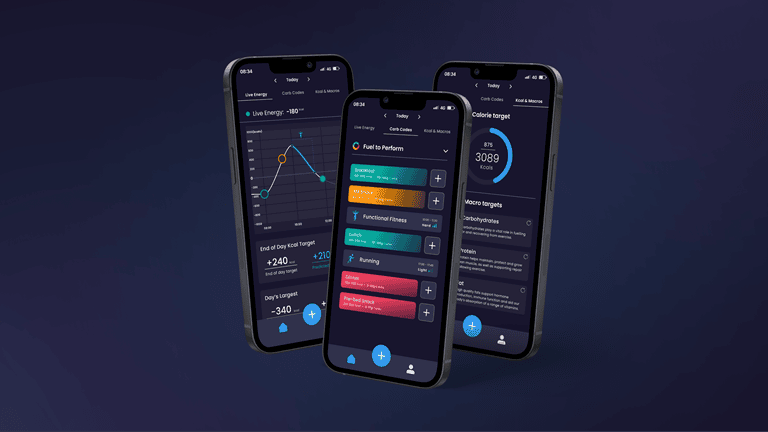
Image courtesy of Hexis

They joined forces, along with three other co-founders: Rodrigo Mazorra Blanco, the director of engineering and CFO; Xiaoxi Yan, who leads data science; and Carmen Lefevre-Lewis, a behavioral scientist who is also a UX research manager at Meta. Impey praised the executive team’s diverse experience and its “strong and encouraging check-and-challenge culture.”

Though most of the team’s experience is in Europe, Dunne’s CV includes a stint as a performance science consultant for Orreco — winner of SBJ Tech’s Best in Athlete Performance for 2022 — where he provided in-person support to client teams, including a two-year stint helping out periodically with the NBA’s Dallas Mavericks.

As with many startups, Hexis draws on elite sport experience to design and develop the product so it’s suitable for professional athletes, but the app is accessible for anyone who trains regularly.

“The reason we built Hexis and where we thought we could really cause a shift in behavior is more around planning,” Impey said, explaining that most tools available are retrospective, but they want to target prospective action.

“Adherence is obviously the golden nugget for everyone,” Dunne said, noting that team spends extensive time exploring ways to engage with all kinds of users who respond to different messaging and prompts at different times of day.

As prevalent as the technology is, one area Hexis has not delved into is machine learning. “When it comes to physiology, we don’t want the system to make a mistake and learn from its mistake,” Dunne said. “We feel there’s pretty good rules around exercise metabolism and biochemistry that, with the development of AI and expert systems, we can give a right and a wrong answer.”

This article was brought to you by SBJ Tech, a Leaders Group company. As a Leaders Performance Institute member, you are able to enjoy exclusive access to SBJ Tech content in the field of athletic performance.

Go to home
Follow us on Instagram Follow us on LinkedIn Follow us on X

Contact

Leaders UK

Tuition House
27-37 St George's Road
Wimbledon
SW19 4EU
London
United Kingdom

Enquiries Line: +44 (0)207 806 9817
Switchboard Number: +44 (0)207 042 8666

Leaders US

120 W Morehead St # 400
Charlotte
NC 28202
United States

Enquiries Line: +1 646 350 0449

Leaders

  • Contact
  • About
  • Careers
  • News
  • Privacy Policy
  • CA Privacy Rights
  • Cookie Notice
  • Website Terms of Use

Performance Institute

  • Membership
  • Events
  • Content
  • Virtual Learning
  • Connections
  • Partners

Latest

Intelligence Hub
High Performance Future Trends Research Elite Performance Partners continue to drive the potential in high performance forward through renewed Leaders partnership
Your Privacy Choices

© 2026 Leaders. All rights reserved

  • Privacy Policy

Attendees

x