The renowned orthopaedic surgeon, who previously served as the Medical Director at the New England Patriots, discusses the art of medical leadership in sports.
A Data & Innovation podcast brought to you in collaboration with

“Fortunately, we had a great coach in Bill Belichick, great ownership in the Krafts, Jonathan and Robert, and I really talked to them around the facility about providing a competitive medical advantage and how we would do that.”
Provencher, who served as the Patriots’ Medical Director between 2013 and 2016 – earning a Super Bowl ring in 2014 – is the latest guest of John Portch and Joe Lemire’s on the People Behind the Tech podcast, which is brought to you by the Leaders Performance Institute and SBJ Tech.
Provencher is one of the foremost orthopaedic surgeons in the world and has treated elite athletes from across the globe at the Steadman Clinic in Vail, Colorado.
In a wide-ranging chat, we also explored:
John Portch Twitter | LinkedIn
Listen above and subscribe today on iTunes, Spotify, Stitcher and Overcast, or your chosen podcast platform.
Leaders Performance Advisor Rachel Vickery explored essential considerations and strategies in the second session of her Performance Support Series.
A Human Performance article brought you by our Main Partners

Part one, which looked at better understanding athletes’ physiological responses under pressure, is available here.
We moved into the second session where the focus shifted to content and thinking around:
Working with the nervous system
As we explored in session one, there is a need to spend time working on our physiological response to pressure. Do your people and athletes really know what it feels like when you experience that adrenaline surge and what changes in the body? How are we working with the nervous system so we can become comfortable being uncomfortable? Giving more tolerance for people to be uncomfortable feeds into this, however it doesn’t actually give them the skill or the tool in their toolkit to understand how to work with the physiology when it gets out of control – we want to develop strategies and deployable skills to take control of the arousal state.
As part of the session, we explored the theme of ‘identity statements’. This is another layer that gives athletes a very powerful identity statement to say that they have earned the right to be able to say, ‘I’m someone who does difficult things’ – it’s actually a really powerful statement when we’re trying to counter unimpactful self-talk that some athletes will try to convince themselves of.
Creative strategies
A really simple but effective strategy for those operating in daily training environments is the use of ice baths or plunge pools. It’s a resourceful strategy – when you get in, the huge adrenaline rush will be present. Breathing tightens, shoulders tense and the heart will begin pounding. We typically see athletes in particular use them for physical recovery, but it’s a great way of dovetailing this with training the physiological response.
How to make this really effective? Don’t do any specific breathing techniques or practices in advance. The reality of the performance arena is that you will need to control your arousal state in that specific moment – there isn’t time to prepare in advance of it. Through consistent training, eventually an athlete or person will get to the point of calm – when it gets to this stage, look to get creative once again through introducing cognitive tasks and intensifying the challenge. Rachel shared that within elite military environment settings, the challenge is ramped up considerably including complex maths questions or communication and translation of a foreign language.
Finally, you might also like to introduce something such as a fine motor skill aligned to an element of performance in your sport; an example being to relax your hand whilst training the response to integrate some performance orientation.
Threat focus
Where’s the threat? Where’s the danger? When considering pressure, the magic is not to buy into the panic. We are striving for situations when the body and mind are trying to do something, you are able to take control because you have learnt how to control it when it kicks in. The only time a stress response kicks in is when we’ve actually got another response that we need to handle and execute on, this concept is known as ‘threat focus’. In most performance environments, we don’t have enough time to notice, think about the what and the go to strategy.
Creating awareness for athletes or others around threat focus is important, it’s powerful to ask athletes in particular ‘what did you notice about yourself? What was your go to?’ You will hear responses such as a feeling of tension through the shoulders, the heart pounding or ‘my mind went into a victim mindset’. Provide space for those self-awareness moments and exposure.
Coaches and performance staff should also look to be involved in this process. You will often here coaching staff wanting their athletes to improve at handling and staying calm under pressure. An interesting insight shared within the roundtable was how many coaches do this work as well? Many coaches and performance staff don’t think they need to do it.
Mental rehearsal
The notion of mental rehearsal isn’t new to high performance environments. However, relating to the topic for this Performance Support Series, this is not mental rehearsal from the perspective of generic visualisation. This rehearsal is visualising yourself in the performance arena right now and working on ways to get into a calm state so that the brain waves are in a more optimal state. The practice is visualising yourself doing the difficult thing and experiencing how your strategies impact the difficult thing. This is where consistency of training neurophysiologically is important to ensure there isn’t a movement towards the ‘fear track’ and instead stay in the ‘calm track’.
Weaving strategies in skills training
We have already discussed the importance of building the muscle of the nervous system in training environments. What are some practical things we can do:
Dylan Frittelli is among those using TourIQ for their own game analysis, course profiles, hole strategy recommendations and a schedule optimizer that can recommend which tournaments a golfer enters.
A Data & Innovation article brought to you by
Such power can come with a cost in accuracy, however. Until recently, when he began working with Cory Jez and his new TourIQ golf analytics business, Frittelli had no way to objectively measure the holistic impact on his game.
“I wouldn’t have any clue how to go about it,” Frittelli said. But he was able to ask Jez, “Have I actually improved my overall ball striking? Or does missing a few more fairways actually hurt me?”
“He did a deep dive in the analysis,” Frittelli continued, “and he basically found out it was almost a break-even, but then my wedge play was much worse out of the rough. So he was like, ‘Look, you’re hitting it much farther down, but you’re in the rough more.’ And between him and my coach, we decided, OK, maybe I’m going to toggle back a bit on driving distance.”
Golf is a data-rich sport, particularly with the PGA Tour’s Shotlink system generating several metrics per shot (and with an upgrade expected soon). TourIQ has more than 12 million Shotlink-tracked shots in its database. But golfers are independent contractors who don’t have the pooled resources to establish the necessary data infrastructure or hire analysts and developers to mine for insights.
That’s the need Jez is trying to fill. He is a former Director of Basketball Analytics for the Utah Jazz who then held a similar role foe Austin FC. That’s where he met Frittelli, a University of Texas graduate who had befriended some of the MLS club’s executives. Jez developed TourIQ to analyze and visualize data across four modules: a player’s own game analysis, course profiles, hole strategy recommendations and a schedule optimizer that can recommend which tournaments a golfer enters.
“It’s exactly what I would build for an NBA team, but it’s just built for a PGA Tour golfer instead,” Jez said. “For one-tenth of that cost, you can get 95% of the benefit.”
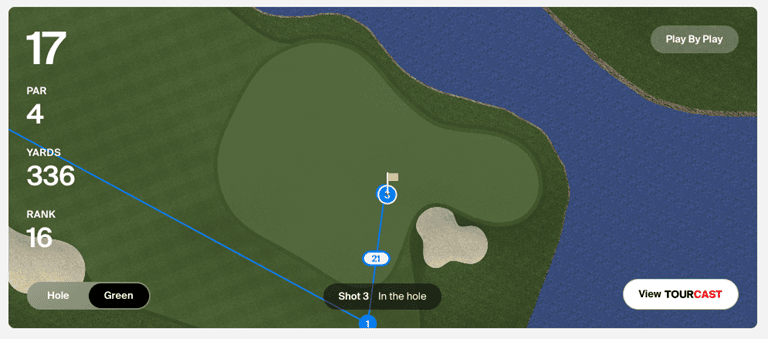
Photo: TourIQ
There are two tiers of access. Platform partners can use the portal for a fee in the low five figures while consulting partners receive additional individualized analysis for a flat fee plus a commission based on Tour earnings.
Jez is the founder and CEO while his software engineer is Phil Baker, whose day job is as the Assistant Director of Baseball Systems for the Cleveland Guardians. TourIQ’s advisors include BreakAway Data co-founder Steve Gera and StatsBomb founder Ted Knutson. They draw on their experience in pro team settings to inform not only the relevant data science but also the communication of the findings.
“I quickly realized in those roles that, obviously, the Moneyball part — building the predictive model to value the player — is definitely part of the job,” Jez said, “but so much of the job is, how do you get this information to your stakeholders in a really quick, easy-to-consume, easy-to-integrate way? How do you get a head coach to use the model?”
Two years ago, Frittelli spent considerable time working on his putting. After a couple months of practice, Frittelli wondered how it really translated to his performance.
“I knew my putting was bad — bad relative to the other guys — but I didn’t really have a metric to tell whether it was getting better or worse,” he said.
There are so many variables in terms of greens and pins to sift out the signal from the noise, but Jez built a model to determine that Frittelli’s putting was, in fact, improving.
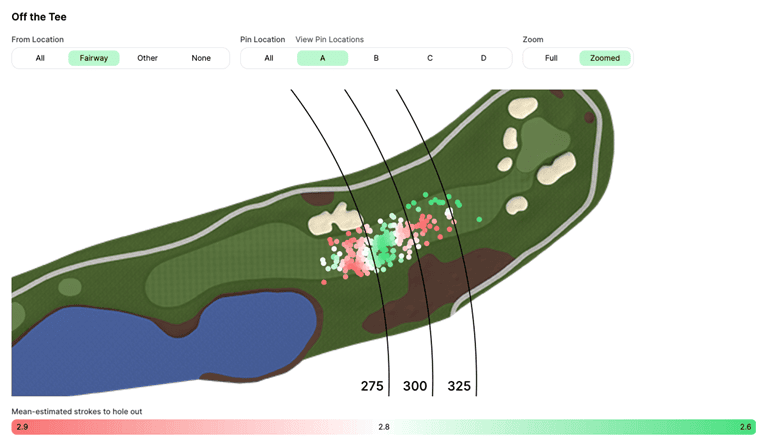
Photo: TourIQ
“There’s a bit of evidence here: now I know what I’m working on helps,” Frittelli said. “Previously I would just go on feel and I’d be looking at it like tournament to tournament or day by day. And it’s really hard to have that sort of bird’s eye view and know if you’re getting better when you’re just looking at small snippets of data.”
TourIQ normalizes the data to account for course variations and strength of tournament field, using 24- and 76-round moving averages as the default comparisons for recent play and baseline performance. The schedule optimizer identified two courses in particular for Frittelli to enter: the Sanderson Farms Championship in Jackson, Mississippi, and the World Wide Technology Championship in Mexico.
The 17th green at the Waste Management Phoenix Open proved a good case study in hole strategy. It’s a drivable par-four, but the second round’s pin location in the back-right corner mandated a different approach: hit to right of the green rather than straight ahead. Frittelli followed suit and made a birdie.
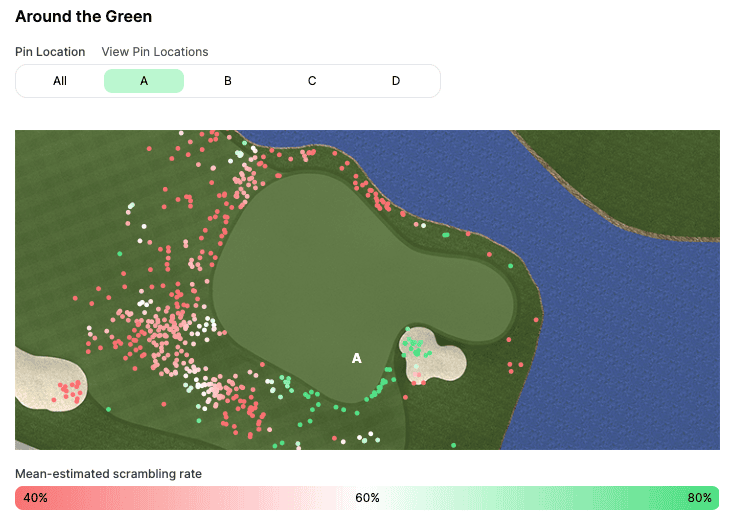
Photo: TourIQ
Generally, Frittelli said, his own experience and the accumulated wisdom of his long-tenured caddie are sufficient. But some of TourIQ’s more counterintuitive recommendations are worth jotting down in his yardage book.
“That’s what I always tell him, ‘I want to find anomalies,’” he said. “It doesn’t help if you tell me to miss it in the right rough here or left rough there. That’s obvious on most holes. But if there’s a random one that says ‘hit it in a different fairway’ or ‘hit it in this fairway bunker’ that gives me an edge that I wouldn’t think about, that’s where he comes in big time.”
“We can essentially give players the cheat sheet on how to play this hole when the pin’s front, when the pin’s back,” said Jez, noting that impact of a shot or two improvement per round. “Being able to make more informed decisions on those margins might be the difference between keeping your [Tour] Card or not. You take a missed cut, and you replace it with a 20th [place] — and you’re a guy who is a middle-of-the-field type of player — and that has really big implications.”
This article was brought to you by SBJ Tech, a Leaders Group company. As a Leaders Performance Institute member, you are able to enjoy exclusive access to SBJ Tech content in the field of athletic performance.
EPIC Risk Management’s Mike Huber and Ben McGregor discuss gambling harm prevention.
A Gambling Harm Prevention Podcast brought to you by our Partners

It’s a startling revelation from Mike Huber, an advisor with our Partners at EPIC Risk Management, on this Gambling Harm Prevention edition of the Leaders Performance Podcast.
“Taking it a step further,” he continues, “we ask the question in our sessions ‘why do you think that is?’ And the reasons that come up from a lived experienced perspective, a research basis, are the personality traits of an athlete. The competitiveness, the ego. Sometimes it’s injuries when they have downtime.”
The reasons why athletes gamble – in the US and beyond – are manifold, as we discussed during this episode, where Mike was joined by Ben McGregor, EPIC’s Director of Sports Partnerships.
Over the course of our conversation with Mike and Ben, we covered:
For those seeking more information on gambling harm prevention, check out EPIC Risk Management’s white paper review from February 2023.
Listen above and subscribe today on iTunes, Spotify, Stitcher and Overcast, or your chosen podcast platform.
As part of a multiyear deal beginning in 2023-24, Hawk-Eye will provide the NBA with pose tracking data for the first time.
A Data & Innovation article brought to you by
As part of a multiyear deal beginning in 2023-24, Hawk-Eye will provide the NBA with pose tracking data for the first time, capturing 29 points on the body as opposed to a single, center-of-mass datapoint for each player. The league is in the process of installing 12 cameras in all 29 arenas that will shoot at 60 frames per second to generate the 3D dataset that will be new to basketball but similar to what Hawk-Eye has provided MLB via Statcast since 2020. Best known publicly for its tennis line calls, Sony-owned Hawk-Eye will also be used to develop future officiating uses for the NBA. Some examples they have been working on in a proof-of-concept capacity since 2019 include goaltending or out-of-bounds determinations, although specific implementations have not been finalized and may require policy sign-off from the unions for the players and referees.
Track record important: “The reason we felt so strongly that Hawk-Eye was the right partner for that is they have an incredible track record across other sports,” NBA EVP/Basketball Strategy & Analytics Evan Wasch said, adding that the primary focus was build a more robust dataset and have it be accessible in real time. “With those capabilities, that unlocks a whole range of use cases across broadcast, officiating, basketball analytics, fan engagement.” Wasch said that this process began with an RFP a little more than a year ago, noting that Hawk-Eye and Second Spectrum were the two finalists. Because they had different strengths that could work in tandem, he said, “We really tried to capture the best of what both companies offered.”
Second Spectrum still involved: Genius Sports-owned Second Spectrum will continue to support teams with the analysis and visualization of tracking data through its AI and machine learning. It will be an official augmentation provider for NBA League Pass, creating alternate telecasts in the spirit of what the company has done in powering ClipperVision. Second Spectrum is also collaborating with the NBA on its next generation tracking product, Dragon, which seeks to collect so-called “mesh data” — essentially, the entire surface area of a player as opposed to individual points. The NBA also touts the ability to use Hawk-Eye data — along with functionality from sister Sony sports businesses, Beyond Sports and Pulselive — for virtual recreations and other gamification activations, along the lines of how NBA Commissioner Adam Silver recorded Ahmad Rashad in 3D at the NBA Tech Summit and then his avatar was rendered as one of the players in game video. “The NBA is pretty progressive when it comes to engaging fans, and they have a lot of pretty experiential, immersive digital experiences on their platforms and obviously with their partners, too,” said Michael Markovich, CCO of Sony’s sports businesses. “And from that, we hope that some of this data we’re generating can create new fan experiences.”
Working with teams: Second Spectrum’s roots are in the analysis of data more than its collection, having originally used what SportVU captured to power its metrics a decade ago. Continuing to work with teams in that capacity through its AI and machine learning is “one of our big priorities,” Second Spectrum CCO Mike D’Auria said. Wasch added, “Second Spectrum remains the foremost basketball analytics experts in the world, and their ability to take raw tracking data and turn it into basketball insight — which brings tremendous value for the teams, for the league and for our fans — was something that we wanted to maintain.”
Hawk-Eye tested in the summer league: The NBA tested the accuracy and sub-second latency of Hawk-Eye at the Summer League and in six team arenas. Hawk-Eye will work together with the league’s exclusive data distribution provider, Sportradar, to maximize the possible stats. What the 3D Hawk-Eye data will offer is an opportunity to understand key dimensions of the game. Whether a defender has his hand in the face of a shooter, for instance, can certainly affect shot probability but center-of-mass data capture can’t make that distinction. “It’s a stepwise shift in the amount of data, and we’re really excited about all the ways that data can be leveraged to tell more stories about the game and to engage and educate fans about what’s happening on the court,” NBA AVP/Stats Technology Product Development Charlie Rohlf said, adding that the empirical data will help unlock insights “that are so integral to basketball that are seemingly so simple. We’ve never been able to measure before things like, How close was that player to blocking that shot? Or how high did he jump on that incredible dunk or that incredible block?”
This article was brought to you by SBJ Tech, a Leaders Group company. As a Leaders Performance Institute member, you are able to enjoy exclusive access to SBJ Tech content in the field of athletic performance.
Lúcás Ó Ceallacháin of the Australian Institute of Sport delves into his work with teams across the Australian system.
Main image: courtesy of the Australian Institute of Sport
“If I were to describe it in a nutshell,” he says, “It’s a facilitation method. A novel way of having great conversations.”
During his sessions, attendees will be encouraged, using un-themed Lego (“no Star Wars”), to build a model based on a thought, question or intention.
Lego Serious Play’s reputation as a tool for solving complex problems stems from a project in 1996 when Lego Group owner Kjeld Kirk Kristiansen worked with two professors from the IMD Business School in Lausanne, Switzerland, to explore ways to stimulate imagination and creativity within his organisation.
It has proven popular as a strategic planning tool, with Lego bricks physically standing in for issues and challenges faced by companies across the corporate world. The method is also making inroads in the world of sport thanks to the work of individuals, such as Ó Ceallacháin, who has observed high levels of engagement with athletes and coaches.
“The amount of cortex devoted to any given body region is not proportional to that body region’s surface area or volume, but rather to how richly innervated that region is,” he continues. “Your hands have a disproportionate representation in your brain. Sports people use their hands and body more than the average person so these senses are trained to a higher level.”
Some of sport’s challenges are ideal for exploration through Lego Serious Play. “Where it works really well is with things like high-ceiling, low-threshold questions where everybody’s got an answer, everybody wants to contribute. If you’re talking about strategy, culture, values or vision, it’s a good tool.” Lego Serious Play also encourages people to be curious rather than judgemental, and is designed to give everyone a voice, from the head coach to the kit person.
It is not, Ó Ceallacháin stresses, a mere team-building exercise. “There’s definitely a team-building element because you build connection, but if someone says ‘we’ve done paintball and we’ve done go-karting – let’s do Lego next’ then I know they’re just trying to fill a couple of hours with a fun activity. I’ll quickly say no to those kinds of things, but if someone says ‘we’re struggling to understand why this is a problem in our organisation’ that’s where I get curious.”
Here, Ó Ceallacháin explains how he uses Lego Serious Play with teams across Australia.
How does a typical session pan out?
LÓC: A typical session lasts for two hours – this is to ensure we have time to build the skills they need to use the method. The first 30 minutes are dedicated to introducing the method, the background and how to communicate through metaphor and storytelling. Then we get cracking! The method follows four steps – Question, Build, Share and Capture. We use the Padlet App to capture our work as we go.
Is there an optimal group size?
LÓC: I like to work with smaller groups but it can be done on a large scale. The challenge with large groups is you won’t have enough time for everyone to hear what is being shared – so you need extra help on tables or in the room.
How do you use Lego Serious Play in your sessions?
LÓC: I’ll take a group through the skills first; ‘what do you need to be able to do?’ and the skills are not about ‘how do you connect these pieces or how do you do that?’ The skills are about ‘how do you tell stories, how do you use metaphors?’ So something as simple as an orange brick might hold a lot of meaning for somebody because they’ve put meaning into it. We ask questions, we build the answer, we reflect and share the answer together – that’s how we generate insights – then we capture, we’ll take pictures and keep a record of it and break it all down and build something else. Typically they’re building for five minutes. It’s not hours of building. The bulk of the session is always about the discussion that they have about whatever they’ve built.
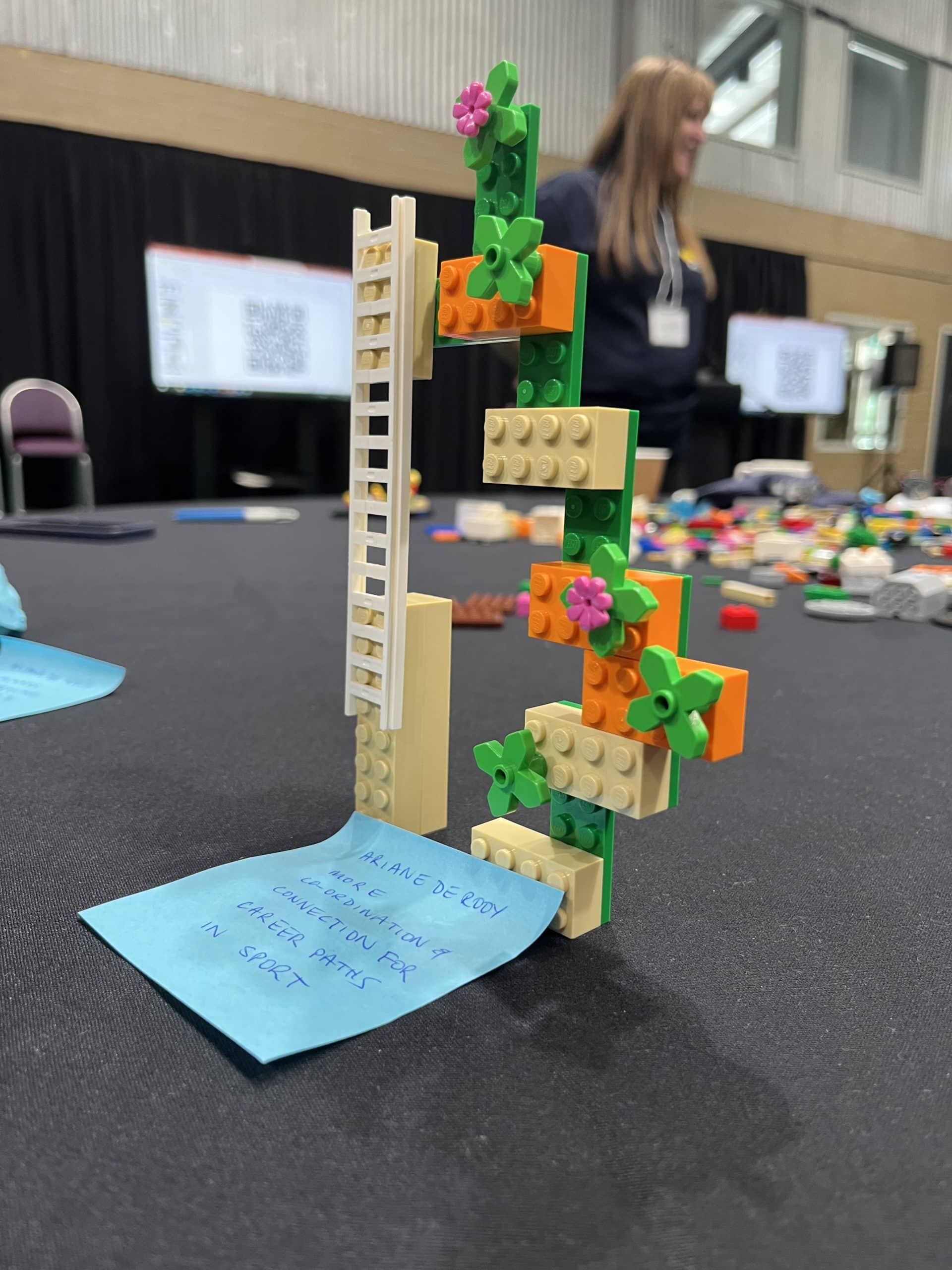
Image: Australian Institute of Sport
With what issues does Lego Serious Play work best?
LÓC: Questions that need creative answers. These are typically around vision, strategy, culture, values, UX design, innovation, team development. What’s exciting now is how people are taking this to their own environments and applying their owns skills to enhance it. It unlocks the creative thinking of the wisdom in the room.
What is a good type of question to ask?
LÓC: High-ceiling, low-threshold questions – future-focused questions where everyone has an answer and can contribute. I use an assets-based approach so I will often frame the question in a positive way. My approach is to understand what their challenge is currently and also what they may have tried previously. The flow of a session builds to a bigger question but all the steps on the way contribute to the momentum of a session.
How does that look in practice?
LÓC: For example, one technical director asked: ‘how do we get the best out of each other?’. Their team was new and had few opportunities to be in the room together. So there was a bit of ‘who am I and what am I about? What do I care about and what are my values? What makes me tick?’ All of that came out in a three-minute build that we did and they started talking about that. Then we said ‘think of a time when you’ve been part of a really successful team – what did it look like? What did it feel like? What helped you to be your best in that team and what are some of the things that you bring to that team that no one else can bring?’ Lots of stuff came out and then they were then able to talk about ‘what are the things that are common? What are the things that are different? How do we get to those next steps for what we want to build?’ And they’ll continue that conversation long after I’m gone. But it just kind of gave them a primer rather than just coming in and asking ‘what are your values?’ and they look at their logo or their crest and start talking about whatever had been written down by corporate leadership a couple of years ago. They asked of themselves: ‘what are our behaviours? What does that look like? How do we want the players to experience us as a coaching team as well?’
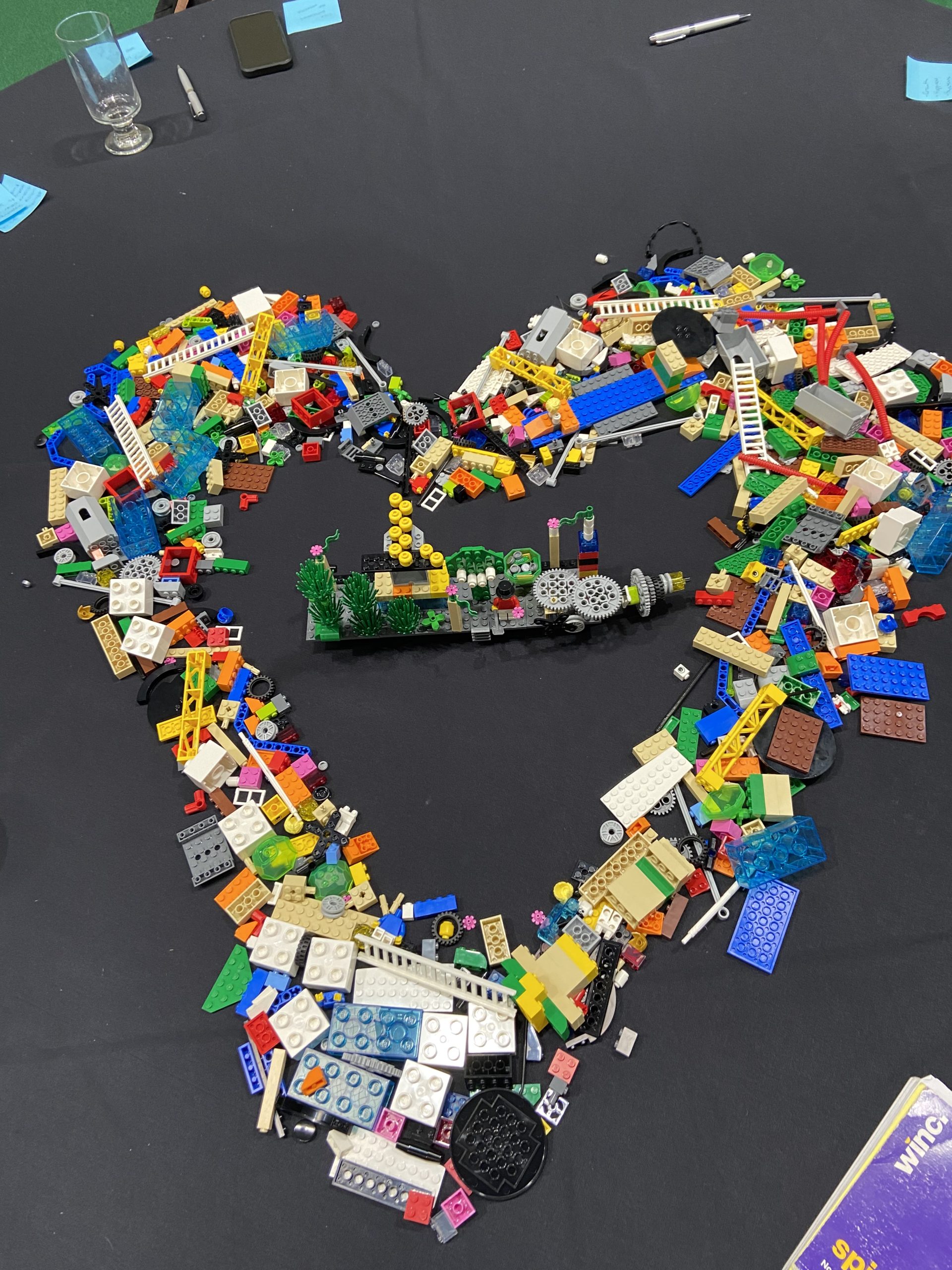
Image: Australian Institute of Sport
Can you outline the science behind Lego Serious Play?
LÓC: I learned from [Lego Serious Play expert] Michael Fearne – who trained me – there are sound scientific principles underpinning the use of Lego in engaging people, changing the conversation and solving complex problems. The way building something with your hands unlocks knowledge you didn’t know you had. There is also the joy and productivity of getting into a flow experience. There is safety in talking about issues through a model rather than the usual business/power dynamic. For example, we might have an idea and we try to make sense of it, but when you put something physical out into the world and you and I can look at it together and say ‘well, what do you see? What do I see? Let’s turn it around and look at it from another side’. We see very different things. And then the flow piece is fascinating with sportspeople because of the connection between the hand and the brain. When you’ve got a big pile of Lego in front of you and your hands are like another search engine for your brain. So you start pulling out stuff that you didn’t even know was there. With my HP hat on – in simple terms, it works!
How might that emerge during a session?
LÓC: So I go back to our orange brick. One coach used an odd orange brick in a model and I asked them about it. They said: ‘Oh… that’s the fire in my belly and that’s why it’s in the middle. My grandad was the first person who brought me to a game. That’s where I got the fire and I take that wherever I go and I think about how important it is to pass that on to the next generation of kids’. That was just a little brick, just the colour, that didn’t look like anything but the fact that we had a quick conversation about it; and the meaning that somebody had put into that brick was really powerful. These stories come up and the power of storytelling resonates here in Australia, where that storytelling tradition is really strong. And I feel like sportspeople just love a good yarn.
How does a second or third session differ from a first?
LÓC: We can get to more complex questions more quickly using different skills, such as rapid builds or you can build with no question or instructions. Then I hand them a Post-It with a theme to explain using the model they built. With the skills warmed up we can tackle system issues or stakeholder maps – the truly complex environment that HP Sport operates in.
How do you encourage introverts or those less likely to talk to actually speak up?
LÓC: I make sure that we let people know that they only have to share what they want to and I also put caps on time. With curious questioning lots of people start to share more. Best of all is that others in the room model the sharing and it gets the rest of the group going. The design of the first hour is all about warming up to get to better sharing – we don’t jump in at the deep end. In my research as part of my Professional Doctorate in Elite Performance at Dublin City University I am also looking more closely at how Lego Serious Play builds the behaviours that contribute to psychological safety.
How do you know when to stop digging with a person? What are the signs to move on to the next person?
LÓC: We put time limits to ensure that we don’t get one person dominating the conversation but I also invite the group to question the model and be curious about it. Often I do very little talking. At the top of the session I make sure that people know that they only have to share what they are comfortable with. The time limit helps with those who are more sceptical too – they get time to warm up to the method and once others share their stories you find the sceptics start to join in. This is also part of the power of Lego Serious Play – it flattens the hierarchy – no one is more expert in your own story and model than you, but you invite others in to see and share your inner world. That demonstrates courage and vulnerability.
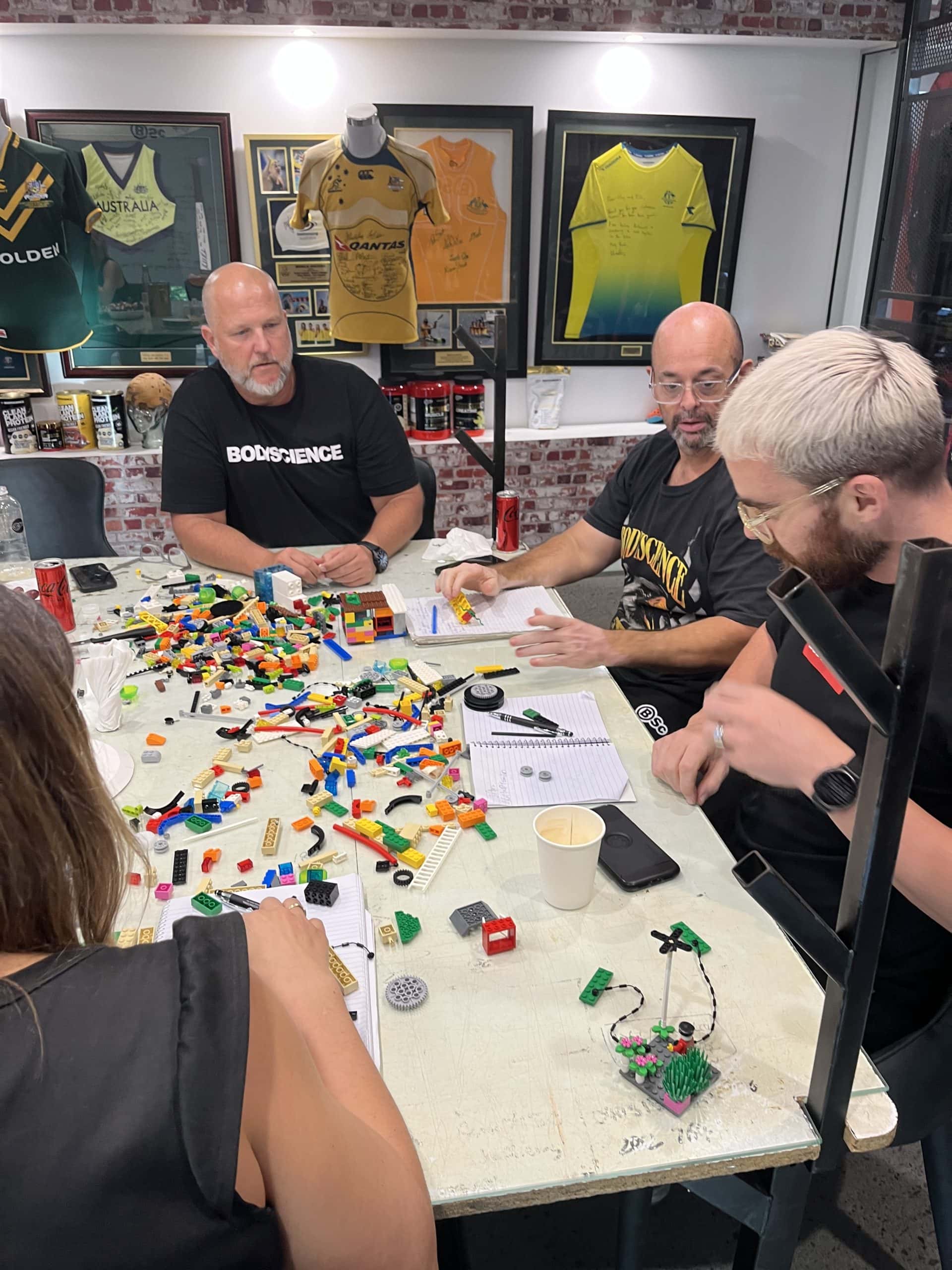
Image: Australian Institute of Sport
You said you take pictures. What are you trying to capture?
LÓC: I’m documenting the experience, summarising insights and generating artefacts that can continue to be used long after the session ends. We are also encouraging people to reflect on and retrieve what they have learned. Also, each model is broken down after it is built – so you are constantly breaking down the models to build something new. It also allows me to be fully present in the room and the conversation.
Do you take notes along the way?
LÓC: Honestly, very few. My job is to continue to facilitate the flow of the conversation so that the participants are producing the questions. This is another reason why the live feed on Padlet is important. By the end of the session the group will produce some simple guiding principles to apply going forward.
Do you prefer to be well-versed in the sport or team?
LÓC: I like to have some background and context of the room I am walking into – where does the session fit in for them, what kind of headspace are they in? I don’t want to have preconceived notions about the group or the outcome. As a former athlete, coach and High Performance Director myself, I’m cautious about what I introduce to an environment.
How do you work with leaders to give them the skills to host sessions of their own?
LÓC: I’m doing a large amount of Lego Serious Play facilitator training now. It can be nerve-racking to lead a session with your own team so I’m currently building a community of practitioners who I train. They are very supportive of each other and help to design sessions for each other. I am excited to see how others apply LSP, especially in situations like 1-to-1 wellbeing or coaching sessions. Everyone will come up with their own way of applying this to solve their challenges.
Leaders Performance Advisor Rachel Vickery explored arousal state control in high-pressure, high-stakes environments in the first session of her Performance Support Series.
A Human Performance article brought you by our Main Partners
In session one, there were four objectives that provided context to the topic and begin to offer some practical solutions.
Within that framework, the Leaders Performance Institute picks out some key considerations that emerged from the session.
Technical. Tactical. Hope.
Something you will often see in elite sporting environments is that many teams get really good at the technical and tactical aspects of their sport, and hope it is going to show up under pressure. Teams practise their skills, strategy and game plans over and over, but they don’t actually plan for what happens when we experience change in aspects of performance like biomechanics, situational awareness and fine motor skills when the pressure comes on.
When there is pressure on performance, typically you will see a breakdown on task execution in high stakes situations. This is generally where teams and organisations will try to do the ‘fixing’ outside of the performance area and resort to managing the anxiety of those that experienced it.
However, it often isn’t the technical skill that is the issue, it is the changes in our physiological stress which causes timing changes in biomechanics and decision making. When we are trying to optimise performance under pressure, this is where the work actually has to get done – a lot of the work in this space is about ‘front loading’.
The disservice we do to high performers
The concept of performing under pressure can often follow the narrative that athletes or teams are mentally weak. Whether this is due to things like coach and media feedback, with things said such as ‘they don’t know how to handle pressure’ and athletes or teams are labelled a ‘choker’ or ‘chokers’.
If we are to look at ourselves as high performance practitioners, if we don’t educate our players and our staff about some of the things that are actually going on, if we don’t normalise it and if we don’t train it, they will still experience changes to performance as a result of being under high pressure. If we don’t understand what’s going on, it’s really hard to actually train for it.
What goes on in the nervous system
This is the physiological stress response, not the emotional ability to handle pressure and stress. Inevitably, what we find is that high performers are generally very good at having emotional and mental tolerance through high pressure, but the physiology can still go crazy underneath the surface and derail performance.
We can’t be in both of these states at exactly the same time – it has the opposite effects on everything and constantly fluctuates. As humans, we are probably more optimal when we were in the calmer nervous system. It’s more of the anabolic state being in the spot of fright and flight where there is high energy cost, where it’s not sustainable to operate in that state for long.
In modern society, we are spending more time in the Sympathetic Nervous System – we’re always under pressure and always being stimulated. Our nervous system will respond to what we think about in the same way if we are actually in an environment. Athletes who are starting to think about games a week out, can begin priming their nervous system, even though they’re in the comfort of their own home.
Performance under pressure is less about what happens in the moment of pressure, it’s more to do what is going on everywhere else. To better understand this, it’s worth exploring the differences between the different types of physiological responses within the nervous system:
Rest & Digest (Parasympathetic Nervous System)
What does Rest & Digest look like:
Fright & Flight (Sympathetic Nervous System)
What does Fright & Flight look like:
Training for performance under pressure
What will typically activate the fright and flight response and increase pressure?
When we begin to think about training for pressure, where can we take people out of their comfort zone, increase the consequence of outcome and integrate some uncertainty and the unknown into that?
When coming into a performance arena, we want to strive for a gap between the Parasympathetic and Sympathetic nervous system, so when the normal increase arousal which occurs with competition environments, it still remains under their threshold and performance stays on point.
Learning
The magic around performance under pressure is learning to manipulate the responses around the arousal state. One way to do this is to de-escalate really quickly – what is someone’s ‘get out of jail card’ to bring them back under their threshold so they can bring the ‘smart brain’ back online and think through what their next strategies are?
More buffer. Front loading this so when coming into the performance arena there’s already a lot of buffer in the system. The down side of this is that very few teams and individuals want to do the hard work that it takes to get really good at this. The true magic lies in front loading to absorb the consequence of ‘go time’ and the notion of not needing get out of jail cards because you don’t end up in jail in the first place.
Phil Coles of the Boston Celtics and Marty Lauzon of the Atlanta Hawks share their approach to performance preparation strategies for the post-season.
A webinar brought you by our Main Partners
“I feel in the past few years, this term has become a bit of a buzzword or a misused term, thrown around left and right,” says Černivec, who is moderating this Keiser Webinar.
Her guests are Phil Coles, the Executive Director of Performance at the Boston Celtics, and Marty Lauzon, the Director of Athletic Performance and Sports Medicine at the Atlanta Hawks. The title is Performance Preparation Strategies for the Post-Season.
It just so happens that the Celtics and Hawks are currently competing against each other in the first round of the NBA Playoffs but, beyond some friendly jibes, both were happy to talk to Černivec about their post-season work with their respective teams and how their views on load management have evolved.
Misconceptions around load management
“There’s definitely some misconceptions about what ‘load management’ is in the public and in the media,” Coles tells Černivec. “The first one is that load management means rest; that player’s aren’t playing, and I think that’s a real misconception because a lot of times load management can be encouraging players to do more.
“There’s also a misconception that this is dictated by people such as ourselves, directors of performance or sports scientists and, again, I think that’s completely untrue in a practical sense. We’re people that obviously spend our lives in this space and we’re what would be considered an expert opinion, but that expert opinion is discussed with the general manager, the coaches, and decisions are arrived at for the good of the player and for the team as a whole.”
Lauzon and Coles share the challenges posed by the NBA’s hectic game and travel schedule. “If we have a common language between us as practitioners, coaching, management and the players, that is really helpful,” says Lauzon.
“It’s always about starting with ‘what does that mean?’ For a certain player, it could be rest but, most of the time, it’s something else – you’re just changing the stressor, really. It’s about having that language so that everybody understands that it’s not just rest – the player’s not just laying on the table all day.”
Preparing for the playoffs
Černivec asks Coles and Lauzon how their approaches have changed during the post-season. As Coles explains, the density of games is less during the playoffs but the intensity is higher, as is the volume, due to the player rotations getting tighter as coaches rely on certain players.
“I think that’s important as we prepare players leading up to the playoffs that we’re trying to mimic all of those things,” he says, adding that the Celtics’ roster divides into three groups for the post-season: the high-volume players, who are playing the most minutes and under the most physical and mental stress; players who are either unlikely or ineligible to play in the playoffs; and a hybrid group between the two where players may get some minutes in certain games or series.
“There is a natural spread within your 15-17-man group of seven or eight players,” he continues. “There are the guys who are on a high-volume, high-stress programme and we’re focused on maintenance and recovery; we’ve got the guys at the other end and we’re looking at a longer-term development programme than what we’re focused on during the regular season because we know they’re not likely to feature significantly in this next period; and then we’ve got the group in the middle where we’re constantly evaluating what they have done, how well have they recovered, when do we need to push them on the practice court to ensure they’re staying prepared to play big minutes and effective minutes in the playoffs, but we’re not putting them in the game when they’re tired because we’re overworking them.”
Lauzon and the Hawks have a comparable approach. “Good conversation helps with that,” he tells Černivec. “Communicating with the staff so that they know that the development group needs to get pushed and they’re going to have more court time for practice; the high-volume players spend more time in the physio groups and in recovery. It’s dialogue and communication. As practitioners, it helps us plan best for what the needs are.”
He also makes the point that the post-season affords a team more days spent in one place. “It’s helpful in the playoffs that you may be in the city for four or five days. You’re not just coming in, coming out, coming in, coming out, which happens during the season. It’s more helpful for the guys who play a lot. They have a mainstay and we can really cater to them.”
‘Don’t dismiss the coach’s eye… or athlete feedback’
Lauzon and Coles welcome the opportunities that tech and data have brought to performance conversations with athletes and coaches, but both share the belief that a performance programme should be data-informed, not data-driven.
“I’ve been surprised sometimes how a coach can tell you what he sees,” says Lauzon. “The numbers are almost a little bit of a reflection of that. It can help to say ‘hey coach, what you’re seeing looks right’. The coach’s eye is important. They see the game in a way that we don’t see it as practitioners.
“It helps us in dialogue with the player and we try to optimise from there.”
Coles points to a “bell curve” in the introduction and use of tech and data in high performance. “When it starts, there’s a lot of data that people don’t understand and don’t know how best to use. There’s fear amongst how that data will be used,” he says.
Recalling his experiences working in his native Australia, he feels that athletes and teams became too reliant on data at one stage at the expense of the coach’s eye. “We’ve now gone past that and got to a point where we can recognise what the data can do for us.
“It gives people good valid reasons to continue on the process they’re on and if it challenges what they’re doing then it creates interesting questions for people to discuss.”
The starting point is always how the player is feeling. “There’s no data that can tell us how an athlete feels as well as what an athlete can tell you how they feel,” says Coles, who also emphasises the need for mutual trust.
“That’s the feedback that when you sit down with a coach you’d say ‘this is what we can see. The player feels fine. Or the player does not feel good’. That has to be the primary point when the coach factors that into making a big decision about what happens on a particular day.”
“The wellness check-in we do in the morning is probably the biggest thing we do all day because that’s when you get your feedback from the player himself,” says Lauzon. “You don’t treat an MRI and you don’t treat data – you treat the player.”
‘Wellness check-ins have gone full circle’
Coles and Lauzon tell Černivec there is no getting away from sports as a people business.
“The mental component is just as important as the physical component, particularly when you get into the playoffs and you have a deep playoff run because the continual stress builds up over a long period,” says Coles. “And the difficulty with the mental side is that it’s much harder to be objective.
“Our data is not as good in that sense but it’s every bit as important. In fact, I genuinely think the mental fatigue that happens in a long playoff series is a greater issue than the physical fatigue given how well most of the players are prepared.”
Coles’ daily wellness checks have gone full circle. “Over time, I’ve gone through everything from very basic to really detailed and now I’m back at a really basic check-in,” he continues. “That really is a fall-back system to make sure that no one fell through the cracks and to throw up a flag to make sure that we go and have a conversation with someone if they don’t report that they’re feeling great.”
As he says, “we rely much more on the personal interaction than the particular questionnaire.”
Lauzon reports a similar experience. “We’ve been through the whole gamut where players could fill it out on an iPad or on their phone and then we were more formal with them. Now, I think we’re going back to more face-to-face, one-on-one personal interactions that starts with what’s going on in their lives first. Then you get the information you need.”
Education is a constant
Coles explains that sleep, nutrition and hydration represents 90% of Boston’s recovery programme and all are monitored using a range of objective and subjective metrics, which can then be used to educate and impart information.
“It’s not like we sit down and give a lecture to the players once a year on the importance of these things, it’s a continual part of the individual relationships they have with individual staff who are focused on that.”
“Players want to know if you’re going to scan them or force plate them – they want to know why,” says Lauzon. “If you explain it to them that’s where it starts. ‘You guys are measuring how much I’m drinking in game or how much I’m drinking pre-game’. You get player buy-in that way and they get a better sense of their bodies and what they need. It always starts with education.”
As with Coles, there is no big pre-season lecture or seminar at the Hawks. “It’s nice in the NBA that there’s 16 or 17 players so there’s a lot more touch points than on a bigger team,” he adds. Veteran players are also useful role models for both rookies and those players from overseas who may be versed in a different way of approaching preparation and recovery.
“We all have the same message and the same language so that the player gets the same message constantly from our staff. And if there’s people helping him, if the player has a personal chef or assistant, we have to educate them as well and bring them onboard with what we’re trying to do.”
“”Until you have this data at your fingertips, you can’t properly train these guys,” says Duggan Moran of ArmCare.com.
ArmCare’s strength sensor measures a pitcher’s arm strength and range of motion, and paired with pitchLogic’s velocity and key metrics, can track arm readiness and fatigue as well as offer pitch design recommendations and custom training plans. (Image courtesy of pitchLogic/ArmCare.com)
A Data & Innovation article brought to you by
On its own, pitchLogic — a smart baseball embedded with a circuit board full of inertial sensors — can measure velocity, spin rate, backspin, sidespin, riflespin, spin axis, spin direction, horizontal and vertical movement, arm slots and 3D renderings of the ball’s release from a pitcher’s fingers. In real time.
On its own, ArmCare.com — by pairing a dynamometer with an inertial sensor— can calculate a pitcher’s pinch grip, internal and external rotation, scapular strength, fatigue, recovery and an all-important metric known as Strength Velocity Ratio. In real time.
But until their announced partnership in February, pitchLogic wasn’t in the wellbeing business, and ArmCare.com wasn’t in the release point business. Under this joint arrangement, pitchers now have intertwined tech-centric apps that work in concert to improve performance and arm health all at once.
“We’re working together because we have the same customer,” says Jeff Ackerman, pitchLogic CEO. “What we’re saying to each other’s client base is, ‘Look, this is something that we recommend. We think that you should not just have pitchLogic, you should also have ArmCare.’ And then for ArmCare people, ‘You shouldn’t just have ArmCare, you should have pitchLogic so we can measure your progress.’ And then everybody still uses their separate equipment and goes to the separate websites to buy each thing, but rely on both.”
The gains and overlaps in baseball technology are beginning to accelerate these types of vital integrations. The pitchLogic app has already been adopted by the pitch design platform Driveline Baseball, particularly for remote training purposes, and the partnership between pitchLogic and ArmCare is the next obvious progression.
The goal of both companies is to be must-haves in the duffle bag of every pitcher. For instance, pitchLogic is a transient option to its competitors Rapsodo and TrackMan, which aren’t nearly as portable or affordable. As for ArmCare.com, the system was perfected in part by a former Angels pitching coach Jordan Oseguera and a former Angels director of performance integration Dr Ryan Crotin — both of whom believe their product can pinpoint whether a pitcher’s injury risk is lack of strength or pitiable biomechanics.
ArmCare.com, in particular, took a winding and scientific road to get here. A decade ago, a long-term Colorado Rockies arm study showed that spring training weaknesses in a pitcher’s external rotators and supraspinatus were precursors to regular-season throwing injuries. Accompanying research also confirmed that imbalanced throwing shoulders — meaning an unproportional ratio between external rotation and internal rotation — also increased odds of a crippling arm injury.
From a distance, the founder of a rotator cuff and scapular strengthening platform called Crossover Symmetry dug into the hypothesis. His name is Duggan Moran, and he enlisted his father Jim Moran, a physical therapist, to begin prohibitively testing throwing shoulders — just to confirm whether their exercises were targeting the right arm muscles.
Using a basic dynamometer, or muscular strength tester, they found promising results before shifting their strength testing to teenage prodigies at Perfect Game baseball tournaments. Alarmed at how weak and predisposed to injury the young players were, Duggan Moran took the technological steps needed to develop what is now the ArmCare.com app.
By using a new “research grade” digital dynamometer to measure pinch grip, combined with an Inertial Measurement Unit sensor chip to quantify range of motion, Moran’s company built proprietary software that ultimately democratized strength testing.
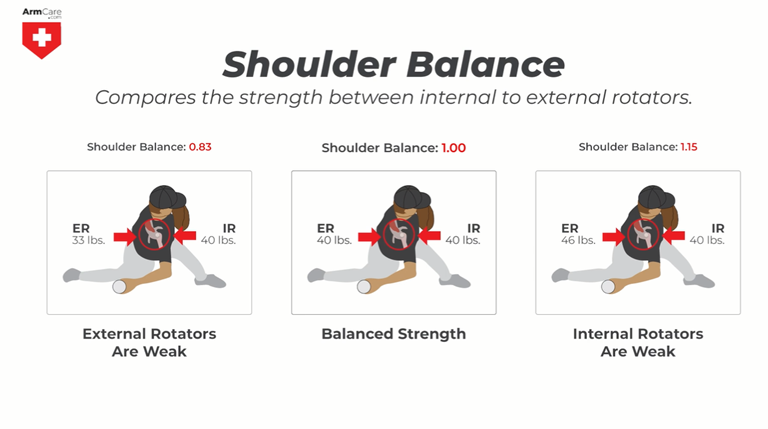
Image courtesy of pitchLogic/ArmCare.com.
Developed further by the pair of ex-Angels pitching specialists Crotin and Oseguera, the app began to pinpoint the most crucial metrics to empower pitching arms such as pinch grip and the ratio of strength to velocity (SRV), The platform ascended from there. They could state confidently that spin rate could only be improved through increased pinch grip strength, that simply altering a grip to create spin rate was fallacy. They could state confidently that talented and flexible teenage athletes could throw hard without proper strength, but those were also the very ones most likely to snap a ligament.
“Until you have this data at your fingertips, you can’t properly train these guys,” Moran says. “You can’t know whether you’re overtraining or undertraining unless you understand the fatigue and recovery of these athletes. And in less than five minutes, we can gather that data, and you don’t need a clinician. You don’t need expensive equipment to do it. You do it remotely. The app guides players through the exam with audio-visual graphics and then delivers customized exercises based on the results, as well as feedback.”
As a result, there are now players from all 30 MLB teams and most every D1 baseball program using the app — purportedly 15,000 youth, high school, college and pro players total — and Crotin claims the total number of ArmCare clients who’ve needed arm surgery is exactly…one.
Which is where pitchLogic comes in. Crotin and Co. know that an ever-changing arm slot can be a red flag for arm weakness, something their app does not ascertain. But pitchLogic’s smart baseball — utilized by all MLB teams, including Yankees closer Clay Holmes — contains the accelerometers, gyroscopes, magnetic sensors and Bluetooth radio to produce a 3D clock that shows precise arm slot, not to mention any irregularities in velocity and spin. From there, ArmCare can determine whether any arm slot inconsistency is from weakness, fatigue or simply biomechanics.
But if it is weakness — and a pitcher’s about to blow out an elbow or shoulder — pitchLogic and ArmCare.com can together sound the siren.
And go from one surgery… to none.
This article was brought to you by SBJ Tech, a Leaders Group company. As a Leaders Performance Institute member, you are able to enjoy exclusive access to SBJ Tech content in the field of athletic performance.