The performance specialists are preparing some NFL prospects for the ‘interview of their lives’ in an interdisciplinary fashion.
Main image courtesy of Exos.
A Data & Innovation brought to you by

The type of question asked during those otherwise idle spring months was, recalled Exos VP of Performance Brent Callaway, “if we’re trying to create the fastest athletes on earth and we have anywhere from eight to 10 weeks to do it, what’s the process that we should follow?”
Across its multiple performance institutes, Exos has trained more than 1,000 athletes for the NFL since 1999, including eight No. 1 overall picks and four of last year’s top-10. For this year’s Combine, which is being held in Indianapolis, 98 of the 319 invitees prepared at Exos, most working out on location for about eight weeks.
“Everyone’s coming here to do the biggest job interview of their lives,” Exos Director of Sports Science Matt Darnell said.
Despite that pedigree of success, its staff wants to continue iterating on its program. That Covid-mandated break prompted Exos to further investigate emerging technologies, leading to several new partnerships. Introduced into the ecosystem was Vald Performance for advanced human measurements, Hologic for DXA scans and Kitman Labs to organize the voluminous datasets. Exos piloted Intel’s 3D Athlete Tracking system in 2021 and uses DARI Motion, its primary motion capture partner since 2018.
“The true magic happens when they can start to feel the customization and then the output of effort that we receive is better because they know that it’s purposeful,” said Callaway, who has personally trained a top-five pick at the Dallas-Frisco location every year since 2017. “I always tell them, within the first 14 days, with the conversations that we’re going to have, you’re going to understand your body more now than you ever have in the past.”
While many athletes who played at Power 5 schools are exposed to advanced technology and staff of innovative coaches, that’s not everyone’s experience. Back in 2015, defensive back Will Brown had competed at Division II Missouri S&T before enrolling in the Exos program. He called the training environment “eye opening” and saw immediate dividends: in two months, he added nearly 10 pounds of muscle and improved his 40-yard dash time by two-tenths of a second.
Brown likened his stint at Exos to the metamorphosis of Captain America. “When he went in the tank, and then when he came out of the tank, that’s how I like to describe my Exos experience,” said Brown, an industrial engineering graduate who returned to work at the company’s Arizona location on its research and performance innovation team.
Callaway described a “downhill slope” of technology, where methods used in the NFL trickle down to college and then to high school, so the base level of training is higher. That’s where Exos delves into personal evaluations and bespoke training plans — “adding pixels to the pictures,” as Darnell put it.
That’s where the work Exos’ interdisciplinary team of physical therapists, sports dietitians and strength coaches coordinate to maximize each athlete’s potential, testing each participant on rapid movements, range of motion, nutrition, body composition, asymmetry and hydration. Instead of this data sitting in eight siloed spreadsheets across the computers of five experts, all of it is collected in Kitman’s intelligence platform. There are built-in alerts when an athlete falls below the 50% standard at his projected NFL position, so there can be training remedies implemented.
The marquee event of the Combine each year is the 40-yard dash, where margins can be razor-thin and even savings of hundredths of seconds can be meaningful. That’s where Exos graduates excelled last year: in Callaway’s first 18 years of draft prep, he has six athletes run the 40 in under 4.4 seconds. He had six more last year alone.
“Some of it, I’m sure, is just an anomaly of talent,” he said, “but obviously there’s quite a bit of training involved here too.”
The newest area of exploration is through Hologic’s DXA scan, which can quantify body fat percentage, detect limb asymmetries and even calculate muscle-to-bone ratio. In consultation with an expert in the field named Francis Holway, Exos is seeking to prescribe ideal body masses for every individual, which may be different even among two men of the same size and same position.
“If I’ve got a 6’2” corner, and I’ve got two of them, and they both weigh 190 pounds, I would imagine their skeleton weighs the same — and that’s not what we’re finding,” Callaway said. “So you have different bone densities, you have different bone sizes, you have different limb length. And if you have an athlete who has too much mass per pound of bone, that can actually be a performance decrement.”
If there’s any one area of training that is persistently underemphasized by athletes before arriving at Exos, Brown said it’s their mobility and functional movement patterns.
“Being mindful of how to incorporate PT as a part of your plan, rather than going once it’s already got the check engine light on,” he said. “We’ve got to really keep the car with the oil and the gas on a daily basis.”
“It’s almost hard to tell where our PT clinic stops and our training floor starts,” added Darnell.
Though there are critics of the Combine — most recently, NFLPA executive director DeMaurice Smith called for it to be scrapped — there is underlying value in some of the datapoints collected. That enables historical comparisons to successful pros. For example, one can assess a prospect’s force plate data and his ability to accelerate and deceleration and marry that data with results in the 40, the 20-yard shuttle and the three-cone drill. (Smith advocated for union-backed regional pro days instead of the national combine.)
“Now you can go back and say, ‘OK, these athletes who tested really well on these tests all have these specific qualities,’ and it’s objective, right?” Callaway said.
“At the same time,” Darnell said of the Combine’s value, “it’s really hard to play the game of football in today’s world without having explosive speed and power and the ability to put on brakes and the ability to show up in an environment under stress, with millions of people watching you.”
This article was brought to you by SBJ Tech, a Leaders Group company. As a Leaders Performance Institute member, you are able to enjoy exclusive access to SBJ Tech content in the field of athletic performance.
The human and AI-powered basketball analytics lab is able to provide an array of insights within 15 minutes of the final buzzer.
A Data & Innovation brought to you by
Synergy, the human and AI-powered basketball analytics lab that was acquired by Sportradar two years ago, has evolved into such a coaching resource that every D1 men’s and women’s program subscribes to their scouting service just for the sheer nuance and volume of it all.
A breakdown of every possession from every college team all season? That’s available. What plays the team ran on each possession? Available. Who passed the ball to whom and then to whom and then to whom? Available. Who shot the ball and from where? Available. Don’t believe them? They’ll gladly verify it on their proprietary video. Synergy has 1,000 human data collectors… to go with an automated camera tracking system in 250 D1 arenas… to go with their own shot quality algorithms themselves.
They literally monitor 75,000 basketball games a year — from high school to DI to DII to DIII to the G-League to the EuroLeague to the NBA — and estimates it has 50 million tracked shots in its database since its inception in 2004. But when it came specifically to this year’s March Madness, Synergy has logged every game in real-time and then distributed a data-video report 15 minutes after every final buzzer.
Considering teams sometimes have just 30 hours to prepare for an NCAA Tournament opponent, Synergy will also conveniently diagram every opponent’s play calls and supply APIs for more expert level coaching staffs that have their own analytic departments for additional game-planning.
“I don’t have [any stories] for this year’s March Madness, but, [in 2012], we had a 15-seed, Norfolk State, beat a 2-seed, Missouri,” says Mark Silver, EVP, Sports Performance, Sportradar. “And immediately after that game, the [Norfolk State] coach called and thanked us for everything we did and said, ‘The only reason we won was the fact that we had the Synergy scouting report.’”
One of the company’s first coaching clients in 2006, in fact, was a then-relatively unknown Jim Larranaga of George Mason University — who leveraged the platform all the way to a shocking Final Four run that season. Now, Larranaga’s back in the Final Four with Miami and again with Synergy.
The product helps coaches on multiple levels, the first being game prep. Synergy will provide an opponents’ innate tendencies such as which direction a post player tends to spin to the basket — off of his right shoulder or left. Or if a player turns to the baseline from the right block 100% of the time or dribbles first 95% of the time.

Photo courtesy of Synergy
The info is so nuanced, Synergy can tell a coach if an opposing player, or his own player, is superior driving right or left or better shooting off the dribble or off- a-screen or better pulling up or finishing at the rim. There are stats and videotape to support it all. “Advanced scouting,” Silver says.
Another new activation is quantifying the role of every player in this year’s NCAA tournament. Through machine learning, Synergy’s software can determine the positional characteristics of any player, leaning on a database that contains every college player’s shot since 2014. For example, Synergy classified Miami’s 6-foot-7 Norchad Omier as a “Rim-Finishing Big”, Gonzaga’s 6-10 Drew Timme as a “Post-Up Big” and Alabama’s 6-9 Brandon Miller is a “Playmaking Wing.”
By using artificial intelligence to categorize every player, Synergy has perhaps become the technological centerpiece of the transfer portal. Coaches can search the company’s database for “Slashing Wings” or “Spot Up Shooting Wings” or “Scoring Ball Handlers” or “Stretch Bigs,” and the names come spitting out.
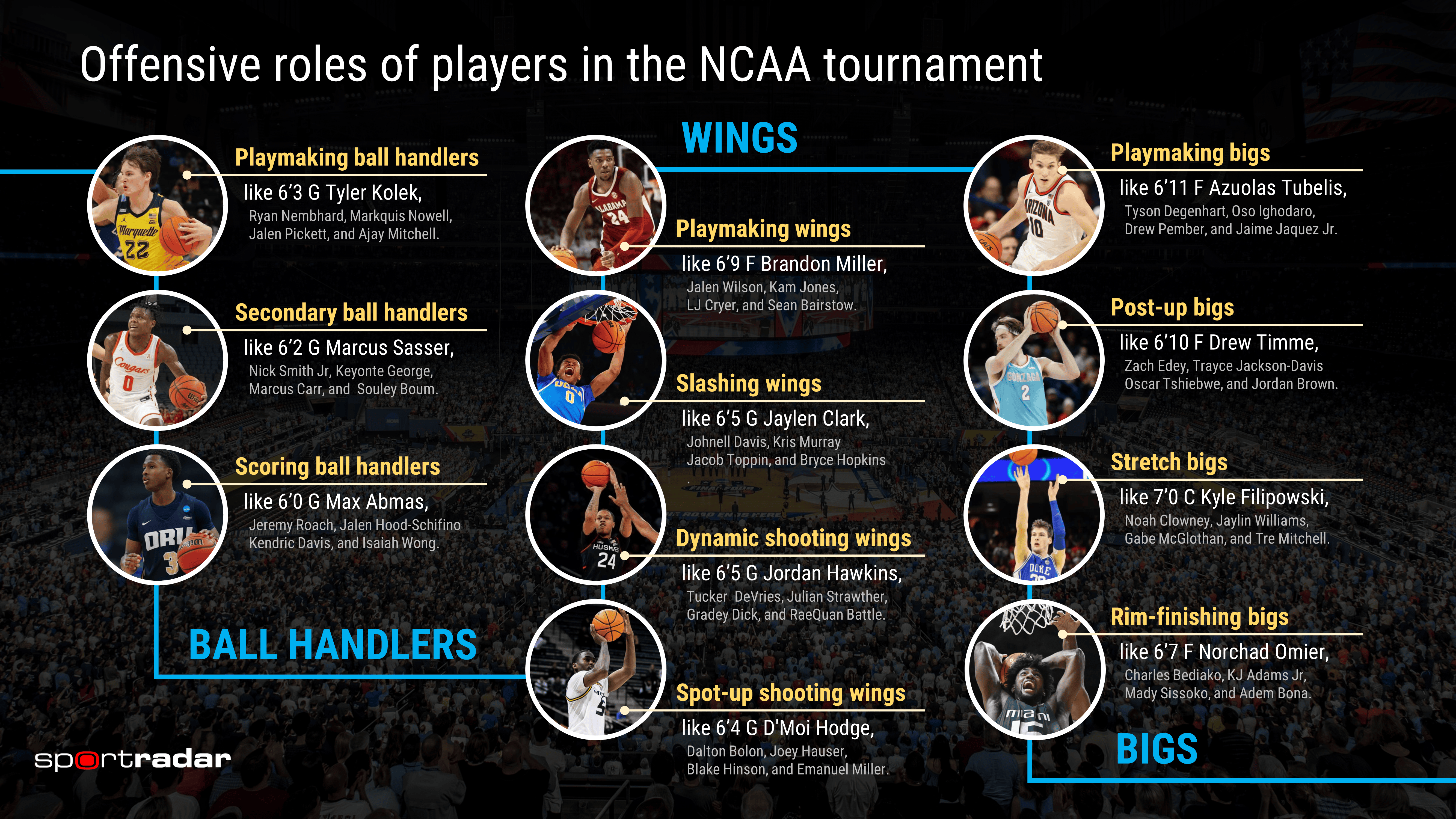
Photo courtesy of Synergy
“We undoubtedly play a huge role in the transformation of the transfer portal because you can go into our system,” Silver says. “And if you’re looking for a type of player or a player in a certain class, whether they’re playing in JUCO or D1 or D2 or D3 — or if you already know about the player — you can easily go and find every game that player has played. Since high school, most likely.
“Or if you just need to fill a spot, you can actually look and query the system to try to find a player that’s most fitting what you’re looking for. So recruiting, scouting, transfers: that’s one of the big ones for us.”
The Synergy Automated Camera system is another high-tech advantage, considering its camera vision tracks shot quality and team/player tendencies while also providing coach’s film and video confirmation. Hawk-Eye’s cameras handle that for the NBA. But when it comes to the college level, Synergy is more or less holding down the tracking landscape.
With all of these NCAA coaches bought in, the company has to try to stay neutral — which may be a little tricky at this weekend’s Final Four.
Especially when Larranaga starts winking at them.
This article was brought to you by SBJ Tech, a Leaders Group company. As a Leaders Performance Institute member, you are able to enjoy exclusive access to SBJ Tech content in the field of athletic performance.
The US Applied Performance Specialist Manager at Kitman Labs talks about development opportunities for female practitioners and athletes alike while exploring how workflows can be improved in both professional and college sports.
A Data & Innovation podcast brought to you in collaboration with
“The conversation has grown,” says MT Eisner, “but curiouser and curiouser: has the conversation grown because I’m in that circle or has the conversation genuinely grown?”
The US Applied Performance Specialist Manager at Kitman Labs would like to think it’s the latter. “Within Kitman, we talk about it consistently, within the other organisations that we’re helping [we ask] ‘how can we assist with this?’” she continues.
“We had this organisation want to now start tracking menstrual cycles, starting to do X, Y and Z with their athletes. ‘Who else is doing this? What conversations are you having? Who can we tap into?’ and so forth.”
In addition to the increasing focus on female athletes – and the development of female practitioners – our conversation also covered:
John Portch Twitter | LinkedIn
Listen above and subscribe today on iTunes, Spotify, Stitcher and Overcast, or your chosen podcast platform.
Trainers and jockeys will have more post-race information about how their horses performed and what tactics worked and didn’t.
The TRACAB Horse Tracking System (HTS) uses advanced satellite tracking technology via GNSS (Global Navigation Satellite System) and real-time radio communications systems for accurate and fast data delivery during live horse races. (Main image: TRACAB)
A Data & Innovation brought to you by
The latest iteration of the Horse Tracking System calculates horse positioning based on Global Navigation Satellite Systems, such as GPS, to centimeter accuracy and without the same level of hardware necessary at the track. The project was tested at more than 1,000 races at Norway’s national race track, Bjerke, and has led to a recent, five-year partnership with Norsk Rikstoto, the betting operator for Norwegian horse racing. The TRACAB Horse Tracking System (HTS) will be deployed at all major tracks in the country.
“We see in the horse racing industry that this is fairly new, because they’ve had tracking technology with varying degrees of quality and availability, but how can they really get some more value out from the data?” TRACAB head of wearable technology Stian Dahl said. “I think a lot of exciting stuff can be built upon this kind of tracking database.”
The most immediate use of the data — which includes position, speed and acceleration — will be to augment broadcasts with improved graphics and insights. With a latency said to be less than 150 milliseconds, the data can enable betting operators to improve their offerings. Trainers and jockeys will have more post-race information about how their horses performed and what tactics worked and didn’t.
In the near future, TRACAB executives hope, the wearables can help power robotic cameras using AI. TRACAB has already begun implementing that in soccer with its optical tracking system. That’s done in conjunction with the Bundesliga and Sportec whereby international rights holders can isolate a camera on the home country’s domestic star.
“Our plan here is to bring that same kind of technology now, with our experience from football, into horse racing as well, where we believe that automation is really something that’s going to be a big talking point in the next few years,” TRACAB SVP business development and strategy Oskar Norrman said.
TRACAB is best known for its work in soccer and for its camera-based tracking systems in that sport, but there are parallels to horse racing, which is a decade or two behind soccer in the adoption of big data.
“We see a big future of analytics coming into horse racing right now,” Norrman said, adding, “I do see this being something that can really grow within horse racing as well, everything from being able to see patterns in the behavior of specific horses to looking at historical data and looking at patterns there. So not only to enhance the experience or work with prediction of races, but also to help the betting companies to provide better odds and have a more automated functionality there. And at the end, also providing real-time, in-race betting, based on high quality and fast real time data.”
“HTS does not process data on the 100-gram (3.5-ounce) transponders themselves, but the devices instead uploads everything via radio technology,” Dahl said, “and then we can do some more clever things with a bit more CPU power on the server to create the best quality tracking.”
The Nordic countries were a logical starting place for this technology, as Sweden is the location of TRACAB’s home office and there is uniformity in management of racetracks and betting. The US market is “a bit more fragmented,” Norrman said, but is certainly an option for future growth.
“Working closely with the federation, or the organization, behind the racing is really key here, because they have a way to really monetize on this and find good synergies and cooperation between their own organization but also globally, as there’s a lot of cooperation between the racing associations,” he said.
This article was brought to you by SBJ Tech, a Leaders Group company. As a Leaders Performance Institute member, you are able to enjoy exclusive access to SBJ Tech content in the field of athletic performance.
The Zone is designed to integrate with a team’s wellness initiatives to improve the access and options available to users.
The Zone’s platform is an innovative and proactive approach to student-athlete wellbeing. (Main image: The Zone)
A Data & Innovation brought to you by
Those social repercussions persist, as do new pressures related to name, image and likeness (NIL) opportunities — and all the other stressors that come with being a college student and competing in a sport at a high level.
The Zone, a mental wellness app catered toward the specific demands of college athletes, has gained traction and today announced its largest deal yet, a multi-year, conference-wide deal with the Big East. The app will roll out slowly to start, with 100 student-athletes at Georgetown and Marquette onboarding this spring, before a similar number of app licenses will become available to all other Big East schools thereafter.
“Our student-athletes have reported some of the most significant challenges center around the pressures of being a Division I student-athlete and the need to make your life seem perfect on social media,” Big East Senior Associate Commissioner Katie Willett wrote in an email. “Additionally, student-athletes have struggled with the reintegration following Covid and successfully managing academics, athletics and community service.”
The Zone encourages users to complete regular check-ins in the app, answering questions about mood and academic and athletic updates in a gamified way. Through machine learning, the app offers advice, connections to on-campus resources, suggested activities like meditation and even the ability to book appointments with a counselor or therapist.
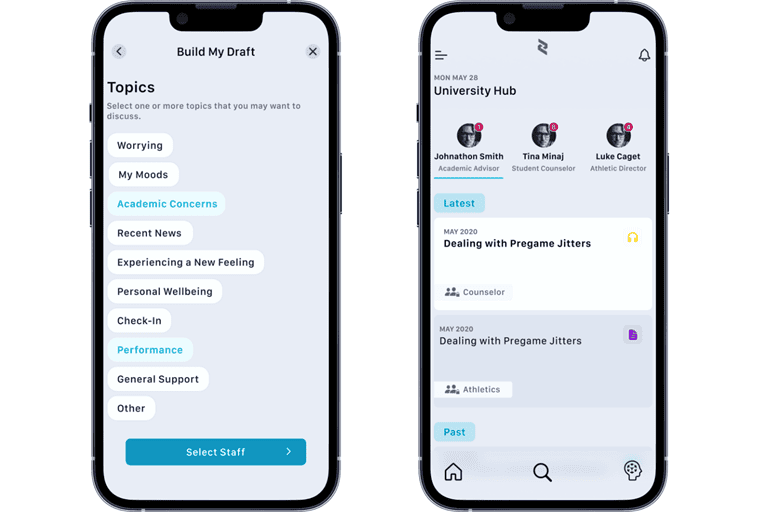
The Zone makes reaching out for mental health support easier for student athletes through the platform’s accessible and streamlined process (Image: The Zone)
“Performance anxiety is the biggest trigger we’ve seen over the last two years,” said The Zone Co-Founder/CEO Ivan Tchatchouwo, a former Division II basketball player whose own experiences with mental health challenges informed the founding of the app. “And it shows up in different ways. It’s not just performing on the court, right? It’s performing through the anxiety of being a first-generation college person on campus. Your parents pressure on you, or fans, friends and family. NIL pressure is causing performance anxiety because now it’s like, ‘I want to get paid just like a teammate.’
“Time management is another huge one that’s causing a lot of stress and anxiety for young people. And then also, lack of community. They’re in teams, but those two years have taken them away from knowing how to communicate correctly.”
Lehigh, Seton Hall University and St Francis-Brooklyn are all early adopters of The Zone; Memphis and Stony Brook previously used it as well. Former America East Commissioner Amy Huchthausen became such a strong supporter that she joined the company’s board of advisors. The Zone first connected with Big East leadership when hosting its fourth annual Student-Athlete Well-Being Forum at the University of Connecticut in June 2022.
Tchatchouwo says about 4,000 student-athletes are enrolled in the app, of which 2,800 remain active. Monthly participation is almost 25% whereas recent peer-reviewed research estimated that industry average for digital mental health apps is 3%.
“We spent the whole last year testing what works, what’s sticky, what doesn’t work. We’ve added a whole new content strategy,” Tchatchouwo said.
“That experience has to consistently be fresh for them, to want to go through it,” he added. “It also gets daunting to just see all the time, the same kind of inundating stuff. We’re getting creative on how we push that up. Machine learning is a big thing that we’re jumping bigger into and really understanding what it is that your data is saying. What is your storyline? What are your trends? And how do you the trends play out the life? And then what are the next steps for you?”
Tchatchouwo is quick to emphasize that The Zone is not a replacement to existing mental health services or professionals but rather a complement to or conduit for those options.
“The Zone is a state-of-the-art mental wellness platform that integrates perfectly into our institutions’ wellness programs,” Willett wrote. “It will make our services more effective by enabling a culture that prioritizes mental wellness, an important topic this day and age for our student-athletes. Our goals are to provide our student-athletes with a safe space and easily accessible resources to complement the amazing services being provided by our institutions when it comes to mental wellness.”
Other universities might try to buttress students by hiring additional psychologists to counsel student-athletes, but Tchatchouwo said that approach can suffer from inefficiency. Often the ratio of students-to-psychologists remains overwhelmingly high. Even then, the students need help discovering and accessing those resources. It’s important to have layers of defense, and The Zone seeks to drive awareness through content and to make specific referrals within the app to help maximize the use of what’s already available.
“You still need to educate the people that are on the forefront of what it looks like for their athletes,” Tchatchouwo said. “So we want to launch that education series for the coaches and the staff and administration, so they’re also educated, which makes the mental health investment even that much better.”
This article was brought to you by SBJ Tech, a Leaders Group company. As a Leaders Performance Institute member, you are able to enjoy exclusive access to SBJ Tech content in the field of athletic performance.
The case could lead to athletes having greater leverage over their digital identity and data.
A Data & Innovation brought to you by
Gervin, whose four NBA scoring titles are eclipsed only by Wilt Chamberlain and Michael Jordan, was one of Nike’s first signed athletes and was the very first to wear a popular Nike sneaker called The Blazer in a 1973 NBA game.
The lawsuit, which was filed in the Southern District of New York, alleged that the Ralph Lauren product has violated Gervin’s right of publicity and the Lanham Act, federal legislation that bars false advertisement and trademark infringement.
“I have worked hard throughout my career to build my name and reputation, and I will not allow any company to exploit it without my permission,” Gervin said in a statement. “I am taking legal action to protect my rights and ensure that consumers are not misled.”
In early 2022, Ralph Lauren’s website and affiliates began selling the Gervin Mid, a retro 1970s sneaker which, as the complaint claimed, bears a resemblance to the 1970s-era Blazers that Gervin wore. The suit alleged that Ralph Lauren did so without his consent or an offer of compensation and has continued to sell versions of the shoe despite being told to cease and desist by Gervin’s attorney.
The complaint alleged that counsel for Ralph Lauren at once point replied that the sneakers were “coincidentally” given Gervin’s surname by a French designer only because it “sounded good.” The fashion brand later altered the name of the product to the Ralph Lauren Mid, although secondary sellers are still offering the Gervin Mid by its original name and, as the suit said, the Ralph Lauren website still sells baby-sized versions of the shoe with Gervin’s name attached.
“We must protect those whose privacy and identity rights become exploited in today’s increasingly data, digital, online, and technology-driven world,” Michael Clohisy, attorney for Gervin, said. “George Gervin is suing Ralph Lauren to regain and control the commercial use of his name and likeness, as well as protect the next generation of athletes.”
The complaint said that, even after the name change, “due to the pervasive and permanent nature of the internet, the digital footprint damage was already done and the Ralph Lauren Mid is forever algorithmically linked to Gervin’s name.”
Representatives for Ralph Lauren did not immediately reply to a request for comment.
In September, Gervin became a brand ambassador for the launch of the “I Own Me” campaign, a joint initiative of sports marketing firm Fox Ellis Sports and IPrivata, a tech startup seeking to help athletes take ownership of their personal data and digital assets. It was built in conjunction with the HBAR Foundation, a nonprofit affiliated with the Hedera platform, a decentralized ledger that serves as a blockchain alternative.
This case could have far-reaching implications as athletes’ name, image and likeness (NIL) rights have become increasingly commercially viable, even for NCAA athletes, according to Fox Ellis Sports president Richard Lufkin.
“NIL for college and amateur sports has become a billion dollar market overnight,” Lufkin wrote in an email. “We believe the NIL Collectives are still significantly undervalued. The GG fight against RL will prove the true value of NIL is based on digital identity and data, which all athletes can leverage moving forward.”
In retirement, Gervin has led several philanthropic efforts, including the establishment of free public charter schools, and the player known widely as ‘the Iceman’ has remained involved in the sport. Most recently, he coached a team in the BIG3’s 3-on-3 league last year.
“Like his nickname, the Iceman did not bring this case in haste,” GS2Law chairman Robert Garson, the lead counsel for Gervin, said in a statement. “As an athlete, an ambassador of the game and a philanthropist, George Gervin deserved better. The Scriptures say, ‘A good name is better than precious oil.’ Clearly Ralph Lauren failed Bible class.”
This article was brought to you by SBJ Tech, a Leaders Group company. As a Leaders Performance Institute member, you are able to enjoy exclusive access to SBJ Tech content in the field of athletic performance.
The former NFL star, now a broadcaster with Fox, talks about wearables and tracking tech, as well as the implications of early specialization.
A Data & Innovation brought to you by
* * * * *
Greg Olsen has emerged as a breakout star in sports broadcasting, forming a dynamic duo with partner Kevin Burkhardt as the lead NFL broadcast team for Fox Sports. Olsen and Burkhardt’s biggest moment in the broadcast booth came on February 12 at Super Bowl LVII.
As a player, Olsen played 14 seasons in the NFL as one of the league’s premier tight ends for the Chicago Bears, Carolina Panthers, and Seattle Seahawks. He made three-straight Pro Bowls from 2014 to 2016 before retiring after the 2020 season. In March 2022, Olsen partnered with actor Vince Vaughn and former NFL center Ryan Kalil to launch podcast production network Audiorama. The company has received funding from Powerhouse Capital. Olsen, a New Jersey native and father of three children, hosts his own podcast called Youth Inc that’s focused on helping parents and coaches navigate the evolving world of youth sports.
Previous guests on Youth Inc include former NFL star linebacker Luke Kuechly, softball star Jennie Finch, NFL Pro-Bowler Marcellus Wiley, NBA forward Larry Nance Jr, MLB star Christian Yelich, Premier Lacrosse League founder Paul Rabil, and NASCAR legends Dale Earnhardt Jr and Kyle Busch. The show also sees Olsen interview legacy sports families, coaches, psychologists, and authors. Olsen coaches his 11-year-old son’s youth football team. He and his wife Kara also have twin 10-year-olds, a daughter who plays soccer and basketball, and a son who plays baseball and basketball. Olsen’s younger son was born with hypoplastic left heart syndrome and he received a successful heart transplant in 2021.
On the origins of his podcast …
It just spurred from a product of what my life has been. I grew up the son of a high school football coach, grew up around youth sports and high school sports. It’s what I’ve done pretty much my whole life. And now full circle after playing and making a career out of it, college and into the NFL, now I’m a father of three. I spend pretty much every night of my life at a kids practice, a workout, tournament on the weekends. And just from that experience I have a lot of unknowns, a lot of questions and things I don’t really understand or feel like I’m navigating correctly.
And if I don’t know it, someone who’s lived his whole life this way, how is anybody else going to do it? So we thought it would be an interesting concept for a podcast, to bring on some really interesting guests from all over the youth sports spectrum and have those conversations as a resource and a tool for other families, just like mine who are navigating this and trying to have the best practices for their son or daughter. It’s an ever-changing world. The youth sports world seems like every decade it’s unrecognizable, and for a lot of families it’s overwhelming. So we could be that resource, if we can bring on guests and specialists and experts to help share some of that wisdom and, and past experiences.
On his parenting approach and youth sport specialization …
We try to encourage our kids every season to try something different, to test their skill level, test their interests. Then if it’s something they don’t like, there’s no pressure to do it again. But we’re big believers of exposing our kids and exposing them to different sports, different styles of coaching, different types of kids as they get older for middle school and into high school. Find something that they really enjoy doing. Find something that when they practice, it doesn’t feel like work. It doesn’t feel like a chore. It’s something they wake up every day excited to go do. And I think the only way you do that is by kind of casting a wide net and exposing them to as many different experiences as possible.
I have three kids that have different abilities based on what sport, based on what season. And it’s not often about being the best kid or being the most talented, but maybe you find a sport that you had never played before and it’s the one you really wanted to spend the most time. That’s great. We’re on a constant search for that. When you’re young and the idea of just picking a sport at an early age I think could be a little dangerous because you don’t expose kids to finding what their true passion and what their true love is.
On safety conversations in youth football following Damar Hamlin’s cardiac arrest …
We’ve had a lot of those conversations, health and safety of all sports is of the utmost importance. In regard to the Damar Hamlin story, what we all watched unfold our national television was what appeared to be tragic, has kind of turned inspirational within nine days. Just today as of this call to hear that he’s been discharged and sent home. It’s truly remarkable. And, and to see the world kind of unites around him and in prayer and best wishes and faith it was pretty incredible and powerful to see.
In regard to the safety of football, I think that was such a one in a million thing. I think you hear about all these stories in all sports, and unfortunately, I don’t think that had anything to do with football. I think that happens to kids in all different sports — lacrosse, soccer, baseball. There’s unfortunate tragic stories of kids going into cardiac arrest or passing out. It’s unfortunate. I think obviously right now football kind of has the bullseye on it, because of all head injuries and the concussions. Watching that unfold, of course on live television with Damar was hard to watch. But I think when it all settles and all comes out, I think doctors and experts agreed that the risk of that happening on the football field is so small. It’s so rare that it’s really no greater risk factor of something like that happening on the football field versus any other number of fields. It’s tragic, it’s rare and thankfully, and I think everyone’s just thrilled that, that Damar is doing well. We’re just glad that it didn’t end tragically.
On wearables devices in the NFL and if the tech is reaching youth levels …
I think toward the end of my career, a lot of the GPS data tracking that we’d wear, wearable devices for acceleration and deceleration, velocities and load and whatnot. Not only was it implemented in our training, but it was even probably more valuable in our recovery. That that was kind of the last five or six years of my career, and I imagine going forward, it’s just going to continue to be more of a data-driven approach to how we care for athletes, how we train them, how we allow them to recover, how we load manage.
I think data and technology’s kind of at the forefront of a lot of things now, especially in the NFL, and, and I know it’s very common in basketball and, they use a lot of similar approaches in all major league sports. Whether or not that’s going to trickle down to youth level, I don’t know. I think there’s obviously like anything a cost involved. How practical is it for high schools and youth organizations to have the money to pay for that level of data and then obviously hiring the person who can interpret it and apply it.
I think there might be some time between now and when that gets down to the younger level. But I think as far as it’s applicability and value especially at the higher levels, I don’t think there’s any denying that it’s a really useful tool. It’s a really good gauge for coaches, trainers and strength and conditioning coaches that they don’t just have to use their gut instinct. They don’t have to just trust their eyes. They can really look at the data and say, okay, this athlete needs more or less attention in certain areas and, and they can kind of guide programming according to pretty precise data and whatnot. So that was something we used a lot and I only see it growing from here.
On baseball bat-tracking sensors used by his kids …
A lot of kids in baseball use those bat-tracking devices. You track your swing plane, your swing speed, exit velocity. You’re starting to see a lot of that kind of creep in now to the youth level. It’s something that my kids use. It’s something that we use at home and you get a lot of value at them. I think you’re starting to see wearables and technology devices that are a little more cost effective and a little more reasonable in that regard definitely make their way down to the youth level. People are using HitTrax and all sorts of different ways to measure how the kids hit and swing.
This article was brought to you by SBJ Tech, a Leaders Group company. As a Leaders Performance Institute member, you are able to enjoy exclusive access to SBJ Tech content in the field of athletic performance.
The first Briton to compete at both the Winter and Summer Olympics shares her thoughts on the growing significance of recovery practices.
A Human Performance article brought to you by our Main Partners

In competing in the two-woman event in the bobsleigh, alongside teammate Mica McNeill, Douglas became the first Briton to compete at both the Winter and Summer Games.
She had earlier competed in the 100m and 4x100m relay at the 2008 Summer Games, which were also in Beijing.
Douglas made the switch from the Tartan track to the ice in 2016. A number of the skills and attributes that served her well in sprinting lent themselves to the bobsleigh, although she was told that the sport needed “bigger, faster, stronger girls,” as she told RunBlogRun in 2022.
“It also depends what kind of athlete you are,” she continued. “In an Olympic 100m final eight girls line up but they’re different kinds of athletes – some taller, some smaller, some stronger – each with different attributes. Not all of them would necessarily do well in a bob. It depends on what kind of athlete you are and what you’re bringing to the table. People from the outside look at bobsleigh and say ‘Oh, you are running and pushing’ but there’s more to it than just sprinting behind the bob! I had to work on developing my attributes a lot”.
Douglas spoke about her career transition at the 2022 Leaders Sport Performance Summit in London and, when she came offstage, we asked her a few more questions about her approach to recovery and how it might have evolved.
“‘Evolved’ is the correct word,” she says, with a knowing smile. “My attitude towards recovery has definitely evolved, mainly because of transitioning into different sports, different arenas, but also being a more experienced athlete.
“When you’re doing more high intensity work and probably less volume, the way you can bounce back from a session is really important. For me, I probably take it, not a step back, but a different approach to my recovery. Before it was like ‘ice bath, making sure I’m rested’. I had a lot more free time, but with lifestyle, working, balancing being an athlete also with the time travelling to training and things like that, it was 24 hours already sometimes.”
Douglas combines her athletic career with a day job in the student recruitment team at the multinational professional services firm Ernst & Young.
She continues: “It’s always about finding nuances that I can do so that I can recover better. For me, I guess not being too stressed about it as well and worrying that I’m not recovering the best way and that it’s going to look different to how it looked before. In terms of strategies, for me, it’s about really basic things like what I do next when I’m finishing warming down – I was always really bad at doing that when I was training – but the more I got to train differently I then figured that it’s how I reset for the next session that was really important. It’s not always about that session that I’ve just done, it’s actually like ‘I’ve got to go back and do this session later or that session tomorrow, how are you going to get ready for that session?’
“Recovery is not just about what’s gone, it’s about what’s to come. So my thought process around it has changed and I guess it’s become higher quality as opposed to doing more of it. Across the board, I thought ‘what’s the best way I can recover?’ Rather than doing something over and over again.”
Was there a single experience that changed her thinking around recovery?
“When I originally transitioned into my sport, the one thing that really changed in me, thinking about my recovery, was actually the quality of work I was doing and not being able to train consecutively,” she says. “So before I was training six days per week back to back. That came down to about four or five days; so what I realised was that I was not able to produce really high quality work and I couldn’t come back from it, so I was missing out on some key sessions that we put in place because my coach and my team, we just hadn’t realised that I wasn’t able to deliver that quality in such a short window. ‘I can only give you this kind of quality of work, but then you’re going to need 48 or 72 hours before I can give you that high quality work again.’ So in terms of programming, it’s really important to know what you’re putting where because I wasn’t able to come back the next day, even if it was a mild session. I needed more time to give just what you wanted to get. That’s one of the things that definitely sparked ‘how can we do this better? What am I doing that’s not great?’ And I had to put my hands up and say ‘I just can’t do that, that’s not where I am right now as an athlete, but what can I do? What do we need?’ and then we just tick those boxes.”
When Douglas transitioned, her recovery needs changed and, as she points out, no two athletes in the British Winter and Summer Olympics system necessarily has the same requirements.
“I think it varies depending on the sport but also where you are in your career. So if you are a full-time professional athlete, your dedicated job is essentially to perform. So you’re looking at it from the point of view that all the hours in the day serve you to do X and that’s what you should be looking towards; that means your morning routines, whatever you do before and after training, how you recover. Your nutrition, your physiotherapy. All those kinds of physical components are dedicated to that.
“In a different stage of your life where you may not have that kind of flexibility, you might not have that privilege to be a full-time athlete. There’s considerable variables that you have to look at, whether it’s family life, they might have kids or they may have dependents in other ways; they might have jobs. Those things can get in the way. Even if you’re studying, your energy expenditure is completely different to what it was before.
“I think genuinely, wherever you are at that time in your life, athletes in the British system just go according to where they are, but a lot of the time it’s like the grass is greener for a lot of people. When you’re a professional athlete you’re like there’s so much time in the day but you don’t feel like there is because you are looking at your nutrition, you are looking at your physiotherapy, so you feel like you don’t actually have as many hours as you do. But if you wrote it all down, actually, compared to my peer, who works a part-time job 15 hours but does the same thing as me, I’ve actually got a lot more time to dedicate to recovery or performance, but I’m not utilising my time as well. So it depends on the athlete they are, the sport they are in, whether it’s a centralised system, whether you’re doing your own thing ad hoc, it will determine how you approach your recovery.”
How does she see attitudes to recovery continuing to evolve over the next few years?
“I hope that it’s not an afterthought,” she says. “It’s not always what you can produce, but it’s always what you can recover from. I remember training in the States, one of my coaches said to me ‘we’re going to push you really hard, I’m going to push you almost to breaking point, and then I’m going to give you a day off’. At first I thought ‘what on earth is going on?’ But then I got it because it enabled me to train at a higher quality level but just enough to where my body was like ‘I need the time off to adapt to this work and then go back again’. So I’m hoping it goes to the point where people say ‘let’s do quality over quantity’.
“Are you getting the correct amount of sleep? If you’re going to bed at 2am and sleeping for 10 or 12 hours, is that the same amount of quality sleep as if you were going to bed at 10pm and then waking up at 7am? It’s the same time line, but one is possibly quality over quantity. And if you look at it from a performance standpoint, you have to look at the marginal gains, you have to look at the small percentages of improvement that you make – and recovery is absolutely one of them.”
The South Carolina forward discusses NILs, sports science, and her deal with Six Star Pro Nutrition.
A Data & Innovation brought to you by
* * * * *
Aliyah Boston is, without question, the most decorated player in women’s college basketball. In 2022, the South Carolina forward became the first male or female athlete to win the Naismith Trophy as overall player of the year as well as Naismith Defensive Player of the Year. She was named the Honda Cup Collegiate Woman Athlete of the Year, joining a list of recent winners that includes Katie Ledecky, Breanna Stewart, Brittney Griner, Maya Moore and Candace Parker — as well as her coach, Dawn Staley, who did in 1991.
Boston, who is 6’5”, has rewritten South Carolina’s record book for just about every permutation of stats related to rebounds, blocks and double-doubles. She averaged 17 points and 17 rebounds in last year’s Final Four, as she led the Gamecocks to the program’s second NCAA national championship. She is the expected No. 1 overall pick in the 2023 WNBA Draft.
A native of St Thomas in the US Virgin Islands and a graduate of the Massachusetts-based prep school, the Worcester Academy, Boston has struck a number of NIL [name, image and likeness] deals with Under Armour, Bose, Bojangles, Crocs, Octagon Basketball, Orangetheory Fitness and, most recently, Six Star Pro Nutrition. When NIL deals became legal on July 1, 2021, Six Star Pro Nutrition announced three at midnight with women’s basketball twins Haley and Hanna Cavinder as well as then-Illinois player Edgar Padilla Jr South Carolina women’s basketball players are also all estimated to be earning about $25,000 per year through the Garnet Trust and NOCAP Sports.
On choosing to align with Six Star Pro Nutrition . . .
First of all, their want to partner with me was just something truly special because I know how big their brand is. But I also love their protein powder and their 4th Quarter Energy supplements. I really think that they do really well when it comes to training and recovery. They’re just a great partner, and I’m just super excited about it.
On when she began to emphasize nutrition and recovery . . .
It’s definitely been a major focus since I got to college because the pace of the game is just so much faster than it was in high school or anything that I’ve ever done. And so definitely in college I really started to focus on that, especially sophomore year going into junior year was definitely my key time to lock in and focus on that.
On college level training . . .
It’s definitely intense, but I feel like, as the time has passed, I’ve been able to adapt really quickly and I think I’ve done that pretty well. It was different because in high school I didn’t really have that focus — the strength coaches or the nutrition pieces that I needed. Now when I got to college, that was a major difference, definitely beneficial.
On sport science devices . . .
Definitely [we use] technology to track a lot of it. We have the Kinexons that we use [for load monitoring]. We have a jumping machine [force plate] that tells how fast or how hard we land and jump and how quick we get up and down.
On tracking sleep . . .
We actually used to do an Oura ring where it would tell us our sleep, but then I got a little nervous before I go to sleep at 1:00 AM and then my strength coach sees that and she’s like, ‘Why are you not in bed?’
On having Dawn Staley as a coach . . .
She understands the game very well, and so her IQ of the game has just helped us because she just directs us. She tells us really how things should go, and then when we really like look at it, she’s right. It makes it a lot easier because she never second guesses, she never questions. She’s always like, you know what? Like, ‘This happens, [then] this.’ She has a solution for every scenario that could possibly happen, which I just think is really cool.
On what she looks for in a brand when making NIL deals . . .
I look at them trying to help grow the game, which I think is definitely a priority. And I think Six Star is doing that well, especially, like they’re offering the trip to go to the national championship game, whether it’s the girls’ or the men’s game, which I think is something truly special because there are probably so many fans out there that might not ever get to get the chance. They can apply on the website, try to get in and they have a great chance to win.
On why growing the game is such a passion for her . . .
There’s a lot of attention on the women’s game specifically right now. I think we have a lot of talent, and I do think there are a lot of younger people looking up to us. If they could come to a game, they would love it, they would probably talk about it a lot more. But also [I want] to help grow the game in the future. When our time is done in college and we get to the league, we want people to continue to watch us — the same fan bases that we played for years and years or even a fan base that we competed against — and to say, ‘They’re no longer in college, let’s see how they do in the league.’
On her message to young girls who might be interested in basketball . . .
I would tell them to set high goals for themselves. Don’t think anything is untouchable because that’s what I did — a little girl from the islands trusted God, set high goals to go to college, play in the league. And so I’d definitely tell them to also do the same thing, no matter what, whether it’s not basketball, but something else. Make sure they set their goals themselves and surround themselves with people that support them all.
On her rebounding . . .
All the coaches I have in South Carolina have definitely helped, but I just track the ball and then I’m just like, ‘I need to go get it.’ Rebounding is a big part of South Carolina basketball, and Coach Staley emphasizes us rebounding defensively and offensively. And so it’s really just the will, the want, to go get the rebound to give yourself your team another possession or to help them push the ball in transition.
On taking pride in playing the post . . .
Everybody wants to now shoot the ball, dribble. Everybody’s a big guard. But playing the position that I play, having my back to the basket, I truly enjoy it because I feel like not a lot of people right now like the contact, like to bang, but I do. And so I think it goes to my advantage. But I also want to be growing my game as an individual, so definitely being able to knock down that jumper, take people off the dribble is definitely a priority, but I also think it’s important to be able to go and bang down there and score through contact or even get a stop defensively.
On how she views brand-building. . .
Social media is definitely a crucial part of it all because that is where you get your fan base, your followers, and partner companies. They look at that, your social media engagement, how you get along with fans.
At first I wasn’t a big social media girl. I had to be convinced time after time after time by my parents to post a simple post on Instagram. Before NIL started, my mom was like, ‘Aaliyah, you need to lie build a following.’ And I was like, ‘OK, sure. I’ll try. I’ll post the beach picture, let me post this.’
But now I really enjoy it. I enjoy posting, I’ll TikTok, I’ll post on Instagram, Twitter. So I definitely think it is an important role, though, because this is how you build your brand, who you are. So companies can see this and be like, ‘Oh, I like this, I like that.’
This article was brought to you by SBJ Tech, a Leaders Group company. As a Leaders Performance Institute member, you are able to enjoy exclusive access to SBJ Tech content in the field of athletic performance.
The former Head Performance Coach at LAFC is bringing genetics into the performance equation and he believes it will be a game-changer.
A Data & Innovation podcast brought to you in collaboration with
“Our genetics are just a code that says ‘here’s how your genetics express here whether that’s cardiovascular or it’s cellular or it’s your body composition or whatever it might be and here’s how we need to influence your environment’,” he tells Joe Lemire and John Portch on the People Behind the Tech Podcast.
“‘Environment’ being how do you train? How do you recover? What stresses do you have in your life? All of that stuff influences our genetics. Although our genetics never change, they can be expressed on or off. Kind of like a dimmer switch at any point.”
After more than a decade as a performance coach, taking in roles at the LA Galaxy, US Soccer and LAFC, Daniel joined 3×4 Genetics as the Head of Enterprise Sales in late 2022.
The Seattle-based startup believes its ability to analyze a person’s genes, whether they are an athlete or not, enables them to recommend lifestyle changes. In the case of athletes using its GENEFIT program, that might mean diet, training, recovery or other forms of preparation.
He anticipates a time when elite teams routinely call upon a geneticist to inform their performance.
During our conversation, Daniel also discussed:
John Portch Twitter | LinkedIn
Listen above and subscribe today on iTunes, Spotify, Stitcher and Overcast, or your chosen podcast platform.