Data gleaned from college football may help to shape equipment upgrades and even rule changes in the future.

Programs at the Universities of Alabama, North Carolina, Washington and Wisconsin were the inaugural college teams to begin wearing the NFL’s impact-monitoring mouthguards last fall, meaning the league is now doubling its research efforts to eight universities and more than 250 college players. NFL sponsor Align Technology, the maker of Invisalign clear aligners, conducts dental scans of all participating college players. Those digital models are then sent to Virginia-based Biocore to build the personalized sensor-embedded mouthguards for each player.
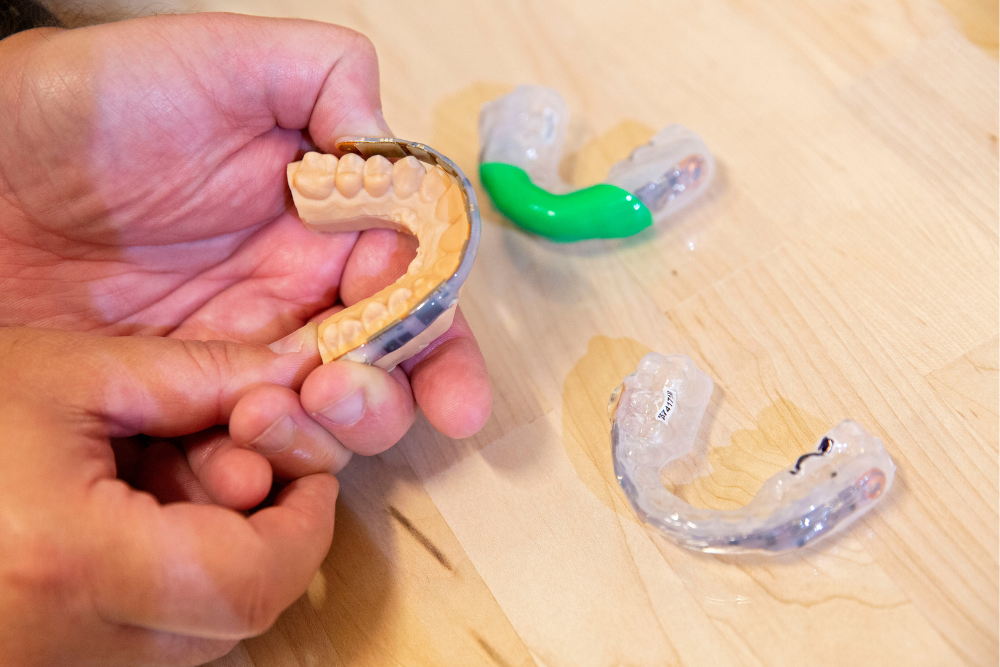
An engineer demonstrates on a player’s mouth mold where the sensor will fit once installed into the mouthguard.
The NFL’s mouthguards calculate the force and location of each impact through measuring linear and angular acceleration. Mechanisms for how football players typically get concussed can vary by their position. For example, quarterbacks tend to sustain hits to the back of the head on plays where they brace themselves against incoming defenders, according to the NFL’s SVP of Health and Safety Innovation Jennifer Langton.
“The mouthguard will tell you the frequency and the severity of impact for each player. If you have enough data in aggregate, you can have it by position,” Langton says. “We have the insights to provide to helmet manufacturers so that they can start to design helmets to mitigate that impact that we are seeing from the data for that position. We want to really stimulate the helmet marketplace.”
Studies of data from the NFL’s mouthguard program is led by Biocore CEO Jeff Crandall and Dr. Kristy Arbogast of The Children’s Hospital of Philadelphia, both of whom serve on the NFL Engineering Committee. Players on at least four NFL teams have worn the league’s smart mouthguards since the 2019 season, after the devices were developed as part of the league’s $60 million commitment to its Engineering Roadmap. Each participating NCAA program receives statistical analysis of player mouthguard impacts specific to their team, but the identity of the players is protected.
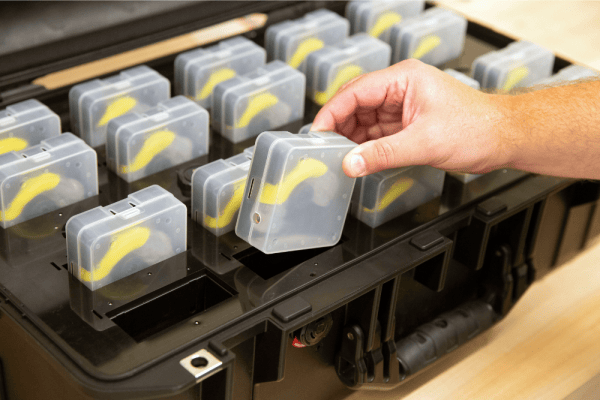
There are control and charging cases for the mouthguards instrumented with sensors.
“Data collected across the mouthguard sensor program is anonymized and analyzed by NFL and NFLPA’s independent engineers,” Langton says. “Only our engineers have access to that data, it does not come to the league office. So when they do the analytics, they provide it so that we can put injury reduction strategies together. But it’s only the independent engineers that have access to any of the mouthguard sensor data, whether NFL or university.”
The 2021 season saw players on 10 NFL teams wear mouthguard sensors, but the league decided to scale back the program to four NFL teams this season. In September, the NFL said it’s recorded a 25% reduction in concussions in each of the last four seasons. Other recent health and safety efforts from the league include the Guardian Cap worn by players during training camp, medical marijuana studies, pre-season load management wearables, and the Digital Athlete system created with AWS that uses computer vision to detect player head impacts during games through video analysis.
The NFL is not the only professional league implementing smart mouthguards. World Rugby outfits players with impact-monitoring mouthguards from Prevent Biometrics, while soccer’s English Premier League does the same through its collaboration with Wales-based Sports & Wellbeing Analytics. Medical leaders from the NFL and English Premier League met in London last month to share their latest findings around soft tissue injury reduction, mental wellness, concussions, and head impacts.
“The mouthguards is a program that we could roll out to the EPL,” Langton says. “And then in addition, with our digital Athlete Program, we are able to identify and track players and their impacts on field, so there is an open opportunity for them to collaborate to use some of those technologies as well,” she says, adding, “there is a huge opportunity to collaborate with other sports so we can share with them what we have built as far as technologies, how we’ve collected the data, and how we’re measuring head impacts in our game so that they can do the same for their sport.”
This article was brought to you by SportTechie, a Leaders Group company. As a Leaders Performance Institute member, you are able to enjoy exclusive access to SportTechie content in the field of athletic performance.
This recent Leaders Virtual Roundtable brought together members of the Leaders Performance Institute to discuss the coaching and application of mental skills.
A Human Performance article brought to you by our Main Partners

Recommended reading
Psychology and Purpose: Creating a Thriving Team Environment
How Do you Get that Little Bit Extra Out of a Person’s Performance?
Framing the topic
The practice of psychology or mental skills is always a field of interest across the Leaders Performance Institute – there is always a curiosity to learn about how others are integrating and influencing the practice across different environments. Therefore, within this topic-led roundtable discussion we wanted to delve into our members’ current thinking around what is making the most impact and what some of the associated barriers are to embedding effective psychological practice.
Due to the popularity of the topic, we split the group into two to cover more of the detail.
Group 1:
Group 2:
The wearable infrared performance clothing brand wants to make the interaction with recovery and performance technologies as simple as getting dressed.
An article brought to you by our Partners

KYMIRA, on the other hand, would like to turn such thinking on its head, as its Founder and CEO, Tim Brownstone, tells the Leaders Performance Institute.
“We’re creating products that can be taken anywhere,” he says while pointing to a selection of KYMIRA’s products on a rail over our shoulders. We are onsite at the 2022 Leaders Sport Performance Summit at Twickenham Stadium in London where KYMIRA are exhibiting.
The rail contains a range of KYMIRA’s sweatshirts, leggings and tracksuits. All are designed with the company’s infrared-emitting fibre technology which is designed to enhance performance, accelerate recovery and reduce injury risk. It is a small selection of KYMIRA’s apparel, which is medically certified – an important detail given that those certifications prevent potential conflicts with a team’s contracted kit supplier – to assist athletes with recovery and rehab.
“Because it’s clothing; whether the athlete is sleeping, on a flight or a bus, they can gain the physiological benefits. They can also be used in the practice facility too,” Brownstone continues. “Our core ethos is making the interaction with bio-responsive technologies as simple as possible.”
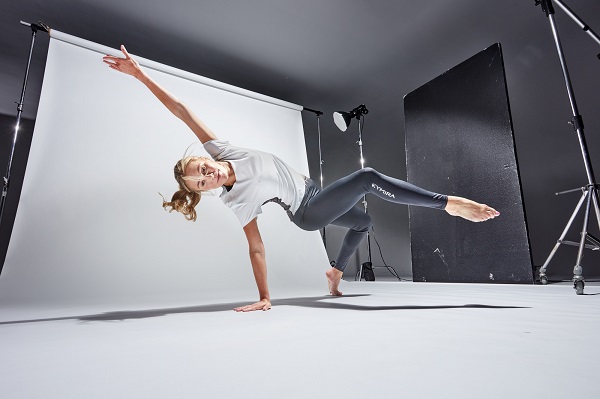
KYMIRA’s sweatshirts, leggings and tracksuits are designed with the company’s infrared-emitting fibre technology which is designed to enhance performance, accelerate recovery and reduce injury risk.
KYMIRA’s sporting clients include numerous teams from across both NFL and NCAA colleges covering 15+ sports and counting in North America as well as elite soccer and multiple international rugby union teams in Europe. All these teams are tapping into a well of expertise born of ongoing medical research and certifications.
Just days earlier, KYMIRA completed a fitting with an English Premier League team, which turned into an education session for the players. “The club identified the products that they want to make available to their athletes, we visited their training centre, and set up a pop-up KYMIRA area. We also had a microscope so we could demonstrate some of the biological effects to help the athletes visualise what is going to happen and we were there to answer questions such as ‘what does it do for me? Does it fit? What colours do you have?’ Some had already been using our products, been on the website, and come with some scientific questions. But the important thing for us is getting that face time with the athletes, so that they can ask their questions, they can be curious.”
Brownstone is a biochemist who specialises in photobiological wound healing. He is also a former competitive rower and is well-placed to explain to athletes how KYMIRA’s clinical research translates for their benefit.
“It’s reducing injury probability, it’s making sure that you’re more available to be in more games and help your team win,” he continues. “It’s extending your career; we have a big population of aged athletes and I think we’ve given the biggest an extra five seasons. Their agents like that, their families like that, and they’ve been able to keep doing the sport they love for longer.”
Such visits as the one described above are a valuable opportunity to build rapport with athletes and practitioners. One individual, an NCAA performance director, reached out with a series of questions. It is also not uncommon for athletes to post online about their use of KYMIRA products. “They’ll post something on Instagram, we’ll share it saying ‘thank you’ and then we use that chance to engage. Then when athletes are buying directly through our website, we’ll typically follow up and say ‘we’re pleased to see that you like the product. We’d like to know more’. Building that rapport enables us to collect honest feedback.”
Brownstone again points to the rail of KYMIRA clothes. “Each of those has been developed because teams and athletes have said ‘hey, I sleep in my recovery tights but I’d rather be in pyjamas – can you do pyjamas?’ or ‘I don’t really want pyjamas – can you do bedsheets?’ or ‘can you do tracksuits, or tights, or loose-fitting garments?’ We’ve evolved that range with demand and that close back-and-forth during the developmental period to make sure that fit and style is on point.”
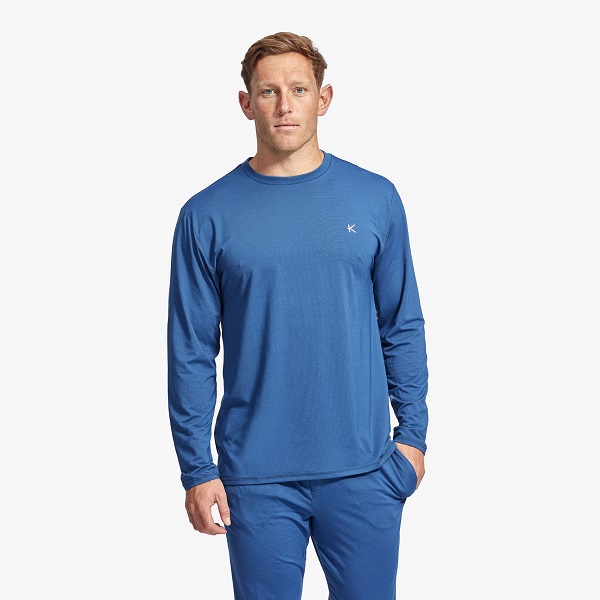
KYMIRA has developed a range of sleepwear that can improve sleep quality by 15.8%.
Functional and applied benefits
Brownstone divides the benefits of using KYMIRA into the functional and the applied, with data drawn from case studies with the company’s clients.
“From a functional standpoint, they will stimulate nitric oxide production, which will increase circulation,” he says.
“There’s a pain relief response, which is actually the same pathway as taking an opiate. Not as potent as morphine, for example, but it can help with chronic pain relief, which is where we get that 25% reduction in pain scores coming from. There’s an improvement in sleep quality of 15.8% based on research that’s been conducted on the products. Cells respire more efficiently so they’re consuming less oxygen to achieve the same work output; that, plus the circulation, you’ve basically got an increased supply and a reduced demand, which yields a 20% increase in tissue oxygen levels, which means there’s more oxygen there for the cells to use from a recovery and performance standpoint.
“From an applied benefit, we have an ecosystem. So preparation, performance, recovery, including travel and sleep, and rehabilitation. The ring around all of that is injury mitigation. So from a preparatory standpoint, wearing the products before a game setting, for example, allows you to accrue some benefits. So if you wore a KYMIRA product for 60 minutes, for 90 minutes afterwards you’re still going to have accelerated nitric oxide production, which is boosting circulation, helping the muscles to become more supple and less prone to injury.”
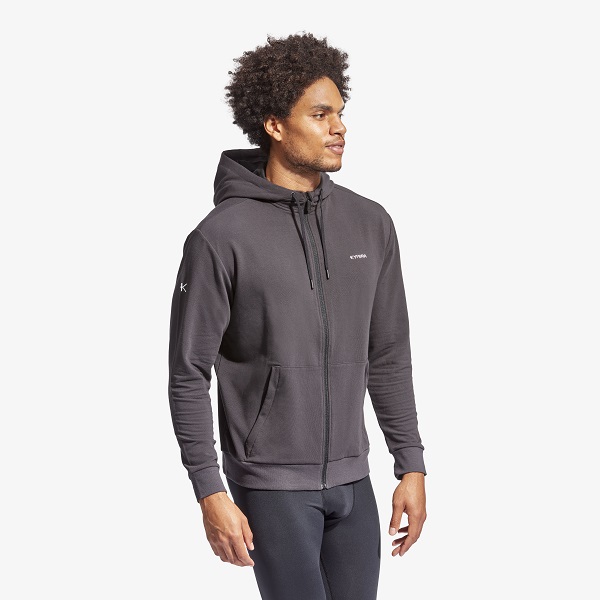
KYMIRA has evolved its range with close back-and-forth during the developmental period to make sure that fit and style is on point for athletes.
The benefits sound remarkable, with one user – a British SAS operator – wryly enquiring if KYMIRA deal in ‘black magic’. Sceptics naturally abound and Brownstone welcomes their questions.
“Sceptics are really important because everyone should be sceptical of confident claims like ours because they’re quite bold. They’re substantiated but they’re bold because they’re substantiated. I don’t think anyone should look at the list of benefits that are on the wall over there and just go ‘that’s fantastic’. They should ask ‘how do you do that? Why do you do that?’
“The sceptic often becomes the biggest advocate because they’ve made us work harder for the reward, in essence. In dealing with sceptics, we just let the data speak for itself. We’ve got tens of case studies, tens of clinical trials, there is a mountain of evidence.”
As we head into 2023, Brownstone and KYMIRA are optimistic given their own plans for the new year as well as the increasing levels of education around all aspects of recovery in sports. Some teams are even using their athletes’ experience with KYMIRA to underline their fundamentals around sleep, nutrition and recovery.
“That’s quite cool and we hope that trend continues.”
The catcher discusses his use of the Trajekt pitching machine, heat maps, raw data, iPads and much more besides.
His 2022 season with the Mets was slowed by injuries — a fractured hamate bone and strained oblique — but McCann caught the team’s combined no-hitter on April 29 in a game started by Tylor Megill. McCann helped to anchor the pitching staff along with teammate Tomás Nido as New York made its first playoff appearance since 2016.
McCann, 32, is a California native who starred at catcher for the University of Arkansas. The Tigers selected him in the second round of the 2011 MLB Draft, and he made his big league debut in September 2014. McCann was also the club’s nominee for the Roberto Clemente Award, an honor for community service.
On his use of video and data to prepare for opposing pitchers . . .
A little bit of both. You watch previous matchups against them that you’ve had individually. You watch how he’s pitched other hitters from the same [side] ± whether you’re righty, lefty — and then you also just pay attention to tendencies. You try and see if there’s any tendency to pick up on, whether there’s a certain time in the game, certain count, where you can [expect] a certain pitch.
It’s almost like a poker game. You got to play your odds at times. When you’ve got a guy — and Darvish definitely has the capability to do this —who can be on his game and not being missing spots, you got to take a shot [at guessing]. You might look foolish at times, but other times it turns out to be a big reward.
On whether he prefers to review heat maps or the raw data . . .
Probably a little bit of variety. I like to at tendencies, and then I like to see the actual video just so I can see pitch shape. Obviously, there’s nothing quite like standing in the box and seeing pitch shape. But if you can watch it on video and see, ‘Hey, this is what it looks like when it’s really good. Here’s what it looks like when there’s a mistake.’ Hopefully then you can hunt the mistake or and lay off the really good one.
On trying WIN Reality or the Trajekt pitching machine . . .
I’ve never tried [VR]. I have tried our pitching machine, Trajekt. The way I compare it for guys is, if I’m hitting off of a guy that I’ve caught for an entire season, it doesn’t mean I’m going to have more success off of him, but I know pitch shapes. I know what his pitches are going to do. And it gives me that background information to know what to look for. And that’s exactly what the Trajekt does.
[I’ve used Trajekt] just a few times. It’s not a ‘feel good’ machine. It’s just different as far as timing. So it’s hard to get in there and take swings. I like it to just go in and just track pitches and see pitch shape. It’s still just popping out of a hole. It’s timed up with the release point, but the thing that’s interesting about it is, you don’t really realize how much your eyes tell you at release point. You’re actually picking stuff up in the angle of the wrist and different things like that, that you don’t get from just a hole spinning the ball out.
On the vision of hitting . . .
I’ve heard Manny Ramirez used to look at the backdrop because you want to go from big focus to small focus. If you’re focusing real hard, you can’t focus on a small area for an extended period of time. So going from a big picture to a small picture is what most guys try to do.
On how he prepares for other hitters as a catcher . . .
A little bit of everything, honestly. Looking at the numbers, looking at heat maps. Looking at trends, the most recent things that are going on, and watching the video. Does the video — what I’m seeing with my eyes — match up with what the numbers are telling me?
For example, this is why heat maps are good because then you can have heat maps that have expected values [of contact] versus actual values. You might have a guy that looks like he’s struggling on sliders, and then you pull up his video against sliders and every ball he hits is on the money but just going right at somebody. So in that case, is he really struggling on sliders or is he just having bad luck? That’s why I like a little bit of everything: numbers, heatmaps and video.
On balancing opposing hitter tendencies with his pitchers’ arsenals . . .
[Deciding to] go with pitcher strengths vs. hitter strengths, hitters’ weakness, pitchers’ weakness. At the end of the day, you don’t want to lose on your worst pitch, right? If you’re going to get beat, you want to get beat on your best pitch, but how does that match up with the hitter? So it’s the cat-and-mouse game, it really is.
On working with each individual pitcher’s interest in this info . . .
That’s exactly it, every guy’s a little bit different. Some guys are really hands-on, and other guys are just, ‘Let’s just go with the rhythm of the game.’ So that’s part of getting to know each guy and knowing what makes them tick and having a relationship with them.
On using the dugout iPads during the game . . .
I like to look at them defensively more than offensively. I like to be able to go back and look at pitches that we may have gotten [called a strike] or not gotten, see where the strike zone is being called to know, Can we go keep going there defensively? Or do I need to make my hitters aware that, ‘Hey, he’s giving a little bit off the plate, he’s giving a little bit down, off the plate — whatever it may be.’
Offensively, yes, I like to look, just like maybe a quick check and balance, but I don’t like to sit there and study something in the game because, in the game, if you’re trying to think about your hands or your feet, you’re missing the most important thing and that’s seeing the ball. So it’s a touchy subject in the fact that I think it’s really good, but it can also be paralyzing at times.
This article was brought to you by SportTechie, a Leaders Group company. As a Leaders Performance Institute member, you are able to enjoy exclusive access to SportTechie content in the field of athletic performance.
Nyaka NiiLampti explained how the NFL’s Total Wellness project supports young players across the league.
A Human Performance article brought to you by our Main Partners
Help athletes to take care of themselves
Nyaka NiiLampti, the VP of Wellness & Clinical Services at the NFL, spoke of the mental wellness work she does with the leagues rookies at the 2019 Leaders Sport Performance Summit in Atlanta. “My first question is asking ‘how many of you have heard that this will be the longest year of your life?’. They all raise their hands,” she said. “Then I ask ‘how many of you actually feel like this has already been the longest year of your life?’ and most of them will raise their hands as well”. A significant part of the NFL’s Total Wellness project, which NiiLampti oversees, focuses on helping young athletes to be intentional in pursuing their wellness. “[We tell them] all of the new experiences that you’re going to have over the next eight to ten months, you need to know exactly who’s your support, how do you take care of yourself, what does that support look like?” added NiiLampti. “Know it now because that’s where we see the mistakes happen, that’s where we see the impulsive behaviours, that’s where we see decision making that could really propel the end of your already really short careers… any mistakes that you make in this space are going to be really costly”.
Set up athletes for their post-playing transition
NiiLampti pointed out that the average NFL career is short even by elite sport’s standards. It is essential for her to understand the culture of the league and its impact on young players. “Anything they see as a potential for someone to see them as not performing up to par in any area is a risk of unemployment,” she said. Make sure you are aware of what those unique cultural factors are but then also know the specific factors about your sport. For example, with the NFL, we know that the average career is 3.5 years. That means you’re going to get guys coming in who are super young who are not going to stick around very long; so how can you make sure you’re providing as much education as you possibly can on the front end?”. This is essential because NiiLampti has found that players “Scotch tape and bubble gum themselves together” due to college and professional football tending to be crisis-focused. She added: “You come into the league thinking ‘yeah, there’s some things I could probably work on but I’ll worry about it after I make my money and transition out’.” Organisations must change this outlook and provide support for their athletes. “We’re going to give you additional skills that might actually help you prolong your career. But [teams should] make what happens in that transition out get a little bit easier. We know the transition out is going to be difficult anyway but what are the sort of things we can do to minimise the difficulty?”
Seek out the low-hanging fruit
There are always quick wins to be found. “One of the things that we talk about is we know that every team is going to have a population of players who struggle with injury,” said NiiLampti, who put the injury rate in the NFL at 100%. “So how do you put things into place that’s low-hanging fruit? How do you put things into place for that population? It’s being aware of who’s your population as well as what are the unique cultural pieces of the environment that you work in? Start small… then that word of mouth grows… if it’s high quality and done well that word of mouth travels”.
Promote sport as a platform for increasing self-awareness
The idea of athletes as role models is as true as some of the best clichés. “We know sports also has an incredible platform and if we can educate and we can use this to further the conversations, particularly around mental health or aspects of wellness; there’s a trickle-down effect,” said NiiLampti. “To what degree, if we are using that platform to further educate the rest of the world, particularly young men and particularly young men of colour, then I think the healthier that men in the NFL get the healthier that young boys get in this country, the healthier families get, and so the healthier we are collectively”.
The organization’s biosensing technology has the ability to take wearables to the next level in high performance.
Forget the subjective messaging and, well, more than a few teams still use that urine color chart as a hydration monitoring tool. In 2022. While there have been advances in the space, many are either still low-tech — weighing a player in and out of a session to track sweat loss — or are hard to scale beyond a single moment in time, such as the use of a pen refractometer in a urine sample.
In the coming weeks, however, a continuous hydration monitor will be commercially available as Nix Biosensors launches its first product. The sensor-laden patch — which has already received in excess of a half-million dollars in pre-orders — will calculate sweat rate and composition, providing users data-driven feedback of how much fluid and electrolytes they need to replenish.
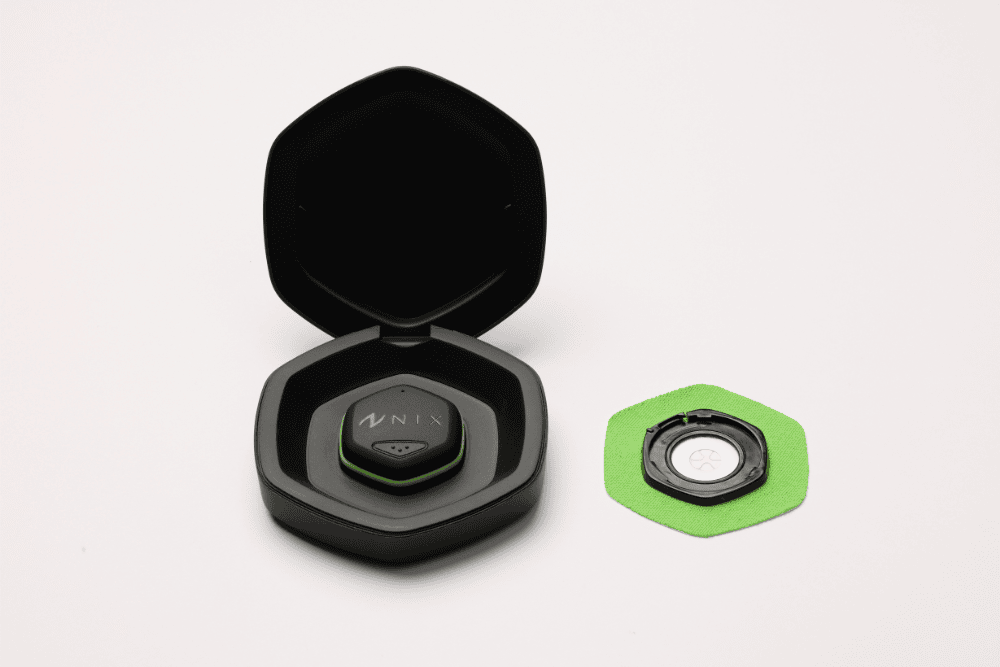
The biosensing wearable analyzes sweat and prescribes a personal hydration strategy in real time.
“Hydration for us is just the first of many applications that I think fall into that category of health and wellness data that consumers might like to have without having to go to the doctor and that they can act on — on their own — with that personalized data,” Nix founder and CEO Meridith Cass says.
Over the past few years, Nix has been conducting pilot programs with MLB, NBA and NFL teams as well as athletes in motorsports and tennis. It was a finalist in the 2021 NFL 1st and Future Competition and, in August, for instance, 14 IndyCar drivers wore the biosensors in practice sessions prior to the Bommarito Automotive Group 500 in St. Louis, with the research done in conjunction with PitFit, a motorsport performance group. Nix partnered with fitness industry creative agency SweatWorks on help with the hardware and UX development.
Nix Biosensors has also assembled a formidable team of advisors. The scientific counsel includes Bob Murray, the founder of the Gatorade Sports Science Institute; Brad Wilkins, the former director of the Nike+ Performance Lab and lead physio on the Breaking 2:00 project starring Eliud Kipchoge; and Doug Casa, the CEO of the Korey Stringer Institute. Sports advisors include Olympic and Paralympic marathoner Shalane Flanagan and Tatyana McFadden as well as ultramarathoner Dean Karnazes.
What a Bluetooth-enabled patch can do is individualize hydration monitoring, which is challenging to do with endurance athletes traversing large distances or in large team settings because of the numbers. Nix added Pratik Patel as its director of human performance this year. Patel most recently was director of performance nutrition and an assistant strength coach with the New York Giants and previously worked for several major college programs.
“[The goal] is to empower the practitioners and the athletes to understand what their information is, and drive that behavior change,” Patel says. “I think that’s one of the biggest things that we’re trying to do as a company, instead of playing this guessing game where we have blanket recommendations for everybody.
“I’ve been in that space, I know how difficult it is trying to wrangle 90 to 110 athletes at one time, and you want to do right by them because all of them have very varying levels of educational knowledge and background with sports, nutrition and hydration,” he adds.
Football training camps are typically held in the summer, with players wearing heavy pads in high heat and humidity for two sessions a day. Add in the size of the linemen, and Patel says some could lose 15 to 18 pounds of fluid in a practice despite regular drink breaks. Cass told a SportTechie Pro Day audience that athletes are 29% slower when in just a mild state of dehydration, among other impairments. Nix cites studies indicating that 87% of endurance athletes are afflicted with some degree of dehydration, with a 2% loss of body weight a threshold for significant performance depletion.
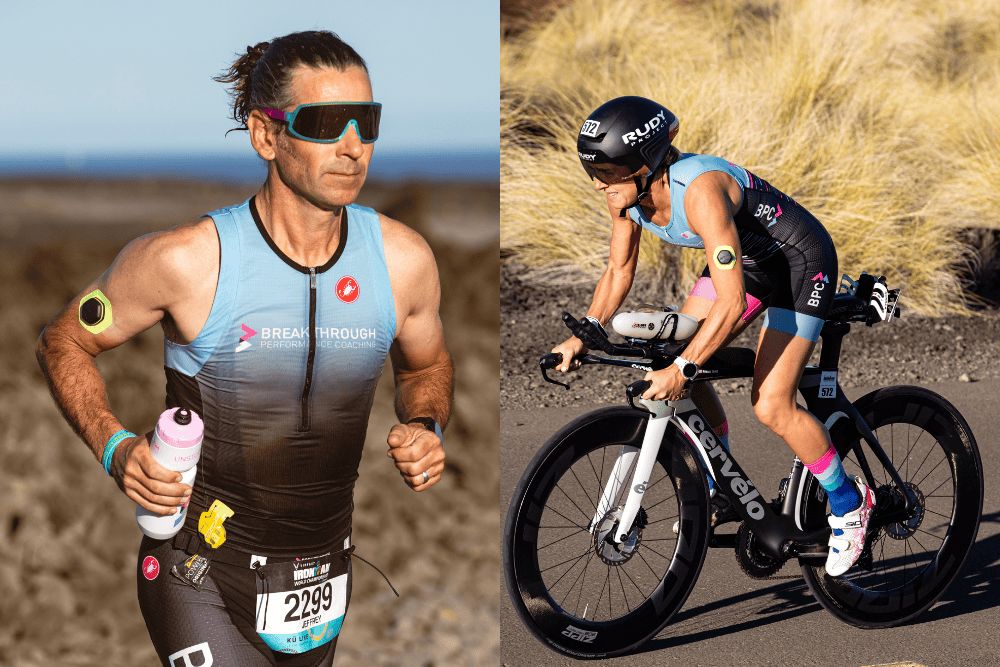
The Bluetooth-enabled patch allows endurance athletes to individualize hydration monitoring.
“When it gets past 2%, you start seeing decrements in speed, power, accuracy, cognitive function,” Patel says.
The founding story of Nix stems largely from Cass’s own experiences. She played basketball at Bryn Mawr College and took up marathon running in her 30s, where she struggled with her own hydration. At the time, the Harvard Business School graduate returned to campus as an entrepreneur in residence. Her charge there was to build something with broad health care implications.
“For me, that was what has now developed into what we define as biosensing,” says Cass, who had been the principal of the Children’s Hospital Boston technology development fund. “That word didn’t really exist as much at that time, but it was this concept of, ‘Let’s borrow what we can from the healthcare industry of real, true, validated electrochemical biomarker data and marry that with what we think wearables have done right and leave behind what they have done wrong.’”
The experienced led to Nix Biosensors, whose wearable weighs less than a half-ounce. There are integrations with Apple Watch and Garmin, as well as some bike computers. It can be set to send customizable push notifications. The user can ask the app to say how much fluid he or she should consume every 10 minutes or to receive a prompt to drink another predetermined volume — say, four ounces — whenever the body needs it, no matter if it’s been five minutes or fifteen.
Nix also builds a sweat profile — the Nix Index — for each individual, combining fluid and electrolyte losses, sweat rate and environment to build a personal predictive model that can given recommendations for expected hydration needs in future workouts. The electrolyte information of popular sports drinks is pre-loaded into the app for reference.
“Because whether you like Gatorade or Skratch or Maurten or Tailwind or whatever your product is, you can then compare the exact composition of your sweat to the exact composition of that beverage,” Cass says.
Patel has seen the power of data in informing his athletes’ decisions. Referring to other wellness wearables such as Whoop or Oura, as well as blood panels, he discovered that the players respond to concrete information on inflammatory markers and other nutritional deficiencies.
“It’s like a light bulb in their head saying, ‘Oh, I’m not as healthy as I thought I was,’” Patel says. “And it became that much more empowering and easier to actually educate them say, ‘This is why the recommendation is for you to eat this, this and this and supplement with this, this and this.’ It’s because you have levels that aren’t optimal for where we want them to be for you as an athlete, and you potentially could be teetering on the lines of exposing yourself to be more risk for injury.”
This article was brought to you by SportTechie, a Leaders Group company. As a Leaders Performance Institute member, you are able to enjoy exclusive access to SportTechie content in the field of athletic performance.
Dan Lawrence of Matchroom Boxing discusses his work in combat sports and beyond.
A Human Performance article brought to you by our Main Partners
Dan Lawrence, the Head of Performance at Matchroom Boxing, watched his former boxer, the now-retired George Groves, learn this in real time.
“Yes, he had a team. He had myself, a conditioning coach, we had his head coach at the time,” Lawrence tells the Leaders Performance Podcast. “He was steering the ship at that time, whereas I don’t think that was the right way to go.”
In fact, “you have to have a cohesive team working with one sole goal”.
Here, Lawrence discusses his work in combat sports while also touching upon:
Dan Lawrence Twitter | LinkedIn
John Portch Twitter | LinkedIn
Listen above and subscribe today on iTunes, Spotify, Stitcher and Overcast, or your chosen podcast platform.
AWRE Sports uses camera vision, cloud technology, skeletal tracking and streaming to create automated film clips.
If only the numbers could all be aggregated onto one simple video.
Then again, that’s the goal of AWRE (pronounced Aware) Sports, a startup that relies on camera vision, cloud technology, skeletal tracking and streaming to create automated film clips that can be overlayed with any baseball player’s wide swath of personal metrics.
The company is currently deploying its hardware and software at the Division I level with the University of Maryland, at the DII level with Erskine College, at the DIII level with Keystone College, at the JuCo level with Eastern Oklahoma State College, at the prep level with IMG Academy and, yes, even at the youth level with Brick Little League in New Jersey.
The result is an application that serves as part recruiting platform, part training platform, part game-stream platform and, down the road in an absolute dream scenario, as perhaps a competitor of the scoring app and automated highlight company GameChanger.
“Obviously, GameChanger’s literally everywhere – that is a monster,” says Ken Spangenberg, AWRE’s chief sales officer and older brother of the St. Louis Cardinals’ Cory Spangenberg. “But I think there are differences that kind of separate us from anyone else. One, the fact we’re trying to capture everything, not just games. Hopefully, people are ultimately going to choose: ‘Do I want to watch on GameChanger or do I want to put it on AWRE?’”
If nothing else, AWRE has a vision…as well as computer vision. It doesn’t intend to be the scoring app that GameChanger is, although it does stream games. Instead, it wants to elevate its streams to another stratosphere with radar and sensor integrations.
The company’s roots are in golf. CEO and co-founder Chris Clark, a former college baseball player at DI Wofford, is married to the former Vanderbilt golf coach Holly Clark and saw his wife struggle trying to organize the team’s data, scorecards and spreadsheets. Circa 2012, he developed software that allowed her players to store all of their vital golf analytics on their iPhones, giving birth to a company he called, “Birdie Fire.’’
But his passion remained baseball, and he went on to develop a predictive spray chart model that appealed to most of the college programs that demoed it. One of those schools, Oregon State, went on to win the 2018 College World Series, claiming Clark’s spray chart predictor helped them position their defense and strategize pitch location during their title run. From there, Clark had no choice but to expand.
“I’ve got this [Oregon State] coach wanting to give me a testimonial,” Clark remembers. “I’m like, ‘Hell, now I’ve got to figure this out. It may never get better than this. How do I leverage turning this into a business in the baseball space?’”
He ended up having a purposeful conversation with his Wofford college roommate, Steve Johnson, who ran a New Jersey baseball training academy named Invictus with business partner Rob Corsi. The discussion turned to the smorgasbord of baseball technology out there: the Pocket Radars, Stalkers, TrackMans, Blasts and so on. Johnson mentioned how his facility’s travel ball players needed those sorts of data points to be recruited but often had no way to afford or gain access to such high-end tech.
Clark then talked about how college programs could afford all those devices but could barely aggregate it. He mentioned how graduate assistants were always tasked with writing down launch angle, exit velocity, spin rate, bat speed — arduous and imperfect tasks.
The outgrowth of those discussions became the genesis of AWRE. Clark and Johnson — with the help of a chief technology officer Dave Johansen, COO Corsi and later Spangenberg — debuted the company in their comfort zone: college baseball. Due to their connections from their days at Wofford, Clark and Johnson made a decision to reach out to universities large and small to trial their hardware and software.
The hardware involved the installation of six cameras at each college’s baseball field: a centerfield camera, a camera above home plate and two more cameras on each dugout so both a hitter and pitcher could be filmed from their open and closed sides. Meanwhile, the software involved camera vision, machine learning and artificial intelligence that enabled each pitch or swing to become an automated video clip.
Next was adding the video overlay. Integrating with Pocket Radar, for instance, started with a pitch speed being uploaded to the Pocket Radar cloud, where it would then be synced with the AWRE cloud. With other apps, such as the Stalker radar gun, the overlay vehicle may be Bluetooth instead of a cloud, according to Johansen. He says for the TrackMan V3 ball flight tracking, there is a listening device that marries the data with the video. With Blast Motion, the data is overlayed through separate downloads and uploads, and the same with Yakkertech.
“We started to sell it to colleges,” Spangenberg says. “The reason for that is it’s the cleanest target. You know what the fields are going to be, you know they’re going to pay their invoices on time, you know they’re going to be receptive to the technology. And we’re full. So at this point, we have a waiting list.”
In other words, anyone streaming a Maryland Terrapins baseball game this season through AWRE will be able to toggle between the six cameras, but also see the metrics of each pitch and swing on company’s game center. But streaming games isn’t the platform’s long term goal: streaming analytics is.
The company will soon trial a platform on smart phones that will enable parents or fans to log in, start streaming any game through the AWRE app and immediately have automated clips of every pitch or swing that can be found on player profiles. If the fan or parent can bring a Pocket Radar or Stalker or Blast with them, or if the venue is equipped with AWRE software, the metrics can be overlayed onto every clip – turning every swing or pitch into a video that can be sent to a college or shared over social media with verified analytics.
GameChanger has begun to do the same during games, but AWRE’s hardware and software can be deployed in batting cages or bullpens for just as valuable training data.
“We’re democratizing recruiting,” says Spangenberg, a former head baseball coach at DIII Arcadia University. “The one-percenters have the high-end platforms like like Yakkertech or Track Man. It’s the Power 5 schools. But I think what we’ve built and why it’s interesting is it can also service an 8U team. So we’re not looking at 1 percent of the market, we’re looking at the entire market.”
AWRE’s longer term goal is to eventually use its skeletal tracking — which is currently part of its machine learning — to measure metrics like pitching velo and exit velo on its own…without integrating all the grab-and-go technology.
“Then our app can give people feedback on their swing mechanics or pitch mechanics in real-time,” Johansen says. “Our product can say ‘Your swing is most like Mike Trout. Or Aaron Judge.’ How cool would that be?”
This article was brought to you by SportTechie, a Leaders Group company. As a Leaders Performance Institute member, you are able to enjoy exclusive access to SportTechie content in the field of athletic performance.
Ben Williams of Ineos talks to James Morton about the true nature of innovation as he perceives it and managing change when people are instinctively reluctant.
An Industry Insight Series Podcast brought to you by our Partners

“One thing I do believe is: to harvest a culture of innovation we need human engagement and we need collaboration.”
Williams, who serves as the Ineos Grenadiers cycling team’s Integrated Performance Lead and the Ineos Britannia sailing team’s Head of Human Performance, is our very special guest on this Science in Sport Industry Insight Series podcast.
He sat down with SiS Director of Performance Solutions, James Morton, to discuss his varied professional background and the approach to innovation he has cultivated in each of his roles in sport and beyond.
Also on the conversational agenda were:
James Morton LinkedIn | Twitter
Ben Williams: Twitter | LinkedIn
Listen above and subscribe today on iTunes, Spotify, Stitcher and Overcast, or your chosen podcast platform.