24 Apr 2026
ArticlesSwingVision’s app is ideal for tennis players who all rely on speed, being able to manage costs, and often operate with limited connectivity on the courts of the world.
Main Image: SwingVision

More recently, SwingVision has added a beta feature that yells “Out!” if a shot lands beyond the court boundaries. That audible line call takes a split second for the iPhone to process the image and make its determination, a rapid reaction only possible by the computing power of the chips Apple puts in its smartphones, bypassing the need to transmit to the cloud.
“That’s really only possible on device,” said SwingVision CEO Swupnil Sahai. “Because we’re processing 1080p at 60 frames per second, that’s a lot to process. And if you were to send that to the cloud and then have it process it and then run it back, you definitely can’t do that in half a second. And you certainly can’t do that on any court in the world.”
The proliferation of cloud providers and their processing have transformed sports tech for the better, democratizing access to storage and AI models, but there remain key use cases when the cloud isn’t the answer — when requiring speed, managing costs and operating with limited connectivity.
“This is a bit of a trend in my view, is that you see something that really works well in the cloud, but you need it speedier,” said Mike Davies, Fox Sports EVP of Technical and Field Operations.
Davies shared that observation in the context of his network’s IndyCar coverage. Fox and Indy Motor Sports Productions contracted with Lumen Technologies recently to install 10-gig fiber-optic cables at every track to support on-location servers. That enables faster rendering of data overlays on the driver’s eye camera and the use of a product called XtraMotion, which uses generative AI to turn regular footage into high-frame-rate video.
Sahai was a Tesla engineer before founding SwingVision, and the automotive manufacturer processes its Full Self-Driving cameras entirely with on-car hardware. “So that’s how I’ve always thought about this problem, is it should be done on device,” he said, calling it a philosophical decision.
“We just drew a line in the sand from Day 1: We’re doing this on device, we’re not going to use the cloud at all,” Sahai said, adding, “It just felt like it’d be way too expensive for a consumer app to run it in the cloud.”
Financial transparency can help. Gamecode, a soccer analytics startup, includes an upfront estimated cost for each predictive model run on the cloud.
Many sports tech firms offer a hybrid approach. Pixellot, whose AI cameras stream and analyze up to 20,000 games every weekend, is an AWS technology parter. Pixellot CTO Gal Oz once told SBJ that his company couldn’t have scaled without the cloud and “making Amazon do the heavy work. It’s not magic. I like the phrase that ‘there is no cloud, it’s just someone else’s computer.’”
Even though Pixellot CEO Doron Gerstel recently quipped of AWS, “They love us,” he added that every camera has an on-premises server to reduce the cost and expedite the video feedback for coaches and athletes. By the time the game ends, highlights are waiting.
“Now if you are doing it over there on the cloud, one of the most problematic things is you are on queue — if you want to pass the queue, fine with them, pay more,” Gerstel said. “The question is how much attention I’m losing if you’re not getting it immediately after the game. We are dealing with audience that is all about here and now.”
Gerstel added that he believes cloud computing prices will go down in time, and remaining affordable and timely is critical for the user. (Cloud pricing can be very dynamic based on time of day, volume of data, speed of turnaround, etc.)
GameChanger’s app was used to track more than 8 million baseball and softball games last year and is receiving an upgrade to stream in 1080p HD this year. Its President, Sameer Ahuja, said his group has invested in technical talent to optimize the efficiency of databases to minimize cloud reliance and cost. New innovations around video compression help retain quality while uploading faster.
And Ahuja previously shared that, internally, they often say “a bet on GameChanger is a bet on Apple and Samsung” because the smartphone providers are powering more on-device processing. That echoes a point from Sahai about SwingVision which, to date, is only available on iOS devices, but soon will expand to Android.
“A big reason why we haven’t gone to Android so far is because the compute wasn’t there,” Sahai said, saying it will finally be possible later this year. “We’ve started development for that, but even then, it’s only the very latest Androids, whereas on iPhone, you can go all the way back to iPhone 11.”
SwingVision’s electronic line-calling has been used in some junior tournaments as it applies to the ITF for certification that would enable use at higher levels. The audio alerts are, for now, a consumer feature to replicate the Hawk-Eye Live experience enjoyed by professional tennis players. But emitting that seemingly simple audio alert necessitates a huge behind-the-scenes engineering effort.
“Orchestrating all those different models, getting those to run as fast as possible,” Sahai said, “[required] a lot of experimentation and iteration for us throughout several years, honestly, of basically building our own architectures and getting it to run efficiently.”
This article was brought to you by SBJ Tech, a Leaders Group company. As a Leaders Performance Institute member, you are able to enjoy exclusive access to SBJ Tech content in the field of athletic performance.

21 Apr 2026
ArticlesArtistic Director Alexander Campbell explains his academy’s approach with reference to his own experience as a professional ballet dancer.
“The reality is that not any one teacher is going to know, if you’ve got ten people in front of them, what’s best for each individual person in that class,” he told an audience at Leaders Meet: The Talent Journey last year.
“It’s about having that humility or that understanding that it’s OK not to know that definitively, for it to be a work in progress.”
Campbell, who spent 19 years at the Royal Ballet and Birmingham Royal Ballet companies, retired in 2024 to take up his current role, which gives him responsibility for the academy’s teaching across more than 80 countries.
It’s a position that grants him insights into the expectations, motivations and development needs of the next generation of dancers; and, as a self-proclaimed “sports tragic”, he was delighted to address an audience of Leaders Performance Institute members at the Royal College of Music in London.

The Amaryllis Fleming Concert Hall at the Royal College of Music in London where we hosted Leaders Meet: The Talent Journey in April 2025.
Below, we explore, through the lens of Campbell’s own ballet career, his approach to meeting that challenge head-on with the RAD.
Meet students halfway
Campbell’s teaching mindset has been influenced by his underwhelming student experience at the Royal Ballet School, which he attended on a scholarship between 2003 and 2005.
The main problems were the teachers and the environment. “I struggled so much that I wasn’t sure whether I wanted to continue pursuing a career in ballet,” he said.
He had arrived from his native Sydney mid-term, which didn’t help him to settle, but it was also down to the type of prescriptive teaching that routinely irks younger generations today.
“We weren’t really encouraged to step out of our lane. It was like, ‘you know the steps, you focus on this, and we’ll worry about everything else,’” he added.
As Campbell explained in a 2017 interview with the Daily Telegraph, “we weren’t encouraged to ask too many questions. I think it took me too long to learn that, because I was naturally inquisitive, and wanted to know why we were doing certain things.”
When reflecting on that time for Leaders members, he said it was “such a missed opportunity.”
His turn-of-the-century experience as a ballet student shows that the need for teachers to meet their students halfway is not new. Two decades later, talent environments in performing arts, and in sport, must be designed to engage a cohort that wants to know ‘why?’
Promote early sampling
Campbell followed in the footsteps of his maternal grandparents, Valma Briggs and Mario Desva, who had both danced with Ballet Rambert in London.
By the early 1990s, Briggs was teaching at Academy Ballet in Sydney; Campbell’s mother worked in the same school as a manager. He began dancing at the school at the age of five.
He played grade cricket too. If his dancing talent was no surprise then nor was his cricketing ability as his father Alan was a professional player.
Campbell might have gone down that path himself had circumstances been different, but there was no pressure from his parents to choose one over the other; his teachers at Academy Ballet were similarly minded.
Of his cricket and school studies (he was homeschooled from the age of eight), Campbell said, “my parents were keen for me to remain interested in other things so that I was ‘Alexander, a person with various interests’ rather than just ‘Alexander, the ballet dancer’.”
Much like the world of sport, the performing arts has increasingly moved away from the idea of early specialisation. On Campbell’s watch, the RAD promotes the type of holistic development he enjoyed; and he is not alone. “Thinking about and knowing certain conservatoires, thinking about their talent pathways and their talent identification, how they train people is being reconsidered.”
The shift towards co-creation
As Campbell explained, RAD teachers must be able to adapt to a generation of students that desire agency in their own development.
“As educators and teachers, it’s really easy to go, ‘OK, I have to have this knowledge and I have to demonstrate to them that I know how best to get from A to B’,” he said.
That isn’t true, of course, but it requires humility on the part of the educators; and much of Campbell’s focus is on equipping dance RAD teachers with the “understanding that it’s OK not to know things definitively, for it to be a work in progress, and that it is going to be different, not just for each individual, but for each year [grade] at the school.”
Campbell’s decision to persist with ballet beyond his experience at the Royal Ballet School was influenced by his “opportunities to work with other coaches and have different experiences” at the Birmingham Royal Ballet. When he joined the company in 2005, it enabled him to see “a different environment and different way of operating that felt much more aligned to the sort of experience that I’d hoped for and wanted to have.”

Campbell demonstrates a plié for an audience of Leaders Performance Institute members, who imitate his movements with varying success despite his words of encouragement.
Care is a baseline expectation
We know that wellbeing is a performance enabler; younger generations sense it too.
Campbell wants RAD staff to be role models of wellbeing. He said: “Educating our teachers on that and the importance of looking after themselves could have the most impact in a fairly short period of time.” It must start with him as Artistic Director; a fact of which he is “acutely aware”.
The RAD has also made efforts to improve safeguarding in its schools and increase the accessibility of its courses, particularly for students and participants with additional support needs. “We’ve got teachers who have parents saying ‘my child has additional needs but they love dance, they really want to be part of it; is that something you can do?’ And a lot of our teachers will find a way or have found a way, but a number of them feel nervous about the responsibility that entails. They don’t want to get it wrong.”
Campbell and the RAD are working to provide those teachers with the right tools. “We give them the support so they can say ‘this is how you go about it or if you want to find out more this is where you would go’. I think this is giving us the best opportunity to broaden our participation in ballet and dance.”
A broader definition of success
Campbell admitted that all his “Plan As” came off in his professional life. He is a prime example of talent meeting opportunity.
However, as he said, “my self-worth and my personality were not determined by whether I was successful in that pursuit.”
He makes sure this is reflected across the RAD’s curricula. “I don’t want to just provide for those people who want to get to the top level and be the very best.” Rather, he also wants to support the career aspirations of students who say, “I enjoy this, I’m quite good at it, but actually I don’t have that real drive to pursue this one very narrow thing.”
Their love of the art form might lead to a career in dance teaching or one of the industry’s that surround the performing arts such as lighting, set design or even physiotherapy with a specialism in dance. The RAD will support those aspirations. “It’s understanding that there are more opportunities than just being the dancer on the stage.”
What to read next
17 Apr 2026
ArticlesIn a significant development for women’s basketball, the new league’s player-first, development-minded vision has led to significant investment in its sports science personnel and resources.
Main Image: Getty Images

Susan King Borchardt, who has been a fitness consultant to Sue Bird, Kelsey Plum and Breanna Stewart, joined Unrivaled as its Director of Performance and Recovery. Borchardt’s first call was to Lindsey Elizondo, an athletic trainer and physical therapist with the Magic, who joined as Director of Medical.
“We crafted this idea — her coming from the NBA, me working with some of the higher-level individuals privately in the WNBA — and just saying, ‘This should be the standard,’” Borchardt said courtside before the semifinals in Brooklyn. Phantom went on to defeat Mist for the championship 84-70 in Florida on March 4.
Their department has a headcount of about 25 and is supported by an extensive array of technologies, such as Plantiga insole sensors, Kinexon wearables, Springbok Analytics MRI scans and VALD devices for the weight room. Katie Buria, Head Athletic Trainer at the Dream, is Unrivaled’s Director of Sports Science managing the relationships with the tech providers.
“What we’ve seen is that will raise the bar everywhere else that we go,” Elizondo said. “So if we set that bar here, that’s going to feed upward into the W, it’s going to feed into the NWSL, it’s going to feed into all of these other sports and force the hand of this is what it takes to perform at this level.”
The athletes have full ownership of their data and can choose whether to share it with their WNBA teams and personal coaches. Unrivaled didn’t have exact figures available but indicated that the majority of players opted into using the tech, with Borchardt calling it “part of our culture.”
“This is a very player-driven league, and they care about player safety and wellness. The treatment has been top of the line,” said Breeze G Paige Bueckers, praising both the staff and the tech, such as “the data and what we look like on the court with our Plantigas or our [Kinexons] or our chips that measure our asymmetries — little stuff like that goes a long way in basketball.”
Plantiga has made women’s sports a priority, with its CEO Quin Sandler saying of the work with Unrivaled, “Together, we’re not just collecting movement — we’re helping build the future of applied sports science for women.”
Her teammate Cameron Brink, who suffered an ACL tear in June 2024, had her first Springbok scan — which uses AI to turn an MRI into 3D muscle data — while rehabbing with Unrivaled last year and then again before this season.
“Once you have a big injury, you want to learn how to optimize everything, so all these tools really help,” Brink said. “It is really reassuring to get MRIs done like that and just a full body scan. From here you can see how you’ve grown and improved and what areas you still need to work on.”
Elizondo noted the unprecedented position Unrivaled is in by collecting all of this data since the league’s inception. By having access to data for every player, the performance group can identify trends and understand the demands of the elite 3-on-3 game, which are different than 5-on-5. That helps them train the players with more specificity and develop more targeted treatment and recovery protocols.
Tracking longitudinal data enables Unrivaled to share baseline metrics for each player, and for rehabbing players, it helps reinforce the value of the hard work. Borchardt saw it firsthand with one athlete recently.
“For that athlete to have those two visual pictures to be like, ‘Wow, this is actually really working’ — that was so motivating,” she said.
Unrivaled CEO Alex Bazzell emphasized the league’s player-first, development-minded vision as a reason why it has invested so deeply in the personnel and products to make the performance team what it is.
“These players are thinking long term, and the expectation is not just your compensation but resources of off the court,” Bazzell said. “Our staff and who we hire, those are the ones that the players need to trust. You have to build trust in a 10-week period, too. That’s not easy.”
This article was brought to you by SBJ Tech, a Leaders Group company. As a Leaders Performance Institute member, you are able to enjoy exclusive access to SBJ Tech content in the field of athletic performance.
AS Béziers Hérault Head Coach Rory Teague ponders the question of skill acquisition and delivers his six considerations.
These are the words of Rory Teague, who notably spent a year and a half between 2016 and 2017 working as a skills coach under then England men’s rugby union Head Coach Eddie Jones.
A decade on, Teague serves as the Head Coach of French Pro D2 club AS Béziers Hérault and, as he tells the Leaders Performance Institute, would not copy Jones’ appointment in southern France.
“I wouldn’t myself employ a skills coach,” he says. “I think every coach who coaches an area of the game should be able to coach the skill of their area. ‘Skills coach’ as a term has become archaic as coaching has moved along.”
He feels that assigning skills coaches to coaching units risks diluting accountability. “When something breaks down, you’re not going to just look to the skills coach who’s sat in the room waiting for the moment to say ‘oh, that’s me’,” he continues.
“If the lineout doesn’t go well because of the throw, who’s responsible for that? Is it the lineout coach or the throwing coach that comes in once a week? I would prefer that my forward coach has understanding of the skill of throwing and takes responsibility for it.”

AS Béziers Hérault Head Coach Rory Teague. (Image: Rory Teague / LinkedIn)
Over the course of half an hour, Teague ponders the topic of skill acquisition from a coaching career spent as a skills coach, unit coach, and now a head coach.
Here are his six of his main considerations.
1. The difference between ‘skill’ and ‘technique’
“Ultimately, skill is technique performed under pressure,” says Teague, who has been influenced in his thinking by coaches including Rick Shuttleworth (a consultant at organisations including the Rugby Football Union and UK Sports Institute), Scott Wisemantel (Attack Coach at the NRL’s Paramatta Eels) and, of course, Jones (who is now in his second spell as Head Coach of the Japan men’s team).
“They were three incredible coaches who helped me along the way,” he adds. “They pushed me to go and find out what is ‘skill’; what is the difference between ‘technique’ and ‘skill’? Because there’s a big difference.” Skill, he suggests, is the ability to select, adapt and execute actions in a pressured context. There is little value in a player passing the ball ten metres to their teammate repeatedly at the end a training session. “They’re only working on their technique, because there’s no external cue for when they’re passing.”
It follows that skills in rugby develop as a consequence of an interaction between mechanics, cognition and match context. “If I stand in front of the player and they run towards me and I run towards them, they’re interacting with the environment i.e. me, them, and the distance – and then they’re performing the technique.”
There is also a psychological and emotional dynamic that goes beyond cognition and technical execution. All these elements can affect skill expression in a match situation.
“There’s no substitute for being in the saddle,” adds Teague. “Hot feedback in the moment can be so powerful because you’re living that moment with the player.” He will use the moment to talk them through a situation.
He will readily halt training sessions to allow kickers to practise too. “Get them to kick when their heartrate is up and their emotional state is variable rather than just doing 50 kicks at the end of the session – because that’s just technique.”
2. Implicit and explicit learning both matter
At the heart of discussions about skill acquisition is the dichotomy between information-processing approaches (skill acquisition as learning to plan and execute correct movements by processing information internally) and ecological approaches (skill acquisition as learning to perceive and act in context by interacting with the environment).
Teague is not a dogmatist, even if he leans towards the latter. “I like implicit coaching where the exercise and your questions give the player the feedback,” he says. “What exercises can you design whereby you don’t have to say anything, the player performs the act, and the exercise gives the player the feedback? If you look at, say, goal kicking or throwing, you want the player to self-regulate when they’re in the moment and feel the pressure.” He will look to ask a series of questions that “get the player to think about where they want the ball to end up, where they want the ball to go versus breaking it down too technically”. He will also be mindful of the timing too, both pre and post-match.
However, when it comes to explicit approaches, “it’s not that those guys you’re very direct with are not taking control of their own journey and development, they just need to be told.”
It comes down to knowing the individual athlete. “I’ve worked with some players where I’ve fluffed it up too much and asked too many questions and they just want you to go ‘tell me exactly what you want me to be doing, tell me exactly what I’m doing wrong, tell me exactly how I can get it better’. Whereas with others, you can ask ‘what do you think?’”
Skill acquisition requires the coach to understand what the best approach is and why. Additionally, while it may be ideal for the session design to act as the teacher, there will be times when the coach needs to check for understanding.
3. Ask yourself: what will help the player?
While it is important for players to be drawn towards training sessions, whether by coaches placing balls in their line of sight or by making sessions enjoyable, the guiding principle should be whatever will help the players in that moment.
“Do you want your players to think your coaching drills are really good or do you want players to think ‘you’ve taught me how to pass better’?” As ever, the answer “depends on where you are” with the players in question.
In any case, “sometimes you have to get through the reps and you can’t deviate away from repetition”. Teague says: “I’ve seen coaches try to do these fast exercises to appease players and sometimes they can be so complicated that the players don’t buy into it because of how complex it is.”
There will be times when a coaching intervention can harm a player’s development and Teague will consciously be less prescriptive as a game week develops. “As you get closer towards the game, you’re looking at confidence versus correction” because sometimes less is more.
4. The coach is only part of the player’s journey
Between 2022 and 2023, Teague worked as a forwards and backs coach with Racing 92 where he had the opportunity to coach Finn Russell, who is widely considered one of the best fly-halves in the world.
Teague reflects on that period and what he refers to as the “culture of extras”, which is the work that the world’s best players continue to do on their basic skillsets.
“Finn would ask to do some extras when he thought it was right for him,” says Teague, who explains that Russell’s experience guided their training interactions. “Sometimes he’d do them on his own, sometimes he’d ask a coach to be there to give him some feedback, sometimes he’d want a coach there just to keep him company.”
Teague has also worked at school and underage level where he employed a more directive approach but in an environment like England or Racing, “telling them what to do probably isn’t the most intelligent thing.”
Instead, “I think the more players take control of their own skill development, the more you as a coach just have to be part of that journey, not driving that journey for them.”
5. Be patient, it’s a journey
The Leaders Performance Institute asks Teague what he knows now that he wished he knew whilst working as a skills coach.
“Skill acquisition takes a lot more time than I thought,” he says, adding that it could take a season for a goal kicker to become 10% better. “I don’t know if patience is a skill, but I wish I understood more about the learning journey of the player in terms of skill; that each player can pick things up at different rates.”
It comes back to the player-coach relationship. “Players need to take responsibility around what they want to be working on; and that’s a shared process with the coach. Obviously, if there’s something the player has really not identified that they need to work on, and if the coach has to tell them, then so be it.”
Teague will decide when to intervene, when to step back, and when to change the task.
“If you’re clever in your design, you can keep pushing and changing the design incrementally as you see the player evolving and becoming better. Equally, you can take it backwards if the player isn’t getting it. So it’s that ability to move up and down the bandwidth of the learning journey where, ‘OK, I’ve set the start point here at three, I need to go back to one before I can move to four, five and six’.”
6. Data informs, it does not decide
When it comes to using data in skill development, Teague describes it as a question of “data versus feel”.
He says: “You can look at the number of passes per game, for example, but then I think you have to really sit down, watch the video, watch the technique, watch the context, look at the environment that they’re in at that moment in time in the game, conditions; there’s lots of different things.”
As ever data must inform judgement, not replace it; it must provide a meaningful talking point. “I think data can serve its purpose, but what we don’t want to do is go too much down the data route without looking at the individual data moments in the game.”
As a final question, the Leaders Performance Institute asks Teague what advice he has for coaches working in skill development.
“Go and find the theory behind skill acquisition. I think it will change you. It will change mindsets, definitely.”
What to read next
How Do you Develop the Most Expert Coaching Workforce in World Football?
27 Mar 2026
ArticlesThe Nets recently opened the Brooklyn Basketball Training Center where a couple of weeks ago SBJ’s Joe Lemire had been invited to test the Shoot 360 tech its coaches use in training youth players.
Main Image: Brooklyn Sports & Entertainment

Across the street from Barclays Center, the Nets recently opened the Brooklyn Basketball Training Center where a couple of weeks ago I had been invited to test the Shoot 360 tech its coaches use in training youth players.
Standing in front of one of the baskets outfitted with Noah Basketball’s shot-tracking tech and Shoot 360’s graphical user interface, I awaited the pass, dribbled back across a few lines and confirmed with coach Michael Collins that I was now behind the NBA three-point line. I was. And so I took a shot.
The net swished, and the LED screen lit up green — Shoot 360’s Splash Zone confirmed that my shot’s arc, depth and left-right alignment were just about perfect. Bird would have been proud.
Or at least my fellow ginger sharpshooter, Brian Scalabrine, who looks like family and played for the Celtics and Nets. (My two-time fantasy basketball title team was named Big Scal’s Doppelgängers.)
The Nets have long run free youth basketball programs in the borough, reaching 40,000 kids annually through 235 schools as well as Boys & Girls Clubs and other community centers. But this space now gives them a centralized location to run daily programs, largely targeting children ages 6 to 17. The Shoot 360 tech, Collins noted, offers a range of drills and sills — even passing and dribbling — so kids have a balance of autonomy and structure, so they can “use this technology not only to create a workout, but then also have fun.”
Don’t take just my word for it, but my brother and I brought some of our kids — ages 9, 11 and 14 — to test out the tech. They loved it and didn’t want to leave despite working up a light sweat and pushing close to tip-off an NBA game.
Three stations have responsive, large-screen LEDs that show videos demonstrating technique and then offer interactive exercises. The kids were asked to dribble a certain way and then fire passes at numbered targets. At one point, the screen showed a memory game that also required passing accuracy: players bounced the ball off the card to flip it over.
“One of our main lenses is, how do we help players get better faster?” said Shoot 360 founder/CEO Craig Moody, a former college basketball coach.
The company’s founding story involved Moody seeing his teenage son and his friends prefer to play NBA2K inside rather than go outside and shoot hoops on a sunny day. “If I could build a gym like a video game,” Moody thought to himself, “I’d have it made.”
Just before our family visit, the training center hosted a group of young campers from NBA Brazil, while another international group visited a similar facility operated by the Cleveland Cavaliers. The coaching staffs at the two sites synced up the Shoot 360s at each location and organized a real-time contest — truly the video game ideal Moody had long envisioned.
Marissa Shorenstein, Chief External Affairs Officer at Brooklyn Sports & Entertainment, said there’s a dual purpose to the franchise’s investment.
“We do it because we believe in giving back to the community, but we also do it because we know that engaging youth is the best way to engage long-term fandom for the Brooklyn Nets and the New York Liberty,” she said, noting that the Knicks, for example, have decades of inherited fandom whereas the Nets have only been in Brooklyn for 13 years and the Liberty for half that time. “For us, really creating that connective tissue with the community through the youth is what we believe is going to differentiate us long-term to build that generational growth.”
But there’s an appeal for adults, too. Collins said Nets players periodically pop in and shoot on the tech-enabled baskets. Jamal Crawford, Thad Young, Trae Young, Sue Bird and Breanna Stewart are among the former NBA and WNBA players to invest in Shoot 360. And weekend warrior adults (like me) had fun taking shots and getting feedback. It’s akin to what TopGolf, Home Run Dugout and other sport-tainment venues are offering.
“Where you have just the shooting piece, you don’t have to run up and play defense. You’re getting all the competition, you’re getting the social [element],” Moody said, adding, “We want people to play around the world for a lifetime.”
This article was brought to you by SBJ Tech, a Leaders Group company. As a Leaders Performance Institute member, you are able to enjoy exclusive access to SBJ Tech content in the field of athletic performance.
Leaders Performance Adviser Iain Brunnschweiler addresses the complex world of youth sport.
For all the experience in the virtual room – members that have spent decades working with youth athletes – each struggles to balance the elements that help young athletes to realise their potential.
“You’ll never solve it,” says Brunnschweiler, who has worked on successful talent pathways in both football and cricket. “The interesting part is how we make decisions and deliver on a strategic approach that’s appropriate for the context of the athlete.”
For the benefit of the virtual table, he outlined five common tensions that he has encountered on talent pathways:

The list is not exhaustive, but it is representative.
“The headline feedback from everyone at the roundtable is that probably they’re weaving down that ‘versus’ line in the middle when they’re doing this well,” adds Brunnschweiler.
He explains each tension in turn:
1. Group/Team learning vs Individual development
“Within your programme, how much time are you spending on team tactics, team interconnectivity, team culture, etc. versus identifying individual work-ons, individualised practices, individual focused development, individual prioritisation?”
2. Process focus vs Outcome/Match focus
“This is very similar to the first in many ways but, in my mind, is distinctly different. How much are you focusing on the process versus the outcome? And this is really around how you’re monitoring development. So if there’s a pathway lead or an academy director: are you looking at whether teams are winning when it comes to competition or are you looking at tracking progress against process markers that are embedded either within training or within the game?”
3. MDT staff input driving decisions vs Coaching/Technical staff driving decisions
“This is about athlete programming. How much of your emphasis is put on the ologists, multidisciplinary staff, the scientists versus coaching and technical staff? Who’s making the final call? How are you looking to integrate? What are the processes or systems that allow those two things to collide effectively? This was certainly one of the tensions that strongly resonated with the group.”
4. Holistic development of well‑rounded humans vs Targeted development of ruthless performers
“There’s been a massive growth in talent pathways around understanding the holistic nature of development and the growth in player care, support, psychology support, performance, wellbeing, and education off the pitch. The common question is ‘how do we develop well‑rounded humans?’ And the tension is someone saying ‘but surely it’s just about game performers can we spend all of our time targeting development of that ruthless in‑game performance?’”
5. Staff‑led teaching and guiding vs Player‑led discovery
“There’s a perception that it’s slower to do the player‑led, but it might be deeper; whereas it’s quicker and can feel more rewarding to do the staff‑led. ‘Let me tell you, here’s some guidance. Let me solve the problem for you.’”
Brunnschweiler then reflected on some of the available support mechanisms:
1. Consider if the athlete’s experience of a programme matches your teams’ intent. Much will depend on the athlete’s prior experiences, plus how and when they came to your programme.
“There’s a lot of insight generated around young athletes in all sports now and it’s like, well, how do you harness that background information as well as that current information you’re getting on them in order to make decisions around their programming?”
It requires a shared mental model between the different disciplines.
“There were some good examples at the roundtable where team culture means people’s view are respected, taken onboard and valued. And that’s utilised as a part of a decision-making approach.”
2. Retain coaches with age-specific expertise. Too little value is placed on age-group coaches, which can lead to those individuals seeking employment with more mature athletes.
“If I’m the first team coach, there’s a perception I’m better than the under-12s coach; whereas they’re equally challenging in different ways. Someone who’s brilliant at working with 10 to 12 year olds may end up working with older athletes because they get paid more.”
They may or may not be equipped to make that transition but he argues that teams can make it less of a problem by asking:
“Can you manipulate your wage structure to ensure these academy coaches stay valued within the role they’re best deployed in?”
3. Remember: well-rounded athlete can still possess an edge. While there is a desire to ensure holistic approaches that promote well-rounded development, there is a risk in taking it too far.
“There’s a danger that we over-index on compliance within pathways; and, actually, being an edgy, ruthless person is an imperative characteristic for an elite performance athlete.”
4. Development support for coaches. There is a time when a coach needs to be instructional and clear as well as a time when they need to skilfully draw a decision from an athlete.
“How do we provide learning and development support for coaches and other members of the MDT in this space so they can be skilful at learning design and skilful at knowing when to provide which approach based on the context and the athlete?”
5. Give the young athlete a sense of agency. Let young athletes speak in conversations around their IDPs and help them understand why things may feel challenging.
“I’ve seen people saying we want to put on sessions that look slick. That may or may not be the objective. It might also be that we’re really clear as a club that we think the deep learning and progress occurs in messy sessions where it’s clunky and we’re allowing players to play and solve problems. As coaches, we should be the best problem-setters.”
What to read next
10 Ways in Which the Best Environments Support their Pathway Athletes
Owl AI’s software would have flipped the gold and silver medalists at the women’s slopestyle in Milano Cortina.
Main Image: AFP via Getty Images

The women’s snowboard slopestyle finish prompted immediate criticism for the judges who awarded Japan’s Mari Fukada the gold (with a score of 87.83) and New Zealand’s Zoi Sadowski-Synnott (87.48) the silver — with notable reactions from NBC analyst Todd Richards and others.
The frustration focused on the inconsistency of scoring on jumps — specifically Fukada’s high scoring on the 720s (two full rotations) in her routine, while Sadowski-Synnott’s attempted more difficult 1080s (three full rotations) as part of her set. And it hit the exact reason why Bloom founded the tech startup to begin with — and in this case, the difference between silver and gold after a rejudging from Owl.

This graph shows the data sets utilized by Owl AI to determine that the women’s snowboard slopestyle at the Milano Cortina Games should have likely flipped the gold and silver finishes for the event. (Graphic used courtesy of Owl AI.)
“I don’t think much needs to be said about how important these moments are for the athletes,” Bloom told SBJ. “They’ve worked their entire lives to just make an Olympic team, let alone put down the best run and either miss the podium or have the wrong color medal for whatever reason.”
To check the medal finish, Owl AI created a data set to look back at the past five years of judging for both 720s and 1080s. What it discovered: The two scores Fukada earned in Milan Cortina on her 720s (7.7 and 8.3, respectively) stood out drastically. The scores on Sadowski-Synnott’s 1080s were also near the peak of scoring for the moves but still very in line historically with the judging from which Owl pulled.
Owl rejudging still slates Kokomo Murase as the bronze winner. But it flipped the finishes of Fukada (with an 86.67 adjusted score) and Sadowski-Synnott’s (89.13).
“This is where we really think we could augment the judges,” said Josh Gwyther, Owl AI’s CEO. “Because if you, as a judge, are putting in a score and immediately saw this deviation, you might be like, ‘Okay, let me see, Is there something there?’ And maybe notate that anomaly.”
Both Bloom and Gwyther have often shared that Owl is not meant to replace judges but to be a helpful tool to set everyone (judges, athletes, fans) up for success around an event. But because judges can vary in their experience, background, and biases, Owl becomes guardrails of context. For example, Bloom pointed out, 720s won the men’s version of this event in the 2006 Olympics. It’s no longer a cutting-edge move, which should be reflected in the score.
Because Olympic moments happen at a four-year frequency, it adds extra pressure to make these decisions as correct as possible.
“On one hand, you want to honor those who won,” said Bloom, a former world champion and two-time Olympic skier. “You want to say, listen, on this day, given this criteria, that’s your gold medal. And any sort of commentary beyond that shouldn’t sort of diminish you because that was their day.
“But at the same time, if that athlete or any athlete would agree that there’s a lot of subjectivity to these sports and everybody would like to push for a more objective world.”
This article was brought to you by SBJ Tech, a Leaders Group company. As a Leaders Performance Institute member, you are able to enjoy exclusive access to SBJ Tech content in the field of athletic performance.
Dr Áine MacNamara of DCU reflects on the characteristics that set the best apart.
“Early success does not always equal later success,” she tells the Leaders Performance Institute, “but, in some ways, our pathways drive early success to get into the pathway, get funding and get competition opportunities.”
It presents a challenge to pathway coaches and environments, but MacNamara, an Associate Professor in Elite Performance and Co-Lead of the Coaching and Expertise Lab (Co|Ex Lab) in the School of Health and Human Performance at Dublin City University explains where the balance must be struck.
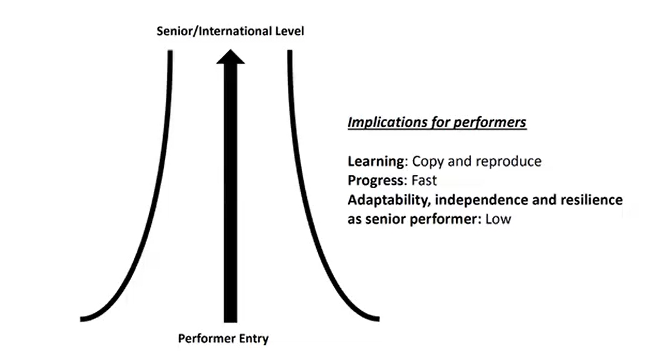
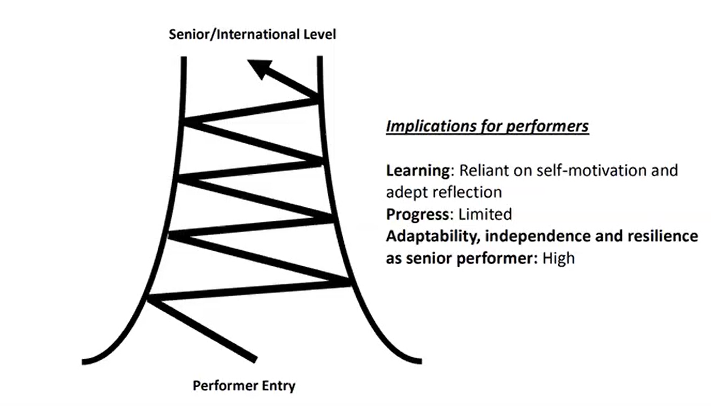
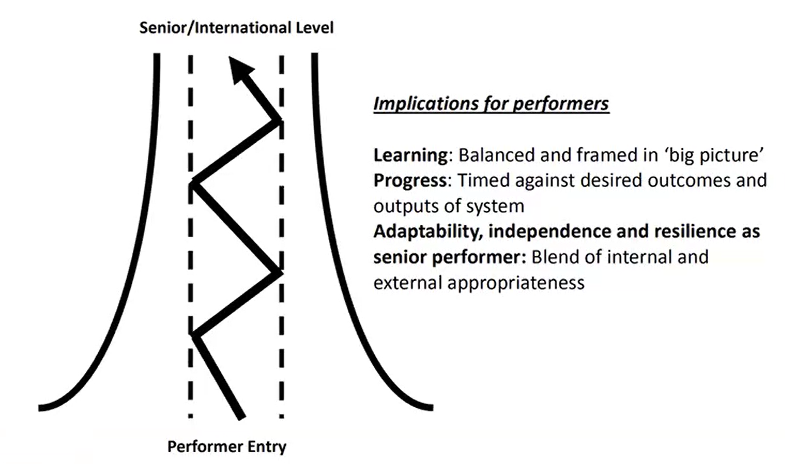
“There’s a bandwidth of performance early that drives both motivation, technical and tactical coaching opportunities,” she continues, “and all of those development factors will propel athletes towards success. That means that at the start of the pathway, coaches and systems need to look beyond just what makes someone good now towards consideration of those factors that support later development.”
These factors are influenced by an athlete’s proximity to performance (this is how urgently an individual athlete needs to deliver performance based on their stage in the pathway and current demands).
Then there is the question of temporality. Rather than simply the linear progression of time, temporality “is inherently fluid”, as MacNamara and her co-authors Ger Barry and Jamie Taylor wrote in their recent research paper.
“Temporality”, they wrote, “varies across individuals, shaped by unique personal experiences and subjective perspectives” and, rather than isolated moments, it is “a continuous flow where each experience is shaped by both past events and future expectations.” So one young athlete may be ready for senior competition at 17 years old; another may not.
In either case, “temporality can create a series of temporal reference points for coaches to help them coach for development and performance as required.”
MacNamara tells the Leaders Performance Institute that the balance comes back to the coach’s intentions. “A coach must ask themselves what was I planning for that session, in this block, this season for the athlete or the team? How did I go about it? How did I review it? How does the athlete experience it?”
With all this in mind, we asked MacNamara to reflect on the characteristics of good pathway environments. We highlight ten that cover system prerequisites, environmental features, and day-to-day practice.
1. Multiple entry and exit points
Talent identification and development is not predictable. It is dynamic, non-linear and individual. “Because a 14-year-old swimmer isn’t just a 14-year-old swimmer,” says MacNamara. “They come with a range of individual factors and experiences.”
High quality pathways, she explains, are designed with multiple entry and exit routes that take into account that young athlete’s proximity to performance. “If I go and pick the best 14-year-olds for my pathway I’m probably going to include people who look good now but without the potential to be good later,” she continues, “and I’m at risk of excluding people who don’t look good now but have the potential to develop later.”
As for exit points, it may be that attrition rates are close to 99% but that is to be expected. “Conversion is a pretty poor metric to evaluate a talent development pathway,” she says of a topic that has long been at the heart of her research. “Even in the best environments there’s only finite space for athletes to develop into.”
Nevertheless, good pathway programmes equip young athletes with the “developmental constructs to be successful elsewhere”.
2. Firm understanding of an athlete’s ‘priors’
If coaches are to meet the demands of such a complex environment, they must develop both horizontal and vertical knowledge across their system’s curriculum.
“In a coaching context, horizontal curriculum knowledge informs what experiences might be desirable for athletes at specific stages of development, ensuring these experiences align with broader developmental goals,” write Barry, MacNamara and Taylor. “Vertical curriculum knowledge equips coaches to understand an athlete’s previous experience and anticipate the steps required to achieve desired future performance.”
Coaches generally possess strong horizontal knowledge but can lack that vertical understanding of an athlete’s “priors”, which is defined by Barry, MacNamara and Taylor as the experiences, beliefs, expectations and habits the athlete brings into the learning environment.
An athlete’s priors shape how they interpret coaching, respond to challenge and adapt over time and so, as MacNamara tells the Leaders Performance Institute, “coaches with a broad understanding of everything that’s happening across the pathway and a high level understanding of what they’re delivering” are best-placed to meet the development and performance needs of their young athletes.
“The ultimate job of a talent pathway is to develop players for the future,” she adds. “That future isn’t yet defined, so we need to develop a breadth of skills – adaptability, robustness, resilience, as well as a range of technical and tactical skills – that will allow them to evolve towards that ultimate aim.”
3. Specialist coaches
Youth coaching requires specialists – it is not just a stepping stone to senior coaching. “Lots of systems now recognise the importance of that development coaching population being supported and developed themselves,” says MacNamara.
“The young athlete is a mixing bowl of inputs and outputs. They’re in school, they might be in an academy, they might be on a national pathway or at a club. So, in a way, coaching a developmental athlete is more complex than coaching an elite athlete; and the better a young athlete gets, the more people they accumulate.”
4. Equity not equality
An athlete’s priors, proximity to performance and temporality require adroit handling. “There’s almost like an orchestration from the coach’s perspective that’s recognising what the individual athlete needs at this moment in time and how to organise the environment to do that,” says MacNamara.
The coach needs to know how an athlete will respond to, say, entering a competition above their current capability, training with a new group, or being coached in a certain way. “There’s a triangulation of asking what is this athlete bringing into the environment? How do they cope with this? And, after reflection, what’s next? It’s almost like giving them the water wings to survive the turbulent thing that’s going to happen next.”
This, MacNamara suggests, is why the best environments offer equity rather than equality. “No one gets the same experience, but they get the type of experience that is required, that promotes their development at that time.”
5. Athlete agency is essential
Young athletes should be considered agents in their own development. “It’s pretty condescending to think on a pathway we’re just doing things to them,” says MacNamara.
She uses the example of an early maturer who suddenly finds themselves in a difficult academy environment. “Unless they understand why this feels uncomfortable and unless they’ve been given a toolbox of skills to be able to cope with that then retention on a pathway is going to be difficult because why would you stay if you didn’t know why what was happening was happening? High quality systems and environments integrate the athlete into their conversations and individual development plans.”
6. A shared mental model of development
The best way to ensure coaches, athletes and other staff are on the same page is alignment between three distinct curricula:
“The alignment between the three is often broken because people don’t understand why what’s happening is happening,” says MacNamara.
“What we should be looking at is the experienced curriculum; what’s actually happening on the ground between different domains. So this idea of being interdisciplinary, not multidisciplinary. How do sports scientists, doctors, biomechanists, physiologists, coaches and other staff work together to ensure the experienced curriculum is what we intend it to be?”
7. Successfully managed expectations
Athlete experience is also shaped by how success is framed and celebrated. MacNamara jokes that she has spent her career warning about the perils of early athlete success, but there’s no inherent harm in an athlete winning early in their development providing it is interpreted correctly and fully understood by the athlete and their coach.
“Being successful is both a motivational and strategically useful outcome at a younger age” says MacNamara. “Pathways need to manage those social expectations and how that success is experienced by the athlete and the people around them.”
8. Equip athletes with psycho-behavioural skills
Generally, it is not social rewards but challenges that inspire growth. “When we look at those athletes that successfully navigate the pathway, often they have relative disadvantages early on,” says MacNamara. However, by the time they become a senior athlete, having faced a wealth of challenging experiences, they have acquired a range of developmental skills and mechanisms that have allowed them to progress through each stage of the pathway. “Those psycho-behavioural skills are part of a toolbox that allows them to cope with the inevitable ups and downs of development.”
By contrast, the early physical developer who has had access to high quality coaching and environments may steal a march on their peers, but if they lack those psycho-behavioural tools then there’s a risk, as MacNamara explains, that their early lustre will be exposed as “fool’s gold”.
9. Coaches that balance fluency and learning
Coaches must know how to balance their levels of challenge and support. MacNamara says: “Being able to slide that dial for different people in a session is a real hallmark of quality coaching. We don’t coach to the mean – we recognise the range of experiences that athletes are having at that time and adjust towards that. With young athletes, there’s often a tendency for us to do a lot for them, provide them with positive experiences, because we want them to be good, we want them to enjoy it, we want them to get that feeling, but we also should want to create desirable difficulties.”
In training, that might mean balancing the provision of fluency sessions, which are often fun and easy on the eye, with error-strewn learning sessions. Yet too often, onlookers rush to judgement on a disjointed learning session.
“I can’t judge whether that’s a good session unless I know what you’re trying to achieve. What’s your intention?” says MacNamara. “If you want the kids to look good, feel great and boost their confidence, then your fluency session is a good idea. If you said we’re dialling up the challenge tonight because we’re working on certain technical aspects or for a motivational intention then a messier learning session is a better idea. And it’s not just the session. The intention and debrief at the end are critical too.”
10. A continuous cycle of reviewing, debriefing and reflection
That debrief needs to occur at both a micro and macro level. “The coach does not just make decisions on a daily basis, they will be within a session,” says MacNamara. “It’s the reaction to what is happening in those day-to-day, minute to minute interactions of a coaching session, and a recognition that the environment is everything that happens to the athlete, and how they’re reacting to things.”
This goes hand in hand with regular reviews of systems, processes and athlete individual development plans. “Ten years is definitely a long time for a 13-year-old at the first stages of a pathway,” says MacNamara of the latter. “So actually reviewing plans is critically important, and integrating people into that review is key as well.”
What to read next
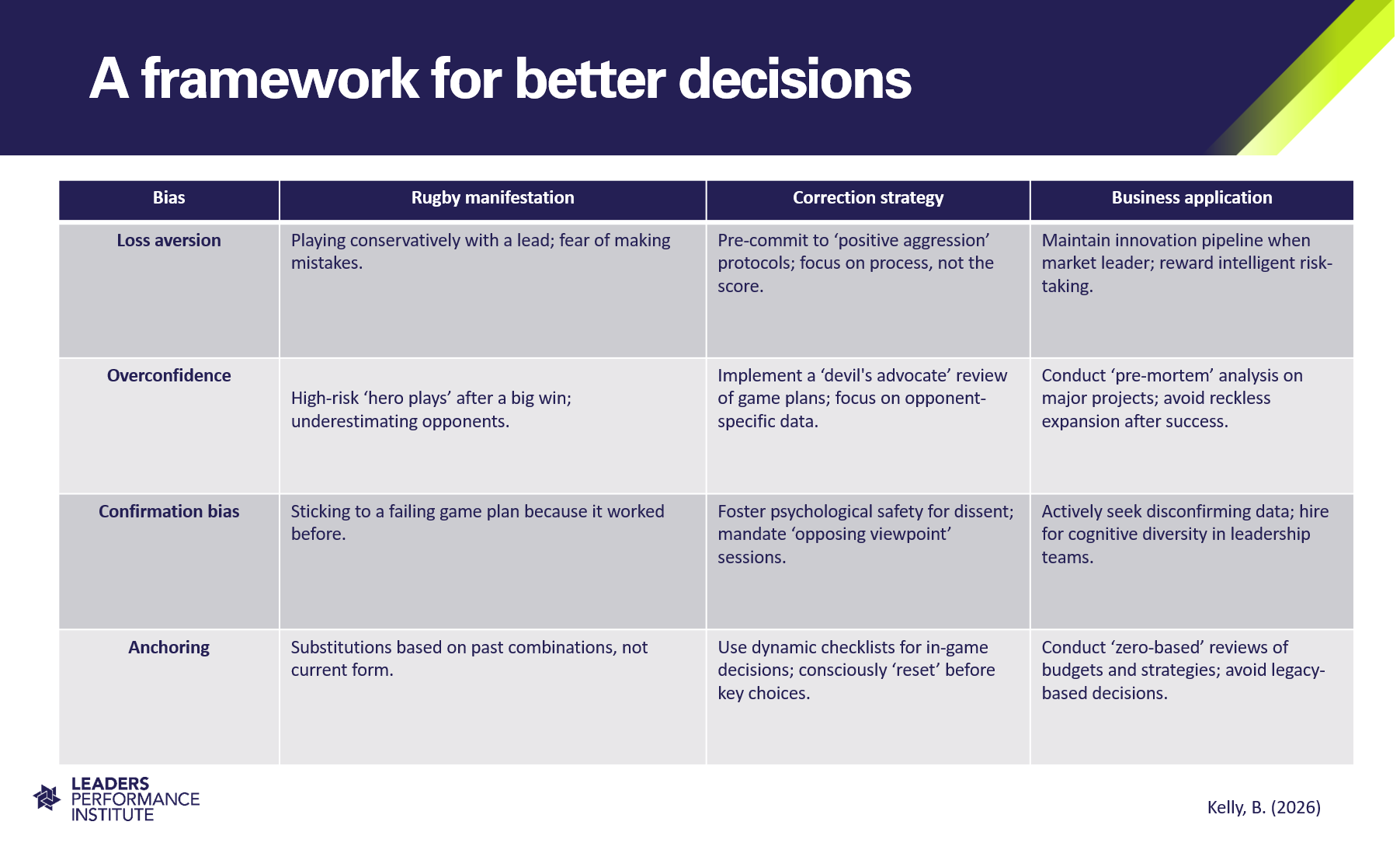
Ahead of the 2026 season, Dr Benjamin Kelly explains how loss aversion afflicts the F1 paddock and how the same biases cost companies billions in lost revenues.
The Brazilian driver, in his Ligier, collided with Luca Badoer’s Forti, which flipped upside down and ended in the gravel trap.
After some confusion, the trackside marshals belatedly deployed the Safety Car to pick up the race leader, Williams’ Damon Hill.
Diniz managed to continue and made a pit stop as the Safety Car prepared to pull in. However, his Ligier burst into flames as he attempted to rejoin the race.
Both drivers were unhurt despite Badoer being forced to crawl from underneath his Forti unaided in the confusion; Diniz subsequently abandoned his ruined vehicle without assistance too.
At a distance of three decades, footage of the Safety Car, a Renault Clio – a 150bhp city runaround – leading Hill’s 700bhp Williams and Michael Schumacher’s Ferrari seems quaint.
The criticism that came the marshals’ way underlined how Safety Car deployment in the 1990s tended towards ad-hoc chaos. They were typically borrowed road cars, they improvised pace and there were no standardised rules.
Fast-forward to 2026 and we have Aston Martin and Mercedes Safety Cars bristling with telemetry and data links.
Yet while the machinery has evolved, the cognitive vulnerabilities exposed by Safety Car moments have not.
The real deficit remains: human decision-making under pressure still misfires.
The Safety Car bunches the field, resets race dynamics, and, critically, forces high-stakes strategy calls in seconds.
Data across more than 200 Grands Prix reveals a chilling pattern: 68% of Safety Car deployments trigger suboptimal decisions. This is not because teams lack talent or simulation power, but because of loss aversion (the behavioural bias where avoiding pain outweighs equivalent gains) distorts pit wall logic under yellow lights.
To underline the point, here are three F1 case studies in pressure-induced error.
1. Mercedes at the 2020 Sakhir Grand Prix: over-defensive pitting
When George Russell deputised for world champion Lewis Hamilton at the 2020 Sakhir Grand Prix following Hamilton’s positive test for Covid‑19, his remarkable performance should have produced a debut victory. Instead, a sequence of communication breakdowns, tyre mix‑ups, and late‑race chaos denied Russell the chequered flag.
A late‑race Safety Car is deployed following Jack Aitken’s spin at the final corner, which dislodges his Williams car’s front wing and leaves debris on the racing line.
Mercedes is presented with two choices:
Mercedes reacts by calling in both Russell and his teammate Valtteri Bottas for an unplanned double‑stack pit stop. They feel the Safety Car creates the perfect opportunity to pit with minimal time loss and finish the race on fresh tyres.
However, a radio fault means Russell arrives and is mistakenly fitted with Bottas’ front tyres, which violates tyre allocation rules. The mistake in the pit lane is mechanical, but the decision to double‑stack at all reflects a deeper bias. Mercedes immediately realises the error and instruct Russell to pit again on the next lap.
As for Bottas, with no tyres ready, the Finn is sent back out on his old hard tyres after a long delay.
Russell plummets from P1 to P9 while Bottas eventually takes P8.
What happened? This was a classic case of loss aversion. Pit crews tend to fear losing track position more than they value tyre advantage; protecting a lead trumps expected value in the calculus. It echoes golf when a player decides to lay up short of a par-5 hazard, sacrificing birdie odds to avoid the potential pain of a bogey.
2. McLaren at the 2025 Qatar Grand Prix: anchored to plan A
McLaren, with Oscar Piastri on pole and his teammate, the aspiring world champion Lando Norris, in P3, enters the race expecting a two-stop strategy based on pre-race simulations.
On lap seven, a Safety Car is deploys after Sauber’s Nico Hülkenberg and Alpine’s Pierre Gasly collide.
As this new evidence emerges, the entire grid, with the exception of the McLarens and Haas’ Esteban Ocon, pits. Pitting makes sense due to the 25-lap maximum rule for tyres on the 57-lap Lusail track; two pits stops are mandatory for each driver in any case. Pitting on lap seven allows teams to complete the race with two clean 25‑lap stints. There is also the fact that pitting under the Safety Car massively reduces the time cost.
But McLaren is anchored to the pre-race model – they’ve committed mentally. They delay the stop. Their rivals undercut. Piastri and Norris miss out on the podium.
What happened? This was classic anchoring bias. New information (Safety Car, track evolution) is discounted because the original plan feels ‘safer’.
3. Drama at the 2021 Abu Dhabi Grand Prix: authority collapses under dual pressure
Perhaps the most infamous in recent times, Mercedes’ Hamilton leads Red Bull’s Max Verstappen on old, hard tyres, at the 2021 Abu Dhabi Grand Prix. He is mathematically cruising to an eighth world title just as Williams’ Nicholas Latifi crashes and triggers the Safety Car.
Mercedes faces a choice: pit Hamilton for soft tyres (risky as he’d lose track position) or have him stay out (on old tyres, but his position would be protected).
They have Hamilton stay out. It is a reasonable decision under loss aversion – avoid the certain pain of dropping position – but Race Director Michael Masi, under torrential team radio pressure from both Red Bull’s Christian Horner (“You have to race!”) and Mercedes’ Toto Wolff (“No, Michael, no! That was so not right!”), makes a call that bends the regulations. He unlaps only selected cars (just the five placed between Hamilton and Verstappen rather than all eight as per the regulations), then restarts the race on the same lap rather than the following lap, which was the rule at the time.
Fresh-tyred Verstappen blasts past the disadvantaged Hamilton on turn one and claims both the chequered flag and the 2021 world championship. The FIA later cites “human error.”
What happened? Masi faced cognitive overload, from duelling authority figures (in this case team principals) and an ambiguous rulebook to live broadcast pressure and split-second timing. He defaulted to the heuristic that felt ‘right’ under duress: let the fastest car win, ignore procedural nuance. The regulatory error is the symptom; the bias is the disease.
Why this pattern repeats: Attentional Control Theory meets the pit wall
Attentional Control Theory (ACT) explains the mechanism at play: under stress, humans shift focus from task goals to threat appraisal. On the pit wall, that threat is losing track position. Mental bandwidth narrows. Working memory floods with:
With capacity overloaded, crews revert to loss aversion heuristics i.e. ‘protect position at all costs’. While this worked in 1996 when Clios led the field safely, it fails in 2026 when marginal tyre advantage can swing a race. Compounding hits harder.
A defensive Safety Car call leaves you vulnerable to undercuts on the next lap. Hamilton’s stay-out in Abu Dhabi was reasonable in isolation but under two-car pressure (Masi plus both team principals) it triggered a regulatory cascade. One error amplifies into a second.
The business parallel: boardrooms defend rather than attack
Replace ‘pit wall’ with ‘C-suite’ and the pattern scales perfectly:
A 2023 McKinsey study found that 64% of board decisions during crises were suboptimal not because of information gaps, but because of process breakdown under cognitive load. It is the same mechanism as the pit wall: stress narrows focus, heuristics override analysis.
The fix: process over heroics
Elite teams and organisations beat loss aversion by building process immunity. Red Bull’s mastery of 2024-25 Safety Car restarts wasn’t luck; it was systematic.
The Red Bull playbook (which any organisation can adopt):
McKinsey teams using checklists and red-teaming cut high-stakes errors by 44%; aviation proved it scales to life-or-death; F1 proves it scales to titles.
The invisible opponent
The yellow lights flash. A crash freezes the pack. Your rivals have Mercedes power units and tyre warmers. You have a pit wall under cognitive fire and a rulebook with ambiguous clauses. The invisible opponent – loss aversion, anchoring, authority bias, compounded errors – costs more points than any gap in car performance.
From Renaults herding supercars in the mid-90s to Abu Dhabi’s 2021 title reversal, Safety Cars have revealed F1’s deepest truth: the fastest car loses when humans default to defence.
Spot the bias. Build the process. Accelerate through the pack.
Dr Benjamin Kelly advises investors and professional athletes on decision making strategies in high stakes environments. If you would like to speak to Benjamin about his work, please contact a member of the Leaders Performance Institute team.
What to read next
27 Feb 2026
ArticlesThis year, the league has introduced broader startup criteria and encouraged a series of high-risk, high-reward bets.
Main Photo: Courtesy of the NBA

These companies will be paired with various league properties for six-month pilots culminating in a final Demo Day pitch session at NBA Summer League in Las Vegas.
This year’s batch of startups for NBA Launchpad in 2026 consist of:
For the second year, Launchpad’s selection criteria is loosely based on five league priorities — Future of Officiating, Youth Basketball, Player Health & Wellbeing, Future of Media and Fan Connection — without necessarily adhering to those exact categories. Ryan told SBJ the goal is to find products that live outside the daily core business but could be relevant within the next five years.
“In the first three years of Launchpad, we were really focused on putting out specific, almost DARPA-type of challenges, and then finding companies that map directly to those,” Ryan said. “Where we are in year four and five is just broadening up and always staying true to our big five priority areas around the game and our business, and then really just focusing on finding world-class founders and making sure that the problem they’re solving is a high-risk, high-reward type of bet.”
Alumni from the first four years of the program include seven startups to receive funding from NBA Investments and several who have gone on to work directly with NBA teams, such as insole sensor provider Plantiga, MRI-based muscle scan analysis company Springbok Analytics and broadcast tracking data supplier SkillCorner. Others have collaborated with the league on projects such as nVenue, which creates micro-betting markets, and SportIQ, whose ball sensor is being piloted for automated officiating use cases.
This article was brought to you by SBJ Tech, a Leaders Group company. As a Leaders Performance Institute member, you are able to enjoy exclusive access to SBJ Tech content in the field of athletic performance.