Olympic runner Alexi Pappas discusses working with Oura on bringing meaning to the metrics in a why that benefits training, preparation and recovery.

Before that, Pappas was an All-American runner at Dartmouth, from which she graduated magna cum laude, and then completing her NCAA eligibility at Oregon while pursuing a graduate degree, helping the Ducks win indoor and outdoor track national titles.
Now with her eyes set on the marathon — she recently ran Boston and London as a guide for visually impaired runner Lisa Thompson — Pappas aspires to set the Greek national record. Her personal best is a 2:34:26, which set in 2020 at the Houston Marathon, less than a minute from Maria Polyzou’s national mark of 2:33:40.
Alexi Pappas is a multi-hyphenate: Greek-American Olympic runner, writer, filmmaker and actor. She is the Greek national record holder in the 10,000 meters (31:36), which she set while competing at the 2016 Rio Games. Before that, Pappas was an All-American runner at Dartmouth, from which she graduated magna cum laude, and then completing her NCAA eligibility at Oregon while pursuing a graduate degree, helping the Ducks win indoor and outdoor track national titles.
Now with her eyes set on the marathon — she recently ran Boston and London as a guide for visually impaired runner Lisa Thompson — Pappas aspires to set the Greek national record. Her personal best is a 2:34:26, which set in 2020 at the Houston Marathon, less than a minute from Maria Polyzou’s national mark of 2:33:40.
On her introduction to Oura . . .
I used to train in Oregon with a very closed professional group where everything was pretty micromanaged by a coach. There was a lot of guidance and hand holding, as I think a lot of athletes require, especially early on in their career.
I was exposed to Oura once I moved to Los Angeles and started training in different environments and not in the context of like one of those Olympic training groups. Because in these groups [like Oregon], you have a coach that has eyes on you, and they can see sometimes what you can’t about yourself, especially because my coach was an Olympian himself. He could see fatigue, where I couldn’t.
But once I moved to LA, there wasn’t always consistent eyes on me. So I needed to keep better eyes out for myself. And I learned about Oura from a friend of mine named Blue. He was wearing it, and I met him at the Chicago Marathon. And so I just started to learn about this and how it was different than the watch I was wearing, which wasn’t as accurate for the data about recovery.
On the metrics she finds most meaningful . . .
The readiness and sleep scores are more useful to me than anything else, as well as obviously the period tracker. To be perfectly honest, the sleep score has helped me figure out what of my habits will lead to the most restful sleep. I think the sleep score is something that I’m more dynamically interacting with—if I have had, you know, red meat for dinner, or if I’ve eaten at this time, or if I’ve eaten out versus cooking at home, or if I’ve gone to bed at this time, or different habits—so the sleep score is helping me get better sleep because that data is pretty consistent and my life is changing, if that makes sense. Then the readiness score is something that I use to adjust my actual training and activity for that day.
On how Oura data helps her make decisions . . .
It has really helped me because I live a very multifaceted life that I’m excited about. I’ve tried to see everything in my life as a choice rather than a sacrifice. For example, if I make a choice to drink, I now just have a better understanding of what it’s going to do to me, and therefore I’m making more informed choices.
And I’m someone who really values my time. So if I’m going to do something, whether it’s training or socially, I want to understand why and what I’m doing. I have adjusted specifics in my routine and been very amused and interested in how it affects my sleep. And it’s not always in the way articles that I read reflect because everybody’s so different. What affects my sleep might be different than what affects somebody else’s sleep. But it has allowed me to make adjustments in my life and be better educated.
The whole thing is that it’s information. What you choose to do with it is up to you, but to not know it at all is really disempowering. I’m a creative person—I make films and I write—and I sometimes like to think about criticism or feedback with my creative work as data that you can either choose to pay attention to or not. Just because I don’t ask for feedback on my book from my editors doesn’t mean my book is good or communicating, it just means I refuse to look or ask them the questions. And I think it’s like that with bloodwork or with Oura data where, just because you don’t want to know, it doesn’t mean it’s not true. So I’ve just found the information to be empowering, and I keep it in balance with, also, how do I really feel? It’s not the only information I use, but it’s an additional piece of information that I didn’t have prior.
On her current running career plan and goals . . .
It’s possible that I go to New York [for the marathon], but I think competitive-wise, I’m looking at a race in January. What I’m trying to do in my life is generally move in a direction of everything supporting everything else.
I would like to break the Greek record in the marathon as an overall goal. I think it’s like ‘should be broken, can be broken.’ It’s in the low 2:30s. And I have not had the opportunity to run a fully healthy marathon yet because I had this post-Olympic depression and did not realize what toll that took on my body.
For me, I don’t have anything to prove to myself or anyone else. I’m very happy with my career, but I have curiosity and fascination with the marathon that I think hasn’t been fully expressed yet as it was in the 10K. So, yeah, I think a winter marathon would be fun. I’m thinking about Houston, which is a really nice race, but we’ll see.
On balancing running with life . . .
I think this sport is evolving. If I’m being really honest with you where, before Covid, I think the world wanted this sharp, hard motivation of get out and grind, the world just got a little bit worn down by Covid. Generally in sport, but in running in particular, the energy has moved towards just be enjoying your sport and doing your sport. And I think that’s something that I see myself increasingly filling the role of in other people’s eyes and giving them permission to actually enjoy and lean into whatever form the sport takes for them.
Girls quit sports at twice the rate of boys by the age of 14. I’m very aware that that number, I think, is because, when they see female adult athletes, I don’t think they see themselves in it as much as it’s more common to see men playing sports in adulthood and pick up tennis, basketball. I think part of my privilege in this world is to be someone who shows that you can have a full life and still play your sport as a woman. It’s not why I do it, but I’m seeing that it is affecting people in that way. I think that number could shift if girls see more women in sport living a full life and still playing sports.
It’s not that I need these things for myself. It’s just that I love running, and I want to keep doing it. And it might take different forms—guiding, flying through like a fairy, racing, occasionally trying trails—but mostly I just really like the sport. In my creative career, a lot of the projects I’m doing are actually athletic in nature. I’m really embracing my identity as like an athlete in Hollywood, and I’m realizing that I actually don’t have to hang up my shoes like I thought I would. I can be an athlete and be a creative person. And that’s a strength, it’s not a weakness. I just haven’t fallen out of love with the sport, and I don’t think I ever will.
On the potential for wellness data to benefit young women . . .
Men and women obviously have different development timelines. And I think what has been really difficult is, when a young girl is going through puberty, for example, isn’t able to see the word ‘development’ as a really positive step in a really healthy life. I think the word ‘development’ is something that we generally don’t embrace. During those years, for example, to have a different vantage point about your health besides what a coach might say and also what social media might tell you is probably wise.
That’s because, as athletes, we’re really hard on ourselves and, to have some permission to be as kind to ourselves as we are hard on ourselves, is what we need. It can come from a coach and it can come from a book, but if it comes from data that’s specific to our bodies, I think we’re more likely to allow ourselves the chance to recover and therefore develop during those developmental years.
For me, personally, I didn’t run during those puberty years. It was because I had a coach in high school who wanted us to specialize in just running. And I was playing soccer and doing theater and student government. And this was before social media. So I wasn’t able to be like, ’Is this messed up?’ I just thought I was de facto not allowed to run unless I only ran. And I didn’t run because I wanted to have a well-rounded life. What the result was, I went through puberty very normally during the years when some people overtrain.
For someone who doesn’t happen to be kicked off their running team, and therefore develop normally, they should still be given data that shows that they’re healthy during a time when they might be self-conscious about an evolving body. So this Oura data can give you confidence. And it can give you ease where that time in life is so uneasy.
On why she likes Oura’s customizable dashboard . . .
There’s a new feature that you can remove the caloric [expenditure]. Here’s a more metaphorical way of putting this: Everybody receives information and inspiration differently. You might tell a kid ‘enjoy the journey,’ and it might not resonate with them. But maybe if they hear it from the right person or they hear it said in a different way, it resonates. And I think the fact that you can toggle and change the way the data speaks to you also acknowledges that people receive information differently. What’s useful to everyone is unique, and so I was always taught to focus on what’s useful. And something that might be useful for me might not be useful to you.
This article was brought to you by SportTechie, a Leaders Group company. As a Leaders Performance Institute member, you are able to enjoy exclusive access to SportTechie content in the field of athletic performance.
Professor Dan Lerner spoke of the power of positive psychology and its ability to help us achieve excellence.
A Human Performance article brought to you by our Main Partners

Success and happiness very rarely go together at all.
“Often people who are incredibly successful, and have worked extremely hard at their chosen profession or sport, are not happy,” stated Dan Lerner, Co-Professor of The Science of Happiness Course at New York University at the 2017 Leaders Sport Performance Summit in Chicago. So Lerner sought to find people who were both successful and happy to understand how you can balance the two. He posed the audience a question: “Some of the most successful people in sport and business have proven you don’t need to be happy to be excellent, but there are some who are able to balance success and happiness and so shouldn’t we aim for this?” He gave examples of people who have proven that you can be both successful and happy, such as Richard Branson and Maya Angelou. Lerner quoted Richard Branson: ‘Most people would assume my business success and the wealth that comes with it have brought me happiness, but they haven’t. In fact it’s the reverse, I am successful, wealthy, and connected because I am happy.’
Do you have an advantage as a positive coach?
“We have lived in this world where success comes before happiness,” said Lerner, “but we have started to see exemplars creep into our culture that show us that’s not necessarily the case. There are tremendous advantages when we put happiness before success.” Lerner went on to describe many studies that proved if people were positively stimulated before an event they produced better performance. One study which Lerner explained, was undertaken on doctors, where they were split into three groups; one not primed at all, one group positively primed and the final group negatively primed. They were then given 50 symptoms to diagnose. “Those that were primed positively, diagnosed with 20% more accuracy than those that were primed negatively. Something happens to us when we are primed with positive emotions which enables us to operate differently” he added. Another study which directly relates to athletes, was an eye tracking study. When athletes were negatively primed before taking the eye tracking test, they were found to have a much more narrowed vision and focus, compared to the athletes who were given positive emotions before the test, who showed their vision remained far broader and they were able to take in information from their peripheral vision. “Do you want your quarter back to hone in on one person or them seeing the entire field?” Lerner asked. “Positive emotion is not only allowing us to operate differently, it’s allowing us to see the world differently and operate at a higher level.”
How do we cultivate positive emotions?
“When we have more positive interactions than negative interactions is when we take advantage of that positive emotion,” said Lerner. “Every time you criticise someone, you have to have at least two or three positive interactions to get the best from that person”. However there is a limit to this. Lerner also went on to highlight that if you give too much positive emotion, it becomes unreal, and it feels fake. “If there is no criticism they aren’t hearing ways to get better.” What can you do to cultivate these positive emotions? Lerner explains that it is essential to provide interventions for your athletes or staff that take no more than five minutes per day. Below are four examples Lerner provides to help increase positive emotions.
MedStar Health, the team’s medical provider have partnered with the Orioles to deliver a fully in-house initiative.
Housed on MedStar’s campus in Bel Air, Maryland — around the corner from the franchise’s High A minor league affiliate in Aberdeen, only 30 miles northeast of Camden Yards and about an hour’s drive from the Double A team in Bowie — the tech-laden lab will help the club assess and monitor their pitchers for delivery efficiency and injury prevention using 10 Qualisys markerless motion-capture cameras, TrackMan’s optically enhanced radar and three force plates embedded in the mound.
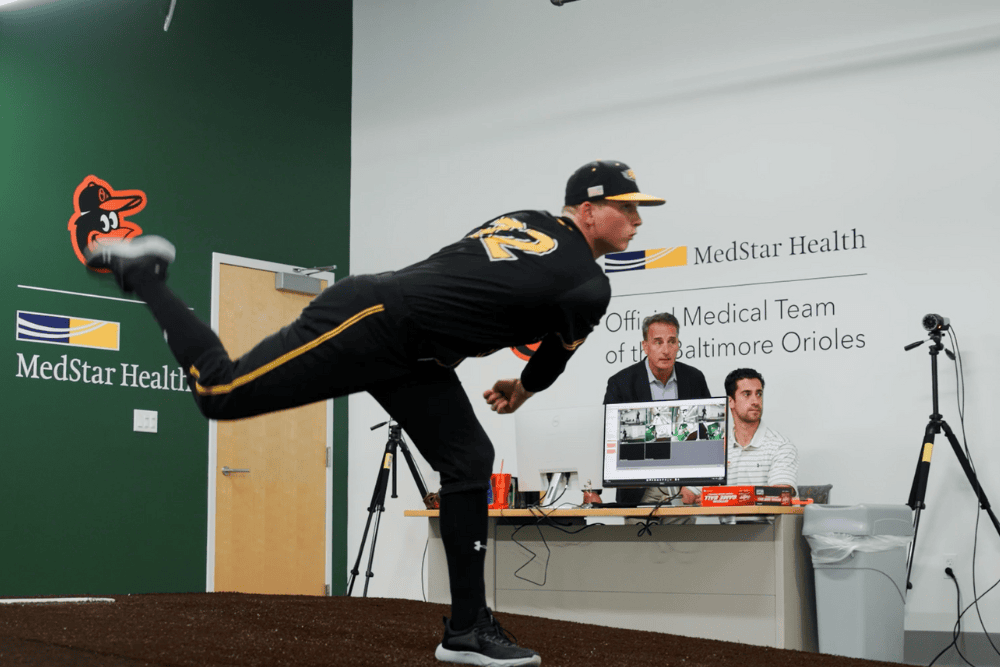
The Orioles’ pitching lab uses 10 high-speed cameras, force plates in the mound and advanced ball tracking technology.
“It’s something that any modern, cutting-edge player development system needs. It’s sort of a baseline requirement at this point,” says Orioles Director of Player Development Matt Blood. He adds, “The competitive advantage lies in how you actually use the information that the labs produce because I think just about every team is acquiring this information, but then it’s what do you do with it from there to help the players get better?”
Since the new executive team took over in November 2018, led by GM Mike Elias and AGM Sig Mejdal, the Orioles have built out a robust group of coaches and analysts to modernize the franchise’s then-lagging baseball operations. Now, they’ve assembled a management team can interpret and apply such data sources, rather than contracting out some of that work to biomechanics consultancies such as provided by Reboot Motion or Driveline Baseball.
“Fully in-house. We’ve hired the people that we feel are necessary to process the data at every step of the way,” Blood says. “And then we’ve got coaches who are hungry for that information and will put that into play on both the pitching coach side and the strength and conditioning side.”
The cameras and TrackMan are portable, enabling most of this set up to be moved around, including to the Orioles’ player development complex at their spring training facility in Sarasota. Only the force plates are fixed in place, but Blood says a second sensor-laden mound is slated for construction there. One force plate is placed at the rubber to capture a pitcher pushing off to start his delivery, and then two more are installed side by side down the mound to evaluate the landing force of righty and lefty pitchers.
The idea, he says, is for pitchers to get a spring training baseline and then receive follow-up assessments every four-to-eight weeks. In a video interview shared by the team, Orioles starter Jordan Lyles discussed throwing one of his between-start bullpens at the lab, which opened to the team in July, while seeking better efficiency with this throwing motion.
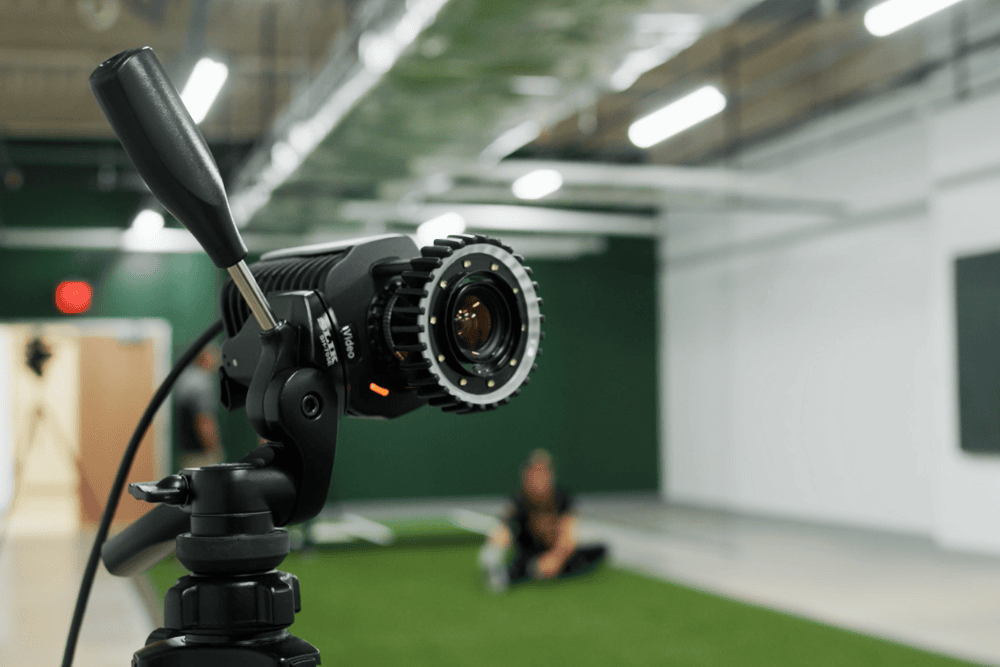
The pitching lab will serve as an evaluation destination for Orioles pitchers at every level.
“We feel like we have gone about this in a responsible and organic way,” Blood says. “Instead of just rushing to acquire the data, we rushed to acquire the people who could help us and build out the proper system and process and technologies that were most practical and productive to use.”
Previously, the Orioles sent players to the Wake Forest Pitching Lab, owing to a good working relationship they have with both lab director Kristen Nicholson and baseball coach Tom Walter. The Wake lab is identical to what the Orioles built — 10 Qualisys markerless motion capture cameras, TrackMan, three force plates — and is open to the university’s baseball programs as well as the public.
“I have a particular interest in creating 3D simulations to enhance performance in both sports and medical rehabilitation and then also to figure out and define pitching efficiency,” Nicholson said. “We want to limit throwing arm stress and avoid injury without sacrificing velocity, and that becomes the real core of our lab and what’s driving our research in player development.”
This article was brought to you by SportTechie, a Leaders Group company. As a Leaders Performance Institute member, you are able to enjoy exclusive access to SportTechie content in the field of athletic performance.
In our latest Member Case Study Virtual Roundtable, James Morton of Science in Sport reviews his time spent helping to develop a winning strategy with Team Sky.
A Leaders Performance Institute article brought to you by our Partners

Recommended reading
The Secrets of an Agile Team: when McLaren Racing Began to Make Ventilators
Framing the topic
Our final Member Case Study of the year was led by James Morton, Professor of Exercise Metabolism at Liverpool John Moores University, and focused specifically on executing performance in one of the most challenging performance environments in sport – the Tour de France. James shared with us his experiences from the Team Sky, now Ineos Grenadiers, environment around how they approach the race and maximising the impact on rider performance.
“Lack of knowledge is not always the problem… it’s the ability to take this knowledge and develop and deliver practical and simple solutions that counts… it’s the detail and final step of delivery that makes the difference in sport” – Sir Dave Brailsford, Team Sky / Ineos
Performance Knowledge & Delivery
This is the concept of it is what you do that really matters not always what you know. How are you taking the knowledge and applying it – execution.
There are four pillars of consideration to this model (Close, Kasper & Morton, 2019):
High-performing teams strive for Transformational Improvements – practitioners who engage in research and practice, constantly auditing and wanting to improve.
The Knowledge Delivery Framework
Developing the programme and athlete performance plan through the performance checklist:
Where can you lose or win this race? What can stop us winning?
Identify the factors that can stop you winning (cycling example):
What can you do from a delivery perspective to optimise performance?
Discussion points
Biggest challenges
The neurotechnology company’s Pro-Sync software contains a series of video-based eye movement tracking tests accessed through wearing a virtual reality headset
NeuroSync (formerly SyncThink) is calling its new software product Pro-Sync and it contains a series of video-based eye movement tracking tests accessed through wearing a virtual reality headset. The setup is similar to Eye-Sync, the company’s signature eye tracking product released in 2016 that’s used by college football and NBA teams to test athletes for concussions.
“We’re using a different measurement tool that essentially takes you through a battery of eye movement tests, some are similar to what we have in Eye-Sync and some are different and new,” says Scott Anderson, NeuroSync’s chief clinical officer. “We look at different aspects of how well you focus, how well you can sustain your attention, or how well you can maintain your working memory or your inhibitory control.”
Cameras in the VR headset follow the user’s eyes while NeuroSync’s algorithm quantifies how long their eyes are moving to the appropriate location. NeuroSync then provides an instant score from 0 to 100 (100 being best) to rank their results though a machine learning model that compares their performance based on NeuroSync’s cognitive assessments data of more than 20,000 patients. Some of those patients are NBA players from NeuroSync’s work with teams such as the Warriors, Wizards and Hawks, who all originally leveraged the company’s Eye-Sync concussion product as a makeshift solution to monitor fatigue amid the rigors of an 82-game schedule.
“Teams are making are making arbitrary decisions on load management, based on what’s happening physically, but what people don’t realize is that the brain’s central nervous system controls your entire body. We just look at all the physiological parameters that help us understand what the status of the athlete is,” Anderson says. “I think there’s a better way. If you start at the source, you’ll understand why physiological changes happen and cardiovascular changes happen — it’s because it’s all being run by the central processing computer in your body.”
The brain has long been neglected by sports scientists and team physicians working with athletes, according to Anderson, who notably also serves as a medical observer consultant for the NFL. He often sits in the replay booth during games and shares specific video angles with on-field team doctors to help identify and diagnose player injuries after plays.
Earlier this spring, the NFL mandated players’ use of wearables to track load management during all preseason practices. While football has been a main target of Eye-Sync, Anderson expects Pro-Sync’s fatigue evaluation to be most applicable in continuous-play sports such as basketball, soccer and rugby.
“People spend a lot of time talking about reaction time, but actually visual processing happens before reaction time. And so you have to move your eyes to the right place, so that your brain can interpret what it is that is in front of you, so that you can formulate a reaction,” Anderson says.
Anderson says NeuroSync has conducted “unofficial studies” over a couple NBA seasons with the Atlanta Hawks that affirmed a relationship between slower eye movements and sustained physical injuries. “They had several players who as soon as these markers showed up, soon after that they got injured. And so we want to be able to predict when somebody is at risk for decreased performance or potential injury,” he says.
The Hawks and Wizards have also worked with NeuroSync to deploy eye-tracking tests on college prospects before the NBA Draft, to assess their cognitive abilities. The process served a similar role to the Wonderlic Test used for scouting evaluation in the NFL.
“We screened 60-plus [NBA] draft prospects and then ranked them according to risk,” Anderson told SportTechie. “We identified the high performers and those we thought were risky investments.”
Devices from Kinexon and Catapult are among the most used wearables in NBA and college basketball for load management, and the NBA is also testing Nextiles’ sensors in apparel. Pro-Sync’s cognitive function assessments would provide a complementary perspective for evaluating athletes whose schedules include cross country flights and games in different time zones.
“We have data from NBA players before they went on a five day road trip, in the middle of that road trip, and when they get home from that road trip,” Anderson says. “And the difference in their cognitive abilities at those three time points is remarkable. They’re trashed when they get home, and nobody knows it.”
Pro-Sync’s software roadmap for 2023 includes adding training protocols for athletes to practice improving their cognitive deficits in virtual reality. NeuroSync has more than 20 sports teams in the NBA and college football, including its league-wide deal with the Pac-12, but it’s been a few years since the company announced a new team partner as teams don’t want to publicize a potential competitive advantage.
While NeuroSync’s Eye-Sync concussion product is a registered medical device with FDA approval, Pro-Sync is considered a nonmedical device and thus not seeking those certificates. What began as a “passion project” for Anderson, he now thinks is on the precipice of changing the way sports view fatigue and cognitive function.
“I think it’s the next frontier. I wrote an article about it for Leaders in Performance in 2016, talking about the potential to measure real time brain performance, how it could change sport,” Anderson says. “I’ve been obsessed with it ever since.”
This article was brought to you by SportTechie, a Leaders Group company. As a Leaders Performance Institute member, you are able to enjoy exclusive access to SportTechie content in the field of athletic performance.

Sports teams and organisations have spent the best part of a decade collecting data on athlete performance, but what does the next decade hold? Zone7 believe that the answer lies in making sense of it all. In fact, they refer to this as sport’s next ‘arm’s race’. This is just one of the themes touched upon in this Special Report, which is brought to you by our Partners at Zone7.
Complete this form to access your free copy of In The Zone, which delves into the growing sophistication behind data interpretation, the importance of openness and collaboration between stakeholders, particularly when addressing any reservations, and how data can transform the way business is done in the front offices of elite sport.
The American swimmer is working closely with Orreco and is witnessing first-hand how the company’s performance platform is deepening the understanding of female physiology in athletes and coaches alike.
Born in Pittsburgh and raised outside Detroit, Schmitt later starred on the University of Georgia swimming team where she was a four-time individual champion and leader in helping the Bulldogs win the 2013 NCAA national title.
Schmitt initially retired after the Rio Olympics in 2016, at which point she began pursuing a master’s degree in social work at Arizona State. She reduced to a part-time load when she began swimming again in 2018 and now is on track to graduate in May. Schmitt recently joined the Female Athlete team at Orreco and is an ambassador for its FitrWoman campaign.
On her medical history . . .
I was diagnosed anemic in 2010, and the only really cure for that, I was told, was on an IUD so that I would bleed less. That’s all I knew, and I was on an IUD for eight years. I came off of that into the end of 2018. I just wanted to see how my body reacted. The myth is that the only thing we really know about female health is that our body changes every seven years. So I figured that maybe my hormones have changed, and I wouldn’t bleed as much.
That was my thought process. Coming off of birth control essentially was—I mean, I didn’t know what exactly an IUD was—my only question was, ‘I want kids some day. Is this going to stop me from having kids?’ They were like, ‘No, as soon as you stop, you can have kids.’ I didn’t really realize the severity of the synthetic hormones and what it does to your body. So when I came off it, my body was adjusting to it for quite a few months because of the synthetic progesterone was being produced for those eight years, and now all of a sudden, my body’s trying to produce it.
On using Orreco’s platform. . .
I didn’t really know what was going on with my body, which is when I got connected with the USA Swimming Director of Sports Medicine, Keenan Robinson. He connected me with Dr Georgie [Bruinvels], and I have been working with her ever since. I was very involved. I talked with Georgie almost daily. I would be on mostly weekly calls with the whole team. It was like a team. We would talk just to check in, make sure everything’s going right.
For what was needed, we would have blood work. So going towards Olympic trials, from probably October of 2020 through May of 2021, I was going through a lot of health things, and they helped me through that. And by the end, when I was actually into full training again, I was getting blood tests every Monday to check on my cortisol levels to see how it was in response to training.
On applying her Orreco results to training . . .
We had a plan of nutrition, recovery and training. But on Mondays if that number came back extremely low, I would have to adjust the training for that day or for that week. That was a different type of challenge, I guess for my coach, Bob Bowman, in just adjusting that based on what the scientific numbers are. I love that about Orreco: everything is proven and scientific-based, and it’s not just opinion.
We needed that change because of my performance at a time. I wasn’t able to finish practices. I wasn’t able to do practices at the level that I needed to do them at. The whole Orreco team helped us through that process. And, I mean, it was kind of like hands up in the air. Bob and I don’t know any information on the female health side, so teach us what we can [learn] and what’s going to be beneficial. It ended up working—all of us working together—and results started improving. From where I was in March and April to where I was in Tokyo was a drastic difference, and I don’t think that we could have got there without the help.
On training men versus women . . .
I come from a mostly male training environment, and my mentality, which in that environment has gotten me a lot of success in sport, is, ‘Okay, put your head down, push through, you can get through it.’ But I think just now learning the difference between pushing through something, and getting the right help in this situation, is a big difference, but also the difference between men and women.
Why are we training females like males? And why is all the research on males when females and males are different people? How our bodies are made up is completely different. It’s critical to treat your body how it’s made up, understanding that [females] can use those hormones and the differences to their advantages, and they can be more powerful than what they already are.
On pairing training with monthly cycles . . .
We look at it as four phases in a female athlete, and yes, there’s different modalities that are ideal for them. But, at the end of the day, yes, we have our goals that we want to accomplish and adjusting to your needs and your period is not asking for less work. I’m still putting the same amount of work in, I just need to be more conscious and educated on ways that I can perform better. So whether that be nutrition, whether that be more recovery, whether that be more warm up—whatever that is for that day, I as an athlete have to be educated in that. But also, from a coach standpoint and pushing their athletes, I think there’s a lot of times where athletes are hard enough on their selves as it is. And they’re gonna want to do better week after week.
On other wellness monitoring . . .
I did use Sleeprate which [paired with] a disc under my bed. And when it first came out, I used Whoop. And then I started using it again at the end of my career. And still today I use those modalities just because it’s interesting to me to see how much our bodies can adjust, and even seeing between the different phases, the quality of sleep I have. It kind of affects my performance, not only in athletics, but in your everyday human interactions.
On now working for Orreco . . .
I’m very passionate about getting that education out just because I feel like I learned so much about it. And if I’m learning this—I’m a 30-year-old female and am just learning about my body—how many other females are going through the exact same thing? If we can get this information out to kids at a younger age, in high school and college, there’s a lot of obstacles that they will be able to avoid throughout their career and hopefully have a more successful career.
This article was brought to you by SportTechie, a Leaders Group company. As a Leaders Performance Institute member, you are able to enjoy exclusive access to SportTechie content in the field of athletic performance.