Two-time Olympic 400m hurdle medalist Dalilah Muhammad discusses the role of technology in her training, preparation and performance.

Muhammad later set a personal best of 51.58 seconds in the Tokyo Olympics, running what would have been another world record, if not for Sydney McLaughlin running even faster in the same race. In addition to that silver medal, Muhammad claimed a second career gold as part of the USA’s 4×400 relay team. At July’s World Championships in Eugene, Oregon, Muhammad returned from a hamstring injury to finish third.
A 2007 IAAF World Youth title winner, Muhammad, now 32, is a native of Queens, New York who graduated with a business degree while compiling an All-American career running at the University of Southern California. She starred in Nike’s 2017 ad campaign on equality alongside Serena Williams, Megan Rapinoe and LeBron James and, more recently, joined Cheribundi’s Pit Crew—its brand ambassadors of athletes and wellness experts promoting the company’s natural health products.
On why there’s been so many world records in the 400 hurdles . . .
I get this question a lot. And I think a couple of things come into play. The event is just run differently. It’s actually a newer event in track and field’s history—we didn’t start running the 400 hurdles until [the 1970s] when women actually started running the 400-meter hurdles. And I think at the time, it was thought of as a race for people that weren’t fast enough to run the open quarter [mile]. Originally, it was thought of that way, kind of like the steeplechase. You weren’t fast enough to run a flat distance, so your coach threw you in the steeplechase.
You had those standout athletes early on, but I think more and more people are falling in love with the 400 hurdles and it’s becoming that premier event. And it’s become a race that you have to be just as good in the 400, a good 800 runner and even a fast 200 runner to be able to run the 400-meter hurdles—as well as hurdle. It’s just a combination of finding that type of athlete that’s good and that has that type of broad talent.
And finding new ways to coach it. I think their approach in coaching has always been strength-based, and we’re turning it more into a sprint. And we’re seeing that now. When I first started doing the 400 hurdles, my coach would tell me and taught me to go out really slow and hold on and wait for that last 200. And now we’re all going from the gun because we know we can handle it. I think just having that faster increase in pace that first 200 is really making a difference.
On training tools for the hurdles . . .
I definitely look at video and look at myself and how I’m hurdling and how I can improve and what I’m seeing when I hurdle. I have a guy named Ralph Mann that comes to the track as well and analyzes our hurdle form. He created this model that can show you exactly, based on your weight and height, just how fast you’re getting over the hurdle, where you’re stepping over and the world record pace. Actually, he can put the model to a world record pace and see how close you are to it.
So we have those types of tools that we use, but of course it’s my coach’s eye, more than anything. He has the formula as to what hurdling should look like, and we’re adjusting it every year, honestly, trying to get better and better at it. So it’s just repetition and going over and over and reviewing just what I personally look like.
On how she improves her running technique . . .
I’ve become a better sprinter in the last couple years even just because of focusing on the form and looking at the greats to do it. I was just looking at [Usain] Bolt, looking at FloJo, just how she actually sprinted and what that looked like and just incorporating it into my own training. So that’s something that my coach and I really pay attention to—exactly what the form looks like. And that’s been a key component of my race. I never actually was that good of a sprinter—or at least I was told I wasn’t—so focusing really on the form has helped me to get faster.
On how there’s no typical training session . . .
As a 400 hurdler, we really do it all. I do interval work. I do speed endurance. I do distance. I’ll go up to like even 1K’s. I’ll run repeat 1000s. I’ll run repeat 200s. I’ll do short 30s at practice. And of course I hurdle as well. And there’s some days that I’ll just do straight 100-meter hurdle type training that you would see a typical 100 meter hurdler do. So there’s a huge balance. We really do a mix of every single thing, every single week.
On track shoe technology . . .
There’s a lot of controversy going around our spikes. Is it the spikes? Is it the athlete? And I feel like I’m not supposed to say this, but I’m going to say it anyway: Honestly, I think it’s both. I do think the advancement of our spikes has played a huge role in just how fast athletes have gotten.
To me, that’s not a bad thing. Those types of advancement have been made through history so many times, from just the type of ground that we compete on going from dirt to the Mondo we have now. Those advancements have been made, and you see the huge difference. And our timing system—there has been advancements in our timing system, and how much faster the world has gotten. And I think the spikes are definitely a part of that.
The important bit is it being an even-playing field. And I think they’ve done that amongst the companies. They put criteria that allows not one company to have an advancement when the other company cannot. If that didn’t exist, then maybe we’d be talking about something else, but the fact that it’s even amongst companies, yeah, I think we’re going in the right direction.
On feeling the immediate difference in her own spikes . . .
I remember the first time I put on the Nike spikes, and I said to the Nike guy, ‘Wow, I can break the world record in these.’ And that’s literally how it played out. That was in 2020. They were coming out with new shoes, testing them and having different models. And I broke it in 2021. So I think it’s great. I think technology should advance, and I’m happy that it has.
On her introduction to Cheribundi . . .
I’ve used their products for years now, but we just met recently. I told them my story back when I was in college, I started drinking tart cherry juice. It was introduced to us on campus as a snack that we can use to help recover and things like that. So I always loved it.
Nutrition was really focused on, especially when I went to the University of Southern California. And you notice, as an elite athlete, you start to realize how much the body needs to recover. There are different tools that we can use, and Cheribundi that we’ve been one of those tools that I’ve been using.
On the products she uses . . .
[I mostly] use their tart cherry juice for recovery, and I’ve recently just started using their one that has the melatonin in it as well. It helps you to sleep better, and especially when you’re traveling so much in our sport—we change time zones very frequently—and we have to adjust to that time period very quickly. Sometimes we are at a track meet, and we literally get there 48 hours before we compete—and we can be competing in China. So imagine the difference in time zones from China to Fort Worth, Texas. So that’s just something that helps me adjust really quickly, so I’m able to compete.
On whether she tracks her biometrics . . .
No, not really. Nothing for monitoring sleep and recovery. I definitely just pay close attention to how many hours I’m sleeping, and just making sure that I’m getting that eight hours of uninterrupted sleep as best as I can.
field. And I think they’ve done that amongst the companies. They put criteria that allows not one company to have an advancement when the other company cannot. If that didn’t exist, then maybe we’d be talking about something else, but the fact that it’s even amongst companies, yeah, I think we’re going in the right direction.
On feeling the immediate difference in her own spikes . . .
I remember the first time I put on the Nike spikes, and I said to the Nike guy, ‘Wow, I can break the world record in these.’ And that’s literally how it played out. That was in 2020. They were coming out with new shoes, testing them and having different models. And I broke it in 2021. So I think it’s great. I think technology should advance, and I’m happy that it has.
This article was brought to you by SportTechie, a Leaders Group company. As a Leaders Performance Institute member, you are able to enjoy exclusive access to SportTechie content in the field of athletic performance.
This question was tackled by Gavin Benjafield of LAFC and Ben Mackenzie of Zone7 in our latest webinar.

Ben Mackenzie, a Data Research Analyst at Zone7, an injury risk forecast and load management platform, is talking at the organisation’s webinar titled ‘Blending Sports Science and Data Science’.
“Quite often, when people refer to injury prediction, I think the mind goes to ‘this injury, on this day, at this time, as a result of this action’ – and it really isn’t any of those.”
Instead, Zone7 can dip into its ‘data lake’ of over 200 million hours of performance metrics and over 10,000 injury instances to produce an injury forecast based on clean, consistent data.
Still, data science remains misunderstood across elite sport. “Sometimes data analysts and data scientists get blended together now that we have analytics departments,” said moderator Dr David T Martin, the Chief Scientist, Director of Performance at Performance Health Science. “Some people will say ‘I’m not a data scientist, I’m an analyst’.”
Mackenzie and Martin are joined in conversation by Gavin Benjafield, the Director of Performance at Los Angeles FC, who have worked with Zone7 for two years.
Mackenzie uses Benjafield and the club to further illustrate his point on injury forecasting. “We’re able to identify that ‘this’ player, if he continues on the path that he is, he might be outside a certain range, might be at risk or is a risk of an injury as a result of being outside of the norms for LAFC’s training data. Therein lies the risk forecasting. This player either needs to do more, we suggest that he does more, or we suggest that he does less to mitigate that risk of injury.”
Practitioners from across the globe logged on to listen to the trio discuss the distinction between sports science and data science, the misconceptions that abound, as well as the steps teams can take to better use the data they are collecting.
Here, the Leaders Performance Institute highlights the other key insights from the session.
Sports science vs data science
There is a perception in the sports science world that data science is just another element of the job. Benjafield shares the story of a job opening at LAFC. The position was for a data scientist and the job description made that clear, yet just 25% of the 200-plus applicants worked with data. “Sports science: your understanding of physiology, psychology, biomechanics, all those components are nothing to do with data science,” said Mackenzie. Whereas the data scientist’s ability includes “[collecting] data, clean data, and understand multiple programming languages as well as the ability to clearly express what your findings are – they are completely different disciplines.”
Should you outsource your data science?
To illustrate a point around using consultants, Benjafield spoke of his ability as a handyman around the house. He is adept at certain task but draws the line at electrics. At LAFC, Zone7’s forecasting services and AI fulfil the role of the electrician. “If you’re just going to absolutely outsource everything then you’re just going to be an organisation with a ton of consultants running around you. You’re actually not going to have any identity,” said Benjafield. “We’re not going to become a consultant circus, we’re going to strategically pick those that we believe are the electricians that we feel comfortable doing that by ourselves, but we still want to take ownership and do a lot of the things ourselves otherwise we become spectators in our own department and I don’t think anyone wants that.”
As Mackenzie said: “A sentence that is thrown around at Zone7 quite a lot: we are a weapon the practitioner’s armoury. You have the tool box, we are just the hammer. There are many other tools that can get jobs done or can be used for other jobs. It is up to the practitioner to use their skill, their interpersonal skill and their skills in other sports science disciplines, combining all those elements and information provided by Zone7 for them to come to an informed opinion and not data-led.”
Creating actionable steps
Actionable steps are essential when using data, as 100 metrics cannot be manipulated by someone in Benjafield’s shoes across 25 athletes. Minor adjustments and corrections are a good start. LAFC worked with Zone7, who retrospectively analysed a season of data, to hone in on five GPS-related metrics. “Three of those we were already monitoring closely, two of them were not, so I think that just helped us to get actionable items,” said Benjafield, who is mindful of the challenge of pleasing coaches who want as many players as possible available.
The future
Mackenzie and Benjafield wrapped things up by pondering where the future relationship between data science and sports science. “People are fearful of losing jobs or being overtaking by data or AI,” said Mackenzie of the sports world. “I think it requires a change of mindset, a change in appreciation of different skillsets, and an understanding that a different skillset offers different things. That’s where it needs to start. Mindset, openness and willingness.”
Relationships are important for Benjafield too. He said: “I’d like to still be in an industry where we are wearing fewer external devices but we are collecting more data and richer data; and that is translated. I don’t want to lose the relationship with the athlete.”
Rod Ellingworth, the Deputy Team Principal of the Ineos Grenadiers talks to James Morton about talent development in modern cycling.
An Industry Insight Series Podcast brought to you by our Partners

“A lot of experienced people have been through life but they’re not perhaps listening to these young people enough. You’ve got to listen to their ambitions and, when they say things, there’s a lot in there. And if you ask the right questions, open questions, getting into the guts of it really, really getting under their skin about how they want to go from A to B, I think you can learn a lot from people.
“Try to follow people’s ambitions and dreams. And as long as you’ve got the programme and the space, you can keep working with people, because the talent will come through.”
Ellingworth is a former cyclist who now oversees talent identification at the Ineos Grenadiers and, in this latest edition of the Science in Sport Industry Insight series, he sits down in conversation with his former colleague James Morton, the Director of Performance Solutions at SiS.
Both men spent five year working together under Ineos’ previous guise, Team Sky, and here they delve into advice for talent spotters as well as:
James Morton LinkedIn | Twitter
John Portch: Twitter | LinkedIn
Listen above and subscribe today on iTunes, Spotify, Stitcher and Overcast, or your chosen podcast platform.
Recent data demonstrate that an incremental increase in practice length can help curtail soft-tissue injuries.
According to the NFLPA’s General Counsel and Head of Medical Innovation Sean Sansiveri, all 32 NFL teams—besides being required for the first time to place GPS trackers on every player—had to adhere to the new health and safety protocol at training camp.
“We’ve now mandated a gradual ramp for the first time this season,” said Sansiveri, referring to the revision that was approved at this spring’s annual league meeting. “We had an acclimatization and contact integration period the last two years because of Covid, but this will be a whole different approach to that, and we anticipate seeing a reduction in the lower extremity injuries because of it.”
Sansiveri said that by monitoring players the last two “Covid” seasons through wearables designed primarily by Zebra and Catapult, the league determined that a spike in soft-tissue injuries came from “overbearing load” during early-season workouts.
“One of the things, very interestingly, that we learned from the GPS trackers was the teams that had a gradual duration ramp up,” Sansiveri told SportTechie. “Meaning start one practice at 90 minutes, the next one at an hour and five minutes, then an hour and 20 minutes—the teams that didn’t do that had almost a 25 percent higher risk of lower extremity injuries.
“But we wouldn’t be here if not for the use of the X,Y data and being able to monitor load [with wearables]. The information has turned out to be tremendously valuable for injury mitigation. And [this season] we want to look at intensity, we want to look at conditioning tests, we want to look at the number of padded practices. The CBA limits it to 16 during the training camp period, but not all clubs use all 16. And so looking at from the pure injury side, plus the load and the movement standpoint, we’re able to piece together with the help of our engineers a pretty clear picture of what’s contributing to the injuries.”
The NFLPA has to sign off on any wearables deployed by the NFL on its players and has formed a “joint sensor committee” with the league to ensure that the devices are “validated for its intended use and what the potential arms or downsides are.” Sansiveri, for instance, says some devices (such as sweat patches) are “bleeding over into bio-specimen” collection, and those need to be consented to by the NFLPA, as well.
Last season, Sansiveri said approximately 25 teams used various GPS devices during practice—either from Zebra, Catapult, STATSports or Kinexon. But by having all 32 teams gradually ramp up practice length during this year’s training camps, the data should be more definitive going forward. Last season’s Super Bowl Champion Los Angeles Rams were particularly lauded for their load management tracking during every preseason and regular season practice, which led to a reduction in injuries while winning nine of their final ten games.
“You can definitely bucket the teams in terms of the ones who are more effective than others,” Sansiveri said. “Depends on how you look at it. Whether you look at total number of injuries, which may not necessarily be indicative. Because you can have more contact injuries, for instance, versus non-contact and load-based. So if you break it down in terms of the duration ramp-up thing that I mentioned, there is a clear difference in the number of lower extremity injuries based on that. And that’s one of the reason we’re pursuing this the way we are.”
“As I said, the duration ramp-up question was primarily based on the two Covid seasons worth of data. But you can bolster that by looking at the piecemeal data sets on this issue we had previously. So I would say the study really solidified two years ago, and it’s sort of been in the works much longer than that.”
Troy Vincent, the NFL’s executive vice president of football operations, used the Rams’ game-wrecker Aaron Donald as a prime load management example in a conversation last February with SportTechie.
“Aaron Donald,” says Vincent, pronouncing the name with emphasis. “Nobody gets more double and triple-teamed in the National Football League over the last 7, 8 years than this man. In the trenches. That’s monitoring, that’s [load] managing. They have a lot of players in that situation where they don’t miss a lot of game time. But that is being properly managed through the head coach [Sean McVay] and the head trainer, Reggie [Scott]. So that’s everyone being on the same page. You can’t do it and be effective if it’s not a team. You can’t have one side of the house saying, ‘Data is it,’ and the other side of the house saying, ‘Nope, it doesn’t work.’ You can’t have sports science over here and someone says, ‘I don’t believe in sports science.’”
“[The Rams are] so cutting edge. When you look at their injury prevention, their injury reduction platform, it’s data science. They are no question light years ahead.”
This article was brought to you by SportTechie, a Leaders Group company. As a Leaders Performance Institute member, you are able to enjoy exclusive access to SportTechie content in the field of athletic performance.
The Seattle-based startup discuss the technologies that can help basketball players improve the mental side of their performance.
World’s shortest elevator pitch: “We focus on training the mental side of basketball. It’s a part of basketball we think is undertrained.”
Company: VReps. “The goal of the company is to give virtual repetitions of your sport, primarily basketball right now. That’s the impetus behind it.”
Location: Seattle, Washington
Year founded: 2015
Website/App: https://vreps.us/; Google Play app; Apple Store app
Funding round to date: “We are Pre-Series A. It’s all Seed funding.”
Who are your investors? “We are all angel funding and have raised roughly $2.5 million.”
Are you looking for more investment? “If the right investors came, yes.”
Tell us about yourself, CEO and founder Shawn Cooper: “I was studying computer science at the University of Michigan and was a scout player for the women’s basketball team. I’m 6-foot, I was 190 pounds and athletic, so as a scout player I could play any of the five positions. For an upcoming opponent, we would be given the scout team playbook and we’d have four or five plays we’re supposed to simulate during practice. That means during a span of 48 hours I was supposed to memorize 20-25 plays because I’m learning all five positions and it’s just a paper playbook, that was the best way to learn. The idea behind the company was initially making NBA 2K for playbooks, that’s really where we started–a video game version of playbooks. We’ve since broadly expanded to preparing the mental side of basketball, so how do you play basketball? What’s the chess match that happens? When you go through a ball screen, what are the reads? Why are there different ways you defend a ball screen? That’s the idea that came out of it. My senior year, I dropped out for a year and a half and started the company. I did graduate, went back, but that was the start of it.”
Who are your co-founders/partners? “I don’t have co-founders but have some really important leadership to the company in Mike Greenman and Matt Stewart-Ronnisch. They are both supremely talented in the worlds they occupy. Matt, our CTO, is a very talented engineer. Met him in college and he joined pretty quickly after we started, probably a year after we started. Mike Greeman is our Director of Basketball and joined us two years ago after it became clear we had potential to impact the NBA. I have no connection to the NBA, I don’t know enough about basketball to chase that market. We hired him and he has the connections and the expertise. He is a very talented basketball mind. He’s the one that trained Chet Holmgren before the draft and Jalen Williams. We had three first-round picks (Holmgren, Williams and Christian Braun), three second-round picks (E.J. Liddell, Kendall Brown and Jabari Walker) and one player picked up on a Summer League contract (Jermaine Samuels). Chet was our highest draft pick at No. 2.”
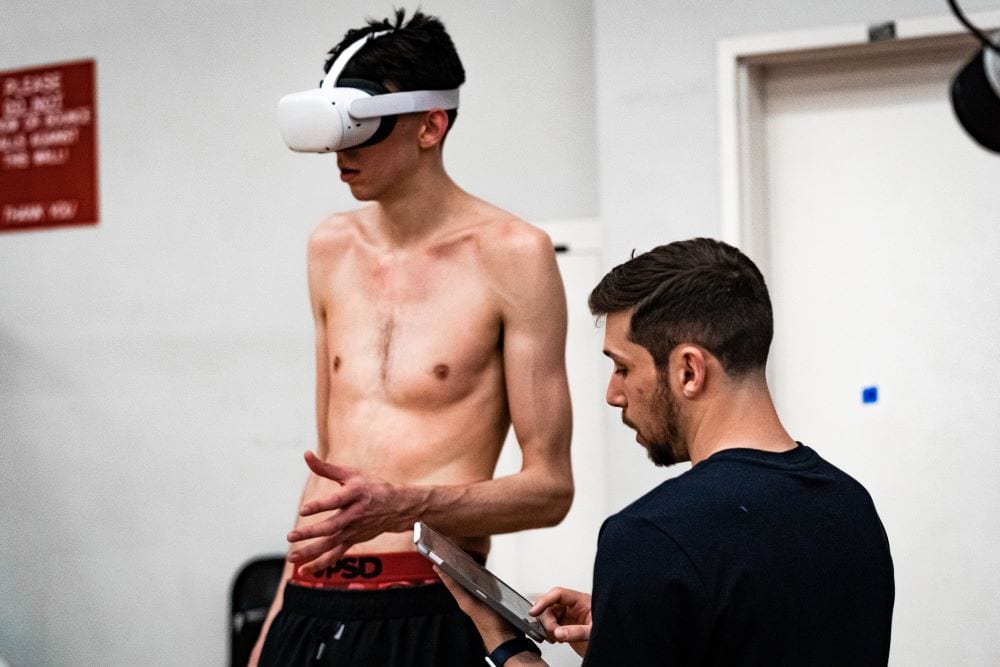
The 2022 No. 2 overall draft pick Chet Holmgren had signed an NIL deal with VReps while playing for Gonzaga.
How does your product/service work? “The product is technology at the NBA level. We recreate NBA games as they happen, any NBA game from the past five years, and we’re able to put players in virtual reality in the shoes of any player during that scenario. That’s the product and that’s available for any NBA team to purchase, and we’re working with a handful of NBA teams. The service is the player development training that Mike does utilizing that product. He actually trains players and trains them on how to prepare for the NBA using previous NBA scenarios as examples. So, before Chet got drafted we put him into the shoes of any player in the league. After he got drafted, we put him into Oklahoma City’s offense to prepare to play with the team. So before he ever steps on the court with Oklahoma City, he’ll have been in their offense for almost an hour in virtual reality.”
What problem is your company solving? “Basketball training is very focused on individual skills–shooting, ball handling, weight lifting, vertical, speed. There is an entire segment that is mostly ignored, which is the development of your mental understanding of how basketball works and why those things are that way and the strategy behind it. We’re filling the gap between how a player gets from a really good college player to an exceptional NBA talent. A lot of that growth is on the mental side and we are accelerating that mental growth, which is traditionally learned almost exclusively through game time.”
What does your product cost and who is your target customer? “Our product costs $10,000 to NBA teams as an initial offering. There are more expensive layers. The service to the NBA players, there are two tiers. One is $20,000 per year and the other is $60,000 per year. For the product, our target customers are the NBA teams. For the service, it’s NBA players or players that are preparing to be in the NBA. It’s not just NBA players.”
How are you marketing your product? “It’s entirely word of mouth right now and direct connections with those teams or players.”
How do you scale, and what is your targeted level of growth? “The technology we built has meaningful potential at nearly every level of basketball. It’s training the mental side of your brain in terms of the strategy aspect. Our growth will come, depending on what markets we want to grow into. Our growth from here, after we successfully enter the NBA market a little more, will be high-level international basketball and probably going into the college level in the U.S. We may also pursue other sports like the NFL. This technology has the same value in the NFL. We can do virtual reality training for NFL players. That’s another way we can grow. Depends on how much cash we get and from whom.”
Who are your competitors, and what makes you different? “Our nearest competitor would probably be Strivr. There’s also a company that does hockey simulations. Nobody, as far as we know, recreates historical games to relive that from the perspective.”
What’s the unfair advantage that separates your company? “Our unfair advantage is our technology expertise. We have 10 engineers working at the company. Very few companies our size are that heavily invested in their technology. We also have a few proprietary partnerships that give us access to the data streams we rely on. The recreation of the NBA games, for example, is through our partner, Sportradar. As of now, we are the only company that has access to those data feeds for player development purposes.”
What milestone have you recently hit or will soon hit? “We just trained the second overall draft pick. That was a huge accomplishment. We also trained a player that wasn’t on most draft boards through the draft process and ended up being drafted 12th.”
In what ways have you adapted to the Covid-19 pandemic? “NBA teams are very focused on in-person relationships, as are NBA players. Trying to create a business where we could work with NBA teams and NBA players remotely has been a challenge. I don’t think we’ve done it super successfully but we’ve managed to get through it and now we are growing on the other side of the pandemic, now that it’s mostly gone back to normal in how the NBA operates. We’re growing into the normal sales processes.”
Beyond the pandemic, what obstacles has your company had to overcome? “It’s a very slow market to adapt. For example, the idea of relying on analytics took almost a decade to catch on. Now, every team is heavily relying on analytics. The NBA moves very slowly and negotiating that very slow-moving market has been incredibly challenging. I’m not saying we haven’t been successful in it yet, because the company is still growing and trying to enter this market, but it’s an extremely challenging thing to overcome. ”
How has your company been affected by the current economic situation, and how are you dealing with it? “The current economy isn’t positive for startups and inflation has also made it more challenging, but I don’t think we’re doing anything special or noteworthy to mitigate those problems other than trying to reduce our spending as much as possible.”
What are the values that are core to your brand? “The values are engineering excellence and content excellence. We have a very talented basketball expert and a very talented engineering team and having a high-quality product that is impactful, it’s not just something to talk about, it actually does make players better. The impact we have is really a core tenant of the company itself.”
What does success ultimately look like for your company? “Success on a small scale is players that want to get better come to us as a way to mentally prepare and mentally enhance in any sport. Success at a big level is changing the culture around the importance placed on the mental side of basketball. If more people started to focus on the strategy behind their sport, that would be–on a broader scale–a lot more success from our perspective as a culture shift from just individual skill training to the broader picture of the strategy behind sports.”
What should investors or customers know about you—the person, your life experiences—that shows they can believe in you? “What gives me the best shot of making an impact in this market is my ability to build a very talented team. The team we have is exceptionally talented from an engineering and basketball perspective. I feel confident I can grow the engineering team as we need to, and also grow into deeper levels of basketball or build into new sports and build a team necessary to enter those markets.”
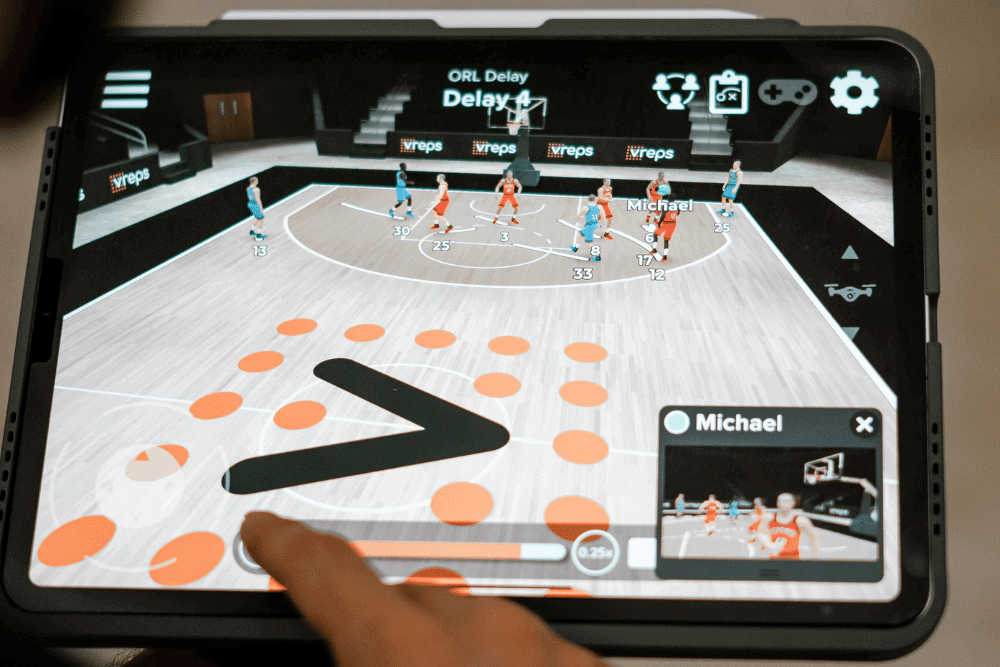
VReps allows players to create and watch plays through their app in 3D.
What made you start with basketball for VReps? “My true sports are lacrosse and ultimately frisbee. I was a very talented lacrosse player in high school but didn’t play in college because it’s really hard to do computer science and play a varsity level sport, so I decided to pursue a career. Now, I play at the highest level of ultimate frisbee. I play on a world-level team. Basketball is one of the easier sports to monetize and has one of the bigger markets and is a sport that has a very clear strategy to teach. Soccer is a little more fluid in the way strategy works. Basketball is a pretty ‘rock, paper, scissors’ type game where if they do this, you do this and they are going to do this and you do this. It’s not scripted in a football sense but more of a read-and-react sense, and it’s teaching that read-and-react decision making that is core to our business and what we can do. Basketball is the perfect petri dish for us to really prove our technology can grow in these sports.”
Do you have a favorite quote about leadership? “‘Knowing what you don’t know is more useful than being brilliant’ from Charlie Munger. The best leaders are those that build world-class teams around them. As an entrepreneur, you usually have very limited resources, so you need to be able to identify your biggest weaknesses and hire talented people to fill those gaps first.”
Question? Comment? Story idea? Let us know at [email protected]
This article was brought to you by SportTechie, a Leaders Group company. As a Leaders Performance Institute member, you are able to enjoy exclusive access to SportTechie content in the field of athletic performance.
Whether it is mere scouting reports or an analytical deep dive, the startup’s platform, which pulls in data from various sources, offers something to all coaches.
“I was jaded on some things, felt like they could be done a lot better,” he says.
Those pain points led to the founding of 6-4-3 Charts, a leading college baseball and softball data analysis and visualization tool. Five years later, 6-4-3 Charts works with 550 college programs, provided statistical support for ESPN’s broadcasts of the men’s and women’s College World Series and recently partnered with Sportradar-owned Synergy Sports on integrating its cloud-based video platform. Synergy already counts 96% of Division I baseball schools as clients, as well as growing numbers of softball programs and smaller school baseball teams. It also supports all 30 MLB organizations.
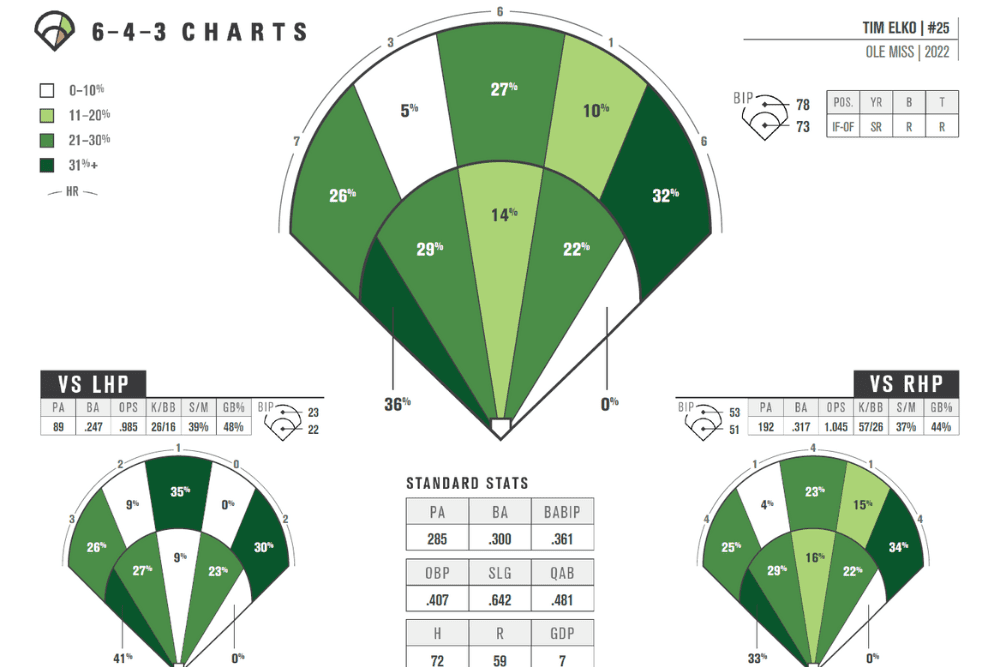
The 6-4-3 report generating process is on-demand and customizable. Coaches choose the template, stat year, spray chart design and players to include.
“What’s really cool is we’re sharing data between both of our APIs, so we’re not just leveraging Synergy data and video, but they’re also leveraging our data to improve some quality assurance processes and to look at potential ways to make their vlogging process even more efficient,” Weldon says. “And then, on our side, obviously, accessing all their video and data gives us a really unique opportunity to connect data from multiple sources.”
The origins of 6-4-3 Charts were humble, starting with a $12,000 investment and no full-time employees for its first two years. On the long bus ride to Tennessee Tech’s appearance in the ’17 NCAA regional in Tallahassee, Weldon called one of his former players from his time leading the Timberline High program in Lacey, Washington.
Rick Ahlf, who played shortstop for Weldon, was a high school valedictorian and Arizona State engineering graduate who had accepted a job at Boeing in low-speed aerodynamics product development. Ahlf laughs when recalling the experience of playing for Weldon at Timberline—“That was my first 50-hour-a-week job,” he jokes—but was interested in sports analytics and agreed that there was an opportunity to make a better product. (The third co-founder is Tim Kuhn, a CPA by trade who serves as COO at 6-4-3.)
Working out of his parents’ basement in the summer before the Boeing gig started, Ahlf coded the first iteration of the 6-4-3 Charts product. By scraping box scores and play-by-play data, the tool produced in-depth statistics and visualizations. In recent years, they’ve added a feature to sync TrackMan ball flight data as well as several other partnerships, including with SEQNZR and Playsight.
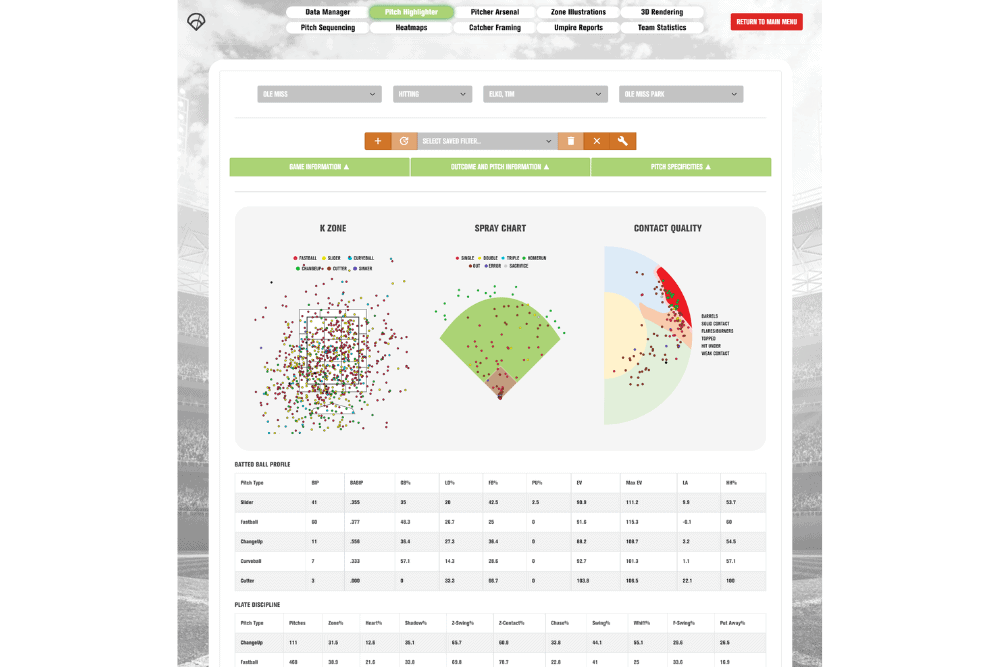
6-4-3 syncs with TrackMan to share ball tracking data visually with coaches and players.
“We started with PDF reports and Dropbox links, and we’ve evolved,” Weldon says. “Five years later, it’s a fully dynamic interface with on-demand reporting, customization, upload visualizations, video tagging, analysis, ball tracking.”
Coaches are the primary users, with some simply downloading basic scouting reports and spray charts and others delving deep into situational data.
“Coaches of all levels will now have the ability to enhance their game prep and film review,” Matt Lawrence, Synergy Sports’ senior director of baseball and softball, writes in an email. He adds, “And, importantly, their program is in-depth and easy to use. As a former D3 coach, I know this partnership is something that would have enhanced my video scouting and game preparation experience.”
Weldon says they are considering development of their own player portal; one of 6-4-3’s other partners, Driveline Baseball, already does with its TRAQ system. One of the 6-4-3 features is customization of a pocket card with info, for players to wear in a wristband during games or coaches to keep in their pockets. (NCAA rules prohibit in-game access to technology.)
In addition to serving its coaching clients, 6-4-3 has begun sharing some of its data in the media, both with ESPN and D1Baseball.com and D1Softball.com.
“We have all this data,” Weldon says, “and it’s like, ‘Well, other people besides coaches would probably be interested in this data. How can we tailor something for media, for example?’”
For the softball College World Series, Weldon was in the ESPN booth alongside the lead stats researcher and with two 6-4-3 team members in the graphics truck. Having seen how the process works, he is now brainstorming a specific TV production app to help broadcasters provide additional context and storylines.
6-4-3 started gaining significant market share by early 2019, when Ahlf left Boeing and dedicated himself full-time with the startup.
“Honestly, I like having control of my own future,” he says. “I’d rather bet on myself and the people that I trust to work with than being part of a large company where things just honestly move slowly. I like having that level of ownership and accountability that, ‘Hey, if I don’t perform properly, then this thing doesn’t go anywhere.’”
Weldon, incidentally, does still coach back in the high school ranks. His Olympia (Washington) High team won the Class 4A state championship last month. And he’s still in charge of the grounds. “Oh, absolutely,” he says, before correcting himself. He recently handed over mowing duty to a volunteer whose son is on the team.
So some things change, even if the spirit remains.
“All I ever say,” says Weldon, “is, ‘Just keep moving. We’re not going to be still. Let’s just keep going.’”
This article was brought to you by SportTechie, a Leaders Group company. As a Leaders Performance Institute member, you are able to enjoy exclusive access to SportTechie content in the field of athletic performance.
The former wide receiver discusses the use of data in the NFL and his work with Breakaway Data, the holistic data platform.
The Bills drafted him in the third round of the 2012 NFL Draft. Graham played two seasons in Buffalo, catching 54 passes for 683 yards and three TDs. He went on to play regular season games with the Jets and Saints while also logging time in training camp with the Titans, Eagles and Panthers and spending parts of three seasons with the CFL’s Montreal Alouettes.
Graham, now 32, completed his playing career in 2019 and turned his attention to coaching and data. He’s mentored numerous elite athletes in the Raleigh-Durham area while becoming a data advocate. For a spell, he also worked in Sportlogiq’s business development office on American football projects.
Graham has spent the past two years at Breakaway Data, a holistic data platform co-founded by the leaders of the Gains Group sports consultancy to monitor and improve their own fitness and performance. He is currently its head of performance and on-field application, but also just started a two-month stint with the Green Bay Packers as part of the NFL’s Bill Walsh Diversity Coaching Fellowship.
On when he realized the importance of data . . .
It started a little bit around the time I interacted with Philadelphia Eagles—that was in 2016—but the best and realest time I had a connection with data and analytics in football was definitely with the Panthers. And I’ll give you the story: we had always worn GPS devices, but we didn’t really get that stuff given back to us. It was just measured, tracked, probably used more against us than for us—but also to tailor our workouts to fit us, personalized.
Other than that, it wasn’t to the degree of… I call it ‘athletic expansion.’ Just for me in my athletic knowledge and IQ, there are things that I need to know, and I need real-time feedback to adjust. I wasn’t getting that until I was with the Panthers.
One day at practice, one of the strength coaches came by and said, ‘Dude, you ran 23 miles-an-hour on the GPS.’ I’m like, ‘What does that mean?’ He was like, ‘That’s the fastest we’ve ever seen recorded on the GPS units.’ I’m like, ‘OK, I really don’t know what that means.’ I mean, I’m a track guy. So I understand that we’re moving, but in my mind, I’m like, ‘When did I do it in practice? What did I do in preparation for that practice or even that data point to hit 23 miles-an-hour? What did I do to lead up to that? And then how do I replicate that? Or was it so high and so fast that I need time to recover?’
On the evolution of data in the sport . . .
It definitely has improved as coaches have gotten younger and the more that the data providers have created education around the space. It started with some [analysts] calculating some and then being like, ‘Hey, this is beneficial.’ And then a coach saying, ‘I don’t know what the heck this is,’ then a coach saying, ‘I kind of know what this is.’ I started between the two of them. Football has always been statistical and analytical. We do down and distance. We do stats. So we know stuff. We want to keep track of stuff.
I have a heavy track background. My dad was an Olympic track coach. I was around Olympians forever. And I’m at practice listening to splits, listening to times for reps, I’m listening to technical feedback for mechanics. And then, after a while during the summer, I’m seeing them run 9.7, and you’re like, ‘That makes sense now.’ If you don’t hit these different points within your 10-meter splits, 20-meter splits, 30-meters splits, you’re not going to achieve the end goal time. So within practice, within a rep, with your warmup, you have to start tailoring yourself and have an understanding what specifically you need to do to obtain a 9.7 because you’re measuring against the clock, right?
That same thing can be applied to football with analytics. Coaches have used GPS load to justify if a player is exhausted or done too much and how they go into recovery and how they plan their scripts and their practice plan. That’s high level. That’s way more objective than a subjective view of basically, ‘We ran around today and did this.’ Now we’re having hard data to justify that this guy, compared to this guy, is gassed. So we have tailored practice for this guy specifically but not the whole team—compared to not resting this guy and pushing the whole team and now we hurt this guy. And we really need him. So analytics and data has definitely helped out.
On how he coaches with data . . .
I coach as a performance coach but also as a receivers coach with analytics. Specifically, I’ve worked with a lot of the NC State football players in the area and some pro guys, definitely some other colleges and the HBCUs and some high-level high school recruits in the area. I put GPS units on my guys when we run. We start with running technique. It’s important to be efficient within route running so that you can hit every point on the field efficiently, right? No part of the grass is off-limits because you know how to move your body in the most efficient way to that point on the field.
[I look] at the technicalities of biomechanics. Now I’ll put that in front of video, and then we break it down there. But then we take that and put it on the field. We go from the track or another surface to the field. Now once it’s on the field, it needs to be applied within sport. And I use GPS units to [monitor] change direction, acceleration, deceleration acceleration, average speed, top speed, of course, and just [overall] load. So the quicker that our younger generation can understand it and take the ownership of it off the coaches, the higher level football will be in quicker. Breakaway is doing that right now.
On whether he would have used data had it been available earlier in his career . . .
As a young player, I would have had to be receptive to this information, and I might have just been ignorant to the fact that it was even around, or it was just so early on that it wasn’t around. But I think it would have definitely added a year or two onto my career, just knowing how to be more strategic in my preparation.
Right now, we’re in the NFL offseason. So prior to showing up for OTAs, I was very calculated as an athlete. It was a chance to really hone in on or own the thing that you really good at, really work on that craft. So, for me, I always had to work on my top-end speed. I could not show up to an NFL camp and be anything less than that. And that was important to me. So in order to either maintain or to increase my top end speed, we have to measure, we have to run, we have to be consistent, we have to, like, run to the point of exhaustion. Understand that that point and that wall is going to be pushed further the next time. But we have to know where that wall is to even push it further.
On the infusion of sensors in the sport . . .
Sports and football are getting there. We have sensors in our helmets. There are sensors in the ball. There are sensors in our shoulder pads. There are sensors now in our tights, our girdles, to see what strains or what muscles are activated in our legs and seeing how they are strained or stressed. Next up will be shoes, right? That would measure stride length, frequency, force—almost like a force plate in your foot. Next will be your hands and gloves. You have your visor being able to do some digital overlay. There’s a way to make this whole thing work.
On joining Breakaway Data . . .
When I first heard about the idea around Breakaway, I was sold immediately because I was like, ‘Excuse me. where the [heck] was this my whole career?’ I’ve been waiting to aggregate all my stuff in one place. It’s just been me by myself, and I cannot do it, and I need something to help me make it all sticky.
The part about it that is really cool is that it incorporates your recovery outside of football, your lifestyle outside of football, with your lifestyle within football. If I can figure out if I walked too much in the mall and figure out how much energy I would have for practice, it would definitely on the next day be like, ‘Don’t go walk around the mall that much.’ Without that, guys were doing this pregame ritual when you go to a new city—for instance, we would stay at the Galleria in Houston, and it was right across the street from a nice big designer mall. All I saw was just steps and steps that I need to recover from prior to tomorrow. They’re going to ask a lot of me, and I’m going to run a lot tomorrow. So let me not use that energy over there at the mall.
One of my guys [that I coach] is coming back from an injury. We’re not doing as many reps with him, but his GPS load and output and overall energy exertion was just as high as one of other guys. I’m like, ‘So what were you doing if you weren’t in the workout?’ Then you start looking back at the video, and he’s having fun behind the line. He’s moving over here. He’s dancing. He’s doing this, he’s doing that. And all that plays into it. I’m measuring it, and I’m getting it. I’m like, ‘Well, you need to just sit down somewhere. You need to be a little more detailed and fine- tuned.’
On empowering athletes through their data . . .
Breakaway is knocking on the door of owning that data. Own your data. The team’s tracking it for their own good, but it’s going to be on your own personal self to go take advantage of that and read it and understand it and ingest it and figure out how to become a better player yourself to even help your team. A football roster is 60, 70-plus in the NFL. Colleges are 100 deep. That’s a lot of bodies to assess. I have 12 players, and it takes me three hours to go through some lines of code and lines of data and statistics.
I cannot imagine doing a full team on the daily, but an individual player can go in read his line off in maybe 20 minutes—see what they did, how they did—and now they can justify their day after that. For linear speed, I like to see average sprint speed and average time spent sprinting. Now if you have a long time sprinting, now you’ve got to understand the mechanics of sprinting. You put a lot of high stress on those body parts. It’s like you’re a driver, and you need to go check the tread on your tires.
Sure, your tires are worn. You’ve got to go refresh your tires. The same thing happens to your body. You have to know what you’re doing—not just go and feel it, but you’ve got to know exactly what you’re doing and have a plan in place. And once you start justifying creating a schedule a routine that you know, satisfies your output, now you’re going to be a consistent Tom Brady type player, right, like longevity type stuff. We can’t just grind it out like we used to in old-school football. And that’s where the younger class has to get on board and be able to read what is being measured, but also understand who to go to and where to go to manipulate the outcome or output on the other side. So, that’s Breakaway.
On getting players to lean into data . . .
Building trust with data is tough, right? It’s almost like building trust with the court system. It’s got to be fair. No bogusness, no BS. It is for you, and it can be used against you. It’s a weapon and a shield. Some teams do a good job of taking care of their athletes, but the uniqueness of it is that it can be used as a shield to keep away the BS. A team is going to try to justify your reps, your pay, your position, your whatever, by whatever they collect. But you need to know, as if you were in courtroom, what they have on their side, to even combat it. And it has to be an open forum. And you can’t be intimidated by knowing that they know.
It’s just an understanding that it’s something that’s going to happen, like our iPhones are tracked but that doesn’t stop you from using your phone, right? We’re ahead of the game, in the sense of we are so early that every time we meet a person, we have to explain its usefulness or benefit. But you still need a place to put [the data]—so insert Breakaway and its app. It’s definitely why I’m here and why I’ve been so passionate in the space because as much as it’s annoying to try to get data released to us, it’s necessary. The sooner that all the data could be sent and delivered back to an athlete, the better, and it’ll lessen that feeling of being scared about the new technology.
It starts with owning your own shit. That was one of my slogans I pitched to Breakaway— own your shit. You have to own your stuff, like listening to the Panthers tell me it was I was running at 23 miles an hour. That was just the tip of it. That was just throwing a pebble in my pond, and the ripples started going. They’re cutting and signing people based off of expenditure of GPS loads and movements and all sorts of craziness. You need to know what they’re doing and why they’re doing it and what they’re tracking and why they’re tracking it, to even fight against that.
This article was brought to you by SportTechie, a Leaders Group company. As a Leaders Performance Institute member, you are able to enjoy exclusive access to SportTechie content in the field of athletic performance.
Dr Kate Hays, now of the Football Association, discusses the psychology around skill execution and why confidence must be viewed holistically.
A Human Performance article brought to you by our Main Partners

Develop a confidence bank
Confidence is multifaceted and people can be confident about different things, which is why, according to psychologist Dr Kate Hays, it is important for athletes to develop what she calls a “a robust confidence bank” ahead of any setbacks or moments of self-doubt. “What we try to do is ensure they’re pulling their confidence in from lots of different places,” Hays told an online audience at Virtual Leaders Meet: Evolution of Leadership in June 2021 when she was still serving as Head of Psychology at the English Institute of Sport. “We know that athletes gain a huge amount of confidence from performance accomplishments whether that’s in training or in competitive settings. We know that they derive a huge amount of confidence from coaching, social support and holistic preparation, whether that’s physical or mental. The more proactive people can be in terms of self-reflection and developing confidence from a multiple of sources, the more likely it is to be robust when they have those peaks and troughs.”
Normalise a bad day at the office
Hays, who is currently the Head of Women’s Psychology at the Football Association, tried to dispel the myth that you are either confident or you are not. “That’s just not true,” she said, explaining that no one is immune to self-doubt or negative thinking. We can all have a bad day at the office, as Dr Wendy Borlabi, the Director of Performance & Mental Health at the Chicago Bulls, has said. Hays added: “I think it’s a myth that we see the professional athletes and these Olympic athletes line up and they look so well-rehearsed – and they are – but it’s not true to think that some of them are not standing on that start line wishing they were not anywhere else in the world.” Athletes need to accept the inevitable and not fall prey to the myth. “It’s so important then that you’re able to go back to your evidence base and the preparation and your process to be able to cope with that in the moment and to enable you to still perform when the pressure is on. Confidence is not about positive thinking, confidence is about a set of evidence-based beliefs developed from really good preparation.”
The value in constraints-based coaching
What is happening when athletes are unable to execute under pressure? “If the skill is not transferring, there is a difference in the pattern, behaviour, the emotions or the cognitive thought processes that are taking place,” said Hays. She believes the path to the solution lies in constraints-based coaching. “It’s creating as many different environments and as many different circumstances and helping people understand their processes. But it doesn’t matter what you’re faced with, if you’ve got a consistent process that works for you, you can transfer it into any environment and you start to build confidence in your skill execution. I’m a massive believer in constraints-based coaching and how you develop psychological principles through technical and tactical coaching. Just having sessions day to day about learning; ‘so you’re going to make some mistakes and that’s OK.’”
“Confidence is an essential part of the make-up of the very best performers; of course, the key question is how can belief be developed so that it remains robust under pressure? As Dr Hays says, one of the best ways of doing this is to help performers draw their confidence from various foundations, with their previous accomplishments being at the core of this. The notion of a ‘confidence bank’ is one that many top performers use because, just like our personal income and finances, we can generate confidence from multiple sources, we can invest and expand our belief portfolio over time, and we can make withdrawals when we need them most. But, similar to financial management, performers require support from coaches, family, experts and others, on how to best manage their own experiences and environment in such a way to strengthen their confidence. Certainly, focusing on personal mastery experiences, particularly success in difficult tasks that have occurred recently, is critically important for performing at our best.
“Just because the best performers can develop their confidence to high levels, this does not make them immune from intense anxieties. In other words, performers can simultaneously have strong belief in their ability (i.e., high levels of self-confidence) whilst being uncertain, or even doubting, if they will achieve some of their goal(s) (i.e., high levels of competitive anxiety). This is the performance equivalent of what the novelist, George Orwell, termed ‘doublethink’: the acceptance of contrary opinions or beliefs at the same time. It is not uncommon, for example, for performers to believe that they are capable of a great performance but be uncertain of whether it will be enough to win – hence being self-confident and anxious at the same time. The good news though is that some doubts can serve to keep high levels of confidence in check and prevent arrogance and/or complacency. It is, in part, for these reasons that performers should use some constraints-based coaching and pressure training to help them learn how to draw on and maintain their self-belief when they are under pressure and some doubts will likely creep in.”
