The asymmetrical training bar has helped PGA Tour players including Scheffler, Jordan Spieth, Zach Johnson and Ryan Palmer with their stability and mobility patterns.

A trained chiropractor with a focus on sports biomechanics, Van Biezen does some treatment on the training table before Scheffler begins his warm-ups. For the vast majority of that time—85%, Van Biezen estimates—the recent Masters champion is clutching GolfForever’s new SwingTrainer, a 44.5-inch, asymmetrically-weighted training bar with attachments that either replicate the feel of a driver or a club head that’s 2.5 times heavier for training. There is also a detachable resistance band for a wide variety of exercises.
“When we’re on the road, SwingTrainer is an integral part of our warm-ups and our training throughout the week,” says Van Biezen, who has worked on the PGA Tour for 20 years with Jordan Spieth, Zach Johnson, Ryan Palmer and others. “What I try to do in a gym, which is under a controlled environment, is just mimic the movement patterns that we want to have Scottie integrate into his golf swing. The SwingTrainer has been a very versatile, durable tool that we can apply those movement patterns under a light load but generating that neural pathway pattern to get that brain working on certain movements we want to get him into.”
GolfForever is the spinoff of chiropractor Jeremy James’ BackForever program, and the SwingTrainer launched in November as a training tool to complement the library of video content in the program. Scheffler, who has been training with Van Biezen for a decade in the Dallas area, recently joined Justin Leonard as a GolfForever ambassador, calling the SwingTrainer “critical” to his Tour preparation.
James, whose practice is based in Aspen, Colorado, welcomed patients suffering from chronic back pain for weeks or even months at his facility. Recognizing the challenge and expense of his location, he sought to distribute his message further, first by writing a book and then by recording streamed video content. Many of his most active users were golfers, which spurred the development of the GolfForever package that launched in 2019.
“Golf does a very predictable set of things to your body,” James says. “From a biomechanical perspective, it’s a repetitive, asymmetrical motion, and if you’re not in great shape or if you’ve had injuries in the past, it’s going to wear your body down.”
For the first couple of years, GolfForever relied primarily on resistance bands, but James sought to more precisely target the core muscles that generate and resist the rotational forces created during a golf swing. “We didn’t invent the idea of asymmetrical bar training—that had been in the fitness world for a while—but we took that concept and we made it specific for a golfer,” James says.
The SwingTrainer helps golfers open up the joints in all three planes of the swing, Van Biezen says, referring to the sagittal (left/right), frontal (front/back) and transverse (top/bottom) planes. He’ll have Scheffler do a side lunge with a rotation, a Bulgarian squat while doing a unilateral push or a single-leg overhead press, all while incorporating the SwingTrainer.
“With Scottie, he’s very, very strong,” Van Biezen says. “It’s just now, with the GolfForever, what I really like about is it just helps a lot with the stability and mobility patterns. It’s just a really high-beneficial, low-risk training tool. I think golf fitness has probably gone down one extreme where you get the Olympic lifting and all that kind of stuff and guys really getting hurt. I’ve always said the game of golf is a marathon, not a sprint. And so these guys can play for a long period of time and perform at a high level if they just keep themselves healthy.”
Van Biezen says he believes strongly in rigorous baseline testing to track movement patterns and detect asymmetries. He uses 3D motion capture regularly and employs massage therapists and strength coaches at his facility. There is also a golf shop and hitting bay with club fitting and repair, making it a one-stop destination. Scheffler first visited around the age of 14 or 15 and has kept coming back, much like Spieth, the 28-year-old who ascended to a world No 1 ranking in 2015.
“What’s going on with Scottie right now, it’s kind of like Groundhog Day for me with what happened with Jordan around the same time,” Scheffler says. “They both had a little bit of low back issues, and that’s why they first came in. Then they both just realized, for injury prevention, they have to start doing stuff off the golf course.”
Last season, Scheffler had eight top-10 finishes in his 29 starts but no wins. In fact, he had never won a tournament prior to the WM Phoenix Open in February—which began a streak of four wins in six tries, culminating in his Masters victory. Van Biezen pushed him hard in the offseason to strengthen his upper body and core but also build his endurance so that he was as fresh during the back nine on Sunday as he was the front nine on Thursday. By a small margin, his fourth round average a year ago was his worst, and his first round was his best.
“We’re just beginning to see everything come together finally,” Van Biezen says.
This article was brought to you by SportTechie, a Leaders Group company. As a Leaders Performance Institute member, you are able to enjoy exclusive access to SportTechie content in the field of athletic performance.
The Formula One team are make better, more data-informed decisions around race strategy.
Suddenly, the graph line began a rapid descent, so unexpectedly that Green, McLaren’s Head of Commercial Technology, quipped, “Oh, this doesn’t look good. We must have broken something.”
A colleague, however, assured him otherwise. The algorithm was predicting rain, which would cool the track. Though Green saw blue skies and sunshine, he shared the intel with folks in the hospitality area, who grabbed precautionary umbrellas.
“Sure enough, 20 minutes later, it started raining, and the clouds rolled in,” Green says. “That just made me smile, thinking that this is quite powerful that the race team that’s down there is using this information.”
This graph was the product of a new artificial intelligence model built and maintained by DataRobot, McLaren’s new partner this season. DataRobot has helped cull data and refine the AI models to make better predictions, even accounting for such details as how the hillier train in Monaco affects cloud movements compared to the flat Miami course. The rain in Miami cooled the track enough that F1 cars could make a few extra laps on their tires.
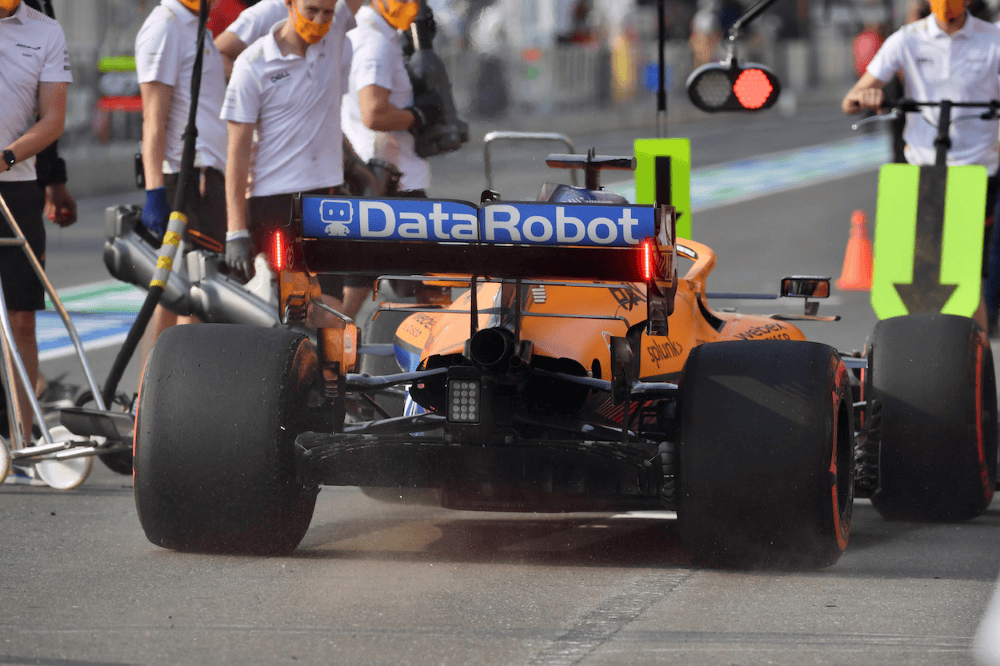
DataRobot is integrated into the McLaren Racing infrastructure, delivering AI-powered predictions and insights.
“It sounds a little pedantic, but it’s one of the most extremely important aspects that you could do for the race strategy team,” says DataRobot’s AI evangelist, Ari Kaplan. “So that was one of the successes is being able to better predict the actual air temperature, as well as the track temperature, more precisely than they could before.”
An F1 car is outfitted with 300 sensors, many of which sample data at different rates. The fuel flow sensor measures 2,200 times per second. Collectively, they produce tens of thousands of data points per second—and that doesn’t include any of the myriad of external sources—to be reviewed by the on-site team, which is in France this weekend, and the engineers at Mission Control, the nickname for McLaren’s headquarters in Woking, England.
“It’s a very data-rich sport, and we’re collecting and analyzing, truthfully, more data than we know what to do with,” Green says. While emphasizing how smart his team’s engineers are, he notes that a little more scrutiny was needed in their analysis.
“We’ve been running models and using AI for quite some time now, but like many organizations, as working on the IT team, we sort of just let people get on with it,” he adds. “And we didn’t really ask too many questions about which model they were using, how they made that choice where they were deploying it. It was really done without much supervision or much oversight.”
That’s where the DataRobot partnership, which was announced last November and includes McLaren’s F1 and IndyCar racing teams, plays a role. DataRobot maintains an AI cloud that serves a third of Fortune 50 companies.
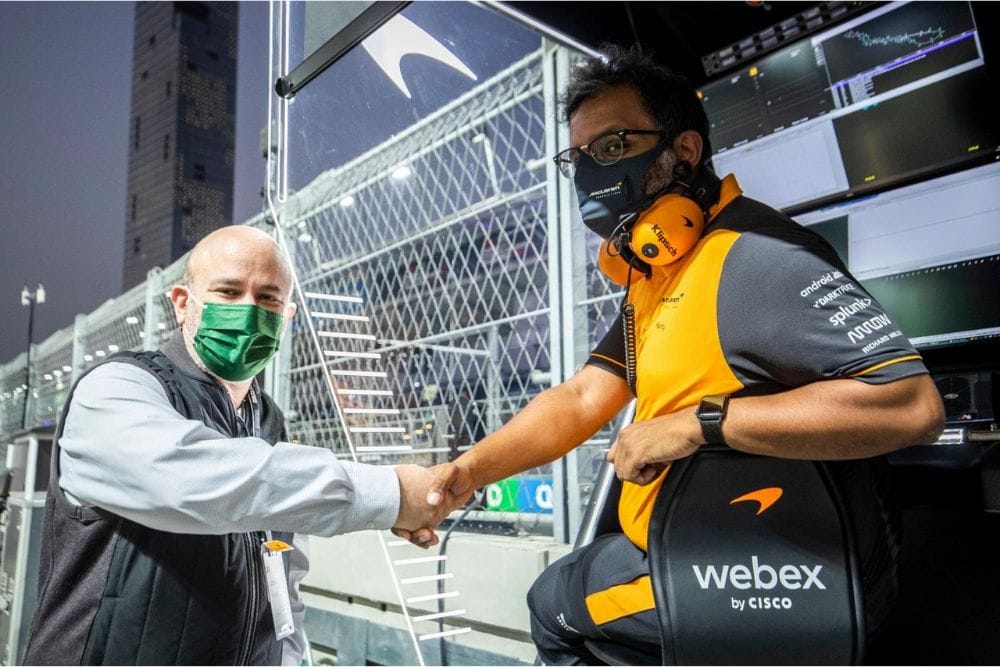
DataRobot’s Ari Kaplan (left) with Randy Singh, McLaren Racing’s Director of Strategy and Sporting.
“Anytime you have an AI opportunity,” Kaplan says, “you look at all different factors: what data is readily available? What type of insights could be given? What’s the actual value? If we get an insight, is it actionable and practical? Or is it just Trivial Pursuit and you’re getting fun data? Maybe that’s good for fans, but if it’s the race team, [they need] the things that they can take action on.”
Every area of racing strategy can be optimized in support of drivers Lando Norris and Daniel Ricciardo. McLaren’s pit times have been among the circuit’s fastest this season, with Norris making the fast pit stop in the field at Italy’s Emilia Romagna Grand Prix, needing just 2.27 seconds to get moving again.
Kaplan, who was a pioneer in baseball analytics, describes AI’s role in helping plan the timing of those stops—based on the car’s wear and tear, fuel management and weather—and also the intricate “ballet sequence” of so many crew members simultaneously tending to the car.
“You can spend hours and weeks in the wind tunnel trying to shave hundredths of seconds off the car—and you could lose that through through a pitstop,” Green says.
The remodeled car being raced this season in F1 are optimized for creating ground effect, an aerodynamic phenomenon that generates downforce. Green describes the change as going from “how much air can we push over the car to how much air can we pull under the car.”
To help with this transition, McLaren has built a digital twin of the car. Every new part begins its life on a designer’s computer where it undergoes rigorous computational fluid dynamics (CFD) modeling. Once it meets a certain standard, Green says they use a 3D printer to construct a part at 60% scale for wind tunnel testing. Only after those tests are passed is the part physically constructed for an on-car trial. These simulations are an area where AI has helped “massively,” Green says.
But for all the proliferation of data and technology, the AI models remain complementary to the process.
“We have this concept of ‘human in the loop,’” Green says. “So it’s not letting the AI make the decision for us. It’s not letting the machine model dictate your strategy that you’re clicking along with. It’s really about giving the human in the loop the best information, the best insight possible, so they can go and execute that decision with all of the other systems and information that’s coming out from the rest of the team—be that at the track or be that back in Mission Control.”
This article was brought to you by SportTechie, a Leaders Group company. As a Leaders Performance Institute member, you are able to enjoy exclusive access to SportTechie content in the field of athletic performance.
The tech organization’s innovative wearable technology adds sensors into fabric by weaving circuitry into clothing or other material.
“I thought giving them a sleeve would be a no-brainer: ‘I can tell you your perfect free throw form,’” Sun says. “But they’re more interested in ankle injuries, so that’s why they opted in for socks.”
What Sun has developed is IP around imbuing textiles with electronic properties so that the fabric looks and feels like normal athletic attire while managing to collect data on movements, forces and even biometrics.
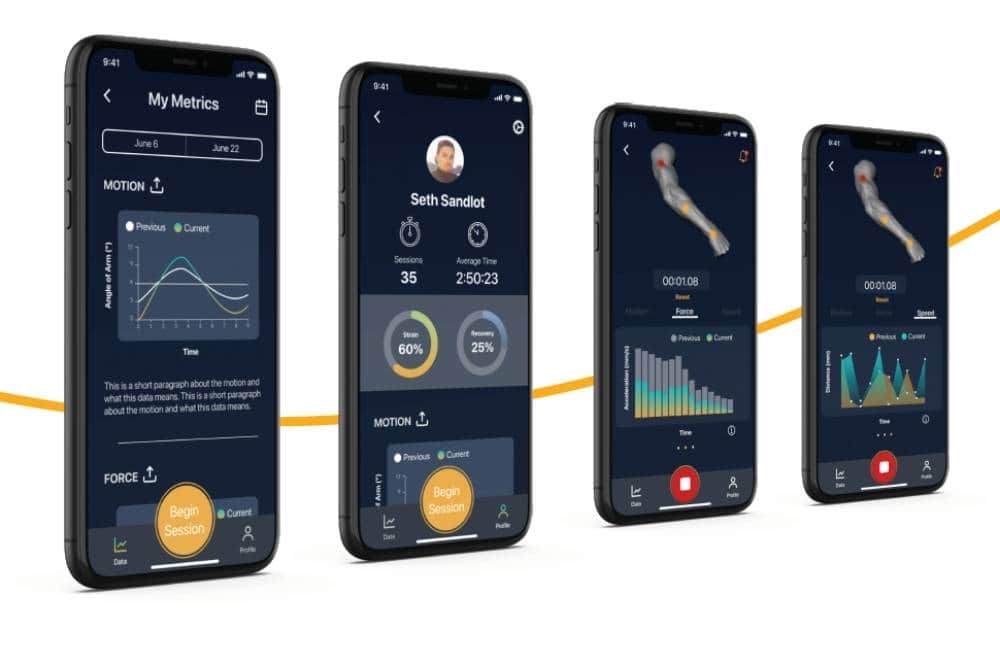
Users can view detailed biometrics tracked by Nextiles’ sensor-laden apparel.
The NBA example is a perfect case study of Nextiles’ B2B2C approach: develop innovative technology and let strategic partners guide the development of features and interface to meet their needs. Since the league selected Nextiles for its inaugural Launchpad startup program, the NBA has become a validator, a customer and now an investor.
Nextiles has raised a $5 million seed round led by Drive by DraftKings and joined by the NBA, Madison Square Garden Sports Corp., Alumni Ventures, SmartSports, Phoenix Capital Ventures, Newlab and Olympic hockey medalist Hilary Knight. Among its other early business partners are baseball training company KineticPro Performance, a tennis company and the US Air Force. The KP Sleeve, which monitors pitching workload and form, is expected to be available late summer.
“We’re not really in the business of guessing and saying, ‘Hey, you need to wear this.’ It’s more of you tell us what you want,” says chief business officer John Peters. “We have the form factor fabric, we have the sewing infrastructure, we have the supply chain set up, everything’s ready to go. And it’s really plug and play at this point.”
When Nextiles first stitched its socks for the NBA—technically, an outer layer to be worn over one’s usual socks—they quickly received more feedback: they foot covers are too small for the basketball player population. Peters laughs as he holds up the new product, which is befitting a man with a size 16 shoe. “So we have a new definition of ‘large’ after that,” he says.
Nextiles received that feedback and turned around the new product quickly. Its core team works out of NewLab, a hardware-focused workspace in the Brooklyn Navy Yard, and its product sewing studio is in New Jersey. The team shares communal resources at NewLab that enable rapid turnarounds.
“I want to ideate really, really quickly—as in, have a drawing, have a sketch and then print it out and touch and feel it to see if it’s the right geometry, the right fit,” Sun says.
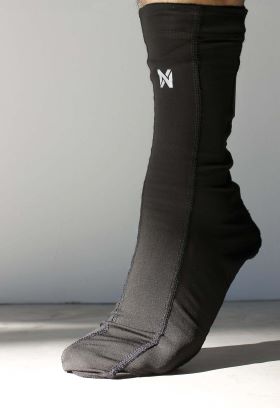
Nextiles stitched socks for the NBA because the league was interested in tracking data related to ankle injuries.
On a recent afternoon, Sun leads a guided tour of the 20th century shipbuilding factory that last decade was transformed into a prototyping studio. The first stop was to a room of 3D printers where, rather than order and shape mannequins to specific needs, Sun will use computer-assisted design to render the precise geometry of a body part he wants to clothe.
Most of the smart textiles his team makes include a patch of fabric with conductive materials covering about 5 or 10% of the garment. Sun uses the 3D printed body parts as a form around which to cut and stitch prototypes. His arts and crafts skills are a departure from his childhood spent tinkering with electronics.
“I used to break things—like, really disassemble things,” he says. “It wasn’t until I went to grad school and I worked for Puma that, yeah, I basically I can hand-sew now. I hot glue things together. I can teach kindergarten pretty well.”
Sun then proceeds to the chemistry lab where he experiments with materials of different ratios, combining metals like copper, stainless steel and silver with threads of polyester and cotton. Based purely on its inherent attributes and position on the periodic table, silver is best situated as the metal of choice, but Sun shies away from using because of both its cost and its inability to be reclaimed for a future iteration.
Instead, Sun prefers working with stainless steel. Because it’s less reactive than silver, it can be extracted from materials. It’s water-resistant. It is, however, a bit thicker and heavier.
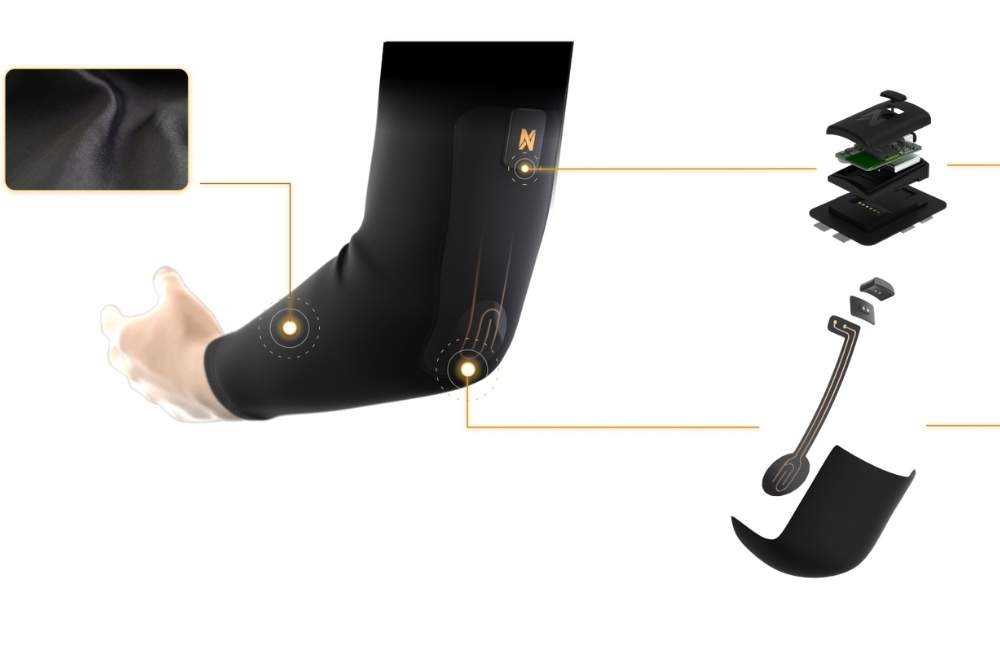
A Nextiles arm sleeve can help tennis players measure torque on their arm and help baseball pitchers manage their workload.
“It has more of a tensile strength than silver, and it’s just easier to sew,” Sun says. Many competitors “have deferred to silver, mainly because you can’t really see it afterwards. It’s so thin, it’s pliable. But for us, we found ways to have some interesting stitching patterns where the stainless steel is not as noticeable.”
From there, Sun walks down the hallway to an electronics testing room. Its benches are lined with soldering irons, voltmeters and the like. Here, he can experiment with signal strength and modulation as based on various twists, bends and folds of the fabric. Once a prototype is complete, one early round of informal testing is done upstairs where Bats-Toi—an MMA-focused mixed reality sports tech company—has a motion capture studio. Nextiles and Bats-Toi work collaboratively on some R&D, Sun says. (Asked to critique his wrestling style, he jokes, “I can’t fight. I go to the fetal position.”)
Back at Nextiles’ open loft space, entrants are greeted by a company nameplate touting a Steve Jobs quote, “Stay Hungry. Stay Foolish.” Inside the space are prototypes, conductive threads and desks for the small but growing team. The software team consists of only two engineers for now—who spend most of their time working on data security and “plumbing,” as Sun calls the encrypted data transmission to the servers—but will likely add at least a half-dozen more in light of the new investment.
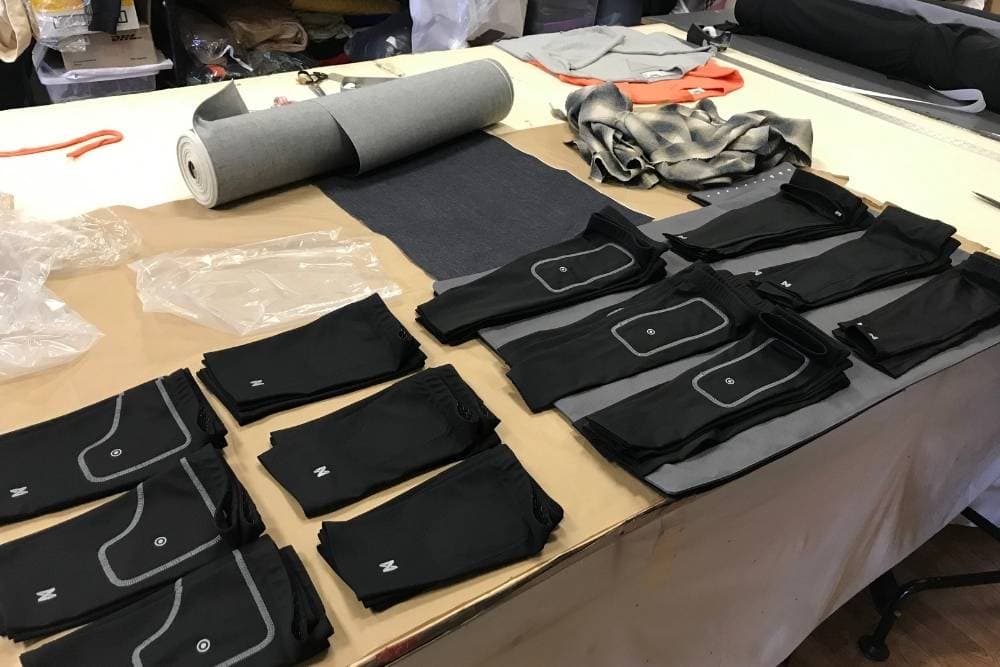
Nextiles uses repurposed sewing technology to merge fabrics and hardware to create a new type of wearable for athletes.
“The next six months is all about developing that software ecosystem,” Sun says. Nextiles still won’t be creating its own user apps, leaving that work for the partners, but much more can be done to organize and interpret the data to help clients gain more insights.
The filtering of all that requires actually quite a bit of analytics on the software and coding side, as well as data science and machine learning to say, ‘Hey, what is actually happening in this range of motion or this muscle movement or activity?’” says CFO Matt Evans. “That’s taking the science and translating it into adjustable outputs? That’s really the key part of what’s going to drive this forward.”
Two black fabric mats lie on the ground. A tablet is affixed to the wall at eye level. Every step or jump on the mats creates Richter Scale reading on the tablet’s digital seismograph-like display. While traditional force plates are heavy and expensive, Nextiles has replicated the concept with lightweight material that can be rolled or folded.
Nextiles created force plates with lightweight material that measure range of motion and muscle movement.
“I used to be a swimmer, so I’m not really a land guy,” says Sun, who swam through high school but stopped upon matriculating to Berkeley for his undergrad degree. “I had to be educated how important ground force was. I was really more about like, ‘Let’s build a body suit, an Iron Man suit.’ But it turns out just two pieces of fabric floor work for that information.”
The value of that data has made force plates a common sight in weight rooms and training rooms across all elite sports. Nextiles wants to deliver it more efficiently.
“We’re not always shooting out datasets that are claiming to be different,” Sun says. “We’re trying to say, ‘OK, our data sets can get the same thing but from a form factor that’s more seamless.’”
The same goes for one of its earliest partners, the US Air Force, who were the second—after the National Science Foundation—to award Nextiles funding (via a grant) following Sun’s PhD work at MIT. What used to be the data-collecting domain of wearable sensors can now be gleaned through fabric.
“The Air Force is looking for more biometrics like skin voltages, heart rate, breath rate, even eye movement,” Sun says. “And so that’s actually a different phase of our company that’s less mechanical and more biometric, and we can do that, actually, just by putting different fabric electrodes on the body, we can actually pick up signals from the skin.”
Eye movement? The human body is essentially a live battery, and the electric currents in the brain, heart and muscle can be detected by EEG, ECG or EMG. EOG, or electrooculogram, can do similar work for the eyes through nodes placed on the surrounding muscles.
The more imminent beachhead in sports will come through noninvasive motion capture and force analysis.
“Our goal is to deliver that experience—like a lab in a box—anywhere,” Peters says.
Nextiles hopes to provide that dataset as a companion to other technologies, all without the need for additional hardware. “Because,” Sun says, “I would hope you remember to wear your clothes.”
This article was brought to you by SportTechie, a Leaders Group company. As a Leaders Performance Institute member, you are able to enjoy exclusive access to SportTechie content in the field of athletic performance.
Members of the Leaders Performance Institute convened at St George’s Park to hear from pathways specialists at the Football Association, Wales Rugby Union and the Lawn Tennis Association.
In partnership with

Session 1: Performance Pathways Part 1: Creating Effective Transitions
Speakers:
John Alder, Head of Player Development, Welsh Rugby Union
Helen Reesby, Head of National Performance Pathway, Lawn Tennis Association
Transition experiences:
Effective transitions:
Session 2: Performance Pathways Part 2: The Different Stages of Psychological Safety
Speaker:
Tim Cox, Managing Director, Management Futures
Psychological safety:
Why it matters:
Social pain & the brain:
Four stages of psychological safety:
Inclusion safety – key concepts:
Learner safety – key concepts:
Contributor safety – key concepts:
Challenger safety – key concepts:
Six ways we can increase psychological safety:
Model openness & honesty
Make it easy to speak up
Session 3: Performance Pathways Part 3: An Insight into the FA’s Approach
Speaker:
Phil Church, Senior Coach Development Lead, The Football Association
Attendee takeaways:
NeuroPeak Pro is helping elite athletes to reach their potential through precision breathing, heart rate variability monitoring and neurofeedback.
Bryson DeChambeau has been setting new driving distance records in each of the past two seasons, setting a new standard with a nearly 324-yard average in 2021.
In the tee box prior to the drive, he often paces around to get the blood pumping faster and then focuses very carefully on the pace and force of his respiration. “Breathing helps quite a bit,” he has said.
Helping golfers like DeChambeau and Jordan Spieth for the past several years has been NeuroPeak Pro, a sports science company focusing on helping its users perform better, particularly under pressure, through precision breathing, heart rate variability monitoring and neurofeedback.
Its latest tool monitors heart rate and HRV through an ECG belt worn around the sternum with added IMU sensors (accelerometer and gyroscope) to track movements of the diaphragm due to breathing. This newly released device, the NTEL belt, replaces what previously required a full briefcase of medical-grade equipment.
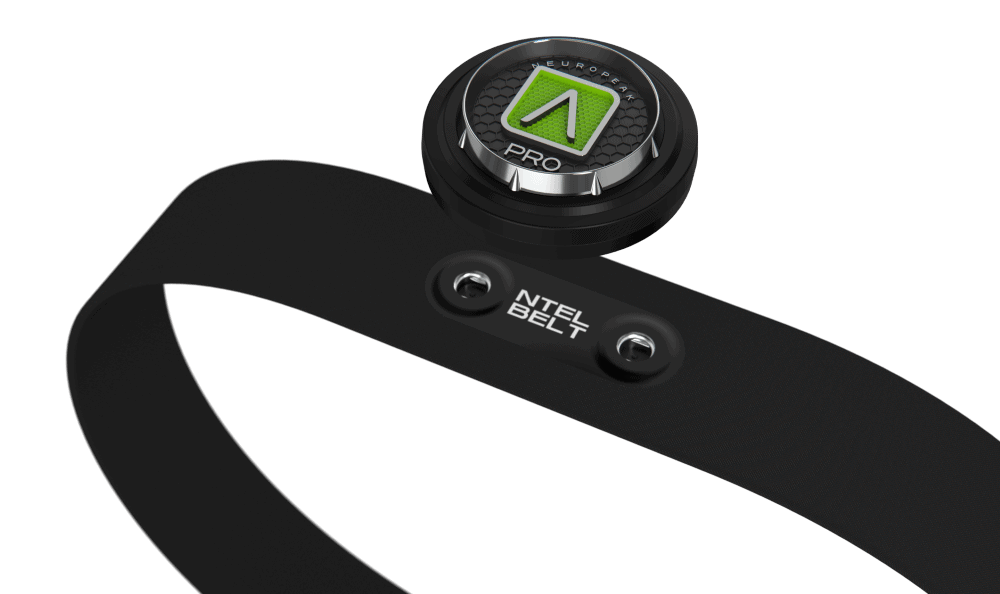
NeuroPeak Pro’s NTEL belt is more of a trainer than a wearable.
Unlike other Bluetooth fitness wearables, this one isn’t intended for around-the-clock usage to passively collect data.
“The NTEL belt is a trainer, and it’s not a tracker,” says NeuroPeak Pro’s Director of Golf Performance Andy Matthews.
NeuroPeak Pro Vice President of Performance Programs Nick Bolhuis shared a recent story of a PGA Tour golfer who had grown discouraged when his Whoop registered a lower-than-expected recovery score. But using the NTEL belt allowed him to be proactive, with the NeuroPeak app providing scores on a scale of 0 to 100. Before the golfer’s final round at the Players Championship, he did two breathing sessions a couple hours apart, registering scores of 93 and 95, before completing the tournament with a strong showing.
“We gamified breathing,” Bolhuis says.
Matthews describes the NTEL belt as the missing link between those two, helping athletes transcend an immutable recovery assessment. “I did everything I was supposed to do yesterday,” Matthews says, “and I woke up with a 71% recovery score. But I need to perform at 100% of myself today. How do I bridge that gap between those two?”
After starring at the University of Michigan, Matthews played several years of pro golf, mostly in Canada. He won the 2010 Corona Mazatlan Mexican PGA Championship while using NeuroPeak’s tools, and that experience helped him appreciate the value of learning effective breathing technique.
“The precision breathing practice is just like one would practice their golf swing or their putting stroke,’’ Matthews says. “You set aside that time to really dial in and start to really hone in on your muscle control, your respiration rate and allow all those heart rate metrics that are connected to your physical breath start to follow in and unlock that zone-like performance state.’’
The NeuroPeak app has tutorial videos to help athletes learn to control their breathing, and premium packages include personal instruction. Breathing can be used for focus or for recovery. DeChambeau has previously discussed how, after a poorly executed shot, he can use the methodology to re-center himself. “When my heart rate got up, I was able it to control it and get it back down, based on breathing,” said DeChambeau.
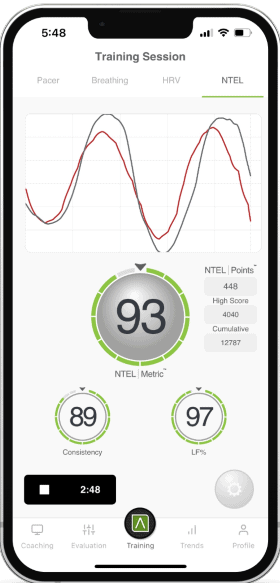
The NeuroPeak Pro app.
Asked in late 2018 how important this training had been to his success, DeChambeau told a writer for the PGA Tour website, ““There’s a reason why I’ve won four times this year. That’s my statement on that.”
Golf has been the beachhead for NeuroPeak, but the company counts pro athletes in all sports as users. Minnesota Vikings quarterback Kirk Cousins, San Francisco Giants pitcher Matthew Boyd and New York Islanders center Brock Nelson are among the other notable users.
The demands of each sport are unique, of course, and NeuroPeak caters to each. There’s foundational breathing everyone must master, after which “we’ll be very specific and prescriptive, based upon your sport in the needs,” Bolhuis says.
Bolhius was recently working with tennis players, who will invoke their precision breathing between sets. They need only two or three deep breaths, typically taken in 10-second cycles—four-second inhale, one-second transition, four-second exhale and another one-second transition—to reset themselves. In that half-minute, they won’t return all the way to their resting heart rate, of course, but they can conserve themselves.
“It’s the difference of being at 150 and getting that down to like 120 or 110, as opposed to staying at 150 the whole time and just redlining it,” Bolhius says. “Because then you get impacts on your cortisol output and all these different things physiologically. So, it’s how quickly can I take my foot off that accelerator and get that braking mechanism in place and conserve energy?”
This article was brought to you by SportTechie, a Leaders Group company. As a Leaders Performance Institute member, you are able to enjoy exclusive access to SportTechie content in the field of athletic performance.
First-Team Fitness Coach Conall Murtagh explains how Zone7 is helping the club’s monitoring model to optimize individual player care.
An article brought to you by our Partners
Murtagh joined as a sports scientist while studying for his PhD in 2012. He then became the Fitness Coach for the men’s under-18s in 2014, and joined Head Coach Jürgen Klopp’s staff in early 2016. His tenure with the first team coincides with one of the most successful spells in the club’s history.
“When you come through the door each day there is a desire and expectation to be world-class,” he tells the Leaders Performance Institute. “Working under this philosophy is the ultimate motivation for me.”
Recipe for success
Liverpool, who won the League Cup and FA Cup this season, have played the maximum number of games possible – 63 in total and the most of all teams in the Premier League – the first time an English team has competed in every possible match in a single season since Liverpool themselves completed the feat during their FA Cup, League Cup and UEFA Cup-winning 2000-2001 campaign.
The Reds ended the season with almost a full complement of players thanks to the work of Klopp and his multidisciplinary staff which includes Murtagh, a former footballer himself and UEFA A Licence-qualified coach. It is a demanding environment. Murtagh’s fascination with sports science and physiology began long before his own playing days.
“I was obsessed with how the human body worked, particularly how it responded to training and games. That led me down the study of physiology and then sport science. When I was playing as a professional, I had no real knowledge of sports science until I started studying and playing semi-professionally. The individual response to training always intrigued me. How the day after the same session, some players would turn up fresh as a daisy, while others arrived feeling sore and stiff. We could also all do the same gym intervention programmes and yet some players’ sprint or jump performance would shoot through the roof, while others’ stayed the same.”
Murtagh believes that different players inherently have different capacities for physiological adaptation from physical workload. Therefore, they require a stimulus tailored to their individual needs in real-time; something that is very difficult to provide consistently in a team sport environment. That is the challenge Murtagh embraces, as he and the wider staff strive to keep all squad members in peak condition.
Zone7 adoption
Liverpool, much like any Premier League club, has an array of player monitoring and intervention tools at their disposal. For the 2021/22 Premier League season they have also enlisted Zone7, a data-driven artificial intelligence risk forecasting system, to support their development of personalised player workload management processes.
The collaboration, amongst many other important cutting-edge processes adopted at Liverpool, has been a success. Under the watch of club practitioners, Liverpool’s first team – according to Premier Injuries – have seen a 33% drop in days lost to injury this season compared to last. When narrowed to ‘substantial’ injuries (long absences marked by 9+ consecutive days lost), this drop increases to 40%. Goalkeeper and illness-related absences are excluded from the breakdown.
In essence, Zone7 empowers human decision-makers who oversee athlete workloads. These professionals are often tasked with making recommendations in highly pressurised situations. By analysing the extensive, disparate datasets generated and collected in elite sporting environments, Zone7 can detect injury risk patterns that may otherwise be invisible. In some instances, it can go a step further by making proactive recommendations to mitigate the identified injury risk. Importantly, Zone7 will often suggest increasing workloads in particular areas to lower risk. Reducing workloads or simply prescribing rest is not always the right solution.
“We know that adaptation for the human body is a dynamic process,” says Murtagh. “Every time the player performs a training stimulus we must reassess their body’s adaptation balance.”
“As a multidisciplinary team, we assess every player every day. Zone7’s AI works alongside our extensive internal monitoring processes by effectively identifying more complex data patterns that could indicate whether a player has good rhythm or has deviated from it. If our monitoring system identifies that the player is not in optimal rhythm, we intervene accordingly from a multidisciplinary perspective.”
The productive use of Zone7 requires pragmatism. No credible AI solution will claim it is correct all the time and periodic false flags are a natural consequence. Murtagh, however, is unfazed.
“You can never say [a Zone7 risk alert] is a false positive when you’re flagging the player,” he says. “Some players do receive flags and we do not detect anything to suggest they are at an elevated risk. There is such a fine line between someone getting injured or not, we try to identify when the player has sub-optimal rhythm and we intervene appropriately.”
Zone7’s data science team has evolved their solution this year by introducing a new ‘Workload-Simulator’ component, which enables practitioners like Murtagh to input projected workloads and simulate players’ future injury risk in advance.
“The thing I like most about Zone7 is that they’re constantly updating the algorithm, constantly evolving, constantly on the front foot in this field,” added Murtagh. “To have the AI working in our environment to support our internal monitoring system gives us a certain sense of safety around our player management recommendations. The simulator is a brilliant feature, which will be used more and more as the system evolves.”
With a full season behind them, and tangible success metrics to point to, Liverpool and Zone7 have extended their working engagement by another two years, a move that also includes Zone7 adoption across the Liverpool Women’s and Under-23 teams. Rich Buchanan, Zone7 Performance Director, says that “working with Murtagh and Liverpool FC is hugely important to Zone7. It shows that our technology, in the hands of progressive and experienced practitioners, can exist and evolve, in one of the world’s most elite sporting environments.”
Technology, data and innovative training all have a role to play in ensuring its safe implementation.
Before all that, the Rhode Island native was a lifelong lover of the sport. From that vantage point – baseball fan who helps protect pitchers’ health as a profession – Buffi has a unique perspective of the pitch clocks that are now universal in the minor leagues and seem to be imminently headed to the majors, likely as soon as the 2023 season.
“Selfishly, and personally, I kind of like it. I do feel like the time between pitches has gotten a little crazy, just as a fan of the game,” Buffi says, adding this important proviso:
“But we’ve got to make sure we are smart about implementing it.”
After experimenting with a tightly enforced pitch clock in the Low-A West League (just re-named the California League) last year, Major League Baseball mandated its use across all four minor league levels in 2022. After a pitcher receives the baseball, he has 14 seconds to deliver a pitch when the bases are empty. That limit is extended to 18 seconds with runners on, except at Triple A where they have 19 seconds. Hitters must be ready to bat by the time there are nine seconds left. Infractions are penalized with an automatic ball (for pitchers) or strike (for hitters).
The resulting changes to time of game has been nothing short of dramatic. According to data provided by MLB, the average length of a minor league game through May 11 was 2 hours, 35 minutes—that’s a full 28 minutes faster than the 3-hour, 3-minute average of minor league games without the pitch clock in 2021. (The clock went into effect on 15 April; games played in the 10 days prior averaged 2 hours, 59 minutes.) Violations of the clock steadily declined during April and May to less than one per game.
The potential catch to what is very welcome news for a sport cognizant of hastening its pace and duration of games is that speeding up pitchers could induce higher levels of fatigue, according to preliminary research on the topic. Fatigue is the No. 1 predictor of pitcher injury.
Mike Sonne wrote his Ph.D. thesis on muscle fatigue prediction and has studied workplace ergonomics extensively. Among his other projects was consulting on the design of assembly lines at Ford Motor Company and devising the appropriate number of rest breaks to prevent injuries.
When interest in a baseball pitch clock heightened in 2015, Sonne and co-author Peter Keir researched its effect through a series of computer simulations. They concluded, “This study has shown the implementation of pitch clocks, or enforcement of existing pace of play rules, will increase the fatigue accumulated in the forearm and elbow musculature and could jeopardize joint stability.”
That finding was published in the Journal of Sports Sciences in 2016, but Sonne says now that the premise is rather intuitive, too.
“It doesn’t require any machine learning or anything like that,” says Sonne, now the Chief Scientific Officer of 3MotionAI, maker of ProPlayAI. “You just think about, if you go to the gym and you do 10 reps and you shorten the time between the 10 reps, it’s a lot more tiring by the end of it.”
Later that year, a research group in Taiwan conducted a similar study but experimented with college pitchers instead of computer simulations. The study was admittedly small – only seven pitchers completed all three phases – but gave empirical, physiological evidence to the effects of pitch clocks. Each pitcher was evaluated for pitching performance (velocity and location) and muscle inflammation and damage (via blood biomarkers) when throwing pitches every eight, 12 and 20 seconds for seven innings.
Their results, which were published in the December 2016 issue of Medicine & Science in Sports & Exercise, indicated that an eight-second pace was untenable, and there was also notable muscle inflammation lingering after the 12-second paced outing.
“Our data suggests that 20 is much better than 12,” says Donovan Fogt, one of the study’s co-authors and formerly a kinesiology professor before working as a scientist reviewer, vetting military research at Brooke Army Medical Center. He advises using the two completed papers as a guide to drive the study design of larger-scale research.
For years, MLB has had Rule 8.04 on the books, which mandates that a pitcher throw to the plate within 12 seconds of receiving the ball, although that, quite clearly, has not been enforced. That duration informed the design of the Taiwanese study, although the data is not apples to apples. In the experiment, a pitcher literally threw the ball every 12 seconds whereas the minor league pitch clock only starts after the pitcher receives the ball – either a return throw from the catcher or from a fielder if the ball had been hit into play.
Thus, in the minors, the average interval between pitches is inherently a bit longer. This is borne out in the MLB-supplied data that says the actual average time between pitches has been 18.8 seconds. The number of runs, hits and pitches per game have all been stable this year compared to last year – and, most importantly, so too have injuries.
“We monitor injury rates very closely at the minor league level, and we have an excellent injury tracking system that allows us to get some really useful information about the injury impacts of the different rules that we experiment with,” says MLB Executive Vice President of Baseball Operations Morgan Sword. “So far, we are one season and one month in, there’s no evidence to suggest that the timer is having a negative impact on pitching health.”
Interestingly, the Low-A West League – the only one with the strict pitch clock in 2021 – had “the lowest rate of pitching injuries of any of our minor leagues,” Sword says. “We’ll see what ends up being supported by the data, but there’s a theory that the quicker pace that’s forced by the timer prevents the max-effort pitching style, or at least mitigates the max-effort pitching style that is more common in today’s game and maybe contributing the more injury. So forcing pitchers to manage their effort level a little bit may actually have a positive effect on arm health.”
Pitcher velocities in the minors have been “pretty flat,” Sword adds, “and I guess that’s probably worth noting because they’ve been going up every year. We don’t yet have a ton of data to suggest a big change one way or the other.”
Under the terms of the new collective bargaining agreement, a Competition Committee consisting of six MLB-appointed members, four active players and one umpire will decide on rule changes. They can be implemented with as little notice as 45 days, but Sword pledges that the league is “cognizant that more notice is better than less notice on rule changes.”
The exact time intervals for the likely MLB pitch clock are not set in stone, either, with some calling for a relaxation of the limit.
“We’ve cut so much time from the minor league game that some games are being done in less than two hours now. And that’s good, I guess, but I would hope that maybe we can give the pitchers back a couple seconds because maybe we were too aggressive with the pitch clock, you know?” says Driveline Baseball founder Kyle Boddy, who spent the past two years overseeing minor league pitchers in the Cincinnati Reds’ organization. He adds, “At the end of the day, though, we do need to increase the pace between pitches, and I think the pitch clock is definitely a part of that weapon.”
Here’s how technology, data and innovative training can play a role in making sure it is implemented safely:
New training programs
“The body,” as Buffi recently wrote, “is great at adapting to what we train it to do.” Updated training will be the most important pillar of any new protocol.
“There’s a physiological limit where you can’t just do things rapid-fire over and over and over, but I do think that we could find a pace where, as long as the pitchers are training for that pace, they should be able to sustain that pace,” Buffi says.
The experts consulted for this story say pitchers should train with a clock for bullpens, simulated games and side sessions. Pitching and strength & conditioning coaches will have to adapt their throwing and training programs.
“You can plan for building athletes to face that requirement,” says Kinetic Pro Performance Founder Casey Mulholland. “What you’re building up for – and this is general workload principles – is you’re trying to get your body ready to handle the stimulus you’re going to face.”
When the minor leagues began implementing new pickoff rules in the minors last year, Boddy says the Reds coaches used their iPhone stopwatches in the bullpens to track pitcher delivery times. That data was then posted to keep every pitcher accountable in adhering to new standards. He believes proper game planning – such as presetting pitch calling sequences – can help, too. The introduction of the PitchCom system for sign delivery has been well received by some pitchers and may be adopted by more going forward.
Pitch tracking
Every minor league ballpark is outfitted with a pitch tracking device, whether it’s a TrackMan radar or Hawk-Eye camera system. These technologies provide a wealth of information. On the most basic level, they provide time-stamped pitch release times for monitoring pace. They also record pitch velocities, locations, movements and spin rates for tracking deviations in performance or signs of fatigue. Researchers can use these large datasets to track trends that may arise in either individual pitchers or the entire minor league system, both in the short term and longitudinally over multiple seasons.
Player monitoring
Several on-body and camera-based technologies can provide insights into how individual pitchers are faring, both in training and in games. “You just need to manage it, you need to measure it,” Boddy says.
Driveline Pulse (née Motus) is an elbow-worn compression sleeve with a sensor that can track a variety of metrics related to pitching volume and intensity. The KP Sleeve, made by KineticPro Performance and Nextiles, is a newer option.
Many MLB clubs have multi-camera motion capture systems installed in their ballparks, such as KinaTrax or Simi Motion. These solutions provide their own biomechanics analysis dashboards and can be augmented with additional tools such as Reboot Motion. Outside of MLB venues, smartphone options such as ProPlayAI, Mustard and Uplift Capture are alternatives.
Deviations in mechanics, as measured by individual baselines, can indicate signs of fatigue.
“The way we do it at Reboot is for a selection of the metrics, we try to calculate a normal range as a function of pitch count,” Buffi says. “So then we try to see, as the game goes on, at any point is there a time when that person fell outside of their normal range?”
Fatigue Units
About a year after his research paper on pitch clocks published, Sonne set out to develop a metric to monitor the accumulated strain on pitchers. This new stat, called Fatigue Units, takes into account the number of pitches thrown in an inning, the type of pitches thrown, the velocity of the pitches and the interval of time between them. That is then aggregated across games and seasons, accounting for days of rest. Relievers in particular populated the Fatigue Units leaderboard.
“Some of these big relievers, I hope they can stay healthy, but they’re going to have to really monitor their workloads, and maybe it’s time to let off the gas a little bit,” Sonne says. “You can’t throw as hard as you were before.”
Mulholland has assessed pitchers’ warmup routines and discovered that too many guys go right from long toss to the bullpen to the first inning, causing the largest fatigue spike in the first inning. That’s an avoidable one. The other pratfall is the long inning in which a pitcher needs 30 or more pitches to escape a jam.
“You just want to be as efficient as possible as a pitcher, which might change the way some guys approach going into the game and pitching,” Mulholland says. “But you just don’t want to amass a lot of pitches in a short amount of time.”
Majors vs Minors
“It’s possible that the rules in the minor leagues and major league shouldn’t be the same,” Boddy says. The objectives of the leagues are not completely aligned. Organizations want their players to develop winning habits and competitive instincts in the minors, but winning a championship is not of such primal importance as it is in the majors.
“At the end of the day, the goal is not to prevent all injury,” Boddy says of the minors. “The goal is to develop big league pitchers. And so how do you balance those things that are constantly at odds – giving them enough workload and enough stimulus to make them better and give them the opportunity to improve with not doing too much.”
Changes implemented in the minors typically take three to five years before they manifest in the big leagues, he adds. That lag is because pitchers build up stamina and durability over time. Boddy believes limiting the number of pitchers on a roster will help provide the incentive for pitchers to develop those physical tools and hopefully help quicken the pace of games by limiting pitching changes.
While minor league managers might be more inclined to let a pitcher work out of trouble for the sake of his development, Sonne doesn’t think a big league club would offer the same leash to its pitchers.
“The major league game is so different that, if the command goes, if the velocity drops, you may have more base runners, you may have more walks, you may have more pitching changes, and does it actually help?” Sonne says. “Are you going to get 20 minutes off of a major league game? I don’t know if I’m convinced of that yet.”
More research
“Generally speaking, it’s a reasonable idea, but there just hasn’t been enough research into it,” Boddy says, noting that there are several motion capture laboratories who credibly can conduct the appropriate studies on the topic and calling for a clear timeline of implementation.
“How do you individualize this?” Mulholland says. “I just don’t think we have enough data on it. And I don’t think it’s been to the point yet where players have really overly thought about it.”
For now, MLB is opting to study game data – with the giant sample size of 120 minor teams – through its injury surveillance database and the various pitch tracking systems rather than commissioning lab research, which has its own limitations when pitchers aren’t throwing with full game adrenaline.
And, of course, pitchers may not be the primary culprit to slow pace of games. Fogt wonders why the onus on speeding the game is placed on the pitcher. “When you think about all the screwing around that the batter can do – get into the box, get out of the box, get into the box, get out of the box – how can you blame the pitcher for that kind of shenanigans?” he says.
This article was brought to you by SportTechie, a Leaders Group company. As a Leaders Performance Institute member, you are able to enjoy exclusive access to SportTechie content in the field of athletic performance.