Leaders in Business
  • Membership
  • Events
  • Content
  • Virtual Learning
  • Connections
  • Partners
Login
  • Leaders Club
  • Events
    • Leaders Week London
    • Leaders Sports Awards
    • Leaders Club Events
    • Leaders Performance Institute Events
    • Leaders Meet: Innovation
  • Memberships
    • The Leaders Club
    • Leaders Performance Institute
  • About
    • Careers
    • Contact
I’m a sports leader:
  • Off The Field For those focused on the business of the sport View more
  • On The Field For those working with an athlete or elite team View more
  • Login
    • Leaders ClubThe membership for future sport business leaders
    • Leaders Performance InstituteThe membership for elite performance practitioners
  • Newsletters
Performance Institute Leaders Performance Institute Logo
  • Membership
  • Events
  • Content
  • Virtual Learning
  • Connections
  • Partners
Login
Members Only

20 Jun 2022

Articles

Why Adversity Can Be a Powerful Teaching Tool with the Right Support

Category
Coaching & Development, Premium
Share
Facebook Twitter Email Copy Link
https://leadersinsport.com/performance-institute/articles/why-adversity-can-be-a-powerful-teaching-tool-with-the-right-support/

John Alder discusses the concept of balancing challenge and support within the British Olympic and Paralympic movements.

By John Portch
  • Do you understand the young athlete that has walked through your door?

  • Can you meet their needs without diluting your programme?

  • What steps can you take to build their resilience?

Putting the learner at the heart of the coach’s decision-making

“The idea of meeting the person where they’re at has never been more prevalent in sport – we can’t take for granted that the previous experiences have [enabled] a particular athlete to knock on the door,” said John Alder at a 2021 Keiser-sponsored Webinar titled ‘The Effectiveness of Performance Pathways for Nurturing Young Talent’. Alder, who now serves as Head of Player Development at  Welsh Rugby Union, was speaking in his previous capacity as Head of Performance Pathways at UK Sport and the English Institute of Sport [EIS]. “Based on what am I making judgements about what the learner needs next?” he added. The coach must understand what the young athlete arrived with, the experiences they will need henceforth, and the future direction of their development.

The pedagogue’s duty of care

Alder explained that UK Sport and the EIS’s focus has gradually shifted from talent ID towards development and a more rounded understanding of what constitutes ‘success’. “Only a finite group of people will ever go to an Olympic Games let alone win anything,” he said. “What’s our duty of care as custodians of our industry to ensure that those developmental experiences, if they are to be effective, not only prepare those who are able to make the long journey to an Olympic Games but they also give a really rich experience that they leave better for it and they are custodians of their sport and good citizens as well?”

He added a crucial caveat: “Yes, it is identifying what might be needed here and working backwards, but it’s not a watering down. It’s understanding how do these things manifest at different stages of the journey because it is complex and non-linear; and [we want to be] attuned to that rather than being reductive.”

Do not undervalue your pathway coaches

The depth and breadth of responsibility goes further still, as UK Sport and the EIS acknowledged in their December 2021 Performance Pathway Coaching Statement. Its purpose was to help establish UK coaching as a competitive advantage. “The genesis of it was a dissatisfaction with the undervaluing of coaches in the development domain,” said Alder. “Therefore we went to see what differentiated that domain. When you talk about redefining the pedagogical relationships, and therefore the domain-specific skills, qualities and experiences required to be effective, there’s inevitably a real emphasis on pedagogy and developmentally-appropriate ‘ologies’, so not just our more traditional sports science and disciplines and ologies we’d find in broader sport. [It is about] how those disciplines are brought to bear on the developing person and what that means for the coach, the pedagogue, in terms of making those professional judgements as to what are the needs here and ‘how do I go about designing experiences that will nourish and allow this young person to develop?’

How does your curriculum consider the development of resilience?

Resilience, as Alder explained, is merely one manifestation of a young athlete’s psycho-social development, but it is a necessary characteristic if they are to flourish in a high performance environment. At UK Sport and the EIS they feel that an athlete’s curriculum is essential in providing the necessary challenge and support. “We’re quite interested in the idea of curriculum; and curriculum being the totality of experiences that an athlete has,” said Alder, “and the role of the pedagogical relationship, the coach, and others, leaders included, in creating that curriculum; the importance of it being progressive and coherent so that it builds on what came before in equipping young athletes for the road ahead.”

17 Jun 2022

Articles

How AI Fits into Liverpool’s Multidisciplinary Monitoring Model

Category
Data & Innovation
Share
Facebook Twitter Email Copy Link
https://leadersinsport.com/performance-institute/articles/how-ai-fits-into-liverpools-multidisciplinary-monitoring-model/

First-Team Fitness Coach Conall Murtagh explains how Zone7 is helping the club’s monitoring model to optimize individual player care.

An article brought to you by our Partners

sport techie

Interview by Sarah Malone
Dr Conall Murtagh, the First-Team Fitness Coach at Liverpool FC, will soon be celebrating a decade working with the English Premier League club.

Murtagh joined as a sports scientist while studying for his PhD in 2012. He then became the Fitness Coach for the men’s under-18s in 2014, and joined Head Coach Jürgen Klopp’s staff in early 2016. His tenure with the first team coincides with one of the most successful spells in the club’s history.

“When you come through the door each day there is a desire and expectation to be world-class,” he tells the Leaders Performance Institute. “Working under this philosophy is the ultimate motivation for me.”

Recipe for success

Liverpool, who won the League Cup and FA Cup this season, have played the maximum number of games possible – 63 in total and the most of all teams in the Premier League – the first time an English team has competed in every possible match in a single season since Liverpool themselves completed the feat during their FA Cup, League Cup and UEFA Cup-winning 2000-2001 campaign.

The Reds ended the season with almost a full complement of players thanks to the work of Klopp and his multidisciplinary staff which includes Murtagh, a former footballer himself and UEFA A Licence-qualified coach. It is a demanding environment. Murtagh’s fascination with sports science and physiology began long before his own playing days.

“I was obsessed with how the human body worked, particularly how it responded to training and games. That led me down the study of physiology and then sport science. When I was playing as a professional, I had no real knowledge of sports science until I started studying and playing semi-professionally. The individual response to training always intrigued me. How the day after the same session, some players would turn up fresh as a daisy, while others arrived feeling sore and stiff. We could also all do the same gym intervention programmes and yet some players’ sprint or jump performance would shoot through the roof, while others’ stayed the same.”

Murtagh believes that different players inherently have different capacities for physiological adaptation from physical workload. Therefore, they require a stimulus tailored to their individual needs in real-time; something that is very difficult to provide consistently in a team sport environment. That is the challenge Murtagh embraces, as he and the wider staff strive to keep all squad members in peak condition.

Zone7 adoption

Liverpool, much like any Premier League club, has an array of player monitoring and intervention tools at their disposal. For the 2021/22 Premier League season they have also enlisted Zone7, a data-driven artificial intelligence risk forecasting system, to support their development of personalised player workload management processes.

The collaboration, amongst many other important cutting-edge processes adopted at Liverpool, has been a success. Under the watch of club practitioners, Liverpool’s first team – according to Premier Injuries – have seen a 33% drop in days lost to injury this season compared to last. When narrowed to ‘substantial’ injuries (long absences marked by 9+ consecutive days lost), this drop increases to 40%. Goalkeeper and illness-related absences are excluded from the breakdown.

In essence, Zone7 empowers human decision-makers who oversee athlete workloads. These professionals are often tasked with making recommendations in highly pressurised situations. By analysing the extensive, disparate datasets generated and collected in elite sporting environments, Zone7 can detect injury risk patterns that may otherwise be invisible. In some instances, it can go a step further by making proactive recommendations to mitigate the identified injury risk. Importantly, Zone7 will often suggest increasing workloads in particular areas to lower risk. Reducing workloads or simply prescribing rest is not always the right solution.

“We know that adaptation for the human body is a dynamic process,” says Murtagh. “Every time the player performs a training stimulus we must reassess their body’s adaptation balance.”

“As a multidisciplinary team, we assess every player every day. Zone7’s AI works alongside our extensive internal monitoring processes by effectively identifying more complex data patterns that could indicate whether a player has good rhythm or has deviated from it. If our monitoring system identifies that the player is not in optimal rhythm, we intervene accordingly from a multidisciplinary perspective.”

The productive use of Zone7 requires pragmatism. No credible AI solution will claim it is correct all the time and periodic false flags are a natural consequence. Murtagh, however, is unfazed.

“You can never say [a Zone7 risk alert] is a false positive when you’re flagging the player,” he says. “Some players do receive flags and we do not detect anything to suggest they are at an elevated risk. There is such a fine line between someone getting injured or not, we try to identify when the player has sub-optimal rhythm and we intervene appropriately.”

Zone7’s data science team has evolved their solution this year by introducing a new ‘Workload-Simulator’ component, which enables practitioners like Murtagh to input projected workloads and simulate players’ future injury risk in advance.

“The thing I like most about Zone7 is that they’re constantly updating the algorithm, constantly evolving, constantly on the front foot in this field,” added Murtagh. “To have the AI working in our environment to support our internal monitoring system gives us a certain sense of safety around our player management recommendations. The simulator is a brilliant feature, which will be used more and more as the system evolves.”

With a full season behind them, and tangible success metrics to point to, Liverpool and Zone7 have extended their working engagement by another two years, a move that also includes Zone7 adoption across the Liverpool Women’s and Under-23 teams. Rich Buchanan, Zone7 Performance Director, says that “working with Murtagh and Liverpool FC is hugely important to Zone7. It shows that our technology, in the hands of progressive and experienced practitioners, can exist and evolve, in one of the world’s most elite sporting environments.”

Members Only

17 Jun 2022

Articles

The Minor League Baseball Pitch Clock: an Important Innovation or a Potentially Dangerous Development for Athletes?

Category
Data & Innovation, Human Performance, Premium
Share
Facebook Twitter Email Copy Link
https://leadersinsport.com/performance-institute/articles/the-minor-league-baseball-pitch-clock-an-important-innovation-or-a-potentially-dangerous-development-for-athletes/

Technology, data and innovative training all have a role to play in ensuring its safe implementation.

A Data & Innovation article brought to you by

sport techie

By Joe Lemire

Jimmy Buffi has made his career in baseball. He earned a Ph.D. studying pitching biomechanics, worked as a senior analyst for four years with the Los Angeles Dodgers and now is CEO of Reboot Motion, the startup he co-founded to provide biomechanical analysis.

Before all that, the Rhode Island native was a lifelong lover of the sport. From that vantage point – baseball fan who helps protect pitchers’ health as a profession – Buffi has a unique perspective of the pitch clocks that are now universal in the minor leagues and seem to be imminently headed to the majors, likely as soon as the 2023 season.

“Selfishly, and personally, I kind of like it. I do feel like the time between pitches has gotten a little crazy, just as a fan of the game,” Buffi says, adding this important proviso:

“But we’ve got to make sure we are smart about implementing it.”

After experimenting with a tightly enforced pitch clock in the Low-A West League (just re-named the California League) last year, Major League Baseball mandated its use across all four minor league levels in 2022. After a pitcher receives the baseball, he has 14 seconds to deliver a pitch when the bases are empty. That limit is extended to 18 seconds with runners on, except at Triple A where they have 19 seconds. Hitters must be ready to bat by the time there are nine seconds left. Infractions are penalized with an automatic ball (for pitchers) or strike (for hitters).

The resulting changes to time of game has been nothing short of dramatic. According to data provided by MLB, the average length of a minor league game through May 11 was 2 hours, 35 minutes—that’s a full 28 minutes faster than the 3-hour, 3-minute average of minor league games without the pitch clock in 2021. (The clock went into effect on 15 April; games played in the 10 days prior averaged 2 hours, 59 minutes.) Violations of the clock steadily declined during April and May to less than one per game.

The potential catch to what is very welcome news for a sport cognizant of hastening its pace and duration of games is that speeding up pitchers could induce higher levels of fatigue, according to preliminary research on the topic. Fatigue is the No. 1 predictor of pitcher injury.

Mike Sonne wrote his Ph.D. thesis on muscle fatigue prediction and has studied workplace ergonomics extensively. Among his other projects was consulting on the design of assembly lines at Ford Motor Company and devising the appropriate number of rest breaks to prevent injuries.

When interest in a baseball pitch clock heightened in 2015, Sonne and co-author Peter Keir researched its effect through a series of computer simulations. They concluded, “This study has shown the implementation of pitch clocks, or enforcement of existing pace of play rules, will increase the fatigue accumulated in the forearm and elbow musculature and could jeopardize joint stability.”

That finding was published in the Journal of Sports Sciences in 2016, but Sonne says now that the premise is rather intuitive, too.

“It doesn’t require any machine learning or anything like that,” says Sonne, now the Chief Scientific Officer of 3MotionAI, maker of ProPlayAI. “You just think about, if you go to the gym and you do 10 reps and you shorten the time between the 10 reps, it’s a lot more tiring by the end of it.”

Later that year, a research group in Taiwan conducted a similar study but experimented with college pitchers instead of computer simulations. The study was admittedly small – only seven pitchers completed all three phases – but gave empirical, physiological evidence to the effects of pitch clocks. Each pitcher was evaluated for pitching performance (velocity and location) and muscle inflammation and damage (via blood biomarkers) when throwing pitches every eight, 12 and 20 seconds for seven innings.

Their results, which were published in the December 2016 issue of Medicine & Science in Sports & Exercise, indicated that an eight-second pace was untenable, and there was also notable muscle inflammation lingering after the 12-second paced outing.

“Our data suggests that 20 is much better than 12,” says Donovan Fogt, one of the study’s co-authors and formerly a kinesiology professor before working as a scientist reviewer, vetting military research at Brooke Army Medical Center. He advises using the two completed papers as a guide to drive the study design of larger-scale research.

For years, MLB has had Rule 8.04 on the books, which mandates that a pitcher throw to the plate within 12 seconds of receiving the ball, although that, quite clearly, has not been enforced. That duration informed the design of the Taiwanese study, although the data is not apples to apples. In the experiment, a pitcher literally threw the ball every 12 seconds whereas the minor league pitch clock only starts after the pitcher receives the ball – either a return throw from the catcher or from a fielder if the ball had been hit into play.

Thus, in the minors, the average interval between pitches is inherently a bit longer. This is borne out in the MLB-supplied data that says the actual average time between pitches has been 18.8 seconds. The number of runs, hits and pitches per game have all been stable this year compared to last year – and, most importantly, so too have injuries.

“We monitor injury rates very closely at the minor league level, and we have an excellent injury tracking system that allows us to get some really useful information about the injury impacts of the different rules that we experiment with,” says MLB Executive Vice President of Baseball Operations Morgan Sword. “So far, we are one season and one month in, there’s no evidence to suggest that the timer is having a negative impact on pitching health.”

Interestingly, the Low-A West League – the only one with the strict pitch clock in 2021 – had “the lowest rate of pitching injuries of any of our minor leagues,” Sword says. “We’ll see what ends up being supported by the data, but there’s a theory that the quicker pace that’s forced by the timer prevents the max-effort pitching style, or at least mitigates the max-effort pitching style that is more common in today’s game and maybe contributing the more injury. So forcing pitchers to manage their effort level a little bit may actually have a positive effect on arm health.”

Pitcher velocities in the minors have been “pretty flat,” Sword adds, “and I guess that’s probably worth noting because they’ve been going up every year. We don’t yet have a ton of data to suggest a big change one way or the other.”

Under the terms of the new collective bargaining agreement, a Competition Committee consisting of six MLB-appointed members, four active players and one umpire will decide on rule changes. They can be implemented with as little notice as 45 days, but Sword pledges that the league is “cognizant that more notice is better than less notice on rule changes.”

The exact time intervals for the likely MLB pitch clock are not set in stone, either, with some calling for a relaxation of the limit.

“We’ve cut so much time from the minor league game that some games are being done in less than two hours now. And that’s good, I guess, but I would hope that maybe we can give the pitchers back a couple seconds because maybe we were too aggressive with the pitch clock, you know?” says Driveline Baseball founder Kyle Boddy, who spent the past two years overseeing minor league pitchers in the Cincinnati Reds’ organization. He adds, “At the end of the day, though, we do need to increase the pace between pitches, and I think the pitch clock is definitely a part of that weapon.”

Here’s how technology, data and innovative training can play a role in making sure it is implemented safely:

New training programs

“The body,” as Buffi recently wrote, “is great at adapting to what we train it to do.” Updated training will be the most important pillar of any new protocol.

“There’s a physiological limit where you can’t just do things rapid-fire over and over and over, but I do think that we could find a pace where, as long as the pitchers are training for that pace, they should be able to sustain that pace,” Buffi says.

The experts consulted for this story say pitchers should train with a clock for bullpens, simulated games and side sessions. Pitching and strength & conditioning coaches will have to adapt their throwing and training programs.

“You can plan for building athletes to face that requirement,” says Kinetic Pro Performance Founder Casey Mulholland. “What you’re building up for – and this is general workload principles – is you’re trying to get your body ready to handle the stimulus you’re going to face.”

When the minor leagues began implementing new pickoff rules in the minors last year, Boddy says the Reds coaches used their iPhone stopwatches in the bullpens to track pitcher delivery times. That data was then posted to keep every pitcher accountable in adhering to new standards. He believes proper game planning – such as presetting pitch calling sequences – can help, too. The introduction of the PitchCom system for sign delivery has been well received  by some pitchers and may be adopted by more going forward.

Pitch tracking 

Every minor league ballpark is outfitted with a pitch tracking device, whether it’s a TrackMan radar or Hawk-Eye camera system. These technologies provide a wealth of information. On the most basic level, they provide time-stamped pitch release times for monitoring pace. They also record pitch velocities, locations, movements and spin rates for tracking deviations in performance or signs of fatigue. Researchers can use these large datasets to track trends that may arise in either individual pitchers or the entire minor league system, both in the short term and longitudinally over multiple seasons.

Player monitoring 

Several on-body and camera-based technologies can provide insights into how individual pitchers are faring, both in training and in games. “You just need to manage it, you need to measure it,” Boddy says.

Driveline Pulse (née Motus) is an elbow-worn compression sleeve with a sensor that can track a variety of metrics related to pitching volume and intensity. The KP Sleeve, made by KineticPro Performance and Nextiles, is a newer option.

Many MLB clubs have multi-camera motion capture systems installed in their ballparks, such as KinaTrax or Simi Motion. These solutions provide their own biomechanics analysis dashboards and can be augmented with additional tools such as Reboot Motion. Outside of MLB venues, smartphone options such as ProPlayAI, Mustard and Uplift Capture are alternatives.

Deviations in mechanics, as measured by individual baselines, can indicate signs of fatigue.

“The way we do it at Reboot is for a selection of the metrics, we try to calculate a normal range as a function of pitch count,” Buffi says. “So then we try to see, as the game goes on, at any point is there a time when that person fell outside of their normal range?”

Fatigue Units

About a year after his research paper on pitch clocks published, Sonne set out to develop a metric to monitor the accumulated strain on pitchers. This new stat, called Fatigue Units, takes into account the number of pitches thrown in an inning, the type of pitches thrown, the velocity of the pitches and the interval of time between them. That is then aggregated across games and seasons, accounting for days of rest. Relievers in particular populated the Fatigue Units leaderboard.

“Some of these big relievers, I hope they can stay healthy, but they’re going to have to really monitor their workloads, and maybe it’s time to let off the gas a little bit,” Sonne says. “You can’t throw as hard as you were before.”

Mulholland has assessed pitchers’ warmup routines and discovered that too many guys go right from long toss to the bullpen to the first inning, causing the largest fatigue spike in the first inning. That’s an avoidable one. The other pratfall is the long inning in which a pitcher needs 30 or more pitches to escape a jam.

“You just want to be as efficient as possible as a pitcher, which might change the way some guys approach going into the game and pitching,” Mulholland says. “But you just don’t want to amass a lot of pitches in a short amount of time.”

Majors vs Minors 

“It’s possible that the rules in the minor leagues and major league shouldn’t be the same,” Boddy says. The objectives of the leagues are not completely aligned. Organizations want their players to develop winning habits and competitive instincts in the minors, but winning a championship is not of such primal importance as it is in the majors.

“At the end of the day, the goal is not to prevent all injury,” Boddy says of the minors. “The goal is to develop big league pitchers. And so how do you balance those things that are constantly at odds – giving them enough workload and enough stimulus to make them better and give them the opportunity to improve with not doing too much.”

Changes implemented in the minors typically take three to five years before they manifest in the big leagues, he adds. That lag is because pitchers build up stamina and durability over time. Boddy believes limiting the number of pitchers on a roster will help provide the incentive for pitchers to develop those physical tools and hopefully help quicken the pace of games by limiting pitching changes.

While minor league managers might be more inclined to let a pitcher work out of trouble for the sake of his development, Sonne doesn’t think a big league club would offer the same leash to its pitchers.

“The major league game is so different that, if the command goes, if the velocity drops, you may have more base runners, you may have more walks, you may have more pitching changes, and does it actually help?” Sonne says. “Are you going to get 20 minutes off of a major league game? I don’t know if I’m convinced of that yet.”

More research

“Generally speaking, it’s a reasonable idea, but there just hasn’t been enough research into it,” Boddy says, noting that there are several motion capture laboratories who credibly can conduct the appropriate studies on the topic and calling for a clear timeline of implementation.

“How do you individualize this?” Mulholland says. “I just don’t think we have enough data on it. And I don’t think it’s been to the point yet where players have really overly thought about it.”

For now, MLB is opting to study game data – with the giant sample size of 120 minor teams – through its injury surveillance database and the various pitch tracking systems rather than commissioning lab research, which has its own limitations when pitchers aren’t throwing with full game adrenaline.

And, of course, pitchers may not be the primary culprit to slow pace of games. Fogt wonders why the onus on speeding the game is placed on the pitcher. “When you think about all the screwing around that the batter can do – get into the box, get out of the box, get into the box, get out of the box – how can you blame the pitcher for that kind of shenanigans?” he says.

This article was brought to you by SportTechie, a Leaders Group company. As a Leaders Performance Institute member, you are able to enjoy exclusive access to SportTechie content in the field of athletic performance.

16 Jun 2022

Articles

How Do you Coach Jordan Spieth?

By Sarah Evans

  • Harness the athlete’s internal drive, create a realistic vision.
  • Encourage your athlete to be their own best coach.
  • Create a belief that no matter what happens your athlete will rise from setbacks.

Cultivate a clear vision

Cameron McCormick, who has coached an array of PGA and LPGA players, has been Spieth’s coach since the latter was a 12-year-old dreaming of winning golf’s most prestigious major, the Masters. He saw in Spieth “the drive and determination that fuels the necessary ability to do work,” as he told the 2016 Leaders Sport Performance Summit in New York, and worked to support Spieth’s goal of winning the Masters for almost a decade. Spieth possessed what McCormick called the “internal drive that sees a future reality,” making the link between Spieth’s drive and vision of the future. The youngster set his goal very high from a young age and, with the right support, was able to chase his Masters dream without being afraid to aim high. In 2015, aged 21, Spieth became the youngest player to win at Augusta since a 19-year-old Tiger Woods in 1997.

Self-belief and resilience

McCormick explained that one key way of being able to bounce back from a defeat or bad performance is “a self-belief that no matter what happens I will rise again”. He emphasised the critical importance of self-talk, and “signal-to-noise management”, whereby the noise that exists has a decided advantage, i.e. taking in the jeers from Augusta or playing forward negative situations in your mind versus the signal that you want to control. “Be a creator of the scene in your mind, not a viewer of what you are experiencing,” he said. McCormick is able to measure this with the athletes by reframing the scenario and creating perspective. It is a centring process, and needs to be repeated and cultivated consistently over time.

He then spoke about the round briefings he has with Spieth and how he uses these as an opportunity to “pump his tyres” and how Spieth is then able to build his self-belief. It is all about the principle of reinforcement, the more you think about and talk about something happening, you increase the probability of it taking place, which works, of course, both positively and negatively. Therefore, playing a highlight reel, remembering your strengths and building positive self-talk before competition is paramount.

The Three C’s – Collect, Correlate, Correct

McCormick‘s goal, although it seems counterintuitive, is to make himself redundant to the athlete. He fosters a sense of self sufficiency amongst the players, and sets out to educate them on how to be their own best coach. McCormick only wanted his players to come back to him when they really needed his help. He calls this process the three C’s: collect the clues, attribute a correlation or causation, then close the loop with a correction. This ability for the athletes to figure it out themselves and “dig it out of the dirt” is critical when their contact time is at a minimum.

Get buy-in from key influences

Athletes rely upon a good support system and McCormick understands how important it is to filter his core coaching messages through the key influences in an athlete’s life. Done well, those messages will resonate beyond the coaching session itself. McCormick called it “the rule of 168”. There are 168 hours in a week and he might only get one hour with an athlete. “Therefore that hour needs to be high octane and have longevity over a week or two-week period so when they come back, you’re not in the same place,” he said.

13 Jun 2022

Articles

Self-Regulated Learning: the Route to Better Talent Pathway Transitions?

Category
Coaching & Development
Share
Facebook Twitter Email Copy Link
https://leadersinsport.com/performance-institute/articles/self-regulated-learning-the-route-to-better-talent-pathway-transitions/

By John Portch

  • A holistic approach is essential if students are to have viable exit strategies.
  • Self-regulated learning is better for development.
  • How can you better use parents to support the work of your talent pathways?

Plan exit routes from the off

Much like aspiring athletes striving for elite level, not all students at the Royal Ballet School will forge a career in classical ballet and so it is incumbent on the school to prepare its students for that eventuality. As Christopher Powney, the school’s Artistic Director, told an audience at the 2021 Leaders Sport Performance Summit in London: “We want to make sure that students have the proper education and the proper nurturing to maximise who they are as a person and that ‘success’ is actually anything they can take from the school that they can employ in their future life, whether it be in dance, or if they’re unsuccessful in getting there – because there’s no guarantee at all they will achieve that – of being able to take what they’ve learnt and take that into whatever profession they decide to go into.” The Royal Ballet School’s approach is holistic. “Success for me is that the child is OK coming out of school and they are a good human being who can maximise themselves, they feel confident, they’re curious about life, and they want to develop themselves into whatever field they want to go into,” added Powney.

Build paths towards self-regulated learning

Youngsters in sports academies – and sometimes even accomplished senior athletes – may not be fully cognisant of how to train to attain and sustain their level. It is often a similar scenario with students at the Royal Academy of Music [RCM]. “By the time they get to us they will have already accrued 10,000-15,000 hours of practice and yet some of them say that they don’t know how to [practise] effectively,” said Dr Terry Clark, a Research Fellow for Performance Science at the RCM, who spoke alongside Powney at London’s Twickenham Stadium.

The RCM offers a range of courses based on the theme of effective learning that are designed to enable students to be less teacher-dependent as they transition through the course. Clark continued: “We’re looking at how we might be able to use novel technology to support our students’ development in things like self-regulated learning.” This includes peer support models as well as the RCM’s self-regulated learning framework, which starts with planning. “Being able to identify goals that they want to achieve in a short practice session and strategies for being able to do that. Being able to monitor focus, concentration, self-evaluation in the moment, but then, post-practice, reflecting and debriefing back on that. We have a lot of courses devoted to these things but we also do a lot of one to one work with our students as well, taking them through this process.”

The mental side of training is paramount

Clark, who works at the RCM’s Centre for Performance Science, spoke of the College’s performance simulator as a practice tool. The simulator, which places students in a performance situation with features such as a stage, a backstage and, if desired, even a restless audience, helps students to develop not only their performance but their coping and regulating skills. The simulator is essential for performance reps. “Performance opportunities are not as plentiful as the student might like but they’re also high-pressure events and there may not be opportunities necessarily for our students to learn from and debrief those performances,” said Clark. “It’s a safe space, musicians can try out new things, make mistakes perhaps, but there are no repercussions from that.”

Bring the parents onboard

“The majority of the parent body are fantastic,” said Powney when acknowledging the challenges that parents may pose. Historically, the Royal Ballet School used to keep its students’ parents at arm’s length. Not anymore. “We try to teach parents what’s involved with it,” he continued. “We also encourage the parents to talk to the children and the children to talk to the parents constantly about how they’re feeling, how they’re doing, and to allow them the space to say ‘actually, I’m struggling’. And then we put in place the supporting measures we need to help them with that.”

Members Only

10 Jun 2022

Articles

Why Athlete Trust Needs To Be Earned Away From High Pressure Situations

Category
Coaching & Development, Premium
Share
Facebook Twitter Email Copy Link
https://leadersinsport.com/performance-institute/articles/why-athlete-trust-needs-to-be-earned-away-from-high-pressure-situations/

By Sarah Evans

  • Are you someone who builds others up and brings out the best in them? Or do you let your ‘stuff’ fly out sideways at others?​
  • The athlete needs to know in the critical moment that you have their back
  • Allow the athlete to operate from a place of belonging rather than fear

In May, we held a Member Case Study Virtual Roundtable titled, Communication in High Pressure Environments, which was led by Leaders Performance Advisor Rachel Vickery, who is an expert in high-stakes situations. One of the key takeaways from the discussion was the notion that trust between athlete and leader is built up and earned away from pressure. Here we look to explore the three key areas that underpin this process of building trust.

1. The common factor in all sport is the human stress response

Vickery explained that the human stress response is something that we all have and can hugely affect how we operate within high stake situations. It is a primal response, and something that is survival driven. “We become very ‘me’ focused and combative” when in this state, says Vickery, which is not conducive to success in high performing sport. Therefore, it is so important as leaders to be aware if you yourself enter this state, and also recognise if your athletes respond this way in high pressure moments.

2. Understand what you are ‘bringing’ into every interaction

Vickery stressed that often within teams, “the strongest energy will determine the vibe”. The team will model the behaviour of the coaches and leaders within the team, so it’s so important to recognise the energy leaders are giving out. Emotionally intelligent leaders need to set the energy through their communication, and therefore it is critical to understand the energy you as a leader bring to any interaction. Vickery posed some questions which are incredibly useful to ask yourself as a leader. She said: “If you are stressed, how does this present in your body language? If there is a breakdown in communication, think to yourself, ‘Am I bringing something into this interaction?’” If you can be aware and understand how you show up under pressure, you can learn to adapt, and even practise in low-threat environments how you want to react under real stress.

3. Fear of failure is more likely to elicit mistakes

As Vickery said: “If you are volatile and others don’t know how you are going to act, the athlete might anticipate your reaction and operate from a sense of fear rather than belonging”. If they operate from a place of fear, they are more likely to tense up and make more mistakes. Whereas if you can remain calm and centred, and the athletes trust that you have their best interest at heart, they are more likely to be successful. “The athlete needs to know in the critical moment that you have their back to give them the freedom to perform to their best,” added Vickery. This will take time to be built up, but don’t take for granted the daily interactions you have, and how important these can be in building trust, so that when it comes to the real pressure moments, you and the team will have a much higher chance of success.

Members Only

6 Jun 2022

Articles

‘We Need you to Trust your Coaches More than the Talent that Brought you Here’

Category
Coaching & Development, Premium
Share
Facebook Twitter Email Copy Link
https://leadersinsport.com/performance-institute/articles/we-need-you-to-trust-your-coaches-more-than-the-talent-that-brought-you-here/

By John Portch

  • People are emotional and not necessarily rational – you need a student’s trust more than you need a 10-point plan.
  • Progression is not linear so be sure to have an environment where youngsters feel safe when making mistakes.
  • Life skills – resilience, collaboration, communication – should be baked into your curriculum.

Do your youngsters trust you when setbacks arrive?

The Chicago Academy of the Arts recruits some of the United States’ finest performing arts talents but, much like a gifted child entering a sports academy, their abilities may no longer stand out on campus. There is the potential for friction as teachers and coaches break down and rebuild their performance. “They might not see results today or tomorrow and we’re asking them to take that on faith that this is going to work,” said Jason Patera, the Head of School, when speaking at the 2017 Leaders Sport Performance Summit down the road at Chicago’s Soldier Field. Patera and his colleagues know how to manage bumps in the road that students inevitably encounter and that is where trust can be developed with the young person. “When we as the leaders can get out in front of [setbacks], we know it’s going to happen, when we can set up in their mind to expect that, not only can we help prepare them for that, but when it does happen, they say ‘oh yeah, [you] told me about that thing. What else can you tell me? I am ready to hear you on these other things because you called it and I believe you.’”

Are your young people ready to take a leap of faith?

Patera explained that even if a student tells him they want to be the next Steven Spielberg or a prima ballerina, he knows that deep down kids set personal limits that need breaking down. “The first thing we have to do is help them expand that conception of what it’s possible for you to do,” he said. “We have to take them from thinking about who they are – ‘I am an athlete, I am a dancer, I am a singer’ all these static things – and get them focused on ‘what can you change by the work that you do? What can you change by the training that you do?’ To help them understand that ‘where I go is related to the things that I do’.  That’s the first part. Then the second part is creating that trust. If they don’t trust you in this scary time, they’re going to cower in fear and not take that leap of faith into trying something new.”

Are you preparing your youngsters for plan B?

Chicago School for the Arts alumni includes Grammy winners, Broadway stars and world-renowned ballerinas, but it also includes computer programmers, attorneys and game designers. “There’s so much luck involved that we have to prepare them for the other thing,” said Patera, who defines ‘the other thing’ as those careers beyond the arts. “We have to think in our training of not compromising that dedication to the dream, but it would be enormously irresponsible to say we’re going to spend the next four years of your life preparing you for that Juilliard audition that you have a one in 50 chance of passing, and if you don’t make it, say ‘sorry kid, you’re kind of irrelevant.’” The school’s curriculum is designed to prepare students for plan B, especially if they realise the arts are not for them. Patera added: “When people get a sense of how to collaborate better, when they get a sense of how to lead better, when they get a sense of how to respond to failure better, not only are they going to make the team better – or in my case it’s the ensemble – not only is the main product going to be better, but they’re more useful in whatever path they go on.”

Members Only

2 Jun 2022

Articles

‘It’s the Metrics Below the Headline Stats that we Need to Monitor’

Category
Data & Innovation, Premium
Share
Facebook Twitter Email Copy Link
https://leadersinsport.com/performance-institute/articles/its-the-metrics-below-the-headline-stats-that-we-need-to-monitor/

By John Portch

Kate Burke, the Lead Pathway Analyst at the Rugby Football Union [RFU], agrees that the data analyst is a storyteller, but believes that the idea goes further.

“We’re telling data-supported stories but it’s also data-supported feel,” she tells the Leaders Performance Institute.

“In a presentation, how do you make sure that the data wanted by the coach stands out? We do a lot of work around making presentations look good. We ask ourselves how, if we’re giving a coach one slide of information, we can ensure their eyes are immediately drawn to it? It’s similar with players. There’s lots of tools now where you can draw people’s eyes to what they need to see. Especially when you do review meetings with players, you’ll show a 30-second video clip and I’ll say pretty much every player in that room will be looking at something different because it’s relative to how they see the game, what they’re doing for their position, how they’re trying to see it. So the use of drawing tools on video or arrows means that everyone’s eyes are drawn to the same place. Then everyone’s looking at the same thing.”

The relevant information needs to fly off the page. Burke adds: “If I’ve got a big presentation to do or some key information to put across, I’ll speak to my friends who know nothing about rugby and ask ‘does this make sense? This is the information I want to get across and does it get across?’ The important information will jump off the page and then, whilst we’ve got all the other information in the background, there’s a time and a place for that to come out.”

Burke, who oversees data analysis on the men’s and women’s rugby pathways, has almost 15 years’ experience working in the sport and is well-placed to discuss the role of the analyst in supporting coaches and multidisciplinary teams.

Kate, how important is it for the analyst to work with coaches to establish what their priorities are and how data can support those?

KB: Unless we understand what coaches are trying to do, and have a clear picture, then our job is completely irrelevant. I’ll get all of my new starters to go and sit down with their coach to work out what their coaching philosophy is. There’s a lot of coaches who are top level but everyone’s philosophy around how they see the game is different. There’s no two coaches in the same way that there’s no two players who are the same. But the hard bit for the analyst then is trying to remain objective when you are integrated into a coaching and team philosophy.

In what sense is that hard?

KB: You can become invested in the coach and their philosophy. I did this at the start of my career. You buy into what the coaches are trying to do, what they’re trying to achieve, and you think ‘this is awesome’. However, to have a clear picture of what the coach is trying to do and how they are doing it, you have to remain objective. You need to be able to drop in information that answers questions such as ‘are we doing this right?’ or ‘are we actually achieving this and what are we doing to achieve it?’ Training is a good example. Historically, we as a discipline did not analyse effectively against what we were trying to achieve and what we were trying to do in the match at the weekend. How do you make that a seamless process from an analytical and feedback point of view? If you’re an analyst working with four or five different coaches, trying to understand what each is trying to do to achieve that overall objective is key. It is easier for an analyst to work with a coach that has clear ideas of how they see the game and what they’re trying to do.

Once you have that idea, what does the analyst need to ask themselves?

KB: They need to find the data that support what the coach wants and also the data that may not. For example, lineout win percentage. Your lineout win percentage is fine but it’s just a stat. There are six or seven working parts to it so how do you make sure you’re monitoring all of those as opposed to just the outcome, which will give you a number, but it needs detail and context to add value. It’s often the metrics underneath, those leading to that headline stat, that need our attention. There’s aspects that we have to monitor in the background because if we only monitor the datasets that the coaches want, you’re missing so much more of the game.

How will you approach a coach if you think they’re missing something?

KB: The majority of information we give coaches will be driven towards them, but there’s going to be times when there’s a broader piece around ‘we’re not doing this, we think we’re doing this, but we’re not. This is what we’re actually doing’. It isn’t our job to suggest how we can do things better but to show them what the data is telling us. Having good relationships with the coaching teams allows challenging conversations to take place. These conversations have to be backed up with what the data is telling us.

Pathway players have individual development plans [IDPs], but what about the aspects of their development that are not easily measured?

KB: In the pathway, there is always a mix of objective and subjective data and there is always going to be something you can’t measure but there will be roundtable discussions with everyone involved in the player’s development. They’ll discuss the relevant datapoints and everyone has a different role to play, from our coaches and medics to strength & conditioning and the psychologist. Having those people in the room to talk around everyone’s IDP is key.

What are some of the challenges that have emerged?

KB: Typically, pathway staff have tended to spend time talking about the players that are doing well or the players who are not doing as well. How do we ensure that we are talking about the players who are just staying constant? What do they need for their development? We’ve got a lot of data in this space, but the pathway especially is hugely context-driven around where the player is in a lot of areas – technically, tactically, psychologically and physically. We also need to look at where they are, where they’re playing, what their playing programme looks like in order to monitor and plan for the player effectively. The rugby academies across England are brilliant in the ways in which they work and understand players. They have the most amount of time with them and there are some great pathway and development specialists working at that level.

26 May 2022

Articles

Leaders Meet: Learning & Cultural Development – the Key Takeaways

Category
Coaching & Development, Leadership & Culture
Share
Facebook Twitter Email Copy Link
https://leadersinsport.com/performance-institute/articles/leaders-meet-learning-cultural-development-the-key-takeaways/

By Luke Whitworth

The focus of our first Stateside Leaders Meet of 2022 was centred around the concepts of Learning and cultural development.

Throughout the day, we sought to learn how to apply new thinking and ideas in practice, explored how we are looking to evolve our respective organisational cultures, we even profiled the Blue Jays’ environment after spending time walking around their new Player Development Complex in Dunedin, Florida, and we wrapped up the day by hearing how Jack Easterby, who is responsible for implementing the core themes of the day at the Houston Texans, where he serves as Executive Vice President of Football Operations, puts them into practice.

Across the day, the group discussed concepts such as the application of learning, learner safety, becoming a cultural architect, belonging and much more. Taking these dynamics in mind, here are the choice insights from the day’s proceedings.

Session 1: Application of Learning

Speaker: Dehra Harris, Assistant Director of High Performance Applied Research, Toronto Blue Jays

  • Continuous Learning: one of the best things you can do for yourself is always be learning. If you aren’t learning, how are you going to help others learn better?
  • Ingredients for Applied Learning Model: specificity, support & perspective taking.
  • Perspective Taking: this is the key to applied learning. Activate the right part of the brain through asking questions.
  • Do vs. Reflect: in high performance sport, there is a culture of doing, but in the process of quality applied learning, we need to reflect on how we do things.
  • Create a Sense of Belonging: people do not fail on purpose – belonging is always at stake and is often something that is overlooked. What actually enables someone to take risks? (Safe environment, trust, relationship building, vulnerability.)
  • Be a Power of Support: how willing are you to become the power of support? There can be a culture of outcome in high performance sport, which is often where our language extends to – that language is often based on the outcome we want.
  • Repetition: repetition is a key component of applied learning.
  • Specificity: specificity is your separator. If we are creating environments for athletes, the more we know them, the more we can drive acceptance.
  • All Behaviour Has Meaning: no matter what the athlete is doing, their mindset is that it is their best solution (it is their version of right).
  • Creating Specificity; Adaptive Learning Environments: core questions to consider around adaptive learning are what decisions do your athletes make? What is involved in that decision? In how we design things, what do they need from us?
  • Coaching becomes the reinforcement because the game does not provide reinforcement.
  • Do you address each element of the tasks they need to perform?
  • Repeatability & Adjustability: how are you dialling in and creating a space for repeatability and adjustability? Input variability into the things people do.
  • Understanding Obstacles: do you understand the obstacles they face? Time, understanding, can’t see it, can’t focus, physically can’t move that way, don’t have resources, don’t fit your model, don’t have support, don’t believe in themselves.
  • Support for Repeatability & Adjustability: how do we build for the above? Support for repeatability and support for adjustability.

Session 2: How Are We Developing Our Cultures & Creating Learner Safety?

  • Group 1: feedback and acting on it. Making it a two-way conversation. Something that has to happen consistently.
  • Group 2: clarity of communication. Providing a clear vision, philosophy and approach. Having two-way communication is a great way to learn. Ownership and vulnerability – owning your mistakes. Trying to now drive a philosophy and approach of empowerment, moving away from authoritarian.
  • Group 3: create time and space for conversations and learning. Do you leverage ‘coaches retreats’ where there is time for safety and understanding? Do you create strategic pauses to assess where we are at? It’s important to have context in decisions and situations. Create value in the human relationship and being conscientious.
  • Group 4: meaningful vulnerability, managing your own reactivity and having a safe environment where you need to trial and be patient. Take the emotion out of it, go to the hard areas and explore the root of the problem. Communication vs. confrontation – do they fully understand and grasp the concept? Break things down and take your time. Think about ‘calling people up or in’ – don’t call people out. Remove the stakes and listen.
  • Group 5: collaboration of input and messaging with influential stakeholders – in pursuit of this mission, these voices are collected at the start and then disseminated. Building structures, ensure that they are clear and the expectations have clarity as well. With this approach, it can create a sense of calm around what was expected. In times of change, don’t clean sweep everything, maybe only 25 per cent needs to change to evolve a learning culture.
  • Group 6: create task alignment. People at the top show vulnerability and accountability, which helps everyone else underneath to feal safer. Do you have a consistent feedback loop? It’s great to have them, but make sure you go through that feedback. Go into others environments and be vulnerable – take yourself out of the comfort zone to develop relationships in an environment that is more natural to them.
  • Group 7: what is safety? It is the healthy environment where we learn to understand vulnerability and take risks without repercussions. To help create those environments, set expectations of working (norms, acceptance, collaboration) – this will set clarity on purpose.
  • Group 8: with culture specifically, peel back layers and keep a constant review of how things are going. Get to know each other more. Have deep discussions around deep pain points of the previous year – how can we get ahead of those?
  • Group 9: vulnerability and the admission of mistakes. To improve learner safety you can ask more questions. Ask the learner how they like to learn – help them to lead their own learning.
  • Group 10: generate a community of belonging – easier to learn, make mistakes and have a safety net. Subject matter experts fear making mistakes. Feedback culture – it’s hard to learn and develop without that feedback; set expectations at the start.
  • Group 11: trust is less a thing and more a pattern of behaviour. You have to behave in a way that you have faith for someone to execute. Creating a common language can support learner safety – something that can be understood by people in an environment to drive inclusion and understanding. What do we mean when we say certain things? Feedback – what does this look like? How are we guiding people through that reflection?

Session 3: Levers for Leading Culture

Speaker: John Bull, Director & Lead for High Performance Research, Management Futures

  • Shifting Culture: 80 per cent of organisations have clearly stated ambitions around how they want their culture to be – approximately 20 per cent act upon that vision. If you look at sustained high performing environments, it’s close to 100 per cent.
  • Defining vs. Instilling: the most common mistake is putting too much energy into defining the culture, but not enough in instilling.

6 levers for leading culture:

  1. Define Aspirational Standards and Communicate in a Way That Sticks (leave the jersey in a better place and bone deep preparation are standards utilised by the New Zealand All Blacks). How sticky is your communication?
  2. Unpick Successes to Codify What Works (Appreciative Enquiry) – when we are at our best, what does that look like?
  3. Develop Skills & Or Processes to Support Intent
  4. Involve People in Reviewing Progress (Culture Conversations)
  5. Feedback (Reinforce Positive / Challenge Negative)
  6. Get the Right People on the Bus
  • Appreciative Inquiry: works well in culture change. This approach builds self-awareness and technique. Identify and share examples where you have been at your best and identify behaviours that stand out and be specific.
  • Intent vs. Skills: having an intent for culture is not enough, it takes skill.

 Four Skills of Effective Collaboration:

  1. Build High Trust Relationships at Pace: act as if there is trust immediately. Research across silos. Focus on shared interests. Invest time and energy in building relationships.
  2. Speaking Up: contribute, share knowledge, insights and ideas. Challenge each other.
  3. Listening Up: situational humility (open to what we don’t know). Proactively seek out and be open to other people’s insights and views. Lead with questions.
  4. Situational Awareness: aware of and take responsibility for how the team is performing. Help the team make good use of time (Diamond Thinking).

Three Types of Thinking Environment In Groups

  1. Open Dialogue: thoughtful debate. What they’re thinking, then listening.
  2. ‘Polite’ / Withholding: people not saying what they’re thinking.
  3. Fixed Position: expressing views, but not listening.

Four Types of Psychological Safety

  1. Inclusion Safety: I feel valued and a sense of belonging. Safe to be myself.
  2. Learner Safety: I feel safe to ask questions, seek guidance, ask for help, admit mistakes and be vulnerable.
  3. Contributor Safety: I feel safe to share my ideas, and trusted to act on my initiative.
  4. Challenger Safety: I feel safe to challenge the status quo.
  • Skilled Candour: create safety and show you care.
  • Skilled Candour: driven by Kim Scott’s research.
  • Ruinous Empathy.
  • Skilled Candour (creating psychological safety and speaking directly).
  • Insincerity (we don’t challenge, because we are often protecting ourselves).

Session 4: Learning & Culture in Practice

Speaker: Jack Easterby, Executive Vice President of Football Operations, Houston Texans

  • People vs. Structure: organisational structures are so different. It is important to study people more so than the structures. You either value people or you don’t.
  • Four Buckets Around People Development: Emotional Intelligence / Intellectual or Curiosity Component / Skills They Have Learnt / Gifts They Have Been Given. After researching those who are thriving or diving, these have now become the four buckets that the Texans use in terms of their people development and recruitment.
  • Use People’s Gifts: with the fourth concept of ‘gift’, if we are to have this as a zone of success and contribution, we all win. Build cultures around what people can be outstanding at.
  • What is Your Curriculum: there had historically been a lot of inefficiency. We explored the ‘curriculums’ of each person in-season, during camp and post-season. From here, it allowed the Texans to identify where things overlapped and create more effective workflow.
  • Ask Questions: be curious and ask questions within your environment. Start where the environment is at. Once you understand this, that’s where your philosophy can begin to have an impact.
  • Thriving: when you are evaluating people, you have to be careful to make sure the result is about a person’s ability to thrive. If we take time and space out of the equation, widen the lens and take away the anxiety that is permeated about fear.
  • Re-Delegate Assignments: one of the big leadership lessons Jack highlighted is the ability to reassign assignments and projects if they are taking the life out of someone and they are not thriving. Take it out of their bucket and give them something else that can help them to thrive, not starve.
  • Nameless & Faceless: when you are trying to either evolve culture and reinforce standards and behaviours, going nameless and faceless is an effective approach. Often there is a debate around whether to start with staff or to start with players – it’s best not to prioritise either, but go nameless and faceless.
  • Onboarding: if you are onboarding, you are equipping and inspiring. There is a curriculum that sits within all of these three phases. Highlight how you attach to the greater good of the organisations.

Members Only

25 May 2022

Articles

Executing Under Pressure: What you Need to Know

By Rachel Vickery

In 2016, the Golden State Warriors were on the brink of reclaiming their NBA title. At 3-2 up heading into game six of the final, away to Cleveland and off the back of a record-breaking season, Golden State was one win away from the Championship.

A very different version of Golden State would appear on the court. Instead of the masterclass in group flow, fluidity, risk-taking, and creativity that the team had become known for, passes tightened up, players hesitated, threw air balls and missed routine passes and shots. Cleveland came out dominant, while Golden State made seven significant passing, handling or shot errors in the first three minutes alone. They never recovered, losing the game 101-115. They lost the final game and lost the Championship.

Golden State’s inability to recover when they were in a corner and the pressure came on was devastating but not unique in high performance arenas. How could a team who had the physical skills to execute some of the most creative basketball seen to that point in history not read the court, mishandle the ball, miss shots they could usually take with their eyes closed, and lose all semblance of composure and control?

While some may say they choked, a more objective view would identify negative changes related to the human physiological stress or threat response. When a human crosses their threshold for pressure in a given scenario, they may experience loss of peripheral vision, reduced fine motor skills, biomechanical timing changes, lack of intelligent decision-making, and emotional regulation. The negative consequences of these changes in pressure situations can be devastating yet are highly preventable with strategic awareness and intentional training.

Unfortunately, many high-performing teams misinterpret momentum, past results, and winning streaks, believing this means by default that they can execute under pressure. In many instances, it’s more likely they have just never been tested.

When a lost game does not negatively impact the season’s outcome, a team can afford to be creative, try new things, and take risks because the consequence of failure is not a threat to the season’s result. However, if a team has ignored the critical skill of learning how to work with the changes that occur when the pressure is on, the stakes are high, and the consequence of failure becomes real, the cracks will show.

Most readers are familiar with the difference in play between a team aiming to win and one trying not to lose. A team playing to win exhibits creativity, fluidity, clear communication, confidence and risk-taking. A team focused on not losing plays with a fear-driven approach, tight technique, hesitation, self-doubt, and blaming others – not qualities that result in a high performing organisation.

There is a significant human, financial and reputational cost of not being able to execute in high-pressure moments that impact coaches and athletes, executives, leadership, and support staff. The focus is often on the people in the performance arena being able to execute their roles. But it is imperative for sound governance, intelligent decision making, career longevity, optimal communication, organisational reputation, trust and ethical elite high performance that learning these skills extends to every human in a high performance role. This education must include front office, leadership, support staff and board members.

By not strategically and intentionally setting individuals and teams up with an awareness of:

a) how their bodies and minds physically change in different pressure and threatening situations,

b) skills to acutely deploy in the moment of pressure if needed and

c) front loading strategies to prevent them from getting into that situation in the first place, high performers are set up for failure by “hoping” this skill shows up. To borrow a term from the military, ‘hope is not a course of action’.

The reality of high performance environments is magic happens outside of your comfort zones, not within. You can’t be a world champion by being average. You can’t lead a team through unprecedented times using your old, familiar approaches. You can’t set a personal best anything without pushing past the boundaries of what you’ve previously thought possible for yourself. By definition, being outside one’s comfort zone feels uncomfortable. Unfortunately, humans, by nature, don’t like to be uncomfortable!

In ancient times, being outside one’s comfort zone signalled the possibility of life-threatening danger. In modern times, while the triggers are usually not life-threatening, the response remains the same as some part of our ancient brain remembers or still believes that being out of our comfort zone is ‘unsafe’. If left uncontrolled, this response derails performance in high pressure but potentially magic situations.

Most people recognise their experience when outside their comfort zone, and their ‘fright and flight’ response (sympathetic nervous system) kicks in. Their heart beats faster, their breathing tightens up, they feel tenser, their vision may narrow, they lose fine motor skills, and they can’t think or speak as clearly. These are all consequences of the physiological threat response – a very ancient and normal survival response, hardcoded into every human to prime us for action and protect us from danger.

What is less appreciated is the impact these changes have on performance and execution in critical moments if this response is uncontrolled. Consider players who:

  1. Make technical, tactical and handling errors (due to loss of fine motor skills or biomechanical timing changes through increased muscle tension and breathing changes);
  2. Misread the field of play (loss of peripheral vision);
  3. Don’t hear calls (auditory exclusion);
  4. Forget the game plan (poor memory recall);
  5. Make poor decisions (executive processing goes offline);
  6. Lash out at opponents or referees when calls go against them (loss of emotional sobriety).

However, this physiological response in and of itself does not have to result in poor performance. When a person’s control of their physiological response means their operating state or arousal state stays under their threshold or ‘redline’ in a given situation, they will be aware of the heightened response but without the negative consequences to performance.

To use the threat response advantageously, without misinterpreting it as ‘something bad is about to happen’ or letting it derail performance, requires skill and training. The magic of harnessing this response lies in early identification of when it kicks in, navigating it for optimal performance and preventing it from crossing the threshold where performance is compromised. Achieving this requires a combination of skills to deploy in the critical moment, skills to increase one’s threshold and front-loading strategies to put a buffer in the system in the first place.

There are several misconceptions about performance in high-pressure environments and an individual’s ability to execute or not. These misconceptions can leave significant performance gains on the table and the discard of valuable people too early. However, these misconceptions also point to where teams can make improvements.

1. ‘Performance under pressure is a psychological skill, taught by psychologists’ 

Human neurophysiology, human behaviour, and a physiological threat response thousands of years old drive reactions and responses to high pressure and threat perception. Our ancient and automatic responses can undermine even the best psychological training despite modern technology and awareness. Further, positioning performance under pressure as solely a psychological skill deters many alpha and elite performers from exploring understandings and ways to manage the negative consequences of a heightened operating state for fear of being seen as mentally or emotionally weak.

2. ‘Performing under pressure is determined solely by what you experience and do in the moment of pressure’

There is a cumulative effect to the threat response, with many things that elevate someone’s operating state as having nothing to do with the ‘thing’ itself. Think about your reaction if an idiot cuts you off in traffic on your drive to work. If life is humming and you’re feeling good, you’ll likely respond differently than if you haven’t slept well, argued with your partner, your team has performed poorly all season, you’re running late for an important meeting, and it’s rush hour. If you have a different reaction in these two scenarios, you’re not reacting to the idiot driver; you’re reacting to the accumulation and escalation before the idiot cuts you off. The performance arena works the same way. For most high performers, the performance arena is their relative comfort zone. They love competition and the opportunity to test their abilities. However, pressures related to (as examples) contracts, travel, young families, media and fan feedback, battles with self-worth, value and identity cause many high performers to enter their performance arena in an already elevated operating state. The normal and expected elevation of their operating state by a couple more notches at “go time” can be enough to push them across their threshold, and the cracks show.

Front-loading skills and strategies, rather than solely focusing on learning skills for the critical moment, are crucial to account for this accumulation and put a buffer into the system.

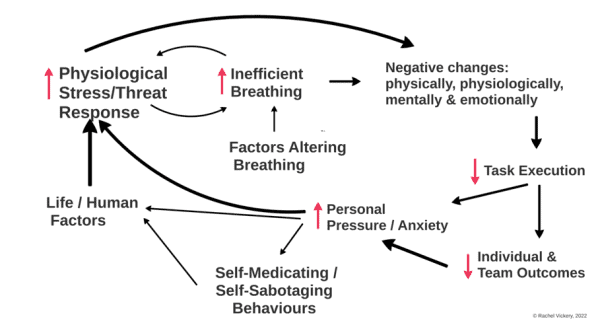
Typically, the problem is brought to awareness or focus in one of three areas (right-hand lower corner of Diagram 1) – the breakdown of task execution and outcomes, the heightened perception of pressure/anxiety, or the self-medicating/self-sabotaging behaviours.

3. ‘If a human fails to perform under pressure, it’s anxiety, and it’s in their head / they are mentally weak’

See the two points above. Irrespective of the performance arena, many high performers have the mental and emotional resilience to handle, excel and thrive in high pressure. But their physiology can still get out of control underneath the surface, leading to the negative consequences outlined previously. If someone can execute skills in lower arousal environments but not under pressure, assuming or labelling the problem as “anxiety” ignores the impact that a myriad of other physiological drivers will have on escalating the threat response that has nothing to do with “anxiety”. And it often has nothing to do with the performance arena, either! Part II of this article series will explain this point in more detail.

4. ‘People can either handle pressure, or they can’t’

Executing under pressure is a highly trainable skill, just like any other sport-specific skill. Unfortunately, it is often omitted in training during early career development, meaning performers get a long way through their careers due to natural talent or early physical development before this gap appears and the problems show. The assumption mistakenly gets made at this point that the operator can’t handle pressure. Most people who falter in high-pressure situations have just not learnt specific skills to prevent or recover from when their operating state crosses their threshold.

Additionally, a person’s threshold will differ between scenarios. An exceptionally qualified black belt martial artist will comfortably face down an opponent in a dark alley but get a dry mouth and sweaty palms at the thought of giving a speech in front of a thousand people. A seasoned firefighter will move confidently into a structural fire with no fear for their safety but momentarily freeze and move forward with heart palpitations and fast breathing when confronted with performing CPR on a young baby.

5. ‘Performance Under Pressure just “shows up’

There is a mistaken belief that operators can do the technical and tactical training, turn up in a big moment, and perform when the pressure and stakes are high simply because of their technical excellence. Coaches and team managers will often bemoan the sub-par performance that falls well short of potential without realising there is a skill gap. Most high performers do not automatically know what to do or expect mentally or physiologically when in high-pressure situations. Without intentionally learning skills to control their state in these situations, they fall victim to the negative performance changes outlined above.

In the most simplistic view, consistent elite performance in high pressure and high stakes moments requires two things:

  1. The ability to execute to one’s physical potential and
  2. The ability to stay in control of one’s operating or arousal state.

Many of the negative consequences of high pressure and high stakes environments, and the strategies employed to overcome them, are linked to the human threat response (particularly the sympathetic nervous or fright or flight system). How an individual breathes when they aren’t thinking about breathing will also impact this response by signalling whether there is a threat or everything is safe. These two areas directly affect the other – either positively when trained strategically and with intent; or negatively when left to chance. Consistent elite performance in high-pressure environments needs both areas to be trained intentionally in a coordinated way and in advance of ‘go time’.

We see the following negative interactions when these two factors are not well controlled.
sport techie

Diagram 1

Typically, the problem is brought to awareness or focus in one of three areas (right-hand lower corner of Diagram 1) – the breakdown of task execution and outcomes, the heightened perception of pressure/anxiety, or the self-medicating/self-sabotaging behaviours.

Some of the changes to task execution and performance for athletes are identified earlier in this article. The same concept applies to coaches, executive teams and support staff in their respective roles, although how it shows up may vary. The subsequent increase in pressure and anxiety for the individual, team, coaches or team management related to poor performance; and the impact of negative media and public criticism leads some individuals to self-medicate or self-sabotage. Any combination of alcohol, drugs, porn, gambling, food, missing training, out-of-arena altercations, excessive work hours, neglecting family, affairs, and unethical decision making may be present. Unsurprisingly poor mental health and suicidal tendencies sit in this mix also.

Teams will often try to fix the problem in one of these three areas. If a player misses kicks – they spend more time on their kicking technique (unfortunately, often in a relatively relaxed, no-pressure state). If a person – particularly coaches and management personnel- struggles with anxiety, they either keep it to themselves, are medicated, or receive insufficient expert guidance. If a person has an addiction or behavioural problems, they are disciplined, sent to rehab or hide it in shame.

This traditional approach is fundamentally flawed. Waiting for performance issues in pressure environments to show up (whilst hoping they don’t) and then reactively fixing them does not result in excellence and consistent high performance. Punishing poor performance under pressure in the absence of a front-loaded strategy of skill acquisition in this area is akin to throwing a bunch of humans who don’t know how to swim into a pool and then yelling at them to stop drowning.

Consistent elite high performance in high stakes and high-pressure environments means going “left of boom”, understanding the situation for what it is, and front-loading strategies to set up for success, thus avoiding a negative response. Normalising the physiological, cognitive and biological reactions that humans have in high-pressure environments and training and optimising for it is far more impactful on performance than just wishing or pretending it wasn’t there or reacting to the fallout after the event.

Part II of this series will dive deeper into how the human stress response works in high-pressure situations, how it disrupts performance and some skills and strategies to thrive in high pressure and high stakes environments.

Rachel is one of six Leaders Performance Advisors, a group of leading performance thinkers providing more subject expertise to our member-only content and learning resources. To find out more about all our Performance Advisors, click here.

Go to home
Follow us on Instagram Follow us on LinkedIn Follow us on X

Contact

Leaders UK

Tuition House
27-37 St George's Road
Wimbledon
SW19 4EU
London
United Kingdom

Switchboard Number: +44 (0)207 042 8666

Leaders US

120 W Morehead St # 400
Charlotte
NC 28202
United States

Enquiries Line: +1 646 350 0449

Leaders

  • Contact
  • About
  • Careers
  • News
  • Privacy Policy
  • CA Privacy Rights
  • Cookie Notice
  • Website Terms of Use

Performance Institute

  • Membership
  • Events
  • Content
  • Virtual Learning
  • Connections
  • Partners

Latest

Intelligence Hub
High Performance Future Trends Research Elite Performance Partners continue to drive the potential in high performance forward through renewed Leaders partnership
Your Privacy Choices

© 2026 Leaders. All rights reserved

  • Privacy Policy