The former NFL defender and Super Bowl winner spoke at SBJ’s Tech Week about how he used tech during his career and the impact of being able to call Warren Buffet and Joe Moglia his mentors.
Main image: Gregory Shamus / Getty Images

Suh, now 38, last played in 2022 and was part of the Sky Sports broadcast team for last month’s Super Bowl. He has invested in more than 30 companies, including Oura, through his family office, House of Spears Management. (Ndamukong means “House of Spears” in the Cameroonian language of Ngemba.) Suh also operates a real estate development company in Portland, Ore.
During SBJ Tech Week, Suh participated in a panel entitled “Tech and Talent: AI’s Impact on Athlete Training and Performance.”

Image: Marc Bryan-Brown
On the datapoints he tracked during his career…
The most consistent one that we’ve always done was, waking up first thing in the morning, I’d use a simple Google Sheet: How do you feel? One to 10. Where’s your energy level? There were four or five questions. That was probably the most consistent, and then we had so many other pieces of sleep data, whether it comes from Oura or, back in the day, we had other programs that we use. Ultimately, it’s a combination of looking at all this.
I’ve always been wired, especially from an athletic perspective, [where] I don’t really care how I feel. I have a job that I want to go and do an accomplish, and so I’m going to push myself through that. And if I chose to go get drunk the night before, I know I have to get up, and I’m going to have to muster through some things because I did that to myself. Vice versa, if I woke up and I just wasn’t feeling well, because traveling, or whatever it is, there’s ways to manipulate the body and manipulate the mind so you can reach your ultimate goals at the end of the day. It’s a combination of knowing when to pull back and when to push forward.
On the growth of data and tech…
Back in 2010 when I started, which is ages ago, it was kind of archaic, but to where we’re at now in 2025, there’s been a transformation. As athletes, we find different nuances and ways to find ways to get that 1% or half a percent to take us to the next level. And so I was always going into the lab. I was fortunate enough to have an amazing performance director I still work with to this day.
And then I had the great lab on the campus of Nike where I got to sit there underneath Phil Knight’s beautiful campus and everything that he has out with innovation. Back then it was the Mia Hamm Building, but now it’s LeBron James Building. So in there every summer finding new ways to tweak and learn different nuances that can advance my playing career.
On not overloading on tech…
Tools are key to have, but we also have to have that human interaction as well. It’s very important. That’s why I mentioned Keith D’Amelio, who’s my Performance Director. To have that human interaction and being able to say, “I can look and feel and see the things that you’re doing and I can teach you about the data.” Because I’m so focused on my craft and what I’m trying to do and accomplish and be the most dominant, but at the same time, I also need to learn those different new aspects of these new data points that are coming out. Some of them may not be relevant to me and that’s okay, but how do we decipher which ones are the best ones for me and which ones are not going to be the best ones for me.
On his interest in engineering…
I was born and raised into it. My father was a mechanical engineer. So as a young kid, as early as probably, second, third, fourth grade, I was riding around in this truck. He owned his own business, and so I was always with him, especially in the summers, when I wasn’t in school. It became a way for me to, one, be exposed to the industry and then falling in love with it, but then also as a kid, wanting toys and bikes and all different stuff — that became a job. Sweeping job sites and carrying duct work and all these particular pieces, and as I got bigger and stronger, I could lift heavy equipment and do that and things like that. Maybe I shouldn’t have been, but I was. So it was something I just easily fell in love with, [being] my dad, being on his hip, being able to watch and do everything, and just seeing it as something cool.
View this post on Instagram
On his studies at Nebraska…
I was a construction manager, so a broader view where, basically, I have the understanding of mechanical, electrical, plumbing, all the different trades that go into developing a building because I have to manage all of it. I have to know enough to be dangerous.
On how he’s put that to use…
I have built apartments, commercial buildings, so I’ve definitely put my degree to use. I have a development company back home in Portland that I do a majority of that through, and then I’ve built single family homes, not for myself, but for others and just different developments with different partners. I first learned by starting to do it, especially when I was in Detroit my first five years playing for the Lions. There was a guy named Gary Shiffman — he runs and started Sun Communities, which is a big publicly traded company centered around manufacturing homes. And so I learned a lot from him. We still work together to this day.
On his investing mentors, Warren Buffet and Joe Moglia…
We share an alma mater, Nebraska, so I first met [Buffet] when I was playing football there and going to school. He was honorary captain my senior year. And so they randomly came to me and were like, ‘You’re one of our top players. We’d love for you to meet him and walk out with you to the coin toss. Do you know who he is?’ And I was like, ‘Of course I know who he is. You’d have to be under a rock if you didn’t.’
So I really started reading up on him, understanding everything that he did. And then, funny enough, there was a defensive assistant that I didn’t really know until later on in my senior year, a guy named Joe Moglia, who was a big finance guy — he was CEO of TD Ameritrade — so everybody knew him as football coach, a silent assistant coach, but nobody really knew why he left in a black car every Thursday night to go to New York. And I had the balls to ask him. So we built a bond, and he became a close mentor of mine, especially after leaving college and even to this day.
On his investments…
I have a broad spectrum — the hospitality space, real estate and tech, depending on what type of technology it is and if I can add value to it and also if it’s just functionally things that I use. Especially on the sports side of things, like Oura Ring. Hyperice — I sold a business to them over the last couple of years for new technology for them to integrate into their organization with Normatec. I’ve been an advisor since the inception.
This article was brought to you by SBJ Tech, a Leaders Group company. As a Leaders Performance Institute member, you are able to enjoy exclusive access to SBJ Tech content in the field of athletic performance.
Last month at SBJ’s Tech Week, Bettman took to the stage to discuss how the NHL continues to embrace technologies that push the boundaries of performance.
Main image: Marc Bryan-Brown
His 32-year tenure has now arrived at a place where the sports industry is infused with tech, and the league is pushing in so many areas to advance its product: NHL Edge player tracking data, the digitally enhanced dasherboards and the alt-cast avenues it uses to reach various sections of its fans.
“The game has got to be good fundamentally,” Bettman said. “And you don’t change the game for the technology. What you do is use technology to enhance the game and to connect people with the game — whether it’s the players, the coaches or our media partners or our fans.”
As the headline speaker for SBJ Tech Week on Wednesday, Bettman rolled through the NHL’s various tech ventures, which continue to grow in both dedication and success. Here are some of his key thoughts on their current and future plans.
Boosting the referee process: One of the league’s recent developments focuses on officials using Apple Watch, which started in September.The hardware is helping officials track the game clock and also alerting them at the end of periods and penalties. Bettman sees the potential for that to expand to notifications that eventually include the players who commit penalties. The pairing of this technology with Hawk-Eye (one of SBJ’s 10 Most Innovative Sports Tech Companies) can help in the various judgment calls in games.
“I’m not sure we want to take all the human elements out of the game,” Bettman said. “However, something like offsides and high-sticking in terms of where the puck was touched, those are things that we may be able to do better of using not just the Apple Watch or the Hawk-Eye system but even using artificial intelligence in terms of re-creating situations.”
NHL Edge tracking data: Bettman pointed to the continued evolution of NHL Edge — which became operational for puck and player tracking in 2021-22 and added fan-facing features in 2023 — as a foundation of its tech mission. It supports the league’s alt-casts, as well as coaching insights. It has the potential to help video reviews, too.
“It took us better than five years and more money than I think I’ve ever told the owners to figure out how you could embed something in the puck that could actually be tracked,” Bettman said. “And then putting the chips on the player was a lot easier.”
A growing presence on Roblox: Roblox has increasingly become a space for the NHL to build and connect with younger fans. The league’s work on the platform started in 2023 with NHL Blast, which has housed All-Star Weekend and Stanley Cup Final deployments.
“It’s a combination of content creation [and data],” Bettman said, “And we now, because of the data we accumulate, we create more content and make it more readily available.”
Cloud-based live game broadcasts: The NHL, along with AWS, were SBA: Tech finalists for Best Technology Collaboration — the first live game broadcast of its kind.
“Producing the game on the cloud is more efficient from an environmental standpoint, a manpower standpoint, a financial standpoint,” Bettman said. “That’s the way of the future. That’s the way everybody’s going to be producing games.”
AI usage league-wide: Bettman mentioned that the NHL has leaned into AI in both fan-facing and back-of-house use cases. AI has streamlined aspects of selling tickets and scheduling games for its 32 teams.
“We schedule over 1,300 regular-season games, looking at building availability, looking at traffic patterns to get people in and out of games,” Bettman said. “These are all things that AI is going to make us better at.”
This article was brought to you by SBJ Tech, a Leaders Group company. As a Leaders Performance Institute member, you are able to enjoy exclusive access to SBJ Tech content in the field of athletic performance.
How haptic feedback helps officials to keep their eyes on the ice during games.
Main image: Getty Images courtesy of the NHL
The league and its officials, in collaboration with Apple and technology innovation partner Presidio, developed the NHL Watch Comms App to track the game clock and signal the imminent end of periods and penalties. But to help the officials focus more on the action around them, the primary function is to provide haptic feedback with vibrations, rather than visual cues.
“The watch doesn’t distract you,” said Stephen Walkom, a former on-ice referee who is now NHL Executive Vice President, Hockey Operations. “It actually informs you. You think you’ve got to see a watch, right? And we feel a watch, but we know what time it is.”
Rollout of the Apple Watches began in September, with the league reporting a 92.5% adoption rate by officials. Saturday’s NHL Stadium Series game, in which the Columbus Blue Jackets are hosting the Detroit Red Wings at Ohio Stadium — the usual football home of the Ohio State Buckeyes — is an important milestone for the technology.
Every arena hangs scoreboards and places LED-ribbon clocks in different places, but over time, the officials grow familiar with their locations for quick time checks. In a one-off location like with the Stadium Series, everything is new, plus the size and typical depth perception is thrown off by the vast size of the venue.
“In that building,” Walkom quipped, “you’d be spinning like a top on the ice looking for a clock.”
Part of the impetus for the technology was a safety concern. There have been collisions and near-misses on the ice when players emerge from the penalty box and an official happens to be skating near the door. Having the haptic reminder that a player is about to emerge can help clear that space.
“We had a really high-level objective: It was an interest to figure out, how can we help the officials keep their eyes on the ice more?” said Dave Lehanski, NHL EVP of Business Development and Innovation. “We can’t understate how important it was to collaborate with the officials and how agreeable they were to participating in this.”
The NHL brought that goal to its tech partners. Apple had previously helped the league by providing iPads for in-game bench use, and Presidio developed applications for the NHL Draft and the league’s streaming operations.
As straightforward as the end result is, there were technical challenges to develop it, not to mention the need for significant input from the officials to ensure the app didn’t disrupt their workflow. Presidio developed the app, extracting about two dozen datapoints from the NHL’s OASIS data feed, rather than pushing notifications to the watch.
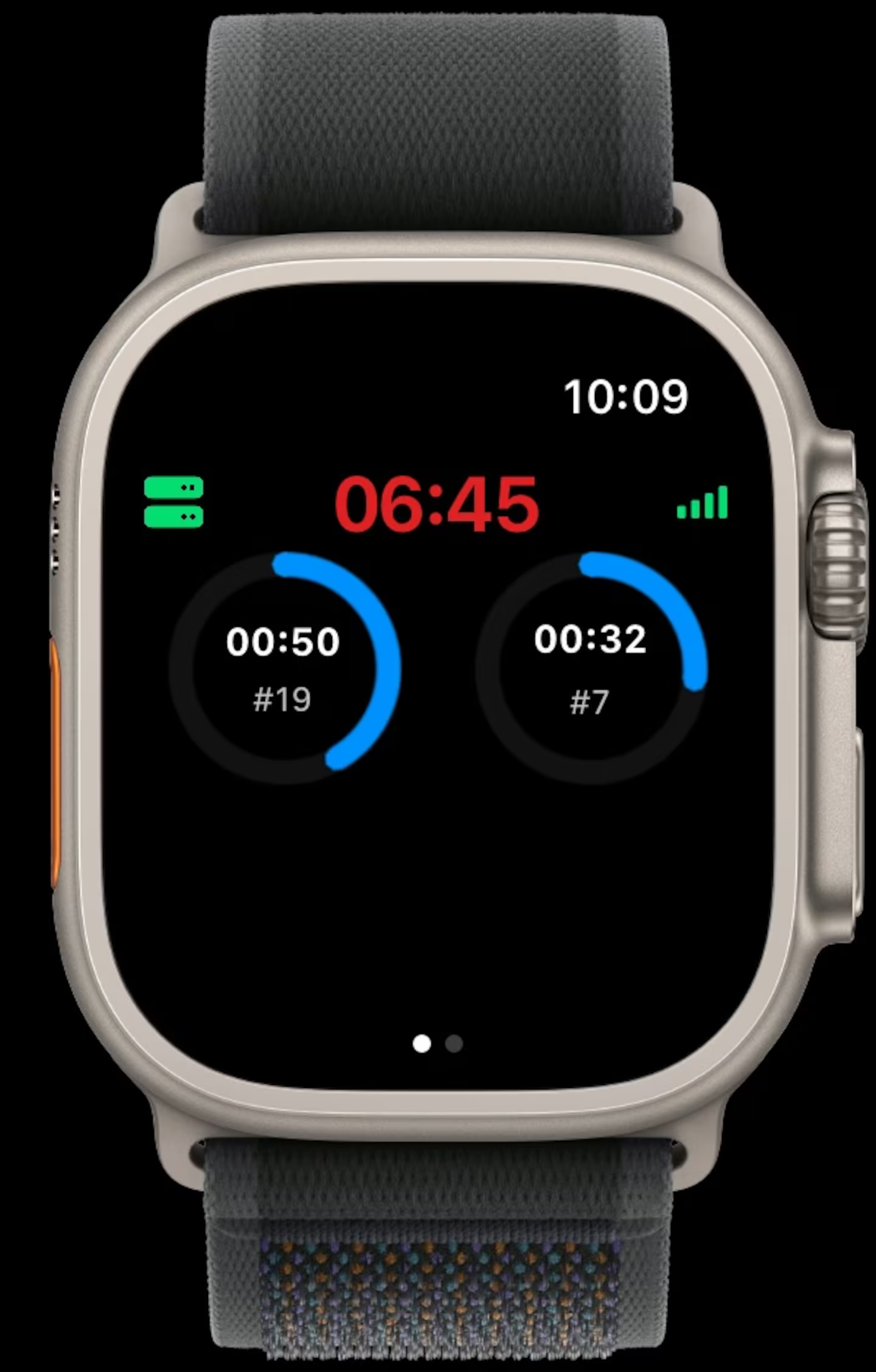
The NHL Watch Comms App showing the imminent end of two penalties (Photo: NHL)
“We had to build, not necessarily a push-based application, but a pull-based application, which was really, really unique, to make sure we had accurate data for the officials,” said Andres de Corral, Presidio VP Digital Services, noting that the timeline required “a series of design thinking sessions and trial and error.”
“The NHL has a real patience about these implementations,” added Scott Brodrick of Apple Worldwide Product Marketing. “The goal is the seamless use of technology to enhance the game, and I think that has materialized over this period of development. Sometimes the simple solution is the most powerful.”
Now, before games, almost every official grabs an Apple Watch as routinely as his shin guards, microphone and striped shirt.
“Guys just came to trust it,” Walkom said, “and we have less and less looking for a clock in the rink.”
This article was brought to you by SBJ Tech, a Leaders Group company. As a Leaders Performance Institute member, you are able to enjoy exclusive access to SBJ Tech content in the field of athletic performance.
In this edition of SBJ Tech’s Athlete’s Voice, British triple jumper Naomi Metzger discusses how data and AI are transforming her recovery.
After narrowly missing the Tokyo and Paris Olympics, Metzger is documenting her goal of qualifying for the LA28 Games on the blockchain. Cudis was founded by UCLA graduate Edison Chen, and it targets Gen Z athletes, having also secured partnerships with UCLA athletics and individuals competing for Lamborghini Racing (Cam Aliabadi), in Ironman (Patrick Schilz) and in Olympic rowing (Kate Knifton, a two-time NCAA champion at Texas who was Big 12 Athlete of the Year in 2023).
On how she learned about Cudis…
I actually found it on X. I was scrolling through, and I’m always having a look at what the next thing in crypto is — and then Cudis popped up. I saw wellness, web, crypto all combined — own your data — all these words that I’m thinking, ‘This sounds really interesting.’ So I shot them a message, and I was like, ‘Hi, I would love to be an athlete ambassador.’ I got talking to Edison, and then they made it happen. So I got sent the ring to test out, and then I got sent the version two ring. For the past six months, I’ve been playing around with the ring and really got to enjoy using it.
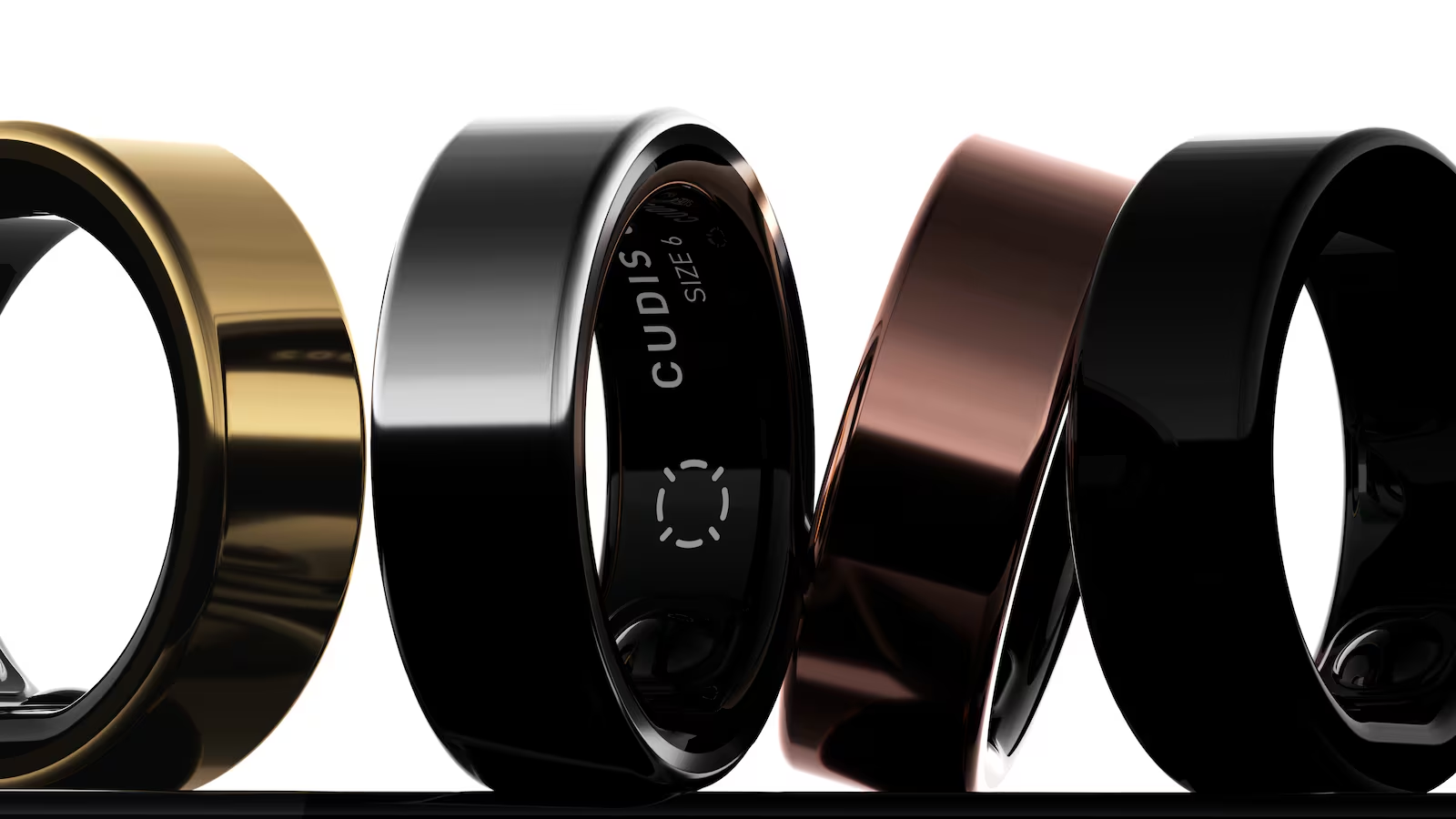
Cudis rings add a new layer to the wearable experience with their Web3 features that can transform real-time data into valuable points redeemable for exclusive rewards. (Image: Cudis)
On her interest in crypto…
Kind of out of desperation because I got dropped by my sponsor in 2021, so I wanted to find a way of how I can fund my athletics. I was on TikTok and stumbled across a Gary Vee video talking about NFTs. He was really passionate. So I was like, OK, let me just see if this works. So I created my own NFT collection in 2021 and stuck around since then.
On her prior use of wearables…
I used the Apple Watch but never to monitor my sleep because the problem I found with the Apple Watch is that you constantly need to charge it, and then when I’m sleeping, I might forget. So I never really tracked my sleep. A lot of athletes were using a Whoop, but they have to pay a monthly or yearly [fee] — it is a subscription-based model.
I don’t really like to pay monthly fees. I’m an ambassador, but I knew Cudis is a one-off payment. And I was like, OK, that appeals a little bit more to me. Since getting the ring, I’ve started to track my sleep as well, and that’s been pretty helpful.
On what she’s learned about her sleep…
I basically learned that I wasn’t getting as good of a sleep as I thought I was because I’m always quite proud of the fact that I get eight hours, but a lot of that was very light sleep. It wasn’t deep sleep, and I realized that once I got more deep sleep, that meant spending longer time actually in bed and trying to aim for a bit more than that eight hours, I felt a lot better, and the more I started tracking that, I realized that training was better when I well rested, my mood felt better. So that’s something that I wouldn’t have learned if I wasn’t really tracking it and looking at the data.
On how she tried improving her deep sleep…
I Googled, and I was asking people, “Do you have any tips?” I went with magnesium before bed, and that seemed to really help. A colder room and weighted bed sheets. I literally tried everything because, even though I was getting those hours, I really wanted to maximize my sleep because I know that’s super important for recovery.
On her analysis of daytime metrics…
It was the stress levels that I found really interesting with the ring. Although I’m pretty in tune with my body and what aches and pains, because I’m at 100% all of the time, whether that’s training or I’m doing the crypto things or making videos, I didn’t realize how stressed that I’m actually becoming when doing that. So when I started to have a look at the ring data and seeing that way the stress levels are pretty high, that told me to maybe rest a little bit, self-care, and prioritize my mental health a little bit more. And it sounds silly that I wasn’t in tune with my own brain, but I feel like the ring almost helped me to figure that out a little bit.
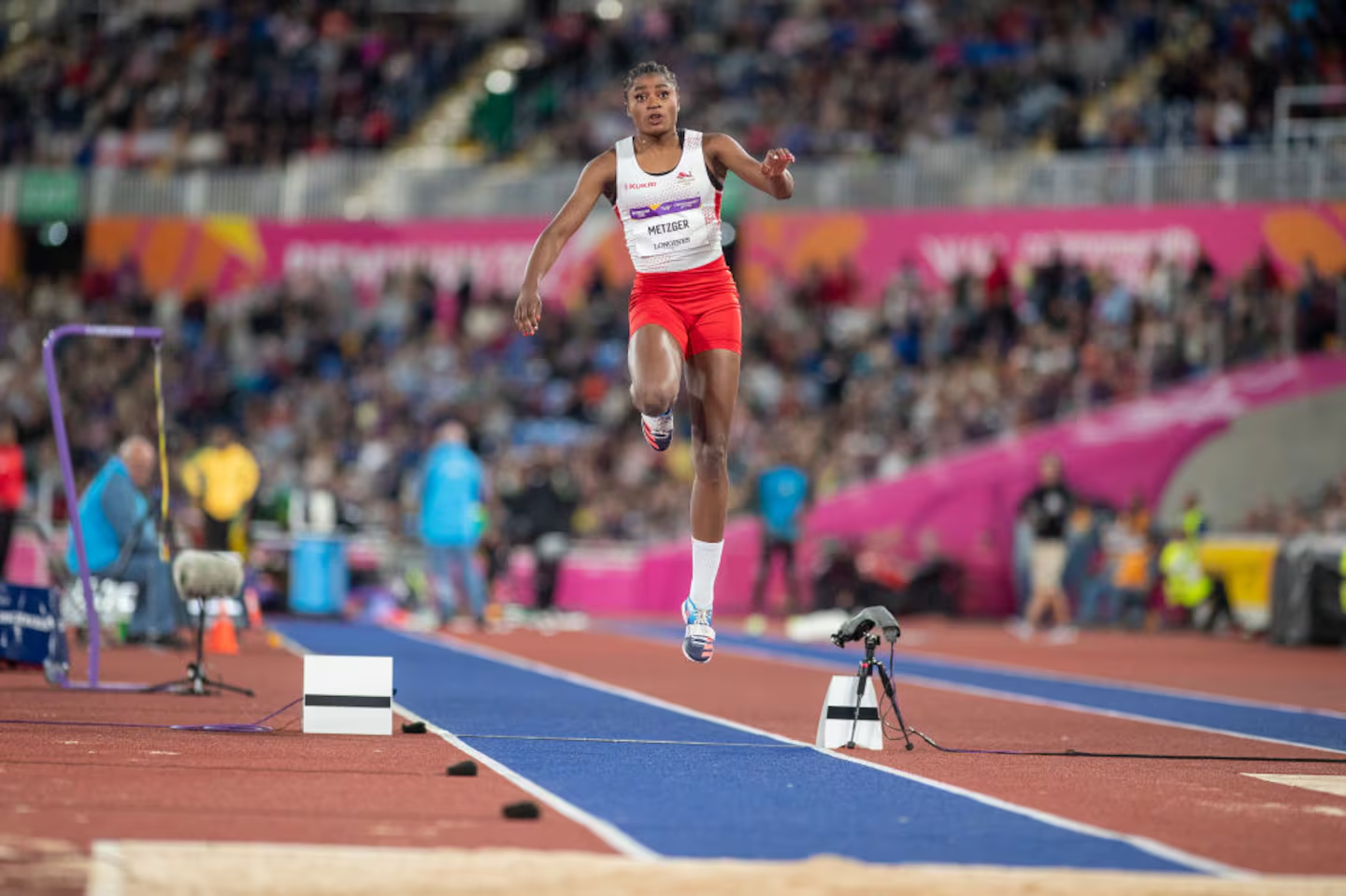
Naomi Metzger is an athlete ambassador for Cudis, a wearable ring technology with a Web3 component. (Photo: Corbis via Getty Images)
On using Cudis’ AI coaching functionality…
It really helped when I was looking at my sleep and looking at that deep sleep. When I first got the data, it was almost so much data, and I didn’t quite know what to make of it, so I asked the AI component, the coach, ‘Can you have a look at my sleep data and let me know what needs to improve and what’s the average and that type of thing?’ It was able to feed back [info] using my data what I should aim for, and I found that really helpful.
I also sometimes just ask for a little bit of advice. It sounds weird to speak to AI for advice, but sometimes I’m like, ‘Hmm, is it okay do you think to have a coffee now? Or do you think I should wait till maybe a bit later?’ And then it would be like, ‘This is the optimal times of having coffee.’ It’s quite cool to use AI in these ways, when I’d normally, I guess, be a bit too embarrassed to ask my actual coach.
On the ring’s Web3 component…
I’m really incentivized by rewards. As athletes, we’re obviously aiming for medals and things like that. The idea that your fitness gives you points, and those points can add up, and soon, I think, it’ll be able to be monetized, which is really cool. It’s a really good way for me to make sure that I’m tracking my workouts, sharing them, to get other people to, I don’t know, give them a bit of a boost — but it also just holds me a little bit more accountable.
You have a vitality score, and I’m always trying to aim for that 100 score. But sometimes I can be like, I don’t really need to do this rep, and I remember I’ve got the ring, it’s tracking me. I’m like, Okay, let me just do it. So I think, especially because I train on my own quite a bit, it’s a good way to hold me accountable.
On how much she continues doing her art…
I actually feel like I don’t have the time but definitely something that I want to get back into a little bit more. That was something that calmed me down. As I said, I’m always at like 100 but drawing was a way of calming me. And when I was doing the NFT collection, I was drawing a lot, and I had a really good athletic season. And also, when I was injured, I was drawing a lot as well because it was keeping my brain active when my body couldn’t move.
This article was brought to you by SBJ Tech, a Leaders Group company. As a Leaders Performance Institute member, you are able to enjoy exclusive access to SBJ Tech content in the field of athletic performance.
As Angus Mugford and Rich Hampson explained in a recent Leaders Virtual Roundtable, it begins with teams better serving the psychologists on their books.
This is all according to a straw poll of Leaders Performance Institute members during a recent Virtual Roundtable.
“I’m not surprised,” said Angus Mugford, the former Senior Vice President of Player Development & Performance at the New Jersey Devils. “I would be curious to ask the group what kind of services and provisions you have because the thing that always jumps out when you mention sports psychology or psychological services is that it means different things to every stakeholder.”
That’s the first problem. “You’re often setting your services up for failure.”
Mugford was joined by Rich Hampson, the Head of Psychology on the men’s side at the Football Association, to discuss why psychological services are not set up to succeed and to propose some ideas for redressing the balance.
Better developmental pathways for psychologists
Sometimes, through no fault of their own, psychologists are ill-prepared for careers in sports performance and, when things go wrong, Hampson feels they can be scapegoated for structural failures elsewhere. “It’s almost like they’re going from reception [kindergarten] into year one of school,” he said.
There should be better pathways for aspiring practitioners once they walk through the door. “The first thing you’d want is close supervision, guidance, the opportunity to observe and be observed in your practice,” Hampson continued. “There’s a lot to be desired in terms of the number of touchpoints in those first two years of applied practice and the kind of supervision that should go alongside that.”
It is not hard to see why problems can mount without true accountability. “It is leaving practitioners with a load of uncertainty or potentially false confidence.” Or rather than focusing on their practice and its impact, they are potentially more focused on navigating the political landscape – “the things that keep them in a job”.
Mugford, while serving as President of the Association of Applied Sports Psychology [AASP], oversaw the development of a certification pathway for mental performance consultants. However, there are few internship opportunities on offer in both professional and US college sports. “The system has not caught up with the pathway yet,” he said, adding, “there’s also a difference in the way the clinical pathway is creating and fostering development versus the mental skills pathway.”
Teams must establish what is required of their psychological services
A team’s psychological services are a common point of misalignment. “If you think of the people that drive a job search, even just the definition. Let’s say we have a GM, head coach and director player of development talking about sports psychology, I’d be willing to bet each of their definitions and perspectives are different,” says Mugford.
Hampson has observed this in job adverts. “You know they’re saying ‘we’re not sure’ because the job description lists key responsibilities and includes vague psychology words,” he said. “It’ll probably be ‘help with mental health’ and then something about ‘wellbeing’, then ‘athlete performance’ and ‘coach performance’.”
For leaders tempted to type those words, he has some advice. “Consider: what is this helping us to achieve?” If it’s still unclear, you might instruct a consultant to complete an assessment. “What is going to make the biggest impact here in the short to medium term? Let’s go after that. If nothing else, you’re then clear on what success looks like and you’re actually clear on the skillset you need – it will help your hiring process to be more specific. It’s not because they’re ‘good’ or ‘bad’. This person might be the best fit here, but they may not fit what we’re going after here.”
For Mugford, it is critical to decide who is running the hiring process and who to ask for their input. In his time at AASP, he developed a decision-making tree (see image below) to help provide clarity when developing a performance programme:
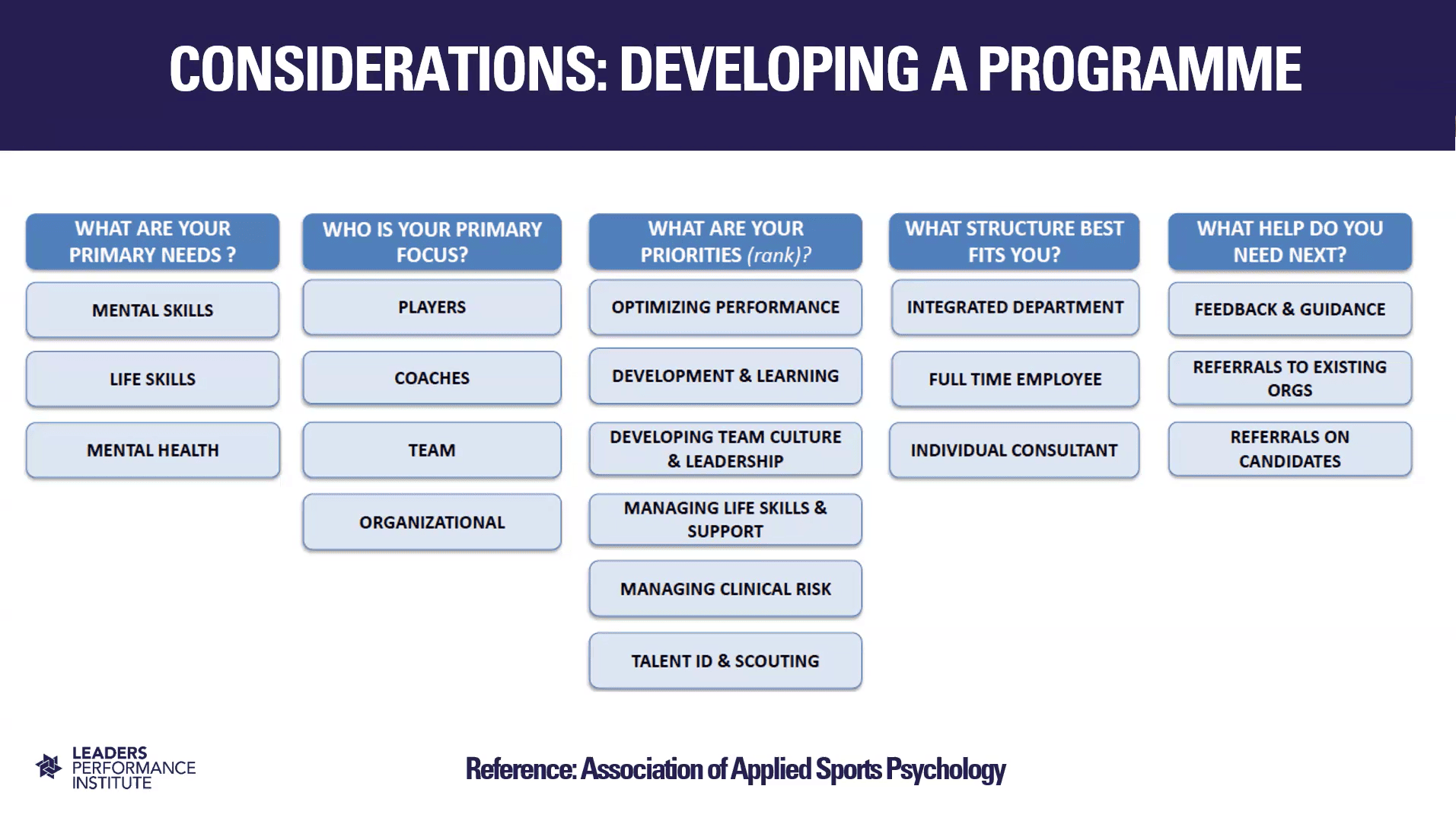
Mugford said: “What information do you need to gather and seek? [After using a decision-making framework] I often find there might be a search and interview process that organisations sometimes put on hold because they realise they have now got a different decision to make.”
Embed psychology as another performance service
“High-profile sports environments are unforgiving,” said Mugford. “It’s like you put someone in a room and, if they fail, their credibility and trust may be done.” Psychologists have fallen into this trap in the absence of a proper induction.
He argued that it is on key stakeholders to manage inductions and help the psychologist to build trust, particularly in environments where they might be unaware of social or sports norms. “It can create havoc and a longer pathway to building relationships,” he added. “The onboarding process can really minimise the downside and accelerate the positives. We underestimate that window.”
The work can be hard and lonely, as Hampson explained. A psychologist might be spread thin due to budgetary reasons or because their role is too broad and ill-defined. “It’s always really hard to be in the helicopter and going ‘what is psychology trying to achieve here?’ and simultaneously be on the ground driving things forward while being a really good practitioner.”
For Hampson, the solution is a leader able to set the direction, to bring in people with the right skillsets and develop them against established markers. Then, the psychologist “can deliver with the guidance of the person above them”.
That structure is critical, as Mugford explained. “Organisations will often over-index on fit, personality and EQ, whereas building a team or programme, even language that sticks for a culture, that goes beyond an individual’s preference or training is something for teams to think about.”
Find ways to track, test and refine your psychology work
Some people in sport openly lament the perceived lack of metrics in psychology. This frustrates Hampson: “I see psych fall down because it’s not defined well enough early enough.” However, if you are clear at the beginning, “90 per cent of it can be tracked. The broader you are, the less defined you are, it’s harder to ask: ‘is this actually having impact?’”
Benchmarking tends to be an area where sport excels, but not when it comes to psychological services. Hampson said: “I think sports should be more confident in going ‘if we’re clear on what we’re doing, more often than not, we’ll be able to give you an indicator here, whether that has done what we want it to do’; and then, like any science experiment, if your first intervention doesn’t lead to the outcome that you want, it gives you a real good platform to go ‘OK, why did that not work? And what do we need to adapt and change?’
“I think that’s really hard to do in a really objective way when you’re not setting that in the first place.”
What to read next
Sports Science Research: the Strengths, Weaknesses and Opportunities
The St Louis Cardinals’ star rookie of 2024 discusses his use of tracking technology in the pursuit of performance gains.
You can’t have a discussion about sports technology today without including athletes in that conversation. Their partnerships, investments and endorsements help fuel the space – they have emerged as major stakeholders in the sports tech ecosystem. The Athlete’s Voice series highlights the athletes leading the way and the projects and products they’re putting their influence behind.
* * * * *
Despite weathering an early injury, Wetherholt slashed .295/.405/.400 with 2 home runs and 20 RBI across 29 appearances for Single-A Palm Beach in his first season in the Cardinals organization, culminating in a game-winning double in the league’s championship game in September. He entered 2025 as MLB.com’s seventh-ranked SS prospect (23rd overall).
Before that, Wetherholt was a standout for West Virginia, where he was introduced to Pison, the maker of AI-powered neural sensors that measure cognitive functions through smart wristbands. WVU, along with several other collegiate and youth programs, use Pison’s tech as an athlete performance tool on an institutional basis, and MLB is in the process of testing it for on-field approval. The company recently launched a training platform specifically for baseball, called Pison BASEBALL Pro, and integrated sleep tracking data into its Pison Perform product. Wetherholt is a brand ambassador.
As he prepares for his second pro season, Wetherholt spoke to SBJ about his use of Pison and his goals moving forward.
On his first impressions of Pison…
I thought it was interesting. I wasn’t really sure the practical use of it. I thought it was cool to get a benchmark [of my reaction time] and compete with your friends. But then, after that, I didn’t really understand how it could be beneficial or helpful. It’s like, ‘You just got a score, what now?’
As I’ve gotten used to it, I’ve found cues that say, ‘Hey, do it on days that you’re feeling slow and you might see an improvement.’ Or, ‘Do it after your lift and you’ll see an improvement.’ Just different ways to mess around with it, use it on a more consistent basis, to remind your brain and wake it up on days that you’re sluggish.
On how he uses the reaction tests…
A light flashes, and you move your hand open, and it measures how fast you moved it in accordance to when the light flashed, basically. And then there’s also a mode, which is pretty cool, it lights white and you’re supposed to move your hand, or it’ll light yellow and you’re not supposed to move. It’s kind of a yes-yes-no type of thing, which is pretty similar to baseball and hitting.
I’m not a huge person to be like, ‘Oh, my reaction time is bad today, I’m going to stink.’ So, for the most part, I really wouldn’t pay attention to it too much on a gameday. But on an off day it’s cool to see where you’re at. If you had a heavy workload and you wake up and you feel good, but then you check and your reaction times are low, it’s like, ‘OK, maybe I have to do it a little bit more today to try to wake up.’ It’s cool as a benchmark in that regard.
View this post on Instagram
On his use of athlete performance technology…
I’m definitely not a genius in the tech field, but I’m open to it. Baseball is getting more and more tech-driven, so all of the stuff in regard to hitting, Trackman, where you can see all the metrics on your swing — that stuff’s really cool. The only other thing is sleep, which is the biggest selling point that [Pison] is introducing now, being able to track sleep. I want to know how I sleep, I want to know HRV rates, stuff like that, where it’s going to help me be able to see how I can recover better.
On differences in technology investment at pro and college levels…
We had decent exposure to it at school. We didn’t have the [same extent] of it as professional ball, as you would expect. Now, pretty much every swing is videoed, and you have your Blast [Motion] numbers and Trackman numbers, which we didn’t have at school.
But also, with [analytics], it’s a blurred line. You don’t want to dive too much into it, where it’s like, ‘Oh, I got perfect metrics on my Blast Motion sensor, but now I can’t hit.’ It’s about finding the middle ground of knowing what’s a red flag and what’s not.
It’s different from person-to-person, [coaches] are going to work with everyone differently. For me, I’m tracking bat speed, attack angle, vertical bat angle and rotational acceleration, which is all measured from the bat. So that stuff is concrete. Other people look at it differently. It’s definitely been a little bit of an adjustment — you can get over-consumed. That’s been a big point [from coaches], they’re like, ‘Do what you do. Play ball. We’re just here to help. If you have questions, ask, we’ll explain it to you. But here’s what we want you to focus on. We’ll bring [metrics] up to you if we think there’s a problem.’
On his goals for his second MLB season…
I’d say the biggest thing is to play as many games as possible. I want to be healthy. You can’t play good baseball and you can’t move up levels if you don’t play — and if you’re not healthy, you can’t play.
And then, no matter where I go, just competing to the highest level at that particular level, whether it’s Low-A, High-A, Double-A, whatever the case may be. Just competing and trying to dominate at that level and not looking at anything past that. It’s easy to get centered on, ‘This guy got moved up in this org,’ or ‘I want to go up.’ But at the end of the day, you’re going to move yourself up. If you’re too focused on jumping levels and not dominating the level that you’re in, you can look too far forward and forget to commit to where your feet are. So, just staying present, and then hopefully win a bunch of games.
This article was brought to you by SBJ Tech, a Leaders Group company. As a Leaders Performance Institute member, you are able to enjoy exclusive access to SBJ Tech content in the field of athletic performance.
The wellbeing plans available to student-athletes to include connections to mental health professionals, as well as the Zone’s screening tool that monitors athlete wellness.
Outside of just being the right thing to do, there’s a straight line from holistic support of athletes and business success. Wellbeing begats better performance, which begats results, greater fan interest and, ultimately, a product fans will pay for.
Last year, the NCAA released the latest version of its mental health best practices, outlining obligations for all member schools (regardless of division) to create a healthy environment for athletes. Components of that plan included support via resources and connections to mental health professionals, as well as a screening tool to monitor athlete wellness.
The NCAA required D-I members to provide this by last August. And this November will be the first deadline for schools to prove they’re doing so. With that mile-marker approaching, The Zone is gearing up to test a new feature in its athlete wellness platform: the Mental Readiness Score. The metric will provide insight into an athlete’s mental state.
Knowing the score
In a walkthrough with SBJ, The Zone CEO and Co-Founder Ivan Tchatchouwo showed a series of check-in questions that help create the score. Prompts focused on physical essentials like hydration and sleep but also considered ratings for categories such as confidence and energy level. The quick series produces a score (scaled from 0-100) that a coach can see for each player, while the individual student view will show tiered descriptors (such as ‘Fully Ready’ or ‘Needs Attention’) to take away the pressure of potentially seeing a poor numerical score.
Tchatchouwo said the feature, which The Zone will pilot with select schools as part of its premium platform offering before a future rollout, came as an idea from numerous conversations on different campuses since the company was founded in 2021.
The Zone has a client base of roughly 200 teams at various levels of the NCAA, offering three tiers of its platform: basic, premium and enterprise.
“The biggest thing, and we’re seeing this in all sets of industries and technology in college sports, is how do you harmonize this data to drive value for the athlete but also to drive value for the administration?” Tchatchouwo said.
Coaches will be able to see Mental Readiness Scores for each athlete and a collective score for a team, allowing for responses at the individual and group levels in their teaching and preparation. The Zone’s athlete experience also offers support via breathing and visualization exercises that cater to the user’s preference.
One of The Zone’s biggest triumphs of 2024 came through validation from its own data and research. Tchatchouwo said that athletes who used The Zone 15 times saw their moods “significantly” improve, and that was especially true for women who used The Zone’s platforms. He also added that client schools see up to 3X more access to their athletes via The Zone platform, meaning an increased understanding in what their athletes are collectively experiencing on the mental side.
“What we’re seeing is the athletes that are stigmatized, that don’t talk about it, are getting help from The Zone,” Tchatchouwo said.
This article was brought to you by SBJ Tech, a Leaders Group company. As a Leaders Performance Institute member, you are able to enjoy exclusive access to SBJ Tech content in the field of athletic performance.
Tech vendor Receptiviti worked with Senior Bowl partner Tatnuck Group to transcribe interpersonal interviews, then create 52 reports that measured and compared players based on psychological traits.
This year, analyses of those sessions included reports created by language processing technology vendor Receptiviti, which worked with existing Senior Bowl partner Tatnuck Group to ingest and transcribe interviews, then create 52 reports that measured and compared players based on psychological traits.
“We’ve always looked for the most effective and reliable means to objectify what we do from an interview and assessment standpoint,” said AJ Scola, the former Assistant Director/Personnel at the Atlanta Braves who founded Tatnuck Group in 2020 as a sports-focused talent assessment and development firm. “Receptiviti did a great job of delivering on that.”
This was Tatnuck Group’s fourth year supporting Senior Bowl staff, a mandate that includes providing performance coaches for players and interview training to scouts, but its first wrapping Receptiviti’s API into its offering.
Receptiviti’s software, called LIWC, was invented by Dr. James W. Pennebaker on the back of several decades of psychological research. Its thesis is that the propensity with which humans use different categories of words – ranging from the academic (e.g., prepositions, conjunctions) to sentiment-based (positive emotion words) – can correlate to different psychological characteristics.
“Two different people who see the world differently, who see their own place in the world differently, are going to use these different grammatical categories at slightly different rates,” said Kiki Adams, Receptiviti’s Head of Linguistics. “By combining those word categories, we have formulas that give us the probability to which someone is in a certain psychological state or trait; things ranging from personality – like extroversion, agreeableness – to their emotions – fear, sadness, happiness.”
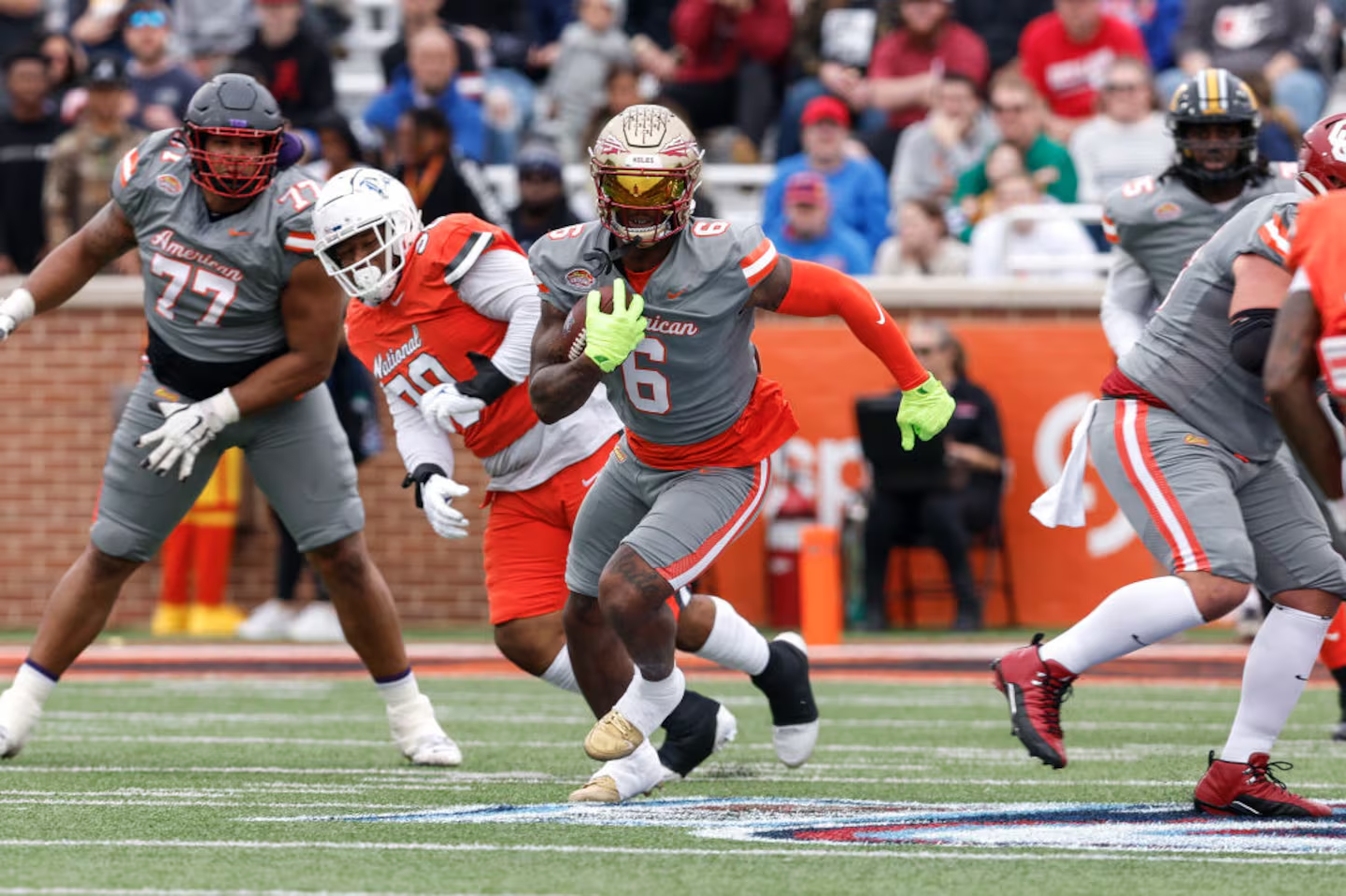
Photo: Don Juan Moore / Getty Images
Receptiviti’s tech analyzes thousands of word categories and subcategories to ultimately score speakers in more than 200 “dimensions,” which include everything from personality type to whether someone is a more intuitive or deliberative decision-maker.
It then feeds that data to large language models, trained on the company’s psychological research, to place that raw data into context.
Receptiviti’s Senior Bowl reports, as one example, charted each quarterback’s standing across the “Big Five” personality traits, with text summaries attached that described what those measures mean and how they apply to football.
“If a player scores higher on a measure like neuroticism, meaning they’re more likely to experience things like anxiety and stress and negative emotionality,” said Jade Marion, Receptiviti’s Senior Manager/Customer Success, “we include information about how a coach might work with a player with that type of disposition.”
Such assessments have a clear use-case in athletics, where optimal performance is table stakes and, on-field talent aside, relationships can make or break a team’s chemistry.
But Jennifer Glista, Receptiviti’s CRO, said the company’s integration engine is used by sports organizations for more than just personnel scouting, including to better inform coach and executive hires.
“Language is so flexible, and so, from our perspective, the more data you have around the entire organization, the more effective you can be,” Glista said. “But it depends on what each customer’s application is setting out to do.”
This article was brought to you by SBJ Tech, a Leaders Group company. As a Leaders Performance Institute member, you are able to enjoy exclusive access to SBJ Tech content in the field of athletic performance.