In this recent edition of The Athlete’s Voice, SBJ Tech catches up with former Olympic badminton player Howard Chu discusses the implications for AI that can deliver real-time feedback and data across racket.

You can’t have a discussion about sports technology today without including athletes in that conversation. Their partnerships, investments and endorsements help fuel the space – they have emerged as major stakeholders in the sports tech ecosystem. The Athlete’s Voice series highlights the athletes leading the way and the projects and products they’re putting their influence behind.
* * * * *
In January, the self-described “tech nerd” appeared at CES to try out a new AI-powered badminton training system developed by Taiwan’s Industrial Technology Research Institute (ITRI). An automatic serve machine fired shuttles, and when Shu returned the serves, cameras using computer vision relayed data such as shot speed and trajectory as well as on his own swinging motion.
Shu, 34, is a UCLA graduate and former EY consultant now working in supply chain logistics as Manager Business Development & Operations for Hizooo Network Technology. He was recently starred in a short film about his athletic career called 10,000 Days of Chasing My Dreams.
On connecting with ITRI before CES…
I didn’t know anything about it, actually, so it was really exciting. They reached out. I did a little bit of quick Google search as well and saw the machine that they had. This was my first time actually seeing it and testing it out. First impression, it’s cool. I think there’s some refinement [to be done], and we weren’t in a perfect, controlled environment, but just running through my head, there’s so many use cases for it already.
On the AI trainer…
Basically, it’s a typical shuttle feeding machine, which we’ve seen already. That’s not new, where it basically shoots a shuttle at you. You see this in tennis as well, if you’re trying to practice by yourself. But what happens is, after I hit the shuttle, it gives me some data output, like speed of my return shot, positioning, height. So those are some of the metrics that it was actually giving me after I hit the shuttle that it fed to me.
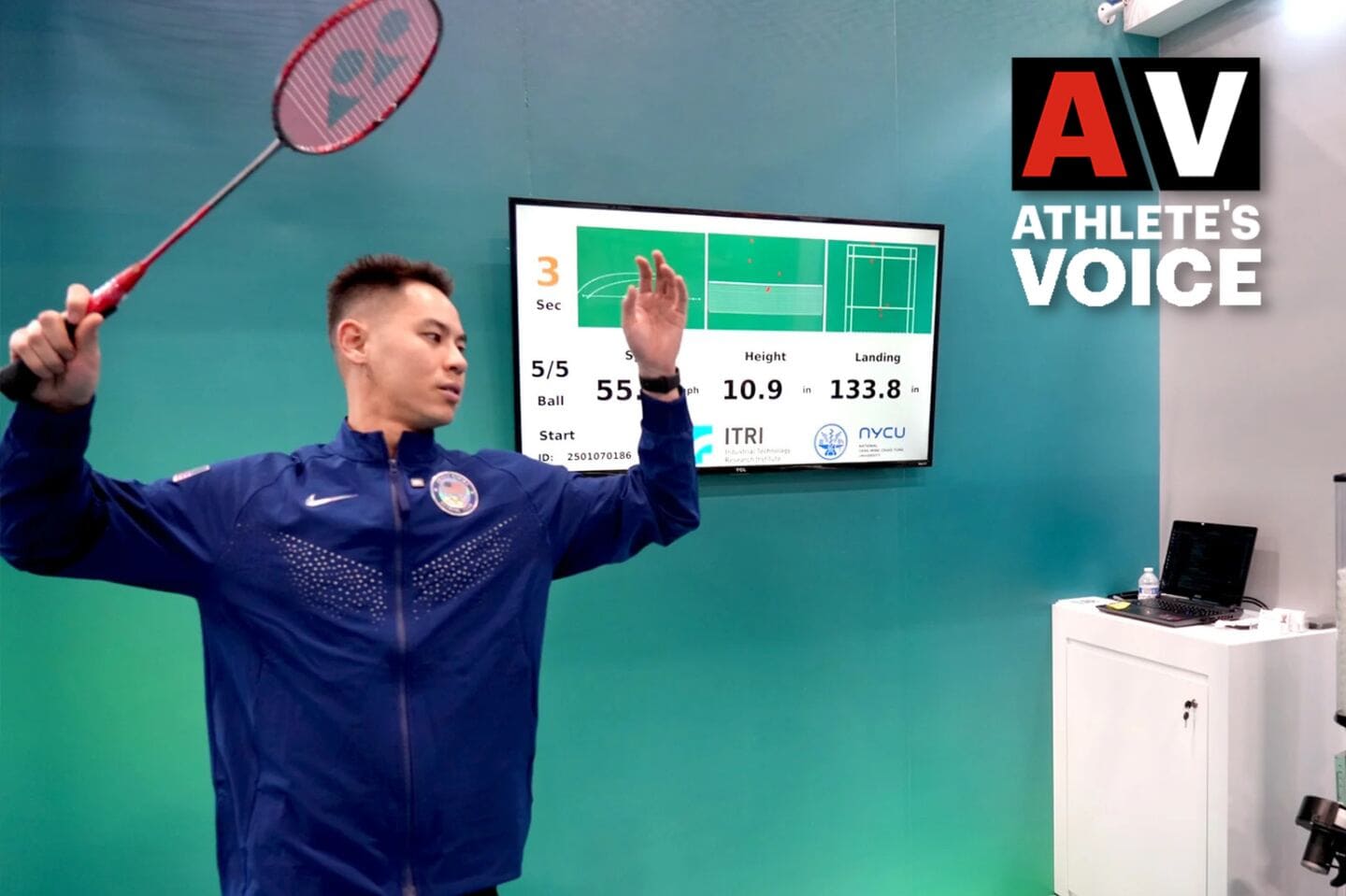
Photo: Getty Images
On whether he typically saw such data…
I haven’t. If we talk about AI or technology in the space with other racket sports like pickleball or padel, we’ve seen some other technologies trying to track number of shots in a rally or where you made the mistake. On tour, we do have metrics like speed, but it’s not to your own use where you can track every shot. Sometimes they’ll track a big smash or something like that, but not [it’s] something in your hands where you can track every single shot of your own.
On the limited data on tour…
If you’re in a big match, you might see, ‘Hey, this player hit a 400-kilometer-an-hour smash once during the match.’ It’s not like I would be able to dial in and say, ‘Hey, during the third match, I was feeling a little bit more tired. I want to know if my smashes were dropping off by 5 per cent or 10 per cent.’ So those are the kind of metrics that you would really be able to act on if you had something like this.
On using this new badminton data for racket fitting…
One of the main use cases that I thought right away is — I follow a lot of other sports like tennis and golf — I think this type of technology would be extremely helpful in customizing or picking out the proper equipment for the athlete. So we see this in golf a lot, right? They use their Foresight [launch monitor]. They track ball speed, ball spin, height, all these details that are really meticulous, right?
And so if I’m an athlete and maybe I’m not optimizing the proper equipment, whether it’s string tension or there’s head light or head heavy. I could go on to a court, test out 10 different models with 10 different variations of strings tensions and figure out which one is giving me the best smash, the best speed, things like that, which otherwise would just right now be going by feeling like, ‘Hey, this racket feels good. That smash felt good, [but] I don’t know exactly what the speed was.’ You’re seeing it in some of these other sports that have a little bit more money, that are already implementing it into a lot of their strategies.
On other tendencies the system could learn…
I’m sure those cameras are capable of [identifying tendencies], whether you put in a match video and it spits out some sort of post-analysis data like, ‘Hey, I made X amount of mistakes in my backhand or X amount of mistakes in my forehand.’ They might even be able to drill down to more meticulous details like, ‘Hey, the height over the net on this shot was five inches or 10 inches, and that’s what led to losing this point.’ It’s obviously a lot of back-end code and different scenarios that they have to run, but there’s definitely a ton of use cases for something like this.
View this post on Instagram
On his own data-driven training…
Very late in my career, at 34 years old, one of the things I’ve done is I’ve laid off of all the impact cardio. So, for example, no more running, whereas in my early 20s, I did a lot of that. But now it’s always low-impact cardio — swimming, biking — but then it’s tracking my heart rate, making sure I’m getting into the right zones to push that cardio.
There’s so much recovery tech out there, whether it’s compression boots, plunge, infrared sauna. These are just all things that I would say were not accessible to the average consumer, five years ago, 10 years ago, and now we’re really seeing companies push the envelope where it is very accessible to consumers. And I don’t know what the timeline is on a machine like this, or a technology like this, but I’m sure it’ll be scalable to one day where it will be in the hands of consumers.
On the surprising speeds of badminton smashes…
The world record now is [565] kilometers an hour. That’s [351] plus miles an hour. That’s obviously at contact because the way the shuttle works is, there’s a cork, right? So as it flips when it lands on the other side, it’s not traveling at 300 miles an hour anymore. It’s impact that they’re tracking. But I’m confident to say I could probably still get it over 240 [mph, I would say. I’ve seen people do challenges where they smash a shuttle into a watermelon or break through cardboard and things like that.
This article was brought to you by SBJ Tech, a Leaders Group company. As a Leaders Performance Institute member, you are able to enjoy exclusive access to SBJ Tech content in the field of athletic performance.
Springbok Analytics’ technology offers the latest develop in preventative health measures for athletes.
Inside, a portable MRI machine needed only 10 minutes to scan the women’s lower bodies, at which point AI algorithms from Springbok Analytics took the 2D imaging and converted them into 3D digital twins that can be used for muscle analysis — establishing baselines that can be used to individualize training and flag latent injury risk.
Unrivaled, the 3-on-3 women’s league that debuted on Jan. 17 in Miami, is the latest league to partner with Springbok Analytics. In the past two years alone, Springbok has collaborated with three of the five biggest North American sports leagues: It graduated from NBA Launchpad; completed data collection on an NFL-funded research project into hamstring injuries; and began the initial phase of an MLB-backed study into pitcher health.
Now boosting Springbok’s rapid growth across pro sports and into broader populations is a newly closed, oversubscribed $5 million Series A led by Transition Equity Partners , which also led a $3 million seed round in 2023. Joining the investment were the NBA, which added to its initial equity stake from Launchpad, and Cartan Capital , a sports tech venture firm led by former pro tennis player CiCi Bellis .
“This is a clear sign that our current and new investors are excited to see us scale all aspects of our business,” Springbok CEO Scott Magargee said, “and from a dollars-in-the-door perspective, it allows us to advance what we believe is our global leadership in the area of muscle analysis for large demographics of athletes and patients across the entire health care landscape.”
The interactive reports Springbok produces are musculoskeletal avatars shaded various hues of red, orange, tan and blue that detail muscle asymmetries, fat infiltration and a proprietary score comparing a person’s muscle size with others of similar sex, size and sport. Springbok recently released sport-specific databases for men’s pro basketball and soccer athletes — a women’s soccer counterpart is planned soon — for more apt comparisons. It received FDA clearance in October on its flagship lower-body scan, and added core and upper-body scans to what previously was lower extremity only.
Such a tool is even more important when the athletes are such physical outliers as in the NBA. More than 100 players are in that database, and in addition to partnering with nearly half the league’s teams, Springbok continues working at the league level during the pre-draft process.
“Their work with us proved that this is a really interesting new dataset in elite sports,” said NBA Senior Vice President Tom Ryan , who oversees Launchpad and all basketball R&D. “Springbok data is starting to become an important piece of the puzzle to help support player health and performance initiatives. That’s really the story: It’s very strategic for us, both at the league and team level.”
The continued strategic relationship helped facilitate the additional funding, NBA Investments Associate Vice President Pat Crouch added. “First and foremost, for companies that come out of the NBA’s Launchpad program, we look for follow-on investment opportunities when there is a continued strategic relationship. We only invest in companies where there’s some type of commercial partnership, at either the league or the team level, that has gained meaningful traction and has upside to continue to grow and expand.”
Notably, Springbok has no true competitor and a 15-year head start on understanding the use of this data, making it “a piece of the puzzle that nobody else is,” said Magargee.
“The fact that our expertise is the technology, but also in human performance and muscle physiology, we know where to keep going with it in a way that’s meaningful,” said Silvia Blemker , Springbok’s chief scientific officer. She added that one recently devised new metric is an objective injury severity score, which can quantitatively assess a strain or sprain rather than rely on a human practitioner to subjectively evaluate it.
Though Springbok Analytics’ work in sports has intensified in recent years, the foundational technology has roots dating back to 2009 and Blemker’s biomedical engineering lab at the University of Virginia. The company’s headquarters remain in Charlottesville, sitting in a nondescript office at one end of its pedestrian-friendly Downtown Mall. Springbok’s dual recognition in 2024 from SBJ Tech — as a Most Innovative Sports Tech company and SBJ Tech Award winner for Best in Athlete Performance — prominently greets visitors.
In those early days, Blemker was working on solutions to aid treatments of cerebral palsy and muscular dystrophy when the lab began developing the machine learning to extrapolate 3D data from MRIs. Those life science use-cases remain a part of Springbok’s mission, while also adding the human performance sector that makes it a highly differentiated product appealing to investors.
“Not only do we really believe in the team, but the technology, we think, is pretty unprecedented, especially with the years of R&D,” Bellis said, “and then the beachhead that they’ve had into the sports market is super interesting, because they can really instantly provide value to these sports teams and instantly give them money back, so to say, by having this preventative health measure for athletes.”
That expediency of the scans — much quicker than what’s needed for traditional MRIs — has helped Springbok amass its large elite athlete databases, including a thousand college and pro American football players, Blemker said. Those were collected to build a hamstring injury predictive index in collaboration with researchers at the University of Wisconsin and Australian Catholic University, and funded by a $4 million grant awarded by the NFL’s Scientific Advisory Board.
It’s that rich dataset, as much as any algorithm or an investment check, that is sparking Springbok’s growth — and the same competitive advantage will only continue to grow the same way it started.
“It’s taken us time,” Magargee said, “and it’s taken us partnerships.”
This article was brought to you by SBJ Tech, a Leaders Group company. As a Leaders Performance Institute member, you are able to enjoy exclusive access to SBJ Tech content in the field of athletic performance.
The pilot program will see biomechanics labs installed at the the Cavaliers, Jazz, Pacers and Suns.
The protocols, as explained in a league-wide memo in January, have been developed in consultation with the NBPA as well as sports medicine and performance experts. Provisions for such a screening program are codified in the current collective bargaining agreement, requiring players to participate in up to four assessments per season.
“It’s one of several major initiatives that we have in the works, including with the Players Association, to try to reduce injuries in the league,” NBA EVP for Operations & Administration David Weiss said, emphasizing its scope and ambition by adding, “We’re not aware of anything quite like this league-wide in the world.”
Planning for this project began long before a perceived uptick in the injury rate over the past year, but it remains set against the backdrop of ongoing conversations around appropriate load management and player participation policies.
The NBA is now in the process of installing biomechanics labs with four pilot teams: the Cavaliers, Jazz, Pacers and Suns. The goal is to have identical setups, with the same technology vendors and the same prescribed athlete motions, to ensure standardized data collection.
The four tech companies that won the league’s RFP are:
P3, a private facility that independently has evaluated the biomechanics of roughly 70% of current NBA players, will work with the league as a consultant to the program. The NBA first hired P3 to assess prospects at the draft combine in 2014. Individual teams can also contract with the firm for additional insights and normative data.
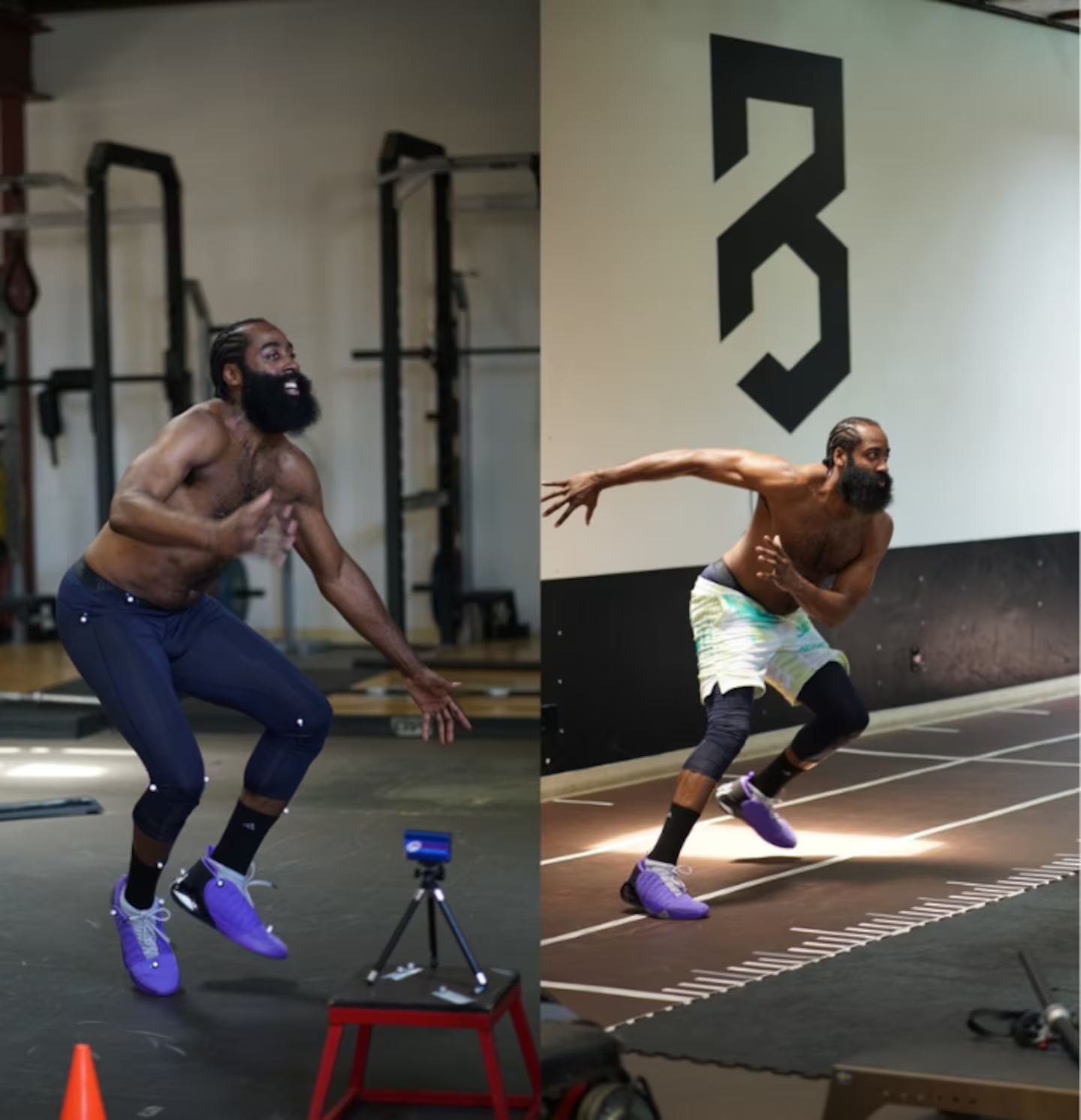
Image courtesy of P3.
“This relationship between how we move and what happens to us is a strong relationship,” P3 founder and director Marcus Elliott said. “It’s stronger than most people realize, which is why we invested all this energy into all of it. And the more we can start actioning that — and not just waiting for bad things to happen — the better it is for everyone: for the players, for the teams, for the league. I’m super bullish on the potential of biomechanics to make lives better and for us to follow these signals.”
Access to the data collected in these biomechanics evaluations will follow similar guidelines to how the NBA handles medical records. Players have full access to their own reports, which they will retain even as they change teams. Coaches, executives and performance staff will be able to see data for players currently on their rosters. Weiss indicated MDs and PhDs conducting vetted research will also be to connect the data with injury information for studies on potential risks.
One source noted a “vast discrepancy” in the way franchises have utilized biomechanics data to date, praising this new program as a way to ensure consistent, efficient and accurate assessments. Some teams have been investing in biomechanics for years while others have yet to allocate any resources toward it. By implementing his program across the league, the NBA can collect in one year as much data as any team could collect in 30 — hastening the pace of understanding what correlations exist between movement and injuries.
Deployment of this program, which is scheduled to last at least through the end of the current CBA in 2030, has been measured to make sure it is properly communicated and rigorous. Evaluating success will take time, too.
“Certainly whether we can reduce injuries long-term or a particular type of injury — that’s going to be one of [the KPIs] — and whether we can connect certain movements or certain changes in the way an individual moves to injury,” Weiss said.
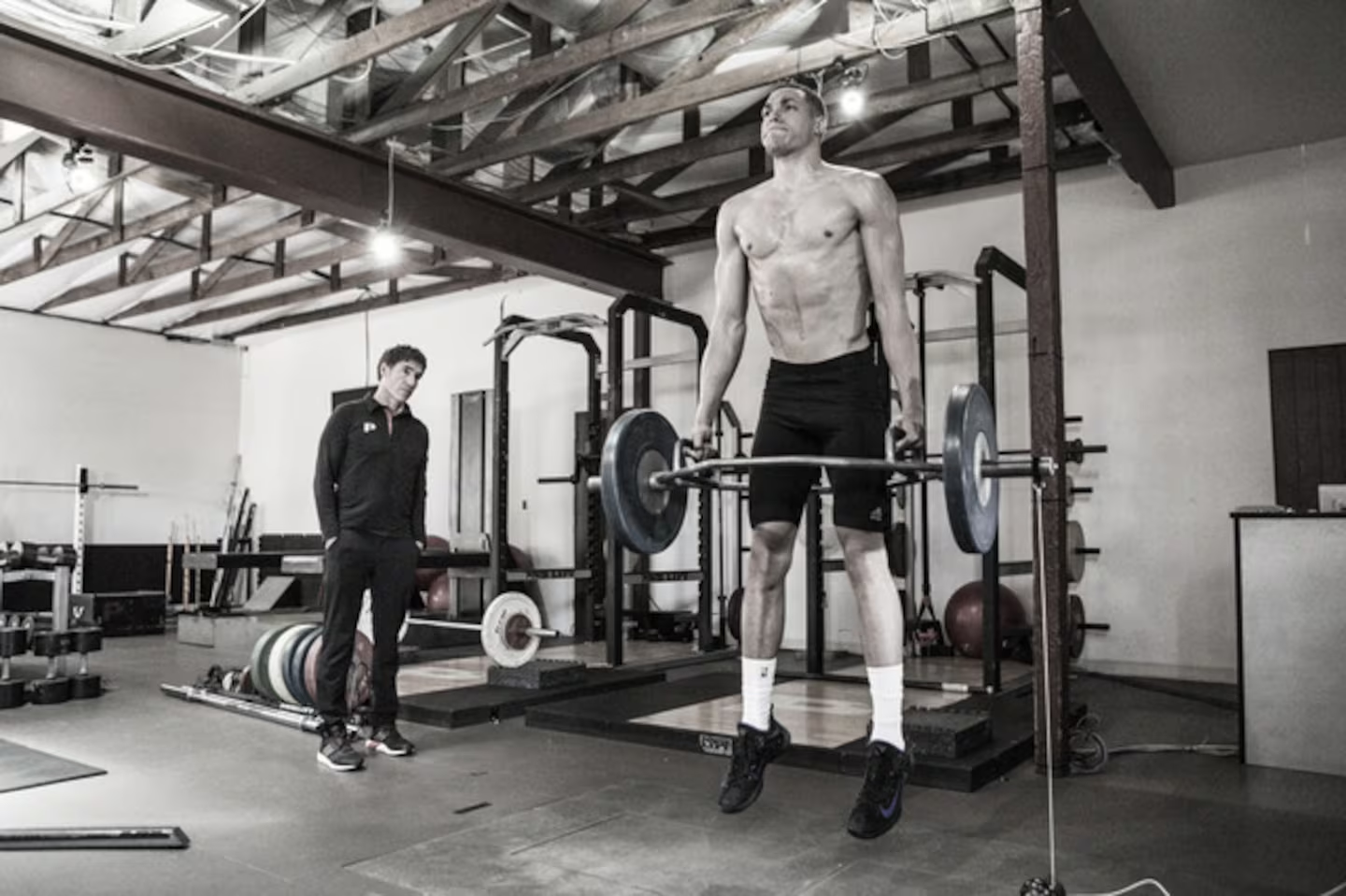
Image courtesy of P3.
Though the NBA’s in-game tracking system — powered by Sony’s Hawk-Eye — is camera-based and collects data on limbs and joint angles, that solution is only nominally a tool for rigorous biomechanics. Sony’s recent acquisition of KinaTrax, the leading baseball biomechanics technology, might help in the long run, but the current in-game tracking system doesn’t have the same fidelity the new lab-based system will provide.
There is a consensus that biomechanics might be an especially helpful tool in a sport like basketball “that certainly requires you to be a pretty impressive, high-flying athlete,” said BreakAway Data CEO Dave Anderson, a former NFL receiver. “The game is played well above the rim in the NBA, so jumping and your ability to land are critical to your career.”
Weiss added that experts with whom the league has conferred, including on its two biomechanics committees, point to “a number of factors — the size of players, the nature of the game, the number of games in the season, the hardcourt surface — that there’s reasons to think about biomechanics could be as helpful in basketball as almost any sport,” he said.
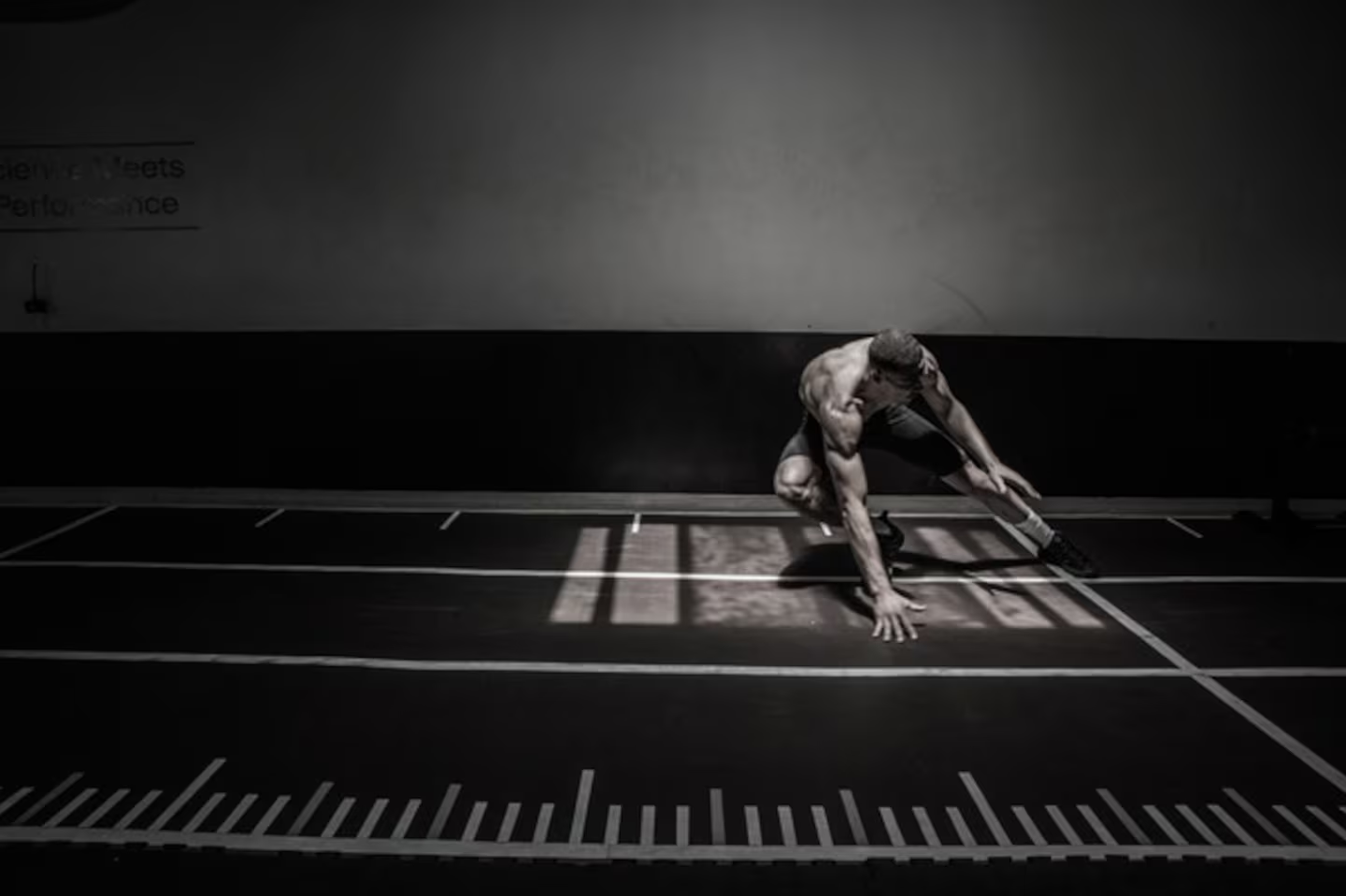
Image courtesy of P3.
These lab assessments are expected to take about 15 minutes, following a pre-scripted set of “motions that are directly applicable to their sport and health,” Theia CEO Marcus Brown said, describing his company’s software as “an accessible tool that also enables standardization within a vast data set. As a generalized neural network, Theia3D doesn’t require additional data for unique movements, environments or outlier athletes.”
It’s a highly technical distinction, but an important one: other motion capture solutions compare movement to various models, which can add to discrepancies when analyzing data from different sources and different seasons. “Having consistency in data collection over a long period of time on a big group of people is just something that I know our customers are looking for,” Qualisys product manager for life sciences Nils Betzler said, praising the “unified approach.”
“They’re really doing a tremendous job trying to better understand player biomechanics, player movement, and overall player health,” added Anderson about the NBA and NBPA. “They’re really trying to use science and numbers and research to make sure that the players are playing at the highest level. And I really appreciate that because a lot of these leagues are just adding games, changing roster sizes, and changing rules, and they just assume the players will figure it out. The NBA is taking this player-first initiative, and that’s just really cool to see.”
This article was brought to you by SBJ Tech, a Leaders Group company. As a Leaders Performance Institute member, you are able to enjoy exclusive access to SBJ Tech content in the field of athletic performance.
Project leads Anna Warren and Tham Wedatilake discuss the factors that enable Insight 360’s data-led approach to athlete management.
Insight 360 is a data-driven approach to performance management and athlete monitoring. It was launched in February 2024 by the ECB in collaboration with Ascent, their digital services provider, and includes an app for players (to view their data), a dashboard for practitioners (to view data across the board), and a portal that practitioners can use to input data.
“When you see the little research that’s out there, you’ve not got much to hang your hat on,” said Anna Warren, the Head of England Women’s Science & Medicine, at November’s Leaders Sport Performance Summit in London. “We’re using this platform to better understand in depth the female cricketer; what they look like from the academy through to the international cricketer.”
The rollout has been a success and, as the ECB launches phase two (the wider introduction of injury data and more sophisticated use of match data), we highlight the factors that led to its sport-wide take up.
It reflects the concerns of players
Insight 360, as the name suggests, represents a holistic approach to collating athlete data. There is a focus on availability and performance, but there is also a focus their health, home life, and career progression. “Players come to us and discuss their issues quite openly,” said Dr Tham Wedatilake, the Lead Physician for England Women’s Cricket, who joined Warren onstage to discuss the project. “They want to perform without any barriers.”
It is a co-designed platform
Ahead of the launch, the ECB gathered input from practitioners and coaches across the English game. “This means Insight 360 is bespoke for women’s cricket,” said Warren. Players, she said, are happy with an app that allows them to review their own data in as much detail as they like. “This is good for player buy-in, which is always a challenge in relation to athlete monitoring.”
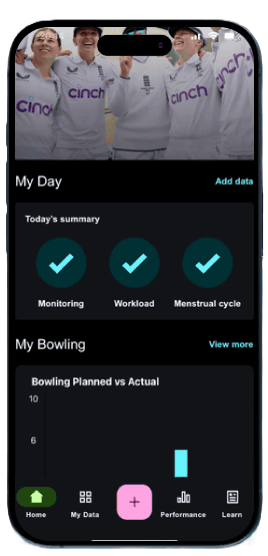 There is also the power of a co-designed project. UK Sports Institute have found as much with their Project Minerva. Dr Richard Burden, the UKSI’s Co-Head of Female Athlete Health & Performance, said: “Get the practitioners involved, get athletes, get the teams and bring them along with it because if they’re onboard you get easier access to them and you’re going to produce something that’s more translatable, meaningful and applicable to them.”
Warren is on the same page with Insight 360. “You can link loads of different data sources together and start to answer some key performance questions – we’re not looking at everything in isolation.”
It provides a single source of truth
Collaboration can be easier said than done. “When you have so many people pull data together it becomes almost impossible for the human brain to comprehend and then deliver effective, unbiased solutions to players’ needs and expectations,” said Wedatilake.
Insight 360 is the single reference point and it provides continuity. “As soon as one person leaves and another is working with the players, that record gets lost,” said Warren. “We’re really trying to create a joined-up system.”
It is future-proof
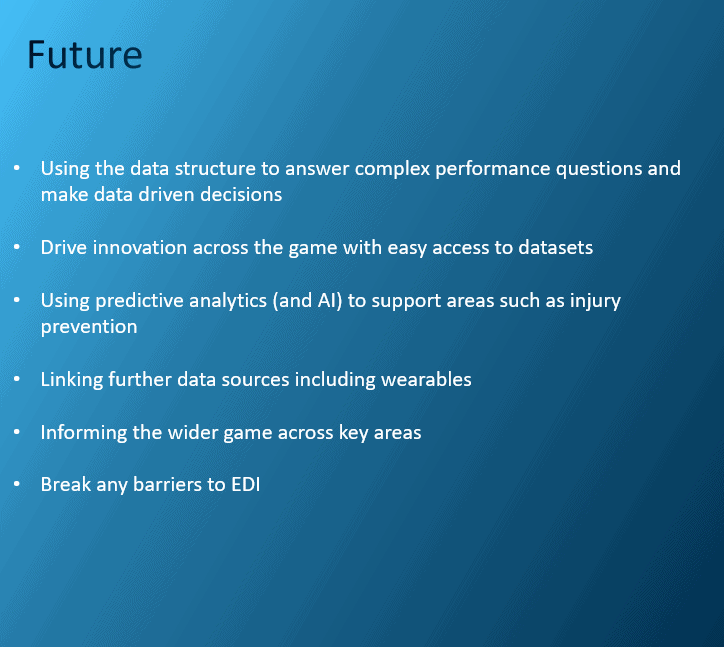
Wedatilake explained that Insight 360, as part of its next phase, will include injury data. He said: “It will be a game-changer for us in terms of load and injury risk and other factors such as the menstrual cycle and wellness.” The platform is primed to integrate future sources of data.
He does, however, also temper his excitement with a note of caution. “We didn’t want to get greedy too early,” he added. It was critical to have the right structure and means of integration before adding different elements, whether they are rooted in stats or video.
One of the next steps is further automation, particularly with regards to match data. “That’s the beauty of this system,” said Warren. “It’s so much quicker for people.”
She and Wedatilake wrapped up their presentation by setting out their ambitions for Insight 360:
College teams across the US are starting to consider the mental side as a critical element of player development and are using Pison’s AI-powered solution in their pursuit of answers.
Main image: Pison
Priced annually at $359 per player, the package comes with the same hardware and ENG technology as the company’s Pison Perform product – which encompasses sleep tracking in addition to cognitive assessments – plus access to an online data visualization dashboard and Pison Baseball Pro app with drills specific to the sport.
“As far as this game goes, it’s been known to be 90% mental, but how often do we train the mental part of the game?” said Marc Deschenes, Pison’s VP/Sports Operations and a former professional pitcher. “Us being able to use that information and integrating that into player development for performance and awareness on the baseball field is integral in making this game more complete for our players.”
Pison’s sensors detect electrical signals that emanate from the brain, pass through the nervous system and manifest in muscle movements. Its breakthrough is in coining what it calls ENG (electroneurography), which measures electrical signals in a way that would typically require complex lab testing via a chip pressed to the surface of the skin.
The roots of the company’s technology are in treating degenerative brain illnesses such as ALS, but it broke into sports about one year ago with an eye on performance and evaluation use-cases. Pison’s sensors measure cognitive functions such as reaction time, mental agility and focus through light-based reaction tests that range from 20 seconds to three minutes.
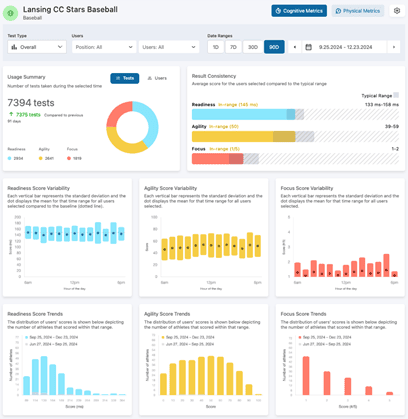
Image: Pison
Pison has public partnerships with the baseball programs at Penn State, Oral Roberts, West Virginia (including use by 2024 No. 7 overall MLB draft pick of the St. Louis Cardinals JJ Wetherholt), and Lansing Community College, which Deschenes calls a “power user” because of feedback they have provided. At the youth level, Pison works with USA Prime New England (which Deschenes owns) and Fort Worth Christian Academy for baseball, as well as the Boston Hockey Academy.
Multiple MLB teams are also evaluating the technology, and the league itself is in the process of testing it for on-field approval.
The new product was formally announced at the American Baseball Coaches Association conference in Washington D.C. this morning. In the future, Pison will look to expand to other sports and potentially integrate its sensors into existing wearable vendors.
“The product, really, is taking a sophisticated technology that has been in the medical world – and kind of out of reach even there because of the cost – and bringing it down to something that everybody can use,” said John Joseph, Pison’s CRO. “When we look at the market, we aren’t just going after the MLB market or college. This is really for anybody that wants to develop that elite mental game.”
This article was brought to you by SBJ Tech, a Leaders Group company. As a Leaders Performance Institute member, you are able to enjoy exclusive access to SBJ Tech content in the field of athletic performance.
For the first time, all players will access to their data and video within 40 minutes of finishing their match.
Main image: ATP Tour
The tour treats the Next Gen Finals as an experimental ground for innovation, whether that be in competition format or technology. At the last edition that meant expanding access to filterable snippets of points within matches, which can be sorted by factors such as point result; shot type, direction or spin; and score, among others.
Metrics such as Shot Quality, developed by ATP partner TennisViz, are accessible within Tennis IQ in real-time to coaches sitting courtside, and supplementary video is typically available within 40 minutes of matches ending.
“What we’ve looked to do is offer the players an enhanced version of Tennis IQ across those two events (the ATP Finals and ATP Next Gen Finals), which actually is a bit of a glimpse into what we expect the future of Tennis IQ to be,” said ATP Director/ATP Events Adam Hogg. “It’s something that’s not currently available for the players on a week-by-week basis through the Tennis IQ platform, but ultimately something that we as the Tour at our own events wanted to offer as a premium service.”
The ATP is planning to roll out the video feature, along with biometric data derived from approved wearable devices, within Tennis IQ for its full schedule of events sometime in 2025, likely between Q1 and Q2. Tennis IQ launched as a match data platform last September.
To derive the metrics available within that platform, TennisViz applies custom-built machine learning algorithms to ball and player-tracking data provided by the ATP and ATP Media’s joint venture, Tennis Data Innovations (through the tour’s work with vendors like Hawk-Eye). TennisViz has collected data from more than 7 million shots dating back to 2004 and identified more than 60 different shot types, according to Head of Performance/Media and Broadcast Tom Corrie, with a shot’s quality determined by an assessment of ball characteristics, including speed, spin, bounce angle, and a shot’s depth and width on the court.
Relative to that process, the video feature is simple.
“What’s advanced is creating the Steal Score or the Shot Quality,” Corrie said, referencing two of the metrics TennisViz has developed. “We’re just attaching a time-stamping process to the [match] video, which we’ve developed the technology to do.”
TennisViz has a similar partnership with Wimbledon that encompasses video-tagging and has also worked with the USTA’s player development department. Corrie said the company is half-staffed by former coaches and half-staffed by engineers and developers, giving them a unique lens on the sport.
“Our vision was, ‘tennis data is dated,’” Corrie said. “All the other sports, particularly American sports, have moved on massively in the last 10 years in terms of different analytics and different fan-facing metrics. Tennis is still using ‘break points won’ as the number one determination of winning.
“This platform (Tennis IQ) rivals any platform in any other sports now, in terms of the fact that is’ live data. If you take the number of matches, the 24-hour nature of tennis, all those things – it’s now as good as any platform in any sport… We’re (tennis) now not behind. But we were.”
This article was brought to you by SBJ Tech, a Leaders Group company. As a Leaders Performance Institute member, you are able to enjoy exclusive access to SBJ Tech content in the field of athletic performance.
In this recent edition of SBJ Tech’s Athlete Voice, former US Olympic gymnast Samantha Peszek discusses AI and the role of technology in the sport.
You can’t have a discussion about sports technology today without including athletes in that conversation. Their partnerships, investments and endorsements help fuel the space – they have emerged as major stakeholders in the sports tech ecosystem. The Athlete’s Voice series highlights the athletes leading the way and the projects and products they’re putting their influence behind.
* * * * *
Olympic medal-winning gymnast Samantha Peszek, who now broadcasts for ESPN and NBC Sports, recently drew upon her careers as an athlete and analyst to speak with SBJ about technological advances in how gymnastics is scored. The Judging Support System, an AI-powered technology developed by Fujitsu, tracks gymnasts’ motion in 3D. It is used as a resource available to officials and was first deployed on every apparatus at the 2023 world championships in Antwerp, Belgium. Peszek, 33, is known as the Beam Queen for her prowess in the event.
On gymnastics judging…
I’ve seen it both ways. I’ve been the recipient of things going my way and getting the benefit of the doubt, and I’ve definitely been on the other side of it where I was really frustrated re-watching my routine, especially in college, and thinking that I should have gotten a higher score than I got. As much as you can get frustrated and complain, at the end of the day, that’s the sport of gymnastics. It’s a subjective sport, and so those are the rules that you play by, and you’ve done that since you’ve been a little kid.
You pick up different tricks along the way to maybe sell your routine to the judges a little bit more or [make] more eye contact to make them feel like you have more artistry. There are little like tricks to the trade — sliding your feet together to make it look like you stuck — so I always tell the girls that I coach at my event, Beam Queen Boot Camp, that it’s a sport about perfection, but it’s not about perfection. It’s about the illusion of perfection.
On the potential of AI in the sport…
The idea of AI having a play in gymnastics excites me because it’s helping a subjective sport transition to a more objective sport. The biggest area that I see for improvement is in the judging. Not only would I think it makes scoring more accurate, but it would also speed up the process.
Something a lot of people don’t think about is, when an athlete competes one event, they have to wait not only for everybody else to compete on their event but they’re changing to the next event [to get their score]. So that time that you’re getting cold in between events is pretty significant. You’re trained to learn how to do that at a young age, but there’s not really a practice for taking a turn and competing, doing one routine and then just waiting for 20 minutes, especially at higher levels. So that’s why oftentimes you see gymnasts jumping around and staying warm.
If AI can help the efficiency of generating more accurate scoring, I think that would be a huge positive for the sport, especially when it comes to out of bounds on floor, which we saw came into a really big play at this past Olympics. How crooked they are on the mats? [How is their] form, technique? Did they take a step on the landing?

Photo: Samantha Peszek
On the limits of AI…
When you think about implementing that, the way I see it is you would have to add a judging panel for the artistry because my fear is that if you make it as objective as it possibly can, then you take away the beauty and the artistry, creativity and just the overall integrity of the sport. So you would have to do still do a combination because I think it would be really hard for AI to judge the artistry as well as the objective components of a routine.
On how such a dramatic change could be implemented…
I think lots of trial and error. They would need to present it to the committees and get a buy in from a majority of countries that participate in gymnastics. Another aspect that I think some other countries would probably ask is, is it going to be accessible for everybody, or is it just going to be the bigger countries that can afford to implement AI in all of their sporting events? And I know America in particular really values sports, but other countries don’t put the same emphasis and priority on sports as we do.

Photo: Samantha Peszek
On the training tech she’d like to see in gymnastics…
If there was some sort of tracking information on an athlete’s body that could tell a coach, Hey, she’s normally at this number, but today she’s operating — her energy level or her stamina or what have you — is actually lower than the average, then a coach can adjust the numbers. Maybe other athletes and other sports do this a little bit better because they’re older, but in gymnastics, most of the gymnasts are under 20 years old, and so, one, they don’t want to look like they’re not working hard, so they have a hard time speaking up, I think. And then, two, they haven’t lived with their body long enough to know, is this just soreness, or is it an injury?
I just know, from my own experience, other athletes I would see wouldn’t speak up, and then they would end up getting injured because they were pushing themselves when they probably should have been pulling back. So I think AI could really help injury prevention in that way, just more data to show coaches, ‘Hey, just FYI, she’s not operating at full capacity today. Take that information as you will.’
On becoming a beam specialist…
It was my least favorite [apparatus]. I used to pray to God growing up in bed, ‘If you love me at all, please let beam not be an event in gymnastics because I had so many fears on the event.’ I think, because I had so much trouble on that event in particular growing up, it forced me to home in on my mindset at a young age, figuring out how to be mentally tough. As much of a bear as it was, and a burden for me to go through all those challenges as a young gymnast, I think it actually benefited me in the long run because I had to visualize, and I had to goal set, and I had to do positive self-talk.
The majority of gymnastics, and specifically on beam, is all about the power of the mind and the confidence that you have on beam. And so for me to have to go through that and come out on the better on the other side of it, I forced myself to become mentally strong at a young age, and it became my secret weapon as I got older through the sport. So I wish I could go back and tell my younger self that it was all worth it because I almost actually quit gymnastics because of how many obstacles I had on the event.
This article was brought to you by SBJ Tech, a Leaders Group company. As a Leaders Performance Institute member, you are able to enjoy exclusive access to SBJ Tech content in the field of athletic performance.
John Bull of Management Futures set out a series of easy-to-adopt measures that could make the difference between winning and losing.
It’s easy to say that, as a battle-weary 32-year-old facing a younger, stronger champion, Ali had little choice when selecting his approach.
Foreman had won 37 of his 40 fights by way of knockout and was confident of adding No 38 to his unbeaten record in the early hours of 30 October at Kinshasa’s packed Stade du Mai 20.
Yet Ali later said his decision to stay on the ropes and allow Foreman to tire, which set him up to secure an eighth-round knockout, was made on the fly. He backed himself to absorb Foreman’s punishing body blows and wait for his moment. Foreman had only been taken to eight rounds four times previously in his career, so there were question marks over his stamina. The longer Ali could last – easier said than done – the greater his chances.
“I didn’t really plan what happened that night,” said Ali in 1989. “But when a fighter gets in the ring, he has to adjust to the conditions he faces.”
That Foreman could be lured into rope-a-dope was at least deemed possible by Ali’s coach, Angelo Dundee, who was seen loosening the ropes (to make leaning back easier) prior to the fighters’ ring walks. But that’s another story.
Ali’s defensive tactics, particularly during the fight’s final rounds, chimed with John Bull, the Director & Lead for High Performance Research at Management Futures (and big Ali fan), as he told an audience at the 2023 Leaders Sport Performance Summit in London.
Of his hero, Bull explained that a wave of fear came over Ali “for the first time in his career” as he sat in his corner at the end of the first round.
“Ali was really scared; and then 20 seconds later said to himself ‘I’m going to need to outthink this guy’,” Bull said.
Outthink Foreman Ali did; and Bull argued that such adaptability could be commonplace in sport with the right approach.
“I do believe some people are more naturally creative, but there are ways and structures that help anyone become more creative,” he continued while likening the process to strengthening muscles.
“What I love about these techniques is you can learn them really quickly. Practise any of these techniques for more than 15 minutes and you will be better than most people.”
These are the techniques Bull shared with the audience.
The STOP process for creative problem-solving

“I love STOP,” said Bull. “It’s a really simple way to get people thinking about ‘how are we doing that?’ How often do we take the STOP moments during a game, during the season etc. It’s a quick, short use of time.”
Bull then presented five strategies for encouraging athletes to adapt to the challenges or opponents facing them.
If you can find new ways to consider your problems, it can open up new ways of thinking.
Bull used the example of an elevator. Perhaps your goal is to make the elevator go faster, but what if your aim was to make the wait less annoying?
“Most hotels will put a mirror beside the elevator,” he said. “That seems to kill time when we’re looking at ourselves in a mirror.”
Bull suggested we “think of at least three different ways we could define our goal, to help open up new ways of thinking about the problem”.
If you can map the different categories of possible solutions it can prevent you narrowing in on just one type of solution.
Bull asked members of the audience to take a pen and piece of paper and write down as many sports as they could think of in one minute.
He then proposed a rerun of the exercise where the paper includes sub-categories such as ‘team’, ‘individual’ or ‘in or on water’. It might look like this:
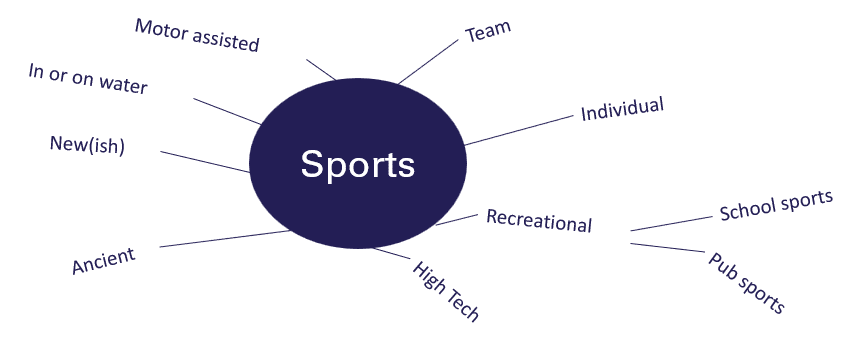
“What mind mapping is very good at doing is getting us to think more broadly,” said Bull. “What we tend to do when we’re being creative is we’ll come up with one or two ideas quickly as you would have been doing there, but then we tend to stay in that same vein of thought. So if I come at this using mind mapping, the first question you ask yourself mind mapping is not what sports can I think of, but what categories. Once you come up with a category, the brain very quickly accesses four to seven ideas.”
Step change thinking is the idea of setting a very stretching goal and then thinking how that could be possible.
Bull posed two questions:
He shared the following example:
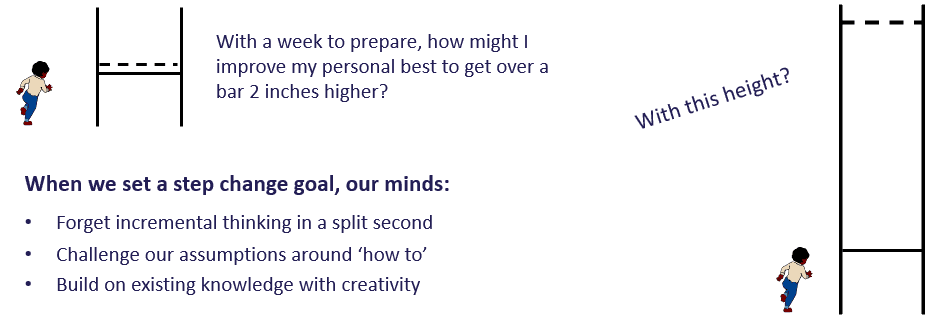
To underline his point, Bull explained that step change goals are common at Google where employees often set – and meet – seemingly impossible goals. “They’ll take any performance measure they want to get creative with and they’ll say ‘times it by ten’ and ask ‘how would we do that at a ridiculous level?’ just to provoke creative approaches.”
This notion is straightforward enough:
Bull cited the real-world example of paramedics in England. Providers of ambulatory care would like to reach people who suffer heart attacks within eight minutes, which is impossible by road in areas such as rural Norfolk in East Anglia. “You ask ‘how could we make that happen?’ And the answer that came up was you could train someone in every community to be able to keep someone alive until the first-responders arrive.”
Sport is not life and death, but a similar thought process could prove useful.
Who has already solved your problem and what can you learn from them?
In answering this question, New Zealand rugby, as Bull explained, turned to ballet for help with its lineout lifting.
“Rugby’s been doing this for 25 years in terms of assisted lineouts. Ballet’s been doing this for a few hundred years – they probably know a little bit more about it, so it’s that idea of going outside.”
Lasso Safe’s AI-powered software helps sports teams to assess risk and better care for its athletes.
Photo: Lasso Safe
Founded by a pair of retired professional athletes — endurance cyclist Pamela Minix and figure skater Luis Hernández — Lasso Safe has developed an evidence-based, research-validated survey and software to detect potentially toxic environments and unsafe relationships.
Players Health, a sports insurance group that recently raised a $60 million Series C round, will use it to “create safer, more supportive environments that lead to both healthier athletes and more sustainable businesses,” said Kyle Lubrano, Chief Mission Delivery Officer of Players Health.
Minix said Lasso Safe completed validation of its most updated product in October and described it as “a machine learning software that recognizes athletes’ experiences — specifically the areas are mental, emotional, physical and social wellbeing. We recognize them on spectrum from healthy, happy experiences to harmful and even abusive experiences.”
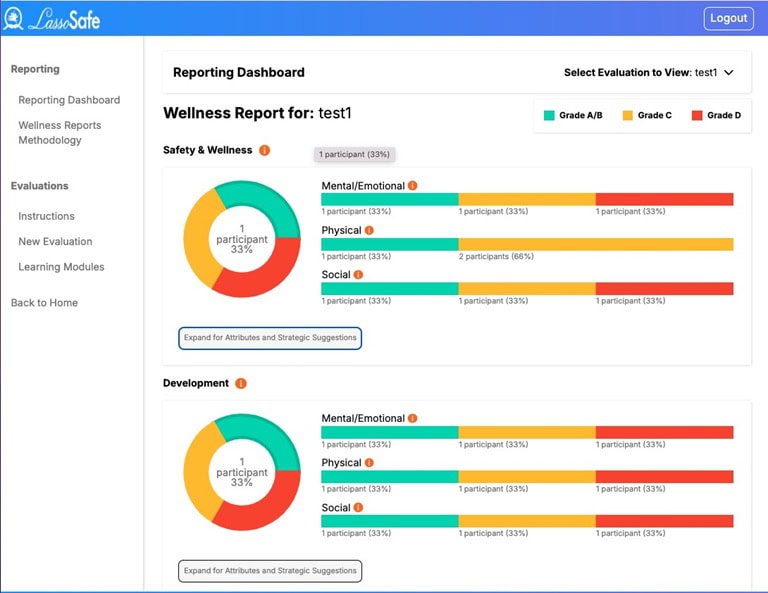
Lasso Safe described the product as “a machine learning software that recognizes athletes’ experiences — specifically the areas are mental, emotional, physical and social wellbeing.” Image: Lasso Safe
It was originally developed for national governing bodies that serve Olympic sports but has been modified for age groups as young as elementary school. Minix noted the increasing pressures at the youth level, in part because of growing expectations from the coaches and the growing financial investment in the space.
“Any level can experience this, not just highly competitive levels, so we focus on youth, but we do all age groups,” Minix said. “The software is designed to recognize even the first step away from that, when maybe those pressures start to come up or any type of misconduct within those wellness pillars.”
The frequency of surveys is at the discretion of each organization. Minix noted that Players Health will typically require them at least once during an application process to the platform, but many groups will administer them periodically or after incidents.
Questions asked of athletes include whether they feel valued by the coach, whether they have adequate access to nutrition and hydration during training sessions and more. Surveys can take anywhere from five to 15 minutes to complete.
Minix said Lasso Safe has run pilots with about 50 universities in the past five years, led by Utah State and Victoria University in Australia. The first adopter of the latest software is Globocol, a case management company based in the UK that offers services for sporting integrity, DEI, health and safety and data governance, among other uses.
This article was brought to you by SBJ Tech, a Leaders Group company. As a Leaders Performance Institute member, you are able to enjoy exclusive access to SBJ Tech content in the field of athletic performance.