Former NFL star Greg Olsen discusses the second season of his show with Michael Gervais, Youth Inc., and the apps helping young athletes with their mental health.

You can’t have a discussion about sports technology today without including athletes in that conversation. Their partnerships, investments and endorsements help fuel the space – they have emerged as major stakeholders in the sports tech ecosystem. The Athlete’s Voice series highlights the athletes leading the way and the projects and products they’re putting their influence behind.
* * * * *
Former NFL TE Greg Olsen has stayed busy since retiring from the league after the 2020 season. He made a fresh name for himself as Fox Sports’ lead NFL color commentator over multiple years, and now anchors the network’s No. 2 booth following its addition of Tom Brady. In 2022, he partnered with former Panthers teammate Ryan Kalil, actor Vince Vaughn and LA-based venture firm Powerhouse Capital to launch podcast production house Audiorama, which has since spun off youth-sports-focused interview show Youth Inc. into a media company that is adding a digital commerce platform in 2025 and raised $4.5M earlier this year. On top of it all, he is also a dad and youth football, basketball and baseball coach.
“It’s hard,” Olsen said of juggling those responsibilities in a recent interview. “I try to coach one season per kid.”
The first episode of season two of Olsen’s Youth Inc. Podcast releases today with a new co-host in sports psychologist Dr. Michael Gervais. Earlier this week, SBJ Tech caught up with Olsen to discuss Youth Inc., working with Brady and sports technology trends that interest him.
On what to expect from season two of the Youth Inc. Podcast…
Season one was really almost testing the market. When we approached season one, our plan was, let’s cast a wide net, let’s have a big variety of conversations with all different aspects of the youth sports experience – whether it’s parents, coaches, Olympians, professional athletes, college, sports psychologists, performance coaches. Every aspect of what the landscape looks like, let’s have surface-level conversations, cast a wide net, and let’s test the interest level, let’s test which areas of the system people most gravitate to and respond well to.
It became very evident through those 40-some-odd episodes that there were certain areas that people had strong interest in. Season two is going to be a lot more of hyper-focused episodes that are more of a deep dive into different conversation with guests, but all have the same storylines.
For example, me and Dr. Michael Gervais, who’s one of the leading sports psychologists in sports from the youth level all the way up through professional athletes and Olympians – I met him when I played for the Seahawks and have gotten to know him – we sat down with a bunch of different guests. And while the conversations all covered different sports, different ages, different levels, different detail, they all had common threads around mental health, sports performance anxiety, best practices of parenting youth athletes, best practices for being a youth or college or professional athlete.
View this post on Instagram
On how technology is changing youth sports…
It’s a great question, and obviously [with Youth Inc.’s digital commerce platform] we’re trying to tackle one of the big areas, which is a very complicated and fragmented e-commerce experience. We spend all week very much on our phones or on our computers with the ability to process buying in a seamless one-touch, whether it’s Fanatics, or Amazon, and all these big e-commerce platforms that we’ve all become very accustomed to. And then when it comes to, you know, buying a hoodie for your kid’s middle school football team, it seems like you’re jumping through hoops.
With sports performance and mental health, there’s a lot of good apps and programs that people are investing in that are right on kids’ phones, take them step by step through performance anxiety, best steps to handling pressure, the best steps of handling failure – and they’re almost bringing a mobile sports psychologist into the palm of their hands. There’s scheduling apps that best process how to pick the best baseball tournaments and best volleyball tournaments. [The technologies are] all geared towards – yes, capitalizing on a big market, capitalizing on a big opportunity financially – but more so just trying to make the experience better.
On working with Tom Brady at Fox…
It’s been great. We’ve had a good relationship, and obviously we’ve had a lot of conversations as he’s transitioned to this role. He’s been really good to work with, super humble and open-minded to asking questions and wanting to learn and realizing that when you start anything new – it’s no different than when I first started – you don’t know what you don’t know. I give him a lot of credit. He’s been very upfront and humble and honest about wanting to learn and wanting to get advice from other people. And you’re talking about the best guy who’s ever played the sport. So, it’s a credit to him. I’m sure if you asked him, he feels a lot better now than he did in Week 1, and he’ll feel a lot better in five weeks than he did yesterday, and that process just continues to get more and more comfortable the longer you do it. No different than how it was when we all first came in the [NFL] as players. There is a learning curve and there is a process of getting comfortable as time goes on.
View this post on Instagram
On the keys to his transition from player to broadcaster…
Early on for me, what I tried to remind myself is: there was no learning curve for football. I knew football. The learning curve came through the technical part. The learning curve came through communicating on live broadcasts and communicating with producers in your ear and understanding replay sequencing and all the specific things to a broadcast were where I had to do a bunch of my learning.
To this day, I don’t know exactly all the camera angles, official names. When I ask for a replay, I’m probably calling it the wrong name, but they by now know what I’m talking about… At the end of the day, when you get your 20-second sound bite to get in there, talk about what you know. We’ve lived this sport our whole lives. We know it. We see it. Describe it to someone at home in a way that keeps it interesting, keeps it informative. The complexity of football is what makes it so special. But also you can’t talk like you’re in the locker room. You can’t talk like you’re talking to another 20-year veteran at the position. So, there is a little balance.
To sum it up, keep the football part. That’s the part you know. Don’t let the transition of the technical broadcast component paralyze you. At the end of the day, you’re talking football. Don’t complicate it. Talk what you know. Talk what you see. You can figure out the mechanics of a broadcast, figure out the mechanics of television along the way.
On the NFL’s in-game authorization of Guardian Caps in 2024…
I think anything that can continue to improve the health and safety of players while keeping the game the game is something worth looking into. So, I’ll always be a supporter of any of that.
I think helmet technology has come such a long way. I mean, I look back, I had my rookie year Chicago Bears helmet and when I look on the inside, let alone when I look back at what I wore in high school compared to what I wore at the end of my career, you talk about the technology growing and getting better with time. And then you factor in what the Guardian Caps are able to do and the extra layer. I know everybody wears them in practice. And I’m sure there’s some adjustment getting used to it. But I think everybody has the decision, what helmet they wear, whether they wear the Guardian Cap in practice or also in the games.
I don’t know if I would wear one. Obviously, I’m probably on the older side. By the time it was introduced I was like that ‘can’t teach and old dog new tricks’ kind of person. But for guys who wear it, I’m sure there’s a level of comfort, a level of protection. I wouldn’t be shocked if some of that technology Guardian is developing gets incorporated into some of the helmet design, and one day you get the combination of both things all wrapped up in one.
This article was brought to you by SBJ Tech, a Leaders Group company. As a Leaders Performance Institute member, you are able to enjoy exclusive access to SBJ Tech content in the field of athletic performance.
In November, we discussed those elusive leadership skills, the notion of collaborating with your rivals for the greater performance good, and the question of what it takes to deliver an effective mental skills programme.
We definitely saw some of you there but, if you didn’t make it, don’t worry. We were sat in the front row with a notepad and, having deciphered our handwriting, compiled a list of six factors for turning setbacks into springboards. It was one of the main themes across both days.
The summit wasn’t all that was happening at the Leaders Performance Institute during November and we reflect on insights into the fields of leadership, coaching, data and human performance and pose five questions.
Perhaps the answers will provide one or two nuggets to help you with your next project.
Do you have all the skills you need to lead?
Perhaps you’ve heard of the of the Peter Principle. The concept, devised by psychologist Laurence J Peter, states that people tend to be promoted to their ‘level of respective incompetence’. Think of the supreme technician who, upon promotion, finds themselves overwhelmed as a manager tasked for the first time with leading people.
Carole Mundell, the Director of Science at the European Space Agency, told the audience at the Oval that while she viewed herself as a creative and independent scientist, that wasn’t going to cut the mustard in an organisation designed by engineers.
“I’m learning to think like an engineer,” she said. “All of ESA’s structures and processes and how we operate comes from the mind of an engineer… We have a whole quality assurance system where we set our objectives and we say ‘what will we do?’ ‘What did we say we’d do?’ ‘Did we do what we said?’”
Take time to consider the missing element that might make you a better leader.
What is to be done during losing streaks?
David Clancy, a Learning and Development Consultant at the Houston Texans and Director at The Nxt Level Group, wrote that the answer lies in purpose. ‘In elite environments, whether you’re a player, coach, or part of the front office, the pressures and expectations are immense,’ he wrote. ‘But the best leaders, those who guide their teams with purpose, know that long-term success is rooted in meaningful work.
‘This drives individuals to not only execute their tasks but also to find value in how those tasks contribute to the big picture. Leaders who strive to inspire meaningful work allow individuals to not just survive pressure, but thrive under it, empowering them to embrace challenges as part of their career journey.’
Clancy highlighted three principles to cultivate meaningfulness in your teams:
Who are your friends in high performance?
You don’t need us to tell you how competitive things get at a world championships, Olympics or Paralympics, but there are things that transcend rivalry.
One such area is female athlete health, where the UK Sports Institute, US Olympic and Paralympic Committee, Australian Institute of Sport and High Performance Sport New Zealand have clubbed together to form the Global Alliance. This enables them to share resources and insight in this one particular field.
“We are all under-resourced, we’re overstretched in terms of the time that we’re wanting to spend in this space,” said Dr Rachel Harris, the Lead of the Female Performance & Health Initiative at the AIS. “We really wanted to try and allow the people that are working in our sporting organisations to be more proactive.”
Her peers are just as effusive. “I think it’s a natural step to build an international community; and we do have them, but they’ve been a bit ad hoc,” said Dr Helen Fulcher, the HPSNZ Athlete Performance Support Lead. The Global Alliance is, as she added, an opportunity to raise standards across female sport. “The focus is not just on individuals having great connections but what can we collectively do better for this group of athletes that we all care about.”
The Alliance has every expectation that its membership will grow in the near future.
How do you solve a problem like innovation?
Professor Fabio Serpiello, the Director of Sport Strategy at Central Queensland University, told attendees at Leaders Virtual Roundtable that the best way to approach innovation is to start by defining your problem.
To that end, he employs a range of models, including David J Snowden and Mary E Boon’s Cynefin Framework.
‘Cynefin’, which is pronounced ‘ku-nev-in’, is a Welsh word that signifies ‘the multiple factors in our environment and our experience that influence us in ways we can never understand,’ as Snowden and Boon wrote in their 2007 Harvard Business Review essay titled ‘A Leader’s Framework for Decision Making’.
The Cynefin framework, they continued, ‘helps leaders determine the prevailing operative context so they can make appropriate choices’.

Source: HBR
Snowden and Boone identified five operative contexts – simple, complicated, complex, chaotic and disordered. Serpiello touched upon each:
Simple contexts are stable and one can observe a clear cause-and-effect relationship (although there is a risk of oversimplification).
Complicated contexts are the world of known unknowns; multiple right answers exist, but they require analysis.
Here, there are unknown unknowns; and cause-and-effect relationships are only apparent in hindsight.
These are domains of no clear cause-and-effect relationships and high turbulence.
Is your mental skills work simple, relevant and applicable?
Mental skills coach Aaron Walsh wanted to understand the perceived gap between value and impact in his field and embarked on a research project.
It furthered his understanding and, as he wrote in an exclusive column for the Leaders Performance Institute, Walsh alighted on three principles for making mental skills work meaningful:
NFL Player Health & Safety Innovation Advisor Jennifer Langton sets out the ways in which AI, AWS and the NFL’s Digital Athlete Program has had a positive impact.
Main Photo: CNBC
A Data & Innovation article brought to you by
Lower-extremity injuries have become a major focus for the league, with the first two weeks of preseason training camp – a period of re-acclimation to the sport – as the period of greatest risk, yet for the first time ever, the NFL saw a reduction in leg injuries in consecutive summers.
NFL Player Health & Safety Innovation Advisor Jennifer Langton shared that finding on stage at CNBC Evolve: AI Opportunity in New York City in October. She attributed that success, as well as changes to the kickoff rule, to the league’s work with AWS on the Digital Athlete, in which data about every rostered player on every team is anonymized and analyzed. Positional benchmarks are shared league-wide to help inform player training and usage.
“When you can integrate and aggregate data across all 32 [teams] for all 53 [players], you have more power in the data that you are generating to model,” said Langton, who for years helped lead player health and safety efforts as an SVP in the league office before leaving her full-time position for personal reasons in August.
Other work Langton highlighted was the use of computer vision triangulated with the Next Gen Stats RFID sensors to calculate the severity of head impacts, which for the first time last year was distributed to offensive and defensive line coaches on a weekly basis so they can “put in injury prevention strategies to get the head out of the game,” she said.
The reformatted kickoff was a direct result of the league’s biomechanical consultants at Biocore collaborating with AWS to run 10,000 seasons’ worth of data on rule variations to determine the best combination of a rule change that would be safe but also encourage on-field excitement.
The NFL has crowdsourced innovations in computer vision and worked with AWS on collecting more accurate tracking data. The investment in data capture is paying dividends and, Langton noted, will expand in the future to full-body limb and joint tracking. It has been a challenge to get the necessary precision for actionable insights, particularly with the high rate of occlusion in a contact sport like football.
“With the new AWS deal, that’s the focus, to build that pose estimation so that we can get to that true Digital Athlete on quantifying body movement,” Langton told SBJ in a post-panel interview.
Much of the efforts to date have been in creating operational efficiencies. A half-dozen years ago, for example, staff would take four days to manually tabulate head impacts through painstaking film review. That’s now done in real-time. Similarly, injuries would be listed in the league’s electronic medial records database as happening only in a particular quarter, so officials would have to review game film to find the specific cause. Now, those injuries are automatically tagged with a clip of the play in question.
“The infrastructure and the data to fuse that together is power,” Langton said of the work with AWS. “If you can standardize them and then synchronize, then we can integrate and aggregate across the league.”
The acclimation period was instituted in 2022, with leg injuries down 27% in 2024 compared to the year prior, in 2021. Langton had noted that the league saw declines in consecutive years for the first time.
“The decrease in the lower extremity injuries that we saw in the preseason last year led to the savings of more than 700 games that players did not miss during the regular season,” Miller said. “And so those benefits of the fewer hamstring strains or soft tissue injuries pull through into the regular season. Those injuries don’t recur as often, and the fact that the players don’t suffer the injuries in the first place mean that they’re healthier for the regular season.”
The new dynamic kickoff helped encourage 70% of kicks to be returned in the preseason, up 15% from last year. The injury rate on those played declined by 32%, with Miller noting that player speeds — which are calculated by the Next Gen Stats RFID chips in players’ shoulder pads — were about 20% lower on average in the reformatted version of the kickoff, in which most players line up 5-to-10 yards away from each other.
“Because we eliminated some of the space and therefore decreased some of the speeds, that led to a substantial decrease in the injury rate,” Miller said. “In fact, we saw zero ACL injuries on the kickoff. We saw zero MCL injuries on the kickoff. And those huge time-loss knee injuries are going to substantially save a lot of players, a lot of time.”
This article was brought to you by SBJ Tech, a Leaders Group company. As a Leaders Performance Institute member, you are able to enjoy exclusive access to SBJ Tech content in the field of athletic performance.
David Clancy and Richard Pullan set out their strategic and intentional approach to network building in a high-performance world of ever-growing complexity.
In today’s fast-paced world, high-performing individuals and teams face increasingly complex cognitive demands. These challenges are not just about processing information but also about managing stress, navigating uncertainty, and maintaining clarity amid competing priorities. This is where the power of strategic and intentional network building comes into play.
There are several means available to help build this network. They include purposeful twinning with others, developing an ecosystem of critical friends and identifying a web of second-opinion teammates. Each of these connections provides leaders with the means to make more informed and rounded decisions, make perspective shifts as well as provide objective feedback.
Twinning
‘Twinning’ refers to the practice of forming reciprocal partnerships with other teams or organisations that share similar goals, challenges, or conundrums – perhaps they might even be competitors, if the context makes sense. This is a huge part of what the Leaders Performance Institute does, in fact, forging ‘partnerships’ with teams and individuals. This is how the Houston Texans of the NFL became professional friends with the Texas Rangers of MLB, as an example. This symbiotic relationship allows for mutual learning and growth, where both parties can share best practices, resources, and insights. A term we often hear is ‘collaboration over competition’ – we can all row the boat faster if we are willing to exchange protocols, philosophies and pain points.
Professional sports teams all face their unique set of struggles but, oftentimes, there are numerous similarities with these. Sharing best practices and ways to approach challenges is a significant benefit downstream of this pairing. By ‘linking’ with another team, leaders can expand their knowledge base, reduce the isolation often felt in high-pressure roles, and benefit from other viewpoints.
In terms of innovation, if teams are open to sharing what they do (to a degree), how they do it, etc, they can draw on the experience and solutions already implemented elsewhere. This save them time, effort, and energy. Food for thought.
Critical friends
Critical friends play a unique role in leadership, deliberation and decision-making. A critical friend is someone who offers candid, constructive feedback and is unafraid to challenge assumptions. This is ideally someone outside the team/ franchise. They are trusted individuals who can act as a sounding board for ideas, provide a second perspective, and offer checkpoints when needed.
Creating and nurturing these ‘friends’ requires energy and effort, but the payoff can be huge. As an example, if you are ideating a new return-to-play system and method, bouncing ideas off someone with exposure to this in another environment could help make your system better. A no-brainer if you ask us!
We have witnessed the benefit in relation to cognitive demand also, as critical friends offer a safe space to validate thinking and refine or rethink ideas. Critical friends help prevent blind spots, biases and assumptions by encouraging the leader to pause and reflect before executing a critical task. The best critical friends strike a balance between support and challenge. They are not afraid to disagree, but they do so with the intention of helping the leader grow.
Second-opinion teammates
Second-opinion teammates (teammates being a crucial word) serve a similar purpose, offering alternative viewpoints to ensure a more well-rounded decision-making process, such as another set of eyes on an MRI report and image for a hamstring injury.
Particularly in high-stakes environments, seeking a second opinion reduces cognitive stress by distributing the weight of responsibility and allowing leaders to feel more confident in their choices. Knowing that a trusted colleague has reviewed the same data or proposal with rigour and objectivity can provide a sense of reassurance and clarity.
Strive to stock a bullpen of second-opinion teammates. It’s a game-changer.
Mentorship
“The delicate balance of mentoring someone is not creating them in your own image, but giving them the opportunity to create themselves”, said Steven Spielberg. To create themselves entails helping one to find their way. Consider giving a project to a more junior member of staff from a senior ‘mentor’, rather than the ‘easier’ option, of giving the project to a ‘middle manager’ who has done the type of project before. That’s an example of what this could look like.
Mentorship is a timeless strategy – one for managing both the emotional, physical and intellectual demands of leadership. This is typically someone with more experience who can offer guidance, advice, and lessons learned from mistakes, and successes. Great mentors provide leaders with the tools to think more effectively for themselves, enabling them, giving them their own toolkit; this helps them navigate complexity, prioritise, and mitigate stresses. They leave breadcrumbs behind.
Mentors can help leaders manage cognitive demands by offering perspective on what truly matters, helping to sift through the noise and focus on the signal i.e. what is essential. They also provide historical insight, showing leaders that many challenges they face are not new and can be tackled using time-tested methods. This reduces the sense of overwhelm that comes with thinking one must always reinvent the wheel. The issue you are facing has been faced and solved before.
Moreover, mentors are invaluable in helping leaders manage their wellbeing, as they can provide reassurance and encouragement when times get tough and they can acknowledge that these times come with the intense world of competitive sport.
Building a network
In high-pressure environments, leaders often find themselves juggling multiple competing priorities, balancing short-term, ‘urgent’ demands with long-term, ‘important’ goals.
Here are five reasons for nurturing a network to help with this:
What makes a good mentor?
The best ones share several key traits that make them invaluable in helping leaders grow and meet the demands of high-performance sport.
Here are five traits we often see:
And let’s not forget that mentors need mentors. This could be your partner at home, as an example.
So, here’s our challenge for you reading this article today – take on a mentorship role in some capacity, to give back…to pass the ladder down, as it were.
Final thoughts
In today’s fast-paced and ever-evolving landscape in high-performance sport, a leader’s success isn’t just defined by individual strength – but by the strength of their network. Jobs these days in sport are complicated and complex. It is now rarely possible for one individual to serve a function fully without seeking support from other disciplines, to deliver the final solution to a given problem.
By cultivating relationships through twinning, critical friends, second-opinion teammates, and mentorship, leaders create a support system that fosters psychological safety, collaboration, and continuous learning. These connections enable leaders to confidently navigate complexities, make incisive decisions, and lead afront with impact. After all, just as every great athlete stands on the shoulders of their team, no leader can truly flourish without a trusted network standing behind them.
David Clancy is a Learning and Development Consultant at the Houston Texans and Director at The Nxt Level Group. He is also the Editor of Essential Skills for Physiotherapists: A Personal and Professional Development Framework, which is available now from Elsevier.
Richard Pullan is a Director at The Nxt Level Group, the Visionary Founder of The Altitude Centre, and leads the training of clients for flash ascents of Everest and other 8,000m peaks, while also preparing professional athletes and elite sports teams. He is formerly of Sporting Health Group.
If you would like to speak to David and Richard, please contact a member of the Leaders Performance Institute team.

BreakAway Data’s new app aggregates health information from clubs, national teams and private consultants.
A Data & Innovation article brought to you by
The new product, BreakAway Pro, aggregates health information from all practitioners — all clubs, national teams, private consultants — through an athlete’s career where it can be displayed and compared against game stats, tracking data and training workload. It is available for all interested leagues and unions, with a custom-build for a first, unnamed partner almost complete.
Since launch, BreakAway has secured deals with the NFLPA, NWSLPA, WNBPA and Athletes Unlimited, among others. Its founders, Dave Anderson and Steve Gera, regularly heard from agents, athletes, investors and other stakeholders that adding EMR capabilities would be a helpful addition to the product.
“We didn’t know we needed to move this mountain in order to give all athletes access to their data, but this was the key piece and the key thing that was missing in sports that we’ve now got,” Anderson said, adding that the topline benefit of this fingertip retrieval is ensuring that what “costs them time, money and effort are now guaranteed and done quickly and swiftly.”
While the data infrastructure was largely in place, meeting the standards for EMR access required significant outlay from BreakAway — a 2023 SBJ 10 Most Innovative Sports Tech company honoree — to add higher levels of insurance, meet HIPAA compliance and build maximum digital security, including a revamp of its AWS storage. Anderson estimated that this project consumed about 75% of the company’s time, money and effort for most of the past year.
Athletes register using multi-factor authentication that is verified by government ID, and all records are stored in a secure server, with none of the information stored locally on a mobile device. Users can manage settings over who has access to what information, toggling permissions on and off as they change teams or seek additional opinions.
“Players have been advocating for better access to their data for a long time, and BreakAway was the first company to build a product specifically tailored for players,” Meghann Burke, NWSLPA Executive Director, wrote to SBJ. “They have set a new standard for what, how, and when information should be delivered. It’s no surprise that they continue to innovate in the digital space, providing players with functional and accessible data solutions.”
Anderson, who had a six-year career as an NFL wide receiver, recounted his own experience attending NFLPA-backed health and wellness testing at the Cleveland Clinic. When he returned to the same facility three years later for an additional checkup, the computer systems had changed, and the doctor couldn’t easily see his past records. Anderson had to bring his own paper copies, making him think, “There’s got to be a better way to do this.”
While that’s an acute pain point in elite sports, it’s also an issue for everyday people who change medical practices.
“We’re the first company that is daring enough to take it on. We built this for players, and let’s see how it works because this really doesn’t even exist in the normal world,” Anderson said. “It’s a huge build, and something hopefully that resonates well beyond just sports.”
Intelligence within the app helps provide context and comparisons to normative datasets. Visual tagging of joints and muscles is one of several ways to filter the information a user is searching for. BreakAway Pro also is agnostic to other EMR providers and supports all types of medical imaging as well.
“We heard from enough leagues and we heard from enough people that we were like, ‘All right, let’s just go all in. Let’s bet the farm on our company on this,’” Anderson said. “We claim to be the athlete data company and to have the app where they put all their information, and if this is the most important piece of information that they want, what are we doing here? It is the core piece that ties everything together.”
This article was brought to you by SBJ Tech, a Leaders Group company. As a Leaders Performance Institute member, you are able to enjoy exclusive access to SBJ Tech content in the field of athletic performance.
Former Seattle and Montreal running back Kerry Carter and his company Atavus is using technology to change the game.
A Data & Innovation article brought to you by
The Stanford grad went on to work for business-to-business mobile solutions company Viva Vision before starting a pair of consultancies. The first, JumpIt Media, Carter began with former NFL teammate Joe Tafoya, and the second, Apex Agency, he started on his own.
In 2016, Carter, now 43, joined Atavus, a tackling analytics company that had roots in rugby before expanding to football. He was promoted to COO in 2020 and to CEO in January this year. He recently spoke to Sports Business Journal about getting his start in the business world and his plans for growing Atavus through AI.
On preparing to transition out of pro football…
I played NFL first, went up to the CFL, and that whole experience offered me a little different perspective on things because of the schedule. At the time I was playing, we didn’t do a lot in the offseason. You were there from June to November, and then you were off pretty much until the next season.
I’m a pretty curious guy. So every offseason, I just tried something new or different. I did insurance and financial services. I did some marketing stuff. I did some event stuff. And the last couple years of my career, I really got into technology. An old teammate of mine, Joe Tafoya, was out here in Seattle, and we reconnected. I was just learning about what they were doing in the technology and mobile space. So that was my first foray into, “OK, what can I do as I transition?”
On his first business job after his playing career…
We put together a group to acquire Viva Vision that was a software development company that already had clients in a bunch of different spaces. They were working with some big brands, but they were transitioning over to smartphones. This was in like 2008, ’09, ’10, around there. Obviously social media was continuing to ramp up in different ways, so I just dug into that. We started to do some work there — learned a lot, but I really wanted to do something in sports.
NFL and CFL veteran Kerry Carter’s path to technology came through other industries. [Photo courtesy of Atavus]
At the time Joe and I decided to step out on our own, we started our own marketing consultancy where we worked with athletes and helped them with technology, digital media, social media, events, nonprofits — we combined all those things. And, man, we did a lot of crazy things. We went for the Guinness record for the loudest cheer in the stadium, and so we actually put that together here for the Seahawks’ stadium. I think we did it first, and the Kansas City Chiefs came and beat it. And then we went back and we did it again. All of that was just learnings around fan engagement and digital and social, and how do you inspire and push fans and players and athletes?
We built up brands like that. We worked with athletes directly. Where it all came together for us, we did this celebrity softball game to launch Richard Sherman’s nonprofit. And this was 2013. We partnered with Richard. We produced the event. We did all the digital and social and website. Coming out of that, we got a lot more requests from athletes, from brands. That was our business, where we were connecting the two on the event side, and there was always a charitable component to it.
For a while, we owned the Legion of Boom trademark, and we licensed that to Nike. That’s back when Richard, Kam [Chancellor], Earl [Thomas], Brandon Browner were doing their thing. I did some of that while I was finishing my [playing] career. I was in Year 9 — my goal was always to get to 10 years — but I had to make a decision back in 2012.
I always say it’s the best decision I made because Montreal had just released me, and we had started to move things along with the company. I had other teams call me. Do I go back [to football] or do I continue what we’re doing here because we have good momentum? I decided this was probably the right time, so I stepped away. And another reason why it’s the best decision I made: A week later, I met my wife.
On getting started with Atavus…
After having our second daughter in 2016, we were doing so much. I actually wanted to slow things down a little bit. A friend of mine was doing PR for Atavus at the time. They [started] in rugby and were making the transition into the football world. I went to an investor event that they had, and I really got to understand what they were doing. I was like, ‘Man, this is really cool, unique, different and adds value to the game that I love and protects athletes and kids.’ It’s funny, I wanted to slow things down, so I joined a startup — that’s not usually the way it goes.
I started on the business development side, and they really gave me carte blanche to be able to explore every aspect of the business. I really love marketing, so I did a lot on that side. Operations, design. I helped us launch our first SaaS product into the market, Digital Tackling Academy. We designed our training for our analysts, and then we built our entire grading and reporting platform. Then I even got to go out and pitch and raise money for the company.
On how Atavus does its analysis…
It’s honestly still a very manual process in terms of our tackling technique. There’s a lot of stuff you can pull from third-party data — you can pull down-and-distance information, yards gained, all those things — but when it comes down to our actual [evaluations], we still have a team of analysts that we bring in every year, similar to what PFF [Pro Football Focus] does. They’re breaking down film, they’re tagging it and then we’re scoring it. We don’t just give data, but we actually give insights by position group, by the entire defense, and then we have a tackle plan. Here are the things that you need to focus on going into the next week, into the offseason, into the preseason.
On what they assess…
On a weekend, we have bunch of high school clients, college clients and we’ve had NFL clients — we don’t have any at the moment. It really only takes about a couple of hours to do it, but we get it back to the team within 24 hours with a full breakdown of every tackle made or missed. Anyone that’s involved in the tackle gets analyzed, and we’re looking at pre-contact and contact. Are they continually moving towards a ball carrier? How are they avoiding blocks? Are they maintaining their leverage? Are they taking a good angle towards the ball carrier, and then, once they get closer and into the contact zone, now we’re looking at footwork. We’re looking at which shoulder they are using. Is your head involved? There are a lot of safety components.
If you involve your head a lot of times, then it’s higher risk. Because of what we do and how we break it down, we’re able to show that performance and safety are not mutually exclusive. You can actually do both. So when you’re in contact, you’re using your shoulder, you’re driving your feet, you’re punching through the ball. The higher incidences of shoulder contact lead to less yards after contact, higher performance on defense — and we don’t say reduction in injury, it’s just reduction in exposure.
On how AI can help…
How do we improve speed, accuracy and all those things with our analysis? We’re looking at, No. 1, computer vision. How can we leverage computer vision to speed up our process? We’d reduce our grading time and efficiencies, which obviously reduces cost for us.
You can get to a mass market with that. Right now the NFL, obviously, has wearables, so everybody’s using it. It’s a lot easier to track all those things. You can get the most data. But it’s not everywhere in college. And when you get down to high school, which is our biggest market, you don’t get that at all. So we’ve been looking for a solution that will fit into that market. Where we start with computer vision is using pose recognition to try to identify what’s happening on a play, track where athletes are at the start of a play and the end of the play, how far they’ve traveled, their angles — leverage all those things.
And then the generative AI piece, for me, I want to look at how we future-proof the business. What we call our tackling analytics engine — that’s our grading and reporting tool — as we look at expanding that, it’s, “How can we take in as much information as possible?” Whether it’s our analysts manually putting it in, or we’re getting third-party data, or some wearable data or computer vision data.
So how do you take in multiple input points and use this generative AI process — where we’re training a model specifically on our style of tackling and the way that we grade it and the things that we look for — to produce the outputs of an individual tackle for an individual athlete? Then that just scales up to the position groups and gets up to the entire defense.
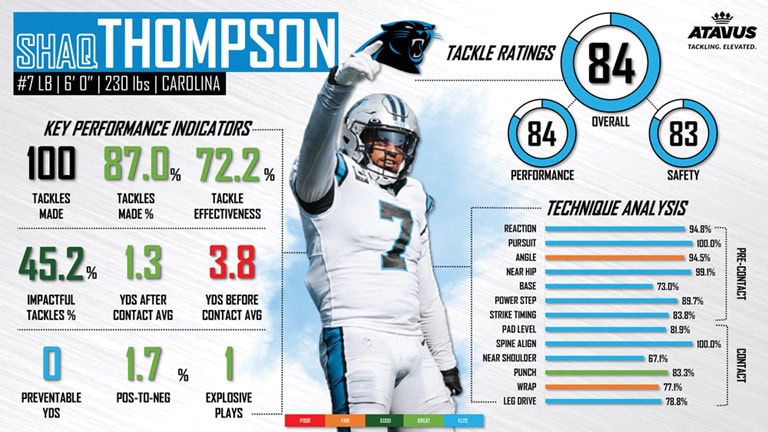
The company breaks down a player’s tackling technique and overall performance. [Courtesy of Atavus]
LLume’s Light Lace technology measures respiration, heart rate, joint motion and impact detection.
A Data & Innovation article brought to you by
The core IP is the “LL” in the product name: Light Lace. Spun out of Professor Rob Shepherd’s Organic Robotics Lab at Cornell, LLume uses red LED light to measure, for starters, respiration, heart rate, joint motion and impact detection. It’s an exceedingly versatile tool when inhibited only by the speed of light.
“We are right now the only solution that has such high precision, and that’s because we’re using fiber optics instead of electrical sensors,” LLume CEO Ilayda Samilgil said during a recent SBJ visit to its workspace in the Charlestown neighborhood of Boston.
Following several years of development — during which time it won the NFL’s First & Future innovation contest, received grants from the Department of Defense and did early testing with an MLB club — LLume is now launching its first commercial product in beta.
The LLume strap resembles a standard chest worn heart rate monitor, only it doesn’t need to be worn directly on the skin and its initial focus is respiration. (LLume does monitor heart rate but initially won’t report that in the app until it has more time for validation.)
Most measurements of VO2 and — VO2max, a limit of oxygen consumption during exercise that is increasingly understood to be the single best predictor of fitness and longevity— need to be done either in a lab setting or else with expensive portable equipment, such as the VO2 Master that retails for $6,295.
LLume’s beta price tag is $199, with possible discounts for high usage. The early target market demo is the cycling community, with a preference for those near Boston for additional support testing.
“We’re going to start direct to consumer mainly to get feedback from the customer, but I think eventually — whether it’s with apparel companies or something like Peloton or iFit equipment or gyms — we’re definitely very open to going B2B2C instead,” Samilgil said.
The LLume strap doesn’t use a mask to quantify oxygen intake and carbon dioxide exhalation but rather uses its high sample rate to detect minute changes in the chest as a proxy for lung ventilation. (Though capable of higher sample rates, the team realized anything over 400 hertz is overkill for biometrics.) The idea is to provide personalized exertion monitoring that’s more precise than the standard wearable’s heart rate zones.
“Heart rate is affected by how you breathe,” LLume biomechanist Riley Edmonds said. “So that zone can change quite quickly if your breathing is not controlled. So if you want to look at the step behind what’s powering your heart, breathing is what does that so it gives you a more accurate, precise control over your zones.”
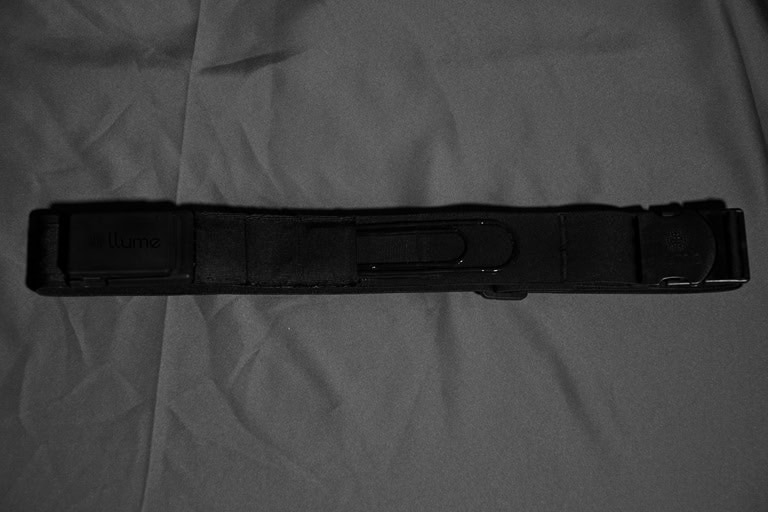
Image: LLume (Melanie Lyons)
This chest strap for endurance athletes is a starting point, but future adaptations are nearly limitless. With its baseball partner, LLume has been working on sleeves to track pitchers’ elbows and shirts to monitor their shoulders — those motions might be tracked at 20 kilohertz, they said. It can capture rapid accelerations in the joints, which Edmonds said is a more actionable datapoint than torque.
The 250 kHz measurements have been used by the military in research contracts to measure impact and trauma. LLume has developed algorithms that enable the device to sample at moderate rates continuously but then automatically increase when triggered by, say, a potentially concussive explosion.
Impact monitoring is, of course, applicable to sports such as football, hockey and rugby. The potential for embedding Light Lace into helmets or uniforms is possible but it hasn’t attempted that yet. The company’s winning pitch in the NFL competition — for which it received a $50,000 grant — was for tracking respiration and muscle fatigue.
At the time, LLume was doing business as Organic Robotics Corporation in a nod to its roots, especially with Shepherd remaining with the company as co-founder and CTO. But the name proved confusing to the marketplace, leading to the change. LLume has that double L, is pronounced as “loom,” which is relevant for its ability to be embedded into textiles and “llume” also means “fire” in Asturian, a regional dialect in Spain — fitting for a company whose core technology is red light.
There are future opportunities to make the Light Lace glow either as a fashion accessory or as an indicator — maybe it blinks twice when you reach a set respiration target. It’s another idea yet to be realized, on a long roadmap of possible destinations for the adaptable technology. And often when Samilgil looks at her iPhone, the auto-generated memories will be a picture of earlier product form factors.
“I’ll get a photo of an older prototype,” she said, “and I’ll be like, ‘Oh, my God, this is only like three months ago. We’ve come such a long way.’”
This article was brought to you by SBJ Tech, a Leaders Group company. As a Leaders Performance Institute member, you are able to enjoy exclusive access to SBJ Tech content in the field of athletic performance.
Six NFL teams used Ferretly’s innovative service as an extra layer of scouting ahead of April’s event.
A Data & Innovation article brought to you by
Ferretly is acutely aware of that dynamic and the startup has developed an AI-powered social media screening platform for a half-dozen NFL teams who took part in April’s NFL Draft in Detroit.
“The behavior off the field is almost as important as their athletic prowess to these organizations,” Ferretly Founder/CEO Darrin Lipscomb told SBJ in a recent interview. “Because their brand is at stake.”
Ferretly’s platform scans publicly available posts across seven top social media sites – including Facebook, X, Instagram and LinkedIn – links accounts to the subject (with a confidence score attached) and analyzes their activity across 12 classifications, like disparaging/prejudicial remarks, political speech, threats, drug mentions/images and so on. Such posts can include text, images or even memes.
The engine’s findings are then distilled into in-depth summary reports, with elements ranging from a subject’s flagged behaviors listed chronologically, a word cloud of frequently used phrases or topics, sentiment trends, and aggregated news coverage of the subject.
“A person that’s evaluating that individual can then use [the report] to better assess an individual’s character and integrity,” Lipscomb said. “We don’t adjudicate. We just want to surface those and say, ‘Here’s what he posts.’”
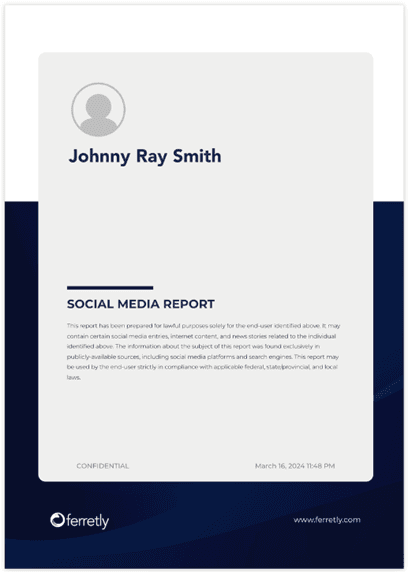
Image: Ferretly
That surfacing is surface-level, Lipscomb added, so past posts deleted at the time of the report would not be included, nor would posts from a private profile. Ferretly’s services are also Fair Credit Reporting Act (FCRA) compliant, a federal law protecting the privacy of subjects of consumer reports.
Still, Lipscomb noted that among this year’s top 200 or so NFL Draft prospects, about 70% had at least one behavior flagged – more than double the rate in other industries Ferretly covers (where the average is 33-34%). The three most common flags: profanity, disparaging remarks and political speech.
Lipscomb estimated sports teams comprise about 10% of Ferretly’s business, which encompasses nearly 1,000 clients across the retail, media, finance and public sectors, among others (they added 75 customers in Q1 this year). Influencer vetting is another popular use case, and teams in the English Premier League, NHL, NBA, MLB and Division I college are clients.
“There’s no real separate distinction between whether you’re hiring an NFL player versus an influencer,” Lipscomb said. “It’s the same report, the same assessment.”
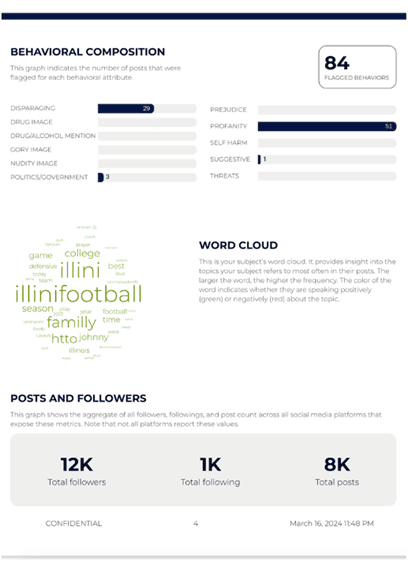
Image: Ferretly
Ferretly offers its platform as a SaaS solution, or with analyst support at a higher cost. Running an analysis takes about an hour, with reports typically turned around within a day, Lipscomb said, adding that most clients average about $20 per report. The price point is determined by volume of reports per month.
“It’s really a rapid turnaround because of the use of AI, especially for social profile discovery and the machine learning classifications. We probably do more use of AI than most of our competitors,” Lipscomb said. “There’s some competitors that do this mostly manually. They’ll produce a report at about three times the cost of what we charge.”
This year, Ferretly had analyzed around 250 NFL Draft prospects across their client’s potential targets by the time the Chicago Bears used the No 1 pick to select USC quarterback Caleb Williams.
This article was brought to you by SBJ Tech, a Leaders Group company. As a Leaders Performance Institute member, you are able to enjoy exclusive access to SBJ Tech content in the field of athletic performance.
Edge3 and Kenyon Rasheed are using data to help athletes navigate the complex recruting process in college football.
A Data & Innovation article brought to you by
* * * * *
You can’t have a discussion about sports technology today without including athletes in that conversation. Their partnerships, investments and endorsements help fuel the space – they have emerged as major stakeholders in the sports tech ecosystem. The Athlete’s Voice series highlights the athletes leading the way and the projects and products they’re putting their influence behind.
* * * * *
Kenyon Rasheed captained the University of Oklahoma football team before playing three seasons in the NFL as a fullback, starting 10 games for the New York Giants in 1993 and 1994. When his playing career ended, Rasheed began a career in tech. He started at Oracle, then ventured out on his own, licensing sports data to media in a quarter-billion-dollar deal and building a HIPAA-compliant medical record system for players at the NFL Draft Combine.
Rasheed, 53, later consulted for Opendorse and worked for Global Payments, Inc, helping the company become the official commerce technology provider for Atlanta’s Mercedes-Benz Stadium.
His latest project is Edge3, an athlete intelligence and advisory firm that recently partnered with IBM to leverage Watsonx AI to create a data-driven college recruiting service. Co-founded with a fellow NFL alumnus, Brian Jones, who is also a CBS Sports analyst, Edge3 raised a friends and family seed raise in 2022 and signed with Next League to develop its product strategy and business model. Other retired NFL and NBA stars — Warren Sapp, Gary Payton, Horace Grant — joined as advisors, and Edge3’s first client was Will Anderson Jr, a national champion at Alabama who recently was named NFL Defensive Rookie of the Year with the Houston Texans.
On the idea for Edge3…
I was running a podcast and was having on a lot of retired athletes, Jonathan Hayes, Rod Woodson. I heard a coach in them as they were being interviewed — a need to give back this intelligence and knowledge that they had. And my question was, ‘Why are you not coaching? You’re Hall of Famers.’ And they had the same question, ‘Why are we not coaching because we’re Hall of Famers?’ What I found is, there’s really only 32 opportunities to do that — or broadcasting — to really give back what you know. And as you get older, your name loses a lot of relevance. So what doesn’t always fade is that intelligence.
Instead of trying to coach 32 teams, what if they could coach 1000s of teams because of the information? Well, I looked at technology and said, What a great way to scale it. If I can take all of this information and stories and intelligence of all of these players that have been through, the recruiting process, college, pro, financial planners, agents, NIL deals, all of that, and then give it to the generation that actually needs it, which are these young athletes and parents that are coming up.
On proving the idea…
To test it out, I went out and said, I’m not an agent. Let me see if I can go sign a first-round pick and have them be our first client. And that happened to be Will Anderson Jr. And all we did was [say] we didn’t really know if we could help you at the time, but let us try to add our intelligence and advisory position to help you choose an agent, to help you choose a financial planner, teach you how the marketing game actually runs for an athlete. And we were able to do that and really kind of standardize his search around picking an agent. So we were interviewing CAA and Klutch and Octagon, and all of these under the parameters of what are the requirements for the family.
On convincing his first client…
This is where I realized this was different. Because whereas CAA and Klutch are spending hundreds of thousands of dollars recruiting players to get them to sign with them, I did it on a Zoom. But on the Zoom, I had Warren Sapp. I had Horace Grant. I had Gary Payton. I had Brian Jones. When his mom and dad turn on the Zoom and sees us, I tell Mr Anderson, ‘[I see] the scowl on your face. You’ve probably met with a thousand agents — we’re not agents. We don’t want anything from you. We want to be able to see if we can help you. These guys have been through the same thing your son’s going to go through. Our parents went through the same thing you guys are going through, trying to figure out who’s real, who’s not. And we would love to help you. And the difference is, it’s us. This is not a third-party coming through. You’re working directly with the guys who have actually been through it.’ Literally Mrs Anderson was in tears at the end of the call because she was so overwhelmed from the agents.
“All of this information and stories and intelligence, the recruiting process, college, pro, financial planners, agents, NIL deals, all of that, [Edge3] gives it to the generation that actually needs it.” Image: Edge3
We started to build out a plan for them that got them to the draft. It was really amazing because we were sitting in rooms with Klutch and CAA, listening to pitches that we heard 30 years ago. Our thing was, well, with all of this data available, we already know what Will’s going to make based on his draft position because we have enough information to know that these days — thanks to fantasy, thanks to betting — any datapoint that can possibly be had on a player, we have. So why are we not interpreting that for the athlete and the parent to understand, This is what the agent actually does. This is the value of what he brings. And understand that it’s a marketing game. And by that I mean this, the athletes on the field get their money. Agents are there to represent and present that in a way that leverages more opportunity for them.
But the data is the same. So if I have access to the data, you have access to the data. Why am I paying you 3%? And I’m not to say that they don’t deserve a fair shake. But at the end of the day, every vertical has changed. I looked at the finance industry, I looked at the legal business — I look at Legal Zoom, for instance. And as I said, 15 years ago, you had to walk in and to a lawyer’s office to create an LLC. Now I can go on LegalZoom and do with the templates, and if I need an expert, here’s a attorney and expert there. So why are we not doing that in sports when all of this information and data is available?
On how coaches benefit…
We believe it’s a lead generation for the schools as well. Because as we were talking to coaches, what they were trying to say is, ‘If you look at all of the media platforms that cover recruiting, one kid may be 6’2” on one site and 6’5” on another. He may be running a 4.8 [40-yard dash] on one site and 4.5 on the other.’ They have to sort through all of that data as well. So why are we not narrowing down the scope?
[They are] looking at this, from their perspective, as a roster management [tool] and the more information we take on kids, and the more information we understand about what they’re doing in their systems, we can figure out a better match. That’s really where IBM Watsonx has come in because it’s able to actually put into machine learning a lot of these data points because we’re asking the right questions from both sides. What does an athlete want? What does a coach want? What is the school looking for? What is a parent looking for? All of those things are what we’re putting together in the engine.
On developing the product with Watsonx…
We also worked with Next League who handled our discovery. Dave Nugent and those guys were awesome because they gave us a roadmap on how we can build this out and conceptually understood what this looks like. Because I have seen so many different platforms — I’ve worked with Opendorse, I’ve worked with Teamworks, I’ve worked with Microsoft — I’ve seen all of these technologies in bits and pieces. And they may have one piece of the solution, but not the totality of it, which is why we don’t see a lot of new technologies being implemented in sports.
One of the things I was talking to IBM about was, ‘We see the probabilities around tennis. What if we could take that predictive engine that you already are using and apply it to this industry the right way? By having subject matter experts sitting here telling you, no, here’s the information we need to retrieve from all of this data. You figure out how to get it to me and give me the answer.’
On the business proposition for college programs…
To be able to go into an athletic department, sit down with the AD, figure out their financials, and where they’re spending money on recruiting, being able to sit down with a position coach and say, ‘OK, how are you narrowing down your field and communicating who you want to offer to the head coach?’ Going to the front end analysts saying, ‘How many players are you evaluating? How are you bringing that data in and communicating that upstream to a CEO, which is, at the end of the day, a head coach making a decision?’ So we approached this from just a business standpoint, with information needing to be gathered, needing to be analyzed, and needing to be collaborated with within the organization.
Thanks to the transfer portal, we found that schools now have 48 hours to decide, ‘Do I keep recruiting this high school kid? Or should I take a kid out of the portal?’ And from athlete side, what we now know is, let’s look at the average age of a roster. If the average age of a starter is 23 years old, and I’m 17, 18, it says a lot. So when we talk data, it doesn’t really need to be this complicated process. We’re talking, simplify things that can give an athlete a better sense of my success at a particular school and on the other way around: what’s the risk of me taking this athlete and him being on my roster for three or four years and being productive within my system? And so we believe those are two core questions that we can help answer on both sides.
On leveraging playing experience…
Everyone’s got access to the same data. It’s how we look at it, and there are certain traits that every coach is looking for, no matter what the positional room, no matter what the team. This is a poll that I did with a lot of players: I would send tape out of a kid, and just say, ‘Give me five things that you see.’ They were all consistent with what they all saw. It was the same terminology — hip mobility, feet, I want to see his eyes, things like that — that I was like, ‘Well, what if we standardized those things?’
If Warren Sapp could develop an assessment for defensive tackles based on his eyesight — and what people didn’t realize is that Warren on a Saturday is watching multiple college football games with a Telestrator, sending me and the other partners on my team clips of what a defensive tackle is not doing. And I’m like, ‘Warren, first of all, you’ve got to stop this.’ But that’s how deeply we watch games. My wife gets irritated with me because I can see two plays and be like, ‘He doesn’t bend fast enough. He doesn’t work his head.’ Just automatically. And if you talk to any former player, they’ll tell you the same thing. They watch the game differently. I want linebackers that understand the linebacker position to evaluate linebackers.
On projecting college recruits’ performance…
We live in a world that a star system has been created by media companies to determine the value of a player. We have all ingested that as the standard. What I will ask you is, if a five-star is truly a five-star, how come all of them are not first-round picks? Because a five-star to one roster may be a three-star to another, based on the system, based on who they’re playing with, based on historical look at the coach, based on the fact he may be going out of state — there are so many other factors to determine the success.
We have a history that we can baseline now and then backtrack to start predictive models around the kids that are coming in today. [We have] a group of guys that we know who can actually dig in and understand the game and then look at it and re-engineer the solution backwards. Start with what we look for in a position and then build out from there. We haven’t even touched the surface yet. Yeah. Because everything that we’re looking at now is from what we know. I believe, with the help of IBM and Watsonx, that’s going to start to tell us things that we can’t see within those data patterns.
On how he started his career in tech…
When I retired, I didn’t know what the hell I was going do like any other athlete. I met a guy on the plane who worked at Oracle. He said, ‘Hey, I think you’d be good at sales.’ I said, ‘I don’t know anything about technology.’ He said, ‘I can teach you technology. What I can’t teach you is what you already know, and that is an understanding of people and markets.’ So I went to work for Oracle, which then taught me that there was software being built for individual verticals based on the processes of those verticals. Well, sports is as a vertical so who would know those processes better than me?
And so I took a gamble on myself. And in 1999 I started with what was called Rasheed & Associates. My first client was Interactive Systems Worldwide, which provided a real-time, play-by-play betting system that was in Las Vegas. I introduced them to the NFL, NBA, Concacaf , and all of them said, ‘Too closely resembling gambling. We will never touch it.’ This was at the NFL offices when I was 27 years old. Then I said, ‘OK, what if we had a game and a contest piece off of that,’ and I got to Kirch Media through Concacaf, and [Kirch] ended up licensing the technology for $250 million [over 14 years]. We were using it in SkyBet overseas as an interactive betting system.
On his next career steps…
So I was in betting well before and then two years later, someone asked me about a health smart card. Can we put our medical records on a card and take it with us? This was in 2002. And I was like, ‘What if the NFL players had their medical records on their player card?’ So I started polling trainers, then I found out about HIPAA, and then I started going out to teams.
I created what they called the Player Record Library System. I got everybody at the Combine, all 32 teams, to use the system. I took all of their medical information and put it into an API that they could access during the draft. Prior to this, they were FedExing medical records back and forth. I did not know anything about technology. I didn’t understand programming, and I wasn’t in the medical industry. But at 28 years old, I’m presenting to Paul Tagliabue, [NFL EVP and Chief Legal Officer] Harold Henderson, the medical council, and it changed how the Combine operated.
It taught me how to commercialize a product from concept, which is what we’re doing today. And then in 2015, when everyone was talking about fan engagement, I got into Global Payments. Mercedes-Benz Stadium is the first stadium that did a direct deal minus Ticketmaster, established payment and fintech within the sponsorship divisions within the sports industry. And now look at where we’re at right today with cash-less stadiums. So all of these purviews have given me an understanding of how this stuff actually works, how it can be commercialized, how we can build a product, and how to actually sell it, and have an instance where they can actually use it on a wide-scale basis.
This article was brought to you by SBJ Tech, a Leaders Group company. As a Leaders Performance Institute member, you are able to enjoy exclusive access to SBJ Tech content in the field of athletic performance.
A Data & Innovation article brought to you by
You can’t have a discussion about sports technology today without including athletes in that conversation. Their partnerships, investments and endorsements help fuel the space – they have emerged as major stakeholders in the sports tech ecosystem. The Athlete’s Voice series highlights the athletes leading the way and the projects and products they’re putting their influence behind.
* * * * *
Barkley is a two-time Pro Bowl selection, earning the honor after his rookie campaign in which he ran for 1,307 yards and caught 91 passes as well as in 2022 when he ran for 1,312 yards and had 57 catches in his return to stardom two years after tearing his ACL. Barkley could be a free agent as the Giants weigh whether to place the franchise player tag on him for a second straight season.
Last week, Barkley added his latest brand partnership with Silk, a producer of plant-based products. He joined the Feel Planty Good Challenge, a campaign to incorporate Silk in breakfast every day for a week. He has done a wide range of deals in his career, including with blue chips like Nike, Pepsi, Toyota and Visa.
On the partnership with Silk…
I’m excited and happy to be partnering with Silk and doing the Silk Feel Planty Good Challenge. I think it’s a fun challenge for everyone to get involved. It’s healthy. It’s an easy, quick way to add plant-based [food] in your diet, especially breakfast. I think people overthink breakfast too much. When you could have a quick, easy, simple, tasty breakfast and get your day started off right.
I’m doing the challenge myself. I think it’s important for me too with my diet and nutrition, especially after coming off a long year. You want to start off right and get the body back into the right form so I can have the best offseason I can so I can attack the next year.
On when he started getting more serious about his nutrition…
I would say even when I tore my knee three or four years ago. But the year [2021] where [Brian Daboll] and Joe Schoen [arrived] and we moved off from [Joe] Judge and we got into our phase with Dabes, so two years ago, was really when the focus changed for me. I feel like my career was at a point where I was coming off the ACL and didn’t have the year that I wanted to have.
And, man, I wanted to do it again, I want to be dominant. I want to have a major impact on the game for my team, and I was able to have another Pro Bowl year. I thought I had a pretty good year this year, too, just the ankle injury kind of slowed me down a little bit. But definitely with the way I’ve changed my diet and my training has definitely helped me up to this point.
On how prior offseasons compared to this one…
I trained in Arizona at Exos. I think I’m going to stay around a little more in Jersey. My daughter is in school now. So definitely going to be out here a little longer. I feel like that’s important, too — get back to the grind of it by yourself, in a basement, blast music, kind of like I’m in high school again, get that mindset to give me back ready for the season. When I’m able to get out there, I’ll go out there and work on my techniques and everything to get back to the player I know I am.
I just redid my gym downstairs, so I’m excited to get down there and get to work. I’m going to add a little boxing, too. My little brother is going to become a boxer and definitely going to be with him and training him a little bit too. Also I’m going to lose a little weight. I’m going to play a little lighter next year.
On why Exos is such a good fit…
It’s just relationships. I’m a big relationships guy when it comes to the training side — when it comes to anything, to be honest. I feel like that’s the most important thing. I have a trainer there, Nic Hill, who’s great. But I respect him more as a person. I know he’s going to challenge me. I know he’s going to hold me accountable. And I know he’s going to push me.
Also I had a couple of my teammates out there. You have Deebo, Hop, Odell [Deebo Samuel, DeAndre Hopkins, Odell Beckham]. When you have guys like that, and you’re in a gym or you’re on a track, you’re talking crap and you push each other — it pulls the best out of each other too. So those are the real main focuses why. Obviously Exos has an unbelievable facility and all the great equipment, but for me personally, that’s what matter most.
On how much he tracks his training data…
Yeah, I do, especially we do a lot with the team. We’ve got Catapult to track your speeds, track the mileage you have, how much wear and tear you put on your body, your balances. Especially working with Ryan [Flaherty], he is really data-driven. I got to learn a lot from him. But the biggest thing I learned from him, I wouldn’t even say it’s the data stuff. It’s more just that he’s been with all the best. He’s been with the LeBrons, the Kobes, the Serenas — all the people who did it at the highest level. So he knows what it takes, he knows the mentality it will take.
On when he is at peak performance…
I probably felt my best coming into a season my third year. I was in unbelievable shape coming into the year I tore my knee. I felt amazing. But that’s when we had Covid. I was locked away in house, in a gym and on a treadmill. That’s when I got to really my peak — everything was where I wanted it to be.
When I play my best is when I’m free. When I just let loose, don’t care. It’s hard when you battled injuries. Even when you want to be this tough guy and be like, ‘No, I don’t think about it.’ But it’s your body. It’s impossible. When there’s a disconnect in your mind and your body, and you can see that you’re taking extra steps or doing this and you’re like, ‘Why am I doing that?’
But it’s just your body and mind have got to be connected. So I feel like I had my body and my mind connected after my knee [rehab] last year, which I had a pretty good year. And I felt good, I felt great coming into this year, too. But when I’m playing free, to answer your question. When I’m playing free and it’s no F’s given, as they say. That’s when I’m at my best, season-wise and in the game.
On training his mental game and using a mental performance coach…
That’s something I think I’m going to add this year — I might add a mental coach. That definitely can help. But for me, the way I do it [now], how I challenge myself, is to throw yourself in the fire. When that’s working out, when it’s training, when it’s conditioning, put yourself in uncomfortable positions to have that mindset that, ‘You know what, I’m going to get through it.’
That’s more to be mentally ready for that moment or that play or that game, but the [mind and body] disconnect is all about just trust. You’ve got to put your body in those situations. You’ve got to go through it. Eventually, you’ll know because, boom, you make a cut or you do something. It’s like, ‘OK, that’s back. And everything feels free.’ You’re not thinking about it. Every decision I make is right, but I’m not thinking, ‘OK, I’m running inside a zone. The front-side linebacker to the play side jumped inside, now I’ve got to do this.’ No, it’s just boom, boom, and I’m there. OK, one-on-one with the safety. Am I going to attack the safety?’ Nope, my body already knows what I’m doing. I watch film. I know what he’s going to do.
On how he responds to those who devalue running backs…
Yeah, I can go into that in two ways. I can sit there and bring up stats and numbers for myself, but I will keep myself out of it. I would use Christian McCaffrey as an example, who I’m a big fan, who I think is the best running back in NFL right now — right now, I’m going to get him soon, but right now. He’s MVP-caliber, just what he’s able to bring to that team.
It’s all trends. When you talk about the value of the running back position, it’s all because in recent years, backs that got paid high money, they had an injury histories. And so now it’s the trend. It just unfortunately sucks for guys like me, and it sucks for other guys that also have to go through it. They can do that for any position. So in 5 or 10 years and we’re paying wide receivers all that money, if three, four, five of the seven guys who are the highest paid end up getting injured and are not producing, then they’re going to be able to do the same thing to the wide receivers position.
And then if you want to talk about value of positions of just anything, it’s a team sport. We give credit to too much people anyway, to be completely honest. And we’re fortunate enough to get paid a lot of money — some more than others — but the reality of it is that’s the truth: it is a team sport. One of the best quarterbacks in the NFL right now was the last pick of the draft. You could find talent anywhere.
On how he evaluates deals with brands…
Authentic. Early in my career, there was some stuff that I did that wasn’t authentic. And that’s no diss or anything to any one of the brands — I’m thankful and grateful for any brand that I have partnered with, but for me now, it’s more authentic. Silk matches up with everything that I align with and what I want to do.