The former cornerback chats to SBJ Tech about his Coach Performance Assessment System.
A Data & Innovation article brought to you by

You can’t have a discussion about sports technology today without including athletes in that conversation. Their partnerships, investments and endorsements help fuel the space – they have emerged as major stakeholders in the sports tech ecosystem. The Athlete’s Voice series highlights the athletes leading the way and the projects and products they’re putting their influence behind.
* * * * *
James Hasty was a premier bump-and-run cornerback in the NFL for 14 seasons, mostly split between the New York Jets and Kansas City Chiefs. He received second-team All-Pro honors in 1997 and was named to Pro Bowls that year and again in 1999. A third-round pick out of Washington State, Hasty had 45 career interceptions, 24 fumble recoveries and 10 sacks before retiring after playing one game for the Oakland Raiders in 2001.
Hasty, 58, is now the Founder and Chairman of Eneje’ Consulting Firm that uses data and proprietary algorithms to champion the principles of equity, diversity, and inclusion among NFL coaches. The goal is to evaluate all candidates based on objective information — spurred by an insight from when Hasty coached at the Washington-based Bellevue High — and philosophical compatibility with the owners’ preferences. The hope is to surface more deserving candidates from all backgrounds to improve upon the league’s Rooney Rule.
On the origin of Eneje’…
Eneje’ as an African derivative word, essentially, means willingness to help your fellow man. The goal was to create a tool that allowed folks to grade a coach and his performance.
On what his experience coaching taught him…
I had coached high school football, and we were very competitive. In fact, every year that I coached at Bellevue High School as a defensive coordinator, we won the state championship. In fact, we beat De LaSalle out of California, and they had a 151-game winning streak — for nine years they hadn’t lost. What I struggled to show the kids is that the coach on the sideline didn’t have a game plan in his hand. What that showed me is that he calls plays off the top of his head, based off of what makes him comfortable, right. What I used was data analytics, to teach the kids the percentages of what they want to do in certain situations, and based on those percentages, we were going to set our defense up to stop them.
I realized, as a D-coordinator, I’m doing a lot of the work. I’m spending eight, nine hours a day breaking down film before I go to practice, and so what it said to me is, there’s got to be a way to create a system where we recognize people’s contributions to any organization, not just in sport, but in any organization everybody has a certain level of contribution to that organization. Everyone contributes towards a win, but they’re not all valued the same.
On gaining support for his idea…
That was the genesis of how I created this algorithm. Then I reached out to a friend of mine, Ronnie Lott, and I said, ‘Ronnie, I got this algorithm that I created, and it’s based off of these coaches and their contributions. So what do you think?’ And he’s like, ‘Man, that’s a great idea. I think you should go forward with it.’ I then went and met some folks that he suggested I speak to, and they encouraged me to continue to go.
I reached out to a friend of mine, his name was Dr. Steven Cureton. And Dr. Cureton and I go back to undergrad. He’s the head of the department now at the University of North Carolina-Greensboro, their sociology department. And I said, ‘Hey, I need to sign you to a contract, and I need you to come on board. I need you to go ahead and do the research on the hiring practices of the National Football League over the last 102 years,’ at that time, and he said, ‘I’ll do it.’ With the help of people like John Wooten who played with Jim Brown back in the day with the Cleveland Browns. Woot assisted us with meeting with different people to do the research into what they consider important elements of hiring a head coach or a general manager.
On developing Eneje’s interview protocols…
We talked to current and former coaches, we talked to lawyers, we talked to journalists, we talked to athletic directors, you name it. From that study came the creation of the interview tool that we have. Because some people will say, ‘The game is not just about analytics.’ This interview tool was critical because we were hearing about the whole sham interview deal that was ongoing within the National Football League, and so this tool essentially would work very simply.
Let’s say you’re the owner. We come in, and we say, ‘What are you looking for in your next head coach?’ And you say, ‘Oh, I’m looking for these variables: I’m looking for leadership, I’m looking for understanding of the salary cap, I need you to be a play caller, I need you to be a guy in the locker room that is great with the players.’ You’ve got these certain variables, as an owner, that you want your next head coach to have, whatever that might be.
We would take that same interview tool, and we would document all the stuff that you said you’re looking for. And now we would go and find a candidate that you had recommended to us, and we would interview those candidates separate of you and ask them the same questions. The interview tool would then record and transcribe their answers and grade your answers as it relates to your answers to see how closely they’re aligned to one another. In the heat of the moment, you want somebody that thinks like you. You want somebody that has a similar belief system that you have.
On the company’s qualifications algorithm…
We’ve got a tool that grades your background — high school, college, pro — and who you’ve developed and statistics during that particular year. I reached out to Dr. Filip Saidak, a professor of mathematics at the same school as Dr. Cureton, and Dr. Saidak said, ‘I can show you how you can add other elements to the algorithm.’
As an owner, let’s say you may want a guy that has a defensive background or you may want a guy that has a quarterback background, or whatever those elements may be to you, personnel-wise. You may be strong in some areas, but you may be weak in others. And so you want a head coach to offset those weaknesses. Whatever those variables are important to you, we can add those elements to the algorithm to where those coaches are graded accordingly. And you will find which of those folks, based on the quantitative formula, have the higher grade.
It’s not based on race, it’s all based on performance. And you’ve got the interview tool that looks to match your psychological compatibility with the owner as a coach. And so now you’ve essentially have two options as far as how to identify candidate.
On building an objective coaching network…
When it comes to the CPAS, which is the Coaching Performance Assessment System, we believe there should be a database, whereby we’re able to keep up with all the coaches in our database. We’re able to truly develop a pipeline where the NFL can always have access to knowing where and who and what coaches are available so that there’s never an issue where we’re talking about why are we continually hiring the same people? Because now there’s a there’s a place where you can go and find these coaches, and they have outstanding careers. And you’re not hearing about it through the media. You’re not hearing about it through a network of cliques of different former general managers, or former head coaches or whatever.
On the development timeline for the full platform…
CPAS, the database that we have developed, we put in a few thousand coaches ourselves right now. We believe that this database needs to be available for folks to join, and we want to make this available in the spring. So right now, I’m working with Microsoft to make it available in the marketplace so you can go and download the app. It’s available, but we don’t want it to go live yet — let’s just put it that way. You can go on Google Play, you can go into Apple, and you can find CPAS in there. Because of what we also have to get access to joining the database. But within that it’s also a tool that we call Huddle Up.
Huddle Up is basically [similar to] these podcast platforms like Clubhouse. There are these virtual rooms where people can go in, based on that particular topic, and they can talk about whatever the subject matter is. And in this particular case, we’ve created Huddle Up for coaches to go into these various rooms and talk on a podcast-like platform about their particular sport, any practice or game planning or anything relating to that particular sport. We want to use Huddle Up as a platform for coaches to engage and learn from one another, kind of like a peer-to-peer learning network.
On his vision for CPAS adoption…
Ideally, we’d like to make this a system for the league to use, not just for individual teams. We’d like to see a baseline approach where these owners have a place to start. What we do is we go back to the owner, and we say, ‘Here’s a quantitative grade. Here’s your qualitative compatibility score. Pick from these guys which one you want. It’s your call, obviously.’ We’d give them the information to where now they can go forward and have a better idea who may be the best fit for their organization. But our job is certainly not to tell them who to hire. We’re just providing information on these candidates that we believe in the long run [will succeed], based on the data, based on the research.
He is a rare technologist well-versed in bureaucracy, has just completed a 12-month listening tour of the league’s 32 teams and his first initiatives are starting to take shape.
A Data & Innovation article brought to you by
Rather than detail an immediate list of objectives, he embarked on a listening tour. Brantley met with every department of the league’s sprawling operations, spending enough time with each to understand the nuances of their roles. He spoke to the technology leaders at the NFL’s 32 franchises to learn their local issues and considerations.
Now, 12 months after taking the job, Brantley’s early initiatives are taking shape. Chief among them is the creation of an NFL Innovation Hub that seeks “to create a culture of innovation, cross-functionally and across the league, that allows us to operationalize ideas fast,” he said.
Guided by what he spent the past year hearing, Brantley has also played a role in streamlining efficiency, hiring three new roles in his department, creating a council to study artificial intelligence, helping the implementation of an updated credentialing system that uses facial recognition and introducing a concept that’s been called “Football as a Service.”
In his 2019 book — The Art of Organizational Transformation: 7 Steps to Impact & Influence — he wonders aloud why leaders are in such a rush to make changes ‘without being a part of the entity long enough to understand the true internal needs.’
“The first thing I’m trying to do is really understand how the organization operates,” Brantley said in a series of conversations with Sports Business Journal. “I don’t want to hear anything about tech — I’ll get to that at some particular point — but, how do you operate as an organization? What do you care about the most? What makes you go? How do you create revenue? All those types of things are interesting to me. And then I try to surround tech around it to be a support function for what the organization is trying to accomplish.”
Over the past quarter-century, Brantley has worked for big tech companies such as IBM and MCI WorldCom, founded his own faith-based media site, led technology at multiple levels of government — the state of Ohio, the city of Atlanta and the school system of Georgia’s DeKalb County — and then worked in the C-suite of a large home construction company.
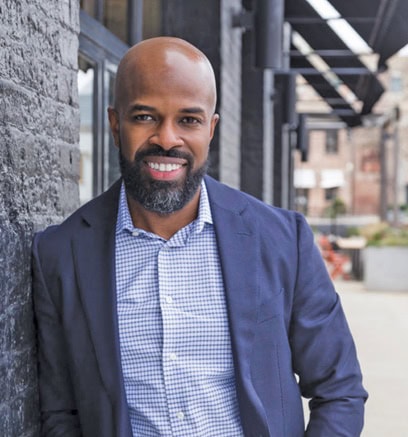
Image courtesy of the NFL.
Raised in Youngstown, Ohio, the son of a 30-year AT&T veteran, Brantley hails from a high-achieving family: His three siblings include a doctor and two attorneys.
These experiences have shaped Brantley. He is the rare technologist well-versed in bureaucracy, an innovator committed to efficiency, the entrepreneur with a long tenure in the public sector and the business leader who can roll up his sleeves and code — not to mention an accomplished drummer with an enviable collection of Jordans and a sub-two-hour half-marathoner who commutes to league headquarters on an electric scooter.
His hiring in October 2022 came at the end of a lengthy search, following Michelle McKenna’s departure as NFL CIO in March that year, but Brantley’s fit for the post quickly became apparent once he applied.
“When I interviewed him, I was like, ‘He gets it,’” recalled NFL Chief Administrative Officer Dasha Smith, noting his “understanding that you have a lot of key stakeholders, and every single one of them is very important. It’s really about consensus building.
“I knew within 10 minutes that Gary, honestly, was the one — based on his experience, based on being a real technologist, his humility, which is something that is really unique for someone who’s as talented as he is, and then he’s a sports fan, so that was good.
“He really just checked every single box.”
■ ■ ■ ■ ■
The IT department of some organizations is relegated to the same status as referees and umpires, in that they’re only noticed when there’s a problem. At the NFL, that expectation of smooth operation without drawing attention to itself is very much there — but that’s only one part of a broad remit that also includes everything from HR and payroll to player health and safety and the searchability of the NFL Media archives.
“We have no room for failure on the technology front,” Smith said. “A lot of people don’t see all the pipes behind the scenes that go into making sure that that you and I can watch the game, that the coaches can talk to the quarterbacks on the field, that their Microsoft Surfaces are all working correctly. We cannot have any points of failure, so first and foremost, making sure that the game could be played flawlessly. Every single game.”
But, she continued, technology is also a strategic priority with the NFL wanting to continue as a leader in the space. That’s what lured Brantley to the role; he describes himself as “a creator and more of a business entrepreneur than, I would say, a traditional tech guy. I see myself as a business guy who just understands tech really, really well.”
“Technology needed to be a core component of the organization that I was working for, not just a back office support organization, not just a cost center. I wanted an opportunity to really use technology to be able to affect positive outcomes,” Brantley said.
The NFL’s Deputy CIO, Aaron Amendolia, is a long-tenured member of the department who admitted that “every time you have a new leader come in, you’re always holding your breath about what’s this is going to be like, and it’s been refreshing,” he said, noting “Gary’s focus as a leader is always on communication and transparency.”
Together, they’ve endeavored to reconsider the role of the department. Messaging is important. The final chapter of Brantley’s book, after all, is titled Shaping and Controlling the Narrative. Along with adding a vice president of IT business services and posting for a vice president of football technology, Brantley hired the department’s first communications professional, to help craft storytelling.
“When you’ve been here for a while just doing IT for operational sake, you just do the operations, and you’re more attached to the systems than the outcome of what the systems do,” Amendolia said. “We’re actually tying to [ourselves] some of these business objectives and goals. That’s what we think will really change the perspective of IT from being this cost center and as being an operational back-of-house type of service to a strategic partner with the league.”
The Innovation Hub is the most concrete example. It’s a common platform within Fortune 500 companies but new to sports. The Hub is a way to standardize the process of ideating, monitoring and measuring progress. Major partners, such as Amazon, Microsoft and Verizon, are invited to collaborate, but it also can be used for crowdsourcing solutions, much as the NFL has found success with the Big Data Bowl and its health and safety competitions.
The idea germinated last spring, recalled Jason Dvorkin, AWS principal industry specialist for media, entertainment and sports, after Brantley gave a presentation on innovation at the National Association of Broadcasters conference. Conversations grew from there about how to shape this idea what Dvorkin described as Football as a Service — to take media and data such as the NFL Next Gen Stats and “make that all available in a centralized way, so that whoever needs it at whatever point in time in the process has a way to access it,” Dvorkin said. N-Ovate Solutions is spearheading implementation of the Hub.
Brantley then went out to build support, counting 39 meetings over six months. This is where politics, salesmanship and charisma become important.
“You can build and spend all types of money on technology, and no one really adopts the change. And that’s what you don’t want. And so everything about aspects of innovation, change, the ability to move the needle — it’s all people-focused,” he said, adding, “If you can go and you can approach it in a way that they don’t feel like it’s being forced on them, but they also feel like they had a piece and a part in it, it really helps us to speed things up.”
The conceit is to flip around the old truism that one has to hurry up and wait for other necessary pieces to fall into place for a project to move forward. Instead, it’s about waiting for the right idea and then hurrying up its completion.
“His vision is around trying to find the technology of the future and not make a snap decision. He’s looking five years out, 10 years out,” Dvorkin said.
“And he’s using us and our experience to help shape that operation. I mean, you look at what’s been done in player health and safety right now, using computer vision to create that Digital Athlete. He’s realizing that there’s more to that than just injury prevention. It’s: How do we start to coach the game of football better? How does that provide insights into the lower levels of the game to help cultivate and foster that next fan, to actually become passionate and deeply invested in the league?”
But innovation isn’t strictly relegated to the transformational ideas, either. Amendolia emphasized the importance of back-end efficiency to free up resources and time.
Brantley noted that it’s common for large organizations to be unaware of their redundancies or the full capabilities of their tools. He undertook a process called application rationalization, a mechanism of modern IT management to assess their software portfolio. He said they’ve identified 419 applications across the league, of which 40% show some redundancy. Different departments, for example, might use Microsoft Teams or Slack or Zoom for communications.
Aligning the league on shared platforms can be a major boon, though he acknowledged the importance of a multicloud environment and noted that compartmentalization is good — a point driven home during his time in Atlanta.
■ ■ ■ ■ ■
When Brantley arrived in Atlanta, the city was in turmoil. In March 2018, the capital of Georgia was stricken by a brazen ransomware attack, and it was still reeling from the consequences of that when Brantley took over as CIO in October of that year.
He discovered that the city had only one firewall in place, which thankfully protected the world’s busiest airport, Atlanta’s Hartfield-Jackson, but most of the city’s other services were shut down. That included four or five systems each for email, customer relationship management and permits. By the time he was done, many of the solutions were consolidated, and he bequeathed the city 37 firewalls to contain any future network breaches.
“The goal was to make lasting change and to create an environment that will protect the city for years to come,” Brantley said. “There was going to be no innovating here. I had to rebuild an entire city infrastructure that was depleted. I didn’t have time for a three-year technology plan. There was a 12-month road map that was tied to making sure my team got back to general basics and general hygiene of how you operate a successful environment.
“They all knew things needed to be improved. So I knew I would get the resources and the funding that I needed to turn this around — for a short period of time. And then it would go back to what government is.”
By contrast, Brantley said, the NFL is “more nimble and flexible,” owing largely to the team owners, who have a more business and revenue-generating mindset than, say, a community-focused city council. The missions are very different, but his fundamental approach to enacting change within organizations is similar. What he said about rebuilding Atlanta’s technological infrastructure seems applicable to how he began his tenure at the NFL.
“I saw the end,” he said, “so I knew where to start.”
Former New England Patriot Nate Ebner discusses, an exercise science graduate, discusses blood-flow restriction technology and wearables while discussing his dual football and rugby careers.
A Data & Innovation article brought to you by
You can’t have a discussion about sports technology today without including athletes in that conversation. Their partnerships, investments and endorsements help fuel the space – they have emerged as major stakeholders in the sports tech ecosystem. The Athlete’s Voice series highlights the athletes leading the way and the projects and products they’re putting their influence behind.
Ebner was a standout youth rugby player and was still competing internationally upon enrolling at Ohio State. In his junior year — despite not having played football in high school — he walked on to the Buckeyes and earned a scholarship for his senior season.
In 2012, the Patriots drafted Ebner in the sixth round and, a couple years later, coach Bill Belichick described him as being “in the top 5% all time of players that I’ve coached, from where they were in college to how they grew in the NFL.” He played for the Patriots through 2019 before joining New York Giants Head Coach Joe Judge, a former Pats Special Teams Coordinator, for two more seasons.
Ebner, 34, finished the 2021 season on injured reserve during which time he wrote a book, Finish Strong: A Father’s Code and a Son’s Path, that detailed his close bond with his rugby-loving father. The day after Ebner shared the news that he was going to begin pursuing football, his father was murdered by a robber.
Now healthy again, Ebner has not ruled out a possible return to elite sports, but in the meantime, he has become an active speaker to groups of all kinds. He’s also an exercise science graduate from Ohio State who is researching blood-flow restriction technology and investigating possible opportunities in that space. He also is a minority investor in the New England Free Jacks of Major League Rugby.
On adapting his use of blood flow restriction technology…
Through my NFL career, I had quite a few surgeries, unfortunately, and seven on my knees. So there was a lot of use of blood flow restriction because it’s a major device in the rehab space. So the best part about it is it restricts your blood flow to the muscles so that your muscle gets this huge metabolic response, lactic acid buildup, without actually going through real stress. And you can do that by restricting the blood flow rather than load the joint and turn, like you would typically have to do if you wanted to run 1,000 stairs — you can get that same lactic acid build up by just restricting the blood flow, doing a bodyweight exercise or even less.
I used it a lot in my last year in the NFL, just with the injuries that I was going through, and for me, it was something that I think I was utilizing it in a different way. Like I said, it’s mainly used in the rehabilitation space, but for me, it was better suited for nervous system activation and muscle activation. It is a lot less time consuming than a typical dynamic warmup that we would go through in the NFL, and also a lot less invasive in energy expenditure.
Because to get warmed up without any restriction, you have to really get your motor going and get those feet firing and get your nervous system going. And when you restrict that blood flow, you get that crazy response without that type of energy expenditure. So for someone that was dealing with as much joint pain as I was, just getting warmed up was probably the hardest part. I stopped doing those team warmups before the game. We’d do that stuff for an hour before the game when the whole team goes out. I would just stand there, and I’d wait. And I’d utilize the BFR to activate me right before we’d come out for the national anthem.
On broader use of BFR…
I started to think about how to implement that for not only high performance athletes, but there’s exponentially more people that are older that wish they could be more active but deal with too much pain to even get warmed up enough to do the activities they probably wish they could do. That’s something that can be utilized big time in the recreational sports person’s life that just wants to continue to go play hoops, go play a pickup game of touch rugby or a bike ride.
I’ve been injured a lot. So I was really I was always very observant of what I was going through, why I was doing it. I’d ask a lot of questions. I was in sports science and nutrition in college so I had that background, but I learned a lot just through what I had gone through. That space has always interested me because there’s so much BS out there. So when there was something that actually was like, ‘Wow, this freakin’ works,’ it opens your eyes. And for me, that’s what BFR was in terms of activation. It’s a space I’m really interested in, and I’m venturing down that rabbit hole as a passion project.
On his use of wearable tech like Whoop…
What devices didn’t I try? Playing on the Olympic team, Whoop was awesome. They’re a big supporter of the NFL players, and I got in touch with them. I don’t know how many guys in the NFL are really using this, but for, the physical requirements of what it takes to play rugby — just practicing three sessions a day for 45 minutes — we’d run more than we do in football for three hours. And we do three of them in a day. So really understanding your recovery, where your body’s at and really for the coaches to understand that was big. Whoop was huge, helping with the National Sevens team.
On GPS…
Rugby was big, and obviously football, we had GPS. Those were awesome for the data on max speeds. I think they were also awesome for the deceleration. I could sit on a ladder with you in a five-yard box and wear do you out more than running a couple of miles because that stop, start, accel, decel — that’s really where, not only your joints are under stress, but your muscles are really working hard. Those accel/decels that those GPS units would give us were good because you might not log 5,000 meters in a day [during football practice]. But you could have 2,000 meters of high velocity.
With rugby, we run so much volume. Those were important because some guys would get up to 7,000 meters in those 45-minutes sessions, and it was like, ‘All right, we need to get him off the field.’ Because nothing good happens after 7,000, especially at those high speeds in training. It’s not like you’re just going for a jog.
On other training tools…
The Run Rocket is a really good tool. It’s basically a resistant wheel that connects you to a harness, and you can get some resisted running. I thought it was great for rehab because you’ve got to start to resisted run before you just try to explode with your bodyweight. And then you talk about just maximizing your performance, you do a couple resisted runs for 10-yard bursts, and then you take that thing off, and you feel like a fly and can just jet out of there.
We use a lot of the Kaiser machines in the NFL to gauge the max output because they had this system in there for weight and velocity. You could move heavy weight — some guys are really, really strong — but if you’re not moving fast, especially in a sport like football, I mean, the whole point is to be explosive. So between the Kaiser machines and what they call Tendo machines, where you attach them to a bar, those readings were important in translating the weight room strength to performance in a sport that really explosiveness is all that matters, not necessarily max strength. We’re not powerlifters.
On transitioning from rugby to football and back…
When I came back from rugby and then I went into football, that transition was seamless if we’re just strictly talking physical, not the mental, side of the game. I was a little lighter than I wanted to play football at but actually played really well. My aerobic capacity was so high from rugby that there was just nothing on the football field that would even challenge me — not even close to the requirement of rugby.
I was very quick twitch and we’d have 30 seconds to do these wrestling matches, and I could get the biggest guy on the team and I’d be fine. But we do them for four minutes, and after a minute or two, I would just be shot. My nervous system was shot, and that goes along with the aerobic capacity of just being able to exert yourself and then recover, exert yourself and then recover, but then do it for long durations and then recover in half the rest time and the work rate being twice as much — that’s kind of what rugby was. So it took a lot of time to physically change the way my nervous system operated my aerobic capacity to handle that.
Football is that four-to-six seconds of just absolute max effort, and then you have like 30 seconds recovery, compared to seven-minute halves of rugby where you really don’t stop and you’re reaching times where you’re exerting yourself to 95%, 100% and then you have to recover jogging. The transition from football to rugby was very hard.
On getting healthy and thinking about a comeback…
That first year out of the league, I had two really big knee surgeries. I had to have some cartilage replacements — 2022, for me, basically half the year, I was on crutches, trying to try to get healthy. So that’s where my focus was originally, but now that I’m getting better, I’m not shutting the door on [returning to sports]. I’m still 34. And we’ll see how healthy I get. Because now that I’m starting to feel good, I can’t believe how bad I felt playing those last couple of years. I can’t believe I was tolerating that. So I don’t know if I want to get myself back in that muddy water again, physically, but when I start feeling good, I can’t help it.
On writing his book and embracing his platform…
That’s been awesome. Urban Meyer really pushed me to write that. Urban knew my story. He wasn’t even one of my coaches, but I would come back in the offseason and he would talk to me a lot. And then obviously, I went to the Olympics, and we won the Super Bowl, and I was All-Pro and all that. And he just was like, ‘You need to write a book,’ especially what happened with my dad, [me being] a walk on and all that. So I was like, I don’t know about that. I ended up tearing my ACL six months later, and I was like, ‘You know what, screw it, I’ll write the book, I’ve got time.’
I’m really glad that I did that. It was not only therapeutic for me to relive all the memories I have with my father, but it’s just been going forward now. I really enjoy speaking to people. I speak to businesses quite a bit, just from a mindset standpoint and how to operate through turmoil and adversities. I also enjoy talking to the kids that are 16, 17 years old, that might might start to question things and maybe didn’t have the father figure that I had. I was very lucky to have the Dad that I had that showed me the path.
On his ownership of the New England Free Jacks in Major League Rugby…
That was a cool project-slash-investment, whatever you want to call it. When I was 16, 17, I played in the upcoming pro leagues in the United States. There was NA Fours, which was four pro teams. There was Pro Rugby, there were all these things. And you could just see, even as a player, there’s no way this will last. And none of them did.
As a young kid, you need a professional league. You need that aspiration. For a 16-year-old kid to continue playing the sport, they need to aspire to be a professional. For me, there was no professional league that I can make a living doing it. So you’re basically telling me if I want to continue to play this sport in this country, for the US, I’m probably going to have to go overseas to get a pro contract and then come back and live in France or England for six months, and then maybe play in Japan — that just wasn’t something I was interested in and, ultimately, is what led me to football.
To see where we’re at now, as those pro leagues have tried to get established, and then see the MLR come along in 2018 and see a franchise-based model that has real money around it, but also had a real business plan. We’re not going to just go rent out NFL stadiums and try to sell 40,000 tickets. There were stuff like that going on. You see that MLS tried to do that at the beginning and how hard it was for them.
This was done the right way. And for someone that was in a position to get a small ownership role in a startup, you don’t really get an opportunity to be an owner in a pro sports league unless you’re a billionaire. One, this is just, point blank, a good business opportunity, because if the league does have success, that growth is exponential, relative to the initial investment for those teams, but more so, being biased as a rugby player, just wanting to see that success and wanting to be involved in that was really something I was never going to pass up on. It was just where I decided to be involved with.
The 2015 Super Bowl champion is an investor in startup Smart Picks, which takes into account 150 different variables in order to predict the outcomes of events.
A Data & Innovation article brought to you by
You can’t have a discussion about sports technology today without including athletes in that conversation. Their partnerships, investments and endorsements help fuel the space – they have emerged as major stakeholders in the sports tech ecosystem. The Athlete’s Voice series highlights the athletes leading the way and the projects and products they’re putting their influence behind.
* * * * *
Davis recently backed Smart Picks, a sports prediction platform that will utilize artificial intelligence and machine learning to predict outcomes. As a subscription-based service, the AI will take factor in more than 150 variables.
Smart Picks will start with the upcoming NFL season, then will eventually expand to other professional sports.
On why he invested in Smart Picks…
Whenever I’m looking at investing, I always look at the people. That’s first and foremost. It’s just something I learned to do all the time. But you’re talking about an invention. A startup is something that changes the world. And I felt like these guys were on to something. I felt like this was something that we can really leverage when it comes to using learning algorithms to predict outcomes of sporting events, this is something unmatched.
On learning about AI and the sports-betting scene…
It’s definitely a new world. It’s different, but it shows us where the world is going when it comes to artificial intelligence. I think about four or five years from now, we’re going to see a lot more of this because it’s been proven that when it comes to AI in general, it can be really proficient and accurate in anything you wire it, program it to be proficient.
On pivoting to investment following his professional career…
Having a platform like this has been a beautiful experience for me because I didn’t come from much. I grew up in a household with six other siblings, raised by my grandparents. To be able to come from that and look at where I am now is truly a blessing. I’m very grateful for the opportunity to be able to surround myself with individuals like guys in this company — like Henry Penzi, Josh Webber and Paul Van Kleef. Because people like this can help make the world a better place and help make life great because they’re all positive and they want to do something and give back in so many different ways. So I’m extremely grateful, truly grateful for it.
On having an investment advisor or role model…
Magic Johnson was a guy who I really looked up to because he was an athlete. He wasn’t particularly a football player, but he was an athlete. So he was someone that I really looked up to. I heard about him and Starbucks (Johnson partnered with the company and facilitated the Urban Coffee Opportunities) and a lot of the business moves that he was able to make, post-career. To watch him transition the way he did and go through some of the trials and tribulations he had to face, it was truly inspiring and amazing.
On other investment projects…
There’s a lot of different things right now that I’m involved in. I have several different restaurant groups that I’m a part of in Washington, DC Big Tony’s Pizza and Dive Bar. Then we have the Cove Garden, which is next to the Nats’ stadium. I became part owner of the Brisbane Bullets basketball team (of the) National Basketball League over in Australia. I can go on and on and on. There’s a full list, but that’s just some of it. And I’m going to continue to keep going on, educate myself and learning, finding out different ways to really add to my resume, to my bottom line, and just grow in general.
On useful wearables from his playing career…
The equipment that I used was called the Q-Collar from Q30 Innovations. It was a company that was all about mitigating the impacts that you take whether you’re in practice or you’re in a game. And I thought that was very helpful to me, that technology they created, because we all know about the trauma and the history of concussions and things of that nature. Q-Collar is not there to prevent concussions, but it’s there to minimize the amount of impact you take on. Because it’s always those little things. It’s the little things in between the big things. It happens all the time. So that’s why I was very grateful to be able to be a part of that company as an investor, an ambassador and being able to wear it.
This article was brought to you by SBJ Tech, a Leaders Group company. As a Leaders Performance Institute member, you are able to enjoy exclusive access to SBJ Tech content in the field of athletic performance.
The program’s Director of Football Performance Nutrition discusses the dietetic practices of the back-to-back national college champion.
A Data & Innovation podcast brought to you in collaboration with
“He used that next year to really focus on nutrition,” she tells Joe Lemire and John Portch. “[He] got down and dropped his body fat percentage by 7%, lost 45lbs [20.4kg], and he was a first-round draft pick.
“He just did such a good job at buying in and it made him a faster, more explosive person. He never lost any muscle mass, which meant he was really focusing in on eating enough of just the right things so that we were able to retain that muscle and focus on losing that fat.”
Collier’s pride is palpable, particularly as a native of Athens, Georgia, and long-term Bulldogs fan. “It’s so much fun to see them buy-in and then say ‘C, I feel so much better in practice’. ‘C, I didn’t know I could have this much energy’. It’s probably the most rewarding part of my job.”
In this edition of The People Behind the Tech podcast, Collier lifts the lid on her work as the Director of Football Performance Nutrition at the Georgia Bulldogs, who retained the NCAA national championship in January.
During the course of the conversation, we covered:
John Portch Twitter | LinkedIn
Listen above and subscribe today on iTunes, Spotify, Stitcher and Overcast, or your chosen podcast platform.
Perch’s 3D camera has become a feature in the weight room of the college football champion, the Bulldogs.
Main image courtesy of Perch.
A Data & Innovation article brought to you by
The days of walking around a weight room with a clipboard are long over. At Georgia — not to mention other SEC schools such as Auburn, Ole Miss, Mississippi State and Mizzou — Bulldog players got stronger and stayed fresher last season through an automated velocity-based weight training platform from the fitness tech company Perch.
Saturdays were the gamedays in Athens, Georgia, but every other day of the week for the national champions was a Perch day. The school’s 24,000 square-foot weight room contains a ‘DawgTron’, a 25-foot-by-10-foot digital screen that displays a strength and power leaderboard. That meant players could lift, but not hide — which created a competitive environment that Georgia’s lead strength and conditioning coach Scott Sinclair attributes to Perch.
“Our players now see who’s moving the bar fastest,” Sinclair says.
Perch’s premise — and now about half of the NFL teams are on board, as well — is that computer vision, machine learning and artificial intelligence can inform players of their lifting data and consequently how hard to push themselves. In theory, it’s all about the speed of a lift, which is what Perch is able to quantify and display in real time.
The company’s co-founder and CEO Jacob Rothman is a former MIT baseball player who herniated his disc while squatting in a weight room — not realizing he’d been overexerted — and brainstormed a smart gym that could reduce the risk of injury. After internships with the virtual reality company Oculus and the corporate behemoth Apple, he entered the business world as an entrepreneur and made it happen.
“This is like 2016-ish,” Rothman tells SBJ. “Wearables were really, really popular. Apple Watch had just come out. Fitbit was popular. But there was nothing that collected a similar type of data for the weight room. So how do you complete the picture? How do you provide a similar experience for the people that prefer to strength train or who are augmenting their cardio with strength training? So we kind of set out to build an experience, and we discovered that elite athletics is an amazing use case for that product. So we just started building in that direction. And you know, the rest is history.”
Perch would solve the problem of athletic load and the inherent risk that comes with it. If a player or a team had a physically taxing game or practice the day before, typically their strength coach would assign perhaps a lighter day of lifting. But with Perch, that would all be determined by lift velocity. If Perch’s numbers prove a player can’t move a barbell fast enough, it means the weight is too heavy or they’re too tired to do so. The decision can then be made to back off. But if the player is moving the weight too swiftly, then they are alerted to add more weight to optimize what can be a sterling day.
“So basically, what [Perch does] is we tell the coach how the athlete is performing, and the coach can make real time adjustments based off of that,” Rothman says. “So it really is closing that feedback loop, and what that results in is reduced risk of injury and basically like athletes getting stronger, faster. You can get a lift in, and you can guarantee that you’re not over training or under training.”
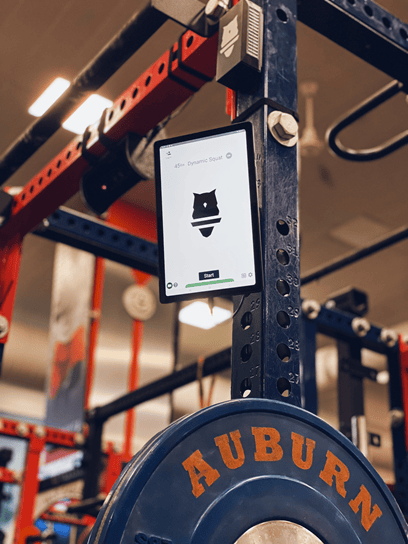
Image courtesy of Perch.
Computer vision cameras are attached, or “perched,” on top of the weight equipment, and through the machine learning and AI, can recognize and calculate the number of reps while charting the corresponding speeds of each lift. The analytics then emerge in real-time, and players can see their body outputs on a small screen or, in Georgia’s case, on the DawgTron.
MLB teams such as the Phillies leaned on it last season because, over the course of 162 games and cross-country travel, the team’s strength coaches were concerned about both muscle atrophy and exhaustion. To balance that properly — lifting without overexerting — the team leaned on Perch’s metrics.
“They wanted [Phillies] players to maintain strength or even get stronger and do that safely while in-season,” Rothman says. “So I think one of our huge benefits for baseball is managing fatigue.”
Other endurance-conscious teams such as the NBA’s Miami Heat and Orlando Magic and the MLS’s L.A. Galaxy and San Jose Earthquakes are also clients for similar reasons. But football players are still Perch’s most prominent use case. And as the season was starting last September, the company closed what Rothman called a “$4 million Seed Plus” round to help them hire a larger staff to keep up with demand.
For instance, NCAA schools such as Wake Forest, Maryland, Virginia, Duke, North Carolina, Boston College, West Virginia and Stanford have all gone public with their Perch usage, while NFL teams such as the Chargers, Patriots, Jaguars, Dolphins and Titans are also on board. Rothman hopes that perhaps the Philadelphia Eagles, Georgia’s football subsidiary, can end up joining next.
With one caveat, though. DawgTron is sold separately.
This article was brought to you by SBJ Tech, a Leaders Group company. As a Leaders Performance Institute member, you are able to enjoy exclusive access to SBJ Tech content in the field of athletic performance.
The renowned orthopaedic surgeon, who previously served as the Medical Director at the New England Patriots, discusses the art of medical leadership in sports.
A Data & Innovation podcast brought to you in collaboration with
“Fortunately, we had a great coach in Bill Belichick, great ownership in the Krafts, Jonathan and Robert, and I really talked to them around the facility about providing a competitive medical advantage and how we would do that.”
Provencher, who served as the Patriots’ Medical Director between 2013 and 2016 – earning a Super Bowl ring in 2014 – is the latest guest of John Portch and Joe Lemire’s on the People Behind the Tech podcast, which is brought to you by the Leaders Performance Institute and SBJ Tech.
Provencher is one of the foremost orthopaedic surgeons in the world and has treated elite athletes from across the globe at the Steadman Clinic in Vail, Colorado.
In a wide-ranging chat, we also explored:
John Portch Twitter | LinkedIn
Listen above and subscribe today on iTunes, Spotify, Stitcher and Overcast, or your chosen podcast platform.
The performance specialists are preparing some NFL prospects for the ‘interview of their lives’ in an interdisciplinary fashion.
Main image courtesy of Exos.
A Data & Innovation brought to you by
The type of question asked during those otherwise idle spring months was, recalled Exos VP of Performance Brent Callaway, “if we’re trying to create the fastest athletes on earth and we have anywhere from eight to 10 weeks to do it, what’s the process that we should follow?”
Across its multiple performance institutes, Exos has trained more than 1,000 athletes for the NFL since 1999, including eight No. 1 overall picks and four of last year’s top-10. For this year’s Combine, which is being held in Indianapolis, 98 of the 319 invitees prepared at Exos, most working out on location for about eight weeks.
“Everyone’s coming here to do the biggest job interview of their lives,” Exos Director of Sports Science Matt Darnell said.
Despite that pedigree of success, its staff wants to continue iterating on its program. That Covid-mandated break prompted Exos to further investigate emerging technologies, leading to several new partnerships. Introduced into the ecosystem was Vald Performance for advanced human measurements, Hologic for DXA scans and Kitman Labs to organize the voluminous datasets. Exos piloted Intel’s 3D Athlete Tracking system in 2021 and uses DARI Motion, its primary motion capture partner since 2018.
“The true magic happens when they can start to feel the customization and then the output of effort that we receive is better because they know that it’s purposeful,” said Callaway, who has personally trained a top-five pick at the Dallas-Frisco location every year since 2017. “I always tell them, within the first 14 days, with the conversations that we’re going to have, you’re going to understand your body more now than you ever have in the past.”
While many athletes who played at Power 5 schools are exposed to advanced technology and staff of innovative coaches, that’s not everyone’s experience. Back in 2015, defensive back Will Brown had competed at Division II Missouri S&T before enrolling in the Exos program. He called the training environment “eye opening” and saw immediate dividends: in two months, he added nearly 10 pounds of muscle and improved his 40-yard dash time by two-tenths of a second.
Brown likened his stint at Exos to the metamorphosis of Captain America. “When he went in the tank, and then when he came out of the tank, that’s how I like to describe my Exos experience,” said Brown, an industrial engineering graduate who returned to work at the company’s Arizona location on its research and performance innovation team.
Callaway described a “downhill slope” of technology, where methods used in the NFL trickle down to college and then to high school, so the base level of training is higher. That’s where Exos delves into personal evaluations and bespoke training plans — “adding pixels to the pictures,” as Darnell put it.
That’s where the work Exos’ interdisciplinary team of physical therapists, sports dietitians and strength coaches coordinate to maximize each athlete’s potential, testing each participant on rapid movements, range of motion, nutrition, body composition, asymmetry and hydration. Instead of this data sitting in eight siloed spreadsheets across the computers of five experts, all of it is collected in Kitman’s intelligence platform. There are built-in alerts when an athlete falls below the 50% standard at his projected NFL position, so there can be training remedies implemented.
The marquee event of the Combine each year is the 40-yard dash, where margins can be razor-thin and even savings of hundredths of seconds can be meaningful. That’s where Exos graduates excelled last year: in Callaway’s first 18 years of draft prep, he has six athletes run the 40 in under 4.4 seconds. He had six more last year alone.
“Some of it, I’m sure, is just an anomaly of talent,” he said, “but obviously there’s quite a bit of training involved here too.”
The newest area of exploration is through Hologic’s DXA scan, which can quantify body fat percentage, detect limb asymmetries and even calculate muscle-to-bone ratio. In consultation with an expert in the field named Francis Holway, Exos is seeking to prescribe ideal body masses for every individual, which may be different even among two men of the same size and same position.
“If I’ve got a 6’2” corner, and I’ve got two of them, and they both weigh 190 pounds, I would imagine their skeleton weighs the same — and that’s not what we’re finding,” Callaway said. “So you have different bone densities, you have different bone sizes, you have different limb length. And if you have an athlete who has too much mass per pound of bone, that can actually be a performance decrement.”
If there’s any one area of training that is persistently underemphasized by athletes before arriving at Exos, Brown said it’s their mobility and functional movement patterns.
“Being mindful of how to incorporate PT as a part of your plan, rather than going once it’s already got the check engine light on,” he said. “We’ve got to really keep the car with the oil and the gas on a daily basis.”
“It’s almost hard to tell where our PT clinic stops and our training floor starts,” added Darnell.
Though there are critics of the Combine — most recently, NFLPA executive director DeMaurice Smith called for it to be scrapped — there is underlying value in some of the datapoints collected. That enables historical comparisons to successful pros. For example, one can assess a prospect’s force plate data and his ability to accelerate and deceleration and marry that data with results in the 40, the 20-yard shuttle and the three-cone drill. (Smith advocated for union-backed regional pro days instead of the national combine.)
“Now you can go back and say, ‘OK, these athletes who tested really well on these tests all have these specific qualities,’ and it’s objective, right?” Callaway said.
“At the same time,” Darnell said of the Combine’s value, “it’s really hard to play the game of football in today’s world without having explosive speed and power and the ability to put on brakes and the ability to show up in an environment under stress, with millions of people watching you.”
This article was brought to you by SBJ Tech, a Leaders Group company. As a Leaders Performance Institute member, you are able to enjoy exclusive access to SBJ Tech content in the field of athletic performance.