Leaders in Business
  • Membership
  • Events
  • Content
  • Virtual Learning
  • Connections
  • Partners
Login
  • Leaders Meet: Innovation
  • Events
    • Leaders Week London
    • Leaders Sports Awards
    • Leaders Club Events
    • Leaders Performance Institute Events
    • Leaders Meet: Innovation
  • Memberships
    • The Leaders Club
    • Leaders Performance Institute
  • About
    • Careers
    • Contact
I’m a sports leader:
  • Off The Field For those focused on the business of the sport View more
  • On The Field For those working with an athlete or elite team View more
  • Login
    • Leaders ClubThe membership for future sport business leaders
    • Leaders Performance InstituteThe membership for elite performance practitioners
  • Newsletters
Performance Institute Leaders Performance Institute Logo
  • Membership
  • Events
  • Content
  • Virtual Learning
  • Connections
  • Partners
Login
Members Only

22 Mar 2023

Articles

Jack Easterby: Moving on from Systems Failure in High Performance

Category
Leadership & Culture, Premium
Share
Facebook Twitter Email Copy Link
https://leadersinsport.com/performance-institute/articles/jack-easterby-moving-on-from-systems-failure-in-high-performance/

The performance specialist discusses the resolution of conflicting ideas and managing the fallout when things go wrong in high performance.

By John Portch
Where does the balance sit between the vision of an incoming leader and the needs of the people whom they lead?

“There’s factors in every culture that pre-exists the leader’s vision – that’s the thing that most people don’t want to admit,” says Jack Easterby.

The performance specialist, who most recently served as the Executive Vice President of Football Operations at the Houston Texans, is referring to the limitations that face a leader. “Sometimes that’s weather, sometimes that’s facilities and sometimes that’s the finances of the club,” he continues.

“If you set your vision based on ideal circumstances and you don’t consider major footprint factors, issues that have held things back in the past, then your vision will never find traction. The balance is: are you receiving from your people the risk factors or the inhibitors of the past and why they haven’t gotten to where they want to be? Are you receiving those and reincorporating them in your new vision? If you don’t do that then even the best vision is doomed to fail.”

This is the second part of the Leaders Performance Institute’s recent interview with Easterby. The first instalment focused on the questions a leader must ask their people. This one hones in on conflict management.

‘People are more attached to motives than ideas’

Easterby argues that a leader must move away from focusing on the origin of an idea to the process of implementation in as little time as possible. “You really don’t want to be stuck to one person’s idea ever. It may be a good idea that someone comes to you with, but you want to be able to create consensus,” he says.

“Everybody is going to have ideas, some are better than others, some will be more original than others like you can take it and put it in place and roll; some things you’ve got to change in a bunch in order for it to work.”

What approach does he take when two people come to him with conflicting ideas? “My first reaction is to ask myself: ‘can we jump into the “why” of both of those versus affirming one or the other?’ because if I can get to the why of those; ‘why do you think we should do B?’ And ‘why do you think we should do A?’ Then what I may be able to do is come up with idea C that incorporates the ‘why’ from both of them and we may actually be doing a different idea in the end.

“People are more attached to motives than they are to ideas. For example, if someone says ‘I want to do expense reports differently because I believe that it costs me too much time to do it this way’, the motive for me is to save time. They don’t really care if they have a debit card or they’re paying online or whatever; they’re really just saying ‘this costs me a lot of time’. You don’t just want to say that idea A is better than idea B, you want to get the motive from idea A, the motive from idea B, and then you want to say ‘how do we consider all of the motives behind these ideas before we implement it?’ ‘They might be saying idea A but they’re not saying that, what they mean is this’. You can then build consensus with idea C.

“You want to know the ‘why’ behind the idea because there’s a lot of time people make great suggestions and you listen to it and think the why behind it is right and pure, ‘let’s go with it’. There’s other times that people make suggestions and these people are tired and frustrated right now, they’re upset with their co-workers, they’ve got some things going on personally. I’ve got to make sure I filter that and ask more questions about the motive to see if that’s really where we should be going with this initiative or not.”

Always have a backup

What about those times when systems simply fail? “The number one thing when moving on from systems failure – this is something I wish I would have done better in Houston – is to recognise that system failure can’t be deflating for the entire team,” says Easterby, reflecting on the time he spent at the Texans between 2019 and 2022.

“No matter what the system is that’s not working, you need to be able to insulate yourself from operating poorly because that system didn’t work. So if something is going wrong in athletic training, if something is going wrong in operations, if something is going wrong with salary cap administration, all of those things have to be done in a way that if something goes wrong there’s another system that you can run temporarily or a backup philosophy that you can operate so that everybody is not looking and going ‘oh my goodness, we’ve failed’ because you can’t let the confidence of the entire group be attached to one system.

“I would say that one of the greatest things I experienced in New England, which was really cool, is that Coach Belichick often had multiple systems in play but the same initiative. So if it were an athletic training situation, he had a couple of different trainers who could do the same job just in case we needed to replace one or something happened. If it was a situation when we were travelling, he had multiple contingencies so that there wasn’t just one thing that threw us off and everyone felt deflated and the confidence of the team was lost because we didn’t execute.

“You never want any particular system to carry the entire confidence of the group. You want to have a lot of layers in there because a lot of things can go wrong in athletics and you’re naturally going to be on your heels some. So if you can create systems, lily pads that you need in case you need to jump from one to the other, that’s the way to do it.

“If the system does fail, the leader has got to be willing to say ‘hey, I didn’t do this right, I missed this, this factor I didn’t consider’; whatever it is, just confess that, because it’s going to open the gate. If you get into blame it’s going to disenfranchise people and they may turn their backs on you, you’re not going to have a chance to build the system back right.

“I like the idea of putting a few people in a committee and potentially starting a meeting structure to talk about why that system failed immediately. ‘Hey, these three people, you guys were really a part of that system. Let’s come to my office, let’s share, let’s get on the white board, let’s talk about why this didn’t work, because your “whys” are going to go right into your new system.’

“You’re going to be learning a lot about why something potentially didn’t work and that’s going to give you the keys to the new system when you’re building it. I like committees or actions that can give you some good feedback; ‘this is potentially where the tension point was and why we didn’t do a good job’ and then you begin to edit. Then I like sharing the results of those meetings publicly within the team. ‘This didn’t work, this is what we found, and here’s how we’ve been addressing those needs, and we’ll meet and implement this new system when it’s ready’.”

Members Only

17 Mar 2023

Articles

Jack Easterby: ‘There Are Questions I Wished I’d Asked in Houston and New England’

Category
Leadership & Culture, Premium
Share
Facebook Twitter Email Copy Link
https://leadersinsport.com/performance-institute/articles/jack-easterby-there-are-questions-i-wished-id-asked-in-houston-and-new-england/

In the first part of our interview, the Former Executive Vice President of Football Operations at the Houston Texans explains that a leader needs the right inputs.

By John Portch
How does a leader in sport make sure they are choosing the right ownership group?

“That’s a very tough question to answer because you don’t always know everything about what everyone’s doing,” says Jack Easterby, the Former Executive Vice President of Football Operations at the Houston Texans.

“It becomes important to look at wide windows of decision-making patterns. Most of these owners have other businesses. You can study some of their investment strategies or their potential investments in those businesses.”

Easterby, who also worked with Bill Belichick, the General Manager and Head Coach at the New England Patriots, believes a prospective leader can learn from studying how the owners structured their C-suite and delegated responsibilities.

He does, however, issue a caveat. “It’s not good to do that based on the media because the media doesn’t always tell the story of what owners are really about,” he continues, “but it is incumbent upon the leader to pick the right place because that alignment is key, from jump street”.

In the first part of this interview with the Leaders Performance Institute, Easterby explores the art of the inquisitor, the questions he thinks should be asked by the leader, and the questions he wished he’d asked in the past.

Jack, what is the risk to the leader in failing to ask the right questions?

JE: People are going to give you information, and when you have whatever reporting structure you have set up, people are going to come to you and say: ‘hey, this needs to be done, this needs to be dealt with’; and they’re going to do that based on their tension points. ‘We need a better bathroom for everyone to use’ or ‘we need a better cafeteria’. You don’t just want the inputs you get to be based on their problems. You want the inputs to be based on what’s going to make the program better. Sometimes, if you don’t ask good questions, and you don’t persist in the deep questions that you feel are better for everybody, what happens is that you get a lot of issues – but the issues that you hear about are not the real issues. So you may solve a lot of problems but you’re not actually getting better. As a leader, I think the question is not ‘do you solve problems?’ – every leader has to solve problems – it’s ‘which problems are you solving?’

What are the important questions?

JE: The ones that make the biggest impact on the clubs that I’ve been part of are the ones that solve the big questions; and in order to solve the big questions you’ve got to ask the big questions. ‘How do we function as an overall group? How are you held accountable for your job? How does each individual person feel cared for in their professional and personal existence? How do we create a better version of ourselves year by year? What are the inputs of information and how we receive data from the outside world? And how do we store data on the inside world and how do we communicate with each other?’ Things like that – when you ask those questions you’re going to get systems, past experiences, a lot of stuff that people throw at you. You can go through it and be able to say ‘here’s what we do from here to go to next place as a group’. But if you don’t ask really good questions you’re just going to get a newspaper of today’s problems sent to your desk. That’s good, but that’s not always the long term best information that you want to go through.

What are some of the questions you wish you’d asked in previous roles?

JE: How do we build or how do we digest the multi-phase implementation of a program? Meaning that I think we all want to win, we all want to be great, but that’s a question I would have asked in Houston, maybe even in New England. How does the leadership team or the executive team digest a multi-phase program and how do we make sure that we’re all going to stay on track no matter how many phases it takes? Because when you diagnose a problem and you go from A to B to C to D to E and you’re trying to elevate slowly to get to a place of prominence, you know that’s going to take some time and phases. It’s going to take some iterations. You might be at phase two and everyone is like ‘we’ve got to get this done’ and so you’re not really at phase two because everybody is ready to abort the mission. I think that’s something I would have asked going in. ‘How does everybody in here receive the multi-phase vision and how do we keep everybody on track to a multi-phase vision so that we’re not evaluating the ham when it’s only been cooking for 15 minutes?’ You can’t pull it out, you have to leave it in there and let it cook because then you can really push out different challenges along the way and say ‘hey, remember we’re at phase two of six’ versus ‘this is the next thing’ and I probably didn’t do a great job of that. I was just trying to sell that next thing as we all got excited about growing. You’re trying to sell that next version of yourself versus ‘hey, this is version two of our nine-step process to get us to where we can be the best version of who we can be here within the club’.

Perhaps it is not always obvious at the time.

JE: That’s exactly right. Hindsight is 20-20. It’s like the stock market, which tells us every day where we are at the moment. You have forecasting but you also have that daily metric on where you are; up down or whatever. When you’re leading, you need to be able to do both of those. You need to be able to forecast and then come back to today and say ‘this is where we are within that forecast’. If you’re buying a bond or something that’s going to mature over time, you need to be able to know, ‘OK, I’m going to remind you. It’s not going to mature today, it’s going to take a second’. And if you do that, your checkpoints are going to be a little easier because you’re not looking for the best possible result within a short period of time.

Members Only

10 Mar 2023

Articles

‘We’re Starting to See Bat-Tracking in Youth Baseball’ – Greg Olsen Talks Tech in the NFL and Beyond

Category
Data & Innovation, Premium
Share
Facebook Twitter Email Copy Link
https://leadersinsport.com/performance-institute/articles/were-starting-to-see-bat-tracking-in-youth-baseball-greg-olsen-talks-tech-in-the-nfl-and-beyond/

The former NFL star, now a broadcaster with Fox, talks about wearables and tracking tech, as well as the implications of early specialization.

A Data & Innovation brought to you by

sport techie

By Andrew Cohen
You can’t have a discussion about sports technology today without including athletes in that conversation. Their partnerships, investments and endorsements help fuel the space – they have emerged as major stakeholders in the sports tech ecosystem. The Athlete’s Voice series highlights the athletes leading the way and the projects and products they’re putting their influence behind.

* * * * *

Greg Olsen has emerged as a breakout star in sports broadcasting, forming a dynamic duo with partner Kevin Burkhardt as the lead NFL broadcast team for Fox Sports. Olsen and Burkhardt’s biggest moment in the broadcast booth came on February 12 at Super Bowl LVII.

As a player, Olsen played 14 seasons in the NFL as one of the league’s premier tight ends for the Chicago Bears, Carolina Panthers, and Seattle Seahawks. He made three-straight Pro Bowls from 2014 to 2016 before retiring after the 2020 season. In March 2022, Olsen partnered with actor Vince Vaughn and former NFL center Ryan Kalil to launch podcast production network Audiorama. The company has received funding from Powerhouse Capital. Olsen, a New Jersey native and father of three children, hosts his own podcast called Youth Inc that’s focused on helping parents and coaches navigate the evolving world of youth sports.

Previous guests on Youth Inc include former NFL star linebacker Luke Kuechly, softball star Jennie Finch, NFL Pro-Bowler Marcellus Wiley, NBA forward Larry Nance Jr, MLB star Christian Yelich, Premier Lacrosse League founder Paul Rabil, and NASCAR legends Dale Earnhardt Jr and Kyle Busch. The show also sees Olsen interview legacy sports families, coaches, psychologists, and authors. Olsen coaches his 11-year-old son’s youth football team. He and his wife Kara also have twin 10-year-olds, a daughter who plays soccer and basketball, and a son who plays baseball and basketball. Olsen’s younger son was born with hypoplastic left heart syndrome and he received a successful heart transplant in 2021.

On the origins of his podcast …

It just spurred from a product of what my life has been. I grew up the son of a high school football coach, grew up around youth sports and high school sports. It’s what I’ve done pretty much my whole life. And now full circle after playing and making a career out of it, college and into the NFL, now I’m a father of three. I spend pretty much every night of my life at a kids practice, a workout, tournament on the weekends. And just from that experience I have a lot of unknowns, a lot of questions and things I don’t really understand or feel like I’m navigating correctly.

And if I don’t know it, someone who’s lived his whole life this way, how is anybody else going to do it? So we thought it would be an interesting concept for a podcast, to bring on some really interesting guests from all over the youth sports spectrum and have those conversations as a resource and a tool for other families, just like mine who are navigating this and trying to have the best practices for their son or daughter. It’s an ever-changing world. The youth sports world seems like every decade it’s unrecognizable, and for a lot of families it’s overwhelming. So we could be that resource, if we can bring on guests and specialists and experts to help share some of that wisdom and, and past experiences.

On his parenting approach and youth sport specialization …

We try to encourage our kids every season to try something different, to test their skill level, test their interests. Then if it’s something they don’t like, there’s no pressure to do it again. But we’re big believers of exposing our kids and exposing them to different sports, different styles of coaching, different types of kids as they get older for middle school and into high school. Find something that they really enjoy doing. Find something that when they practice, it doesn’t feel like work. It doesn’t feel like a chore. It’s something they wake up every day excited to go do. And I think the only way you do that is by kind of casting a wide net and exposing them to as many different experiences as possible.

I have three kids that have different abilities based on what sport, based on what season. And it’s not often about being the best kid or being the most talented, but maybe you find a sport that you had never played before and it’s the one you really wanted to spend the most time. That’s great. We’re on a constant search for that. When you’re young and the idea of just picking a sport at an early age I think could be a little dangerous because you don’t expose kids to finding what their true passion and what their true love is.

On safety conversations in youth football following Damar Hamlin’s cardiac arrest …

We’ve had a lot of those conversations, health and safety of all sports is of the utmost importance. In regard to the Damar Hamlin story, what we all watched unfold our national television was what appeared to be tragic, has kind of turned inspirational within nine days. Just today as of this call to hear that he’s been discharged and sent home. It’s truly remarkable. And, and to see the world kind of unites around him and in prayer and best wishes and faith it was pretty incredible and powerful to see.

In regard to the safety of football, I think that was such a one in a million thing. I think you hear about all these stories in all sports, and unfortunately, I don’t think that had anything to do with football. I think that happens to kids in all different sports — lacrosse, soccer, baseball. There’s unfortunate tragic stories of kids going into cardiac arrest or passing out. It’s unfortunate. I think obviously right now football kind of has the bullseye on it, because of all head injuries and the concussions. Watching that unfold, of course on live television with Damar was hard to watch. But I think when it all settles and all comes out, I think doctors and experts agreed that the risk of that happening on the football field is so small. It’s so rare that it’s really no greater risk factor of something like that happening on the football field versus any other number of fields. It’s tragic, it’s rare and thankfully, and I think everyone’s just thrilled that, that Damar is doing well. We’re just glad that it didn’t end tragically.

On wearables devices in the NFL and if the tech is reaching youth levels …

I think toward the end of my career, a lot of the GPS data tracking that we’d wear, wearable devices for acceleration and deceleration, velocities and load and whatnot. Not only was it implemented in our training, but it was even probably more valuable in our recovery. That that was kind of the last five or six years of my career, and I imagine going forward, it’s just going to continue to be more of a data-driven approach to how we care for athletes, how we train them, how we allow them to recover, how we load manage.

I think data and technology’s kind of at the forefront of a lot of things now, especially in the NFL, and, and I know it’s very common in basketball and, they use a lot of similar approaches in all major league sports. Whether or not that’s going to trickle down to youth level, I don’t know. I think there’s obviously like anything a cost involved. How practical is it for high schools and youth organizations to have the money to pay for that level of data and then obviously hiring the person who can interpret it and apply it.

I think there might be some time between now and when that gets down to the younger level. But I think as far as it’s applicability and value especially at the higher levels, I don’t think there’s any denying that it’s a really useful tool. It’s a really good gauge for coaches, trainers and strength and conditioning coaches that they don’t just have to use their gut instinct. They don’t have to just trust their eyes. They can really look at the data and say, okay, this athlete needs more or less attention in certain areas and, and they can kind of guide programming according to pretty precise data and whatnot. So that was something we used a lot and I only see it growing from here.

On baseball bat-tracking sensors used by his kids …

A lot of kids in baseball use those bat-tracking devices. You track your swing plane, your swing speed, exit velocity. You’re starting to see a lot of that kind of creep in now to the youth level. It’s something that my kids use. It’s something that we use at home and you get a lot of value at them. I think you’re starting to see wearables and technology devices that are a little more cost effective and a little more reasonable in that regard definitely make their way down to the youth level. People are using HitTrax and all sorts of different ways to measure how the kids hit and swing.

This article was brought to you by SBJ Tech, a Leaders Group company. As a Leaders Performance Institute member, you are able to enjoy exclusive access to SBJ Tech content in the field of athletic performance.

Members Only

16 Dec 2022

Articles

The NFL Is Extending its Mouthguard Sensor Program to Four More Schools

Category
Data & Innovation, Premium
Share
Facebook Twitter Email Copy Link
https://leadersinsport.com/performance-institute/articles/the-nfl-is-extending-its-mouthguard-sensor-program-to-four-more-schools/

Data gleaned from college football may help to shape equipment upgrades and even rule changes in the future.

A Data & Innovation article brought to you by
sport techie
By Andrew Cohen
The NFL is expanding its mouthguard sensor program to four additional college football programs: University of Florida, University of Georgia, University of Pittsburgh, and Vanderbilt University. Players at each school can opt-in to wear the instrumented mouthguard during games and practices, and the head-impact data will help inform the NFL’s decisions on rule changes and equipment upgrades such as position-specific helmets.

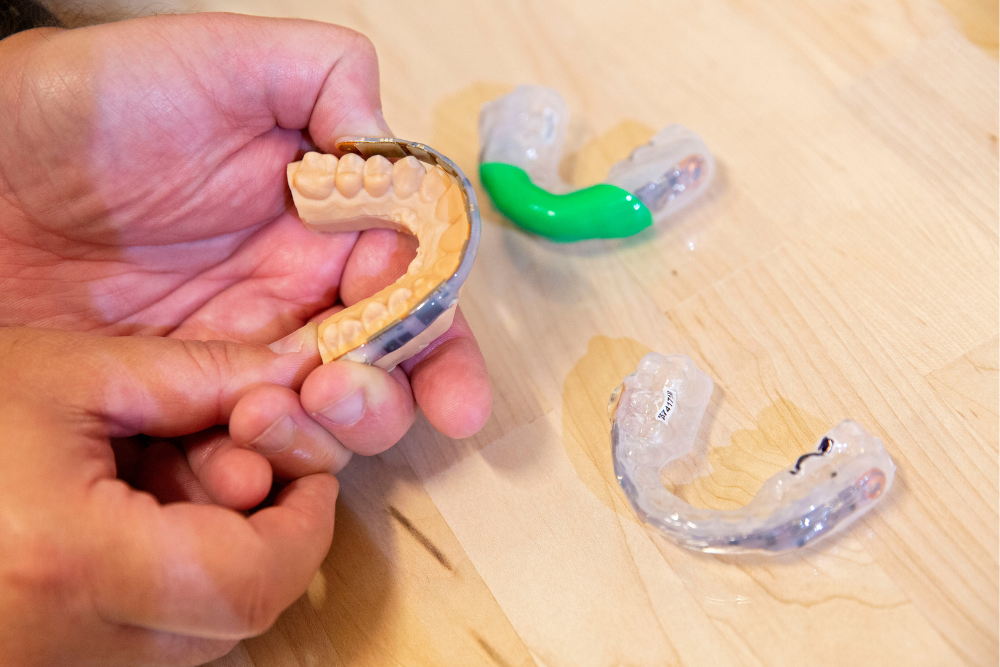
Programs at the Universities of Alabama, North Carolina, Washington and Wisconsin were the inaugural college teams to begin wearing the NFL’s impact-monitoring mouthguards last fall, meaning the league is now doubling its research efforts to eight universities and more than 250 college players. NFL sponsor Align Technology, the maker of Invisalign clear aligners, conducts dental scans of all participating college players. Those digital models are then sent to Virginia-based Biocore to build the personalized sensor-embedded mouthguards for each player.
sport techie

An engineer demonstrates on a player’s mouth mold where the sensor will fit once installed into the mouthguard.

The NFL’s mouthguards calculate the force and location of each impact through measuring linear and angular acceleration. Mechanisms for how football players typically get concussed can vary by their position. For example, quarterbacks tend to sustain hits to the back of the head on plays where they brace themselves against incoming defenders, according to the NFL’s SVP of Health and Safety Innovation Jennifer Langton.

“The mouthguard will tell you the frequency and the severity of impact for each player. If you have enough data in aggregate, you can have it by position,” Langton says. “We have the insights to provide to helmet manufacturers so that they can start to design helmets to mitigate that impact that we are seeing from the data for that position. We want to really stimulate the helmet marketplace.”

Studies of data from the NFL’s mouthguard program is led by Biocore CEO Jeff Crandall and Dr. Kristy Arbogast of The Children’s Hospital of Philadelphia, both of whom serve on the NFL Engineering Committee. Players on at least four NFL teams have worn the league’s smart mouthguards since the 2019 season, after the devices were developed as part of the league’s $60 million commitment to its Engineering Roadmap. Each participating NCAA program receives statistical analysis of player mouthguard impacts specific to their team, but the identity of the players is protected.
sport techie

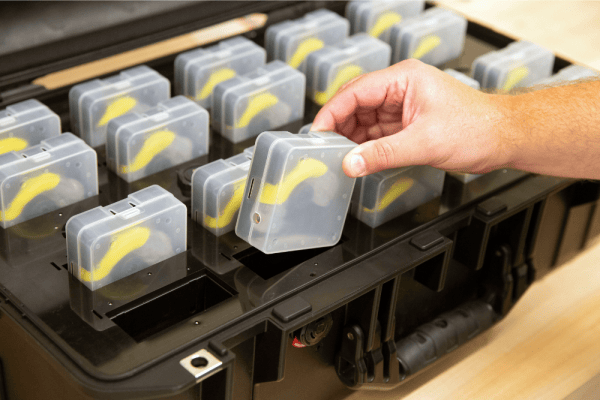
There are control and charging cases for the mouthguards instrumented with sensors.

“Data collected across the mouthguard sensor program is anonymized and analyzed by NFL and NFLPA’s independent engineers,” Langton says. “Only our engineers have access to that data, it does not come to the league office. So when they do the analytics, they provide it so that we can put injury reduction strategies together. But it’s only the independent engineers that have access to any of the mouthguard sensor data, whether NFL or university.”

The 2021 season saw players on 10 NFL teams wear mouthguard sensors, but the league decided to scale back the program to four NFL teams this season. In September, the NFL said it’s recorded a 25% reduction in concussions in each of the last four seasons. Other recent health and safety efforts from the league include the Guardian Cap worn by players during training camp, medical marijuana studies, pre-season load management wearables, and the Digital Athlete system created with AWS that uses computer vision to detect player head impacts during games through video analysis.

The NFL is not the only professional league implementing smart mouthguards. World Rugby outfits players with impact-monitoring mouthguards from Prevent Biometrics, while soccer’s English Premier League does the same through its collaboration with Wales-based Sports & Wellbeing Analytics. Medical leaders from the NFL and English Premier League met in London last month to share their latest findings around soft tissue injury reduction, mental wellness, concussions, and head impacts.

“The mouthguards is a program that we could roll out to the EPL,” Langton says. “And then in addition, with our digital Athlete Program, we are able to identify and track players and their impacts on field, so there is an open opportunity for them to collaborate to use some of those technologies as well,” she says, adding, “there is a huge opportunity to collaborate with other sports so we can share with them what we have built as far as technologies, how we’ve collected the data, and how we’re measuring head impacts in our game so that they can do the same for their sport.”

This article was brought to you by SportTechie, a Leaders Group company. As a Leaders Performance Institute member, you are able to enjoy exclusive access to SportTechie content in the field of athletic performance.

Members Only

5 Dec 2022

Articles

‘This Will Be the Longest Year of your Life’

Category
Human Performance, Premium
Share
Facebook Twitter Email Copy Link
https://leadersinsport.com/performance-institute/articles/this-will-be-the-longest-year-of-your-life/

Nyaka NiiLampti explained how the NFL’s Total Wellness project supports young players across the league.

A Human Performance article brought to you by our Main Partners

By John Portch
  • Help athletes to better understand and use their support networks independently.
  • Calibrate wellness education to your athletes or playing group.
  • Identify the low-hanging fruit in your organisation.

Help athletes to take care of themselves

Nyaka NiiLampti, the VP of Wellness & Clinical Services at the NFL, spoke of the mental wellness work she does with the leagues rookies at the 2019 Leaders Sport Performance Summit in Atlanta. “My first question is asking ‘how many of you have heard that this will be the longest year of your life?’. They all raise their hands,” she said. “Then I ask ‘how many of you actually feel like this has already been the longest year of your life?’ and most of them will raise their hands as well”. A significant part of the NFL’s Total Wellness project, which NiiLampti oversees, focuses on helping young athletes to be intentional in pursuing their wellness. “[We tell them] all of the new experiences that you’re going to have over the next eight to ten months, you need to know exactly who’s your support, how do you take care of yourself, what does that support look like?” added NiiLampti. “Know it now because that’s where we see the mistakes happen, that’s where we see the impulsive behaviours, that’s where we see decision making that could really propel the end of your already really short careers… any mistakes that you make in this space are going to be really costly”.

Set up athletes for their post-playing transition

NiiLampti pointed out that the average NFL career is short even by elite sport’s standards. It is essential for her to understand the culture of the league and its impact on young players. “Anything they see as a potential for someone to see them as not performing up to par in any area is a risk of unemployment,” she said. Make sure you are aware of what those unique cultural factors are but then also know the specific factors about your sport. For example, with the NFL, we know that the average career is 3.5 years. That means you’re going to get guys coming in who are super young who are not going to stick around very long; so how can you make sure you’re providing as much education as you possibly can on the front end?”. This is essential because NiiLampti has found that players “Scotch tape and bubble gum themselves together” due to college and professional football tending to be crisis-focused. She added: “You come into the league thinking ‘yeah, there’s some things I could probably work on but I’ll worry about it after I make my money and transition out’.” Organisations must change this outlook and provide support for their athletes. “We’re going to give you additional skills that might actually help you prolong your career. But [teams should] make what happens in that transition out get a little bit easier. We know the transition out is going to be difficult anyway but what are the sort of things we can do to minimise the difficulty?”

Seek out the low-hanging fruit

There are always quick wins to be found. “One of the things that we talk about is we know that every team is going to have a population of players who struggle with injury,” said NiiLampti, who put the injury rate in the NFL at 100%. “So how do you put things into place that’s low-hanging fruit? How do you put things into place for that population? It’s being aware of who’s your population as well as what are the unique cultural pieces of the environment that you work in? Start small… then that word of mouth grows… if it’s high quality and done well that word of mouth travels”.

Promote sport as a platform for increasing self-awareness

The idea of athletes as role models is as true as some of the best clichés. “We know sports also has an incredible platform and if we can educate and we can use this to further the conversations, particularly around mental health or aspects of wellness; there’s a trickle-down effect,” said NiiLampti. “To what degree, if we are using that platform to further educate the rest of the world, particularly young men and particularly young men of colour, then I think the healthier that men in the NFL get the healthier that young boys get in this country, the healthier families get, and so the healthier we are collectively”.

Members Only

10 Oct 2022

Articles

Why the San Francisco 49ers’ Hiring of John Lynch and Kyle Shanahan Owed More to the Fortune 500 than NFL Tradition

Category
Leadership & Culture, Premium
Share
Facebook Twitter Email Copy Link
https://leadersinsport.com/performance-institute/articles/why-the-san-francisco-49ers-hiring-of-john-lynch-and-kyle-shanahan-owed-more-to-the-fortune-500-than-nfl-tradition/

EVP of Football Operations Paraag Marathe outlined the innovative approach at the Leaders Sport Performance Summit.

By John Portch
  • Are you asking the right questions of candidates? What do you really need to know?
  • Do you fully understand the demands placed on the role for which you are hiring?
  • Personality traits and potential compatibility are increasingly important.

San Francisco took an agnostic approach

In early 2017, Marathe and the 49ers installed John Lynch as GM and Kyle Shanahan as Head Coach as they sought to return their franchise to prominence. Their approach was unconventional, such as the long-listing of 22 candidates, and they didn’t rush. “We were 26 days in and we hadn’t announced anything,” Marathe told an audience at the 2018 Leaders Sport Performance Summit in Chicago. “Fans were getting impatient.” San Francisco had adopted what Marathe called an “agnostic” approach and eschewed the usual questions one might ask an aspiring GM or head coach. “We didn’t ask any of those questions because we figured if you’re at that stage where you’re interviewing for a GM or a head coach, you have a successful process that got you to where you are – we want to know what kind of leader you are,” he continues. “What’s your vision? Who are your mentors? How do you respond to failure? How do you deal with accountability? How do you hold yourself accountable? How do you hold your staff accountable? How do you think about the big picture?”

They recognised how demands on GMs and coaches are evolving

The questions the 49ers posed above are still more readily found in a job interview at a Fortune 500 company than in sports, but Marathe argued that the roles of the GM and head coach require different skillsets in the modern era. He said: “In today’s NFL, it’s no longer just about coaching the team or living in a Motel 6 in West Virginia and scouting players for 15 years – it’s about actually being a CEO on the field, a CEO off the field. That’s what running an NFL franchise is all about, so we were very focused on the process about looking for people who are leaders, who have leadership qualities, who hold themselves accountable, who have a certain amount of humility.”

In John Lynch and Kyle Shanahan they sought a partnership of equals

San Francisco prioritised a partnership, with neither GM nor head coach seen as the senior figure but more of a duo. “A lot of times this is an insular industry where people get threatened by one another,” said Marathe. “So we wanted to go in and find a head coach and a GM that were on the same sort of life cycle in their careers.” The hiring group acknowledged that a particular head coach candidate may work better with a subset of GM candidates. “We tried to find the right match that together brought out the best personality traits for the organisation and together had the right vision for leadership and accountability.”

They tested the personalities of their candidates

San Francisco gradually realised that Lynch and Shanahan would potentially be a good match. Such personality insights were delivered through some of the activities they asked their candidates to complete. One included a list of ten skills or responsibilities for a GM. They produced the same lists for a head coach. “For a head coach it might be designing a game plan or coaching your coaches or evaluating your players,” said Marathe, “and we asked them to rank them, one to ten, in terms of not how important they are but how good they are at each one. They had to be the best at something and they had to be the worst at something. And the same with the GM. It was actually interesting, going through these interviews, that some candidates couldn’t make themselves No1o at something. That teaches you something about them. In some of those exercises we did we really felt that John and Kyle would be very complementary working together.”

Members Only

5 Aug 2022

Articles

TJ Graham: ‘Data Would Have Added a Year or Two to my Career’

Category
Data & Innovation, Premium
Share
Facebook Twitter Email Copy Link
https://leadersinsport.com/performance-institute/articles/tj-graham-data-would-have-added-a-year-or-two-to-my-career/

The former wide receiver discusses the use of data in the NFL and his work with Breakaway Data, the holistic data platform.

A Data & Innovation article brought to you by

sport techie

By Joe Lemire
TJ Graham was a two-time North Carolina state champion sprinter in high school who also played football, accepting his only scholarship offer in that sport to NC State. He starred as a wide receiver in Raleigh, completing his career as the ACC career leader with 3,153 kickoff return yards while catching 99 passes for 1,453 and 16 total touchdowns.  

The Bills drafted him in the third round of the 2012 NFL Draft. Graham played two seasons in Buffalo, catching 54 passes for 683 yards and three TDs. He went on to play regular season games with the Jets and Saints while also logging time in training camp with the Titans, Eagles and Panthers and spending parts of three seasons with the CFL’s Montreal Alouettes.  

Graham, now 32, completed his playing career in 2019 and turned his attention to coaching and data. He’s mentored numerous elite athletes in the Raleigh-Durham area while becoming a data advocate. For a spell, he also worked in Sportlogiq’s business development office on American football projects.  

Graham has spent the past two years at Breakaway Data, a holistic data platform co-founded by the leaders of the Gains Group sports consultancy to monitor and improve their own fitness and performance. He is currently its head of performance and on-field application, but also just started a two-month stint with the Green Bay Packers as part of the NFL’s Bill Walsh Diversity Coaching Fellowship. 

On when he realized the importance of data . . . 

It started a little bit around the time I interacted with Philadelphia Eagles—that was in 2016—but the best and realest time I had a connection with data and analytics in football was definitely with the Panthers. And I’ll give you the story: we had always worn GPS devices, but we didn’t really get that stuff given back to us. It was just measured, tracked, probably used more against us than for us—but also to tailor our workouts to fit us, personalized. 

Other than that, it wasn’t to the degree of… I call it ‘athletic expansion.’ Just for me in my athletic knowledge and IQ, there are things that I need to know, and I need real-time feedback to adjust. I wasn’t getting that until I was with the Panthers.  

One day at practice, one of the strength coaches came by and said, ‘Dude, you ran 23 miles-an-hour on the GPS.’ I’m like, ‘What does that mean?’ He was like, ‘That’s the fastest we’ve ever seen recorded on the GPS units.’ I’m like, ‘OK, I really don’t know what that means.’ I mean, I’m a track guy. So I understand that we’re moving, but in my mind, I’m like, ‘When did I do it in practice? What did I do in preparation for that practice or even that data point to hit 23 miles-an-hour? What did I do to lead up to that? And then how do I replicate that? Or was it so high and so fast that I need time to recover?’  

On the evolution of data in the sport . . . 

It definitely has improved as coaches have gotten younger and the more that the data providers have created education around the space. It started with some [analysts] calculating some and then being like, ‘Hey, this is beneficial.’ And then a coach saying, ‘I don’t know what the heck this is,’ then a coach saying, ‘I kind of know what this is.’ I started between the two of them. Football has always been statistical and analytical. We do down and distance. We do stats. So we know stuff. We want to keep track of stuff.  

I have a heavy track background. My dad was an Olympic track coach. I was around Olympians forever. And I’m at practice listening to splits, listening to times for reps, I’m listening to technical feedback for mechanics. And then, after a while during the summer, I’m seeing them run 9.7, and you’re like, ‘That makes sense now.’ If you don’t hit these different points within your 10-meter splits, 20-meter splits, 30-meters splits, you’re not going to achieve the end goal time. So within practice, within a rep, with your warmup, you have to start tailoring yourself and have an understanding what specifically you need to do to obtain a 9.7 because you’re measuring against the clock, right?  

That same thing can be applied to football with analytics. Coaches have used GPS load to justify if a player is exhausted or done too much and how they go into recovery and how they plan their scripts and their practice plan. That’s high level. That’s way more objective than a subjective view of basically, ‘We ran around today and did this.’ Now we’re having hard data to justify that this guy, compared to this guy, is gassed. So we have tailored practice for this guy specifically but not the whole team—compared to not resting this guy and pushing the whole team and now we hurt this guy. And we really need him. So analytics and data has definitely helped out. 

On how he coaches with data . . . 

I coach as a performance coach but also as a receivers coach with analytics. Specifically, I’ve worked with a lot of the NC State football players in the area and some pro guys, definitely some other colleges and the HBCUs and some high-level high school recruits in the area. I put GPS units on my guys when we run. We start with running technique. It’s important to be efficient within route running so that you can hit every point on the field efficiently, right? No part of the grass is off-limits because you know how to move your body in the most efficient way to that point on the field.  

[I look] at the technicalities of biomechanics. Now I’ll put that in front of video, and then we break it down there. But then we take that and put it on the field. We go from the track or another surface to the field. Now once it’s on the field, it needs to be applied within sport. And I use GPS units to [monitor] change direction, acceleration, deceleration acceleration, average speed, top speed, of course, and just [overall] load. So the quicker that our younger generation can understand it and take the ownership of it off the coaches, the higher level football will be in quicker. Breakaway is doing that right now. 

On whether he would have used data had it been available earlier in his career . . . 

As a young player, I would have had to be receptive to this information, and I might have just been ignorant to the fact that it was even around, or it was just so early on that it wasn’t around.  But I think it would have definitely added a year or two onto my career, just knowing how to be more strategic in my preparation.  

Right now, we’re in the NFL offseason. So prior to showing up for OTAs, I was very calculated as an athlete. It was a chance to really hone in on or own the thing that you really good at, really work on that craft. So, for me, I always had to work on my top-end speed. I could not show up to an NFL camp and be anything less than that. And that was important to me. So in order to either maintain or to increase my top end speed, we have to measure, we have to run, we have to be consistent, we have to, like, run to the point of exhaustion. Understand that that point and that wall is going to be pushed further the next time. But we have to know where that wall is to even push it further. 

On the infusion of sensors in the sport . . . 

Sports and football are getting there. We have sensors in our helmets. There are sensors in the ball. There are sensors in our shoulder pads. There are sensors now in our tights, our girdles, to see what strains or what muscles are activated in our legs and seeing how they are strained or stressed. Next up will be shoes, right? That would measure stride length, frequency, force—almost like a force plate in your foot. Next will be your hands and gloves. You have your visor being able to do some digital overlay. There’s a way to make this whole thing work. 

On joining Breakaway Data . . . 

When I first heard about the idea around Breakaway, I was sold immediately because I was like, ‘Excuse me. where the [heck] was this my whole career?’ I’ve been waiting to aggregate all my stuff in one place. It’s just been me by myself, and I cannot do it, and I need something to help me make it all sticky.  

The part about it that is really cool is that it incorporates your recovery outside of football, your lifestyle outside of football, with your lifestyle within football. If I can figure out if I walked too much in the mall and figure out how much energy I would have for practice, it would definitely on the next day be like, ‘Don’t go walk around the mall that much.’ Without that, guys were doing this pregame ritual when you go to a new city—for instance, we would stay at the Galleria in Houston, and it was right across the street from a nice big designer mall. All I saw was just steps and steps that I need to recover from prior to tomorrow. They’re going to ask a lot of me, and I’m going to run a lot tomorrow. So let me not use that energy over there at the mall.  

One of my guys [that I coach] is coming back from an injury. We’re not doing as many reps with him, but his GPS load and output and overall energy exertion was just as high as one of other guys. I’m like, ‘So what were you doing if you weren’t in the workout?’ Then you start looking back at the video, and he’s having fun behind the line. He’s moving over here. He’s dancing. He’s doing this, he’s doing that. And all that plays into it. I’m measuring it, and I’m getting it. I’m like, ‘Well, you need to just sit down somewhere. You need to be a little more detailed and fine- tuned.’  

On empowering athletes through their data . . . 

Breakaway is knocking on the door of owning that data. Own your data. The team’s tracking it for their own good, but it’s going to be on your own personal self to go take advantage of that and read it and understand it and ingest it and figure out how to become a better player yourself to even help your team. A football roster is 60, 70-plus in the NFL. Colleges are 100 deep. That’s a lot of bodies to assess. I have 12 players, and it takes me three hours to go through some lines of code and lines of data and statistics. 

I cannot imagine doing a full team on the daily, but an individual player can go in read his line off in maybe 20 minutes—see what they did, how they did—and now they can justify their day after that. For linear speed, I like to see average sprint speed and average time spent sprinting. Now if you have a long time sprinting, now you’ve got to understand the mechanics of sprinting. You put a lot of high stress on those body parts. It’s like you’re a driver, and you need to go check the tread on your tires.  

Sure, your tires are worn. You’ve got to go refresh your tires. The same thing happens to your body. You have to know what you’re doing—not just go and feel it, but you’ve got to know exactly what you’re doing and have a plan in place. And once you start justifying creating a schedule a routine that you know, satisfies your output, now you’re going to be a consistent Tom Brady type player, right, like longevity type stuff. We can’t just grind it out like we used to in old-school football. And that’s where the younger class has to get on board and be able to read what is being measured, but also understand who to go to and where to go to manipulate the outcome or output on the other side. So, that’s Breakaway. 

On getting players to lean into data . . . 

Building trust with data is tough, right? It’s almost like building trust with the court system. It’s got to be fair. No bogusness, no BS. It is for you, and it can be used against you. It’s a weapon and a shield. Some teams do a good job of taking care of their athletes, but the uniqueness of it is that it can be used as a shield to keep away the BS. A team is going to try to justify your reps, your pay, your position, your whatever, by whatever they collect. But you need to know, as if you were in courtroom, what they have on their side, to even combat it. And it has to be an open forum. And you can’t be intimidated by knowing that they know.  

It’s just an understanding that it’s something that’s going to happen, like our iPhones are tracked but that doesn’t stop you from using your phone, right? We’re ahead of the game, in the sense of we are so early that every time we meet a person, we have to explain its usefulness or benefit. But you still need a place to put [the data]—so insert Breakaway and its app. It’s definitely why I’m here and why I’ve been so passionate in the space because as much as it’s annoying to try to get data released to us, it’s necessary. The sooner that all the data could be sent and delivered back to an athlete, the better, and it’ll lessen that feeling of being scared about the new technology.  

It starts with owning your own shit. That was one of my slogans I pitched to Breakaway— own your shit. You have to own your stuff, like listening to the Panthers tell me it was I was running at 23 miles an hour. That was just the tip of it. That was just throwing a pebble in my pond, and the ripples started going. They’re cutting and signing people based off of expenditure of GPS loads and movements and all sorts of craziness. You need to know what they’re doing and why they’re doing it and what they’re tracking and why they’re tracking it, to even fight against that. 

This article was brought to you by SportTechie, a Leaders Group company. As a Leaders Performance Institute member, you are able to enjoy exclusive access to SportTechie content in the field of athletic performance.

26 May 2022

Articles

Leaders Meet: Learning & Cultural Development – the Key Takeaways

Category
Coaching & Development, Leadership & Culture
Share
Facebook Twitter Email Copy Link
https://leadersinsport.com/performance-institute/articles/leaders-meet-learning-cultural-development-the-key-takeaways/

By Luke Whitworth

The focus of our first Stateside Leaders Meet of 2022 was centred around the concepts of Learning and cultural development.

Throughout the day, we sought to learn how to apply new thinking and ideas in practice, explored how we are looking to evolve our respective organisational cultures, we even profiled the Blue Jays’ environment after spending time walking around their new Player Development Complex in Dunedin, Florida, and we wrapped up the day by hearing how Jack Easterby, who is responsible for implementing the core themes of the day at the Houston Texans, where he serves as Executive Vice President of Football Operations, puts them into practice.

Across the day, the group discussed concepts such as the application of learning, learner safety, becoming a cultural architect, belonging and much more. Taking these dynamics in mind, here are the choice insights from the day’s proceedings.

Session 1: Application of Learning

Speaker: Dehra Harris, Assistant Director of High Performance Applied Research, Toronto Blue Jays

  • Continuous Learning: one of the best things you can do for yourself is always be learning. If you aren’t learning, how are you going to help others learn better?
  • Ingredients for Applied Learning Model: specificity, support & perspective taking.
  • Perspective Taking: this is the key to applied learning. Activate the right part of the brain through asking questions.
  • Do vs. Reflect: in high performance sport, there is a culture of doing, but in the process of quality applied learning, we need to reflect on how we do things.
  • Create a Sense of Belonging: people do not fail on purpose – belonging is always at stake and is often something that is overlooked. What actually enables someone to take risks? (Safe environment, trust, relationship building, vulnerability.)
  • Be a Power of Support: how willing are you to become the power of support? There can be a culture of outcome in high performance sport, which is often where our language extends to – that language is often based on the outcome we want.
  • Repetition: repetition is a key component of applied learning.
  • Specificity: specificity is your separator. If we are creating environments for athletes, the more we know them, the more we can drive acceptance.
  • All Behaviour Has Meaning: no matter what the athlete is doing, their mindset is that it is their best solution (it is their version of right).
  • Creating Specificity; Adaptive Learning Environments: core questions to consider around adaptive learning are what decisions do your athletes make? What is involved in that decision? In how we design things, what do they need from us?
  • Coaching becomes the reinforcement because the game does not provide reinforcement.
  • Do you address each element of the tasks they need to perform?
  • Repeatability & Adjustability: how are you dialling in and creating a space for repeatability and adjustability? Input variability into the things people do.
  • Understanding Obstacles: do you understand the obstacles they face? Time, understanding, can’t see it, can’t focus, physically can’t move that way, don’t have resources, don’t fit your model, don’t have support, don’t believe in themselves.
  • Support for Repeatability & Adjustability: how do we build for the above? Support for repeatability and support for adjustability.

Session 2: How Are We Developing Our Cultures & Creating Learner Safety?

  • Group 1: feedback and acting on it. Making it a two-way conversation. Something that has to happen consistently.
  • Group 2: clarity of communication. Providing a clear vision, philosophy and approach. Having two-way communication is a great way to learn. Ownership and vulnerability – owning your mistakes. Trying to now drive a philosophy and approach of empowerment, moving away from authoritarian.
  • Group 3: create time and space for conversations and learning. Do you leverage ‘coaches retreats’ where there is time for safety and understanding? Do you create strategic pauses to assess where we are at? It’s important to have context in decisions and situations. Create value in the human relationship and being conscientious.
  • Group 4: meaningful vulnerability, managing your own reactivity and having a safe environment where you need to trial and be patient. Take the emotion out of it, go to the hard areas and explore the root of the problem. Communication vs. confrontation – do they fully understand and grasp the concept? Break things down and take your time. Think about ‘calling people up or in’ – don’t call people out. Remove the stakes and listen.
  • Group 5: collaboration of input and messaging with influential stakeholders – in pursuit of this mission, these voices are collected at the start and then disseminated. Building structures, ensure that they are clear and the expectations have clarity as well. With this approach, it can create a sense of calm around what was expected. In times of change, don’t clean sweep everything, maybe only 25 per cent needs to change to evolve a learning culture.
  • Group 6: create task alignment. People at the top show vulnerability and accountability, which helps everyone else underneath to feal safer. Do you have a consistent feedback loop? It’s great to have them, but make sure you go through that feedback. Go into others environments and be vulnerable – take yourself out of the comfort zone to develop relationships in an environment that is more natural to them.
  • Group 7: what is safety? It is the healthy environment where we learn to understand vulnerability and take risks without repercussions. To help create those environments, set expectations of working (norms, acceptance, collaboration) – this will set clarity on purpose.
  • Group 8: with culture specifically, peel back layers and keep a constant review of how things are going. Get to know each other more. Have deep discussions around deep pain points of the previous year – how can we get ahead of those?
  • Group 9: vulnerability and the admission of mistakes. To improve learner safety you can ask more questions. Ask the learner how they like to learn – help them to lead their own learning.
  • Group 10: generate a community of belonging – easier to learn, make mistakes and have a safety net. Subject matter experts fear making mistakes. Feedback culture – it’s hard to learn and develop without that feedback; set expectations at the start.
  • Group 11: trust is less a thing and more a pattern of behaviour. You have to behave in a way that you have faith for someone to execute. Creating a common language can support learner safety – something that can be understood by people in an environment to drive inclusion and understanding. What do we mean when we say certain things? Feedback – what does this look like? How are we guiding people through that reflection?

Session 3: Levers for Leading Culture

Speaker: John Bull, Director & Lead for High Performance Research, Management Futures

  • Shifting Culture: 80 per cent of organisations have clearly stated ambitions around how they want their culture to be – approximately 20 per cent act upon that vision. If you look at sustained high performing environments, it’s close to 100 per cent.
  • Defining vs. Instilling: the most common mistake is putting too much energy into defining the culture, but not enough in instilling.

6 levers for leading culture:

  1. Define Aspirational Standards and Communicate in a Way That Sticks (leave the jersey in a better place and bone deep preparation are standards utilised by the New Zealand All Blacks). How sticky is your communication?
  2. Unpick Successes to Codify What Works (Appreciative Enquiry) – when we are at our best, what does that look like?
  3. Develop Skills & Or Processes to Support Intent
  4. Involve People in Reviewing Progress (Culture Conversations)
  5. Feedback (Reinforce Positive / Challenge Negative)
  6. Get the Right People on the Bus
  • Appreciative Inquiry: works well in culture change. This approach builds self-awareness and technique. Identify and share examples where you have been at your best and identify behaviours that stand out and be specific.
  • Intent vs. Skills: having an intent for culture is not enough, it takes skill.

 Four Skills of Effective Collaboration:

  1. Build High Trust Relationships at Pace: act as if there is trust immediately. Research across silos. Focus on shared interests. Invest time and energy in building relationships.
  2. Speaking Up: contribute, share knowledge, insights and ideas. Challenge each other.
  3. Listening Up: situational humility (open to what we don’t know). Proactively seek out and be open to other people’s insights and views. Lead with questions.
  4. Situational Awareness: aware of and take responsibility for how the team is performing. Help the team make good use of time (Diamond Thinking).

Three Types of Thinking Environment In Groups

  1. Open Dialogue: thoughtful debate. What they’re thinking, then listening.
  2. ‘Polite’ / Withholding: people not saying what they’re thinking.
  3. Fixed Position: expressing views, but not listening.

Four Types of Psychological Safety

  1. Inclusion Safety: I feel valued and a sense of belonging. Safe to be myself.
  2. Learner Safety: I feel safe to ask questions, seek guidance, ask for help, admit mistakes and be vulnerable.
  3. Contributor Safety: I feel safe to share my ideas, and trusted to act on my initiative.
  4. Challenger Safety: I feel safe to challenge the status quo.
  • Skilled Candour: create safety and show you care.
  • Skilled Candour: driven by Kim Scott’s research.
  • Ruinous Empathy.
  • Skilled Candour (creating psychological safety and speaking directly).
  • Insincerity (we don’t challenge, because we are often protecting ourselves).

Session 4: Learning & Culture in Practice

Speaker: Jack Easterby, Executive Vice President of Football Operations, Houston Texans

  • People vs. Structure: organisational structures are so different. It is important to study people more so than the structures. You either value people or you don’t.
  • Four Buckets Around People Development: Emotional Intelligence / Intellectual or Curiosity Component / Skills They Have Learnt / Gifts They Have Been Given. After researching those who are thriving or diving, these have now become the four buckets that the Texans use in terms of their people development and recruitment.
  • Use People’s Gifts: with the fourth concept of ‘gift’, if we are to have this as a zone of success and contribution, we all win. Build cultures around what people can be outstanding at.
  • What is Your Curriculum: there had historically been a lot of inefficiency. We explored the ‘curriculums’ of each person in-season, during camp and post-season. From here, it allowed the Texans to identify where things overlapped and create more effective workflow.
  • Ask Questions: be curious and ask questions within your environment. Start where the environment is at. Once you understand this, that’s where your philosophy can begin to have an impact.
  • Thriving: when you are evaluating people, you have to be careful to make sure the result is about a person’s ability to thrive. If we take time and space out of the equation, widen the lens and take away the anxiety that is permeated about fear.
  • Re-Delegate Assignments: one of the big leadership lessons Jack highlighted is the ability to reassign assignments and projects if they are taking the life out of someone and they are not thriving. Take it out of their bucket and give them something else that can help them to thrive, not starve.
  • Nameless & Faceless: when you are trying to either evolve culture and reinforce standards and behaviours, going nameless and faceless is an effective approach. Often there is a debate around whether to start with staff or to start with players – it’s best not to prioritise either, but go nameless and faceless.
  • Onboarding: if you are onboarding, you are equipping and inspiring. There is a curriculum that sits within all of these three phases. Highlight how you attach to the greater good of the organisations.

Go to home
Follow us on Instagram Follow us on LinkedIn Follow us on X

Contact

Leaders UK

Tuition House
27-37 St George's Road
Wimbledon
SW19 4EU
London
United Kingdom

Enquiries Line: +44 (0)207 806 9817
Switchboard Number: +44 (0)207 042 8666

Leaders US

120 W Morehead St # 400
Charlotte
NC 28202
United States

Enquiries Line: +1 646 350 0449

Leaders

  • Contact
  • About
  • Careers
  • News
  • Privacy Policy
  • CA Privacy Rights
  • Cookie Notice
  • Website Terms of Use

Performance Institute

  • Membership
  • Events
  • Content
  • Virtual Learning
  • Connections
  • Partners

Latest

Intelligence Hub
High Performance Future Trends Research Elite Performance Partners continue to drive the potential in high performance forward through renewed Leaders partnership
Your Privacy Choices

© 2026 Leaders. All rights reserved

  • Privacy Policy

Attendees

x