NewtForce’s streamlined analysis tool enables real-time pitching feedback thanks to its collaboration with motion capture specialists Movrs.
Main Photo: Movrs

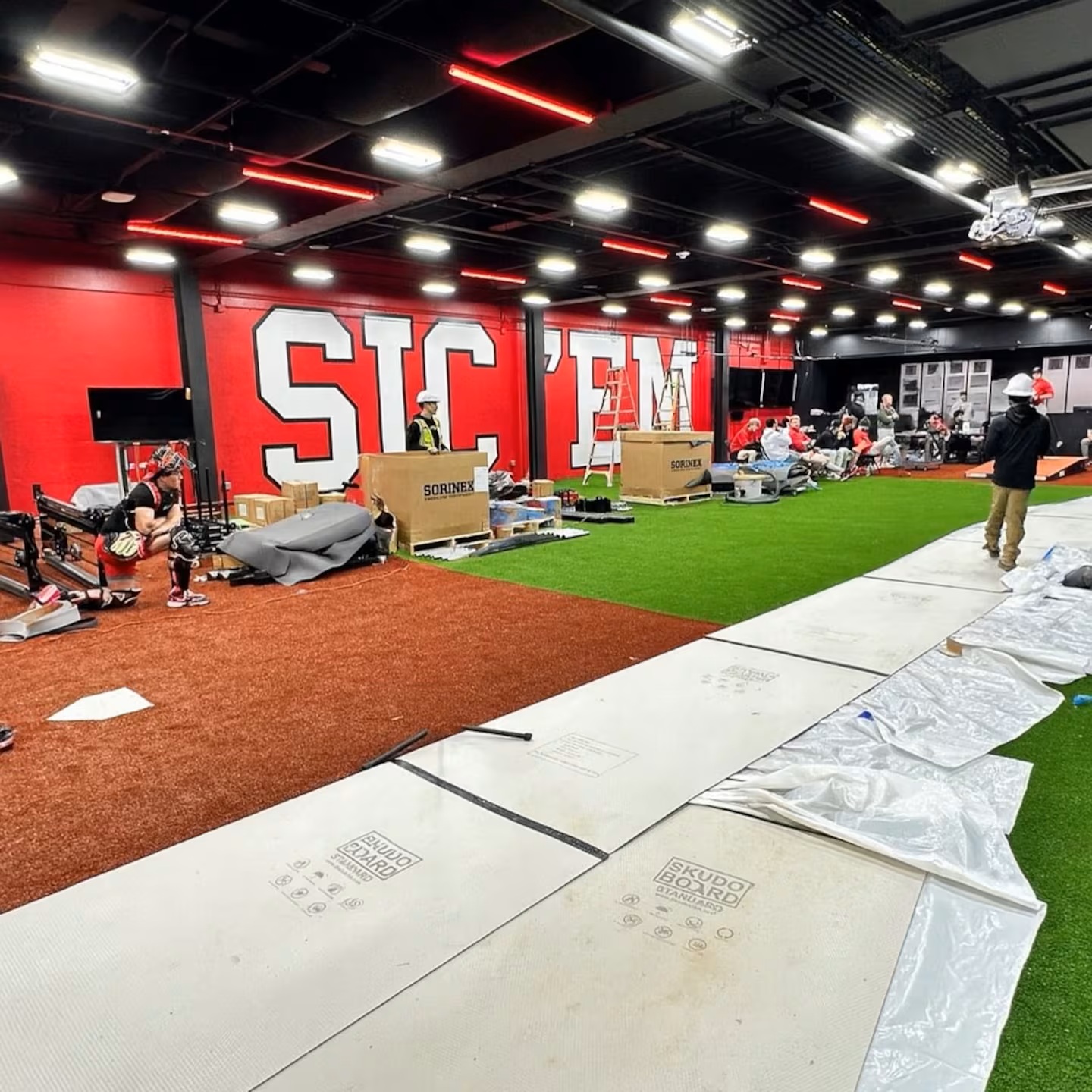
The Bulldogs began using the new high-tech pitching tunnels while construction workers were still clearing the space. Photo courtesy of NewtForce.
This article was brought to you by SBJ Tech, a Leaders Group company. As a Leaders Performance Institute member, you are able to enjoy exclusive access to SBJ Tech content in the field of athletic performance.
Artificial Intelligence could be making key calls in your sport.
Main Photo: Getty Images
Current automation: NASCAR’s Optical Scanning Station maps the exterior of cars to ensure they comply with the rules. Bolt6 cameras also inspect the underbody of cars and operate the Pit Road Officiating system to flag violations.
Possible on the horizon? NASCAR intends to upgrade existing tech.
Current automation: The automated ball-strike challenge system is used throughout minor league baseball. A full ABS system is used by the KBO.
Possible on the horizon? MLB is likely to adopt the ABS challenge system for the 2026 season. It is also in the early stages of low-minors testing whether checked-swing calls can be automated.
Current automation: The NBA provides enhanced replays augmented with tracking data to assist with goaltending and basket interference calls.
Possible on the horizon? Determining who last touched the ball out-of-bounds and whether a shooter was behind the three-point line are under development, as are shot clock and other timed-based violations. The tech will start in the NBA, but it already is being investigated for the WNBA, too.
Current automation: The NFL will measure for first downs with Hawk-Eye cameras this season and contribute to calls about where punts fly out of bounds.
Possible on the horizon? The NFL and its innovation-minded collaborator, the UFL, are looking into whether the ball can be spotted after each play using technology, as well as making determinations on whether the quarterback is in the pocket (for intentional grounding and roughing the passer calls) or whether there are too many men on the field.
Current automation: The AI-powered Judging Support System is used as one input in the total score.
Possible on the horizon? There has been no report to date that gymnastics would consider full automation of scoring.
Current automation: None
Possible on the horizon? The NHL could use tech to determine offside, goal or no goal or whether a player high-sticked the puck.
Current automation: Rugby balls with embedded Sportable sensors were trialed at international youth tournaments to determine whether a ball was thrown forward, where a ball exited the pitch, whether a ball was touched in flight, whether the ball has reached the try-line and whether a lineout throw was straight. A Touchfinder feature helps Six Nations make boundary and ball spotting calls.
Possible on the horizon? Conversations around possible expansion of the tech are ongoing.
Current automation: Goal-line technology determines whether a goal is scored, and enhanced semi-automated offside technology makes all but the closest calls automatically.
Possible on the horizon? FIFA is researching whether technology can identify the player who last touched a ball before it went out of bounds. Detecting hand balls is also possible.
Current automation: All line calls can be called electronically.
Possible on the horizon? Technology could help determine whether there was a second bounce or a let serve. Electronic line calling will continue to move downstream into college and juniors tennis.
Current automation: AI judging will be one input in the total score beginning with the January 2026 X Games.
Possible on the horizon? Full automation of scoring might be possible.
This article was brought to you by SBJ Tech, a Leaders Group company. As a Leaders Performance Institute member, you are able to enjoy exclusive access to SBJ Tech content in the field of athletic performance.
The one clear theme across most sports is that human officials should be supplemented, not replaced, by AI.
Main Photo: Getty Images
There were also 20 4K optical tracking cameras triangulating motion from the players and ball. A few infrared cameras operated lightly in the background. The NBA is building a new R&D lab at the G League home of the Salt Lake City Stars. The lab will feature multiple tracking systems, connected basketballs and more to test a variety of on-court technology “with the top priority being officiating,” said NBA Senior Vice President Tom Ryan.
The NBA has created an automated officiating group within its Basketball Strategy & Growth Department, hiring data scientists and engineers — led by Avinash Bhaskaran, previously of Nvidia and autonomous vehicle company Cruise — to create a new, league-operated technology stack. Its three main purposes are to improve call accuracy and consistency, hasten game flow and enhance transparency and consumer confidence.
“You’re trying to trade off speed versus accuracy versus entertainment.”
Rufus Hack, CEO of Sony’s sports businesses
A recurring refrain from the more than two dozen insiders across sports that Sports Business Journal spoke to was that human officials, referees and umpires are far better at their jobs than fans will ever give them credit for, and few are seeking full automation of officiating; just supplementary aids. But they also have an inherent limitation of using only two eyes from one viewpoint, tracking projectiles that can travel in excess of 100 mph.
“At some point,” said SMT CEO Gerard J Hall, “that technology is more accurate than any human could ever pretend it to be.”
The presence of instant replay is ubiquitous in modern sports, but there’s a newfound emphasis on using technology not to review decisions, but to automate binary calls: ball or strike, in or out, offside or not? Tennis pioneered this practice with its adoption of Hawk-Eye Innovations’ cameras for line calls, first as a challenge system 20 years ago and now often used on every shot.

Automated officiating in baseball and other sports can help bring more accuracy and quicker decisions to games. But there are downsides to removing the human element from decisions. (Photo: Getty Images)
In recent years, that idea has spread downstream — junior tennis tournaments might have an iPhone or two mounted atop chain-link fences to call lines using an app called SwingVision — as well as to other sports. Every NFL stadium now has six Sony-owned, 8K Hawk-Eye cameras to virtually measure first downs and supplant the iconic, but archaic, chain gangs.
The Premier League adopted semi-automated offside technology last spring. MLB is likely to add a new challenge system for calling balls and strikes in 2026. The NHL, X Games, NASCAR and international gymnastics have all begun using or researching automated officiating principles as well.
How, why and even whether to implement such tech is thorny. Sports is approaching a tipping point where it reckons with how much of the human element to preserve, how much technology to deploy and the right balance of the two, putting human and machine in the best positions to succeed.
“All sports are wrestling with the right way to weave technology into the officiating of the game and to get as many calls right without making the game less entertaining and ruining the game’s rhythm and emotion and humanity,” said Morgan Sword, MLB’s Executive Vice president of Baseball Operations. “And it’s tricky. Each of these decisions is fraught with conflicts.”
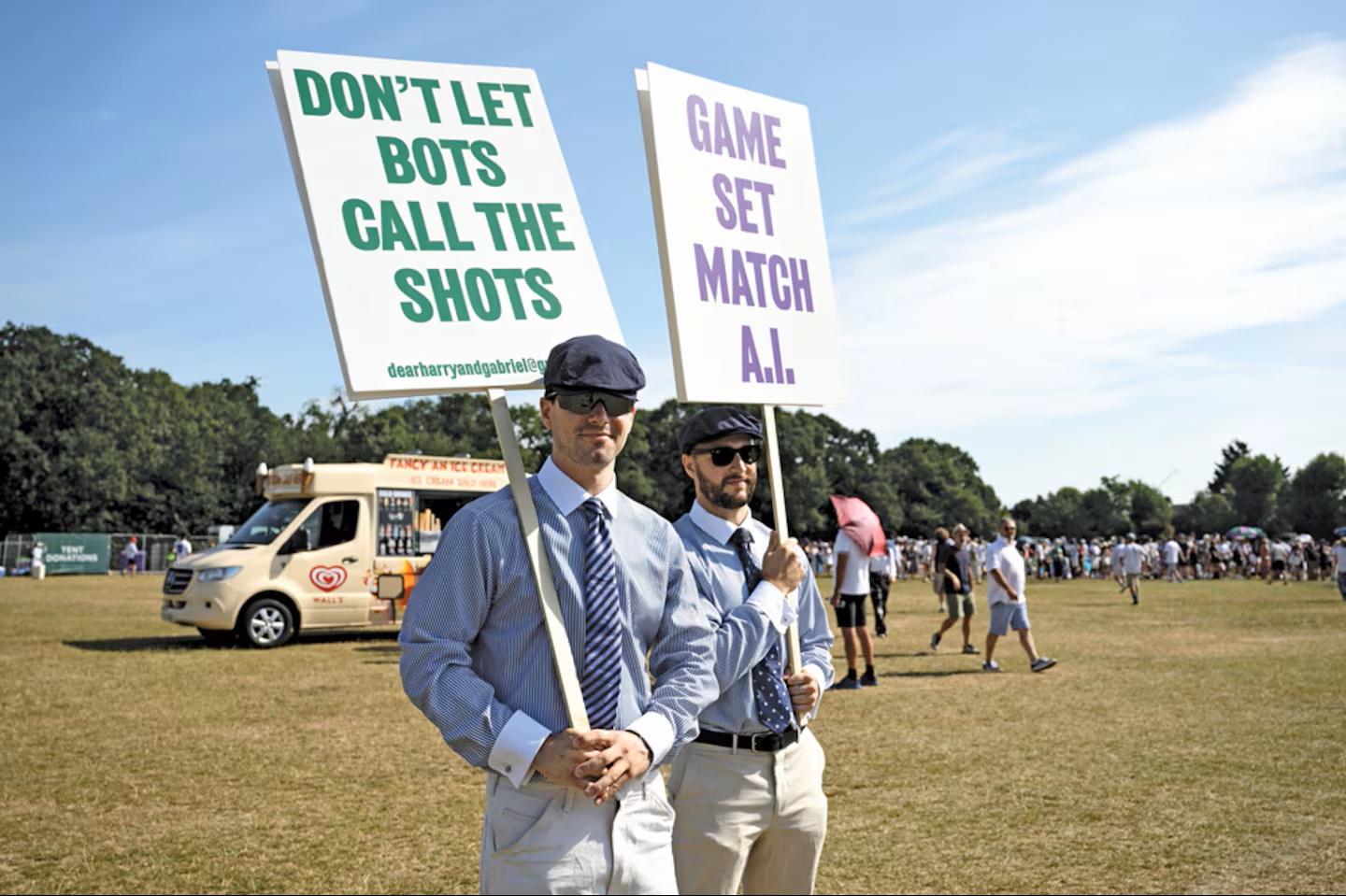
Protestors decried Wimbledon’s move to fully electronic line calls. (Photo: Getty Images)
Hawk-Eye is not only the trailblazer but also the primary provider of these technologies, with its cameras and algorithms able to track balls within one-fifth of an inch. Rufus Hack, the CEO of Sony’s sports businesses, shares a basic rubric for considering officiating tech.
“You’re trying to trade off speed versus accuracy versus entertainment,” Hack said.
The interplay of those three priorities varies by sport and league. He noted, for example, that accuracy is particularly paramount in short-duration tournaments, such as the FIFA World Cup, but perhaps less critical in the early throes of, say, a 162-game baseball season.
The dynamics and culture of a sport need to be considered and rigorously tested, Hack said. “Its implementation needs to be handled incredibly sensitively, and it needs to be empathetic to the values of the game because obviously people are incredibly passionate about their sport.”
The rigidity of technology’s calls also begs the philosophical question: What actually should be called? Is strict adherence to the rules always best or should there be some contextual subjectivity, such as when a police officer has the discretion to decide how tightly to enforce a speed limit?
The goal — and it’s a hard one — is not to let technology change the framework of a sport. As former NFL officiating boss Dean Blandino, who now holds that position with the UFL, said, “It’s just creating that right balance between ‘let’s get it right in those big moments’ but ‘let’s not distort how we do things for the majority of the game.’”
In the multitrillion-dollar asset class of sports, with athletes earning nine-figure salaries to play games with billions at stake in bets and broadcasts, the integrity of the competition has never been more closely scrutinized.
“The stakes are just too high not to try to solve this.”
Jeremy Bloom, X Games
As X Games CEO Jeremy Bloom, a two-time Olympic skier and NFL kick returner, described the gravity from his own playing days, “It didn’t feel like a medal was on the line. It felt like my life was on the line.” He’s now also Founder and Executive Chairman of Owl AI, an officiating tech spinoff run by the former head of AI at Google.
“The stakes,” Bloom said, “are just too high not to try to solve this.”
Here’s how leagues and tech companies are developing solutions that balance accuracy, speed, entertainment and the futures of their sports.
Accuracy
Paul Hawkins is an enthusiastic sportsman who earned a PhD in artificial intelligence in 1999 before developing a computer vision tracking system as a broadcast enhancement for cricket and tennis. Within a few years of it populating TV screens, the sports world started noticing the disconnect between what officials called and what the technology showed.
A 2004 US Open quarterfinal match in which four clearly incorrect calls went against Serena Williams in her loss to Jennifer Capriati ignited interest in a better system; Hawk-Eye was in use by the USA Network for the match.
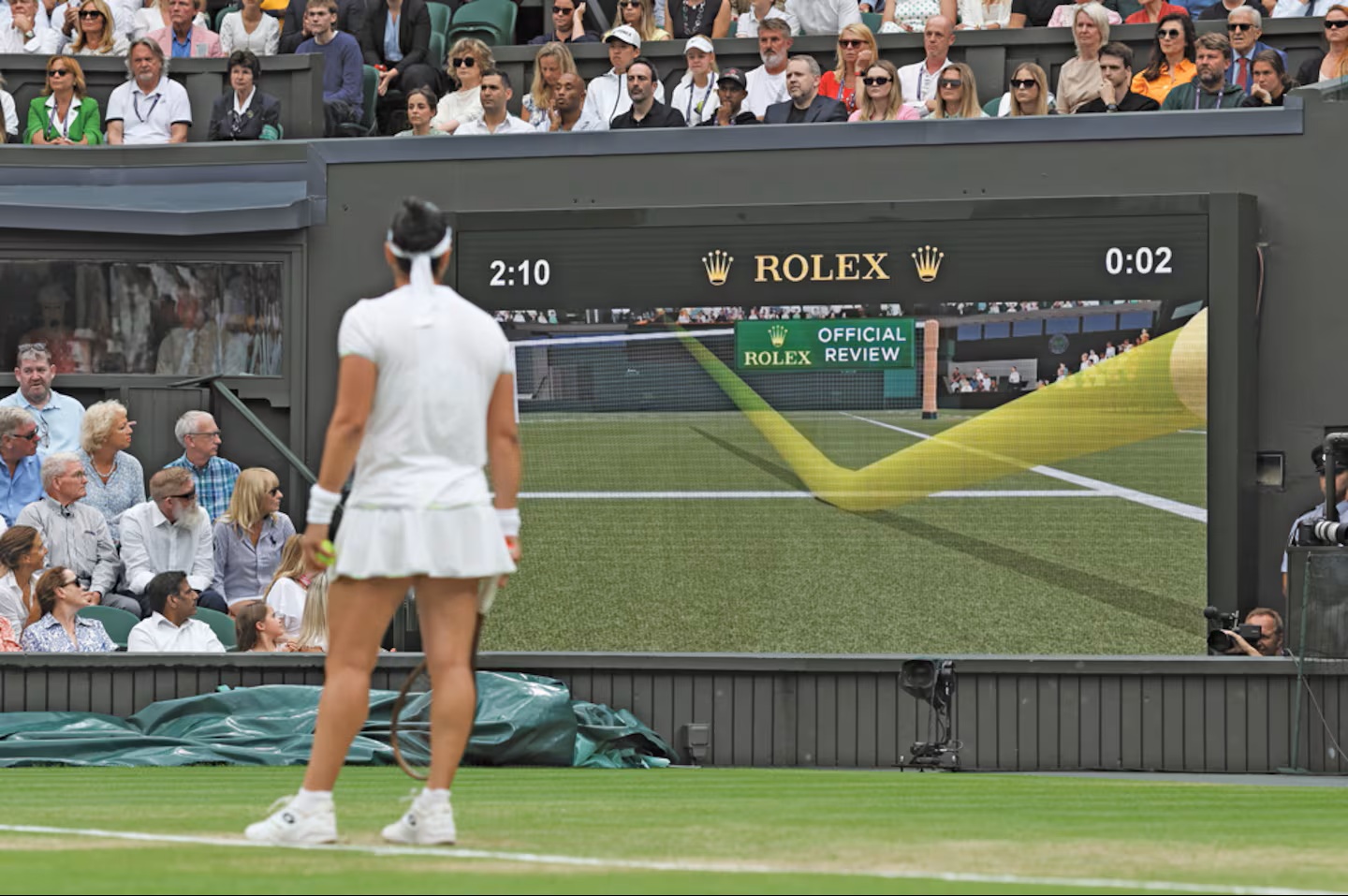
Tennis was the first sport to embrace automated officiating. (Photo: Getty Images)
“It became more and more apparent that the umpire essentially had the worst view out of everyone,” Hawkins recalled.
Hawk-Eye was used as an officiating tool for the first time a year later and, by 2006, was adopted at the US Open. At the outset of its first Grand Slam, USTA Tournament Director Jim Curley approached Hawkins and told him, “If I don’t see you over the next two weeks, you’ve done a great job.”
“You either can deliver what you’ve promised and worked very hard to do, or it can go horribly wrong,” Hawkins said.
“You can forgive or you can understand the human making a mistake and you can get over it,” he added, “but if a computer makes a mistake, that’s then suddenly a bigger controversy.”
Early adoption followed as a reactive step in response to a controversy — Williams’ Open loss in tennis, a disallowed Frank Lampard goal for England in the 2010 World Cup for soccer — but now leagues are making large investments even for incremental upgrades. The collective-bargaining agreement between MLB and its umpires signed in December 2024 codifies the league’s right to implement ABS.
“The real goal for us has always been in the high-leverage situations when it really matters, to have an outlet where you can get a bad call corrected.”
Rob Manfred, MLB Commissioner
Challenges in MLB spring training this year were overturned 52.2% of the time, up slightly from 50.6% during Class AAA games in 2024. With roughly four challenges per game, that translates to two overturned pitches. That might not seem like much, unless one of those calls is in the ninth inning of a tied game.
“We accepted, when we first went to the instant replay system, that you’re not going to get every call right — that’s an aspiration no matter how much you do,” MLB Commissioner Rob Manfred said. “The real goal for us has always been in the high-leverage situations when it really matters, to have an outlet where you can get a bad call corrected.”
ABS can input any strike zone shape, but finding consensus on what that shape should be is trickier than expected for such a fundamental part of the game. The rulebook defines a 3D shape over home plate. The plane facing the pitcher is a rectangle, but what it’s actually called is an oval. What ABS is programmed to call isn’t the same as either.
“Those are three different zones,” Sword said, acknowledging that “the zone that we actually call is dynamic and a little bit different for each umpire, a little bit different depending on the count, a little bit different depending on the pitch type. One of the challenges that has consumed a lot of time with testing ABS has been finding a static zone that will be the same for all pitches that best replicates what’s now a living, breathing thing.”
For now, ABS will adhere to the rectangle outlined in the rulebook but only call it as a flat zone at the plate’s midpoint, specific to each player’s height.
And automation calls it without bias, no matter the sport or stakes.
“You get the consistency because the AI doesn’t care who the player is, it doesn’t care if the fans are going to get upset, it doesn’t care what the money line is on the game,” Owl AI CEO Josh Gwyther said.
Speed
Goal celebrations in soccer are notoriously elaborate affairs, rituals that engage the fans and provide a natural break in the action. For officials, it’s a chance to review whether the goal should be allowed.
Those celebrations last 54 seconds, on average, according to Genius Chief Product Officer Matt Fleckenstein. “If you can actually get to a decision on whether or not someone was offside on a goal before the celebration has completed and they’re lining back, you’ve now not interrupted the fan experience.”
Expediency often helps retain viewers’ interest. “It is conceivable that a really, really hard, really, really clutch close call could be compelling for two minutes of time, but where it gets bad is when you get something that feels pretty routine, and that takes a long time,” said Phil Orlins, ESPN Vice President of Production, Technology and Innovation. “There is a shelf life on how long it feels tolerable before it becomes tedious.”
There’s a clear direction of travel, according to Bill Squadron, an Elon assistant professor of sports management. He previously led Sportvision, which created the first-and-10 yellow line in football and the K-Zone for baseball.
“Technology is now being applied to this element of the game,” he said. “It’s just being done often in clunky ways, with replays and challenges that slow down the pace and take forever.”
FIFA first used goal-line technology at the 2014 men’s World Cup, VAR at the 2018 tournament and SAOT for the 2022 edition. Enhanced SAOT, which is mostly automated, debuted at the FIFA Club World Cup. (A recent FIFA project developed AI that correctly identified 82.5% of last-touch-out-of-bounds calls, a promising start that still needs considerable refinement.)
“We are implementing technology on the field of play not to remove people, but simply to support people,” said Pierluigi Collina, Chairman of the FIFA referees committee, noting rule interpretations “are not given to artificial intelligence.”
“If we can turn a 60-second review into three seconds, and it’s automatically visualized on the broadcast and in an arena, even better.”
Tom Ryan, NBA senior vice president
The Korean Baseball Organization added full ABS for the 2024 season in part to expedite pace of play, and MLB is mindful of not giving back its dramatic gains from the pitch clock. MLB’s ABS saw an average of 13.8 seconds per challenge during 2025 spring training trials.
The NFL’s switch to a virtual first-down measurement system is said to reduce measurement time from 75 seconds for the human-carried chains to 30 seconds for the technology. The league measures about 12 times per week — fewer than once per game — but it adds up to nine minutes of weekly savings.
“Even though there’s a limited number of the virtual measurements, we are planning for what the future could potentially be,” said Kimberly Fields, NFL Senior Vice President of Football Business and Innovation Strategy, adding that the league is “lots of steps” away from using tech to spot the football. (The UFL is investigating a hybrid solution: Bolt6 tracking cameras and Sportable ball sensors; spotting the ball remains the “holy grail of problems to solve in sports tech,” Bolt6 Chief Commercial Officer James Japhet said.)
The NBA is mindful of its end-of-game pace when the strategic benefit of fouls already slows the last two minutes of a game to about seven minutes of real time. Deliberations over which of the 100 extra-long fingers last grazed a basketball heading out of bounds are tricky.
That’s why the league piloted SportIQ to see if its ball sensor might help automate those decisions. Summer League trials were “very successful,” Ryan said, and will continue in the G League.
Game flow is “very much top of mind for everyone at the league office,” Ryan said. “If we can turn a 60-second review into three seconds, and it’s automatically visualized on the broadcast and in an arena, even better.”
Entertainment
The first public demonstration of ABS took place at the 2019 Atlantic League All-Star Game. The proceedings were remarkably unremarkable. The so-called robot umpire only made one visibly jarring call — a low third strike. The hitter started to argue, only for the umpire to point to his right ear-worn AirPod, signaling it was an ABS call, not his, thereby deflating the player’s budding fury.
“I would love to see John McEnroe play with the machines,” retired tennis star Maria Sharapova recently quipped at a Bloomberg event. “He’d still find a cause for argument.”
Such argumentative theatrics are entertaining to some, but disrespectful to others. And they get trumped by what really matters.
“We are in the storytelling and drama business,” ESPN’s Orlins said. “Historically, there are elements of debate and argument over calls that are interesting, but at its core, I think the fans demand the best possible accuracy and, from a broadcast standpoint, we want transparency for the viewers as best we can. We want speed and precision.”
“I would love to see John McEnroe play with the machines. He’d still find a cause for argument.”
Maria Sharapova, retired tennis star
Technology, meanwhile, can generate a different kind of engaging presentation. Tennis fans clap in unison at the sight of a replay, cheering or booing the result. What’s shown on the video board is a conclusive 3D recreation of the ball’s landing. Hawkins explained that a tennis ball can skid along the ground for 8-to-10 centimeters, which is why the animation shows an oval, not a circle. Any single video frame will inherently be incomplete, and it’s the triangulation among several cameras that compounds the accuracy.
“It is very difficult to get video that is definitive,” Hawkins said. “The computer has made the decision, and any presentation is just there to sell the decision the computers made.”
The NBA created a similar graphic for goaltending, which is decided by a series of three discrete events — whether the ball is descending, whether it is over the rim and whether it has touched the backboard — that can be visualized.
Engendering fan support requires some transparency in the process. “You don’t want a black box,” SMT’s Hall said. ”You want to make sure it’s formulaic and it’s algorithmic, and it’s repeatable and explainable as to why this outcome was arrived at.”

The NFL replaced the chain gang with virtual first-down measurements this year, saving time during the game. (Photo: Getty Images)
One of the models underpinning Owl AI’s officiating provides a written explanation for its scoring. An evaluation of snowboarder Yuto Totsuka on the halfpipe mentioned his rotations and vertical height, while also describing his “DARING and powerful approach, all while being exceptionally SMOOTH.”
“The really tricky part was teaching the model what good style was,” Bloom said. “There’s a lot of inputs, of course, but the predominant one is what we describe as good economy of motion.”
While artistic merit would seem subjective, Owl deconstructs components of each trick. That piecemeal approach helps the AI conjure a score even for brand-new tricks — complete with a script saying why.
“We can take the collective input of the actual athletes,” Gwyther noted. “So it’s almost like they’re being judged by their peers versus an individual that has a specific thought process.”
As Hawk-Eye first proliferated sports and met with officials, Hawkins recalled those as “fairly frosty initial meetings” that felt “very much ‘us versus them.’” In time, the contentious dynamic faded, and recently he said, “I think they do see us as all a part of the same team.”
Officials’ early fear of being shown up by technology has, in many cases, evolved into appreciation for the cover. Getting overturned can spare them public criticism.
“One of their biggest problems is the pipeline of referees,” Bloom said. “The people who want to be refs, these guys are getting death threats because there’s so much money in sports betting. Their families are getting harassed.”
Recruitment and retention of officials is already difficult. The National Federation of High Schools has described the shortage as having reached a “crisis level.” When Wimbledon eliminated its line judges, one researcher wondered if it might disincentivize those seeking to reach a Grand Slam.
“That’s no longer an option for those line judges,” said Tom Webb, a Coventry University associate professor and the founder of the Referee and Sports Official Research Network. “What does that mean in terms of enticing people into the sport, in terms of performance and development below that level?”
Technology is typically more aid than replacement. Removing objective calls from the workload of referees could help them focus more on subjective decisions.
While most hockey penalties are judgment calls, NHL Commissioner Gary Bettman said there’s a place for tech: “Something like offsides and high sticking, in terms of where the puck was touched — those are things that we may be able to do better with using, not just the Apple Watch or the Hawk-Eye system, but even using artificial intelligence in terms of recreating situations.”
Players are not permitted to lift their sticks above an opponent’s shoulder to strike the puck to a teammate. Tracking cameras can assess stick height, so the on-ice official only needs to see who gains possession.

Owl AI’s officiating models create commentary about the action, enabling rare transparency in sports judged by scoring. (Photo courtesy of Owl AI)
“You only have one decision to make instead of two,” said Stephen Walkom, NHL Executive Vice President of Officiating, earlier this year. “Anything that is seamless and serves the game is always best.”
While an enterprise system like Hawk-Eye’s can cost nearly $100,000 for a single tennis court, some products are leaner and more easily democratized. Owl AI runs entirely as a software layer applied to video. It used a single camera for the X Games halfpipe, with the algorithms correctly predicting first, second and third place.
The same concept could be applied to other judged sports. “The goal would be that you get that certified by an Olympic committee, and now all these nonprofessional events — like your kids’ gymnastics — can now have a professional judge behind just a webcam,” Gwyther said.
Tennis is rife with line-call issues at the lower levels, with “hooking” — i.e. deliberate cheating — so rampant it has been cited as the No. 1 reason young players quit. Now, systems such as PlaySight and the USTA-backed PlayReplay are providing results with light installations, while SwingVision operates using only iPhones.
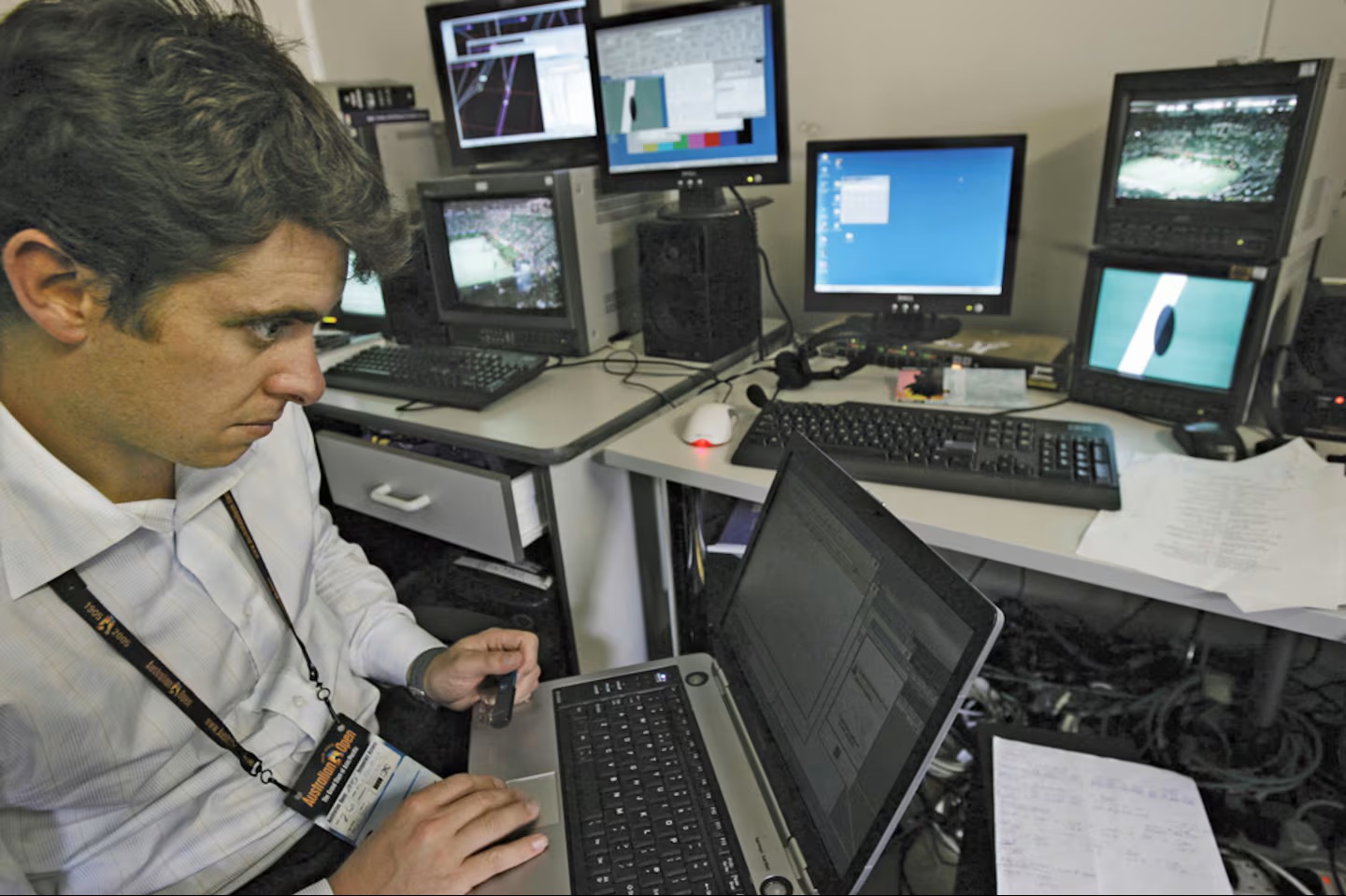
Paul Hawkins, shown at the Australian Open in 2005, founded Hawk-Eye, a camera tracking tech provider for the MLB, NBA, NFL, NHL, FIFA and tennis. (Photo: Getty Images)
SwingVision, financially backed by Tennis Australia, started calling lines at five USTA junior tournaments last summer. “There was one parent we talked to, and he said, ‘This is the first tournament where I was talking to the opponent’s parent, and we were just talking about life and we weren’t arguing about anything,’” CEO Swupnil Sahai said. “He was shocked. He’s like, ‘This is so transformational.’”
By and large, Squadron said, the reluctance to embrace more technology is less about its accuracy and more about people’s attachment to tradition.
“The human element is about the athletes, the unpredictability, the excitement about whether somebody can perform in an incredible, pressured situation,” he said. “Those unexpected errors that are so devastating — that is [part of] sports. The fact that an official doing his or her best misses a call and costs a team that’s trained, worked, performed for a championship? To me, that’s not part of the game.”
This article was brought to you by SBJ Tech, a Leaders Group company. As a Leaders Performance Institute member, you are able to enjoy exclusive access to SBJ Tech content in the field of athletic performance.
Commissioner Rob Manfred announced that he plans to propose that ABS be implemented for major league regular-season games next season.
But it won’t be the first top league to do so. The Korean Baseball Organization has had ABS in place for two seasons. Its robot umpires call every pitch, as opposed to the two-challenges-per-game system in place in Class AAA and expected in MLB, following a spring training trial.
MLB’s own testing has been rigorous, dating to the MLB-affiliated Atlantic League’s usage back in 2019 and continuing through all levels of the minor leagues. But the KBO represents an opportunity for learnings from the third-most prominent league in the world.
“We have a nice back and forth with KBO and NPB on these rule issues,” Manfred told SBJ, referring to the Korean and Japanese pro leagues. “We pay a lot of attention to those sorts of experiments, how they’ve worked. They were very satisfied with the way it played out in Korea, and we take that as encouraging as well.”
More details emerge on MLB’s robot umpire plan
The KBO uses a camera tracking system from its longtime data and technology provider, Sports2i, just as MLB will utilize Hawk-Eye cameras, the same system that powers Statcast. MLB’s minors have used a two-dimensional plane at the center of home plate, but the KBO ABS requires a pitch to cross through the strike zone at both the middle and back of the plate.
ABS in the KBO uses the corners of the plate and adds 2 centimeters to either side, using a formula based on a player’s height. The zone was lowered roughly 1 centimeter at the top and bottom edges between 2024 and 2025, based on feedback.
Any strike zone can be inputted into the technology, and it may take some iterations to get it just right. The rulebook defines a rectangle but, in practice, most human umpires call an oval — neglecting to call strikes in the upper and lower corners. Human umps also typically widen the zone in blowouts or on 3-0 counts.
The impact of ABS in the KBO: Walks have ticked up slightly, from 9.1% of all plate appearances in 2023 (the last non-ABS season) to 9.4% this year, while strikeouts have increased more dramatically, from 17.7% in 2023 to 19.9% in 2025.
Kwangwon Lee, Sports2i’s team leader for its global business unit, told SBJ, “Our partner, KBO, always makes bold and innovative decisions to develop the league,” and added that its R&D department continues to iterate and improve the tracking system.
Mets designated hitter Jared Young, who starred in a 38-game stint with the Doosan Bears last season, said pitches on the edges were called normally but noted it appeared to be “a very up-and-down strike zone” and that it seemed inconsistent from one stadium to the next. “But,” he added, “you can’t complain. Everyone’s got the same thing.” Having also spent time in Class AAA the past few seasons, Young endorsed the challenge system as his preference.
Daniel Kim, who formerly scouted for MLB clubs and made appearances on ESPN during its 2020 COVID coverage of the Korean league, is now a popular KBO media analyst with 164,000 subscribers to his YouTube channel. Kim said fans, and even many players, were upset with the state of human umpiring.
“Fans love it,” Kim said, adding that all they want is consistency. “From the player side, surprisingly, we got some mixed reaction. Veteran players started complaining quite a bit in the early part of last year, whether pitchers or the hitters. As you know, the older established players had their own strike zone. They got the benefit of the doubt, I guess.”
One KBO team executive, who requested anonymity to speak freely about umpiring, said, “ABS shows no mercy or bias toward either side. It is as objective as it gets, and the machine does not care for any context of the situation at all. In a vacuum, that is how it should be, as the strike zone has been defined by the league of how it should be and the ABS follows the rules.”
Player evaluation is changing as a result of ABS: Pitchers with high velocity and big breaking pitches are being prioritized over pitchers with less dynamic stuff who try to command the outer edges.
“ABS does not care how well a pitcher locates the shadow zone” — referring to a baseball-width addendum on either side of the zone — “or how well a catcher frames a pitch,” the executive explained. “It only cares if a pitch crosses the zone or not. So the pitchers that used to live in the edges of the zone that would often benefit from umpire calls/framing are out of luck.”
ESPN and MLB Network analyst Xavier Scruggs, who hit 61 home runs in two KBO seasons, has kept in touch with old teammates who have shared good feedback about the system. He and Dan Kurtz, who runs the league’s leading English-language media site MyKBO.net, both noted that ABS was a safeguard against gambling improprieties, as it removes the human element. They pointed out the KBO endured some bad headlines — mostly a decade or longer ago — related to allegations of scandal.
“You have something that’s set in stone to where you don’t have umpires affecting the game in such a drastic way that could be concerning,” Scruggs said.
But the KBO even demoted a few umpires to the minors in 2020 for calling inconsistent strike zones, so technology can mitigate that variation.
“KBO looks at ABS as trying to help speed up the games and trying to prevent confrontations,” Kurtz said. He added, “Korea is a very forward-thinking, technology-using country in itself, and so they’re basically, if we have it, why are we not using it?”
Many US baseball fans have asked the same question, but won’t have to wait much longer — at least for a small taste of what the KBO has.
This article was brought to you by SBJ Tech, a Leaders Group company. As a Leaders Performance Institute member, you are able to enjoy exclusive access to SBJ Tech content in the field of athletic performance.
The New York Mets’ starting pitcher, who is enjoying a breakout year, ponders whether tech leads to changes or provides validation.
You can’t have a discussion about sports technology today without including athletes in that conversation. Their partnerships, investments and endorsements help fuel the space – they have emerged as major stakeholders in the sports tech ecosystem. The Athlete’s Voice series highlights the athletes leading the way and the projects and products they’re putting their influence behind.
* * * * *
The 29-year-old Canning, a former second-round pick out of UCLA, has credited the Mets’ pitching lab and its tech-savvy coaches as part of why he signed with the club in the offseason — and why he’s off to a strong start to the season.
On how the Mets’ pitching lab has helped…
Personally, probably the biggest thing has been the KinaTrax. It can show your body, just as a skeleton moving through your delivery. I feel like it’s a little easier to look at just the skeleton, instead of maybe video of yourself to really dissect how you’re moving and maybe where your mechanics are off a little bit. And then obviously every team has the Edgertronic to see how the ball is coming off your hand and be able to tweak your pitches a little bit there and see just how to make them more consistent.
On whether KinaTrax data led to changes or validated what he was doing…
A little bit of both. I can see how my feels match up with some of the numbers and what it looks like. It’s a helpful tool in-season, too. [If you] maybe have an outing where your mechanics feel a little bit off, you can go to that and see, maybe you moved on the rubber a little bit, or you’re not lifting your legs high, or your front side is doing something a little bit different. It’s a tool just to help keep you on track and not let things spiral.

On the tools he uses in the offseason…
I threw some on a force plate mound at Banner Health in Arizona. It’s super helpful to see where you’re at and get some validation for maybe how you’re feeling. It’s easy to go down the rabbit hole of comparing yourself to ‘the hardest throwers have this.’ So I think it’s a double-edged sword of understanding who you are and knowing yourself, and then just trying to maximize that.
On his use of the Oura ring…
Going to bed early is definitely valuable for me. Trying to getting to bed early and then hitting that [lowest heart rate before] the midpoint — those are usually the nights that I get my best sleep. It’s a little harder in-season with different schedules, traveling.
If anything, it’s probably more of a tool to hold you a little bit accountable because you don’t know exactly how accurate it is. Sometimes you wake up feeling great, and your sleep didn’t match all. So I think it’s more of a tool just holding yourself accountable, wanting to see a good score when you wake up in the morning. You don’t want to put too much stock into it because if you wake up on a day that you’re pitching, you don’t want to let that get in your head.
On why he embraces tech…
You’re always trying to find an edge of how you can feel your best consistently every single day, just with how long of a season it is. We’re here every single day. It’s just about checking all the boxes — your nutrition, your sleep, your recovery — just to feel your best and be able to go out there and perform.
This article was brought to you by SBJ Tech, a Leaders Group company. As a Leaders Performance Institute member, you are able to enjoy exclusive access to SBJ Tech content in the field of athletic performance.
The torpedo bat enhances exit velocity and optimizes swing mechanics. Here its story as told by 16 players, front office executives, batmakers and other insiders.
Main image: Bloomberg via Getty Images
Attached to the message sent to Brad Hillerich, who leads the production of pro products, was a CAD file from an MLB team analyst. It included a 3D-rendered wood baseball bat whose shape was unlike anything either Hillerich had ever seen. Brad called Bobby and they took a look at its bulging barrel and jarring taper.
“Oh, man, it was kind of like looking at a Tesla truck,” Bobby recalled. “[People say] ‘that’s not a truck,’ and we looked at it and said, ‘That’s not a bat.’ But we just said, ‘Listen, these guys are physicists. They’ve done their research, and the least we could do is turn it into a usable product and see what happens with it.’”
A year and a half later, that idea would have a catchy name — the torpedo bat — and a gaudy introduction into the baseball world. Five Yankees started swinging it this season, and they contributed nine home runs in one weekend, including five in one Saturday matinee against the Brewers in which YES Network broadcaster Michael Kay first called attention to the bats.
The cellphones of bat manufacturers were immediately overwhelmed with calls and texts from players and agents, a barrage starting even before the final pitch of that game. The secret was out.
The best ideas are the ones that seem so simple and intuitive in hindsight, and this was no different: increase the mass, and thus the energy and exit velocity at the primary point of contact. Still, by baseball standards, this was a radical innovation in a staid industry that is 150 years old. Its lesson is waiting to be applied across all sports, challenging assumptions and complacency potentially in favor of careful reinvention of even the most basic tools.
“It makes a lot of sense, but it’s like, why hasn’t anyone thought of it in 100-plus years?” said Yankees outfielder Giancarlo Stanton. “Then you try it, and as long as it’s comfortable in your hands — we’re creatures of habit, so the bat’s got to feel kind of like a glove or an extension of your arm.”
Stanton quietly used a torpedo bat from Marucci while slugging seven postseason homers last fall — and, it turns out, he wasn’t the only one to deliver playoff heroics with such a model. Guardians outfielder Lane Thomas adopted a tapered Old Hickory bat and smashed a grand slam off AL Cy Young winner Tarik Skubal in ALDS Game 5.
In interviews with 16 players, front office executives, batmakers and other insiders, Sports Business Journal traced the path of the torpedo bat’s innovation and identified the keys for its disruption with lessons that apply across all sports. Its creation was a race not just in research and development — a formula involving both physics and biology — but also, crucially, in adoption.
“You’re talking about wood baseball bats, so at the end of the day, we’re at the mercy of Mother Nature with most everything we do,” said Travis Copley, Old Hickory Vice President of Sales and Marketing. “This is a huge innovation already. It potentially could be even bigger.”
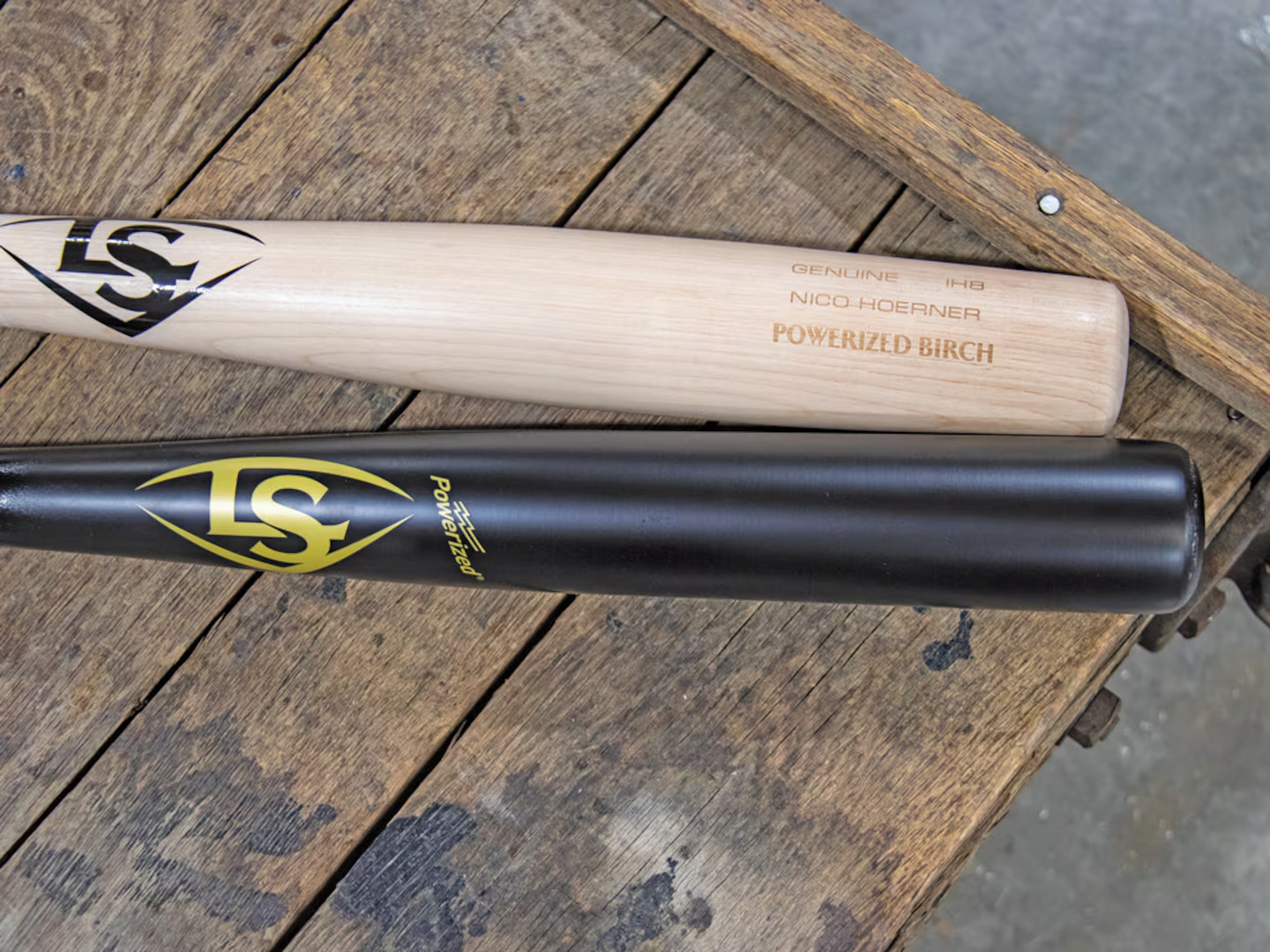
The Louisville Slugger Torpedo Bat (top) compared to a traditional bat shows the difference in the ‘wood budget’. Photo: Getty Images
Now, everyone from industry giants to batmaking boutiques are recognizing the need to do more. Hillerich said Louisville Slugger is “looking at doing more and more research,” and so too will Spoke Bats CEO Scott Pershern, whose founding principle is the use of a modeling engine to personalize each bat (i.e. bespoke, hence the name) and continue to push the boundaries of a product market mired in “institutional inertia.”
“The interesting thing for me,” Pershern said, “is now it has opened up everybody’s minds to what is possible.”
To see where baseball bats — and all stagnant sports equipment is going — it’s instructive to first understand how the sport arrived at this critical tipping point.
—
As an analyst with the Yankees, Aaron Leanhardt asked the players where on the bat they try to strike the ball. Leanhardt is a career-changer — an MIT-educated physicist who conducted NASA-funded research and was a physics professor at Michigan — who said his eureka moment was seeing that the sweet spot the players targeted was not the fattest part of the bat. He recalled to reporters saying, “Well, let’s flip it around. It’s going to look silly, but are we willing to go with it?”
Elsewhere in the AL East, Baltimore Orioles Assistant General Manager Sig Mejdal fielded questions from hitters wondering about the efficacy of bat fitting — that is, the use of advanced data and technology to ensure players are using the best-performing bat for their swing. Mejdal replied, “Sorry, I have no idea,” but he began investigating. Mejdal also has NASA roots, having worked for the agency as a mathematical modeler after earning multiple engineering and operations degrees.
“My background is mechanical engineering, so if you’re a hammer, everything you see is a nail,” said Mejdal, who led a team working on similar designs, including one called a bubble bat. “When you see the bat, it’s impossible not to wonder and not to think about the engineering of it.”
Also operating on a separate strand of development were the Cubs, whose core hitters last year — Cody Bellinger, Ian Happ, Nico Hoerner and Dansby Swanson — all tried variations at least in batting practice. “We had some long discussions with the Cubs this past summer where we talked about tapered-barrel bats a couple different times,” Pershern noted. (The Cubs did not respond to an interview request.)
An exact accounting isn’t possible, given the cloak-and-dagger secrecy of baseball operations, but Louisville Slugger was working with four unspecified teams on the design. Marucci supports eight MLB clubs through its high-tech baseball performance center, though not all were pursuing this shape. Orioles All-Star catcher Adley Rutschman was seen swinging one last year, as was Mets shortstop Francisco Lindor, who finished second in NL MVP voting.
Marucci CEO Kurt Ainsworth said half of his pro players inquired about the bat earlier this month. Louisville Slugger took more than 100 orders.
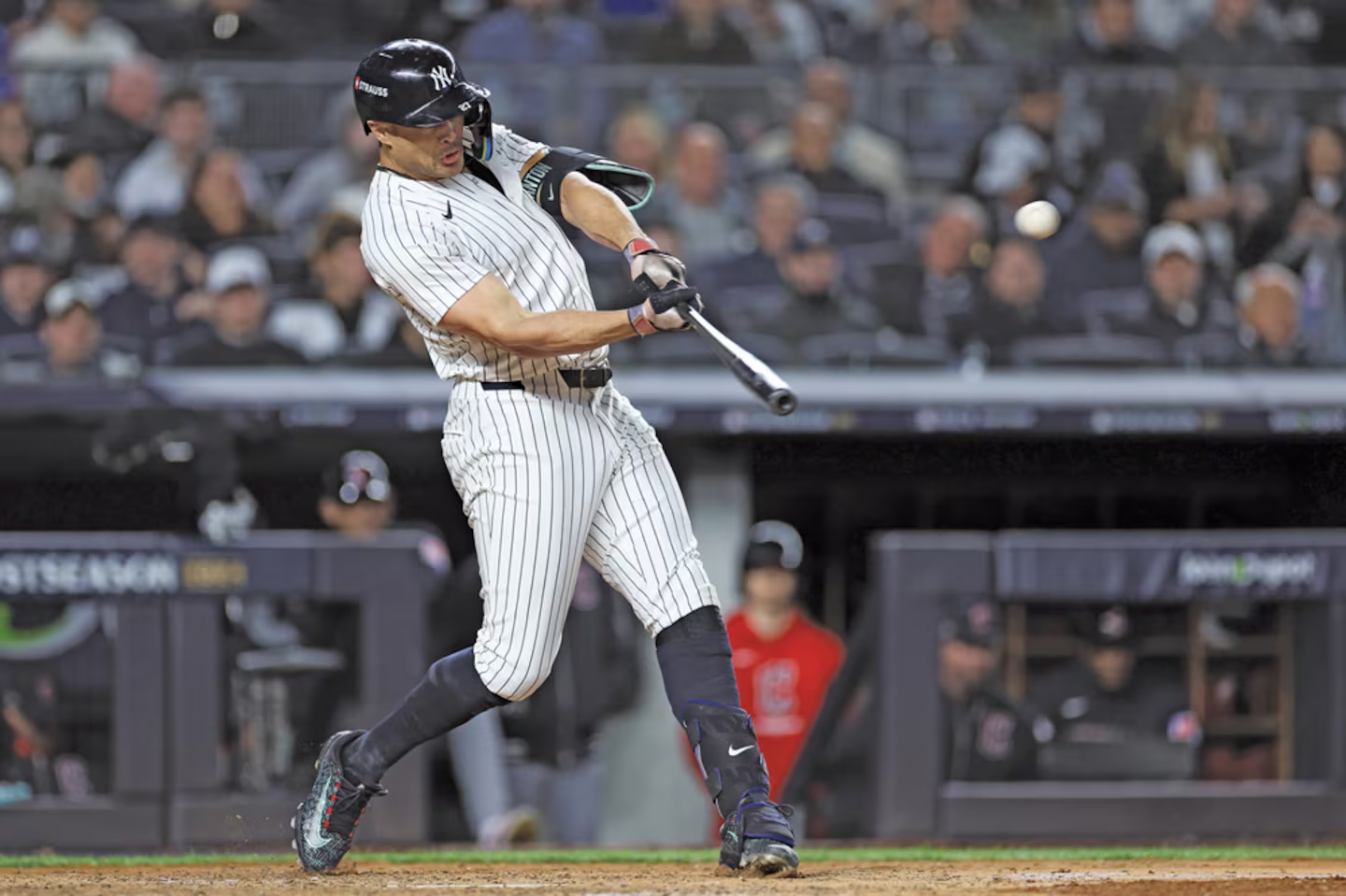
Giancarlo Stanton smashed seven postseason home runs last year with a torpedo bat and won ALCS MVP honors. Photo: Getty Images
The Yankees will be remembered for spearheading this because they fostered a culture in which the players bought in despite the unorthodox shape. The bat change may be a revolution, but the closest antecedent is in evolution. The Yankees are Charles Darwin, and everyone else is Alfred Russel Wallace, the naturalist who independently formulated the theory of natural selection but had his contributions overwhelmed by Darwin’s fame.
Most torpedo bats are the product of advanced personalization. Statcast tracking cameras provide a wealth of data on swing speed and path, as well as contact point. The Cubs made Bellinger a custom bat last season, but he didn’t like the way it felt. After an offseason trade, the Yankees made him a new custom bat, which he also didn’t care for. But Bellinger picked up the generic torpedo the Yankees made as a demo for players in 2023 and immediately took to it.
“I swung other bowling pin models, or torpedo bats — I didn’t like them,” Bellinger told SBJ. “This one just feels good in my hands.”
Big leaguers spend decades swinging bats to reach the sport’s highest level, and they take untold batting practice swings before the highly visible performance on the field, so they understandably can be fickle about change. Superstition and word-of-mouth recommendations can go a long way, and the word “feel” is paramount.
Leanhardt talks about a “wood budget,” a certain weight the player can swing, and redistributing wood needs to be done delicately and in balance. Hillerich said these changes are “to maximize the barrel, to maximize the sweet spot and still feel like the exact same bat that they started with.” In some cases, the torpedo bats move enough weight closer to the hands that they can be swung faster, which bears out in early-season Statcast data.
MLB has affirmed that these bats are legal, with the only real geometric stipulation being that the diameter can’t exceed 2.61 inches. Many torpedo bats now have larger barrels than regular bats, and at least some are at that max diameter. (Most torpedo bats are made of birch because it is a lower-density wood than maple; the latter makes it hard to construct a bat that is sturdy enough overall because the handle would have to be tiny to get the weight right.)
The league has a team of inspectors who periodically visit clubhouses to ensure compliance. The leader of that program is Scott Drake, the CEO of wood product inspection firm PFS-TECO, who first saw the torpedo shape in a MLB clubhouse when he saw Stanton’s bat last season. But even that reminded him of a manufacturer’s tour more than a decade ago when he saw maple bats that had “a very similar shape and design”, though those didn’t meet the density for requirements in MLB.
—
Within a week of the new bats’ public introduction at Yankee Stadium, the website of just about every bat manufacturer underwent a rapid update. “Incoming Torpedo,” touted Old Hickory. “The bat everyone is talking about is here,” promised Marucci. “Get the TPD1 Torpedo Bat Today,” exclaimed Louisville Slugger.
“I love that people are talking about baseball, and my role here is growing the game of baseball,” Marucci’s Ainsworth said. “This is great for our game, all the way down.”
“All the kids now want it,” said Éric Gagné, the former Cy Young-winning closer who is now primary owner of B45 Baseball. The company’s GM, Marie-Pier Gosselin, said it’s been nimble in meeting demand — “We had the wood available to make them rather quickly” — and continuing a tradition of innovation. The Québec-based company was the first to use birch in bats two decades ago, a short time after Barry Bonds and Sam Bats popularized maple.
Consumer demand was immediate, buoyed in part by the catchy torpedo name that has overtaken bowling pin, bubble and tapered barrel for obvious marketing reasons. Louisville Slugger noted that it is even thinking about new ways to shape the barrel of its metal bats. Without the underlying data informing a personalized bat shape, some experts aren’t convinced amateur players will be able to fully maximize its potential. Similarly, Ainsworth noted, younger hitters are less apt to hit the ball off the sweet spot, so the taper at the end of the bat might actually offset some gains.
Experts are clear that the benefits are real, but moderate, likely an increase of a couple miles per hour in exit velocity when connected on the sweet spot. Every mph of EV usually leads to another 5 feet or so of distance, which can quickly turn warning-track flyouts into first-row home runs. As an added benefit, some predict that the tapered barrel tip might turn poor contact (weak grounders or popups) into foul tips that keep the hitter at the plate.
Even Yankees Manager Aaron Boone said it’s more gains on the margin and helping players incrementally. The Orioles’ Mejdal noted that “this isn’t for every hitter.” Chuck Schupp, a 40-year industry veteran with Louisville Slugger, Marucci and now Chandler Bats, said he fielded 100 inquiries that first weekend, but cautioned everyone, “You’ve still got to hit the ball in the sweet spot — it doesn’t matter what the bat looks like. I just don’t think this is going to be an ‘a-ha’ moment to make a guy a better player.”
But, as Old Hickory’s Copley noted, the torpedo may serve as the catalyst for a broader “ideology of redesigning bats.” Just as the 2003 book “Moneyball” spawned the entire baseball analytics industry by making clubs reconsider all forms of player evaluation — and not just the initial realizations about metrics, such as on-base percentage — so, too, might torpedo bats precipitate deeper reevaluations of bats and other sports equipment.

Lane Thomas hit a huge homer for Cleveland with a torpedo bat. Photo: Getty Images
Wood bats are a relatively small but crowded market, with 41 MLB-approved suppliers. Pro models typically retail to consumers for $100 to $200 apiece. “You have the big-name companies, but aside from them, they’re all pretty boutique companies, so obviously it’s hard to have a very big R&D department,” Gosselin said. R&D dollars are typically slated more for the larger amateur market — and colleges, high schools and Little Leagues all swing metal.
Prior wood bat innovations in the past decade have centered on the knob at the end of the bat. Some players began preferring larger puck-sized knobs. Axe Bats pioneered a new sloped handle design. But the area is rife with opportunity.
“I personally feel like there is a bat that can be designed for each player, and we believe that you shouldn’t be using the same bat versus each pitcher anyway,” Ainsworth said. “In golf, you don’t use the same club for every shot.”
An early Marucci investor, former Phillies star Chase Utley, actually tried this prior to the 2009 World Series, ordering a bat with a different shape and length to face the infamous cutter thrown by Yankees Hall of Famer Mariano Rivera. He grounded into a double play his one chance to use it.
Brewers infield prospect Eric Brown Jr., a former first-round pick now in Class AA, ordered a tapered-barrel bat from Spoke late last summer because it felt lighter — “like a toothpick” — as the long season wound down. Brown had previously suffered a hand injury from getting jammed so often, leading Pershern to move the hard knot of the wood closer to his hands.
“Since the knot is moved down the barrel, I don’t feel that I’m getting jammed,” Brown said. “Essentially, it makes the bat harder.”
The torpedo bat’s shape isn’t as polygonal as Tesla’s Cybertruck, and its future seems brighter, despite Hillerich’s first impression. Whereas the president of an automotive design consultancy recently described the Cybertruck to Forbes as “a huge swing and a huge miss,” the torpedo bat seems poised to be exactly the opposite.
This article was brought to you by SBJ Tech, a Leaders Group company. As a Leaders Performance Institute member, you are able to enjoy exclusive access to SBJ Tech content in the field of athletic performance.
The St Louis Cardinals’ star rookie of 2024 discusses his use of tracking technology in the pursuit of performance gains.
You can’t have a discussion about sports technology today without including athletes in that conversation. Their partnerships, investments and endorsements help fuel the space – they have emerged as major stakeholders in the sports tech ecosystem. The Athlete’s Voice series highlights the athletes leading the way and the projects and products they’re putting their influence behind.
* * * * *
Despite weathering an early injury, Wetherholt slashed .295/.405/.400 with 2 home runs and 20 RBI across 29 appearances for Single-A Palm Beach in his first season in the Cardinals organization, culminating in a game-winning double in the league’s championship game in September. He entered 2025 as MLB.com’s seventh-ranked SS prospect (23rd overall).
Before that, Wetherholt was a standout for West Virginia, where he was introduced to Pison, the maker of AI-powered neural sensors that measure cognitive functions through smart wristbands. WVU, along with several other collegiate and youth programs, use Pison’s tech as an athlete performance tool on an institutional basis, and MLB is in the process of testing it for on-field approval. The company recently launched a training platform specifically for baseball, called Pison BASEBALL Pro, and integrated sleep tracking data into its Pison Perform product. Wetherholt is a brand ambassador.
As he prepares for his second pro season, Wetherholt spoke to SBJ about his use of Pison and his goals moving forward.
On his first impressions of Pison…
I thought it was interesting. I wasn’t really sure the practical use of it. I thought it was cool to get a benchmark [of my reaction time] and compete with your friends. But then, after that, I didn’t really understand how it could be beneficial or helpful. It’s like, ‘You just got a score, what now?’
As I’ve gotten used to it, I’ve found cues that say, ‘Hey, do it on days that you’re feeling slow and you might see an improvement.’ Or, ‘Do it after your lift and you’ll see an improvement.’ Just different ways to mess around with it, use it on a more consistent basis, to remind your brain and wake it up on days that you’re sluggish.
On how he uses the reaction tests…
A light flashes, and you move your hand open, and it measures how fast you moved it in accordance to when the light flashed, basically. And then there’s also a mode, which is pretty cool, it lights white and you’re supposed to move your hand, or it’ll light yellow and you’re not supposed to move. It’s kind of a yes-yes-no type of thing, which is pretty similar to baseball and hitting.
I’m not a huge person to be like, ‘Oh, my reaction time is bad today, I’m going to stink.’ So, for the most part, I really wouldn’t pay attention to it too much on a gameday. But on an off day it’s cool to see where you’re at. If you had a heavy workload and you wake up and you feel good, but then you check and your reaction times are low, it’s like, ‘OK, maybe I have to do it a little bit more today to try to wake up.’ It’s cool as a benchmark in that regard.
View this post on Instagram
On his use of athlete performance technology…
I’m definitely not a genius in the tech field, but I’m open to it. Baseball is getting more and more tech-driven, so all of the stuff in regard to hitting, Trackman, where you can see all the metrics on your swing — that stuff’s really cool. The only other thing is sleep, which is the biggest selling point that [Pison] is introducing now, being able to track sleep. I want to know how I sleep, I want to know HRV rates, stuff like that, where it’s going to help me be able to see how I can recover better.
On differences in technology investment at pro and college levels…
We had decent exposure to it at school. We didn’t have the [same extent] of it as professional ball, as you would expect. Now, pretty much every swing is videoed, and you have your Blast [Motion] numbers and Trackman numbers, which we didn’t have at school.
But also, with [analytics], it’s a blurred line. You don’t want to dive too much into it, where it’s like, ‘Oh, I got perfect metrics on my Blast Motion sensor, but now I can’t hit.’ It’s about finding the middle ground of knowing what’s a red flag and what’s not.
It’s different from person-to-person, [coaches] are going to work with everyone differently. For me, I’m tracking bat speed, attack angle, vertical bat angle and rotational acceleration, which is all measured from the bat. So that stuff is concrete. Other people look at it differently. It’s definitely been a little bit of an adjustment — you can get over-consumed. That’s been a big point [from coaches], they’re like, ‘Do what you do. Play ball. We’re just here to help. If you have questions, ask, we’ll explain it to you. But here’s what we want you to focus on. We’ll bring [metrics] up to you if we think there’s a problem.’
On his goals for his second MLB season…
I’d say the biggest thing is to play as many games as possible. I want to be healthy. You can’t play good baseball and you can’t move up levels if you don’t play — and if you’re not healthy, you can’t play.
And then, no matter where I go, just competing to the highest level at that particular level, whether it’s Low-A, High-A, Double-A, whatever the case may be. Just competing and trying to dominate at that level and not looking at anything past that. It’s easy to get centered on, ‘This guy got moved up in this org,’ or ‘I want to go up.’ But at the end of the day, you’re going to move yourself up. If you’re too focused on jumping levels and not dominating the level that you’re in, you can look too far forward and forget to commit to where your feet are. So, just staying present, and then hopefully win a bunch of games.
This article was brought to you by SBJ Tech, a Leaders Group company. As a Leaders Performance Institute member, you are able to enjoy exclusive access to SBJ Tech content in the field of athletic performance.