13 Nov 2023
ArticlesLeaders Performance Advisor Bobby Scales explains why he always returns to his old notes in his ‘Book of Intelligent Stuff’.
A while ago, I asked a friend, and his reply fascinated me. “I’m not reading anything new,” he said. “I’m going back through books I’ve read and I’m really trying to pick up on the things I missed before”.
The idea resonated with me. “Go back through the books, podcasts or articles you really felt you learnt from and relearn,” he continued. We all have a mountain of books or e-books that we dive into with both feet with the intention of learning or educating ourselves in one form or fashion. Even the most intelligent among us can’t catch, retain and process everything.
He is definitely onto something. I have found that when you return to a book, there will be things you want to brush up on but there is also going to be things you missed first time around because you were so engrossed in other ways. Much of this is due to the fact that whether it be six weeks or six months on, certainly there is some personal growth and development. With that in mind, things you either didn’t catch or glossed over will have a different meaning once you go back to it.
We should all make the time.
‘The Book of Intelligent Stuff’
It is not just books or articles. With the forthcoming Leaders Sport Performance Summit in London in mind, you may have notes of previous conferences or conversations that hold even greater relevance today. You could probably even pick up the phone and reacquaint yourself with people you connected with at those conferences.
My first Leaders Sport Performance Summit was at London’s Emirates Stadium in November 2015. I appeared onstage during my tenure as Director of Player Development at the Los Angeles Angels alongside Stuart Worden, the Principal of the renowned BRIT School. We discussed talent development at length and I stayed on for both days and took notes from a number of other sessions.
I revisited those notes recently and it is funny to reflect on some of the things you write down. Events will happen in life and it will amplify certain elements that I won’t say didn’t apply back in 2015, but they can have a boatload more meaning eight years on.
There is research that people retain more learning when we write things down with pen and paper. I keep all my notes in one book I call ‘The Book of Intelligent Stuff’. It sounds like a silly title but there are thoughts, quotes and notes from the different insights that fascinated me. I used to be an eBook reader but there is something different about having a hard copy book with a pen and highlighter at hand. Like many of you, I am sure, I’ll write notes in the margin or highlight certain passages. My shelves are full of annotated books.
As for my Book of Intelligent Stuff, I had it in hand at Soldier Field in Chicago in 2017 when I returned to the Sport Performance Summit, this time as a delegate. I flicked through my notes recently – I remember taking them sat next to Leaders’ Matthew Stone – and there were a couple of concepts that really hit home harder now than they did then just because of the circumstances in my life. I had left professional baseball for a position in private industry. While I was fairly certain what I was doing at the time wasn’t going to be it. I was at a crossroads professionally. In Chicago, Stuart Lancaster spoke about his own personal crossroads after having been sacked as Head Coach of the England men’s rugby union team. Stuart’s presentation that day and the notes I took from it are still staples of my decision making tree to this day. As we all know, when you work in professional athletics more often than not you are going to be sacked at some point… I was again. The first place I looked the last time was ‘The Book Of Intelligent Stuff-Chicago 2017’.
Don’t agree? Do more digging
That’s another thing about conferences. You will look around the auditorium and see people with their heads down taking notes. You are looking at them and thinking ‘should I be writing this down?’ Certain things just resonate with people at certain times.
In my Book of Intelligent Stuff, I’ve got three quote sections where I’ll write down things I hear on Instagram or Facebook, for example. If I’m listening to a podcast and a guests says something resonant, I’ll make a note on my desk or my phone and later add it to my book.
I will also note down things I disagree with. You owe it to yourself to learn why you disagree with a point and investigate it further. If you’re reading an article or a book and they say X, Y or Z, why do they feel that way? You take the emotion out of it and learn why a person feels that way or why they think this isn’t actually as important as we once thought it was. There could be some academic research behind it or some hard numbers. It is important to investigate why that person came to that conclusion and maybe decide that you need to change your position. We owe it to ourselves to think critically and challenge what we think and what others present. It can only make you sharper
All of that is part of the life-long learning process we should all be on.
The pitcher explains why wearables have their limits in his eyes and how biomechanics have transformed his approach to strength training.
A Data & Innovation article brought to you by

You can’t have a discussion about sports technology today without including athletes in that conversation. Their partnerships, investments and endorsements help fuel the space – they have emerged as major stakeholders in the sports tech ecosystem. The Athlete’s Voice series highlights the athletes leading the way and the projects and products they’re putting their influence behind.
* * * * *
Cole is 10-3 with a 2.27 ERA [Earned Run Average] over 150 innings so far this season. He has twice led the majors in strikeouts, including in 2022, and also led the AL in ERA back in 2019. He has finished in the top-five in Cy Young voting five times and twice been the runner up.
A Yankees first-round pick out of Orange (California) Lutheran High, Cole turned them down to attend UCLA, after which he was the Pirates’ No. 1 overall pick in the 2011 draft. His nine-year, $324 million free agent deal with New York prior to the 2020 season remains the largest contract ever awarded a pitcher — nearly $80 million more than anyone else.
On how he recovers the day after a start…
I try to sleep as best I can, but I don’t always sleep great. And then if I need to catch up on sleep, I just I try to find some time to maybe take a nap. I’ll try to put down some electrolytes and about four liters of water. I’ll do a recovery walk either at the house through the woods or on the treadmill. I’ll get a little bit of treatment in the training room just to make sure things are roughly in the right place so that I can walk better
To me, [soreness] is always a whole body experience. And then sometimes, hot or cold tub therapy, just depending on how life’s going, I guess. And I’m hungry. I’m going to eating all day.
On his previous use of Whoop…
Basically, I’m in the green pretty much all the time, and so I thought it validated my process. And I thought after I collected four or five years worth of data on it that it validated some of my practices and my routine, and going a little bit too much into the micro aspect of it, I’m not sure it’s so beneficial.
So there’s stuff you can’t control, right? Like we’re going to fly to the West Coast, and I’m probably going to be red for three days after that. And we’ve got to play. Sometimes I’ve got to pitch. Do I need something to tell me I’m in the red all the time? Or do I just need to know that I need to be on top of everything that I possibly can be to give myself the best chance?
On heart rate variability (HRV)…
HRV fluctuates throughout the day. There are different breathing cadences. There are different physiological things that evolve throughout the day in terms of exercise, how stimulated your nervous system is, caffeine [consumption] — all these things fluctuate HRV positively or negatively throughout the day. Obviously alcohol and dehydration negatively affects it, but sometimes those are quality of life [decisions].
But the algorithm the Whoop uses is at a specific time, right [before] you wake up. So it’s not like you’re a 50 HRV for the whole day. It’s just when you wake up. So depending on how you slept, depending on what your routine is for the rest of the day — let’s say you had to perform at 7 o’clock [p.m.], your HRV could be back to normal. I wore it for a long time. I wore it through a lot of stuff — starts and workouts and vacations and everything. There are some things that we learned, for sure. I definitely tightened some stuff up, but on the whole, it just validated that you’re pretty good.
On nutrition…
I’ve done a lot of food allergy and blood work over the last, I don’t know, forever. So I pretty much know what I’m sensitive to, what causes systemic inflammation and how to try to manage those levels by just regulating the exposure to those things: gluten, dairy and some other random stuff. Sometimes they change, too, depending on how much you avoid them or where your tolerance is.
I would expect a player to have things be more inflammatory, inadvertently, at the end of the year when your immune system is depleted, and you’re at the end of your rope and your at high-level stress. Just your tank is not full, so in a sense you’re overall less resilient. But at the same time, if you focus all of that resiliency on your performance, you can maintain, or even sometimes improve, regardless if all the other stuff is falling low. So t’s always an ebb and flow. It’s always a balance.
On strength training after a start in season…
Day two, day three depending on if it’s five or six days [between starts]. I would say definitely trying to maintain power, elasticity, control. Through that control, the proper mobility. You build a tank up in the offseason, and you just put as much gas in there as you can. And then during the [season], you’ve got to make sure you treat your performance as load, and your weightlifting as a supplement to that load. So I am gaining strength by pitching, I am gaining more efficiency the more I pitch.
These things are allowing me to operate at a more efficient level, and the supplementation of the lift maintains the integrity of the tissue, maintains the power, maintains the routine in terms of when your central nervous system is recovered and spiking and peaking on the fifth or on the sixth day. It’s different than position players, very much so. It’s very much almost like horse racing, football [when you have one shot kind of thing].
On how his approach to training has changed since the beginning of his career…
Total strength, we build in college. We build when those growth plates are just about ready to be closed up, and then you go through life and you start maturing and, again, you’re trying to find ways to maximize power with the least amount of wear and tear because you only get one joint. And then you have kids, and then you carry you carry your kid around. So then you get the dad strength, so your load goes from just your body all day to another 10 pounds for about 10 months, and that has a cumulative effect. And then you have two, and then your 10-month-old turns into three and he’s 40 pounds.
You definitely mature as you get older, and you realize that you want to take all that tissue and strengthening stuff that you built early in the career and make sure that functionally you’re rock solid because that preserves the joints, preserves the tissues, and maximizes power.
On how much he analyzes biomechanics…
The Hawk-Eye stuff is super helpful. At this point, I just think the more data we get is even better. AJ Burnett told me once you’re never going to throw two pitches the same way even if they land in the same spot. And I think, to a certain extent, do we want to be ultra-repeatable? Yes. So do we need to be adaptable at the same time and still be able to produce the same output? It’s going to be hot, could be a hard mound, could be wet, sloppy, it could be slipping, I could be pushing through an injury in a certain area.
There’s all these different variables that are going to contribute to the release point having some variance and the delivery never being the same back-to-back outings. Always being able to be resilient while you have those uncontrollable things changing. Your body’s always adapting to this and that. You can look at one delivery in slow mo and look at another delivery, and that’s not always very helpful.
What I find will be probably really helpful, especially it continues, just the more and more reps that we get on the Hawk-Eye and finding the centration of the joints and the centers of the joints and how biomechanically they’re moving over and over again. Where’s my window for performance? And how do I use that to my advantage? I don’t really know yet. But how do you use that to your advantage as you as you start to gain [more data]? Gill’s great and David’s great, and they’re on top of it all the time. [Gillian Weir, Senior Biomechanist, and David Whiteside, Director of Performance Science.]
On childhood pitching mechanics and throwing load…
I built my mechanics as a kid, just basically trying to be as close to some form of Clemens, Pedro and Maddux. Just simple and repeatable and putting myself in position to minimize load and also giving myself time to recover as a youth. My dad only let me throw six months out of the year until I was 18 at UCLA.
You’re going to stress the ligaments, you’re going to stress the labrum and all that stuff, but then you’re going to give it six months while you’re still producing large amounts of GH and growing and your growth plates [close]. So it gives your tissues time to adapt and lay down those adaptations.
They should look asymmetrical left to right, but they shouldn’t necessarily look worn down, to a certain extent, because you’re pushing, you’re pushing and pushing, and then you’re recovering. A lot of kids these days, just push, push, push, push, push. [Pitching] being a unilateral move, the more fatigued you get, the more you just end up putting too much load in the wrong areas.
On the importance of training the deceleration muscles…
They always used to use an analogy of ‘you can’t have a Ferrari V12 engine and Honda Civic brakes.’ The car’s not going to go very fast, and it’s going to crash.
On tracking his spin rate and other pitch tracking metrics…
I have general parameters that I keep an eye on, I would say, but that’s not at the expense of performance. So if the fastball is spinning high, but it’s getting hit, or if a fastball is sitting low but it’s not getting hit — I’m in for not getting hit, you know what I’m saying? In terms of introducing a new pitch, I would only start that in the offseason, and it probably will take a year or two at this point for it to really even settle in. I feel better with the cutter this year than I did last year, but I guarantee you that next year I will feel even better.
This article was brought to you by SBJ Tech, a Leaders Group company. As a Leaders Performance Institute member, you are able to enjoy exclusive access to SBJ Tech content in the field of athletic performance.
28 Jul 2023
Articles‘Our core is working with the coaches to give actionable insights to the player and coaches between pitches,’ says former MLB pitcher Zach Day, who helped launch NewtForce Mound.
Main Image: NewtForce
A Data & Innovation article brought to you by

A key reason he chose to join LSU’s program was the chance to work with Pitching Coach Wes Johnson and the advanced technologies at his disposal. One of the tools Skenes has credited for his improvement this season is the NewtForce Mound, a sensor-laden, turf-covered slope that tracks a pitcher’s ground forces throughout their delivery.
It’s similar to work Johnson did in his prior role as pitching coach for the Minnesota Twins. After the club traded for pitcher Kenta Maeda in 2020, Johnson recognized that the right-hander’s mechanics were much less efficient out of the windup than out of the stretch. Using NewtForce to quantify the discrepancy, Johnson helped Maeda improve his tempo out of the windup and ultimately finish the season as the AL Cy Young runner up.
Johnson identified the need for the NewtForce Mound as a pioneering coach in the tech-savvy Dallas Baptist baseball program, at a time when ball-flight tracking and motion capture technologies proliferated in the sport, leaving the foot-mound interaction as an unexplored frontier.
“My mind doesn’t stop a whole lot, so I’m constantly trying to find an edge for our guys,” Johnson recounted to MLB Network. “The piece we were missing was ground force.”
For help in solving this need, Johnson turned to one of his oldest friends, Kyle Barker, a former Sylvan Hills High School classmate in Arkansas who started his own aerospace engineering firm, AeroNatique. Former MLB pitcher Zach Day, who met Johnson through his work at TrackMan, joined the founding team and helped launch NewtForce.
The smart mound is used by seven MLB clubs and five college programs, including LSU, who competed in Omaha last month. (Johnson, who recently accepted the head coaching job at Georgia for next season, is not officially affiliated with NewtForce but has been a big supporter of the effort.) There are also installations at private facilities such as P3 in Atlanta and the Florida Baseball Ranch.
The NewtForce mound collects ground reaction data while synced to two high-speed cameras for careful review of granular mechanics. The data and visualizations are available immediately after each pitch so that pitchers can still remember the feeling of that last delivery.
“Real and feel, combined, make all the difference for development,” Day said, referring to the objective data and subjective experience of the pitcher. “Like TrackMan, we provide the actionable data in between pitches. So that’s our foundation, our core, is working with the coaches to give actionable insights to the player and coaches between pitches.”
Unlike competing products available, NewtForce doesn’t use embedded force plates but rather a “cousin technology,” Barker said, that enables the mound to collect force data no matter where the pitcher’s lead foot lands. Barker acknowledged that there were several developmental missteps along the way, but a project in his day job using sensors to gauge reactive forces in aerospace components led to a breakthrough.
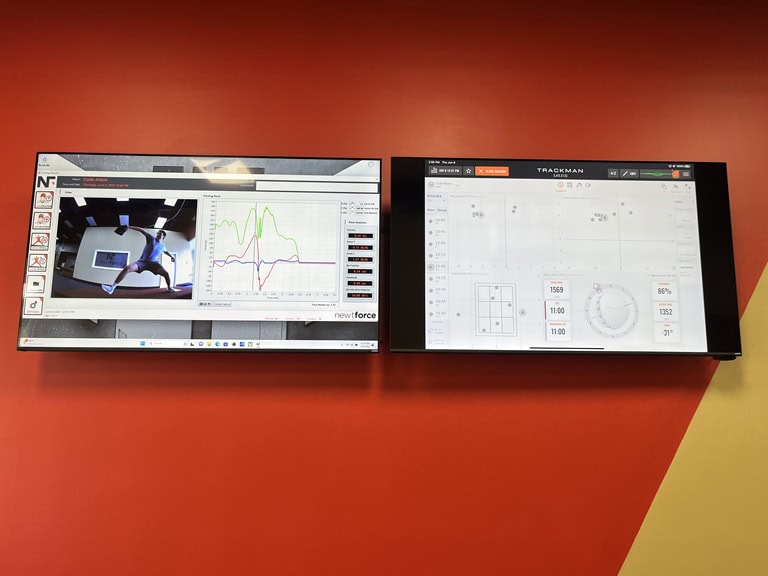
Image: NewtForce
“We were doing some testing for a major aviation manufacturer, and if you took a deep breath and cleared your head and backed up far enough from it, you can envision a way to get ground force reactions out of a surface with what we thought was infinitely more reliability,” Barker said.
Barker declined to get too specific about the company’s proprietary competitive advantage but said the concept of stiffness-to-weight ratio on an aircraft wing — heavily engineered to be strong, yet light — was critical, as was the collaboration of his lab manager, Paul Wanamaker, who is now NewtForce’s hardware lead.
“My aviation background, oddly enough — and it makes no sense to many people — was just perfect for an instrumented pitching mound,” Barker said.
Among the two dozen metrics collected by NewtForce are acceleration and deceleration patterns, impulse (total force over a period of time) and what they call the clawback, which is the duration of time the lead leg is planted on the ground.
Some early machine learning research using data from the NewtForce mound by Randy Sullivan and his team at Florida Baseball Academy suggests that impulse is a key metric for velocity production.
While progression typically takes time, Barker recalled witness some fairly immediate improvement in one particular pitcher during a site visit to an installation at Vanderbilt.
“I’m no coach, but I’ve seen Vanderbilt’s coach take a kid that was, call it 92 and minus command, and intuitively, after seeing the force charts, have some idea about what his kinetic chain was to cue him verbally,” he said. “And then in two or three pitches, you see better velocity, ballistic spin efficiency.”
Particularly younger pitchers, Day said, tend to have under-developed deceleration patterns in their lower halves. Building arm strength is less the issue than efficient movement in the legs and hips.
“Sometimes the eyes are going to deceive us,” Day said. “There’s times that you’re going to think a guy is using the ground well, and the data is just not saying that. So the way guys move can be deceptive. That’s one thing we’re learning is, Yeah, it looks good, and often it actually is good. But there are times that it looks good, and it’s not. And there are times that it looks bad and awful, and it’s like, you have the best lower-half efficiency out of anybody.”
This article was brought to you by SBJ Tech, a Leaders Group company. As a Leaders Performance Institute member, you are able to enjoy exclusive access to SBJ Tech content in the field of athletic performance.
The takeaways from the second round of Women’s High Performance Sport Community Group calls where the focus is how environment design can support and enable women to flourish.
Our US ‘call’ for this period was in fact a discussion that took place in person over breakfast at our Leaders Meet: People Development event in June at Globe Life Field in Arlington, Texas.
That morning we were joined by Shelby Baron, the Coordinator of Player & Coach Services at the United States Tennis Association and the Texas Rangers’ Senior Director of Baseball Operations, Michaelene Courtis, and Mental Performance Coordinator, Hannah Huesman. The trio explored the moments of progression in their careers; their experiences of what works as well as what else is needed.
A month later, in July, the Women’s High Performance Sport Community Group came together to share their thoughts and experiences on the second call.
Here, the Leaders Performance Institute picks out ten thinking points (networking and relationship building stand out for us) from across both conversations.
1. Be sure to plan
Several people mentioned planning their personal development better. This might be from a logistical point of view and when it makes sense to focus on development based on the seasonality of a role; at a time when full commitment can be given. Or planning what to spend time on in a more deliberate manner, be that based on current gaps or where someone would like to be in the future. We also discussed who might input into the planning aspect and the consensus was that seeking the input of others was key. It’s not all about what we need either: what do we want to learn? It is also important to have objectives and goals, which can be personal too.
2. Protect time for development…
It sounds obvious, but the importance of protecting time for development, even when in amongst the weeds and firefighting, was a point clearly made. As leaders of others, how are we helping with this or role-modelling this?
3. … and time and support for development in your role
One way which helps ensure development happens is creating opportunities for development to take place organically through what’s needed from our roles. This might not always be people and leadership skills. At the breakfast in Texas, it was said that “in order to lead, you have to go and do it. Going out and doing the work is the best development you can have.” For this to be most successful and long-lasting we need to ensure that the right support is provided. For Hannah Huesman, one of the most valuable growth opportunities has been being the ‘middle person’. It challenges you to think about how to connect with people, collate information and deliver it to others.
4. Put the person before the performer
When planning our own development or supporting others, we have to be kind to ourselves, or to them, and put the person first; we can even demonstrate vulnerability. We should show genuine interest in them as a person. This will make sure the individual is at the centre. When supporting others, we shouldn’t take the responsibility of developing others lightly. We want to be there based on the experiences we have engaged in. That might be us being open with our own line managers, or as line managers encouraging those you line manage to discuss next moves, whether that’s inside or outside the current place of work.
5. Network and build relationships
By far the most commonly mentioned successful – and desired – development tool has been networking and building relationships with others. This can be done in a deliberate manner. Whether that’s using networking for adding to our diversity of thought and understanding other people’s experiences by finding ways to connect with people who are not like ourselves. We tend to look for and find commonalities with people, but we should be aware that we can learn from anyone. It’s working for some to do this within their organisation as well as by speaking to those outside of our organisations by joining community groups, sharing current practices of your own. Some take consulting, or trustee, or non-executive roles, including those outside of sport.
It’s common that people seek out differences, be that different sports, different levels within an organisation or different perspectives in terms of leadership execution and problem-solving; or in different areas of expertise within sport, new environments, and even in new tools emerging for communication. Others have sought out leadership positions that mean that they’ll be a leader of range of people.
Whichever method people have chosen for networking and building relationships it’s in pursuit of the right spaces to connect, and to share stories and experiences. Sometimes it’s to deliberately seek differences and challenge thinking, other times it’s to normalise some of the challenges that are faced across sports, roles, and cultures; and it’s to also help us understand what is possible and know that others have done what we’re seeking to do. If you’re in a position that is less common, making yourself ‘available for networking’ could be powerful for others who aspire to follow in your footsteps.
6. Consider relationship mapping
To help make networking and relationship-building purposeful and focused, the act of relationship mapping can be a useful tool. In Texas, everyone in the discussion agreed on the importance of relationship mapping. Building these relationships creates an impact in the environment that makes a difference to performance.
7. Try reciprocal mentorships or ‘reverse mentorships’
Formalising this further, mentorships and reciprocal or reverse mentorships were discussed. They elevate collaboration between two people and provide more opportunity for quality learning. Some invest in personal coaches, be they specialists in leadership or from areas outside of sport. What people want from a mentorship will differ, but taking time to consider this for ourselves or those we support could prove fruitful. We spoke about the recent story of Debra Nelson, an educational assistant at sport and educational charity Football Beyond Borders, who recently reverse mentored Justin Welby, the Archbishop of Canterbury, at his request.
8. Take risks
A few community members said that being brave and taking risks was positively impacting their current development. Some of this meant putting themselves in new situations, reaching out to people they didn’t think would respond, or exploring new sports. Sometimes we might need it to be others that take risks on our behalf and support us as we find the confidence to shape a role that may have traditionally been a male-dominated space.
9. Reflect
Several members of the group mentioned being deliberate in reflection on their development, a good practice for ensuring learning. For example, 360-degree feedback might help with this, and kickstart the planning process again, ensuring some ‘bottom-up’ input to our journeys.
10. Look at the bigger picture
And what can organisations be thinking about at a broader level? The following were suggested:
Ultimately, we were reminded to ask women first – don’t assume you know – and in general we should think about the individual needs of each person we’re working with and build a development plan from there.
There are several traits that all teams can look to adopt in their pursuit of performance.
They include the ability to have honest and open conversations, an emphasis on behaviours that build trust, and a belief in the collective before the individual.
As with much of performance, they are often easier said than done but most teams understand their importance and continue to work towards those qualities in their daily work and habits.
Here, the Leaders Performance Institute lifts some insights from our vaults that we hope can help you to plot a course with your teams. We are not saying that all the athletes and coaches in the examples cited below have nailed it, but their approaches may help you to stay on track.
‘Great cultures are built on connection’
Adelaide Crows midfielder Rory Sloane served as team captain between 2019 (when he was co-captain alongside Taylor Walker) to 2022 and, with time, learned the skills to handle difficult conversations in a way that put his teammates at ease.
Sloane had fewer concerns about his on-field captaincy than he did his off-field abilities. “Off-field stuff has always been my challenge absolutely – that’s something that I’ve always had to work on massively over the years,” he told an audience at Virtual Leaders Meet: Evolution of Leadership in 2021. “I wasn’t someone that loved confrontation at all, and that’s where I worked really hard over the years just on my relationships with people to be able to then have those conversations.”
He cited the influence of renowned American leadership specialist Brené Brown. “There was something she said: ‘Sit next to someone when you’re having those conversations rather than across’; because I reckon I used to always come across very aggressively, so sitting next to someone was something that really helped me just have those conversations.”
Sloane’s development as a leader was aided by Dan Jackson, who was appointed the Crows’ Leadership Development Manager in 2020. “We’ve spent a lot of time talking about connection, and it’s a theme I keep seeing across elite sport, and also across corporate organisations – great cultures are built on connection,” said Jackson.
Another with a keen sense of the importance of connection was three-time World Series winner and 10-time MLB All-Star David Ortiz.
During this 20-year career in the US, the Dominican helped to transform the fortunes of the Boston Red Sox. During that time, he came across innumerable prospects in Spring Training, each hoping to play alongside a man who would enter the MLB Hall of Fame in 2022 in his first year of eligibility.
One such hopeful was Leaders Performance Advisor Bobby Scales, who joined the Red Sox’s Spring Training at Fort Meyers in Florida in 2007. Having been handed the number 76 (“an awful number”) Scales knew he needed to do everything in his power to impress Manager Terry Francona and the Red Sox’s decision-makers.
“I would arrive at 5:30am for the workouts that typically didn’t get started until 9am because you never know what might happen. Lift, eat, sort equipment, adjust to any changes, whatever needed to be done,” wrote Scales in 2002. “I remember the third or fourth day of camp at about 5:50am. I had just changed into shorts and a t-shirt and, out of the weight room having finished his workout, comes ‘Big Papi’.
“‘Hey, what you doing here? It’s too early,’ he said in a deep voice with a heavy Dominican accent.
“‘Papi’, I said, while pointing to the #76, ‘man, unless you’re early they forget about you!’ Part of me was kidding, part of me was dead serious. His answer was something that I’ll never forget.
“‘Nah, you get invited to this camp, you have a chance to help us win a World Series and we gonna do that. Get your bat… let’s go hit!’
“He didn’t know me from the next guy but I was in that clubhouse and I had the same uniform on. At this point of his career he had been a three time All-Star, a World Series champion and a World Series Most Valuable Player. At 6am he was changing his shirt post-gym workout and heading to the batting cage.
“With his actions he was saying ‘we win things around here, this is how we work and you’re part of it’. This was his routine and he was going to do this whether I was in the building or not. I happened to be there so this was his opportunity to show me the culture in the building without saying a word. Leaders such as ‘Big Papi’ act with intention because they have a vision of where they see themselves and their club and a clear plan of how they can get there.”
‘Without connection, it falls short’
James Thomas, who currently serves as Director of Performance Services at Manchester City, told the Leaders Performance Institute how he worked to engender trust in the coaches with whom he has worked as a performance director.
“Unless you spend the time to build the connection with somebody I’ve often found it falls a little bit short,” said Thomas in 2022 while still serving as Performance Director at British Gymnastics.
“I’ve always taken the time to stand next to a coach during training, watch, ask questions, be inquisitive, and give them a sense that I’m interested rather than coming in and make a big change. It might not need a big change, but unless you talk to people and find out, you’ll never really know. It’s probably quite simple, but I just stand, watch and ask questions and try to be humble. I’ve come in, I’m not going to fix everything for anybody, but I’ll happily try and help. But I need to know about what you feel, what you think the issues are, and what you think doesn’t need fixing. What you think is great and really sacred to the sport, what needs to be maintained for the next few years.”
Sometimes, it is not even the head coach who is the prime source of the information needed – a point to which Leaders Performance Advisor Meg Popovic, who previously worked with the Toronto Maple Leafs, makes with reference to equipment staff.
“They’re always connected to the pulse of the players,” she wrote in 2022. “These staff team members know the make, model, year, brand, variability, and functionality of every piece of equipment a player uses or wish to try out. They understand the engineering, while finding delight in the new trends in the market that have the potential to improve performance and evolve the sport. They are applied-historians of the industry and the trusted mechanics whom players rely on to tune up, repair, and remodel themselves as living, breathing, sporting machines.”
They are vital and often put themselves out in long and arduous shifts and, Popovic recommends that coaches demonstrate their appreciation on a regular basis.
“This group wants to be (and should be) acknowledged personally for their long hours and often difficult, unseen efforts,” she continued. “A thank you, a coffee, or helping hand could quickly relieve resentment and amplify the energy flowing in this very important staff group. Also, as they are of the giving-type, asking equipment staff how they’re doing could go a long way as their innate way of relationship is to be in the service of everyone else’s needs, requests, and demands.”
Such traits can have a profound impact, although they take some work. “Anyone involved in elite sport knows that you can’t get to the elite level without systems,” said Jackson. “I mean building in routines that become habits and then those habits just become natural.”
28 Jun 2023
ArticlesIn the second of a two-part interview, Hector Morales, the Pirates’ Director of International Development, delves into his work addressing those limiting factors.
“That’s what I call it. This confidence is just based on the people that are around you where you are,” says the Pirates’ Director of International Development. It is not uncommon for recruits from places such as Colombia, Venezuela, Mexico and the Dominican Republic to be the best player on their youth or school team. In those surroundings, they may be the best.
“But then that competence dissipates and goes away as soon as you step up to another cohort, where there’s a group of people who play better than you; and this is the first time you’ve seen this so it’s a culture shock sometimes.
“One player said to me once ‘my uncle lied to me – he said I was the best he’s seen’. I said: ‘He didn’t lie to you – you’re probably the best he’s seen, but that doesn’t mean there aren’t better arms out there’. I always tell the players, ‘if it’s too easy for you now, then your competition’s not here’. You shouldn’t be saying to yourself ‘I’m the best’ you should be saying ‘where’s my competition at because they’re not here? Where are those people who are going to give me the run for my money?’
“We’re never that good. There’s always somebody out there who can change our perspective”.
Morales spoke at length about bridging the cultural and development gap between Latin players and US players in part one of our interview. He also spoke of the practices that underpin the club’s approach at their Dominican Summer League academy in El Toro. In this second and final part, he delves further into some of the limiting factors that can affect Latin players and how he and his colleagues seek to address those.
“I still think that the biggest challenges we face are unrealistic expectations that things can go fast, that’s it’s like highlights,” says Morales, echoing the observations of some youth coaches across the globe.
“They were raised on highlights, they don’t see the games any more. If you asked, I’m pretty sure in soccer it’s the same, if you ask them, ‘do you see the full length of the game so you can understand the game?’ They’ll tell you ‘No, I saw the goal. I saw this pass or this tackle or I saw the red card’. They’re used to the 15-second or 20-second bite and they expect that their development will be the same.
“If you’re thinking that things should be fast – and elite level performance takes time – then there’s an immediate disconnect on satisfaction and effort and other things because it’s taking so long and you think you’re not progressing the way you should be”.
Morales adds that while smartphones have transformed all of our lives (“they dictate our moods and what we do”) the younger generation are “even more comfortable communicating this way, which has taken a toll on the social aspect of things”.
Compounding these factors, in Morales’ view, is the role of these young players’ agents. “They are overly protected,” he says. “They want their agents to fight their battles for them. There’s no longer this coach conversation. It is now ‘I will have my agent reach out to you. My agent will talk to you now’. ‘I’m talking about development, I want to talk to you’. ‘Talk to my agent’.
“It’s that [lack of] nurturing, not being able to solve problems and deal with an adult, to reach a potential opportunity to do something differently. Those are very big limitations we’ve got to train our young athletes for and prepare them for. ‘If you’re expecting X then let’s have a conversation because we need to reframe your expectations’. It’s interesting and a good challenge to have, I believe, the more the realistic the expectations, the better for the kids in the competitive environment”.
Morales explains that the players’ parents or guardians remain influential in their children’s lives, but it is the ‘buscones’ – a Dominican term for local agents – who pedal young players to visiting major league scouts and often have the most influence on the player.
“When you ask the players who’s the person they trust the most, they’ll tell you that person. They’ll give you the name of that person. That’s still the case,” he says. “This is one of the key elements I’m focused on. Who does this person trust? What’s their ‘why’? It is constantly evolving but we’ve got to stay on top of that so we can help them and they can feel connected”.
The Dominican academy’s roster of mentors perform a significant role in this regard. A player is assigned a mentor at the academy who checks in regularly to discuss the player’s development.
“I normally select former players who have been through the stages the players are going to go through in transition,” says Morales. “So they’ve been there, understand the challenges of going to the next level. They can sell it through emotional and personal connective stories of what it was like for them to go through those transitions. And there are a lot of times where guys didn’t make it all the way through, or their career ended early or their talent got to a certain level, but they always dominated the mental game whether in college or if they played for the Pirates. They did everything they needed to do and they controlled everything they needed to control and they were engaged in trying to get better but their talent met its ceiling.
“The next requirement for a mentor is that they want to be in baseball or find a way to get a career in baseball. So they are here for two reasons: to mentor players and also open their own understanding of what the potential opportunities are out there for them so they can continue to have a career in the game”.
As we wrap up the interview, the Leaders Performance Institute asks Morales for his hopes for the future in baseball development in this part of the Americas.
“I still have a ways to go to get all the players to understand all the components that influence performance,” he says. “At the elite level, when you have a bunch of people whose talents are the same, there at elements of the head and heart that get in the way, there are elements of nutrition and recovery. I’m still struggling to get them to understand this because I’m breaking the paradigm of ‘I’m only being looked at because of my tools so far’”.
He elaborates on that last point. “No scout in any sport goes to a player and says ‘talk to me about your sleep, talk to me about your recovery strategies. How do you prepare? What are your routines to ensure that you are eating well?’ They’re just looking at their capacity to dribble the ball, their capacity to hit, how hard the arm can throw and move. They’re looking for the fundamental raw tools.
“So now I’m trying to get the player to go from ‘I was valued, paid and given a bonus before this one thing and now you’re telling me this is not the only thing that matters, that everything else in here matters so I can be the best athlete I can be’. So it takes time. You finally get a nutritionist in there last year and now these players are understanding how to assess themselves and the importance of having one-to-one sessions with a nutritionist. We’re talking about the mental game all the time and we do mindfulness practices twice or three times a week during camp so they can practise and study, so they can find the opportunity to be in the moment.
“Some still do it with hesitation. They say ‘I don’t need this’ and then until I get video and show them what happened with this particular play ‘I guess I wasn’t paying attention’, ‘oh, so those mindfulness things we talked about – you might need it, you might need to practise how to focus and be in the now and in the moment’. So how about giving that a try now that you have proof they do need it because multiple times in the field it’s proven that they cannot focus very well.
“It’s a battle. And the next stage of this is for them, once we’ve nailed this down, is for them to understand the analytics and the things that we know are important so they can begin to understand how to address those challenges and how to make changes and how to adapt. And one that’s always in the forefront for me is to ensure that they don’t go back home without any one to change what they have going forward, because the natural tendency over time as they go home for the off-season and they see their old coaches who say ‘that’s not what we used to do here. This is the way you used to it. Keep doing it this way’. Because they trust this person they show up back at the academy worse than when they left because we have moved them forward in development and now they have gone back to something that they were doing before because they didn’t have the tools to say ‘no, my team’s metric of success is this way and they taught me to do this and I’m going to continue to do it this way’. They’re too young to tell an adult figure with authority that they can’t use their advice.
“I want 80% of my guys to go home and say ‘no’”.
It takes time, but Morales, the Pirates and their young recruits are on the right path.
21 Jun 2023
ArticlesIn the first of a two-part interview, Hector Morales, the Pirates’ Director of International Development works to ensure that the club’s Latin players are not at a disadvantage to their American peers.
“A lot of times it’s easy because they see it,” says Hector Morales, the Pittsburgh Pirates’ Director of International Development.
Dr Morales, from his base in Florida, oversees the Pirates’ Dominican Summer League academy in El Toro in the Dominican Republic. With locals, the academy houses up to a hundred players from nations including Venezuela, Mexico and Colombia.
In keeping with elite sport, a significant number, around 30 players in this case, are released from the academy each year, but most of these youngsters, as Morales explains, expect it.
“These young men can look to the left and to the right. They see the writing on the wall, they see the talent of other players, they see they’re not getting as many opportunities on the field. Many of them welcome that conversation,” he says. “They don’t want to be the ones making the decision, they don’t want to come to you and tell you ‘I recognise where my career is and I don’t want to play no more’. They see it as a welcome relief to say ‘I was terminated, I did the best I could, it was out of my hands. My career is over and I can transition’.
“But still, research tells you that a career ending, whether it’s a college career or a professional career, the athletes go through the natural grieving process emotionally as if they’ve lost their best friend”.
This is an area where Morales feels US baseball has often let down Latin players. “At times, we forget to provide resources and services on the other end of a player’s career, for people who make it transactional – ‘I’m the GM and I’m going to make this transactional. I’m sorry your career has come to an end’ – there has to be a support system that is part of that process to ensure that the player has a plan and is moving and we’re setting them up for success. That’s one of the things that we do with international players. We find a way to have a final transition approach where we give them a resume, we teach them, we connect them with courses and trade courses and opportunities for them to make a life for themselves and their families after baseball”.
Setting people up for life
Players are recruited from Central and South America at the age of 16 and, typically, those with a future in the American game will spend three years at the Dominican academy before crossing the sea to Florida, home of Pirates’ domestic operations.
The Dominican academy hosts two teams – its Black and Gold teams – each with a manager and full coaching staff. There is also its fully-staffed Performance Center that caters for all the players’ high performance needs. It is designed to mirror the Pirates’ provisions for American players in Florida.
“We have eight classrooms where they can take their classes,” says Morales, who explains that the local players complete their secondary education under the ‘Nivel Medio’ system laid out by the Ministry of Education of the Dominican Republic. Players from Central and South America are enrolled in systems recognised in their homelands. “Our Senior Coordinator of Education manages where the players are assigned and what route they’ll take. We celebrate them all in one graduation at the end of every year. That’s the last event before we go into our off-season”. Additionally, all players take classes in English as a second language.
This has been a long time in the making and predates Morales’ employment at the Pirates, whom he joined in 2014 as a Spanish-speaking assistant to the Mental Skills Coordinator. His role expanded as he sought to address the shortcomings of the club’s induction program for young Latin players coming to play in the United States. Too often, these players would find themselves at a disadvantage, culturally and socially, in comparison to their American peers.
In 2015, Morales became the Director of the Pirates’ ‘Cultural Initiative’, which morphed into the Department of Cultural Readiness and, eventually, adopted its current moniker, the Department of International Development.
“The idea was to research the entire year and learn some of the things that we needed to do differently to ensure our players can transition and compete at this level and get cut only because of their talent. That was my personal goal,” he says.
“My personal goal was that they sent you home only because your skills reached their ceiling. The second goal I had, because I’m naturally an agreeable person, and I’m an underdog mindset kind of guy, it was that if any scout or anybody told you that the highest you will go would be Rookie ball, then you will be in a Double-A team threatening to take somebody’s job”.
What you can control
The Leaders Performance Institute asks Morales how academy staff work with players to bridge their developmental gaps. “The baseball skills are easier to find because we have more baseball coaches than anything else,” he says. “Let’s say a player is recognised for what we value, whether it’s some analytical aspect; spin rate or exit velocity, the fear that that player is not there. It’s a way to centralise our approach to a player.
“We try to connect all the resources around that player. ‘So right now, the primary need for this player has to do with him having more power to exit’. So the analysis is the strength & conditioning coaches analysing the effectiveness of the kinetic chain. ‘Is he using the body properly? Is his movement maximised for him to be able to generate that power? Or do we need to go to the gym and develop muscle mass? Or do we need to add more motor unit recruitment so he can just develop some natural strength because he doesn’t have that?’ If that’s the case then whatever work we have to do in the gym has to be connected with that need that we know is going to be the primary thing for them to move”.
The bigger challenges concern cognitive capacity as well as social and emotional learning, all of which are regularly assessed. “We’re talking about baseball IQ and all that,” adds Morales of cognitive capacity. “Can this player gather and receive information and process it right away or do they need to explain it to him multiple times? How does he problem-solve? Does he have strategies for problem-solving?”
As for social and emotional learning, questions asked can include: “How does he relate to others? How does he associate with the coach or the team? How does he respond to feedback? Those things are critical for us to identify and then be able to see based on the knowledge that we have from them and their family background if there were things that were not developed, that they were not exposed to in development?”
Morales cites the concept of concentration as an example to illustrate this at play. “People go to school and people go to college and they tend to have the capacity to be a little bit more focused because they were trained to do so. They were trained to read, they were trained to focus on a book or gaps in information for a long period of time to be able to gather and evaluate research. People who did not do that or did not go to school, they were not forced to focus on things that didn’t matter to them. They only focused on the things they wanted to focus on. Their capacity to be in the moment was diminished because they were not exposed to opportunities to develop that skill. So what do we do to help them improve that capacity and do better in their ability to focus? That’s just another of the many areas we look into for developmental gaps”.
It goes beyond raw ability. “Some people may say they’re better than you, although they’re not better than you in skill but they were able to be a better teammate because they understood social and emotional learning, they understood how to get information quickly so they could process something. He might have a better toolset but he has two other things that allow him to fit into a culture better and that can cost you an opportunity to reach your maximum potential, if you look at the big picture”.
The academy has four ‘controllables’ that guide all athletic development: preparation, attitude, concentration and effort. “Preparation is king,” says Morales. “In whatever we do, our head and our mind is free and anxieties are diminished; and it’s something that’s completely under your control. You can prepare the night before and have your stuff ready or you can run around at 5:30 in the morning after you overslept to try and put things together and be stressed out for the rest of the day. To me, that’s controllable.
“The second one is attitude, meaning how do they approach things? The way that they decide to tackle a task and approach it is going to have a great impact on how people see them and how it’s reflected.
“The third one is concentration, which is ability to be in the moment, the ability in the now. Being able to control your mind in the natural battle of fighting forward or going backwards.
“And lastly, it’s effort, which for me is defined by them showing up and giving you what they have at that moment. People will say at times ‘100%’ but in reality we’ll only be 100% at day one of training. After that, you’d never have 100% – what you have is what you have, so can you give me what you’ve got?
“I say ‘control what you can control’. And these things, no one else will influence them because your preparation, attitude, concentration and effort belong to you and you only. And if you can control those you give yourself a better chance to not have distractions”.
Self-assessment
Players are evaluated on a weekly basis and part of that process involves a self-assessment survey, which is sent to each player. “They evaluate their own week – ‘the things that went well in my week, the things I need to do better next week’ – to give themselves a goal. It’s an opportunity for them to close the door on the last week. That’s pretty much what we’re trying to do. And then, because we have access to mentors and the mental performance coordinators, they go around and have one on one conversations to get clarity; ‘I saw your report and I saw your review. You did this and you also talked about getting better at this. What are you going to do get better? What are some of the strategies? Or I’ve noticed that you’ve had success in this area but I don’t think that’s the way the orientation defines success. How can we find a way to match the way they are looking at success with the way that you look at success?’ So there’s a lot of things you learn by getting into the mind of them and seeing how they are seeing themselves, how they are evaluating themselves”.
Are there other common characteristics in those who make it to the United States? “In general, what we see is connected to the desire to be better,” says Morales. “That’s one of the things you can’t teach the guys. Their ‘why’ is pretty well connected to who they want to be for their families, to who they want to be for their siblings, who they want to be for their communities.
“The ones that have the most intrinsic approaches and motivations are the ones that tend to do best with all the different challenges associated with a minor league career. In terms of their tools and their potential, it’s putting all those tools together and then, leaning to the expectations, I would say that there are more that come in from more solid structure families and the ones that come with lineage of other baseball people in their families, tend to have a little bit of a leg-up compared to some of the other ones because they know the game better, they understand and they’ve been around the game for a while.
“So guys from the Dominican that have dedicated their life to this, you can see right away that they’re more of a gamer; they understand the game a little more. Mexican players, for example, they go through school. They’re almost ready to graduate high school so their cognitive capacity is a little more advanced than some of the others. Venezuela used to be like that but it’s regressing a little. So I think from different places you’ll see some of those differences that helps them set themselves apart just based on the foundations that they were given”.
All MLS first team clubs, as well as MLS Next Pro and MLS Next teams, will have access to the platform to scout players who can upload videos and metrics to the app for free.
A Data & Innovation article brought to you by

“That’s why we think this technology is so powerful because all you need is this [smartphone],” MLS SVP Emerging Ventures Chris Schlosser said, “and suddenly, you can be scouted anywhere at zero cost. You can go do drills in your backyard or your driveway or local park, and that would allow you to get on MLS’s radar.”
MLS and ai.io will begin collecting data this fall to create appropriate benchmarks for evaluating players at various levels before all players gain access to aiScout in January 2024. The aiScout app uses Intel’s 3D Athlete Tracking computer vision technology and assess users’ physical and technical skills. Premier League clubs Chelsea and Burnley, which recently clinched a return to the top tier next season, are both R&D partners.
Fred Lipka, the Technical Director at MLS Next, helped champion the use of technology to eliminate the barriers of cost and geography from talent identification.
“Players’ pathways, as they journey through youth sport, is not necessarily soccer first,” Richard Felton-Thomas, aiScout’s COO and Director of Sport Science, said of the US. “And they didn’t just want to be an organization that’s picking up talent because they haven’t made it somewhere else. They want it to be at the forefront of talent identification, and he very early saw that the way to do this is to be able to make sure we can look at everybody in the country simultaneously and fairly.”
The founding story of ai.io originates from the experience of Founder Darren Peries and his son who, after being released from Tottenham’s academy, had no digital CV — data or video — to share with scouts of other clubs. And that was the case for a promising player who had been competing under the purview of a top-flight club. Many multiples more youth had even less access to the typical sporting infrastructure.
Perhaps the best case study of aiScout’s efficacy is its use by another early client, the Reliance Foundation Young Champs, a leading academy in India. During the pandemic when its scouts were unable to travel, RFYC used aiScout to evaluate 12-year-old players. AiScout was used to whittle down the number of candidates for a tryout — and led to the academy inviting four players from rural areas who weren’t even playing organized soccer at the time and thus never would have been on the radar.
“The nature of talent development can be a bit random,” Ben Smith, formerly Chelsea Football Club’s Head of Research and Innovation, told SBJ last summer before joining BreakAway Data full-time. “So if we can have a technology to work at scale across vast areas, then that our scope and our reach is potentially very substantial.”
MLS clubs will be able to search for talent globally, but the primary goal is to consider continental talent, given some of the regulations around homegrown players and international visas.
The aiScout app was part of FIFA’s innovation program and underwent validation testing at Loughborough University, London and Kingston University. A revamped version of the app was released last year to include more gamification and more content geared toward player development, as opposed to just evaluation.
“We wanted to prove that we were a trusted tool first with the clubs,” Felton-Thomas said. “What the new app does is it brings in more of those elements that players get to see, ‘OK, how do I get better if I’m not good enough today?’ We’ve got a bit more player focus to that journey of development, not just trialing.”
The aiScout app will be the focal point, especially early in the partnership, but the company also maintains mobile sport science centers, aiLabs, that has additional evaluative tools for biomechanics and cognitive function.
As the partnership progresses, each MLS club will be able to customize their use to include additional tests, datapoints and benchmarks that are bespoke to their needs. Schlosser said, to his knowledge, none of the league’s clubs have harnessed computer vision at the amateur level before, but he said they are eager to get started.
“The system is up and running in the UK,” he said. “They’ve done some trials with a couple of UK-based teams, so we have some confidence that this isn’t just fly-by-night stuff. This is real. And we’re excited to roll up our sleeves and then roll this out across the country. We think there are many, many kids that we haven’t seen yet.”
This article was brought to you by SBJ Tech, a Leaders Group company. As a Leaders Performance Institute member, you are able to enjoy exclusive access to SBJ Tech content in the field of athletic performance.
The afternoon at Global Life Field brought to the stage the Texas Rangers, digital solutions provider TaskUs, and leadership experts Management Futures.
In partnership with

Throughout the day, we engaged in case study sessions, roundtable discussions and skill-based learning centred around the overarching theme of people development for performance.
These are the key afternoon takeaways. (Morning takeaways can be found here.)
Session 3: Elevating Performance Through Psychological Health & Safety
Speaker: Rachel Lutz-Guevara, Vice President of Wellness & Resiliency, TaskUs
Session 4: Translating Values into Development
Speaker: Dayton Moore, Senior Advisor, Texas Rangers
Session 5: Skills Development – Building Our Personal Impact
Speaker: Tim Cox, Managing Director, Management Futures
Effective behaviours
There are push and pull behaviours.
Responsive:
Assertive:
Ineffective Behaviours
Passive:
Aggressive:
Questions to consider around your personal impact:
The key morning takeaways are available here.
The morning at Globe Life Field delivered insights from the Texas Rangers, Dallas Mavericks, the Center for BrainHealth and included the Women’s Sport Breakfast.
In partnership with

Throughout the day, we engaged in case study sessions, roundtable discussions and skill-based learning centred around the overarching theme of people development for performance.
These are the key morning takeaways. (Afternoon takeaways can be found here.)
Women’s Sport Breakfast: Development Experiences
Speakers:
Hannah Huesman, Mental Performance Coordinator, Texas Rangers
Shelby Baron, Coordinator of Player & Coach Services, United States Tennis Association
Michaelene Courtis, Senior Director of Baseball Operations, Texas Rangers
Session 1: Developing a Learning Culture
Speakers:
Chris Young, General Manager, Texas Rangers
Nico Harrison, General Manager, Dallas Mavericks
Session 2: Developing Healthier and Stronger Minds – Unlocking Human Potential Through Improved Brain Health & Performance
Speaker: Jennifer Zientz, Center for BrainHealth, The University of Texas at Dallas
The key afternoon takeaways are available here.
