The afternoon at Global Life Field brought to the stage the Texas Rangers, digital solutions provider TaskUs, and leadership experts Management Futures.
In partnership with

Throughout the day, we engaged in case study sessions, roundtable discussions and skill-based learning centred around the overarching theme of people development for performance.
These are the key afternoon takeaways. (Morning takeaways can be found here.)
Session 3: Elevating Performance Through Psychological Health & Safety
Speaker: Rachel Lutz-Guevara, Vice President of Wellness & Resiliency, TaskUs
Session 4: Translating Values into Development
Speaker: Dayton Moore, Senior Advisor, Texas Rangers
Session 5: Skills Development – Building Our Personal Impact
Speaker: Tim Cox, Managing Director, Management Futures
Effective behaviours
There are push and pull behaviours.
Responsive:
Assertive:
Ineffective Behaviours
Passive:
Aggressive:
Questions to consider around your personal impact:
The key morning takeaways are available here.
The morning at Globe Life Field delivered insights from the Texas Rangers, Dallas Mavericks, the Center for BrainHealth and included the Women’s Sport Breakfast.
In partnership with
Throughout the day, we engaged in case study sessions, roundtable discussions and skill-based learning centred around the overarching theme of people development for performance.
These are the key morning takeaways. (Afternoon takeaways can be found here.)
Women’s Sport Breakfast: Development Experiences
Speakers:
Hannah Huesman, Mental Performance Coordinator, Texas Rangers
Shelby Baron, Coordinator of Player & Coach Services, United States Tennis Association
Michaelene Courtis, Senior Director of Baseball Operations, Texas Rangers
Session 1: Developing a Learning Culture
Speakers:
Chris Young, General Manager, Texas Rangers
Nico Harrison, General Manager, Dallas Mavericks
Session 2: Developing Healthier and Stronger Minds – Unlocking Human Potential Through Improved Brain Health & Performance
Speaker: Jennifer Zientz, Center for BrainHealth, The University of Texas at Dallas
The key afternoon takeaways are available here.
“”Until you have this data at your fingertips, you can’t properly train these guys,” says Duggan Moran of ArmCare.com.
ArmCare’s strength sensor measures a pitcher’s arm strength and range of motion, and paired with pitchLogic’s velocity and key metrics, can track arm readiness and fatigue as well as offer pitch design recommendations and custom training plans. (Image courtesy of pitchLogic/ArmCare.com)
A Data & Innovation article brought to you by

On its own, pitchLogic — a smart baseball embedded with a circuit board full of inertial sensors — can measure velocity, spin rate, backspin, sidespin, riflespin, spin axis, spin direction, horizontal and vertical movement, arm slots and 3D renderings of the ball’s release from a pitcher’s fingers. In real time.
On its own, ArmCare.com — by pairing a dynamometer with an inertial sensor— can calculate a pitcher’s pinch grip, internal and external rotation, scapular strength, fatigue, recovery and an all-important metric known as Strength Velocity Ratio. In real time.
But until their announced partnership in February, pitchLogic wasn’t in the wellbeing business, and ArmCare.com wasn’t in the release point business. Under this joint arrangement, pitchers now have intertwined tech-centric apps that work in concert to improve performance and arm health all at once.
“We’re working together because we have the same customer,” says Jeff Ackerman, pitchLogic CEO. “What we’re saying to each other’s client base is, ‘Look, this is something that we recommend. We think that you should not just have pitchLogic, you should also have ArmCare.’ And then for ArmCare people, ‘You shouldn’t just have ArmCare, you should have pitchLogic so we can measure your progress.’ And then everybody still uses their separate equipment and goes to the separate websites to buy each thing, but rely on both.”
The gains and overlaps in baseball technology are beginning to accelerate these types of vital integrations. The pitchLogic app has already been adopted by the pitch design platform Driveline Baseball, particularly for remote training purposes, and the partnership between pitchLogic and ArmCare is the next obvious progression.
The goal of both companies is to be must-haves in the duffle bag of every pitcher. For instance, pitchLogic is a transient option to its competitors Rapsodo and TrackMan, which aren’t nearly as portable or affordable. As for ArmCare.com, the system was perfected in part by a former Angels pitching coach Jordan Oseguera and a former Angels director of performance integration Dr Ryan Crotin — both of whom believe their product can pinpoint whether a pitcher’s injury risk is lack of strength or pitiable biomechanics.
ArmCare.com, in particular, took a winding and scientific road to get here. A decade ago, a long-term Colorado Rockies arm study showed that spring training weaknesses in a pitcher’s external rotators and supraspinatus were precursors to regular-season throwing injuries. Accompanying research also confirmed that imbalanced throwing shoulders — meaning an unproportional ratio between external rotation and internal rotation — also increased odds of a crippling arm injury.
From a distance, the founder of a rotator cuff and scapular strengthening platform called Crossover Symmetry dug into the hypothesis. His name is Duggan Moran, and he enlisted his father Jim Moran, a physical therapist, to begin prohibitively testing throwing shoulders — just to confirm whether their exercises were targeting the right arm muscles.
Using a basic dynamometer, or muscular strength tester, they found promising results before shifting their strength testing to teenage prodigies at Perfect Game baseball tournaments. Alarmed at how weak and predisposed to injury the young players were, Duggan Moran took the technological steps needed to develop what is now the ArmCare.com app.
By using a new “research grade” digital dynamometer to measure pinch grip, combined with an Inertial Measurement Unit sensor chip to quantify range of motion, Moran’s company built proprietary software that ultimately democratized strength testing.
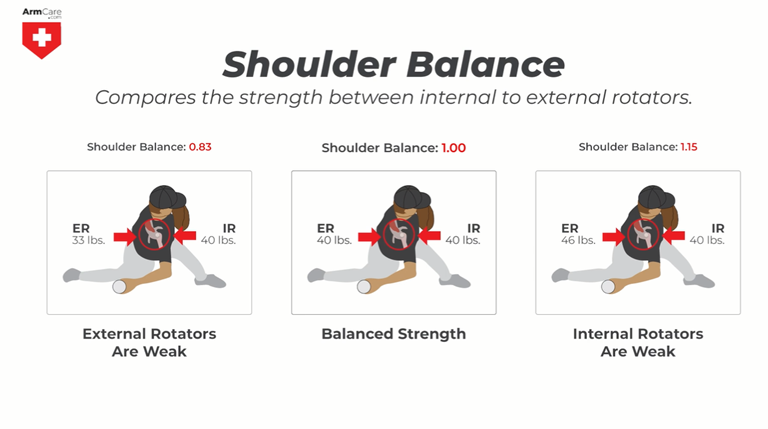
Image courtesy of pitchLogic/ArmCare.com.
Developed further by the pair of ex-Angels pitching specialists Crotin and Oseguera, the app began to pinpoint the most crucial metrics to empower pitching arms such as pinch grip and the ratio of strength to velocity (SRV), The platform ascended from there. They could state confidently that spin rate could only be improved through increased pinch grip strength, that simply altering a grip to create spin rate was fallacy. They could state confidently that talented and flexible teenage athletes could throw hard without proper strength, but those were also the very ones most likely to snap a ligament.
“Until you have this data at your fingertips, you can’t properly train these guys,” Moran says. “You can’t know whether you’re overtraining or undertraining unless you understand the fatigue and recovery of these athletes. And in less than five minutes, we can gather that data, and you don’t need a clinician. You don’t need expensive equipment to do it. You do it remotely. The app guides players through the exam with audio-visual graphics and then delivers customized exercises based on the results, as well as feedback.”
As a result, there are now players from all 30 MLB teams and most every D1 baseball program using the app — purportedly 15,000 youth, high school, college and pro players total — and Crotin claims the total number of ArmCare clients who’ve needed arm surgery is exactly…one.
Which is where pitchLogic comes in. Crotin and Co. know that an ever-changing arm slot can be a red flag for arm weakness, something their app does not ascertain. But pitchLogic’s smart baseball — utilized by all MLB teams, including Yankees closer Clay Holmes — contains the accelerometers, gyroscopes, magnetic sensors and Bluetooth radio to produce a 3D clock that shows precise arm slot, not to mention any irregularities in velocity and spin. From there, ArmCare can determine whether any arm slot inconsistency is from weakness, fatigue or simply biomechanics.
But if it is weakness — and a pitcher’s about to blow out an elbow or shoulder — pitchLogic and ArmCare.com can together sound the siren.
And go from one surgery… to none.
This article was brought to you by SBJ Tech, a Leaders Group company. As a Leaders Performance Institute member, you are able to enjoy exclusive access to SBJ Tech content in the field of athletic performance.
‘How can we put our athletes in positions to be successful?’
A Data & Innovation podcast brought to you in collaboration with
“When I need to be able to understand something, when I need to be able to communicate something, when I need to be able to have that conversation with our front office or coaching staff, whoever that might be, they’re the ones that I’m going to in order to get that information.”
McDaniel is the Vice President of Player Performance at the LA Dodgers and the first guest on the People Behind the Tech Podcast series, a new collaboration between SBJ Tech and the Leaders Performance Institute.
During the course of the episode, he also talks to SBJ’s Joe Lemire and Leaders’ John Portch about topics, including:
John Portch Twitter | LinkedIn
Listen above and subscribe today on iTunes, Spotify, Stitcher and Overcast, or your chosen podcast platform.
The catcher discusses his use of the Trajekt pitching machine, heat maps, raw data, iPads and much more besides.

His 2022 season with the Mets was slowed by injuries — a fractured hamate bone and strained oblique — but McCann caught the team’s combined no-hitter on April 29 in a game started by Tylor Megill. McCann helped to anchor the pitching staff along with teammate Tomás Nido as New York made its first playoff appearance since 2016.
McCann, 32, is a California native who starred at catcher for the University of Arkansas. The Tigers selected him in the second round of the 2011 MLB Draft, and he made his big league debut in September 2014. McCann was also the club’s nominee for the Roberto Clemente Award, an honor for community service.
On his use of video and data to prepare for opposing pitchers . . .
A little bit of both. You watch previous matchups against them that you’ve had individually. You watch how he’s pitched other hitters from the same [side] ± whether you’re righty, lefty — and then you also just pay attention to tendencies. You try and see if there’s any tendency to pick up on, whether there’s a certain time in the game, certain count, where you can [expect] a certain pitch.
It’s almost like a poker game. You got to play your odds at times. When you’ve got a guy — and Darvish definitely has the capability to do this —who can be on his game and not being missing spots, you got to take a shot [at guessing]. You might look foolish at times, but other times it turns out to be a big reward.
On whether he prefers to review heat maps or the raw data . . .
Probably a little bit of variety. I like to at tendencies, and then I like to see the actual video just so I can see pitch shape. Obviously, there’s nothing quite like standing in the box and seeing pitch shape. But if you can watch it on video and see, ‘Hey, this is what it looks like when it’s really good. Here’s what it looks like when there’s a mistake.’ Hopefully then you can hunt the mistake or and lay off the really good one.
On trying WIN Reality or the Trajekt pitching machine . . .
I’ve never tried [VR]. I have tried our pitching machine, Trajekt. The way I compare it for guys is, if I’m hitting off of a guy that I’ve caught for an entire season, it doesn’t mean I’m going to have more success off of him, but I know pitch shapes. I know what his pitches are going to do. And it gives me that background information to know what to look for. And that’s exactly what the Trajekt does.
[I’ve used Trajekt] just a few times. It’s not a ‘feel good’ machine. It’s just different as far as timing. So it’s hard to get in there and take swings. I like it to just go in and just track pitches and see pitch shape. It’s still just popping out of a hole. It’s timed up with the release point, but the thing that’s interesting about it is, you don’t really realize how much your eyes tell you at release point. You’re actually picking stuff up in the angle of the wrist and different things like that, that you don’t get from just a hole spinning the ball out.
On the vision of hitting . . .
I’ve heard Manny Ramirez used to look at the backdrop because you want to go from big focus to small focus. If you’re focusing real hard, you can’t focus on a small area for an extended period of time. So going from a big picture to a small picture is what most guys try to do.
On how he prepares for other hitters as a catcher . . .
A little bit of everything, honestly. Looking at the numbers, looking at heat maps. Looking at trends, the most recent things that are going on, and watching the video. Does the video — what I’m seeing with my eyes — match up with what the numbers are telling me?
For example, this is why heat maps are good because then you can have heat maps that have expected values [of contact] versus actual values. You might have a guy that looks like he’s struggling on sliders, and then you pull up his video against sliders and every ball he hits is on the money but just going right at somebody. So in that case, is he really struggling on sliders or is he just having bad luck? That’s why I like a little bit of everything: numbers, heatmaps and video.
On balancing opposing hitter tendencies with his pitchers’ arsenals . . .
[Deciding to] go with pitcher strengths vs. hitter strengths, hitters’ weakness, pitchers’ weakness. At the end of the day, you don’t want to lose on your worst pitch, right? If you’re going to get beat, you want to get beat on your best pitch, but how does that match up with the hitter? So it’s the cat-and-mouse game, it really is.
On working with each individual pitcher’s interest in this info . . .
That’s exactly it, every guy’s a little bit different. Some guys are really hands-on, and other guys are just, ‘Let’s just go with the rhythm of the game.’ So that’s part of getting to know each guy and knowing what makes them tick and having a relationship with them.
On using the dugout iPads during the game . . .
I like to look at them defensively more than offensively. I like to be able to go back and look at pitches that we may have gotten [called a strike] or not gotten, see where the strike zone is being called to know, Can we go keep going there defensively? Or do I need to make my hitters aware that, ‘Hey, he’s giving a little bit off the plate, he’s giving a little bit down, off the plate — whatever it may be.’
Offensively, yes, I like to look, just like maybe a quick check and balance, but I don’t like to sit there and study something in the game because, in the game, if you’re trying to think about your hands or your feet, you’re missing the most important thing and that’s seeing the ball. So it’s a touchy subject in the fact that I think it’s really good, but it can also be paralyzing at times.
This article was brought to you by SportTechie, a Leaders Group company. As a Leaders Performance Institute member, you are able to enjoy exclusive access to SportTechie content in the field of athletic performance.
AWRE Sports uses camera vision, cloud technology, skeletal tracking and streaming to create automated film clips.
If only the numbers could all be aggregated onto one simple video.
Then again, that’s the goal of AWRE (pronounced Aware) Sports, a startup that relies on camera vision, cloud technology, skeletal tracking and streaming to create automated film clips that can be overlayed with any baseball player’s wide swath of personal metrics.
The company is currently deploying its hardware and software at the Division I level with the University of Maryland, at the DII level with Erskine College, at the DIII level with Keystone College, at the JuCo level with Eastern Oklahoma State College, at the prep level with IMG Academy and, yes, even at the youth level with Brick Little League in New Jersey.
The result is an application that serves as part recruiting platform, part training platform, part game-stream platform and, down the road in an absolute dream scenario, as perhaps a competitor of the scoring app and automated highlight company GameChanger.
“Obviously, GameChanger’s literally everywhere – that is a monster,” says Ken Spangenberg, AWRE’s chief sales officer and older brother of the St. Louis Cardinals’ Cory Spangenberg. “But I think there are differences that kind of separate us from anyone else. One, the fact we’re trying to capture everything, not just games. Hopefully, people are ultimately going to choose: ‘Do I want to watch on GameChanger or do I want to put it on AWRE?’”
If nothing else, AWRE has a vision…as well as computer vision. It doesn’t intend to be the scoring app that GameChanger is, although it does stream games. Instead, it wants to elevate its streams to another stratosphere with radar and sensor integrations.
The company’s roots are in golf. CEO and co-founder Chris Clark, a former college baseball player at DI Wofford, is married to the former Vanderbilt golf coach Holly Clark and saw his wife struggle trying to organize the team’s data, scorecards and spreadsheets. Circa 2012, he developed software that allowed her players to store all of their vital golf analytics on their iPhones, giving birth to a company he called, “Birdie Fire.’’
But his passion remained baseball, and he went on to develop a predictive spray chart model that appealed to most of the college programs that demoed it. One of those schools, Oregon State, went on to win the 2018 College World Series, claiming Clark’s spray chart predictor helped them position their defense and strategize pitch location during their title run. From there, Clark had no choice but to expand.
“I’ve got this [Oregon State] coach wanting to give me a testimonial,” Clark remembers. “I’m like, ‘Hell, now I’ve got to figure this out. It may never get better than this. How do I leverage turning this into a business in the baseball space?’”
He ended up having a purposeful conversation with his Wofford college roommate, Steve Johnson, who ran a New Jersey baseball training academy named Invictus with business partner Rob Corsi. The discussion turned to the smorgasbord of baseball technology out there: the Pocket Radars, Stalkers, TrackMans, Blasts and so on. Johnson mentioned how his facility’s travel ball players needed those sorts of data points to be recruited but often had no way to afford or gain access to such high-end tech.
Clark then talked about how college programs could afford all those devices but could barely aggregate it. He mentioned how graduate assistants were always tasked with writing down launch angle, exit velocity, spin rate, bat speed — arduous and imperfect tasks.
The outgrowth of those discussions became the genesis of AWRE. Clark and Johnson — with the help of a chief technology officer Dave Johansen, COO Corsi and later Spangenberg — debuted the company in their comfort zone: college baseball. Due to their connections from their days at Wofford, Clark and Johnson made a decision to reach out to universities large and small to trial their hardware and software.
The hardware involved the installation of six cameras at each college’s baseball field: a centerfield camera, a camera above home plate and two more cameras on each dugout so both a hitter and pitcher could be filmed from their open and closed sides. Meanwhile, the software involved camera vision, machine learning and artificial intelligence that enabled each pitch or swing to become an automated video clip.
Next was adding the video overlay. Integrating with Pocket Radar, for instance, started with a pitch speed being uploaded to the Pocket Radar cloud, where it would then be synced with the AWRE cloud. With other apps, such as the Stalker radar gun, the overlay vehicle may be Bluetooth instead of a cloud, according to Johansen. He says for the TrackMan V3 ball flight tracking, there is a listening device that marries the data with the video. With Blast Motion, the data is overlayed through separate downloads and uploads, and the same with Yakkertech.
“We started to sell it to colleges,” Spangenberg says. “The reason for that is it’s the cleanest target. You know what the fields are going to be, you know they’re going to pay their invoices on time, you know they’re going to be receptive to the technology. And we’re full. So at this point, we have a waiting list.”
In other words, anyone streaming a Maryland Terrapins baseball game this season through AWRE will be able to toggle between the six cameras, but also see the metrics of each pitch and swing on company’s game center. But streaming games isn’t the platform’s long term goal: streaming analytics is.
The company will soon trial a platform on smart phones that will enable parents or fans to log in, start streaming any game through the AWRE app and immediately have automated clips of every pitch or swing that can be found on player profiles. If the fan or parent can bring a Pocket Radar or Stalker or Blast with them, or if the venue is equipped with AWRE software, the metrics can be overlayed onto every clip – turning every swing or pitch into a video that can be sent to a college or shared over social media with verified analytics.
GameChanger has begun to do the same during games, but AWRE’s hardware and software can be deployed in batting cages or bullpens for just as valuable training data.
“We’re democratizing recruiting,” says Spangenberg, a former head baseball coach at DIII Arcadia University. “The one-percenters have the high-end platforms like like Yakkertech or Track Man. It’s the Power 5 schools. But I think what we’ve built and why it’s interesting is it can also service an 8U team. So we’re not looking at 1 percent of the market, we’re looking at the entire market.”
AWRE’s longer term goal is to eventually use its skeletal tracking — which is currently part of its machine learning — to measure metrics like pitching velo and exit velo on its own…without integrating all the grab-and-go technology.
“Then our app can give people feedback on their swing mechanics or pitch mechanics in real-time,” Johansen says. “Our product can say ‘Your swing is most like Mike Trout. Or Aaron Judge.’ How cool would that be?”
This article was brought to you by SportTechie, a Leaders Group company. As a Leaders Performance Institute member, you are able to enjoy exclusive access to SportTechie content in the field of athletic performance.
MedStar Health, the team’s medical provider have partnered with the Orioles to deliver a fully in-house initiative.
Housed on MedStar’s campus in Bel Air, Maryland — around the corner from the franchise’s High A minor league affiliate in Aberdeen, only 30 miles northeast of Camden Yards and about an hour’s drive from the Double A team in Bowie — the tech-laden lab will help the club assess and monitor their pitchers for delivery efficiency and injury prevention using 10 Qualisys markerless motion-capture cameras, TrackMan’s optically enhanced radar and three force plates embedded in the mound.
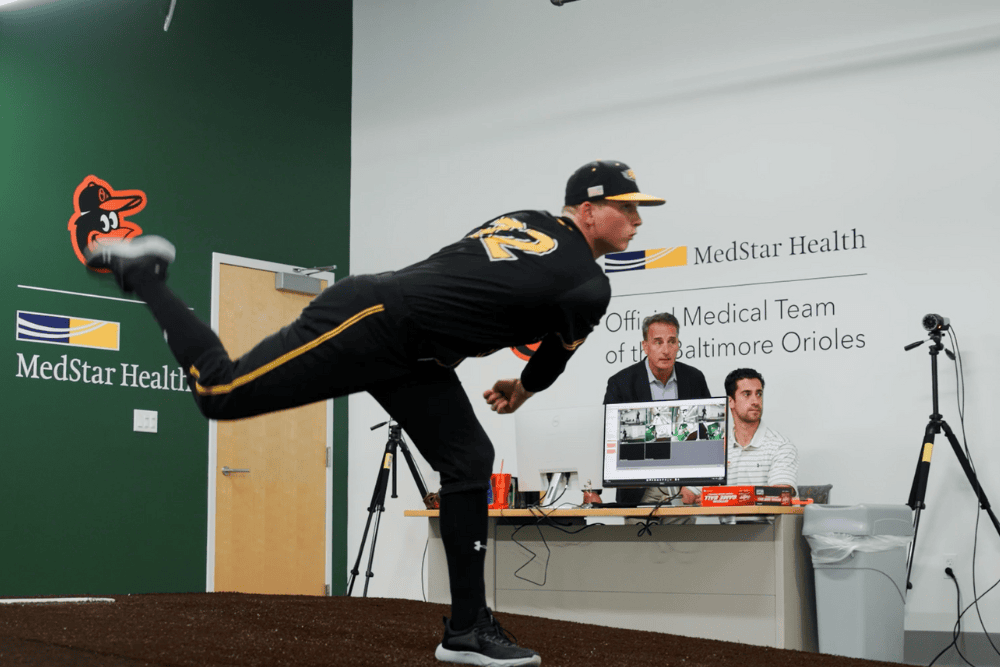
The Orioles’ pitching lab uses 10 high-speed cameras, force plates in the mound and advanced ball tracking technology.
“It’s something that any modern, cutting-edge player development system needs. It’s sort of a baseline requirement at this point,” says Orioles Director of Player Development Matt Blood. He adds, “The competitive advantage lies in how you actually use the information that the labs produce because I think just about every team is acquiring this information, but then it’s what do you do with it from there to help the players get better?”
Since the new executive team took over in November 2018, led by GM Mike Elias and AGM Sig Mejdal, the Orioles have built out a robust group of coaches and analysts to modernize the franchise’s then-lagging baseball operations. Now, they’ve assembled a management team can interpret and apply such data sources, rather than contracting out some of that work to biomechanics consultancies such as provided by Reboot Motion or Driveline Baseball.
“Fully in-house. We’ve hired the people that we feel are necessary to process the data at every step of the way,” Blood says. “And then we’ve got coaches who are hungry for that information and will put that into play on both the pitching coach side and the strength and conditioning side.”
The cameras and TrackMan are portable, enabling most of this set up to be moved around, including to the Orioles’ player development complex at their spring training facility in Sarasota. Only the force plates are fixed in place, but Blood says a second sensor-laden mound is slated for construction there. One force plate is placed at the rubber to capture a pitcher pushing off to start his delivery, and then two more are installed side by side down the mound to evaluate the landing force of righty and lefty pitchers.
The idea, he says, is for pitchers to get a spring training baseline and then receive follow-up assessments every four-to-eight weeks. In a video interview shared by the team, Orioles starter Jordan Lyles discussed throwing one of his between-start bullpens at the lab, which opened to the team in July, while seeking better efficiency with this throwing motion.
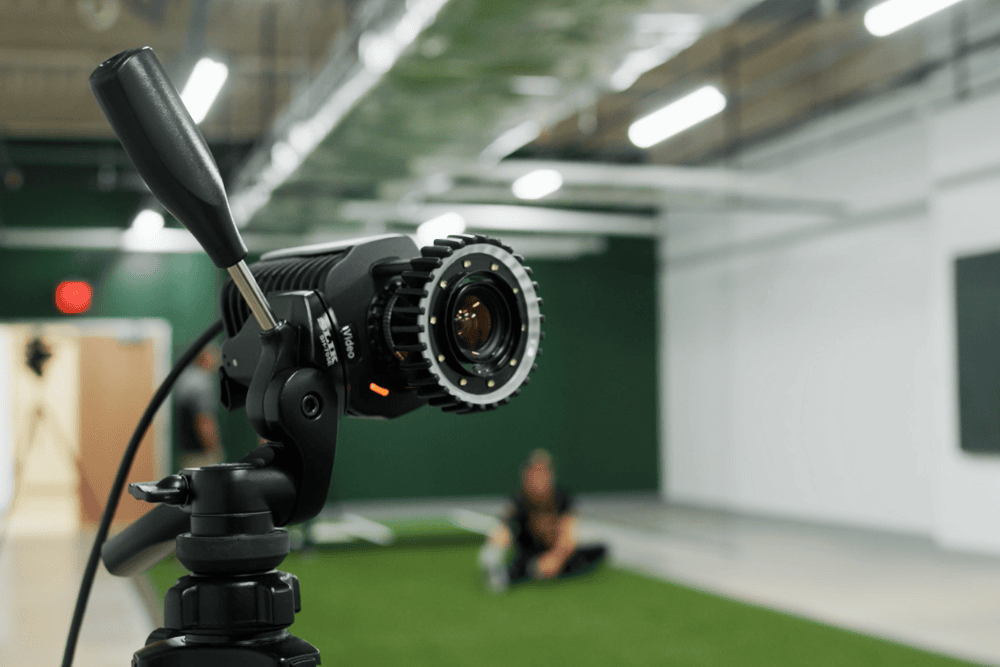
The pitching lab will serve as an evaluation destination for Orioles pitchers at every level.
“We feel like we have gone about this in a responsible and organic way,” Blood says. “Instead of just rushing to acquire the data, we rushed to acquire the people who could help us and build out the proper system and process and technologies that were most practical and productive to use.”
Previously, the Orioles sent players to the Wake Forest Pitching Lab, owing to a good working relationship they have with both lab director Kristen Nicholson and baseball coach Tom Walter. The Wake lab is identical to what the Orioles built — 10 Qualisys markerless motion capture cameras, TrackMan, three force plates — and is open to the university’s baseball programs as well as the public.
“I have a particular interest in creating 3D simulations to enhance performance in both sports and medical rehabilitation and then also to figure out and define pitching efficiency,” Nicholson said. “We want to limit throwing arm stress and avoid injury without sacrificing velocity, and that becomes the real core of our lab and what’s driving our research in player development.”
This article was brought to you by SportTechie, a Leaders Group company. As a Leaders Performance Institute member, you are able to enjoy exclusive access to SportTechie content in the field of athletic performance.
Brandon Stone of the Toronto Blue Jays explores four factors to promote buy-in.
A Human Performance article brought to you by our Main Partners

“If it’s true but useless,” he told the gathered media. “I don’t really share that with our team.”
The Leaders Performance Institute cites that moment when speaking to Brandon Stone, the Sports Science Coordinator at the Toronto Blue Jays. Coach Kelly was referring to a game that took place two years earlier – but could ‘true but useless’ apply to the application of sports science as a team?
“If you walk into a room as a sports scientist and you feel that you have to say ‘the rate of force development is at the 50 millisecond epoch’ or ‘you’ve got to start an assessment with the upper quarter YBT’ – if you always have to be that technical and you can’t generalize it or apply it– to me that isn’t science,” says Stone, who previously worked in Olympic and Paralympic sports, college sports, and with the military.
“We have to bring the lab to the field and make sure it answers questions that are relevant to the work our coaches do every day. If it can’t be applied, it isn’t useful. I’m not going to get caught up in a term that would prevent me from connecting with coaches. If they use ‘workload’ and they don’t really mean work in joules, then use another term. It’s the same if they say ‘velocity’ and they mean ‘speed’. Instead of me getting hung up on that for six months I would rather connect with people and meet them where they are as that creates an opportunity to say: ‘when we say speed, then this is how we define it , and here’s how we’re seeing it’. The faster we speak the same language the quicker we can begin impacting players together.”
Stone is proud of the manner in which the different departments of baseball operations, such as scouting and player development, are willing to collaborate with the sports science department. “I would say that we’re dot-connectors,” he continues. “We understand the ‘benchtop science’ aspects of physiology, neurobiology and biomechanics, but then we also have the ability to apply that in a field setting. I think that’s what the backbone of sports science should be, can be, and is, in certain instances.”
He has also noticed the wider trend towards generalists in sports science. “We need to have a bit of depth in each domain,” he says, which includes a breadth of ‘soft’ skills allied to a deep practitioner knowledge and, here, Stone sets out four factors for sports science practitioners to consider when developing trust in their craft.
Stone argues that sports scientists have, at times, adopted the wrong approach when entering an organization. “We’re often coming into environments that have been there for a long period of time and, for me, it’s more about creating an environment of openness and a willingness to engage on both sides,” he says. “As long as we have a way we’re going to approach something internally that makes sense to everybody in the room – not just the scientists or the coaches – but it has to make sense to everybody and we work really hard with that. We’re going to make sure that the technology and verbiage we use fits that environment so that people don’t feel like they can’t connect and understand, because then they’re going to be unwilling to say anything. We’re going to be two ships passing in the night instead of getting on land together and making sure we’re taking the next step forward.”
Meeting the coach where they’re at – and gaining their confidence in your work as a sports scientist means listening. Stone says: “We can fall into this trap where you think you’ve got to come in and prove your value. ‘I will try to show you how smart I am and show you all the gadgets I have.’ But if you’re in the organization they already value you at some level, right? In my opinion, what creates that confidence in our coaches is my ability to just listen. I want to learn from them regardless of their age, their years in the field or the game. What ends up happening is that they’ll say things that I also see or resonate with. We already mentioned the challenge of the verbiage, the language that is unique to that culture. The ability for the practitioner to learn fast is fundamental and the best way to do that is to listen. Just little things. You get a sense for what they’re describing, and you end up saying ‘Oh yeah, I see the same thing’. That common ground can gain confidence and trust can grow from there.”
When it comes to building confidence in a dataset, Stone stresses the importance of routine for everyone involved. “You want to have as much rigor as you can in the field, but there’s a razor’s edge of knowing I can’t control everything,” he says. “It’s not going to be a sterile lab environment, but if we can keep the same repeatable things every single day then we have a higher likelihood of that being reliable over time. Simple things – simple but not always easy – like monitoring. We’re going to monitor at the same time or at least in the same time block every day at certain times of the year, knowing that when we have to switch, then we’re not going to compare morning to afternoon data. Research would support it, anecdotal information that we have in-house would support that too. Working in the United States military, working in college athletics, I can’t remember one place where people didn’t like a schedule. So we’ve tried to leverage that so that what we do fits into their day. It’s not an extra thing that they have to do.”
Pick the item that gains you the most buy-in. “That was the thing when we came in,” says Stone. “We picked the one thing that we were already doing that we could improve, and once we had that dialed in the other pieces could fall into place. Some coaches have that model for skill acquisition; ‘I’m going to start with one cue and one thing a day. We’re going to get really good at that and build upon that foundation.’ It’s the same thing with our scientific approach. Yes, it may not be perfect, and someone from an academic environment would come in and say ‘there’s seven things that aren’t right’. I would suggest that if we can fix one thing that helps three of those take care of themselves and I know that one thing can get more buy-in. I may have a lower confidence level on the validity and reliability of that data upfront, but I can also circle back with some key stakeholders and say early on ‘this is going to be a little bit rough but it gets us into our routines to know that these other three or four things are going to happen down the line.’ That’s what gives me more confidence now because those other things have started to snowball in a positive way where we’re getting to control those simple but not necessarily easy things.”
Whether it is mere scouting reports or an analytical deep dive, the startup’s platform, which pulls in data from various sources, offers something to all coaches.
“I was jaded on some things, felt like they could be done a lot better,” he says.
Those pain points led to the founding of 6-4-3 Charts, a leading college baseball and softball data analysis and visualization tool. Five years later, 6-4-3 Charts works with 550 college programs, provided statistical support for ESPN’s broadcasts of the men’s and women’s College World Series and recently partnered with Sportradar-owned Synergy Sports on integrating its cloud-based video platform. Synergy already counts 96% of Division I baseball schools as clients, as well as growing numbers of softball programs and smaller school baseball teams. It also supports all 30 MLB organizations.
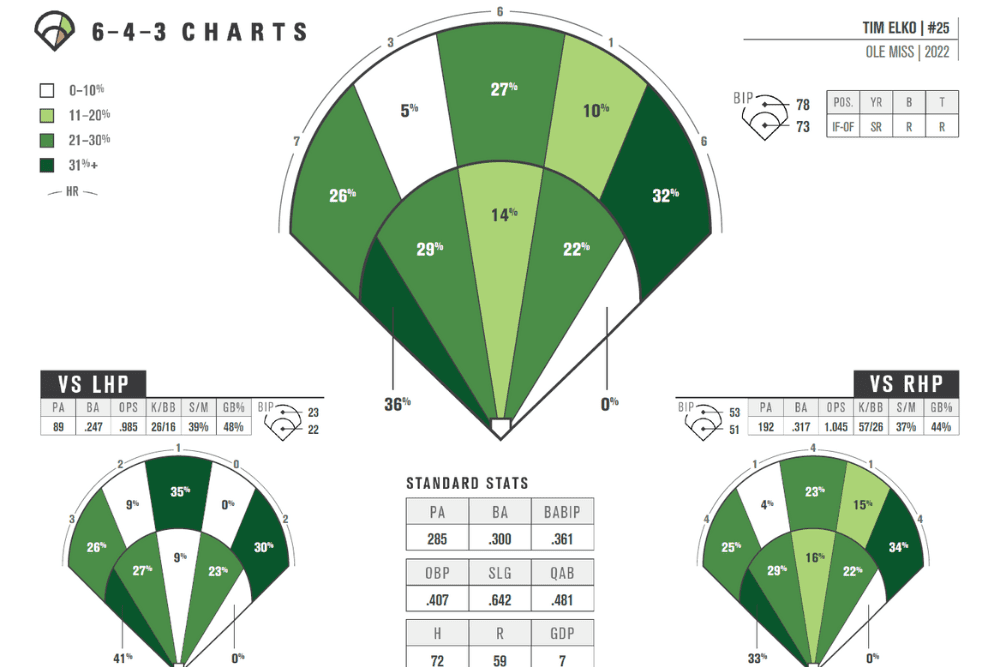
The 6-4-3 report generating process is on-demand and customizable. Coaches choose the template, stat year, spray chart design and players to include.
“What’s really cool is we’re sharing data between both of our APIs, so we’re not just leveraging Synergy data and video, but they’re also leveraging our data to improve some quality assurance processes and to look at potential ways to make their vlogging process even more efficient,” Weldon says. “And then, on our side, obviously, accessing all their video and data gives us a really unique opportunity to connect data from multiple sources.”
The origins of 6-4-3 Charts were humble, starting with a $12,000 investment and no full-time employees for its first two years. On the long bus ride to Tennessee Tech’s appearance in the ’17 NCAA regional in Tallahassee, Weldon called one of his former players from his time leading the Timberline High program in Lacey, Washington.
Rick Ahlf, who played shortstop for Weldon, was a high school valedictorian and Arizona State engineering graduate who had accepted a job at Boeing in low-speed aerodynamics product development. Ahlf laughs when recalling the experience of playing for Weldon at Timberline—“That was my first 50-hour-a-week job,” he jokes—but was interested in sports analytics and agreed that there was an opportunity to make a better product. (The third co-founder is Tim Kuhn, a CPA by trade who serves as COO at 6-4-3.)
Working out of his parents’ basement in the summer before the Boeing gig started, Ahlf coded the first iteration of the 6-4-3 Charts product. By scraping box scores and play-by-play data, the tool produced in-depth statistics and visualizations. In recent years, they’ve added a feature to sync TrackMan ball flight data as well as several other partnerships, including with SEQNZR and Playsight.
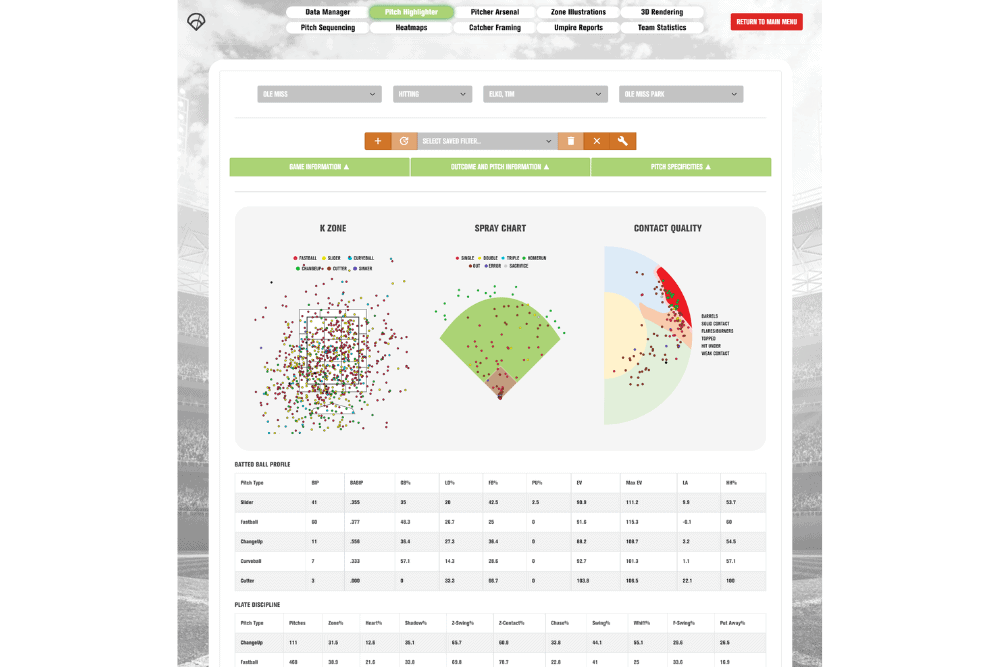
6-4-3 syncs with TrackMan to share ball tracking data visually with coaches and players.
“We started with PDF reports and Dropbox links, and we’ve evolved,” Weldon says. “Five years later, it’s a fully dynamic interface with on-demand reporting, customization, upload visualizations, video tagging, analysis, ball tracking.”
Coaches are the primary users, with some simply downloading basic scouting reports and spray charts and others delving deep into situational data.
“Coaches of all levels will now have the ability to enhance their game prep and film review,” Matt Lawrence, Synergy Sports’ senior director of baseball and softball, writes in an email. He adds, “And, importantly, their program is in-depth and easy to use. As a former D3 coach, I know this partnership is something that would have enhanced my video scouting and game preparation experience.”
Weldon says they are considering development of their own player portal; one of 6-4-3’s other partners, Driveline Baseball, already does with its TRAQ system. One of the 6-4-3 features is customization of a pocket card with info, for players to wear in a wristband during games or coaches to keep in their pockets. (NCAA rules prohibit in-game access to technology.)
In addition to serving its coaching clients, 6-4-3 has begun sharing some of its data in the media, both with ESPN and D1Baseball.com and D1Softball.com.
“We have all this data,” Weldon says, “and it’s like, ‘Well, other people besides coaches would probably be interested in this data. How can we tailor something for media, for example?’”
For the softball College World Series, Weldon was in the ESPN booth alongside the lead stats researcher and with two 6-4-3 team members in the graphics truck. Having seen how the process works, he is now brainstorming a specific TV production app to help broadcasters provide additional context and storylines.
6-4-3 started gaining significant market share by early 2019, when Ahlf left Boeing and dedicated himself full-time with the startup.
“Honestly, I like having control of my own future,” he says. “I’d rather bet on myself and the people that I trust to work with than being part of a large company where things just honestly move slowly. I like having that level of ownership and accountability that, ‘Hey, if I don’t perform properly, then this thing doesn’t go anywhere.’”
Weldon, incidentally, does still coach back in the high school ranks. His Olympia (Washington) High team won the Class 4A state championship last month. And he’s still in charge of the grounds. “Oh, absolutely,” he says, before correcting himself. He recently handed over mowing duty to a volunteer whose son is on the team.
So some things change, even if the spirit remains.
“All I ever say,” says Weldon, “is, ‘Just keep moving. We’re not going to be still. Let’s just keep going.’”
This article was brought to you by SportTechie, a Leaders Group company. As a Leaders Performance Institute member, you are able to enjoy exclusive access to SportTechie content in the field of athletic performance.
The Rangers’ Ben Baroody explores how the club sets people up to succeed.
A podcast brought to you by our Partners Elite Performance Partners

Ben Baroody, the Director of Leadership Development & Mental Performance at the Texas Rangers of Major League baseball, is discussing career and leadership development opportunities at the club in this latest edition of the Elite Performance Partners Industry [EPP] Insight Series.
EPP are a performance consultancy and search firm highly regarded across sport and, for this episode, EPP’s Founding Partner Dave Slemen and Managing Partner Anna Edwards posed the questions to Ben, who spoke of the Rangers’ processes and practices that enable the advancement of players and staff alike.
Also on the agenda were:
Dave Slemen Twitter | LinkedIn
Anna Edwards LinkedIn