Springbok Analytics’ technology offers the latest develop in preventative health measures for athletes.

Inside, a portable MRI machine needed only 10 minutes to scan the women’s lower bodies, at which point AI algorithms from Springbok Analytics took the 2D imaging and converted them into 3D digital twins that can be used for muscle analysis — establishing baselines that can be used to individualize training and flag latent injury risk.
Unrivaled, the 3-on-3 women’s league that debuted on Jan. 17 in Miami, is the latest league to partner with Springbok Analytics. In the past two years alone, Springbok has collaborated with three of the five biggest North American sports leagues: It graduated from NBA Launchpad; completed data collection on an NFL-funded research project into hamstring injuries; and began the initial phase of an MLB-backed study into pitcher health.
Now boosting Springbok’s rapid growth across pro sports and into broader populations is a newly closed, oversubscribed $5 million Series A led by Transition Equity Partners , which also led a $3 million seed round in 2023. Joining the investment were the NBA, which added to its initial equity stake from Launchpad, and Cartan Capital , a sports tech venture firm led by former pro tennis player CiCi Bellis .
“This is a clear sign that our current and new investors are excited to see us scale all aspects of our business,” Springbok CEO Scott Magargee said, “and from a dollars-in-the-door perspective, it allows us to advance what we believe is our global leadership in the area of muscle analysis for large demographics of athletes and patients across the entire health care landscape.”
The interactive reports Springbok produces are musculoskeletal avatars shaded various hues of red, orange, tan and blue that detail muscle asymmetries, fat infiltration and a proprietary score comparing a person’s muscle size with others of similar sex, size and sport. Springbok recently released sport-specific databases for men’s pro basketball and soccer athletes — a women’s soccer counterpart is planned soon — for more apt comparisons. It received FDA clearance in October on its flagship lower-body scan, and added core and upper-body scans to what previously was lower extremity only.
Such a tool is even more important when the athletes are such physical outliers as in the NBA. More than 100 players are in that database, and in addition to partnering with nearly half the league’s teams, Springbok continues working at the league level during the pre-draft process.
“Their work with us proved that this is a really interesting new dataset in elite sports,” said NBA Senior Vice President Tom Ryan , who oversees Launchpad and all basketball R&D. “Springbok data is starting to become an important piece of the puzzle to help support player health and performance initiatives. That’s really the story: It’s very strategic for us, both at the league and team level.”
The continued strategic relationship helped facilitate the additional funding, NBA Investments Associate Vice President Pat Crouch added. “First and foremost, for companies that come out of the NBA’s Launchpad program, we look for follow-on investment opportunities when there is a continued strategic relationship. We only invest in companies where there’s some type of commercial partnership, at either the league or the team level, that has gained meaningful traction and has upside to continue to grow and expand.”
Notably, Springbok has no true competitor and a 15-year head start on understanding the use of this data, making it “a piece of the puzzle that nobody else is,” said Magargee.
“The fact that our expertise is the technology, but also in human performance and muscle physiology, we know where to keep going with it in a way that’s meaningful,” said Silvia Blemker , Springbok’s chief scientific officer. She added that one recently devised new metric is an objective injury severity score, which can quantitatively assess a strain or sprain rather than rely on a human practitioner to subjectively evaluate it.
Though Springbok Analytics’ work in sports has intensified in recent years, the foundational technology has roots dating back to 2009 and Blemker’s biomedical engineering lab at the University of Virginia. The company’s headquarters remain in Charlottesville, sitting in a nondescript office at one end of its pedestrian-friendly Downtown Mall. Springbok’s dual recognition in 2024 from SBJ Tech — as a Most Innovative Sports Tech company and SBJ Tech Award winner for Best in Athlete Performance — prominently greets visitors.
In those early days, Blemker was working on solutions to aid treatments of cerebral palsy and muscular dystrophy when the lab began developing the machine learning to extrapolate 3D data from MRIs. Those life science use-cases remain a part of Springbok’s mission, while also adding the human performance sector that makes it a highly differentiated product appealing to investors.
“Not only do we really believe in the team, but the technology, we think, is pretty unprecedented, especially with the years of R&D,” Bellis said, “and then the beachhead that they’ve had into the sports market is super interesting, because they can really instantly provide value to these sports teams and instantly give them money back, so to say, by having this preventative health measure for athletes.”
That expediency of the scans — much quicker than what’s needed for traditional MRIs — has helped Springbok amass its large elite athlete databases, including a thousand college and pro American football players, Blemker said. Those were collected to build a hamstring injury predictive index in collaboration with researchers at the University of Wisconsin and Australian Catholic University, and funded by a $4 million grant awarded by the NFL’s Scientific Advisory Board.
It’s that rich dataset, as much as any algorithm or an investment check, that is sparking Springbok’s growth — and the same competitive advantage will only continue to grow the same way it started.
“It’s taken us time,” Magargee said, “and it’s taken us partnerships.”
This article was brought to you by SBJ Tech, a Leaders Group company. As a Leaders Performance Institute member, you are able to enjoy exclusive access to SBJ Tech content in the field of athletic performance.
The pilot program will see biomechanics labs installed at the the Cavaliers, Jazz, Pacers and Suns.
The protocols, as explained in a league-wide memo in January, have been developed in consultation with the NBPA as well as sports medicine and performance experts. Provisions for such a screening program are codified in the current collective bargaining agreement, requiring players to participate in up to four assessments per season.
“It’s one of several major initiatives that we have in the works, including with the Players Association, to try to reduce injuries in the league,” NBA EVP for Operations & Administration David Weiss said, emphasizing its scope and ambition by adding, “We’re not aware of anything quite like this league-wide in the world.”
Planning for this project began long before a perceived uptick in the injury rate over the past year, but it remains set against the backdrop of ongoing conversations around appropriate load management and player participation policies.
The NBA is now in the process of installing biomechanics labs with four pilot teams: the Cavaliers, Jazz, Pacers and Suns. The goal is to have identical setups, with the same technology vendors and the same prescribed athlete motions, to ensure standardized data collection.
The four tech companies that won the league’s RFP are:
P3, a private facility that independently has evaluated the biomechanics of roughly 70% of current NBA players, will work with the league as a consultant to the program. The NBA first hired P3 to assess prospects at the draft combine in 2014. Individual teams can also contract with the firm for additional insights and normative data.
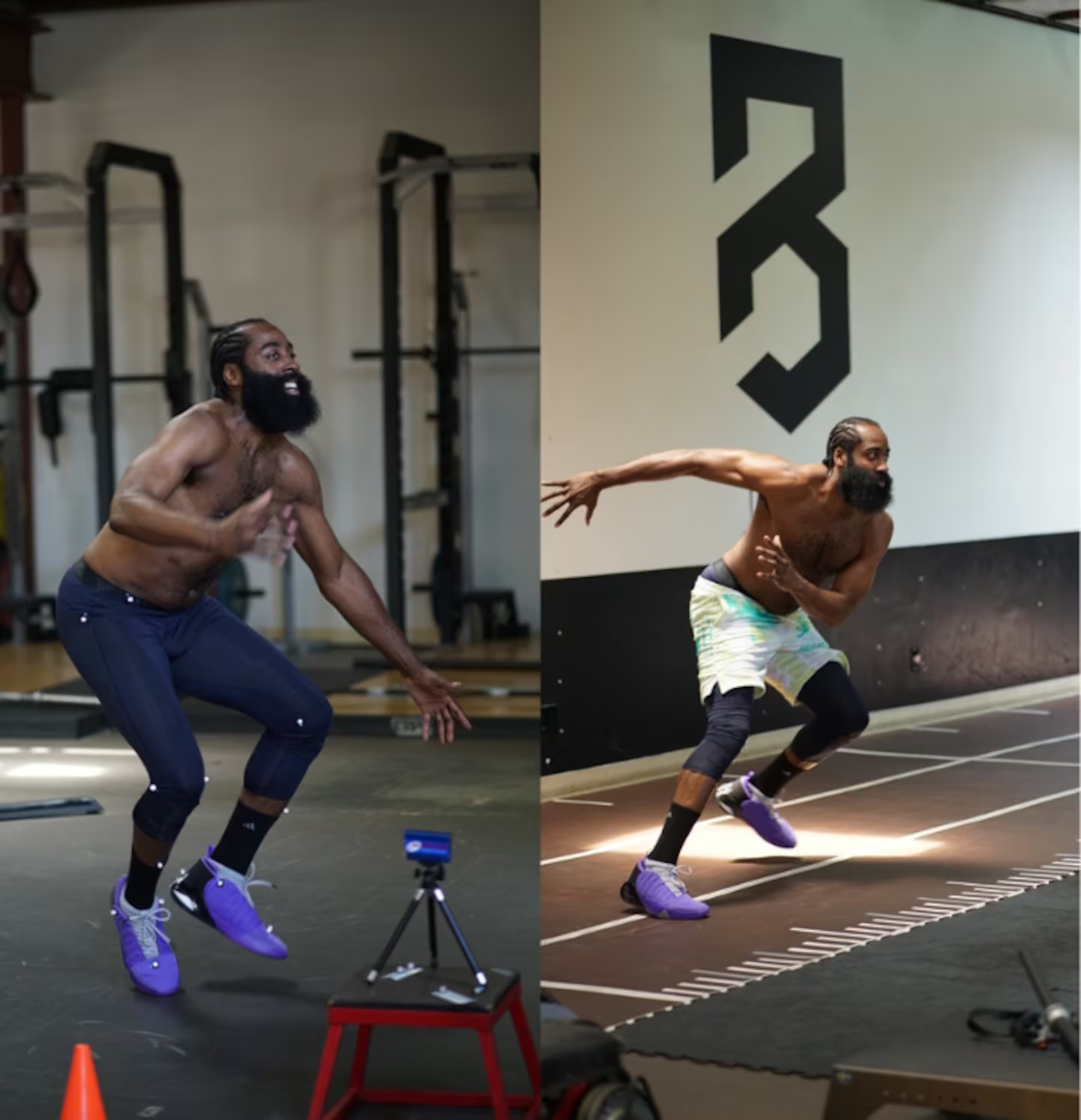
Image courtesy of P3.
“This relationship between how we move and what happens to us is a strong relationship,” P3 founder and director Marcus Elliott said. “It’s stronger than most people realize, which is why we invested all this energy into all of it. And the more we can start actioning that — and not just waiting for bad things to happen — the better it is for everyone: for the players, for the teams, for the league. I’m super bullish on the potential of biomechanics to make lives better and for us to follow these signals.”
Access to the data collected in these biomechanics evaluations will follow similar guidelines to how the NBA handles medical records. Players have full access to their own reports, which they will retain even as they change teams. Coaches, executives and performance staff will be able to see data for players currently on their rosters. Weiss indicated MDs and PhDs conducting vetted research will also be to connect the data with injury information for studies on potential risks.
One source noted a “vast discrepancy” in the way franchises have utilized biomechanics data to date, praising this new program as a way to ensure consistent, efficient and accurate assessments. Some teams have been investing in biomechanics for years while others have yet to allocate any resources toward it. By implementing his program across the league, the NBA can collect in one year as much data as any team could collect in 30 — hastening the pace of understanding what correlations exist between movement and injuries.
Deployment of this program, which is scheduled to last at least through the end of the current CBA in 2030, has been measured to make sure it is properly communicated and rigorous. Evaluating success will take time, too.
“Certainly whether we can reduce injuries long-term or a particular type of injury — that’s going to be one of [the KPIs] — and whether we can connect certain movements or certain changes in the way an individual moves to injury,” Weiss said.
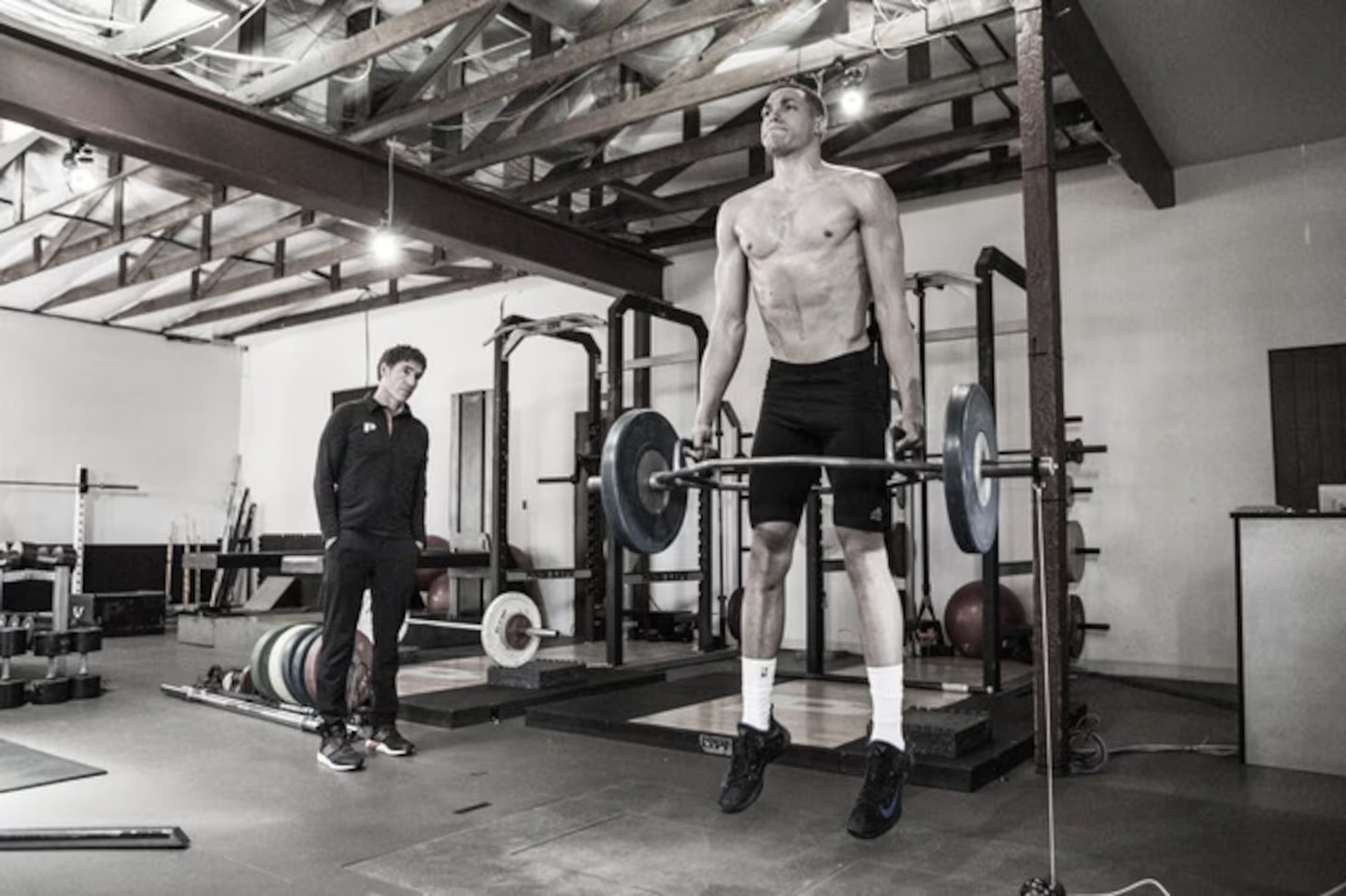
Image courtesy of P3.
Though the NBA’s in-game tracking system — powered by Sony’s Hawk-Eye — is camera-based and collects data on limbs and joint angles, that solution is only nominally a tool for rigorous biomechanics. Sony’s recent acquisition of KinaTrax, the leading baseball biomechanics technology, might help in the long run, but the current in-game tracking system doesn’t have the same fidelity the new lab-based system will provide.
There is a consensus that biomechanics might be an especially helpful tool in a sport like basketball “that certainly requires you to be a pretty impressive, high-flying athlete,” said BreakAway Data CEO Dave Anderson, a former NFL receiver. “The game is played well above the rim in the NBA, so jumping and your ability to land are critical to your career.”
Weiss added that experts with whom the league has conferred, including on its two biomechanics committees, point to “a number of factors — the size of players, the nature of the game, the number of games in the season, the hardcourt surface — that there’s reasons to think about biomechanics could be as helpful in basketball as almost any sport,” he said.

Image courtesy of P3.
These lab assessments are expected to take about 15 minutes, following a pre-scripted set of “motions that are directly applicable to their sport and health,” Theia CEO Marcus Brown said, describing his company’s software as “an accessible tool that also enables standardization within a vast data set. As a generalized neural network, Theia3D doesn’t require additional data for unique movements, environments or outlier athletes.”
It’s a highly technical distinction, but an important one: other motion capture solutions compare movement to various models, which can add to discrepancies when analyzing data from different sources and different seasons. “Having consistency in data collection over a long period of time on a big group of people is just something that I know our customers are looking for,” Qualisys product manager for life sciences Nils Betzler said, praising the “unified approach.”
“They’re really doing a tremendous job trying to better understand player biomechanics, player movement, and overall player health,” added Anderson about the NBA and NBPA. “They’re really trying to use science and numbers and research to make sure that the players are playing at the highest level. And I really appreciate that because a lot of these leagues are just adding games, changing roster sizes, and changing rules, and they just assume the players will figure it out. The NBA is taking this player-first initiative, and that’s just really cool to see.”
This article was brought to you by SBJ Tech, a Leaders Group company. As a Leaders Performance Institute member, you are able to enjoy exclusive access to SBJ Tech content in the field of athletic performance.
The former NBA small forward talks to SBJ Tech his new tool, which helps players to shot and offers instant feedback.
Main photo courtesy of Form
You can’t have a discussion about sports technology today without including athletes in that conversation. Their partnerships, investments and endorsements help fuel the space – they have emerged as major stakeholders in the sports tech ecosystem. The Athlete’s Voice series highlights the athletes leading the way and the projects and products they’re putting their influence behind.
* * * * *
Even though he was an above-average shooter — Hayward hit 1,111 career three-pointers at a .370 rate, and his .950 playoff free-throw percentage is No. 1 in NBA history — he kept seeking new ways to improve, which led him to an entrepreneur named Charlie Wallace. Hayward, 34, and his former Butler teammate, Emerson Kampen, acquired most of Wallace’s company, redesigned a few things and rebranded it as Form, which they launched this month.
Form makes a basketball shooting aid. The product is a flat-sided cube whose shape helps encourage proper shooting form and the development of muscle memory. The pro ambassadors for Form are nine-time NBA All-Star Paul George and the WNBA’s Lexie Hull, who’s currently a starter for the Indiana Fever.
On how he got involved with Form . . .
The creator of Form was this guy named Charlie Wallace, who created what was called Qube. I’m somebody that’s kind of a perfectionist, and I was scouring the internet looking for something for hand placement on a basketball and where to position it. And I came across Charlie’s YouTube and saw this device, saw him shooting it, and thought, ‘I might as well try it out.’ So I ordered one for myself. He came across on his sheets that Gordon Hayward bought one, so he messaged, asking if it was the real Gordon Hayward — it was.
I got the product. Then he sent me his number. We talked and chatted about it. Then we decided — my partner and I, Emerson Kampen — that we wanted to push forward with it and rebrand and relaunch the company. We designed a few different things about it and changed some stuff a little bit, and here it is now.
On the target demo for the product…
It was something that I loved using during the last couple years of my career, and I felt like this was a product that could really help a lot of young kids, especially. It’s really a tool that’s geared more towards younger kids that are just [wondering], How do you learn how to shoot? How do you shoot a basketball? You would start with a tool like this. I have young kids myself and felt like it was something that could really help them.
On what interested him originally…
For one, I saw Charlie, who’s this unassuming, middle-aged guy just draining jump shots from almost half-court. And it was like, ‘What is he doing?’ Shooting it straight every time. The ball is rolling back to him.
Now, at this point in time, I obviously still was a good shooter, and it’s not like I wanted to change my shot at all, but certainly felt like I used my left thumb a little bit and wanted to perfect it even more. So I think that’s what initially sold me on it, and then once I got it, just [saw] how simple it was. I used it more shooting around the house than anything. I didn’t really shoot it on a goal. I would warm up with it on a goal, especially during my offseason workouts, but more than anything, it was something that, I could be on the couch and just shoot over and over and over. It just locks in your form.
You can’t be on the basketball court at all times. But you’re sitting around watching TV and you’re just shooting this thing up and down on the couch. If you’re thinking about basketball and thinking about your shot and thinking about your game, it’s something that you can do, like I said, not even on a court. And that was another thing: I know a lot of people don’t have access to courts all the time, and you can use this anywhere and everywhere.
On whether he always wanted to become an entrepreneur…
I honestly didn’t ever think about it. I wanted to be a basketball player, and I was blessed and lucky enough to be able to play in the NBA and have a long career in the NBA. And I was just thinking each year about how I could get better as a basketball player, and this kind of fell into my lap. As I got older and older, you do have to start thinking like, at some point in time, this is going to end. The NBA always has a lot of meetings about that, and they’re trying to help players because your career is usually a lot shorter than you think it will be. And so you’ve got to have something that you can do afterwards.
This was something that fell into my lap, but it’s something that we quickly became passionate about because it allows me to still be around the game and help young kids learn how to shoot and but it’s also the other side of it. It’s the business side of it, and that’s fun. Obviously business is competitive. It gives you a chance to compete.
On his other post-basketball business interests…
My portfolio, in general, I wanted to make sure it had a lot of variety in it. I just also released a movie — I was the producer of a movie. So that’s another thing, and it certainly has helped me. As preseason games get started, I’m kind of missing it a little bit, but this has helped me bridge that gap. They always say retired athletes start to get bored and all this, but this has helped me jump right into it.
On the first film from his production company, Whiskey Creek Productions…
We made the movie [Notice to Quit] in September of ’21, over the course of that year. I was obviously still playing, so I wasn’t extremely involved on a day-to-day standpoint, but as the producer, I was sent dailies. I was able to go to Skywalker Sound and do some editing there, and I think, moving forward in the future, I would love to get more involved with that as well.
On other shooting tech…
I used Noah when it first came out. My shot was actually pretty flat, and we used that for a little bit just to work on the arc of my shot. Noah is good because you want to be consistent in your shot more than anything, and it helps you just realize your arc is not as high as you think it is. And so I used that. We used the gun when I was in high school — the gun is just the thing where you’ve got the nets that go right around the goal, and when you shoot it, the balls drop down, and then it passes it back to you.
On how youth can learn to shoot…
Another thing I thought was really amazing about Form: There’s never been and there’s not really a tool that helps you learn how to shoot. A lot of tools these days are data-driven, and they’re showing you all the data about your shot, the arc, the rotation of the basketball, the depth, how far you’re shooting it. It counts your misses and your makes, and all that stuff is really good, but it doesn’t help you learn how to shoot. It doesn’t tell you about your form.
There’s so many tools in other sports, like golf and baseball, for example, that everyone’s all-in on and learning to do the fundamental part of whatever you’re trying to do. [Basketball tools] show you your data, but they can’t help you fix it. You would have to do that on your own. This, if you don’t shoot it the right way, it’s going to spin because it’s a cube. It’s not going to spin on that singular axis. And so if you do it correctly, you see its instant feedback. You see it right away. It spins beautifully, and if it’s not, it’s going to be wobbly.
This article was brought to you by SBJ Tech, a Leaders Group company. As a Leaders Performance Institute member, you are able to enjoy exclusive access to SBJ Tech content in the field of athletic performance.
David Clancy, Richard Kosturczak and Ronan Conway explore the identifiers of team cohesion and the fundamental building blocks that separate the great from the good.
Without it, even the most skilled groups falter. As Peter Guber, the CEO of Mandalay Entertainment and Co-Owner of the Golden State Warriors, LA Dodgers and LA FC said, “Without social cohesion, the human race wouldn’t be here. We’re not formidable enough to survive without the tactics, rules, and strategies that allow people to work together.” This principle is as true in modern business organisations and elite sports as it was in our evolutionary history.
High-performing teams aren’t just thrown together without thinking. They are intentionally built through careful design, clear communication, and shared goals. It’s about finding the blend where roles, responsibilities, and diverse perspectives align, allowing every individual to leverage their strengths for the benefit of the collective.
So, how do we achieve that cohesion, especially in environments where team members may not fit neatly into traditional roles? How do we ensure that the whole team operates as a cohesive unit, even when differing opinions and reporting lines exist?
Finding the sweet spot
Cohesive working requires creating an environment where finding the sweet spot means aligning team members’ roles and responsibilities in a way that meets both organisational goals and individual capabilities. It’s about meeting in the middle – ensuring that while everyone contributes their unique expertise, they also respect the collective objective.
Leaders play a pivotal role in facilitating these moments of alignment, ensuring that when opinions or methods differ, the focus stays on finding the most effective solution, rather than reinforcing silos, judgements or personal agendas. In this sense, cohesion is about not just collaboration, but collaboration that works toward shared objectives, adapting as needed to meet challenges in real time.
The building blocks
The foundation of a cohesive team lies in four critical elements:
These building blocks allow for cohesion even in complex or unconventional team structures.
Identifiers of high cohesion
How a team clicks: does it work in harmony? Knowing where to look is essential for identifying how well a team is functioning together. Here are some concepts to look at for indexing this sense of ‘teamwork’.
These markers are crucial for evaluating is a team functioning as a tight unit. You could use these identifiers as a means for tracking and measuring how well the team is doing.
When these indicators are robust, the team’s ability to perform at a high level is elevated.
Ensuring that everyone is on the right bus – and in the right seat on that bus
Ensuring that people have the right roles and responsibilities in a team isn’t as simple as matching a title to a task. Often, it requires rethinking traditional organisational designs. Instead of relying on predefined job descriptions, high-performing teams focus on matching skills, expertise, and interest to the actual needs and musts of a team. This flexibility ensures that individuals are positioned to succeed, even if their role falls outside a traditional org chart.
The best approach is to identify the key outcomes the team needs to achieve and then allocate responsibilities based on who is best suited to drive those outcomes. It’s not uncommon for someone to hold responsibilities that cross functional boundaries, but as long as clarity exists, cohesion can still thrive.
The goal is not to fill predefined slots but to build a dynamic, flexible system that adapts to the needs of the moment, such is the demands of elite sport.
Good on paper vs good in reality
It’s easy to assume that a team looks perfect on paper – each role clearly defined, each person seemingly in the right position. But the reality is often far more nuanced. Good on paper might mean that organisational charts, roles, and responsibilities are technically correct, but it doesn’t account for the personal dynamics, communication styles, or agility of the individuals involved.
Good in reality, on the other hand, refers to teams that function well in practice, in the training room, on the field – when it counts, when pressure comes. This requires fluidity, acknowledging that roles may overlap, opinions may diverge, and people may need to step outside of their ‘assigned’ lanes to help the team succeed. Cohesion in the real world demands malleability, trust, and a willingness to change when necessary.
Managing differing opinions
It’s quite common for teams to have two people with different opinions or views reporting to different leaders. This could be shaped by the individual’s personality predisposition, such as are they more Type A and Type B, for example. These differing views, opinions and traits can create friction – but in high-performing teams, this diversity of thought is seen as a strength, something to be amplified, if positioned well. It pushes the team toward innovation and deeper problem-solving. The key is to ensure that these differing opinions don’t lead to disjointed decision-making and fragmentation.
This is where a decision-making model becomes critical. Leaders should establish processes that guide how decisions are made, who gets the final say, and how differing viewpoints are resolved. For instance, a performance director may not need to make the final call on a return to play decision, but having the A-Z flow will make this decision ‘cleaner’. Each professional stays within their expertise, but they collaborate through a framework that aligns with the team’s overarching goals, such as getting the player back on the pitch after an injury.
Overseeing the decision
Who oversees the decision-making model depends on the structure of the team, but it’s crucial that not every decision needs to reach the top. In well-functioning, cohesive teams, there are levels of authority and autonomy, allowing for faster and more efficient decision-making. Sometimes, well-oiled departments have decentralised command structures, often seen in the military. For example, a doctor doesn’t need the performance director’s approval to prescribe treatment, but the doctor and the PD must work within an established system that ensures consistency and alignment with the team’s overall strategy and vision from a sporting director.
The model should be overseen by those who understand both the day-to-day operational needs and the bigger picture. One needs to be able to zoom in, but also out. This is often a middle ground between front-line team members and senior leadership; this ensures that decisions are informed, timely, and strategic.
Cohesion reading
As a leader, you have likely accumulated a bank of time in teams and groups, from school, university, your organisation, etc. Thus, you have experienced a wide spectrum of people dynamics, cultures and environments. Think of the moments where something felt ‘off’. The energy seemed blunted. People were preoccupied with relational issues, toxic rhetoric, or disgruntlements. In these environments, the task at hand sometimes became secondary. On the flip side, when a team felt closer, it felt ‘right’. In these moments, energy flows… it bends… it adapts like a river. People are locked in, focused on the team vision. Why? Because these relationships are grounded on bone-deep trust and mutual respect.
Call it intuition. Gut feel. Emotional intelligence. This is how you gauge how cohesive a team feels, like a barometer for linkages.
The next time you walk into a team meeting or the changing room, allow yourself a moment to take a reading of the room. Pause and step back. Take a breath. Watch your people. Track their body language and eye contact. How do they greet each other and interact? Listen in. Note the intonation, the laughter, the silence. This is all data.
Is the energy flowing or is it stuck? Notice what you are picking up. Trust it. Take note.
Connection is a separator of great teams
If role clarity, conflict resolution, collaborative decision-making and mutual accountability are the bricks in the house, connection is the cement that binds it all. The quality of our team interactions is heightened when we feel psychologically safe with others, valued and respected. We remain open and engaged and are less likely to shut down or retreat into a corner.
So, how do we foster this connection more?
The elite coaches and managers take no chances in this area. Connection must be intentional. It is not something that one assumes will happen in a performance café or at a team-building Christmas party per se. Just as time is allocated in the weights room to build muscle, elite teams dedicate time to strengthen the collective muscle. This can be bridged by facilitating conversations with individuals to enable them to take stock and interact on a meaningful level. In doing so, they reinforce their connections between teammates, the jersey, their why, legacy and their higher purpose.
A great example of this deliberative connection-building comes from Europe’s Ryder Cup win in 2023 at the Marco Simone Golf and Country Club. Post victory, Rory McIlroy reflected on when his team started to take shape, under the leadership of Luke Donald, their team captain at the time, and European Captain for the 2025 Ryder Cup. On a practice trip in the lead-up to the tournament, putting greens, driving ranges and tactics boards were swapped for an ‘amazing experience’ around a fire pit. The team reflected on topics like ‘why they love the Ryder Cup so much’, and ‘having parents that sacrificed a lot for them’. This moment helped galvanise the European team.
Now to The Last Dance. In 1998, Phil Jackson, the Head Coach of the Chicago Bulls, gathered Michael Jordan, Scottie Pippen, Dennis Rodman, and co. He asked them to write about what their Bulls team meant to them before each player read aloud to the group. After they all had their turn, Jackson symbolically lit the tin cup filled with papers on fire, and all the Bulls watched on and felt more connected. “One of the most powerful things I’ve ever seen”, said current Head Coach of the Golden State Warriors and former Chicago Bull, Steve Kerr. The rest is history.
Final thoughts
Building cohesion and connection is about far more than getting the right people in the right roles – it’s about finding that sweet spot where collaboration thrives, even when team structures or opinions don’t fit the mould.
The successful teams of the past, whether this is Manchester United Football Club under Sir Alex Ferguson, the All Blacks of 2011 to 2015, or the Red Sox after they broke the curse, they all built strong foundations of trust, clear communication, and adaptable roles.
Teams can become great, making decisions that are informed by a diverse range of perspectives yet aligned toward shared goals. By implementing robust decision-making systems and processes, and fostering environments where flexibility, connection and trust are prioritised, high-performing teams can unlock their full potential…navigating complexity with confidence, and a higher sense of team.
David Clancy is a Learning and Development Consultant at the Houston Texans and Director at The Nxt Level Group. He is also the Editor of Essential Skills for Physiotherapists: A Personal and Professional Development Framework, which is available now from Elsevier.
Richard Kosturczak is a Market Specialist at The Nxt Level Group and Specialist Physiotherapist.
Ronan Conway is a Team Connection Facilitator, who has worked with teams including the Ireland men’s rugby team and Dublin GAA, Ireland’s most decorated Gaelic football team.
If you would like to speak to David, Richard and Ronan, please contact a member of the Leaders Performance Institute team.

Springbok Analytics uses AI to create a tool with the potential to help all 450 players.
A Data & Innovation article brought to you by
A graduate of the NBA Launchpad, Springbok Analytics has been scanning players for more than three years and has grown its team partner list to 10. To date, performance and medical staffs had used the product to detect muscle asymmetries and fatty infiltrations into the tissue, both of which can be early signs of injury risk.
But teams didn’t gain value from Springbok’s normative database because, even though there is a large proportion of elite athletes to go along with recreational competitors, most NBA players are outliers for their height and ability.
Utah Jazz Director of Performance Science Barnett Frank said the new NBA database “allows us to really be a little more strategic with our information.”
“One of the biggest challenges I have in the space is always getting asked, ‘Well, what does that mean for an NBA player?’” he added. “There’s 450 of them. When we’re comparing them to the general research or what’s out there in the population, it’s really hard to make any specific conclusions for them. So knowing that it’s NBA-specific for us, that really gives me a little more juice, for lack of a better term.”
This feature has been requested by teams for a while, said Matt Brown, Springbok’s Director of Sales & Business Development.
“It’s the first time they’ll really use the comparison mode,” he said. “Now they’re going to have a better pathway forward of team-wide analysis, understanding how strength and development is working for their players, and what metrics that means, and what that looks like, and is there an attainable phenotype that they’re going after in comparison to other players?”
Brown added that other sport-specific databases are in the pipeline. A pro soccer database is next — consisting of players from MLS, the English Premier League and Championship and other European leagues — and slated for this fall. American football would follow that, primarily of college football players who participated in the NFL-funded hamstring injury research study. Similar datasets for women’s soccer and the WNBA are also progressing toward possible 2025 launches.
In 2023, Springbok Analytics was one of SBJ’s 10 Most Innovative Sports Tech Companies and also won Best in Athlete Performance Technology at the Sports Business Awards: Tech. Nominations have opened for this year’s awards, with the nomination window closing on Oct. 21. You can review the categories and make nominations here.
This article was brought to you by SBJ Tech, a Leaders Group company. As a Leaders Performance Institute member, you are able to enjoy exclusive access to SBJ Tech content in the field of athletic performance.
BreakAway Data’s new app aggregates health information from clubs, national teams and private consultants.
A Data & Innovation article brought to you by
The new product, BreakAway Pro, aggregates health information from all practitioners — all clubs, national teams, private consultants — through an athlete’s career where it can be displayed and compared against game stats, tracking data and training workload. It is available for all interested leagues and unions, with a custom-build for a first, unnamed partner almost complete.
Since launch, BreakAway has secured deals with the NFLPA, NWSLPA, WNBPA and Athletes Unlimited, among others. Its founders, Dave Anderson and Steve Gera, regularly heard from agents, athletes, investors and other stakeholders that adding EMR capabilities would be a helpful addition to the product.
“We didn’t know we needed to move this mountain in order to give all athletes access to their data, but this was the key piece and the key thing that was missing in sports that we’ve now got,” Anderson said, adding that the topline benefit of this fingertip retrieval is ensuring that what “costs them time, money and effort are now guaranteed and done quickly and swiftly.”
While the data infrastructure was largely in place, meeting the standards for EMR access required significant outlay from BreakAway — a 2023 SBJ 10 Most Innovative Sports Tech company honoree — to add higher levels of insurance, meet HIPAA compliance and build maximum digital security, including a revamp of its AWS storage. Anderson estimated that this project consumed about 75% of the company’s time, money and effort for most of the past year.
Athletes register using multi-factor authentication that is verified by government ID, and all records are stored in a secure server, with none of the information stored locally on a mobile device. Users can manage settings over who has access to what information, toggling permissions on and off as they change teams or seek additional opinions.
“Players have been advocating for better access to their data for a long time, and BreakAway was the first company to build a product specifically tailored for players,” Meghann Burke, NWSLPA Executive Director, wrote to SBJ. “They have set a new standard for what, how, and when information should be delivered. It’s no surprise that they continue to innovate in the digital space, providing players with functional and accessible data solutions.”
Anderson, who had a six-year career as an NFL wide receiver, recounted his own experience attending NFLPA-backed health and wellness testing at the Cleveland Clinic. When he returned to the same facility three years later for an additional checkup, the computer systems had changed, and the doctor couldn’t easily see his past records. Anderson had to bring his own paper copies, making him think, “There’s got to be a better way to do this.”
While that’s an acute pain point in elite sports, it’s also an issue for everyday people who change medical practices.
“We’re the first company that is daring enough to take it on. We built this for players, and let’s see how it works because this really doesn’t even exist in the normal world,” Anderson said. “It’s a huge build, and something hopefully that resonates well beyond just sports.”
Intelligence within the app helps provide context and comparisons to normative datasets. Visual tagging of joints and muscles is one of several ways to filter the information a user is searching for. BreakAway Pro also is agnostic to other EMR providers and supports all types of medical imaging as well.
“We heard from enough leagues and we heard from enough people that we were like, ‘All right, let’s just go all in. Let’s bet the farm on our company on this,’” Anderson said. “We claim to be the athlete data company and to have the app where they put all their information, and if this is the most important piece of information that they want, what are we doing here? It is the core piece that ties everything together.”
This article was brought to you by SBJ Tech, a Leaders Group company. As a Leaders Performance Institute member, you are able to enjoy exclusive access to SBJ Tech content in the field of athletic performance.
Adaptive growth sat at the heart of the Leaders Sport Performance Summit in Los Angeles. Discover the insights to propel you to greatness courtesy of the arts, academia and, of course, the world of sport.
An article brought to you by our Event Partners


“We choose to go to the moon in this decade and do other things, not because they are easy, but because they are hard,” said the US President at Rice University on 12 September 1962.
Those words, undiminished by six decades of distance, might have become a monument to presidential hubris had NASA’s Apollo program failed to land Neil Armstrong and Buzz Aldrin on the moon. Instead, Kennedy’s vision galvanised his nation and, allied to federal resource, gave the program the impetus it needed.
NASA’s ‘moonshot’ has since become a byword for ingenious and audacious projects that showcase adaptive growth. That is: being adaptable in the face of change and challenges, continuously striving for growth and improvement, learning from your experiences and making strategic decisions that drive progress and innovation.
Moonshots were a theme of the recent Leaders Sport Performance Summit at Red Bull in Santa Monica, with Jennifer Allum, who is part of the leadership team at Alphabet’s X, The Moonshot Factory, taking to the stage to discuss an environment where audacity is a prerequisite.
It was a marvellous start to proceedings on the morning of day one but, in truth, other themes discussed across both days, from talent and creativity to strategic thinking and resilience, just as readily point to adaptive growth.
Here, inspired by the worlds of sport, the arts and academia, we touch upon seven factors that can help to fuel your own moonshot, whether you’re taking your first small step, sustaining your early momentum, or looking to make a giant leap.
Harvard professor Clayton Christensen observed that large, established organisations do not always take advantage of potentially disruptive technologies and trends, while newer and less-established organisations often do. In his 1997 book The Innovator’s Dilemma, he explores the tension between sustaining existing products and embracing disruptive innovations.
Allum discussed the concept onstage in front of an audience where ‘failure’ is a common bedfellow. She understands that Alphabet, the parent company of Google, could easily fall prey to the Innovator’s Dilemma. So while X, The Moonshot Factory performs an instrumental role in delivering ‘moonshot technologies that make the world a radically better place’, there are myriad failures that pile high on their factory floor – and Alphabet wouldn’t have it any other way because they perceive failure as a learning opportunity rather than a threat.
Allum’s top tips for avoiding the Innovator’s Dilemma:
Jennifer Allum, leadership team, X, The Moonshot Factory
Long-established teams can all do better, but what of those just starting out, particularly in women’s sport? How can a beginner’s zeal be channelled into establishing a stable, long-term concern? Those are two of the questions currently facing NSWL expansion team Bay FC and their WNBA counterparts the Golden State Valkyries.
It is an exciting time for women’s sport but there are pitfalls to be avoided:
Lucy Rushton, General Manager, Bay FC
Ohemaa Nyanin, General Manager, Golden State Valkyries
Is yours a creative learning environment? Either way, you’d do well to listen to the Westside School of Ballet (LA’s most successful public ballet school) and the UCLA Herb Alpert School of Music – what can such schools teach the world of sport about the creation of learning environments that encourage improvisation, experimentation and intrinsic motivation?
It begins with a love for the art form and a welcoming ecosystem that allows the freedom to explore:
Adrian Blake Mitchell, Associate Executive Director, Westside School of Ballet
Eileen Strempel, Dean, UCLA Herb Alpert School of Music
As a leader, strategic thinking is in your remit, but do you ever include protecting your energy as part of the equation? “An organisation can’t outpace its leaders,” said author Holly Ransom onstage in Santa Monica. “So there’s nothing more important than working on ourselves as leaders.”
How to show up each day:
Holly Ransom, author, The Leading Edge
No matter your level of success or the smoothness of your systems, high performance can exact a large toll if your stakeholders are not resilient. As Red Bull US CEO Chris Hunt explained, a leader’s first job is to engender trust amongst their team. There’s no instant solution – you have to advocate for people and stand up for your values time and again.
How can people in high performance develop their resilience?
Chris Hunt, CEO Red Bull US, Red Bull
As a big wave surfer, Red Bull’s Ian Walsh is well-placed to discuss performance under pressure. He took to the stage to discuss the strategies that serve him well out on the surf.
Pressure points:
Ian Walsh, big wave surfer, Red Bull
Technology at its best can inform your decision making and, as Fabio Serpiello, a professor at the University of Central Queensland, told the audience at Red Bull, there are steps you can take to ensure you’re using the right technology and datasets.
Ensure you’re staying on top of tech innovations:
Fabio Serpiello, Director, Sports Strategy, University of Central Queensland
In the last episode of this series of the People Behind the Tech podcast, the Magic’s Harjiv Singh discusses smart practice design, targeted data visualization, and the cognitive elements of motor learning.
A Data & Innovation podcast brought to you in collaboration with
Hot on the heels of Andrea Hudy, who recounted her own story of ACL troubles in episode one, Harjiv told the tale of a pickup basketball game that ended with him tearing his ACL and meniscus while also suffering an avulsion fracture.
The 16 months of rehab stoked an interest in sports science that not only led him to the NBA but, since January, roles at the Grand Rapids Rise women’s volleyball team, as Director of Performance Science, and the University of Michigan, where Harjiv teaches out of the Human Performance and Sports Science Center.
John Portch and Joe Lemire could not have wished for a more engaging guest on this finale to this People Behing the Tech podcast series, where Harjiv delved into the sports science principles that define his work.
He also shared his thoughts on training drill design [15:39] and the transferability in competition – a relatively new area of enquiry. “It could be as simple as, in basketball, you’re putting a defender in front of you,” he says. “But it can also be as complex as the angle and the approach of that defender, the people in the vicinity of the athlete, where the athlete is starting from, their position on the court. And that’s merely the introductory part of this.”
Then there’s his thoughts on the “neglected” cognitive component to ACL injuries [6:41]; the need to know your audience when visualizing data [27:38]; and his ability to ask applied questions in the lab at Michigan.
Check out episode two:
Five Years on from the USWNT Introducing Menstrual Cycle Tracking, Sports Science for Female Athletes Remains Under-Developed. So What Can Athletes and Practitioners Do about it?
Listen above and subscribe today on iTunes, Spotify, Stitcher and Overcast, or your chosen podcast platform.