In the last episode of this series of the People Behind the Tech podcast, the Magic’s Harjiv Singh discusses smart practice design, targeted data visualization, and the cognitive elements of motor learning.
A Data & Innovation podcast brought to you in collaboration with

Hot on the heels of Andrea Hudy, who recounted her own story of ACL troubles in episode one, Harjiv told the tale of a pickup basketball game that ended with him tearing his ACL and meniscus while also suffering an avulsion fracture.
The 16 months of rehab stoked an interest in sports science that not only led him to the NBA but, since January, roles at the Grand Rapids Rise women’s volleyball team, as Director of Performance Science, and the University of Michigan, where Harjiv teaches out of the Human Performance and Sports Science Center.
John Portch and Joe Lemire could not have wished for a more engaging guest on this finale to this People Behing the Tech podcast series, where Harjiv delved into the sports science principles that define his work.
He also shared his thoughts on training drill design [15:39] and the transferability in competition – a relatively new area of enquiry. “It could be as simple as, in basketball, you’re putting a defender in front of you,” he says. “But it can also be as complex as the angle and the approach of that defender, the people in the vicinity of the athlete, where the athlete is starting from, their position on the court. And that’s merely the introductory part of this.”
Then there’s his thoughts on the “neglected” cognitive component to ACL injuries [6:41]; the need to know your audience when visualizing data [27:38]; and his ability to ask applied questions in the lab at Michigan.
Check out episode two:
Five Years on from the USWNT Introducing Menstrual Cycle Tracking, Sports Science for Female Athletes Remains Under-Developed. So What Can Athletes and Practitioners Do about it?
Listen above and subscribe today on iTunes, Spotify, Stitcher and Overcast, or your chosen podcast platform.
Andrea Hudy is one of the individuals posing those questions, as UConn’s Director of Sports Performance for women’s basketball tells The People Behind the Tech podcast.
A Data & Innovation podcast brought to you in collaboration with
She returned to action in November 2023 after 15 months out and drove UConn all the way to the Final Four of the NCAA Women’s Basketball Tournament.
Behind the scenes, Andrea Hudy, the Director of Sports Performance (Women’s Basketball) at UConn, was critical to Bueckers’ convalescence and is working (while pursuing a PhD) to ensure there are fewer such occurrences in the future.
“My passion is trying to understand why people get hurt or the story behind their injuries and keep them strong and resilient for what’s unexpected or the challenges ahead,” she tells The People Behind the Tech podcast.
Andrea speaks from her own experience of injury as a varsity volleyball player. Indeed, when anyone says she “played without an ACL” for six years – as Andrea told Joe Lemire and John Portch – it makes you sit up and take notice.
In the first episode of this new series, we discuss the questions that still need to be asked about female injury occurrence rates [18:00]. We also touch upon Andrea’s career in college athletics, which took in tenures at Texas and Kansas before she returned to UConn three years ago for her second spell [8:40]. Then, we broach her willingness to experiment with new technologies while concurrently seeking better insights from existing datasets [11:40]. Finally, she tells us why she can occasionally see herself as a modern, real-life Icarus [26:30] and much more besides.
Listen above and subscribe today on iTunes, Spotify, Stitcher and Overcast, or your chosen podcast platform.
Second Spectrum underlines the league’s status in the vanguard of player tracking and analytics in women’s pro sport.
A Data & Innovation article brought to you by
This multi-year, league-wide agreement with Second Spectrum marks the latest milestone in the rapid growth of the WNBA and could signal a new era of personnel decisions, game strategy and sports science for the teams. The NBA’s analytics revolution followed the installation of its first league-wide optical tracking system back in 2013. And such 3D tracking underpins so many modern fan engagement activations — everything from MLB’s 3D Gameday to ESPN’s Big City Greens NHL game and the Toy Story NFL game.
“Our teams are obviously very enthusiastic about this and that the league is making the investment on behalf of the teams,” WNBA Head of League Operations Bethany Donaphin said. “It’s really a statement to the importance of developing our basketball technology capabilities as the league continues to grow and as the game continues to evolve.”
One of the key criteria for the WNBA system was that ability to collect the raw x-y-z tracking data as well as being able to generate an “end-to-end suite of analytics,” added NBA VP Tom Ryan, who oversees technology initiatives. Such second-level metrics include assessing quality of shots and advanced defensive proficiency evaluations.
“Probably the most exciting thing about the deal for us is that this the first time, to our knowledge, that a women’s pro sports league is going to have this level of tracking and analytics,” Second Spectrum Chief Commercial Officer Mike D’Auria said. “We’re going to take the cutting-edge technology, not just from the tracking side, but going through the analytics, data and software that is the cornerstone of NBA workflows. We’re excited to level up the women’s game, which is something we’ve wanted to do for ages.”
This follows a major digital transformation from the WNBA before the 2023 season in which the league rebuilt its app and website following a $75 million infusion of capital. That enabled the W to assemble its own in-house digital team to better serve its fans. That group will now have considerably more data to power leaderboards, highlights and immersive experiences.
Ryan noted the value in finding a partner who will “be able to evolve with the WNBA. It’s at an incredible inflection point as a property. The first phase is really about advancing the game and the core product, but then over time, we’re obviously going to want to innovate the fan experience and add a new media element.”
“What people are starting to discover — hopefully more and more — is how elite our athletes are, how talented they are, how really skilled they are,” Donaphin said, “and I think it’ll be impactful to be able to tell stories around that with data supporting it.
Some of the media tools will need to be negotiated directly with each broadcaster in the coming months. Genius and Second Spectrum have a stable of AR and other visualizations tools that they’ve used in, for example, NFL coverage on CBS and NFL+.
“I really think some of the data information and graphics can really start to accentuate the women’s game in a different way and give a unique look and feel to the game,” D’Auria said, namechecking the potential of analyzing Caitlin Clark’s shooting in a new way.
“The WNBA is growing so much, which means they have a lot of new fans coming to them,” he added. “What we hope is that we can really help that process of driving new fans.”
Second Spectrum was the longtime provider of NBA tracking data until that deal concluded prior to this season, although it remains a provider of basketball analytics and broadcast augmentation for the league. The WNBA first tested tracking data at the inaugural Commissioner’s Cup in 2021 when it leveraged a combination of Kinexon sensors and Hawk-Eye cameras.
Soon after that game, WNBA Commissioner Cathy Engelbert shared her vision for tracking data in a keynote conversation with SBJ Tech.
“It’s really important to provide that to teams and players about workload and stuff like that, but it’s important also to integrate some of that data into broadcast to make it very interesting — and then integrate it into a second screen experience,” she said at the time, discussing the value in “finding ways to engage fans differently.”
On Tuesday, she reaffirmed that value proposition in a statement, saying, “Technology continues to fundamentally change the sports landscape. Deploying state-of-the-art optical tracking technology through Genius Sports will deliver rich data to our teams that they can leverage to enhance player performance while informing in-game strategy and enable a new wave of insights and media elements for fans.”
This article was brought to you by SBJ Tech, a Leaders Group company. As a Leaders Performance Institute member, you are able to enjoy exclusive access to SBJ Tech content in the field of athletic performance.
We bring you insights, reflections and a range of tips from the Brisbane Lions, San Antonio Spurs, Melbourne Business School and beyond.
An article brought to you by our Event Partners


The renowned leadership consultant was onstage at the Leaders Sport Performance Summit at Melbourne’s Glasshouse speaking about her book The Leading Edge, in which she proposes a framework for leadership based on notion that when we are able to lead ourselves we are better equipped to steward others through periods of change and development.
An audience of more than 200 Leaders Performance Institute members sat with rapt attention as Ransom joined coaches and leaders from organisations including the Brisbane Lions, San Antonio Spurs and Melbourne Business School, all of whom laid out how they are working to ensure their people can navigate the shifting sands of high performance in years to come.
“Research suggests some of the most in-demand skills by 2030 will be how we work together, connect, and build empathy,” Ransom continued.
Here, in light of those skills, we explore eight ways those who took to the stage are working to future-proof their teams.
The recent renaissance in Australian cricket – the men’s and women’s teams are reigning world champions across four different formats – has not been a happy accident. Andrew McDonald and Shelley Nitschke, the head coaches of the men’s and women’s teams respectively, stressed the need for thorough performance planning, skilful execution and finding the space to pick up lessons along the way.
Andrew McDonald, Head Coach, Australia men’s cricket team
Shelley Nitschke, Head Coach, Australia women’s cricket team
Next steps:
Burnout is a universal problem, with New Zealand and Australia suffering some of the highest rates in the world, according to leadership consultant Holly Ransom. She argues that while stress is inevitable, and can be abated, burnout can be entirely avoided. In her view, the conditions necessary for eradicating burnout stem from empathetic leadership and, when a leader adapts their habits, it gives permission for others to do the same.
Holly Ransom on the notion that we can’t sustain leadership, without leading ourselves first.
Next steps:
1) Complete an energy audit – when are our natural highs and lows in a day, and how are we using them?
2) Establish your building blocks – do the little things that help you build momentum.
3) Set your micro-breaks – take time to get mini hits of new energy.
Kit Wise of the Royal Melbourne Institute of Technology [RMIT] and Budi Miller of the Theatre of Others, an innovative performing arts company, were invited onstage to share their approaches to fostering creativity and risk-taking in their environments.
Professor Kit Wise, Dean, School of Art, RMIT
Budi Miller, Co-Artistic Director, Theatre of Others
Next steps:
The New Zealand All Blacks and San Antonio Spurs are worlds apart in sporting terms but share numerous commonalities when it comes to bringing to life and sustaining a winning culture. Beyond results, both are renowned for creating environments where people and innovation flourish, as the All Blacks’ Mike Anthony and Spurs’ Phil Cullen explained.
Mike Anthony, High Performance Development Manager, New Zealand Rugby Union
Phil Cullen, Senior Director of Basketball Operations and Organizational Development, San Antonio Spurs
Next steps:
New Zealand Rugby have identified five factors that enable their group to flourish:
1) Connection – players take pride in serving their community.
2) Balance – the group looks for learning, stimulation and edge.
3) Fun – a big part of balance.
4) Learning – athletes learn by doing; so what environment will facilitate the best learning?
5) Family – the organisation has worked to bring families in while also helping them to understand the expectations of an athlete in high performance sport.
The Spurs have their three core values:
1) Character, which is based on values.
2) Selflessness, which is culture-focused.
3) ‘Pound the Rock’. A metaphor inspired by 19th Century Danish-American social reformer Jacob Riis. His Stonecutter’s Credo perfectly captures the Spurs’ drive for championships:
“When nothing seems to help, I go and look at a stonecutter hammering away at his rock perhaps a hundred times without as much as a crack showing in it. Yet at the hundred and first blow it will split in two, and I know it was not that blow that did it, but all that had gone before.”
The Stonecutter’s Credo, Jacob Riis
The Brisbane Lions men’s team, under the stewardship of Senior Coach Chris Fagan, have in recent years returned to prominence for the first time in a generation. Amongst the factors responsible for their rise is their ability to out-learn their opponents, as High Performance Manager Damien Austin explained.
Damien Austin, High Performance Manager, Brisbane Lions
Next steps:
Models for change are all good and well – change is inevitable, so perhaps they are entirely necessary – but what are some of the so-called ‘soft’ factors that enable a leader to influence change? Professor Jen Overbeck was on hand in Melbourne to dispense some tips for explaining and justifying change to others.
Jen Overbeck, Associate Dean, Melbourne Business School
Next steps:
Wellbeing and performance are indivisible, yet there is more we can all be doing to ensure our people can flourish. At the Glasshouse, Emily Downes of High Performance Sport New Zealand and Sonia Boland from the Australian Institute of Sport provided an insight into their work helping people to thrive amidst the challenges presented by high performance sport.
Emily Downes, General Manager – Wellbeing & Leadership, High Performance Sport New Zealand
Sonia Boland, National Wellbeing Manager, Australian Institute of Sport
Next steps:
As women’s sport continues to evolve, the system will need the athletes and the coaches to fill the spaces created. Given the hitherto piecemeal approach to developing women’s sport, and the often misunderstood differences between men and women athletes, this is far from a given. Helene Wilson of High Performance Sport New Zealand and Tarkyn Lockyer of the AFL are two individuals meeting this challenge head on.
Helene Wilson, High Performance Sport New Zealand
Tarkyn Lockyer, Australian Football League
Next steps:
A Data & Innovation podcast brought to you in collaboration with
He spent two years as an S&C at the Orlando Magic, a further six years as Director of Science & Research at the Houston Rockets, before spending almost nine years at the National Basketball Players Association [NBPA].
Since 2022, he has served as Chief Medical Director of the National Basketball Retired Players Association [NBRPA], a non-profit organization comprised of former professional basketball players of the NBA, ABA, Harlem Globetrotters, and WNBA.
Rogowski was at the NBPA in 2015, the year the league introduced its wearables committee and his views were informed by his time in Orlando and Houston.
As he tells Joe Lemire and John Portch, he worked with players wary of wearables as well as those mor willing “guinea pigs”, as they refers to them, such as retired Magic point guard Jameer Nelson.
Rogowski would ask himself of the latest devices: “Is it practical? Is it something that you can wear in a practice? Is this something that I can consistently do? Or is this a one-time thing and you collect the data and move on?
“I had plenty of those devices that actually changed how I think about training these guys or how I’d help them with recovery. But it is a sale because, with the players, you only have so many asks.”
Rogowski recalls those moments working with players as well as:
Listen above and subscribe today on iTunes, Spotify, Stitcher and Overcast, or your chosen podcast platform.
As the league introduces Hawk-Eye as its new tracking technology, the level of granular detail available to officials is set to grow.
Main Image: Hawk-Eye
A Data & Innovation article brought to you by
To the right is the group overseeing the implementation of the Hawk-Eye player and ball tracking system that is set to replace Second Spectrum as the raw data collector and enhance the offering by providing 3D pose data via 29 points on the body, rather than a single center of mass. To the left is the on-premises replay room, a luxury not typically afforded the NBA Summer League.
The Summer League, which took place between July 7 and July 17, was used as an experiment in innovation, as the league conducted a final test of its new tracking provider while also assessing new avenues of reviewing close calls and then communicating those decisions swiftly to the earpiece or wristwatch of an on-court official.
“Number one is just a dry run of the core tracking system because that’s the lifeblood of team front offices and Sportradar, our partner — we want to make sure that is working because that’s the foundation of all this,” said NBA Basketball Strategy VP Tom Ryan, who oversees technology initiatives. “Building on top of that, we are, for the first time, going to see what a fully-integrated, tracking-plus-video replay system looks like. We’ve never used tracking data live in a replay center.”
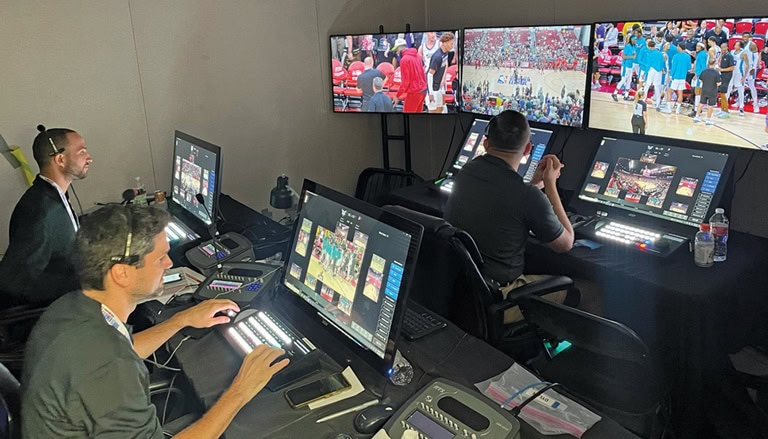
Image: Joe Lemire
The legacy product of Sony-owned Hawk-Eye is its precision ball tracking used to adjudicate line calls in tennis before an expansion to tracking players, their limbs and balls in other sports, like MLB. Its other primary offering is the Synchronized Multi-Angle Replay Technology (SMART) video replay that’s used by the NFL and others.
Now, the NBA is pairing the two with an eye toward generating supplemental evidence to help referees make decisions on goaltending, the primary point of emphasis this year. Foot-on-the-line and last-touched-out-of-bounds calls will be in R&D all year. In the future, those determinations could be fully automated, though that step would require sign off from the Competition Committee and the National Basketball Referees Association.
“Our top objective here at the Summer League is to showcase how all of our different technologies can come together to create this synergy of solutions to provide the NBA with ultimately what they need to better officiate the game,” said Dan Cash, Hawk-Eye’s Managing Director for North America. “We believe that if you couple that [tracking] with replay, which we’re demonstrating here, you have a really powerful tool to be able to officiate the game efficiently and effectively.”
Hawk-Eye installed its optical tracking system in every NBA arena over the course of two months, January to March, this year. It entails 14 cameras with 4K resolution that are expected to operate at 120 frames per second — double the broadcast standard for sports — and could go even higher, although the requisite processing power necessitates a trade-off with latency. A 15th camera may be deployed at times that’s capable of a whopping 1,000 fps with even greater resolution.
What these cameras provide, first and most obviously, are more angles of the action. A questionable three-pointer in the Summer League’s first few days lacked a conclusive broadcast view, but one of the Hawk-Eye cameras had a better angle to confirm the foot was behind the line.
But the tracking data provides a new dimension of analysis. The NBA flew out its usual Secaucus-based replay operators for a trial. “It’s video plus data, which is a new skill to learn,” Ryan said, adding that “we have a different [replay] partner that we’re really happy with,” referring to EVS. Hawk-Eye’s three prior visits to the Summer League were all for testing in the background; this is its first time used in games.
The cameras collect positional data of the basketball and players’ hands, then apply the rules of goaltending and the laws of physics. On the replay operator’s screen are yes-no indicators for the goaltending criteria.
“Goaltending is relatively easy — if the ball passes its apex, if it’s over the cylinder, if it’s touching the backboard — those are all pretty defined use cases, but if we haven’t collected data for a significant amount of time, you don’t have a historical data set to refer to, to understand where your pain points are,” Hawk-Eye Commercial irector Justin Goltz said.
“Realistically, the technology moves in at a pace that it can do it relatively quickly, but there’s a lot of logistics to get it from this broadcast truck, or from the stadium, down to the court that needs to be hashed out over a season or two.”
The operator also sees a second-screen experience with a replay animation similar in spirit to what Hawk-Eye has made famous in tennis. The NBA is still evaluating the best presentation of information and visuals to, first, help make the correct call and, second, show the fans. “A big part of this initiative is just more transparency,” Ryan said.
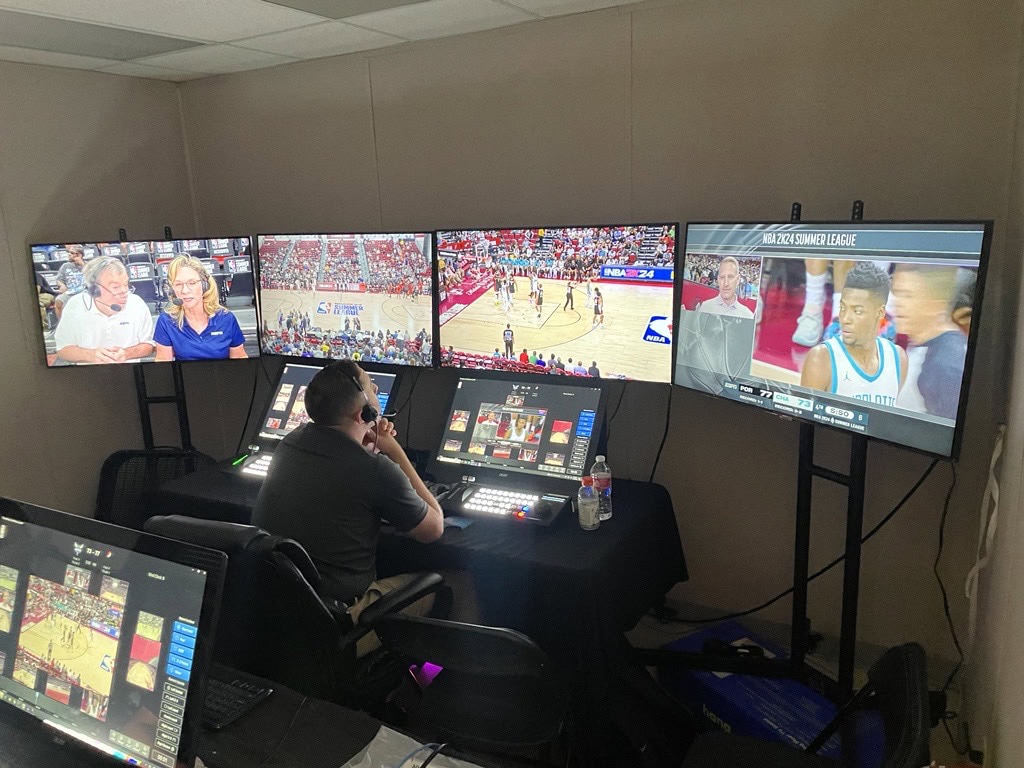
Image: Joe Lemire
Following the same adage that content is king but distribution is queen, so too with this enhanced replay format is that accuracy is paramount, but efficiency is critical, too. The league is testing two methods of communication to its referees: both audible messages to an earpiece or haptic and written transmissions to a watch.
The NBA, for example, introduced a new mechanism for relaying a scoring change from the replay center to the on-court officials last year. If a two-pointer became a three, or vice versa, a blue light would flash at the scorer’s table. The problem: looking in that direction was never part of the usual routine or field of vision. Of about 120 such blue light indicators, only five were organically spotted.
That’s an obvious starting point — and not novel as other sports, such as soccer, have done this for years — but it could lead to other use cases.
“Live communications with the ref is definitely a core component of our strategy because if we’re doing all this work on the automation side,” Ryan said, “you have to be able to communicate that with the ref in real time.”
This article was brought to you by SBJ Tech, a Leaders Group company. As a Leaders Performance Institute member, you are able to enjoy exclusive access to SBJ Tech content in the field of athletic performance.
Hyperice Founder and President Anthony Katz brainstormed his products with a little help from some of the league’s most influential players.
Main image courtesy of Hyperice
A Data & Innovation article brought to you by
During the NBA Playoffs , TV cameras constantly caught marquee players wearing futuristic massage wraps around their backs and knees. It was not to hold their shorts up.
Hyperice and its latest heat + vibration wellness technology has cornered the NBA market more than ever, even though the relationship goes back to an inspirational conversation with the late Kobe Bryant in 2011. The company’s new Venom 2 product has swept through the league this past season with its reverberating, pliable, granulated copper-like material that generates up to 130-degrees of heat — with a who’s who of all-stars on board.
The Lakers’ LeBron James and Anthony Davis and the Celtics’ Jayson Tatum are investors, but that’s not why their respective teams have faltered — the surging Kentavious Caldwell-Pope of the NBA champion Denver Nuggets wears it, too.
“Well, 130 degrees is the maximum heat allowed in a commercial product,” says Anthony Katz, Hyperice’s Founder and President. “Athletes, they always want to push it. If it’s something hot, they want it hot. Or they want it really cold. And if it’s pressure, they want a lot of pressure. If it’s vibration, they want a lot. They want to push their body.”
Hyperice’s journey to the top only proves that everyone’s an entrepreneur at heart and that Katz is open to any and all suggestions. His products — from an original ice simulator to a novel Hyperice X hybrid device just out of the lab — were in part brainstormed by NBA players.
Back in 2011, in an era when players wore sloppy bags of ice late in games on the bench, Katz had already devised a proprietary Velcro cold wrap for his own balky knees. At the time, he was constantly playing pickup games alongside college players at UC Irvine and inevitably would see guys eye-balling the knee contraption. One of his former high school teammates, who happened to be a UC Irvine assistant coach and was charged with letting Kobe Bryant into the gym for 4 a.m. workouts, had a superlative idea.
Show it to Kobe.
Bryant liked Katz’s concept but made suggestions on how to improve it and — if applied — promised to wear it/flaunt it on the Lakers bench. “Inspired me to start the business,” Katz says. “That gave me the motivation to say… I gotta do this now because if he’s gonna wear it, that will trickle down. And if it’s good enough for him, it’ll be good enough for anybody.”
Soon, it was good enough for Blake Griffin and LeBron James, who showed it to his buddies Dwayne Wade, Carmelo Anthony and Chris Paul. Before long, Katz never had to pay for a game ticket again. Griffin and Paul regularly invited him to Clippers games — back when Paul was playing there — and that’s how Katz had his next entrepreneurial moment.
Given access to the Clippers training room, circa 2015, Katz saw how players relied on three modalities: foam rollers, soft tissue massage and vibration. His revelation was to combine them, and he launched the Hyperice Vyper, a product that fitted high amplitude and high frequency vibration into the core of a foam roller. “We went from a company doing not even a million in sales to almost $5 million,” he says.
The next year, in that same Clippers locker room, came his company’s seminal moment. Paul and teammate Matt Barnes told him to think heat, not ice. They said players were now wearing damp hydrocollator pads to stay loose during games, but problem was, they said the pads were “nasty” and would “stink.” They suggested he devise an alternative.
Voila, he developed a vibrating heated pad product, the Venom, that wrapped conveniently around backs, knees and shoulders. The battery, however, would dissipate or detach during games, which was a problem. But Katz was always unafraid to go back to the drawing board. He purchased a company called RecoverX and had engineers incorporate RecoverX’s seamless heating technology into a new completely redesigned vibrating Venom 2.
That product officially launched in August of 2022, in time for this season, ensconcing Hyperice’s role as an official NBA product. During the 2020 Bubble, players were openly using the Hypervolt percussion instrument on the sidelines during games, especially big names such as Milwaukee’s Giannis Antetokounmpo and James. James was also the most prominent proponent of Hyperice’s Normatec air compression system, a lower torso covering that is essentially a lymphatic circulation pump. Post-game, James commonly wears it at home in an easy chair while sipping a glass of wine.
But it was the power-plated Venom 2 back pad that gained the most steam throughout the 2022-23 NBA season. The combination of heat and vibration helped players loosen up swifter — and stay loose. Nearly the entire New York Knicks team took the court wearing it every night. Stars such as Atlanta’s Trae Young couldn’t function without it, while Tatum, Griffin, James and Davis went one step further: they helped bankroll it.
But Denver’s Caldwell-Pope may be the face of the product this June. Or the voice of it. Mic’d up by ABC/ESPN during the NBA Conference Finals, he was on camera wildly exhorting his teammates up and down the sidelines.
Venom coming out of his mouth, Venom 2 wrapped around his back.
This article was brought to you by SBJ Tech, a Leaders Group company. As a Leaders Performance Institute member, you are able to enjoy exclusive access to SBJ Tech content in the field of athletic performance.
The man who helped save Steph Curry’s ankle explains that there are times when athletes can train their movement patterns in the name of performance.
A Data & Innovation podcast brought to you in collaboration with
The Director of Performance at Uplift Labs was on the pod to discuss how the company’s AI can reduce injury risk in athletes.
There is no better candidate to delve into injury prevention and mitigation than the man often credited with saving Steph Curry’s ankle.
We made a whistlestop tour of his work at the Minnesota Timberwolves, Atlanta Hawks and, of course, the Golden State Warriors.
Also on the agenda were:
John Portch Twitter | LinkedIn
Listen above and subscribe today on iTunes, Spotify, Stitcher and Overcast, or your chosen podcast platform.