John Bull of Management Futures set out a series of easy-to-adopt measures that could make the difference between winning and losing.
It’s easy to say that, as a battle-weary 32-year-old facing a younger, stronger champion, Ali had little choice when selecting his approach.
Foreman had won 37 of his 40 fights by way of knockout and was confident of adding No 38 to his unbeaten record in the early hours of 30 October at Kinshasa’s packed Stade du Mai 20.
Yet Ali later said his decision to stay on the ropes and allow Foreman to tire, which set him up to secure an eighth-round knockout, was made on the fly. He backed himself to absorb Foreman’s punishing body blows and wait for his moment. Foreman had only been taken to eight rounds four times previously in his career, so there were question marks over his stamina. The longer Ali could last – easier said than done – the greater his chances.
“I didn’t really plan what happened that night,” said Ali in 1989. “But when a fighter gets in the ring, he has to adjust to the conditions he faces.”
That Foreman could be lured into rope-a-dope was at least deemed possible by Ali’s coach, Angelo Dundee, who was seen loosening the ropes (to make leaning back easier) prior to the fighters’ ring walks. But that’s another story.
Ali’s defensive tactics, particularly during the fight’s final rounds, chimed with John Bull, the Director & Lead for High Performance Research at Management Futures (and big Ali fan), as he told an audience at the 2023 Leaders Sport Performance Summit in London.
Of his hero, Bull explained that a wave of fear came over Ali “for the first time in his career” as he sat in his corner at the end of the first round.
“Ali was really scared; and then 20 seconds later said to himself ‘I’m going to need to outthink this guy’,” Bull said.
Outthink Foreman Ali did; and Bull argued that such adaptability could be commonplace in sport with the right approach.
“I do believe some people are more naturally creative, but there are ways and structures that help anyone become more creative,” he continued while likening the process to strengthening muscles.
“What I love about these techniques is you can learn them really quickly. Practise any of these techniques for more than 15 minutes and you will be better than most people.”
These are the techniques Bull shared with the audience.
The STOP process for creative problem-solving

“I love STOP,” said Bull. “It’s a really simple way to get people thinking about ‘how are we doing that?’ How often do we take the STOP moments during a game, during the season etc. It’s a quick, short use of time.”
Bull then presented five strategies for encouraging athletes to adapt to the challenges or opponents facing them.
If you can find new ways to consider your problems, it can open up new ways of thinking.
Bull used the example of an elevator. Perhaps your goal is to make the elevator go faster, but what if your aim was to make the wait less annoying?
“Most hotels will put a mirror beside the elevator,” he said. “That seems to kill time when we’re looking at ourselves in a mirror.”
Bull suggested we “think of at least three different ways we could define our goal, to help open up new ways of thinking about the problem”.
If you can map the different categories of possible solutions it can prevent you narrowing in on just one type of solution.
Bull asked members of the audience to take a pen and piece of paper and write down as many sports as they could think of in one minute.
He then proposed a rerun of the exercise where the paper includes sub-categories such as ‘team’, ‘individual’ or ‘in or on water’. It might look like this:
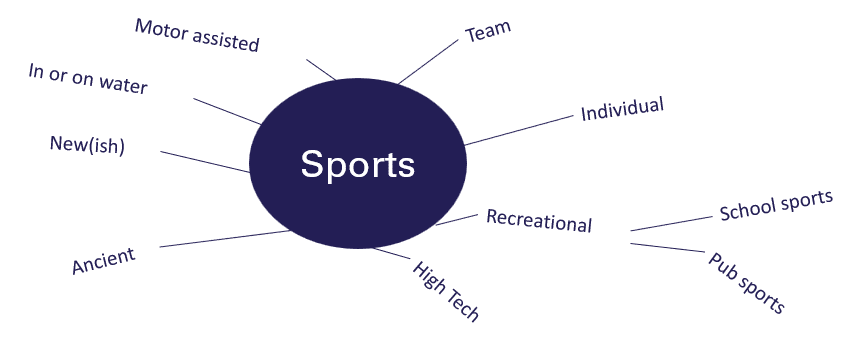
“What mind mapping is very good at doing is getting us to think more broadly,” said Bull. “What we tend to do when we’re being creative is we’ll come up with one or two ideas quickly as you would have been doing there, but then we tend to stay in that same vein of thought. So if I come at this using mind mapping, the first question you ask yourself mind mapping is not what sports can I think of, but what categories. Once you come up with a category, the brain very quickly accesses four to seven ideas.”
Step change thinking is the idea of setting a very stretching goal and then thinking how that could be possible.
Bull posed two questions:
He shared the following example:

To underline his point, Bull explained that step change goals are common at Google where employees often set – and meet – seemingly impossible goals. “They’ll take any performance measure they want to get creative with and they’ll say ‘times it by ten’ and ask ‘how would we do that at a ridiculous level?’ just to provoke creative approaches.”
This notion is straightforward enough:
Bull cited the real-world example of paramedics in England. Providers of ambulatory care would like to reach people who suffer heart attacks within eight minutes, which is impossible by road in areas such as rural Norfolk in East Anglia. “You ask ‘how could we make that happen?’ And the answer that came up was you could train someone in every community to be able to keep someone alive until the first-responders arrive.”
Sport is not life and death, but a similar thought process could prove useful.
Who has already solved your problem and what can you learn from them?
In answering this question, New Zealand rugby, as Bull explained, turned to ballet for help with its lineout lifting.
“Rugby’s been doing this for 25 years in terms of assisted lineouts. Ballet’s been doing this for a few hundred years – they probably know a little bit more about it, so it’s that idea of going outside.”
The seven-weight world champion spoke to SBJ Tech ahead of her second fight with Ireland’s Katie Taylor.

You can’t have a discussion about sports technology today without including athletes in that conversation. Their partnerships, investments and endorsements help fuel the space – they have emerged as major stakeholders in the sports tech ecosystem. The Athlete’s Voice series highlights the athletes leading the way and the projects and products they’re putting their influence behind.
* * * * *
Two of her losses included the tightly fought split decision against Katie Taylor that headlined Madison Square Garden two years ago. Their rematch last month, which Taylor won by a controversial unanimous decision, was as the co-headliner with Jake Paul and Mike Tyson in the Most Valuable Promotions card was held at AT&T Stadium in Texas and streaming live on Netflix.
Also in November, Serrano, 36, partnered with Total Wireless, a no-contract 5G provider that runs on the Verizon network — and received her very first mobile phone. Citing an unwavering, distraction-free focus on boxing, Serrano had resisted owning a phone until now. She will host a meet-and-greet with fans at a Total Wireless store in Brooklyn on Dec. 1.
On not owning a mobile phone…
No, never. It’s going to be my first one. All my communication has been through my trainer, my brother-in-law, which is Jordan Maldonado, and every now and then, I’ll steal my sister’s phone and do everything there. I do have an iPad, but this would be my first phone.
On who she’ll call or text first…
I think it’s going to be my sister, and I’m going to talk. She will be happy that I don’t take her phone anymore. Now I have my own.
On working with Total Wireless…
Total Wireless definitely has a good commitment with the Latino companies, Latino athletes. What really got me was because their plans, and then they’re associated with Verizon. I needed a plan and something that’s not going to slow me down. Because I’m always high pace, and I needed something that’s going to do that for me.
On how she evaluates brand partnerships…
If I truly believe in it, if I’m happy with them, if I see their work and what they’ve done for others, and what they’re doing for in general — yeah, that’s how we partner up. If I believe in it wholeheartedly, then I’m going to go with them. There’s people that we’ve gotten offers from, and I said I don’t agree with what they’re doing, or I don’t get what they their motives are. So I will not represent them.
On being on co-headlining with Jake Paul and Mike Tyson…
Obviously the fans wanted this fight. I believe I won the first fight. So it was really easy when my team came up to me and said, ’It’s going to be on Netflix in a big stadium for 80,000.’ I said, ‘Let’s do it.’ We gave an iconic first fight, headlining Madison Square Garden, selling it out. And I think we’re just going to do a better fight this time. And I think we’re both deserving of this platform to go out there and represent for the women in the sport.
It’s truly an honor. I’m super proud. I have an amazing team that even thought of me to put this fight on. I can’t wait. I know I’m going to put on a show. I’m ready. I know Katie’s ready. And you’re going to witness women’s boxing at its finest.

On her training methods…
I’m old school. I have an old school trainer. We’ve been doing it for 16 years this way. It’s been working for me for 16 years. I’m one of the most accomplished female fighters in the world, and that’s only [after] having nine amateur fights. I have 50 pro fights. And if it ain’t broke, why fix it? But we definitely train smarter this camp. I train hard for all my fights. So I’d be lying if I you that I trained harder. No, we just trained smarter. I’m ready to become undisputed champion at 140.
View this post on Instagram
On how she’s evolved…
I never really, in the beginning of my career, thought of recovery as part of training, but that was definitely a plus for this fight. As you get older, your body gets a little more wear and tear, so you definitely have to concentrate on that and just eating good and just going out there and performing, making sure you’re training hard and running the miles you have to run, putting in the work, and you’ll do good at fight time.
On her team…
My team is very small. It has been my brother-in-law [who is] my manager and my trainer, which is Jordan Maldonado; and my sister [Cindy]. We’ve been together. It’s been us three. I do have a pad coach, but he does what my main coach, Jordan, tells him to do. I had a nutritionist, and I learned things from him. So I moved it over to this fight. I try and cook for myself, but I’m I don’t like too much. I don’t like an entourage. I don’t like too many people around me. So it’s been my small team, and I’m happy. They just bring the best out of me.
On what she learned about fighting Katie Taylor…
Katie is definitely a warrior. She’s tough as they come. She’s not going to go down easily, and she’s going to fight every minute, every round, and that’s what I I learned. I gained more confidence after that first fight. I know I hurt her. I’m capable of hurting her again this fight. And that’s what we’re going to try to do.
On the growth of women’s boxing…
It’s been a long journey. Definitely people had their doubts in us, but now that they’ve seen that champions are fighting champions, we’re putting in on great shows — I’m not the type to brag, but when I do express how much money I’m making in my fights, that’s to motivate these young girls and show them, inspire them. There’s a light at the end of the tunnel, like ‘I can make this type of money if I continue to fight, work hard.’ Now, with this type of money, women are coming into the sport more. They’re putting on shows. They’re fighting, they’re getting in shape, and we have amazing talent, amazing champions, and I think it’s only getting better.
This article was brought to you by SBJ Tech, a Leaders Group company. As a Leaders Performance Institute member, you are able to enjoy exclusive access to SBJ Tech content in the field of athletic performance.
Dan Lawrence of Matchroom Boxing discusses his work in combat sports and beyond.
A Human Performance article brought to you by our Main Partners

Dan Lawrence, the Head of Performance at Matchroom Boxing, watched his former boxer, the now-retired George Groves, learn this in real time.
“Yes, he had a team. He had myself, a conditioning coach, we had his head coach at the time,” Lawrence tells the Leaders Performance Podcast. “He was steering the ship at that time, whereas I don’t think that was the right way to go.”
In fact, “you have to have a cohesive team working with one sole goal”.
Here, Lawrence discusses his work in combat sports while also touching upon:
Dan Lawrence Twitter | LinkedIn
John Portch Twitter | LinkedIn
Listen above and subscribe today on iTunes, Spotify, Stitcher and Overcast, or your chosen podcast platform.