The wellbeing plans available to student-athletes to include connections to mental health professionals, as well as the Zone’s screening tool that monitors athlete wellness.

Outside of just being the right thing to do, there’s a straight line from holistic support of athletes and business success. Wellbeing begats better performance, which begats results, greater fan interest and, ultimately, a product fans will pay for.
Last year, the NCAA released the latest version of its mental health best practices, outlining obligations for all member schools (regardless of division) to create a healthy environment for athletes. Components of that plan included support via resources and connections to mental health professionals, as well as a screening tool to monitor athlete wellness.
The NCAA required D-I members to provide this by last August. And this November will be the first deadline for schools to prove they’re doing so. With that mile-marker approaching, The Zone is gearing up to test a new feature in its athlete wellness platform: the Mental Readiness Score. The metric will provide insight into an athlete’s mental state.
Knowing the score
In a walkthrough with SBJ, The Zone CEO and Co-Founder Ivan Tchatchouwo showed a series of check-in questions that help create the score. Prompts focused on physical essentials like hydration and sleep but also considered ratings for categories such as confidence and energy level. The quick series produces a score (scaled from 0-100) that a coach can see for each player, while the individual student view will show tiered descriptors (such as ‘Fully Ready’ or ‘Needs Attention’) to take away the pressure of potentially seeing a poor numerical score.
Tchatchouwo said the feature, which The Zone will pilot with select schools as part of its premium platform offering before a future rollout, came as an idea from numerous conversations on different campuses since the company was founded in 2021.
The Zone has a client base of roughly 200 teams at various levels of the NCAA, offering three tiers of its platform: basic, premium and enterprise.
“The biggest thing, and we’re seeing this in all sets of industries and technology in college sports, is how do you harmonize this data to drive value for the athlete but also to drive value for the administration?” Tchatchouwo said.
Coaches will be able to see Mental Readiness Scores for each athlete and a collective score for a team, allowing for responses at the individual and group levels in their teaching and preparation. The Zone’s athlete experience also offers support via breathing and visualization exercises that cater to the user’s preference.
One of The Zone’s biggest triumphs of 2024 came through validation from its own data and research. Tchatchouwo said that athletes who used The Zone 15 times saw their moods “significantly” improve, and that was especially true for women who used The Zone’s platforms. He also added that client schools see up to 3X more access to their athletes via The Zone platform, meaning an increased understanding in what their athletes are collectively experiencing on the mental side.
“What we’re seeing is the athletes that are stigmatized, that don’t talk about it, are getting help from The Zone,” Tchatchouwo said.
This article was brought to you by SBJ Tech, a Leaders Group company. As a Leaders Performance Institute member, you are able to enjoy exclusive access to SBJ Tech content in the field of athletic performance.
John Wagle of Notre Dame explains how the question of sleep enabled true interdisciplinary work to emerge at the school’s athletic department.
As you reflect on your team or department, you may be moved to ask a question of your own: what’s the difference?
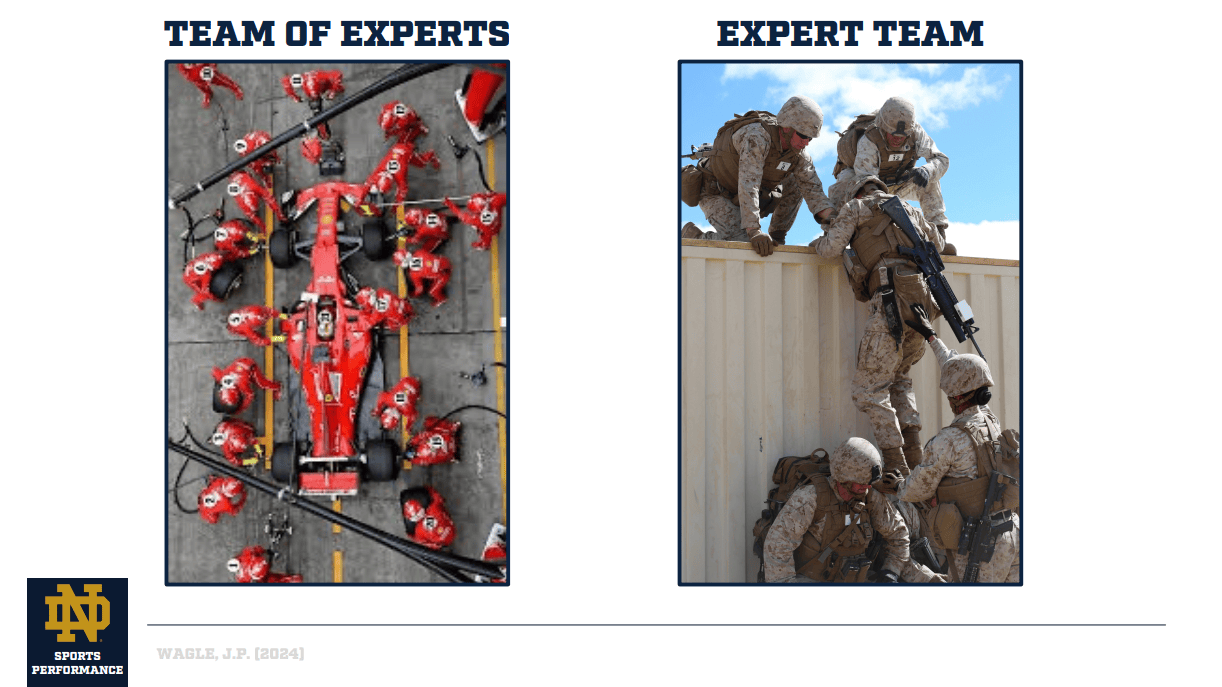
According to John Wagle, in a ‘team of experts’, “everyone has their job, they do it well, and the execution of their role doesn’t directly impact another person”. He cited a Formula 1 pit crew as an example.
An ‘expert team’, on the other hand, refers to groups where “the work of an individual may directly impact that of another person”. Wagle’s example was a US Navy SEALs team.
In illustrating this distinction onstage at November’s Leaders Sport Performance Summit in London, Wagle, the Senior Athletics Director for Sports Performance at the University of Notre Dame, highlighted the distinction between multidisciplinary and interdisciplinary.
Wagle was hired by Notre Dame in 2022 to lead an athletic department that was unable to consistently deliver an interdisciplinary approach despite the best intentions of all staff members.
“We needed a catalyst,” he continued. “The challenge as a performance director is to set the stage to solve a problem at scale in your environment.”
‘Constraints push you into new places’
Student-athletes continuously juggle their sport, academic studies and lives on campus – a situation Wagle described as “suboptimal”.
However, as he said, “these operational constraints push us into new places. They push our boundaries of how we can create solutions and I believe the best way to do that is to bring together two largely opposed ideals: knowledge and belief.”
Knowledge v belief
Knowledge, as Wagle explained, stems from a practitioner’s formal training as well as any external and internal research. He said: “the more common terminology for people in this room is evidence-based practice”.
Belief is different. It is an aggregate of a practitioner’s experiences from working in the field, athlete values and preferences, and the matter of risk tolerance and uncertainty management. “There is an element in belief that you’ve got to harness and steer into uncertainty.”
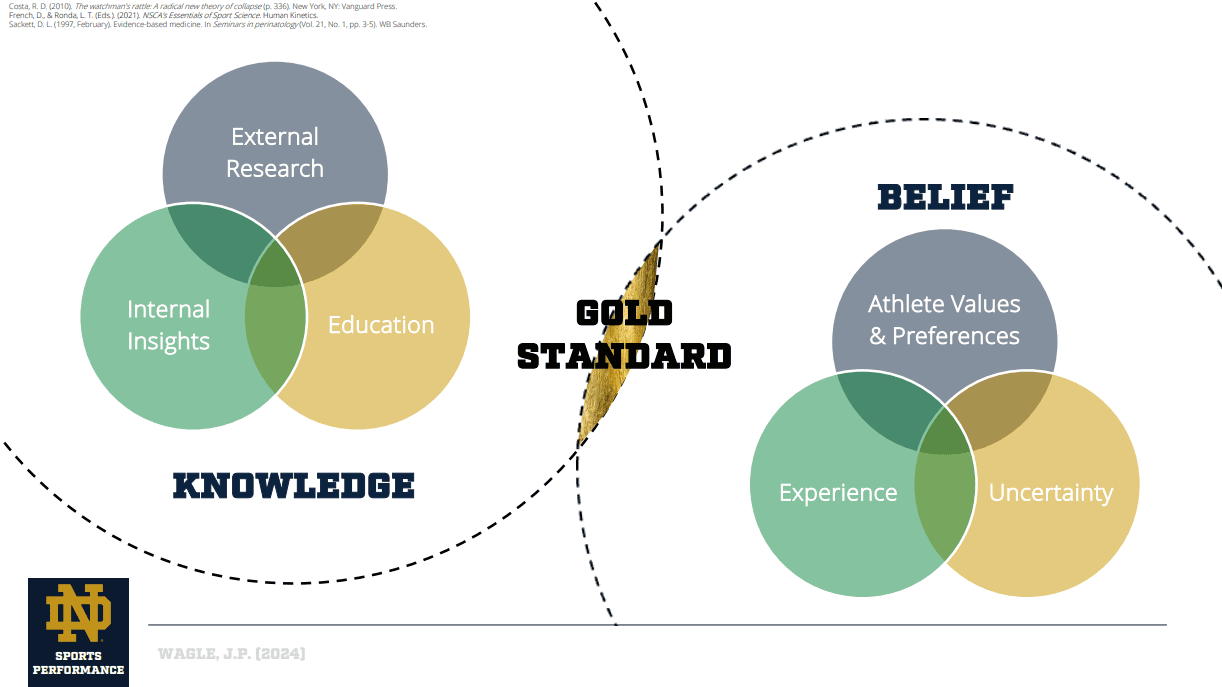
“These don’t need to be opposing viewpoints,” Wagle added, despite admitting that people “gravitate towards their tendency”.
“This is the true power of interdisciplinarity and, if we don’t bring these pieces together, we run the risk of being blind to what a lot of our athletes are experiencing.”
He spoke of the student-athlete being in a “complex adaptive system” where the interaction of different elements leads to either a health or a performance outcome, with the ‘gold standard’ somewhere in the middle.
Sleep = the catalyst
Wagle admitted that Notre Dame’s athletic department oscillated between knowledge and belief despite concerted efforts to bring both together.
“There were members of our team that no matter what the problem was were always on the knowledge side and there were members of our team who were always on the belief side,” he said. “It did not necessarily manifest in conflict – it manifested in avoidance – because I think every problem we tried to solve was inherently biased towards a discipline and it was easier to run away from that problem.”
They needed a catalyst to underline the power of interdisciplinary work and alighted upon sleep.
“We chose sleep because it is inherently lacking a discipline,” Wagle continued. “It can be owned by psychology, by nutrition, by strength & conditioning, by medical. There’s no obvious lead person in that.”
Everyone was able to meet the challenge that Wagle set: to be the best sleep support ecosystem in the whole of college sports. The knowledge people combined their data-driven approaches and devised a sleep screening tool. “We were able to get more granularity on our sleep habits and behaviours.” The belief people “brought to the table the ebbs and flows of the academic year.”
Remember: you could be part of the problem
Notre Dame’s approach to sleep has proven a game-changer in their approach to interdisciplinary work. Staff members recognised their biases, let go when necessary, and committed to collaboration.
Wagle said: “If we don’t acknowledge that ‘we could be part of the problem’, that’s where culture and alignment suffer; and resources fail to be allocated properly.”
In this episode we explore the lived experience approach to gambling harm prevention with the Chicago Fire and EPIC Risk Management.
A Gambling Harm Prevention Podcast brought to you by our Partners

Marc, a former professional footballer who suffered the consequences of gambling harm, will speak to athletes and teams with a view to educating and informing them about the pitfalls and trigger associated with gambling harm.
“They can see what we’ve been through, where gambling took us, and from that they can really relate to it themselves and think ‘wow, this could be me’,” he tells John Portch on the Leaders Performance Podcast.
Marc is joined by Rachael Jankowsky, the Head of Player Care & Well-Being at Major League Soccer’s Chicago Fire, to discuss EPIC’s work with the club, which included Marc presenting in front of young players.
On today’s special episode, we discuss topics including:
For those seeking more information on gambling harm prevention, check out EPIC Risk Management’s white paper review from February 2023.
Listen above and subscribe today on iTunes, Spotify, Stitcher and Overcast, or your chosen podcast platform.
Samford University is winning championships and is being assisted in its efforts by the athletics department’s renewed focus on data.
A Data & Innovation article brought to you by
Now he’s two years into his role at Samford University as Assistant Athletic Director, Sports Performance. Mathers oversees Project SAMson, a universitywide effort to infuse a data-focused approach into the entire athletics department.
In its short life so far, the project has helped to produce the greatest sports season the university has ever seen: a total of 11 championships, counting regular-season and conference tournament crowns. That included the school’s first outright Southern Conference championship in football, an 11-win campaign that set a school record.
In the battle for competitive advantage throughout college athletics, biometrics and sports science have often been treated as an effort to keep up with the Joneses (or in this case, the Sabans and Smarts). A lot of big programs have data. But schools like Samford, which kicked off its football season last week with most of the nation’s programs, show how data digestion could become a new divider between winners and losers.
“I think people are starting to use it in ways that really help them to structure and manage what they’re doing with their athlete loads every day,” said Mathers, a day before Samford’s game with Division II Shorter University. “I would say five years ago, 90% of people had it as a recruiting tool. It was the shiny thing.”
That’s a progression that Matt Bairos has observed as well. Bairos is the Chief Product Officer at Catapult. The sports performance analytics company, notable for its wearable vest that features GPS tracking, works with every Division I school in the country.
Catapult introduced two new products for football teams ahead of this season: Catapult Scout and Catapult Hub. The former allows for the quick generation of scouting and recruiting packages, as well as transfer portal monitoring. The latter improves video creation and sharing abilities to incorporate more teaching and data infusion.
Through Catapult’s partnerships with the likes of Formula One, Bairos points out, rich data sets have become descriptive, prescriptive and predictive. College football may never be that sophisticated analytically, he said, but he sees the room available still to grow for the sport.
“I think there’s a lot more variables as it relates to sports that involve humans running around,” Bairos said. “But the more pieces of data that we put together, it’s almost like we’re putting that map together of what’s going to happen next.”
Samford University has taken that notion and proliferated it. The private university, with a total enrollment of just under 5,700, houses the Center for Sports Analytics. The center has partnered with professional leagues and teams, as well as brands like Nike and Coca-Cola, as an integration into student curriculum that features three focuses: business, statistical analysis and sports science.
According to the center’s Executive Director, Darin White, the idea for Project SAMson originated from former Samford football player and donor Gary Cooney. Between the programs on campus, plus the school’s existing partnerships with Andrews Sports Medicine (the team doctors for Samford) and the American Sports Medicine Institute, the pieces were in place. A $1 million grant to the school supported the tracking of all Samford athletes. “It’s rare to find a team that has no data being collected,” White said. “But I’d also say the vast majority of teams are only utilizing that data in summary fashion.”
Project SAMson enhances the strength training and injury prevention efforts. Phase 1 consisted of a workout equipment overhaul. In total, Mathers estimated, it was roughly $250,000 in total enhancements. Samford uses EliteForm, a motion-camera system, on all of its weight room racks. Those systems track the movement of the bar, measuring how fast the player moves it through a lift. Players can enter login information on a touchscreen and record video for review with strength coaches.
Mathers said they also utilize VALD Performance equipment, mainly the company’s NordBord for hamstring strengthening/testing, ForceDecks for strength and movement testing, and timing gates for sprinting. Catapult is used by the Bulldogs, too. Mathers and his staff can use all these tools as part of their effort to measure player load. The staff can forecast how future adjustments to practices and activities could even affect the energy an athlete has for output.
Soon Project SAMson will take another big step: Samford will start using Smartabase, a platform that houses all performance data from multiple sources in one place. Samford’s sports performance unit has five full-time staffers and two graduate assistants, and also draws upon an intern group of about 35 to 40 students.
Such a drastic, long-term change can be a hard sell in a results-now business, Mathers said. Project SAMson established itself in a time when health monitoring was desperately needed: Samford, along with many other FCS schools, played a spring and fall season in 2021 due to COVID’s postponement of 2020. The team played 18 games in that calendar year, producing data that couldn’t reflect a year with normal preparation and recovery times.
Fortunately, Mathers said, he works with a head football coach in Chris Hatcher who trusted the vision for the project. That trickled throughout the program. “I think the SoCon championship is the result of everybody doing their job really well,” Mathers said. “I think we were able to give objective data to them. It helps the coaches do their jobs better, and it helped the athletes do their jobs better.”
This article was brought to you by SBJ Tech, a Leaders Group company. As a Leaders Performance Institute member, you are able to enjoy exclusive access to SBJ Tech content in the field of athletic performance.