Australia ‘threw chaos’ at India in the World Cup final, but as Andrew McDonald explained, 18 months of meticulous planning went into their triumph.
The Australia captain won the coin toss and defied conventional wisdom by electing to field during the first innings when most teams might have preferred to set their opponents a formidable target. On top of that, the dry conditions on that November afternoon at the Narendra Modi Stadium in Ahmedabad appeared to favour batting first.
“I’d have batted first,” said India captain Rohit Sharma. “It looks a good pitch, it’s a big game, let’s put runs on the board.”
Cummins obviously disagreed. “It looks a bit of a dry wicket; bowl on it during the day and back ourselves to chase whatever we need to,” he said before pointing to the weather. “Dew is one factor, it gets quite dewy here at night. It feels like this venue has got better and better to bat so hopefully the same today.”
Dew can make it easier to bat under the lights as the ball skids onto the bat, but some accused Australia of overthinking the conditions. It is easy to dismiss those criticisms in light of Australia’s subsequent six-wicket victory – and sixth men’s World Cup triumph – but they do point to the traditional thought processes that tend to govern cricket.
Andrew McDonald, Australia’s Head Coach, picked up on this two months later at February’s Leaders Sport Performance Summit in Melbourne. “An important piece is that this group is making decisions not on what’s happened in the past,” he said.
In cricket, the captain is tasked with most on-field team decisions during play and, the day before the final, McDonald and his coaches spent two hours weighing up the pros and cons of batting first and second; and yes, the dew was discussed. “We had great fun solving these problems and then said to Patty: ‘this is our recommendation. Over to you, mate, because ultimately you’re accountable at the toss’.”
There were several factors beyond the dew that supported their recommendation, but the underlying story is one of how McDonald, who was promoted to Head Coach in April 2022, has worked to engender trust between players and coaches while also streamlining the team’s high-performance systems.
“One of our philosophies in the Australia cricket team is on the day you have to be less dysfunctional than your opponent,” said McDonald with a combination of pragmatism and humility.
Here, we explore what that philosophy entails for Australia’s men.
‘Environment’, not ‘culture’
McDonald insists on referring to the team’s ‘environment’ rather than its ‘culture’, even as he admitted that it may just be words. However, given that he had served for three years as an assistant coach to his predecessor, Justin Langer, and could quickly take the pulse of the team upon taking the reins, one should give McDonald the benefit of the doubt.
“We felt as though ‘culture’ was quite rigid and it was almost the players coming in and needing to conform with what the team required,” he said, indicating that he had thought deeply about the idea. “We’ve shifted to ‘environment’ and made sure that people could commit to that.”
The Australia men’s team is on the road for more than 220 days per year and, if they are not competing at home, they are almost always touring in far flung foreign lands from the West Indies to the Asian sub-continent. It can be isolating, stressful and even boring. Therefore, it was a good idea, McDonald argued, to let his players shape their environment.
“We wanted to create some safe spaces for people to operate in and make sure that they could be themselves. Hopefully that shines through in the way our players represent the country,” he continued.
The players and coaches’ families are also free to join them on tour whenever possible; and it works both ways. McDonald encouraged all-rounder Mitchell Marsh to fly home mid-World Cup to visit his ailing grandfather, who passed away during the tournament. Anyone reading that line with reservations should note that Marsh, with the full support of his teammates, returned to hit an unbeaten 177 in his next match against Bangladesh.
Getting the creative juices to flow
Another key decision McDonald made was to complement structured training sessions (coach-driven with the coach at the heart of the work being done) with unstructured sessions where the players choose what they want to do within the wider strategy. His aim was clear: “when you’re trying to build a team to problem-solve under extreme pressure on their own, you’ve got to give them choice in the training activities they do” as this will get their “creative juices flowing”.
This is also dependent on the team having the right players at the outset across the three main formats in which Australia compete. McDonald joins Cricket Australia Chairman George Bailey and former Test all-rounder Tony Dodemaide on the three-person National Selection Panel.
McDonald, however, felt that too often the interested parties operated in silos and true collaboration would only come from sitting the key decision-makers down at the same table. There is now better dialogue between the coaches and the panel, with McDonald serving as the go-between.
He said: “Selectors ultimately have the final decision, but knowing what the coaches and players are trying to achieve, and the style we’re playing, I think it streamlined our decision making and we could move more quickly.”
‘We had to throw chaos at India’
Australia lost their opening two matches in the World Cup group phase. The first, a six-wicket loss to the hosts India in Chennai, offered some mitigation. Afterall, India were the favourites and would eventually reel off ten wins in a row on their way to the final.
The second, an ignominious 134-run defeat to South Africa, provoked greater introspection. Yet the team emerged from the post-match review committed to doubling down on the aggressive style they had adopted in the buildup to the tournament.
The Australians, as McDonald explained, were not going to throw 18 months of collaborative planning down the drain. “Every conversation with coaches was about where we thought games would be won and lost in India,” he said. These conversations were data-informed. “The eye test can lead you towards a certain bias,” he added. “We always have our checks and balances there with our data scientist to make sure that we’re on task.”
Their approach received its first memorable vindication when Australia claimed a 2-1 victory in a one-day international [ODI] series in India six months out from the World Cup. “That checkpoint was important in terms of belief for our playing group.”
It helped them at 0-2 in the group phase and in the World Cup buildup when they lost batter Travis Head to a fractured left hand. Head was given every chance to recover, which is just as well given his match-winning 137 runs off 120 balls in the final.
It did, however, prompt the team to amplify the aggression that led Australia to win their next nine matches, including avenging that opening defeat to India in the final itself.
“We knew that India were probably the better team on paper so we had to throw chaos at them,” said McDonald, explaining that the shift was to a style more akin to short-form T20 cricket. “A lot of things go into building that.”
The team had developed its capabilities in the harshest conditions, seen evidence that their style could win matches, and so they didn’t “throw the baby out with the bath water”.
That meant that come the final, when match referee Andy Pycroft tossed the coin and Cummins called correctly, the Australia captain had every confidence in his planning and preparation when electing to field.
“I think it was a great reflection of the work the data team put in with the coaches and the collaborative approach that Patty invites as a leader,” said McDonald.
“If we keep presenting decent options to him then he’ll keep listening to us. If we don’t, then he’ll probably shut us out. That’s our challenge.”
25 Jul 2024
ArticlesWe highlight the core beliefs that have strengthened the ECB’s resolve to transform English men’s cricket despite the setbacks.
Brendon McCullum had no first-class coaching experience when he was appointed Head Coach of the England men’s Test cricket team in May 2022.
Nevertheless, the New Zealander was the favourite candidate of England & Wales Cricket Board [ECB] Managing Director Rob Key, who himself had been appointed a month earlier.
McCullum, assisted by captain Ben Stokes, introduced a bold playing style that has been labelled ‘Bazball’ (a reference to McCullum’s nickname).
England have improved on his watch and are moving in the right direction ahead of their primary objective, which is a successful 2025-26 Ashes series in Australia. There have been resounding victories in the past two years and there have been some chastening defeats too, which McCullum had anticipated.
‘Are you prepared to take a punt?’ He asked Key during the hiring process. ‘This could go wrong.’ Key was not fazed. ‘What’s the worst that could happen?’
Key shared this story at November’s Leaders Sport Performance Summit at London’s Kia Oval, where he spoke alongside the ECB’s former Performance Director Mo Bobat (who now works in the IPL with Royal Challengers Bangalore). The duo discussed the ECB’s efforts to transform the way England’s men think about and play cricket following a meagre run of one Test win in 15 months prior to McCullum’s appointment.
The subsequent teething troubles were as inevitable as the criticisms that accompanied them, but they have not dissuaded the ECB.
Here, we highlight four beliefs that underpin their resolve.
1. Brave decisions lead to good outcomes
Key inherited a “bruised” performance team riddled with insecurity. Key, who believes that brave decisions made by the right people can lead to good outcomes, got to work immediately. He began to give people the latitude to make decisions without any blowback. With the atmosphere of negativity stripped away, Bobat’s playful side began to emerge. “If you don’t take yourself too seriously, what appears like a risky or brave decision to someone else just feels like the right thing to do.” This was Bazball in the boardroom.
2. Positive reinforcement is critical
McCullum is Key’s ideal frontman. His belief in a fearless style of play, much like Key’s, is born from memories of feeling stifled by coaches when he was a player. So when England batter Ben Duckett was caught and bowled for a duck during England’s 2022-23 tour of Pakistan, McCullum simply said: ‘well done, you’re going to get all your runs with that approach – keep committing to it’. It’s another story Key told at the Oval. “In that moment, it’s not about the ‘well dones’, it’s the player who got nought that Brendon’s reinforced,” he said. “I’ve had so many coaches when I was playing and they’re all over you when you’ve scored 100. What about the bloke in the corner who’s got no runs and he’s thinking that the world is coming to an end? That’s the person who needs you; sometimes they just need you there to listen.”
3. Progress cannot be taken for granted
Anyone looking for a stick with which to beat Key, McCullum or Stokes would not have to look further than their recent high profile defeats. “In English cricket we unravel quickly,” said Key of the criticisms that come his way. “That’s the time when you’ve got to look like you’re the most calm; you’re the one in control; you’ve got all the answers.” This was underlined in the one-day game, specifically following England’s group stage elimination from the 2023 Cricket World Cup. Key’s view is that he and his colleagues made the mistake of assuming their messages had landed. “When people say ‘just go out there, be aggressive and we’ll back you’ they’ve got to believe it,” he said. “We ended up with players who doubted the way we wanted to go.” Do not take your progress for granted.
4. Understand your strengths, minimise your weaknesses
England’s underage teams have adopted the same playing principles as the seniors. The ECB’s hope is that English cricket will produce players with the confidence to back themselves and their technique in the face of adversity. “We’re trying not to be overly focused on technique or fault-spotting, both of which are easy to do in performance systems,” said Bobat specifically of the England Lions and under-19s programmes. Weaknesses are addressed by coaches, but not dwelt upon. “We’re trying to be focused on moments and situations where you use your strengths to put the opposition under pressure.”
Iain Brunnschweiler explores the impact of our behaviour upon others and asks where we as leaders may have a more positive influence.
This demonstration of frustration is clear for all to see, despite his young age. To compound matters, the opposition coaches, having both prowled angrily around what passes for their technical area, pointing and shouting for the whole game, join in the protests against the teenager who is officiating the game, as a part of her development.
This was an actual scene that I witnessed last weekend in an under-9s grassroots game.
Behaviour can be contagious. It can spread like wildfire. And it isn’t restricted to those directly in contact with you, especially if you are in a position of hierarchical influence.
Now, I could write an article pointing out some of the clearly unhelpful adult behaviour that seems to emerge on the side lines of kid’s sport, however, for the moment I will leave that for the governing bodies to address. The area of interest to me here is the impact of role modelling.
There are two clear examples above of where individuals have been influenced by the role modelling of people of significance to them. The young goalkeeper will have seen and be mimicking the behaviours of one of the many keepers displaying this approach on TV. For the impressionable mind, that’s what goalkeepers do. They complain about every decision. They run directly at the referee when any decision is made. They shout and throw their arms in the air in disgust.
Secondly, the coaches on the side lines – probably two incredibly well-meaning parents who have committed their free time to support youth sport – are doing what they’ve seen on TV, or live from the stands. Standing up for the whole game, allowing the emotion (attached to the score line of the clearly very important under-9s match) to spill over into behaviours they would never normally enact within the bounds of normal life. Shouting at the children within their care, shouting at the child who is learning to referee, whilst being accountable for the experience for all of these impressionable young folk.
The point of real interest for me (and hopefully others who have the privilege and responsibility of being in a leadership role) is to consider which of our behaviours are contagious. How aware are we of the impact of our behaviour both directly upon others, and indirectly through the role modelling we demonstrate? What are the things we see in others around us that mimic our behaviour, and how comfortable are we about this? How can we raise awareness of these factors?
One great way is opening yourself up to feedback. I received some highly valuable feedback in the past from a colleague, about getting the best out of my team. She generously pointed out a specific behaviour (one of my preferences) that she didn’t think helped the team get in the appropriate state for a given meeting. It was brave of her to give me this feedback, and I valued it hugely. She skilfully raised awareness of a learned behaviour, and allowed me to consider how I responded. I committed that day to make a change.
Organisations will often commit to a set of values, sometimes written on the walls or company documents. In many cases the words ‘honesty’ or ‘integrity’ might appear. Yet how often are people within the organisation encouraged to provide genuinely honest feedback to leaders around the impact of their behaviours? How often do we ask how we make others feel at work? I’ve experienced some feedback-rich environments, and I’ve experienced some that felt very unsafe. The former was certainly far more enjoyable to work in, and far more productive for all. Once awareness has been raised, one still has to consider whether they will take action or not.
Some examples of contagious behaviour that I’ve seen are:
The workaholic. A key leader spends enormous lengths of time at the workplace. They are online even when they are home.
The standards monitor. A key leader is incredibly hot on standards of clothing, office space, and punctuality. They will regularly call out colleagues who are not achieving the leader’s expected level.
The time-giver. A key leader regularly is seen taking time to speak to colleagues, getting to know them.
The HIPPO. Within meetings, the Highest Paid Person’s Opinion is always the decisive one. They shut down others in order to make the call, based on their perception.
The joker. A key leader is regularly seen making jokes and having fun within the work place.
The calming influence. A person of hierarchical position who demonstrates a calm, thoughtful and logical approach at times of pressurised decision-making.
The above are just a few examples of contagious behaviours, and I will let you decide to what extent you perceive these attributes to be helpful, or a hindrance, within the workplace. This will no doubt be relative to the context and the complexity of the organisation and the people surrounding the leader.
However, in my experience, the contagion is very clear and obvious. We see miniature versions of these behaviours permeating throughout the organisation. This becomes the culture.
One successful and overt strategy to utilise role modelling within the work place that I have seen has been the deployment of experienced professional players within an U-21s team. Southampton and Brighton & Hove Albion Football Clubs have very successfully deployed Ollie Lancashire and Gary Dicker respectively into player-coach roles. These players, both in their 30s have role modelled the behaviours, approaches and attributes that a consistently high performing player possesses, all at very close proximity to the club’s top youth talent. I’m sure there will be other examples of this within sport, military and business.
Behaviour can be contagious. I have, as most of us who are sporting parents, felt all of the emotions that come to the surface when a loved one is either doing well or doing badly in front of you. I have the urge to shout in support, to shout words of encouragement or at times words of despair. However, I remember watching a video that Arsenal FC pulled together where they interviewed young players about what they wanted to hear from their parents on the sidelines, and the messaging stuck with me. “I don’t want you shouting from the side of the pitch… I just like it when you clap when I’ve done something well” or words to that effect. I now have a strategy of holding my hands behind my back when I’m watching my kids, to remind me of this video. This physical act helps me. Hopefully my side line approach would be perceived as helpful role modelling to other parents who want the best for their kids.
Questions for leaders:
So, if you are not happy with the behaviours you see in front of you, consider how you can act. As Ghandi once said, “Be the change you wish to see in the world”. Role modelling has a huge impact. If it is contagious enough through a TV screen to affect an 8-year-old and a couple of adults at a kids match, imagine the power of this in person.
And, by the way, if you know an adult who behaves like this in kids sport then please pass this article onto them! As I’m 100% sure that coaching kids looks very different from coaching professionals.
Iain Brunnschweiler runs the Focus Performance Consultancy. He is a former professional cricketer, has authored two published books, and most recently was the Head of Technical Development at Southampton Football Club.
21 Nov 2023
ArticlesWhat we learned about the importance of uninhibited performance at the Leaders Sport Performance Summit in London.
Removing the fear from performance was at the heart of this month’s Leaders Sport Performance Summit at London’s Kia Oval.
Over the course of two days, speakers from organisations including the England & Wales Cricket Board [ECB], the Football Association [FA], Australian Institute of Sport [AIS], Brisbane Lions, British Cycling and the National Health Service [NHS] continually returned to the theme of removing the fear factor from performance.
Here we present seven steps towards generating the clarity and purpose that fills people with energy, delivers alignment, and enables people to adhere to principles when challenged.
When Rob Key, the Managing Director of Cricket at the ECB, took the reins in April 2022, the England men’s Test team was at its lowest ebb in decades. The team had lost its last five series when Key, alongside ECB Performance Director Mo Bobat and new Head Coach Brendon McCullum, decided to adopt an approach to performance rooted in positivity rather than negativity. England were accused of naivety – until the team started performing in fearless fashion. Critically, they stuck with it following setbacks and defeats across all formats of the game.
“English cricket has [historically] spent its entire time looking at the danger… my view is that we have so many talented players… it’s not a lack of talent, it’s the mentality of English cricket, especially county cricket, which is so conservative. That was my thing: we need to change the way we think about the game, the way that we do things, the mentality. It wasn’t about winning. There isn’t a person that doesn’t want to win… this informed every decision that Mo and I ended up making.”
Rob Key
Key readily admitted that he could have achieved very little in his first months without the counsel and support of Bobat. He needed Bobat onside – and free to speak without fear or reservations – if the ECB’s renewed emphasis on positivity was to deliver tangible outcomes. It was not mindless idealism.
“Rob immediately made me feel valued… and then I was going to give it my all. The thing that I enjoyed most from him, having worked with him for a year and a half, has been [the realisation] that I am at my best when I’m playful; and working with Rob encourages me to be playful and I think that enabled you to do not worry so much about the risk and the threat. And I think if you’re playful and you don’t take yourself too seriously what appears like a risky decision or brave decision to someone else just seems like the right thing to do.”
Mo Bobat
Bobat’s point was underlined by Lucy Pearson, the Director of Education at the FA, who has worked in both sporting and academic settings. Pearson explained that playfulness in the FA’s approach to education enhances skill acquisition and attainment for athletes and coaches alike.
“I think play and playfulness is really important if we’re going to achieve high performance in any area. How do you foster playfulness in your workplaces and challenge the seriousness that comes with the serious thing of high performance? Because we take ourselves too seriously at times. That doesn’t mean that everything’s hilarious – maybe it is – but it does mean that we adopted a slightly different approach.”
Lucy Pearson
Positivity and playfulness count for little if every error is pounced upon. The fear factor would return in an instant. Chris Fagan realised this upon his appointment as the Brisbane Lions’ Senior Coach in 2017. He took over a team in turmoil and the results remained poor for the following two campaigns. Then Brisbane started winning and gradually became one of the finest teams in the AFL [Australian Football League]. Their grand final appearance in September showed how far they’d come.
“I told the players at the very start when we got together that we’re going to fail our way to the top and not to worry about that because it’s through your failures that you learn. These blokes were really frightened about failing and I had to take that fear out of it for them… [the concept of having a growth mindset] we’ve pretty much been doing that stuff for the last seven years.”
Chris Fagan
The OSAD [Observational Structured Assessment of Debriefing] tool is a useful way of reducing the fear factor in surgical operating theatres. It was based on studies in the UK, US and Australia and, not only does it allow for analytical objectivity and precision, its emergence has seen processes of debriefing brought into an environment where debriefs were unpopular with those who might benefit the most from self-reflection. As consultant emergency surgeon Sonal Arora told the Leaders audience, OSAD seeks to provide evidence-based performance debriefing so that surgeons and surgical teams can train “the gold medallist” rather than the “runner-up”. However, as she explained, such a system must be baked into the culture.
“People said to us… things like debriefing and feedback need to be part of the culture. People need ring-fenced time for this, it can’t just be an add-on, ad hoc that some people are doing well and other people are doing it off the cuff at the end of a game, at the end of an operation, and the end of the week. It actually needs to be given the time and the importance. And that comes from the top down, it’s not going to be down to the individual person in their organisation – we need to get buy-in from seniors… we looked at the components of the ideal debrief from looking at all of the literature, all of the interviews, gathering all the experts.”
Sonal Arora
The safe spaces and psychological safety stem from people feeling that they belong – something that was not true of the AIS. In 2022, the organisation was still developing its 2023+ performance strategy as the nation prepares for the 2032 Olympic and Paralympic Games on home soil in Brisbane. Before the strategy launched, Matti Clements, the organisation’s Executive General Manager, was given a reality check by some of the nation’s Paralympians.
“[Some Paralympians] felt that they were an afterthought. Our system had been created around able-body and that they were just a consideration once everything else had been done. For them to belong to the strategy, they needed to see themselves as part of that strategy. So we made a very considered commitment to them to ensure all of our programmes, the frameworks, models etc. in the future had inclusive design as a basic fundamental principle, which would not only benefit them but broader cohorts in our system.”
Matti Clements
Similarly, Clements explained that Australia has the “longest living culture in the world yet we are white and middle class and do not utilise the knowledge of our Aboriginal and Torres Strait Islander peers about passing on knowledge from generation to generation and getting better. We’ve made a commitment to do better at that.”
Her colleague Bill Davoren, the AIS’s Head of High Performance Coach Development, spoke of some of the progress being made.
“I’m very proud that I’ve got a gentleman in my team who comes from an indigenous background. He is a former Australian boxing coach, an amazing story. Was Australian military before he became a boxing coach and he went on to get a PhD in coaching theory and coaching methodology. He’s probably been my greatest teacher over the past three years. He’s talked to me a lot about the concept of yarning, sharing stories, sharing information, building connections.”
Bill Davoren
Inclusion is not just a nice-to-have or merely a moral imperative. Time and again studies have demonstrated that diverse teams produce better results. Remove the fear, make people feel welcome, and when they are empowered to input you’ll alight on a better performance strategy. The point was convincingly made by Jon Norfolk, the Head Coach of British Cycling, who explains that strategising cannot be the preserve of the few.
“The clearest plan wins… the clearer your plan is the more people can access it, the more people understand it, and the more people you’ll have to back your plan. I’ve seen situations where the plan is the product of the coach and it’s only the coach that’s inputted into it… if you have one person inputting into a plan you’ve got their biases baked into that plan. The more people that input the more that bias is neutralised. The clearer your plan is the more people can input into it and the better plan you get. The clearer the plan, the more impactful the plan.”
Jon Norfolk
The AIS’s strategy for 2032 includes in its vision the need to ‘win well’. They embody the growing belief that wellbeing and performance are indivisible. Taking the idea further, wellbeing is critical to the elimination of fear.
“We believe wellbeing is fundamental to sustainable high performance success in our country and we wanted to make a commitment to our athletes, future and current, that we would do better. When all those leaders signed their commitment to standing behind Australia’s first-ever united strategy, they also committed to a win well pledge. As leaders of the system, they said: ‘we stand here and we’re going to commit to creating cultures that consider wellbeing at the core of all high performance programmes now and in the future and we believe it’s going to be a performance advantage.’”
Matti Clements
23 Oct 2023
ArticlesIn his latest column, Iain Brunnschweiler explains why listening – and having the humility to listen well – is the special sauce of the best teams.
You are about to walk into a meeting with the rest of your leadership team and you know that you’ve got something to say to add value to the conversation. However, the dynamic in the room means that you already know that you will hold your tongue and won’t feel comfortable to say what you really think.
Sound familiar? If it doesn’t, then you’ve done extremely well to navigate a career thus far without this experience!
For the majority of us, this kind of feeling may have occurred a handful of times, or it may have occurred hundreds of times. You might be reading this thinking that this is exactly how you will be feeling either tomorrow, or later this week.
Seeking optimal
This situation surely cannot be optimal. It cannot be optimal for the individual who is suffering the anxiety-inducing thoughts, and it certainly cannot be optimal for the business who is deploying this group of people to work together.
Whether in business, music, sport or military, the ability for us to maximise the combined forces of those ‘in the room’ is absolutely paramount for success. And, more importantly, for the humans involved to feel comfortable enough to contribute and feel valued.
One of my key focus areas in recent years has been supporting people to work better together. In sports, a key objective has been to look at what is broadly termed ‘co-coaching’.
Co-coaching is the ability for multiple coaches to work together in the same coaching session. With growing support staffs, often in elite team sports today there will be two or three technical coaches, along with multiple other specialists such as strength & conditioning coaches, analysts, psychologists and physiotherapists. With all of these expert practitioners on the same field at the same time, the coordination of their roles and responsibilities is paramount. So, co-coaching could describe two coaches working together with the same squad, in the same session. Or it could be an entire support staff of seven or eight working together at the same time. This can get pretty complicated, and it is very easy for their to be a lack of role clarity, which results in a lack of impact on player development.
In my experience, there are three broad, fundamental qualities needed to co-coach effectively. They are:
1) Having an aligned purpose or intended outcome.
2) Having clarity on individuals roles in order to achieve the outcome.
3) Having a level of respect for the other members of the team and the contribution they are making.
The special sauce
As my old boss, the relentlessly successful Simon Timson (currently the Performance Director at Manchester City) once said to me, we need “no precious professional boundaries”. What the heck does that mean, I hear you cry!?
Well, I learned, and then experienced exactly what that meant during my time at England Cricket. We had a performance support team comprising technical coaches, an operations team, a physio, S&C coach, analyst, psychologist and education/welfare coaches. Similar teams will be present in many sports performance/development environments.
However, I have rarely experienced these teams operating anywhere near optimally together. And that’s where Simon’s wonderful phrase comes in.
For example, as the head coach of a national age group team, I embraced the view of the physio. This is not uncommon, he is a highly qualified technical expert in his field. However, it was not just his physio-medical view that I would be seeking. I would also genuinely embrace his view on the way a batter had approached an innings, or the field setting that we were going with during a youth international match. That’s what it means, that is what Simon meant. As a staff, we were aware that there was a high level of technical expertise in our own fields, but the special sauce was that we trusted each other to provide a view that wasn’t necessarily in our lane. The fast bowling coach could genuinely provide a view on the gym programme or the analyst discuss the education provision. This feeling that we had amongst us is rare. Too many times I have seen people being shut down because the leader in the room was not open to a level of cognitive diversity. Their mind was shut to the fact that someone deemed to be a non-technical coach might actually have value to add.
So what led this group to come to this place? I think there was one fundamental skill that we worked on, got better at, and evolved: listening.
It sounds simple, but how often do you REALLY listen to your colleagues? Listen to understand. Listen with all of your senses. Listen for the story behind the story, for the values or beliefs that might be guiding the narrative. To create and hold space for the contribution of others, as a leader, rather than to fill it with your own preconceived ideas or to confirm your own biases.
Listening is a whole lot harder than it sounds. Especially when the heat is on, and decisions need to be made. Listening takes energy and it takes attention. It is also really easy to hear what you want to hear rather than what is really being said. I have often asked a player “How was training today?” To which the answer is almost invariably “Good, thanks”! Only by asking a better question such as “What did you learn in training today?”, or “What made you think the most in training today?”, and then really listening carefully to the answer have I unlocked conversations with players that I never thought I would have.
So when you reflect on your own contribution to a team, or specifically a team meeting, please do consider the role you are playing. Are you causing anxiety in others, to the point at which they may not say the one thing that could be critical to success? Are you creating and holding the space to genuinely listen? Because if you aren’t, then you’ll almost certainly be making much worse decisions due to not having the full picture from all of the minds you’ve got in the team.
Questions for leaders:
Iain Brunnschweiler runs the Focus Performance Consultancy. He is a former professional cricketer, has authored two published books, and most recently was the Head of Technical Development at Southampton Football Club.
7 Aug 2023
ArticlesThree things that sport and business can learn from England’s approach to Test cricket.
Zak Crawley, England’s 25-year-old opening batsman, could have been forgiven for feeling the pressure. At the time, his batting average was much lower than one would historically hope for an international batsman, and a bumper crowd awaited the first ball from Australia’s captain Pat Cummins. Yet Crawley crashed the ball through the off side for four runs, with one of the most dominant shots you could ever see, to spark an eruption of rapturous applause from the crowd.
This was different. What proceeded to unfold over the next six hours or so was without doubt one of the most scintillating days of Test cricket you could ever see. England played with a freedom and a joie de vivre uncommonly seen in elite sport. Joe Root made an impeccable unbeaten hundred, including some outrageous shots, against some of the best bowlers in the world, and all delivered with the biggest of smiles on his face.
The England men’s cricket team produced some quite remarkable, yet publicly divisive, performances against the Australians this summer in a series that was drawn 2-2. The media labelled it ‘BazBall’ (a phrase which Coach, Brendon McCullum, and captain, Ben Stokes, refute), however, it is clear to me that there is significantly more behind England’s approach than simply smiling and smashing it. There has clearly been a process of strategic thought, some well-considered internal communications and an integration between those in dark trousers at executive level (Managing Director and Performance Director) with those in the white trousers on the pitch.
In my experience in elite sport, seeking genuine alignment of philosophy, leading into strategy and ultimately performance, is like searching for a unicorn. Every organisation will have a VMOST [Vision, Mission, Objectives, Strategies, and Tactics] or similar, but how often is the MD really singing off the same page as the practitioner on the grass? How often when the going really gets tough, do we see players overtly playing for themselves and their own agenda, rather than that of the team and the organisation? Unfortunately it is all too common for misalignment to occur somewhere along the chain of command.
What can other sports, and businesses learn from the approach that England have adopted? I believe there are three headline areas:
Let’s consider these one by one.
Strategic alignment
England have consistently provided the media with a stated intention: they want to entertain. They have seen that this format of cricket (Test cricket is played in whites with games often lasting five days) has witnessed declining attendances in most of the world. England have strategically aligned themselves, from the Managing Director, Rob Key and Performance Director, Mo Bobat, through to the Coach (McCullum) and team captain (Stokes). They have taken the responsibility to seek to have a bigger purpose than just winning a game or a series – they are inspiring a nation and inspiring an audience with a specific style of play. Of course, they are doing everything they can to win every game, but at the heart of things, this is about something bigger. This is about keeping this format of the game alive by playing a brand of cricket that will entertain, regardless of the result. Not every team in the world has the resources at their disposal to deliver this super attacking approach – with the likes of Stokes, Root and younger players Crawley and Harry Brook, offset with the experienced bowling attack spearheaded by Jimmy Anderson and the now-retired Stuart Broad.
It was clear to me, that even when things got tough, losing the first two matches of the series against England’s ultimate enemy, that every player was clear on the strategy, and they did not deviate. Despite incredible levels of scrutiny and challenge from high profile media personnel, they were trusted from the upper echelons of Key and Bobat, and provided the psychological safety to be themselves.
Did the Aussies have genuine strategic alignment too? Currently the best team in the world, with many of the world’s best players, they are an outstanding unit. However, at times it looked like they were not sure whether to try to match England’s uber-positive tactics, or to maintain a more traditional approach and seek to grind their opposition down. I listened to a podcast recently where one of the phrases used was that the Australians were ‘fighting fire with water’!
Questions to ask yourself:
Performance psychology
England believe that players are at their best when they focus on their strengths. McCullum and Stokes have facilitated a psychologically safe environment whereby every player is encouraged to understand their strengths (just like when Crawley played his imperious cover drive) and then to deploy them with 100% commitment. Under the immense heat of battle, it is incredibly easy to become within yourself and therefore more risk averse. This leads to missed opportunities and can easily swing the momentum back in the opposition’s favour. We saw England batsmen and bowlers attacking the game with such a refreshing and entertaining approach that it seemed infectious. It also is very apparent that the players are enjoying their sport! Typified in many ways by pace bowler Mark Wood. Not only capable of bowling at extreme speeds (he hit a top speed of 96mph!), but falling over, joking around both on and off the pitch and generally demonstrating a level of joy that is normally reserved for the under-10s team. How often have we seen bland, almost robotic performances in sport…pre-defined patterns of play dictated by control-freak managers and directors. This is normally caused by personal insecurity and our ‘audit-driven’ approach to simplify the complex for a spreadsheet or boardroom. This England team are encouraged to do the opposite. To seize the moment and to play the game as they see it, with a personal plan focusing on what they individually do best. Genuine leadership and belief from the top, that the individual skills within the troops need to be unleashed. Rare indeed.
Questions to ask yourself:
Change management
England are administering a change programme. Any of us who have operated in more senior roles will no doubt be very accustomed to the challenges that come with delivering change within an organisation, let alone promoting it to the outside world. This normally comes with doubters, as change is hard. One of my observations during this period of time, has been how the commentators and media (mainly the ex-players in their 50s and 60s) have struggled to comprehend England’s approach. ‘It’s just not cricket!’ they have cried, ‘Why would you play such high risk shots, surely you would be better off getting out defending it!?’ or ‘Why would you choose to declare at that point!?’ This to me is like the member of staff who has been at an organisation for a long time, struggling to get their heads around a new approach. However, by the conclusion of the series, I think even the stalwarts are finally starting to understand. England DO care about winning, they just care more about entertaining a global audience with a brand of cricket that will inspire a future generation. They have consistently explained this to everyone who will listen, and the penny seems to finally be dropping. Change is difficult, but with an inspiring vision, consistent communication and a core of early adopters it is possible.
Questions to ask yourself:
In summary, I was absolutely captivated by this summer’s Ashes series. The viewing figures released by Sky Sports in the UK, and the levels of social media engagement, also indicate that England are achieving their lofty goal of having a higher purpose. Most importantly to me personally, my two kids aged 10 and 7 have been captured by the entertainment. They wanted to watch the highlights every morning, and then run out into the garden to emulate their heroes, Ben Stokes, Joe Root or Mark Wood. This is a new era for the game, an exciting one, and one which I believe we can all take learning from.
Iain Brunnschweiler runs the Focus Performance Consultancy. He is a former professional cricketer, has authored two published books, and most recently was the Head of Technical Development at Southampton Football Club.
Ludimos’ solution is used by more than 19,000 players in 15 countries, including the IPL’s Royal Challengers Bangalore.
A Data & Innovation article brought to you by

“I lost all my fundamental flow and feel for the bat,” Rajagopal recalls. He adds, “Coming from India, cricket is kind of in our blood, in my blood, and I could live without anything but not without cricket. But in 2018, there was a point where I literally thought about stopping cricket because I wasn’t enjoying the game anymore. I wasn’t scoring. I wasn’t playing well. My performance was very bad.”
Around the same time, Rajagopal was helping coach the club’s junior players and was surprised not to find any apps to help track their progress. In his professional life, he is a data scientist and AI engineer, so he set out to build his own solution.
That product is now Ludimos, a smartphone-based cricket tracking and training app that has been used by more than 19,000 players across 15 countries. Among the team clients are nine national cricket associations, including those in Scotland and the Netherlands, as well as Royal Challengers Bangalore of the Indian Premier League (IPL).
Ludimos can analyze video from multiple viewpoints and provide tracking data on ball and bat. An assessment of player biomechanics is in development. And the platform is also a communication tool that enables coaches to assign drills, evaluate them upon completion and return annotated videos with tips.
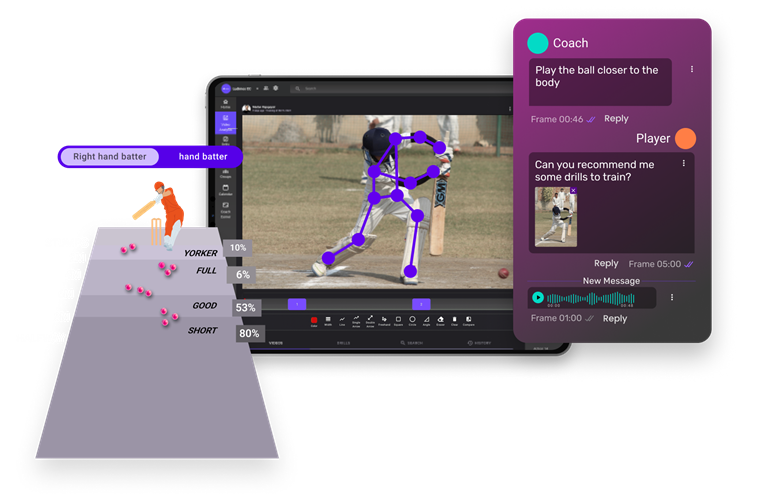
Ludimos can analyze video from multiple viewpoints, provide tracking data on ball and bat and act as a communication tool where coaches can assign and evaluate drills. (Courtesy of Ludimos)
“Our current core value prop is the ball tracking,” Rajagopal says. “So our ball tracking technology is good enough that it is already adding value to both batters and ballers, and in our roadmap, the next thing we have is to unlock the bat tracking and then the biomechanics. Then at that point, then we can merge everything together and have contextual analysis of the player in full.”
RCB, in fact, revealed this week that one of their newest additions — bowler Avinash Singh — was the direct result of its Hinterland Scouting program, a data-driven talent identification tool powered by Ludimos. Singh has never played professionally and mostly played tennis ball cricket until less than a year ago, yet now he is the first of more than 10,000 registrations to make the RCB roster through this program and has bowled 145 kilometers per hour (90 mph), an elite pace.
In a video interview, RCB head of scouting Malolan Rangarajan described Hinterland Scouting as a “very, very objective way of identifying talent where we don’t use human eyes” while likening the bowling action of Singh to Umran Malik, the IPL’s fastest bowler.
As part of an innovation contest in 2021, Ludimos earned second place in the competition hosted by Cricket Australia and HCL, with distinction for its player development tools. Ludimos is also a graduate of the Stadia Ventures accelerator program and is now raising a €1.5 million seed round, of which €300,000 was slated to come from a crowdfunding campaign on Seedrs. (By mid-January, Ludimos had exceeded that goal and raised €314,511.)
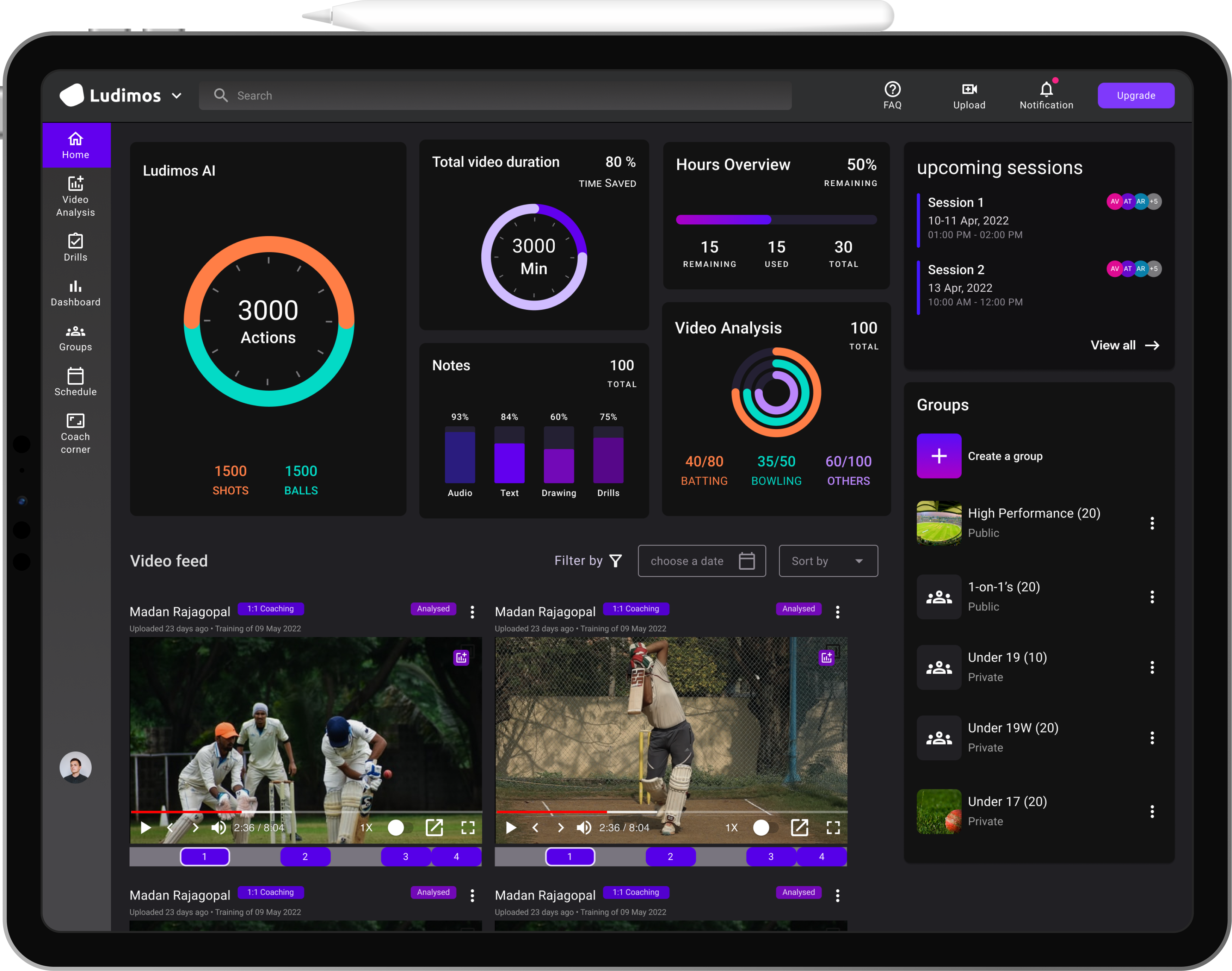
The Ludimos homepage interface includes access to video analysis, drills and more. (Courtesy of Ludimos)
While other sports — most notably baseball — have seen great advances in the understanding of the sport via publicly accessible databases and research, cricket’s advanced data has been more closely held.
“We don’t have any open data set about what’s been collected and how it’s been used, which means that there are only a handful of companies in the world that actually do this,” Rajagopal says. “And we are the only one of them, which does all three, which is bat tracking, ball tracking and biomechanics.”
Video review helped remedy Rajagopal’s own swing woes. He asked friends on the team to record him for three weeks straight and reviewed the clips with a coach.
“Even though the exact same sentence was said to me by several coaches — ‘that your head is moving away, that your weight is actually falling off and not coming towards the ball’ — I could never visualize what that actually meant, how that would look like, until I saw him pointing on the screen where he said, ‘Your head should be here, but it’s few pixels to the right or to the left,’” he says, describing the experience as empowering.
With small changes, Rajagopal dramatically improved his batting results, regaining his confidence and triggering his pursuit of Ludimos to create similar opportunities — with greater tech-driven features — to everyone. (Ludimos is an amalgamation of Latin words that try to capture the process of improvement: self-reflection, practice, habit formation.)
Rajagopal says Ludimos was designed for all age groups of cricket, recognizing that most club coaches might work with 11 year olds on up to 40-somethings. The older bracket will seek more detailed analysis; youth players will seek a different experience. “For 11- to 15-year-olds, it’s more about having fun and feeling for the game,” he says. “It’s more about gamification, so we turn our data and AI into a way that they can use as challenges and leaderboards.”
Ben Ferbrache, the cricket development manager for Guernsey, manages and coaches the junior programs for the small island state situated in the English Channel.
“It’s a really good way of tracking a player’s progress, especially with a lot of our guys that are going from one age group to the next,” he says. Ferbrache notes the ease of use, both for the players and for the coaches to record and assign their own practice drills. “What we find is kids love technology,” he adds. “Everything is on a phone or an iPad these days. So that’s where we were like, ‘Why don’t we just embrace the technology, and the kids will actually start using it?’”
This article was brought to you by SBJ Tech, a Leaders Group company. As a Leaders Performance Institute member, you are able to enjoy exclusive access to SBJ Tech content in the field of athletic performance.

At the 2022 Leaders Sport Performance Summit at London’s Twickenham Stadium, we had a peer-to-peer interview between Andrea Furst and Helen Richardson-Walsh, who worked together as psychologist and athlete to win Rio 2016 Olympic Hockey Gold for Great Britain. The pair talked us through how they were able to create a winning team environment and the importance of the role psychology can play in performance.
GB Women’s Hockey Vision:
Individual mindset: Knowing your ‘A Game’
Featuring insights from British Olympians Dina Asher-Smith and Montell Douglas, the English Premier League and the worlds of trading and the performing arts.
Session 1: The Lessons I Learned: Rebuilding After Setbacks, brought to you by our Main Partners Keiser
Speaker: Dina Asher-Smith, Team GB Olympian
Moderator: Jeanette Kwakye
To kick off the two days of insights, we had the incredible Dina Asher-Smith talking us through her journey as an athlete and how she overcame some of the setbacks she faced along the way.
Session 2: Accelerating Excellence: Elite Performance in the World of Trading
Speakers:
James King, Author of Accelerating Excellence: The Principles that Drive Elite Performance
Greg Newman, Chief Executive, ONYX Capital Group
For the second session of the day we heard from James King about his lessons from the world of trading and how they apply to high performance.
Ambition, talent and effort dictate success in every field. Performance is never a coincidence, and it always aligns with a specific set of principles.
There are four mechanisms, each of which contain principles to help our rate of progress. No one can predict success, but if you align yourself with more of these principles you stack the odds in your favour.
Three questions you have to ask yourself:
We need move away from ‘you can be anything you want to be’, towards, ‘you can be more of who you really are’.
James then welcomed Greg Newman on stage to discuss how he was able to utilise these principles in practice.
Session 3: Coaching Conversation: Coaching Mastery & Creating Environments for Talent to Flourish
Speaker: Craig McRae, Senior Coach, Collingwood FC
Moderator: Roger Kneebone, Director of Surgical Education, Imperial College London
The third session saw Roger pick Craig’s brain around his approach to coaching, how he works with his athletes, and the importance of coach wellbeing.
“Having a mentor is key. I would video every session, so I could watch it back and reflect, and constantly look to get better. As coaches we review the game a lot but we very rarely review ourselves and the processes behind the programme.”
Session 4: Case Study: The Premier League’s Elite Player Performance Plan brought to you by VEO
Speaker: Neil Saunders, Director of Football, Premier League
After the lunch break, Neil Saunders took us through the Premier League’s Elite Performance Plan, it’s successes and how the Premier League will carry this into the plan’s second reiteration to further develop the pipeline of talented players in English football.
10 years of the Elite Player Performance Plan (EPPP):
Elite Player Performance Plan:
Vision: To produce more and better home grown players
Mission: The development of a world-leading academy system
Focus areas:
Critical Success Factors (Goals)
The perception before the EPPP was that we didn’t have any high quality youth players. There was a milestone moment of age group teams winning major competitions, and at these three tournaments our players won player of the tournament across the board. The narrative had shifted from we are lacking talent, to we have some of the best talent in the world. These players are now playing en mass in the Premier League and thriving in that environment.
What has the EPPP achieved?
The Strategy for the Academy System:
We care most about:
Our building blocks:
Reflections:
Session 5: Athlete Meets Actor: Practice, Performance & Cross Industry Learnings
Speakers:
Montell Douglas, Athlete, Team GB
Dom Simpson, Actor, The Book of Mormon
Moderator: Jeanette Kwakye
To round the day off, we had a fascinating discussion between Montell and Dom where they delved into the challenges of having to adapt to ever changing environments, consistency within high performance and over coming setbacks.

![]()
One of the primary motivations for this Performance Special Report, which is brought to you by our Main Partners Keiser, is to address the issues that affect female individuals within high performance sport, because they have been neglected for far too long. There are numerous issues – far too many to address in this report – but the Leaders content team took it upon themselves to shine a light on some of the admirable work being done for female athletes and coaches across the globe.
Complete this form to access your free copy of this Special Report, to discover the untapped potential that lies across girls’ and women’s sport, from the grassroots through to the elite level, and the individuals working to unlock that potential.