Ludimos’ solution is used by more than 19,000 players in 15 countries, including the IPL’s Royal Challengers Bangalore.
A Data & Innovation article brought to you by

“I lost all my fundamental flow and feel for the bat,” Rajagopal recalls. He adds, “Coming from India, cricket is kind of in our blood, in my blood, and I could live without anything but not without cricket. But in 2018, there was a point where I literally thought about stopping cricket because I wasn’t enjoying the game anymore. I wasn’t scoring. I wasn’t playing well. My performance was very bad.”
Around the same time, Rajagopal was helping coach the club’s junior players and was surprised not to find any apps to help track their progress. In his professional life, he is a data scientist and AI engineer, so he set out to build his own solution.
That product is now Ludimos, a smartphone-based cricket tracking and training app that has been used by more than 19,000 players across 15 countries. Among the team clients are nine national cricket associations, including those in Scotland and the Netherlands, as well as Royal Challengers Bangalore of the Indian Premier League (IPL).
Ludimos can analyze video from multiple viewpoints and provide tracking data on ball and bat. An assessment of player biomechanics is in development. And the platform is also a communication tool that enables coaches to assign drills, evaluate them upon completion and return annotated videos with tips.
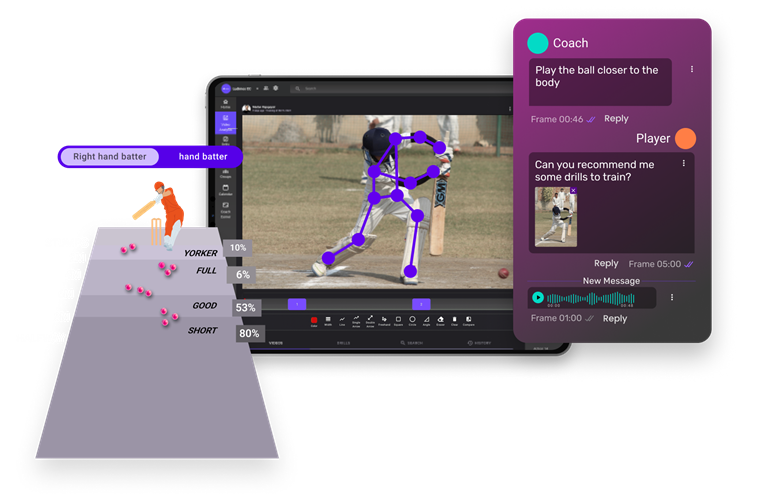
Ludimos can analyze video from multiple viewpoints, provide tracking data on ball and bat and act as a communication tool where coaches can assign and evaluate drills. (Courtesy of Ludimos)
“Our current core value prop is the ball tracking,” Rajagopal says. “So our ball tracking technology is good enough that it is already adding value to both batters and ballers, and in our roadmap, the next thing we have is to unlock the bat tracking and then the biomechanics. Then at that point, then we can merge everything together and have contextual analysis of the player in full.”
RCB, in fact, revealed this week that one of their newest additions — bowler Avinash Singh — was the direct result of its Hinterland Scouting program, a data-driven talent identification tool powered by Ludimos. Singh has never played professionally and mostly played tennis ball cricket until less than a year ago, yet now he is the first of more than 10,000 registrations to make the RCB roster through this program and has bowled 145 kilometers per hour (90 mph), an elite pace.
In a video interview, RCB head of scouting Malolan Rangarajan described Hinterland Scouting as a “very, very objective way of identifying talent where we don’t use human eyes” while likening the bowling action of Singh to Umran Malik, the IPL’s fastest bowler.
As part of an innovation contest in 2021, Ludimos earned second place in the competition hosted by Cricket Australia and HCL, with distinction for its player development tools. Ludimos is also a graduate of the Stadia Ventures accelerator program and is now raising a €1.5 million seed round, of which €300,000 was slated to come from a crowdfunding campaign on Seedrs. (By mid-January, Ludimos had exceeded that goal and raised €314,511.)
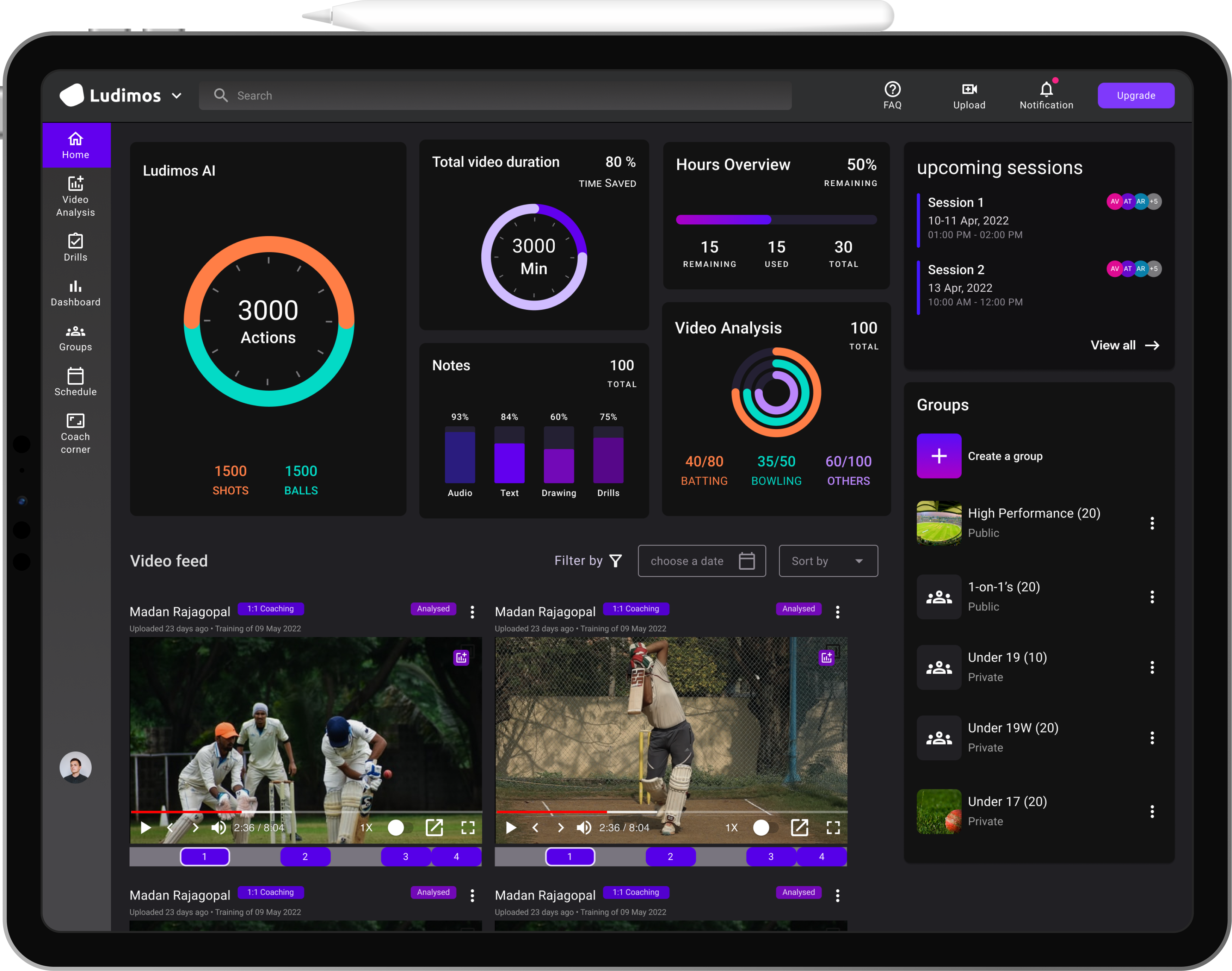
The Ludimos homepage interface includes access to video analysis, drills and more. (Courtesy of Ludimos)
While other sports — most notably baseball — have seen great advances in the understanding of the sport via publicly accessible databases and research, cricket’s advanced data has been more closely held.
“We don’t have any open data set about what’s been collected and how it’s been used, which means that there are only a handful of companies in the world that actually do this,” Rajagopal says. “And we are the only one of them, which does all three, which is bat tracking, ball tracking and biomechanics.”
Video review helped remedy Rajagopal’s own swing woes. He asked friends on the team to record him for three weeks straight and reviewed the clips with a coach.
“Even though the exact same sentence was said to me by several coaches — ‘that your head is moving away, that your weight is actually falling off and not coming towards the ball’ — I could never visualize what that actually meant, how that would look like, until I saw him pointing on the screen where he said, ‘Your head should be here, but it’s few pixels to the right or to the left,’” he says, describing the experience as empowering.
With small changes, Rajagopal dramatically improved his batting results, regaining his confidence and triggering his pursuit of Ludimos to create similar opportunities — with greater tech-driven features — to everyone. (Ludimos is an amalgamation of Latin words that try to capture the process of improvement: self-reflection, practice, habit formation.)
Rajagopal says Ludimos was designed for all age groups of cricket, recognizing that most club coaches might work with 11 year olds on up to 40-somethings. The older bracket will seek more detailed analysis; youth players will seek a different experience. “For 11- to 15-year-olds, it’s more about having fun and feeling for the game,” he says. “It’s more about gamification, so we turn our data and AI into a way that they can use as challenges and leaderboards.”
Ben Ferbrache, the cricket development manager for Guernsey, manages and coaches the junior programs for the small island state situated in the English Channel.
“It’s a really good way of tracking a player’s progress, especially with a lot of our guys that are going from one age group to the next,” he says. Ferbrache notes the ease of use, both for the players and for the coaches to record and assign their own practice drills. “What we find is kids love technology,” he adds. “Everything is on a phone or an iPad these days. So that’s where we were like, ‘Why don’t we just embrace the technology, and the kids will actually start using it?’”
This article was brought to you by SBJ Tech, a Leaders Group company. As a Leaders Performance Institute member, you are able to enjoy exclusive access to SBJ Tech content in the field of athletic performance.

At the 2022 Leaders Sport Performance Summit at London’s Twickenham Stadium, we had a peer-to-peer interview between Andrea Furst and Helen Richardson-Walsh, who worked together as psychologist and athlete to win Rio 2016 Olympic Hockey Gold for Great Britain. The pair talked us through how they were able to create a winning team environment and the importance of the role psychology can play in performance.
GB Women’s Hockey Vision:
Individual mindset: Knowing your ‘A Game’
Featuring insights from British Olympians Dina Asher-Smith and Montell Douglas, the English Premier League and the worlds of trading and the performing arts.
Session 1: The Lessons I Learned: Rebuilding After Setbacks, brought to you by our Main Partners Keiser
Speaker: Dina Asher-Smith, Team GB Olympian
Moderator: Jeanette Kwakye
To kick off the two days of insights, we had the incredible Dina Asher-Smith talking us through her journey as an athlete and how she overcame some of the setbacks she faced along the way.
Session 2: Accelerating Excellence: Elite Performance in the World of Trading
Speakers:
James King, Author of Accelerating Excellence: The Principles that Drive Elite Performance
Greg Newman, Chief Executive, ONYX Capital Group
For the second session of the day we heard from James King about his lessons from the world of trading and how they apply to high performance.
Ambition, talent and effort dictate success in every field. Performance is never a coincidence, and it always aligns with a specific set of principles.
There are four mechanisms, each of which contain principles to help our rate of progress. No one can predict success, but if you align yourself with more of these principles you stack the odds in your favour.
Three questions you have to ask yourself:
We need move away from ‘you can be anything you want to be’, towards, ‘you can be more of who you really are’.
James then welcomed Greg Newman on stage to discuss how he was able to utilise these principles in practice.
Session 3: Coaching Conversation: Coaching Mastery & Creating Environments for Talent to Flourish
Speaker: Craig McRae, Senior Coach, Collingwood FC
Moderator: Roger Kneebone, Director of Surgical Education, Imperial College London
The third session saw Roger pick Craig’s brain around his approach to coaching, how he works with his athletes, and the importance of coach wellbeing.
“Having a mentor is key. I would video every session, so I could watch it back and reflect, and constantly look to get better. As coaches we review the game a lot but we very rarely review ourselves and the processes behind the programme.”
Session 4: Case Study: The Premier League’s Elite Player Performance Plan brought to you by VEO
Speaker: Neil Saunders, Director of Football, Premier League
After the lunch break, Neil Saunders took us through the Premier League’s Elite Performance Plan, it’s successes and how the Premier League will carry this into the plan’s second reiteration to further develop the pipeline of talented players in English football.
10 years of the Elite Player Performance Plan (EPPP):
Elite Player Performance Plan:
Vision: To produce more and better home grown players
Mission: The development of a world-leading academy system
Focus areas:
Critical Success Factors (Goals)
The perception before the EPPP was that we didn’t have any high quality youth players. There was a milestone moment of age group teams winning major competitions, and at these three tournaments our players won player of the tournament across the board. The narrative had shifted from we are lacking talent, to we have some of the best talent in the world. These players are now playing en mass in the Premier League and thriving in that environment.
What has the EPPP achieved?
The Strategy for the Academy System:
We care most about:
Our building blocks:
Reflections:
Session 5: Athlete Meets Actor: Practice, Performance & Cross Industry Learnings
Speakers:
Montell Douglas, Athlete, Team GB
Dom Simpson, Actor, The Book of Mormon
Moderator: Jeanette Kwakye
To round the day off, we had a fascinating discussion between Montell and Dom where they delved into the challenges of having to adapt to ever changing environments, consistency within high performance and over coming setbacks.

![]()
One of the primary motivations for this Performance Special Report, which is brought to you by our Main Partners Keiser, is to address the issues that affect female individuals within high performance sport, because they have been neglected for far too long. There are numerous issues – far too many to address in this report – but the Leaders content team took it upon themselves to shine a light on some of the admirable work being done for female athletes and coaches across the globe.
Complete this form to access your free copy of this Special Report, to discover the untapped potential that lies across girls’ and women’s sport, from the grassroots through to the elite level, and the individuals working to unlock that potential.

Day one set the bar high and we looked to carry that energy and momentum into day two. We began with a deep dive into the performing arts, looking at talent development at the Royal Ballet School and Royal College of Music before exploring the theme of diversity, equality and inclusion with Brentford FC and British department store Selfridges. We then checked in with performance coach Owen Eastwood before turning our attention to extreme adventurer Adrian Hayes in the afternoon. Aspetar then had the honour of bringing down the curtain with a fascinating look at rehabilitation and recovery.
A big thank you from the Leaders Performance Institute team and our main partners Keiser, Abu Dhabi Sports Council and Aspetar, for joining us for two days of total high performance.
For those of you who couldn’t make it – or those wishing you refresh your memories – here are the key takeaways from day two.
Full Day 2 programme:
Talent Factories: How the Performing Arts Develops & Nurtures World Class Talent
Belonging: The Ancient Code of Togetherness
Diverse & Inclusive Leadership: Exploring How Diverse Workplaces Positively Influence Organisational Performance
Lessons from Extreme Adventuring: Adaptability & Resilience in Adversity
Rehabilitation & Recovery: The Latest Thinking to Support your Performance Strategy
Coaches and practitioners will have their own thoughts on the matter but an increasing number of teams are following the practices of the business world in empowering their athletes – their people – to find their own solutions.
With more people engaged in their own problem-solving, more options and, therefore, more creative solutions, are likely to emerge across a team.
In October, the Leaders Performance Institute hosted a Virtual Roundtable for members titled ‘Approaching Complex Problem-Solving’, which underlined the trend for allowing practitioners to develop as individuals by affording them the opportunity to problem-solve, reflect and refine their practice.
At one point, a participant highlighted their use of David J Snowden’s Cynefin Framework. The framework, which is based on concepts of knowledge management and organisational strategy, enables people to place situations into one of five domains: ‘complex’, ‘complicated’, ‘chaotic’, ‘obvious’ and ‘disorder’. Where your problem fits depends on assessing its cause-and-effect relationships.
Perhaps the most common situation in both the business world and sport is ‘complicated’, where a problem may have several suitable solutions, though the relationship between cause and effect is evident only to a limited number of individuals.
The Cynefin Framework recommends that complicated situations be assessed, then analysed with the help of experts before deciding on the best response using good practice. One caveat is that leaders can be over-reliant on experts in complicated situations when others may be able to provide creative solutions. This thinking is also central to beliefs in the value of cognitive diversity.
Moreover, people like to solve their own problems, as Kim Wylie, the Global Director of People Development at the online luxury fashion platform Farfetch, told an audience at Leaders Meet: Total High Performance in 2020.
“When people solve problems themselves, they get this nice little bump of dopamine, which is a positive legal high and people feel really good about themselves and it brings really positive energy to the group and to the individual,” she says. “The point here that’s really useful to make is that by solving other people’s problems for them, we’re robbing them of this opportunity to feel good.
“Even if, as a leader, you do know the answers to things as a manager or a coach, getting people to solve their own problems is a really good thing to do. Obviously not all of the time, you need to work out the right situation, but not being the problem-solver for everything; get people to solve their own problems – it will do them the world of good and bring some positive experience to what’s going on.”
This approach to problem-solving underpinned Jayne Ludlow’s work with the Wales women’s national team, whom she coached between 2014 and 2021. Both staff and players, she believes, have the capacity to find their own solutions.
“There’s lots of collaboration between staff and players or between the players themselves,” she told the Leaders Performance Institute in April. “There was a focus within our national team camps to make sure the players could check their understanding with each other and our thought processes.”
Often, this was easier for the younger players coming into the national setup. “I’m not sure if this is because we were working with them as youngsters and we had a specific style and way of working,” said Ludlow, who also served as Wales’ under-17s and under-19s Manager. “If I think about the group of 17, 18 year olds I had with the seniors, in the last few camps, they’re growth mindset players. They want to step on the pitch and learn. It is OK if they make a mistake, they’ll adapt and they’ll learn from it.”
Why was it different for some of the older players? “That’s to do with the environments they’ve been in. How over many years and generations we weren’t coached that way. I hardly had any feedback and they were similar, whether they were in pro or semi-pro clubs. Then suddenly you were bringing them into our environment and every day they’d have a development area.
“You’d notice in presentations. The majority of our younger ones are very different in their approach. They look at training and games as a learning opportunity, whereas the older ones were still defensive in learning moments.”
How can you lower those defences? “My general approach to feedback is: goal, then highlight what you’ve done well, then highlight what the next step is to develop it. There’s the positive aspect but then there’s a development moment. With some players, I’d take a slightly different approach. It’s a bit of sandwich approach at times so there’s more positives than development; but then you’ve always got to be careful, do they actually take the development information from you?”
Ludlow observed that older players needed more support in her social constructivist approach to problem-solving. Often, it is a question of providing the right environment for athletes to feel safe to explore a problem in a safe environment with the attendant opportunities for collaboration and developing a shared language.
Matthew Mott, the Head Coach of the Australia women’s national cricket team came to a similar realisation after taking control in 2017, particularly during the post-match debriefs.
“I do think that’s probably the thing I’ve learnt the most with this team,” he told the Leaders Performance Institute in January. He found an environment that diverged in significant ways from those found at the male teams where he had previously played and coached.
“I’ve come from a male environment where you tend to be able to just debrief the games straight after. They get quite emotional about the games and call it out for what it was.” He took this approach to the women’s team and, like coaches who work with both female and male teams, realised things needed to change. “Certainly, throughout our journey, we went into team meetings where it was basically only the coaching staff talking and I quickly realise that it wasn’t a safe space and players needed smaller groups.
“So we got into smaller groups and we gave them tasks to feed back into the main group to create that safe space. But it’s interesting that we’ve gone through that and we have that complete trust in each other that you can now say things without fear of upsetting people and looking at it objectively and dissecting the game for its good parts and the areas to improve.”
He admitted that it is still a work in progress but the difference these days is profound. “Now that we’re actually in our full group meetings, the players are the ones talking all the time now and coaches are directing and starting and facilitating but, essentially, the players are the ones talking about the game and I think that’s a great space.”
Download the latest Performance Special Report – Winning With Nutrition
Long relegated to the side lines, nutrition is finally getting the attention it deserves when it comes to helping athletes achieve peak performance. Download our latest Special Report, produced in partnership with Science in Sport and featuring NBA champions the Milwaukee Bucks, the NFL’s Dallas Cowboys, and English Premier League club Aston Aston Villa.
