We bring you five factors to consider as discussed at Leaders Meet: the Art of Strategy this year by guests including Michael Bourne of the Lawn Tennis Association, Olympic gold medallist Tabby Stoecker and the UK Ministry of Defence’s Aneaka Reay-Kemp.
Main Image: Robert Obreja / Leaders Performance Institute
“In order to build the right bridge, you need to understand those two things.”
Bourne, the Performance Director at the Lawn Tennis Association [LTA], was the first to speak at Leaders Meet: the Art of Strategy, which took place at Lord’s Cricket Ground in London in late March.
Members of the Leaders Performance Institute travelled from far and wide for a day that challenged assumptions and provoked some of the sharpest minds in the sports industry to rethink how strategies emerge in high-performance environments.
Bourne was joined on the bill by Milano Cortina mixed skeleton gold medallist, Tabby Stoecker, and speakers from organisations including the Football Association, luxury retailer Selfridges, and the UK Ministry of Defence. Together, they explored how strategies are built, stress-tested and executed by the best in the business.
Below is a snapshot of the day’s proceedings; five fresh insights to help strengthen your own planning and execution.
1. A strategy starts with a brutally honest discussion
Bourne joined the LTA in 2018, when they were two years into their ten-year performance strategy designed to tackle the lack of players coming through the British tennis system.
Yes, Andy Murray had won three majors in recent memory, but the sense was that this was “despite the system, not because of it”.
“In essence, between 2016 and 2017, the organisation undertook a diagnosis of the situation,” said Bourne, “and they came up with a number of different issues”.
This diagnosis, which included a lack of coherent pathways, limited programmes for talent ID, and resources spread too thinly, enabled the LTA to have a long, hard look at itself without pointing fingers at individuals. It lowered stakeholder defensiveness and provided the foundations for what they needed to do next.
Bourne was not present for the diagnosis, but he was recruited shortly after to ensure the LTA adopted the right approach and a coordinated set of actions. But they could not jump ahead. As he said:
I believe that you have to have that first element of the diagnosis and your guiding policy right first.
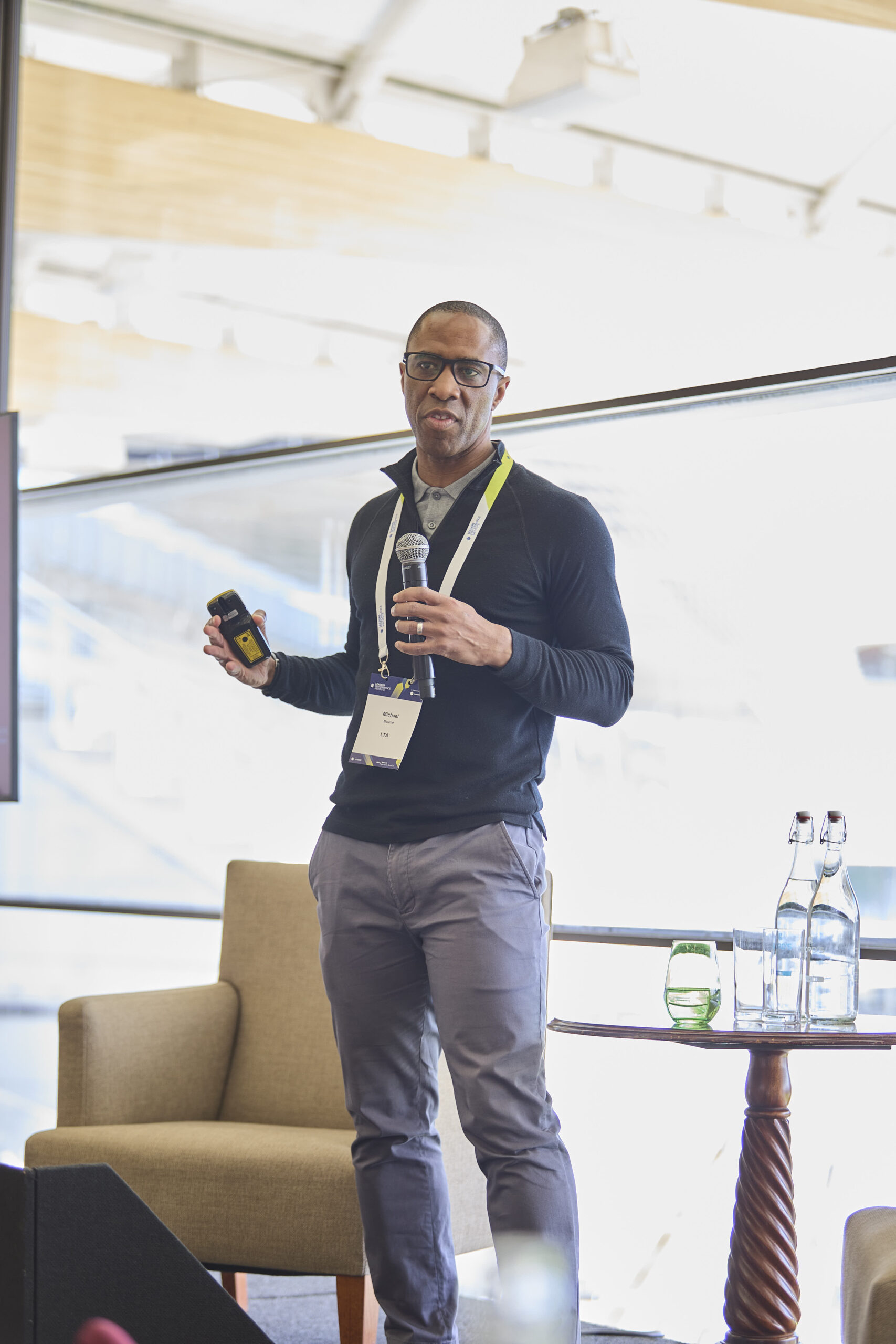
Michael Bourne, Performance Director at the Lawn Tennis Association, spoke first and set out the hard truths confronting British Tennis back in the mid-2010s. Image: Robert Obreja / Leaders Performance Institute
2. Your strategy must be co-created
At luxury retailer Selfridges, Head of DEI, Recruitment & Onboarding, Sharlene John, faced the challenge of trying to tie her work to commercial outcomes while challenging the idea that DEI is “fluffy” and irrelevant.
The result was Selfridges’ award-winning DEI and culture strategy Open to the World. On John’s watch (she joined Selfridges in 2021), female leadership within the organisation has grown from 32% to almost 70%; Selfridges is also an industry leader in ethnic representation.
Open to the World flourished because of John’s efforts to ensure it was a co-created initiative from the start. She said:
Before we even put pen to paper, it was going out and speaking to my teams, but also my leaders, to understand what does DEI or culture mean to you? And where there was that missing voice, it was bringing people into the room. So not just relying on those senior leaders where we don’t have representation, it was ‘OK, we’ll go down a layer’… I was talking to people across our business with a headcount of around three and a half thousand… We’ve got stores in Manchester, Birmingham, a tech suite in Leicester, and then the flagship in London. I went to every site speaking to people from grade 2, which is our junior role, up to our grade 7, which is exec positions, to understand what Open to the World actually means to them.
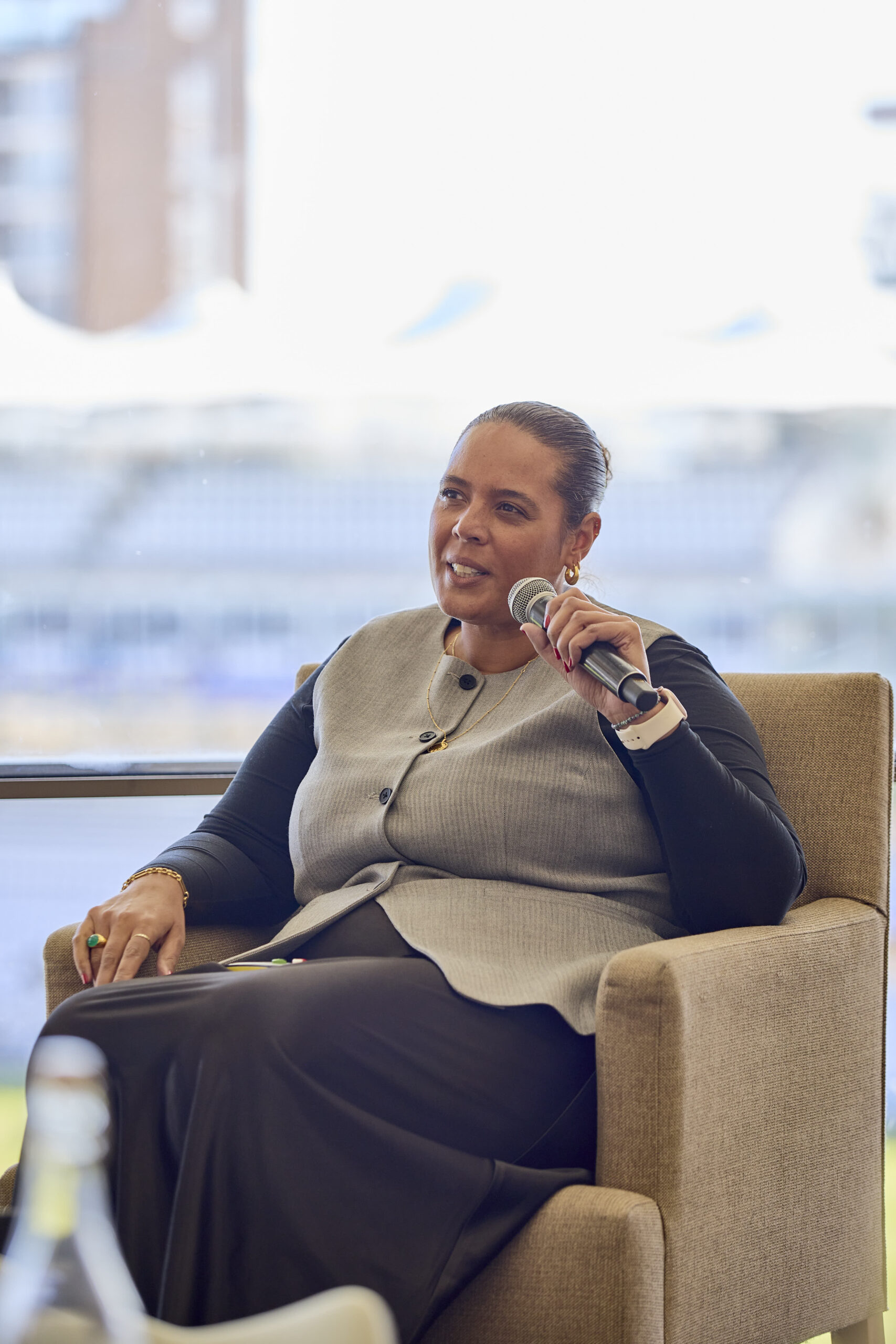
Sharlene John, the Head of DEI, Recruitment & Onboarding at Selfridges, describes her organisation’s award-winning Open to the World inclusion programme, which was built by a plurality of stakeholders. Image: Robert Obreja / Leaders Performance Institute
3. Evaluation (and re-evaluation) is continuous
“If you don’t get it right when you’re there in the moment, doing a review process at the end is worthless.”
So said Paul Ford, the former Head of Sport at the British Olympic Association [BOA] who recently joined English Championship side Norwich City as Performance Director. He spoke alongside Tabby Stoecker, the mixed team skeleton gold medallist at the Milano Cortina Games alongside her teammate Matt Weston.
When it comes to in-the-moment tweaks, Ford has a point. The BOA must work with national governing bodies, coaches and athletes continuously throughout a four-year cycle. “It’s making sure that we are doing it hand in hand with our sports as frequently as possible,” Ford added.
A macro ‘plan-do-review’ alone is not adequate. Of competition time itself, he said:
It’s on a daily cycle during delivery mode at a Games. [We ask] what are you planning for this day? What are we doing this day? How has this day gone? Because if you don’t make the most of that experience in the moment, it’s not going to happen for another four years.
Stoecker benefited from this approach, as demonstrated by her success. She said:
There wasn’t just the review of that specific race, but also ‘what are you taking from this that you’re going to change or carry forward for three years’ time, two years’ time, six months’ time?’… you can get quite swept up in what you’re doing and you have these extreme highs and lows. So I think staying focused, and when you’re then doing that and being so process-driven, the results just come.

British Olympic gold medallist Tabby Stoecker is deep in conversation with Paul Ford, the former Head of Sport at the British Olympic Association, as they discuss Team GB’s strategic approach to Olympic cycles and, more specifically, Stoecker’s path to gold in the mixed skeleton at the Milano Cortina Games. Image: Robert Obreja / Leaders Performance Institute
4. Be ready to act on incomplete information
You and your team may enjoy clarity and alignment of purpose, but optimal operating conditions are likely to be elusive whatever your efforts.
With this in mind, Aneaka Reay-Kemp, the Lead Military Intelligence Specialist at the UK Ministry of Defence, told the audience how British military operations are primed to perform when personnel do not have even 60% of the desired information. They are trained, as she said, to be “comfortable being uncomfortable”.
Rank, she argued, has limited bearing. In fact, the British military has taken steps to reduce the influence of its own hierarchies in moments of uncertainty. She said:
It doesn’t matter what’s on that person’s chest, it doesn’t matter their background, they still bring value no matter how junior they are. So for me, I find that when you’re operating in an environment where you don’t have all the information, understanding your people, understanding their capability, what they bring to the party can help save someone’s life.

Aneaka Reay-Kemp, the Lead Military Intelligence Specialist at the UK Ministry of Defence (centre), in conversation with moderator Iain Brunnschweiler (left) and Football Association Head of Strategic Development & Operations, Paul Cleal (right) as she explained what it takes for military personnel to act with incomplete information. Image: Robert Obreja / Leaders Performance Institute
5. What are you ready to discard?
New initiatives, new processes and new ways of thinking are great, but what are you prepared to discard?
“One of the things about strategy is making choices,” says Paul Cleal, who spoke alongside Reay-Kemp in his capacity as Head of Strategic Development & Operations at the Football Association. “If you’re trying to change something, it almost always involves stopping doing something else.”
However, as he has experienced, this is often easier said than done. “If things involve stopping doing something for the new thing you need, a lot of organisations struggle with that.”
Evidence, he explained, is critical in making those choices:
When I walked in three years ago, my job was not to throw things in the bin and do them differently. It was to ask: is what we’re doing now meeting the strategic aims and to what extent do we need to get closer to our strategic aims and what is it we can change?
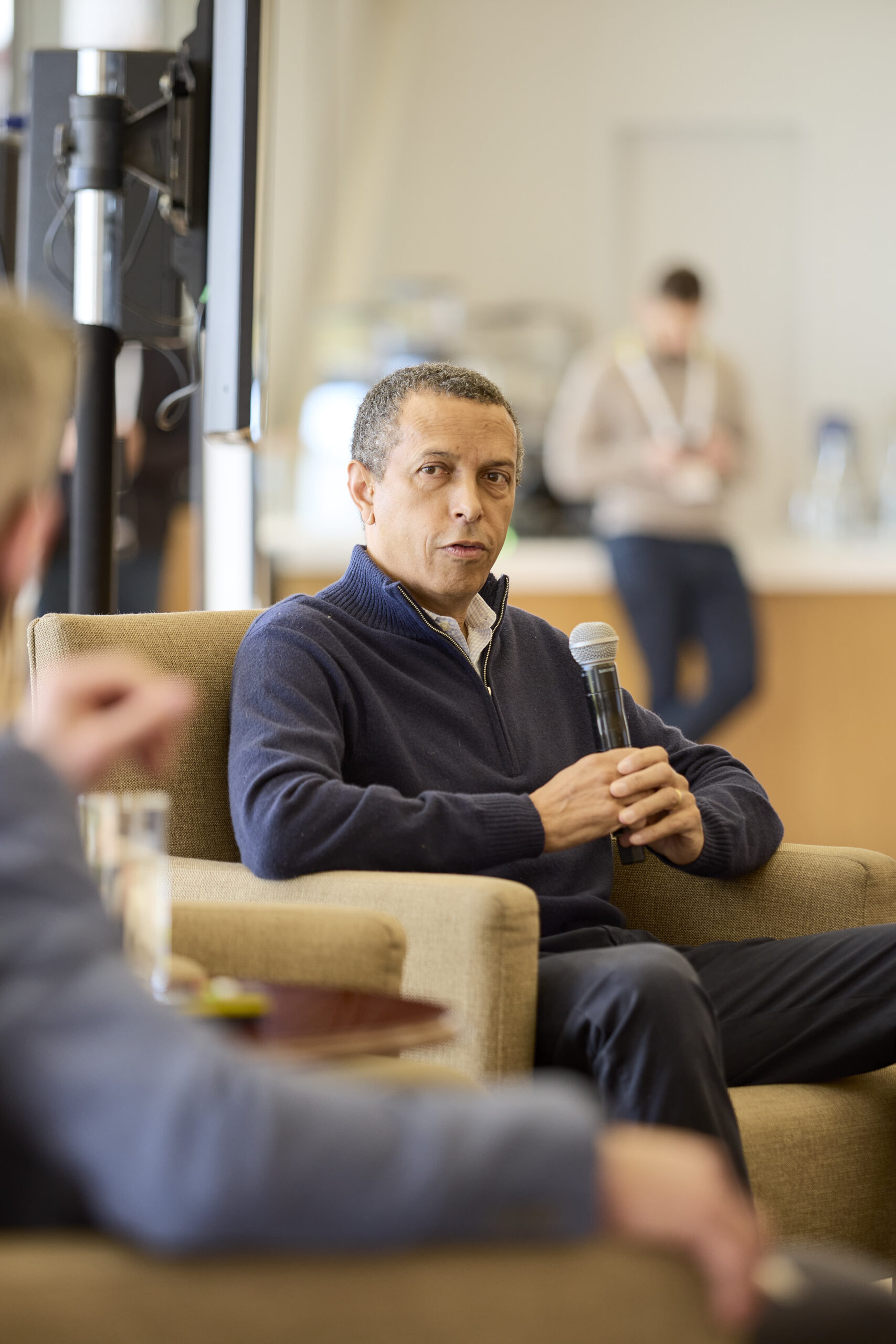
Paul Cleal, the Head of Strategic Development & Operations at the Football Association, explains why it’s important to discard programmes and processes when they no longer serve the collective. Image: Robert Obreja / Leaders Performance Institute
See you at the Sport Performance Summit in New York?
Here are a selection of best practice tips from members of the Leaders Performance Institute.
Former US President Dwight D Eisenhower wrote that line in a letter to a US diplomat in 1950 and repeated the sentiment throughout his eight years in the White House.
The line was quoted by Patrick Mannix, the Sports Science Senior Manager at US Soccer, at a presentation to Leaders Performance Institute members in 2025.
“The idea behind this quote is that high-performance teams don’t necessarily have a static plan,” said Mannix.
“The plan is constantly evolving as new information comes to light, whether that’s in relation to the tournament that we’re playing in, the players that we’re working with, and a variety of other contexts that are relevant to the world of international soccer.”
With a considered plan, a leader can align their people and allocate their resources effectively. With a structured review process, improvements can be sustained.
That is the message at the heart of a forthcoming case study virtual roundtable hosted by Mannix’s US Soccer colleague, Teena Murray, who will speak in her capacity as the organisation’s Director of Performance and from her experience of leading performance programmes at the NBA and NHL.
Here, we foreground Murray’s presentation with a selection of five best practice insights in the realms of planning and reviewing delivered by members of the Leaders Performance Institute.
1. The VMOST framework
‘The organisations that perform most consistently are not those that plan less,’ wrote James Thomas. ‘They are those that build solid foundations, plan with intent, adapt with discipline and continue to stay rooted to the agreed values and behaviours when circumstances change.’
Thomas, the Performance Director at Warwickshire County Cricket Club, wrote these words in February.
He argued that while planning is often perceived as control, he believes it to be the opposite:
When the direction is clear, planning is decentralised. Coaches, athletes and staff can act with confidence because they understand the broader context. When strategy is absent, everything escalates upwards. Decisions slow, responsibility blurs and energy is wasted re-litigating the same conversations week after week.
Thomas then introduced business strategist Rakesh Sondhi’s VMOST (Vision, Mission, Objectives, Strategy and Tactics) framework, which ‘provides a disciplined way of connecting the big picture of the future to the daily actions, tasks and deliverables required to get there’: 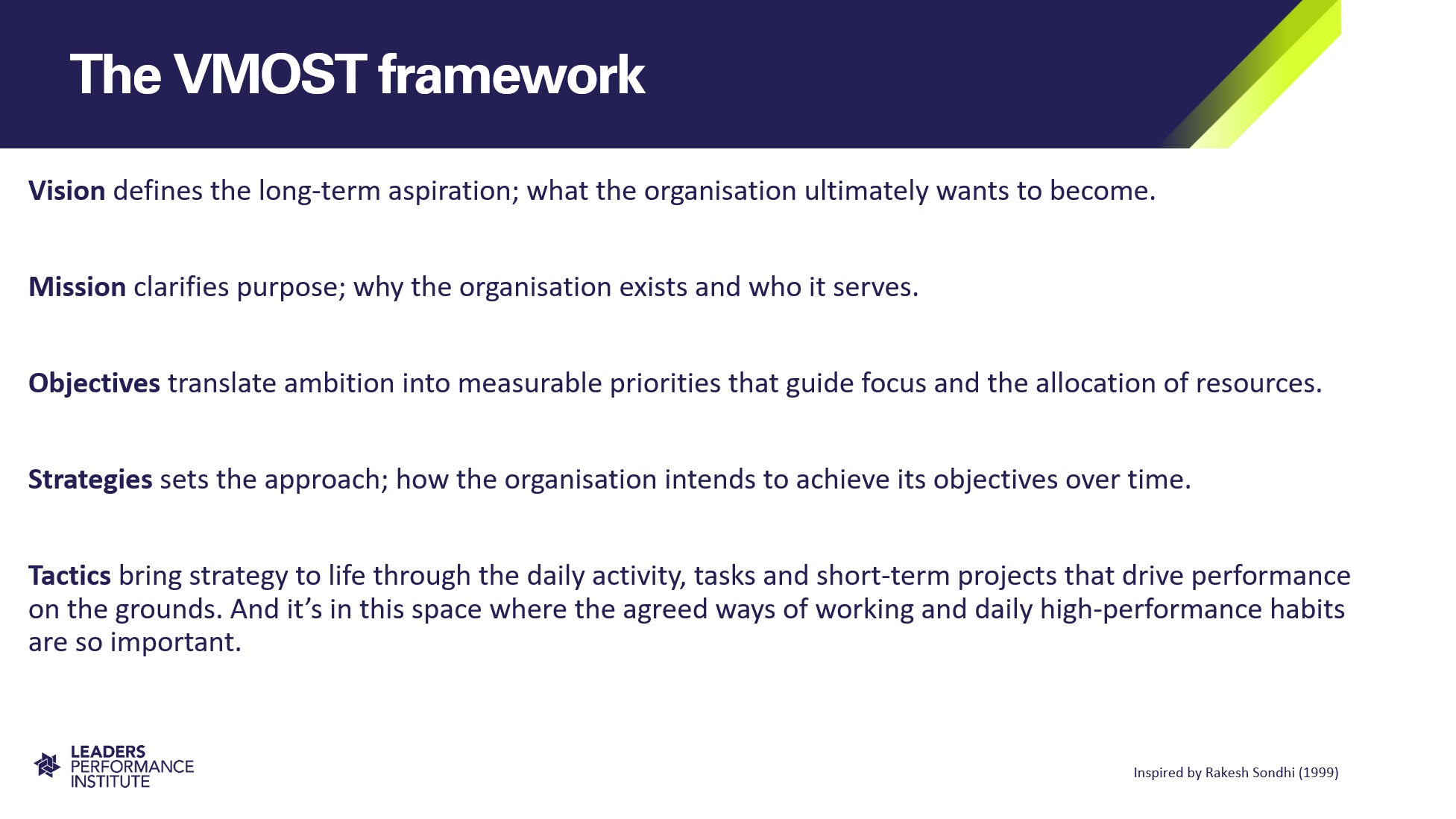
‘The power of VMOST lies in its simplicity,’ Thomas continued. ‘In high-performance environments, complexity is already high. Strategy models must reduce cognitive load, not add to it. VMOST creates line of sight. Individuals can see how their daily work connects all the way through to the long-term vision of the team and/or organisation.’
Finally, ‘when applied well, this kind of structure does not constrain creativity. It enables it. People can feel empowered to adapt, innovate and solve problems within a clear strategic frame’.
2. Find the right time for athlete education
Paul Ford, the outgoing Head of Performance at the British Olympic Association, explained in a recent article that an Olympic Games environment ‘is the worst possible place for trying to get people to peak and perform to the best of their capabilities’. He wrote:
Athletes are compacted into a brand-new village of more than 16,000 people who are all subject to a constrained competition schedule in what amounts to 52 world championships in 17 days, all in the same city.
It’s almost like they are being set up to fail when they’re expected to deliver the best performance of their lives.
The key, he argued, is tapping into the bits of the Olympic experience that build you up and not the elements that can detract from your performance. Athlete education is a critical element of the BOA’s fixed Games plan and comes in the form of discussions. ‘When to land these discussions is the next question,’ wrote Ford, before adding:
[Ahead of the 2028 Los Angeles Olympics] some sports, such as sailing and canoeing, will know their Olympians as early as September 2027; others, such as track and field, won’t select until May 2028. So the education journey we go on with the sailors and canoeists is long; we can plan out and get that right and drip feed it at the right times. Whereas the track and field athletes don’t want to hear anything about the Games because they’re not necessarily going. We must be smart in making the education bespoke and fit for purpose for each sport. Equally, some will want us to sit down and talk it through while others just want those short videos and podcasts. It’s finding out how the different cohort of athletes’ best digest information.
3. It is critical to learn from failure
In October, Everton’s Head of Sport Science, Jack Nayler, penned his thoughts on what it takes to look at a failure and ensure lessons are learned (primarily in the context of complexity in sports high-performance systems).
He shared his reflections on the late Richard Cook of the University of Chicago, specifically his treatise entitled How Complex Systems Fail.
Nayler wrote:
Around this time, I was challenged by a friend in the industry to put together my thoughts on building a performance department for a sports team. I found it challenging just to make an org chart and list positions without giving the background and rationale for why and how the department existed in that structure as well as its philosophical construct. This exercise of transferring ideas from my head on to paper forced me to critically confront my assumptions and crystallised my thoughts on how I believe we need to operate in the complex environment of elite professional team sports (specifically football as this has been my professional experience).
4. Embed review mechanisms
Mannix and his colleagues at US Soccer continually face the club vs country balance. In his aforementioned presentation, he spoke of the process that takes place when American players report for international duty.
“Building rapport and trust with those clubs is massively important because that helps us drive a lot of the exchange of information,” he said. “We need to know when our equipment and staff are arriving and where our players are coming from.”
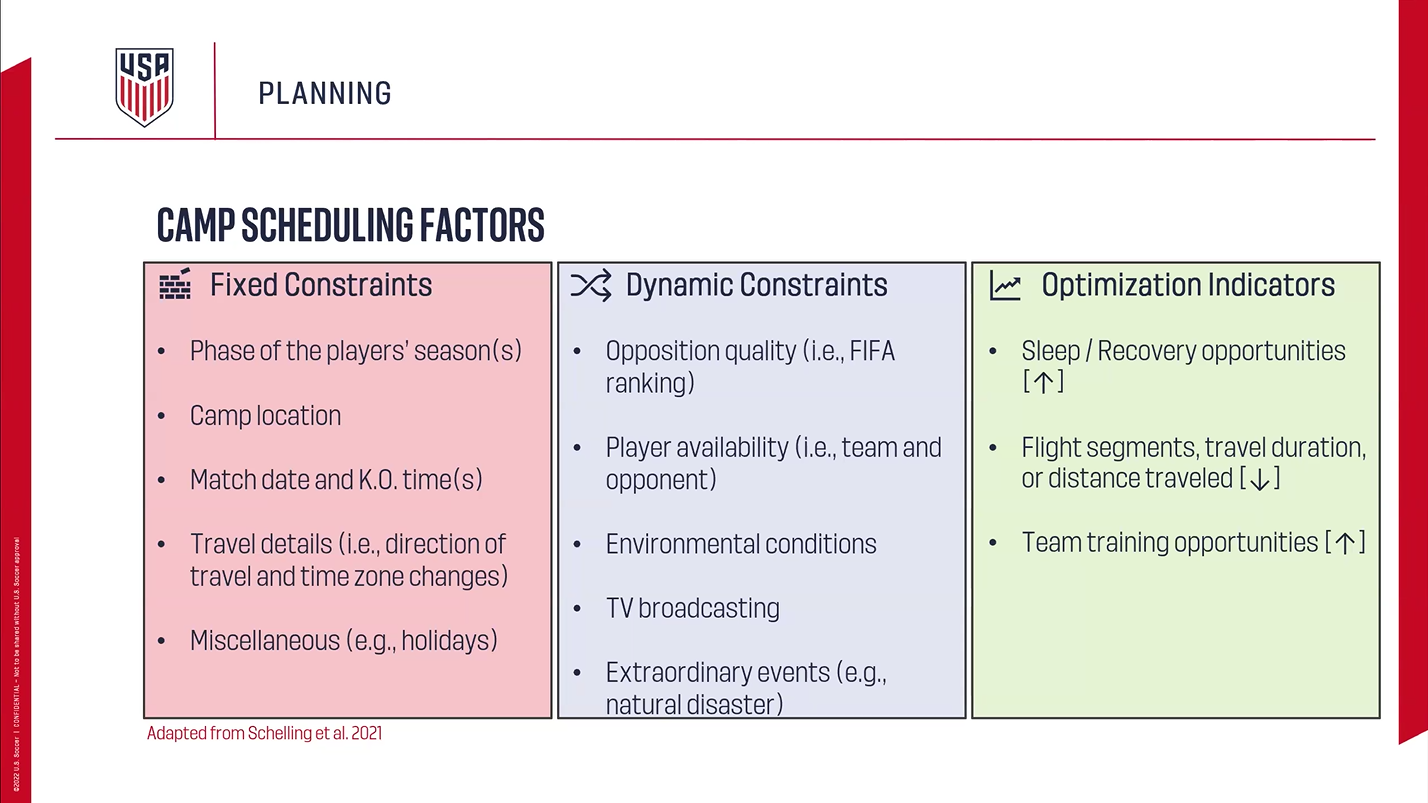
Some may be in better shape than others, which underlines the need to review ahead of a session. Mannix said:
When a coach is trying to build out the session plan, the right hand is a good sports scientist or a performance coach, and the left hand is the first assistant, and those three individuals are working very closely to ensure that there’s a good plan in place for every training session. There’s good understanding as to what the availability of the players is going to be, particularly in the first two days of training, because what we’ve found through communication with clubs is we sometimes have to be flexible when players are coming into our environment simply because although Europe observes FIFA windows, we have to work with our partners in MLS on when players are released to come and join our environment.
Mannix and his colleagues understand the range of fixed and dynamic constraints they face. They use that understanding to find ‘optimization indicators’:
5. Pursue collaborative planning where possible
Where can you pool your resources with others for the collective good?
In 2024, the UK Sports Institute, US Olympic and Paralympic Committee, Australian Institute of Sport and High Performance Sport New Zealand formed the Global Alliance, which enables them to share sports science research and best practice when it comes to their female athletes.
The Global Alliance is a case study in what can be achieved in time and resource-limited environments when organisations collaborate in areas with little impact on competition itself (they still want to beat each other).
The Alliance’s main objectives, as explained on a Leaders Community Call in November 2024, include…
Additional reporting by Sarah Evans, Rachel Woodland and Lottie Wright.
In February, high performance specialists from across the sporting landscape wrote and spoke about a range of topics including performance systems, coach wellbeing and organisational alignment.
The Chinese-American star, who had just won silver medals in the slopestyle and big air at the Milano Cortina Olympics, had been asked at a press conference if she saw those medals as “silvers earned” or “golds lost”.
She chastised the journalist for his “ridiculous perspective” but her wider comments were more telling.
“How do I say this? Winning a medal at the Olympics is a life-changing experience for every athlete. Doing it five times is exponentially harder because every medal is equally hard for me, but everybody else’s expectations rise, right?” she said.
“I’m showcasing my best skiing. I’m doing things that quite literally have never been done before. So, I think that is more than good enough, but thank you.”
It called to mind the Milwaukee Bucks’ Giannis Antetokounmpo, who was similarly exasperated in a press conference when he was asked about the Bucks’ ‘failure’ upon their elimination from the 2023 NBA Playoffs.
“There’s no failure in sports,” he responded. “There’s good days, bad days, so days you are able to be successful — some days you’re not. Some days it’s your turn, some days it’s not your turn. That’s what sports is about. You don’t always win — so other people are going to win, simple as that. We’re going to come back next year, try to be better, try to build good habits, try to play better.”
Gu, it must be said, won gold in the halfpipe just days later (making it three golds and three silvers in two Olympics) but she and Antetokounmpo (who won the NBA Cup with the Bucks in 2024) hinted at how unhelpful it is to frame high performance as anything less than first place or a gold medal.
Setbacks are inevitable, but as Gu and Antetokounmpo show, athletes, coaches and programmes can choose how they meet the moment. Those that prepare smartly, with the right focus and guidance, can give themselves improved chances of success.
These ideas came up time and again at the Leaders Performance Institute in February. Here is a flavour of what was said.
Insight of the month
The Winter Olympics are on the agenda across the Performance Hub, with high-performance specialist Richard Young telling us what happens when teams stray from their mission:
As the event approached, small adjustments began to appear. Plans were refined again. Extra conversations were added. Senior leaders checked in more frequently. None of it seemed dramatic, yet the clarity that had carried them started to dilute. The athletes felt it before anyone articulated it. The system became busy, and when the moment came the performances were close but the medals did not follow.
The issue was not effort; it was the absence of a shared and protected standard. When everything feels important, the essential things lose their edge. The debrief circled around marginal gains, yet the real margin had slipped much earlier. At some point the team stopped asking whether each decision truly met gold medal quality.
Read more here.
Quote of the month
This month its Peter Hodgkinson, who wrote of his time working as Build Operations Manager for the INEOS Britannia sailing team during the 37th America’s Cup.
Given the youth and inexperience of his build team, psychological safety and intent-based leadership were the order of the day. He wrote:
Surprises are for birthdays and Christmas, in my book. I wanted this young team under pressure to speak up. I wanted them to feel that it was wrong not to say something if they were concerned about a part or a process or were having a problem. I wanted to hear what they had to say, I was desperate to hear what they were thinking, and it was important that I responded productively when they did bring me bad news.
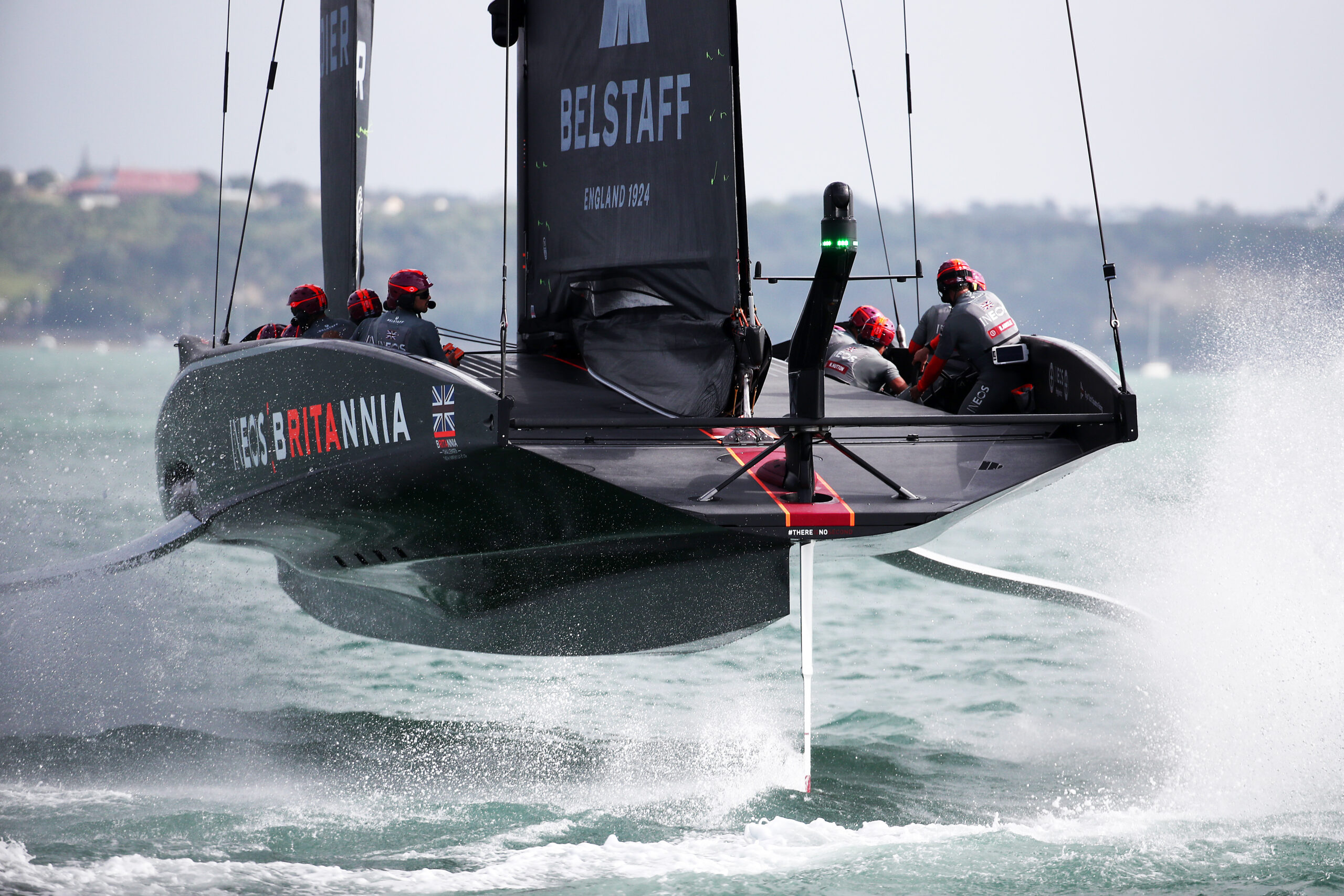
INEOS Britannia in action at the 37th America’s Cup. Photo: Getty Images/Fiona Goodall
Good to know
Pressure doesn’t make you better, but it does reveal what is already here.
That is according to high-performance specialist Rachel Vickery, who led a virtual roundtable for members looking at how they can reduce their athletes and coaches’ allostatic load – that is the cumulative ‘stacking’ of stressors over time that erode the amount of physiological ‘space’ an athlete has between their current arousal level and their personal stress threshold.
The stressors in question can be personal (e.g. a lack of sleep), organisational (e.g. misalignment), performance-based (e.g. being outside your comfort zone), or physiological (e.g. reduced ability to hear or absorb information).
Crucially, as Vickery explained, “as long as your arousal state stays below your threshold, your negative performance will not show up.”
Read more here.
Coach wellbeing
Though often neglected, members of the Leaders Performance Institute gathered to share ideas on how they can better support their coaches.
In one particular World Cup-winning environment, when athletes wanted specialist help, they were asked to book appointments. There was no 24/7 service.
This, their former manager explained, not only developed the self-reliance of the players, but also served to protect coaches and staff members who were all too ready to put themselves out, whether for out-of-hours appointments or “2am emails”.
Read more here.
Aussie rules
In early February we welcomed many of you to Brisbane for Leaders Meet: Australia, where organisations including the Brisbane Lions, Cricket Australia and World Rugby tackled the challenges of the day.
Chief amongst those was the ever-pressing need for alignment.
The Lions’ Senior Coach Chris Fagan favoured strong relationships with senior management; Australian all-rounder Ellyse Perry espoused the value of psychological safety in cricket; and World Rugby Chair Brett Robinson, as an executive, emphasised trust built on clarity from the top.
We picked out five elements for your consideration.
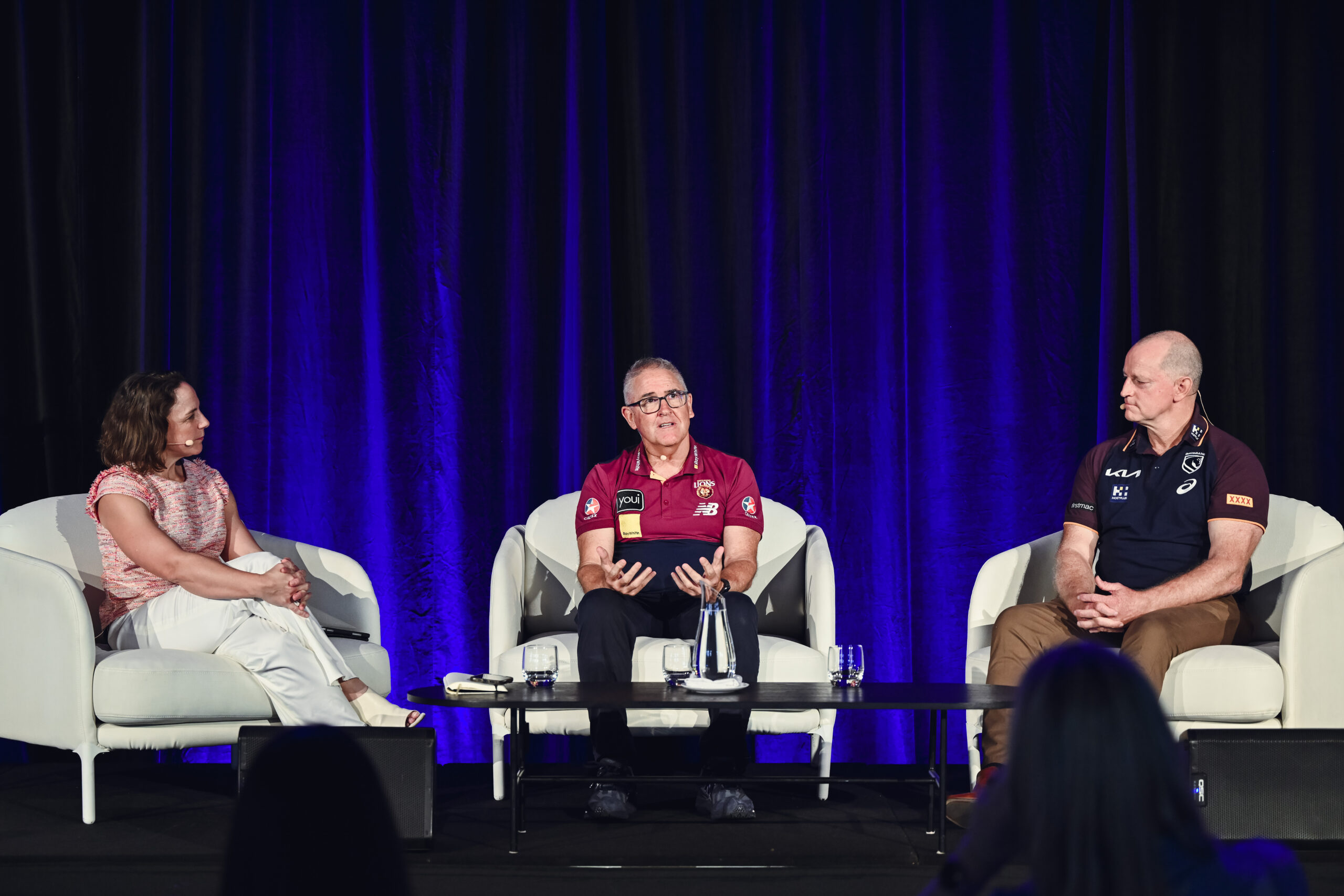
Chris Fagan (centre) in conversation with Michael Maguire (right) and moderator Rachel Vickery. Photo: Albert Perez
One you might have missed
Ben Ashdown and Dr Mustafa Sarkar of Nottingham Trent University pondered the behavioural elements of resilience in young players at football academies in this exclusive interview.
Their research has identified six resilience behaviours:
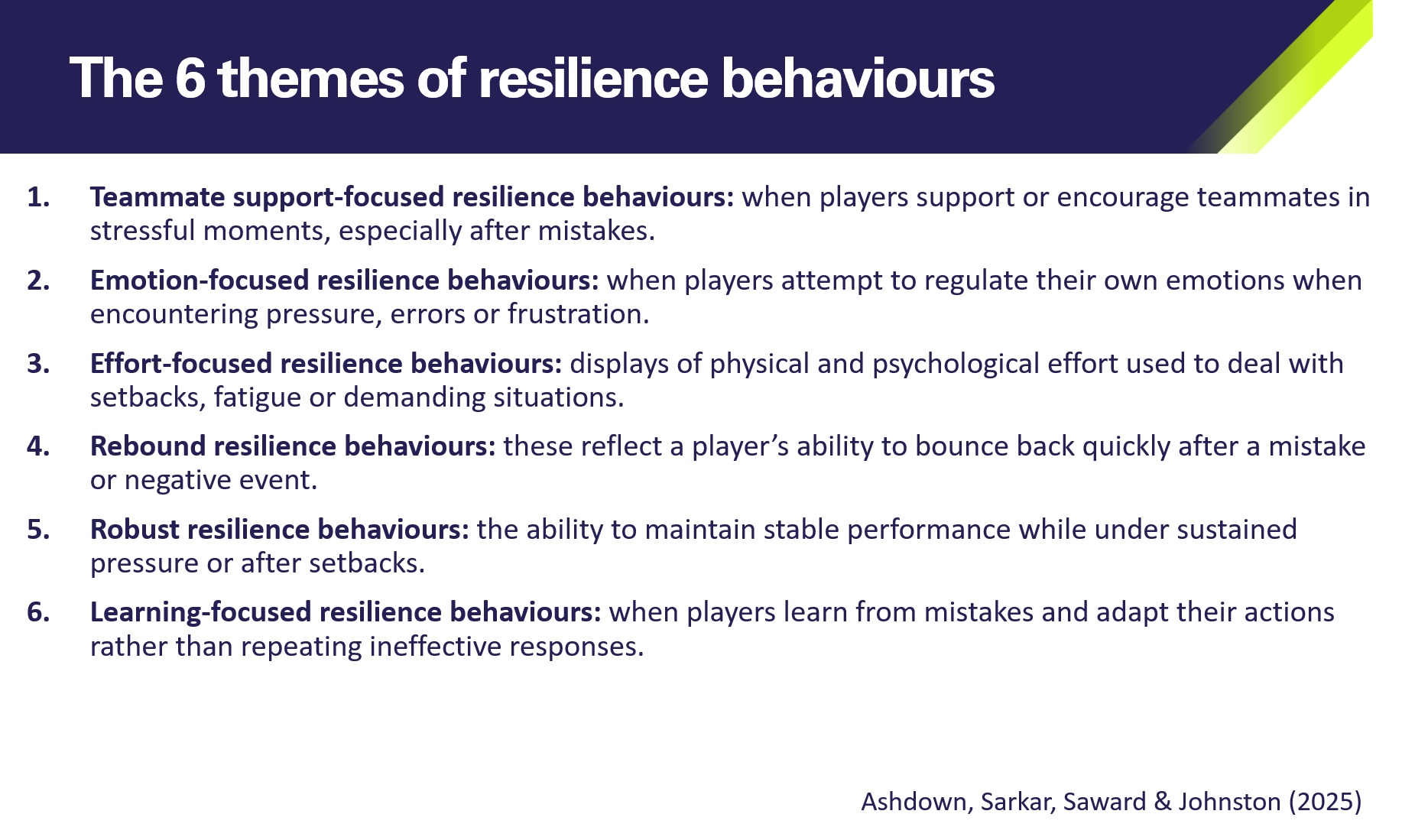
Their hope is to use these six to fashion a tool to help academy staff identify and develop resilience behaviours in their young athletes.
Read more here.
What’s coming up for members
As Warwickshire’s Performance Director James Thomas explains, strategy is not about establishing certainty, it’s about people, collaboration and coherence.
Often the word elicits a raised eyebrow amidst busy training and competition schedules or it alludes to scarce downtime for coaches and practitioners.
It is also associated with corporate language, long documents and theoretical discussions that feel disconnected from the daily reality of training, selection and competition. In high-pressure environments, planning (reviewing and learning) can be seen as a luxury, something to revisit once results improve or uncertainty settles.
My experience has been the opposite. I’m passionate about helping raise awareness of the importance and performance impact of great strategic planning.
Strategy: a precursor to performance
After more than two decades working across Olympic and professional sport, I have come to believe that performance strategy and planning are not distractions from performance, they are precursors to it. In environments often defined by pressure, volatility and constant change, strategy provides something invaluable: direction, connection and a level of continuity.
High-performance sport is inherently unstable. Calendars shift, athletes get injured, form fluctuates, staff move on, leaders change and external demands arrive without warning. In that context, the absence of a clear performance strategy does not create freedom. It creates noise. Decisions become reactive, alignment erodes, and short-term fixes quietly undermine decision-making rooted in the agreed long-term ambition.
The organisations that perform most consistently are not those that plan less. They are those that build solid foundations, plan with intent, adapt with discipline and continue to stay rooted to the agreed values and behaviours when circumstances change.
Planned Olympic success
One of the clearest demonstrations of the value of performance strategy in my career came during my time as Performance Director at British Gymnastics in the build-up to, and during, the delayed Tokyo Olympic Games in 2021.
This period was defined by disruption. The global COVID-19 pandemic fundamentally altered how athletes trained, competed and lived. Lockdowns restricted facility access. Competition schedules collapsed and re-emerged unpredictably. Athlete preparation was fragmented, and long-term planning was constantly challenged.
At the same time, the organisation was navigating a significant cultural crisis. The Whyte Review had been co-commissioned by UK Sport and Sport England in 2020 following allegations of abuse and mistreatment within gymnastics in Britain. Trust had been damaged, scrutiny was intense and the responsibility to rebuild confidence, both internally and externally, sat alongside the imperative to perform on the world’s biggest stage, the Olympic Games.
In that environment, strategy became an anchor.
It provided stability when circumstances were anything but stable. Performance strategy gave athletes, coaches and staff a clear sense of direction at a time when certainty was scarce. It reminded us of our five principles of high performance, our data informed team strategies for qualifications and finals, and created a shared understanding of what mattered most, even as day-to-day plans shifted repeatedly. This anchor also supported me during really challenging times when key staff behaviours or direction of travel didn’t align to our beliefs and approach. It gave me confidence to hold the line and make the tough decisions that leaders are so often faced with.
Rather than attempting to predict an uncertain future, the strategy focused on the team, the people, the data and practitioner-informed principles that we talked about for over three years. It established how decisions would be made, what trade-offs we were prepared to accept and those ‘what if’ scenarios that can always catch you off guard. One of these being the Head Coach breaking their leg 48 hours before heading to Tokyo. We actually had a plan for this!
This allowed the system to adapt without losing its identity.
That experience was one of the most challenging of my career, but always hugely exciting and rewarding. Three planned, but hard-earned medals secured for Team GB reinforced a core belief: strategy is not about certainty. It is about people, collaboration and coherence.
Different sports, same principles for high performance
The same principle holds true in professional football, albeit at a different scale.
During my time as Director of Performance Services at Manchester City, operating within the City Football Group, I saw first-hand how long-term strategic planning can drive sustained performance improvement across an entire ecosystem.
At Manchester City, consistent performance progression was not the product of isolated excellence or short-term cycles. It was anchored in a clear long-term plan that connected the Academy, Women’s and Men’s first teams through shared principles, aligned methodologies and a common performance language.
That plan did not seek to eliminate fluctuation. Ebb and flow were expected. Injuries, form, competition demands, squad evolution and commercial demands were all recognised as natural parts of elite sport. What mattered was that the long-term vision, the direction of travel remained consistent, even as tactics and personnel changed.
Crucially, this strategic clarity extended beyond a single team or season. It flowed across the wider City Football Group model, creating a level of coherence across clubs operating in different countries, cultures and competitive contexts. While local adaptation was encouraged, the underlying performance philosophy remained aligned.
The level of consistent on-pitch success at Manchester City over the last 5-7 years, in many ways, is unparalleled, from Academy player progression and sales to the Men’s first team treble in 2023. Long-term business and performance strategy has a lot to do with this, in my opinion.
Good performance strategy increases speed
Modern high-performance environments are defined by complexity. Multiple competitions, condensed calendars, overlapping priorities and increasingly specialised roles place constant strain on alignment. Planning in these environments is often misunderstood as control. In reality, it is the opposite.
When direction is clear, decisions decentralise. Coaches, athletes and staff can act with confidence because they understand the broader context. When strategy is absent, everything escalates upwards. Decisions slow, responsibility blurs and energy is wasted re-litigating the same conversations week after week.
The VMOST model
At this point, structures and frameworks matter.
One of the most effective ways I have seen performance strategy articulated in high-performance sport is through clear, simple models that translate long-term ambition into day-to-day action.
One such model is VMOST (Vision, Mission, Objectives, Strategy and Tactics).
VMOST was created by business strategist Rakesh Sondhi and first proposed in 1999 book Total Strategy. The framework provides a disciplined way of connecting the big picture of the future to the daily actions, tasks and deliverables required to get there.
The power of VMOST lies in its simplicity.
In high-performance environments, complexity is already high. Strategy models must reduce cognitive load, not add to it. VMOST creates line of sight. Individuals can see how their daily work connects all the way through to the long-term vision of the team and/or organisation. In my last two roles as a performance director, my VMOST strategy was etched onto a big wall, one which staff members and athletes walked passed regularly. And when curious conversations or even debates took place, we often found ourselves standing around the visual, challenging whether a new idea could really help us achieve a strategy or the mission, or was it something that could derail us and divert energy, with no clear route to helping us win. This is definitely something I am taking into my new role in professional cricket.
When applied well, this kind of structure does not constrain creativity. It enables it. People can feel empowered to adapt, innovate and solve problems within a clear strategic frame.
A new era in professional cricket
In cricket, this strategic clarity is particularly valuable and I’m living this right now as Performance Director at Warwickshire and the Birmingham Phoenix.
Across a single season, players move between formats that demand entirely different physical, technical and psychological outputs. Red-ball cricket rewards patience, control and endurance. Short-form formats demand clarity, aggression and adaptability. Players are selected for specific skill sets, yet all must contribute to a collective performance.
Without a clear strategic framework, these transitions become chaotic. Workloads conflict, roles blur and development stalls. With strategy, complexity becomes more manageable. Individuals understand their role, how it evolves across formats, and how their contribution supports the team’s wider ambition.
At its best, performance strategy connects people.
High-performance sport is full of specialists. Coaches, analysts, medics, strength staff and operations teams all operate in defined roles, and rightly so. The risk is not a lack of expertise, but fragmentation. Excellent work happening in isolation without a clear line of sight to the bigger picture, is one of the biggest risks leaders can face.
A well-articulated strategy creates connection. It allows people to see how their work links through to the final mission and vision of the organisation. Daily decisions gain meaning. Trade-offs become easier to navigate. Autonomy increases because intent is understood.
When people understand why their work matters, they can make better decisions.
Strategy also provides continuity in environments where turnover is inevitable.
Athletes move on. Coaches change. Support staff rotate. In some organisations, meaningful personnel change happens every season. Culture alone cannot carry performance identity through that level of churn.
Strategy creates continuity of thought.
It anchors philosophy, ambition and non-negotiable principles beyond any individual. It allows new people to arrive and quickly understand how performance is built, what standards matter and what success really means in that environment.
In my experience, the strongest systems are those where people can come and go without the performance identity being lost. That does not happen by accident. It happens because strategy has been made explicit, shared and lived.
This requires leadership discipline.
Performance strategy only creates connection and continuity if leaders reference it consistently, use it to explain decisions and hold themselves accountable to it under pressure. When strategy is visible in how leaders talk, select, invest and prioritise, it stops being a document and becomes a shared language.
That language matters when pressure rises.
Under stress, people revert to what they understand. Strategy provides a common frame of reference. It reduces anxiety, accelerates alignment and allows honest conversations about performance without personalising every decision.
Planning also helps organisations say ‘no’.
In elite sport, opportunity is constant. New competitions, new technologies, new interventions and new ideas arrive relentlessly. Without strategy, everything feels urgent, and every new opportunity feels like one we can’t miss out on. With strategy, priorities are clear. Resources are allocated intentionally. Energy is focused where it matters most.
Importantly, you need to find ways to stay flexible, and not become rigid, bound to a strategy you developed years ago.
The best strategies are not scripts. They are frameworks. They define principles, priorities and trade-offs rather than fixed answers. They allow adaptation without drift.
Good performance strategy answers simple but powerful questions:
The human impact of planning is often underestimated.
Clear strategy can reduce uncertainty. It gives people confidence in decision-making. Applied well, it creates psychological safety by replacing ambiguity with intent. Athletes and staff perform better when they understand direction, expectations and how success is defined.
This is particularly important in high-performance environments where accountability is high and pressure is constant.
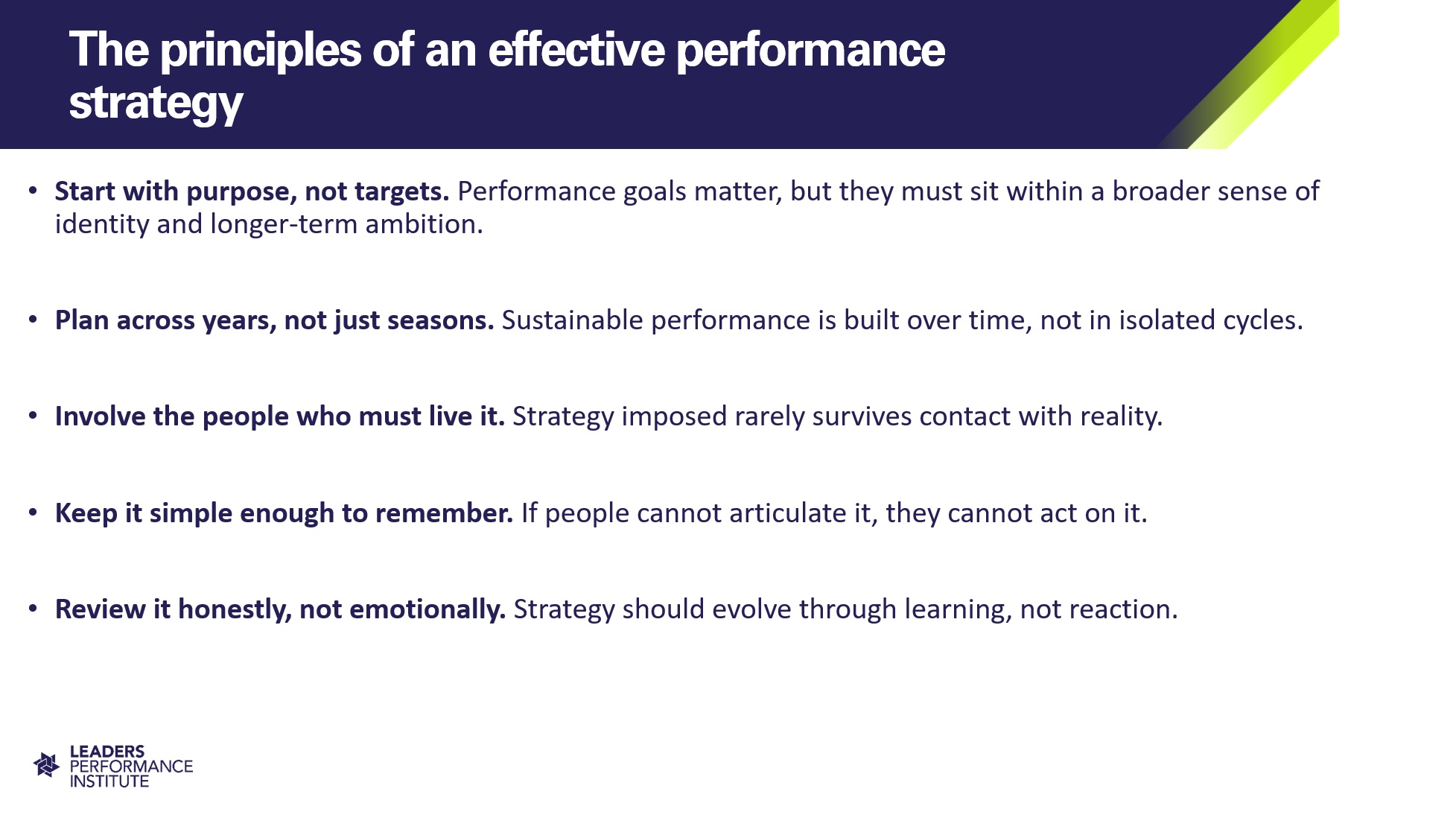
For leaders looking to build effective performance strategy, a few principles matter.
Competitive advantage
Across Olympic and professional sport, one belief has remained constant for me: strategy is a competitive advantage if organisations are willing to treat it as such and invest in the people who are delivering it.
In high-performance sport, change and uncertainty is guaranteed. Strategy does not eliminate it, but it determines whether change becomes a threat or can be used as an advantage.
When planning for performance connects people, aligns ambition, creates continuity and promotes curiosity, performance shifts from reactive winning to sustainable success.
James Thomas is the Performance Director at Warwickshire County Cricket Club and one of sport’s leading high performance experts. If you wish to speak to James, please contact a member of the Leaders Performance Institute team.
More from James Thomas
Ben Ashdown and Mustafa Sarkar of Nottingham Trent University are working on a research programme aimed at providing an evidence-informed and objective approach to tracking resilience on the pitch.
Main Image: Thomas Eisenhuth/Getty Images
“Even within the same football academy we’ve seen staff have different views of what resilience is,” Ben Ashdown, a Senior Lecturer in Sport and Exercise Psychology and Lead Researcher at Nottingham Trent University, tells the Leaders Performance Institute on Teams.
“They’ll say ‘resilience is a really important part of our philosophy but actually we don’t really know what it is, we don’t really know how to measure or assess it, we don’t really know how to track it’,” says Dr Mustafa Sarkar, who also joins the call. He is an Associate Professor of Sport and Performance Psychology at Nottingham Trent and Lead Supervisor of the research programme.
Together, alongside Dr Chris Saward, Dr Nathan Cobb, and Dr Julie Johnston at Nottingham Trent University, they are leading a research programme to identify behavioural indicators of resilience in English academy football and develop a resilience behaviours observational tool. As part of the research, they have worked with academy stakeholders including coaches, psychologists, scouts, and analysts. They are also conducting a season-long study at a Category One academy (Derby County Football Club).
Based on their research, they have found that resilience behaviours can be categorised under six themes:
At the end of this research programme, they hope to have developed a tool for sport psychologists and coaches primarily, with some benefit to analysts who might contribute to the tracking of these behaviours through video-based analysis.
Sarkar says: “We don’t necessarily see it as a tool for identifying talent. I think it would be more as a conversation-starter with a player for player development purposes.”
Resilience: a behavioural response
As the exploration, measurement, and assessment of resilience in sport has tended to rely on self-report alone, myths and misconceptions have emerged (such as resilience being related to endurance and the suppression of emotion), and there is a gap between what resilience truly entails and what practitioners witness on the pitch.
“Coaches and support staff are starting to recognise that both physical and mental rest are critical to sustained resilience over time,” says Sarkar who has spent time with academy stakeholders dispelling those myths and misconceptions. “Part of resilience is about helping individuals to develop their thought and emotional awareness. It is not about encouraging people to hide their emotions”.
Additionally, “resilience requires more nuanced (context-specific) language because a person’s resilience in relation to being injured might be quite different to their resilience in relation to a loss of form”.
The behavioural elements of resilience lay at the heart of their research programme.
“We see resilience as a behavioural response,” says Ashdown, “but, up till now, there hasn’t been any literature that has actually asked what do these behaviours ‘look like’? How do we observe them? I think our work, in a behavioural sense, gives us some directly observable, reliable and valid indicators of resilience in football.”
The appeal for coaches, psychologists, and analysts is clear. “They’ve really bought into this idea that we’ve got something to look for on the pitch, and if we can see it [resilience], then maybe we can then develop it and track it over time,” Ashdown continues.
Their initial 2025 study/paper identified 36 behaviours (across six themes mentioned above), which have since been refined to ten. “We retained at least one across the six themes, which is another indicator that they’re pretty reliable.”
These behaviours include: demonstrating supportive actions during pressure or adversity (support-focused behaviour); positive body language in response to stressors (emotion-focused behaviours); and regaining focus in the face of challenges (robust resilience behaviours).
How might coaches approach these behavioural themes in their resilience development work?
The Leaders Performance Institute asks Ashdown and Sarkar about each of the six themes and they give consideration to each in turn with the caveats that a) they should be viewed collectively in order to develop a holistic view of an athlete; and b) the data collection and analysis of their research programme remains ongoing.
When players support or encourage teammates in stressful moments, especially after mistakes.
Ashdown admits that the relational aspects of resilience are more significant than he initially thought. “At times I probably assumed resilience was an individual capacity that you developed almost by yourself without realising that social support (through your teammates) is really significant,” he says.
“Through the work of Ben and others we’re starting to find that resilience is very much relational,” says Sarkar. “The development of resilience is dependent on cultivating high quality relationships. The interesting bit about social support is that we’ve found that it’s not necessarily about getting social support, but it’s about the perception that that support is available to you. From a resilience perspective, the perception is more important than receiving the actual support itself.”
Ashdown then shares a story of academy training drills, at Derby County FC (work led by academy sport psychologist, Lyle Kirkham, and supported by Ashdown), where players had a “secret support partner”. “We tasked some players with, right, when your teammate experiences some adversity or stressor or when they’re under pressure, find ways of offering them support,” he says, adding that the process raised the players’ awareness of how they’re reacting, responding and interacting with their teammates.
When players attempt to regulate their own emotions when encountering pressure, errors or frustration.
While there isn’t yet the data to support a definitive conclusion that emotion-focused behaviours depend on age and phase, as Ashdown explains, “there’s so many points where the participants said ‘we would expect to see a different response from a 10-year-old than one of our under-18s’.”
Emotional maturity is sure to be a factor. He adds: “How these players react and respond to things, particularly at younger ages, it’s a lot more visible, whereas maybe the older players tend to try and disguise how they’re feeling.”
This is a behavioural theme where interdisciplinarity comes to the fore. “We’re working with performance analysts to try and identify these behaviours through video footage and I think we’ll end up with a bespoke set of behaviours based on the phase [foundation, U9-U11; youth development, U12-U16; professional development, U17-U23].”
Displays of physical and psychological effort used to cope with setbacks, fatigue or demanding situations.
What does making an effort ‘look like’ in any sport? “There’s a danger of making assumptions because every player is different,” says Ashdown with reference to both physical and psychological indicators of effort. Their work has talked of pairing GPS data with observations but, as he admits, “this is where we need to be careful and cautious of not mislabelling players based on a perceived lack of effort and we must be aware of individual differences”.
For Sarkar, again, it is more about setting the terms for a player development conversation. He says: “You might come up with a resilience profile to say one player has got hypothetically high effort-focussed behaviours and lower teammate-focussed behaviours, but we see this observational tool more holistically across all six themes”.
These reflect a player’s ability to bounce back quickly after a mistake or negative event.
These need to be channelled. It is no good if a player makes a mistake and runs around like a headless chicken for the next 10 minutes and is sent off.
“One of the participants in our research mentioned that exact point in relation to effort-focused behaviours,” says Ashdown, before echoing Sarkar’s earlier reflections. “The most value in this behavioural approach is the opportunities that it creates for player-coach or player-psychologist reflection.” This, Sarkar suggests, could be a joint review of game video clips where the coach and/or psychologist says to the player ‘talk us through your thought process. What were you thinking and feeling at the time? How might you react and respond differently?’ or it a series of ‘what-if’ questions and scenarios. ‘What if this were to happen in the future? How would you react and respond?’
Sarkar adds that any intervention should be context-specific. “If a player has done that once are we then making an assumption that they’re doing that all the time – is this a one-off occurrence versus a pattern of occurrences? If it’s a one-off, like Ben said, then it’s probing that player about what they were thinking at that particular point in time. But we have to be careful that we’re not intervening based on a one-off versus a pattern.”
The ability to maintain stable performance while under sustained pressure or after setbacks.
Ashdown and Sarkar make the point that robust resilience behaviours risk being conflated with youthful inconsistency – and all its causes – at academy level.
“One of the participants in our research said it’s not about consistency of performance but the consistency of behavioural responses to things. So performance will fluctuate but is there some consistency in the way they’re behaving, reacting and responding?” says Ashdown. “What some of the coaches are after is a flattening of the curve emotionally and the way the players are managing things on the pitch.”
Sarkar believes coaches may be able to use the resulting observational tool as a means of evaluating the efficacy of pressure training scenarios. “What are you, the coach, actually seeing in terms of their reactions, responses, certainly from a behaviours point of view, and as a result of that pressure training, are you actually seeing an increase in some of the resilience behaviours in relation to these themes?”
When players learn from mistakes and adapt their actions rather than repeating ineffective responses.
Pressure training also presents an opportunity for self-reflection and learning through its video component – this is the ultimate purpose of this resilience behaviours work. “If we’re aware of that, can we support them in navigating those more effectively when they’re inevitably going to come up on the pitch?” says Ashdown.
“We don’t learn from experience, we learn from reflecting on experience,” says Sarkar, paraphrasing the American educational reformer John Dewey. “Pressure training shouldn’t just be about putting people under pressure in training and then automatically assuming somehow that they’re going to develop their resilience to future situations?”
At Derby County, led by Kirkham and supported by Ashdown, they have also introduced a series of gamification principles in delivering education and feedback at the academy through a resilience behaviours lens. This includes FIFA-style cards for players, and a football-specific version of snakes & ladders to mirror the ups and downs of the academy journey.
The future of resilience tracking
When it comes to resilience, coaches are acting on intuition, which is valuable but ultimately has its limitations.
“We’re trying to make that process more objective and systematic; hence this is where the interdisciplinary piece comes in,” says Ashdown. “We wouldn’t expect coaches in the moment in the game to be thinking about necessarily tagging or noting these behaviours. We might ask the analyst, with support from the psychologist, to do live coding or tagging of these behaviours or retrospective tagging based on the recording. That would then lead to conversations with the players. With this work, there’s a big opportunity to bring together coaching, performance analysis, and psychology.”
Sarkar explains that they are using the behavioural data to create a resilience profile for players across the noted behaviours. “That gives you a holistic viewpoint,” he says. “A player might have higher team-focused resilience behaviours and slightly lower effort-focused resilience behaviours and a medium level of learning-focused resilience behaviours. So, it gives you a nice overall resilience profile of an individual.”
The hope is that their work will eventually provide an evidence-informed and objective approach to tracking resilience on the pitch.
“It can also then become part of the everyday conversation with multiple staff. So rather than just a conversation in relation to psychology, it’s a broader conversation about player development.”
What to read next
Playfulness and Resilience: How Ballet and Music Schools Link Them Together to Amplify Both
As Jamie Taylor of Dublin City University and the CoEx|Lab explains, the university’s master’s and doctorate programmes are designed to help coaches and other high-performance practitioners embed research into their daily practice – a habit that is sometimes overlooked in sport.
Additionally, one of the key challenges in coaching is that there is a world of evidence that can help practice, but most do not know about it.
At Dublin City University we are trying to subvert that attitude through our online doctorate and MSc programmes, which are aimed specifically at coaches and practitioners in high performance sport.
We have a community of around 100 coaches and practitioners who appreciate the capacity for research to enhance both theirs and their organisation’s practice in ways that have long been transformational in, say, S&C or medical.
In many respects, coaching is a discipline apart, yet sports performance has long-been reliant on other domains to pick up and apply research. More research can and should be done.
Below, I explore – drawing on insights from students across the doctorate and MSc programmes – the common barriers in coaching, before making the case for evidence-informed research that can meaningfully support practice. The programmes are delivered by a team of practitioner-researchers, including Áine MacNamara, Dean Clark, Robin Taylor, Rosie Collins, Stephen Behan and myself.
The common barriers
As a coach, you should be weaving research into your practice – it should not be additional.
“Last Friday, we protected two hours for some internal professional development with a group of practitioners,” says Ian Costello, the General Manager of Munster Rugby. “There’s 20 reasons not to do it, but if it’s important, it’s protecting the time in your diary, no matter how busy you are.”
Ian believes the programme has opened up new career options, potentially even beyond professional rugby union. He has now got into the habit of writing in his diary in three colours: black for operational matters; green for strategic issues; and blue for learning and personal development.
“Someone gave me one of those multicoloured pens – I hate them because of my bad handwriting and these don’t help – but it’s brilliant for my diary,” he continues. “Learning and personal development can be anything from podcasts to light reading or heavy reading. It can be writing too – that was a good life skill and practical skill that a mentor shared with me.”
Additionally, coaches have not often been shown how to critically organise their thinking, even when they thought they were doing so.
Ian has been coaching for more than two decades, but still wouldn’t describe himself as the finished article.
“The first year broke me down in terms of questioning everything I know around critical thinking and reflective practice,” he says. “What the doctorate does is give you more structure to that process. It provides you with a more robust and applicable skillset to be accurate in research terms and then to think critically about the information you’re absorbing. As time goes on, you’re able to transfer that to your practice more readily and with a lot more clarity.”
He is not the only one to find the first year challenging. “It was quite confronting and shocking,” says Jamilon Mülders, the Performance Manager at the Royal Dutch Hockey Association. “You try to present where you’re coming from, what you have achieved, what you have done and why you have done things, and the staff at DCU will pose little questions like ‘where’s the evidence?’”
Jamilon has won Olympic and world championship medals as a coach, and yet, as he says, “I have to acknowledge that nine out of ten things we did worked for whatever reason at that stage, but there was no underlying theory, no evidence. There was nothing you could fall back on where you can explain it or also just make sure that you detect possible mistakes, issues, challenges, hurdles which might have happened or occurred in other areas.”
He sensed that something was absent. “I felt that something was missing in my personal education and growth,” he continues, further reflecting on that induction period at DCU.
Some coaches may never have set foot in an academic setting but, whether it’s our doctorate or MSc programme, we don’t need to simplify course material for coaches. We just need to make sure we are providing the right provocation.
“When we’re asked better questions it causes us to say ‘actually, I took that situation for granted, but I need to peel that back a little bit more’,” says Rachael Mulligan, the Athlete Support Manager at the Federation of Irish Sport. “It forces you to go ‘what is the best question to ask in order to get to a better outcome?’”

The most recent cohort of students on DCU’s professional doctorate and MSc programmes lines up for a group shot at DCU in Dublin.
The case for evidence-informed – not evidence-based – research
I hear all the time that ‘we need to quantify this’. It leads us to measure things that don’t really matter simply because we can count them.
There are different ways of seeing this and my view is that evidence should inform coaching, working alongside professional experience, theory, and context, rather than being treated as something on which coaching can be straightforwardly evidence-based.
“For anybody to be genuinely comfortable about their view of the world or their view on practice, it should be research-informed,” says Scott McNeill, the Head of Coach Development at the Premier League. “The risk and challenge of research is that sometimes things can go out of date very quickly. A body of research can be nearly out of date the day that it’s printed. So to keep that as a consistent and live way of engaging in practice would make sense to me, that suggestion that knowledge isn’t fixed, that these things keep evolving.”
“The first thing I said was my issue with research is I sometimes think researchers are almost in an ivory tower and very much removed from what goes on in the day-to-day field of performance sport,” says Rachael of the topic.
“That perception was completely quashed after a couple of weeks in the programme because there’s so much emphasis in terms of, yes, this is fantastic in the academia space, but how do we move this into real-life practice?”
“I used to always say I was evidence-based and a lot of coaches will pride themselves on that,” says Christoph Wyss, the Lead Physical Performance Coach at Red Bull. “But I think evidence-informed makes more sense because if a research paper comes out, being evidence-informed is taking that research, reading it, critiquing it, seeing what’s good and what’s not, and then applying that to your setting, because every setting is different.”
As he says, “with evidence-based you’re just transplanting it, doing exactly what they did, but then evidence-informed is more translating it.”
“There’s not necessarily one solution,” says Eilish Ward, the Head of Player Development at the Ladies Gaelic Football Association. “There’s no one way to learn anything or to gain experience or expertise.” The key for Eilish in her work is to ensure she and her colleagues are “making as informed decisions as possible when we’re designing learning activities” because “not everything from research may be transferable into a practical environment and, equally, every practical environment is going to be hugely different.”
“Being evidence-informed is probably more aligned with what we do on a day-to-day basis,” says Niall O’Regan, the Head of Education & Development at the Football Association of Ireland (FAI). “It is something that has helped me to understand how to be authentic, how to be creative in adapting what the research is saying is to suit the needs and the context and the environment that you’re in.”
Plus, as Scott says, “people sniff you out pretty quickly whenever there’s a gap between what you’re saying and what might feel real to them. Our job as people that work in this space is to either translate the messaging in a more accessible way or to admit that there probably still is a gap.”
And therein lies the opportunity to ask better questions.
Research should never be far from practice
While the programmes can be intimidating for coaches, we’re here to help in any way we can because it is important that research is not too far from practice. When they are close, the research finds practical application.
“This was a part I enjoyed from day one because you could immediately see the practical implications and make an impact,” says Jamilon of his coaching in field hockey. “So if I were talking with S&Cs about load management around our training, my new way of approaching them and asking questions really helped me to have a clearer view on the team and the environment.”
In some cases, research can help to highlight the current inadequacies in a high performance programme.
Niall, for one, thinks differently these days about coach development structures at the FAI; and it feeds into his practice.
“There are some experienced coaches that have so much knowledge and so much expertise in their fields that they may not need to go systematically through a certain set of steps,” he says. “They may have the ability to effectively communicate, empower others or share knowledge in a way which doesn’t require them to go through a checklist. They can get to the end with the exact same learning and sometimes even more learning.”
Such an approach doesn’t necessarily sit right with the coach and it wouldn’t necessarily sit right with the coach developer. “There’s a grappling effect where those people probably feel like, ‘well, I’m being rigidly pushed into a checklist of things and being asked to do things that I naturally wouldn’t do myself’.”
It comes back to being research-informed. “The person in front of you is the actual start point, and then it’s up to us as the educators and developers to be able to link it into research. The practice comes first and then it’s a matter of layering in what research is out there that can inform the decisions that that person is making.”
If you would like to know more about the professional doctorate and MSc programmes at DCU please email Jamie Taylor at: