As Jamie Taylor tells us, the Premier League-sponsored Coaching Expertise Project is challenging assumptions and establishing new standards.
Main Image: Phil Greig, courtesy of the Premier League
Yes, a head coach could be an expert, but that team might also be blessed with a highly expert foundation phase coach or an expert professional development phase coach. Each faces different demands and their work as coaches is inevitably different, but each can be expert.
My colleagues and I have been influenced by the adaptive skill model of Paul Ward and his colleagues. We see coaching expertise as the ability for someone to form intentions in their coaching practice and then flexibly and adaptively work towards those intentions – or change those intentions based on the changing context.
This idea is at the heart of the Coaching Expertise Project, which is an ongoing collaboration between the Premier League and Dublin City University and Insight Foundation Ireland. The project was launched in 2023 as part of the Premier League’s efforts to cement its reputation as world-leading in coach development practice.
Most of our data was collected by Mike Ashford, a postdoctoral researcher at the Insight SFI Research Centre for Data Analytics, while at the Premier League, Scott McNeill, the Head of Coach Development, and Danny Newcombe, the Senior Coach Development Manager, have driven the work from their side.
Scott and Danny’s roles have been to ensure the Coaching Expertise Project is anchored in the real demands of coaching practice and closely aligned to both academy and first team environments. They have worked with clubs to identify expert coaches across phases and to shape the project so that it reflects the realities of their day-to-day work. This is important for them because their ambition is to impact the full coaching pathway, supporting ongoing development not only in academies but also in first team settings. More broadly, their main intention is to contribute to the wider football system by enhancing the skill and expertise of both coaches and coach developers. The Premier League sees this as part of a bigger picture as they work alongside their professional game partners.
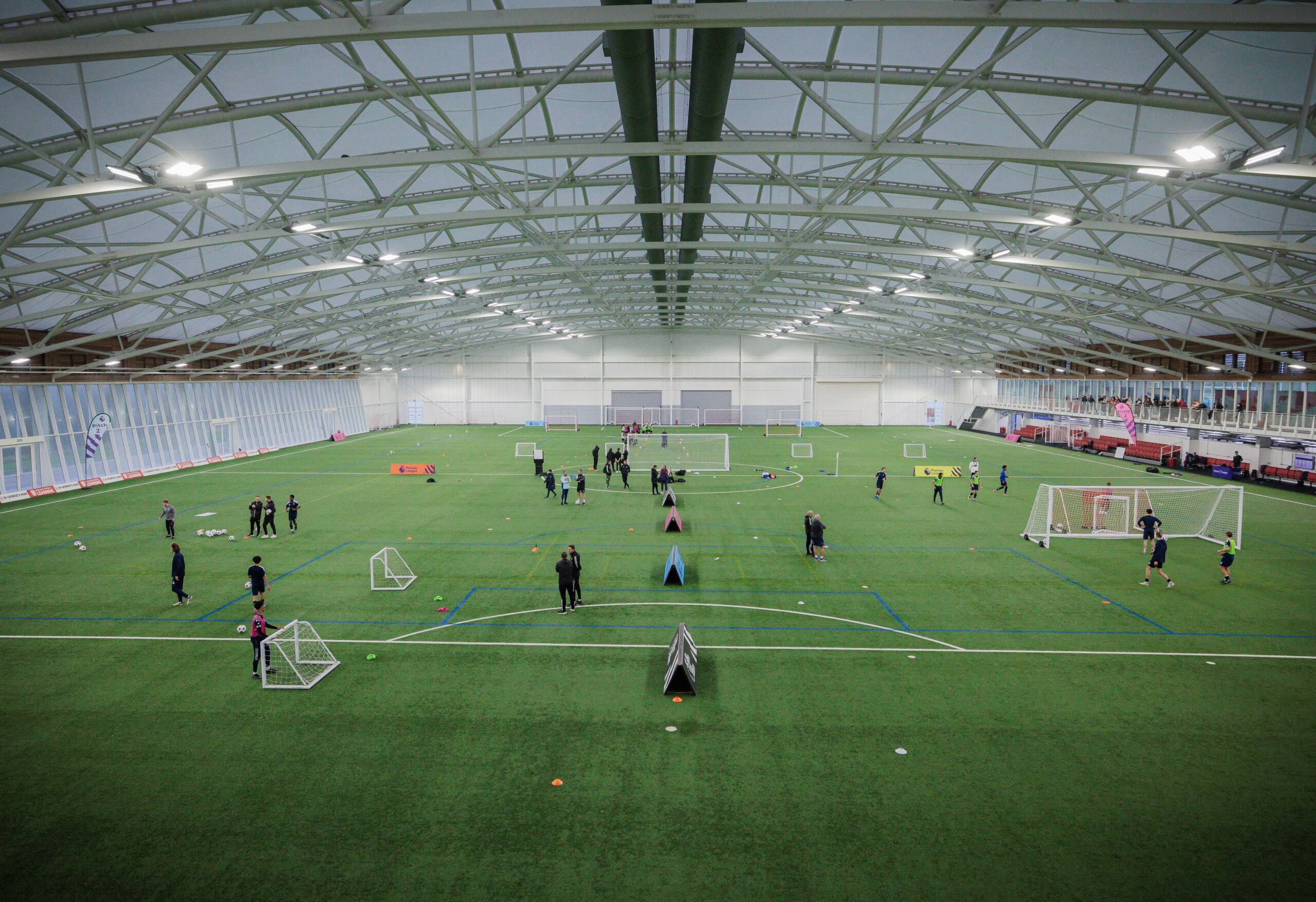
Photo: Phil Greig, courtesy of the Premier League
At the outset, we identified six coaches per phase across the Premier League, each working at a different development phase in their club’s academy. These coaches were selected from amongst their peers – the only effective means by which we can say one coach is better than another – and invited to undertake an extensive research journey.
Through this process we seek to better identify and understand the coaching demands at different levels. If we can understand those demands then we can be better at identifying expert coaches and helping coaches to reach an expert level.
The coaches involved in the project love it too. They’re constantly trying to find opportunities to learn and develop and it has supported their efforts to step into deep, reflective practice.
And so in shifting that focus from mere competence to true expertise, the Coaching Expertise Project has challenged long-held assumptions and is establishing new industry standards.
The issue with traditional coach development plans
Too often in coach development practice there has been a tendency to focus on coaching behaviour. That’s antithetical to what expertise is because, by definition, expertise is about flexibility, decision-making, and changes to practice that are, frankly, not very observable.
The risk in focusing on behaviour and attempting to change coach behaviour is that we end up reproducing what’s already there.
If there is too much focus on behaviours there is also too much focus on the coach and not their environment. This creates coach development plans divorced from demands. It is important to ask: is a coach development plan based on the demands of practice or on a series of generic capacities that cannot be tracked?
Our project is focused on the interaction between the coach and their context because we cannot identify expertise unless we understand the interaction between a coach and the demands of their role. We’ve identified a series of coaching demands – six or seven per phase – then mapped out the cues and strategies that expert coaches use to navigate those demands. It’s not a list of qualities that says ‘every good coach does this’. The demands are consistent but the coaches are different, and they navigate those demands in reasonably unique ways.
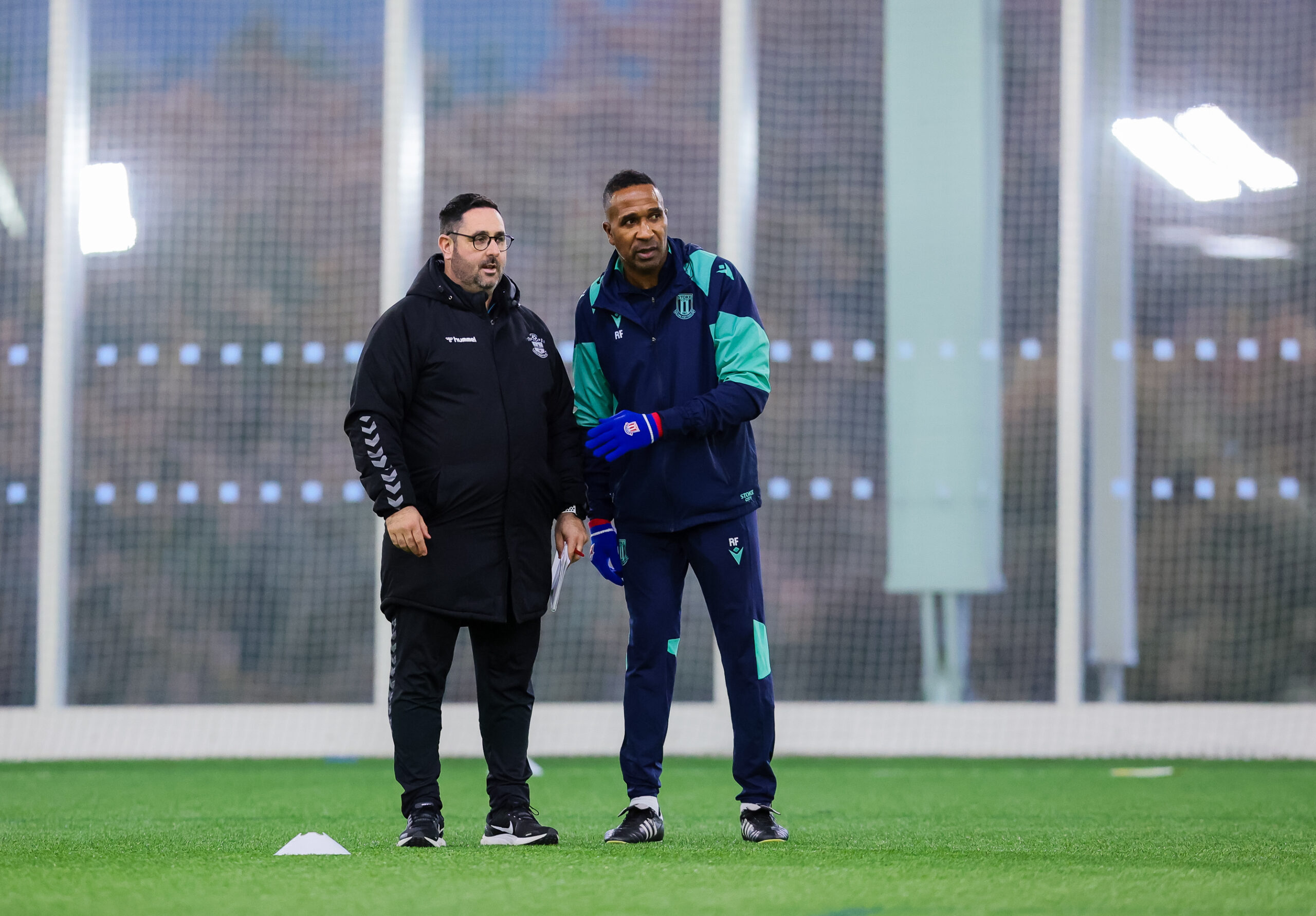
Photo: Phil Greig, courtesy of the Premier League
What ‘expert’ looks like
The Coaching Expertise Project has used this fresh understanding of the demands and coaching context to build a profiling tool that we want to embed in coach development at the Premier League.
It will inform a needs analysis for each coach because we can better understand good practice and the development status of the coach in question.
Capacities are still important. Entry level coaches will still need to show that they’re good enough to enter a role, but the Premier League’s ambitions extend beyond that starting point.
We’re going to be able to provide recommendations for coaches on the different demands of their roles and how they might work to develop themselves against these demands. Ultimately, we hope it’s going to become embedded into coach development practices across Premier League academies and in the daily life of an academy coach.
People have also asked me if we’ve simplified anything for coaches. The answer is no. You’d never say ‘how do you simplify this for a sports scientist or psychologist?’ because we have higher expectations of those professions. Coaches are some of the most expert practitioners in any field so it’s less important that it’s simplified and more that it’s valid and useful for coaches, that it can be integrated into their workflows.

Photo: Phil Greig, courtesy of the Premier League
Evolution not revolution
This remains a fruitful area for research. There are fewer than ten studies that have used expertise as a lens to understand coaching practice – and two of those studies have been mine.
The Premier League remains committed to the ongoing development of coaches across both academy and first team settings. The central intention of the project is to contribute to the wider football system by enhancing the skill and expertise of coaches and coach developers alike. By doing so, we aim to strengthen the overall quality of coaching and create development environments where the very best practitioners can continue to grow and positively impact the game.
We hope that this will eventually have an impact in the wider sporting world, but we are promoting an evolution rather than revolution, and if we can recognise the very best coaches and we’re better able to develop coaches towards expertise, it’ll see those coaches rewarded for good practice and then ultimately every player, when they walk into a club, is on the receiving end of high quality coaching practice.
Dr Jamie Taylor
Jamie is an Assistant Professor in the School of Health and Human Performance at Dublin City University, with a focus on coaching, coach development and coaching research. As a researcher, he supports practitioners on DCU’s MSc and professional doctorate programmes and collaborates with high-performance sports organisations including the Premier League, GAA, IRFU, and Premiership Rugby. As a coach developer, he has worked across a range of high-performance environments. Alongside his academic and development work, Jamie coaches rugby union at Leicester Tigers.
If you would like to speak to Jamie Taylor, Scott McNeill or Danny Newcombe about their work, please contact a member of the Leaders Performance Institute team.
Patrick Mannix, the federation’s Sports Science Senior Manager, shared his insights with Leaders Performance Institute members at a recent virtual roundtable.
Eisenhower liked the sentiment enough to repeat variations during his time in the White House and the appeal to people working in elite sport is obvious.
In fact, Patrick Mannix, the Sports Science Senior Manager at US Soccer, began his recent presentation to Leaders Performance Institute members with that very line.
“The idea behind this quote is that high-performance teams don’t necessarily have a static plan,” said Mannix.
“The plan is constantly evolving as new information comes to light, whether that’s in relation to the tournament that we’re playing in, the players that we’re working with, and a variety of other contexts that are relevant to the world of international soccer.”
With those words, Mannix set the scene for a discussion that centered on performance planning in the international game, specifically the development of camp training plans for players who join up from their respective clubs in the US and beyond.
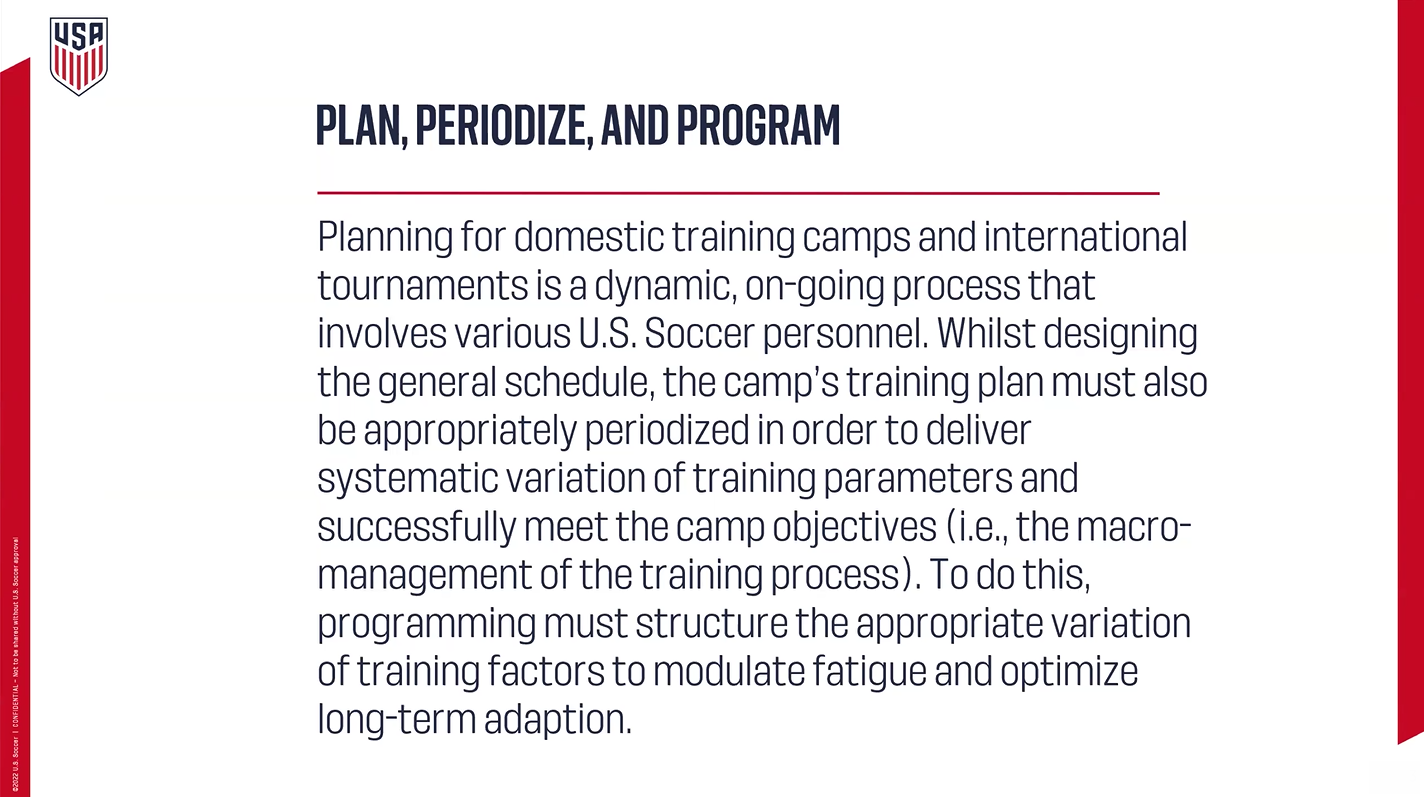
First, he offered a summary:
Mannix then shared how he and his colleagues approach international training camps from a sports science and medicine perspective with the help of this cycle:
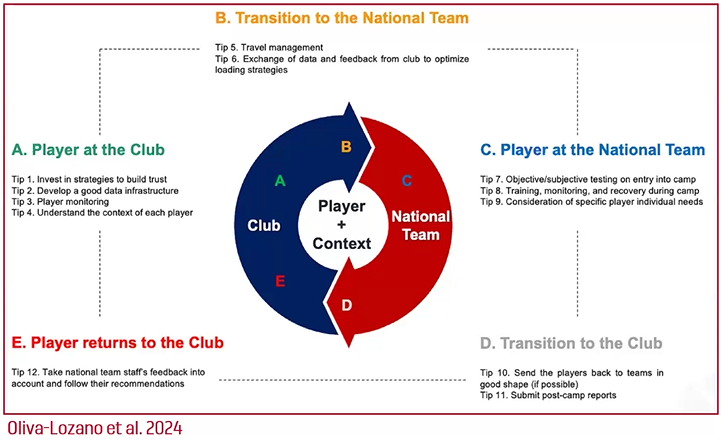
“Building rapport and trust with those clubs is massively important,” said Mannix, “because that helps us drive a lot of the exchange of information.”
He then outlined the common challenges he and his team face in the realms of communication, health & safety and load management:
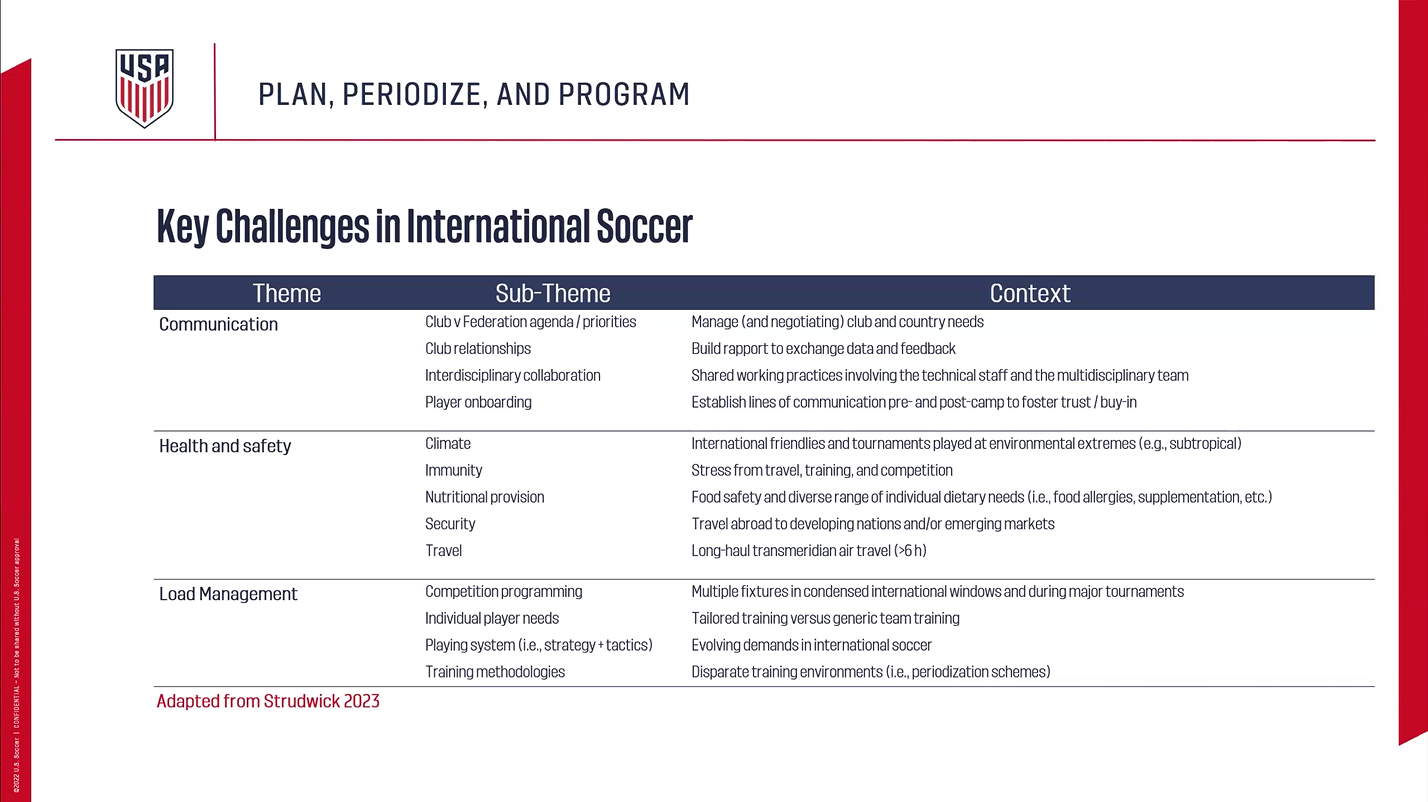
In explaining how they meet those challenges, Mannix focused on three areas in particular:
1. Club and country alignment
The US national teams draw on players from across the globe and, even for matches in the US itself, such is the size of the country that most personnel will have made a long-haul journey.
This map, which depicts the travel schedule of the US men’s team during the 2025 Concacaf Gold Cup, provides some idea of the challenges present even in a domestic setting:

“We need to know when our equipment and staff are arriving and where our players are coming from,” said Mannix in reflection on this map. It calls for close collaboration between the technical/coaching staff, the high performance team and the operations team.
“When a coach is trying to build out the session plan, the right hand is a good sports scientist or a performance coach, and the left hand is the first assistant, and those three individuals are working very closely to ensure that there’s a good plan in place for every training session,” Mannix continued.
“There’s good understanding as to what the availability of the players is going to be, particularly in the first two days of training, because what we’ve found through communication with clubs is we sometimes have to be flexible when players are coming into our environment simply because although Europe observes FIFA windows, we have to work with our partners in MLS on when players are released to come and join our environment.”
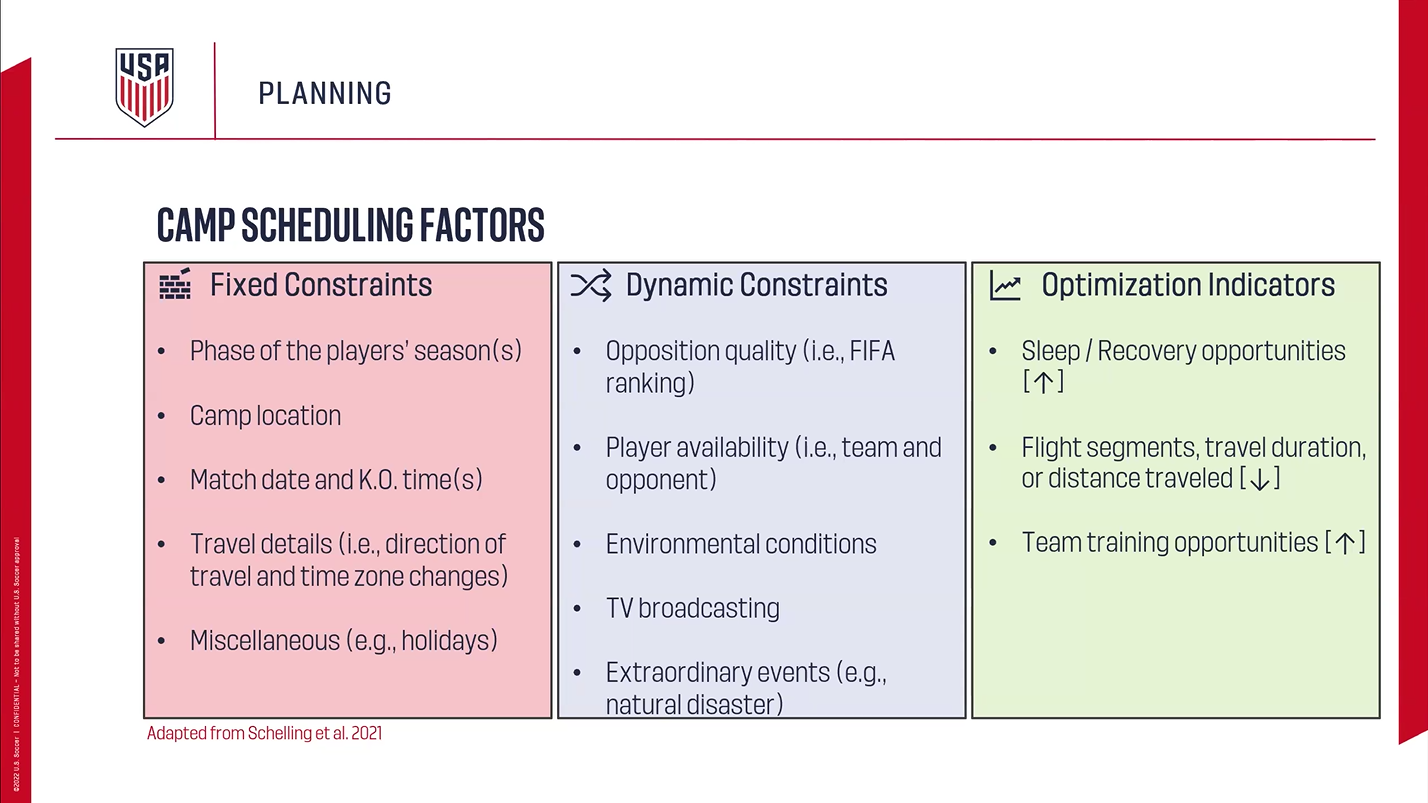
Mannix and his colleagues understand the range of fixed and dynamic constraints they face. They use that understanding to find optimization indicators.
2. Time of year
The leagues of North America operate on a different seasonal calendar to their European counterparts, which requires tailored approaches to preparation and recovery for each player.
Staggered arrivals in camp is a prime example. Players may be excluded from certain match days depending on their status.
Additionally, the federation will try to use domestic camps “to address the identity of the team” and “hybrid camps where we look to go abroad, ideally to play opponents from Africa, Asia, and Europe so we get a variety of different opponents of the kind that we could potentially face in a World Cup.”
Travel logistics are a focus too. “We try to increase our sleep and recovery opportunities, decrease the number of flights to hopefully avoid a situation where the players have to get up at the crack of dawn to hop on a plane,” said Mannix.
Then there are cultural considerations. “The November window for the women’s national team will overlap with the Thanksgiving holiday,” he said, adding, “we’re working with chefs to ensure that we can put together a really creative Thanksgiving meal so the team feel like they have that communal or family experience.”
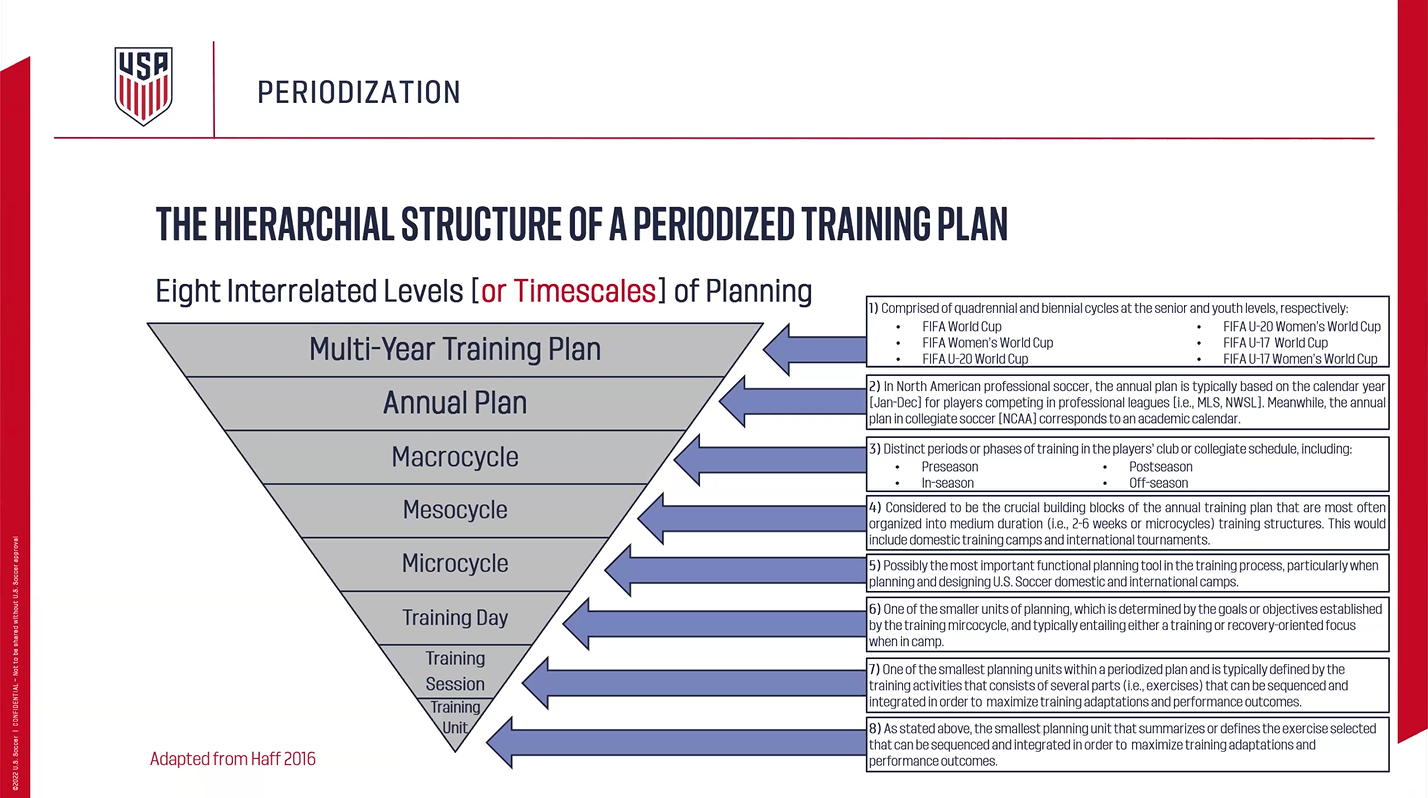
Ultimately, when it comes to periodizing camps, US teams have eight time scales to consider:
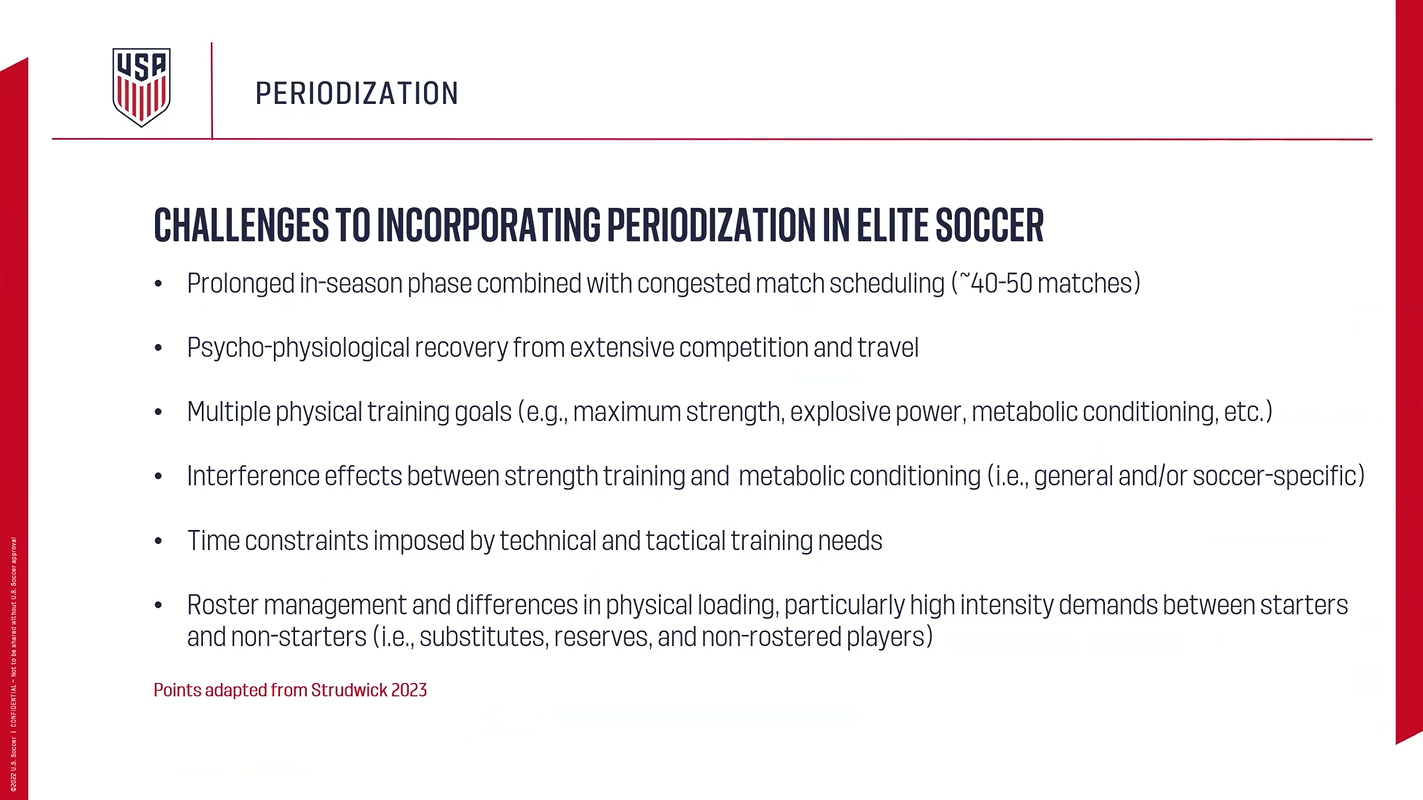
These come with several potential challenges:
Mannix shared the example of a convalescing player joining the men’s national team for the 2024 Olympic football tournament. “In close collaboration with the club, we mapped out the tissue healing process, what the rehab was going to look like and then also what his reintegration into his team training back in his club environment would be,” he said.
“Then we had to negotiate if he were to join us in the Olympics what his match exposure would look like once he joined us, because his first time competing in official competition following the injury would be under our care. So it was super important for US Soccer that this individual was included in the roster because of his long-term trajectory within the national team.”
The coaches and support staff at US Soccer develop training plans three weeks prior to a camp, with session plans devised two weeks out once player arrival times are confirmed.
“We will design things from a team level, but then we also have to look at matters very closely at an individual level when we’re trying to safely integrate players into our national team environments.”
Mannix also spoke of periodization (the macro-level planning of when and why) and programming (the micro-level execution of what and how). He explained the distinction using the following table:
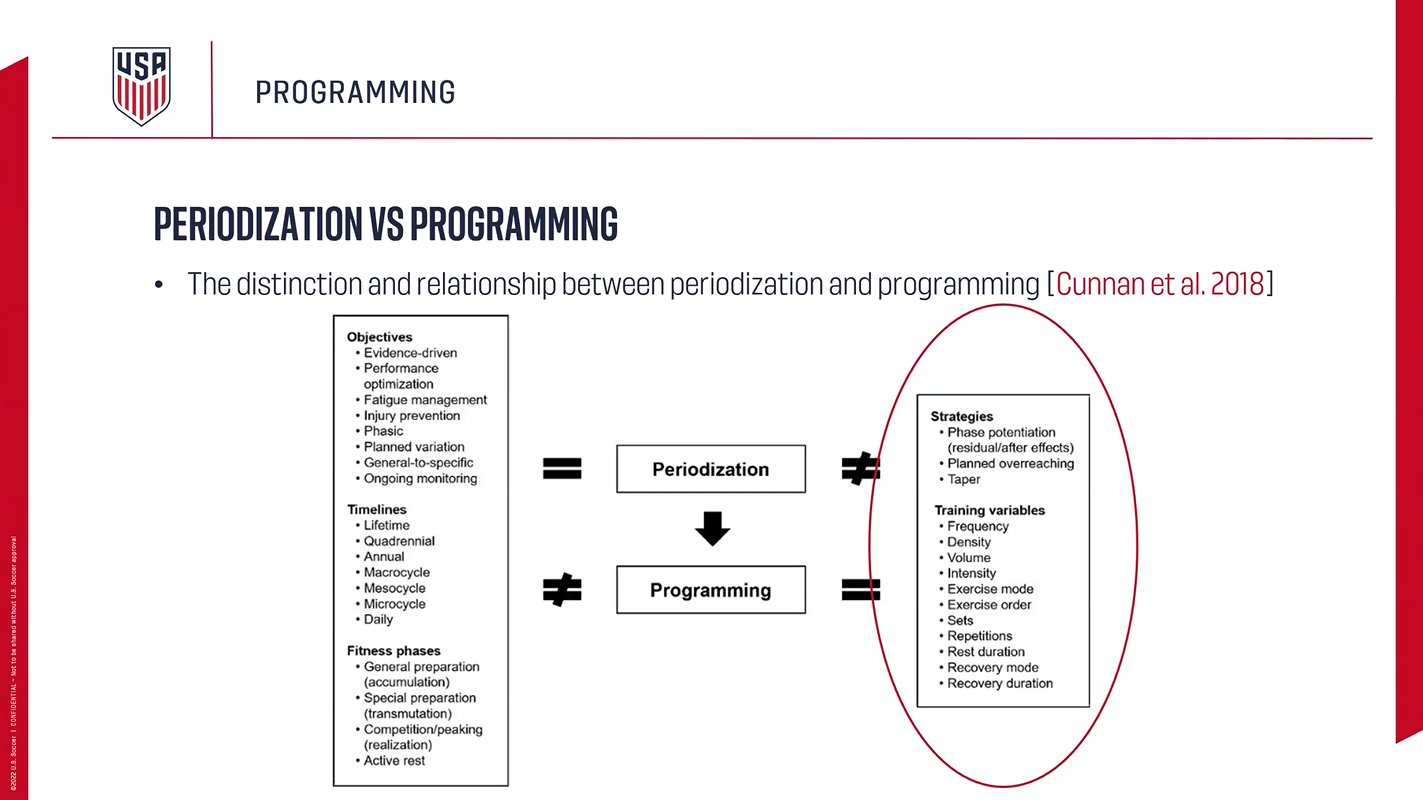
“Most of the time, we are dealing with tapering strategies and figuring out how can we optimize players’ readiness going into competition,” he said. “So it’s often an exercise in fatigue management when they’re coming into our environment and not necessarily trying to drive fitness adaptations, but, on the flip side, we’re also there to potentially facilitate a lot of those long-term physiological adaptations that are occurring.
“When it comes to planning, some of these training variables are super important. Things like training frequency, density, volume, and intensity, ensuring that those are squared away and, with our coaching staff, exercise order. So when it comes to building out session plans, making sure that the sessions are sequenced in the correct fashion.
“Again, I think that’s a lot of close communication and collaboration with primarily our head coach and our first assistant.”
What to read next
Transparency, Empathy and Empowerment: Five Ways Teams Are Serving their People in 2025
An enhanced version of semi-automated offside technology will make its debut at the tournament, which is set to take place in the US, Canada and Mexico.

That’s the joint venture created last November by FIFA and Hawk-Eye Innovations with an initial charge of assisting referees and automating data collection.
FIFA and Sony-owned Hawk-Eye first debuted Semi-Automated Offsides Technology at the Qatar World Cup in 2022, and now it has created an enhanced version of it. Only calls in which a player is within 10 centimeters of the offsides line require manual oversight from an official. Also at this tournament, the tabulation of event data — everything from shots, passes, corner kicks and the like — has been automated with computer vision algorithms, supplanting what historically had always been a very manual process.
Early feedback has been positive, putting those innovations on track for an appearance at next year’s tournament. The quadrennial World Cup typically serves as a debut for new tech. Goal-line technology first appeared in 2014, VAR in 2018 and SAOT in 2022.
“We recognize that, in order to do stuff which is pretty game-changing, you have to do it on a two-, three-, four-year cycle,” Rufus Hack, the CEO of Sony’s sports businesses, told SBJ. “It doesn’t take a year to develop the technology, to implement it, to refine it, to test it, to introduce it. And so we came on this concept of, let’s do an eight-year joint venture where, effectively, they put in some of their IP, some of their technology, their football expertise. We put in people, our technology expertise, our learnings from other sport.”
The vision of the FTC
The Football Technology Center is based in Zurich, like FIFA, and relies on dedicated personnel from both FIFA and Hawk-Eye. In lieu of a CEO, it is steered by a board of directors, consisting of Hawk-Eye’s Hack and Managing Director Ben Crossing and FIFA’s Dir of Innovation Johannes Holzmüller and Technical Director Steve Martens. There is also a separate joint operational management committee with equal representation from both entities.
“We see this as potentially the Football Technology Center creating new football technologies, assets and IP, which then can potentially be commercialized-slash-distributed to the rest of the sport,” Hack said. “Ultimately, FIFA are very much about looking to democratize sports technology down to the member associations,” referring to the 211 countries and territories across six continents that are represented by FIFA.
“For us, this is less about a significant revenue opportunity of being able to create new products,” he added. “It’s more about being able to be thought leaders and sitting side by side with FIFA, who are effectively the guardians of football technology in the game, to be able to do these new innovations, and then potentially working together to distribute some of that for the rest of the football community.”
Hawk-Eye’s cameras and algorithms capture data from 29 points on the human body, so a player’s limbs, hands and feet are fully tracked. That generates millions of datapoints per game, but FIFA sought practical use of it.
“We have high-quality data available, but at the end of the day, we also want to have valuable information — an outcome, not only for officiating, but also for other areas,” Holzmüller said. “We needed to have some vehicle where we can develop and explore how this data can be used in the future.”
The lead time for many of these projects is long, but there other avenues that can be explored. For instance, Hack said it might be possible in the future to use technology to determine whether that ball has gone out of bounds or whether it struck a player’s hand or other part of the body.
“We believe in these big, long-term strategic partnerships,” Hack said. “We believe it provides a much better opportunity for the rightsholder and partner to co-invest alongside each other and genuinely feels like a partnership, rather than that buyer/supplier relationship.”
This article was brought to you by SBJ Tech, a Leaders Group company. As a Leaders Performance Institute member, you are able to enjoy exclusive access to SBJ Tech content in the field of athletic performance.
In June, performance under pressure, empowered leadership and female athlete health were some of the topics discussed by members of the institute.
“I think the real champions are made in situations when you deal with that pressure,” said Alcaraz at Rolland-Garros in Paris last month. “That’s why I saw my best tennis in crucial moments, and that’s why I saw my best tennis in those difficult situations.”
Performance under pressure was a theme that run through the month of June here at the Leaders Performance Institute, starting with the wise words of Red Bull’s big wave surfer Ian Walsh.
His approach is geared around managing his fear. “Those nerves and everything you fear are natural, and you can use that to elevate your performance,” he said in this article. “It commands every ounce of your being and your focus to deal with what’s coming at you and how you want to navigate it to try and finish on your feet.”
Elsewhere, we returned to the question of alignment, named the common causes of inadaptability, and asked the Brisbane Lions to talk about their approaches to female athlete health.
What if there’s clarity in your communication as a team, but still you suffer from misalignment?
Edd Vahid, the Premier League’s Head of Academy Football Operations, answered this in a recent interview with the Leaders Performance Institute.
He explained there could be a few factors at play, all of which point to the importance of feedback:
Staff development needs. If a staff member commits an error of execution, it is an opportunity to deliver developmental feedback. Vahid says: “Does everyone understand what we’re going after? If they do and they step outside of that, then feedback is warranted.”
Psychological safety. “It’s a buzz term,” says Vahid of the commonly used phrase, “but it’s crucial for people to feel they are in a feedback culture.” The leader must show that the intent of feedback is to help the individual to progress. “You’re taking time to give them feedback because you care,” he adds. “You’re then seeking to work with the individual to create that development.”
The leader’s behaviour. Leaders must also demonstrate their willingness to listen to feedback. “They need to provide ‘speak up’ signals,” says Vahid with reference to the work of psychologist Megan Reitz. “The leader needs the skill to understand the position they’re in and the power they carry in that dynamic.”
The four inhibitors that prevent adaptability in a complex world
Those four inhibitors are discussed in great detail here, but one that will discuss below is when leaders themselves become the bottleneck due to their authoritative approach.
“Authoritative leadership has been proven time and time again to be effective in very short bursts,” said Tim Cox of Management Futures at a recent Leaders Virtual Roundtable, “but it isn’t much good for adaptability.” The reasons are simple enough. “It’s really difficult for one person to be able to think through, be creative, respond to the environment around them when things are changing at a high pace.”
Leaders, Cox said, should:
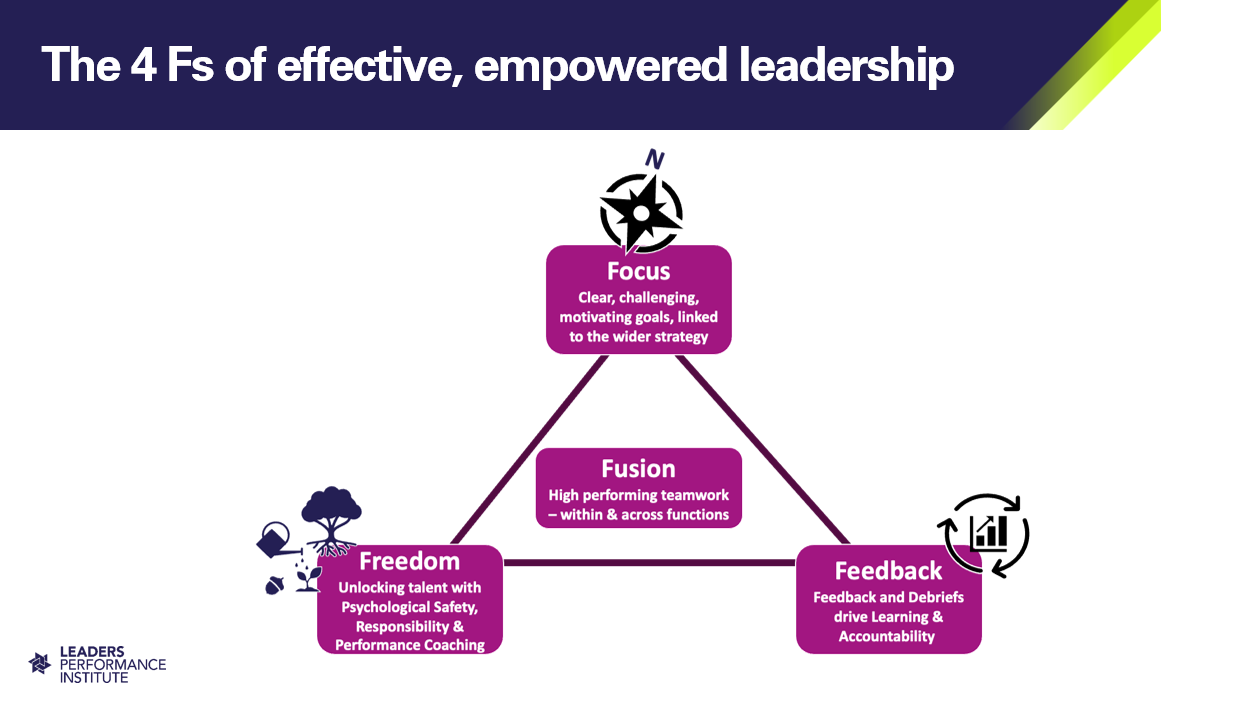 Focus: The leader must deliver clear, strategic alignment where everyone understands the direction and purpose of their work.
Feedback: Regular feedback and debriefing are essential for learning and continuous improvement, especially in dynamic settings.
Freedom: Give people autonomy and allow them to explore, innovate, and respond to change.
Fusion: This is about building strong relationships and collaboration, both within and beyond your organisation with a view to harnessing collective intelligence
Leadership is stagnating
This idea of leadership stagnating was revealed in stark terms in our Trend Report earlier this year.
The Trend Report revealed that 57 per cent of practitioners believe that leadership within their organisation has stayed the same or got worse in recent years.
The primary factors appear to be the shift towards task orientation and the pressure to ‘win now’, which can act to stifle innovation and long-term thinking. Leaders, as a selection of Leaders Performance Institute members agreed during a June roundtable, have less bandwidth, less time for staff development and even less time for staff onboarding.
Ben Baroody of Abilene Christian University, who co-led the session with Edd Vahid, observed that even at organisations that prioritise leadership development, stagnation is still reported. For Baroody, this is compounded by what he sees as the link between alignment and (high) quality leadership.
Vahid questioned whether leaders are giving themselves enough capacity to lead effectively and, as such, he is an advocate of distributed leadership models and leaders who invest in their own development as well as that of their people.
The virtual floor also highlighted the importance of skills including influencing, an ability to hold honest conversations, and active listening.
The Brisbane Lions have turned female athlete health into a performance question
The renewed focus on female athlete health is a direct result of the work of Matt Green, the Lions’ High Performance Manager for AFLW and his team.
As an organisation, the Lions focus on five key, interrelated areas:
When it comes to topics such as developing a performance culture, engendering trust and adroitly using tech, the former defender’s instincts as an athlete stand her in good stead.
A podcast brought to you by our Main Partners

“You feel it,” says the Director of Bayern’s women’s programme. “You already know when you look at their faces. You’re like ‘I think she doesn’t like it’, ‘yeah, she likes it’ and ‘she needs a bit of proof’. It’s like sometimes I see myself sitting on the other side.”
The ‘other side’, as Bianca tells Teamworks’ Andrew Trimble and Leaders’ John Portch, refers to her transition from a Germany international and Frauen-Bundesliga regular to a senior leader of the German champions, whom she represented on the pitch for four years.
“It’s so much harder now when you sit on that side now,” she adds, reflecting on how she used to feel as a player. “I see myself sitting on the other side, like, ‘oh, maybe I have to talk to them again’.”
In this third and final episode of our special series with Teamworks, Bianca touched upon several of the major themes that emerged from our recent Special Report High Performance Unpacked: interconnected performance teams.
She spoke of her role in helping to transform the Bayern culture on and off the pitch [37:00]; keeping the athlete at the centre of the performance jigsaw [14:30]; the importance of sports psychology [31:00]; and the thoughtful integration of technology [21:00].
Listen above and subscribe today on iTunes, Spotify, Stitcher and Overcast, or your chosen podcast platform.
Episode One: Simon Rice, the Philadelphia 76ers
Episode Two: Miranda Menaspà, the Australian Institute of Sport
iBrainTech has worked with some of the biggest names in soccer, including Juventus, and now they are seeking to deliver their neurocognitive training tool to the ranks of academy soccer.
Main photo: iBrainTech
Users wear an EEG headset, which monitors brain activity and translates intention into action on the screen. The goal is to help soccer players sharpen their decision making and execution. It has been adopted by clubs in Serie A (Juventus), MLS (Orlando City SC and formerly Atlanta United), LaLiga (Real Sociedad) and the Portuguese Primeira Liga (SL Benfica). Longtime MLS star Jonathan Bornstein was an avid user.
Now, i-BrainTech is seeking to broaden its reach to academy and youth players. It’s a well-trodden path for performance tech to prove themselves with the elite before reaching the larger consumer market. But i-BrainTech has both the advantage of its inherent gamification and the challenge of making complex tech more frictionless.
“All transformative technologies should be ready and willing to become accessible, to validate the impact on the top level of performance and then to allow access of youth,” i-BrainTech Co-Founder/CEO Konstantin Sonkin said. “You need to be ready to cater your value to the young generation, and we are so lucky to be an engaging game at the end of the day.”
Sonkin has been working on this technology for 15 years to balance high signal quality with ease of use. He described a remodeled product as “a top-level, consumer-ready headset.” The goal is not only to improve the performance of younger players but also to encourage more athletic participation and unlock new revenue streams for clubs, such as with a co-branded cap or content.
“We want to drive them from Instagram back to the pitch,” Sonkin said. “Because when you exercise your mind, you’re so eager to execute in the [physical world] because your brain got so excited. It’s called neuro-priming. It has excessive, let’s say, electricity. It wants to utilize that in real-world actions, and that is the connection between their content created by clubs and then a long lifetime value.”
Michita Toda previously used i-BrainTech with rehabbing players as a physical therapist at Orlando City, where he saw value in keeping injured players mentally sharp while physically recovering. He recently joined the North Carolina Courage as its Head Athletic Trainer and is hoping to bring the product there, both for the NWSL club but also for the associated men’s USL team, North Carolina FC, as well as for the large youth academy system in the area.
“Being on the medical side of things, we talk a lot about youth sports specialization and how the more they play at a younger age, that might make them more susceptible to injury,” Toda said. “Well, using technology like this to supplement what they’re already doing, but not overdoing it physically, they still get the mental reps and get the quote-unquote ‘practice’ without having to tax their body.”
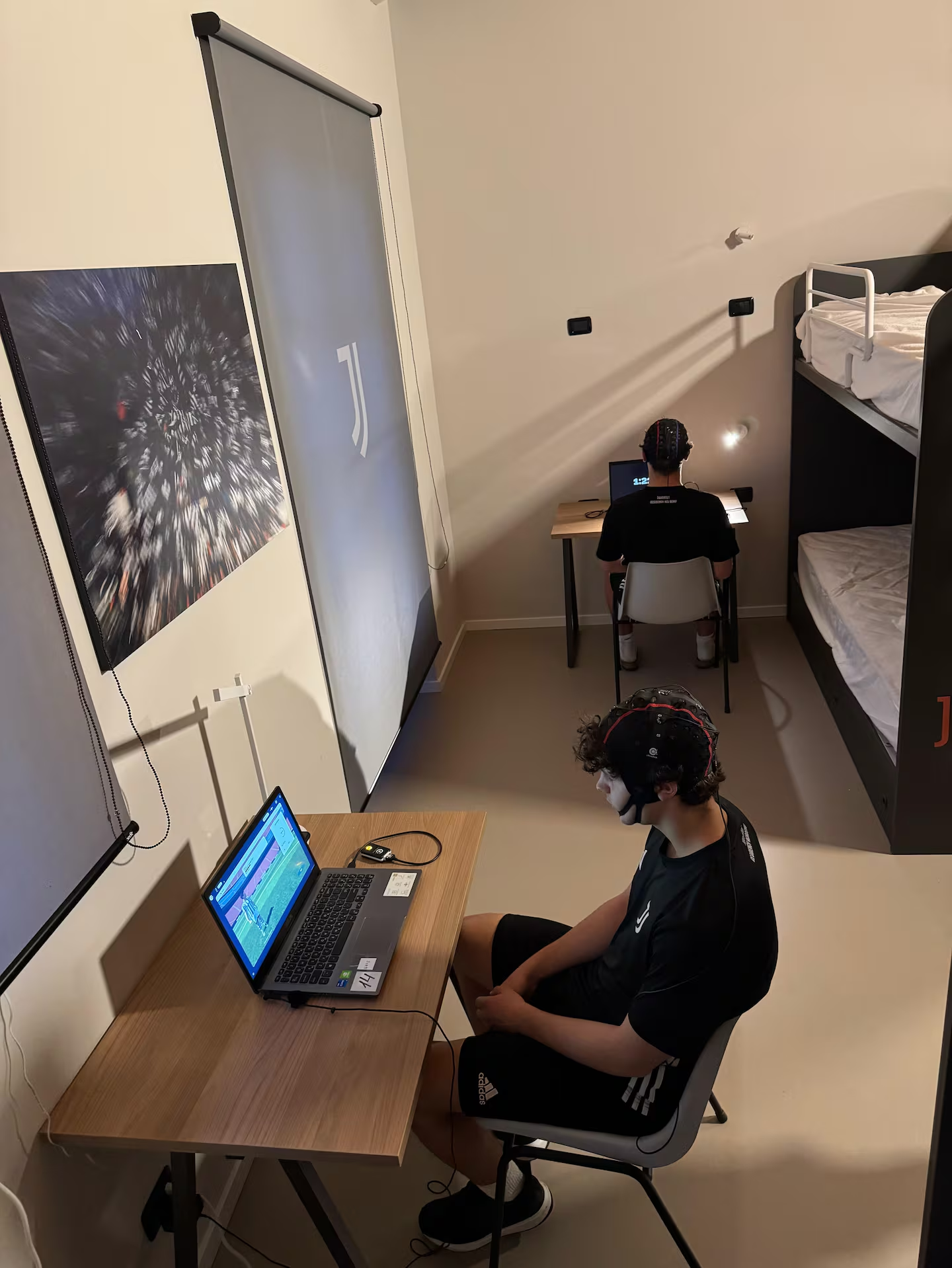
Members of the Juventus Residency Academy train with i-BrainTech. (Photo: iBrainTech)
Limited studies have shown promising results with the transfer of skill from the i-BrainTech product to the pitch. Real Sociedad B — the LaLiga club’s reserve team, which competes in the Spanish third division — completed a 15-player case study that spanned three months and 12,500 visualized actions. Those using i-BrainTech improved 12.4% in the accuracy of long kicks compared to 2.6% in the control group. Five of the eight players using i-BrainTech’s neurofeedback training also reported better concentration in matches.
“When we actually repeat all the actions on the pitch, most of the time we train our mind-body connection,” Sonkin said. “We train our muscle memory. Muscle obviously doesn’t have any memory. Memory lives in the brain.”
This article was brought to you by SBJ Tech, a Leaders Group company. As a Leaders Performance Institute member, you are able to enjoy exclusive access to SBJ Tech content in the field of athletic performance.
The MyTOCA app is also helping TOCA Soccer to stay more engaged with their soccer trainees away from the practice facility.
Main photo: TOCA Football Inc
“We’ve been collecting more and more data, but there really became this gap, if you will, from a customer’s perspective,” TOCA Founder Eddie Lewis said. “We had a lot of really powerful training data, but we made it really difficult to consume and collect.”
Lewis said a clear goal emerged to make an app that was engaging, but also one that easily displayed the value of TOCA training session. He told SBJ that the entire process to build the MyTOCA app started with a complete teardown of its existing platform, which struggled to collect data. The re-engineered setup creates more personalization for players but also helps TOCA stay more engaged with their soccer trainees outside of the facility walls.
View this post on Instagram
“The ability to take a player, use the data to not only understand where they are — but also understand insights that would be very difficult to see necessarily from the naked eye unless you spent a ton of time with these players, and then attack those strengths and weaknesses from a training perspective — we think is really valuable,” Lewis said. “And not only that, we want to share that progression along the way. At the end of the day, we believe the higher the training, the higher the customer satisfaction and obviously, the longer retention.”
The app has a trophy room for players to look at their accomplishments, as well as a community leaderboard and internal booking feature. Lewis also mentioned that this is the first phase of MyTOCA, setting the stage for more rollouts like a planned TOCA Score metric.
The deployment coincided with the start of the second annual TOCA Skills Showcase, an event rolled out in partnership with the MLS that spans two months in a competition across 22 TOCA Soccer centers. TOCA Football entered a 10-year partnership with the league at the end of 2022. Lewis added that the pairing has created both “validation and certainly credibility in terms of what we’re doing from a training perspective.”
Regarding the opening of the first TOCA Social site in Dallas, Lewis said there’s no specific date to share yet. But the goal to open ahead of the 2026 World Cup remains in an effort to capitalize on the nationwide interest that will build as kickoffs get closer.
“Everyone’s going to be interested in a in a soccer-related story, or understanding what’s going on with soccer in the US,” Lewis said. “And I think if we’re not ready to step into that spotlight during that window, we miss a once-in-a-generational opportunity.”
This article was brought to you by SBJ Tech, a Leaders Group company. As a Leaders Performance Institute member, you are able to enjoy exclusive access to SBJ Tech content in the field of athletic performance.