Watford, West Brom and Sheffield Wednesday all decamped to St George’s Park in July. We explore five factors that informed their choice.
Main photo: Watford FC/Alan Cozzi

The three Championship clubs held pre-season training camps at St George’s Park in July when a number of their counterparts were visiting foreign climes.
“You can guarantee that the weather isn’t going to impact training loads,” says Watford Head Coach Tom Cleverley, who took his side to SGP between 22 and 27 July. “Sometimes you can go to Spain, Portugal and it’s too hot to get the intensities that you want.”
It was the week of pre-season where Watford started their out-of-possession work and intensity was a must. “You can’t be intense the whole pre-season because you’ll burn them out,” Cleverley tells the Leaders Performance Institute, “but for one week of pre-season, we identified that week where we could work twice a day on the pitch; we could have a meeting every day in the morning about what we’re going after; and then a meeting in the evening about a target that we’ll set for the season.”
Tony Strudwick is of a similar mindset, as he tells the Leaders Performance Institute of SGP. “We’re guaranteed a consistent weather pattern,” says West Brom’s Director of Medical. “We want to try to create that level of consistency in pre-season.”
The 330-acre Staffordshire facility, which includes a Hilton Hotel, boasts 14 state-of-the-art football pitches, which can be configured for a variety of sports, as well as a range of indoor facilities including a full 3G pitch, a multifunctional sports hall, gym, hydrotherapy pools and a cryotherapy chamber. It suited West Brom to a tee. “The one-site solution is perfect for us,” Strudwick adds.
West Brom spent 13 to 20 July at SGP – hot on the tails of Sheffield Wednesday, whose camp took place between 8 and 13 July.
“You literally come off the training pitch, you’re into recovery, lunch, you can maybe get your feet up for an hour or two and be ready for the next session and then it’s the same in the morning,” Neil Thompson, the Assistant Manager at Sheffield Wednesday, tells the Leaders Performance Institute.
Here, we explore three clubs with five similar reasons for choosing SGP for part of their pre-season work.
Monotony was a big issue for Championship clubs in an off-season that for those not involved in the play-offs ran from the last day of the 2023-24 season (4 May) to the opening day of the 2024-25 season (10 August).
The gap led to an extended pre-season. “A seven-week pre-season is longer than usual,” says Cleverley, who explains that the club’s own training ground “can become monotonous if you’re doing double sessions every day for seven weeks”. SGP, on the other hand, is “second to none” in his view.
“It can freshen things up a bit and create an impact,” says Strudwick, adding that it allowed West Brom’s own training pitches a further week to recover. “It doesn’t sound like a long time, six or seven weeks, but given that you’re going to be at the training ground for the next 38 weeks, it does make sense to create something unique and special.”

Tom Cleverley, the Head Coach of Watford, explains tactics to his players. (Photo: Watford FC/Alan Cozzi)
SGP enabled all three teams the opportunity to promote team bonding, which is particularly critical early in pre-season when new players and staff are settling in.
“You’re there and living in each other’s pockets for a week,” says Thompson. “You might speak to an individual who you’ve never spoken to in depth.”
There are nurmeous “breakout areas” around the Hilton too, as Strudwick explains. “There are plenty of opportunities for players and coaches to interact and engage.”
“The team spirit aspect, I really enjoy,” says Cleverley. “So keeping guys together between sessions, they’re not on their digital devices, they’re together in the evenings, they’re eating together, they’re not going straight back to their rooms – they want to be around each other for that week – which really builds something to move forward for the whole season.”

Neil Thompson, the Assistant Manager of Sheffield Wednesday. (Photo: Jacques Feeney/Getty Images)
There is real value in English teams booking camps in southern and central Europe – Sheffield Wednesday also arranged camps in Germany and Austria – but there is something to be said for having everything on hand at one site at a familiar venue. It is instructive that each of Watford, West Brom and Wednesday previously held pre-season camps at SGP.
“I’m keen to go back there,” says Cleverley, who is already onto the Watford team secretary about the idea. “I’ve had a lot of experience of St George’s Park as an international player, as a club player. I’ve played there, done a camp there with Watford, and now, as a coach.”
“We’re looking at doing the same next year,” says Strudwick of West Brom. “We wanted to reduce travel time and maximise the training opportunities. We didn’t have to get on early flights, go through airports, we don’t lose training days, we don’t lose match prep days.
“We’ve had two years of St George’s Park and both experiences have been fantastic.”
The same works in reverse, with overseas teams such as SL Benfica and AS Monaco enjoying similar benefits in the Staffordshire countryside.
Not only is there favourable training weather and pitches at SGP (“the ground staff were putting the sprinklers on at the right times,” says Cleverley), but teams have the full ability to tweak schedules as necessary or make adjustments.
Cleverley, for example, split his Watford squad in two midway through their camp in order to play Scottish Premiership side Hibernian in Edinburgh. The fixture was arranged as part of Ryan Porteous’ move from Hibs to Hertfordshire in 2023. “It was a unique week,” says Cleverley, who was still satisfied with the camp’s outcome.
A team’s plans are subject to “constant iteration” in pre-season, as Strudwick explains. He says: “We’ll have certain priorities that we want to hit, we’ll have certain individual players that need managing, and players coming back into the training process. But I’ve been in football long enough now to understand that the plan you have in early May often changes come mid-July.”
He also discusses the challenge of working in an environment where players employ external practitioners, particularly as there is no firm guidance for clubs. In any case, “it means you can’t switch off. You’ve got to be in constant contact with the players and tracking them outside of the season now.”

Darnell Furlong of West Bromwich Albion is all smiles in the gym during his club’s pre-season training camp day two at St George’s Park on July 16, 2024. (Photo: Adam Fradgley/West Bromwich Albion FC via Getty Images)
As pre-season focuses continue to evolve from conditioning to game-based, there is an increasing need to test ideas out on the grass in realistic conditions. With this in mind, the facilities at SGP can be primed for behind-closed-doors matches, which West Brom used to their advantage this summer.
The Baggies’ first two pre-season friendlies, against Bolton Wanderers and Peterborough United, were held onsite. The team played a further two fixtures behind-closed-doors (versus Blackpool and RCD Mallorca) at their West Bromwich Albion Training Ground.
The matches at SGP ticked many performance boxes for Strudwick and his colleagues. “You don’t want to go into your first game and expose the players to a 70,000 crowd,” he says. “You still have your referees but it allows you to be more flexible in playing minutes.” This is not just in terms of minutes per player, but reducing half lengths to 30 minutes, or even extending them to 60. “It gives you a lot more flexibility to nail down what you want from a team perspective.”
David Clancy and Richard Pullan set out their strategic and intentional approach to network building in a high-performance world of ever-growing complexity.
In today’s fast-paced world, high-performing individuals and teams face increasingly complex cognitive demands. These challenges are not just about processing information but also about managing stress, navigating uncertainty, and maintaining clarity amid competing priorities. This is where the power of strategic and intentional network building comes into play.
There are several means available to help build this network. They include purposeful twinning with others, developing an ecosystem of critical friends and identifying a web of second-opinion teammates. Each of these connections provides leaders with the means to make more informed and rounded decisions, make perspective shifts as well as provide objective feedback.
Twinning
‘Twinning’ refers to the practice of forming reciprocal partnerships with other teams or organisations that share similar goals, challenges, or conundrums – perhaps they might even be competitors, if the context makes sense. This is a huge part of what the Leaders Performance Institute does, in fact, forging ‘partnerships’ with teams and individuals. This is how the Houston Texans of the NFL became professional friends with the Texas Rangers of MLB, as an example. This symbiotic relationship allows for mutual learning and growth, where both parties can share best practices, resources, and insights. A term we often hear is ‘collaboration over competition’ – we can all row the boat faster if we are willing to exchange protocols, philosophies and pain points.
Professional sports teams all face their unique set of struggles but, oftentimes, there are numerous similarities with these. Sharing best practices and ways to approach challenges is a significant benefit downstream of this pairing. By ‘linking’ with another team, leaders can expand their knowledge base, reduce the isolation often felt in high-pressure roles, and benefit from other viewpoints.
In terms of innovation, if teams are open to sharing what they do (to a degree), how they do it, etc, they can draw on the experience and solutions already implemented elsewhere. This save them time, effort, and energy. Food for thought.
Critical friends
Critical friends play a unique role in leadership, deliberation and decision-making. A critical friend is someone who offers candid, constructive feedback and is unafraid to challenge assumptions. This is ideally someone outside the team/ franchise. They are trusted individuals who can act as a sounding board for ideas, provide a second perspective, and offer checkpoints when needed.
Creating and nurturing these ‘friends’ requires energy and effort, but the payoff can be huge. As an example, if you are ideating a new return-to-play system and method, bouncing ideas off someone with exposure to this in another environment could help make your system better. A no-brainer if you ask us!
We have witnessed the benefit in relation to cognitive demand also, as critical friends offer a safe space to validate thinking and refine or rethink ideas. Critical friends help prevent blind spots, biases and assumptions by encouraging the leader to pause and reflect before executing a critical task. The best critical friends strike a balance between support and challenge. They are not afraid to disagree, but they do so with the intention of helping the leader grow.
Second-opinion teammates
Second-opinion teammates (teammates being a crucial word) serve a similar purpose, offering alternative viewpoints to ensure a more well-rounded decision-making process, such as another set of eyes on an MRI report and image for a hamstring injury.
Particularly in high-stakes environments, seeking a second opinion reduces cognitive stress by distributing the weight of responsibility and allowing leaders to feel more confident in their choices. Knowing that a trusted colleague has reviewed the same data or proposal with rigour and objectivity can provide a sense of reassurance and clarity.
Strive to stock a bullpen of second-opinion teammates. It’s a game-changer.
Mentorship
“The delicate balance of mentoring someone is not creating them in your own image, but giving them the opportunity to create themselves”, said Steven Spielberg. To create themselves entails helping one to find their way. Consider giving a project to a more junior member of staff from a senior ‘mentor’, rather than the ‘easier’ option, of giving the project to a ‘middle manager’ who has done the type of project before. That’s an example of what this could look like.
Mentorship is a timeless strategy – one for managing both the emotional, physical and intellectual demands of leadership. This is typically someone with more experience who can offer guidance, advice, and lessons learned from mistakes, and successes. Great mentors provide leaders with the tools to think more effectively for themselves, enabling them, giving them their own toolkit; this helps them navigate complexity, prioritise, and mitigate stresses. They leave breadcrumbs behind.
Mentors can help leaders manage cognitive demands by offering perspective on what truly matters, helping to sift through the noise and focus on the signal i.e. what is essential. They also provide historical insight, showing leaders that many challenges they face are not new and can be tackled using time-tested methods. This reduces the sense of overwhelm that comes with thinking one must always reinvent the wheel. The issue you are facing has been faced and solved before.
Moreover, mentors are invaluable in helping leaders manage their wellbeing, as they can provide reassurance and encouragement when times get tough and they can acknowledge that these times come with the intense world of competitive sport.
Building a network
In high-pressure environments, leaders often find themselves juggling multiple competing priorities, balancing short-term, ‘urgent’ demands with long-term, ‘important’ goals.
Here are five reasons for nurturing a network to help with this:
What makes a good mentor?
The best ones share several key traits that make them invaluable in helping leaders grow and meet the demands of high-performance sport.
Here are five traits we often see:
And let’s not forget that mentors need mentors. This could be your partner at home, as an example.
So, here’s our challenge for you reading this article today – take on a mentorship role in some capacity, to give back…to pass the ladder down, as it were.
Final thoughts
In today’s fast-paced and ever-evolving landscape in high-performance sport, a leader’s success isn’t just defined by individual strength – but by the strength of their network. Jobs these days in sport are complicated and complex. It is now rarely possible for one individual to serve a function fully without seeking support from other disciplines, to deliver the final solution to a given problem.
By cultivating relationships through twinning, critical friends, second-opinion teammates, and mentorship, leaders create a support system that fosters psychological safety, collaboration, and continuous learning. These connections enable leaders to confidently navigate complexities, make incisive decisions, and lead afront with impact. After all, just as every great athlete stands on the shoulders of their team, no leader can truly flourish without a trusted network standing behind them.
David Clancy is a Learning and Development Consultant at the Houston Texans and Director at The Nxt Level Group. He is also the Editor of Essential Skills for Physiotherapists: A Personal and Professional Development Framework, which is available now from Elsevier.
Richard Pullan is a Director at The Nxt Level Group, the Visionary Founder of The Altitude Centre, and leads the training of clients for flash ascents of Everest and other 8,000m peaks, while also preparing professional athletes and elite sports teams. He is formerly of Sporting Health Group.
If you would like to speak to David and Richard, please contact a member of the Leaders Performance Institute team.

TempleOrthotics believe their proprietary compound could be the crucial difference in helping a player return to their peak post-ACL injury.
A Data & Innovation article brought to you by

Temple OrthoBiologics has created a proprietary compound called TX-33 that has shown good results in preventing fibrosis in abdominal and pelvic surgeries and is on track for human trials in knees as part of the FDA approval process in late 2025 or early 2026.
ACL tears rank among the most devastating injuries to athletes, particularly among girls and women, typically requiring a year of rehab and no guarantee of a full return to pre-injury performance. Understanding the mechanism of injury is a growing focus among researchers, with FIFPRO and the Women’s Super League among those who recently commissioned a study.
Temple OrthoBiologics is announcing its formation on International Arthrofibrosis Awareness Day. It has been privately by its co-founders to date.
“We have a technology that can make a difference in the knee,” said Temple OrthoBiologics CEO Sanj Singh. “The scar tissue that forms in the knee does several things. It prohibits proper function. The stiffness leads to pain and also inhibits good rehab.”
Renowned orthopedic surgeon Dr. Riley Williams — who practices at the Hospital for Special Surgery and leads surgical care for the Brooklyn Nets, New York Liberty and New York Red Bulls — is such a strong supporter of the drug’s potential that he joined as a co-founder.
Williams said he completes between 100 and 115 ACL reconstructions annually. The typical post-operative scar rate is 4-5%, but he noted the importance of reducing it further because, among his patients, “that’s four people” who might have that excessive scar response.
“The formation of scar in and around these surgeries is a very poorly understood phenomena, but it has real-life consequences in surgery,” Williams said, adding: “It’s very exciting because that in a very clean and unfettered way can help to dampen that [inflammatory] response without dampening the natural immune response.”
TX-33 can be injected after an injury or at the time of surgery and, by inhibiting excessive scar tissue from forming, healthy tissue can regenerate instead. Williams predicted that, following a successful trial and FDA approval, it will “become standard care very quickly.”
Another orthopedic surgeon backing the Temple drug is Dr. Vinod Dasa, who chairs the orthopedic surgery department at LSU, and has joined the company as an advisor.
“From a sports perspective, reducing scar tissue will definitely enhance return to play and faster recoveries,” Dasa said. “If it’s an issue in terms of scar formation, in terms of that ligament healing after a sports injury, maybe this will allow that natural healing to progress more appropriately.”
Retired Canadian Olympic bobsledder Neville Wright, who now owns and operates Wright Performance & Therapy, is a speed consultant and trainer for the Canadian men’s World Cup team who now advises Temple OrthoBiologics. (Bobsledder Emily Renna is the other athlete advisor.)
“Surgery is always a fear for a lot of athletes.” Wright said, noting the concern of post-traumatic osteoarthritis and its impact on full-fledged return to performance. “If I’m off a degree in regards to flexion of my knee, that can be a difference of running a really fast time to being outside of that high-performing category.”
Interest in sports is acute, but there is broader potential to help the general population, particularly with total knee replacements. “The age demographic of arthritis is slowly moving to the left,” Dasa said, referring to a trend of younger patients needing interventions.
Big Pharma doesn’t typically get involved in orthopedics, he added, noting the large opportunity for a drug like Temple’s. Dasa also noted that “non-surgical management of arthritis has essentially been non-existent. The lack of treatment options has implications on particular demographics, too.
“We see differences in fibrosis based on health disparities, so based on race, socioeconomic status, and a few other things,” Dasa said. “So if we can improve fibrosis, we may actually improve some of the health inequities and disparities that we see as well.”
This article was brought to you by SBJ Tech, a Leaders Group company. As a Leaders Performance Institute member, you are able to enjoy exclusive access to SBJ Tech content in the field of athletic performance.
The NYCFC custodian recently featured in SBJ Tech’s The Athlete’s Voice series where he discussed his career, education and forays into the business world.
A Data & Innovation article brought to you by
You can’t have a discussion about sports technology today without including athletes in that conversation. Their partnerships, investments and endorsements help fuel the space – they have emerged as major stakeholders in the sports tech ecosystem. The Athlete’s Voice series highlights the athletes leading the way and the projects and products they’re putting their influence behind.
* * * * *
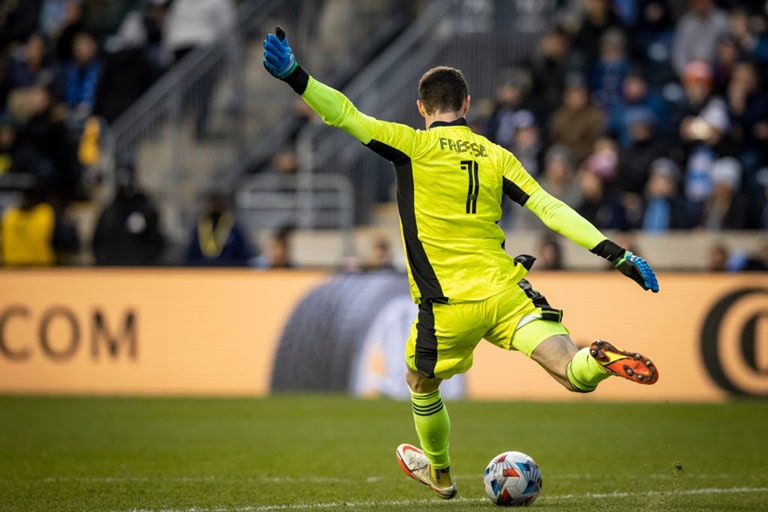
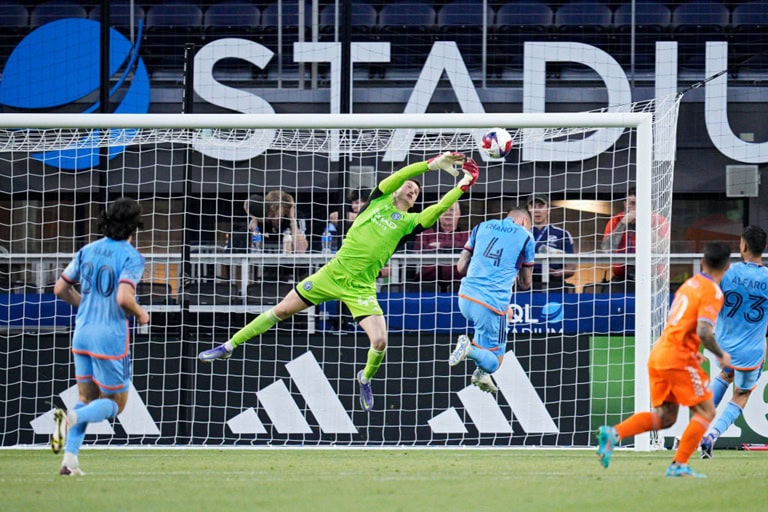
NYCFC goalkeeper Matt Freese has started all 30 of his club’s matches this season in MLS and has a 73% save rate, stopping 102 of the 140 shots he’s faced. This is his second season with NYCFC after beginning his career with the Philadelphia Union. A native of Wayne, Pennsylvania, Freese signed a homegrown contract with the Union and, after two seasons at Harvard, made his MLS debut in 2019.
Freese, now 26, had an opportunity to begin playing pro soccer after graduating from the Episcopal Academy in suburban Philadelphia but elected to attend Harvard first. Though he left early, Freese completed his degree remotely, balancing Ivy League studies with professional soccer, which is something he actually considers an advantage for his athletic career. A curious mind and avid follower of sports business — and a reader of Sports Business Journal, he revealed — Freese wrote independent research projects on MLS franchise valuations and advanced analytics for expected goals.
On opting for college, not pro soccer, right after high school…
The first and most obvious [reason] is just the fact that I wanted to honor my parents’ wishes to go to college. When I got into Harvard, they pushed even harder. I was really fortunate and lucky for that to happen. My dad had gone there, and he really wanted me to make sure I got a degree. The really awesome thing about Harvard, or most colleges at this point, is if you go for a semester or two, you pretty much lock in the ability to go back and finish your degree at some point.
On a more personal level, I don’t know if I was ready to be an adult and live on my own outside of the college setting when I was 17, 18, signing a homegrown contract. Also, goalkeepers usually develop a little bit later, so there wasn’t as much of a rush, if that makes sense. Seeing now the way my career has unfolded and changed, maybe I’d make a different decision and start it earlier, rather than waiting that year.
Ira L Black – Corbis/Getty Images
On balancing school and sports…
I would [attribute] most of my on-field soccer career development to my off-field academic efforts. This was at a time when I was 19, when structure and schedule is so important for a 19, 20-year-old who’s now a professional athlete making good money and getting pulled to do things that that most 19, 20-year-olds are getting pulled to do. Having the structure, having a few hours of work every night after training, making sure I had to be on a good sleep schedule, it all really allowed me to focus on soccer and not get distracted with other things. It really grounds you. It humbles you.
The other thing that I really liked about it was that it gave me a de-stressor off the field. As a 19, 20, 21-year-old, you’re now competing for your career every single day that you’re playing, and it becomes stressful, and as a young guy, you don’t really know how to handle that. So when I got home, and I would be doing work, reading a textbook, doing whatever — my mind was able to get away from soccer, which is super important.
And then the third thing that’s also quite interesting is that there’s a lot of research out there that really supports cognitive development, especially at that age, and your ability to solve problems, lead and organize and be a team leader. A lot of that is correlated with academic and intellectual stimulation. As that was continuing to grow, as my brain was continuing to be pushed and grow, it allowed me to, in my opinion, learn more quickly on the field. Learning quickly, learning on the fly, is completely necessary for a professional athlete.
On writing an undergrad thesis on MLS franchise valuations…
It was my last semester. I had finished all my core requirements, and I was doing everything remotely and then flew up to take exams in the offseason. And so I was able to do two independent research projects as my last credits. The title of one was “The theoretical analysis of the rise of MLS valuations.” Since 2010, they just completely skyrocketed, and the whole point of what I was discussing is that demand was going up. The supply was very limited. It was very constrained for several reasons. The primary one is expansion is limited within the MLS.
Probably the bigger focus was just talking about how demand, from an ownership perspective as well as from a fan engagement perspective, is going up. The academy situation has really changed everything. People want to go see kids or teenagers from their hometown that they knew growing up. They want to go see them play. They want to see them succeed. The US team is obviously getting more and more attention year over year, and that impacts the way fans look at MLS games.
People want to buy into these teams. They’re becoming more and more profitable. Revenues are going up. Operating expenses are also going up, and salaries continue to increase, and transfer fees just always are rising. But in general, they’re just becoming more profitable and easier to operate.
On writing MLS papers while a player for the Union…
I was in my third year. I’d always go to this one coffee shop in Philadelphia and work on that paper. The other independent research project I should probably mention because it’s somewhat related was, I created an expected goals model using data from MLS over the last five, six years, which was also really cool.
Goalkeeper is a weird position [for analytics] because essentially the only one that matters is the post-shot expected goals model and how that relates to the goals conceded. Goalies are a little bit of an anomaly, but in general, yeah, I love looking at data. I love talking to our data analytics team in the organization about these things. I just think it’s really interesting. It can shape a strategy of a team to a degree.
It can’t completely take over what the philosophy of the team is, but it can point you in the right directions or show you what type of cross has the highest percentage of expected goal coming from the end result of, leading you to probably want to look at getting into the cutback scenario more than these long, high crosses. We’re a relatively younger team. Our height and our strength isn’t as much so fighting against these big center backs might not be as successful as getting into that cutback zone, which is something we’ve worked on a lot. This is not me driving that, by the way. [laughs] This is the coach, the data analytics team making those decisions, obviously.
Jeff Dean/Getty Images
On not looking too deeply into his training data…
I am into that, but I just trust our performance director and the medical performance side of things on the team. They handle all that, and they make sure that my dive count is not too high, my explosive [actions] count is not too high. I am hitting the numbers that they want, and I just trust them to do that. They’re very good at their job.
On his interest in sports business when he retires…
I do think about it. The clear priority right now is playing, and I want to play for a very long time and have a good career and get my name into the that top tier of MLS, goalkeepers. But at the same time, I also take a serious interest in what my post-playing career will be. I believe one avenue would be to stay in the sports realm, whether that’s on a business operating side, being on the finance or marketing side of an organization, or the sporting side —GM, Assistant GM, sporting director, that type of thing — is really fascinating as well.
And then there’s also the investing side. I have a background in investing as well. I took several classes and audited some MBA classes at Wharton when I was in Philly. So I’m comfortable and really enjoy that type of stuff. A lot of it also depends on how my playing career goes.
On his game prep…
As a goalkeeper, the routine really is everything. And I’ve become somewhat psychotic about my routine before every game. There’s a lot of research that has indicated that, for an athletic event, your sleep two days prior is actually more important than the sleep one night prior. So my routine really starts two days before the game. I try to get as much sleep, like 9, 10, hours two nights before, and then I usually do a series of meditations leading up to the game. I do the same type of film, just very serious about my routine.
This article was brought to you by SBJ Tech, a Leaders Group company. As a Leaders Performance Institute member, you are able to enjoy exclusive access to SBJ Tech content in the field of athletic performance.
Data Analysts Julia Wells of the UKSI and Mat Pearson of Wolverhampton Wanderers deliver a series of practical tips to help address one of sport’s notorious blind spots.
An article brought to you in collaboration with

That is according to a straw poll of attendees at a recent Virtual Roundtable hosted by the British Association of Sport & Exercise Sciences [BASES] and the Leaders Performance Institute.
The perception is worse when it comes to analysis and recruitment, with over 60 per cent of attendees suggesting that their analytics and recruitment teams do not work closely at all.
Yet 63 per cent also believe that improved data and computer literacy across their staffs would directly impact performance.
The sense that there is room for improvement gave the session its title: ‘Mobilising Performance Analysis in Practice’. It was the second in our three-part collaboration with BASES called Advances in Performance Analysis and centred around two case studies.
The first was delivered by Julia Wells, the Head of Performance Analysis at the UK Sports Institute [UKSI], and the second by Mat Pearson, the Head of Performance Insights & Data Strategy at English Premier League side Wolverhampton Wanderers.
Five areas where data literacy can improve performance
Before Wells and Pearson delivered their insights, attendees were set a further task: ‘as a consequence of improving data or computer literacy, describe what you would see as being the most significant impact on performance’.
The responses were varied but five stood out:
How the UKSI are mobilising performance analysis work-ons in meeting common challenges in data analysis
The first session highlighted the four biggest challenges facing people who use data analysis in sport. To kick off her presentation in the second, Wells explained how the UKSI is trying to tackle those four challenges (plus another).
Challenge 1: integration
Go back to basics. That’s the approach of the UKSI, who have placed an emphasis skill development, support structures and a clear data strategy.
It goes like this: the relevant staff members are upskilled in areas such as collecting the right data, using the correct formats in the right places before the interrogation and analysis even begins. This is then supported by a clear data strategy geared towards performance planning. For example, roles such as the data & insight lead and the performance data lead are embedded within the organisation to better help those leading programmes with the direction and the integration of their data. Thus, the strategy can come to the fore and everyone can better understand what needs collating and why within the team.
Challenge 2: data collation
Wells described how easy it can be to stay on the “hamster wheel” of collecting data without taking the time to critically reflect and pause. Can you, for example, call upon efficient processes for collecting data and wade through the myriad datasets potentially available? She recommended asking “quality questions”: why are we creating the data, what is its purpose, what decisions is it informing, particularly in the coaching process? Teams should do this periodically and continue to plan, do and review. Wells also encouraged engaging in conversations with key leaders in the environment to discuss what to start, continue and stop. It’s important to intentionally carve out those opportunities as part of your performance planning.
Challenge 3: communicating data insights
Wells stressed the critical nature of human engagement in the process and regards communication is a highly technical skill, despite the views of those who might see it as a ‘soft’ skill.
She shared that the different performance departments within the UKSI work closely with the psychology team to help elevate understanding of self and others. Wells said, if we can better understand the people we work with, it will support how people can get the best out of each other. As part of this process, they’ve tapped into better understanding one another’s preferences in order to be more impactful in how they support each other.
Challenge 4: buy-in
It is not uncommon for senior stakeholders to not perceive the value of the work being done. This makes it incumbent on analysts to critically assess their impact and share the meaningfulness of their work. “It’s our job, and it’s our role to be critically analysing why and presenting that back,” as Wells said.
On that note, alignment to the sport’s strategy helps to provide a clearer connection. If this alignment and connection isn’t there, you’ll naturally get disconnection so it will be more challenging to get the buy-in.
In addition, relationships are just as critical when generating buy-in. Wells advocated inviting leaders and key stakeholders into your world and shadowing them. When they immerse themselves in better understanding the process you’ll find that it can quickly lead to them becoming a voice for you in wider conversations.
Challenge 5: data illiteracy
Too often, practitioners can suffer in silence when looking for solutions. In the latest Olympic and Paralympic cycles, Wells and her colleagues are seeking to increase data literacy across the board. They have introduced an internal online data community that provides access to resources, promotes connection, and leads to the sharing of good practice.
Wells’ team also put together a ‘Data Leadership Programme’ which is focused on pulling together the data leaders in the various sports with whom the UKSI work to look at opportunities, challenges and future direction. Courses, with titles including ‘Data Camp’, ‘Project Automate’ and ‘Code School’, were created to improve skills and processes for coaches and practitioners to help them be more efficient. In her mind, this has been crucial to enable people to be upskilled; and all support staff should be able to ask a good question and have the data skills to answer them.
How data analysis is supporting coaching and recruitment at Wolves
Pearson explained that he and his colleagues at Wolves are trying to align the club to ensure there is consistent evidence available and better identification of the trends impacting decision making from a data point of view.
He focused on two key areas: coaching and recruitment.
In the environment, the analysts are part of the multidisciplinary team. They are very much now voices in the room and, with it being a specialised discipline, all analysts must have an impact on decision making.
To that end, Pearson’s team have moved away from leaving the coaches to find the solutions themselves. Instead, analysts are encouraged to go and find solutions, present them to the coach, and then have good conversations to better find the optimal outcome.
Part of the challenge we can face, said Pearson, in particular with performance analysis at first-team level in professional football, is that many environments can be quite coach-led, which is in keeping with the nature of short tenures. The coaches will lean into their viewpoint as a way to exert their control. Therefore, education is important and, in particular, how you communicate with them to ensure the message lands. That said, Pearson observed that coaches in modern day football are more attuned to data and performance analysis and are much more data literate and comfortable with technology.
A key learning when integrating performance analysis and data work with coaching is to make insights as contextual as possible. If you provide insights to a coach that are out of context, you’ll lose them straight away.
Pearson told attendees that some of the biggest strides in performance analysis and the wider data team have been in the field of game modelling, recruitment and selection decisions, with the obvious caveat that subjective input is still valued immensely.
The team have worked to create objective measures against the game model. In better understanding this, it has provided an additional layer of information related to individual player requirements for the game model. These insights are helping to inform both selection for matchday but also the recruitment of new talent. When thinking about the recruitment process in particular, Pearson said this process has helped to educate scouts and other recruitment personnel in the attributes for which they should be looking.
Visuals have played a key role in this process too, particularly in being able to show what it looks like to play in this particular style that the coach or manager wants. They’ve worked to make the playing style more objective.
BreakAway Data’s new app aggregates health information from clubs, national teams and private consultants.
A Data & Innovation article brought to you by
The new product, BreakAway Pro, aggregates health information from all practitioners — all clubs, national teams, private consultants — through an athlete’s career where it can be displayed and compared against game stats, tracking data and training workload. It is available for all interested leagues and unions, with a custom-build for a first, unnamed partner almost complete.
Since launch, BreakAway has secured deals with the NFLPA, NWSLPA, WNBPA and Athletes Unlimited, among others. Its founders, Dave Anderson and Steve Gera, regularly heard from agents, athletes, investors and other stakeholders that adding EMR capabilities would be a helpful addition to the product.
“We didn’t know we needed to move this mountain in order to give all athletes access to their data, but this was the key piece and the key thing that was missing in sports that we’ve now got,” Anderson said, adding that the topline benefit of this fingertip retrieval is ensuring that what “costs them time, money and effort are now guaranteed and done quickly and swiftly.”
While the data infrastructure was largely in place, meeting the standards for EMR access required significant outlay from BreakAway — a 2023 SBJ 10 Most Innovative Sports Tech company honoree — to add higher levels of insurance, meet HIPAA compliance and build maximum digital security, including a revamp of its AWS storage. Anderson estimated that this project consumed about 75% of the company’s time, money and effort for most of the past year.
Athletes register using multi-factor authentication that is verified by government ID, and all records are stored in a secure server, with none of the information stored locally on a mobile device. Users can manage settings over who has access to what information, toggling permissions on and off as they change teams or seek additional opinions.
“Players have been advocating for better access to their data for a long time, and BreakAway was the first company to build a product specifically tailored for players,” Meghann Burke, NWSLPA Executive Director, wrote to SBJ. “They have set a new standard for what, how, and when information should be delivered. It’s no surprise that they continue to innovate in the digital space, providing players with functional and accessible data solutions.”
Anderson, who had a six-year career as an NFL wide receiver, recounted his own experience attending NFLPA-backed health and wellness testing at the Cleveland Clinic. When he returned to the same facility three years later for an additional checkup, the computer systems had changed, and the doctor couldn’t easily see his past records. Anderson had to bring his own paper copies, making him think, “There’s got to be a better way to do this.”
While that’s an acute pain point in elite sports, it’s also an issue for everyday people who change medical practices.
“We’re the first company that is daring enough to take it on. We built this for players, and let’s see how it works because this really doesn’t even exist in the normal world,” Anderson said. “It’s a huge build, and something hopefully that resonates well beyond just sports.”
Intelligence within the app helps provide context and comparisons to normative datasets. Visual tagging of joints and muscles is one of several ways to filter the information a user is searching for. BreakAway Pro also is agnostic to other EMR providers and supports all types of medical imaging as well.
“We heard from enough leagues and we heard from enough people that we were like, ‘All right, let’s just go all in. Let’s bet the farm on our company on this,’” Anderson said. “We claim to be the athlete data company and to have the app where they put all their information, and if this is the most important piece of information that they want, what are we doing here? It is the core piece that ties everything together.”
This article was brought to you by SBJ Tech, a Leaders Group company. As a Leaders Performance Institute member, you are able to enjoy exclusive access to SBJ Tech content in the field of athletic performance.