As behavioural finance specialist Dr Benjamin Kelly explains, these four common biases can derail even the best players.
While technical skill and conditioning are paramount, behavioural biases frequently derail even the most talented players. For leaders in sports, understanding these cognitive shortcuts and emotional responses is crucial for optimising athlete performance, coaching strategies, and mental resilience.
I believe that golf, much like financial markets, is fertile ground for behavioural finance – a field integrating psychology and economics to explain irrational decisions. While behavioural finance has profoundly reshaped our understanding of investment behaviour, its application to sports decision-making, particularly in golf, remains remarkably underexplored. This is a significant oversight, as the very same biases impacting trading decisions equally affect decision-making on the golf course.
By examining cognitive shortcuts and emotional responses that derail golfers, we uncover profound lessons applicable to high-pressure environments across sports and business.
My work with investors has consistently demonstrated that reducing ‘bad decisions’ incrementally improves investment returns. This same principle applies directly to golf: eliminating poor choices on the course directly translates to saving shots and enhancing performance.
Overcoming behavioural biases is notoriously difficult; our innate cognitive architecture makes us highly susceptible. Therefore, the optimal path to mitigation is not to fight the bias directly, but to create a step in the process that prevents us from succumbing to it. In trading, a simple yet powerful example is the stop-loss order – a pre-defined instruction to exit a position if it falls to a certain price, removing emotional discretion from a critical decision.
This methodology, involving structured interventions, is evolving for golfers of all abilities.
Below, I illustrate these points with compelling examples, including Robert MacIntyre’s dramatic final round at the 2025 BMW Championship, and propose actionable strategies for correction.
Loss aversion describes our innate tendency to prefer avoiding losses over acquiring equivalent gains; the psychological pain of a loss is often twice as powerful as the pleasure of a gain. In golf, this bias is a primary contributor to the dreaded ‘choke’ phenomenon, particularly when a player holds a significant lead. The shift from playing to win to playing not to lose is a classic manifestation. It leads to tentative play and costly errors.
Consider the ‘final day phenomenon’ in golf, where approximately two-thirds of leading players fail to convert their lead into a win on the final day of a tournament. This represents a conversion rate of roughly 33%. My work with investors has consistently shown that even a modest improvement in decision-making, leading to an increase in success rates from 33% to 45%, can yield material benefits. For a professional golfer, this translates directly into more career victories and significant financial gains. For investors, it means incrementally improved returns and enhanced portfolio performance. This isn’t a sudden decline in skill; it’s a psychological battle. A player leading a tournament, especially on the back nine, often shifts from an aggressive, winning mindset to a conservative, loss-averse one. Instead of continuing the attacking golf that built their lead, they focus on not making mistakes, which leads to tentative swings, reduced pace, and increased unforced errors. The fear of losing the lead becomes more potent than the desire to win. It paralyses their natural game.
Robert MacIntyre at the 2025 BMW Championship provides a vivid illustration. MacIntyre entered the final round with a commanding four-shot lead, having played exceptional golf through the first three rounds (carding 62, 64 and 68 for an average of 64.67 shots). However, in the final round, under immense pressure and with a significant lead to protect, he shot a 73 – eight shots worse than his average for the preceding rounds. This stark difference, which ultimately saw him lose the tournament to Scottie Scheffler, is a textbook example of loss aversion in action. The desire to protect the lead likely led to a more cautious, less assertive approach, resulting in a performance significantly below his demonstrated capability. His post-round comments when he expressed a desire to “smash up my golf clubs,” underscored the emotional toll of such a collapse, which was rooted in the psychological pain of losing what felt like an assured victory.
Correction strategy: process-oriented thinking and positive aggression
Mitigating loss aversion requires a conscious shift from outcome-oriented to process-oriented thinking. Golfers should:
My methodology, applied to investment, focuses on establishing clear, unemotional exit strategies to prevent such value traps, which directly improves returns by eliminating these ‘bad decisions’.
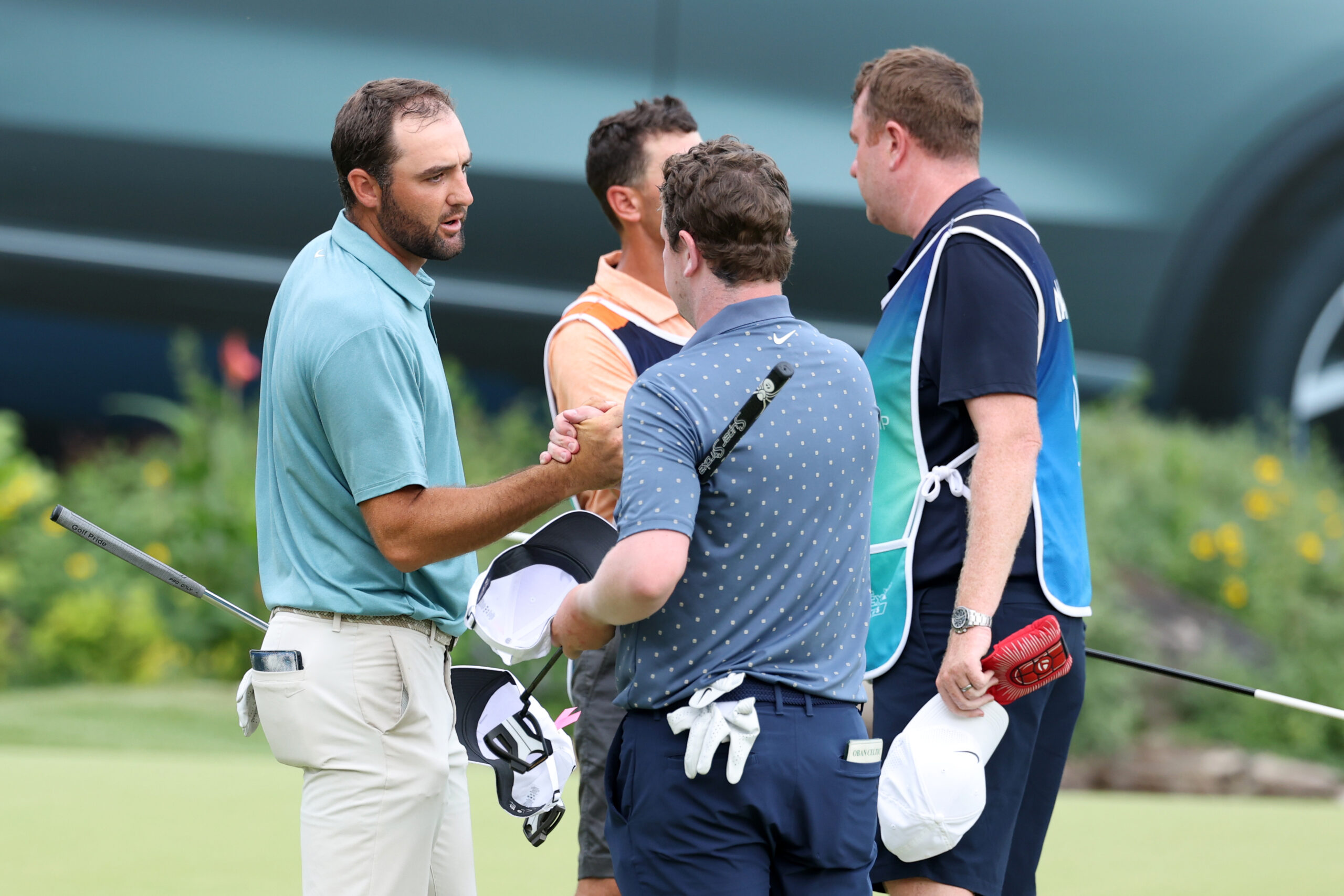
A victorious Scottie Scheffler shakes hands with Robert MacIntyre at the BMW Championship 2025 at Caves Valley Golf Club. (Photo: Kevin C Cox/Getty Images)
This translates to a pre-shot checklist that includes a deliberate assessment of risk vs reward. This ensures the chosen shot aligns with a pre-determined strategy rather than emotional impulse.
Overconfidence bias is the tendency to overestimate one’s abilities, knowledge, and the accuracy of one’s predictions. In golf, this often manifests as the infamous “hero shot” syndrome. Picture a golfer, slightly out of position after a wayward drive, facing a daunting carry over water or a dense thicket of trees to reach the green. A more prudent strategy might involve laying up, accepting a bogey or par. However, the overconfident golfer, convinced of their exceptional skill or believing this is their moment of glory, attempts the low-percentage, high-risk shot. The result is often disastrous: a ball splashed into the water, lost in the woods, or a double bogey that unravels a promising round.
Three-time major champion Pádraig Harrington has openly confessed that overconfidence cost him dearly at the 2025 Senior PGA Championship, particularly on a crucial 15th hole. Despite his vast experience, he felt his confidence and arrogance led him to an ill-advised approach shot, costing him a crucial hole. This mirrors countless amateur golfers who, after a few good shots, attempt to carry a 200-yard water hazard with a 3-wood, only to find their ball sinking to the bottom, convinced their recent success grants them an infallible touch. The allure of the ‘hero shot’ often blinds players to the higher probability of failure, driven by an inflated sense of their current capability.
Correction strategy: objective risk assessment and pre-shot routines
To counteract overconfidence, golfers must:
My investor checklists include a mandatory step for a ‘devil’s advocate’ review of high-conviction trades, forcing a re-evaluation of assumptions. This translates to a ‘reality check’ step in their pre-shot routine, where they explicitly consider the worst-case scenario and whether the reward truly justifies the risk. This step prevents the overconfident ‘hero shot’.

Pádraig Harrington at the 2025 BMW PGA Championship. (Photo: Andrew Redington/Getty Images)
Confirmation bias is the tendency to seek out, interpret, and remember information in a way that confirms one’s pre-existing beliefs or hypotheses. On the golf course, this can lead to flawed self-assessment and persistent errors.
A golfer might believe their slice is due to an ‘outside-in’ swing path, and subsequently only notice instances where their swing appears to confirm this, ignoring other potential causes like an open clubface. This selective attention prevents them from accurately diagnosing and correcting the root cause of their swing fault. Similarly, a player might attribute a good shot to their skill and a bad shot to external factors (a bad bounce, a gust of wind), reinforcing a biased self-perception that hinders genuine improvement.
Correction strategy: objective data and external feedback
To address confirmation bias, golfers should:
My investor checklists mandate seeking out and documenting opposing viewpoints before making a significant investment.
This means a ‘feedback loop’ step where they actively solicit input from their caddy or playing partners on their swing or strategy, or review objective data from launch monitors, rather than relying solely on their internal, potentially biased, assessment.
Anchoring bias occurs when individuals rely too heavily on an initial piece of information (the “anchor”) when making decisions, even if that information is irrelevant. In golf, this can lead to rigid decision-making that fails to adapt to changing conditions.
A common scenario involves a golfer fixating on the yardage provided by a sprinkler head or a course guide at the start of a hole. This initial yardage becomes an anchor, making it difficult to adjust for dynamic factors like wind changes, elevation shifts, or a different pin position that emerges during the round. A player might stubbornly stick to a club choice based on the initial anchor, even when conditions clearly dictate a different approach, leading to shots that are consistently long or short.
Correction strategy: dynamic assessment and multiple data points
Counteracting anchoring requires:
My investor checklists include a mandatory ‘re-anchor’ step, where all previous price points are deliberately ignored, and decisions are made solely on current fundamentals and future projections.
For golfers, this translates to a ‘situational awareness’ step in their routine, where they consciously disregard previous hole outcomes or initial yardage markers, and instead focus on a fresh, comprehensive assessment of all current variables before committing to a shot.

Robert MacIntyre at the 2025 BMW PGA Championship. (Photo: Jasper Wax/Getty Images)
Conclusion: cultivating mental discipline for peak performance
Behavioural biases are an inherent part of human cognition, but their impact on the golf course need not be detrimental.
By understanding how overconfidence, loss aversion, confirmation bias, and anchoring manifest, and by implementing structured strategies to counteract them, golfers can significantly enhance their decision-making capabilities. The journey to mastering the mental game of golf is one of continuous self-awareness, discipline, and a commitment to process over outcome.
Just as my work helps investors reduce the incidence of “bad decisions” to incrementally improve returns, applying these behavioural finance principles to golf can directly lead to saving shots and elevating performance. The critical insight is that overcoming biases is extremely difficult; our innate cognitive architecture makes us highly susceptible.
Therefore, the optimal path to mitigation is not to fight the bias directly, but to create a step in the process that prevents us from succumbing to it. This methodology, evolving from investment to the golf course, empowers athletes of all abilities to make optimal choices when it matters most.
For sports leaders, fostering an environment that encourages objective self-assessment, embraces data-driven insights, and champions structured routines will be key to developing athletes who not only possess exceptional physical talent but also the mental fortitude to make optimal decisions when it matters most.
This approach not only leads to more consistent performance but also a deeper, more rational engagement with the beautiful, challenging game of golf.
Dr Benjamin Kelly advises investors and professional athletes on decision making strategies in high stakes environments. If you would like to speak to Benjamin about his work, please contact a member of the Leaders Performance Institute team.
SBJ Tech’s Joe Lemire takes it upon himself to answer the question for himself and ponders the lessons should elite athletes ever do the same.
A Data & Innovation article brought to you by

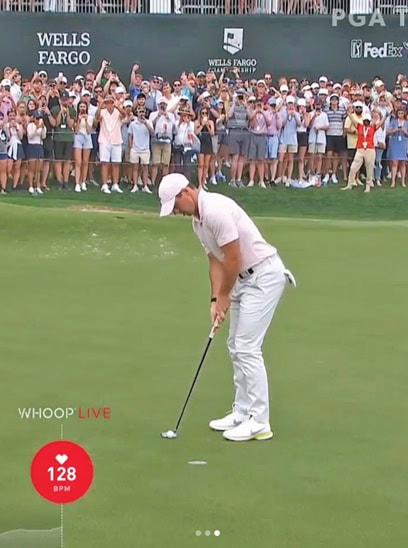
We know this because data from his Whoop, a wearable performance tracker, was shared publicly through a PGA Tour partnership. McIlroy’s heart rate was 128 as he struck the ball before it escalated to 152 when he hurled his golf ball into the crowd and celebrated at the Wells Fargo Championship.
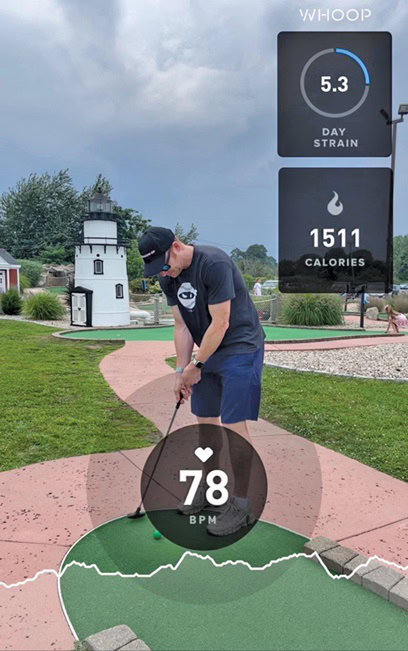
Wearable tech such as Whoop allows 40-something suburban dads to compare biometrics to the pros (below).
Before you say “the pros are just like us,” I submit this counterargument: On the 18th green of Saybrook Point, my own Whoop reported a heart rate of 78 as I took my final shot. Mine only rose to 81 as I contained my disappointment while failing to convert the hole-in-one for a free round.
This is probably where I should mention that Saybrook Point, as distinguished as it sounds, is a mini-golf course where I went on a recent family outing. We didn’t keep score that day, although I suspect my father-in-law edged me by a stroke or two.
OK, so I didn’t really learn anything about my physiology in that example — except my coolness under a lack of pressure — but I certainly have gleaned more than a few helpful tips over the past three years of continuous wearable usage, alternating between Apple Watch, Oura and Whoop.
Most of the time, I wear the Apple Watch during the day as my activity tracker and the Oura ring at night for sleep, but for several weeks this summer, I wore all three devices simultaneously, every waking heartbeat tracked in triplicate. Overkill, but enlightening.
The technologies are similarly accurate on resting heart rate. Oura and Whoop agree on my total sleep and heart rate variability, although they differ widely on sleep cycles: They mimic each other on REM sleep, but Whoop gives me credit for way more deep sleep (the more physically restorative cycle). They were directionally accurate, at least, and cycle identification is a fickle exercise outside of a sleep lab.
My own data has been living proof of the growing body of advice from wellness experts. My sleep and recovery scores are better if I don’t eat within a couple hours of bedtime and when I refrain from alcohol — but if I do drink, earlier is better. Think happy hour, not nightcap.
My latest midlife crisis sporting foray is registering for a 5-mile trail run around some local farm fields. While I keep abreast of the latest running principles — such as doing a majority of my runs in Zone 2, a low-intensity heart rate region, and the rest in high-intensity Zones 4 and 5 — and I do have the privilege of speaking with sport science experts for this job, I don’t have a coach or any formal training plan to follow. So I decided to try the artificial intelligence functionality of Whoop Coach and Oura Advisor.
Both remain in beta and were built by layering their algorithms on top of existing large language models. Whoop partnered with OpenAI on a ChatGPT implementation; Oura declined to identify its foundational LLM.
I wrote identical prompts to each about my plan to run a 5-mile race in two months and prodded for more detail, asking, “Can you write a weekly running program for me based on my data and this goal?”
Pulling on my own data as well as best practices — or at least the best practices embedded in the AI models — Whoop and Oura offered me similar plans. Both featured Saturday long runs, midweek interval runs at faster paces, a couple days of rest or light activity and recommendations for strength or cross training, such as cycling. Whoop offered more detail and suggested certain heart rate zones. (Oura is less precise on activity tracking anyway and imports my Apple Watch data for exercise.)
When I asked Whoop Coach how much faster I could get by training for my race, it alerted me to Project PR, a feature using Whoop and Strava to personalize eight-week running programs. The 2,772 users to complete the program reported an average improvement of 2 minutes, 40 seconds over a 5K. With that kind of a gain, maybe I can compete for the podium — of the 40-something suburban dad age group, of course.
Race day is October 27, after which I hopefully can report a fast time, though I suspect my heart rate won’t be quite as cool as it was at Saybrook Point.
This article was brought to you by SBJ Tech, a Leaders Group company. As a Leaders Performance Institute member, you are able to enjoy exclusive access to SBJ Tech content in the field of athletic performance.
Sportsbox AI utilizes a single smartphone camera to capture, measure, and analyze swing mechanics in 3D.
A Data & Innovation article brought to you by
Among those DeChambeau identified were his agent, manager and friends before mentioning his swing coach, Dana Dahlquist — and then a tech startup called Sportsbox AI. The company can extract 3D swing mechanics using only a single smartphone camera.
“I’m continuing to use technology to my advantage with my golf swing,” DeChambeau expanded in a Golf Channel interview. “Sportsbox AI has been great. Dana Dahlquist has been awesome helping me figure some things. Just really dialing in — when I’m hitting my best, what am I actually doing?”
While struggling at LIV Golf Houston the prior week, at least by his standards, DeChambeau began collecting Sportsbox AI swing data, which was paired with ball flight data collected by a Foresight launch monitor. (That partnership went live to the public on June 17.) Cause and effect were now tidily married together.
Dahlquist, who has been using Sportsbox as a coach for a couple years, noticed a trend in DeChambeau’s data causing his drives to miss out to the right. In short, DeChambeau’s chest-to-rib cage rotation and side bend were too great.
“I want to make sure that I can give the best possible, simplified answer, so that he can perform as the best athlete as he can,” Dahlquist said.
With several members of the Sportsbox team on site at Pinehurst No. 2 for the US Open — including VP of business operations Paul Park, director of sales Edwin Fuh and, for the practice round, CEO Jeehae Lee — Dahlquist and DeChambeau had support in collecting the data that played a role in DeChambeau’s victorious weekend. Sportsbox had already planned to be on site as part of a brand activation with Lexus even before work began with the eventual tournament winner.
Lee noted that DeChambeau’s practice round and range sessions on Wednesday, as well as first-round score of 67, helped create a gold-standard baseline for the sport’s most data-driven golfer.
“Everything is now going to be compared against his Wednesday and Thursday swings because he literally just hit it perfect,” said Lee, herself a former LPGA Tour player. “Thursday was one of the best ball-striking rounds ever in US Open history. He hit 86% of fairways and 83% of greens, hitting it at 350 off the tee — that’s unheard of.”
After DeChambeau name-checked Sportsbox over the weekend, Lee said inbound interest has already started from others seeking similar support. The company originally launched as a coaching tool, before adding a consumer-facing app, 3D Practice. It then had B2B2C and direct B2C touchpoints. Now, it’s considering an elite consultancy for LPGA and/or PGA Tour players and, maybe eventually, junior golfers and college players.
“We’re already getting a lot of inquiries, so we’re trying to formalize it because what we did for Bryson was not a business that we planned on building so, but I do think it’s the best use case for our technology,” Lee said. “He demonstrated that it can be really helpful for the right athlete.”
A day after DeChambeau hoisted the US Open trophy — and lingered on the course for hours after, signing autographs and crashing interviews — Dahlquist was set to give eight hours of lessons on a public driving range in Long Beach. He said he uses Sportsbox “every day” and that the best part is that his students can use it to monitor themselves when practicing outside of lessons, to ensure they use their time effectively.
“This is where the future of the instruction industry is going,” Dahlquist said.
This article was brought to you by SBJ Tech, a Leaders Group company. As a Leaders Performance Institute member, you are able to enjoy exclusive access to SBJ Tech content in the field of athletic performance.
SBJ Tech’s Joe Lemire finds out in real time why baseball players tend to swing a golf club in a particular way.
Main Image: Joe Lemire / SBJ Tech
A Data & Innovation article brought to you by
The Sandbox series is where we share our experiences testing products, gear, solutions and more in the sports tech space. Previous iterations have included demoing Apple Vision Pro apps from MLB and MLS, taking the new F1 Arcade for a spin, trialing AiFi’s cashierless checkout at the Prudential Center, using Nextiles and Rapsodo for improved pitch velocity and physiological testing at the Gatorade Sports Science Institute.
* * * * *
They were smart to do so. I was flatly incapable of hitting a groundball to the right side. (I also usually hit the ball in the air, so I don’t think I actually lost many hits as a result of the shift.)
The irony, it seemed to me, is that my golf swing produces almost exclusively shots to the right. I have since learned, however, that a slice is a common ailment of former baseball players: the left wrist (for a righty batter) needs different positioning for golf — more of a flexion than an extension.
Could an app and an Apple Watch help me overwrite four decades of motor learning? I put Golfshot to the test on a recent evening at the Chelsea Piers driving range in New York City.
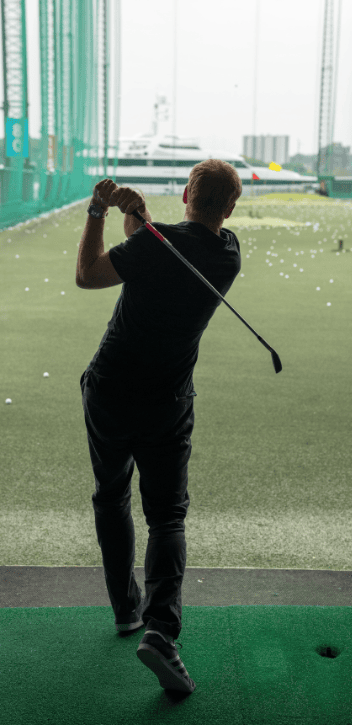
SBJ Tech’s Joe Lemire puts his swing to the test. (Ash Gilbertson)
And this wasn’t just any Apple Watch but the Ultra 2, whose myriad features include a high frequency motion API that can collect data at 800 hertz and dual-frequency GPS. The former allows the accelerometer and gyroscope to sample at four-to-eight times the precision of what Golfshot used to receive of 100 to 200 times per second from the motion sensors.
“As hardware gets better, we can also get better,” Golfshot CTO John Hawley said. “So Apple Watch Ultra and really this high-frequency motion API that came out is something that was a gamechanger for us. These metrics just get much cleaner, much more accurate.”
The enhanced GPS permits more accurate shot lengths, locating where each shot was taken and calculating the distance between them, though on this day the focus was the driving range.
At Apple’s invitation, a select group of reporters tried out Golfshot’s new Swing ID On-Range experience. The app, which is developed by a core group of about 25 people within a larger company called Golf Genius, has been around since 2008, with Apple Watch features introduced in 2015.
The Apple Watch Ultra 2 and accompanying watchOS 10 both were released in September 2023, helping power Swing ID, which is the ability to track swing mechanics. Golfshot first offered that feature on courses where the number of non-putted shots can be about 40 or 50 for competitive players. The range was a scale problem, requiring a new data architecture and storage plan with ardent players logging 10 times as many practice shots.
I only took 34 shots recorded in the app — eight with a six-iron, nine with a driver and then 17 with a three-wood — but that was a sufficient sample to realize that, yes, I do swing with a wrist rotated too far open and, mercifully, the issue seems to be somewhat corrective for me. And I’ve been told I have the raw tools for golf, even if my technique remains barely molded clay.
There are nine key metrics generated on every swing by Golfshot. Some, like tempo and backswing arc, could be improved, but they don’t appear in critical red coloring in the app the way wrist path and wrist rotation do for me. (Of note, the Apple Watch is obviously affixed to my wrist, not the club face, but it’s a helpful, albeit imperfect, proxy.)
On the watch, I was able to select a metric of focus and, after every shot, that datapoint and a visualization of the swing — showing, for instance, my swing path versus the suggested path — would appear on my wrist. It was a helpful way to track progress (or lack thereof) without fiddling with my phone each time. A tripod nearby held the device, where I could use the app for more detailed review of my metrics.
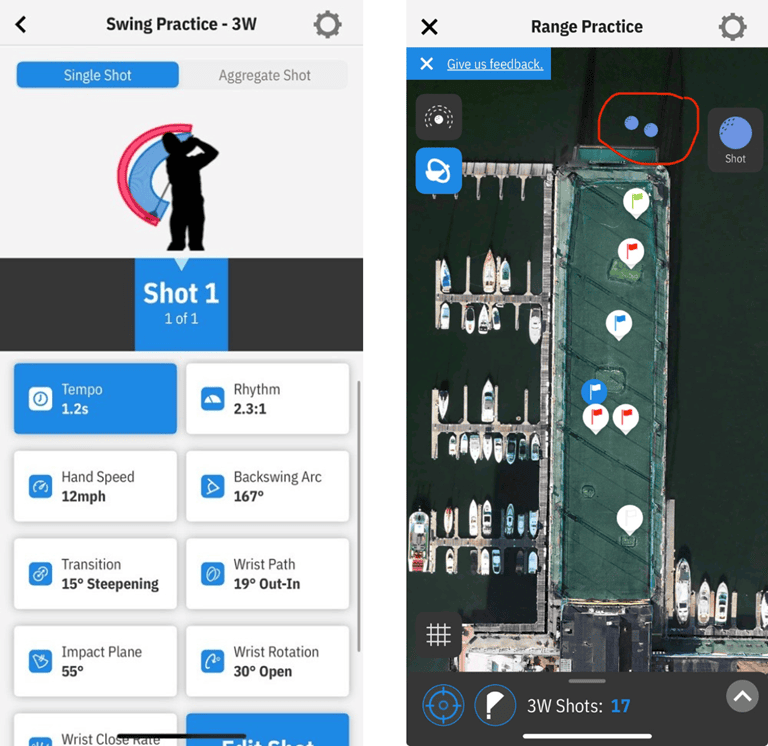
SBJ Tech’s Joe Lemire was able to review his swing metrics on Golfshot (Ash Gilbertson)
Golfshot’s app only offers normative datasets in broad strokes (pun intended), because it has found that swings are too individualized for hard guidelines to be helpful. But reviewing what data I saw — plus a short consultation from PGA professional Jonathan Doctor, the Northeast sales director for Golf Genius — helped mitigate my wrist supination, at least for a few fleeting moments.
My wrist path, which should be 0 degrees for straight contact, usually ranged between 15 and 20 degrees out-in; again, that can work in baseball, but less so in golf. And my wrist rotation, which should also be around 0, instead averaged around 30 to 40 degrees.
As Aristotle should have once said, the whole shot can be greater than the sum of its poor component metrics. In my case, I hit a handful of good golf shots interspersed between a larger number of bad ones. But at least I felt encouraged when, near the end of my session, I hit back-to-back three woods on a straight line into the netting 200 yards away.
It’s a helpful start, but I’ll need more monitoring and instruction to keep it up, which, conveniently is on the Golfshot road map.
“Going out and practicing is one portion of it, but making a plan to practice is really the greater aspiration here,” Hawley said. “Part of this developing practice plans is also going to be integrating with apps like [Golf Genius-owned] CoachNow, where you can communicate directly with your coach. Your coach could even get alerted after you play a round. ‘Here’s the round, let’s review his shots.’”
Hopefully alerts of my play include trigger warnings, but maybe someday I’ll work up the courage and play on a course. I take solace knowing that the Apple Watch Ultra 2 is chockfull of safety features — Emergency SOS, Backtrack GPS, siren and international orange action button that can be used for compass-based wayfinding — so no matter how deep my slice goes into the woods, I won’t get lost.
This article was brought to you by SBJ Tech, a Leaders Group company. As a Leaders Performance Institute member, you are able to enjoy exclusive access to SBJ Tech content in the field of athletic performance.
The PGA Tour player and US Ryder Cup captain is the latest guest in SBJ Tech’s series The Athlete’s Voice.
A Data & Innovation article brought to you by
You can’t have a discussion about sports technology today without including athletes in that conversation. Their partnerships, investments and endorsements help fuel the space – they have emerged as major stakeholders in the sports tech ecosystem. The Athlete’s Voice series highlights the athletes leading the way and the projects and products they’re putting their influence behind.
Among the standout traits of Johnson, 48, is his durability. He had played 69 consecutive majors until withdrawing from the 2021 Open Championship, not because of injury, but because he had tested positive for Covid-19. In fact, Johnson revealed that he has never undergone any surgery in his career — before joking that he wished he hadn’t said that publicly.
One fitness tool Johnson has adopted in recent years is GolfForever, which recently raised a $10 million Series A investment round and was named the Official Golf Fitness System of the PGA Tour. GolfForever uses its patented SwingTrainer, resistance bands and AI-powered app to guide workouts. It was created by chiropractor Jeremy James and has been used by company ambassadors Johnson, Scottie Scheffler, Justin Leonard and Tom Kim. In all, more than 400 PGA Tour and LPGA pros are users.
On how’s he incorporated GolfForever into his training…
The versatility of it is one of the aspects I love about it. I use it every day. I use it at my gym at home, if I don’t see any of my PT guys, just to get going. I can use it in my hotel room. I can use it to warm up for tournament, before I practice at home, whatever. I use it all the time, because of what it has and the ease of it. It’s very mobile — stick it in my golf bag and go. Shoot, I can use it on the range before I actually started to compete. So I just love the accessibility of it at any given moment is really what I think sets it apart from other apparatuses when you’re talking about engaging, warming up, creating some sort of mobility, yet stability. That’s where I find it to be the best thing on the market.
On his training progression…
I do use weights. I do use other apparatuses, too, for my conditioning. This thing is not going to put on 15 pounds [6.8kg] of muscle. I’m 48 years old. Longevity and injury prevention are my two focuses, and knock on wood, I’m probably an oddity in the sense that I’ve never had to go under the knife — I shouldn’t have put that out there, but anyway.
I give my body its full attention each and every day. I think [GolfForever] really helps from a corrective standpoint. It allows me to go through my corrective exercises, my corrective movements, so that I’m warm. I can even go in and do some heavier stuff after I use it. And then when I cool down, it’s great to get everything balanced and firing again after my workout. The app is great, too. They have an app that’s very comprehensive. If I’ve got a corporate event and I’m just going to travel [but not compete], I could just take I could take the bands and the apparatus and use the app, and I can get a full workout in my hotel room if I desire.
On golfers’ need to counterbalance their rotational movements…
That is an absolutely fantastic question. Obviously I’m right handed player, so there is asymmetry in me innately. And I say that it’s probably because I didn’t give my body the attention it needed when I was a young, young, young pro. In the late 90s, golf fitness was just kind of a thing — now, it’s a full-fledged industry. Shoot, golf recovery is a full-fledged industry.
From my body’s standpoint, I’m trying to get as symmetrical as possible, fully knowing that it’s probably not going to be that possible because I’m still hitting golf balls constantly. I would have to hit golf balls left handed, at a pretty high rate to find some sort of symmetry, and I don’t intend on doing so. But the beauty of this GolfForever is it allows me to get into motions. If I need to do more — we’ll just say, for lack of a better term, left handed — I can do that.
One of my imbalances is I can really turn through the ball. So post-impact, I can just keep going. On my backswing, my T-spine, my torso, even down into my low back and shoulders, that whole area basically is fine, but it just doesn’t want to turn as far in the backswing as it does on the downswing. So I’m constantly doing a little bit more to help open up my T-spine on the way back. That’s always an emphasis, if I’m going to get specific.
I actually have a left-handed seven iron. I can go in my gym, or I have a little simulator room. I can go in there and just hit balls — it’s ugly But I can do that. I can actually put a weight on there too, if I desired, and I’ve got to be careful because it’s really uncomfortable. It’s really awkward. And it kind of hurts. But there’s some there’s some truth in that. Yeah.
On other parts of his wellness routine…
I think I’m fairly diligent. I’m sure there’s peers of mine, especially guys that are younger, that may exhaust the resources even more, but I cold plunge probably two times a day, usually in the morning to get me going. It’s kind of like an endorphin release. It’s a hormonal balancing mechanism, and then I’m also going to use heat therapy as well. I just got done working out. So everybody thinks well, you should cool down and get the plunge. Well, the research says you should wait at least three to four hours, so I’ll cold plunge probably tonight before I go to bed. I’ve got a plunge at home, and then I’ll also introduce heat before I go practice to get limber.
Then for supplements, I’m pretty diligent on what I put into my body for the most part. I mean, I can eat bad, too, like anybody but I’m also very conscious of what goes in. I’m a chiropractor’s son, so that’s all I know. Whether it’s vitamins or other things of that nature, I’m a part of a company called LivPur with four other golfers and we make pre-, during and post-round supplements that help —whether it’s aminos, electrolytes, proteins. I’m always constantly monitoring, monitoring that intake.
On recovery…
Sleep obviously is massive. And that’s the best form of recovery for frankly anybody if you can get proper sleep. I used to wear a Whoop. Probably should get back into it. I’ve got some of the things I can wear, too, but it gave me a little bit anxiety. I was only into it for about four to five, maybe six months. I’d be like, ‘Man, I slept great last night,’ and then it says you didn’t or just the opposite. But that’s data, and I love objective data. I probably need to get back into it. My boys are actually starting to do that — I’ve got a martial artist and a football player.
Teammates of mine — my PT and chiros — are constantly encouraging me, pushing me, making me uncomfortable. That’s also, I think, very rewarding in the end, too, so there’s a lot of things that go into my day-to-day operation.
On evaluating business deals…
I think my plate’s pretty full. With my team, my manager, my wife, we pursue relationships more than business opportunities. It’s got to be a good fit. It’s got to be a win-win. So I don’t you know, with three kids at home, I’m not desiring anything more. I like who I’m associated with. I hope they would say the same. And I don’t say it lightly because if we’re going to start something, you’re going to get all of me. I can only be both feet in with a certain number of obligations or ambassador roles. I don’t think it’s fair to myself or them if I spread myself too thin.
On the PGA Tour’s offer of equity to its players…
That’s a hard question. I’m learning as I go. I’ve pursued some communication with certain individuals and the Tour. I think everybody’s kind of learning. I understand it is probably the appropriate or pertinent next step in our evolution as a product. I’m also pretty trustworthy in the sense that I feel like there’s individuals making these decisions that are a lot more wise than I am, especially when it comes to just business in general and the savviness it requires.
It is new. It is obviously somewhat reactionary. But I’ll tell you what I am: I’m grateful for my peers. Because I served on that board in the past, I’m really grateful for the time and energy they’re putting into it. I don’t even know the half of it.
There’s really two factors in my mind, and the first one is I hope the money side of things is not the motivation. There’s an appropriate way to pursue money. Greed is the inappropriate way. So I hope, and I trust that they’re doing that right. And then the second thing would be — and these are 30,000-foot view things — don’t let the game of golf be secondary. It’s still got to be for the fans, it’s still got to be a level of entertainment, it’s still got to be meritocracy, it’s still got to be the purest form of the game where you earn what you get in the dirt. I trust that that that’s still a priority.
This article was brought to you by SBJ Tech, a Leaders Group company. As a Leaders Performance Institute member, you are able to enjoy exclusive access to SBJ Tech content in the field of athletic performance.
The Leaders Performance Institute delved into the concept with David Dunne of AI-powered nutrition app Hexis.
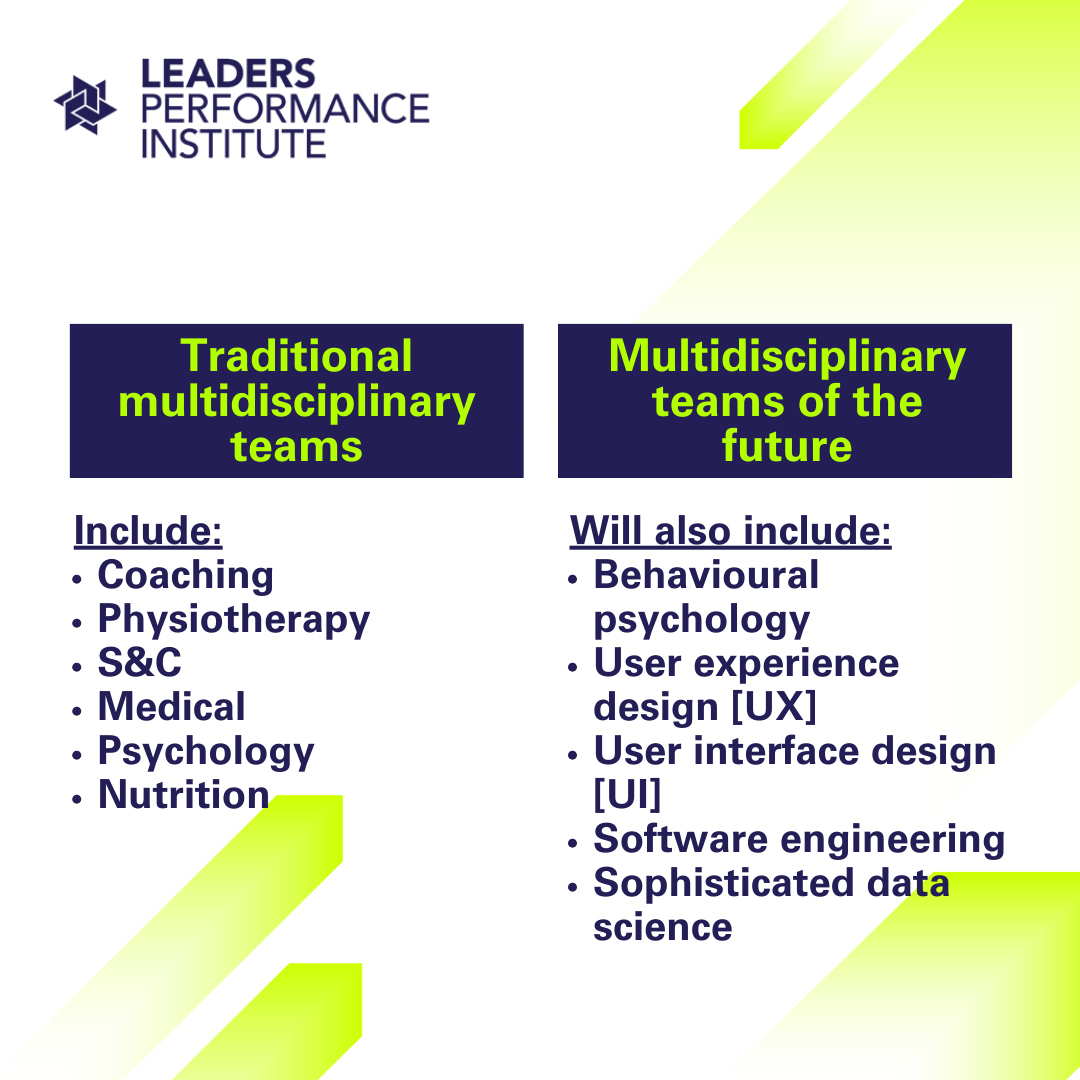
“We expect a nutritionist, coaches, S&C, psych and physio – that’s what we consider a multidisciplinary team,” he told the People Behind the Tech Podcast in April.
“However, now [a multidisciplinary team includes] behavioural psychology, UX [user experience design], UI [user interface design], data science, software engineering, performance science. It’s a whole other world that has opened up new possibilities that we didn’t know were there as a practitioner.”
Dunne, who is the CEO and Co-Founder of Hexis, an AI-powered predictive nutrition service for elite athletes, has made an almost full transition from high performance sport. He previously served as Head of Nutrition at English Premiership rugby club Harlequins and still works in a similar capacity with Ryder Cup Team Europe.
While his assessment of tech’s role in high performance is unsurprising, his views on those “possibilities” now open to practitioners provide some food for thought – and not only for nutritionists or dietitians.
“What we’re going to see is the evolution of the hybrid practitioner,” he continued.
What are the implications for you and your team? Below, we set out a HYBRID framework to illustrate the concept.
H – Haste – “[Going] back to Quins, you spend a lot of time behind the laptop,” said Dunne. “You got bogged down in a spreadsheet. It’s tedious.” However, a hybrid practitioner will “use tech for tasks that can be algorithmically delivered at scale.”
Y – Yield – this can mean being receptive to others; and a hybrid practitioner “uses technology for what it’s good at” while people can focus on what they’re best at, which is “being human”. As Dunne explained: “Humans are good at building relationships, learning how to have conversations, and listening to people and actually helping them change their behaviours and change their beliefs about certain consequences or their own abilities over time.”
B – Balance – Dunne’s Co-Founder at Hexis is Sam Impey. “A brilliant scientist,” as Dunne said. “A far greater academic than I’ll ever be.” Nevertheless, Dunne is aware of his own assets. “My personal strengths have always been on the coaching side – put me in any locker room, put me in any team setting, I love to have conversations, I love to listen.” In truth, a successful practitioner needs both sets of traits. As Dunne put it, “let’s call it practitioner tacit knowledge and actually the application on the frontline.” The best example of this in Hexis’ work is how their app has been influenced by the COM-B model, which is a framework for understanding and changing behaviour – both key factors in performance nutrition. For a behaviour to occur, a person must have the capability, opportunity and motivation to perform it. Practitioners aiming to change behaviour should therefore target one or more of these components.
R – Roadmap – practitioners are too often constrained by tech being restricted to trackers. “It’s retrospective”, said Dunne, specifically of nutrition trackers. But with predictive AI entering the market, the role of the practitioner is likely to be more forward-facing. “We always need to know [and] we always want to help them know what to do next,” he added. This is particularly important in light of Hexis-sponsored research suggesting that most athletes are ‘confirmation seekers’, meaning they want to lead on “making the decision but then they want something to help verify that they’re going in the right direction.” A hybrid practitioner can cater to this need.
I – IT / MI – “I think what we’re going to see more of is a more highly-skilled human practitioner with a lot more software skills and [skills such as] motivational interviewing [MI] on the frontline, and then technology systems that ensure a standard of care across the whole organisation, 24/7, 365 days a year,” said Dunne. Key to that is reducing the “noise” around the athlete. With the right plans and structures, the hybrid practitioner can “deliver impactful value to the athlete.”
D – Data – with apps such as Hexis allowing for data integration – their collaboration with training app TrainingPeaks is a prime example – there is the opportunity for practitioners to make better use of existing data rather than merely seeking the next thing. With the right blend of skills, the hybrid practitioner is well-placed to ask: what can we do with the information we already have?
Listen to the full interview with David Dunne below:
The Co-Founder of Hexis discusses the pinch points for athletes, practitioners and technology.
A Data & Innovation podcast brought to you in collaboration with
“There’s a fundamental mismatch between what practitioners can deliver and what athletes actually want and desire,” he told Joe Lemire and John Portch on the People Behind the Tech podcast.
“So we pivoted towards the COM-B model.”
During this episode we spoke at length about Hexis’ continued growth following a successful seed round, technology’s ability to influence the evolution of the practitioner, and the fundamental union of academic rigour and those so-called softer skills.
COM-B was a major part of that conversation. It has been integral to Hexis’ growth. The company used it in tandem with elements of design thinking which, as Dunne explains, stems from his time working for teams including Harlequins and Ryder Cup Team Europe.
The model is a framework for understanding and changing behaviour. It was developed by Susan Michie, Maartje van Stralen and Robert West in 2011. The model posits that behaviour (B) is a result of an interaction between three components:
Capability (C): this refers to an individual’s psychological and physical capacity to engage in the activity. It includes having the necessary knowledge, skills and abilities.
Opportunity (O): this encompasses all the factors outside the individual that make the behaviour possible, including social and physical environmental factors.
Motivation (M): this includes the brain processes that direct behaviour, such as habits, emotional responses, decision-making and analytical thinking.
Listen to the full conversation:
Listen above and subscribe today on iTunes, Spotify, Stitcher and Overcast, or your chosen podcast platform.
What are the implications for you and your team?
Main image: The PGA Tour demonstrated its generative AI virtual assistant at the Pro Am for Amazon’s re:Invent event in Las Vegas in late November. A video clip was generated after the AI assistant answered a question. Then the player would attempt to replicate the shot. [courtesy of Amazon]
A Data & Innovation article brought to you by
Limitations were apparent early — answers are not always factual, and there’s pending litigation challenging copyright protection on source material — but ChatGPT’s arrival forced everyone in every industry, including sports, to consider how generative AI might aid their end product or internal workflows.
“I would say it may be overhyped in the short term,” said Anil Jain, Google Cloud Global Managing Director for Strategic Consumer Industries, “but it’s definitely underhyped in the long term.”
AI has existed in sports for a quarter-century but not like this. Generative AI, the field that underlies ChatGPT, creates new data and content. Even what the public saw a year ago was not truly new technology, but it marked a change in scale and availability. It was officially ChatGPT-3.5; the original version, ChatGPT-1, was released in June 2018.
“The tech capabilities are a bit of an evolution — we’ve seen elements of this for the last couple of years — but the accessibility has become very revolutionary,” said Shaown Nandi, AWS Director of Technology for Industries and Strategic Accounts.
Microsoft-backed OpenAI may have grabbed the early headlines — and ChatGPT becoming a generic term for generative AI — but there are numerous entries in this space including those from Big Tech, such as AWS’s Bedrock, Google Cloud’s Vertex AI and Meta’s LLaMA, as well as other players like Databricks, Veritone, Pramana Labs and more.
Drawing on insights from more than two dozen leaders in the sports and technology industries, Sports Business Journal has identified applications of generative AI across media and content, operational efficiency, athlete performance, data analysis, marketing, customer service, ticketing and cybersecurity.
Already it’s being tested to fuel content in the NBA app, played a role in baseball operations for the World Series champion Texas Rangers, and automated commentary for highlights of tennis Grand Slams and the Masters in golf.
In some sectors, it will be a necessary cost center; in others, it can drive revenue. More use cases will emerge. And everyone stands to be involved.
“The uniqueness here is ChatGPT was the first time it was introduced to the public, and it was in an easy interface,” said WSC Sports CEO Daniel Shichman, whose company uses AI to automate the creation of video highlights. “It was not just behind the scenes. Everyone can interact with it. Everyone can see the magic of AI.”

CrowdIQ applies computer vision to generate crowd data from high-resolution photos. [Image: Detroit Lions]
WSC Sports does something that was unthinkable a decade ago. It ingests audio and video, recognizes the action and excitement, adds metadata tags for the archives and then generates video reels based on requested criteria, all without human intervention beyond the initial query. It has described its technology as “automagical.”
“It’s a very blurry line to say what is actually generative AI and what is just AI,” Shichman said.
Prior uses of AI in sports involved machine learning, computer vision and deep learning. Those sub-disciplines of AI had wide-ranging capacity to automate tasks, to scour through data for unnoticed trends and to track human and ball movement. Deploying machine learning on a CRM to identify fans’ needs is deeply useful, but it’s the creation of something new that more fully captures the imagination.
The closest one can find to a consensus definition for generative AI is that it requires — warning, gory tech terms ahead — a transformer-based neural network. A transformer is a deep learning architecture invented by Google researchers in 2017 that enabled more parallel processing for faster task completions and required less training time. (The GPT in ChatGPT stands for generative pre-trained transformer.) Generative AI can create in a variety of media, including images and videos, but it is commonly built on top of a large language model to create the conversational text exchanges.
“That’s a huge democratizing force,” Jain said of generative AI, describing it as “the ability to really understand and reason out, what is the intent of the words that are being strung together and how do we put those back. It’s all really complex math in the end. It’s mathematical representations of all these patterns and connections between words and ideas.”
Different models meet different needs. Google, for instance, developed Bard as its consumer-facing generative AI tool and Vertex AI as its enterprise offering. It’s an important distinction: ChatGPT, Bard and the like are trained on wide-ranging data sources, not all of them fact-checked, and such broad AI models are prone to “hallucinations,” which are fabrications generated to compensate for gaps in the training data.
Any product a sports property puts its name on for fan consumption or uses to drive business decisions will demand higher rigor. There’s a necessity for curated, verified datasets.
“The challenge with generative AI — and where you see a lot of fear and uncertainty being thrown out — is, because it’s creating new data, you then have to start asking about, ‘Did it create it with the right guardrails? Did it understand what was accurate as a source and what was inaccurate?’” Nandi said.
Creating a vocabulary of sport requires a bimodal process, Stats Perform Chief Scientist Patrick Lucey said, noting the prevalence of text and visuals. Stats Perform developed a tracking solution, Opta Vision, to extract data from video and bridge that gap. It can work on broadcast footage, using generative AI to model actions by players who are off-screen.
“Sport actually doesn’t exist in natural language — it’s a constructed language,” Lucey said. “At the heart of it, sports data is the language of sport. It’s how we communicate it, we understand it, [how] it’s codified.”
R&D for these large language models and generative AI algorithms has accelerated rapidly over the past year. One example: Microsoft has reportedly invested a total of $13 billion in OpenAI, with $10 billion allocated last January. (Training the most recent ChatGPT-4 model is said to have cost more than $100 million.) And it’s not just financial might, but collective brainpower concentrated on the field that’s rare in human history, with the recent exception of the scientific and medical communities concerting their efforts after the outbreak of the COVID-19 pandemic.
“Researchers and people from all over the world shifted from working on many other verticals, to researching and working on large language models and many implementations of generative AI,” Shichman said. “And I think that’s why we see this domain is moving so fast.”
An informal survey of North American sports leagues didn’t find much immediate traction except for the NBA working with Microsoft and WSC Sports to test some content in their app. The NFL has assembled an artificial intelligence task force from multiple departments to examine possible applications.
“That AI council has been meeting with some of our large partners to really figure out the landscape and where we need to go in this space but also trying to understand the regulatory things that may be coming down the pike,” said NFL CIO Gary Brantley.
“We’re not moving slow,” he added, “but we’re not sprinting.”

Amazon generated synthetic data to test scenarios around its Just Walk Out stores. [Image: Amazon]
On any given tournament weekend, 144 golfers compete in a PGA Tour event. That’s about 10,000 shots per day in the opening rounds. To superserve its audience, the tour first leveraged AI in 2018, partnering with Narrative Science to create automated written recaps for every player on the course.
That same year, the PGA Tour began collaborating with WSC Sports for AI-produced video highlights. By 2021, the tour adopted AI further through a new partnership with AWS; machine learning began helping power Every Shot Live.
Earlier this year, the PGA Tour became a launch partner of the AWS Generative AI Innovation Center. Scott Gutterman, the tour’s Senior Vice President of Digital Operations, said generative AI can create a chatbot that can answer historic questions (Who has the longest consecutive birdie streak?); betting analysis (Do Rory McIlroy or Jon Rahm have an advantage based on a certain pin location in the current weather?); or even logistics (What is the bag policy for fans at this week’s tournament?).
Between the voluminous ShotLink data, which is about to receive another enhancement, as well as the 160,000 hours of video in the media asset management system, the PGA Tour can provide multimodal replies: text, video and/or data.
“We have a lot of great content, but it’s in a lot of different places,” Gutterman said. “Generative AI can basically bring all that together in a response that allows you to ask that question and give you an answer.”
One burgeoning area several tech companies are exploring is automated audio. Using WatsonX, IBM debuted AI commentary this past year through analysis of specific golf shots and tennis points by drawing on past data — both numerical and unstructured text — to layer insights on video clips.
“We’re always focused on maintaining and building fan engagement,” said Monica Ellingson, IBM iX practice lead, sports and entertainment. “We all recognize the popularity of podcasts and audiobooks, and so not everyone just wants to watch their sports — they want to listen, out and about, they want to be caught up in what’s happening.”
Stats Perform and Veritone partnered last year to do the same. That product is “very close,” said Corey Hill, Veritone Senior Director of Product, noting that they will offer markers to insert ads into the commentary for monetization. What’s left is further refinement of that “compelling and engaging sports commentary vibe that you would get with watching a live match,” he added.
The automated voice can be programmed in any number of languages simultaneously and — with strict security permissions in place — can be produced using cloned voices of celebrities, athletes or newscasters. Because the AI engine can be programmed to never utter an expletive, the typically required latency could be eliminated, too.
“The other exciting, forward-looking concept is that, since we are actually not having to deal with broadcast delays, we’re actually faster to present commentary than the linear TV shows are,” Hill said. “So from a betting perspective, I think that puts us in an interesting space.”
That can be democratized to any level of sport, especially when combined with AI-powered video capture, such as Pixellot, which is researching the idea.
Julie Souza, AWS Head of Sports, Global Professional Services, said it could create a thrill for her school-age son: “You think about what a professional sports broadcast looks like — you’ve got talent and color commentary and all of this — I mean, wouldn’t it be great if gen AI could create color commentary for my kid’s hockey game and make it sound like it’s Paul Bissonnette and Henrik Lundqvist?”
Pratik Thakar, Coca-Cola’s Global Head of Generative AI, presented on the topic from the stage at Leaders Week London, noting the prospect of the technology in producing creative content.
“TikTok made everyone an entertainer,” Thakar said. “Maybe Instagram made everyone an influencer. Generative AI makes everyone an artist.”
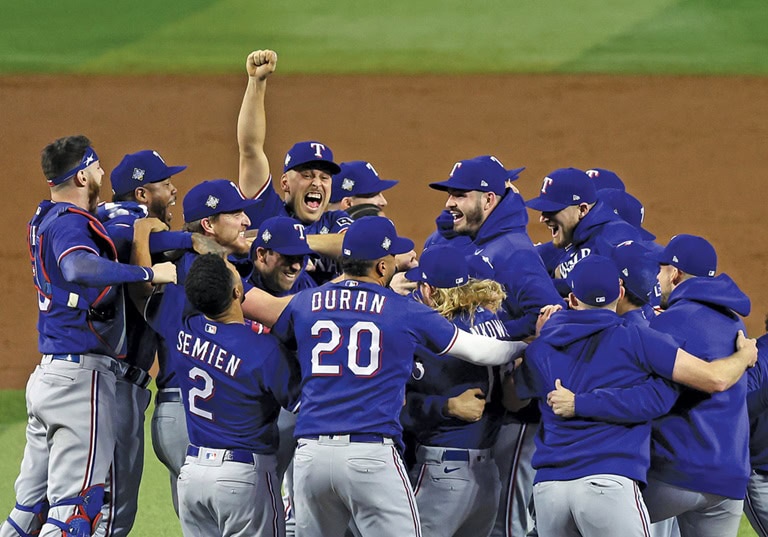
The Texas Rangers Celebrate winning the World Series in October 2023. [Image: Getty]
On MLB’s Opening Day late last March, Ryan Murray, the Texas Rangers Senior Director of Baseball R&D, entered a prompt into Dall-E, OpenAI’s image-generating companion to ChatGPT, to envision the Rangers winning the World Series. He had several of the results printed on canvas and distributed to his department, which adorned their desks throughout the season.
Generative AI didn’t exactly predict the World Series — with the Rangers indeed winning, their first title in club history — but the new technology did play a role.
Baseball clubs have vast quantities of data to consider, both in text via scouting reports as well as news coverage and especially in video, which spans game video, motion capture recordings from the biomechanics lab, high-frame-rate clips taken by scouts and more. The Rangers began implementing generative AI to help process all of that information for the sake of efficiency.
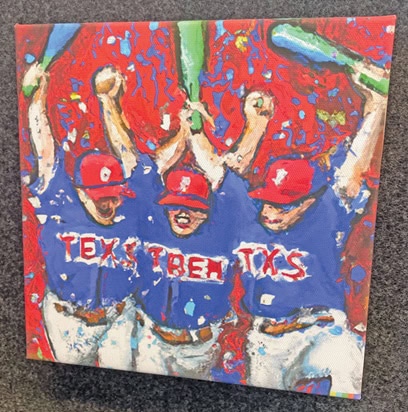
Before last MLB season, an OpenAI tool generated what a World Series win would look like for the Texas Rangers. Then the team experienced the real thing. [Image: Texas Rangers]
Booth acknowledged that, though a work in progress, generative AI’s use has “a lot of buy-in in the organization.” Some areas of continued refinement include ensuring that the algorithms understand the sport’s peculiar lexicon.
“The vernacular that a lot of the scout-specific authors use is pretty unique to baseball,” Booth said. “You may say something like, ‘This guy is built like a truck and throws gas’ — and that’s very, very positive — that he’s got a tree trunk arm. But your off-the-shelf generative AI model may not necessarily understand that. So while we can use pre-trained models to help do a lot of this aggregation and summarization, we’re really looking towards building and fine-tuning our own internalized model that is trained specifically on the baseball language.”
Databricks Head Evangelist Ari Kaplan was an early pioneer in baseball analytics, having worked for or advised more than half of MLB franchises in the past 30 years. He first used AI to make a personnel decision as an Astros consultant in 2007, using machine learning to make the case that Hunter Pence should be promoted to the big leagues. The Rangers are one of Databricks’ MLB clients, and they are developing sentiment scores to assess natural language evaluations. They can also determine if keywords such as “instincts” or “aggressiveness” have any bearing on performance.
“If you have a player who has 20 reports on them over the years, it’s frustrating for me to go through them,” Kaplan said, “and they said, ‘He is good at this. He’s inconsistent. But he has great bat speed. But occasionally he’s lazy running the base.’ I can’t make heads or tails over what’s the bottom line. Does the scout like him or not? So with gen AI, I could just summarize pros/cons or give a sentiment score. ‘This one report is 10 out of 10. But over a dozen scouting reports, the consensus is he’s a 6 out of 10.’”
For now, the Rangers are presenting the information via a retrieval-augmented generation model, a process by which users upload additional pertinent information to guide the algorithms. This can still be presented through a chatbot-style interface.
CrowdIQ CEO Tinus Le Roux envisions a future in which every employee has such a tool to serve as a personal data analyst. His company’s technology takes high-resolution photos and applies computer vision to generate crowd data — tracking its demographic composition and even fans’ attention. Such information can guide team decisions on start times, merchandise offerings, in-venue music and videos.
“Someone in game-day presentation won’t even know what to ask the data science people to improve what they’re doing,” Le Roux said, “but you can give them an app and say, ‘Make recommendations about how I can create a better vibe.’”
Pramana Labs has already begun implementing such automated assistants, who can use prose prompts to access enterprise data. “It’s a sea change in the way that people are going to do work,” CEO Corey Patton said. “I need to empower my subject matter experts to do things at scale.”
One such idea: Comb through typically siloed marketing, ticketing, sponsorship and viewership data to identify brand exposure. Patton shared an example: “‘When so-and-so driver is in the lead more than four laps, viewership goes up to X at this track on Sunday afternoons,’ and you’d be able to then sell sponsorships for that type of logo on a car.”
In addition to content generation, Noah Syken, IBM Vice President of Sports and Entertainment Partnerships, detailed customer service, human resources and code development as areas ripe for disruption through generative AI. Bundesliga is an early user of AWS CodeWhisperer, an AI-powered coding assistant. Google’s Jain explained how his team helped Fox Sports index its 1.7 million archival videos by adding more complete and consistent metadata, enabling clip retrieval by a natural language search.
Another area where generative AI is already helping businesses is in the training of other AI models. While developing Just Walk Out technology, the checkout-less retail experience, Amazon generated synthetic data to “create all these different possible scenarios, even unlikely ones, to be able to make sure that we were capturing everything and fraud was negligent,” AWS’s Souza said.
Asensei, which uses motion capture data for automated feedback, deliberately does not use generative AI in a consumer-facing manner, instead applying “old-fashioned AI” to ensure its human-led coaching expertise drives the user experience, CEO Steven Webster said.
“For generative AI in particular, the more exciting applications are when it gets buried inside a toolset in a product that you’re probably already using, and it makes that toolset and product better,” he added.
But, like Amazon, Webster noted that the generation of synthetic training data makes its markerless motion capture algorithms more effective. Even with the cost of compute power, generative AI is still cheaper and less error-prone than human data collection.
“One of the challenges of computer vision is you don’t want all the training data to be me in the same garage, with the same lighting, wearing the same clothing, with the same skin color, with the same body shape,” he said. “Because you’re really not training the machine to recognize the diversity of the real world it’s going to be out in.”
Souza and Webster both noted the circular nature of using AI systems to train AI systems. Webster took it a step further, saying, “What I’m really excited about is where the technology now exists — and I’m hearing myself just about to say this to you, and I’m like, ‘This is insane’ — that Asensei will be able to teach itself a new movement.”
■ ■ ■ ■
Google’s Jain spoke to SBJ while still reeling from the Arizona Diamondbacks’ World Series loss, so all of his hypothetical examples invoked his favorite baseball team. Among them: the creation of a pseudo-linear feed dynamically generated and completely personalized. Diamondbacks stars Corbin Carroll and Zac Gallen would be fixtures on Anil’s Baseball Channel.
“There’s a lot to be figured out there because I think the technology exists,” Jain said. “The question is, how do we make that feasible and viable and monetizable for media companies to be able to do it?”
The barrier to creating content is lower than ever, but balancing the P&L sheet could be a challenge, at least in the early going.
Technology research consultancy Gartner projects that 80% of large enterprise finance teams will rely on generative AI trained with proprietary business data by 2026. But a VentureBeat survey indicated that, while 73% of companies are either using or experimenting with generative AI, only 18% actually plan to allocate budget for that purpose.
“To use it at the enterprise scale and actually do things of value, there’s a significant cost to it,” Pramana’s Patton said. “So it will provide value, I am certain of that, but I’m also a little bit skeptical of the cost not being a barrier to the output in the future.”
The market is changing rapidly, in favor of democratization. Enough tech companies are building their own large language models that few will need to custom-build it; they will just apply what’s available.
“The cost to train a model could have been tens of millions six months ago, but now you may not need to train the model,” AWS’s Nandi said. “You have all these small models popping up. You may just need to add your data, and in a month or two, you may not need to add your data. You may use a Bedrock agent to constrain it.”
For those who do have proprietary data, it can be a new revenue source. The PGA Tour’s Gutterman noted the importance of cybersecurity for IP protection and what’s known as “red teaming” the models — industry slang for rooting out toxicity and bias — but having the tour’s golf data available for licensing could boost the bottom line for third parties wanting to engage with golf fans.
The definition of “rights holder” could evolve, too. “Another challenge/opportunity, which we’re already starting to see and hear in talks, is media rights,” Shichman said. “What does it mean to have media rights now that you can start to generate new things that didn’t exist before? Who is allowed to do what with generating content, A, on the training side of things, but B, on creating a type of content? What is considered to be part of the rights package that you acquired and what isn’t?”
The experts interviewed by SBJ saw AI improving workers’ productivity more than replacing them. And there could even be a new job description that emerges.
“We were joking that more and more companies are soon going to be needing to hire CPOs, which is chief prompt officer,” said Uplift Labs CEO Sukemasa Kabayama, whose company uses computer vision to analyze athlete biomechanics. “I think gen AI is going to be just as ubiquitous as the internet.”
The club design process can take up to a year and shares several elements with manufacturing in Formula 1, from AI-powered software to generative design tools.
A Data & Innovation article brought to you by
Altair’s engineering started in the automotive industry when it launched 38 years ago, which Benhayoun called one of the “most complex industries.” That complexity allowed Altair to grow and touch many other facets of engineering technology, such as the design of golf clubs.
To illustrate the intricacies of a golf club build, Benhayoun points out that the average car design takes roughly two years. Golf clubs can take between nine and 12 months. So while the club may look much simpler than your average vehicle, both have to account for so many variables. F1 is also using the same technology to develop faster cars. “You’re designing a product that has multiple needs and multiple expectations and multiple factors around it,” Benhayoun said. “When you look at golf clubs, there is the human factor. There’s the technology performance factor of things: how fast it is, feel, how beautiful does it look, etc.”
With all of that to consider, Altair’s software helps streamline the entire design process. AI-powered simulations and generative design tools (through Altair’s simulation/design platform called HyperWorks) can run prototype clubs through numerous projected test swings and cut down on production waste. They’ve also developed digital twin tech to help visualize the data.
Benhayoun has been with Altair since 2012, and in that time, he’s watched the golf club conform to include two significant elements. The first is forgiveness for the golfer, no matter their skill level. The forgiveness of the clubs now, he said, is far superior due to the massive number of digital tests a club set can go through before mass production.
The second has been resilience to the strain caused by the top-level athlete. Case in point: The average drive on the PGA Tour is 299.8 yards (274.14 m). Carbon shafts and club heads have been tested in Altair’s software too before they hit the market.
“We are delivering that software that allows you to do things digitally,” Benhayoun said. “Instead of testing in your (golf club manufacturing) lab, you’re testing on your computer. And now instead of testing one club a day, you’re testing thousands of designs a day for different players, the amateur and the professional.”
