In this edition of The Athlete’s Voice, Cheyenne Knight discusses her use of the SuperSpeed Golf’s innovative program.
A Data & Innovation article brought to you by

You can’t have a discussion about sports technology today without including athletes in that conversation. Their partnerships, investments and endorsements help fuel the space – they have emerged as major stakeholders in the sports tech ecosystem. The Athlete’s Voice series highlights the athletes leading the way and the projects and products they’re putting their influence behind.
* * * * *
En route to that win, Knight noticed tangible improvements in her swing speed and drive distance thanks to her work with SuperSpeed Golf, a company that utilizes data and targeted speed training to increase swing speeds. SuperSpeed’s core offering is a three-piece set of weighted clubs designed to reprogram a players’ neuromuscular reaction time by training from both their dominant and non-dominant side.
“My partner (for the Dow Great Lakes Bay Invitational) Elizabeth hits it pretty far, she’s probably one of the longest on tour,” Knight said. “We were kind of joking around, she’s like, ‘Man, Cheyenne! You’re hitting it out here kind of close to what I do.’”
Knight first purchased a SuperSpeed set in college, and officially signed on as a partner in 2023. The company, which started signing player ambassadors earlier this year, had between 700 and 1,000 player clients as of late June.
As for Knight, SuperSpeed reports that her ball speed increased by nearly 10 miles per hour – from 128 to 136-137 – within two months of adopting her focused speed training regimen.
Here, Knight discusses her work with SuperSpeed and using technology as a tool in her training.
On the motivation to first purchase a SuperSpeed set…
Growing up [as a golfer], it was kind of different as to what kids are taught now. I think now kids are just taught to swing as hard as they can and then figure out where it goes later. But when I was growing up, and I feel like for my generation, it was more, ‘You need to hit it straight.’ And then you saw the shift, I think starting with Bryson [DeChambeau], that really made people think about speed. With SuperSpeed there was a market for that, to help you hit it further. I bought the set and watched the instructional videos on their website. That’s how it got started.
On using the program…
I was lucky enough to do it with the SuperSpeed team and they showed me everything. You make it your own. There’s different things. You have the speed sticks – there’s light, medium, heavy, and then a counterbalance stick. There’s different series of swings that you do on your dominant and non-dominant side.
It doesn’t take that long – you do a few swings with each, like a step-and-swing, and there’s a radar that tells you how fast you’re swinging it. And the goal is to swing the heavy one close or the same as you do the light one. There’s other equipment that they also offer that helps you with your grip strength and these little discs that help you use the ground better. I think with that you’re just really trying to learn how you need to incorporate speed, because using the ground, pushing off the ground is a really big leap in power.
On the specific improvements with SuperSpeed…
I hit the ball pretty straight, but I’m not one of the longest hitters on the LPGA. I feel like you can only benefit from [SuperSpeed]. It doesn’t change the mechanics of your swing, it just teaches you how you can hit the ball further and gain some speed. I just used it as a tool.
I just wanted to see some gains in my swing speed and my club head speed. And if I could gain a few miles per hour, I would hit it further off the tee and kind of just have some different clubs into the greens. When you increase your club head speed and your swing speed, you generate more spin, so that would help my irons too, just being able to generate more spin and hold some of the greens more – because I’m usually coming in sometimes as a longer club than the other girls.
On feedback from SuperSpeed…
When I spent the day with them, I saw some gains in my club head speed and ball speed. I think, for me, swinging on my non-dominant side was really good. Just learning how my body works, and you’re on the force plates and seeing where I lose some of my power. The kind of stuff I already knew – I don’t load that well into my right side in my backswing. But seeing it from a different perspective and technology definitely helped. Me swinging lefthanded, it really gets my muscles engaged and learning how to load a little bit better by swinging on my non-dominant side.
On the length of time it took to see results on the course…
It’s a little tricky, because when I’m playing in a tournament I’m so in-tuned to what’s going on. When you hit it off a tee, I didn’t know if I was hitting it further because at that point I’m just trying to hit the fairway when I’m in competition.
But I would say I really noticed it with my irons, because with my irons you’re being more specific of how far you need to carry it onto the green. I could tell I was picking up three or four yards in carry with my irons. And that was probably two months into it that I saw that.
On being technologically inclined in training…
I’m not going to go online and buy a bunch of stuff to just see if it works. I’m more of a word-of-mouth person. So when SuperSpeed first launched on the market, I heard a lot about it from people in my industry. The guy who fits me, Art Sellinger, in Dallas, my club-fitter, he had talked about SuperSpeed and how that could help me.
The golf community is quite small, and if there’s a good product out there, people will talk about it and rave about it. That’s how I heard about SuperSpeed. Technology-wise, I’ll get a TrackMan or a GCQuad. I’m a TrackMan person. I use SuperSpeed and AimPoint.
This article was brought to you by SBJ Tech, a Leaders Group company. As a Leaders Performance Institute member, you are able to enjoy exclusive access to SBJ Tech content in the field of athletic performance.
The company’s Virtual Greens demonstrate that golfers not only win majors with the clubs in their bag, but with actuator modules, infrared line scan cameras and proprietary apps.
Main image courtesy of Full Swing
A Data & Innovation article brought to you by
Leading up to his four-stroke victory in Augusta in April, Rahm relied on a trio of tech-savvy products from Full Swing that helped turn his borderline weaknesses into strengths. It only goes to show that golfers not only win majors with the clubs in their bag, but with actuator modules, infrared line scan cameras and proprietary apps.
“I had been looking into the best way to practice all aspects of my game at home,” Rahm has said of his decision to install Full Swing’s devices, and, as a result, his sprawling home in Arizona is now one of the epicenters of golf.
In one corner of his house sits an approximate 4-by-8 sliver of sophisticated turf that is actually a high-tech “Virtual Green” simulating the quick 12 to 14 breaks of Augusta National. Immersed with dozens of actuator modules — which move to recreate downhill, uphill, right breaks, left breaks, crests, valleys and hills — the interactive putting green enabled Rahm to zero in on one of his main concerns heading into the Masters.
“Jon just wanted to work on little short left or righters,” Ryan Dotters, CEO of Full Swing, told SBJ. “Because that’s what he kind of struggled with in the past. So we put a smaller Virtual Green in for him. He wanted a nice little square one.
“That’s just what he wanted to focus on to get better: these four to five foot putts that are left or right breakers. And we got [the Virtual Green] down to where it’s super fast, it’s Augusta fast in there…We got that one to the 14 [break] that he needed for the Masters.”
Other adaptive putting greens on the market can tilt left and right or forward and back. But none are said to have Full Swing’s patented actuator modules that can simulate any break on any course in the world with the click of a button. The Virtual Greens, which vary in size and are priced between $70,900 and $95,400, are equipped with an accompanying computer, whose software can replicate subtle, moderate or severe breaks on request.
Only about 400 of them have been on the market so far — “It’s expensive to make, expensive to ship, expensive to install,” Dotters said —but Rahm, Tiger Woods and Jason Day actually own three of those 400 — and have all become Full Swing ambassadors. Woods, in fact, has equity in the company.
In another corner of Rahm’s basement is what had Woods originally buying in: the Full Swing simulator. The company, in fact, was birthed circa 2019 with simulators in mind, and early iterations that included highspeed ION3 cameras drew the interest of Rahm’s tech-centric coach Dave Phillips.
As co-founder of the Titleist Performance Institute in Oceanside, Calif., Phillips began offering his insights to Dotters and the company’s engineers on how to advance their Full Swing simulator further. At around the same time, Rahm was living in his home overlooking an Arizona golf course, baking through 110-degree practice rounds. Looking for a cooler, indoor solution, Phillips steered Rahm to the Full Swing simulator, as it continued ideating the latest technology.
Then, last September, the company released its Pro model simulator that leveraged infrared line scan cameras to create virtually a latency-free experience. The overhead ION3 camera tracks the golf ball on impact, and as the ball crosses the infrared line, it triggers the computer to instantly mimic the shot — producing ball speed, launch direction, launch angle and a visual of the ball flight in real time.
Other simulators generally do not have the ability to track a ball without delay because the devices first calculate ball flight, then rotate the screen to where the ball should land and then provide an image. The difference in elapsed time may seem minor, but to a pro like Rahm the Full Swing Pro was a breath of fresh air…less than 110 degrees.
As a result, he was able to replicate Amen Corner at Augusta over and over to prepare for the Masters, and when the weather was amenable, he’d then retreat outside to train with Full Swing’s third and most recent innovation, the KIT Launch Monitor.
Released originally in December of 2021 with incremental input from Woods, the KIT Launch Monitor — placed in close proximity behind the golfer — used a dual radar system to track a ball from impact-to-landing-to-roll while also identifying the dimple dispersion off the front face of the ball along with rotation and seam. The litany of metrics included spin rate, spin axis, ball speed, attack angle and more. But the statistic Rahm most cared about was: carry.
Dotters asked Rahm questions such as: “How can we make these better? What does the interface look like? What’s the app looking like?” Rahm provided feedback, and a new, improved version. “[It was] a 3-to-4-year project that took a lot of testing and a lot of capital to get right,” Dotters says. It was delivered to Rahm months before the Masters.
“The screen was a big one for Jon,” Dotters says. “He wanted to just turn around look and see what the numbers were. But it really came down to carry numbers for him. He needed those to be exact. And we’ve done a really good job of being pinpoint accurate with carry. Whether it’s 350 with a driver or 60 yards with a wedge, carry is just Jon’s biggest metric.
“Sometimes he doesn’t need to hit it 320, he needs to back it down. So he needs to know those carry numbers and we’ve learned we are really good at this. So I think what I can relay —through his conversations with me and his testing — is that it gave him a leg up at the Masters.”
And a certain green jacket.
This article was brought to you by SBJ Tech, a Leaders Group company. As a Leaders Performance Institute member, you are able to enjoy exclusive access to SBJ Tech content in the field of athletic performance.
The startup’s AI-powered nutrition app is helping athletes to optimize their performance.
Main image courtesy of Hexis
A Data & Innovation article brought to you by
Through that experience, Dunne saw numerous innovations aiding sport science peers as they collected data and provided insights on athletic readiness and training loads, but there was nothing comparable for his field. That realization prompted the founding of Hexis, an AI-powered personalized nutrition app.
“Although wearables had rushed ahead and people were harvesting continuous physiological data from other sources, nutrition had really lagged behind,” said Dunne, the company’s CEO. “Everything was still a tracker and calorie counter. So we decided to take some of the advancements in sports nutrition in elite sport, which were really centered around predictive nutrition and understanding how to periodize intake, according to the load and demands of the day.”
After launching publicly in Q3 last year, Hexis has attracted more than 500 paid subscribers, of which more than 10% are professional and Olympic athletes. Endurance athletes are the most represented group. In mid-April it launched an integration with Apple Health to ingest more objective data for custom meal plans and also an in-house food tracking feature that Dunne believes will improve upon what’s available at MyFitnessPal.
Users are onboarded by sharing info about their sport, lifestyle, sleep patterns, weight, body composition, typical meals and training schedule and their goals. The duration and intensity of training is considered in generating a meal plan automatically. One recently added feature, Live Energy, evaluates intake versus expenditure at a micro level.
“If, for example, this went from being a light session into a hard session, everything pretty much updates on the fly as though I was your nutritionist in your pocket and how I would manipulate things,” Dunne said.
A desktop dashboard for team nutritionists to monitor an entire roster is in development. That’s an acute need in the field, as the best nutrition plans are personalized, which necessarily requires more time and effort. Augmenting a nutritionist’s resources to be more efficient is what helped bring together two of Hexis’ co-founders in the first place.
Dunne, whose longest team stint was with the Harlequins in Premiership Rugby, and British Cycling’s lead nutritionist, Sam Impey, both did their PhD work at Liverpool John Moores University and often crossed paths at industry events.
“Whenever we’d catch up, normally over a beer at a conference, and it was quite weird how often we’d see similarities in the challenges that we faced, even though [cycling and rugby are] dramatically different sports — but the issues of nutrition around scalability,” Impey said.
Their sub-disciplines within performance nutrition were different — Impey focused on carbohydrate periodization and physiological changes to the muscle whereas Dunne is a behavioral scientist with an expertise in the use of technology — but they both identified that same need.
While holding a postdoctoral position at the University of Birmingham, Impey began exploring the application of his PhD research around the timing of carbohydrate intake to help the body best adapt to training. Proper nutrition can increase the benefit of exercise, helping people get fitter, faster. He said he had compiled “a reasonably interesting Excel sheet” and thought he’d bounce some ideas off Dunne.
“I’ll never forget his face when I showed it to him,” Impey recalled, “because he was like, ‘Wow, that’s interesting.’ And he said, ‘Look, I’m actually doing the the same thing.’ But I think he was nine, 12 months, further down the road than me.”
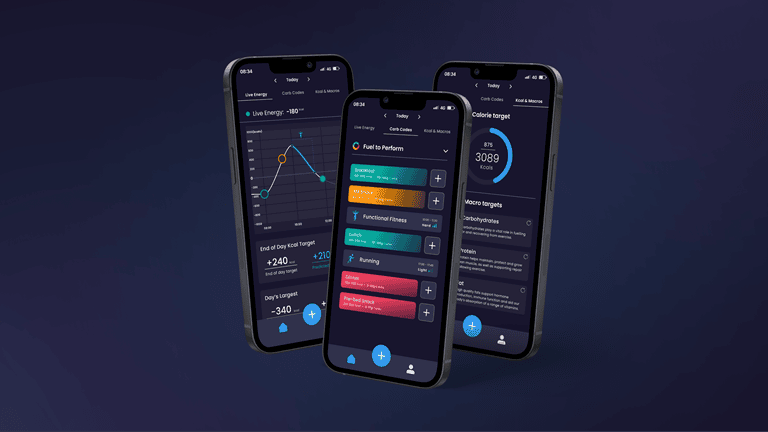
Image courtesy of Hexis
They joined forces, along with three other co-founders: Rodrigo Mazorra Blanco, the director of engineering and CFO; Xiaoxi Yan, who leads data science; and Carmen Lefevre-Lewis, a behavioral scientist who is also a UX research manager at Meta. Impey praised the executive team’s diverse experience and its “strong and encouraging check-and-challenge culture.”
Though most of the team’s experience is in Europe, Dunne’s CV includes a stint as a performance science consultant for Orreco — winner of SBJ Tech’s Best in Athlete Performance for 2022 — where he provided in-person support to client teams, including a two-year stint helping out periodically with the NBA’s Dallas Mavericks.
As with many startups, Hexis draws on elite sport experience to design and develop the product so it’s suitable for professional athletes, but the app is accessible for anyone who trains regularly.
“The reason we built Hexis and where we thought we could really cause a shift in behavior is more around planning,” Impey said, explaining that most tools available are retrospective, but they want to target prospective action.
“Adherence is obviously the golden nugget for everyone,” Dunne said, noting that team spends extensive time exploring ways to engage with all kinds of users who respond to different messaging and prompts at different times of day.
As prevalent as the technology is, one area Hexis has not delved into is machine learning. “When it comes to physiology, we don’t want the system to make a mistake and learn from its mistake,” Dunne said. “We feel there’s pretty good rules around exercise metabolism and biochemistry that, with the development of AI and expert systems, we can give a right and a wrong answer.”
This article was brought to you by SBJ Tech, a Leaders Group company. As a Leaders Performance Institute member, you are able to enjoy exclusive access to SBJ Tech content in the field of athletic performance.
Dylan Frittelli is among those using TourIQ for their own game analysis, course profiles, hole strategy recommendations and a schedule optimizer that can recommend which tournaments a golfer enters.
A Data & Innovation article brought to you by
Such power can come with a cost in accuracy, however. Until recently, when he began working with Cory Jez and his new TourIQ golf analytics business, Frittelli had no way to objectively measure the holistic impact on his game.
“I wouldn’t have any clue how to go about it,” Frittelli said. But he was able to ask Jez, “Have I actually improved my overall ball striking? Or does missing a few more fairways actually hurt me?”
“He did a deep dive in the analysis,” Frittelli continued, “and he basically found out it was almost a break-even, but then my wedge play was much worse out of the rough. So he was like, ‘Look, you’re hitting it much farther down, but you’re in the rough more.’ And between him and my coach, we decided, OK, maybe I’m going to toggle back a bit on driving distance.”
Golf is a data-rich sport, particularly with the PGA Tour’s Shotlink system generating several metrics per shot (and with an upgrade expected soon). TourIQ has more than 12 million Shotlink-tracked shots in its database. But golfers are independent contractors who don’t have the pooled resources to establish the necessary data infrastructure or hire analysts and developers to mine for insights.
That’s the need Jez is trying to fill. He is a former Director of Basketball Analytics for the Utah Jazz who then held a similar role foe Austin FC. That’s where he met Frittelli, a University of Texas graduate who had befriended some of the MLS club’s executives. Jez developed TourIQ to analyze and visualize data across four modules: a player’s own game analysis, course profiles, hole strategy recommendations and a schedule optimizer that can recommend which tournaments a golfer enters.
“It’s exactly what I would build for an NBA team, but it’s just built for a PGA Tour golfer instead,” Jez said. “For one-tenth of that cost, you can get 95% of the benefit.”

Photo: TourIQ
There are two tiers of access. Platform partners can use the portal for a fee in the low five figures while consulting partners receive additional individualized analysis for a flat fee plus a commission based on Tour earnings.
Jez is the founder and CEO while his software engineer is Phil Baker, whose day job is as the Assistant Director of Baseball Systems for the Cleveland Guardians. TourIQ’s advisors include BreakAway Data co-founder Steve Gera and StatsBomb founder Ted Knutson. They draw on their experience in pro team settings to inform not only the relevant data science but also the communication of the findings.
“I quickly realized in those roles that, obviously, the Moneyball part — building the predictive model to value the player — is definitely part of the job,” Jez said, “but so much of the job is, how do you get this information to your stakeholders in a really quick, easy-to-consume, easy-to-integrate way? How do you get a head coach to use the model?”
Two years ago, Frittelli spent considerable time working on his putting. After a couple months of practice, Frittelli wondered how it really translated to his performance.
“I knew my putting was bad — bad relative to the other guys — but I didn’t really have a metric to tell whether it was getting better or worse,” he said.
There are so many variables in terms of greens and pins to sift out the signal from the noise, but Jez built a model to determine that Frittelli’s putting was, in fact, improving.
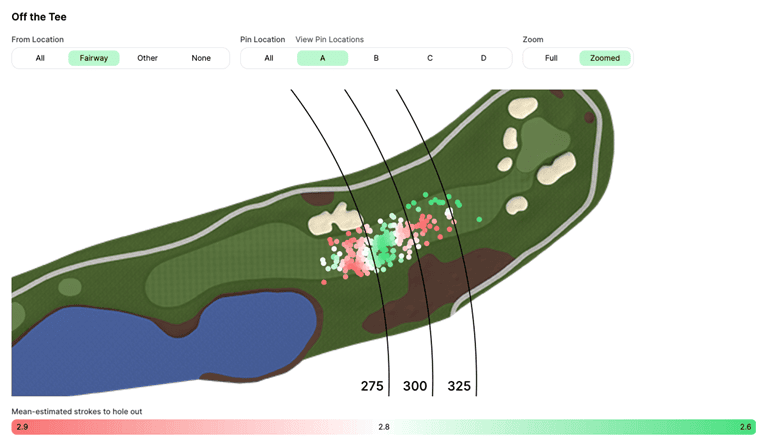
Photo: TourIQ
“There’s a bit of evidence here: now I know what I’m working on helps,” Frittelli said. “Previously I would just go on feel and I’d be looking at it like tournament to tournament or day by day. And it’s really hard to have that sort of bird’s eye view and know if you’re getting better when you’re just looking at small snippets of data.”
TourIQ normalizes the data to account for course variations and strength of tournament field, using 24- and 76-round moving averages as the default comparisons for recent play and baseline performance. The schedule optimizer identified two courses in particular for Frittelli to enter: the Sanderson Farms Championship in Jackson, Mississippi, and the World Wide Technology Championship in Mexico.
The 17th green at the Waste Management Phoenix Open proved a good case study in hole strategy. It’s a drivable par-four, but the second round’s pin location in the back-right corner mandated a different approach: hit to right of the green rather than straight ahead. Frittelli followed suit and made a birdie.
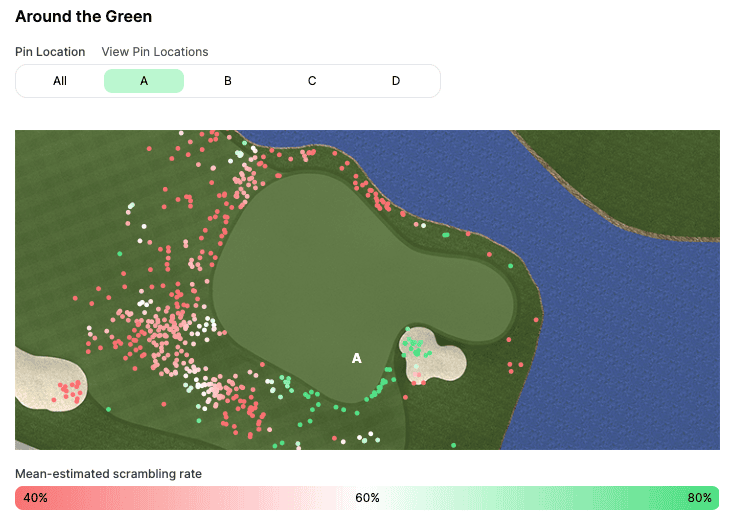
Photo: TourIQ
Generally, Frittelli said, his own experience and the accumulated wisdom of his long-tenured caddie are sufficient. But some of TourIQ’s more counterintuitive recommendations are worth jotting down in his yardage book.
“That’s what I always tell him, ‘I want to find anomalies,’” he said. “It doesn’t help if you tell me to miss it in the right rough here or left rough there. That’s obvious on most holes. But if there’s a random one that says ‘hit it in a different fairway’ or ‘hit it in this fairway bunker’ that gives me an edge that I wouldn’t think about, that’s where he comes in big time.”
“We can essentially give players the cheat sheet on how to play this hole when the pin’s front, when the pin’s back,” said Jez, noting that impact of a shot or two improvement per round. “Being able to make more informed decisions on those margins might be the difference between keeping your [Tour] Card or not. You take a missed cut, and you replace it with a 20th [place] — and you’re a guy who is a middle-of-the-field type of player — and that has really big implications.”
This article was brought to you by SBJ Tech, a Leaders Group company. As a Leaders Performance Institute member, you are able to enjoy exclusive access to SBJ Tech content in the field of athletic performance.
The asymmetrical training bar has helped PGA Tour players including Scheffler, Jordan Spieth, Zach Johnson and Ryan Palmer with their stability and mobility patterns.

A trained chiropractor with a focus on sports biomechanics, Van Biezen does some treatment on the training table before Scheffler begins his warm-ups. For the vast majority of that time—85%, Van Biezen estimates—the recent Masters champion is clutching GolfForever’s new SwingTrainer, a 44.5-inch, asymmetrically-weighted training bar with attachments that either replicate the feel of a driver or a club head that’s 2.5 times heavier for training. There is also a detachable resistance band for a wide variety of exercises.
“When we’re on the road, SwingTrainer is an integral part of our warm-ups and our training throughout the week,” says Van Biezen, who has worked on the PGA Tour for 20 years with Jordan Spieth, Zach Johnson, Ryan Palmer and others. “What I try to do in a gym, which is under a controlled environment, is just mimic the movement patterns that we want to have Scottie integrate into his golf swing. The SwingTrainer has been a very versatile, durable tool that we can apply those movement patterns under a light load but generating that neural pathway pattern to get that brain working on certain movements we want to get him into.”
GolfForever is the spinoff of chiropractor Jeremy James’ BackForever program, and the SwingTrainer launched in November as a training tool to complement the library of video content in the program. Scheffler, who has been training with Van Biezen for a decade in the Dallas area, recently joined Justin Leonard as a GolfForever ambassador, calling the SwingTrainer “critical” to his Tour preparation.
James, whose practice is based in Aspen, Colorado, welcomed patients suffering from chronic back pain for weeks or even months at his facility. Recognizing the challenge and expense of his location, he sought to distribute his message further, first by writing a book and then by recording streamed video content. Many of his most active users were golfers, which spurred the development of the GolfForever package that launched in 2019.
“Golf does a very predictable set of things to your body,” James says. “From a biomechanical perspective, it’s a repetitive, asymmetrical motion, and if you’re not in great shape or if you’ve had injuries in the past, it’s going to wear your body down.”
For the first couple of years, GolfForever relied primarily on resistance bands, but James sought to more precisely target the core muscles that generate and resist the rotational forces created during a golf swing. “We didn’t invent the idea of asymmetrical bar training—that had been in the fitness world for a while—but we took that concept and we made it specific for a golfer,” James says.
The SwingTrainer helps golfers open up the joints in all three planes of the swing, Van Biezen says, referring to the sagittal (left/right), frontal (front/back) and transverse (top/bottom) planes. He’ll have Scheffler do a side lunge with a rotation, a Bulgarian squat while doing a unilateral push or a single-leg overhead press, all while incorporating the SwingTrainer.
“With Scottie, he’s very, very strong,” Van Biezen says. “It’s just now, with the GolfForever, what I really like about is it just helps a lot with the stability and mobility patterns. It’s just a really high-beneficial, low-risk training tool. I think golf fitness has probably gone down one extreme where you get the Olympic lifting and all that kind of stuff and guys really getting hurt. I’ve always said the game of golf is a marathon, not a sprint. And so these guys can play for a long period of time and perform at a high level if they just keep themselves healthy.”
Van Biezen says he believes strongly in rigorous baseline testing to track movement patterns and detect asymmetries. He uses 3D motion capture regularly and employs massage therapists and strength coaches at his facility. There is also a golf shop and hitting bay with club fitting and repair, making it a one-stop destination. Scheffler first visited around the age of 14 or 15 and has kept coming back, much like Spieth, the 28-year-old who ascended to a world No 1 ranking in 2015.
“What’s going on with Scottie right now, it’s kind of like Groundhog Day for me with what happened with Jordan around the same time,” Scheffler says. “They both had a little bit of low back issues, and that’s why they first came in. Then they both just realized, for injury prevention, they have to start doing stuff off the golf course.”
Last season, Scheffler had eight top-10 finishes in his 29 starts but no wins. In fact, he had never won a tournament prior to the WM Phoenix Open in February—which began a streak of four wins in six tries, culminating in his Masters victory. Van Biezen pushed him hard in the offseason to strengthen his upper body and core but also build his endurance so that he was as fresh during the back nine on Sunday as he was the front nine on Thursday. By a small margin, his fourth round average a year ago was his worst, and his first round was his best.
“We’re just beginning to see everything come together finally,” Van Biezen says.
This article was brought to you by SportTechie, a Leaders Group company. As a Leaders Performance Institute member, you are able to enjoy exclusive access to SportTechie content in the field of athletic performance.