23 Feb 2026
ArticlesAs Warwickshire’s Performance Director James Thomas explains, strategy is not about establishing certainty, it’s about people, collaboration and coherence.
Often the word elicits a raised eyebrow amidst busy training and competition schedules or it alludes to scarce downtime for coaches and practitioners.
It is also associated with corporate language, long documents and theoretical discussions that feel disconnected from the daily reality of training, selection and competition. In high-pressure environments, planning (reviewing and learning) can be seen as a luxury, something to revisit once results improve or uncertainty settles.
My experience has been the opposite. I’m passionate about helping raise awareness of the importance and performance impact of great strategic planning.
Strategy: a precursor to performance
After more than two decades working across Olympic and professional sport, I have come to believe that performance strategy and planning are not distractions from performance, they are precursors to it. In environments often defined by pressure, volatility and constant change, strategy provides something invaluable: direction, connection and a level of continuity.
High-performance sport is inherently unstable. Calendars shift, athletes get injured, form fluctuates, staff move on, leaders change and external demands arrive without warning. In that context, the absence of a clear performance strategy does not create freedom. It creates noise. Decisions become reactive, alignment erodes, and short-term fixes quietly undermine decision-making rooted in the agreed long-term ambition.
The organisations that perform most consistently are not those that plan less. They are those that build solid foundations, plan with intent, adapt with discipline and continue to stay rooted to the agreed values and behaviours when circumstances change.
Planned Olympic success
One of the clearest demonstrations of the value of performance strategy in my career came during my time as Performance Director at British Gymnastics in the build-up to, and during, the delayed Tokyo Olympic Games in 2021.
This period was defined by disruption. The global COVID-19 pandemic fundamentally altered how athletes trained, competed and lived. Lockdowns restricted facility access. Competition schedules collapsed and re-emerged unpredictably. Athlete preparation was fragmented, and long-term planning was constantly challenged.
At the same time, the organisation was navigating a significant cultural crisis. The Whyte Review had been co-commissioned by UK Sport and Sport England in 2020 following allegations of abuse and mistreatment within gymnastics in Britain. Trust had been damaged, scrutiny was intense and the responsibility to rebuild confidence, both internally and externally, sat alongside the imperative to perform on the world’s biggest stage, the Olympic Games.
In that environment, strategy became an anchor.
It provided stability when circumstances were anything but stable. Performance strategy gave athletes, coaches and staff a clear sense of direction at a time when certainty was scarce. It reminded us of our five principles of high performance, our data informed team strategies for qualifications and finals, and created a shared understanding of what mattered most, even as day-to-day plans shifted repeatedly. This anchor also supported me during really challenging times when key staff behaviours or direction of travel didn’t align to our beliefs and approach. It gave me confidence to hold the line and make the tough decisions that leaders are so often faced with.
Rather than attempting to predict an uncertain future, the strategy focused on the team, the people, the data and practitioner-informed principles that we talked about for over three years. It established how decisions would be made, what trade-offs we were prepared to accept and those ‘what if’ scenarios that can always catch you off guard. One of these being the Head Coach breaking their leg 48 hours before heading to Tokyo. We actually had a plan for this!
This allowed the system to adapt without losing its identity.
That experience was one of the most challenging of my career, but always hugely exciting and rewarding. Three planned, but hard-earned medals secured for Team GB reinforced a core belief: strategy is not about certainty. It is about people, collaboration and coherence.
Different sports, same principles for high performance
The same principle holds true in professional football, albeit at a different scale.
During my time as Director of Performance Services at Manchester City, operating within the City Football Group, I saw first-hand how long-term strategic planning can drive sustained performance improvement across an entire ecosystem.
At Manchester City, consistent performance progression was not the product of isolated excellence or short-term cycles. It was anchored in a clear long-term plan that connected the Academy, Women’s and Men’s first teams through shared principles, aligned methodologies and a common performance language.
That plan did not seek to eliminate fluctuation. Ebb and flow were expected. Injuries, form, competition demands, squad evolution and commercial demands were all recognised as natural parts of elite sport. What mattered was that the long-term vision, the direction of travel remained consistent, even as tactics and personnel changed.
Crucially, this strategic clarity extended beyond a single team or season. It flowed across the wider City Football Group model, creating a level of coherence across clubs operating in different countries, cultures and competitive contexts. While local adaptation was encouraged, the underlying performance philosophy remained aligned.
The level of consistent on-pitch success at Manchester City over the last 5-7 years, in many ways, is unparalleled, from Academy player progression and sales to the Men’s first team treble in 2023. Long-term business and performance strategy has a lot to do with this, in my opinion.
Good performance strategy increases speed
Modern high-performance environments are defined by complexity. Multiple competitions, condensed calendars, overlapping priorities and increasingly specialised roles place constant strain on alignment. Planning in these environments is often misunderstood as control. In reality, it is the opposite.
When direction is clear, decisions decentralise. Coaches, athletes and staff can act with confidence because they understand the broader context. When strategy is absent, everything escalates upwards. Decisions slow, responsibility blurs and energy is wasted re-litigating the same conversations week after week.
The VMOST model
At this point, structures and frameworks matter.
One of the most effective ways I have seen performance strategy articulated in high-performance sport is through clear, simple models that translate long-term ambition into day-to-day action.
One such model is VMOST (Vision, Mission, Objectives, Strategy and Tactics).
VMOST was created by business strategist Rakesh Sondhi and first proposed in 1999 book Total Strategy. The framework provides a disciplined way of connecting the big picture of the future to the daily actions, tasks and deliverables required to get there.
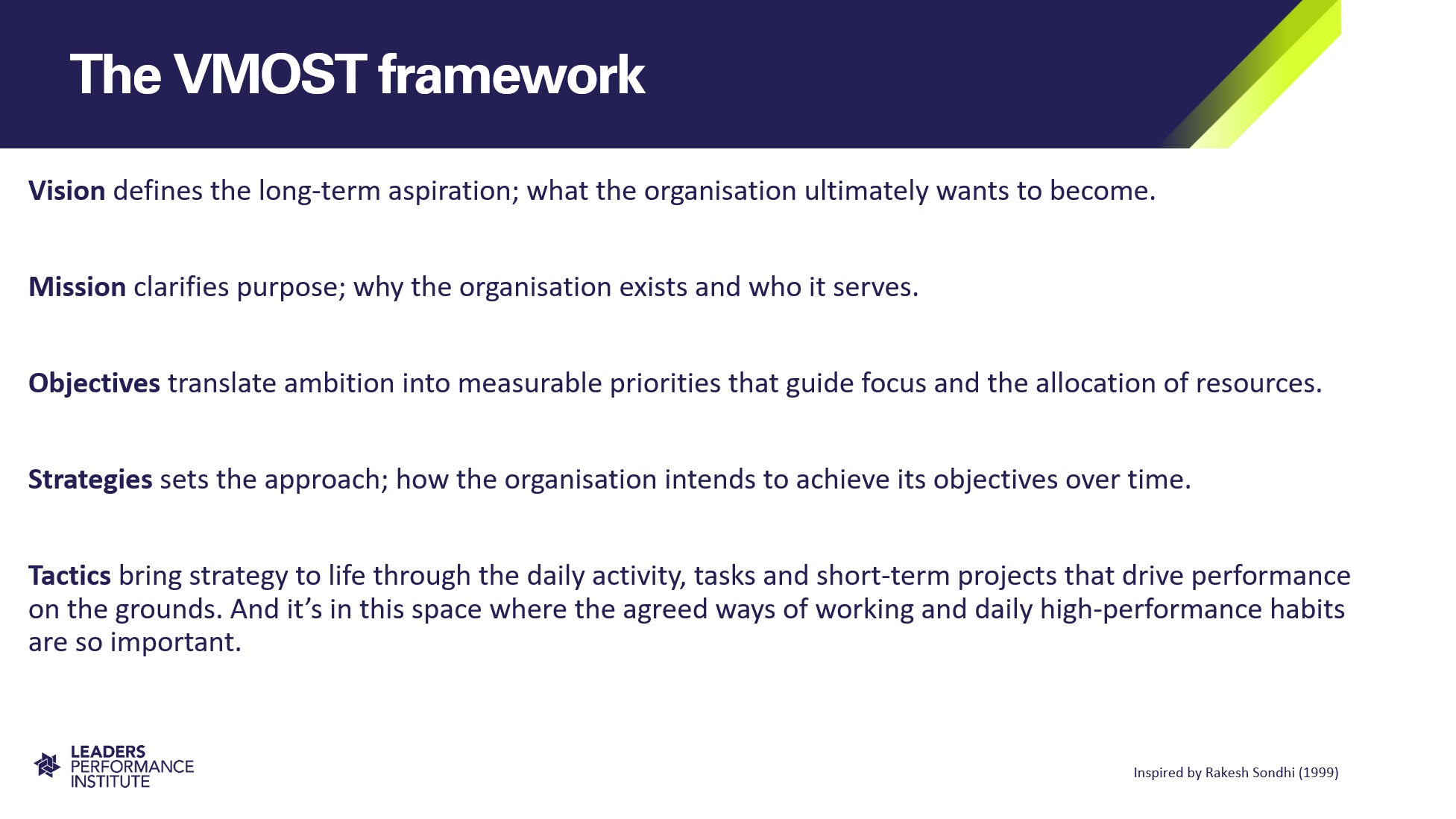
The power of VMOST lies in its simplicity.
In high-performance environments, complexity is already high. Strategy models must reduce cognitive load, not add to it. VMOST creates line of sight. Individuals can see how their daily work connects all the way through to the long-term vision of the team and/or organisation. In my last two roles as a performance director, my VMOST strategy was etched onto a big wall, one which staff members and athletes walked passed regularly. And when curious conversations or even debates took place, we often found ourselves standing around the visual, challenging whether a new idea could really help us achieve a strategy or the mission, or was it something that could derail us and divert energy, with no clear route to helping us win. This is definitely something I am taking into my new role in professional cricket.
When applied well, this kind of structure does not constrain creativity. It enables it. People can feel empowered to adapt, innovate and solve problems within a clear strategic frame.
A new era in professional cricket
In cricket, this strategic clarity is particularly valuable and I’m living this right now as Performance Director at Warwickshire and the Birmingham Phoenix.
Across a single season, players move between formats that demand entirely different physical, technical and psychological outputs. Red-ball cricket rewards patience, control and endurance. Short-form formats demand clarity, aggression and adaptability. Players are selected for specific skill sets, yet all must contribute to a collective performance.
Without a clear strategic framework, these transitions become chaotic. Workloads conflict, roles blur and development stalls. With strategy, complexity becomes more manageable. Individuals understand their role, how it evolves across formats, and how their contribution supports the team’s wider ambition.
At its best, performance strategy connects people.
High-performance sport is full of specialists. Coaches, analysts, medics, strength staff and operations teams all operate in defined roles, and rightly so. The risk is not a lack of expertise, but fragmentation. Excellent work happening in isolation without a clear line of sight to the bigger picture, is one of the biggest risks leaders can face.
A well-articulated strategy creates connection. It allows people to see how their work links through to the final mission and vision of the organisation. Daily decisions gain meaning. Trade-offs become easier to navigate. Autonomy increases because intent is understood.
When people understand why their work matters, they can make better decisions.
Strategy also provides continuity in environments where turnover is inevitable.
Athletes move on. Coaches change. Support staff rotate. In some organisations, meaningful personnel change happens every season. Culture alone cannot carry performance identity through that level of churn.
Strategy creates continuity of thought.
It anchors philosophy, ambition and non-negotiable principles beyond any individual. It allows new people to arrive and quickly understand how performance is built, what standards matter and what success really means in that environment.
In my experience, the strongest systems are those where people can come and go without the performance identity being lost. That does not happen by accident. It happens because strategy has been made explicit, shared and lived.
This requires leadership discipline.
Performance strategy only creates connection and continuity if leaders reference it consistently, use it to explain decisions and hold themselves accountable to it under pressure. When strategy is visible in how leaders talk, select, invest and prioritise, it stops being a document and becomes a shared language.
That language matters when pressure rises.
Under stress, people revert to what they understand. Strategy provides a common frame of reference. It reduces anxiety, accelerates alignment and allows honest conversations about performance without personalising every decision.
Planning also helps organisations say ‘no’.
In elite sport, opportunity is constant. New competitions, new technologies, new interventions and new ideas arrive relentlessly. Without strategy, everything feels urgent, and every new opportunity feels like one we can’t miss out on. With strategy, priorities are clear. Resources are allocated intentionally. Energy is focused where it matters most.
Importantly, you need to find ways to stay flexible, and not become rigid, bound to a strategy you developed years ago.
The best strategies are not scripts. They are frameworks. They define principles, priorities and trade-offs rather than fixed answers. They allow adaptation without drift.
Good performance strategy answers simple but powerful questions:
The human impact of planning is often underestimated.
Clear strategy can reduce uncertainty. It gives people confidence in decision-making. Applied well, it creates psychological safety by replacing ambiguity with intent. Athletes and staff perform better when they understand direction, expectations and how success is defined.
This is particularly important in high-performance environments where accountability is high and pressure is constant.
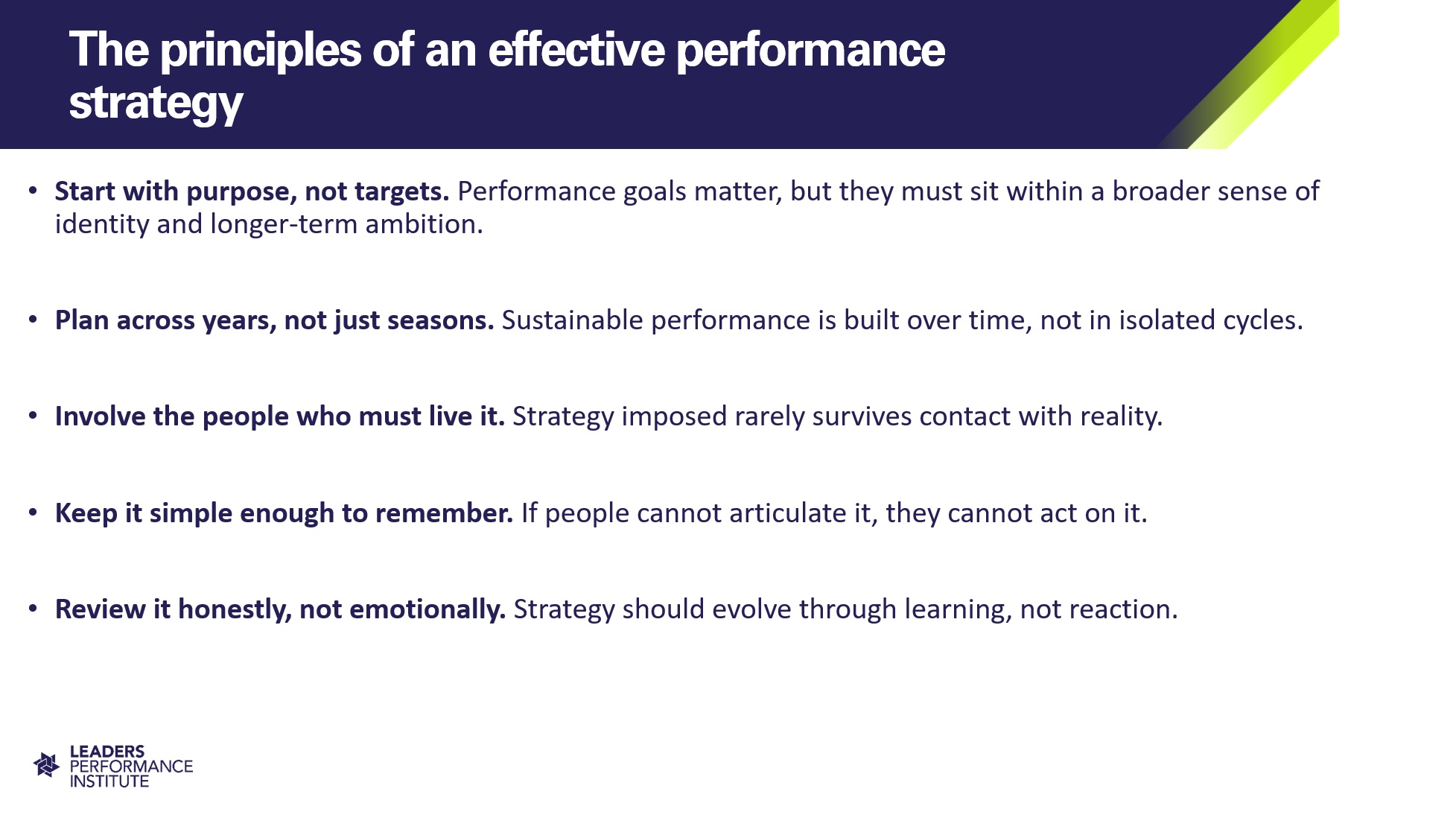
For leaders looking to build effective performance strategy, a few principles matter.
Competitive advantage
Across Olympic and professional sport, one belief has remained constant for me: strategy is a competitive advantage if organisations are willing to treat it as such and invest in the people who are delivering it.
In high-performance sport, change and uncertainty is guaranteed. Strategy does not eliminate it, but it determines whether change becomes a threat or can be used as an advantage.
When planning for performance connects people, aligns ambition, creates continuity and promotes curiosity, performance shifts from reactive winning to sustainable success.
James Thomas is the Performance Director at Warwickshire County Cricket Club and one of sport’s leading high performance experts. If you wish to speak to James, please contact a member of the Leaders Performance Institute team.
More from James Thomas
2 Oct 2025
ArticlesFemale athletes, Artificial Intelligence, adaptive leadership and psychology were all on the agenda in September.
“Most of my career has been in the men’s game,” he said in the aftermath. “It was the only reference I ever had. To get the opportunity to coach these girls you have got to observe and listen and find ways to make them tick.”
The bonds they have forged during his two-year tenure will last a lifetime. “To be associated with these girls, they are driven, they have changed my life, changed the way I think as well. All of those sorts of things are added bonuses. A trophy is one thing, a medal is another thing but actually the quality of the people you work with is the ultimate.”
Mitchell’s sentiments were reflected across several of the conversations we hosted for members of the Leaders Performance Institute in September, from coaching female athletes to a coach’s ability to adapt to their changing environment.
Here are some of the choicest cuts.
Performance anxiety or body anxiety?
Last month, we shone light on Rachel Vickery’s appearance onstage at the Women’s Sport Breakfast at our Sport Performance Summit in Philadelphia. Vickery, a high-performance specialist and former artistic gymnast, recounted a recurring issue from her time working as a physio. Young female athletes would occasionally be sent to her with what was assumed to be exercise-induced asthma. It turned out their breathing difficulties were often anxiety-induced.
“You could see the look of relief on their faces when I started talking about body image, self-esteem and self-worth,” she continued. “So I started a seminar series in 2008 for female athletes and their parents called Growing Up in Lycra around body image identity.”
The seminars were picked up by Swimming Queensland. “I project managed the transformation of these seminars into an education DVD resource that was sent to all female athletes, parents and coaches State-wide.” It was later turned into a national resource by Swimming Australia. “We got some former Olympians involved and that resource went to all of our female athletes, their coaches and their parents. That resource is still used today.”
The role of AI in learning
Vickery was back at the helm for a Leaders Virtual Roundtable discussing how Leaders Performance Institute members can make learning more effective within their teams.
AI was high on the agenda. “AI should be used to support the growth and creativity of staff as opposed to being used for shortcuts where people become lazy,” said one coach developer.
Overreliance on AI, as this coach pointed out above, can stifle creativity. The table also suggested a series of shortcomings in current generations of AI:
The table then highlighted some potential solutions:
Are you an adaptive leader? You’ll need these four skills…
Tim Cox, the Director & Lead for High Performance Research at Management Futures, led a Skills Sprint Session virtual roundtable for Leaders Performance Institute members on the topic of adaptability.
It is a skill, as Cox explained, that was highly coveted by the coaches and practitioners who contributed to our Trend Report earlier this year.
Not that this is anything new. “It is well known that Charles Darwin did not talk about ‘the survival of the fittest’,” Cox continued, with reference to Darwin’s 1859 book On the Origin of the Species.
“The endpoint of Darwin’s research was that it’s not the strongest or the most intelligent of the species that survives, it is the one that is most adaptable to change.”
Over the course of 25 minutes, Cox discussed traps that people can fall victim to in pursuit of better adaptability. He also brought into focus the qualities of adaptive leaders and the skills that can aid adaptation.
Cox discussed four skills:
Read more about the qualities of adaptive leaders here.
‘Sports psychologists cannot just sit and wait for work to come in the door’
Darren Devaney, the Lead Performance Psychologist at Ulster Rugby, and Daniel Ransom, the Head of Psychology and Performance Lifestyle at the Manchester United Academy, co-hosted a virtual roundtable exploring how teams can better use psychology.
They discussed three requisite qualities in depth:
According to Devaney, the psychologist must “get away from the assumption that we work with the individual athlete only”. Instead, they should ask themselves “is my intervention best targeted at an individual or is this more systemic? And if I’m going to be here for the next five or six years, what’s the most useful way of spending one or two hours on this? Is it working with a head coach? Is it working with all the staff? Is it working with a group of players, or is it the one-to-one with the athlete?”
Psychology is not just the work of the psychologist. “An hour spent with one individual athlete is very well spent,” said Devaney, “but an hour spent with somebody that upskills or shapes them”, such as a coach, brings your work into “exponential territory”. He continued: “it changes how they do their work with 20 or 25 people over the course of the week”.
Ransom added: “If we really want to embed and integrate psychology what we require is other people to take on our ideas and work in ways that are psychologically-informed.”
“We can’t sit still and wait for work to walk in the door,” said Devaney. “I’ve often reflected that this organisation functioned for decades without me in the building, so if I’m not here, this place can keep going. I need to recognise the fact that it might not be every day the main thing that everybody’s thinking about, so how can I do that in a way that doesn’t produce scepticism or kickback?” Nevertheless, “you must be proactive in trying to have an impact.”
Ransom has advice for anyone encountering scepticism. “If people are ready for more in-depth and focused work, then let’s meet them there. If they’re not, and they’re at that sceptical end, how do we try and offer them something which is appropriate to the needs of what they might be open to? If we pitch that wrong and we try and go too hard or move too quickly with those people, I think you can get caught in a potential tug of war where we don’t really make much progress and people hold their position.” With skilful guidance, people can “see the value that other people have, and that can be a way of opening a few windows and doors to them.”
Find out more here.
4 Sep 2025
ArticlesAt July’s Women’s Sport Breakfast Rachel Vickery spoke of the problems facing female athletes in ‘Lycra-based sports’.
“I could do it no problems at all in low-level competition,” said Vickery in reflection, “but I fell on the international stage and it cost me a medal.”
Some Leaders Performance Institute members will be familiar with Vickery’s work as a high-performance specialist helping teams in the worlds of sport, business and the military perform under pressure. A smaller number may be aware that she competed for New Zealand between the ages of 13 and 19 and won New Zealand Gymnast of the Year in 1993.
Upon her retirement, Vickery retrained as a physiotherapist and began to explore what went wrong for her in gymnastics when the going got tough.
The latter was top of the agenda at July’s Women’s Sport Breakfast in Philadelphia, which served as a prelude to the Leaders Sport Performance Summit.
These popular morning gatherings were started by Rachel Woodland (who left Leaders in August) and will remain a staple of our performance summits in North America, Europe and Australasia.
“We want this to be a space where, if you don’t know people, you can go into the main room with a bit more confidence from knowing that you’ll see some familiar faces,” said Woodland in setting up her conversation onstage with Vickery.
An audience of largely female coaches and practitioners were keen to hear Vickery discuss her work supporting female athletes in what she calls the “Lycra-based” sports of gymnastics and swimming.
“If you’re an athlete who goes through puberty in a Lycra-based sport as a female, it sucks,” she said.
Vickery recounted a recurring issue from her time working as a physio. Young female athletes would occasionally be sent to her with what was assumed to be exercise-induced asthma. It turned out their breathing difficulties were often anxiety-induced.
“You could see the look of relief on their faces when I started talking about body image, self-esteem and self-worth,” she continued. “So I started a seminar series in 2008 for female athletes and their parents called Growing Up in Lycra around body image identity.”
The seminars were picked up by Swimming Queensland. “I project managed the transformation of these seminars into an education DVD resource that was sent to all female athletes, parents and coaches State-wide.” It was later turned into a national resource by Swimming Australia. “We got some former Olympians involved and that resource went to all of our female athletes, their coaches and their parents. That resource is still used today.”
Chase excellence, not perfection
Vickery, who competed in the late 1980s and early 1990s, spoke of her “complete loss of identity” in an era where little thought was given to either an athlete’s self-perception or their post-retirement transition.
“Everything up to that point had been wrapped around this identity of me being a gymnast: what I ate, what I wore, where I went, what I did on my weekends,” she said.
Gymnastics, she added, is a “very negative, perfection-driven sport,” which didn’t help in those competitions when she fell short. “My sense of self-worth was poor by the time I retired. I had connected to the external validation that came from the media or my school and I’d use that to define whether I was good enough as a human being – which is crazy when I look back on it, but I did not have the emotional maturity to know how to process that.”
It is critical to help athletes understand that they are not defined by what they do.
“Perfection tends to shut us down,” says Vickery. “Our nervous system sees perfection as a threat because the next logical step is, ‘well, if I’m not perfect, then I’m not enough’.”
The key, as Vickery now tells young athletes, is “to shift from chasing perfection to chasing excellence.” Anyone, she believes, can aspire to excellence, which she describes as a “curious and creative state that opens up our nervous system and allows us to tap into performance in a really cool way”.
She says it also “allows you that separation to ride through adversity in tough times” and is “freeing”.
Failure is necessary
Vickery then raised the spectre of failure. “One of the things I took from gymnastics into life is that failure is not only an option, it’s actually necessary.” She made her point by discussing the satisfaction she’d feel at executing a difficult routine. “The only way to get to that point is to fail, fail, fail and fail,” she continued, adding that she would regularly end up in a heap on the gym floor.
“Those failure iterations are so important and just being able to stay open to that in life is essential but, as high achievers, we are often defined against it. Yet failure is just one more iteration closer to getting the thing right.”
Vickery applies the same thinking to sport, medicine and the military or indeed any elite field. “At a deep human level we’ve all got the same fears, self-doubts and insecurities,” she continues.
The solution is the same for all too. “It’s in the ability to regulate one’s own arousal state or threat response, and not only in the moment of pressure and execution, but that ability to front-load puts a lot of buffer in the system to absorb the elevated state. You always have a ‘go time’ but you are then able to self-regulate and come back down again.”
Embrace the chaos backstage
Anyone can increase their buffer. It involves doing “deep work to explore our own messiness – whatever it is that drives our own fears, self-doubts and insecurities – and whatever we know about ourselves. I call it our ‘backstage’.”
One problem is that when we turn up and see others performing, we see their stage but not their backstage. “We don’t see their chaos.” That said, we can assume is that they’ve put in the hard yards. “Confidence can only come from doing big and difficult things. It means doing the preparation, doing the work, and just waiting for the confidence to show up.”
There is also a role for receptive coaches – the kind of which Vickery lacked in her own athletic career.
She told the audience that five or six years ago she bumped into her first female coach, an austere woman who “taught me how not to treat people in a high-performance environment; how not to set them up, how not to coach.”
Vickery, now grateful for the lessons her former coach inadvertently provided, told this woman she was inspirational in ways she probably didn’t expect. This time there was no rebuke when Vickery spoke her mind.
“It was a powerful and pleasant conversation.”
What to read next
26 Aug 2025
ArticlesTeams as diverse as the Philadelphia 76ers, Gotham FC and USA Gymnastics explain that if you discount the people on your teams you will inevitably harm their performance too.
Michael Jabbour, the AI Innovation Officer at Microsoft Education, was on hand to explain that while our futures will look different, there will be simple steps we can all take within our daily practices to integrate AI in useful and supportive ways.
“Quality use of AI comes from communication,” Jabbour tells the audience at the Wells Fargo Center, while running through some of the different types of AI, from simple to advanced and from retrieval to autonomous.
Fundamentally, he speaks to the human side of AI usage. Jabbour is a firm believer that with the right prompts AI is a superb teaching tool. “You’re going to have to fight for friction in order to grow,” he continues. Content generation, summary, code generation and advanced search are all areas where the right prompt can reap dividends.
Whatever the AI’s form, however you use it, “great communicators are excellent in what they get out of AI.”
The same can be said for coaching and high-performance work in general, with speakers from teams including the Philadelphia 76ers, Flyers, Gotham FC, USA Gymnastics and US Soccer joining the University of Pennsylvania and the American School of Ballet to discuss how we can better support the people we serve.
Here, we pick out five things to think about in promoting better alignment, more people-focused approaches to performance, and more thoughtful use of data.
1. Be transparent in your decision making
It is perhaps only in retirement from competition – and in going on to assume admin positions in sport – that Yael Averbuch West and Li Li Leung fully understood the value in organisational transparency.
West has been the General Manager and Head of Soccer Operations at Gotham since 2021, while Leung has served as President and CEO of USA Gymnastics since 2019 (before that she was a Vice President at the NBA).
Both have enjoyed success and endured tough times during their tenures and both explain that without transparency, there can be no alignment. And without alignment, you’ll never be able to establish your priorities, set a course and make big decisions.
There is opportunity in moments of hardship, as Leung explains. “Never let a crisis go to waste,” she says, repeating the words of American political theorist Saul Alinsky. There are obvious moments when it’s right to make a change and align people behind a strategy but, Leung adds, “it’s tougher when you’re deciding whether you need to push through and commit to a process or change.”
Yael Averbuch West
Li Li Leung
Li Li Leung
2. Cut through the noise around the athlete
Alignment is key because the simple fact is that athletes increasingly ask for support beyond their sport and performance. Everyone must be on the same page.
“Do you think the modern athlete has changed or has it always been like this, but as performance staff, have we failed to notice it?” asks Simon Rice, the Vice President of Athlete Care at the Philadelphia 76ers.
“We think it is 50:50 as there is no denying that they are more informed because of more information being available,” he adds, “but this does create noise.”
The remedy requires trust as players in the modern era tend to ask for an explanation more often. The Sixers talk to their players and they talk to them early as they seek to understand what’s important to them. “Do not shut things down right away, work with them to find solutions.”
There is, however, a limit. “It is important to have your non-negotiables so they know where the line is too.”
“The guiding light is that everything that we do needs to help players thrive at NHL level,” says Ian McKeown, the Vice President of Athletic Performance & Wellness at the Philadelphia Flyers, who sat next to Rice. “We are being very intentional in using [the concept of] ‘thriving’ in our language.”
It is important to meet athletes where they’re at, understand their wants and needs, and to involve them in the decision-making process.
And lean into change. See it as comforting – it doesn’t automatically mean that what you did before didn’t work.
Ian McKeown
3. Better leader = better human
“Social and cultural connection is the secret to our success as a species.”
So says Dr Michael Platt, the Director of the Wharton Neuroscience Initiative at the University of Pennsylvania. “If you want to be a better leader, be a better human.”
He speaks to the importance of the social brain network, which is a set of interconnected brain regions involved in understanding, interpreting and responding to social information. This could be recognising emotions, understanding others’ intentions or navigating social interactions.
To that end, he encourages leaders to employ perspective thinking. This can be as simple as writing down five things that illustrate your point of view before then attempting to think about them from another person’s perspective.
Platt also encourages eye contact and deep, rich conversations as starting points on the path to greater connection. Neuroscience explains that good relationships emerge when our brains are synchronised and there is a pattern of activity aligned to the other person.
Michael Platt
4. A programme should protect and empower
Ian McKeown at the Flyers made the point about helping players to thrive. Similarly, the notion of holistic support underpins the work of the American School of Ballet with its students.
“We want students to develop so that they are thriving and not just training,” says Katy Vedder, the school’s Director of Student Life, when speaking of their Whole Dancer Approach.
“We acknowledge their adolescent brain and try to create a sense of belonging as they discover who they are and what they value. We want to support their humanistic needs too and their competencies beyond performance, including self-awareness, peer connections and a healthy comparison framework.”
Wellness isn’t supplementary – it’s central to performance, identity and longevity.
Integral to this reframing has been a realignment of performance priorities, with re-education around cross training and strength & conditioning helping to reduce injury rates while better considering wellness and recovery.
“We can’t work in silos,” says Aesha Ash, the school’s Head of Artistic Health & Wellness. There were several nodding heads in agreement around the room. “The dancers have to be at the artistic centre and we have to work to collaborate in support of them.”
Katy Vedder
Aesha Ash
5. Use data, but don’t discount the person
We close the circle by returning to the question of technology, specifically data.
Both Sam Gregory, the Director of Data & Analytics at US Soccer and John Boyles, the Director of Research & Development at the Sixers, make the point that data isn’t here to take from a coach’s systems or expertise, but to elevate it.
“We want to help you do what you’re best at and take away the parts humans aren’t as good at,” says Gregory. “We’re not trying to replace the system and the expertise.”
That means presenting data in robust but useful formats that never lose track of the human subjects at the centre. With this in mind, it is a good practice to exhibit caution in overcommunicating the data and what the numbers are saying.
Analysts should focus on connection, communication and clarity, especially with those departments and individuals who perceive data as a challenge to their daily workflows.
Finally, infrastructure readiness is critical. There is a lot of noise in the ether when it comes to data and technology, with numerous vendors trying to pitch the exclusivity of their datasets. To abate the noise it is important to build robust strategies and infrastructure to ensure that the noise doesn’t find its way into programmes.
Sam Gregory
John Boyles
What to read next
‘We’ve Lost Athletes Because of this’: When Support Descends into Surveillance
In this recent edition of SBJ Tech’s Athlete Voice, former US Olympic gymnast Samantha Peszek discusses AI and the role of technology in the sport.

You can’t have a discussion about sports technology today without including athletes in that conversation. Their partnerships, investments and endorsements help fuel the space – they have emerged as major stakeholders in the sports tech ecosystem. The Athlete’s Voice series highlights the athletes leading the way and the projects and products they’re putting their influence behind.
* * * * *
Olympic medal-winning gymnast Samantha Peszek, who now broadcasts for ESPN and NBC Sports, recently drew upon her careers as an athlete and analyst to speak with SBJ about technological advances in how gymnastics is scored. The Judging Support System, an AI-powered technology developed by Fujitsu, tracks gymnasts’ motion in 3D. It is used as a resource available to officials and was first deployed on every apparatus at the 2023 world championships in Antwerp, Belgium. Peszek, 33, is known as the Beam Queen for her prowess in the event.
On gymnastics judging…
I’ve seen it both ways. I’ve been the recipient of things going my way and getting the benefit of the doubt, and I’ve definitely been on the other side of it where I was really frustrated re-watching my routine, especially in college, and thinking that I should have gotten a higher score than I got. As much as you can get frustrated and complain, at the end of the day, that’s the sport of gymnastics. It’s a subjective sport, and so those are the rules that you play by, and you’ve done that since you’ve been a little kid.
You pick up different tricks along the way to maybe sell your routine to the judges a little bit more or [make] more eye contact to make them feel like you have more artistry. There are little like tricks to the trade — sliding your feet together to make it look like you stuck — so I always tell the girls that I coach at my event, Beam Queen Boot Camp, that it’s a sport about perfection, but it’s not about perfection. It’s about the illusion of perfection.
On the potential of AI in the sport…
The idea of AI having a play in gymnastics excites me because it’s helping a subjective sport transition to a more objective sport. The biggest area that I see for improvement is in the judging. Not only would I think it makes scoring more accurate, but it would also speed up the process.
Something a lot of people don’t think about is, when an athlete competes one event, they have to wait not only for everybody else to compete on their event but they’re changing to the next event [to get their score]. So that time that you’re getting cold in between events is pretty significant. You’re trained to learn how to do that at a young age, but there’s not really a practice for taking a turn and competing, doing one routine and then just waiting for 20 minutes, especially at higher levels. So that’s why oftentimes you see gymnasts jumping around and staying warm.
If AI can help the efficiency of generating more accurate scoring, I think that would be a huge positive for the sport, especially when it comes to out of bounds on floor, which we saw came into a really big play at this past Olympics. How crooked they are on the mats? [How is their] form, technique? Did they take a step on the landing?
Photo: Samantha Peszek
On the limits of AI…
When you think about implementing that, the way I see it is you would have to add a judging panel for the artistry because my fear is that if you make it as objective as it possibly can, then you take away the beauty and the artistry, creativity and just the overall integrity of the sport. So you would have to do still do a combination because I think it would be really hard for AI to judge the artistry as well as the objective components of a routine.
On how such a dramatic change could be implemented…
I think lots of trial and error. They would need to present it to the committees and get a buy in from a majority of countries that participate in gymnastics. Another aspect that I think some other countries would probably ask is, is it going to be accessible for everybody, or is it just going to be the bigger countries that can afford to implement AI in all of their sporting events? And I know America in particular really values sports, but other countries don’t put the same emphasis and priority on sports as we do.
Photo: Samantha Peszek
On the training tech she’d like to see in gymnastics…
If there was some sort of tracking information on an athlete’s body that could tell a coach, Hey, she’s normally at this number, but today she’s operating — her energy level or her stamina or what have you — is actually lower than the average, then a coach can adjust the numbers. Maybe other athletes and other sports do this a little bit better because they’re older, but in gymnastics, most of the gymnasts are under 20 years old, and so, one, they don’t want to look like they’re not working hard, so they have a hard time speaking up, I think. And then, two, they haven’t lived with their body long enough to know, is this just soreness, or is it an injury?
I just know, from my own experience, other athletes I would see wouldn’t speak up, and then they would end up getting injured because they were pushing themselves when they probably should have been pulling back. So I think AI could really help injury prevention in that way, just more data to show coaches, ‘Hey, just FYI, she’s not operating at full capacity today. Take that information as you will.’
On becoming a beam specialist…
It was my least favorite [apparatus]. I used to pray to God growing up in bed, ‘If you love me at all, please let beam not be an event in gymnastics because I had so many fears on the event.’ I think, because I had so much trouble on that event in particular growing up, it forced me to home in on my mindset at a young age, figuring out how to be mentally tough. As much of a bear as it was, and a burden for me to go through all those challenges as a young gymnast, I think it actually benefited me in the long run because I had to visualize, and I had to goal set, and I had to do positive self-talk.
The majority of gymnastics, and specifically on beam, is all about the power of the mind and the confidence that you have on beam. And so for me to have to go through that and come out on the better on the other side of it, I forced myself to become mentally strong at a young age, and it became my secret weapon as I got older through the sport. So I wish I could go back and tell my younger self that it was all worth it because I almost actually quit gymnastics because of how many obstacles I had on the event.
This article was brought to you by SBJ Tech, a Leaders Group company. As a Leaders Performance Institute member, you are able to enjoy exclusive access to SBJ Tech content in the field of athletic performance.
There are several traits that all teams can look to adopt in their pursuit of performance.
They include the ability to have honest and open conversations, an emphasis on behaviours that build trust, and a belief in the collective before the individual.
As with much of performance, they are often easier said than done but most teams understand their importance and continue to work towards those qualities in their daily work and habits.
Here, the Leaders Performance Institute lifts some insights from our vaults that we hope can help you to plot a course with your teams. We are not saying that all the athletes and coaches in the examples cited below have nailed it, but their approaches may help you to stay on track.
‘Great cultures are built on connection’
Adelaide Crows midfielder Rory Sloane served as team captain between 2019 (when he was co-captain alongside Taylor Walker) to 2022 and, with time, learned the skills to handle difficult conversations in a way that put his teammates at ease.
Sloane had fewer concerns about his on-field captaincy than he did his off-field abilities. “Off-field stuff has always been my challenge absolutely – that’s something that I’ve always had to work on massively over the years,” he told an audience at Virtual Leaders Meet: Evolution of Leadership in 2021. “I wasn’t someone that loved confrontation at all, and that’s where I worked really hard over the years just on my relationships with people to be able to then have those conversations.”
He cited the influence of renowned American leadership specialist Brené Brown. “There was something she said: ‘Sit next to someone when you’re having those conversations rather than across’; because I reckon I used to always come across very aggressively, so sitting next to someone was something that really helped me just have those conversations.”
Sloane’s development as a leader was aided by Dan Jackson, who was appointed the Crows’ Leadership Development Manager in 2020. “We’ve spent a lot of time talking about connection, and it’s a theme I keep seeing across elite sport, and also across corporate organisations – great cultures are built on connection,” said Jackson.
Another with a keen sense of the importance of connection was three-time World Series winner and 10-time MLB All-Star David Ortiz.
During this 20-year career in the US, the Dominican helped to transform the fortunes of the Boston Red Sox. During that time, he came across innumerable prospects in Spring Training, each hoping to play alongside a man who would enter the MLB Hall of Fame in 2022 in his first year of eligibility.
One such hopeful was Leaders Performance Advisor Bobby Scales, who joined the Red Sox’s Spring Training at Fort Meyers in Florida in 2007. Having been handed the number 76 (“an awful number”) Scales knew he needed to do everything in his power to impress Manager Terry Francona and the Red Sox’s decision-makers.
“I would arrive at 5:30am for the workouts that typically didn’t get started until 9am because you never know what might happen. Lift, eat, sort equipment, adjust to any changes, whatever needed to be done,” wrote Scales in 2002. “I remember the third or fourth day of camp at about 5:50am. I had just changed into shorts and a t-shirt and, out of the weight room having finished his workout, comes ‘Big Papi’.
“‘Hey, what you doing here? It’s too early,’ he said in a deep voice with a heavy Dominican accent.
“‘Papi’, I said, while pointing to the #76, ‘man, unless you’re early they forget about you!’ Part of me was kidding, part of me was dead serious. His answer was something that I’ll never forget.
“‘Nah, you get invited to this camp, you have a chance to help us win a World Series and we gonna do that. Get your bat… let’s go hit!’
“He didn’t know me from the next guy but I was in that clubhouse and I had the same uniform on. At this point of his career he had been a three time All-Star, a World Series champion and a World Series Most Valuable Player. At 6am he was changing his shirt post-gym workout and heading to the batting cage.
“With his actions he was saying ‘we win things around here, this is how we work and you’re part of it’. This was his routine and he was going to do this whether I was in the building or not. I happened to be there so this was his opportunity to show me the culture in the building without saying a word. Leaders such as ‘Big Papi’ act with intention because they have a vision of where they see themselves and their club and a clear plan of how they can get there.”
‘Without connection, it falls short’
James Thomas, who currently serves as Director of Performance Services at Manchester City, told the Leaders Performance Institute how he worked to engender trust in the coaches with whom he has worked as a performance director.
“Unless you spend the time to build the connection with somebody I’ve often found it falls a little bit short,” said Thomas in 2022 while still serving as Performance Director at British Gymnastics.
“I’ve always taken the time to stand next to a coach during training, watch, ask questions, be inquisitive, and give them a sense that I’m interested rather than coming in and make a big change. It might not need a big change, but unless you talk to people and find out, you’ll never really know. It’s probably quite simple, but I just stand, watch and ask questions and try to be humble. I’ve come in, I’m not going to fix everything for anybody, but I’ll happily try and help. But I need to know about what you feel, what you think the issues are, and what you think doesn’t need fixing. What you think is great and really sacred to the sport, what needs to be maintained for the next few years.”
Sometimes, it is not even the head coach who is the prime source of the information needed – a point to which Leaders Performance Advisor Meg Popovic, who previously worked with the Toronto Maple Leafs, makes with reference to equipment staff.
“They’re always connected to the pulse of the players,” she wrote in 2022. “These staff team members know the make, model, year, brand, variability, and functionality of every piece of equipment a player uses or wish to try out. They understand the engineering, while finding delight in the new trends in the market that have the potential to improve performance and evolve the sport. They are applied-historians of the industry and the trusted mechanics whom players rely on to tune up, repair, and remodel themselves as living, breathing, sporting machines.”
They are vital and often put themselves out in long and arduous shifts and, Popovic recommends that coaches demonstrate their appreciation on a regular basis.
“This group wants to be (and should be) acknowledged personally for their long hours and often difficult, unseen efforts,” she continued. “A thank you, a coffee, or helping hand could quickly relieve resentment and amplify the energy flowing in this very important staff group. Also, as they are of the giving-type, asking equipment staff how they’re doing could go a long way as their innate way of relationship is to be in the service of everyone else’s needs, requests, and demands.”
Such traits can have a profound impact, although they take some work. “Anyone involved in elite sport knows that you can’t get to the elite level without systems,” said Jackson. “I mean building in routines that become habits and then those habits just become natural.”
Scott Hann, the Head Coach of Olympic champion Max Whitlock explains his relationship with data and where it supports and challenges him as a coach.
“However, leading into Tokyo, I could have counted on one hand the amount of clean routines Max did. They were polar opposites.”
Hann is smiling as he tells this tale to the Leaders Performance Institute, because both Games proved to be a success for Whitlock.
In 2016, in Rio, he claimed gold in both the floor exercise and the pommel horse, while also earning a bronze in the men’s all-around event. Five years later, in Tokyo, Whitlock retained his gold on the pommel horse.
Those four medals go alongside the two bronzes Whitlock won in the team and pommel horse at the London 2012 Games.
Whitlock has been on the senior men’s scene for more than a decade and recently stated his desire to compete at the Paris 2024 Olympics – a decision Hann discussed during his recent appearance on the Leaders Performance Podcast – and that journey has seen him develop from a talented youth to a seasoned champion.
Whitlock’s body and mind have developed with each Olympic cycle.
“I have to do things completely different with Max,” says Hann, building on his earlier point. “And I have to accept that the small successes on the way are going to be different.”
The contrast between Whitlock’s preparations for the 2016 and the delayed 2020 Games were almost besides the point. Hann adds: “I had to have the confidence in that programme, even though there were struggles and adaptions, I had to have the confidence that what we were doing was right because that gave Max the confidence to trust the process.”
The Leaders Performance Institute has asked Hann about his relationship with data; how he uses it and any preferences he has as a head coach.
Says Hann: “There’s two sets of data that I think about: what repetitions need to be done to perform for a competition or to achieve a skill and, of course, the data that you gain from competitions in terms of scorings, deductions etc.
“Over the years, you do multiple preparations before a competition so you get a guide of what numbers you need to be doing; but you need to be able to adapt at every single different preparation because there might be a small injury, there might be different level gymnasts, you might have an older gymnast now.”
Video analysis is a regular feature of Hann and Whitlock’s training routine thanks to British Gymnastics’ relationship with the UK Sports Institute. “We’re doing that all the time, but you don’t realise you’re doing it because it’s usually on your mobile phones,” says Hann. “They’re so advanced these days. But we do have a great analyst at British Gymnastics so that when we can access her data it’s really useful and she’ll pull together all of the different scores and all the different starter scores so that we can take that and pitch where we want the routines to be at and it helps you develop and choose a team as well, if you’ve got all that data.”
Gymnastics is a discipline where Hann’s coaching intuition necessarily comes to the fore. “Once you’ve got your fundamentals in place, you adapt along the way using your coaching intuition and those small nuances of what you see because it’s not a timed sport. It’s not running, it’s not a strength sport, it is so intricate, with so many little details.
“If you think about it, on the men’s side of the programme, you’ve got six different apparatuses, six different events, and in an event, in a routine you do ten different skills, but to develop that, each skill you could have ten different techniques depending on ten different body shapes of athlete to learn that skill.
“Then you’ve got the strength & conditioning, the physical preparation, the mental preparation, the flexibility, all of those things that go into preparing all of those different skills, and then you’ve got to practise them individually, in combinations, and in routines to build that robustness and that physical preparedness to be able to do a full routine.
“Then, of course, you’ve got to do the numbers of a full routine to make sure that they’re prepared. There’s so many things that go into preparing an athlete that you can’t just have a bit of data that tells you how to do it. You should have a guideline of what works and then build on that.”
In Hann’s case, he uses all available sources of information to inform his judgments and overcome his inherent biases.
“In terms of the data from the competition, it’s important to look at where those deductions are because sometimes as a coach you do look at things through rose-tinted spectacles,” he says. “I’ve been guilty of that lots of times. ‘Where on earth did you get those deductions from?’.”
In the pommel horse, routines are scored by two judging panels. One begins with a score of zero and adds points for requirements, difficulty and connections. The second panel has a score starting at 10.0 and subsequently deducts points for errors. The difficulty and execution scores are then combined for a gymnast’s overall score.
“It’s important that you understand those deductions because you have to bring that into your training and make those small changes along the way. So the more data you get from that, the better.”
Injury prevention is another area of intense focus for Hann and British Gymnastics. “I haven’t had to do this with Max – touch wood – but identifying where common injuries occur and look at data to help avoid or mitigate those potential injuries. At British Gymnastics at the moment, they’re doing a lot of work on loading and trying to come with policies and guidelines to make sure that we’re avoiding or at least doing as much as we can to avoid any potential overload or over-use injuries. Acute injuries are going to happen, that’s the nature of the sport, but any over-use injuries so that we can get the athletes to have longevity in the sport, a healthy exit of the sport when they’re ready, so they’re not being held together at the end of it and, of course, a lot of that will link into their mental health. If their body feels good then they’re going to feel good.”
The Leaders Performance Institute asks how, for example, Hann will discuss data with a strength & conditioning coach. “Again, because gymnastics isn’t doing something specific like running where a strength & conditioning coach is almost part of the front, lead coaching team, it’s almost about building a robust muscle core to help protect the body as it goes through the specifics of gymnastics. So it’s helping the strength & conditioning coach understand what those specifics are so that they can design their programmes to make sure that the gymnast is robust and safe in their training.
“That’s where that communication between everyone is key. Because they can also bring advice to you and if you’re open and able to take that advice onboard, you can reflect actually you can find new ways of doing things, but that’s the future, right?”
Listen below to the full conversation with Scott Hann:
Scott Hann, the Head Coach of treble Olympic champion gymnast Max Whitlock, discusses the coach’s role in helping athletes with their mental health while safeguarding against their own struggles.
“I fell into a place, into this rut where I just lost all motivation for everything,” he told BBC Breakfast in September 2022, just weeks after retaining his Olympic title on the men’s pommel horse. “I felt sluggish every single day. I was in this place where I just didn’t want to do anything.
“I even got a blood test because I was just feeling awful every single day. The blood test came back and I was absolutely fine. I think that is what proved to me that it was all in my head.”
Whitlock, who said he felt like a “complete waste of space”, explained that his wife, Leah, was worried and he was unable to process how he felt. “A lot of people say it, talk to people, get it out it helps,” he continued. “But I think I’ve never been that person. I’ve always been the person to just keep it in and plough on through. I’ve done [that for my] whole career of almost putting a mask up.
“I think as I started to talk to Leah or started talk to my parents more and the people around me, I started to actually realise how I was feeling.”
One of the people in whom Max confided was his Head Coach, Scott Hann, who viewed himself as a sounding board rather than as a dispenser of advice.
“Making sure that you’re able to have those conversations with the athlete is important, that you’re able to have those open conversations, that you’re not there to fix, you’re there to guide,” he told the Leaders Performance Podcast last month.
“As a coach, if you’ve been that rock, that support, that guidance throughout the whole journey, you can’t all of a sudden jump into being a practitioner. So it’s important to try and encourage the athlete to reach out and make those connections with people who are going to be able to help them. Qualified good people who are able to help.
“Also just helping by giving them confidence in what they’ve achieved and where the next part of the journey can go. I think just being there is worth its weight in gold because, quite often, when the athlete is at the pinnacle of their career and they’ve achieved something, there could be a break from training. So the athlete and coach are separated. So it’s just making sure you’re there all the time and you’re giving that communication and guidance.”
When the Tokyo Games finished, Whitlock decided to take a 12-month break in which he contemplated retirement. Hann was never going to force Whitlock’s hand and, having given it some thought, Whitlock decided to return to the gym to prepare for the Paris Olympics.
Said Hann: “I know when Max spoke to me about getting back in the gym and making this next drive towards Paris, it wasn’t just a ‘yes’ from me ‘let’s do it’, it was ‘have you considered all of the obstacles, all of the challenges that are going to come your way and are you prepared for all that?’ We spoke in detail about different things that we may experience on this. So there was a big communication around ‘are you planning or working on what you’re going to do next so that you don’t fall into that situation again in the future?’ And I think they were all positive conversations and now Max is in a really strong place with a great mindset and his training is going so well.”
The Leaders Performance Institute’s Henry Breckenridge then steered the conversation towards Hann’s own mental wellbeing.
“Well, it’s interesting because, after the Rio Olympics, I’d never experienced anything like I did before,” said Hann, who recounted his experiences in 2016.
“Everything was just a whirlwind of emotions leading up to it. If you can imagine going from country to country, hotel to hotel, you’re waited on hand and foot, you’re in your own room, you’ve got your own space, you’ve got the highs of competitions, you’ve got the lows of competitions, you’ve got the pressure. You’ve got all of those things and then you get the most incredible results that you could even dream of.”
He spoke of the “euphoria” of Whitlock’s victory, which was swiftly replaced by relief. “It’s literally ‘thank god that is over and that result was what it was’ and then you get home and, all of a sudden, you’re hoovering the floor in your living room and it hit me. It was just ‘what was it all for? What’s happened?’ No one’s holding you on a pedestal, no one’s coming around and helping you with anything now. It’s done and you’re on your own. It was really hard.”
By the time the Tokyo Games came around in 2021, Hann felt better equipped to manage that post-Olympic bathos. “Knowing that that is a possibility was what helped me. And, of course, that’s not the answer you want. You don’t want someone to have to experience that low to be able to identify it in the future. But, for me, I did experience that low so I was prepared for it. So going into Tokyo, I gave myself the tools that I needed to make sure that I was ready to go on that journey, come out the other side, decompress slowly, and then go back into normal life. But I think there needs to be guidance for coaches to be able to reach out and have that support because it is such a pressurised whirlwind of emotion all the way through.
“So I think having people to talk to, having support, having mental health support, and identifying issues and being able to talk about them are all absolutely key for both the coach and the athlete and anybody else that’s involved in that journey.”
Listen below to the full conversation with Scott Hann:
13 Apr 2023
PodcastsScott Hann, who coaches Max Whitlock, a three-time Olympic champion for Great Britain in gymnastics, discusses why coaches need greater support with their mental health. He also delves into his approach to athlete feedback and his self-development as a coach.
A podcast brought to you by our Main Partners

“Then, all of a sudden, you get home and you’re hoovering the floor in your living room and it just hit me. What was it all for? What’s happened?” he tells the Leaders Performance Podcast.
Whitlock, who won a further gold at the delayed Tokyo Games to make it six Olympic medals in total (he won two bronzes at London 2012), recently went public with his mental health struggles and, here, Scott explains that his mental health has also suffered as a consequence of his work.
“After the Olympics, nobody’s holding you on a pedestal, no one’s coming around and helping you with anything now. It’s done and you’re on your own. It was really hard.”
Scott’s efforts to safeguard his mental health is just one of several topics on the agenda, which is today brough to you by our Main Partners Keiser.
Also up for discussion are:
Henry Breckenridge Twitter | LinkedIn
John Portch Twitter | LinkedIn
Listen above and subscribe today on iTunes, Spotify, Stitcher and Overcast, or your chosen podcast platform.

The question is on the mind of Jeremy Bettle, the Performance Director at New York City FC, who won the MLS Cup in December last year, when the Leaders Performance Institute and Dave Slemen and Anna Edwards of Elite Performance Partners [EPP] sat down with him to discuss the steps performance directors can take to become better leaders.
Joining Bettle in conversation are Darren Burgess, the High Performance Manager of the Adelaide Crows who also leads EPP’s search offering in Australia, and James Thomas, the Performance Director at British Gymnastics. The trio work in three different sports and geographies, with systems and structures that vary in their approach, but each brings a sense of vulnerability, self-awareness, and an understanding of the importance of the culture and context they are working within. Their leadership capabilities bind together a great strategy and strong culture, which is essential if teams and organisations are to retain their shape when pressure is applied. Of the expectations and pressure now thrust upon NYCFC, Bettle says: “It’s certainly going to be something new for our club this year.”
Bettle, Burgess and Thomas all have a deep desire to keep learning, which has driven them to the top of their fields and each played a part in a series of ‘firsts’ in 2021. NYCFC’s MLS Cup triumph was the club’s first, while Burgess was serving as Performance Manager of the Melbourne Demons when they won their first AFL Grand Final in 57 years. Also, under Thomas’ stewardship, Great Britain won their first Olympic medal in the women’s gymnastics team event for 93 years.
Thomas tackles the question of pressure from the athletes’ perspective. “It’s been the biggest risk or success factor of the last four years,” he says. “When we look at our gymnasts, they’re phenomenal athletes. They have the ability to execute phenomenal technical skills and they can do it day-in and day-out in the training environment. Where I see the athletes either struggle or excel is that ability to step into a competition environment and deliver it there. With every sport, you’ve got great examples of people who can do it either in a one-off or can do it repeatedly, or they can do it in training and they can’t do it in competition.
“We’ve actually put a lot of time and resource into different pressure environments whether it’s changing training set-ups, whether it’s manipulating timings just to put athletes under more pressure, less warm-up, less time between apparatus, we’ve brought in surprise friends and family to come on the balcony and watch and cheer. We try to exhaust almost all of our coaches and psychologists’ views of manipulating the training environment.” Nevertheless, as Thomas admits, “you can never quite replicate the actual competition environment.”
Burgess, who last year won the AFL Grand Final with Melbourne and previously worked in the English Premier League with Liverpool and Arsenal, finds the same applies to professional team sports. “It’s very hard to simulate pressure, especially with games happening every three or four days in the Premier League, particularly when you’re also competing in European competitions.”
His mind goes back to the two-week period in September before Melbourne took on the Western Bulldogs in the AFL Grand Final. The consensus amongst the fans and media was that Melbourne had the better team but were undermined by the fact that their route through the playoffs meant that they had played one game in 28 days.
“We decided to take the high risk of playing a match simulation,” says Burgess. “It probably cost us a couple of players who were on the fringe of being selected, but in the end, that was how we decided to simulate that pressure as much as we could. We had umpires in, full mouth guards, so it was part of our thought process to try and simulate that as much as we could. We even built up a bit of a rivalry between the ‘possibles’ and ‘probables’ and tried to manufacture that so that the ‘possibles’ put up a good fight.”
Bettle approves of such approaches. “I’m a big believer in exposing people to pressure versus shielding them from it,” he says. “I think there can be a balance there but you’ve got to get used to pressure and have strategies to deal with it. I’m a big believer in process and having done it before; and trying to make these environments a lot more automatic.”
He recalls his time working at the NBA’s Brooklyn Nets between 2011 and 2015 when there were few opportunities to generate pressure because the games came thick and fast. He was struck by the veteran players. “They show very little emotion win, lose or draw. I think because it’s so automatic to them, it really helps them to perform on a nightly basis.” By contrast, however, New York City practised penalties as they progressed through the MLS Playoffs. “Having the guys line up on halfway and having them walk out on their own; and because they’ve gone through it over and over and over again, when we actually get into the scenario, which we did twice in the playoffs, it just felt more normal to us. The guys executed it excellently when it came to it and maybe it helped, maybe it didn’t, but it made me feel better about it anyway!”
The approach is far from universal in soccer, as Slemen points out. Penalties are one of the few closed skills in football that can be practised but the prevailing culture has often been reluctant.
Bettle and New York City Head Coach Ronny Deila also tried to factor an element of fun into the team’s progression through the season and post-season. Though he has often been sceptical of organised fun in a team context, he explains that Deila’s decision to organise team dinners reaped dividends.
“I think the coach did a great job this year of recognising that our team didn’t do well when they didn’t have an opportunity to relax,” says Bettle. “So we started doing team dinners when we go on the road, on match day minus two. They’d have a glass of wine, and we’d have just a really fun night out that felt authentic and not forced. Giving the players an opportunity to enjoy it and not be so disciplined was a bit of a departure from my mindset, but I’ve come to recognise it’s been one of the most valuable things that we did last year, to put a focus on joy and fun and enjoying the experience. I think building that environment, recognising who your players are and how they’re going to respond versus having some really rigid thoughts around ‘this isn’t high performance, we can’t drink wine two days before a game’ it actually helped us.”
Much like in soccer or basketball, Thomas explains that in gymnastics the success of any rituals largely depends on the skill of the coach. He says: “Where I probably see the magic happen it’s been where coaches have managed to really understand the team and the group of athletes they’ve got, where they’re positioned.
“For the men’s gymnastics team, it was very clear in the build-up to Tokyo, they were probably fourth or fifth in the world, and it was very cleverly done by our coach to position them as the underdogs that were going to create the big upset rather than ‘we can’t achieve that’ or ‘we’re world No 1’. It was ‘let’s go on the hunt’. They really put this mindset into the gymnasts that this final 12-week prep was really just about closing the gap. You could see every day that the gymnasts came in with the bit between their teeth about closing the gap. It wasn’t necessarily about winning the medal, it was about ‘how do we get as close as we possibly can?’
“There was a sense of realism, a sense of togetherness towards something and it really pulled them together. It did feel like a team and the feedback that we had from some of the gymnasts who had been to multiple games, said it was the best team environment because they had a really clear purpose and it was really cleverly orchestrated by the coach. That’s where I’ve seen it work its best, through the coach, with a little bit of a framework of what they’re working towards and that purpose.”
Thomas has witnessed scenarios where the use of rituals does not work and puts it down to authenticity, which chimes with Burgess’ views on the matter. “It’s a really risky practice if there’s not authenticity about the ritual, the practice or the theme,” he says. “If there’s not complete buy-in, then you really are in trouble. Let’s say, for example, that your ritual, your belief is ‘selflessness’ and you want everybody to act selflessly throughout everything, the minute that your star No 10 player decides to miss a training session or turn up late or act selfishly in some way, are you going to drop that player? You have to stick to it and then it becomes part of your team’s identity and everybody respects that. Yes, it can work, but it has to work in the right environment and I’ve seen both.”