Leaders in Business
  • Membership
  • Events
  • Content
  • Virtual Learning
  • Connections
  • Partners
Login
  • Leaders Meet: Innovation
  • Events
    • Leaders Week London
    • Leaders Sports Awards
    • Leaders Club Events
    • Leaders Performance Institute Events
    • Leaders Meet: Innovation
  • Memberships
    • The Leaders Club
    • Leaders Performance Institute
  • About
    • Careers
    • Contact
I’m a sports leader:
  • Off The Field For those focused on the business of the sport View more
  • On The Field For those working with an athlete or elite team View more
  • Login
    • Leaders ClubThe membership for future sport business leaders
    • Leaders Performance InstituteThe membership for elite performance practitioners
  • Newsletters
Performance Institute Leaders Performance Institute Logo
  • Membership
  • Events
  • Content
  • Virtual Learning
  • Connections
  • Partners
Login
Members Only

18 Dec 2025

Articles

Could Hawk-Eye Provide New Performance Inputs for NHL Players, Coaches and Officials Alike?

SBJ Tech takes us inside the league’s Situation Room in Toronto, where data can be used to more intricately analyze the sport of hockey.

Main Photo: NHL

sport techie
By Joe Lemire
“Goal, Anaheim.”

“Goal, Boston.”

These pronouncements from video technicians were, for a time, the only interruptions piercing the quiet murmur of the NHL’s Situation Room, the league’s high-tech Toronto facility where every replay challenge is reviewed and ruled on.

Most goals are straightforward, but every one is reviewed by a hockey operations executive to ensure its legality. So long as the puck wasn’t kicked or high-sticked into the net, the game continues. But the technicians, each assigned a single game, watch several angles of each goal to prepare for a possible coach’s challenge — such as whether the offensive team was offside.

“Goal, Pittsburgh. This one’s on us.”

Suddenly, the room stirs to life. The Penguins appeared to net a game-winning goal against the Flyers in overtime, and the Situation Room initiates all challenges in the final minute of regulation or in OT. As the braintrust began reviewing the play — several hockey operations executives and a retired referee — word arrived that the on-ice refs whistled an infraction that nullified the goal.

A few minutes later, the Flyers scored their own apparent game winner, but very quickly, a potentially incriminating view of their entrance into the zone appeared on the screen.
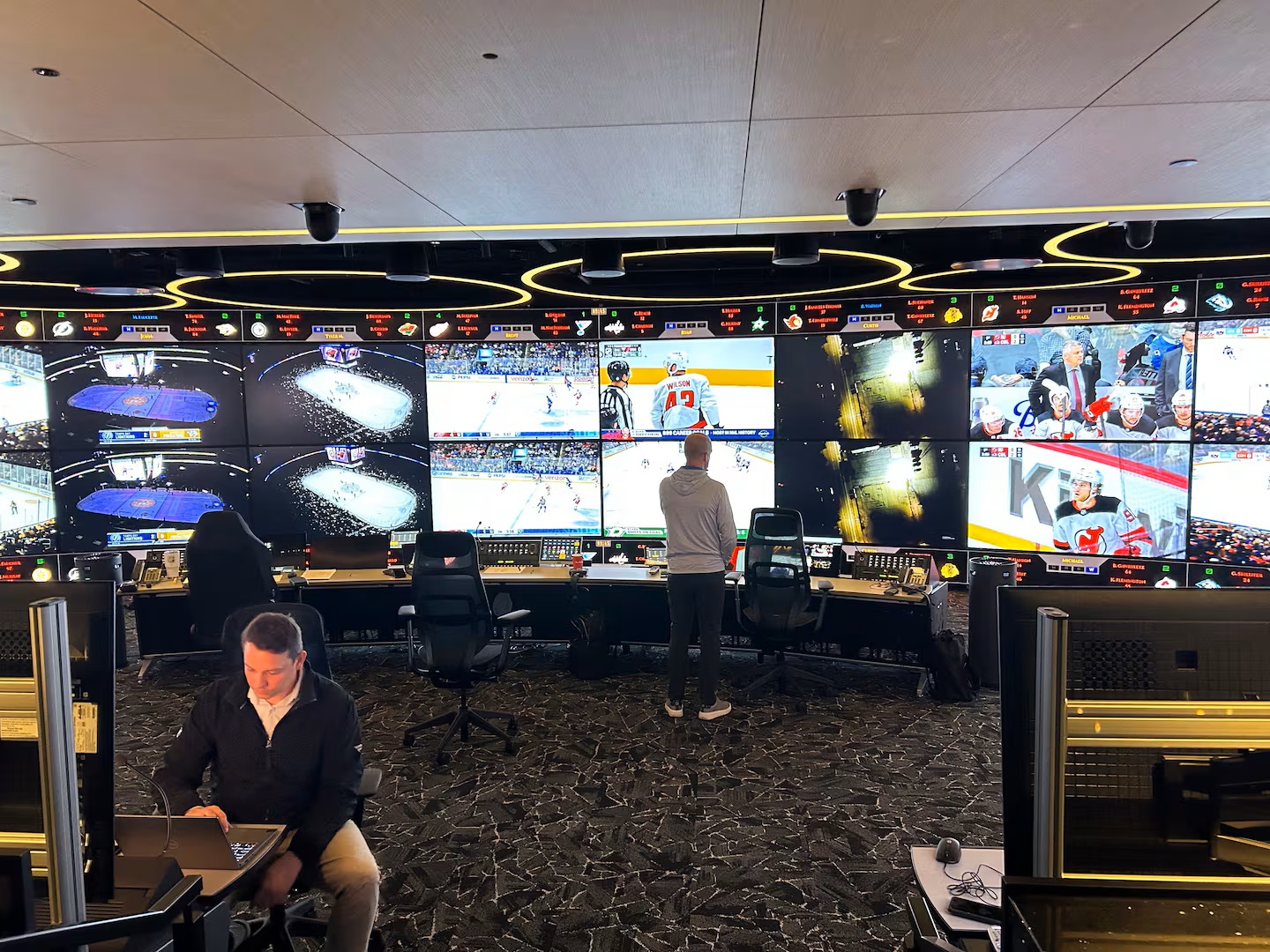
The Situation Room features 16 LED flat screens along the front wall and roughly a dozen workspaces for technicians, each assigned to one game. Photo: NHL

“We’re going to challenge this. Let’s get the linesmen on.”

Word is communicated to the on-ice officials, one of whom informs the crowd that “the previous play is under review by the league to see if the play was offsides prior to the goal” as boos cascade down from Flyers fans.

Situation Room staff pored over several angles, most notably a Sony 4K camera installed right on the blue line for exactly this use. And the final verdict, made by the Situation Room, was close, but clear: Offside. No goal. About 80 seconds after the review began, the ref shared the news in Philadelphia. Even more boos followed.

“We are the keepers of the game,” said Kris King, NHL Executive Vice President of Hockey Operations, the department’s No. 2-ranking official under Colin Campbell.

This is the second year of an upgraded, high-tech Situation Room. There are 16 LED flat screens adorning the front wall, a desk in the middle of the room for executives and roughly a dozen workspaces around the perimeter, where technicians monitor every game. SBJ was one of two news outlets granted behind-the-scenes access on the first night the 10th-floor space was open to media.

“Our job doesn’t really change a lot, but the equipment that we use, and the knowledge that we gain from using better equipment, just gives us a little bit of an upper edge to get to the right answer quicker,” King added.

The NHL was the first professional sports league to centralize its reviews back in 1991, and it has worked with Sony-owned Hawk-Eye’s Synchronized Multi-Angle Replay Technology (SMART) as its video replay provider since 2015.

Separately, the league named Sony a global technology partner earlier this year, and Hawk-Eye’s tracking cameras were installed in every NHL arena prior to last season. That system offers potentially richer data: Whereas NHL Edge, which is powered by SMT sensors on the players and in the puck, tracks a single, center-of-mass location for each player, Hawk-Eye collects data from 29 points on each skater and six points from the hockey stick.

In time, that optical data from Hawk-Eye should inform a richer future of hockey analytics, more immersive fan engagement and, perhaps, data-driven support for officials.

“The NHL are very much innovators in the space — they want to innovate with us to create the future of technology in sport — but I love the fact that it is coupled with patience,” said Dan Cash, Sony Hawk-Eye’s Managing Director for North America. “They know that this is going to be powerful for their game, but they aren’t trying to sprint to the finish line here, which I think with technology can be sometimes a mistake.”
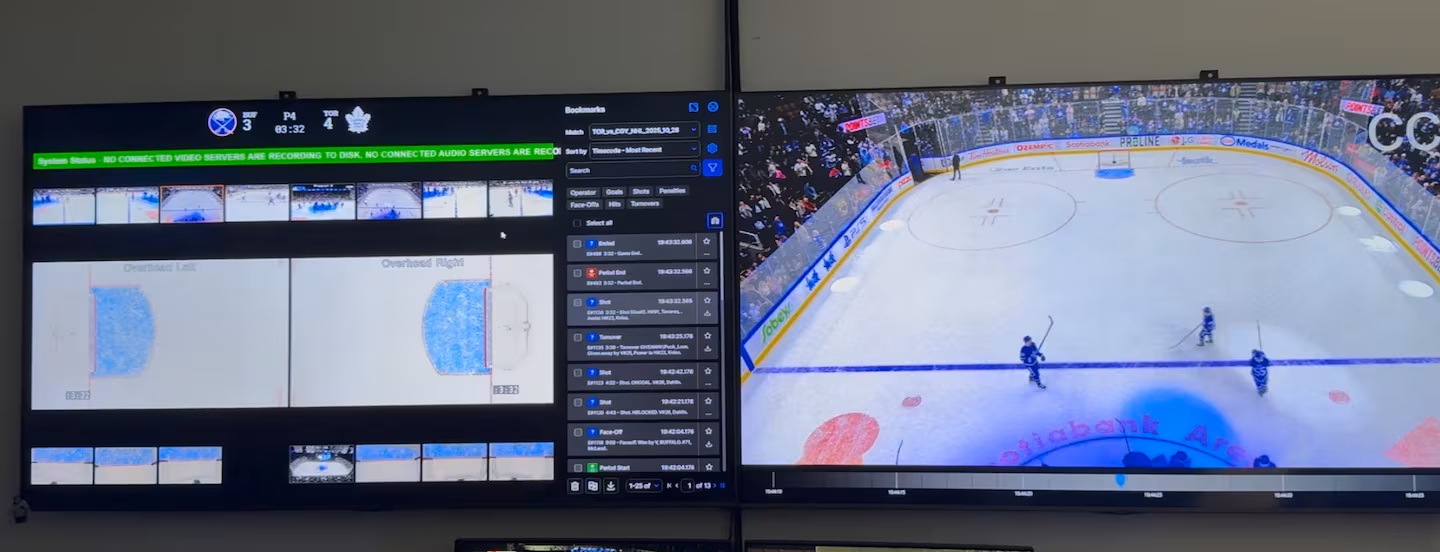
Cameras display a multitude of angles to enable the Situation Room crew to make speedy reviews. Photo: Joe Lemire

‘A real-time league’

When King joined the league office in the early 2000s, the process was dramatically different. When a discipline issue arose, King would need to ferry a VHS tape to Campbell, who lived in Tillsonburg, a two-hour drive from the NHL office in Toronto.

They’d each get in their cars and drive halfway, inevitably connecting at a Tim Horton’s, the most Canadian of meeting points. Campbell would then drive home, review the tape and make a ruling about a possible suspension or fine. Nowadays, that video is transmitted in about 125 milliseconds from arenas to the Situation Room and about as rapidly to Campbell’s house, saving immense time and gas, at only the cost of a fresh coffee.

“How we transport video is the secret sauce, so to speak,” Cash said. “It’s not easy to transport video as quick as we do over a wide area network.”

We are the keepers of the game.

Kris King, NHL Executive Vice President of Hockey Operations

It’s even less for the league’s next-door neighbors. The goal horn from next-door Scotiabank Arena blared concurrently with a Maple Leafs goal scored on the Situation Room monitor. (The horn also later sounded for a Blue Jays home run; the World Series, featuring the local team, was discreetly on a few Situation Room screens.) That immediacy lets the Situation Room prepare video clips and look at questionable calls before even hearing from the on-site staff.

“It definitely is a real-time league now,” said Rod Pasma, NHL Group Vice President of Hockey Operations. “A lot of times we’ll know exactly what’s going on before [the coaches] even call the officials over to challenge a play.”

On that night, the Situation Room scoured replays to prepare a ruling that never materialized, with the on-site coach opting against the review process. “That’s a good non-challenge,” King said, noting the likelihood the call wouldn’t have been reversed.

The NHL continues to add cameras: There are three in each goal, one above, four on the blue lines and an elevated 4K lens to provide the All-12 viewpoint of every skater. Some arenas now have Cosm C360 cameras. The league will soon begin testing an 8K version of the All-12 at the Prudential Center — where the NHL and Verizon also are creating an innovation lab to test new tech, scheduled for full operation early in the new year.

On this particular night in the Toronto Situation Room, as part of ESPN’s Frozen Frenzy, all 32 teams were playing, many of the start times staggered by 15-minute intervals to make the action nonstop. One workstation was solely dedicated to pressing go on a digital dasherboards celebration for Alex Ovechkin’s 900th goal. The NHL didn’t want to chance it flashing live on-air, only for the goal to be overturned on review.

“The technology’s gotten to a point where the only thing we can’t do right now is literally hit the horn in the building,” Pasma said.
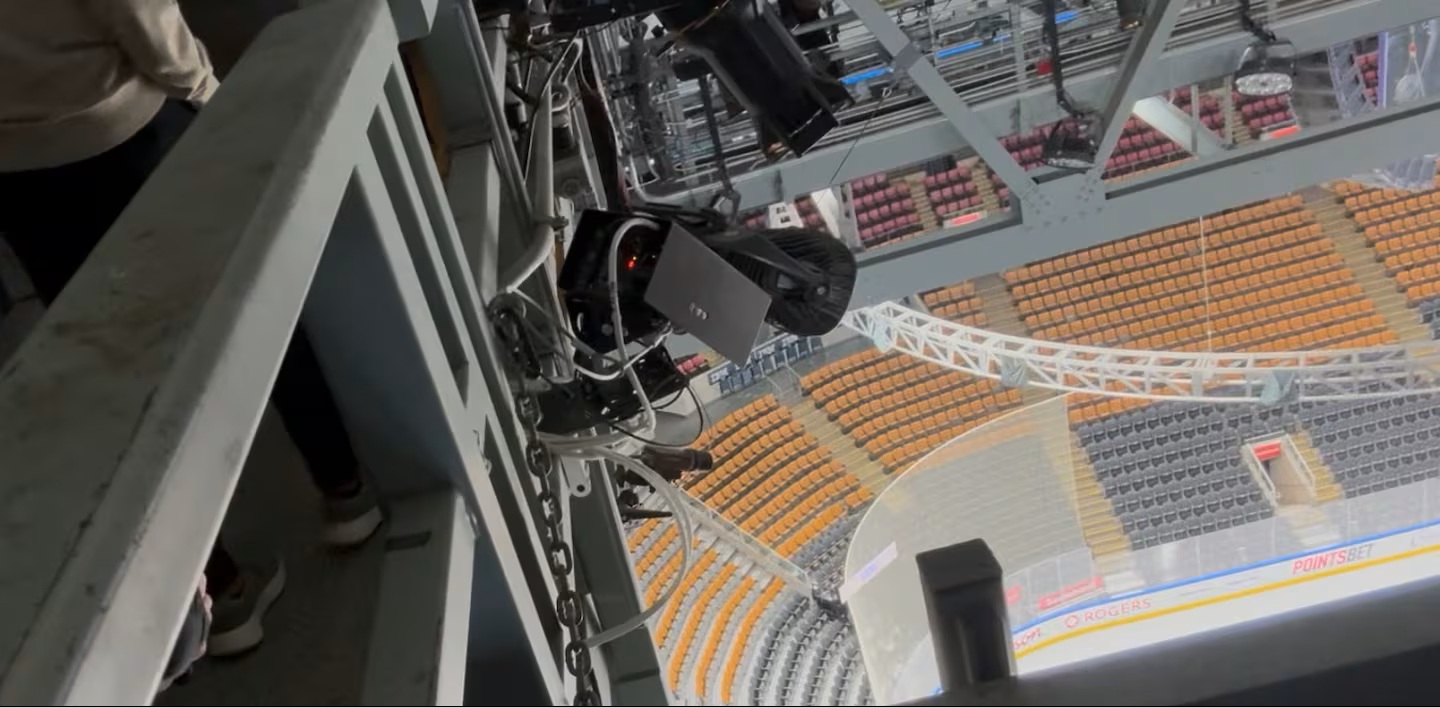
Hawk-Eye’s tracking cameras were installed in every NHL arena prior to last season. Photo: Joe Lemire

Bird’s-eye view

High in the rafters above Scotiabank Arena, looking down on the Maple Leafs’ 1960s Stanley Cup banners, are six black, rectangular cameras affixed to the catwalk and helping power the Hawk-Eye tracking system. From up here in the rafters, the ice seems impossibly low, but the 4K, 60-frames-per-second cameras capture granular movement data via images streamed directly to the cloud — Hawk-Eye’s first leaguewide deal to be cloud-native. Another six cameras are placed on lower levels of the arena to avoid obstruction from the center-hung video board.

Those dozen video inputs are triangulated and processed to determine the precise location of every skater and his stick. Hawk-Eye has provided MLB with bat tracking data for a couple seasons, but that’s only one bat in a known location every time — far different than 12 sticks across a 200-foot-by-85-foot ice rink.

For now, the AI models interpreting this data are still going through iterations to reach the confidence threshold for accuracy needed for wider distribution. The NHL has never had stick data, and Hawk-Eye and the league are in the “true development phase in refining the technology,” said Sean Williams, NHL Vice President, Innovation and Technology Partnerships. Williams added that it could soon be used to enhance the existing Edge tracking that teams can access through the data feed.

When Hawk-Eye data does become a part of the NHL Edge repository, it will not only further enrich the data-driven storytelling for fans via broadcast and digital media and help clubs more intricately analyze the sport, it also could provide other inputs for referees, linesmen and Situation Room executives.

“Not currently, but that’s definitely where we’re going,” said Sean Ellis, NHL Vice President of Hockey Operations, of using tracking data for officiating. “We’re not going to roll it out until we’re 100% confident and comfortable that the data that we’re getting is accurate.”

Even then, the potential is more to inform than automate. “We are genuinely looking at all options,” Williams said, “but our fundamental strategy is to keep the call on the ice made by humans.”

This article was brought to you by SBJ Tech, a Leaders Group company. As a Leaders Performance Institute member, you are able to enjoy exclusive access to SBJ Tech content in the field of athletic performance.

26 Aug 2025

Articles

Transparency, Empathy and Empowerment: Five Ways Teams Are Serving their People in 2025

Category
Coaching & Development, Data & Innovation, Human Performance, Leadership & Culture
Share
Facebook Twitter Email Copy Link
https://leadersinsport.com/performance-institute/articles/transparency-empathy-and-empowerment-five-ways-teams-are-serving-their-people-in-2025/

Teams as diverse as the Philadelphia 76ers, Gotham FC and USA Gymnastics explain that if you discount the people on your teams you will inevitably harm their performance too.

By the Leaders Performance Institute team
Inevitably AI was top of the agenda at the Leaders Sport Performance Summit in Philadelphia last month.

Michael Jabbour, the AI Innovation Officer at Microsoft Education, was on hand to explain that while our futures will look different, there will be simple steps we can all take within our daily practices to integrate AI in useful and supportive ways.

“Quality use of AI comes from communication,” Jabbour tells the audience at the Wells Fargo Center, while running through some of the different types of AI, from simple to advanced and from retrieval to autonomous.

Fundamentally, he speaks to the human side of AI usage. Jabbour is a firm believer that with the right prompts AI is a superb teaching tool. “You’re going to have to fight for friction in order to grow,” he continues. Content generation, summary, code generation and advanced search are all areas where the right prompt can reap dividends.

Whatever the AI’s form, however you use it, “great communicators are excellent in what they get out of AI.”

The same can be said for coaching and high-performance work in general, with speakers from teams including the Philadelphia 76ers, Flyers, Gotham FC, USA Gymnastics and US Soccer joining the University of Pennsylvania and the American School of Ballet to discuss how we can better support the people we serve.

Here, we pick out five things to think about in promoting better alignment, more people-focused approaches to performance, and more thoughtful use of data.

1. Be transparent in your decision making

It is perhaps only in retirement from competition – and in going on to assume admin positions in sport – that Yael Averbuch West and Li Li Leung fully understood the value in organisational transparency.

West has been the General Manager and Head of Soccer Operations at Gotham since 2021, while Leung has served as President and CEO of USA Gymnastics since 2019 (before that she was a Vice President at the NBA).

Both have enjoyed success and endured tough times during their tenures and both explain that without transparency, there can be no alignment. And without alignment, you’ll never be able to establish your priorities, set a course and make big decisions.

There is opportunity in moments of hardship, as Leung explains. “Never let a crisis go to waste,” she says, repeating the words of American political theorist Saul Alinsky. There are obvious moments when it’s right to make a change and align people behind a strategy but, Leung adds, “it’s tougher when you’re deciding whether you need to push through and commit to a process or change.”

“The decisions I’m most proud of are the ones that were the most difficult to make – and often they’re the ones with the clearest answer…”

Yael Averbuch West

“… and you’ll still get crucified for it.”

Li Li Leung

“It can be difficult to commit to a process and find a way, rather than start again, but it’s often the right thing to do.”

Li Li Leung

2. Cut through the noise around the athlete

Alignment is key because the simple fact is that athletes increasingly ask for support beyond their sport and performance. Everyone must be on the same page.

“Do you think the modern athlete has changed or has it always been like this, but as performance staff, have we failed to notice it?” asks Simon Rice, the Vice President of Athlete Care at the Philadelphia 76ers.

“We think it is 50:50 as there is no denying that they are more informed because of more information being available,” he adds, “but this does create noise.”

The remedy requires trust as players in the modern era tend to ask for an explanation more often. The Sixers talk to their players and they talk to them early as they seek to understand what’s important to them. “Do not shut things down right away, work with them to find solutions.”

There is, however, a limit. “It is important to have your non-negotiables so they know where the line is too.”

“The guiding light is that everything that we do needs to help players thrive at NHL level,” says Ian McKeown, the Vice President of Athletic Performance & Wellness at the Philadelphia Flyers, who sat next to Rice. “We are being very intentional in using [the concept of] ‘thriving’ in our language.”

It is important to meet athletes where they’re at, understand their wants and needs, and to involve them in the decision-making process.

And lean into change. See it as comforting – it doesn’t automatically mean that what you did before didn’t work.

“As the person overseeing the performance programme, it is important to listen well and be curious about what is going on across different departments and relationships in that environment. I sought to explore the physical barriers and other impacts of what was going on and I intentionally adapted the flow of the environment to change this.”

Ian McKeown

3. Better leader = better human

“Social and cultural connection is the secret to our success as a species.”

So says Dr Michael Platt, the Director of the Wharton Neuroscience Initiative at the University of Pennsylvania. “If you want to be a better leader, be a better human.”

He speaks to the importance of the social brain network, which is a set of interconnected brain regions involved in understanding, interpreting and responding to social information. This could be recognising emotions, understanding others’ intentions or navigating social interactions.

To that end, he encourages leaders to employ perspective thinking. This can be as simple as writing down five things that illustrate your point of view before then attempting to think about them from another person’s perspective.

Platt also encourages eye contact and deep, rich conversations as starting points on the path to greater connection. Neuroscience explains that good relationships emerge when our brains are synchronised and there is a pattern of activity aligned to the other person.

“Your social brain network is like a muscle: the more you use it, the bigger it gets, so it’s critical to exercise it.”

Michael Platt

4. A programme should protect and empower

Ian McKeown at the Flyers made the point about helping players to thrive. Similarly, the notion of holistic support underpins the work of the American School of Ballet with its students.

“We want students to develop so that they are thriving and not just training,” says Katy Vedder, the school’s Director of Student Life, when speaking of their Whole Dancer Approach.

“We acknowledge their adolescent brain and try to create a sense of belonging as they discover who they are and what they value. We want to support their humanistic needs too and their competencies beyond performance, including self-awareness, peer connections and a healthy comparison framework.”

Wellness isn’t supplementary – it’s central to performance, identity and longevity.

Integral to this reframing has been a realignment of performance priorities, with re-education around cross training and strength & conditioning helping to reduce injury rates while better considering wellness and recovery.

“We can’t work in silos,” says Aesha Ash, the school’s Head of Artistic Health & Wellness. There were several nodding heads in agreement around the room. “The dancers have to be at the artistic centre and we have to work to collaborate in support of them.”

“Our students are not just artists or athletes, they intersect both and need a support system that honours their full, true identity.”

Katy Vedder

“We have to challenge the definition of success at a systemic level. We celebrate those not pursuing becoming a professional dancer, widening the parameters of success.”

Aesha Ash

5. Use data, but don’t discount the person

We close the circle by returning to the question of technology, specifically data.

Both Sam Gregory, the Director of Data & Analytics at US Soccer and John Boyles, the Director of Research & Development at the Sixers, make the point that data isn’t here to take from a coach’s systems or expertise, but to elevate it.

“We want to help you do what you’re best at and take away the parts humans aren’t as good at,” says Gregory. “We’re not trying to replace the system and the expertise.”

That means presenting data in robust but useful formats that never lose track of the human subjects at the centre. With this in mind, it is a good practice to exhibit caution in overcommunicating the data and what the numbers are saying.

Analysts should focus on connection, communication and clarity, especially with those departments and individuals who perceive data as a challenge to their daily workflows.

Finally, infrastructure readiness is critical. There is a lot of noise in the ether when it comes to data and technology, with numerous vendors trying to pitch the exclusivity of their datasets. To abate the noise it is important to build robust strategies and infrastructure to ensure that the noise doesn’t find its way into programmes.

“The aim is to get to the point where data is available to support every decision made, even if it’s not used for every decision.”

Sam Gregory

“We need to think about the importance of what’s visible when discussions are happening. The insight displayed can have an effect on the conversation.”

John Boyles

What to read next

‘We’ve Lost Athletes Because of this’: When Support Descends into Surveillance

Members Only

4 Apr 2025

Articles

NHL Commissioner Gary Bettman Talks Tech, from Tracking Data to AI

Category
Data & Innovation, Premium
Share
Facebook Twitter Email Copy Link
https://leadersinsport.com/performance-institute/articles/nhl-commissioner-gary-bettman-talks-tech-from-tracking-data-to-ai/

Last month at SBJ’s Tech Week, Bettman took to the stage to discuss how the NHL continues to embrace technologies that push the boundaries of performance.

Main image: Marc Bryan-Brown

sport techie
By Ethan Joyce
Gary Bettman chuckled at the idea that his time as NHL commissioner started in an era where no league had a website, email was a budding form of communication, and we were years before the BlackBerry shattered expectations anyone had for a cellphone.

His 32-year tenure has now arrived at a place where the sports industry is infused with tech, and the league is pushing in so many areas to advance its product: NHL Edge player tracking data, the digitally enhanced dasherboards and the alt-cast avenues it uses to reach various sections of its fans.

“The game has got to be good fundamentally,” Bettman said. “And you don’t change the game for the technology. What you do is use technology to enhance the game and to connect people with the game — whether it’s the players, the coaches or our media partners or our fans.”

As the headline speaker for SBJ Tech Week on Wednesday, Bettman rolled through the NHL’s various tech ventures, which continue to grow in both dedication and success. Here are some of his key thoughts on their current and future plans.

Boosting the referee process: One of the league’s recent developments focuses on officials using Apple Watch, which started in September.The hardware is helping officials track the game clock and also alerting them at the end of periods and penalties. Bettman sees the potential for that to expand to notifications that eventually include the players who commit penalties. The pairing of this technology with Hawk-Eye (one of SBJ’s 10 Most Innovative Sports Tech Companies) can help in the various judgment calls in games.

“I’m not sure we want to take all the human elements out of the game,” Bettman said. “However, something like offsides and high-sticking in terms of where the puck was touched, those are things that we may be able to do better of using not just the Apple Watch or the Hawk-Eye system but even using artificial intelligence in terms of re-creating situations.”

NHL Edge tracking data: Bettman pointed to the continued evolution of NHL Edge — which became operational for puck and player tracking in 2021-22 and added fan-facing features in 2023 — as a foundation of its tech mission. It supports the league’s alt-casts, as well as coaching insights. It has the potential to help video reviews, too.

“It took us better than five years and more money than I think I’ve ever told the owners to figure out how you could embed something in the puck that could actually be tracked,” Bettman said. “And then putting the chips on the player was a lot easier.”

A growing presence on Roblox: Roblox has increasingly become a space for the NHL to build and connect with younger fans. The league’s work on the platform started in 2023 with NHL Blast, which has housed All-Star Weekend and Stanley Cup Final deployments.

“It’s a combination of content creation [and data],” Bettman said, “And we now, because of the data we accumulate, we create more content and make it more readily available.”

Cloud-based live game broadcasts: The NHL, along with AWS, were SBA: Tech finalists for Best Technology Collaboration — the first live game broadcast of its kind.

“Producing the game on the cloud is more efficient from an environmental standpoint, a manpower standpoint, a financial standpoint,” Bettman said. “That’s the way of the future. That’s the way everybody’s going to be producing games.”

AI usage league-wide: Bettman mentioned that the NHL has leaned into AI in both fan-facing and back-of-house use cases. AI has streamlined aspects of selling tickets and scheduling games for its 32 teams.

“We schedule over 1,300 regular-season games, looking at building availability, looking at traffic patterns to get people in and out of games,” Bettman said. “These are all things that AI is going to make us better at.”

This article was brought to you by SBJ Tech, a Leaders Group company. As a Leaders Performance Institute member, you are able to enjoy exclusive access to SBJ Tech content in the field of athletic performance.

Members Only

28 Mar 2025

Articles

Why NHL Officials Wear a Smart Watch – and Rarely Look at it

Category
Data & Innovation, Premium
Share
Facebook Twitter Email Copy Link
https://leadersinsport.com/performance-institute/articles/why-nhl-officials-wear-a-smart-watch-and-rarely-look-at-it/

How haptic feedback helps officials to keep their eyes on the ice during games.

Main image: Getty Images courtesy of the NHL

sport techie
By Joe Lemire
Observant hockey fans may have noticed that most NHL referees this season have been wearing an Apple Watch on their wrist — but almost never looking at it.

The league and its officials, in collaboration with Apple and technology innovation partner Presidio, developed the NHL Watch Comms App to track the game clock and signal the imminent end of periods and penalties. But to help the officials focus more on the action around them, the primary function is to provide haptic feedback with vibrations, rather than visual cues.

“The watch doesn’t distract you,” said Stephen Walkom, a former on-ice referee who is now NHL Executive Vice President, Hockey Operations. “It actually informs you. You think you’ve got to see a watch, right? And we feel a watch, but we know what time it is.”

Rollout of the Apple Watches began in September, with the league reporting a 92.5% adoption rate by officials. Saturday’s NHL Stadium Series game, in which the Columbus Blue Jackets are hosting the Detroit Red Wings at Ohio Stadium — the usual football home of the Ohio State Buckeyes — is an important milestone for the technology.

Every arena hangs scoreboards and places LED-ribbon clocks in different places, but over time, the officials grow familiar with their locations for quick time checks. In a one-off location like with the Stadium Series, everything is new, plus the size and typical depth perception is thrown off by the vast size of the venue.

“In that building,” Walkom quipped, “you’d be spinning like a top on the ice looking for a clock.”

Part of the impetus for the technology was a safety concern. There have been collisions and near-misses on the ice when players emerge from the penalty box and an official happens to be skating near the door. Having the haptic reminder that a player is about to emerge can help clear that space.

“We had a really high-level objective: It was an interest to figure out, how can we help the officials keep their eyes on the ice more?” said Dave Lehanski, NHL EVP of Business Development and Innovation. “We can’t understate how important it was to collaborate with the officials and how agreeable they were to participating in this.”

The NHL brought that goal to its tech partners. Apple had previously helped the league by providing iPads for in-game bench use, and Presidio developed applications for the NHL Draft and the league’s streaming operations.

As straightforward as the end result is, there were technical challenges to develop it, not to mention the need for significant input from the officials to ensure the app didn’t disrupt their workflow. Presidio developed the app, extracting about two dozen datapoints from the NHL’s OASIS data feed, rather than pushing notifications to the watch.
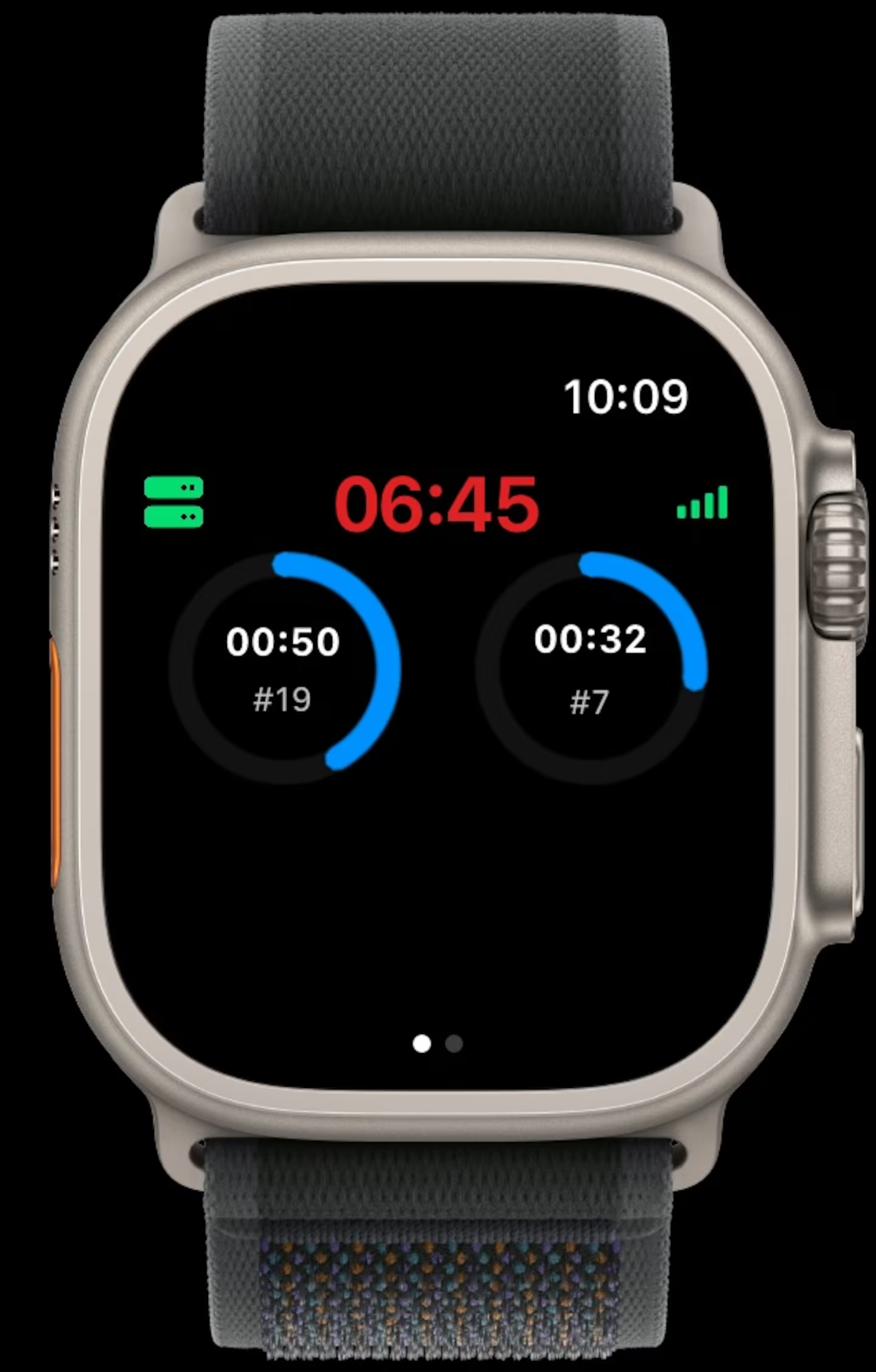
The NHL Watch Comms App showing the imminent end of two penalties (Photo: NHL)

“We had to build, not necessarily a push-based application, but a pull-based application, which was really, really unique, to make sure we had accurate data for the officials,” said Andres de Corral, Presidio VP Digital Services, noting that the timeline required “a series of design thinking sessions and trial and error.”

“The NHL has a real patience about these implementations,” added Scott Brodrick of Apple Worldwide Product Marketing. “The goal is the seamless use of technology to enhance the game, and I think that has materialized over this period of development. Sometimes the simple solution is the most powerful.”

Now, before games, almost every official grabs an Apple Watch as routinely as his shin guards, microphone and striped shirt.

“Guys just came to trust it,” Walkom said, “and we have less and less looking for a clock in the rink.”

This article was brought to you by SBJ Tech, a Leaders Group company. As a Leaders Performance Institute member, you are able to enjoy exclusive access to SBJ Tech content in the field of athletic performance.

Members Only

8 Dec 2023

Articles

Concussions in Hockey: How Pat LaFontaine’s Valor Axiom Will Reduce the Types of Impact He Suffered in his own Illustrious Career

Category
Data & Innovation, Premium
Share
Facebook Twitter Email Copy Link
https://leadersinsport.com/performance-institute/articles/concussions-in-hockey-how-pat-lafontaines-valor-axiom-will-reduce-the-impacts-he-suffered-in-his-own-illustrious-career/

The NHL Hall of Famer’s new helmet has received a five-star rating from the renowned Virginia Tech safety testing laboratory.

Main image: Jim McIsaac / NHLI via Getty Images

A Data & Innovation article brought to you by

sport techie
By Joe Lemire

You can’t have a discussion about sports technology today without including athletes in that conversation. Their partnerships, investments and endorsements help fuel the space – they have emerged as major stakeholders in the sports tech ecosystem. The Athlete’s Voice series highlights the athletes leading the way and the projects and products they’re putting their influence behind.

* * * * *
Hockey Hall of Famer Pat LaFontaine was a New York institution, starring first for the Islanders and Sabres before finishing with one season as a Ranger.

Over those 15 years, he scored 468 goals, added 545 assists and holds the all-time record of 1.17 points per game among American-born players. LaFontaine’s No 16 was retired by the Sabres, and he was included in the league’s 2017 list of the 100 Greatest NHL Players of All Time.

Though LaFontaine had a great career, it ended sooner than he would have hoped. He suffered a half-dozen definitive concussions but estimates the real total may have been twice that. The neurologist who treated him throughout his career — Dr James Kelly, a professor at the University of Colorado Anschutz Medical Campus who previously held a leadership position at Walter Reed National Military Medical Center — became a friend.

“Jim and I became very close over the last 25, 30 years,” LaFontaine said. “He was the doctor that cleared me to play, and he was the doctor said, ‘OK, that’s enough.’ I’m extremely grateful to him.”

LaFontaine, now 58, and Kelly are also now co-founders in a new venture, Valor Hockey, that has made a highly-rated helmet. The Valor Axiom received a five-star rating from the renowned Virginia Tech safety testing laboratory, the first new helmet to garner that best mark since 2017. The Atlantic Amateur Hockey Association, which is affiliated with USA Hockey, is the first league to partner in promoting the Valor helmet that retails for $299.

On the origin story of Valor…

It actually started when Dr Kelly and I looked into doing something in 2004. A company had a material that was 40% more absorbent and could deflect and absorb impact I think better than what EPP was at the time, which was the mainstay. What we found out was they went into an IP lawsuit issue with the material. So we tucked it away for a little bit.

We started talking again around 2016 or so. There was an opportunity with another impact material that we were looking into. The irony was [the helmet] was originally designed by a guy named Jose Fernandez. He did X-Man, he did Batman, he did Ironman. So it was more of like, ‘If you could do a futuristic, cool design of what a hockey helmet is in the future.’

We spoke with a gentleman, a designer and partner now, named David Muskovitz. So David did the engineering and did the final design, but we took an initial design and said, ‘OK, how do we make this safer? And how do we make it perform really well, fit really well? And then how do we make sure we can manufacture it? And most importantly, make it safe?’

We created a monoshell, which is a one-piece shell. I think one thing it’s important I want to say 98%, 97% of all helmets are two-piece shells, which we found interesting. All the NFL and motocross and lacrosse and Major League Baseball [helmets] — why are they one-piece shells? So we came up with a slogan ‘beyond traditional safe’ because in the hockey space, two-piece shells are traditionally safe. Then we found out making a one-piece polycarbonate injected shell is not easy with that kind of a design. But if you build a really good one-piece, and a really good two-piece, the one-piece will always outperform and be safer. Why? Because of the impacts will be distributed more evenly versus a two-piece.

On the shape of the helmet…

Dr Kelly described this in a really good way. We literally took that design, and we created smoother, slightly rounded edges around the sides of the helmet, and then the back and then the front. We made a lower profile with a little bit of an angle for deflection. The way he puts it is, so take a cue ball and then take a Rubik’s cube, and the cue ball hits the cube and it kind of grabs it, torques it, spins it and sometimes breaks it up because it’s got more flat spaces. Well, then take another cue ball with a billiard ball and hit it. And if it’s got more slightly rounded, smoother edges, it’s going to deflect and ricochet and glance.

On minimizing the magnitude of impacts…

You’re not going to stop a concussion — nobody’s going to stop it — but now knowing the science and the testing, you can minimize damage. And over the course of somebody’s career, you think about some of these catastrophic hits, these big hits, then you think of these every day compression hits, over a period of time, the brain in the head isn’t built to sustain those.

I don’t know exactly what the measurements are, but if somebody says you could get a Grade 3 concussion with one helmet, and potentially a Grade 2 or 1 concussion [with another helmet], that’s significant. You accumulate that over a period of time. Minimizing the damage makes a massive difference in the livelihood.

On the helmets he wore as a player…

Dr Kelly said something very profound to me along the way. We didn’t have the testing and the science behind the linear and rotational testing — we didn’t have that back then. This is just the way it was back then. The helmets were what they were. But if it was graded today, it was probably a zero to a one star.

Knowing now what a five-star [helmet] is, and the impacts that it takes to distribute the force load, and Jim actually said to me, ‘I can professionally and publicly be able to comfortably say, after knowing what I know about science and the testing, that you would have most likely had between 50% and 60% less damage during the course of your career. And to me, that’s profound.

On his own experience with concussions…

I’m here telling you the story because I lived it. I went through post-concussion syndrome twice. I went through one extremely dark period of time where things got really scary and depressed, and I really didn’t see a light at the end of the tunnel. I know what can happen if you hit your head enough, and you can do damage.

Fortunately, my brain found its way back. I was able to get that enthusiasm and excitement back. Dr Kelly was willing to let me go back again but warned me, ‘If you take another one, you’re probably going to go through a [dark] period of time again because there’s a threshold that you cross. What used to take 10 days to two weeks to recover is now taking you months. I probably had about six to seven [concussions] documented — when I broke my jaw, we never documented it, but I guarantee you I had a concussion. And then I probably had another handful of dings that I saw stars but we didn’t count them. I’m somewhere probably around double digits, 10, 12, concussions.

I went through six months [of rehab] twice. The second time wasn’t as severe. But even then, there was a part of me relieved that I didn’t have to make that decision, and then a part of me had to let go of something I loved since I was a kid. So it was still difficult to deal with. But I heard something really profound. I read this book called Legacy about the All Blacks rugby team. There’s a quote in there that talks about if, you’re a true servant and leader of your sport, then you have a responsibility to leave it better than you found it. My wife struggled watching my son play. He had a couple of concussions, then she couldn’t watch, having lived through what her husband went through. Now we have a little grandson who’s three, whose name’s Patrick. And you know what, I know that, should he choose to play hockey, that there’s going to be safer products for the next generation.

On how hockey shaped him…

I’m grateful for what we had when I played. This is something to take and [ask], how do we create an evolution of where safety continues to go and I think that should be a natural thing to do anyway. Listen, if I didn’t retire after 15 years from concussions, there wouldn’t have been a service and purpose for me to do this. So I always believe, in life, your experiences, good, bad or indifferent, whether you realize it or not, prepare you for what’s to come next in your life.

I believe your experiences shape you into your service and purpose. And hockey was always a stepping stone. I’m grateful for what the sport has done for me. But it’s put me into a place in my life where everything I learned from those experiences, has taught me how to give back in a purposeful way, a meaningful way and a service way. And I have a mantra in my life, whether it’s my foundation, or whether it’s what we’re doing with Valor, “Score your goals when you’re young because, when you get older, life is about the assists.”

On the values instilled by hockey and in the Valor brand…

Being a player, I was blessed, and it was a privilege and an honor to play in the pros as long as I did and represent my country. The game was my life, and it still is. I say that, even though I don’t play as much, the game still lives inside me. The character lessons, the life lessons, the values, the life skills, leadership, teamwork, getting through adversity, getting enough discipline, the friendships, the relationships, all of those things that you learn in the sport of hockey still are so much a part of who you are in your life going forward, which is really a big part of what the brand is built on.

The Declaration of Principles which we launched with the National Hockey League — the tip of the spear, that north star — and we were able to get the global hockey community to sign off on values and principles to aspire to live to. So part of the Valor brand is based on those declaration of principles and bringing those to life, whether it be in products, programs, technology, services. From my perspective, it’s so important that sports play a role in our society and our next generation, so creating a positive and safe environment is right up there as one of them.

This article was brought to you by SBJ Tech, a Leaders Group company. As a Leaders Performance Institute member, you are able to enjoy exclusive access to SBJ Tech content in the field of athletic performance.

30 Mar 2023

Articles

Leaders Meet: Building Winning Organisations – the Key Afternoon Takeaways

Category
Leadership & Culture
Share
Facebook Twitter Email Copy Link
https://leadersinsport.com/performance-institute/articles/leaders-meet-building-winning-organisations-the-key-afternoon-takeaways/

The afternoon at the Scotiabank Arena featured Toronto Metropolitan University, Klick Health and Management Futures discussing both the theory and application of strategies designed to create winning environments.

In partnership with

By Luke Whitworth
Leaders Meet: Building Winning Organisations, hosted alongside the Toronto Maple Leafs, was our first physical North American event of the year. Throughout the course of the day, we engaged in case study sessions, an observation experience, roundtable discussions and skills-based learning centred around some key ingredients that contribute to building a winning or high performing organisation.

These are the highlights from the afternoon programme, which featured Dr Cheri Bradish, the Director of the Future of Sport Lab at Toronto Metropolitan University; Glenn Zujew, Chief People Officer at the world’s largest independent commercialisation partner for life science, Klick Health; John Bull, the Director & Lead for High Performance at leadership and organisation consultancy Management Futures.

[Already up-to-date with the afternoon? The morning takeaways are available here.]

Session 4: Designing the Environment & Innovating at Pace

Speaker: Dr Cheri Bradish, Director of the Future of Sport Lab, Toronto Metropolitan University

Innovation + Culture

  • Innovation: the action or process of innovating. Innovation is crucial to the continued success of any organisation. Includes new methods, ideas, products, etc. Linked to technological innovation(s).
  • Innovation economy: supports that knowledge, entrepreneurship, innovation, technology, and collaboration are the key drivers of economic growth. Companies can increase their value by creating new ideas which can be developed into products, services, and business models that bring us collectively into the future.
  • Does innovation culture work: “we found a significant correlation between the ideation rate at these companies and success (growth in profit or net income): The more ideation, the faster they grew.”
  • Sport innovation: proactive and intentional processes that involve the generation and practical adoption of new and creative ideas, which aim to produce a qualitative change in a sport context.
  • Key growth areas: fan experience and player performance.
  • Global sport innovation ecosystem: there has been increasing trends in innovation and additional technology.
  • Designing a winning innovation environment: what do good organisations do who innovate effectively? “What gets measured, gets managed!”
  • Open innovation: internal and external innovation. Resourcing and Collaboration.
  • Decentralised innovation: internal labs, ventures, M&A, partnerships.
  • Product development: design labs and studios.
  • Project time commitments: 10-25% of time in the organisation dedicated to time to intentionally innovate and foster an innovation mindset.
  • Maintaining a culture of sport innovation: it’s an extraordinary time for innovation. Technological change and industry disruption seem to be accelerating. And digital information networks are linking individuals, organisations, and nations as never before. Five themes have emerged in maintaining this culture:
  1. Be comfortable being uncomfortable: both leaders and staff.
  2. Be connected, build a strong network: what are other people doing in their space?
  3. Prioritise good, committed and collaborative people.
  4. Diversity of thought and team.
  5. Stay curious.
  • In those that do it well, there is a clear culture of innovation across the organisation.
  • What’s holding sport back: we know that sport is an early adopter industry. A lot also depends on the culture of the organisation.
  • Leading innovation: where is the support and leaders perspective in all of this? How open is your leader to being innovative and supporting your team in its development?
  • Assessing cultures of innovation: do you have an innovation or growth mindset in the organisation?
  • A lot of rich innovation is looking outside of the box.

Session 5: The People & Culture

Speaker: Glenn Zujew, Chief People Officer, Klick Health

  • People that are good at culture pay a lot of attention to it.
  • The culture: an extreme focus of Klick when it started 25 years ago was culture. Core principles were designed and then the organisation identified the people who were needed to achieve that. What type of person would be successful in our organisation? Culture starts at recruiting level and how you promote yourself in the marketplace. Even after 25 years, the organisation still considers themselves in ‘beta’.
  • Recognise innovation in a company: the organisation likes to shine a light on those that have tried and failed. The organisation has ‘Breakfast Meetings’ that are designed to give positive recognition to those that have tried to innovate and failed – the organisation want to promote that behaviour. A lot of people experiment in the environment and the organisation even intentionally allocates hours to innovation.
  • People-first #1: this can often be misconstrued as ‘me first’. Realigning on the goal you are trying to achieve is something that you need to keep an eye on. We don’t want to slip into ‘me first’.
  • Cultural principles: in recent times, creativity and candour have come into the existing principles.
  • Listening: the organisation has also prioritised listening in a big way. Not everyone communicates in the same way so the organisation has used a variety of communication tools to collate insight and feedback to cater for different styles.
  • Feedback: aligned to the above, create different styles and numerous opportunities for feedback: bi-weekly calls with the Chief People Officer and President, fire-side chats, weekly one-on-ones, yearly polls – some people want to communicate verbally, others through technological tools. The Chief People Officer is basically a Chief Learning Officer, and the data that is collated has informed what the organisation does next.
  • Collaboration: have you been intentional in asking your teams how they interact and what is working?
  • Induct & onboard to culture: it starts with how you position yourself in the marketplace. At a recruiting level, there is clarity on what the organisation wants: there is a list that is stress-tested; identify individuals that will add something to the culture.
  • Fit & add: Glenn shared that the organisation had almost too strong of a culture. There was a laser focus on looking for someone that would fit the existing culture seamlessly. This focus actually ended with the organisation having too many similar people. The organisation engaged in one small change: ‘fit to add’. The organisation wanted people to add to the culture, which in turn witnesses an increase in innovation and diverse thinking.
  • New vs existing: we often see challenges in trying to combine existing versus new. In terms of culture, a large part is creating a safe place for existing individuals. Listen, talk and alleviate what’s on people’s minds. People want to be heard. Every environment has stewards who have a key role in connecting to what is important.
  • Cultural champions: who are your cultural champions? Look to recognise where things are working well and make people aware of what that is.
  • People-first #2: in trying to be a people-first organisation, you can get sucked into trying to be everything to everyone. In reviews and feedback opportunities, the organisation asks employees honestly about how things are going; is it what you want it to be?

Session 6: Debriefing Skills

Speaker: John Bull, Director & Lead for High Performance, Management Futures

“The only sustainable competitive advantage is an organisation’s ability to learn faster than the competition” – Peter Senge

STOP: for live debriefs during the event:

  • Stand Back: take a helicopter view.
  • Take Stock: analyse what is happening.
  • Options: explore options around what you can do differently.
  • Proceed: step back in and take action. Assessing what impact your new approach has.
  • Aviation principles: there is a lot we can learn from aviation. They don’t look at human error, instead system first.
  • People and organisations who are good at debriefing are really curious.

How Debriefs Help Create a Winning Culture

  • Coaches only recall between 16.8% and 52.9% of events.
  • Involvement in discussions builds self-awareness and ownership of learning.
  • Fosters an openness to feedback.
  • Builds relationships and team cohesion.
  • Helps decrease negative emotional effects and remove emotional baggage.

Features of a great debrief

  • Psychological safety: create a calm, positive and supportive space. Set people up to focus on learning, not to be defensive; and model your belief in their potential to create great performance. Do everything you can to reduce power differentials.
  • Questions: use open, non-judgemental questions and a lot of follow up questioning. Focusing on learning more than results and allow time for reflection.
  • Strike a good balance between focus on the positives and areas for improvement. Key insight: we learn quickest by reinforcing what works. Consider ‘appreciative inquiry’.
  • Pay attention to group dynamics to get the best possible contribution from all individuals. Write the thinking down before the debrief. Who is well placed to provide feedback that isn’t in the current group?

Broad structure of debrief questions

  • Reviewing where we are against our goals.
  • Drawing out the learning around what has gone well.
  • Exploring areas for improvement, and insights around what’s not gone well? Focusing on learning, not blame. Using root cause analysis.
  • Getting clear on key insights, and how we are going to act on this learning.

Further reading:

Check out the takeaways from the morning here.

25 Jan 2023

Articles

What Defines a Good Practice Facility?

Category
Leadership & Culture
Share
Facebook Twitter Email Copy Link
https://leadersinsport.com/performance-institute/articles/what-defines-a-good-practice-facility/

We explore six themes through the eyes of the Toronto Blue Jays and Boston Celtics, who moved recently, and Paris St-Germain and the San Antonio Spurs, who will both move in the near future.

By John Portch
What are the fundamentals of a good practice facility? For the Toronto Blue Jays, who opened their Player Development Complex in Dunedin, Florida, in 2021, those fundamentals were summed up in an acronym that pulls together their values: CLEAR. It stands for collaboration, learning, empowerment, achieve and respect.

Each was explained by Angus Mugford, who served as the Jays’ Vice President of high Performance at the time. “We want to have a highly collaborative environment where different departments and people are close to each other,” he told the Leaders Performance Institute in 2019. “The open spaces are more attractive for people who want to come together. It’s the same thing with the high performance offices and space. It’s together and unified and it’s also physically and metaphorically in the centre, so that the ease of communication and collaboration is right there, but it’s also a space for players and coaches and other staff can be together easily.

“‘Learning.’ You don’t have to be in a specific room to learn but we want to create some specific environments where learning is enhanced. One of the critiques other teams were telling us about were in auditoriums, how easy it was for guys on the back row to close their eyes and switch off like a movie theatre, so we’ve leaned towards more a business school lecture theatre, which is less about lecturing and more about having a pulpit in the middle and more of an inclusive, collaborative environment between whoever is leading the discussion and everybody who is in that audience.

“The E is ‘empowerment’ and that goes for staff and players. That people can take the initiative, that we want players to be at the centre of that ultimately. So creating spaces where people have the autonomy and ability to create discussions; open meeting rooms. When we toured Google, that was a really good takeaway, they have this idea of ‘collision spaces’; so creating spaces where people can organically meet.

“Then the A is for ‘achieve’. Not just winning but really just more about a process of excellence and really trying to be consistent and thoughtful about the details. I think with the details that we’re trying to get into with the design and setting up, we also realised that in this process of moving in we’re going to screw some things up. Or people are going to have even more ideas that we can think about until they’re actually in the space so I think that whole process of moving in, taking feedback, and saying what people need and want to make that space even more functional is going to be a priority once we do actually move into the space too.

“Finally, ‘respect’ is the R. Not just for each other and the team but our environment and our physical space is an element that can be a thread throughout our team.”

Here, we explore six more themes that define a good training environment.

  1. Flow and efficiency

Efficiency is essential and that comes from frictionless circulation of athletes and staff. “You have everything on one level when it comes to training, preparation and recovery,” said Martin Buchheit of Paris St-Germain’s Ooredoo Training Center in 2019. Buchheit served as PSG’s Head of Performance between 2014 and 2020. He now serves as a high performance consultant with LOSC Lille in France’s Ligue 1. “Everything is central and everything is connected. From the locker room you enter straight into the mobility, stretching and warmup area, which is chronological as well. You get ready, you get changed, then you go for functional work. Afterwards, their recovery, the stretching and mobility area is connected to the locker room, the hydrotherapy area is connected to the locker room; it makes it very efficient to get those recovery routines straight after training.

Flow is also crucial to an aligned, interdisciplinary approach. “One of the things I’ve found historically is that people gravitate towards their own space,” said Mugford, who now serves as the Senior Vice President of Player Development & Performance at the New Jersey Devils. “The strength coaches may want to sit together and the trainers may want to sit together. People gravitate towards their own discipline and what we really want to make a commitment to doing is sharing that space so that we’re really maximising the collaboration. We’ve already made that shift over the past few years, but something as basic as that is really fundamental when we have affiliate staff and groups sitting together so that natural exchange happens as we’d like it to.”

  1. Touchpoints for collaboration and creativity

The Jays’ upgrade made Mugford the ideal man to talk with Phil Cullen, the Senior Director of Basketball Operations & Organizational Development at the San Antonio Spurs, ahead of the team’s move to its $510m Human Performance Campus at The Rock at La Cantera, Texas. Cullen told an audience at the 2019 Leaders Sport Performance Summit in London that the facility will boast human-centred design characteristics that promote collaboration and creativity. “A lot of times it’s focused on the coaching element, which is extremely important, and player amenities, but how do you facilitate those casual collisions?” said Cullen. “The people that would be in your facility the most and have the most touchpoints are probably not who you think they are. For us, it was our equipment guy. Very often you’ll go back and the players are hanging out with the equipment guy. Why? Because they can just hang out. It’ll be the athletic trainer, it’ll be the guy who’s taping his ankles and helping the guy rehab.” This has been uppermost in the Spurs’ thinking, who have even installed TVs close to the ceiling of their current facility to help take players eyes away from their phones.

Cullen added: “How can we make sure we have the best possible experience so that we’re actually giving them opportunities in their career development; giving them all the resources they want to advance? So that when we go into the marketplace to recruit these guys to have elite talent in our building, we’re not only attracting elite basketball players and elite coaches, but also the staff around them. That’s where collaboration is key. For us, the human-centred design piece is really trying to break down those interactions and it starts when the players pull up into the facility; what’s that experience when they enter in, get out, walk into the parking lot? Who are they walking past when they go to the locker room?”

  1. Create a pleasant work environment

Beyond upgraded modalities, modern practice facilities need to be appealing destinations and Art Horne, the Director of Organizational Growth & Team Development at the Boston Celtics, speaks with a sense of awe about the 40-foot glass windows that overlook the city of Boston at the Auerbach Center, which opened in 2018. “Natural light is a huge plus in Boston when it’s cold and dark,” he told the Leaders Performance Institute the following year. “It’s an inviting place,” added Jay Wessland, the Celtics’ Vice President and Chief Technology Officer, who sat next to Horne. “All that natural light and the city skyline; we needed a place that people are encouraged to go and work out in; that they didn’t think it was a chore.” Such considerations were uppermost in the minds of PSG, who plan to move into their Paris Saint-Germain Training Center later this year. The complex is to include the Club House, which the club’s official website says is: “Entirely glassed at ground-floor level to provide views out into the surrounding landscape and create an illusion of levitation. Inside, a shape entitled ‘The Blue Flight’ rises skywards, symbolising the ultimate goal of all of the Club’s athletes.”

  1. If you’re building a new facility, be sure your architect listens

Cullen explained that San Antonio had an issue with the sports-focused architects whom they consulted. “They try to give you the best rendition of what they’ve just completed,” he said. “They’ll kind of tell you what you want rather than really listening to what you need.” The solution was to partner with an architect that had experience of other sectors. “All of us now are becoming small tech companies; the technology’s integrated in everything we do. Why aren’t we looking at technology companies and how they work to see how it can impact how we’ll work in the future?” The Spurs were left pondering aspects and thinking points they may not have otherwise considered.

  1. Does your building have agility?

Training facilities need to allow for the preferences of head coaches and PSG’s Ooredoo Training Centre, even as it comes to the end of its life cycle, has that covered – quite literally. In line with numerous clubs in European football, PSG have a 45x14m tent, which covers a pitch of synthetic turf right next to one of their main training pitches. It is a useful tool for group work. “A lot of work can be done outside,” Buchheit explained. “A portion of the group can be training outside on the pitch and the other half can be doing some strength work or some other exercises in this area – they don’t need to go back inside to take their boots off and a coach can do rotations. It offers efficiency and it also offers flexibility; depending on the coach, we’ll be using the tent a lot or not. It’s about being able to allow all staff and coaches to run their programmes as they wish. The agility of the building today is a legacy of the different coaches who worked with us in the past and so these adaptations are the fruit of a collective process involving the current and past backroom staff.”

  1. Future-proof your facility – leave some space free

It can be tempting to throw the kitchen sink at a new facility but the Spurs and Cullen are wary of doing so or being locked into one type of technology. “We’re trying to be intentional about not designing a space for one specific use because it can very quickly become a closet if it can’t be used for more than one thing,” he said. “By far the No 1 thing people tell us is make sure you have enough space. You may not have all the nice designs and be able to finish it all out, be able to brand it, be able to story-tell the way you want, but make sure you get the space because you want to future-proof and you can’t move around in it.”

Members Only

14 Oct 2022

Articles

First Hockey, Now Tennis, Sense Arena’s VR Software Has the Power to Change Athlete Feedback Loops

Category
Data & Innovation, Premium
Share
Facebook Twitter Email Copy Link
https://leadersinsport.com/performance-institute/articles/first-hockey-now-tennis-sense-arenas-vr-software-has-the-power-to-change-athlete-feedback-loops/

Players can train technical elements in the comfort of their own homes and receive instant feedback on their execution.

A Data & Innovation article brought to you by
sport techie
By Joe Lemire
Before 17-year-old Linda Fruhvirtová took the court for her first match in the main draw of a Grand Slam, she entered the US Open’s indoor practice facility, set down her red Wilson tennis bag and immediately took out a virtual reality headset.
For a year now, Fruhvirtová had been using the goalie version of Sense Arena’s hockey product as a way to warm up with reaction time drills. More recently, Sense Arena has released a tennis version that the young Czech has incorporated into her routine. Fruhvirtová ultimately won her first round match, beating Wang Xinyu in straight sets.

Tennis legend Martina Navratilova has signed on as an advisor to Sense Arena after seeing a demo and calling it “about as realistic as you can get without actually hitting the tennis ball.”

Founded in Prague by Bob Tetiva—whose father, Jaroslav, was a member of the 1952 and 1960 Olympic basketball teams for the former Czechoslovakia—Sense Arena is a partner of 30 pro hockey teams, including the Los Angeles Kings, New Jersey Devils and Vegas Golden Knights among its five NHL clients. It has begun accepting pre-orders for its tennis product, which costs $300 for a yearlong subscription and, for a limited time, includes a free haptic racquet.

“You don’t have time in any sport to think, you just have to react,” says Tetiva, the CEO. “And to learn that, you can either play hundreds and thousands of matches in hockey or tennis, which will be very exhausting for your body or—here comes the beauty of virtual reality—we can throw you in the same environment in the first person to a controlled place where it’s actually only about you.”

The company, which has North American offices near Boston, Toronto and now Tampa, has raised $3 million earlier this year and $5.2 million in total, with participation from the Boston Bruins’ top scorer, David Pastrňák.

Available now on Meta Quest 2 and soon to be expanded to other VR providers, Sense Arena’s tennis software is currently usable as a one-person training tool, with multiplayer capability likely for the future as well as other updates, including the ability to practice serves and a pro-level strategy feature.

Users hold the proprietary racquet—which houses a Quest controller and vibrates when a player makes contact with a virtual tennis ball—and can replicate shots and volleys as well as engage in other cognitive drills.

“Forehand, backhand, it’s all about reaction, and it’s about repetition,” Navratilova says. “And then you get [to see] what the end result is, so you can fix it. The ball tells you what you did wrong. So you get that immediate feedback in the safety of your home.”

Navratilova has suggested some tennis drills to be incorporated and, even after her first product demo, recommended the inclusion of a pause button to help players visualize the angles of shots better. “Immediately she was intuitive giving us feedback on the existing product,” Tetiva says.

Tetiva plans to market the product to both elite teams—colleges, academies and the like—as well as individual players. B2C is likely to be the predominant sector because of its sheer size, he says, “but the credibility is built through the top tier of tennis.”

Yannick Yoshizawa, a former college player at South Florida who worked nearly nine years at the WTA, was hired to lead the tennis business at Sense Arena. The three main pillars of the sport, he says, are physical, technical and mental training. Physical and technical are more easily isolated in practice, but he has bought in to the potential of VR to train the mental component.

That was the early thesis of Tetiva when he began developing a hockey program. He had played some pro basketball in the Czech Republic before entering the IT industry when his son began showing interest in hockey. Sports training has evolved considerably in almost areas, he realized, with a notable exception.

“One piece is kind of neglected, and that’s your brain,” he says, “which actually controls everything.”

This article was brought to you by SportTechie, a Leaders Group company. As a Leaders Performance Institute member, you are able to enjoy exclusive access to SportTechie content in the field of athletic performance.

Go to home
Follow us on Instagram Follow us on LinkedIn Follow us on X

Contact

Leaders UK

Tuition House
27-37 St George's Road
Wimbledon
SW19 4EU
London
United Kingdom

Enquiries Line: +44 (0)207 806 9817
Switchboard Number: +44 (0)207 042 8666

Leaders US

120 W Morehead St # 400
Charlotte
NC 28202
United States

Enquiries Line: +1 646 350 0449

Leaders

  • Contact
  • About
  • Careers
  • News
  • Privacy Policy
  • CA Privacy Rights
  • Cookie Notice
  • Website Terms of Use

Performance Institute

  • Membership
  • Events
  • Content
  • Virtual Learning
  • Connections
  • Partners

Latest

Intelligence Hub
High Performance Future Trends Research Elite Performance Partners continue to drive the potential in high performance forward through renewed Leaders partnership
Your Privacy Choices

© 2026 Leaders. All rights reserved

  • Privacy Policy

Attendees

x