SBJ Tech takes us inside the league’s Situation Room in Toronto, where data can be used to more intricately analyze the sport of hockey.
Main Photo: NHL

“Goal, Boston.”
These pronouncements from video technicians were, for a time, the only interruptions piercing the quiet murmur of the NHL’s Situation Room, the league’s high-tech Toronto facility where every replay challenge is reviewed and ruled on.
Most goals are straightforward, but every one is reviewed by a hockey operations executive to ensure its legality. So long as the puck wasn’t kicked or high-sticked into the net, the game continues. But the technicians, each assigned a single game, watch several angles of each goal to prepare for a possible coach’s challenge — such as whether the offensive team was offside.
“Goal, Pittsburgh. This one’s on us.”
Suddenly, the room stirs to life. The Penguins appeared to net a game-winning goal against the Flyers in overtime, and the Situation Room initiates all challenges in the final minute of regulation or in OT. As the braintrust began reviewing the play — several hockey operations executives and a retired referee — word arrived that the on-ice refs whistled an infraction that nullified the goal.
A few minutes later, the Flyers scored their own apparent game winner, but very quickly, a potentially incriminating view of their entrance into the zone appeared on the screen.
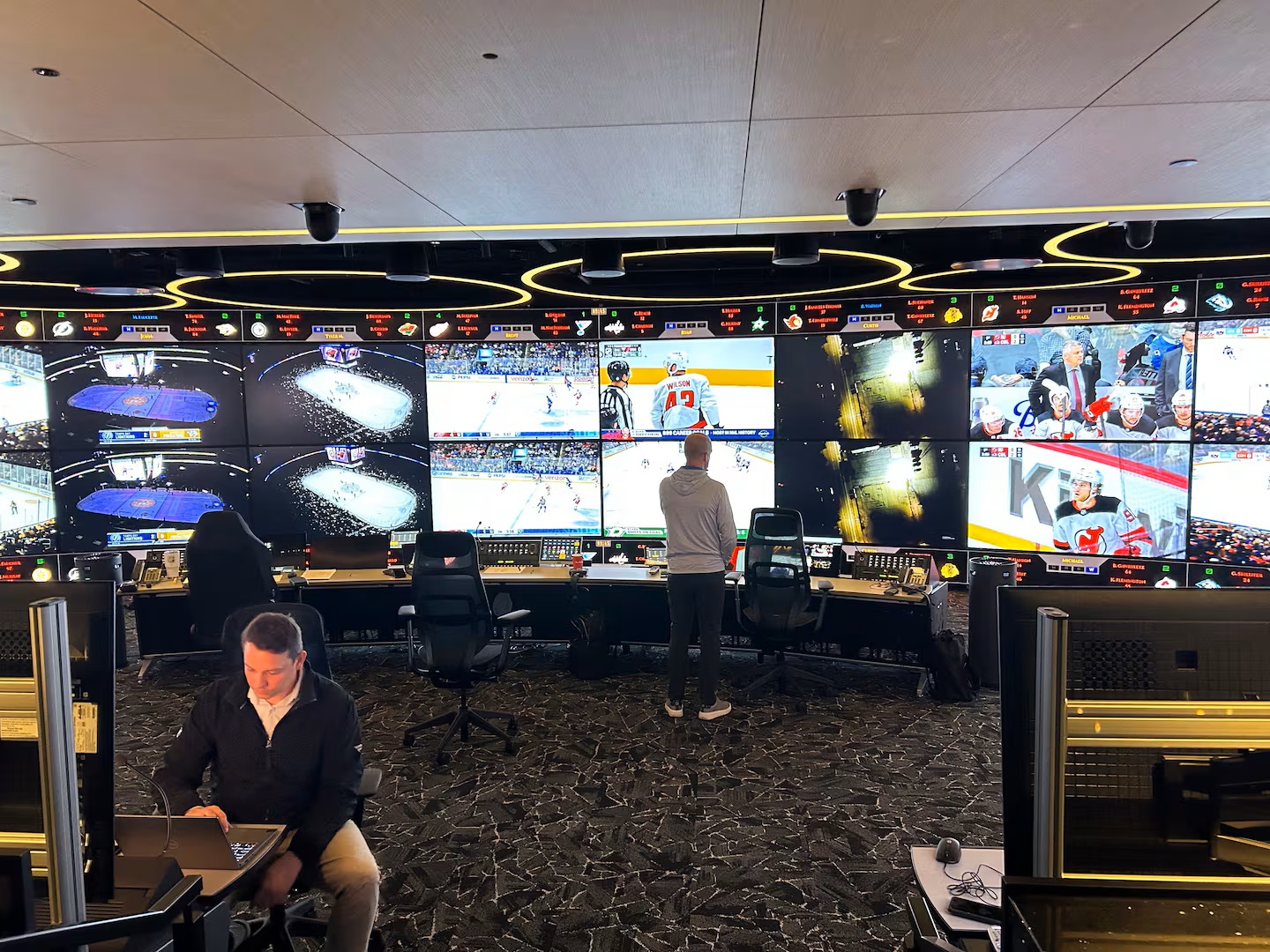
The Situation Room features 16 LED flat screens along the front wall and roughly a dozen workspaces for technicians, each assigned to one game. Photo: NHL
“We’re going to challenge this. Let’s get the linesmen on.”
Word is communicated to the on-ice officials, one of whom informs the crowd that “the previous play is under review by the league to see if the play was offsides prior to the goal” as boos cascade down from Flyers fans.
Situation Room staff pored over several angles, most notably a Sony 4K camera installed right on the blue line for exactly this use. And the final verdict, made by the Situation Room, was close, but clear: Offside. No goal. About 80 seconds after the review began, the ref shared the news in Philadelphia. Even more boos followed.
“We are the keepers of the game,” said Kris King, NHL Executive Vice President of Hockey Operations, the department’s No. 2-ranking official under Colin Campbell.
This is the second year of an upgraded, high-tech Situation Room. There are 16 LED flat screens adorning the front wall, a desk in the middle of the room for executives and roughly a dozen workspaces around the perimeter, where technicians monitor every game. SBJ was one of two news outlets granted behind-the-scenes access on the first night the 10th-floor space was open to media.
“Our job doesn’t really change a lot, but the equipment that we use, and the knowledge that we gain from using better equipment, just gives us a little bit of an upper edge to get to the right answer quicker,” King added.
The NHL was the first professional sports league to centralize its reviews back in 1991, and it has worked with Sony-owned Hawk-Eye’s Synchronized Multi-Angle Replay Technology (SMART) as its video replay provider since 2015.
Separately, the league named Sony a global technology partner earlier this year, and Hawk-Eye’s tracking cameras were installed in every NHL arena prior to last season. That system offers potentially richer data: Whereas NHL Edge, which is powered by SMT sensors on the players and in the puck, tracks a single, center-of-mass location for each player, Hawk-Eye collects data from 29 points on each skater and six points from the hockey stick.
In time, that optical data from Hawk-Eye should inform a richer future of hockey analytics, more immersive fan engagement and, perhaps, data-driven support for officials.
“The NHL are very much innovators in the space — they want to innovate with us to create the future of technology in sport — but I love the fact that it is coupled with patience,” said Dan Cash, Sony Hawk-Eye’s Managing Director for North America. “They know that this is going to be powerful for their game, but they aren’t trying to sprint to the finish line here, which I think with technology can be sometimes a mistake.”
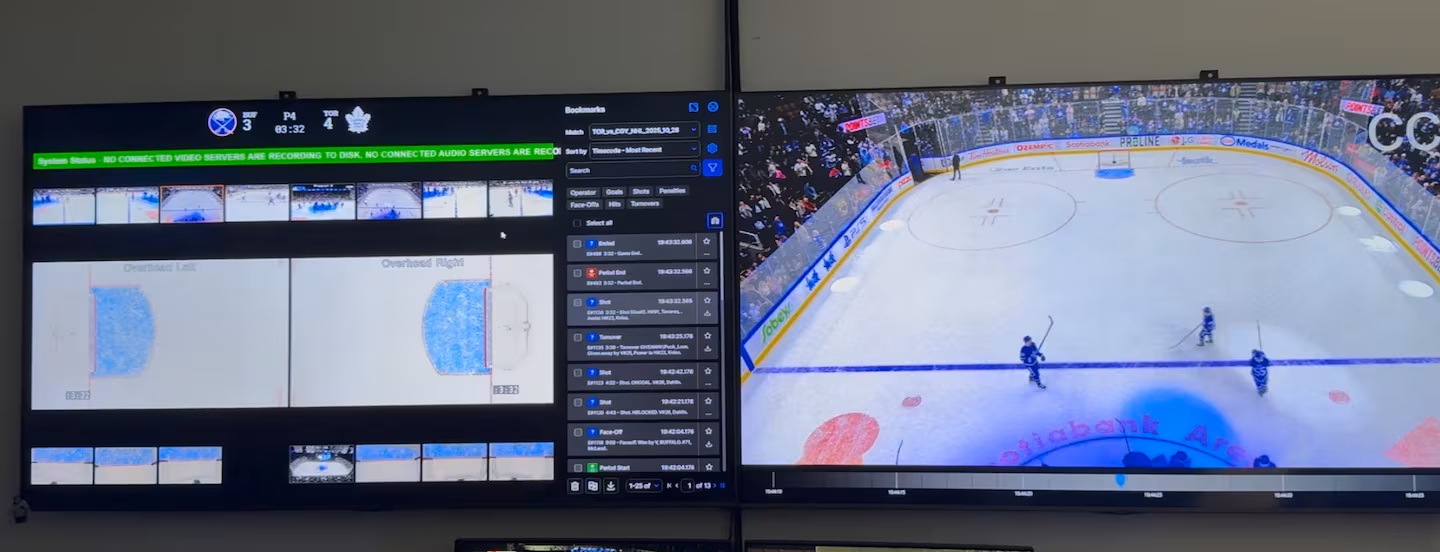
Cameras display a multitude of angles to enable the Situation Room crew to make speedy reviews. Photo: Joe Lemire
When King joined the league office in the early 2000s, the process was dramatically different. When a discipline issue arose, King would need to ferry a VHS tape to Campbell, who lived in Tillsonburg, a two-hour drive from the NHL office in Toronto.
They’d each get in their cars and drive halfway, inevitably connecting at a Tim Horton’s, the most Canadian of meeting points. Campbell would then drive home, review the tape and make a ruling about a possible suspension or fine. Nowadays, that video is transmitted in about 125 milliseconds from arenas to the Situation Room and about as rapidly to Campbell’s house, saving immense time and gas, at only the cost of a fresh coffee.
“How we transport video is the secret sauce, so to speak,” Cash said. “It’s not easy to transport video as quick as we do over a wide area network.”
We are the keepers of the game.
Kris King, NHL Executive Vice President of Hockey Operations
It’s even less for the league’s next-door neighbors. The goal horn from next-door Scotiabank Arena blared concurrently with a Maple Leafs goal scored on the Situation Room monitor. (The horn also later sounded for a Blue Jays home run; the World Series, featuring the local team, was discreetly on a few Situation Room screens.) That immediacy lets the Situation Room prepare video clips and look at questionable calls before even hearing from the on-site staff.
“It definitely is a real-time league now,” said Rod Pasma, NHL Group Vice President of Hockey Operations. “A lot of times we’ll know exactly what’s going on before [the coaches] even call the officials over to challenge a play.”
On that night, the Situation Room scoured replays to prepare a ruling that never materialized, with the on-site coach opting against the review process. “That’s a good non-challenge,” King said, noting the likelihood the call wouldn’t have been reversed.
The NHL continues to add cameras: There are three in each goal, one above, four on the blue lines and an elevated 4K lens to provide the All-12 viewpoint of every skater. Some arenas now have Cosm C360 cameras. The league will soon begin testing an 8K version of the All-12 at the Prudential Center — where the NHL and Verizon also are creating an innovation lab to test new tech, scheduled for full operation early in the new year.
On this particular night in the Toronto Situation Room, as part of ESPN’s Frozen Frenzy, all 32 teams were playing, many of the start times staggered by 15-minute intervals to make the action nonstop. One workstation was solely dedicated to pressing go on a digital dasherboards celebration for Alex Ovechkin’s 900th goal. The NHL didn’t want to chance it flashing live on-air, only for the goal to be overturned on review.
“The technology’s gotten to a point where the only thing we can’t do right now is literally hit the horn in the building,” Pasma said.
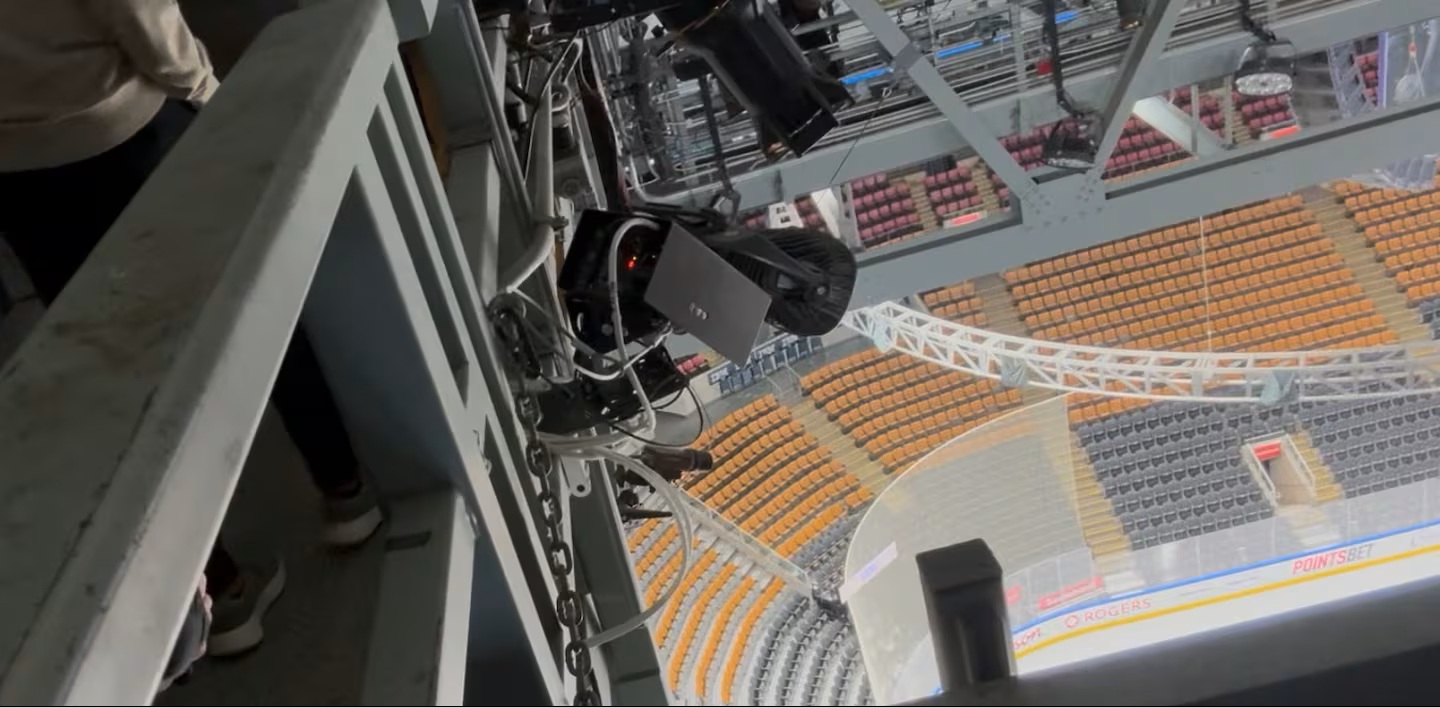
Hawk-Eye’s tracking cameras were installed in every NHL arena prior to last season. Photo: Joe Lemire
High in the rafters above Scotiabank Arena, looking down on the Maple Leafs’ 1960s Stanley Cup banners, are six black, rectangular cameras affixed to the catwalk and helping power the Hawk-Eye tracking system. From up here in the rafters, the ice seems impossibly low, but the 4K, 60-frames-per-second cameras capture granular movement data via images streamed directly to the cloud — Hawk-Eye’s first leaguewide deal to be cloud-native. Another six cameras are placed on lower levels of the arena to avoid obstruction from the center-hung video board.
Those dozen video inputs are triangulated and processed to determine the precise location of every skater and his stick. Hawk-Eye has provided MLB with bat tracking data for a couple seasons, but that’s only one bat in a known location every time — far different than 12 sticks across a 200-foot-by-85-foot ice rink.
For now, the AI models interpreting this data are still going through iterations to reach the confidence threshold for accuracy needed for wider distribution. The NHL has never had stick data, and Hawk-Eye and the league are in the “true development phase in refining the technology,” said Sean Williams, NHL Vice President, Innovation and Technology Partnerships. Williams added that it could soon be used to enhance the existing Edge tracking that teams can access through the data feed.
When Hawk-Eye data does become a part of the NHL Edge repository, it will not only further enrich the data-driven storytelling for fans via broadcast and digital media and help clubs more intricately analyze the sport, it also could provide other inputs for referees, linesmen and Situation Room executives.
“Not currently, but that’s definitely where we’re going,” said Sean Ellis, NHL Vice President of Hockey Operations, of using tracking data for officiating. “We’re not going to roll it out until we’re 100% confident and comfortable that the data that we’re getting is accurate.”
Even then, the potential is more to inform than automate. “We are genuinely looking at all options,” Williams said, “but our fundamental strategy is to keep the call on the ice made by humans.”
This article was brought to you by SBJ Tech, a Leaders Group company. As a Leaders Performance Institute member, you are able to enjoy exclusive access to SBJ Tech content in the field of athletic performance.
Last month at SBJ’s Tech Week, Bettman took to the stage to discuss how the NHL continues to embrace technologies that push the boundaries of performance.
Main image: Marc Bryan-Brown
His 32-year tenure has now arrived at a place where the sports industry is infused with tech, and the league is pushing in so many areas to advance its product: NHL Edge player tracking data, the digitally enhanced dasherboards and the alt-cast avenues it uses to reach various sections of its fans.
“The game has got to be good fundamentally,” Bettman said. “And you don’t change the game for the technology. What you do is use technology to enhance the game and to connect people with the game — whether it’s the players, the coaches or our media partners or our fans.”
As the headline speaker for SBJ Tech Week on Wednesday, Bettman rolled through the NHL’s various tech ventures, which continue to grow in both dedication and success. Here are some of his key thoughts on their current and future plans.
Boosting the referee process: One of the league’s recent developments focuses on officials using Apple Watch, which started in September.The hardware is helping officials track the game clock and also alerting them at the end of periods and penalties. Bettman sees the potential for that to expand to notifications that eventually include the players who commit penalties. The pairing of this technology with Hawk-Eye (one of SBJ’s 10 Most Innovative Sports Tech Companies) can help in the various judgment calls in games.
“I’m not sure we want to take all the human elements out of the game,” Bettman said. “However, something like offsides and high-sticking in terms of where the puck was touched, those are things that we may be able to do better of using not just the Apple Watch or the Hawk-Eye system but even using artificial intelligence in terms of re-creating situations.”
NHL Edge tracking data: Bettman pointed to the continued evolution of NHL Edge — which became operational for puck and player tracking in 2021-22 and added fan-facing features in 2023 — as a foundation of its tech mission. It supports the league’s alt-casts, as well as coaching insights. It has the potential to help video reviews, too.
“It took us better than five years and more money than I think I’ve ever told the owners to figure out how you could embed something in the puck that could actually be tracked,” Bettman said. “And then putting the chips on the player was a lot easier.”
A growing presence on Roblox: Roblox has increasingly become a space for the NHL to build and connect with younger fans. The league’s work on the platform started in 2023 with NHL Blast, which has housed All-Star Weekend and Stanley Cup Final deployments.
“It’s a combination of content creation [and data],” Bettman said, “And we now, because of the data we accumulate, we create more content and make it more readily available.”
Cloud-based live game broadcasts: The NHL, along with AWS, were SBA: Tech finalists for Best Technology Collaboration — the first live game broadcast of its kind.
“Producing the game on the cloud is more efficient from an environmental standpoint, a manpower standpoint, a financial standpoint,” Bettman said. “That’s the way of the future. That’s the way everybody’s going to be producing games.”
AI usage league-wide: Bettman mentioned that the NHL has leaned into AI in both fan-facing and back-of-house use cases. AI has streamlined aspects of selling tickets and scheduling games for its 32 teams.
“We schedule over 1,300 regular-season games, looking at building availability, looking at traffic patterns to get people in and out of games,” Bettman said. “These are all things that AI is going to make us better at.”
This article was brought to you by SBJ Tech, a Leaders Group company. As a Leaders Performance Institute member, you are able to enjoy exclusive access to SBJ Tech content in the field of athletic performance.
How haptic feedback helps officials to keep their eyes on the ice during games.
Main image: Getty Images courtesy of the NHL
The league and its officials, in collaboration with Apple and technology innovation partner Presidio, developed the NHL Watch Comms App to track the game clock and signal the imminent end of periods and penalties. But to help the officials focus more on the action around them, the primary function is to provide haptic feedback with vibrations, rather than visual cues.
“The watch doesn’t distract you,” said Stephen Walkom, a former on-ice referee who is now NHL Executive Vice President, Hockey Operations. “It actually informs you. You think you’ve got to see a watch, right? And we feel a watch, but we know what time it is.”
Rollout of the Apple Watches began in September, with the league reporting a 92.5% adoption rate by officials. Saturday’s NHL Stadium Series game, in which the Columbus Blue Jackets are hosting the Detroit Red Wings at Ohio Stadium — the usual football home of the Ohio State Buckeyes — is an important milestone for the technology.
Every arena hangs scoreboards and places LED-ribbon clocks in different places, but over time, the officials grow familiar with their locations for quick time checks. In a one-off location like with the Stadium Series, everything is new, plus the size and typical depth perception is thrown off by the vast size of the venue.
“In that building,” Walkom quipped, “you’d be spinning like a top on the ice looking for a clock.”
Part of the impetus for the technology was a safety concern. There have been collisions and near-misses on the ice when players emerge from the penalty box and an official happens to be skating near the door. Having the haptic reminder that a player is about to emerge can help clear that space.
“We had a really high-level objective: It was an interest to figure out, how can we help the officials keep their eyes on the ice more?” said Dave Lehanski, NHL EVP of Business Development and Innovation. “We can’t understate how important it was to collaborate with the officials and how agreeable they were to participating in this.”
The NHL brought that goal to its tech partners. Apple had previously helped the league by providing iPads for in-game bench use, and Presidio developed applications for the NHL Draft and the league’s streaming operations.
As straightforward as the end result is, there were technical challenges to develop it, not to mention the need for significant input from the officials to ensure the app didn’t disrupt their workflow. Presidio developed the app, extracting about two dozen datapoints from the NHL’s OASIS data feed, rather than pushing notifications to the watch.
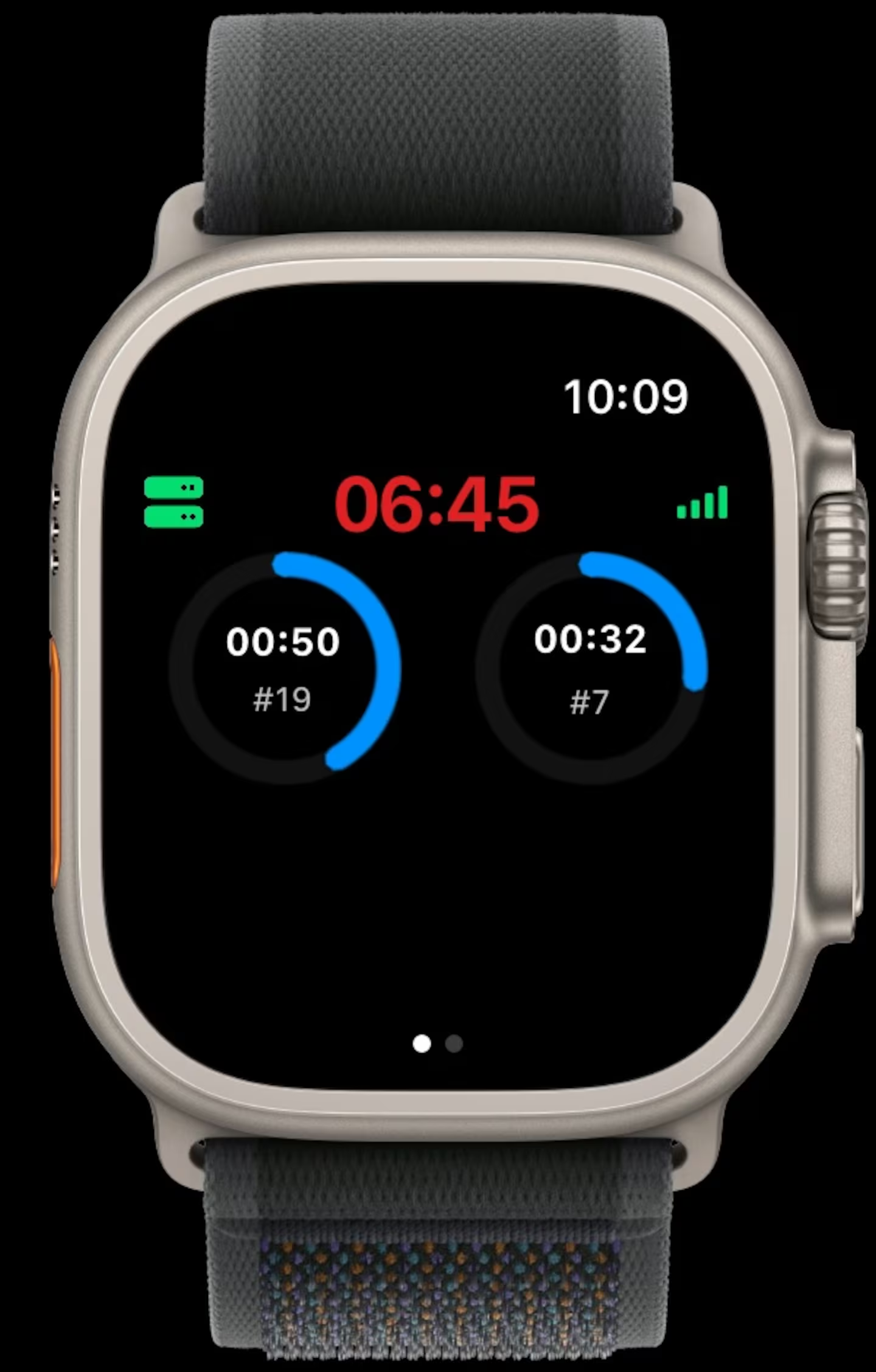
The NHL Watch Comms App showing the imminent end of two penalties (Photo: NHL)
“We had to build, not necessarily a push-based application, but a pull-based application, which was really, really unique, to make sure we had accurate data for the officials,” said Andres de Corral, Presidio VP Digital Services, noting that the timeline required “a series of design thinking sessions and trial and error.”
“The NHL has a real patience about these implementations,” added Scott Brodrick of Apple Worldwide Product Marketing. “The goal is the seamless use of technology to enhance the game, and I think that has materialized over this period of development. Sometimes the simple solution is the most powerful.”
Now, before games, almost every official grabs an Apple Watch as routinely as his shin guards, microphone and striped shirt.
“Guys just came to trust it,” Walkom said, “and we have less and less looking for a clock in the rink.”
This article was brought to you by SBJ Tech, a Leaders Group company. As a Leaders Performance Institute member, you are able to enjoy exclusive access to SBJ Tech content in the field of athletic performance.
The NHL Hall of Famer’s new helmet has received a five-star rating from the renowned Virginia Tech safety testing laboratory.
Main image: Jim McIsaac / NHLI via Getty Images
A Data & Innovation article brought to you by
You can’t have a discussion about sports technology today without including athletes in that conversation. Their partnerships, investments and endorsements help fuel the space – they have emerged as major stakeholders in the sports tech ecosystem. The Athlete’s Voice series highlights the athletes leading the way and the projects and products they’re putting their influence behind.
Over those 15 years, he scored 468 goals, added 545 assists and holds the all-time record of 1.17 points per game among American-born players. LaFontaine’s No 16 was retired by the Sabres, and he was included in the league’s 2017 list of the 100 Greatest NHL Players of All Time.
Though LaFontaine had a great career, it ended sooner than he would have hoped. He suffered a half-dozen definitive concussions but estimates the real total may have been twice that. The neurologist who treated him throughout his career — Dr James Kelly, a professor at the University of Colorado Anschutz Medical Campus who previously held a leadership position at Walter Reed National Military Medical Center — became a friend.
“Jim and I became very close over the last 25, 30 years,” LaFontaine said. “He was the doctor that cleared me to play, and he was the doctor said, ‘OK, that’s enough.’ I’m extremely grateful to him.”
LaFontaine, now 58, and Kelly are also now co-founders in a new venture, Valor Hockey, that has made a highly-rated helmet. The Valor Axiom received a five-star rating from the renowned Virginia Tech safety testing laboratory, the first new helmet to garner that best mark since 2017. The Atlantic Amateur Hockey Association, which is affiliated with USA Hockey, is the first league to partner in promoting the Valor helmet that retails for $299.
On the origin story of Valor…
It actually started when Dr Kelly and I looked into doing something in 2004. A company had a material that was 40% more absorbent and could deflect and absorb impact I think better than what EPP was at the time, which was the mainstay. What we found out was they went into an IP lawsuit issue with the material. So we tucked it away for a little bit.
We started talking again around 2016 or so. There was an opportunity with another impact material that we were looking into. The irony was [the helmet] was originally designed by a guy named Jose Fernandez. He did X-Man, he did Batman, he did Ironman. So it was more of like, ‘If you could do a futuristic, cool design of what a hockey helmet is in the future.’
We spoke with a gentleman, a designer and partner now, named David Muskovitz. So David did the engineering and did the final design, but we took an initial design and said, ‘OK, how do we make this safer? And how do we make it perform really well, fit really well? And then how do we make sure we can manufacture it? And most importantly, make it safe?’
We created a monoshell, which is a one-piece shell. I think one thing it’s important I want to say 98%, 97% of all helmets are two-piece shells, which we found interesting. All the NFL and motocross and lacrosse and Major League Baseball [helmets] — why are they one-piece shells? So we came up with a slogan ‘beyond traditional safe’ because in the hockey space, two-piece shells are traditionally safe. Then we found out making a one-piece polycarbonate injected shell is not easy with that kind of a design. But if you build a really good one-piece, and a really good two-piece, the one-piece will always outperform and be safer. Why? Because of the impacts will be distributed more evenly versus a two-piece.
On the shape of the helmet…
Dr Kelly described this in a really good way. We literally took that design, and we created smoother, slightly rounded edges around the sides of the helmet, and then the back and then the front. We made a lower profile with a little bit of an angle for deflection. The way he puts it is, so take a cue ball and then take a Rubik’s cube, and the cue ball hits the cube and it kind of grabs it, torques it, spins it and sometimes breaks it up because it’s got more flat spaces. Well, then take another cue ball with a billiard ball and hit it. And if it’s got more slightly rounded, smoother edges, it’s going to deflect and ricochet and glance.
On minimizing the magnitude of impacts…
You’re not going to stop a concussion — nobody’s going to stop it — but now knowing the science and the testing, you can minimize damage. And over the course of somebody’s career, you think about some of these catastrophic hits, these big hits, then you think of these every day compression hits, over a period of time, the brain in the head isn’t built to sustain those.
I don’t know exactly what the measurements are, but if somebody says you could get a Grade 3 concussion with one helmet, and potentially a Grade 2 or 1 concussion [with another helmet], that’s significant. You accumulate that over a period of time. Minimizing the damage makes a massive difference in the livelihood.
On the helmets he wore as a player…
Dr Kelly said something very profound to me along the way. We didn’t have the testing and the science behind the linear and rotational testing — we didn’t have that back then. This is just the way it was back then. The helmets were what they were. But if it was graded today, it was probably a zero to a one star.
Knowing now what a five-star [helmet] is, and the impacts that it takes to distribute the force load, and Jim actually said to me, ‘I can professionally and publicly be able to comfortably say, after knowing what I know about science and the testing, that you would have most likely had between 50% and 60% less damage during the course of your career. And to me, that’s profound.
On his own experience with concussions…
I’m here telling you the story because I lived it. I went through post-concussion syndrome twice. I went through one extremely dark period of time where things got really scary and depressed, and I really didn’t see a light at the end of the tunnel. I know what can happen if you hit your head enough, and you can do damage.
Fortunately, my brain found its way back. I was able to get that enthusiasm and excitement back. Dr Kelly was willing to let me go back again but warned me, ‘If you take another one, you’re probably going to go through a [dark] period of time again because there’s a threshold that you cross. What used to take 10 days to two weeks to recover is now taking you months. I probably had about six to seven [concussions] documented — when I broke my jaw, we never documented it, but I guarantee you I had a concussion. And then I probably had another handful of dings that I saw stars but we didn’t count them. I’m somewhere probably around double digits, 10, 12, concussions.
I went through six months [of rehab] twice. The second time wasn’t as severe. But even then, there was a part of me relieved that I didn’t have to make that decision, and then a part of me had to let go of something I loved since I was a kid. So it was still difficult to deal with. But I heard something really profound. I read this book called Legacy about the All Blacks rugby team. There’s a quote in there that talks about if, you’re a true servant and leader of your sport, then you have a responsibility to leave it better than you found it. My wife struggled watching my son play. He had a couple of concussions, then she couldn’t watch, having lived through what her husband went through. Now we have a little grandson who’s three, whose name’s Patrick. And you know what, I know that, should he choose to play hockey, that there’s going to be safer products for the next generation.
On how hockey shaped him…
I’m grateful for what we had when I played. This is something to take and [ask], how do we create an evolution of where safety continues to go and I think that should be a natural thing to do anyway. Listen, if I didn’t retire after 15 years from concussions, there wouldn’t have been a service and purpose for me to do this. So I always believe, in life, your experiences, good, bad or indifferent, whether you realize it or not, prepare you for what’s to come next in your life.
I believe your experiences shape you into your service and purpose. And hockey was always a stepping stone. I’m grateful for what the sport has done for me. But it’s put me into a place in my life where everything I learned from those experiences, has taught me how to give back in a purposeful way, a meaningful way and a service way. And I have a mantra in my life, whether it’s my foundation, or whether it’s what we’re doing with Valor, “Score your goals when you’re young because, when you get older, life is about the assists.”
On the values instilled by hockey and in the Valor brand…
Being a player, I was blessed, and it was a privilege and an honor to play in the pros as long as I did and represent my country. The game was my life, and it still is. I say that, even though I don’t play as much, the game still lives inside me. The character lessons, the life lessons, the values, the life skills, leadership, teamwork, getting through adversity, getting enough discipline, the friendships, the relationships, all of those things that you learn in the sport of hockey still are so much a part of who you are in your life going forward, which is really a big part of what the brand is built on.
The Declaration of Principles which we launched with the National Hockey League — the tip of the spear, that north star — and we were able to get the global hockey community to sign off on values and principles to aspire to live to. So part of the Valor brand is based on those declaration of principles and bringing those to life, whether it be in products, programs, technology, services. From my perspective, it’s so important that sports play a role in our society and our next generation, so creating a positive and safe environment is right up there as one of them.
The afternoon at the Scotiabank Arena featured Toronto Metropolitan University, Klick Health and Management Futures discussing both the theory and application of strategies designed to create winning environments.
In partnership with

These are the highlights from the afternoon programme, which featured Dr Cheri Bradish, the Director of the Future of Sport Lab at Toronto Metropolitan University; Glenn Zujew, Chief People Officer at the world’s largest independent commercialisation partner for life science, Klick Health; John Bull, the Director & Lead for High Performance at leadership and organisation consultancy Management Futures.
[Already up-to-date with the afternoon? The morning takeaways are available here.]
Session 4: Designing the Environment & Innovating at Pace
Speaker: Dr Cheri Bradish, Director of the Future of Sport Lab, Toronto Metropolitan University
Innovation + Culture
Session 5: The People & Culture
Speaker: Glenn Zujew, Chief People Officer, Klick Health
Session 6: Debriefing Skills
Speaker: John Bull, Director & Lead for High Performance, Management Futures
“The only sustainable competitive advantage is an organisation’s ability to learn faster than the competition” – Peter Senge
STOP: for live debriefs during the event:
How Debriefs Help Create a Winning Culture
Features of a great debrief
Broad structure of debrief questions
Further reading:
Check out the takeaways from the morning here.
Players can train technical elements in the comfort of their own homes and receive instant feedback on their execution.

Tennis legend Martina Navratilova has signed on as an advisor to Sense Arena after seeing a demo and calling it “about as realistic as you can get without actually hitting the tennis ball.”
Founded in Prague by Bob Tetiva—whose father, Jaroslav, was a member of the 1952 and 1960 Olympic basketball teams for the former Czechoslovakia—Sense Arena is a partner of 30 pro hockey teams, including the Los Angeles Kings, New Jersey Devils and Vegas Golden Knights among its five NHL clients. It has begun accepting pre-orders for its tennis product, which costs $300 for a yearlong subscription and, for a limited time, includes a free haptic racquet.
“You don’t have time in any sport to think, you just have to react,” says Tetiva, the CEO. “And to learn that, you can either play hundreds and thousands of matches in hockey or tennis, which will be very exhausting for your body or—here comes the beauty of virtual reality—we can throw you in the same environment in the first person to a controlled place where it’s actually only about you.”
The company, which has North American offices near Boston, Toronto and now Tampa, has raised $3 million earlier this year and $5.2 million in total, with participation from the Boston Bruins’ top scorer, David Pastrňák.
Available now on Meta Quest 2 and soon to be expanded to other VR providers, Sense Arena’s tennis software is currently usable as a one-person training tool, with multiplayer capability likely for the future as well as other updates, including the ability to practice serves and a pro-level strategy feature.
Users hold the proprietary racquet—which houses a Quest controller and vibrates when a player makes contact with a virtual tennis ball—and can replicate shots and volleys as well as engage in other cognitive drills.
“Forehand, backhand, it’s all about reaction, and it’s about repetition,” Navratilova says. “And then you get [to see] what the end result is, so you can fix it. The ball tells you what you did wrong. So you get that immediate feedback in the safety of your home.”
Navratilova has suggested some tennis drills to be incorporated and, even after her first product demo, recommended the inclusion of a pause button to help players visualize the angles of shots better. “Immediately she was intuitive giving us feedback on the existing product,” Tetiva says.
Tetiva plans to market the product to both elite teams—colleges, academies and the like—as well as individual players. B2C is likely to be the predominant sector because of its sheer size, he says, “but the credibility is built through the top tier of tennis.”
Yannick Yoshizawa, a former college player at South Florida who worked nearly nine years at the WTA, was hired to lead the tennis business at Sense Arena. The three main pillars of the sport, he says, are physical, technical and mental training. Physical and technical are more easily isolated in practice, but he has bought in to the potential of VR to train the mental component.
That was the early thesis of Tetiva when he began developing a hockey program. He had played some pro basketball in the Czech Republic before entering the IT industry when his son began showing interest in hockey. Sports training has evolved considerably in almost areas, he realized, with a notable exception.
“One piece is kind of neglected, and that’s your brain,” he says, “which actually controls everything.”
This article was brought to you by SportTechie, a Leaders Group company. As a Leaders Performance Institute member, you are able to enjoy exclusive access to SportTechie content in the field of athletic performance.