At the 2025 Leaders Sport Performance Summit, some of the most respected leaders in high performance set out their plans to build the winning teams of the future.
The South African, then with Munster, had agreed to become the Head Coach at struggling Bath in December 2021.
A few days later, he switched on the TV only to see Bath go 0-28 down after just 25 minutes of their Champions Cup tie with Leinster.
It prompted the Everest comment, as Van Graan told an audience at the 2025 Leaders Sport Performance Summit at the Kia Oval in London.
He eventually took the reins at Bath’s Recreation Ground in July 2022 and, over the next three years, led one of the most remarkable transformations in English rugby history.
In May, Bath lifted the European Challenge Cup, Premiership and Premiership Rugby Cup.
The tale of Van Graan’s ‘Rec Revolution’ set the tone for an international gathering of over 300 high-performance leaders to share knowledge, best practice and inspiration.
The agenda took its lead from our Trend Report in which more than 200 performance leaders from almost 40 sports told us how they expect the industry to develop in the years ahead.
Five trends stood out:
Van Graan is at the vanguard of several of these trends and, across both days, the Leaders Performance Institute delivered a range of guest speakers from organisations including England Rugby, the Royal Air Force, and the Haas F1 team to speak to each trend.
The following is a snapshot of what they said.
1. Alignment is now a competitive advantage
For evidence of the stock placed in being aligned, look no further than Bath’s transformation from a rabble to the best team in England in just three years.
Van Graan said: “I put up a picture of Twickenham on the very first day. I said ‘I can’t tell you how we’re going to get there, but we will get there.”
He wanted his playing group, coaches and other performance staff to coalesce around three values: connection, clarity and commitment. The trick was then bringing those to life.
Johann van Graan
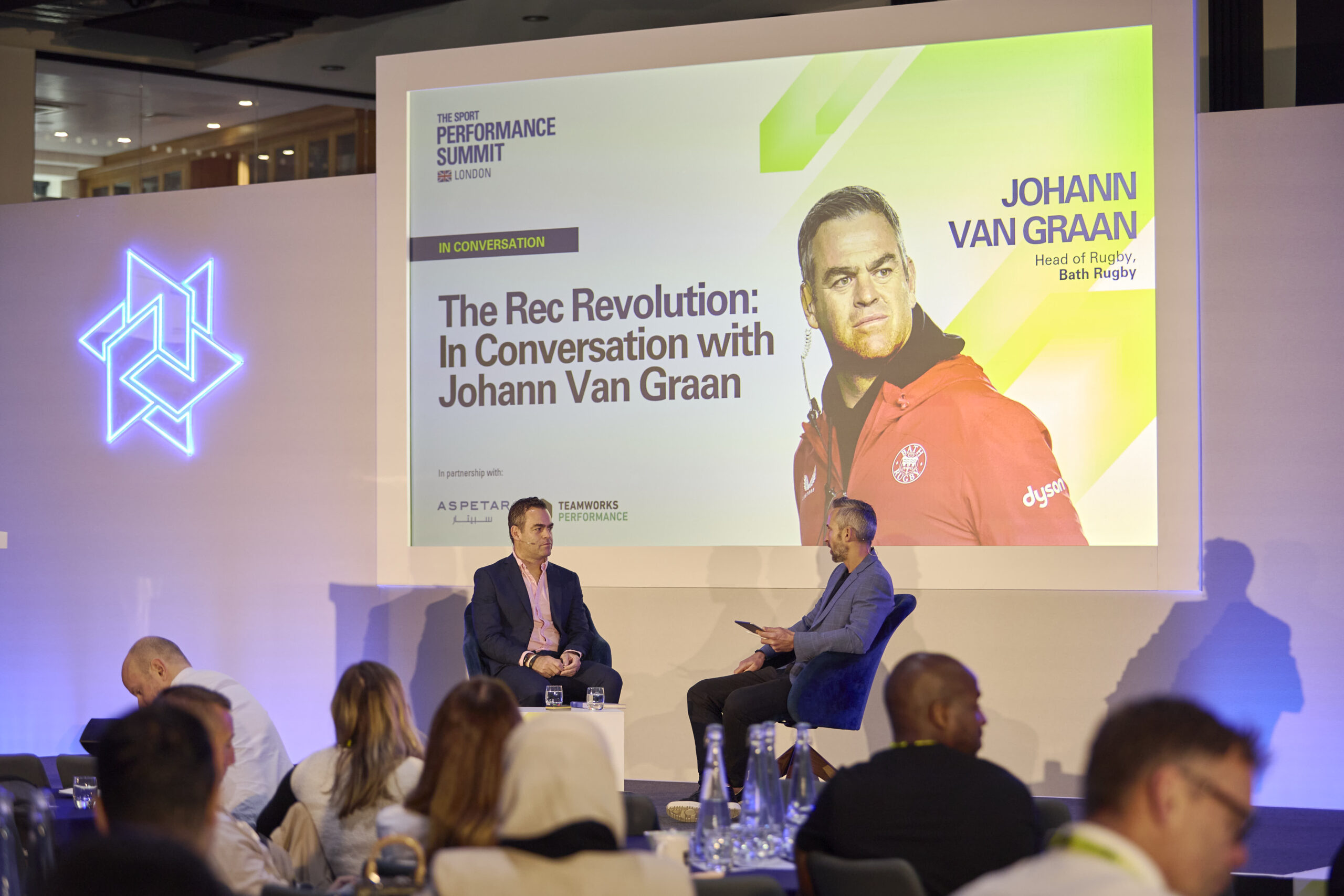
Bath Head Coach Johann van Graan in conversation with host Iain Brunnschweiler.
2. Leaders increasingly seek to empower and collaborate
John Mitchell offered another inspiring story from the world of rugby union.
In 2023, when he signed on as Head Coach of the England women’s national team, it was Mitchell’s first time coaching a women’s team.
The Red Roses had a genuine shot at winning the Women’s Rugby World Cup on home soil in 2025, but a talented team needed an experienced guiding hand.
The team delivered, with Mitchell receiving plaudits for his role as England secured their first world title in 11 years.
Two months on from that achievement, the audience found Mitchell (affectionately known to his peers as ‘Mitch’) in typically reflective mood alongside the recently retired Emily Scarratt, who was part of the Red Roses’ winning squad.
Sport (and rugby union) grows ever more complex and yet, after 30 years, Mitchell feels he has never been better equipped to coach.
“You don’t have the full scope,” he says of his early coaching days in the mid-90s. “You have strengths early on that are recognised but then also you sometimes don’t know the whole of yourself. So you take the time to understand the whole of yourself.”
He came to a critical understanding. “When I was younger, I was going to try and be right. Maybe I was trying to prove myself as a coach.”
John Mitchell

England Red Roses Head Coach John Mitchell shakes hands with former England fullback Emily Scarratt at the conclusion of their panel session.
Emma Keith built on the theme of empowerment in her presentation on officer training in the Royal Air Force.
“Cultures and environments can only grow when everybody takes accountability,” said the Commandant of the RAF’s Tedder Academy of Leadership. Keith, a group captain, is the first female to run RAF officer training.
Emma Keith
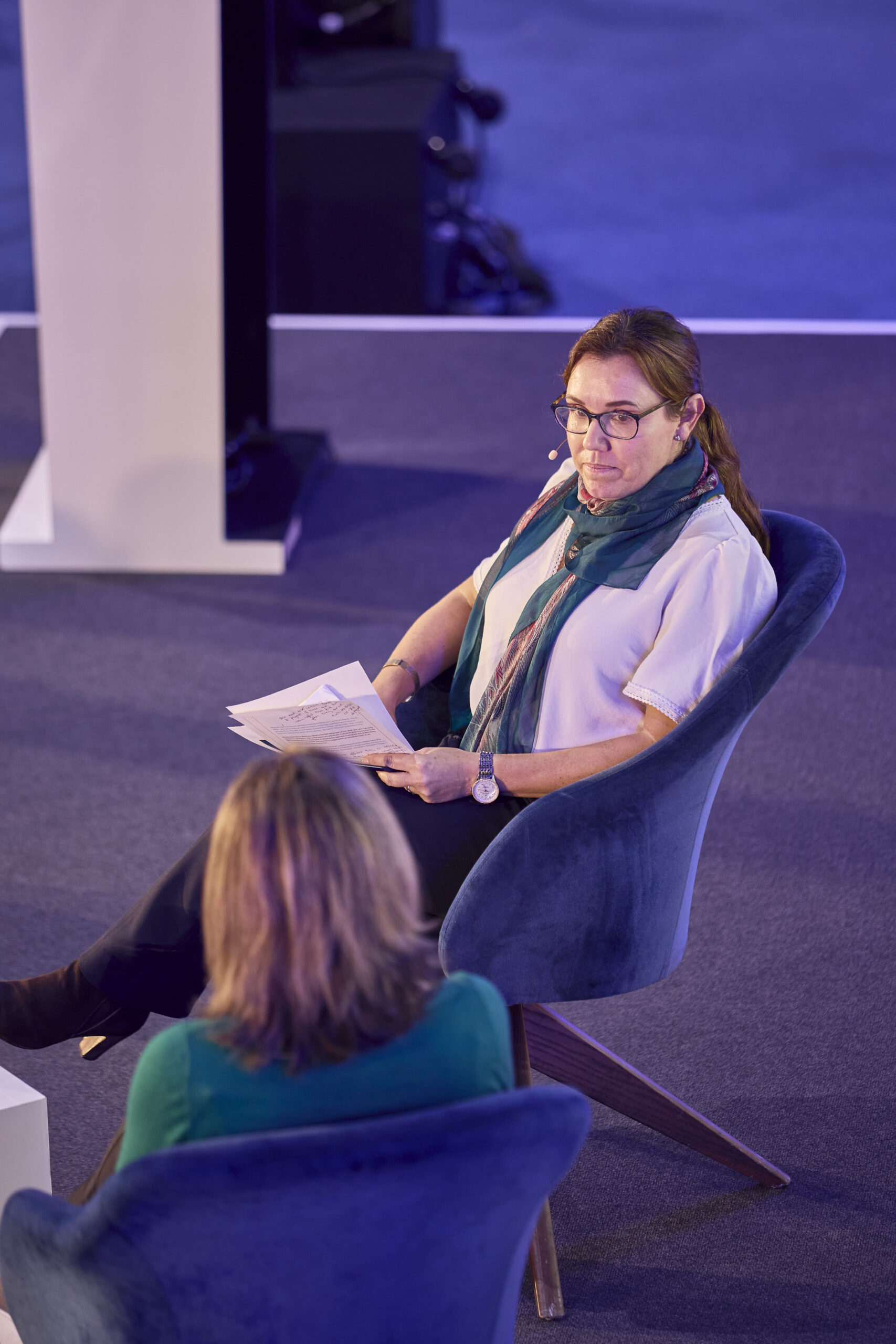
Group Captain Emma Keith talks to UK Sport’s Alex Stacey following her presentation on officer training in the Royal Air Force.
3. Teams are prioritising resourcefulness over resources
As Team Principal of MoneyGram Haas F1, Ayao Komatsu knows as well as anyone that his team is competing with better resourced and more illustrious teams.
The team has 375 staff members, which may sound like a lot, but it pales in comparison to the likes of Ferrari, Red Bull and McLaren.
“If we cannot work together, if you’re not supporting each other, if you’re not aligned, we’ve got zero chance against organisations minimum three times our size,” said Komatsu, who had just flown in from the Brazilian Grand Prix in São Paulo where Haas’ Oliver Bearman achieved a creditable top-six finish the weekend before the summit.
Ayao Komatsu
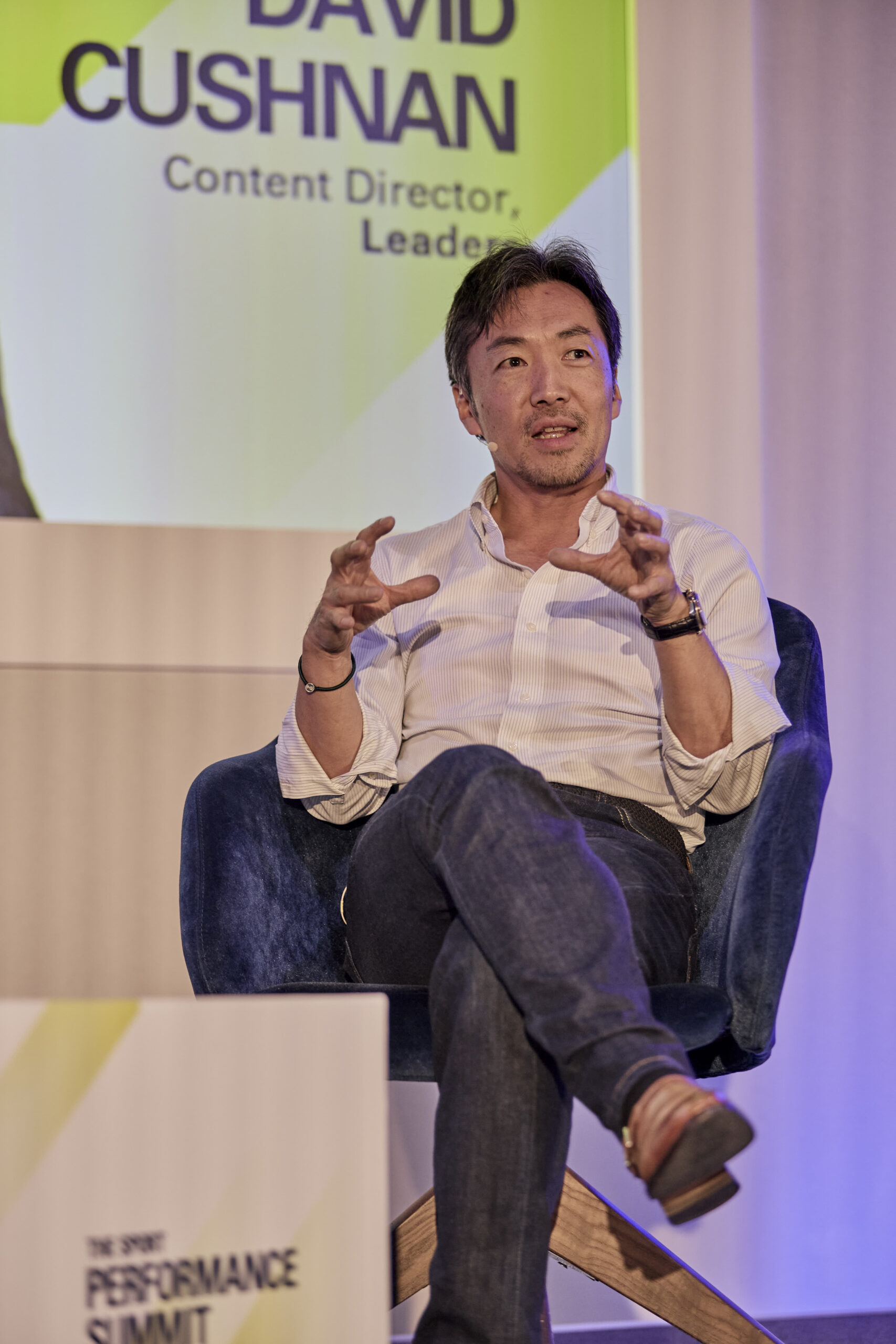
Ayao Komatsu, the Team Principal of Haas F1, shares insights into life in the pitlane.
Similarly, albeit in vastly different circumstances, the Red Cross must make the most of its limited resources when emergencies strike.
Chris Davies, the Director of Crisis Response and Community Resilience at The British Red Cross, cited his team’s core operational process:
Chris Davies
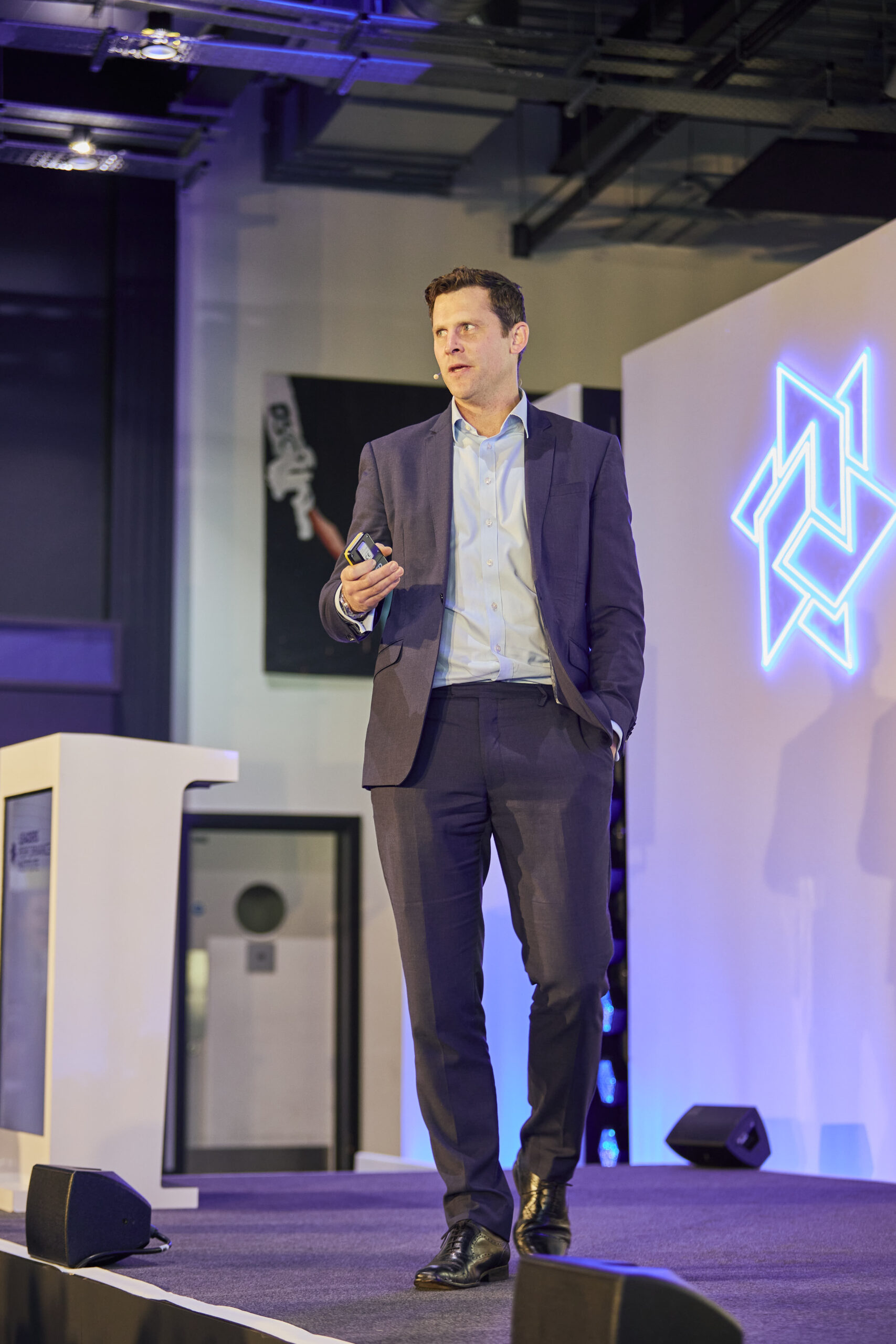
Chris Davies of the British Red Cross in full presentation mode.
4. Psychology will be a game-changer
The mental and behavioural side of performance was an ever-present topic on both days of the summit. Our guests discussed several elements:
The importance of individual expression and acceptance
Johann van Graan
Belonging as a contributor to wellbeing (and performance)
Emily Scarratt
Psychological safety
Ayao Komatsu
5. Teams are engaging in a tech arms race
Professor Tom Crick spoke in his capacity as Chief Scientific Adviser at the UK Government’s Department for Culture, Media and Sport.
He presented on the growth of AI and continually stressed how important it is to keep “the human in the loop” regardless of whatever advances are coming.
To this end he offered Leaders Performance Institute members a series of recommendations.
You must be able to explain why you are using an AI tool…
“You can’t just say ‘the computer says so.’ There has to be some understanding and explainability, and there has to be trust.”
An AI tool should not replace your people…
“AI should not erode or disempower or remove agency for people within your domain. It should augment human capability, not replace it,” said Crick. He added: “It is about co-design, co-decisions and co-evolution as we go forwards – keeping humans embedded in the process.”
Don’t assume your AI tool is right…
“Don’t automatically trust the system. Always ask: is that the right data? Does that feel right? Can we verify and validate it another way?”
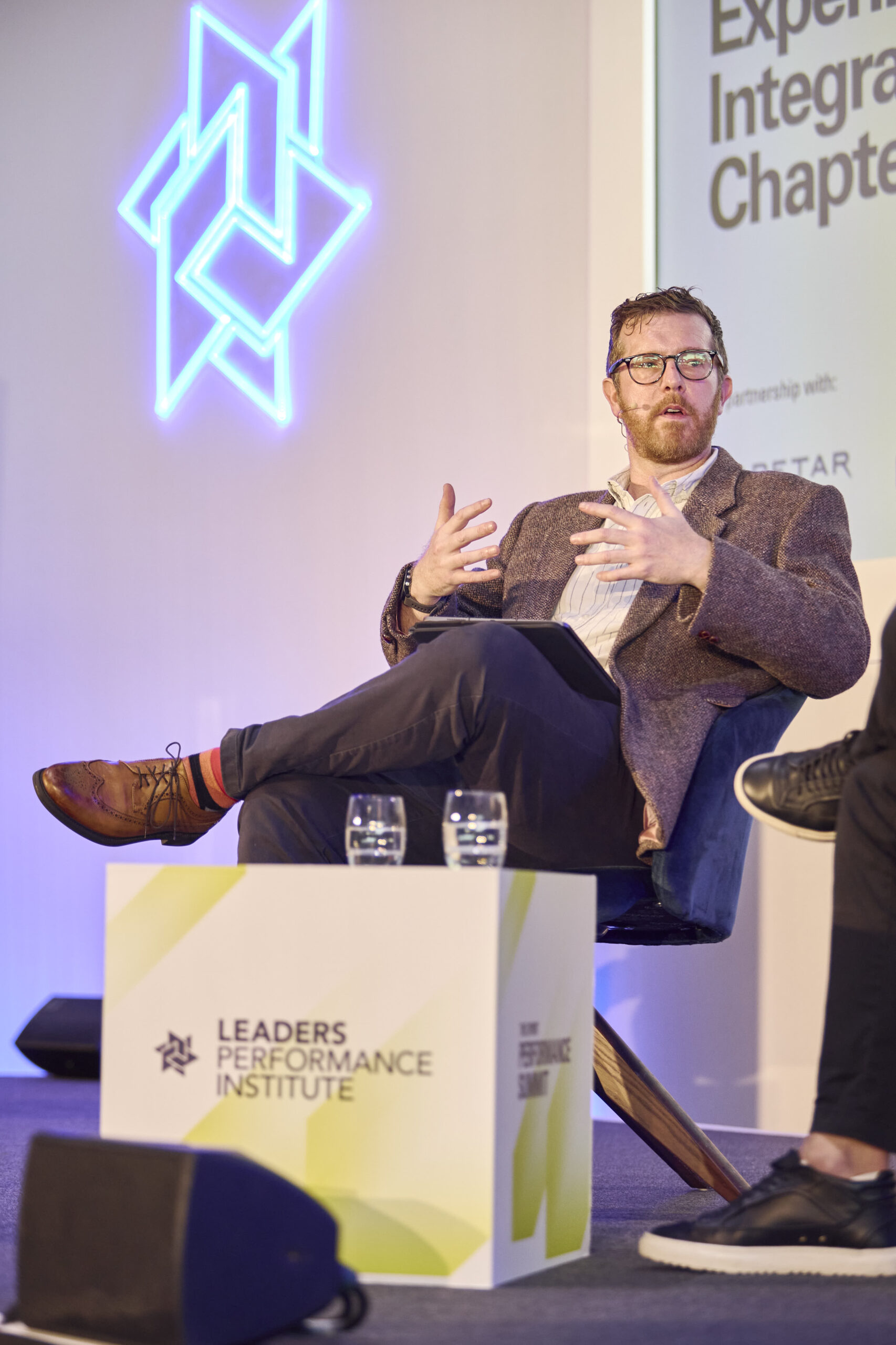
Tom Crick, the Chief Scientific Adviser at the UK Government’s Department for Culture, Media and Sport, answers questions from Leaders Performance Institute members.
Next stop for the Leaders Performance Institute
In an exclusive column, Peter Hodgkinson, the former Head of Build at Mercedes F1, sets out the considerations that helped him to lead in one of sport’s most high-pressured arenas.
Main Image: Getty Images / Mark Thompson
Not only is it difficult to fully see someone’s body language, it also makes it near impossible to see a leaking water pipe at the front of an engine!
In my opinion, you need to be present in a high-performance environment.
I served as Head of Build at Mercedes between 2011 and 2019, an era when we won five driver’s and five constructor’s world championships. It was a period of unprecedented success for the team and for at least part of that time I worked out of a small, tired office in the middle of the team’s factory.
It was a terrible space. It had no natural light, the AC was incredibly bad, and the ceiling tiles were water-stained. Admittedly, I couldn’t see those tiles – or the worn-out carpet, come to think of it – as easily at 7:30am when six or seven people turned up for work and squeezed into a room that was more suitable for four.
I wasn’t sad when that office was finally knocked down as part of a factory refurbishment, but it had been a home away from home. For 20 years I’d spent more time there than I did at home.
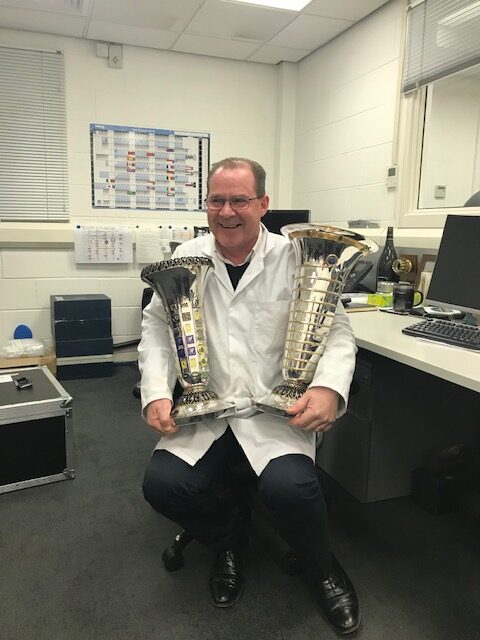
Peter Hodgkinson holds the Formula 1 Drivers’ and Constructors’ World Championship trophies in his ‘dreary’ former office at Mercedes HQ in Brackley, Northamptonshire.
This story (at least my schedule, if not the dreary office) probably sounds familiar to many of you. I was routinely on the road at 5:15am and did not leave until 6:30pm most evenings. Of course, I left my phone on just in case.
Such scenarios in high-performance are not going to change any time soon, but there are several things that you can do as a leader to protect yourself and your team from excessive workloads while still delivering the required work.
There are sure to be other things, but these five considerations make a good starting point.
I believe it was important to be seen and to say at least ‘good morning’ to as many of my team as possible. I wanted them to feel that I cared for them and I was interested in what they were working on and the issues that they faced; and it was another opportunity for information gathering.
When we were in the build period or working on a big update, I would try and get to work in time to talk to the nightshift in Build, Compbond, Inspection etc to get an understanding of the current status and get a head start thinking about what I had learnt. This floor walking – asking questions, providing challenge, learning about the current status and building relationships – as I said, I don’t think you can do this as effectively on Teams or Zoom.
I’ve touched upon this before. I never tried to plan more than 30 percent of my day. Most days, meetings were added into my calendar which I needed to attend and, if I had a big gap, I would try and block it out for my work.
We think of work as writing plans, answering emails, attending meetings, doing things, etc but floor walking and talking to people is just as important and is part of the job. It might not feel like work as you have nothing physically to show for it, but it is so important as you are building relationships with your team which is an essential part of the trust equation.
As a leader, you cannot be chained to your desk doing work, looking at your feet and never lifting your head to talk to your team.
Manage your job list by focusing on getting things done. But don’t just keep adding to the job list. Create movement.
Trying to have 70 percent of my day unplanned also meant that I had a pretty good chance of achieving the 30 percent that I did have planned, so I felt like I got stuff done and when I went home, I felt that I had achieved something.
This is important. We all like big, long job lists. It makes us feel valued, but if we just keep adding to them it is soul destroying, as you never feel like you have achieved anything. Try and get three things done each day, completed and finished. This is movement, placing a real mental focus on a task to get it completed. This is what I attempted to do from 6:00am to 8:00am each day. With the 30 percent rule, if there is a crisis that does require your full attention, then you should have some capacity to manage it without impacting too much of your day.
Dr Ceri Evans got me thinking about tasks in this way:
Name it: What is the technical task you are undertaking? Give it a name.
Time it: Add a deadline for when you are going to get this task completed. This adds pressure which gives us energy to perform.
Move it: Time to step in and perform. Complete or complain, it is your choice. Try three times a day for 15 minutes to focus on a task and get it completed. This is movement.
Trust is at the heart of any team’s performance. Trust is choosing to risk making something you value, vulnerable to another person’s actions. It happens in small moments when you have the opportunity to increase your trustworthiness.
For example, I tried to keep meetings to a minimum as I wanted to walk around and talk to people and follow up on issues. It was important to me to be connected to what was going on in the workshops and for the technicians to know that I cared deeply about what they were doing and the effort they were putting into their piece of the puzzle.
After clearing as many emails as possible, I would try and get out the door by 6:30pm and leave the Team Leaders to it. As I said, the phone was always on but, on the whole, it didn’t ring that much in the evenings or at night because the team knew what to do and what was required.
In short, they had my trust. I believe trust is made up of the following:
Reliability: You turn up at the same time every day, you deliver the work, you can be counted on in a crisis to be there. You are present.
Competent: You are knowledgeable and you know how to do the work to the best of your ability.
Relationship: You need to have a relationship with the people you are interacting with. Find out about what they like and dislike; be curious about them as a person.
In F1, I tried to get to a position where 80 percent of what we did was planned and 20 percent was chaos. The chaos makes the job both challenging and fun. It’s one of the reasons you get out of bed in the morning.
When the chaos hits 40 or 50 percent, this is too much and it leads to overload and overwhelm. Cracks will start to show in the team’s behaviours and the quality of the work will decline.
As a leader, you need to manage this carefully and do everything in your power to protect your team as much as possible from the really impossible requests.
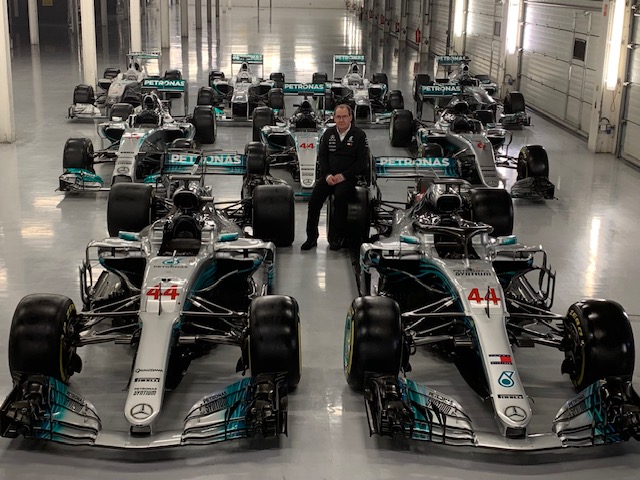
Peter Hodgkinson on the factory floor at Mercedes HQ in Brackley, Northamptonshire.
Sometimes you have to say ‘no’, but make sure you have other alternative options ready to present. You can’t just say ‘no’. There is a very fine line between protecting your team from excessive workload and delivering the required work to support the plan so if you do push back, make sure you can fully explain your concerns with facts, not just emotions.
Peter Hodgkinson is a leadership and performance specialist skilled in helping high-performers become better at what they do. As an accomplished manager and mechanic, Peter has enjoyed almost three decades of success in elite sporting environments. His work in motorsport, as part of winning teams at Le Mans and Daytona, culminated in seven Formula 1 driver’s world championships won at Brawn and Mercedes, where he led car-building operations. Peter was Mercedes’ Head of Build during Lewis Hamilton’s era-defining run of six world titles. After a spell serving as Mercedes’ Head of Employee Engagement, Peter returned to the Factory Floor as Build Operations Manager for the INEOS Britannia sailing team when Mercedes supported their quest for the 37th America’s Cup.
If you would like to speak to Peter, please contact a member of the Leaders Performance Institute team.
The 2008 world champion joined Mercedes in 2013 and would win a further six titles with the team. But, as Peter Hodgkinson tells us, things got off to a rough start. What followed as the team rebuilt the car was a case study in performance under pressure. But it started with a quick spot of lunch.
Main Image: Paul Gilham / Getty Images
Lewis’ rear brakes failed on his 16th lap and he careered into a wall at turn six, which is known as ‘Dry Sack’ corner. He emerged from the wreckage unhurt but his car’s front wing assembly, front uprights and the floor were all damaged in the accident and we had no spares at the circuit. To compound matters we also needed to supply a fix for that rear brake failure.
As the Head of Build for Mercedes F1, I was one of the first to receive the bad news from the Race Team in my office back at our HQ in Brackley, Northamptonshire. Not long after I put down the phone, Aldo Costa, our Engineering Director, came to find out the status of available spares.
The crash had only just happened so I did not have all the answers. I told Aldo I would get back to him shortly. I said much the same to Rob Thomas, our COO, when he stopped by. It was not long before a stream of people came to my office looking for answers and a plan. It was a big moment and I could feel the pressure building. I told some to stand by and others to go and gather information.
Then I told everyone I was going to lunch.
I could see the shock on their faces. How can you eat at a time like this?
For my part, I needed to get out of my office. I normally ate lunch at my desk so my trip to the canteen was out of character. People could see that. I sat on my own and ate for 20 minutes but at the same time my mind was going flat out.
When I got back to my office I knew what we needed to do.
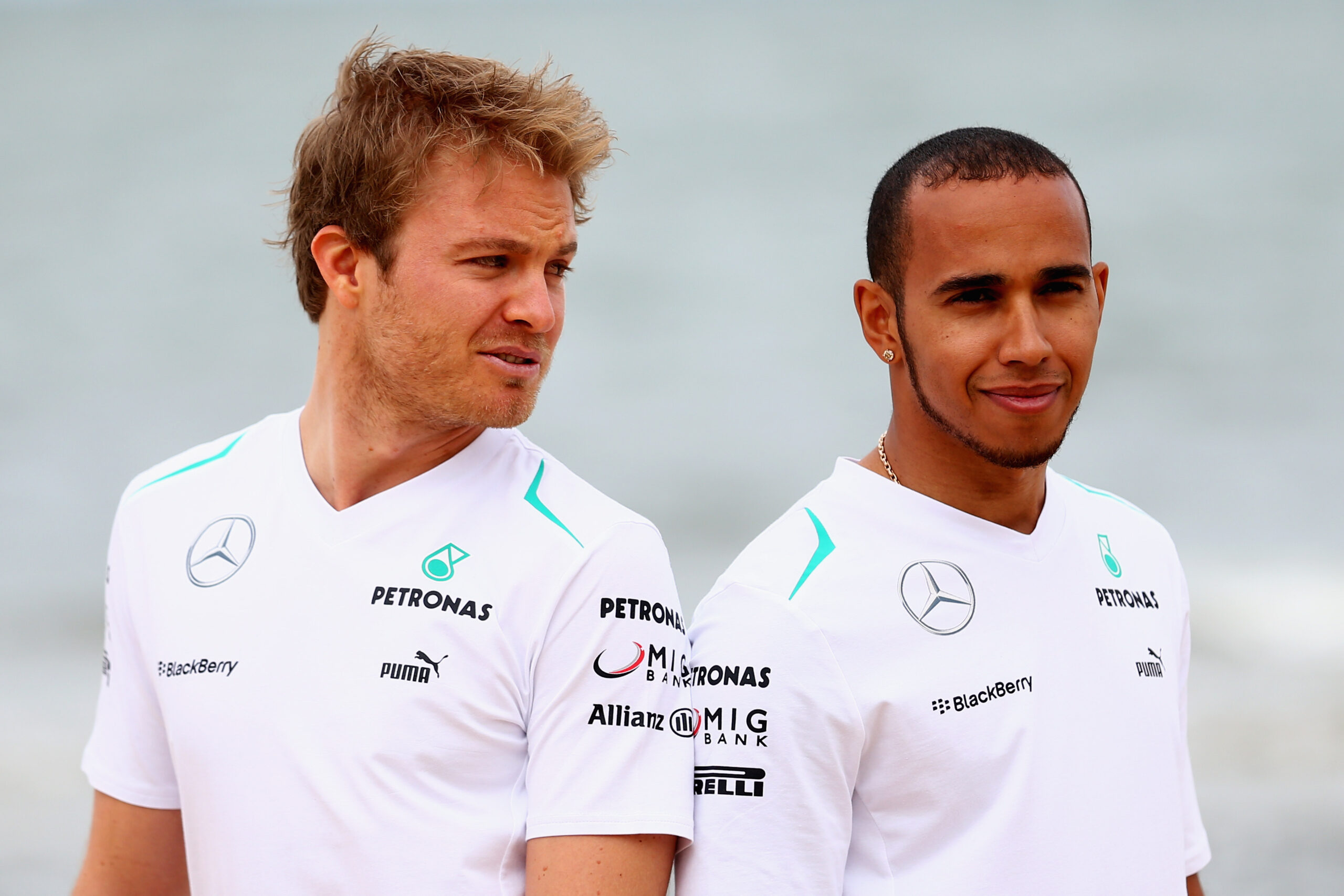
Mercedes teammates Nico Rosberg and Lewis Hamilton in 2013. Photo: Clive Mason / Getty Images
I called everyone to gather around for a short meeting (no one else had moved). We figured out what we knew and what required answers then came up with a basic plan and assigned responsibilities. The Composite Build team looked after the floor and the front wing along with Compbond and the design team. Sub Assembly had to look after the front uprights that were still in the Machine Shop.
I went looking for what we didn’t know because we couldn’t afford any surprises. The Race Team in Jerez needed sufficient time to rebuild the car. I needed to know both the latest the private jet could depart from the airport in nearby Oxford and if a car floor would even fit through the door of the plane. We also booked extra vans to take parts to Jerez and assigned extra people to support repairs at the circuit.
Once we had timings, we were able to understand what we could achieve in the time available. I’d like to think everyone had clearly defined roles and knew their responsibilities. There were so many details to sort out and any one of those could have prevented the car from running the next day.
Instead of meetings – there simply wasn’t time – I walked a thousand miles around the factory gathering and communicating information, asking and answering questions. That communication was dynamic. It was mostly verbal but reinforced with an email when time permitted. I kept Rob and Aldo informed of progress. The late Barry James, who was our Composite Manufacturing Manager, and Darren Burton, our Ops Director, worked with their departments to ensure we got all the support required.
The car ran the next day. It was a true team effort. The damaged parts were returned from Jerez for inspection, repair and service and a fix was sent out for the rear brake issue. It was an amazing recovery from a difficult situation, but that is Formula 1.
So, what did I learn? These moments are important, as the way you react to them is what you will be measured by as a person and a leader. If you think back on your careers, you will have good and bad moments. Some will be short, others will be longer. It will not stay tough forever, it will get better, but nor will it stay under control. Something will happen.
It is important to think about your behaviours in good and bad moments.
Firstly, Lewis’ crash hit five pressure drivers:
So, why I did I go to lunch?
I want to explain my rationale with reference to Dr Ceri Evans’ Red-Blue model, as set out in his 2020 book Perform Under Pressure. I cannot recommend it highly enough for a fuller, clinically-informed account of the principles of performance under pressure and how one can gain emotional control at the times when you need it most.
Ceri proposes a three-step model:
Here, I’ll explain how I approached each in turn after Lewis hit that wall.
The Step Back
I needed to go to lunch. I was under pressure and could feel it. I had to get out of my office and away from the noise. I realised that this was a flight response. I also realised I was under both internal and external pressure. My heartrate was up and you are trying to think of numerous things at the same time. Going to lunch allowed me to move from Step Back to Step Up. It gave me a moment to move away from the emotional response and start to come up with a mental plan of what we were going to do next.
The Step Up
You need to understand what is going on and start coming up with a plan for what you need to do and the desired outcome you seek.
In Step up mode, I was moving from Red mind to Blue mind. This requires a further explanation with a little help from Ceri, who describes two interacting mental systems:
Neither state is ‘good’ or ‘bad’. There must be a balance, as too much Red can make you impulsive, emotional and reactive, while too much Blue can leave you detached and hesitant.
In Step Up mode, I was moving from Red to Blue, from emotions and feelings to logic and planning. I allowed my Blue to dampen the Red. I now had an idea of a plan and what we needed to do and I remember very clearly feeling energised and ready to rock ’n’ roll.
The Step In
You have a plan to start tackling the issue, using the clarity of the Blue combined with the energy of the Red system. Trust you skillset, you are the best in the world at what you do.
We talked through the basic plan and off we went to face the challenges in front of us. During the course of that day, well into the evening, I remember going back to Step Back mode as something went wrong but this was quickly followed by Step Up (planning) and Step In (doing). Red/Blue, Decide and Do.
That day I was in a purple patch, balancing the Red and Blue.
How this impacted my behaviour
I knew that how I behaved and the language I used would impact the people working on this challenge. The pressure was on and one wrong word could trigger a shift back to a Red brain response, which we simply could not afford.
I also felt trusted by Aldo and Rob, who knew I would play my part to help resolve the issues along with the rest of the team. They didn’t interfere with what we were doing and allowed us to get on with the job. We made sure to regularly check-in with them both, providing updates and seeking their thoughts on something in those moments when we were stuck. It was classic Intent-Based Leadership in action.
This was one of many situations we faced weekly at MGP and no F1 team is any different.
You will be judged on how you respond and react to these moments. It is not about placing blame, it is about movement and making extraordinary things happen using the right mindset and behaviours.
Finally, there will always be lessons from these moments, so make the most of them. They are a great opportunity to improve as individuals, teams and organisations.
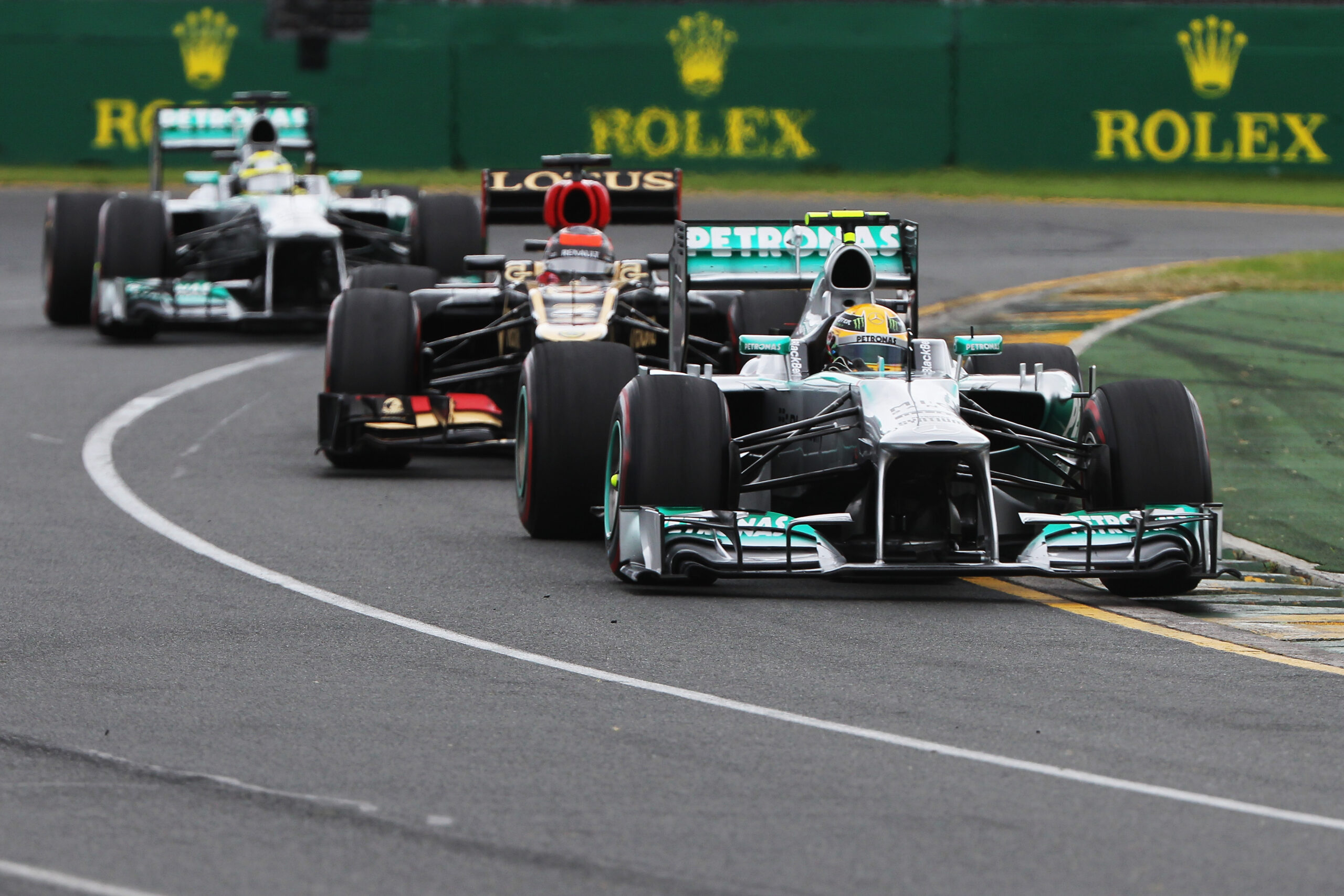
Lewis Hamilton, with Lotus driver Kimi Räikkönen and Mercedes teammate Nico Rosberg on his tail at the 2013 Australian Grand Prix. Photo: Ker Robertson / Getty Images
Peter Hodgkinson is a leadership and performance specialist skilled in helping high-performers become better at what they do. As an accomplished manager and mechanic, Peter has enjoyed almost three decades of success in elite sporting environments. His work in motorsport, as part of winning teams at Le Mans and Daytona, culminated in seven Formula 1 driver’s world championships won at Brawn and Mercedes, where he led car-building operations. Peter was Mercedes’ Head of Build during Lewis Hamilton’s era-defining run of six world titles. After a spell serving as Mercedes’ Head of Employee Engagement, Peter returned to the Factory Floor as Build Operations Manager for the INEOS Britannia sailing team when Mercedes supported their quest for the 37th America’s Cup.
If you would like to speak to Peter, please contact a member of the Leaders Performance Institute team.
The ABT CUPRA star is promoting sustainability and innovation through his company Zero Summit.
A Data & Innovation article brought to you by

You can’t have a discussion about sports technology today without including athletes in that conversation. Their partnerships, investments and endorsements help fuel the space – they have emerged as major stakeholders in the sports tech ecosystem. The Athlete’s Voice series highlights the athletes leading the way and the projects and products they’re putting their influence behind.
* * * * *
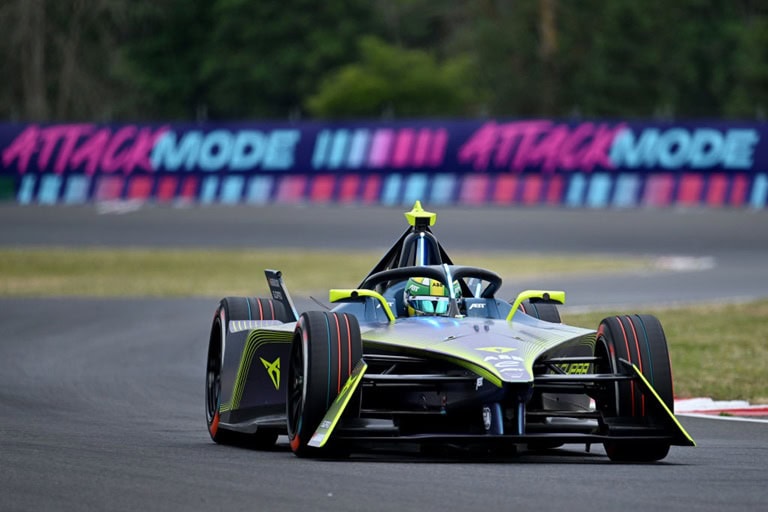
Di Grassi, 39, is a multi-lingual native of Brazil who is close to completing a degree program at Harvard Business School. He co-founded the Zero Summit to promote sustainability and innovation of zero-carbon technologies and serves as a Clean Air Advocate of the United Nations Environment Program.
Most recently, Di Grassi partnered with Rubicon Carbon, a management firm for carbon credits. Rubicon’s logo has adorned the driver’s car and helmet at the Hankook Portland E-Prix in Portland, Oregon in June. Di Grassi has personally offset his personal carbon emissions for the entirety of his Formula E career, matching what the racing circuit has done since inception.
“When I met Lucas the first time, I said, ‘This guy is so switched on and is so into this,’” Rubicon CEO Tom Montag said. “He is such a good guy and what a great person to partner with in trying to get the message out to people about the value of this. He has a global basis, and he drives a car for a living.”
On partnering with Rubicon on carbon offsets…
So I’ve been racing in Formula E and, in parallel, I created this summit on technologies that will mitigate carbon emissions called Zero Summit back in 2020. We have a very strong partnership with Bloomberg, and through the partnership with Bloomberg and a friend in common, I met Tom and Rubicon. One of the core principles of Formula E, the racing series that I race, is to be net zero from inception and to develop the electric technology that we will see in electric cars.
The only way that we can be net zero from inception is that we need to offset some of the carbon. You cannot travel to races by sailing a ship all over the world. So I wanted to be the first racing driver to be net zero all my career in Formula E, personally. The team offsets some of their emissions. Formula E offsets the whole emissions from their own, and speaking to this friend of mine in Bloomberg, the conversation was, how could we do that with a credible company, with somebody that has been doing that for a long time and is the best in the market?
We want to work with the best and Rubicon’s name came along. I met Tom, and then we organized the way for me to buy this offset. So we calculated the offsets of these 10 years, and then I bought these offsets, which are carbon removal projects that are listed as S&P 500 companies. It is a great thing for the world of carbon removal projects, and carbon credits are somehow still not very known by the average person, especially on the personal level. And I think sports and entertainment is a great way to communicate, saying, ‘Look, this is how it works. This is how we can not only offset ourselves, but everybody can actually contribute their part, if they are willing to.’
On his initial interest in sustainability…
I always raced my whole career, and my target was to go to Formula 1. When I was in Formula 1, they were starting to introduce hybrid technologies into F1 cars, and then I raced endurance cars. And I’m not an activist. Of course, I think to try to preserve the environment is a positive thing. Trying to control negative externalities is also positive thing. But I’m not an activist. I’m not a tree hugger. I don’t try to mitigate my lifestyle in exchange of some greater good. No, I’m a very pragmatic guy, and motorsport has been a laboratory for technologies.
My assumption, being pragmatic, is technology is what’s going to save humankind. Humans are always going to use more energy, more resources. As people go out of the poverty, they want to eat more meat. They want to drive better cars. They want to have AC in their houses. They want to have three TVs instead of one. It’s a natural progress of humankind to use more goods and use more services. So the only way for us to have a sustainable planet, or let’s say, a stable environment, is that we should gain efficiencies. And the way to gain efficiency is basically to develop technologies.
On why auto racing is a good driver for the cause…
Therefore motorsport is probably one of the only sports in the whole world that actually we are doing the entertainment, which people like cheering for the driver, A or B, but the technology that is there actually is going to go into a commercial car, is going to be cheaper, better, is going to change mobility. And that was the case for combustion engines in F1 and the hybrid systems.
That was the reason why I decided to start in Formula E. I was the first employee of Formula E back in 2012, and this reasoning led me to say, ‘OK, the next step in racing will be electric, and therefore I’m going to bet on Formula E to be successful.’
On starting his sustainability summit…
I was already in Formula E since the very beginning, and in 2019 I decided to go back studying a bit. So I went to study at Harvard University. I’m doing this three-year MBA there, and the discussion in the classroom with my colleagues was always about how to adapt their businesses to mitigate their negative externalities, and to adapt to this new world, to create efficiencies. And there was not a summit about it.
There was no discussion about it. Latin America, especially Brazil, which is, I would say, one of the main countries in the world that could lead this, let’s say, low-carbon economy — because we are already a low-carbon economy right now — there was nothing about it. So I said, ‘Why we don’t have this discussion with the key people in Brazil?’ So that’s why I decided to do the summit.
On offsetting his career carbon consumption…
It’s done now for my entire career of Formula E. wow, my entire career, often my I haven’t calculated since inception yet. That’s going to be the target, I think, since day zero. But it’s quite funny, because the first go kart I drove — F1 is talking about synthetic fuel right now. ‘Are we going to go to 10% synthetic fuel?’ And I was listening to them talking. I was like, in ‘95 when I was nine years old, when I started go kart, I already used biofuel. We used 100% ethanol because it gave more power to the go kart than gasoline. And in Brazil, we have available ethanol. It is the same price as gasoline, and you can buy it any pump, so we use ethanol in go kart. So I was like, ‘OK, so the new breakthrough technology that you guys are doing is actually my go kart experience from ’95 when I used 100% biofuel.’
On the costs of offsetting his career…
It’s surprisingly not so expensive, and I’ll share the number: it was $30,000, more or less. Most of it is air travel. It is the biggest impact, and if you think about it, it is not that expensive, and that’s the reason why it is actually so easy to do it right now. But as more people actually start offsetting and the supply of carbon credits into the market starts to become less than the demand, this price needs to go up. And if there is, let’s say, a multinational or transnational entity controlling all these carbon credits, it will be very interesting to see how the dynamic flow of these projects and the offsetting and the price structure evolves.
As the moment it is almost zero burden financially — it’s $3,000 a year of offsetting my season in Formula E. It is not so much. But if every season, the price starts to go up and it becomes a financial burden to offset this carbon more and more, I will start thinking, ‘OK, how can I emit less carbon?’
On how the carbon offset market could evolve…
If more people buy those credits, and the market goes from, let’s say, $2-3 billion, to $200 billion, or $2 trillion, it starts to really go up. All the companies, they’ll be financially incentivized to look to increase their efficiency, and to start really thinking about, ‘OK, I’m going to fly this much, but maybe I take a train the next leg because maybe the carbon pricing starts to make financial sense for more people.’
This process creates this financial burden. At the moment it is voluntary, but if it’s a regulated market and the market starts to actually demand this for the companies and people to actually start offsetting themselves, it will push everybody to be more efficient, and new technologies to be financially more available. You can actually scale the production of batteries, making it even cheaper, and then electric cars would be even cheaper. So it helps the trend towards, let’s say, a net-zero world in terms of carbon output and input.
This article was brought to you by SBJ Tech, a Leaders Group company. As a Leaders Performance Institute member, you are able to enjoy exclusive access to SBJ Tech content in the field of athletic performance.
The Australian spoke to SBJ Tech about his cognitive training, using the simulator, and the data he seeks before and after a race.
A Data & Innovation article brought to you by
You can’t have a discussion about sports technology today without including athletes in that conversation. Their partnerships, investments and endorsements help fuel the space – they have emerged as major stakeholders in the sports tech ecosystem. The Athlete’s Voice series highlights the athletes leading the way and the projects and products they’re putting their influence behind.
* * * * *
The native Australian driver spent 2022 as Alpine’s reserve F1 driver, while also testing with McLaren and then joining McLaren’s Formula 1 team as a full-time driver in 2023.
In his rookie season, Piastri claimed two podiums — third in Japan, second in Qatar — and he claimed a further second-place in Monaco last month. Piastri, 23, currently sits in sixth place overall in the driver standings, and he spoke with SBJ last month just before the Miami Grand Prix, at which he finished in P13.
On what makes the Miami Grand Prix unique…
It brings a lot of star power to the calendar. Now that we have Vegas as well, we have two American events that are in pretty prime locations. We have Austin as well, which is, let’s say, a more traditional circuit. But yeah, having Miami on the calendar is very cool. It’s a place where a lot of people want to go. There’s a lot of celebrities and stuff, and it just adds a lot of stardom to the event, really.
On the start to the season…
It’s been a pretty good start to the year, I think, for the team. It’s been very positive. We’ve established ourselves as the third-quickest team at the moment on average. And for me, personally, it’s been a pretty good start. The last couple [before Miami] were a little bit more of a struggle in certain areas. But on the whole, it’s been a nice, clean start to the year. Definitely a much better place than we were 12 months ago.
On being teammates with Lando Norris…
You always utilize your teammate to try and go quicker. With Lando and especially his experience knowing how to drive a Formula One car in the best way and knowing how to drive a McLaren F1 car in the best way as well — because all the cars are going to be a little bit different across the grid — he’s been very useful for that. There’s certainly been things I’ve learned from him along the way.
We’ve been both pushing each other to become quicker, and that’s what you want out of out of a teammate, really, is to be able to push each other and find little bits and pieces here in different corners. Every driver on the grid is going to be looking at their teammate’s data. It’s how you go quicker, especially if there’s corners where they’re there quicker than you. It’s a good idea to look at what they’re doing and try and learn from that.
On the data he checks first after a race…
The first thing is you just look at where everyone’s finished in the race because you often don’t really know how exactly it’s gone. We make a graph of how everyone’s race has gone, so there’s a bunch of different lines, and you can see where people have been quick in their stint, where they’ve been slow in their stint, what their tire degradations look like. And the next thing is then looking into the data itself. You’re looking into what you do in every session like in practice and qualifying the race, looking at which corners you’re better in which corners you’re worse in, looking at how the tires are being used and stuff like that.
On his points of emphasis in development…
It can change a bit from weekend to weekend. For me, managing tires is probably the biggest thing I’m working on at the moment, which is difficult because you need to go as fast as you can but use the tires in a way that’s as friendly as possible for them. So that’s probably the biggest thing I’m still getting to grips with.
On simulated race time…
We do a lot of dedicated simulator work at McLaren trying to prepare the weekends, so the track is as close as possible to the real thing. We’re trying stuff with the setup, trying to get used to the track again, build up some references. I play some iRacing every now and again, as well, but more just for fun, because I enjoy driving racecars. So that’s more what I use that for, rather than actually using it to train or anything like that. It’s more just for a bit of fun in my free time. So yeah, mainly the sim work at McLaren to get a bit of a starting point for the race weekend.
On his fitness training…
Data certainly influences it, for sure. There’s certain metrics that you want to improve, which is, I guess for everyone, trying to get your muscle up and your fat down. But there’s some specific things as well. The biggest strain for us as a driver is our neck, so trying to build that up. And it’s not just your neck muscles that you need but the supporting muscles around it as well, to try and to build that up and see progress in the numbers that you can sustain when you’re training it.
We always log that and monitor that and see where I’m at. Same with my running and cardio side of things, always trying to improve your VO2, trying to get your pace down for a similar heartrate. We monitor all of that kind of stuff, just trying to improve your general fitness because you use a few weird muscles that you wouldn’t normally use in everyday life. But even just with the schedule, with all the jetlag, having a good cardio base is also important. Just so you stay healthy, and you’ve got to get to be able to concentrate for a long time.
On cognitive training…
Everyone’s a little bit different with that. You train your reflexes just by driving in some ways, and we drive so often that you’re always keeping it topped up. I do a bit of reaction training before the session, with tennis balls or whatever, just keeping your mind and hand-eye coordination switched on. We always try to improve our reactions for the start as well, but for me, a lot of that is the state of mind that you’re in, rather than actually training for it. You gain more by knowing whether you need to be revved up or relaxed, or whatever you need to be.
On help from McLaren’s partners…
All of our partners are pretty incredible. To be working with the likes of Google, with Coca-Cola, Dell, just to name a few, working with those kinds of big brands is pretty special. It’s good fun. Of course, they support us in going racing, in all kinds of ways — through financial support, of course, but especially with a lot of our tech partners, with a hands-on approach to helping us, whether it’s through computers or better ways to analyze our data, quicker ways to analyze it. That’s all very important to us. I always enjoy that side of things, the data and, and tech side of things. So yeah, being able to work with some of those big companies like that is very special.
We rely a lot on our partners, especially for our simulator, which we completed not that long ago in the grand scheme of things. Having all the computing power for that, being able to run the graphics well enough, being able to update the model quick enough in real time — I know exactly how important that is when I’m driving it because you know, when you’re lacking in that area.
On Netflix’s Drive to Survive…
I’m still pretty new to Drive to Survive. So I think people are still catching up with me on that. But it’s cool. The benefits it has brought to the sport are pretty incredible. All the sort of new fans that is brought in is very, very cool and positive for the sport. They’re not particularly intrusive on our weekends, so it’s OK. At the end of the day, it’s a good way of getting our sport out there more, and it’s exciting to watch as well.
This article was brought to you by SBJ Tech, a Leaders Group company. As a Leaders Performance Institute member, you are able to enjoy exclusive access to SBJ Tech content in the field of athletic performance.
NASCAR driver Anthony Alfredo explores cognitive training with Pison’s AI-powered neural sensors.
A Data & Innovation article brought to you by
You can’t have a discussion about sports technology today without including athletes in that conversation. Their partnerships, investments and endorsements help fuel the space – they have emerged as major stakeholders in the sports tech ecosystem. The Athlete’s Voice series highlights the athletes leading the way and the projects and products they’re putting their influence behind.
* * * * *
Alfredo, a 24-year-old native of Ridgefield, Connecticut, competes full time in the Xfinity Series as the driver of the Our Motorsports No 5 and makes appearances in the Cup Series behind the wheel of the Beard Motorsports No 62 car. (Both are Chevys.) Alfredo spent the 2021 season entirely on the Cup Series, leading parts of three races and securing one top-10. On the Xfinity circuit, he has 15 career top-10s, three top-5s and one pole.
The most recent addition to Alfredo’s sponsorship portfolio is Pison, makers of AI-powered neural sensors that track nervous system and brain function through skin measurements. The Boston-based, MIT-spinoff began as a tool to aid those suffering from ALS [amyotrophic lateral sclerosis]. That same core ENG technology — electroneurography, which reads neuromuscular signals — is now a part of its new performance product, Pison Ready, which was launched in conjunction with Alfredo’s participation in the Daytona 500.
On his introduction to Pison…
A cousin of mine does commercial real estate in Boston, Steele Divitto, with the Steele Group, a fellow sponsor of ours, and he introduced me to them. They actually were at the summer Daytona race last year as well, some of the co-founders and employees. I got to know them pretty well and learn about their technology. It was just different than most other products out there. For me, I take pride in only being affiliated with brands I believe in. When I learned about their technology, and how it could actually improve lives out there and potentially save lives in the healthcare industry, I thought it was really cool, and I wanted to figure out a way to partner up with them, whether it was on the track or off the track.
Fortunately, we had the opportunity to get together, and we’re doing some cool stuff on social media this year. They’re going to ride along on my B-Post as an associate sponsor all year long, and my gloves have their device printed on them. And we’re going to be giving away my race-worn gloves a handful times throughout the season, starting with my Daytona 500 gloves, which is pretty awesome.
On wearing the tech…
So I actually used a very early-stage device for testing, I would say late last year, and then now that their newer consumer product has been released, I’ve had it on for a few weeks and been able to get familiar with the app, the device itself, some of the cool features. The full version, when it comes out, is going to do a whole lot more as well, so I’m really excited for that.
Currently, I can test my mental agility, my focus and my reaction time at any point in the day, anywhere I’m at, from the comfort of my mobile device. It is really neat because you see a lot of athletes and other people train with cognitive function tools — whether they’re those dots on the wall and all this stuff — but that’s super inconvenient and you can’t get that everywhere. But to have this on my wrist, I was sitting in the airport the other day running a couple of tests. I could run them in the morning, I could run them before I get into the car to qualify — and it must have worked because I made the [Daytona] 500 on time.
On what he’s learned about himself…
My reaction time is super-fast, which I guess is kind of expected for probably most drivers. Now it’s like a game to me to always see if I could beat that [best score]. But more importantly, I can just check my mental readiness when I wake up in the morning — usually I can tell if I’m going to have a faster or slower time based on how I’m feeling. But sometimes I surprise myself, maybe I don’t necessarily feel 100%. Or I’m a little wore out or tired, but my cognitive function is still operating at peak capability.
Other than that, there is a focus test that is really cool, because a go/no-go. So this device, the flashes on the reaction time test, and basically you have to react to that as fast as possible. But with the go/no-go, you have two different colored lights. There’s one that you want to react to and one you stay static — you don’t react to. So that one has caught me off guard. It’s surprising how challenging that is because you’re still trying to go for the time, obviously, of being as quick as possible when you see the white light. But when you see the orange light, instinct is like, you see a light and you want to react, but you got to remember that’s the no-go light.
It can seem like a game at times because it’s so addicting, but in all reality, it’s improving my mental focus, my capability, and preparing me to go about my day but more importantly strap into a racecar and have to make split-second decisions at 200 miles an hour.
On his prior exploration of cognitive training…
I have a fair amount of experience with some of the other tools out there, just from trainers I’ve worked with and teams I’ve been associated with. But this has had the same effect for me, way more conveniently, because like I said, I could do it anywhere throughout the day. I think the important thing is implementing it into our training routine as professional athletes or race car drivers.
Say I’m doing reps with weights and then I’m super-setting that with the rowing machine. In-between sets, when I’m super worn out, instead of just sitting there taking a minute or two break, I’m doing my reaction time [on Pison] — and that is a challenge because you’re physically wore out, and you don’t really feel like paying attention to something like that. But in the racecar when it’s 130 degrees, and you’re uncomfortable, you’re tired, sore, whatever it is, you still have to be operating at your peak, at least that’s what it takes to be a winner.
When I ride my bike, I can almost break it up into a race, like stage one, stage two, checkered flag. So what I mean by that is, if I go ride 30 miles, maybe every 10 miles, I check my reaction time and my focus real quick and just see, how the further end of the ride I get, and the more wore out, I can see how my reaction time changes. Maybe it slows down, maybe it doesn’t. If it does, how can I improve that? I think doing it more consistently in my routine, is where you see that. So I have user other technology out there, like I said before, and I think a lot of people do implement it into their training routine, but this is so much more convenient. And you could do it anywhere, not just in the gym.
On his use of other wearables…
No, not anymore. I used to. I have quite a bit of experience with a lot of the other technology out there, but this is truly revolutionary, as I like to say, because there’s some amazing things going on in other industries — healthcare industry, [the United States] Department of Defense, and then obviously, professional athletes.
One thing we haven’t really talked about is why it is important to the average person. Someone might say, ‘Well, I’m not a NASCAR driver, I don’t need this.’ But I think for as humans, it’s important we all operate at our peak functionality at work, no matter what you’re doing, as a family member, maybe you’re a parent, whatever the case may be. You see how many people are out there wearing other devices or wearables that track their heart rate, their sleep. And the sleep isn’t even accurate, to be completely honest, from what’s out there. But people don’t know that.
On Pison’s upcoming circadian rhythm prediction functionality…
It’s coming soon, and that’s what I’m most excited about — that, the sleep and much more. So right now, it’s more cognitive function and preparation. But very soon, in a couple of weeks, I’m going to have my device and start testing. But I think summer is where anyone will be able to get their hands on this device and improve the quality of their life.
On whether he’s learned what makes him most ready for race day…
Yeah, 100%. And that’s kind of a fun thing: we were messing around yesterday with how Death Wish coffee could potentially improve your reaction time and your focus with the caffeine content. Or right now, even, I’m sipping on a Celsius energy drink on the track, seeing how that [impacts me]. I could do a test before and after that — that’d be interesting to see.
That’s what I’m most excited about when that the rest of the technology comes out here shortly. Right now I could say, ‘OK maybe I didn’t sleep that well. My reaction time was slow this morning.’ Or maybe I didn’t feel like I slept well, but it is good. But to eventually have that sleep data soon, I could directly correlate that information and validate these predictions I already have about myself.
This article was brought to you by SBJ Tech, a Leaders Group company. As a Leaders Performance Institute member, you are able to enjoy exclusive access to SBJ Tech content in the field of athletic performance.
Reigning Formula E world champion Jake Dennis explains why he needs to be heavily involved in the process of each iteration of his Andretti car and some of the software used onboard.
Main Image: the tests, which highlight the demands of being a professional tennis player, can be used to showcase the attributes of the ATP Tour’s next generation. (ATP Tour)
A Data & Innovation article brought to you by
You can’t have a discussion about sports technology today without including athletes in that conversation. Their partnerships, investments and endorsements help fuel the space – they have emerged as major stakeholders in the sports tech ecosystem. The Athlete’s Voice series highlights the athletes leading the way and the projects and products they’re putting their influence behind.
* * * * *
Dennis, 28, is featured in the unscripted docuseries Formula E Unplugged that airs domestically on the Roku Channel and began Season 10 with a ninth-place finish in Mexico City earlier this month. He is again driving a Porsche, this time alongside his new Andretti teammate, Norman Nato, as well as the TAG Heuer Porsche team of Pascal Wehrlein and António Félix da Costa. Since 2018, Dennis has also been a simulator driver for Red Bull’s championship Formula 1 team, a role that included the opportunity of driving the car at a practice session in Abu Dhabi last fall.
On pushing the limits of the Next Gen Formula E car…
That goal is endless. How far we can push this car in terms of software is crazy, and to see how much it’s developed from this time last year, it’s pretty impressive. This time last year in Mexico, everyone was just trying to survive and see the checkered flag, and I think everyone did a really good job with that whereas now the reliability is extremely good. The software is being pushed to the absolute limit in what we’re allowed to do. And I think it’s going to be now down to lap time, efficiency and performance.
Even from July in London, I think we’ve made over 230 iterations of software changes, and the car has only been out [on the track] like four times. So it’s always evolving. It’s a snowball effect. They’re not always good [changes]. They’re not always positives, and definitely not 230 positive steps forward, that’s for sure.
But it’s just great to be part of it. The drivers have a real big input of the direction where the software should go. And they’re always keen to listen to us because we’re the ones driving it, obviously. But it can be quite easy, especially for the performance engineers, the data guys, when you really look down into the numbers, you can get led down the garden path, and they think they found the golden bullet, but it doesn’t always work like that.
On how much he wants to be involved in that planning process…
In the offseason, I definitely get more involved in terms of just the direction — not so much the nitty-gritty stuff — but the direction where I feel like the software needs to be changed. I made a WhatsApp group with me, Pascal, da Costa and Norman this year after London to put our heads together and make sure we’re all on the same boat because we’re all running the same software. So it’s important that all four drivers want to go in the direction we need it, and I think that was positive for us. I think that made it was a bit closer together as well.
But honestly, when the season starts and the development is obviously moving forward — but less of a rate because the races are just back to back and it’s a bit more intense — then generally I let my performance engineer, my software guy lead the direction of where he thinks it should go. And then on the race weekend itself, where there’s no development changes, it’s just you work with what you’ve got, then then you can go into detail of corner by corner. You can generally split each corner down to three stages as well, and then you can go into right detail. I think that’s important.
There’s definitely drivers who go in way more detail than me like Max Gunther, my teammate from the BMW days — he is like a guru with that type of stuff. He absolutely loves it. So he definitely analyzes every little bit, whereas there’s other drivers which are the complete opposite end, and I’m probably in the middle somewhere.
On Formula E Unplugged…
I’m really for it. I enjoy the series. I think it was filmed well so far, the two episodes I’ve watched, and I think it’s really good for the sport. We’re trying to obviously have this sort of mini-Drive to Survive series, which really allows the fans to connect with the drivers and see behind the scenes, which ultimately will hopefully make them keep coming back to watch the other episodes, but also mainly the Formular E season itself, to bring in better viewer [numbers]. So, yeah, I’m definitely looking forward to having Unplugged again next season, and trying to make it better — better insights, more personality across to the camera. I think that’s ultimately what the fans want, and what sponsorships want really as well.
On Formula E’s presence in North America…
Formula 1 now is massive in America, and I think it’s great because we definitely also get the knock-on effect of that, the second wind of it. I think the American following has definitely passed into Formula E. Personally it was a bit of shame to lose New York. It’s a great city. It’s a cool city.
And to go to Portland, I think all drivers were a little bit skeptical. But then when we went there, the race itself was absolutely mental. I was obviously on the fortunate side and had a great result [second place]. But it was a difficult race, we had well over 600 overtakes, which is bonkers. But it was a great spectacle. And I think everyone really enjoyed it. So I’m looking forward to going back. We’ve got a doubleheader this year as well, so really just trying to get as far into the American market as we possibly can. We’re pushing for more future races in America as well, which will be exciting.
On driving Red Bull’s Formula 1 car in an Abu Dhabi practice session last November…
It was amazing. It’s not very often you get to ride the most successful Formula 1 car ever made, and yeah, I’d be lying if I said I didn’t enjoy it. It was such a cool experience to obviously be driving in a Formula 1 race weekend — one off the bucket list.
I’m getting quite old now. I’m 28. So I’d say to get that ticked off before my career ends is pretty special. The cars are obviously achieving very different things to Formula E. It’s just all about performance and lap time in Formula 1, and to drive the Red Bull Car was pretty special. The handling, the behavior, of the car is everything a driver would want, and it was cool to get well over 100 laps on the Tuesday after the race weekend as well.
On his role as Red Bull’s simulator driver…
The development inside of simulators nowadays is massive, whether it’s Formula 1 or Formula E, but with the endless budget of Formula 1, you can really push the limits of software, hardware, and try and make the car as fast as possible. How close they are now is scarily good — the only thing you really miss is the sensation of speed and the fear factor. Everything else in terms of the way you brake, the way you accelerate, the way you turn is identical.
Don’t get me wrong, when I first jumped in Abu Dhabi, it was like, ‘What is this car? It’s so fast.’ But they’re so real life-like now, you can really improve the car throughout the season and develop it at a serious rate. They can make this virtual rear wing, like this is what it’s going to do and then you put it on in the simulator. You can get real life feedback of what it will do and then they also take your driver input and then they put the two together — driver feedback and then the numbers they generate — and see if it’s worth making it.
Before the budget cap came in, I think they probably would have just made it and just put on the car and see what happened whereas nowadays, with a budget cap of whatever it is, $250 million, they have to be a little bit more wary that they can’t just make every single idea that comes into their head. I think makes my life a little bit more harder, a little bit more difficult. And that they trust your feedback a bit more. Because yeah, someone like Max [Verstappen] and Checo [Sergio Pérez] are so busy, they don’t have the time to go on the simulator every other week. So yeah, I’d like to give myself some credit for making the RB19 or RB 20 so good. [laughs]
On wearing Whoop and the different training between Formula 1 and Formula E…
I hadn’t really paid too much attention to my sleep before I put the Whoop band on. It was just another factor of sleep analysis. I definitely just make more of a conscious effort not to try and put it in the red zone [indicating fatigue], which then generally gives you a bit of benefit the next day.
Fitness is obviously important inside the Formula E, and it’s a very different kind of fitness to Formula 1. Formula 1 was extremely easy from the neck down — you have power steering, and you’re strapped in so tight. You obviously have a lot of g-forces, but through your body, I felt nothing. It was just mainly your neck whereas in Formula E, your neck doesn’t really ever suffer. It is really your arms, your wrists, your shoulders. With no power steering, it’s extremely difficult, especially the Gen3 car with the Hankook tire. The front powertrain, when you brake and turn, the steering weight is so excessive, and I think that a lot of drivers are requesting for it to be lighter. But thankfully, I’m one of the bigger guys and have a bit of structure behind me.
You just have to train different aspects. But I would be lying to say like that you need to have the fitness of a football player or an NFL player or something like this. These guys, if they’re fit, they genuinely gain, I think, proper performance. They can just run faster, they can run longer, they can do way more, whereas for us, as long as you’ve got some strength behind you and some stamina and you can get from A to B, the biggest thing that’s making you so fast is how talented you are in terms of your skill and obviously how good your race car is — not so much how fast you can sprint 200 meters.
This article was brought to you by SBJ Tech, a Leaders Group company. As a Leaders Performance Institute member, you are able to enjoy exclusive access to SBJ Tech content in the field of athletic performance.
The NASCAR driver talks tech, using a simulator and partnering with Hurley in his first season racing in the Cup Series.
A Data & Innovation article brought to you by
Gragson, 25, is a Las Vegas native and graduate of the NASCAR Next program for promising drivers. The affable self-proclaimed Mayor of Throttleville is also a two-time ‘most popular driver’ award winner, claiming that honor during the 2018 NASCAR Camping World Truck Series and the 2022 NASCAR Xfinity Series. Among his sponsorship portfolio are Wendy’s, Black Rifle Coffee Company and, most recently, Hurley.
On preparing for race weekend…
It’s a seven-day-a-week job, for sure. You race on Sunday, you fly home Sunday night, we got back at about 2:30am Monday morning this past weekend. Then I headed to the gym, leaving the house at 6:30 in the morning, then meetings the rest of Monday. And then try to get done by 3 or 3:30 and have the rest of the afternoon to relax. Tuesday is working out again. I did simulator this morning for the first half of the morning and had a meeting. Do some interviews like we’re doing. That’s what I’m doing the rest of this afternoon.
Wednesday, it’s usually a workout in the morning time, got pitstop practice, and then it’s more meetings with the race team, going over the race weekend stuff. Thursday morning, we’ll do a workout and then pre-race debrief with the guys in the Chevrolet program with Josh Wise. He runs the Chevrolet program — he’s an ex-driver — and now a lot of Chevrolet drivers will prepare for the races together. So we’ll do more race prep, then we’re either flying out on a Thursday afternoon, or sometimes we have the second half of Thursday off if we’re not in the simulator ’til about 6:30 on Thursday nights.
Then we either fly out Thursday afternoon, Friday morning, go to the racetrack, do tech, do some sponsored stuff, practice, qualify on Saturday, and then again race their Sunday and then back home. And it’s a constant seven-day-a-week job, but I love the process of everything. It’s a lot. It’s definitely time-consuming. But it’s a lot of fun as well.
On his use of the simulator…
It’s helpful, definitely for the Chicago street course, which is a brand new track for NASCAR. They just made it. We’ve never raced on a street course before. We’ve never raised at this particular track so utilizing the simulator and trying to just get some ideas on what you need to focus on for when you go to the real track in real life — how far can I drive in before I have to hit the brakes? What are my visuals looking like? Little stuff like that is what we really use a simulator for helping build up the setups and get the car tuned in on the simulator to give us some ideas when we get to the real racetrack. It’s definitely very beneficial, and we utilize it a couple of days a week for sure.
On his fitness training…
We definitely track our heartrate and everything like that. So when we work out, we’ll do a little warm up and then whether it be a run, row, or the skier or the bike, then we’ll stretch out. Then we get into a daily workout we have. We’re in the gym three days, and then we do karting or other stuff on Tuesdays where there’ll be a trail run or whatnot. But Dan Jansen, the Olympic speedskater, he is our trainer over at Chevrolet. So, man, he loves the leg workouts — they suck — because he comes from the speedskating side and having all that power in his legs. I mean, this dude’s legs are just massive. It’s crazy.
So we do a lot of leg workouts and a lot of heat training on bike rides and runs. Upper body stuff in the gym as well. And then we’ll sit in the sauna for about 30, 45 minutes after the workout just to get some more heat training in. And so that takes about two, two and a half hours a day of in the gym and prepping for the races.
On his use of SMT analytics…
We definitely look at that a lot throughout the week and the race weekend and just finding where we can be better. The majority of the time, it’s during the race weekend and right before practice. We’ll take a look at the prior year and how guys were and where they’re lifting on the gas, how much brake pressure they’re using. We can overlay [data] and compare that.
So that’s a definitely a double-edged sword, I think the SMT data is. Normally you spend your whole racing career figuring out how to go fast, and now it’s like, if you’re in the second group in qualifying, you just look at what the guys in the first group did. And you just go implement that into your driving and try to match up the data to the fast guys. So I think it’s good if you’re first starting to expedite that process of learning the tracks and where you need to be, car placement-wise, how much break, how much throttle you need to use, but at the same time, it kind of takes away a little bit because you just see what the fast guys are doing and you just go copy that.
On partnering with Hurley…
The coolest thing is I grew up surfing, skateboarding, snowboarding. I loved action sports and always wore Hurley stuff at the beach. I remember when they came out with the Phantom swim trunks, in the early 2010s probably. Being a kid, there was a store in Laguna Beach — we’d always go down to Laguna Beach every summer with my family — called 225 Forest or something like that. It was a Hurley and Nike store, and you could customize swim trunks and Nike shoes and Hurley swim trunks and Hurley t-shirts. I just thought that was the coolest thing ever.
I was a little kid running around and would try to do some chores throughout the week so I could get a little spending money. I so got a couple of pairs of custom phantom Hurley swim trunks back in the day and just loved them. I wish I still had them. I think my mom probably threw them away or something. She calls me a hoarder because I like collecting cool stuff and crazy stuff, and my argument to her would be, ‘Those are my first pair of custom swim trunks, c’mon.’ But that was pretty cool. That’s how I got introduced to Hurley and have worn them ever since.
On his creative interests…
[The custom shorts] were pretty wild. It was like a blue and black cow print on one leg — and, I mean, they were wild — and yellow and gray stripes on the other leg with a crazy pocket. I forget exactly, but they were really, really wild looking. I always liked the wild, bright, colored stuff. Now for me from the swim trunks to now designing my own helmets and the paint schemes on my helmets, I really liked getting to do that. So it’s a cool process.
I liked drawing a little bit when I was a kid. I like the helmets because I feel like you can show personality and do some cool stuff and be unique. So yeah, I like art a little bit. I think it’s cool and definitely always loved the designs on race cars, designs on helmets and just cool t-shirts and stuff.
On how he evaluates brand partnerships…
I’ve always told our management group [to pursue] just stuff I believe in, stuff that I enjoy wearing in this scenario or food I like eating. Just stuff I’m passionate about is really the biggest thing. You see so many ambassadors and athletes and whatnot that have partnerships with companies, but they’re just getting a check and they don’t necessarily believe in it or are passionate about it. We turned away deals because I don’t have any passion over this, so why would I want to be an ambassador a spokesperson for this company if I don’t believe in it? It’s a complete opposite with Hurley. I’ve always been a big fan of their stuff. I call myself a swimsuit model for them even though I’m not really.
This article was brought to you by SBJ Tech, a Leaders Group company. As a Leaders Performance Institute member, you are able to enjoy exclusive access to SBJ Tech content in the field of athletic performance.
The McLaren driver joined a panel discussion at the Tribeca Festival in New York City and described his use of the simulator and how the team behind his team continues to iterate the tech on his MCL60.
A Data & Innovation article brought to you by
You can’t have a discussion about sports technology today without including athletes in that conversation. Their partnerships, investments and endorsements help fuel the space – they have emerged as major stakeholders in the sports tech ecosystem. The Athlete’s Voice series highlights the athletes leading the way and the projects and products they’re putting their influence behind.
* * * * *
In addition to his racing credentials, Norris is the founder of Quadrant, an esports team and lifestyle brand partnered with Veloce, a racing and gaming media brand. In June, Norris appeared alongside McLaren Racing CEO Zak Brown at the Tribeca Festival in New York City, which was sponsored by McLaren crypto partner OKX.
Norris and Brown discussed how technology is permeating the racing industry, from the extensive use of simulators to weekly enhancements to the car; Brown estimated that 80% of the livery changes over the course of a season. The car is packed with 300 sensors and produces about 1.5 terabytes of data during a race weekend, with McLaren having enlisted DataRobot to help apply AI algorithms to make the best use of that information. (Note: This Athlete’s Voice is primarily derived from a post-panel interview, with some of his on-stage thoughts included as well.)
On playing racing games as a kid…
I started when I was a kid, like a lot of kids do. I was never into the bad games, shooting and all of this. I never played any of these games, my parents didn’t let me. But driving [games], my parents allowed me to do. I guess the basics, understanding the very simple things of how to drive a car — lines, techniques — you learn such simple things at a very early age.
These skill sets develop and continue to develop even to where I am now. I’m still learning things. I’m still trying to perfect whatever I can perfect. And for me, I think it’s an advantage that I played these games, and I did at such an early age — six, seven, eight years old — and that definitely helped me become the person I am and the driver I am today.
On his extensive use of a simulator…
I don’t have to fear driving a simulator compared to real life. Cost is a lot less. So I’m not scared of crashing and not scared of Zak telling me off or something. And the [simulator], you don’t have a different approach to how you want to go and do things. But you’re still learning in every single thing that you do, whether it’s real or fake or whatever. You’re still learning good things and bad things. And then you take that to the track to improve.
I use it, the whole team use it. So many things now are prepared in a simulation before they’re actually done for real because you’re always going to want to test everything you do. Because you can’t afford to make mistakes. Any way you can test something to see how authentic it is and how correct it’s going to be, from driving to designing your front wing and designing the whole car or making decisions on race day. Things are always checked as many times as possible until they actually get into action.
On his involvement with iterating technological changes on the car…
I’ve tried, in a way. I stick to do my job at the end of the day, so I just drive the car. But you try in as many ways as possible to help give whatever indication of advice you can give to the guys, who are some of the smartest guys in the world. These are people who are creating things that have in a way never been created, that are coming up with ideas.
Formula One is all about innovation. There are so many things in normal life now in road cars that everyone drives on a day-to-day basis, which these guys have come up with within Formula One. So in the end of the day, you can use all this information. But it’s only helping us make the decisions — us as humans who are still the ones that are applying it to our everyday work, who are coming up with the actual ideas. And therefore, I still stay firmly in my position on driving the car, but just being as helpful as I can when my words and my advice are needed.
For me, the most important thing is the minds of the humans, us as people who are still the ones who are applying this information, using the information, using AI. But how we apply it, how we use it in filmmaking or designing cars or driving cars. It’s all us in the end of the day, we’re actually doing it. So I think that’s the thing you can never forget.
On whether he can feel the dramatic changes to the car over a season…
It depends. Sometimes you have things which are there to change the driving style. Sometimes that’s where the improvement comes. An improvement can also be something that you don’t even recognize: you just go a little bit quicker when straight, or you just go a little bit quicker in the corner because you just have a bit more grip. So sometimes you’ll notice a massive difference. Sometimes you’ll hardly notice the difference. But it’s also gradually, it’s rare that you bring something in that’s just like, so noticeable. And also, when you do put something on, drivers are, within a few laps, make that feel like it’s normality again.
So when you go from the beginning of the season to the end, because it slowly happens over that whole period, we don’t really notice that much. But if we were to jump back in the car at the beginning, and you’re like, ‘Oh, wow, this has changed a huge amount.’ So you’re reacting to what’s happening and what’s changing, and you’re just getting on top of that. And because you do it so quickly, things become normal very quickly at the same time.
On managing decision-making in the car…
You train yourself. You learn from a really quite an early age, so you kind of get used to it over time. But there’s still times now where there can be an information overload. And I guess it just has to be said to the team, if they’re talking to me too much, or telling me to do too many things. We go to Monaco where you don’t have really any time to think of changing all these dials. You think your strategy, you think of tires, you also just trying to focus on not crashing. There’s a lot of times when there is still so much information, it’s still like, how can you get the most important bits of information across? But it’s just understanding, I guess, everyone has their own limitations or abilities. Maybe sometimes some people can do more, some people can do less, but I’m just making it known when it’s too much or when I can accept more.
On reaction time training…
Yeah, of course, [it’s] one of the most important things, just for natural driving. The start is one of the most important parts of the race so reacting to the lights, the pit stops. Reactions are probably one of the most important things that create a Formula One driver, but it’s also not just a reaction. A lot of people who can’t drive a car can have quick reactions. It’s the knowledge of knowing what you’re reacting to and how to then apply whatever the correction is.
On how he reaches his peak performance…
It is trying to understand how I drive in the best way that I can, whether that’s getting really pumped up before a race or qualifying. For me, it’s more the opposite, the more relaxed, more chilled I can be, the better. The more subconscious I drive, the better. So if I’m consciously thinking, ‘OK, I need to try and brake here, and do this and do that’ — game over, I’m terrible. So the more I can just know subconsciously what I need to do and just not even think of it, the more I can feel like I’m just going for a drive, then you look down, Wow, you’ve done such a good lap. The more you can feel like that, the better it’s going to be. So trying to recreate that and get in that space as many times as often as possible.
I’m just using the people that I have around me — simple as that. I have a very good team, starting with the McLaren side with my engineers, my mechanics, [team principal] Andrea [Stella], Zak. Using everyone in the best way possible, using their connections and relationships. And then from my side, my manager, to my trainer. to my parents. Using the people I have beside me to get the best out of me, with the training with all of these things. I hate training so much. But it’s part of what you’ve got to do if you want to achieve that one goal, which you know will satisfy you more than anything, which is to win a championship. You have to reach these other targets in order to achieve that, and you’ve got to make the sacrifices along the way.
On the vision for his brand Quadrant…
It’s in an early phase, I would say. From what I would love to achieve with it, it’s still got to grow a lot more in several spaces. One, which is the teams that represent Quadrant in various games. At the minute, we have Halo, we have a team for Call of Duty, we have Rocket League. So having, I guess, like a McLaren but within all these different categories, all these different games, because I love them. I’m terrible at a lot of these games, but I know I get very excited watching my own team. I get very nervous, like my heart starts pumping when they’re in a game and so on.
Expanding on the apparel side — that’s probably one of the best things. Just creating stuff that people like to wear. Hats off to [Veloce CEO Daniel Bailey]. Daniel has done a very good job with this side of it. Creating stuff that you or anyone would happily wear it’s just something that’s cool, but trying to sometimes keep racing involved in it, but also sometimes not.
And expand a lot more on the opportunities of working with different people. Whether that’s within programs or different athletes and different things, expanding to working and creating cool things, events or whatever it is. And not just being, say, an esports team that plays games or just makes a video or does that — but expanding much more beyond that and helping athletes discover their talents or further their talent and just creating content out of a lot of these things at the same time.
On his interest in gadgets and tech…
Since I was a kid, I loved and I always was really into computers and games and things. And I loved it probably too much when I was a kid — my parents hated it. But anything, I just find it very fascinating, how just pieces of metal and stuff comes together, and it creates such incredible things. I also enjoy taking it all apart and destroying it at the same time. It’s just that I enjoy it. Puts a smile on my face. It’s fun. Often sharing it with friends, whatever it is, creating competitions out of it, those kinds of things. Just something that brings me joy, so simple as that.
On storytelling via digital media…
You have the two sides. I guess [there’s] the social media side, which is very much just me, who I am — behind the scenes a little bit, things that you don’t probably ever see on Netflix, even on Formula One TV, documentaries. It’s even more just me and what I do, and even though a lot of it is still Formula One-based and pictures of me driving a car, blah, blah. And then I even have my photography page, which is just more me taking photos here, what I do here when I’m just being an old person, and I’m not even in a race car.
And then you have the Netflix side, which is still trying to capture the difference of you as a Formula One driver, and as an athlete, and then you as a person at home with your family, friends, and so on. So I wouldn’t say I do anything different, but it’s how things are captured and portrayed, which is different.
This article was brought to you by SBJ Tech, a Leaders Group company. As a Leaders Performance Institute member, you are able to enjoy exclusive access to SBJ Tech content in the field of athletic performance.

How is your team doing when it comes to diversity, equity and inclusion? Like everyone else, you can probably do more and, as we hope to demonstrate in the pages of this Performance Special Report, brought to you by our Main Partners Keiser, there are simple steps that you can take. Over the course of four chapters, we explore coaching in blind and deaf soccer, we consider the innovations demanded in para motorsport – where disabled drivers compete as equals with able-bodied opponents – and shine a light on a variety of diversity, equity and inclusion initiatives in the worlds of sport and business. There are key lessons that industries can learn from one another.
Complete this form to access your free copy of Breaking Down the Barriers, which features insights from the Football Association, NASCAR, Team BRIT Racing, Diversity in the Business of Sport and many more besides. None of the featured organisations claims to have cracked it, but they are on a journey to ensure they are creating environments that enable everyone to thrive.