13 Jan 2026
ArticlesWe explore athlete-involved development models and three other trends to look out for in 2026.
Cost was speaking at the 2025 Leaders Sport Performance Summit in London where he was invited to share his views on injury prevention and rehab.
He explained that while planning is important for a director of performance, the human element ensures there will always need to be a degree of flexibility when providing sports science services to athletes.
As he said, there is no “magic sauce” when it comes to reconciling coaching intent, the training required, the athlete’s experience of that training, and making tweaks as required.
Nevertheless, Cost and his peers have to be cognisant of the trends currently shaping athlete development, which we have divided into five themes.
1. The athlete as a member of your interdisciplinary team
Athlete-centric development is long been in vogue but athlete-involved approaches are starting to gain traction.
“Our goal is to put the athlete in the centre and then we fit the jigsaw pieces around them,” said Simon Rice, the Vice President of Athlete Care at the Philadelphia 76ers, in our Teamworks Special Report.
Those jigsaw pieces – the technical, tactical, physical and cognitive – will depend on the individual, which has inspired a trend towards athlete-involved development, as Jack Nayler explained in the context of his work at Premier League Everton.
“I believe that a player-involved as opposed to player-centred approach is vital in developing this knowledge,” wrote Nayler, the club’s Head of Sports Science. “Although the difference is subtle, it is an important distinction to make. In a player-centred model, the team of practitioners, ologists and experts discuss the player and develop a plan, drawing on all their expertise. A player-involved model brings the player into that process, involving them in the decision making and design of their training.”
For Nayler, the benefit is clear. “The player needs respecting as a key member of the interdisciplinary team. Not only will this help to develop the player’s understanding of their body and the training process, but also their investment and trust in the programme. This is key in a sport such as football where the link between doing physical work and performance isn’t always immediately obvious and the talent pool is global.”
2. The continued rise of external clinicians and coaches
As high profile athletes continue to work with their own personal trainers, the sports scientists of the major leagues are doing everything to bring them into the fold.
“It’s about role clarity,” Rice told the Leaders Performance Institute. “If a player has an external strength coach or external physical therapist, you try to sit down with them and work out what the player’s programme is going to look like. So what access do they have? Are they going to be working out in our facility? Are they going to do it separately?”
It is increasingly common for group chats including the athlete, their personal coach, and the key members of a team’s high performance staff. “We want all the information in one place so at least we know what everyone else is doing, and then it allows me in my role to make sure we’re not doubling up on things,” added Rice. “Can we agree on what the goals are for this player, understanding that we may be trying to get there in different ways with different philosophies, but what are the key points that we can agree on and can we get the data in one place so we can all access it and share it? We’re trying to work together, not fight against what the other people are doing.”
3. Better defined performance and clinical psychology
The highest-performing teams will understand psychology’s role in preparing their athletes.
This is a problem for many. As mental skills specialist Aaron Walsh wrote, “In other areas of performance, we give a clear mandate of what we want to happen in the programme, there are regular checkpoints to ensure we are on track, and we review the work after the season. With the mental stuff [skills] we tend to find a person and just let them loose, we don’t follow best practice.”
Walsh argues that is important to define the scope of the work, establish a clear framework, and provide the right content so that the delivery lands.
Whether it’s performance psychology, mental skills or a clinical issue, all staff members are called upon to play their part, as Dr Lyndell Bruce of Deakin University told a Leaders Virtual Roundtable.
“It’s not a once-off conversation because they flagged on the wellbeing this week and then two weeks later they’re back in their normal range – we continue that conversation and check-in,” she said of her work at Deakin.
“Where pathways are regularly communicated, [it’s about] checking for understanding of do you know when to use it, how to use it, what the process is, destigmatising it through education, through raising awareness so it becomes a normal part of life,” said Emily Downes, the General Manager of Leadership & Wellbeing at High Performance Sport New Zealand. “It’s not something that you go and necessarily do when you’re at your worst. So how can you use all of these services proactively to keep you actually performing?”
4. AI as a useful ‘sparring partner’
However AI is used in athlete development, there are some fundamentals that are likely to hold true, as Maximilian Lankheit explained to the Leaders Performance Institute.
“If you don’t know the question, if you don’t know what you’re asking for, you’ll never get a good answer,” said the Senior Medical and Performance Manager at European Football Clubs, which is the representative body for Europe’s football clubs.
“People don’t know what they’re actually looking for. They’re trying to find something in the data that either validates their bias or whatever, but you need to know what you’re looking for.”
With that first question answered, Lankheit believes AI could be “a useful sparring partner that can make you more efficient” when it comes to areas such as devising periodisation protocols.
However, he preaches caution. “When it comes down to everybody’s individual work, I think it will make us much better, but the human sense-making is important.” He cited Apple Co-Founder Steve Wozniak, who said: “I have AI myself: actual intelligence”.
“Without actual intelligence,” Lankheit added, “artificial intelligence doesn’t matter because we as the human users need to add the right context.”
As Jamie Taylor of Dublin City University and the CoEx|Lab explains, the university’s master’s and doctorate programmes are designed to help coaches and other high-performance practitioners embed research into their daily practice – a habit that is sometimes overlooked in sport.
Additionally, one of the key challenges in coaching is that there is a world of evidence that can help practice, but most do not know about it.
At Dublin City University we are trying to subvert that attitude through our online doctorate and MSc programmes, which are aimed specifically at coaches and practitioners in high performance sport.
We have a community of around 100 coaches and practitioners who appreciate the capacity for research to enhance both theirs and their organisation’s practice in ways that have long been transformational in, say, S&C or medical.
In many respects, coaching is a discipline apart, yet sports performance has long-been reliant on other domains to pick up and apply research. More research can and should be done.
Below, I explore – drawing on insights from students across the doctorate and MSc programmes – the common barriers in coaching, before making the case for evidence-informed research that can meaningfully support practice. The programmes are delivered by a team of practitioner-researchers, including Áine MacNamara, Dean Clark, Robin Taylor, Rosie Collins, Stephen Behan and myself.
The common barriers
As a coach, you should be weaving research into your practice – it should not be additional.
“Last Friday, we protected two hours for some internal professional development with a group of practitioners,” says Ian Costello, the General Manager of Munster Rugby. “There’s 20 reasons not to do it, but if it’s important, it’s protecting the time in your diary, no matter how busy you are.”
Ian believes the programme has opened up new career options, potentially even beyond professional rugby union. He has now got into the habit of writing in his diary in three colours: black for operational matters; green for strategic issues; and blue for learning and personal development.
“Someone gave me one of those multicoloured pens – I hate them because of my bad handwriting and these don’t help – but it’s brilliant for my diary,” he continues. “Learning and personal development can be anything from podcasts to light reading or heavy reading. It can be writing too – that was a good life skill and practical skill that a mentor shared with me.”
Additionally, coaches have not often been shown how to critically organise their thinking, even when they thought they were doing so.
Ian has been coaching for more than two decades, but still wouldn’t describe himself as the finished article.
“The first year broke me down in terms of questioning everything I know around critical thinking and reflective practice,” he says. “What the doctorate does is give you more structure to that process. It provides you with a more robust and applicable skillset to be accurate in research terms and then to think critically about the information you’re absorbing. As time goes on, you’re able to transfer that to your practice more readily and with a lot more clarity.”
He is not the only one to find the first year challenging. “It was quite confronting and shocking,” says Jamilon Mülders, the Performance Manager at the Royal Dutch Hockey Association. “You try to present where you’re coming from, what you have achieved, what you have done and why you have done things, and the staff at DCU will pose little questions like ‘where’s the evidence?’”
Jamilon has won Olympic and world championship medals as a coach, and yet, as he says, “I have to acknowledge that nine out of ten things we did worked for whatever reason at that stage, but there was no underlying theory, no evidence. There was nothing you could fall back on where you can explain it or also just make sure that you detect possible mistakes, issues, challenges, hurdles which might have happened or occurred in other areas.”
He sensed that something was absent. “I felt that something was missing in my personal education and growth,” he continues, further reflecting on that induction period at DCU.
Some coaches may never have set foot in an academic setting but, whether it’s our doctorate or MSc programme, we don’t need to simplify course material for coaches. We just need to make sure we are providing the right provocation.
“When we’re asked better questions it causes us to say ‘actually, I took that situation for granted, but I need to peel that back a little bit more’,” says Rachael Mulligan, the Athlete Support Manager at the Federation of Irish Sport. “It forces you to go ‘what is the best question to ask in order to get to a better outcome?’”

The most recent cohort of students on DCU’s professional doctorate and MSc programmes lines up for a group shot at DCU in Dublin.
The case for evidence-informed – not evidence-based – research
I hear all the time that ‘we need to quantify this’. It leads us to measure things that don’t really matter simply because we can count them.
There are different ways of seeing this and my view is that evidence should inform coaching, working alongside professional experience, theory, and context, rather than being treated as something on which coaching can be straightforwardly evidence-based.
“For anybody to be genuinely comfortable about their view of the world or their view on practice, it should be research-informed,” says Scott McNeill, the Head of Coach Development at the Premier League. “The risk and challenge of research is that sometimes things can go out of date very quickly. A body of research can be nearly out of date the day that it’s printed. So to keep that as a consistent and live way of engaging in practice would make sense to me, that suggestion that knowledge isn’t fixed, that these things keep evolving.”
“The first thing I said was my issue with research is I sometimes think researchers are almost in an ivory tower and very much removed from what goes on in the day-to-day field of performance sport,” says Rachael of the topic.
“That perception was completely quashed after a couple of weeks in the programme because there’s so much emphasis in terms of, yes, this is fantastic in the academia space, but how do we move this into real-life practice?”
“I used to always say I was evidence-based and a lot of coaches will pride themselves on that,” says Christoph Wyss, the Lead Physical Performance Coach at Red Bull. “But I think evidence-informed makes more sense because if a research paper comes out, being evidence-informed is taking that research, reading it, critiquing it, seeing what’s good and what’s not, and then applying that to your setting, because every setting is different.”
As he says, “with evidence-based you’re just transplanting it, doing exactly what they did, but then evidence-informed is more translating it.”
“There’s not necessarily one solution,” says Eilish Ward, the Head of Player Development at the Ladies Gaelic Football Association. “There’s no one way to learn anything or to gain experience or expertise.” The key for Eilish in her work is to ensure she and her colleagues are “making as informed decisions as possible when we’re designing learning activities” because “not everything from research may be transferable into a practical environment and, equally, every practical environment is going to be hugely different.”
“Being evidence-informed is probably more aligned with what we do on a day-to-day basis,” says Niall O’Regan, the Head of Education & Development at the Football Association of Ireland (FAI). “It is something that has helped me to understand how to be authentic, how to be creative in adapting what the research is saying is to suit the needs and the context and the environment that you’re in.”
Plus, as Scott says, “people sniff you out pretty quickly whenever there’s a gap between what you’re saying and what might feel real to them. Our job as people that work in this space is to either translate the messaging in a more accessible way or to admit that there probably still is a gap.”
And therein lies the opportunity to ask better questions.
Research should never be far from practice
While the programmes can be intimidating for coaches, we’re here to help in any way we can because it is important that research is not too far from practice. When they are close, the research finds practical application.
“This was a part I enjoyed from day one because you could immediately see the practical implications and make an impact,” says Jamilon of his coaching in field hockey. “So if I were talking with S&Cs about load management around our training, my new way of approaching them and asking questions really helped me to have a clearer view on the team and the environment.”
In some cases, research can help to highlight the current inadequacies in a high performance programme.
Niall, for one, thinks differently these days about coach development structures at the FAI; and it feeds into his practice.
“There are some experienced coaches that have so much knowledge and so much expertise in their fields that they may not need to go systematically through a certain set of steps,” he says. “They may have the ability to effectively communicate, empower others or share knowledge in a way which doesn’t require them to go through a checklist. They can get to the end with the exact same learning and sometimes even more learning.”
Such an approach doesn’t necessarily sit right with the coach and it wouldn’t necessarily sit right with the coach developer. “There’s a grappling effect where those people probably feel like, ‘well, I’m being rigidly pushed into a checklist of things and being asked to do things that I naturally wouldn’t do myself’.”
It comes back to being research-informed. “The person in front of you is the actual start point, and then it’s up to us as the educators and developers to be able to link it into research. The practice comes first and then it’s a matter of layering in what research is out there that can inform the decisions that that person is making.”
If you would like to know more about the professional doctorate and MSc programmes at DCU please email Jamie Taylor at:
Renowned performance advisor Richard Young explains how serial winners cut through noise, prepare for pressure, and deliver when it counts.
It’s on every classroom wall for a reason: literacy is foundational. It’s the skill that keeps on giving.
In high performance, we need a different kind of literacy — one that helps us lead, perform, and sustain success amid noise, pressure, and constant change.
It’s the ability to navigate complexity with clarity and intent.
That’s what I call performance leadership.
Over eleven Olympic cycles, I’ve seen what separates one-off winners from serial champions. It isn’t more talent, motivation, or resources.
It’s three deeper literacies that repeat medallists — and the systems around them — consistently master. I call them The Three Literacies of Repeat Medal-Winning Systems. This idea is explored in my book Amplify: The Keys to Performance Leadership.
Beyond the surface
There’s a difference between reaching high performance and sustaining it. The first is an achievement. The second is an art.
Sustained success isn’t about pushing harder or repeating what worked before, it’s about finding and releasing the hidden friction — the small resistances that quietly wear performance down over time. Grit may get you to the summit, but clarity, alignment, and rhythm are what keep you there.
Too often, leaders chase short-term wins or mistake movement for momentum. These distractions drain energy and blur focus. Exceptional leaders rise above by cutting through the noise — focusing on the vital few forces that sustain performance over time. That’s where the Three Literacies come in: the disciplines that keep clarity sharp, alignment strong, and rhythm alive. Let’s explore each of these.
Einstein once said, “If I had an hour to solve a problem, I’d spend 55 minutes defining it and five minutes solving it.” Most teams flip that ratio.
Problem literacy isn’t about tackling a high volume of problems, it’s about knowing which problems matter most and gaining alignment around them. It’s the discipline of naming the real issue, not just the visible one.
In medal-winning systems, people don’t confuse activity for clarity. They slow down to diagnose, ask uncomfortable questions, and map the terrain before they march.
I once worked with a cycling team convinced their problem was bike technology. Our analysis revealed the real limiter wasn’t the equipment, it was the decision speed between coaches and mechanics during live races. Once they solved that, medals followed.
Try this:
Before your next big decision, pause and ask: what problem are we really trying to solve?
Then get the people closest to the action to describe it.
If you hear ten different answers, you don’t have problem literacy yet.
Once the right problem is named, preparation literacy ensures you build the systems, habits, and routines that hold under pressure.
A gold medallist once told me, “When I feel pressure, I return to my basics. That’s my anchor.” True preparation is quiet, repetitive, and often invisible — like a rhizome spreading beneath the soil. You don’t see the roots growing, but they’re forming strength, connection, and resilience long before anything breaks the surface. When pressure comes, those roots hold everything together.
When the right problem is identified, the solution becomes leverageable and sustainable.
As a great leader once told me, “Think once and deliver often.” That’s the essence of preparation literacy: finding the root issue and creating a systemic solution that can deliver again and again. It’s not about reacting faster, it’s about building better. The deeper the root, the stronger and more repeatable the performance.
Try this:
Audit your preparation. Ask, “If the pressure doubled tomorrow, would our routines still hold?” Preparation literacy isn’t about doing more—it’s about building deeper. Because when the surface shakes, only what’s rooted endures.
Knowing what to do and doing it under pressure are two different skills.
Performance literacy is the capacity to act with clarity when the stakes are high and the conditions unpredictable. It’s the meeting point of preparation and reality where plans are tested, emotions surge, and choices define outcomes.
Champions train for this space. They prepare their systems, minds, and relationships to hold steady when the environment doesn’t. High performers don’t wait for calm. They rehearse in the storm. They build familiarity with chaos, practice decision-making under fatigue, and refine communication when time and pressure close in. Over time, they develop a kind of internal rhythm that holds even as everything around them speeds up.
Performance literacy shows up in the small details — the pause before reacting, the deep breath before deciding, the steady tone in the middle of noise. It’s the mark of someone who has built trust in their process and belief in their preparation.
Try this:
Pressure-proof your moments. Rehearse them. Run “what if” scenarios. Expose yourself and your team to the demands of performance before the real moment arrives. Each deliberate repetition builds readiness, confidence, and flow.
The best don’t rise to the occasion; they return to what they’ve trained for. Performance literacy ensures what you’ve trained for is enough when it matters most.
The Performance Leadership Triad
Together, the three literacies form a Performance Leadership Triad:
• Problem literacy focuses your energy on the right target.
• Preparation literacy builds the foundation to hit it.
• Performance literacy ensures delivery when it counts.
Miss one, and the system wobbles. Solve the wrong problem and effort is wasted. Prepare poorly and pressure exposes it. Neglect execution and planning stays on paper.
Literacy never ends
School teaches reading, writing, and arithmetic. High performance demands Problem, Preparation, and Performance literacy—the hidden grammar of sustained success. Because literacy doesn’t end at school — it evolves. And when you master these three, you don’t just win once; you create a system capable of winning again and again.
In my book Amplify: Performance Leadership, I explore these three literacies in depth, with stories from Olympic campaigns, diagnostic tools, and practical frameworks you can apply immediately.
Richard Young is an internationally renowned performance advisor. He has been involved with 11 Olympics as an athlete, coach, researcher, technologist, and leader working across more than 50 sports and seven countries focused on sustained high performance. He has won international gold medals and coached world champions. He founded international performance programmes including, the Technology & Innovation programmes for Great Britain and New Zealand, and a Performance Knowledge & Learning programme for the New Zealand Olympic, Winter Olympic and Paralympic teams. Across seven Olympic cycles he has researched the differences between medallists and non-medallists, their coaches, support staff, leaders and the system they are in to unlock the keys that separate them from the rest.
9 Oct 2025
ArticlesIn this recent virtual Learning Series roundtable, Drs David Fletcher and Danielle Adams Norenberg explain why there is now more to the role than individual counselling.
An article brought to you in partnership with

“Just this last year I’ve had many more enquiries than I have had in the last 18 years around how my experience and background can help across the institution,” he said.
Once upon a time, it was primarily athletes who requested Fletcher’s time. Today it is just as likely to be a senior coach or performance director.
“Another space is the development of a multidisciplinary team,” he continued. “There’s also a demand for support getting people from technical expertise into leadership-type roles. The other space is working at board level around systems, structures and processes.”
Fletcher co-presented the second part of a Leaders Virtual Roundtable Learning series entitled ‘How Do we Enhance the Impact of Psychology in Performance Environments?’
For all that the role of psychology in performance is expanding, there are enduring challenges.
Wider perceptions for one. “Coaches haven’t necessarily been able to spend the time to truly understand what it is that sports psychology can do,” said Dr Danielle Adams Norenberg, the Head of Psychology at the UK Sports Institute, who joined Fletcher on hosting duties.
“We are still seeing some differences in who is hired, how they’re hired, what support they’re getting.”
Over the course of an hour, the duo set out those challenges before exploring the key role that performance psychologists can play in providing improved coach education and systemic-level support.
Common challenges in sports psychology
Coaches broadly accept the ‘80:20’ idea, which posits that 20 percent of performance is psychological (even if people quibble with the exact balance). Yet relatively few organisations provide the necessary service support.
To compound matters, the psychologists themselves are often at a disadvantage due to:
While these challenges persist, perceptions are shifting. The next part of the conversation focused on the ways a psychologist can support coach development and other system-level elements.
The performance psychologist’s role in coach development
“It’s hard to separate the technical and tactical from psychological, mental decisions coaches have to make,” said a performance manager from the New Zealand system.
Fletcher corroborated this observation. “Without doubt I’ve been doing much more work with coaches than one-to-one sessions with athletes,” he said. However, he finds coach education programmes to be “extremely hit and miss” both within national governing bodies and professional environments.
“A national governing body of sport might have a pretty solid coach education to go through your level one, level two, to get out in the field. But then when you’re working at Olympic level, what support is there?”
Fletcher and Adams Norenberg then outlined the two areas where psychologists can ensure more hits than misses:
A psychologist, as Fletcher explained, can help a coach to develop their “time management skills, body language, and communication skills” in the pursuit of better performance.
By the same token, psychologists have been instrumental in facilitating a shift from deficit-based to strengths-based coaching. Adams Norenberg said: “Even if planted within a very generic training session, athletes have the self-awareness, knowledge and autonomy to make the most out of their training session by focusing on developing their strengths.”
Psychology is another string in a coach’s bow. If they understand the types of pressures that athletes experience they can “choose a particular training session to not necessarily develop technique or tactical skills, but psychology skills.” She cited the example of the VR headsets used in training by Team Europe ahead of the 2025 Ryder Cup. Some players simulated the spectator abuse they would endure at Bethpage Black; others used it not for pressure training but relaxation, such as the Norwegian Viktor Hovland, who recreated the fjords of his homeland.
A performance psychologist can also help to ensure your actions match your words
Adams Norenberg refers to individual psychology work (in the absence of a wider remit) as little more than “icing the collapsing cake”.
It is unnecessarily limiting, as Fletcher illustrated using this common scenario. “If you’re hired as a sports psyche to do lots of athlete one-to-one work, the athlete leaves the room or steps off the track after a training session that’s been supported by a performance psychologist only for some organisational communication to come out that takes away all of that work.”
The solution lies in “working with our leaders to try and help them see that psychology can support them in the alignment of decisions to values and can help them communicate those decisions in ways that that land in a way with athletes that they see and value the support”.
Performance psychology v clinical psychology
There has been a trend towards pathologising psychological issues, which causes clinical psychologists to misunderstand the day to day work of performance counterparts.
With this issue in mind, Adams Norenberg recently hosted a forum for the clinical psychologists in the UKSI’s referral network outlining what performance psychologists do. “I have worked more with the network to try and build up a better relationship and understanding of what the sports psychologist’s roles and skillset is.”
What to read next
‘Sports Psychologists Cannot Just Sit and Wait for Work to Come in the Door’
That topic was the central theme of a recent virtual roundtable designed to help members better understand that balance.
That is according to a straw poll of Leaders Performance Institute members conducted at the outset of a virtual roundtable we hosted in late-August.
Some members – 42 per cent – rate themselves at four out of five, but everyone in attendance felt there was room for improvement.
With the scene set, members went on to highlight four factors that underpin a good balance of challenge and support, with reflections on how these look in practice in their environments.
1. Psychological safety… or psychological confidence?
The idea of psychological safety was raised several times. Psychological services are a key offering in the provision of safe spaces. A member who works in a senior health and wellness role in a major US league, spoke of their organisation’s success in providing confidential counselling services that support individuals in their pursuit of performance goals.
Psychological safety has long been a performance buzz term, but a team in motorsport is taking it upon itself to reframe its terminology. Their wellbeing lead told the table: “We’re playing around with the idea of creating psychologically confident people. In meetings, we make sure that we give everybody a chance to speak up… there’s also got to be challenge, to get [people] to that psychologically confident point.”
Words clearly matter, as a performance support coach in British varsity sport pointed out. “The language we use when we’re talking to the athletes, it’s not a ‘challenge’, it’s not an ‘adversity’, it’s ‘exploration’, ‘playing’, ‘responsibility’.”
Another idea proffered is to take steps to reduce the fear of (inevitable) failure by creating a low-support, high-challenge environment. “We’re trying to make our training environments more intimidating and challenging than the game would be, so that’s not only going to make those game environments easier and normalise failure, but it also allows them to fail in front of their peers and get more comfortable in that space,” said a coach from American baseball. “Then what the support side looks like to that is not just coach to player but player-to-player; figuring out those challenging environments and finding different solutions with each other.”
2. Set standards and expectations first
This provides clarity and should remove doubts. “The places that do this really well, without exception, spend a fair amount of time at the beginning of a training block or at the beginning of a year discussing what the priorities for that thing are and what the standard is,” said a performance science advisor from the Canadian Olympic system.
With those standards in place you have a framework on which to build trust. “When you get to work with a player that you might not know as well, that’s just going to help you get to the trust piece faster and be able to challenge each other in that way,” the baseball coach added.
“One of the things that I see,” said a performance science advisor based in Canada, “is when it’s not just the coach that’s holding athletes accountable, it’s the athletes holding each other accountable as well. That’s much easier when there’s been some time spent talking about what the expectations for the standard are.”
The idea, as a wellbeing lead in motorsport said, is to create “better challenging conversations because it really is a massive coaching benefit. Just creating that space for challenging conversations, practising it, scripting it, and it becoming a natural part of our every day”.
3. Customised support
An attendee with experience of coaching in English football argued that challenge and support is more about the individual than the environment. They said: “Individuals need different things at different times, so if we understand an individual’s needs, then we, as a group, are best placed to cater to individual needs based on where somebody is.”
This is reflected in the psychological services provided by teams. “We are mainly here to navigate and help them navigate their career progression on an individual level,” said the aforementioned health and wellness lead. These services are increasingly integrated and perceived as a part of a holistic offering. “The fact that we have this space in and of itself is really hitting the nail on the head in terms of how much just caring on an individual level really does impact performance.”
It is also incumbent on coaches and staff to know their athletes. “I was reflecting on an athlete who’s getting three buses in order to just get to training, and is just struggling to feed himself,” said the coach in English football. “Lots of that wouldn’t be known unless we were properly getting to know somebody.”
“It literally is just needs analysis,” a member added. “I think just really understanding the individual, because there’s just so much variety and meeting them where they are in the correct language.”
4. Foster autonomy
This is critical in an era where, as one attendee put it, “we’re observing that student-athletes are almost afraid to try new things.”
“Getting athletes to engage in ‘what does this need to look like in order for us to have success?’ really helps foster autonomy,” said another member whose work brings them into regular contact with younger athletes. “They’re an active part of the process of deciding what’s going to happen next, what went wrong, how do we fix it.”
“Getting them to buy into their own responsibility is critical,” added a race engineer when reflecting on drivers in their motorsport. “They have to be ready to leave here with the ability to be responsible for their own actions.”
Another participant spoke of an idea they had while working in English football: “We put constraints in place that meant that the athlete couldn’t revert to his normal type. He had to go and find a new way to execute the same outcome.”
What to read next
Transparency, Empathy and Empowerment: Five Ways Teams Are Serving their People in 2025
John Crawley of the US Olympic & Paralympic Committee is wary of the risk of dehumanising athletes in the pursuit of performance.
Whether it’s high performance or data-related (or even the regular anti-doping tests), it can be intrusive and dehumanising.
“While I appreciate the opportunity for data to inform decision making, I also think we have to be really careful about too much information clouding our judgement, too much information getting in the way of relationships, and too much information turning into surveillance that turns athletes away from sport itself,” says Crawley, the US Olympic & Paralympic Committee’s High Performance Director for team sports.
“We’ve lost athletes because of that,” he continues. “Let’s be honest here: there are athletes who have said ‘once this is over with I want to have my life back’.”
Such micromanagement would not be tolerated in other fields, he believes, and no athlete wants to feel like “a pin cushion that is being monitored 24 hours a day; and if anything is perceived to be off or not optimised then something is wrong and there needs to be an intervention.
“I think we have to be really careful about that.”
Crawley was a contributor to our Teamworks Special Report earlier this year and candidly shares his thoughts on the consequences of the growing sophistication and complexity of high performance environments.
“While increasingly specialised areas of service and support present a challenge, there is also an opportunity to be more reflective and critical around how and why things are evolving the way they are,” he says.
“We want to get back to what these systems were designed to do, making sure that they are operating in the most effective manner possible without becoming overly burdensome, intrusive, or otherwise counterproductive.”
Here, Crawley reflects on how the high performance system may get there.
Coaching, connecting and caring
Crawley recalls a conversation with a friend who happens to be a serial-winning US coach. That coach had three focuses for the LA cycle, telling Crawley ‘I want to focus on coaching, connecting and caring.’
“Coaches have the ability to cut right to the heart of it,” says Crawley.
Don’t always add – try to take away
Crawley remains open-minded to new ideas and approaches but in some respects his approach has evolved from where it might have been 20 years ago. He’s gone from routinely exploring where he can add services or modalities, to asking the opposite. “Are there things that we don’t need to be doing anymore that are getting in the way? Are there things that are counterproductive to ultimately what we’re trying to do? Are there things that are too invasive? Are we getting away from connection between the provider and the athlete and are we now operating more through a filter of some kind of technological gadget?” he says.
“I’m asking more critical questions to get to the heart of why things are being done, their impact, and ensuring we are being supportive and not being overly prescriptive or dehumanising those interactions in any way.”
How does the athlete experience us?
Crawley is also wary of the myriad voices an athlete will hear each day. He says: “When we think about design and implementation, one of the things that’s really important for us to understand is how does the athlete experience this? How many different voices are they hearing and how many different perspectives are they getting? How can we think with the end in mind and bring that back to how we operate as a team?”
It becomes a question of wellbeing. “Unless their personal lives are supported as well – mental capabilities, emotional support, educational desires, professional desires, career aspirations, etcetera – I don’t think the athletes would be in the best position to really aspire towards their ultimate athletic aspirations.”
Surveillance versus support
Crawley stresses that he is not a Luddite but, when using tech, he says: “we have to be mindful of moving into a space of surveillance versus a space of support and there needs to be a strong distinction made between the two.”
The tech must prove to be a demonstrable asset. “I think there is real value in what we’re doing but I also want to have a sober assessment of what we’re doing, why we’re doing it, how we’re doing it and, going back to what that coach said, I want to be able to coach with my full capability, I want to be able to connect to the individuals, the human being, and I want to be able to care for them and myself. How can I best go about doing that? What’s going to pull me in that direction and what’s going to push me away?”
What to read next
Your Team Is Probably Not as Aligned as you Think, But you Can Get Better at it
4 Aug 2025
ArticlesIn July the art of listening, coach and staff wellbeing, and the postpartum return of athletes were top of the conversational agenda.
Nestled in between the myriad elements that contributed to their success was the team’s sense of being “proper English”.
The trope was first aired in February following England’s 1-0 defeat of Spain (who were also their opponents in the Euro 2025 final), with defenders Millie Bright and captain Leah Williamson hailing a “properly English” performance.
Winger Chloe Kelly repeated it during the Euros, and several players were asked to define what it meant as the tournament went on. No-one gave exactly the same answer.
“It’s that we give everything, we run ourselves into the ground,” said midfielder Keira Walsh. For forward Alessia Russo it means “we’ll stick together”. For defender Lucy Bronze it means “if push comes to shove, we can win in any means possible”.
For England’s Dutch Head Coach, Sarina Wiegman, it means “passing with purpose”.
Perhaps it doesn’t really matter one way or another. Much like words on the wall of your changing room, it is more about the feelings they generate than the actual words used.
That is certainly the opinion of Dan Jackson, the General Manager of Player Development and Leadership at the AFL’s Adelaide Crows. He has spent his post-playing career working with teams on their culture. The words on the wall are often a focus.
“I probably spend the least amount of time worrying about whatever words they’ve got,” he told the Leaders Performance Institute in an article that appeared last month.
“Often, I don’t even bother changing them because if you want ‘connection’ or ‘unity’ or ‘team first’ or ‘family’, it doesn’t really matter. What I want to know is the behaviours you’re going to commit to, your system of accountability, and how you drive those behaviours.”
It was one of several nuggets of insight on offer, member to member, across the Leaders Performance Institute in July.
Are you a soldier or a scout?
“Some of the skills of adaptive leadership are more obvious, but that doesn’t make them easier to learn,” said John Bull.
The Director & Lead for High Performance Research at Management Futures hosted the third and final session of our Virtual Roundtable series entitled ‘Leading in Complexity’.
Bull wanted to encourage Leaders Performance Institute members to reflect on their own role as an adaptive leader and pinpoint some areas for self-development.
He introduced the table to the work of philosopher Julia Galef, who has outlined what she calls ‘scout’ and ‘soldier’ mindsets:
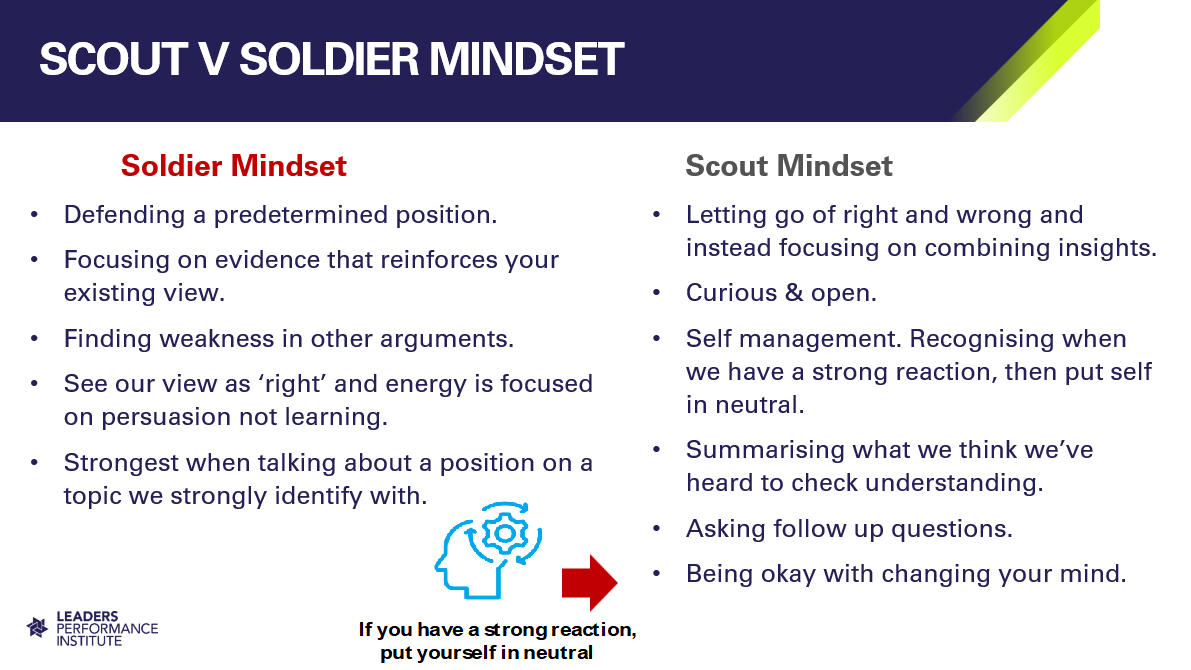
A scout mindset, such as when a scout might draw a map, is essential when learning and adapting. “It’s about acknowledging we might know some elements of the map, but large parts of the map are still undrawn,” added Bull. “It’s not ignoring that we have expertise, but it’s looking for what’s missing.”
On the other hand, a soldier mindset is counterproductive because, as Bull said, “most of our energy is going to influencing other people to see things our way as opposed to learning from what we’re missing.” It can also help, as Shona Crooks, a colleague of Bull’s from Management Futures says, to ‘put your brain in neutral’.
What kind of listener are you?
It was a question posed by Management Futures’ Jeff Pagliano during July’s Leadership Skills Series session.
There are at least four different types of listener, as Pagliano pointed out, but anyone can become better at listening at depth.
He illustrated his rationale with this graphic:
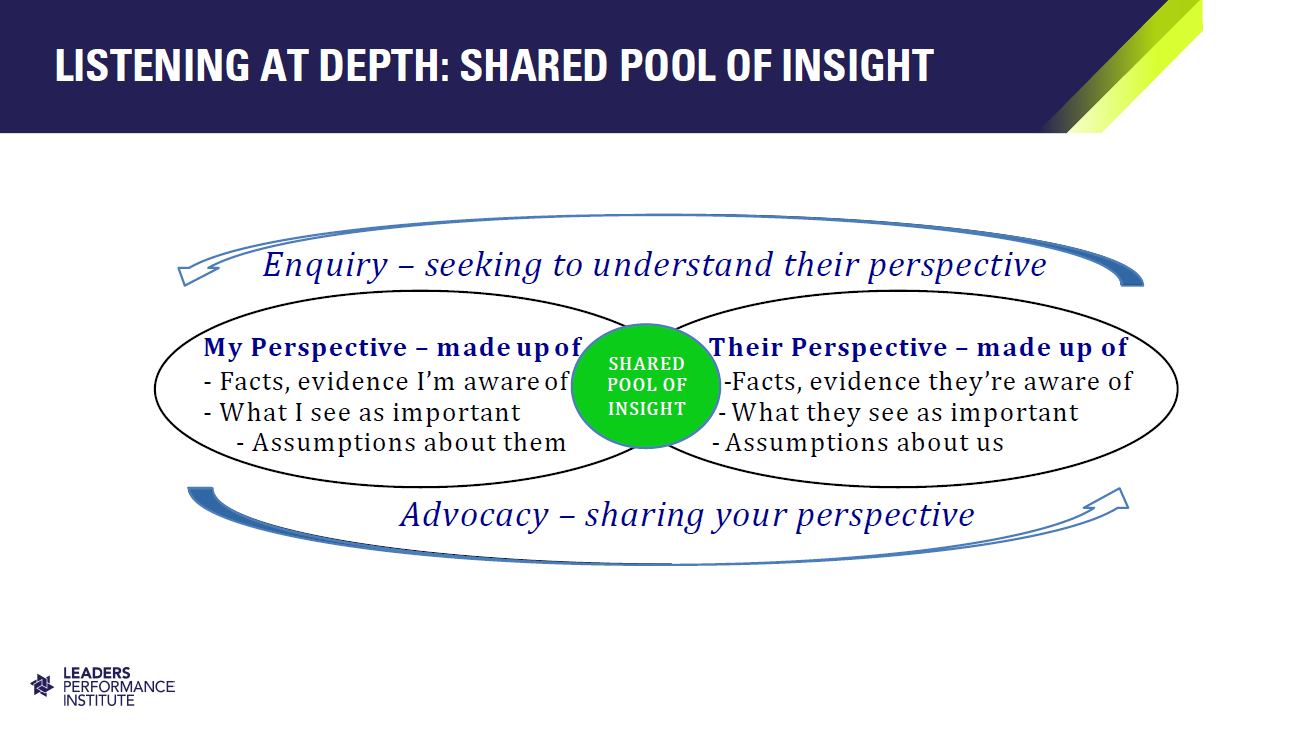
“Usually when we’re trying to persuade someone, it’s all about sharing our perspective. We call that ‘advocacy’,” said Pagliano. Your advocacy will be made up of the facts known to you, things you see as important, and any assumptions you make about the other person.
That person will have facts, thoughts and assumptions of their own, which is why we must add ‘inquiry’ to help bring those to the fore. “And when you bring those two things together that’s where you get that shared pool of insight.”
Listening at depth has other benefits too:
Do you care enough about your coach and staff wellbeing?
“We’ve had athlete wellbeing and engagement in place for more than ten years. We still don’t have coach wellbeing and engagement in place at all.”
This observation, offered at a Leaders Virtual Roundtable on the topic, is by no means unique.
Members of the Leaders Performance Institute have seen the following approaches help:
Read a full account here.
The postpartum return of British athletes
This was a theme of last month’s Women’s High Performance Sport community call, which featured Esme Matthew, the Head of Physiology at the UKSI, and Dr Kate Hutchings, who works with the UKSI’s leading clinical services for all world-class-funded Olympic and Paralympic athletes.
Early and open communication helps athletes and their teams set expectations and create tailored return-to-performance plans, with support from performance lifestyle advisors.
These help to place the athlete at the centre of their own decision-making.
Pelvic floor education and support are essential for postpartum recovery.
Each athlete’s requires unique and flexible plans informed by health monitoring and any necessary practical adjustments. It is key to enable them to stay connected to their sport.
Mental health support is vital as athletes adjust to motherhood.
Informal peer networks, such as WhatsApp groups, offer valuable emotional and practical support, helping athletes share experiences and reduce isolation during pregnancy and postpartum.
Click here for a fuller insight.
As Esme Matthew and Dr Kate Hutchings explain, the reality is you won’t always find the answers in research Papers. Dialogue and individualised plans are critical.
Our recent Women’s High Performance Sport Community call featured the UK Sports Institute sharing how organisations can better support athletes returning to performance postpartum.
We were delighted to be joined by:
The conversation focused on the structures UKSI have put in place to support athletes, including the role multidisciplinary teams (MDTs) have, which practices are having a positive impact on athletes, and what was learnt in the most recent Games cycle.
Six core themes emerged around what is involved in guiding an athlete successfully through pregnancy and their postpartum return. We also discussed what can be done where resources are limited.
The timing of when an athlete chooses to inform their coach and support team of their pregnancy will vary, but having conversations as early as possible during pregnancy is essential to map out return-to-performance plans. It’s advised that athletes establish support networks and define expectations with their teams before delivery. This could include what they expect in terms of communication from their coach, when they’re hoping to train, and how they’d like to stay connected to their sport or team. The panel recommended putting this in contract form and falling back on the initial discussion when necessary.
In their experiences, Matthew and Hutchings have found that Performance Lifestyle Advisors play a pivotal role in helping athletes navigate logistics like childcare, breastfeeding, and travel. It might also be that the Performance Lifestyle Advisor is the team member the athlete lets know first of their plans to have a child, and signposted the athlete to the resources offered by the Female Athlete Performance Programme.
Deciding what will be monitored before giving birth will help with this planning process and ensure shared expectations postpartum. The monitoring plan will also help shape MDT support. More on each to come.
It won’t surprise you to hear that effective return requires collaboration between many people, including but not limited to:
That being said, the athlete must be central to all decisions, with support teams adapting to their evolving needs. It also won’t surprise you that no athlete return is the same as any other, even if it isn’t the athlete’s first child. Ultimately it comes down to who they trust to help them make decisions. Even if the goal is to have the athlete make final decisions, they’ll seek input and guidance along the way.
A key learning from more recent years has come from athletes wanting to test and push the boundaries of what’s possible when pregnant. For Matthew and Hutchings, the health and wellbeing of the athlete and baby are the first priority. But athletes are not used to that being a default mindset. It’s not that they don’t care about their own wellbeing or the wellbeing of their baby, but they are used to continuously thinking about how they are going to be better athletes. How can they return faster? How can they get themselves in the best possible shape pre-delivery so that their postpartum period is as easy as possible. Alongside this, MDTs will need to come together to help support an athlete through some really difficult questions. For example, ‘can I go on this training camp in warm weather?’, ‘can I still compete at this week of my pregnancy?’ or ‘can I still do my sport?’ The reality is that you are not going to find an answer to these questions in a research article.
A further reality is that these questions will always be asked, and that a standard FAQ section won’t suffice. Instead, the duo recommend talking through the risk.
Typical questions:
The aim is to have the athlete answer these question for themselves. The MDT needs to be able to provide guidelines for athletes to be able to consider that for themselves, given that some examples, such as ‘can I go on this training camp to Australia, where we know it’s going to be really hot?’ and ‘can I still do a competition while it’s still really hot if I feel OK?’ can’t be answered ahead of time. They have to be able to answer it on the day given how many factors might change. But we should be educating them in how to make that decision.
One way to approach this is to talk through the theory with the athlete. With the heat example, that’s explaining blood flow and where else blood will be directed beyond the placenta. If they understand the theory of it, it can make it easier for them to make decisions for themselves.
Beyond this, a couple of things to definitely avoid were shared too:
The UKSI are also really clear with the athletes that they don’t provide any sort of obstetric support. So they’re not there to be midwives or health visitors.
Then there are additional considerations to think of for who might be part of the athlete’s support team. For example, Hutchings is working with a Paralympian and she had to leave a meeting because she was going to a session where her hearing dog was going to be trained to listen for a newborn baby’s cry. There are situations where the planning for post-natal is even more considered.
Involving a partner can also be an excellent addition to support teams. It gives them more information for when the athlete needs them to fight the traditional athlete mentality to push through. There can also be a discussion about how hard this transition might be and that the athlete is going to need support through their decision making. It can provide another check and challenge for them when questioning if they really need to push that hard today or offer observations such as ‘I can see you feel really tired. Why don’t you just have a day off?’ It’s not an athlete’s mindset. Their mindset is more likely ‘I feel a bit off, but I’m going to carry on anyway’. Matthew shared that, “having someone that’s there with them on a day-to-day that can really help with that has been really useful”.
It’s also important to train staff. Matthew added that ahead of the Paris cycle, the learning module for staff across the UKSI was rewritten. Para athlete support was interwoven across the module rather than being a separate section, as it had been previously.
On the call, we also spoke about any instances where an athlete might prefer to talk to Matthew or Hutchings about her pregnancy, rather than her MDT in her sport and her coach, and everything that goes with it. Both have found this to be quite rare. If it has happened it’s normally been where they are the only female support they have, or when the team haven’t known about the pregnancy yet. In response to this, they’d focus on brining everyone together to be aligned with the initial message to the athlete being a reminder that Matthew and Hutchings are there as an extra layer of support for both the athlete and their support team within the sport. This is usually followed up with an MDT webinar. This would cover what their training and pregnancy would look like. Talking through training plans postpartum with all of their support team with the athlete in the room. Typically this gels and brings everyone together.
Matthew and Hutchings were quick to point out that some of the best examples of support teams have been all male apart from themselves. They’ve been incredibly understanding, and couldn’t do enough for the athletes. It’s just trying to bring everyone together and get them on the same page.
The other time this can happen is before an athlete is pregnant, but they would like to talk about what training might look like during pregnancy or what return timelines might look like for them in their sport, and they might not want to talk to the sport about it yet because they don’t feel comfortable.
So Matthew and Hutchings would always encourage them to tell their sport as early as possible, but it does at least give like a bit of a safety net for that.
When asked around practices that have a positive impact on athlete return postpartum, pelvic floor education and support before and after birth was repeatedly described as transformative for any female athlete, given its impact on incontinence and strength training.
From research around the Commonwealth Games in 2022 one in five athletes reported urinary incontinence. They were planning for adapting to this through kit changes or fluid restrictions. The stats for urinary incontinence postpartum, regardless of mode of delivery, is at one in three athletes; and faecal incontinence is one in 10. “It’s such an important area for us to get right and that’s why we always work very closely with pelvic health physios,” said Hutchings. “If you keep up and do all your pelvic floor exercises, if you’ve got good pelvic health antenatally, you reduce your risk of urinary incontinence by 40 per cent postpartum, regardless of the method delivery.”
Athletes are encouraged to use tools like the NHS Squeezy app and see a pelvic health specialist pre- and postnatally if something bespoke is needed.
As a group we also discussed being careful with the interrelatedness of symptoms of pelvic floor weaknesses and REDs. With it being important to stay diligent around REDs given changes to nutritional needs, if breastfeeding; plus changes in bone density linked to giving birth. All with the added complexity that athletes remain on the register for drugs testing in their sports and will need to be sensible with supplements.
Given that no two athletes’ journeys are the same. Plans must be flexible and responsive to daily changes in health and energy. Monitoring will play an important role here, with the likes of readiness scores, subjective wellness, sub-max testing guiding training and return.
It’s important to have awareness about each athlete’s training environment. Especially as each athlete will stop full training at different stages antenatally for a variety of reasons. That could also impact when they reengage postpartum too. This awareness, allied to open communication, is even more important if they’re the only pregnant athlete in a squad or sport.
This is important for thinking about athletes feeling disconnected, and how we can continue to keep them in the same spaces as other athletes, but with a different programme, for example in the gym, or continuing to attend squad meetings, even if they’re not training at the same capacity.
As mentioned earlier, having some really clear markers as part of an athlete’s individualised plan is also helpful. This would include discussing what you would like to measure postpartum before you get there. This can useful for the coach too. Matthew and Hutchings also always work hard on helping the athlete connect with detraining while accepting that some of the markers that they would keep track of normally are going to go down. There are also conversations about things like blood volume and endurance levels. For example, some endurance athletes will panic about losing fitness and when these conversations happen, Matthew and Hutchings talk about the physiological principles that sit around pregnancy that actually support a maintenance of economy and supporting systems. So having those markers lets the athlete and MDT talk through the pregnancy, what are you expecting to see, and managing those expectations and then, postpartum, what would you look to be monitoring when you come back and when would you look to do that?
An example where this work well, is in rowing and Jack Brown’s work with Olympic double sculls bronze medallist Mathilda Hodgkins-Byrne. They included clear physiological markers and sub-max testing to guide return. Together they put some good markers in place around sub-max testing to look at economy. They had some clear markers in the sand that the sport wanted the athlete to meet but did some nice monitoring around that. This included morning monitoring, which is quite tricky to get done when the athlete is having to get up and look after her child. Her first thought is to talk about what can work and potential practical solutions that you can look at. It could be that starting with just a readiness score for training for the day can be tracked and then over time you can start to build others back in. For example, resting heart rate in the morning when that feels really important, say, six months postpartum.
We discussed options to support training, including blood flow restriction. However, there are other things that can be done that are just really sound training principles around muscle hypertrophy postpartum that could be harder to implement than previously; therefore focus could be on those first. It could be as basic as doing good training and recovery. It can be quite difficult for athletes to do the training postpartum when they’ve got so much going on, like getting to training, being able to take the time out to do it, finding childcare, sorting all of their nutrition. So that’s a really big focus for the UKSI postpartum, the planning and organisation. With nutrition, this might be have you got something in the car that you can eat on the way home? Because once you get home the baby is back to you and you’re in full-on Mum mode.
Further, if an athlete or coach wants to use methods such as BFR because they want to accelerate their return, it’s known that from a pelvic floor point of view the UKSI doesn’t get people running much before 12 weeks anyway. Thus, you could accelerate other areas such as muscle development, but it’s the pelvic floor that you want to engage. And that takes time.
Both Matthew and Hutchings advocate for mental health support, and work with a psychologist for pregnant and postpartum athletes. The change they face is vast, likely moving from a very regimented and structured training life to one full of unpredictability and many unknowns and firsts. There can be a struggle with the dual identity of being a new mother and an elite performer. As Hutchings said: “I think that’s really important for us to recognise and have those conversations and then feeling comfortable to say to their team. Actually, I don’t feel all right today or I’m a bit tearful, I’m struggling or I don’t feel like I fit in.”
It’s important for the MDT to recognise that an athlete might feel disconnected as they return to their sporting environment. They might be the first (or only current) athlete to be pregnant.
A simple support mechanism has been the creation of a WhatsApp group for pregnant and postpartum athletes to foster peer mentorship and shared learning. This informal network has been highly valued for emotional support and practical advice.
What about those with fewer resources?
Smaller sports often lack in-house expertise. UKSI fills this gap by offering bespoke support and education.
How might you take advantage of the UKSI’s experiences in athlete return postpartum?
1 Jul 2025
ArticlesIn June, performance under pressure, empowered leadership and female athlete health were some of the topics discussed by members of the institute.
“I think the real champions are made in situations when you deal with that pressure,” said Alcaraz at Rolland-Garros in Paris last month. “That’s why I saw my best tennis in crucial moments, and that’s why I saw my best tennis in those difficult situations.”
Performance under pressure was a theme that run through the month of June here at the Leaders Performance Institute, starting with the wise words of Red Bull’s big wave surfer Ian Walsh.
His approach is geared around managing his fear. “Those nerves and everything you fear are natural, and you can use that to elevate your performance,” he said in this article. “It commands every ounce of your being and your focus to deal with what’s coming at you and how you want to navigate it to try and finish on your feet.”
Elsewhere, we returned to the question of alignment, named the common causes of inadaptability, and asked the Brisbane Lions to talk about their approaches to female athlete health.
What if there’s clarity in your communication as a team, but still you suffer from misalignment?
Edd Vahid, the Premier League’s Head of Academy Football Operations, answered this in a recent interview with the Leaders Performance Institute.
He explained there could be a few factors at play, all of which point to the importance of feedback:
Staff development needs. If a staff member commits an error of execution, it is an opportunity to deliver developmental feedback. Vahid says: “Does everyone understand what we’re going after? If they do and they step outside of that, then feedback is warranted.”
Psychological safety. “It’s a buzz term,” says Vahid of the commonly used phrase, “but it’s crucial for people to feel they are in a feedback culture.” The leader must show that the intent of feedback is to help the individual to progress. “You’re taking time to give them feedback because you care,” he adds. “You’re then seeking to work with the individual to create that development.”
The leader’s behaviour. Leaders must also demonstrate their willingness to listen to feedback. “They need to provide ‘speak up’ signals,” says Vahid with reference to the work of psychologist Megan Reitz. “The leader needs the skill to understand the position they’re in and the power they carry in that dynamic.”
The four inhibitors that prevent adaptability in a complex world
Those four inhibitors are discussed in great detail here, but one that will discuss below is when leaders themselves become the bottleneck due to their authoritative approach.
“Authoritative leadership has been proven time and time again to be effective in very short bursts,” said Tim Cox of Management Futures at a recent Leaders Virtual Roundtable, “but it isn’t much good for adaptability.” The reasons are simple enough. “It’s really difficult for one person to be able to think through, be creative, respond to the environment around them when things are changing at a high pace.”
Leaders, Cox said, should:
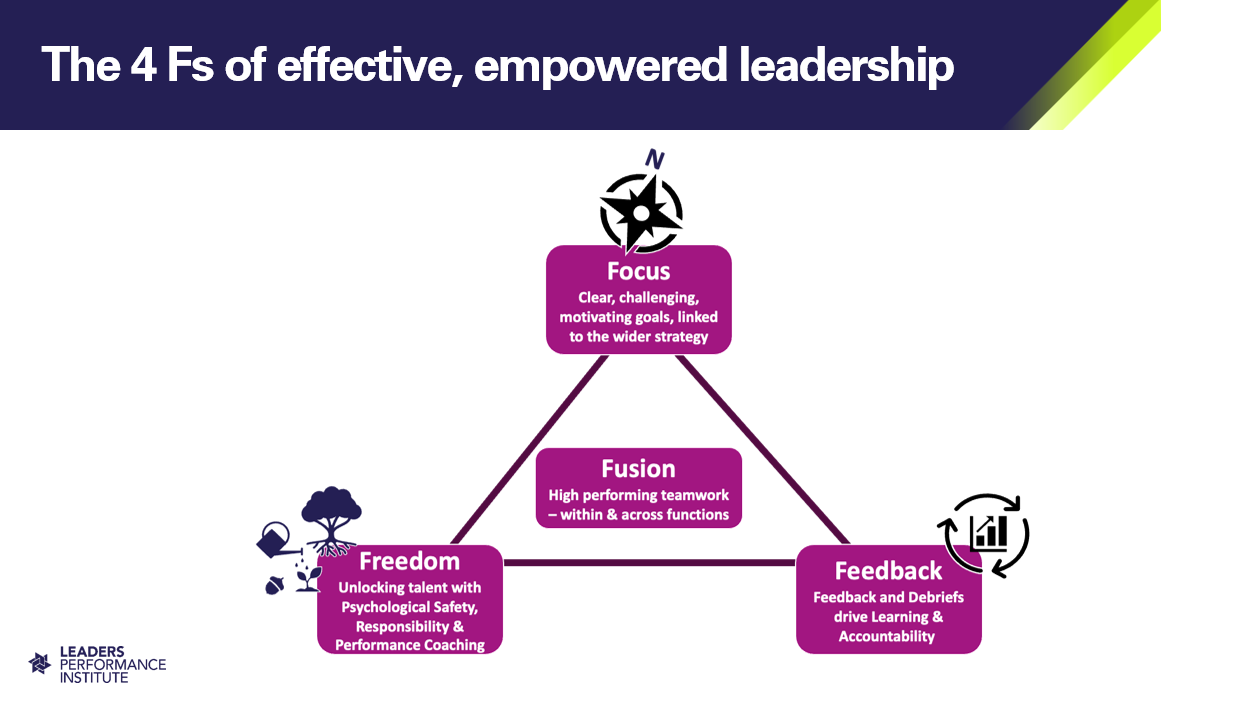
Focus: The leader must deliver clear, strategic alignment where everyone understands the direction and purpose of their work.
Feedback: Regular feedback and debriefing are essential for learning and continuous improvement, especially in dynamic settings.
Freedom: Give people autonomy and allow them to explore, innovate, and respond to change.
Fusion: This is about building strong relationships and collaboration, both within and beyond your organisation with a view to harnessing collective intelligence
Leadership is stagnating
This idea of leadership stagnating was revealed in stark terms in our Trend Report earlier this year.
The Trend Report revealed that 57 per cent of practitioners believe that leadership within their organisation has stayed the same or got worse in recent years.
The primary factors appear to be the shift towards task orientation and the pressure to ‘win now’, which can act to stifle innovation and long-term thinking. Leaders, as a selection of Leaders Performance Institute members agreed during a June roundtable, have less bandwidth, less time for staff development and even less time for staff onboarding.
Ben Baroody of Abilene Christian University, who co-led the session with Edd Vahid, observed that even at organisations that prioritise leadership development, stagnation is still reported. For Baroody, this is compounded by what he sees as the link between alignment and (high) quality leadership.
Vahid questioned whether leaders are giving themselves enough capacity to lead effectively and, as such, he is an advocate of distributed leadership models and leaders who invest in their own development as well as that of their people.
The virtual floor also highlighted the importance of skills including influencing, an ability to hold honest conversations, and active listening.
The Brisbane Lions have turned female athlete health into a performance question
The renewed focus on female athlete health is a direct result of the work of Matt Green, the Lions’ High Performance Manager for AFLW and his team.
As an organisation, the Lions focus on five key, interrelated areas:
19 Jun 2025
VideosIn the second episode of our three-part series, the AIS’s Director of National Performance Support Systems discusses how tech can be better used to deliver insights to athletes and coaches.
A vodcast brought to you by our Main Partners

“One of the things we’re trying to figure out, particularly for fresh graduates coming into high performance, is that sense of pressure to utilise technology because that’s what’s seen to be done in high performance,” she tells Teamworks’ Andrew Trimble and Leaders John Portch.
Miranda is the Director of National Performance Support Systems at the Australian Institute of Sport and a practising physiotherapist, which made her an ideal guest on this special Teamworks Vodcast, particularly when it comes to sharing her perspective on the way the Australian sports system uses technology.
“The next step is ensuring practitioners have got the critical thinking skills to understand why I am using this and what is it adding. What is it telling me? It’s getting that ability to analyse.”
Her words bring to mind High Performance Unpacked, the Teamworks Special Report that spoke to the importance of the practitioner optimising a given tech product to the final user.
It resonated with Andrew too. “When you haven’t got a centralised mechanism for presenting and communicating data, it shines a light on how important it is to be done correctly,” he says. “The greatest dataset in the world, if not communicated correctly, is nowhere near as effective and may be detrimental.”
Elsewhere in this episode, Miranda and Andrew discuss the idea of the physio room as the heartbeat of the team; the balance between system and individual performance [29:30]; why the physiotherapist is a ‘life coach’; and bridging the evidence gap in female athlete health.
Check out Episode 1, with Simon Rice, the Vice President of Athlete Care at the Philadelphia 76ers:
Listen above and subscribe today on iTunes, Spotify, Stitcher and Overcast, or your chosen podcast platform.