Leaders in Business
  • Membership
  • Events
  • Content
  • Virtual Learning
  • Connections
  • Partners
Login
  • Leaders Meet: Innovation
  • Events
    • Leaders Week London
    • Leaders Sports Awards
    • Leaders Club Events
    • Leaders Performance Institute Events
    • Leaders Meet: Innovation
  • Memberships
    • The Leaders Club
    • Leaders Performance Institute
  • About
    • Careers
    • Contact
I’m a sports leader:
  • Off The Field For those focused on the business of the sport View more
  • On The Field For those working with an athlete or elite team View more
  • Login
    • Leaders ClubThe membership for future sport business leaders
    • Leaders Performance InstituteThe membership for elite performance practitioners
  • Newsletters
Performance Institute Leaders Performance Institute Logo
  • Membership
  • Events
  • Content
  • Virtual Learning
  • Connections
  • Partners
Login

22 Oct 2024

Articles

How Sport Wales Is Enabling Female Athletes to Succeed on the World Stage

Category
Human Performance, Leadership & Culture
Share
Facebook Twitter Email Copy Link
https://leadersinsport.com/performance-institute/articles/how-sport-wales-is-enabling-female-athletes-to-succeed-on-the-world-stage/

The institute’s Female Health & Performance Team sets out some of the most important considerations for female athletes from grassroots through to elite level.

By John Portch
A regular menstrual cycle is generally a sign of good health in female athletes – although not all female athletes are necessarily aware of this.

“There are still female athletes who see it as a positive if their periods stop when they’re training,” Dr Natalie Brown, a Research Associate at the Welsh Institute of Performance Science, tells the Leaders Performance Institute on Teams.

“This is because it’s easier and more convenient; they’ve not got to deal with the symptoms or the bleeding.”

Yet the impact on their short and long term health, let alone performance, could be significant. “It’s an indicator that they do not have enough energy for those basic bodily functions.”

Nevertheless, such myths have grown to fill the void left by a lack of education and awareness across sport.

Brown is part of the Sport Wales Female Health & Performance Team who are working to redress that balance by seeking to identify how the Welsh sports system can better support female athletes in their health and performance.

In the first of a series of articles exploring the work of Sport Wales’ Female Health & Performance Team, we discuss some of the major health and performance considerations for female athletes as well as some of the common myths that endure.

Female athletes: long overlooked

It was encouraging to see a 50:50 split between male and female athletes at an Olympic Games for the first time in Paris earlier this year, but the stark reality is that just 22 per cent of leadership positions in sport are held by women.

This is a symptom of a wider gender imbalance. Sport, much like society, has been geared towards males, with female sport often overlooked and under-resourced.

“Females are participating more, and that’s great to see, but the environments in which they are participating have not necessarily been set up for females,” says Esther Goldsmith, who both works alongside Brown within the Female Health & Performance Team and joins her on the call.

A girls’ rugby team, for example, may not have access to suitable changing rooms or toilets. “That means they have to arrive prepared and, if they’ve not got access to toilets, what does that mean if you’ve got someone on her period?” says Brown.

“Even in just focusing on the menstrual cycle you’re ignoring the bigger picture around women’s experiences of sport and how the system that we’ve designed doesn’t enable women to thrive in sport because they’re trying to thrive in a male system.”

She continues: “Girls go through puberty earlier than boys and so they have experienced hormonal changes at a time when they’re very unlikely to have been exposed to a strength stimulus and an appropriate movement at a young age when they would really benefit from it.”

“The other thing is access to physios,” says Goldsmith. “Most female teams don’t have access to a full-time physio, whereas male teams do.” Inevitably, female teams suffer more time lost to injuries than their male peers. “In a male setup you might have a physio input that means that there’s no time loss as a result of a niggle.”

This is compounded by the lack of sports science research on female athletes.

“Females have different biological and physical makeups,” says Goldsmith. “We know our hearts, circulation and hormones are different, our anatomy is different, and therefore our biomechanics are different.”

As long as the performance community overlooks this, from the grassroots to elite level, female athletes will leave both health and performance potential on the table.

Education

The Female Health & Performance Team is focused on trying “to provide practical, tangible things that you can do to support your female athletes without it becoming too complicated or time-consuming to achieve,” as Brown puts it.

Education is a significant lever. “A lot of teams say ‘we need education’ but then they don’t necessarily know how to deliver it,” says Goldsmith. “I will deliver some classes to athletes, coaches and practitioners and work with them to help them take responsibility for themselves.”

Sport Wales is aiming to create a culture where everyone, from board members to volunteers, considers the importance of female health. Goldsmith and her colleagues work with athletes and coaches to address health, wellbeing and performance questions.

It might involve classroom discussions but it could also take in one-to-one sessions. “If you’re working with an athlete there’s a bit of that ‘we’ve got to work on this together’ because every female body is completely different and everyone will respond in a different way,” she adds.

“You’ll go into some sports and work with some female athletes and they’ll respond to or act differently with you to how they might in their day-to-day training environment because you’re external and not part of their setup.”

Goldsmith will also adapt her approach depending on to whom she speaks. “Classes will look different depending on what part of the pathway you’re working on because a 14-year-old is going to respond very differently to a 25-year-old.”

She and her colleagues also strive to go beyond “surface level” initiatives and have carried out behavioural mapping. “How do we actually change behaviour so that females are considered, whether that’s with the athletes themselves or with the coaches and performance directors to look at actionable ideas?”

Myth busting

Around 90 per cent of athletes who menstruate report some symptoms including pain, reduced motivation and fatigue. Brown uses this stat to set the scene for an illuminating story: “I once asked an athlete if their menstrual cycle affects their training and they said: ‘no, not at all. I just miss training if I’m really struggling’. I just had to sit there and say ‘OK, we’re going to have to take a step back here’.”

Brown and her colleagues routinely dispel common misunderstandings and myths.

One such myth is the supposed need to periodise training according to an athlete’s menstrual cycle. “There is inconsistent evidence  that you should completely adjust all of your training based on phases of the menstrual cycle,” she says.

Media headlines suggesting links between ACL injuries and the menstrual cycle have not helped. “I’ve worked with some athletes who are petrified of training in a certain way at a certain time because of those headlines and their anxiety,” says Goldsmith. Another persistent myth is the idea that stopping the use of hormonal contraceptives will restart someone’s cycle (they may experience a withdrawal bleed, which is not the same as a menstrual bleed).

Coaches are just as susceptible to these myths. “You could see them, especially with team sports, asking ‘well, if I’ve got two athletes in that phase and two athletes in that phase and 20 in that phase, how do I make sure that they’re all training based on their phases?’” All are relieved to hear there is an alternative solution to providing female-specific support.

One might also assume that a female coach would be more sympathetic to the needs of a female athlete but that is not always the case. “Some female coaches or practitioners, for example, never had any menstrual symptoms,” says Brown. “Some of them therefore don’t have the automatic motivation to consider it, and sometimes both male and female coaches can perceive athletes as using their symptoms as an excuse.”

It is important that it is not just females either, particularly as the majority of coaches are male. Some have a wealth of knowledge in the area, others don’t. “If you ask male coaches if they think there should be equal opportunities for males and females they wouldn’t say ‘no’,” says Goldsmith. “But that doesn’t mean they’ve factored some of the things we’ve talked about into their practice. They just haven’t developed that understanding. But when you start communicating it as a performance thing, they’re like ‘OK, this applies to the world I live in’.”

To further help athletes, as well as their GPs, Sport Wales Medical Consultant, Dr Katy Guy, has prepared a letter that female athletes can take to their GPs if they were to notice a change in their menstrual cycle. “We know GPs are under the cosh and have a lot to think and know about, so we’re just trying to create a resource to help bust that myth beyond our institute,” says Goldsmith.

For all the obstacles that remain, both Brown and Goldsmith are optimistic.

“In the last two years there’s been quite a shift,” says Brown. “Before that, the conversation was starting and there was some awareness but it was more around what was not being provided. There’s been an increase in both research and support in the last two years.

“The increased visibility of women’s sport has also supported that shift. So rather than us saying ‘this is important, you need to consider it, this is why’, I feel like we’ve shifted towards sports, athletes and coaches saying ‘we know it’s important. What can we do?’”

Stay tuned for upcoming articles where Brown and Goldsmith provide practical suggestions and solutions for supporting female athletes, from enhancing knowledge and establishing supportive environments to embedding positive behaviours and suitable management strategies.

Further reading:

‘Female-Specific Considerations Should Be Part of Normal Practice’


Members Only

8 Oct 2024

Articles

Feel Guilty When Taking a Break? You’re Not Alone

Category
Human Performance, Leadership & Culture, Premium
Share
Facebook Twitter Email Copy Link
https://leadersinsport.com/performance-institute/articles/feel-guilty-when-taking-a-break-youre-not-alone/

Four staging posts to help you follow through on your wellbeing aims when reality starts to bite.

A Human Performance article brought to you by our Main Partners

By John Portch
Guilt often rears its head when thoughts turn to wellbeing and, in particular, matters of self-care.

You may want to go for that walk or a run, but perhaps there’s still so much that needs to be done before your team’s next training session. You know you’ll feel guilty if you step away from your desk for more than a few minutes.

To compound matters, you may silently chastise a colleague for stepping away from their desk and ask yourself ‘where are they finding the time?’

“There is not a single person in this room who has not felt guilt daily,” said Sonia Boland, the National Wellbeing Manager at the Australian Institute of Sport [AIS].

She was addressing an audience at the Leaders Sport Performance Summit in Melbourne in February where the question of guilt, and the fear of fostering an ‘excuses culture’, were raised.

“In those moments where I absolutely feel that, if you know it’s going to help you do your next thing better, ask yourself: what’s the worst that’s going to happen?” she continued, making the point that performance won’t instantly collapse because you’ve gone for a stroll.

“You’ve got to have something around you to allow you to take that step out of the door.”

Boland is echoed in her sentiment by Emily Downes, the General Manager of Wellbeing & Leadership at High Performance Sport New Zealand [HPSNZ], who admitted to the same feeling.

“We all probably struggle with that at one point in time or another,” Downes said. “Who else do you need to have on your support crew that helps give you that permission?”

“It’s not doing new things, it’s not creating new programmes,” added Boland. “It’s just giving more focus to how we do what we do, not what we do.”

Boland and Downes suggested four key staging posts in reaching this goal.

1. Establish what you mean by ‘wellbeing’

Establish the framework for how you want to talk about wellbeing before all else.

Boland will not define ‘wellbeing’ in sport. “What became really clear is that we’re all talking about slightly different things,” she said of her time at the AIS. “When we’re talking about wellbeing, are we talking about your wellbeing or my wellbeing? Or are we talking about the wellbeing of everyone in this space? Are we talking about the environment that enables us to be who we need to be? If you don’t know that, it’s probably the first step.”

2. Consider an ‘ecological’ approach

The wellbeing conversations at the AIS, HPSNZ and beyond are shifting from simply duty of care and risk management for athletes (and increasingly coaches) towards wellbeing as a performance enabler. It’s an encouraging development, but Boland argued that it needs to go beyond a focus on the individual.

“We can throw heaps of money to help athletes and coaches do wellbeing better, we can talk to them to the cows come home about how to deal with burnout, how to lower your stress levels, but none of that means anything if the things happening above and around them are continuing to compound how that stress is coming,” she said.

The Australian system promotes an “ecological model”, as Boland explained. This means there is a focus on relationships, structures, policies and even job descriptions – because job descriptions can help people to set boundaries and feedback mechanisms.

“People want feedback, they want to learn and grow from when it’s not working,” she added. “We need to have the opportunity to fail and we need to have the environment where we can do that. And all of those things contribute to the wellbeing of the individual.”

3. Support self-care

We return to the question of guilt over self-care despite growing awareness of its performance benefits.

“The challenge around this is: are you asking for it?” said Downes. “Are you communicating to your manager what support looks like for you or what you might need to be at your best?”

She addressed the leaders in the room directly. “Have you set up systems within your environment to enable people to [step away from their desk]?”

There is similar thinking across the Ditch. “[If you get up and leave] think about the poor person next to you who’s got the same level of guilt,” said Boland. “They might look at you and say ‘yeah, maybe I’ll give that a go tomorrow’. It creates the culture where we prioritise what we need to do to perform at our best.”

4. Make it make sense to your people

Different words will resonate with different groups, so choose your terms smartly when discussing wellbeing.

“Find language that makes sense to you and your people,” said Boland. “If I think about the Olympic and Paralympic system, the language that needs to be used in skateboarding needs to look different in equestrian, and it’s going to look different in rowing. It’s not one-size-fits-all.

“Find the stuff that’s going to resonate, that connects to the meaning and purpose.”

3 Oct 2024

Articles

The Debrief – a Snapshot of Powerful Discussions Happening Right Now Across the Leaders Performance Institute

Category
Leadership & Culture
Share
Facebook Twitter Email Copy Link
https://leadersinsport.com/performance-institute/articles/the-debrief-a-snapshot-of-powerful-discussions-happening-right-now-across-the-leaders-performance-institute-7/

In September we addressed the pressing questions of making meetings more useful and your data more impactful.

By Luke Whitworth
Let’s begin this month’s Debrief with a question.

How many meetings did you attend in September and how many of those meetings were useful or productive?

On second thoughts, you may want to keep your counsel on that front. If you do happen to feel that your meetings were, let’s say, sub-optimal, you’re not alone.

A 2017 report in the Harvard Business Review laid out some stark facts that ring just as true today:

  • 71 % of senior managers believe meetings are inefficient.
  • 40% of employees consider unproductive meetings to be the highest cost to their organisations.
  • 50% of all meeting time is found to be effective, well used and engaging. This percentage is even lower for remote meetings.

All were discussed in a recent Leadership Skills Series session, which kicks off the September Debrief, before segueing into performance analysis.

Before we get into it, we want to thank those of you who completed our Future Trends in High Performance survey. We’re excited to dissect the findings and begin condensing this into a report which we hope you will find valuable – keep your eyes peeled for this later in the year.

Making your meetings more impactful

Let’s cut to the chase: what we can we be doing practically to make our meetings better? We set out some simple but actionable tactics to deploy right away in our September Leadership Skills Series session.

Before the meeting :

  • Ask at the outset, is a meeting actually required for this particular item? Too often we see meetings happen for meetings’ sake. Be diligent and reflective of the purpose and desired outcome.
  • If it is agreed that meeting would be useful, clearly define the purpose of the meeting before bringing the relevant people together and create an agenda with those involved. Is the purpose to make a decision? Is the purpose to brainstorm or solve a problem? On the whole, what is it and is everyone clear?
  • Create an agenda. This sounds simple but it’s important as many meetings skip this part, which can often derail the quality of the discussions. Start and finish on time. Consider allocating time for items so ‘less is more’ and identify a specific aim for each to give direction – what specifically do we need to take away from this agenda item?
  • Identify the required resources and pre-reading required for the meeting or each agenda item.
  • Instead of inviting everyone, who do we want in the room who is going to enable the decision or enable the best thinking?
  • Assign roles: a chair or facilitator? Who is leading each topic and who is the note taker? Often what happens is the expert or leader of the team ends up defaulting to the chair and facilitator. Look to vary this to bring fresh voices in.

During the meeting:

  • Start well. Start with positivity and be mindful of your body language and the impression you’re creating, as we know about the emotional contagion this can create.
  • The chair or facilitator should look to set out the ground rules from the outset, do this nice and early: share what the plan is, that there will be equal opportunity, expect interruption if the direction of travel isn’t where it needs to be, and be rigorous, especially around timings.
  • Check for buy-in and permission at the beginning of the meeting to stick to the above as this takes away some people feeling a bit nervous about coming in and stopping the conversation or moving it on.
  • Consider ‘mini diamonds’. Each agenda item becomes a mini diamond. At the top of the diamond, you look to open up the conversation and bring different people in and then the chair or facilitator needs to bring it to the end point. What were the actions and ideas that came out of the conversation?

After the meeting:

  • This is where meetings can lose their impact. A really good discussion is had, there are some actions that come out of it, but by the time we actually get the notes from it, the momentum has been lost.
  • In an ideal world, the note taker has some time immediately after the meeting where the notes can be summarised and circulated.
  • Ensure all actions have a specific person – not a department – assigned to them.
  • Ask for feedback. If you haven’t gone out to your teams or the organisation to review what people think of meetings recently, how effectively they’re being used, what’s working and what isn’t working, it’s perhaps an idea to do that.

Mobilising performance analysis: solutions for common challenges

In last month’s debrief, we touched on some of the learnings and reflections from part one of our series titled Advances in Performance Analysis. As part of that first session, we asked attendees to reflect on some of the common challenges they are facing in the space. As a refresher, these were:

  1. Integration: efficiently setting up datasets that allow for different data points to intertwine with one another.
  2. Communication of the data: consider: how good are you at data visualisation and storytelling?
  3. Buy-in: how strong is the understanding around the value of performance analysis across the organisation to show return on investment? How well are you showing and measuring the impact?
  4. Data management: given the amount of metrics being collected, is there clarity and prioritisation of what matters?

The aim of session two, was to explore these challenges in more detail and, by leaning into a couple of case studies from different environments, share some ideas and solutions to shift the dial. Those case studies were provided by the UK Sports Institute’s Head of Performance Analysis, Julia Wells, and Wolverhampton Wanderers’ Head of Performance Insights & Data Strategy, Mat Pearson. Both shared some useful ideas.

Integrating and connecting data

  • Focus on data skill development. This means upskilling the relevant staff involved, from the right data, correct formats and in the right places, before the interrogation and analysis even begins. Go back to basics and upskill everyone in the team.
  • Structures can support this too. There is clear data strategy and leadership within the UKSI environment, all geared towards supporting performance planning. Roles such as Data & Insight Lead and Performance Data Lead are embedded within the organisation to help those leading programmes with the direction and the integration of their data.
  • Do not underestimate the importance of clear strategy as part of your performance planning. Know what needs collating and why within your team.

Data collation

  • Taking the time to pause and critically reflect is really important in the process as it can be very easy to stay on the hamster wheel and just keep collecting.
  • Ask quality questions: why are we creating the data, what is its purpose, what decisions is it informing, particularly in the coaching process? Do this periodically and continue to plan, do and review.
  • Engage in conversations with key leaders in the environment to discuss what to start, continue and stop. It’s important to intentionally carve out those opportunities as part of your performance planning.

Communication of data

  • Communication is a critical skill. Wells suggested that some people would say that communication is a non-technical skill, but it is highly technical, in her opinion. Therefore, it is really important to upskill those working in this space considering the critical nature of human engagement in the process.
  • At the UKSI, staff work closely with the psychology team to help elevate understanding of self and others. If we can better understand the people we work with, it will support how to get the best out of each other. They’ve tapped into better understanding one another’s preferences to be more impactful in how they support each other.

Buy-in

  • Alignment to the sport’s strategy helps to provide a clearer connection. If this alignment and connection isn’t there, you’ll naturally get disconnection so it will be more challenging to get the buy-in.
  • Relationships are key. Invite key stakeholders and leaders into your world and shadow them. When they immerse themselves to better understand the process you’ll find that it can quickly lead to them becoming a voice for you in wider conversations.

Data literacy

This is a bonus challenge and set of solutions, which does have some relevance to communication and buy-in.

  • Often practitioners can suffer in silence when looking for solutions. In the latest Olympic cycle, the team at UKSI have introduced an internal online data community that provides access to resources. This accessibility allowed them to be able to connect with others in the network and share good practice.
  • The UKSI team put together a Data Leadership Programme which was focused on pulling together the data leaders in their sports to look at opportunities, challenges and future direction. Courses and best practices, called ‘Data Camp’, ‘Project Automate’ and ‘Code School’, were created to improve skills and processes for coaches and practitioners to help them be more efficient.

Members Only

24 Sep 2024

Articles

How to Make Data-Informed Coaching and Recruitment a Reality

Category
Data & Innovation, Premium
Share
Facebook Twitter Email Copy Link
https://leadersinsport.com/performance-institute/articles/how-to-make-data-informed-coaching-and-recruitment-a-reality/

Data Analysts Julia Wells of the UKSI and Mat Pearson of Wolverhampton Wanderers deliver a series of practical tips to help address one of sport’s notorious blind spots.

An article brought to you in collaboration with


By Luke Whitworth
Half of the practitioners at elite sports organisations believe there is limited integration between their data analysis and coaching teams.

That is according to a straw poll of attendees at a recent Virtual Roundtable hosted by the British Association of Sport & Exercise Sciences [BASES] and the Leaders Performance Institute.

The perception is worse when it comes to analysis and recruitment, with over 60 per cent of attendees suggesting that their analytics and recruitment teams do not work closely at all.

Yet 63 per cent also believe that improved data and computer literacy across their staffs would directly impact performance.

The sense that there is room for improvement gave the session its title: ‘Mobilising Performance Analysis in Practice’. It was the second in our three-part collaboration with BASES called Advances in Performance Analysis and centred around two case studies.

The first was delivered by Julia Wells, the Head of Performance Analysis at the UK Sports Institute [UKSI], and the second by Mat Pearson, the Head of Performance Insights & Data Strategy at English Premier League side Wolverhampton Wanderers.

Five areas where data literacy can improve performance

Before Wells and Pearson delivered their insights, attendees were set a further task: ‘as a consequence of improving data or computer literacy, describe what you would see as being the most significant impact on performance’.

The responses were varied but five stood out:

  1. Improved efficiency: save time and, with that time-saving ability, you have more space to explore and analyse the insights to then act upon them. Similarly, greater efficiency means less education on metrics and processes for those who don’t have expertise in the area. Finally, there will be fewer mistakes.
  2. Better accuracy: this leads to better decisions, thus allowing one to be more evidence-based in wider decision-making.
  3. Observing trends over time: if done well, this leads to more engagement from coaches and athletes in the process and allows for data trends to be seen over a longer period of time.
  4. More evidence-based decisions: an ability to create general reports at user level with an ability to drill down and ask more specific and sophisticated questions of data.
  5. Easier benchmarking: there is room for more programme guidance and testing if things are working. It leads to more objective-based player assessments rather than just the subjective.

How the UKSI are mobilising performance analysis work-ons in meeting common challenges in data analysis

The first session highlighted the four biggest challenges facing people who use data analysis in sport. To kick off her presentation in the second, Wells explained how the UKSI is trying to tackle those four challenges (plus another).

Challenge 1: integration

Go back to basics. That’s the approach of the UKSI, who have placed an emphasis skill development, support structures and a clear data strategy.

It goes like this: the relevant staff members are upskilled in areas such as collecting the right data, using the correct formats in the right places before the interrogation and analysis even begins. This is then supported by a clear data strategy geared towards performance planning. For example, roles such as the data & insight lead and the performance data lead are embedded within the organisation to better help those leading programmes with the direction and the integration of their data. Thus, the strategy can come to the fore and everyone can better understand what needs collating and why within the team.

Challenge 2: data collation

Wells described how easy it can be to stay on the “hamster wheel” of collecting data without taking the time to critically reflect and pause. Can you, for example, call upon efficient processes for collecting data and wade through the myriad datasets potentially available? She recommended asking “quality questions”: why are we creating the data, what is its purpose, what decisions is it informing, particularly in the coaching process? Teams should do this periodically and continue to plan, do and review. Wells also encouraged engaging in conversations with key leaders in the environment to discuss what to start, continue and stop. It’s important to intentionally carve out those opportunities as part of your performance planning.

Challenge 3: communicating data insights

Wells stressed the critical nature of human engagement in the process and regards communication is a highly technical skill, despite the views of those who might see it as a ‘soft’ skill.

She shared that the different performance departments within the UKSI work closely with the psychology team to help elevate understanding of self and others. Wells said, if we can better understand the people we work with, it will support how people can get the best out of each other.  As part of this process, they’ve tapped into better understanding one another’s preferences in order to be more impactful in how they support each other.

Challenge 4: buy-in

It is not uncommon for senior stakeholders to not perceive the value of the work being done. This makes it incumbent on analysts to critically assess their impact and share the meaningfulness of their work. “It’s our job, and it’s our role to be critically analysing why and presenting that back,” as Wells said.

On that note, alignment to the sport’s strategy helps to provide a clearer connection. If this alignment and connection isn’t there, you’ll naturally get disconnection so it will be more challenging to get the buy-in.

In addition, relationships are just as critical when generating buy-in. Wells advocated inviting leaders and key stakeholders into your world and shadowing them. When they immerse themselves in better understanding the process you’ll find that it can quickly lead to them becoming a voice for you in wider conversations.

Challenge 5: data illiteracy

Too often, practitioners can suffer in silence when looking for solutions. In the latest Olympic and Paralympic cycles, Wells and her colleagues are seeking to increase data literacy across the board. They have introduced an internal online data community that provides access to resources, promotes connection, and leads to the sharing of good practice.

Wells’ team also put together a ‘Data Leadership Programme’ which is focused on pulling together the data leaders in the various sports with whom the UKSI work to look at opportunities, challenges and future direction. Courses, with titles including ‘Data Camp’, ‘Project Automate’ and ‘Code School’, were created to improve skills and processes for coaches and practitioners to help them be more efficient. In her mind, this has been crucial to enable people to be upskilled; and all support staff should be able to ask a good question and have the data skills to answer them.

How data analysis is supporting coaching and recruitment at Wolves

Pearson explained that he and his colleagues at Wolves are trying to align the club to ensure there is consistent evidence available and better identification of the trends impacting decision making from a data point of view.

He focused on two key areas: coaching and recruitment.

  1. The integration of data analysis with the coaching process

In the environment, the analysts are part of the multidisciplinary team. They are very much now voices in the room and, with it being a specialised discipline, all analysts must have an impact on decision making.

To that end, Pearson’s team have moved away from leaving the coaches to find the solutions themselves. Instead, analysts are encouraged to go and find solutions, present them to the coach, and then have good conversations to better find the optimal outcome.

Part of the challenge we can face, said Pearson, in particular with performance analysis at first-team level in professional football, is that many environments can be quite coach-led, which is in keeping with the nature of short tenures. The coaches will lean into their viewpoint as a way to exert their control. Therefore, education is important and, in particular, how you communicate with them to ensure the message lands. That said, Pearson observed that coaches in modern day football are more attuned to data and performance analysis and are much more data literate and comfortable with technology.

A key learning when integrating performance analysis and data work with coaching is to make insights as contextual as possible. If you provide insights to a coach that are out of context, you’ll lose them straight away.

  1. How data can support the game model, recruitment and selection

Pearson told attendees that some of the biggest strides in performance analysis and the wider data team have been in the field of game modelling, recruitment and selection decisions, with the obvious caveat that subjective input is still valued immensely.

The team have worked to create objective measures against the game model. In better understanding this, it has provided an additional layer of information related to individual player requirements for the game model. These insights are helping to inform both selection for matchday but also the recruitment of new talent. When thinking about the recruitment process in particular, Pearson said this process has helped to educate scouts and other recruitment personnel in the attributes for which they should be looking.

Visuals have played a key role in this process too, particularly in being able to show what it looks like to play in this particular style that the coach or manager wants. They’ve worked to make the playing style more objective.

Members Only

23 Aug 2024

Articles

How the Paris Olympics Used AI to Protect its Athletes from Social Media Abuse

Category
Data & Innovation, Premium
Share
Facebook Twitter Email Copy Link
https://leadersinsport.com/performance-institute/articles/how-the-paris-olympics-used-ai-to-protect-its-athletes-from-social-media-abuse/

The IOC’s pilot scheme was another branch of its holistic support for the athletes competing in Paris.

A Data & Innovation article brought to you by

sport techie
By the SBJ Tech team

In April, the IOC launched its Olympic AI Agenda, an initiative full of innovation that could dramatically affect future Games.

A pilot project in Senegal is using AI to identify athletic talent and improve access to athletic opportunities for future generations. Judges for sports such as gymnastics can use computer vision that will bring more structure to the scoring process.

But at the Paris Games, one such AI effort was of immediate benefit to all the world’s best athletes — a monitoring system to protect them from abusive comments on social media. Kirsty Burrows, the Head of the Safe Sport Unit for the IOC, told SBJ this is part of the organization’s greater mental health efforts, and its constant evolution helps creates holistic athlete support.

“We know the enjoyment people get from competing and participating in sport,” Burrows said in July. “But ensuring athletes have a positive, healthy experience where they can thrive on and off the field of play requires specific actions to be taken to support that and to make it so.”

The service, provided by a third party the IOC declined to name, scanned all major social media platforms to flag potentially abusive or harmful messages — an immediacy that hopes to address them and have them taken down before athletes can even see them. Specifically, Burrows said, the system uses AI to look for posts that are either criminal in nature or conflict with community guidelines — for example, guidelines on X include stances against abuse/harassment and hateful content. This service can also pick up emojis and other imagery while navigating more than 35 languages for the 206 delegations (10,000-plus athletes and 2,000 officials).

Burrows highlighted that the IOC wanted to be helpful with this protection but not overly intrusive. It didn’t scan athletes’ DMs, maintaining their privacy. They can opt out of the service as well.

This tech was tested during Olympic Esports Week last March, with the IOC saying that more than 17,000 social posts were analyzed from various platforms. Of those, 199 were highlighted as potentially abusive, flagging 49 of them.

Burrows pointed to the need for social media monitoring around esports because online abuse can be endemic in competitive gaming. The positive learning that came out of that, though, was the flexibility of the system — Burrows said the IOC tried to anticipate issues while also having the capability to swiftly respond to a situation, such as when a player suddenly starts receiving a barrage of targeted abuse.

She feels that this will be an evolving protection that hopefully improves with time and more data. And the need for this learning is only growing — when unveiling the AI monitoring system in April, Burrows estimated that the Paris Games would produce roughly half a billion social posts.
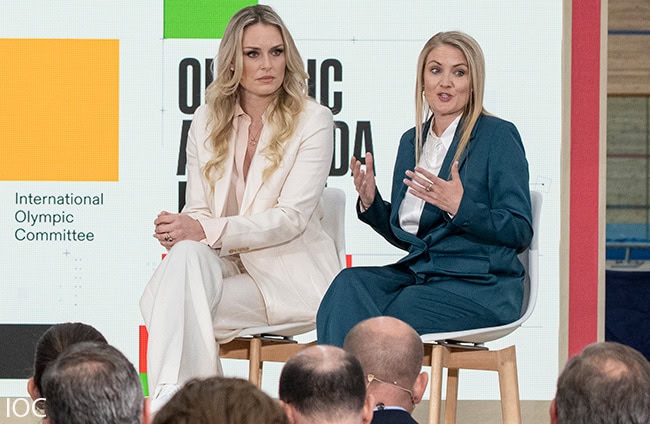
Kirsty Burrows (r), who heads up the IOC’s Safe Sport Unit, speaks with Lindsey Vonn about protecting athletes online.

A former athlete’s take on this system

Emma Terho is uniquely positioned to talk about the need for athlete protection from abuse. She is the chair of the IOC Athletes’ Commission, as well as a two-time bronze medalist (and five-time Olympian) with the Finnish women’s hockey team.

In her playing past, coaches suggested avoiding all outside messaging — whether that was media coverage or, later, social media platforms — during the team’s biggest competitions. “Reading the wrong comment can be detrimental to your self-confidence,” she said.

But so much has changed about social media and the way athletes use it for personal branding and fan outreach. It’s not something that they can brush off. Quite frankly, it’d be detrimental to do so, especially for an athlete who only gets to compete on such a large stage every four years.

Terho’s online experience includes interactions with negative comments. She remembers harsh responses after losses that featured her mistakes on the ice. There’s also the experience of teammates and fellow athletes, some of whom were attacked based on their appearances.

Her recollection resonated ahead of Paris, the first Games with full gender parity. Earlier this year, England’s Loughborough University released an IOC-commissioned study showing that social media abuse toward athletes is rising.

More troublingly, a third of social media posts observed during the study featured negative content directed toward athletes after triggering events (which can be performance-based, social issue-based or reactive-based, according to the Loughborough research). It also discovered that female athletes were especially targeted by “hateful, discriminatory and emotional forms of harassment.”

Factor in the broader conversations about the recent mental health battles of the biggest female star athletes — like Naomi Osaka’s withdrawal from the French Open in 2021 or Simone Biles’ experience at the Tokyo Games — and the need for this AI rings even more clearly.

“Our main goal is to make sure that the Olympic experience is the best possible for the athletes,” Terho said, “and allow athletes to focus on the performance and that they’re not going to get abuse in the wrong moment.”

Burrows mentioned that the IOC has steadily built out its mental health support since 2016. The Summer Games in Rio were the first Olympics to feature safeguarding officers, providing human resources on the ground.

The Safe Sport Unit was established in 2022, and the support effort has continued to grow. Another new tech-bolstered feature of these Olympics was the Athlete365 Mind Zone, an activation sponsored by Powerade that will utilize VR mindfulness exercises in “disconnection pods.” The space, which was in the Olympic Village’s fitness center, was also staffed with members of the Safe Sport team.

“We want people to experience the broad benefits of sport participation,” Burrows said. “And that means ensuring a healthy and safe environment through which they can participate in sport.”

This article was brought to you by SBJ Tech, a Leaders Group company. As a Leaders Performance Institute member, you are able to enjoy exclusive access to SBJ Tech content in the field of athletic performance.

6 Aug 2024

Articles

The Debrief – a Snapshot of Powerful Discussions Happening Right Now Across the Leaders Performance Institute

Category
Coaching & Development, Leadership & Culture
Share
Facebook Twitter Email Copy Link
https://leadersinsport.com/performance-institute/articles/the-debrief-a-snapshot-of-powerful-discussions-happening-right-now-across-the-leaders-performance-institute-5/

Female athlete health, cultural leadership and improv – just some of the topics raised, debated and pondered in July.

By Luke Whitworth
The Paris Olympics have made history as the first Games where 50 per cent of the medals will go to women.

On top of that, 11-time Olympic medallist Allyson Felix led an initiative to introduce the first-ever nursery for competing mothers and their children at an Olympic village.

These are steps in the right direction at a time when the Games have shown us there is still much work to do to better support female athletes and their health.

One can look at the world records involving the United States’ women swimmers at La Defense Arena in Paris, to name an example close to Leaders Performance Institute hearts, and wonder what potential could be unleashed if the sporting world adopted more female-focused approaches to training, recovery and mental preparation.

On that front, there is some superb work being done by our friends at Sport Wales, who shared insights with Leaders Performance Institute members in early July, and that’s where we begin this edition of the Debrief.

How to increase education around female athlete health

Our Women’s High Performance Sport community group has proven to be a mainstay for the female members of the Leaders Performance Institute.

The community has made it clear that they believe there is a shortfall in education for staff around female athlete health.

With this in mind, we welcomed Dr Natalie Brown, a Research Fellow working as part of a collaboration between Sport Wales and Swansea University with the Welsh Institute of Performance Science [WIPS].

Brown led a rich conversation about her work and suggested some practical ways in which you can make positive inroads when it comes to female athlete health education:

  • Invite people external from your female health and the performance team to come in and join the conversations, raising different questions.
  • Balance individual needs versus sport specific challenges with whole system support.
  • Specialist areas need to consider the female specifics as ‘normal.
  • If you’re working as a lone ranger in this space, consider how things are being embedded, knowledge is being passed on, and progress to creating a team is happening.
  • Language is a really important area. Don’t exclude anyone, but also correct. Underpinning language with evidence has been effective. Language can also be the key to confidence to talk about the topics and roll it out with athletes.
  • Consider behaviour changes and the role of psychology in female health.
  • Always provide the evidence of why behind knowledge, advice, support. Especially considering the volume of information, including misinformation, being shared around these topics at the moment.

Additional reporting by Rachel Woodland, Lottie Wright and Sarah Evans.

A six-step approach to driving cultural change

Those of you who read last month’s Debrief will know we touched on the theme of cultural leadership courtesy of Dr Edd Vahid, who placed the topic at the heart of his three-part Performance Support Series for Leaders members.

In July, he followed sessions one and two with a specific focus on cultural change and the effective steps that can be taken to create and deliver a new culture. In session three, Vahid shared a six-step approach:

  1. Existing status – where are we? Honour the strengths of the existing culture; combine this with data, intelligence and insights, whether that be critical incident reviews, walking the floor, interviews or focus groups. Finally, check in on people’s experience of the four enablers.
  2. Move into the idea of vision and purpose and being able to inspire and aspire. This means giving a clear articulation of where you’re going; matching this with the culture and the strategy. Communicate the value of change. Why are we changing, and how do you create a level of urgency and commitment to seeking change?
  3. Identify those who align to the target culture. The guardians play a fundamental role. John Cotter talks about the idea of a ‘guiding coalition’ and it has real validity here.
  4. Design. What are the short-term wins? Consider the work around removing barriers and instituting change.
  5. Behaviour. What are the critical behaviour shifts you want to see? What are you going to recognise and celebrate and be explicit about in terms of the culture? Consistency and regularity are important.
  6. Continuously monitor your progress to help reinforce the change.

What role can AI play in coach and people development?

An interesting question was posed in one of our coaching community group conversations: how can or is AI supporting work in the field of coaching and people development?

When it comes to coaching and learning in general, AI can be a divisive topic. It is common to hear that there is an art to coaching that needs to be protected and that a machine or technology can never connect with a human being.

Nevertheless, those on the community call in July agreed that there is value and opportunity for technology to support elements of people development. We tried to establish what those might be, whilst also testing what AI could come up with during the session.

Three things in particular stood out:

  1. Efficiencies – many of you who operate in this space will be aware of the amount of time and resource it takes to collate data and identify the best ways to support efficiencies in your teams. AI can smoothen this process and, in some instances, identify trends you might not have thought about.
  2. Access to content – this point does tie to the above quite closely. AI-powered virtual assistants can support by providing instant access to information, answering queries and aggregating trends.
  3. Personalisation – AI enhances e-learning platforms by personalising the learning experience, adapting content to the learner’s pace and style, and providing interactive and engaging materials.

Why improvisation is an underrated leadership skill

Those of you who have been involved in the Leaders Performance Institute membership for a while and have attended some of our events, you’ll likely remember we have dabbled into the world of comedy to see what we can learn from the likes of the Upright Citizens Brigade who feature in Dan Coyle’s Culture Code and also comedian Stuart Goldsmith who spoke at our London Summit back in 2019.

We returned to the topic of improv comedy in July’s Leaders Skills Series session, which began with a line from renowned improv actor Bob Kulhan: ‘improvisation thrives at the pivotal intersection where planning and strategy meet execution’.

The session used Kulhan’s premise, set out in his 2017 book Getting to ‘Yes, And’ to explore how improvisation can enhance your leadership. Below, we explore some of the elements that emerged during the discourse.

How does the ability to improvise elevate performance in both individuals and teams?

There are three elements:

  1. Improvisation develops collaboration skills by raising an individual’s self-awareness of how they interact with others when there is a need for collaboration.
  2. It can build people’s confidence and personal impact when they are speaking up and sharing ideas.
  3. Listening: improvisation can build people’s openness to different perspectives and strengthen their active listening skills.

Neil Mullarkey is another of the world’s premier improv actors and, in 2023, he released his book In the Moment. In it, he details some practical skills to help leaders demonstrate the behaviours that help create the conditions for teams to be more creative.

We also explored Mullarkey’s LASER model during the session:

  • Listen– be curious, notice what is being said and what is not being said.
  • Accept– accepting is not the same as agreeing, be aware of your own agenda.
  • Send– listen-to-link, build momentum with the other persons idea or perspective.
  • Explore– remain curious and explore your ‘filters’ and assumptions.
  • Reincorporate… an earlier idea and build on it.

17 Jul 2024

Articles

How Sport Wales Is Challenging the Lack of Support and Education Around Female Athlete Health

Category
Human Performance, Leadership & Culture
Share
Facebook Twitter Email Copy Link
https://leadersinsport.com/performance-institute/articles/how-sport-wales-is-challenging-the-lack-of-support-and-education-around-female-athlete-health/

As Dr Natalie Brown tells us, Sport Wales’ Female Health and Performance Team is putting the female athlete health at the forefront of performance conversations.

By Rachel Woodland, Lottie Wright & Sarah Evans
There needs to be more support for practitioners, coaches and others working in sport when it comes to better understanding women’s health.

That is the consensus across our Women’s High Performance Sport Community, from ongoing conversations to a recent mini survey conducted during our latest Community call, where the focus turned to education for staff.

We were joined by Dr Natalie Brown who is a Research Fellow working as part of a collaboration between Sport Wales and Swansea University with the Welsh Institute of Performance Science [WIPS].

Brown leads the Sport Wales Female Health & Performance Team, which has grown to seven members and is responsible for supporting all staff at Sport Wales in their journeys towards better understanding women’s health.

Brown’s own reasons for her specialism in women’s health stem from her time as a performance scientist with Welsh and British Swimming. She wanted to know more about what she didn’t know and to support the female athletes as best as possible to optimise their performance. It was an early nod to the relevance and interconnectedness of women’s health for practitioners.

Support for female athlete health at Sport Wales

In Brown’s time, Sport Wales’ approach to female athlete support has progressed from being wrapped around individuals to three areas of focus:

  1. System level support
  2. Individual athlete support (and support for practitioners too)
  3. Sport-specific support

There are also three key themes that span everything Sport Wales do: athlete development, health & wellbeing, and athlete environment. Where once Brown worked alone, she now oversees a multidisciplinary team of seven, with specialisms in physiotherapy, physiology, medical, nutrition, strength & conditioning. The work has gone from focusing on the menstrual cycle to include puberty, relative energy deficiency and more to fully encompass female health support.

It is critical for those practitioners to be a good fit and Brown’s team was put together by grouping those who had an interest and the drive and motivation to work in this area of sport. Across the Welsh system, it enabled a network of voices to be created, rather than a single voice; making it more embedded and more natural.

The team work both in overseeing projects and research into specific areas of women’s health and in supporting the athletes, practitioners, coaches, and sports in applying knowledge to their performances. As Brown said, “we’ve got a knowledge development, but we’ve also got application and those two things run in parallel.”

Their efforts to speak to athletes help them to better understand areas where there was suitable support and where there was not. It enabled the sports science and medicine teams to adapt their athlete support. Concurrently, Brown and her colleagues captured all this information to help inform their progress.

Surveys to better understand ways of working

Seven years ago, Brown’s team circulated a survey for all of Sports Wales’s sports science practitioners. It asked:

  1. Did practitioners have conversations about the menstrual cycle in their sports, with their athletes, with the coaches?
  2. How confident are they talking about the topic?
  3. What is their knowledge level?

The survey was circulated at a time before women’s health proliferated as a topic of interest. It identified gaps, highlighted the steps needed to effect change, and what practitioners were requesting. And so the team came together that now works within Sport Wales.

Having a dedicated Female Health & Performance Team allows planning around how to move forward in support of both female athletes and performance practitioners; and as staff members have changed, so Sport Wales has continued to survey its people. They continually assess people’s comfort levels discussing multiple topics within female health and the factors that influence that comfort.

Brown was also particularly interested in whether or not practitioners know where to go to seek further support. The figures are startling. “20 percent still say no, which is too big,” said Brown. That 20 percent is therefore part of her team’s plan. All practitioners need to know that the Female Health & Performance Team is there to support them, and also direct them to other resources and, just as importantly, emphasise that the whole of a team behind a sport need to have this information shared with them.

A more recent survey enabled Sport Wales to better understand how it can support its system’s network of coaches and practitioners. Indeed, there is a growing cohort that see the relevance of a female health lens in addressing issues such as injury risk and performance improvements. This information has helped Brown’s team ask for additional resources and support. It also helps build the full story and picture.

The emergence of a common practice

Sport Wales conducted the survey, put together a team, worked across its sports, and what has emerged are common practices that help to embed female health as a topic within the Welsh sport system.

For example, as Brown said, “across the three themes [see above] there are always at least two people from the team asking how does that apply from a female perspective? Have we considered XYZ from a female-specific angle?”

The current approach is praised for creating an open culture. The Female Health & Performance Team have worked with the sports to normalise conversations around women’s health and how it relates to performance.

Potentially the most interesting piece to emerge from their most recent survey was around knowledge improvement and how the team want to receive information. The two highest reported options were athlete stories & experiences and resources to read. This has led to a shift in how Brown and the team are supporting practitioners and prevented them from heading down the wrong route. It also means that Sport Wales can also think about how to use the stories and experiences to support wider practitioner development. For example, what would it look like for a new starter?

It’s standard practice for all Sport Wales projects to be evaluated as they happen, which means that check-ins keep the team challenged and relevant, as well as aligned to organisation’s wider aims. Their purpose and rationale remains clear.

Another positive consequence is that Welsh sports proactively approach Brown and her team to request help and support. There’s also now an induction for any athlete joining Great Britain’s World Class Programme. It looks across all areas of female health and includes screening from an MDT approach, which then means specific areas can be addressed for the individual, as well as from the perspective of their sport. The overall goal is to ensure that female health considerations aren’t an extra thing or a tick-box exercise that’s added on but are standard, truly embedded and normal practice for providing individual holistic support.

Compared with how things were done previously, one of the biggest changes for Brown has been planning ahead and thinking about how you upskill practitioners and how to engage with sports, as well as identifying which elements are sport-specific and require different support or consideration; and how to provide those resources for athletes, coaches, and practitioners. This is all with the key moment in mind: ‘the doing of it’.

In monthly meetings Brown’s team create scenarios and engage the practitioners in conversations around topics such as energy deficiency or puberty. It provides the space to address meaningful questions as part of the conversation, such as ‘how does that apply in practice?’ or ‘what does that mean?’ This space has potentially been the most impactful development, according to Brown.

Beyond the work that she and her team are completing, they’re linking in with the other parts of the Welsh network across other universities supporting WIPS and Sport Wales, as well as the other Home Nations of the UK. “So in terms of staying ahead of the curve, it’s always a challenge, especially with the pace at which female sport is currently moving.”

How to make female health a performance priority at your team:

  • Invite people external from your female health and the performance team to come in and join the conversations, raising different questions.
  • Balance individual needs versus sport specific challenges with whole system support.
  • Specialist areas need to consider the female specifics as normal, for example nutrition is thought about with that lens too.
  • If you’re working as a lone ranger in this space, consider how things are being embedded, knowledge is being passed on, and progress to creating a team is happening.
  • Language is a really important area too. Don’t exclude anyone, but also correct. Underpinning language with evidence has been effective. Language can also be the key to confidence to talk about the topics and roll it out with athletes.
  • Consider behaviour changes and the role of psychology in female health.
  • Always provide the evidence of why behind knowledge, advice, support. Especially considering the volume of information, including misinformation, being shared around these topics at the moment.

10 Jun 2024

Podcasts

Five Years on from the USWNT Introducing Menstrual Cycle Tracking, Sports Science for Female Athletes Remains Under-Developed. So What Can Athletes and Practitioners Do about it?

Category
Data & Innovation, Human Performance
Share
Facebook Twitter Email Copy Link
https://leadersinsport.com/performance-institute/podcasts/five-years-on-from-the-uswnt-introducing-menstrual-cycle-tracking-sports-science-for-female-athletes-remains-under-developed-so-what-can-athletes-and-practitioners-do-about-it/

Ellie Maybury of Soccer Herformance discusses the obstacles that face females in high performance in the second episode of the latest People Behind the Tech series podcast. For all the issues, she remains optimistic about the steps that can be taken.

A Data & Innovation podcast brought to you in collaboration with

sport techie

When the US women’s national soccer team started tracking their menstrual cycles, it was seen as groundbreaking.

At least part of their success in claiming back to back World Cup titles in 2019 was attributed to the fact they could adjust individual training plans and nutrition based on the data.

Ellie Maybury was part of the USWNT backroom team that introduced this initiative and, more than half a decade on, tech support for female athletes doesn’t seem to have progressed as much as she’d have hoped. At least in soccer.

“A lot of the technology we have absorbed into the women’s game has come from the men’s game or men’s sports environments,” she tells the People Behind the Tech podcast.

“And maybe some of the processes and metrics that come with that get transferred as well.”

Maybury, who recently founded Soccer Herformance, a performance consultancy for female soccer players, is in the hotseat on episode two of this series.

She addressed the issues that hold back female high performance, from managing the lack of objective datapoints [4:50] and the importance of education for athletes who often misunderstand their own bodies through no fault of their own [26:20], to the need to take athletes on a journey while remaining honest about the limitations of research at the present time [17:00].

Check out episode one:

Paige Bueckers Proved Her ACL Injury Was Behind her at March Madness, but, as Andrea Hudy tells us, Questions Must Still Be Asked about the Injuries that Afflict Female Athletes

Joe Lemire LinkedIn | X

John Portch LinkedIn | X

Listen above and subscribe today on iTunes, Spotify, Stitcher and Overcast, or your chosen podcast platform.

Members Only

28 May 2024

Articles

No Money, No Problem: Six Ways to Sustain Innovation on a Budget

Category
Coaching & Development, Data & Innovation, Leadership & Culture, Premium
Share
Facebook Twitter Email Copy Link
https://leadersinsport.com/performance-institute/articles/no-money-no-problem-six-ways-to-sustain-innovation-on-a-budget/

While we all crave larger budgets, there are tangible steps you can take to make what you do have go much further.

By Luke Whitworth & John Portch
Remember: innovation doesn’t necessarily mean the introduction of new technologies but can also be simple changes to existing methods.

In high performance sport, there is increasing pressure on expenditure and efficiency of resource, but innovating within a constrained budget isn’t about cutting costs indiscriminately, it’s about strategic allocation of resources.

The topic was discussed at length during a recent Leaders Virtual Roundtable and has long been on the agenda for members of the Leaders Performance Institute.

Here, we draw on those discussions to bring you six ways to sustain innovation on a budget.

  1. Set realistic targets and align with strategic objectives

Prioritise initiatives that directly contribute to your mission and long-term success. You should evaluate existing projects and programmes rigorously. One programme whose members joined the roundtable spoke of the value of simple and consistent performance planning using a ‘plan, do, review’ approach. You can also set realistic timelines for identifying trends that enable you to cut through the white noise and better support internal decision making.

  1. Leverage existing resources creatively

Evaluate your projects rigorously. An attendee at the roundtable explained they are looking into efficiencies around athlete monitoring and tracking. It speaks to the constant challenge of optimising the efficiency of data inputs, with several members highlighting the collaboration within their teams of different departments around data capture and assessment. It has led to a clearer way of leveraging information and influencing delivery across coaching and other elements of their programmes.

It calls to mind Richard Burden’s presentation at Leaders Meet: Driving Step Change in Female High Performance last September at the Etihad Stadium in Manchester. “What can you do with information that you already have?” he asked an audience of Leaders Performance Institute members. From his position as Co-Head of Female Athlete Health & Performance at the UK Sports Institute [UKSI], he discussed the notion of rethinking existing evidence and spoke of the UKSI’s drive to centralise all blood screens across the British high performance system. It enabled that information to be used in a more informed and impactful way for Great Britain’s athletes.

  1. Measure, prioritise and adapt

You need to continuously monitor the impact of your innovation efforts. Use data to assess progress, adjust strategies, and reallocate resources as needed. This has been the approach in climbing, which is a new Olympic sport for Paris 2024. Budgets are small and creativity is a must. Representatives from the climbing world spoke on the roundtable about their key focus being the identification of impactful performance metrics and a more highly attuned understanding of the sport’s demands. It is important to identify projects that have the potential to create significant value or solve critical problems. The roundtable raised the question of coach development support, a “cornerstone enabler of our programme”, as one attendee put it, in environments where money is more constrained.

Similarly, an organisation in cricket on the roundtable spoke of the introduction of small-sided training matches. Though the training ground had to be modified, cricket is notorious for players in training environments inadvertently left standing around. By tweaking the design of training, players in that environment are better engaged.

  1. Collaborate and share

Partner with other organisations, universities, or research institutions. Collaborative efforts can pool resources, share costs, and, ultimately, accelerate innovation. On the coach development question, an attendee at the roundtable spoke of collaborating with an academic institution with a speciality in that field. It requires less investment and all sides are reaping the rewards.

This approach has been of benefit to numerous organisations, including British Rowing, whom Burden spoke of during his presentation in Manchester. They worked with Manchester Metropolitan University and the UKSI to ask: how is the menstrual cycle influencing British Rowing’s ability to deliver training and what impact is it having on internal load, competition and the performance of athletes?

“It’s their question – it hasn’t come from research or a university – it’s come from the sport,” said Burden of the project. “We’re there to provide some of the research and innovation expertise to help them formulate the question and work out a path to answer it.”

  1. Meet your people where they’re at

This goes for so much more than innovation. You have to tap into the creativity of your coaches, athletes and staff – they will often have valuable insights and ideas. Several roundtable attendees, particularly at talent pathway level, explained how they have taken steps to better engage and support their athletes, enabling them to thrive.

It called to mind the recent efforts of the Lawn Tennis Association [LTA]. Last year, Kate-Warne Holland, the Under-14 girls’ captain at the LTA, told the Leaders Performance Institute that UK pandemic restrictions compelled them to host the majority of competitions in the midlands of England where all players and coaches could travel with relative convenience. The LTA has kept these tournaments due to their transformative performance and development benefits.

“They were so valuable and they were encouraging the private coaches to be there and coach on court,” said Warne-Holland. “It provided an opportunity for the coaches to develop the players right in front of them. So they weren’t on a balcony, watching four matches, and then going home and working on it. We allowed and encouraged them to sit on court so they were able to impact on the player immediately.”

And it’s not just athletes. Performance programmes can be so much more effective when the leaders understand their people’s motivations and how they are doing away from the practice facility. Innovations can emerge from all quarters through the right levels of challenge and support.

  1. Fail cheaply and learn fast

Instead of large-scale, resource-intensive projects, focus on failing cheaply in lower stakes environments and learning quickly. As a roundtable attendee suggested, you could have small cohorts of people testing and working on projects safe in the knowledge they have not been tasked with finding the ‘perfect’ solution prior to testing.

16 May 2024

Articles

It’s Time to Remove the Barriers to Self-Development for Women in Sport

Category
Coaching & Development, Leadership & Culture
Share
Facebook Twitter Email Copy Link
https://leadersinsport.com/performance-institute/articles/its-time-to-remove-the-barriers-to-self-development-for-women-in-sport/

Self-development, difficult conversations and allyship were on the agenda for the latest Women’s High Performance Community call.

By Rachel Woodland
For this month’s Women’s High Performance Community call we turned our attention to how we’re approaching our self-development and any nuances that might emerge for women.

We spoke about self, or personal, development, as well as career development, and the place for each before turning our attention towards difficult conversations and allyship.

There is no doubting that those who joined the call are committed to their development. However, no one felt like they have a well-structured development plan that they simply were not following.

Currently, there’s a general sense that a lot of effort is driven by the individual – reflecting upon this, it’s potentially what those guiding us are told to do.

However, there is a request for more structure, confidence, time and opportunity from above to elevate the impact of our development.

It also came across from the call that many have big obvious blocks of learning, through courses or further education, but struggle to have a clear plan if those aren’t in place or if they are between courses. There are also those, who are doing a lot of learning simply by doing their job each day, which is where reflective tools and support from above can be powerful.

The Women’s Community suggested these five ideas as ways to make development as impactful as possible: 

  1. Protecting dedicated time for self-development.
  2. Support from above – this might be in sense-checking plans, ways of bringing plans to life, sharing career options, identifying experience gaps and creating opportunities to address them.
  3. A way to be kept accountable.
  4. Collaboration – both in development alongside others as well as in sharing learnings.
  5. Using a mentor.

Other examples that we’ve seen work too: 

Visits to different organisations – and having others visit you. This helps avoid echo chambers and benchmarks our practices against others. This becomes increasingly important if our only working experiences are in a single organisation.

Whole team development on specific skills. Having a whole team approach can help avoid siloed learning and contribute to learnings sticking.

It’s always good to remember that we need to leave space for stretch and being in uncomfortable positions. Again, these moments become more impactful if we can reflect on them and shape our development plans as a consequence. Finally, remember: some people’s development is focusing on saying no.

The Community once again spoke about the importance of our networks and brands to career development and shared the following reflections:

  • Networks include both internal and external relationships.
  • If your brand is a reflection of your authentic self, we need to know who we want to be and take time to reflect on that.
  • If you know your personal brand it breeds the confidence to express ourselves and our thoughts as we meet new people and expand our networks.
  • If you can better manage your own thoughts and how you think about yourself, it could help those that suffer from impostor syndrome. It could help quieten negative thoughts and be reflected in our behaviour.

The Community then shared advice for when having difficult conversations:

Difficult conversations can take several forms – they do not necessary involved conflicts or saying no. There’s a range: it could be talking to a new person or even when you are taking steps to change the dynamics and the way things have always been done.

There are stories of female coaches in an otherwise male coaching team stepping out of their comfort zones because their approach to coaching is different. In one particular case, the female coach boosted her confidence by reminding herself that she’s adding to the discourse, providing different inputs and possibilities, and a platform for conversation.

We know that women are different, and that in sport women are often in a minority; so it would be easy to understand why we might doubt ourselves in these moments. However, we can retrain ourselves to not think in this way.

One additional approach that can help us is to have the conversation as part of a regular update session, so it’s not ‘singled out’ as having the need for a difficult conversation.

So what would we want an ally to support us with to enable us to be our most confident selves going into these conversations? These were some of the group’s suggestions: 

  • An ally would get you to reflect on the makeup of your environment. Is it a genuinely safe space and environment to have honest and difficult conversations?
  • If there is a deficiency in being able to have challenging conversations, an ally would recommend dedicated training and skill development to enable you to have courageous conversations. Similarly, scenario planning and training can bring these to life. An ally can be someone to practise these with and provide feedback.
  • We’ve talked about the makeup of the environment. An ally would suggest that open and genuine space for women to talk will be impactful. Do these exist in your environments?
  • In being able to enact positive change and have challenging conversations, being able to understand your stakeholders can be worthwhile, particularly in understanding the behaviours of those you wish to have conversations with.
  • If you are an ally, we value vulnerability but also honest feedback, so there is no risk of overprotection.

Go to home
Follow us on Instagram Follow us on LinkedIn Follow us on X

Contact

Leaders UK

Tuition House
27-37 St George's Road
Wimbledon
SW19 4EU
London
United Kingdom

Enquiries Line: +44 (0)207 806 9817
Switchboard Number: +44 (0)207 042 8666

Leaders US

120 W Morehead St # 400
Charlotte
NC 28202
United States

Enquiries Line: +1 646 350 0449

Leaders

  • Contact
  • About
  • Careers
  • News
  • Privacy Policy
  • CA Privacy Rights
  • Cookie Notice
  • Website Terms of Use

Performance Institute

  • Membership
  • Events
  • Content
  • Virtual Learning
  • Connections
  • Partners

Latest

Intelligence Hub
High Performance Future Trends Research Elite Performance Partners continue to drive the potential in high performance forward through renewed Leaders partnership
Your Privacy Choices

© 2026 Leaders. All rights reserved

  • Privacy Policy

Attendees

x