16 May 2024
ArticlesEmma Springham and Matt Jefferson of British Triathlon speak of their organisation’s efforts to level the playing field for coaches.
“Emma was an exceptional coach who was a perfect fit for the role she applied for,” said Matt Jefferson, who serves as British Triathlon’s Head of Performance, People, and Culture Development.
“We didn’t compromise on having the right coach with the right athletes to meet a ‘quota’ or strategic aim,” he continued. “We took her development seriously, worked with her and supported her as a person and a coach.”
Many of you will know from experience that this is not always the case for women coaches and practitioners at numerous organisations across the high performance world.
Springham and Jefferson joined the Leaders Performance Institute for the April Women’s High Performance Community call so they could share their insights into equality of opportunity at British Triathlon.
Setting the scene
Triathlon is founded on equality – men and women compete in the same activities over the same distances. It’s also a relatively young sport, which frees it of the history and shackles that hinder some other sports.
Whilst there’s wider work happening at British Triathlon around participation, for the team approaching representation within coaching, their first step is to match the athletes that they’re working with.
A strand of the recently launched High Performing Coach Strategy is ‘to build a coaching workforce that is representative of the wider triathlon community.’
British Triathlon’s female coach mentoring programme
To action this, Michelle Hayden, British Triathlon’s Head of Coaching, led the creation of a female coach mentoring programme that used existing performance team members and those known to the organisation as mentors. The programme involved a series of engagements, with some access to high performance environments and coaches. It also included giving access to high performance coach development work, specifically during British Triathlon’s annual Performance Learning Week. A WhatsApp community for the group was created, as well as one for all the female coaches who applied.
British Triathlon requested applications to be submitted in a video format with applicants explaining a bit about themselves and why they felt the programme would support their development. Over 30 people applied, generating over six hours of video. British Triathlon watched each and every video so they could give each applicant feedback.
The videos also helped Jefferson gain an understanding of perceptions of high performance coaching and barriers to female coaches progressing within the sport; and people’s previous experiences revealed that part of making performance coaching roles attractive is to make sure they are fully understood.
‘Never compromise the person for performance’
Springham, Jefferson and the wider system have become increasingly aware of the potential barriers for women entering an elite environment. For example, three athletes on their programme took time out to have children during this shortened Olympic and Paralympic cycle. For coaches, there is the question of access and opportunity.
To address the question for coaches, British Triathlon, before they assume there is something wrong with the coach as an employee or prospective employee, will consider whether their jobs were attractive to women, and, if not, how do they make them more attractive? Considerations included:
Wider questions that British Triathlon have considered in their talent pathway relate to all environments:
For example, Jefferson re-emphasised that Springham’s employment serves as a testament to the organisation’s commitment to supporting female pathway development.
The power of mentors and sponsors on female talent pathways
British Triathlon recognises that female coaches often lack the advocacy and networking opportunities afforded to their male counterparts. Jefferson strongly identified a barrier to this as women feeling uneasy about seeking out a career ‘sponsor’.
Recognising Springham’s dedication, British Triathlon believed it imperative to proactively facilitate opportunities for her, championing and supporting her journey to prevent her from having to forge ahead alone. This commitment stems from the understanding that showcasing exceptional female coaches as role models is pivotal for inspiring future generations. As Jefferson highlighted, “if they don’t see it, they can’t believe they can be it.”
It’s been important to work on the perceptions around a woman asking for help, this shouldn’t be seen as a negative. Providing support is integral to keeping people in the building once they have pushed open the door.
Both British Triathlon and Springham have been aware that a pragmatic approach and willingness to compromise in suitable areas is important to making it work too. Questions often asked include ‘what do you need?’ but when it’s new ground being broken, that can be difficult to answer. However, if the culture reinforces that there is support and an appetite to help make it work, it’s easier to collaborate to work out what is needed. The stories shared during the mentoring programme agenda helped to shape expectations and provide clarity to all sides.
As such, leaders who role model behaviours, such as leaving to pick up the children or openly talking about other family tasks to be completed, help, especially at British Triathlon where there are men taking this approach too.
Helping women coaches to fight impostor syndrome
Springham candidly shared her thoughts around dealing with impostor syndrome, which is all too common in prospective female coaches in particular. She admitted that it might never go away, but that we can use it in the right way to remind ourselves of the work and successes that have been achieved to get to where we are. She has a support network that will help to remind her of this, and she will take five minutes out to remind herself if need be.
As Springham said, we have to train ourselves to think of the positives if the negatives creep in.
An exercise to consider: “Take five minutes to remind yourself through written word or in your head, the journey you’ve taken to get where you are. This rebuilds your confidence and resilience.”
Reflections
Jefferson highlighted the importance of not letting resources and funding be a barrier to change. Much of the programme that British Triathlon introduced didn’t cost anything, or didn’t cost very much, such as the WhatsApp group, or visits to elite environments. Jefferson and Springham suggested starting tangible initiatives to help every organisation to build communities organically, such as women’s support groups, coffee mornings, group chats, or community channels.
The community had the opportunity to ask the duo some questions on this topic and engage in meaningful discussions about their experiences in their own organisations, from the likes of UKSI to Scottish Golf.
British Triathlon encouraged the community to consider the following questions for their future development:
You can read more about Springham’s journey and her involvement with the Women’s Performance Coaching Programme here.
Final thoughts
Representation matters: cultivate coaching teams that reflect the diversity of your community.
Supportive environments: foster cultures that prioritise work-life balance and support female coaches.
Combat imposter syndrome: looking inward as an organisation, regularly celebrate achievements and the journey to help bolster confidence and resilience.
Resourceful solutions: meaningful change doesn’t always require significant financial investment; prioritise simple, effective initiatives.
Community engagement: create spaces for open dialogue and reflection to drive meaningful progress.
Alphabeats explains that the goal is to train one’s brain to produce more alpha waves, which are typically associated with calmness.
A Data & Innovation article brought to you by

The offering consists of an EEG-sensor-embedded headband supplied by BrainBit, which monitors brain activity while users go through mental training sessions in an accompanying mobile app. The sessions, ranging from eight to 12 minutes, are augmented by music playlists curated in partnership with audio streamer Feed.fm (which works with Dr Daniel Bowling, PhD, a neuroscientist at Stanford University School of Medicine) and include dynamic visualizations, cognitive games and eyes-closed meditations.
The idea, according to Alphabeats chief commercial officer Jorrit DeVries? “Training alpha [brainwaves],” he said, recommending users deploy Alphabeats’ solution several times per week over a four-to-six week span to see results. “This is not a solution that you use while you’re working out, for example.”
Alphabeats’ core innovation is in proprietary algorithms that respond to users’ brain activity – sourced from the EEG sensors – in real time. The goal through that feedback is to train one’s brain to produce more alpha waves, which are typically associated with calmness. The system does this by altering music to reinforce negative feedback when less alpha waves are being produced, and vice versa.

Image: Alphabeats
“At a very general level, you could say that [the music] would sound more flat [when providing negative feedback],” said Alphabeats’ head of product Elroy Verhoeven. “And if you were doing well, it would sound richer. It’s a continuous process as you’re listening to the music.”
Alphabeats’ thesis is that athlete training has historically not dedicated enough time to mental performance, instead focusing almost exclusively on physical training, nutrition and gear. Verhoeven and DeVries cite research conducted with Tilburg University in the Netherlands dating back to 2012 as evidence for their method.
“The trick is – if you’re familiar with meditation – to really tap into alpha, and to calm your brain down and to make sure that you produce more of the alpha waves than beta or gamma waves and really start to calm down your brain,” DeVries said. “That will ultimately lead to better focus, but also to better sleep outcomes and better recovery.”
Although Alphabeats’ technology is hardware-agnostic – it only requires EEG sensors to connect with – BrainBit is the company’s exclusive hardware provider as of now. Using the product on an individual basis involves purchasing a BrainBit headband (which retails for $499) and registering for Alphabeats’ $15.99 per month app subscription. In line with its US launch, however, Alphabeats is offering new customers a headband and one-year subscription for a total cost of $499.
The company also offers a starter package for teams, which includes 10 headbands and user accounts, access to an analytics dashboard, and support for onboarding and data analysis. Pricing for that offering varies. Alphabeats has a formal partnership with the Dutch Olympic archery team and a “couple” more in the hopper that they cannot yet publicly share, DeVries said.
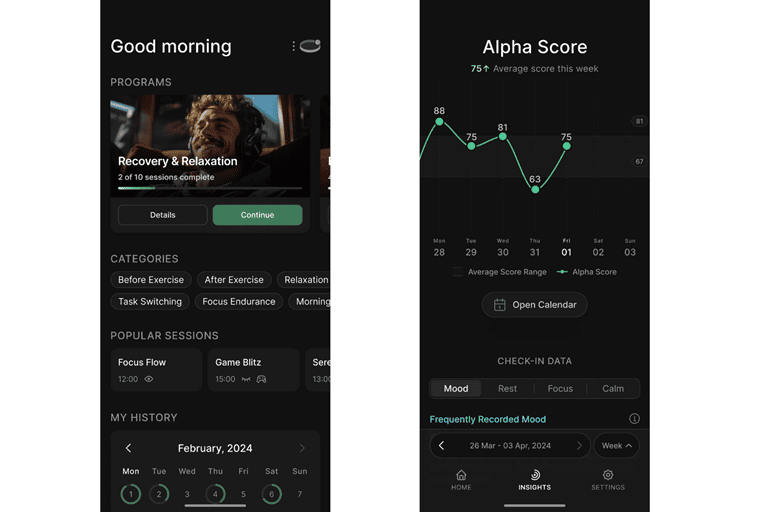
Image: Alphabeats
The vision is that as EEG sensoring becomes more widespread, Alphabeats will be well-positioned to serve athletes and teams. “That’s our moonshot,” Verhoeven said, referencing Apple’s work around EEG sensors in its AirPods – for which the tech giant received approval on a patent last year – as one example.
“There’s different market segments where this taps into. We look, potentially, at a $12 billion market,” DeVries said. “This is a huge market where you see a lot of potential in different areas. But if you then boil it down to what we’re trying to do here, is really capture the athlete platform market, to make sure we connect as many athletes as possible in a hardware-agnostic way, to really build an install base that drives us to the next wave of growth where you see that EEG measurement become more and more available.”
This article was brought to you by SBJ Tech, a Leaders Group company. As a Leaders Performance Institute member, you are able to enjoy exclusive access to SBJ Tech content in the field of athletic performance.
It’s an ever-present challenge, but members of the Leaders Performance Institute are taking steps to systematise their processes.
The challenge facing members of the Leaders Performance Institute is one of consistently showing a tangible return on investment in this space.
This pinch point provided the basis of a recent Leaders Virtual Roundtable that enabled members to share their experiences with coach development practices; what has worked for them, elements that are showing promise, and ideas that warrant further discussion.
Below, we detail their main considerations and their attempts to answer that question of impact and effectiveness.
Factors to consider
How are you currently measuring impact?
While the table offered differing methods, there was a consensus that the challenge of measuring the impact of coach development practices persists.
Storytelling: a counterpoint to data
One environment shared they are using mixed methods and a range of tools, structures and forms to gather information. The attendee also emphasised the importance of storytelling and the creation of narratives, which have been a big piece of understanding the impact. One of the frameworks they are utilising is the values creation framework, which comes out of the social learning space. The aim is to connect this to a ‘values’ story, created by the coach, that will complement other quantitative and qualitative sources of information. Another sport shared that they are focusing on stories of impact. They are still finding it challenging to show this clearly through numbers, but stories of shifts in behaviour or the practice of asking for feedback from others on how they feel as part of the environment the coach has created, have proven useful.
The athlete (and other staff): the missing part of the puzzle
The table looked at coaching impact through the lens of athlete – they are, after all, the beneficiaries of this coaching work. One member commented that athletes can often be a missing part of this puzzle. Similarly, it is important to collate input from others in the environment around the coach’s development journey. Solicit feedback from other staff members on the developmental differences they are seeing in the coach.
A coach’s needs analysis
Other simple methods for measurement include capturing, assessing and measuring against a coach’s needs analysis. Needs analyses often present baseline data to track across time. As part of your needs analysis, there is also an opportunity to understand what makes a particular coach tick. One environment took this idea forward by creating an ‘impact report’, which allowed them to reflect on the needs and what was delivered through subsequent interventions; identifying which had the most impact on the individual. This also provided excellent insight into how to continue to personalise learning opportunities. Another environment shared how they had trialled the use of pre- and post-mortems on specific areas of a coach’s development.
Mic’d up
In a more technical intervention, it has become common practice for coaches to be mic’d up or videoed as part of their development. The next phase being considered is the mic’ing up of the athletes to better understand what they are doing with the learning and coaching they are receiving.
Measuring confidence levels
Another environment shared how they have started to measure a confidence level pre-programme and then used feedback from different people to see where the individual is at during and post-programme. Interestingly, the coaches in this environment tend to feel confident on a topic pre-programme, then, as they get into the programme, that confidence dips as they begin to critically self-reflect, but then it builds back up through developmental support.
Future thinking
Is there a trick we are missing when measuring coach development?
Traditionally, the focus is on the individual, but coaches in elite sport seldom work in isolation. It is important to continue to take into consideration the wants and needs of the environment as well as the individual coach.
Therefore, is the next phase of coach development a better understanding of how we coach and develop teams and then working to establish what team development looks like when everyone is working collectively and effectively?
19 Feb 2024
ArticlesDawn Airton and Emma Groome outline the services that are available to British athletes during and beyond their time on a World Class Programme.
An article brought to you by our Partners at the

“A retired athlete might say ‘I thought I was the only one who couldn’t watch the next Olympics or Paralympics after I retired because it was just too painful’ or ‘I thought I was the only one who struggled with how my body and physical identity changed’,” says Emma Groome, Futures and Senior Performance Lifestyle Coach at the UKSI.
“But they’re not alone,” she continues. “Many athletes have been in their sport for years and years and they can say ‘can I ask you a question: is it normal to think this?’ You’re like ‘yeah, totally. We hear that a lot’.”
The UKSI Performance Lifestyle team numbers 38 staff members currently. “Every sport in receipt of World Class Programme funding from UK Sport is able to access core Performance Lifestyle services and some sports have chosen to invest further beyond their core allocation,” says Dawn Airton, the UKSI’s Futures Lead and Senior Performance Lifestyle Coach, who has joined Groome to speak to the Leaders Performance Institute.
“We’re one of the largest practitioner teams in the Institute,” adds Groome. “It’s quite impressive compared to where we started.”
Previously, athletes could receive support for up to six months after they had left a World Class Programme [WCP]. From athletes sharing their experiences, Groome and Airton realised that a change was needed, successfully pushing for this support to be extended for up to two years.
“It just didn’t feel long enough to provide that duty of care for athletes while they’re still coming to terms with those practical, emotional and physical changes that all athletes go through,” says Airton. “They need more time to make sense of their sporting journey and experiences and ask themselves: ‘what does my next chapter look like? Where am I going to thrive?’ Or even ‘who am I?’”
Airton and Groome have worked together on developing the Performance Lifestyle team’s support to athletes as they transition away from a WCP.
Here are five factors they want all British athletes on a World Class Programme to consider about the transition support services on offer at the UKSI.
1. It is now for two years and not just for retiring athletes
The UKSI Performance Lifestyle team will be there for an athlete and their holistic needs as they journey in, through and beyond elite sport. “It’s really important for athletes to know and to feel that the support is there for them, no matter their circumstances and, crucially, they can access this for two years after they leave a WCP,” says Groome. It could be that a programme has had its funding cut. Maybe an athlete has been deselected. It could even be that they have made the decision to turn professional, as is the case in a number of sports. Entering a WCP entails a number of choices on the part of the athlete and is a major transition in itself. “More often than not, athletes make the choice to move to an elite sports training environment to receive the best training, coaching and support services in the world. What that means is they often have to move home, move away from family and friends and the social and emotional support mechanisms they had in place’. Change and transition is part of every athlete’s journey, we are there to help them understand and manage those changes.” adds Airton.
2. Performance Lifestyle support is holistic and collaborative
The UKSI Performance Lifestyle team will support athletes throughout their time on a WCP and for up to two years afterwards across six ‘pillars’. They are: transitions, mental health & wellbeing, career development, financial health, learning & development, and education. “During and beyond their time on a World Class Programme, we’re supporting our athletes through change,” says Groome. “They’re going from being a funded athlete to not being a funded athlete and that brings them potential change and gives them decisions to make. What do they do next, practically-speaking? Do they need a job? Is this a transition into their next career? Is this the point at which they are going to self-fund? They may need to relocate and their income may be different.” In addition to these ‘external’ considerations come a range of ‘internal’ factors. “We’re talking in terms of their identity; who they are,” Groome continues. “One of the things we hear is what should a former athlete say when someone asks ‘what do you do?’ They tell us ‘I don’t know what to say anymore.”
It is paramount for the Performance Lifestyle team to raise the awareness of their work with current and former athletes, including those eligible athletes that may have left the high performance community. “We’re working closely with UK Sport and the British Elite Athletes Association [BEAA], who are developing an alumni community of athletes who have transitioned from a World Class Programme.” Support available to athletes includes access to the UK Sport-funded and UKSI-facilitated Personal Development Award, which assists athletes with personal and professional development; access to Health Assured, a free health and wellbeing provider who offer help with issues from legal advice through to counselling; and the BEAA alumni app. Airton says: “We want athletes to know that more support than ever before is available and it’s OK to ask for trusted and individualised help and support – people are genuinely there who want to help you with whatever that transition means for you.”
3. It is not one size fits all
The Performance Lifestyle team have tried to make things as simple as possible for transitioning athletes by identifying five areas where they focus their support: ‘understanding change’, ‘understanding self’, ‘understanding the world’, ‘making it happen’, and then ‘review’. “It’s not sequential or absolute that you have to progress through all of those areas, but they’re recurring themes in our conversations with athletes,” says Groome. “With ‘understanding change’, for example, we might come back to financial or professional development. ‘Understanding self’ is often linked to the athlete reconnecting with who they were or connecting with who they are now. This might be around discovering your strengths, values and passions or exploring the timeline of your life and career to this point.”
Athletes will engage with these support services to differing extents and may not engage with some elements at all. “It’s ‘the path of a meandering river’ as one of our Olympians described it to us recently,” says Airton. “It was the journey they’d been on to this point and how it aligns to their strengths, values, who they are as a person, the support mechanisms and the people who have got them through those experiences.”
The priority differs from athlete to athlete. “If it’s finding a job you would hone in on that,” says Groome, “but it could be the emotional component because no practical or sensible decision-making can be made at that time.
Image: UK Sports Institute
4. Performance Lifestyle can help you rediscover your purpose in a time of uncertainty
The removal of an athlete’s routine can be a major source of disorientation. “There was a gold medal-winning athlete I had worked with who had actually done a lot of planning ahead of their retirement and they told me ‘I turned the page in my diary and the page was blank’ – and that was the best-prepared athlete,” says Groome. “Normally, your structure is based around your training. More often than not, that determines when you go home, when you go on your holidays, all of those things. When you take away the reason for that structure it is something that Dawn and I find we have to support athletes with – without it, the impact on mental health can be significant. The Performance Lifestyle team witness snapshots of how athletes feel and they can share those insights with others in transition. “Athletes say it’s so good that another athlete felt like that,” Groome adds.
While an athlete cannot plan everything, there are elements from their athletic career that will aid their transition, as Groome explains. “They have a lot of these strengths and skills and they can apply elements of how they’d plan their performance, to problem-solve it, being resourceful, being creative.”
“They understand the uncertainty. Uncertainty is a big part of sport and any transition,” adds Airton, “but even just feeling like you’re taking action towards something has a big impact, I’ve found. The athletes we support have said ‘If I’m taking action, in my week, in my month, I feel I’m really making progress’ and we can then reflect on and review the progress being made. We do a lot of reflective practice over that two-year period to outline what you have understood about yourself, what you have achieved, and we highlight the strengths that people have.”
5. Planning your transition can help your performance
The growing reputation of the Performance Lifestyle team is down to its advocates, who all see the performance benefits. “We’ve got a lot of advocates across the performance directors, coaches, wider UKSI support teams and colleagues at UK Sport and the BEAA. This really is a system-wide approach to supporting athletes,” says Groome. “A colleague might say ‘I’ve got an athlete who could really do with having something else and I’ve sent them your way’. These advocates in the system help promote the belief that it helps rather than hinders your performance. Often that’s the hook for athletes who would not want to invest their time in something that doesn’t help their performance.”
If you are, work with, or know an Olympic or Paralympic athlete who is on a World Class Programme, or has left a World Class Programme in the past two years, contact [email protected] for more information on the support available.
We bring you insights, reflections and a range of tips from the Brisbane Lions, San Antonio Spurs, Melbourne Business School and beyond.
An article brought to you by our Event Partners


The renowned leadership consultant was onstage at the Leaders Sport Performance Summit at Melbourne’s Glasshouse speaking about her book The Leading Edge, in which she proposes a framework for leadership based on notion that when we are able to lead ourselves we are better equipped to steward others through periods of change and development.
An audience of more than 200 Leaders Performance Institute members sat with rapt attention as Ransom joined coaches and leaders from organisations including the Brisbane Lions, San Antonio Spurs and Melbourne Business School, all of whom laid out how they are working to ensure their people can navigate the shifting sands of high performance in years to come.
“Research suggests some of the most in-demand skills by 2030 will be how we work together, connect, and build empathy,” Ransom continued.
Here, in light of those skills, we explore eight ways those who took to the stage are working to future-proof their teams.
The recent renaissance in Australian cricket – the men’s and women’s teams are reigning world champions across four different formats – has not been a happy accident. Andrew McDonald and Shelley Nitschke, the head coaches of the men’s and women’s teams respectively, stressed the need for thorough performance planning, skilful execution and finding the space to pick up lessons along the way.
Andrew McDonald, Head Coach, Australia men’s cricket team
Shelley Nitschke, Head Coach, Australia women’s cricket team
Next steps:
Burnout is a universal problem, with New Zealand and Australia suffering some of the highest rates in the world, according to leadership consultant Holly Ransom. She argues that while stress is inevitable, and can be abated, burnout can be entirely avoided. In her view, the conditions necessary for eradicating burnout stem from empathetic leadership and, when a leader adapts their habits, it gives permission for others to do the same.
Holly Ransom on the notion that we can’t sustain leadership, without leading ourselves first.
Next steps:
1) Complete an energy audit – when are our natural highs and lows in a day, and how are we using them?
2) Establish your building blocks – do the little things that help you build momentum.
3) Set your micro-breaks – take time to get mini hits of new energy.
Kit Wise of the Royal Melbourne Institute of Technology [RMIT] and Budi Miller of the Theatre of Others, an innovative performing arts company, were invited onstage to share their approaches to fostering creativity and risk-taking in their environments.
Professor Kit Wise, Dean, School of Art, RMIT
Budi Miller, Co-Artistic Director, Theatre of Others
Next steps:
The New Zealand All Blacks and San Antonio Spurs are worlds apart in sporting terms but share numerous commonalities when it comes to bringing to life and sustaining a winning culture. Beyond results, both are renowned for creating environments where people and innovation flourish, as the All Blacks’ Mike Anthony and Spurs’ Phil Cullen explained.
Mike Anthony, High Performance Development Manager, New Zealand Rugby Union
Phil Cullen, Senior Director of Basketball Operations and Organizational Development, San Antonio Spurs
Next steps:
New Zealand Rugby have identified five factors that enable their group to flourish:
1) Connection – players take pride in serving their community.
2) Balance – the group looks for learning, stimulation and edge.
3) Fun – a big part of balance.
4) Learning – athletes learn by doing; so what environment will facilitate the best learning?
5) Family – the organisation has worked to bring families in while also helping them to understand the expectations of an athlete in high performance sport.
The Spurs have their three core values:
1) Character, which is based on values.
2) Selflessness, which is culture-focused.
3) ‘Pound the Rock’. A metaphor inspired by 19th Century Danish-American social reformer Jacob Riis. His Stonecutter’s Credo perfectly captures the Spurs’ drive for championships:
“When nothing seems to help, I go and look at a stonecutter hammering away at his rock perhaps a hundred times without as much as a crack showing in it. Yet at the hundred and first blow it will split in two, and I know it was not that blow that did it, but all that had gone before.”
The Stonecutter’s Credo, Jacob Riis
The Brisbane Lions men’s team, under the stewardship of Senior Coach Chris Fagan, have in recent years returned to prominence for the first time in a generation. Amongst the factors responsible for their rise is their ability to out-learn their opponents, as High Performance Manager Damien Austin explained.
Damien Austin, High Performance Manager, Brisbane Lions
Next steps:
Models for change are all good and well – change is inevitable, so perhaps they are entirely necessary – but what are some of the so-called ‘soft’ factors that enable a leader to influence change? Professor Jen Overbeck was on hand in Melbourne to dispense some tips for explaining and justifying change to others.
Jen Overbeck, Associate Dean, Melbourne Business School
Next steps:
Wellbeing and performance are indivisible, yet there is more we can all be doing to ensure our people can flourish. At the Glasshouse, Emily Downes of High Performance Sport New Zealand and Sonia Boland from the Australian Institute of Sport provided an insight into their work helping people to thrive amidst the challenges presented by high performance sport.
Emily Downes, General Manager – Wellbeing & Leadership, High Performance Sport New Zealand
Sonia Boland, National Wellbeing Manager, Australian Institute of Sport
Next steps:
As women’s sport continues to evolve, the system will need the athletes and the coaches to fill the spaces created. Given the hitherto piecemeal approach to developing women’s sport, and the often misunderstood differences between men and women athletes, this is far from a given. Helene Wilson of High Performance Sport New Zealand and Tarkyn Lockyer of the AFL are two individuals meeting this challenge head on.
Helene Wilson, High Performance Sport New Zealand
Tarkyn Lockyer, Australian Football League
Next steps:
18 Jan 2024
ArticlesRichard Burden of the UKSI’s Female Athlete Health & Performance team reflects on their ability to overcome indifference, limited resources and internal politics.
Though the UKSI is but a small cog in the wheel, the institute’s Female Athlete Health & Performance team has been astute in dealing with the typical challenges present in a high performance system, as Richard Burden, the UKSI’s Co-Head of Female Athlete Health & Performance, told an audience at September’s Leaders Meet: Driving Step Change in Female High Performance at Manchester’s Etihad Stadium.
“We don’t have a lot of resource,” he said of his team, which he leads alongside Dr Anita Biswas. They work closely with Dr Kate Hutchings, who leads the UKSI’s female athlete clinic. It is quite an undertaking for a system that serves up to 800 athletes, numerous coaches and a wealth of different interests.
“Between the three of us,” he continued, “we have four days a week to try and do some of the things that we do. That’s a step change – that’s good compared to previous cycles – I’m not complaining. I’m just giving a little bit of context because a lot of the time when people who don’t have experience look at the system we’re in, they think that’s amazing, that you’ve got a tonne of resource, that you must be able to do some really cool stuff.
“The fact is that we don’t have [unlimited resources]. But we’ve got quite good at working with what we do have.”
Part of their success can be attributed to bringing coaches and athletes on what Burden refers to as a research and innovation journey. Too often sports scientists and practitioners fall short on that front.
In June 2023, Burden and Biswas spoke onstage at the Female Athlete Conference in Boston about the “needless tug-of-war” between female athlete sports science and applied practice. They were joined by exercise physiology and nutrition specialist Professor Anthony Hackney of the University of North Carolina. Together they asked an audience of physicians and practitioners who or what they saw as the greatest barriers to research and innovation. “Coaches” was a common response “because of the perception that they lack engagement in research and innovation”. Three months later, at the Etihad, Burden turned that idea on its head.
“Sports scientists and practitioners are really poor for this,” he said. “If a coach doesn’t want to listen to their idea it’s the coach’s fault.”
Burden suggested it could be a problem with how the idea is pitched. “If coaches are suggested as a barrier, what are we doing about that? Do people know why a coach might not engage in science, research and innovation? Are we giving them a reason to change? Are we giving them something they can use that’s actually going to make a difference?”
People often point to the limited budgets in high performance. “Yeah, funding is tight, but it’s probably not going to get any bigger. Maybe we’ll get a bigger slice of the pie but the pie is unlikely to get any bigger,” he continued. “So how can we be more resourceful?”
Time-poor coaches is another suggested issue. Again, it doesn’t wash with Burden. “How can we create more time with what we currently have? Everyone is super busy. We need to get stuff done – so how are we going to do that? And the translation: how can we improve the practicality of doing research and innovation in elite environments so we can actually give out something useful?”
The UKSI Female Athlete Health & Performance team have focused on four areas.
Any potential innovation has to add value. “There is always an interesting-versus-important question that we ask ourselves,” said Burden. “We can’t just do stuff that’s interesting – we have to do things that are interesting and add value – that’s our sense-check.”
The Female Athlete Health & Performance team answer that question by spending time talking to coaches and athletes with a view to understanding their needs. In 2019, the English Institute of Sport (EIS; the former name of the UKSI) launched their SmartHER campaign to encourage female athletes to speak about their challenges and concerns in a safe setting. It led to a roadshow series where education sessions were provided for coaches and athletes across the UK. “That gave us momentum because it just started conversations,” said Burden. “It was only basic level education but it was things that people hadn’t heard before, and the conversations started to grow within sports and between sports, and back and forth between the UKSI and the sports. Better conversations would happen.”
This opening up of communication lines led to the development of the UKSI’s internal learning platform, known as the Performance Hub, with modules including ‘The Basics of the Menstrual Cycle’ and ‘Additional Considerations for the Female Athlete’. “It’s always available to practitioners in the UKSI so they can upskill themselves on their own time,” said Burden. “It is aimed at giving people more awareness and confidence in their conversations.”
He quickly learned not to assume knowledge. “A lot of this comes from the eyes of a bloke who is quite a lot of the time the only bloke in the room. It is not a given that a female coach will know about bra fit, whereas a middle-aged male coach may be comfortable discussing such issues.”
Increased athlete-coach engagement has eased another common concern from researchers: access to the athletes and coaches themselves. “You have to bring them on a journey,” said Burden. “You bring them along, you increase accessibility. Researchers and academics often complain that athletes are protected, that you can’t access them – but what have you done to try? By doing your research in a lab? They can’t relate to that. Go into their environment, see how they live, see how they train, and co-design the questions.”
As conversations about topics such as menstrual cycle tracking developed within the British high performance system, it led an increasing number of athletes, coaches and researchers to ask if there was a less invasive alternative to needle and blood sampling in hormone data collection.
In 2021, the EIS trialled Hormonix, which collects hormone data through saliva sampling. The technology was designed in collaboration with Mint Diagnostics. Later, Hormonix was trialled at Manchester City Women, where it has led to further research projects around female athlete health.
Burden also spoke of a UKSI research collaboration with Manchester Metropolitan University and British Rowing, who had a question. “They called it Project Minerva,” he said. “It’s something they’ve been developing about the influence of training load and the delivery of training on female health. So how is the menstrual cycle influencing their ability to deliver training and what impact is it having on internal load, competition and performance? It’s their question – it hasn’t come from research or a university – it’s come from the sport. We’re there to provide some of the research and innovation expertise to help them formulate the question and work out a path to answer it.”
Co-designed research and innovation can accelerate the UKSI’s ability to provide support to athletes. “Get the practitioners involved, get athletes, get the teams and bring them along with it because if they’re onboard you get easier access to them and you’re going to produce something that’s more translatable, meaningful and applicable to them.”
When the UKSI Female Athlete Health & Performance team proposed a collaboration with the Australian Institute of Sport [AIS] and the United States Olympic & Paralympic Committee [USOPC], it had never been done before.
“It’s across traditional lines,” said Burden. “When you talk about competitive advantage, why are we talking to the Aussies and why are we talking to the Americans? But that’s not how we’re looking at it. The Aussies have done some really good stuff that we haven’t. We’ve done some really good stuff that they haven’t. The same with the Americans.
“If we combine resources to stop duplicating effort, because we’ve done educational stuff, the AIS have done some brilliant educational stuff, the USOPC have done some really good educational stuff. We’ve all done the same educational work. What’s the point when we can do it all together and focus on other things?
“I thought I was going to have a really hard time when I took this to the directors. I thought there was going to be some sort of major health event for some of them when I said ‘I want to work with the AIS, I want to work with the USOPC’ but it was actually really easy and we put together a fairly compelling reason why, but it was quite easy because this isn’t about performance advantage, this is about advancing female athlete health and performance.”
“What can you do with information that you already have?” asked Burden. To illustrate his point, he referred to the UKSI’s drive to centralise all blood screens across the British high performance system. It enabled that information to be used in a more informed and impactful way.
“The information was being held in UKSI silos, but there was potential if we could aggregate it all,” he continued. “That was a few years ago and it wasn’t the easiest conversation to have with the sports because they had their own suppliers. There was some politicking to convince everyone that it was going to be really beneficial.
“The vast majority of our sports now use the same supplier, which means we have a database of blood screens that is continuously being populated. Because of that, we can start to unpick some of the things that we need to understand.
“We’re starting to understand sport by sport differences, sex differences and, over time, we’re going to be able to start to individualise between sport differences, in-sport differences, individual differences. Being able to do that, we can inform our practices and inform the treatment or our understanding of the biggest health problems in a much more informed and precise way because we’re using what we already have in a much better way.”
In Burden’s view, this pooling of evidence has the potential to lead to the greater individualisation of support services. He contests the perception of case studies as low in the traditional hierarchy of evidence due to them being small in sample size. “We’re in elite sport and I don’t want to generalise – I don’t care what the mean for the whole group is – I need to know why athlete X is different from athlete Y. Case studies are really impactful for us – if you can collect case studies then you start to build an evidence base. When trying to understand things like the menstrual cycle, generalised approaches just aren’t going to cut it.”
The sports scientist behind recent British and Irish Lions tours discusses the real value of finding the right tech and the balance between domain expertise and leadership.
A Data & Innovation podcast brought to you in collaboration with
The question is posed by Brian Cunniffe of the UK Sports Institute [UKSI], who is Joe Lemire and John Portch’s first guest on The People Behind the Tech podcast for 2024.
Brian, a performance lead at the UKSI who works primarily in canoeing and who also served as the British and Irish Lions’ sports scientist on tours of Australia, New Zealand and South Africa, is discussing the power in gamifying training, particularly for younger athletes.
“There’s a slight irony in there but how do we bring it back to the stuff that matters, not just for players but for staff as well?” he continues.
“How do we help coaches on a journey to understand not just the stuff that players have completed but maybe some of the decisions that we need to take on a journey and learn from that so that we’re not replicating or duplicating and can be more efficient with our time?”
Elsewhere, Brian delves into:
Listen above and subscribe today on iTunes, Spotify, Stitcher and Overcast, or your chosen podcast platform.
Michelle De Highden explains that the AIS’s new Action Plan seeks to build a more inclusive and sustainable sporting system.
Research conducted by organisations including the Australian Sports Commission and the Australian Institute of Sport [AIS] revealed that fewer than 10 per cent of the top 36 funded high performance sports were led by women head coaches.
To cast the figures in even sharper relief, this is despite female athlete representation at recent Summer and Winter Olympics reaching over 50 per cent.
This underrepresentation led directly to the Women in High Performance Coaching [WiHPC] Project. It began in October 2021 with the aim of fixing ‘the leaky pipeline’ – the wide range of factors that have drained the Australian system of talented female coaches.
Two years later, the project published its Fixing the Leaky Pipeline: Action Plan and timed its release to coincide with the AIS’s World Class to World Best conference. The Action Plan, in its own words, ‘consolidates 24 months of engagement, highlighting the experiences of women coaches and the need for change. More importantly, it reveals and connects the “bright spots” of opportunity to build momentum and create solutions for the women coaches of Australia.’
Upon its launch, the Leaders Performance Institute sat down with one of its co-authors, Michelle De Highden, the AIS’s High Performance Coach Development Senior Lead.
She revealed that it’s “a snapshot of where the Australian system is at in this moment in time” and is far from complete. What the action plan does, De Highden adds, “is illustrate some things that you can do as an individual or an organisation to create changes for the women in your organisation and environment. It promotes collective responsibility”.
De Highden explains that the ‘leaky pipeline’ concept has resonated with most. It is hard for women to get into the high performance coaching system, and if they do get in, they’re faced with enormous challenges, from parental leave struggles to poor behaviour and mistreatment, to the relentless lifestyle associated with high performance coaching.
This leads to an opportunity for organisations to look at their own landscape and ask ‘where are our hidden talent pools?’ The high performance system must create opportunities to bring back talent that may have previously left.
Looking more closely at the pipeline
De Highden and her colleagues needed to understand the current landscape if adaptations and interventions were to have an impact. Working pods, including one mapping the women’s coaching pipeline – even though it’s organic and ever-changing – spoke with 24 different sports in pursuit of a contextual understanding. As she says, “it was important to answer questions such as where is the inflection point that you can target? How is the shape of the pipeline different for different sports and where does it narrow? What about women-only and traditionally female sports? Or sports that still haven’t had a woman head coach? There is no model and so there is a need to deeply understand the narratives of the women in your environment; and get some data. Some sports report on who coaches at competitions; they collect across as many areas as possible. The deep understanding piece is to know why women coaches are not getting in or staying.”
There is no magic bullet, but the Action Plan identifies ‘toolkits’, which are high-level supports to drive implementation and change. De Highden says that the archetype toolkit, as an example, has resonated deeply. It has, according to the Action Plan, “been developed to assist organisations [and] deepen their understanding of culture, attitudes, and behaviours that their coaching staff are facing. The toolkit provides instructions and support for facilitating a workshop including archetype characters.”
De Highden adds that it can be used to highlight narratives and facilitate storytelling. “Characters, with positive and negative impacts on women, created within and developed by women,” she says. “Individuals can then unpack themes with the group”. This process creates conversation, builds understanding and awareness, and takes the individual person out. When tested, it has had a significant impact – all based on real-life stories. Match the story to character and then have a conversation. The AIS is keen to work with researchers to test the concept further.
Additionally, the WiHPC has made ten recommendations that ‘demand every sport, organisation and individual assumes the responsibility to act’. The recommendations come with a scorecard that invites organisations to mark themselves on areas such as: ‘Develop and implement a Women’s Talent Network’, ‘Implement a 12-month campaign to elevate the visibility of women coaches’, and ‘engage with researchers to support evidence-based interventions’. De Highden explains that organisations will report on the ten recommendations in 12 months’ time. She says: “These sports all need funding and collective buy-in, but everyone is aware there’s already good things happening, so these provide an opportunity to amplify what’s working”.
The Action Plan highlights four strategic focus areas:
For all the talk of 12 months, there are, as De Highden illustrates some quick wins – there has to be to build momentum. For example, visibility and storytelling or the strategic use of marketing teams. “Photos of women coaching are an easy start”, she says. “We can raise the profile of the women who are coaching, celebrate the successes of the organisations who are doing it well, or showcase women wearing kit in high performance support roles. The engagement piece is the vehicle to share stories and 14 case studies have already been shared, including on parental leave. Other groups have been started. Some of these aren’t that difficult and cost no money. Everybody can do this”.
Parental support and recruitment
Navigating the lifestyle around high performance coaching is difficult regardless of gender, but even harder for women. There are opportunities. A parental leave toolkit is already being road-tested with the AIS. De Highden explains that all the toolkits included in the Action Plan will be iterated over time.
There are, she says, two sports already keen to explore opportunities with the AIS, to learn about the realities of what’s useful for their staff. “Every organisation should have a policy and a plan, regardless of gender,” she observes, “but people don’t know where to look for a policy. It’s not transparent, and they don’t want to ask, as that leads to judgements. These need to be actionable, now.”
Recruitment is another important area. Doing this well is central to everything else, including parental leave and part-time talent pool too. It has to be fair, equitable, and transparent. Organisations need to be clear on what they are looking for and, crucially, to recruit based on capability not on reputational, social, or experiential capital. Recruitment structures need to be robust and transparent. There is a ‘capability framework’ toolkit. These illustrate the characteristics of the most capable pathways coaches. It provides evidence to show that the framework is impactful. It is an important piece of work.
De Highden details a case study at Golf Australia, who recently launched their Parental Support and Travel Program. At Squash Australia, one individual took parental leave and then job shared with their substitute once they returned. Sailing Australia wanted to recruit a retiring athlete after Tokyo who only wanted to commit to 80 per cent of the hours, so they found a complementary person for the other 20. “Recruitment, flexible arrangements, parental support, maternity return. It can work”.
Learning and development
The AIS runs an Experiential Learning Program. In August, it enabled 11 aspiring female coaches to gain international competition experience by attending upcoming major events. “Barriers to participation were removed,” says De Highden. There was a one-day workshop first, which was used to establish a plan for whilst on tour and what these coaches needed to learn. They were also taught reflective practices and offered mentorship and support. They were encouraged to ask themselves: what mechanisms are there to help you on and off tour? Consider your reputational capital and your ability to hold your own space in a challenging environment. What’s your role on tour, to help with the clarity of what your job is? De Highden adds: “coaches will then regroup to reflect on experiences from on tour, including an evaluation piece and discussion of what’s next. The AIS has secured funding to do it again in 2024. Not just for women, but with funding targeted to elevate opportunities”.
For those looking to embark on a similar journey De Highden suggests that you take the time to talk to women coaches first. She says: “Listen, showcase, select top themes, focus on learning more about those while using narratives and storytelling as a framework to connect with the women. Celebrate their successes. Bring people in and keep them involved. The AIS used a complex-adaptive systems lens. There is no simple solution. Multiple things can be done to nudge the system at the organisational, interpersonal, systems, cultural level and, if you can nudge at all levels, you can make progress. If everyone takes one step, then we’ve made progress.
“There is so much to do the question is often where do I start. The issue is bigger than just women high performance coaches. We know that there’s some things that need to be done well: understanding the DEI landscape, policies in place”. Self-assessment guides, for example, can be a useful tool. They cannot provide all the answers, but can help give an indication of where an organisation can start. “Reporting is important, and the AIS will have a 12-18 month visibility piece ready by the end of 2024, which will help the Australian sport system share more success stories of what’s working well.”
De Highden says the AIS is looking for funding to research a framework for developing women’s talent. Opportunities come up but these come and go depending on funding. “Our aim is to create an 8-12 year framework in the developmental journey of a coach with opportunities for them throughout and proper evaluation”.
Additionally, the Action Plan highlights 12 factors across the drivers of poor participation, the need for urgent calls to action to avoid broader system risks, and opportunities to leverage the bright spots. The AIS doesn’t want to lose oversight of them. Mentorship, allyship, sponsorship, networking are all important elements.
Visibility in action
De Highden cites several examples of sports and systems coming together to address their concerns. She says: “If organisations know it’s happening they can have conversations around what worked and make sure support is there too. It validates the experience through minimal financial support. Those with well-structured support can share best practices with other sports, for example netball with AFLW. Nothing can be forced, but this is the visibility piece in action”.
This piece is not just about women coaches, as De Highden explains. She says: “If we can apply these toolkits, practices, and thinking of inclusive practice and belonging, everyone is welcome; there will be intersectionality across the board. It will impact the whole organisation”.
Researchers who come to the AIS have previously said they are not sure what’s needed, but now they are ready. They need to work out what the piece looks like and conduct robust evaluations around the impact of these toolkits. The sporting system must forge internal alignment between community coaching and DEI – you need to do this even if it is hard to report on.
You can benchmark to other industries. Qantas and Australian Television and Radio School, for example, both have fewer than 10 per cent of women in high profile roles. Then meet to discuss and share ideas.
It is about deepening your understanding in pursuit of a more inclusive and sustainable sporting system.
5 Oct 2023
PodcastsA Data & Innovation podcast brought to you in collaboration with
He spent two years as an S&C at the Orlando Magic, a further six years as Director of Science & Research at the Houston Rockets, before spending almost nine years at the National Basketball Players Association [NBPA].
Since 2022, he has served as Chief Medical Director of the National Basketball Retired Players Association [NBRPA], a non-profit organization comprised of former professional basketball players of the NBA, ABA, Harlem Globetrotters, and WNBA.
Rogowski was at the NBPA in 2015, the year the league introduced its wearables committee and his views were informed by his time in Orlando and Houston.
As he tells Joe Lemire and John Portch, he worked with players wary of wearables as well as those mor willing “guinea pigs”, as they refers to them, such as retired Magic point guard Jameer Nelson.
Rogowski would ask himself of the latest devices: “Is it practical? Is it something that you can wear in a practice? Is this something that I can consistently do? Or is this a one-time thing and you collect the data and move on?
“I had plenty of those devices that actually changed how I think about training these guys or how I’d help them with recovery. But it is a sale because, with the players, you only have so many asks.”
Rogowski recalls those moments working with players as well as:
Listen above and subscribe today on iTunes, Spotify, Stitcher and Overcast, or your chosen podcast platform.
7 Sep 2023
ArticlesFive factors to consider when meeting the challenge of devising individualised and holistic athlete programming in para sport, as discussed in a recent Keiser Virtual Roundtable.
A Human Performance article brought you by our Main Partners

“It blows your head in terms of the constraints you would have normally – probably unconsciously – worked with because you’ve been doing the same pattern, training and programmes all the time.”
Russell, who will also serve as Team Ireland’s Chef de Mission at the 2024 Paralympic Games in Paris, speaks from both sides having also worked with non-disabled athletes in her previous roles at Rowing Ireland, British Rowing and the English Institute of Sport (now UK Sports Institute).
She was speaking in late August at a Keiser Virtual Roundtable, which was attended by high performance coaches and practitioners from across the world. The aim of the session was to explore the space for innovation and adaptation in a para sport environment while providing some food for thought for those working in non-disabled sport.
“[When coaching para athletes] you have to really rethink and relearn a lot of what you would have presumed or assumed,” she told the host, Keiser’s Gabe Derman. “You need to work off the needs of the athlete and be really creative.”
Russell explained what it is like to work at Paralympics Ireland before taking her place in a series of breakout discussions with the coaches in attendance. The group emerged from those conversations with the consensus view that the growing ability to innovate and effectively adapt in para sport is a consequence of improved investment, which itself is a sign of greater social acceptance and sporting credibility for para sport in the wider world.
The sporting landscape, they agreed, is still not equitable, but well-intentioned organisations are beginning to meet the unique challenges presented by para athletes with creativity, innovation and adaptability.
Here are five factors lifted from the conversation to consider when meeting the challenge of providing individualised, holistic athlete programming in para sport.
Ultimately, para sport is just another branch of your sport. As one coach noted, if para sports were the sole focus at sports organisations then there would be fewer of the issues of limited funding, research and resources that crop up continuously. In that regard, it resembles the general women’s sporting landscape, which has also been neglected from a coaching, medical and sports science perspective. Those of you with para teams: how accommodating is your organisation of para athletes? If you need to ramp things up it is crucial to bring your team’s decision-makers onboard. When the conditions are favourable for para sports programmes, one can look to make the strategic changes that promote innovation or adaptability. Locating a seat for para sport at the top table of high performance often requires a push and will not happen without advocates who are willing to back up their words and intentions.
Russell argued that the athlete-coach dyad in para sport requires an even greater degree of trust than in non-disabled sport. This is due to the challenge presented by an athlete’s unique impairment. For example, a para athlete may not be able to see their coach or engage in video analysis. Or they may not have movement in their lower limbs and it is therefore incumbent on the coach to help tweak their movement patterns. Such situations require both curiosity and humility on the part of the coach as they seek to understand their athlete’s day-to-day preferences. Does the athlete, for instance, want you to offer your help or not? A coach can best develop an understanding of how an impairment impacts the training programme of an athlete by learning in real time. There is no textbook to follow. Any wisdom or experience gleaned from the successful implementation of innovations and adaptions tends to be shared anecdotally from coach to coach. This is, as one participant pointed out, a ‘legacy’ of the lack of investment and sports science research in para sport.
There was a consensus at the roundtable that, in comparing non-disabled and para sport, the performance principles are approximately “80% the same”. However, in para sport, there is an even greater need for individualised and holistic support, as no two athletes will have the exact same impairment. It may come down to modalities or prosthetics but could just as easily come down to other physiological factors. For example, an athlete of short stature will generate lactate especially quickly, which has implications for their recovery protocols. Athletes with spinal cord injuries will have problems with their thermal regulation, especially in outdoor sports where they need to be mindful of managing their cooling strategies. The pinch points may also come in the athlete’s daily living. You may want your athlete to go directly home after training but if they are visually impaired – and therefore unable to drive themselves – they may require buses or even taxis to make their commute. Or if an athlete takes substantial time to prepare a meal because of their impairment then you may wish to ensure they have meals already prepared for post-training in order to help them optimise their recovery. You need to bake such factors into your training programmes. These are just some of the “nuances” a coach must navigate with what Russell termed “richness and craft”.
It is notoriously difficult to establish ‘what it takes to win’ in para sport given the wealth of classifications and range of impairments even in linear sports. However, before considering podium potential, it is important to ask: is your athlete at home on the international stage? It can be difficult for some nations to provide para athletes with the requisite level of competition ahead of a major games. How can you as a coach expose your athletes to international standards? That transition can be managed with better coach and performance support packages. A national Paralympic committee in attendance said they are hosting ‘pathway to Paris’ workshops for their athletes who have either limited international experience or a low training age. These sessions can be remedial at times, but are nevertheless invaluable to that nation’s para athletes.
Talent pools can be shallow in para sport and there are likely to be further disparities between disciplines. National governing bodies have a number of factors to consider when seeking to innovate around recruitment. They include where you recruit your athletes and the best approach to take. A national Paralympic committee at the roundtable said they had adopted a place-based approach in working with its national governing bodies. This means they are working to understand the issues, interconnections and relationships within those para sporting environments in order to coordinate action and investment. There are, as they explained, numerous moving parts and “well tests” (data acquisition tests) that enable athletes and coaches to see what works for them and what doesn’t.
