27 May 2026
ArticlesWinning today is important, but so is development for tomorrow. We explore that balance through the eyes of key personnel at England Rugby, the Netcompany-Ineos Cycling Team, Loughborough University and the Royal Air Force.
That is according to Mark Jarram, the Head of Coaching and Performance Development at Loughborough University.
“There’s such a huge chunk of the coach’s role that takes them away from the on-court or on-pitch coaching,” he told the Leaders Performance Institute in 2023.
However, as he explained, “most of their passion is in the 20%” because the majority “do the job because they like making a difference, they like having a lifetime impact; but, at the end of the day, they also do it because they enjoy competing and winning. Sometimes that creates a lot of friction. You have the element of winning today versus development for tomorrow.”
Where a leader sits on that spectrum between performance outcome and performance growth will depend on the individual. It is worth asking:
There are four further elements where leaders can begin to strike a balance.
Clarity is essential when addressing the tension between outcomes and growth.
When England Head Coach John Mitchell spoke at the 2025 Leaders Sport Performance Summit in London, he did so having just helped the Red Roses win the Women’s Rugby World Cup for the first time in 11 years.
For Mitchell, who took the coaching reins in 2023, it began with a “compelling vision”. “We were very visual about where we wanted to go,” he said. He also shared the three questions he continues to pose to his playing group. “What will earn the right [to retain the World Cup in 2029]? What will we keep and take forward with us? And then, thirdly, is what will we need to start again?”
Never before had their ambition and targets been so clearly articulated, as World Cup-winning centre Emily Scarratt explained onstage with Mitchell. She had lifted the World Cup with the Roses in 2014 but had experienced a series of near-misses in the subsequent decade.
“I think it has to come from the leadership and how important they perceive it to be,” said Scarratt, who has since joined Mitchell’s coaching ticket. “In previous campaigns that hasn’t been the case and therefore inevitably could get a little bit sidetracked or lost along the way.”
Ask yourselves:
When a leader has identified what’s missing, the collective must ensure their values and behaviours enable them to bridge that gap.
This is not easy, as Emma Keith, a Royal Air Force Group Captain and Commandant of the RAF’s Tedder Academy of Leadership, explained at the 2025 Leaders Sport Performance Summit.
She believes the RAF is good at training to execute tasks, but “less good at [managing] the tension between when we need discipline versus ‘I want your diversity of thought, I want you to challenge, and I want you to ask’. I don’t think we’re as good at helping people navigate the nuance of those spaces.”
Keith is trying to address this imbalance; and it begins with setting standards. “They really matter, but what’s important is making sure it’s not the petty ones, the silly ones. If you’re doubling down on standards, it’s because they matter and if you let them go, it will erode performance. It will impact your environment,” she said, adding that “the standard you walk past is the standard that you accept.”
The RAF has a communal document, the prosaically titled Air Document One, which sets out the service’s values and behavioural standards. Crucially, at Keith’s behest, its contents have been shaped by the organisation as a whole. “I really wanted a document that was aspirational for them, that they could believe it, that it was the organisation they wanted to be a part of,” she continued. “We know from all of the different behavioural models of change that actually it only happens when people want to change, not because it’s been forced on them.”
Ask yourselves:
Focus too heavily on the outcome and you risk burnout; focus too heavily on growth and you risk losing accountability or results.
“It seems really simple, but we’re judged by winning bike races ultimately,” Dr Scott Drawer, the Performance Director of the Netcompany-Ineos Cycling Team, told the 2024 Leaders Sport Performance Summit.
In March 2024, he rejoined a team who had enjoyed their greatest successes as Team Sky in the previous decade. The Ineos Grenadiers (as they were then called) were at a low ebb.
“It’s very much an ongoing sensemaking process of just understanding this environment, this sport, this team, the people within it,” said Drawer. “It’s also knowing that there’s this tremendous legacy behind us of what the team had done as a disruptor, but we were no longer there and it was always ‘how do you get back into that mix?’”
Everyone needs to step up, but Drawer recognised that psychological safety was crucial. “We’ll set ourselves up next year in some ways ideally with less constraints and a lot more freedom for our riders to feel like they can just go and race,” he continued. “This is more of an entrepreneurial time for us, the startup mentality. Let’s try stuff. If it doesn’t work, what’s the worst that can happen really?”
Ask yourselves:
Systems provide the structure for balancing outcomes and growth.
“Systemisation allows the opportunity to ask: how can I contribute? What are my deliverables? To therefore have some form of accountability,” Jarram told the Leaders Performance Institute. “I’ve seen it benefit in indicating what it actually takes to win. Systemising helps us to confront brutal facts.”
When something is tracked, it usually gets done. “Are we making a difference? Are we focusing on the right things?” he added “[The answers] can determine opportunities to create collaborative conversations.”
He echoes Keith in stating that a system “should be a living, breathing thing that gets reviewed rather than saying ‘we’re going to create this document, it’s going to be signed off, and then it’s going to sit on the shelf’. It should be co-created by all members of staff; ‘this is what we’re trying to achieve, this is how we’re going to do it, this is how you’re going to contribute to that’; so therefore it should dictate ‘what am I doing today?’ and what you’re doing today should impact winning and performance.”
Ask yourselves:
What to read next
How skill emerges from an interaction of the athlete with the task at hand, coaching instruction and the training environment.
“It’s about how skills are practised within context, how they’re practised in an environment of graded exposure to challenge and pressure,” he told the Leaders Performance Institute when we caught up with him for our Trend Report.
“[It’s about] pressure-testing the skill, rehearsing it, with enough repetition for it to become and feel a little bit more instinctive and automatic. It’s also the right decision-making and execution and relationship with risk.”
The importance of skill acquisition is obvious when you spell it out, but often it is misunderstood or underappreciated.
Last month, we hosted the first of two virtual roundtables focused on the topic. The Leaders Performance Institute members present identified four common tensions and challenges:
Coaches and practitioners have encountered each of these tensions in some shape or form and the solutions sit with everyone, not just those tasked with skill development.
Below, we bring you examples from the worlds of Formula 1, rugby union and netball that address those tensions that can hinder skill acquisition through a combination of environmental, structural and personal approaches.
More than Equal: the search for Formula 1’s first female world champion
More than Equal, which was co-founded in 2022 by former F1 driver David Coulthard and philanthropist Karel Komárek, is a global talent identification and development organisation that has set itself the task of finding and developing Formula 1’s first female world champion.
You can read more about the challenges that face any young female driver here. Skill acquisition is certainly part of it. “The idea of identifying talent based on building a whole profile of a driver, physiologically, cognitively, psychologically, that hasn’t really existed to date,” said Fran Longstaff, the Head of Research at More than Equal, at Leaders Meet: the Talent Journey in 2025. That goes for all drivers. “We don’t know what a racing car driver should be doing and look like at 16 versus 18.”
Such profiles – for male and female drivers – would be multidisciplinary in their scope, help make the vague tangible, and enable coaches to design training scenarios more representative of a racing environment.
More than Equal also commissioned two PhDs; one to research the impact of hormones on performance, particularly cognitive function; another to build “physiological, psychological, cognitive training and anthropometric profiles from drivers all the way from karting to F1.”
More than Equal, as Longstaff explained, is “building the road as we walk”. As more and more useful datapoints emerge, those different threads will have to be woven together to help paint pictures of progress (or stagnation) for each athlete.
England Rugby: how progress is tracked from talent pathways to the senior team
England Rugby’s coaches and performance personnel can call upon a range of objective and subjective datapoints. It is partially the role of individuals such as Kate Burke, the Lead Player Development Scientist, to draw them all together in a meaningful way.
“Everyone has a different role to play, from our coaches and medics to strength & conditioning and the psychologist. Having those people in the room to talk around everyone’s IDP is key,” Burke told the Leaders Performance Institute.
Rugby is a world where the outliers – those destined for great things and those who aren’t perhaps good enough – stick out.
Burke was particularly keen to help those who occupied the middle ground; neither outstanding nor struggling. “Typically, pathway staff have tended to spend time talking about the players that are doing well or the players who are not doing as well. How do we ensure that we are talking about the players who are just staying constant? What do they need for their development?” she continued.
“We’ve got a lot of data in this space, but the pathway especially is hugely context-driven around where the player is in a lot of areas – technically, tactically, psychologically and physically.”
Again, it’s a multidisciplinary concern; and if Burke and her colleagues can find the metrics that matter, there will be implications for training design.
“We also need to look at where they are, where they’re playing, what their playing programme looks like in order to monitor and plan for the player effectively.”
Leinster Rugby and the Northern Mystics: self-reflection for athletes and coaches alike
Longstaff, a chartered psychologist, and Burke, a sports scientist, illustrate the importance of the athlete experience in skill acquisition, but it is not always something that coaches clock.
Too often with coaches, as Simon Broughton explained, “everything’s been delivered, the meeting’s happened and then we’re straight outside.”
The Academy Manager at Leinster Rugby was speaking at Leaders Meet: Teaching & Coaching at Millfield School in 2024. “We don’t actually give the players the space to reflect.”
The implications for skill development can be significant. “Reflective practice helps with recall and then planning for what they want to get better at next.”
Reflective practice is vital for skill development; and it’s not just critical for athletes either.
Helene Wilson, during her time as Head Coach of the Northern Mystics netball team in New Zealand between 2017 and 2022, organised reflective sessions with her players and staff that enabled the group to reach a consensus (known as ‘wānanga’ in Māori).
“My orientation as head coach was always what do others know first rather than bringing my expertise to the table. I needed to be the last one talking in the room,” she told the audience at Leaders Meet: Driving Step Change in Female High Performance in 2023.
“It could look similar to a team meeting but it can take many forms and wānanga happens in many ways,” she continued. “I put a concept on the table, a picture of performance that I may see as a head coach, or someone else may put it there depending on who’s taking a lead that day, and the wānanga takes the form of questions, from multiple perspectives, and we keep going until we get some sense of alignment. It doesn’t come with any level of expertise or experience, it comes with everybody’s level and everybody contributes.”
Wilson had cultivated an environment where neither she nor anyone else in the Mystics setup felt threatened. They would also go on to win the ANZ premiership in 2021.
“My learning was to sit at the back and know that my knowledge was not sufficient; that the knowledge was in the room and I was there to sense the problem and the wānanga would sort out what that problem was.”
What to read next
World Rugby’s Brett Robinson describes the treacherous path he navigated when delivering the global federation’s Impact Beyond 25 strategy.
Robinson, a former Wallabies international-turned-sports scientist and C-suite executive, beat France’s Abdelatif Benazzi by 27 votes to 25 in the second round of the election held by World Rugby’s Executive Council.
His narrow majority meant he succeeded Sir Bill Beaumont without a honeymoon period. Yet his achievements thus far, chiefly the implementation of World Rugby’s Impact Beyond 25 programme and building consensus around new laws of the game, have been commendable.
“I’m really proud of where we’ve got to as a game because, when I came into the role, we were fractured and divided,” he told an audience at Leaders Meet: Australia in Brisbane in February.
There were factions within the World Rugby Council that could be divided into England and the Celtic nations on one side with the French and Latin nations on the other. Robinson, as an Australian, said he was “coming into a gunfight between the Celts, the English and the French.”
For all that, in September 2025, the 17th World Rugby General Assembly had endorsed Impact Beyond 25, its five-to-seven-year strategy for developing and promoting the world game heading into the men’s Rugby World Cup in 2027 and Women’s Rugby World Cup in 2029 (both to be hosted in Australia) with the 2028 Olympic Games in LA sandwiched in between.
So what changed? Below, we explore Robinson’s approach to calming rugby’s internal strife.
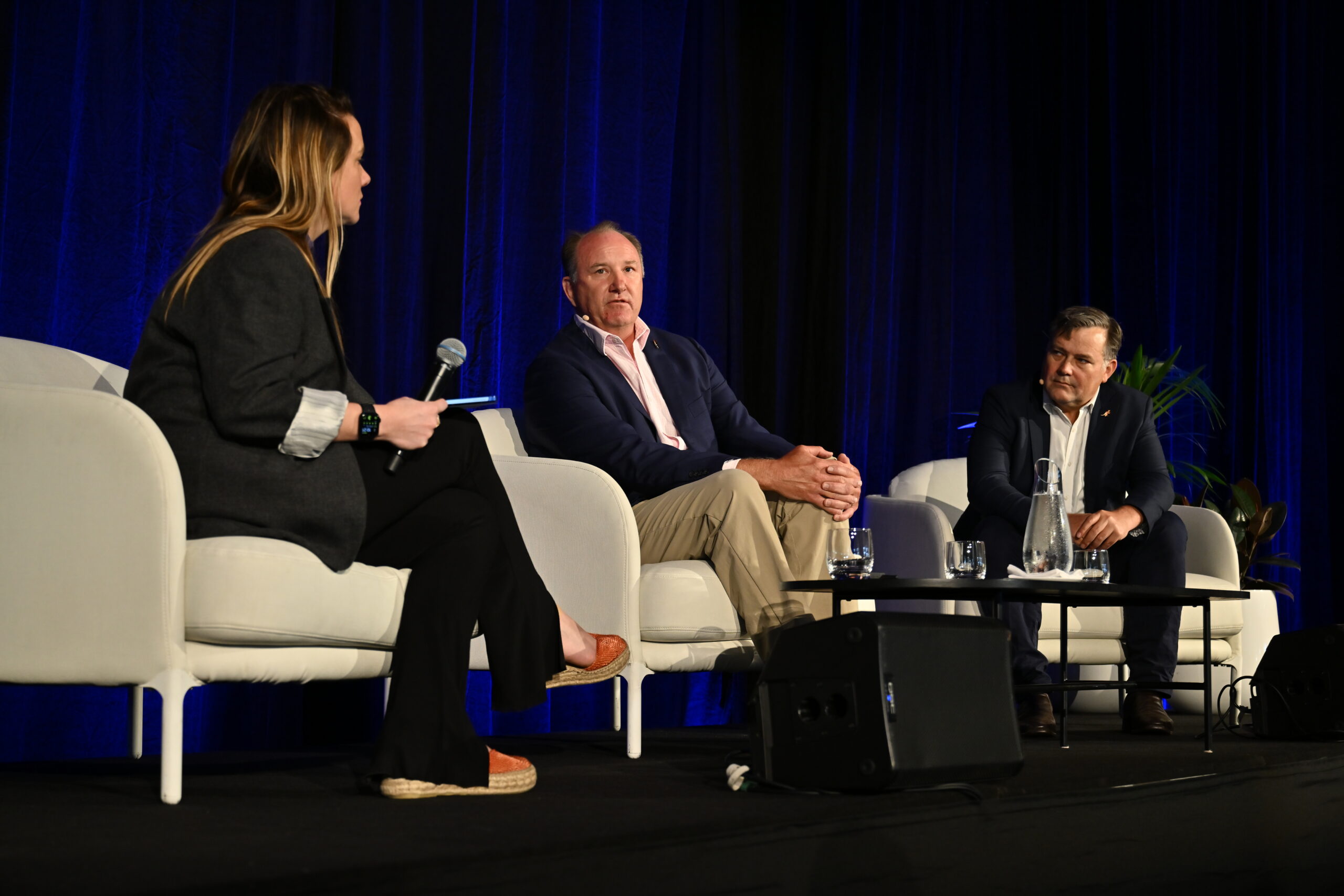
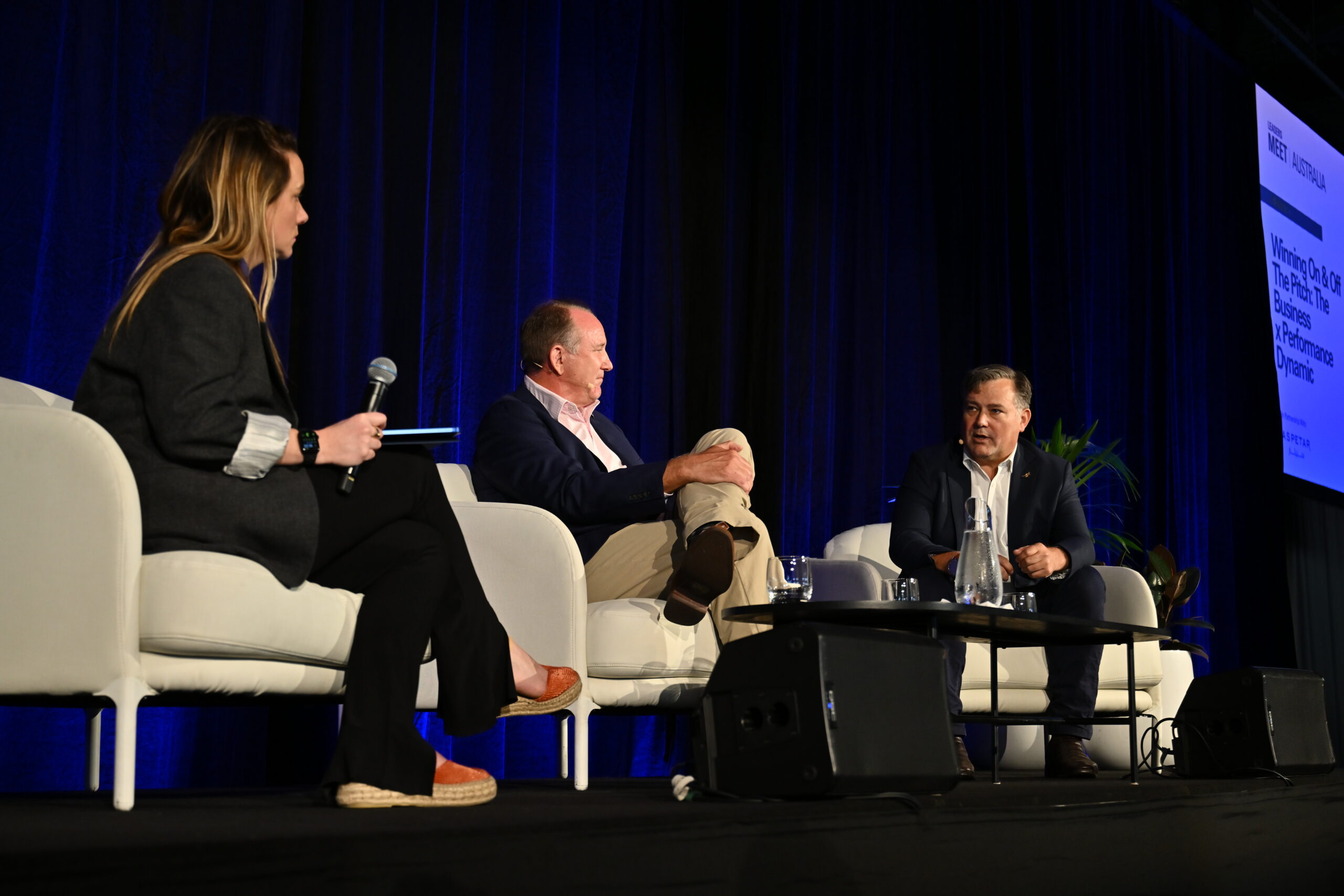
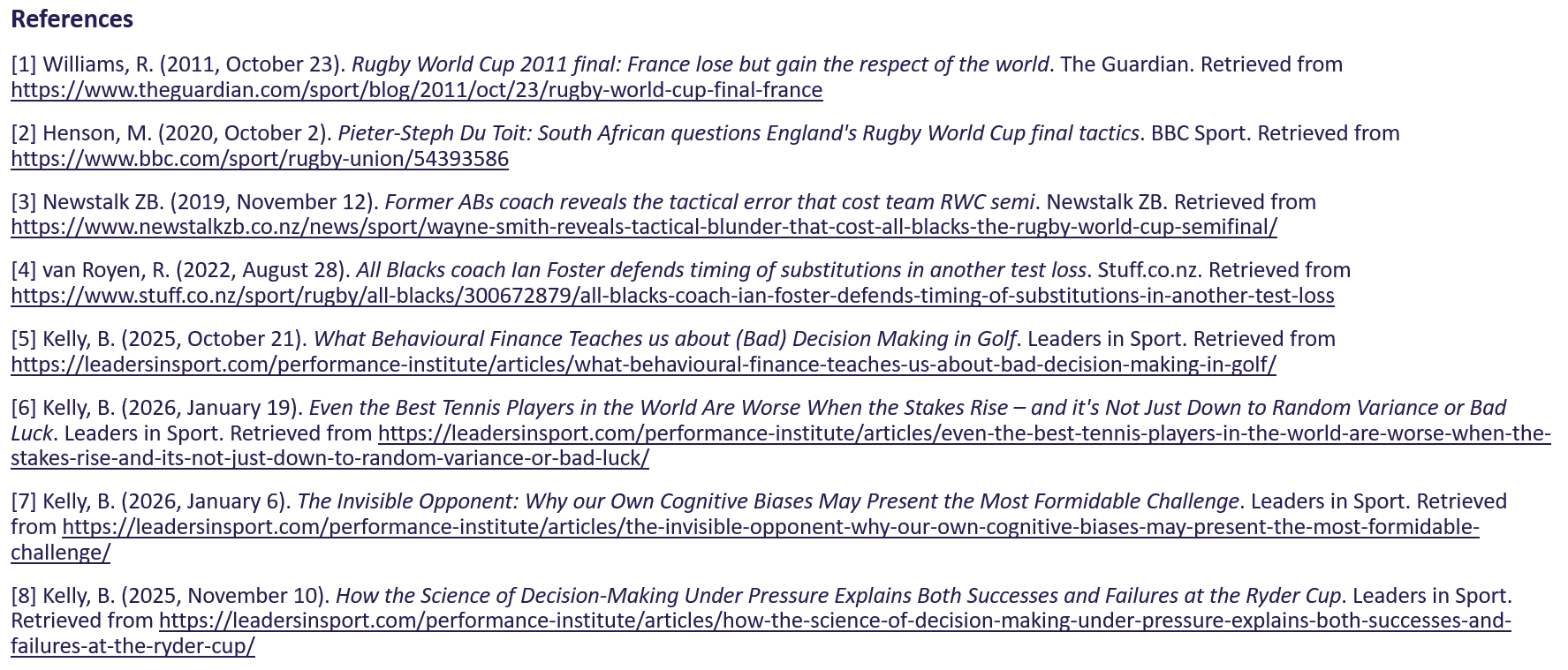
Brett Robinson (centre) onstage at Leaders Meet: Australia with Rugby Australia’s Director of High Performance Peter Horne and Leaders’ Managing Director Laura McQueen. (Photo: Albert Perez / The Leaders Performance Institute.)
Firstly, he didn’t shy away from the problem
As Robinson explained, “some countries were incredibly frustrated; they wanted to revolt and blow everything up.” Others were about “organisationally working with the change and not being too destructive”.
Almost half of the 52 members of the World Rugby Council voted for Benazzi as Chair. Robinson, who will serve a four-year term, did not shy away from that fact. “We’ve got differences of opinion, we’ve got some challenges, and there’ll be some people that were disappointed after the election,” he said in the aftermath.
In December 2025, he expanded on his thoughts as a guest on the Rugby Unity Podcast. “The system upon which World Rugby is built has been in place for 30 years,” he said. “We have systems that simply don’t work and prevent us from reacting with the necessary speed.” It is worth remembering that he made those observations after Impact Beyond 25 had been launched.
Onstage in Brisbane, he further outlined an enduring sticking point: that France and England account for approximately 70% of the revenue generated in rugby union. This had led to political as well as economic tensions across the different factions; and the question was how World Rugby could engage and incentivise the other unions to align in pursuit of a more equitable distribution.
He ensured World Rugby’s new strategy was a collective endeavour
The Impact Beyond 25 strategy was unanimously ratified just days before the 2025 Women’s Rugby World Cup final, which saw a crowd of 82,957 watch England beat Canada 33-13 at Twickenham.
The timing could not have been better. England 2025 was the most well-attended Women’s World Cup ever. World Rugby’s unions gave their blessing to a global impact plan that, in the international governing body’s own words, ‘is built around three core themes of profile and participation, careers and gender equity, and capability and expertise with the mission of inspiring more women and girls to get into rugby on and off the field of play.’
Most importantly, it bore the fingerprints of all those involved in its creation.
“It’s really important that, in my role, I bring the game together and we agree on what shared success looks like and we pursue it together,” Robinson told Rugby Unity.
He expanded on those comments in Brisbane. “We’ve built a collective plan where we’re all engaged, we’re all incentivised, and we’re all a part of that journey,” he said, adding that the plan includes taking All Blacks and Wallabies Test matches to the United States. Such moves “will help build the fandom that ultimately will drive the commercial outcomes and [increase rugby union’s] market share”.
He accounted for local complexity
“We are not going to do everything from Dublin,” he told the Brisbane audience, name-checking World Rugby’s base and then pointing to the man sat beside him onstage, his former World Rugby colleague Peter Horne, who now serves as Director of High Performance at Rugby Australia.
“What we do is only as good as what he [Horne] can deliver and vice versa.”
In some places, such as Australia and England, Robinson said, “we have an Anglo-Saxon way of governing; we’ve got strong boundaries around the role of the chair, the board, the CEO, the executive. In other parts of the world, they have very different ideas of the president or the chair being an executive authority.”
He cited the example of Argentine Gus Pichot, the former Vice-Chair of World Rugby. “He’s not the chair and he’s not on the board of the Argentine Rugby Union, but he is making every decision coming out of it; and so I have to work with that, acknowledging that I need to keep his chair informed and his CEO informed; but if Gus doesn’t agree with it, it doesn’t happen. And I could say, ‘well, that’s just a crazy way of governing’, but I can’t change it, so I have to work with it. The French are the same; Florian Grill is their president. He’s not the CEO, but he operates as an executive chair.”
On that last note, Robinson said: “I spent a lot of time before Christmas with the French in Paris. I’m going back there in a couple of weeks’ time.” These meetings have proven invaluable. “You have to work really hard to genuinely display that you’re listening and supporting, and they don’t necessarily say ‘yes, yes, yes’, but actually they can see the ‘why’.”
World Rugby is now reaping the rewards of his efforts. “Having the French and the Argentinians now with us, and rebuilding the relationship with the Celts and the English, was probably the biggest challenge that I faced; and now we’re there, we need to push on and deliver.”
He won’t rest on his laurels
“You’ve got to be systematic; from my experience, if you go randomly into anything like this, you are more likely to fail than not,” said Robinson. “You have to set up a proper process.”
He listed the necessary personal qualities of a chairperson: trustworthiness, empathy, and emotional intelligence. He balanced these against an ability to act and make tough decisions. All are essential in a world where alignment is predicated on retaining the trust of the individuals involved in the process.
Robinson then explained that the executive board of World Rugby had just undergone a review. He said: “I’ve been running a process over Christmas where we have a 360 on our behaviours; I’m getting a 360 on me. We’re having a discussion about board effectiveness; how that relates to the implementation of our strategy. We have some blind spots and weaknesses on our board, and we have succession plans that are coming. So those things are really important because it all rots from the head.”
What to read next
Why Change Only Sticks when you Lead your People Through the Transition
AS Béziers Hérault Head Coach Rory Teague ponders the question of skill acquisition and delivers his six considerations.
These are the words of Rory Teague, who notably spent a year and a half between 2016 and 2017 working as a skills coach under then England men’s rugby union Head Coach Eddie Jones.
A decade on, Teague serves as the Head Coach of French Pro D2 club AS Béziers Hérault and, as he tells the Leaders Performance Institute, would not copy Jones’ appointment in southern France.
“I wouldn’t myself employ a skills coach,” he says. “I think every coach who coaches an area of the game should be able to coach the skill of their area. ‘Skills coach’ as a term has become archaic as coaching has moved along.”
He feels that assigning skills coaches to coaching units risks diluting accountability. “When something breaks down, you’re not going to just look to the skills coach who’s sat in the room waiting for the moment to say ‘oh, that’s me’,” he continues.
“If the lineout doesn’t go well because of the throw, who’s responsible for that? Is it the lineout coach or the throwing coach that comes in once a week? I would prefer that my forward coach has understanding of the skill of throwing and takes responsibility for it.”
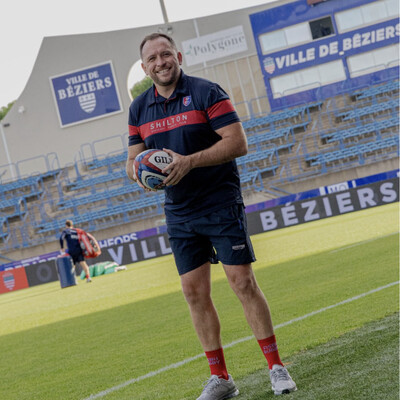
AS Béziers Hérault Head Coach Rory Teague. (Image: Rory Teague / LinkedIn)
Over the course of half an hour, Teague ponders the topic of skill acquisition from a coaching career spent as a skills coach, unit coach, and now a head coach.
Here are his six of his main considerations.
1. The difference between ‘skill’ and ‘technique’
“Ultimately, skill is technique performed under pressure,” says Teague, who has been influenced in his thinking by coaches including Rick Shuttleworth (a consultant at organisations including the Rugby Football Union and UK Sports Institute), Scott Wisemantel (Attack Coach at the NRL’s Paramatta Eels) and, of course, Jones (who is now in his second spell as Head Coach of the Japan men’s team).
“They were three incredible coaches who helped me along the way,” he adds. “They pushed me to go and find out what is ‘skill’; what is the difference between ‘technique’ and ‘skill’? Because there’s a big difference.” Skill, he suggests, is the ability to select, adapt and execute actions in a pressured context. There is little value in a player passing the ball ten metres to their teammate repeatedly at the end a training session. “They’re only working on their technique, because there’s no external cue for when they’re passing.”
It follows that skills in rugby develop as a consequence of an interaction between mechanics, cognition and match context. “If I stand in front of the player and they run towards me and I run towards them, they’re interacting with the environment i.e. me, them, and the distance – and then they’re performing the technique.”
There is also a psychological and emotional dynamic that goes beyond cognition and technical execution. All these elements can affect skill expression in a match situation.
“There’s no substitute for being in the saddle,” adds Teague. “Hot feedback in the moment can be so powerful because you’re living that moment with the player.” He will use the moment to talk them through a situation.
He will readily halt training sessions to allow kickers to practise too. “Get them to kick when their heartrate is up and their emotional state is variable rather than just doing 50 kicks at the end of the session – because that’s just technique.”
2. Implicit and explicit learning both matter
At the heart of discussions about skill acquisition is the dichotomy between information-processing approaches (skill acquisition as learning to plan and execute correct movements by processing information internally) and ecological approaches (skill acquisition as learning to perceive and act in context by interacting with the environment).
Teague is not a dogmatist, even if he leans towards the latter. “I like implicit coaching where the exercise and your questions give the player the feedback,” he says. “What exercises can you design whereby you don’t have to say anything, the player performs the act, and the exercise gives the player the feedback? If you look at, say, goal kicking or throwing, you want the player to self-regulate when they’re in the moment and feel the pressure.” He will look to ask a series of questions that “get the player to think about where they want the ball to end up, where they want the ball to go versus breaking it down too technically”. He will also be mindful of the timing too, both pre and post-match.
However, when it comes to explicit approaches, “it’s not that those guys you’re very direct with are not taking control of their own journey and development, they just need to be told.”
It comes down to knowing the individual athlete. “I’ve worked with some players where I’ve fluffed it up too much and asked too many questions and they just want you to go ‘tell me exactly what you want me to be doing, tell me exactly what I’m doing wrong, tell me exactly how I can get it better’. Whereas with others, you can ask ‘what do you think?’”
Skill acquisition requires the coach to understand what the best approach is and why. Additionally, while it may be ideal for the session design to act as the teacher, there will be times when the coach needs to check for understanding.
3. Ask yourself: what will help the player?
While it is important for players to be drawn towards training sessions, whether by coaches placing balls in their line of sight or by making sessions enjoyable, the guiding principle should be whatever will help the players in that moment.
“Do you want your players to think your coaching drills are really good or do you want players to think ‘you’ve taught me how to pass better’?” As ever, the answer “depends on where you are” with the players in question.
In any case, “sometimes you have to get through the reps and you can’t deviate away from repetition”. Teague says: “I’ve seen coaches try to do these fast exercises to appease players and sometimes they can be so complicated that the players don’t buy into it because of how complex it is.”
There will be times when a coaching intervention can harm a player’s development and Teague will consciously be less prescriptive as a game week develops. “As you get closer towards the game, you’re looking at confidence versus correction” because sometimes less is more.
4. The coach is only part of the player’s journey
Between 2022 and 2023, Teague worked as a forwards and backs coach with Racing 92 where he had the opportunity to coach Finn Russell, who is widely considered one of the best fly-halves in the world.
Teague reflects on that period and what he refers to as the “culture of extras”, which is the work that the world’s best players continue to do on their basic skillsets.
“Finn would ask to do some extras when he thought it was right for him,” says Teague, who explains that Russell’s experience guided their training interactions. “Sometimes he’d do them on his own, sometimes he’d ask a coach to be there to give him some feedback, sometimes he’d want a coach there just to keep him company.”
Teague has also worked at school and underage level where he employed a more directive approach but in an environment like England or Racing, “telling them what to do probably isn’t the most intelligent thing.”
Instead, “I think the more players take control of their own skill development, the more you as a coach just have to be part of that journey, not driving that journey for them.”
5. Be patient, it’s a journey
The Leaders Performance Institute asks Teague what he knows now that he wished he knew whilst working as a skills coach.
“Skill acquisition takes a lot more time than I thought,” he says, adding that it could take a season for a goal kicker to become 10% better. “I don’t know if patience is a skill, but I wish I understood more about the learning journey of the player in terms of skill; that each player can pick things up at different rates.”
It comes back to the player-coach relationship. “Players need to take responsibility around what they want to be working on; and that’s a shared process with the coach. Obviously, if there’s something the player has really not identified that they need to work on, and if the coach has to tell them, then so be it.”
Teague will decide when to intervene, when to step back, and when to change the task.
“If you’re clever in your design, you can keep pushing and changing the design incrementally as you see the player evolving and becoming better. Equally, you can take it backwards if the player isn’t getting it. So it’s that ability to move up and down the bandwidth of the learning journey where, ‘OK, I’ve set the start point here at three, I need to go back to one before I can move to four, five and six’.”
6. Data informs, it does not decide
When it comes to using data in skill development, Teague describes it as a question of “data versus feel”.
He says: “You can look at the number of passes per game, for example, but then I think you have to really sit down, watch the video, watch the technique, watch the context, look at the environment that they’re in at that moment in time in the game, conditions; there’s lots of different things.”
As ever data must inform judgement, not replace it; it must provide a meaningful talking point. “I think data can serve its purpose, but what we don’t want to do is go too much down the data route without looking at the individual data moments in the game.”
As a final question, the Leaders Performance Institute asks Teague what advice he has for coaches working in skill development.
“Go and find the theory behind skill acquisition. I think it will change you. It will change mindsets, definitely.”
What to read next
How Do you Develop the Most Expert Coaching Workforce in World Football?

16 Mar 2026
ArticlesHead Coach Johann van Graan took the club from crisis to the podium in under three years. Here, we explore how closely he embodies Bernard M Bass’ popular idea.
The South African, then with Munster, had agreed to become the Head Coach at struggling Bath in December 2021.
A few days later, he switched on the TV only to see Bath go 0-28 down after just 25 minutes of their Champions Cup tie with Leinster.
It prompted the Everest comment, as Van Graan told an audience at the 2025 Leaders Sport Performance Summit in London.
“My oldest boy was worried,” he said onstage. “He almost broke into tears and he said ‘no, we can’t go to Bath’.”
Van Graan took the reins at Bath’s Recreation Ground six months later on 11 July 2022 and, over the next three years, led one of the most remarkable transformations in English rugby history.
By the end of the 2024-25 season, Bath had lifted three trophies: the European Challenge Cup, Premiership and Premiership Rugby Cup.
Here, we explore their ascendancy under Van Graan through the lens of transformational leadership theory, which was made popular in the mid-1980s by American scholar Bernard M Bass, an expert in leadership and organisational behaviour.
Transformational leadership theory has gained traction in the world of high performance in the subsequent four decades and, here, we take the four core dimensions of Bass’ model of transformational leadership (‘the four I’s’) and ponder how they define Van Graan’s work at Bath.
The four I’s of Bernard M Bass
1. Idealised influence
The transformational leader is admired for ‘walking the walk’. They embody qualities their followers want in their team.
In several respects, Van Graan is the embodiment of Bass’ idealised influence. He strives to be a role model of authenticity, fairness and purpose. By the same token, he is not merely a charismatic leader and does not see himself as a hero, even if he told himself at the start of his coaching career in 2023 to “back yourself because no one else will”.
“There’s a quote by Pep Guardiola,” said Van Graan. “‘This beast called football will eat you alive if you’re not always, always, always yourself’.”
Onstage, Van Graan repeatedly returns to the idea of authenticity; his views are sincerely held and he hints at the vulnerability expressed by the Manchester City Manager.
“It took me many years to figure out who I am first and then to become comfortable with that,” he continued.
This attitude has served Van Graan well in his nine years as a head coach working abroad, whether it was getting to grips with St Stephen’s Day rugby in Munster (“in South Africa on 26 December it’s the summer and you go on holiday”) or bracing himself to deal with Bath’s dire situation (“firstly, I had to understand the club’s issues”).
2. Inspirational motivation
Transformational leaders have the ability to inspire and motivate followers through fashioning and presenting a vision.
On his first day at Bath, Van Graan pinned a picture of the Allianz Stadium on the dressing room wall and said, “There’s no date attached to this, but we will get there”.
“I’m in,” said Bath hooker Tom Dunn in response, “but I’m not sure how we’re going to get there.”
It set the expectations suitably high and represented a compelling vision into which any rugby player could buy, not least a group with such raw potential.
For his part, Van Graan knew that performances and, later, the trophies would come when his team was bound by “connection, clarity and commitment”.
“One of the things we underestimate is what alignment truly looks like,” he continued. “I think we as coaches are sometimes scared of that word. We can never communicate enough. Do we really let people know what the standards look like? What the boundaries actually are? What are we actually going to attack?”
He also posed a question to the team’s leadership. “I asked ‘what does the club stand for?’ and nobody would give me an answer. I picked three words: ‘tough to beat’.” They made sense for a team at a low ebb.
“In a rugby context, most of us coaches go after the sexy stuff, but I think you have to go after the important stuff first. That’s defence, set pieces and managing your kicking game; ultimately, it’s a game where you have to go backwards to go forwards.”
Fast-forward three years, following that successful 2024-25 season, Van Graan turned to Dunn and said “we did this together”.
3. Intellectual stimulation
Transformational leaders challenge followers to be innovative, creative and open to new ideas.
Van Graan invited his players to challenge his thinking from day one.
With one player in particular, he played a game of ‘20 questions’. “I didn’t quite know how that was going to go,” he said. It led to a critique of the style Van Graan employed at Munster.
“His first question was ‘why did you kick so much at Munster?’ and I said ‘because we had the best lineout in the world’.”
Additionally, Van Graan runs an open-door policy. “You can make an appointment or knock on my door, come in, close the door, and in that way you can tell me anything. I won’t always agree with you but I will tell you exactly what I think.”
He will also listen. “We’ve all got two ears and one mouth,” he said, underlining the point.
“It’s very easy as a leader, specifically in a successful time, that you think it’s you. It’s not you. It’s the sum of all the others around you.”
Van Graan told the audience he has six mentors, one of whom is Frans Ludeke, whose coaching staff he joined in the mid-2000s at the Pretoria-based Bulls. In 2017, Van Graan flew to Tokyo to meet Ludeke and show him the presentation with which he hoped to win over the management at Munster where he had just applied to be head coach.
“Frans just said ‘you’re not going to get this job’. I asked why and he said ‘because it’s not you. You wrote on here what you think they want to hear. You’re not being yourself’.” Van Graan took the next 24 hours to rework his presentation and was ultimately successful in his candidacy. “I’m not saying it’s because of my presentation but Frans is someone who’s spoken into my life.”
4.Individualised consideration
Transformational leaders demonstrate concern for the needs and feelings of followers and help them fulfil their potential. They establish strong relationships and act as a supportive resource.
Van Graan, who recited a series of quotes during his time onstage, delivers a line from German philosopher Albert Schopenhauer: “talent hits a target no one else can hit; genius hits a target no one else can see.”
“I’m in no way saying I’m a genius,” said Van Graan. “The point I want to make is people want to dream, people want to belong, so you’ve got to give people hope, whether it’s players or staff, you’ve got to be able to see something first and then bring people along with you.”
He hoped to pursue that dream by co-creating a “new culture” at Bath. “‘Culture’ is a word that gets used by so many people. For me, it’s embracing everybody in the group, setting clear boundaries as to what you want and who you are. I guess what I’m saying is that it doesn’t matter where you’re from, what language you speak, the colour of your skin: everybody’s welcome at our club.”
This is particularly important when delivering bad news, such as telling a player their contract will not be renewed. In the past, he would make small talk. “Now, I walk in, shake your hand and say: ‘unfortunately, this will be your final season at the club’. I’ve become comfortable with the silence; and people respect that a lot more than not telling them.”
As part of Bath’s collective sense of trust, belonging and psychological safety, Van Graan encourages his players to take perspective. They led Northampton 21-18 with five minutes to go in the 2024 Premiership final and went on to lose 25-21. “We were six minutes from tasting greatness.” They walked out of Twickenham with their heads held high and, 12 months later, defeated Leicester Tigers 23-21 to win the 2025 final.
“We actually played a lot better in the final we lost than the final we won,” said Van Graan. “We haven’t reviewed the previous final at all. We spoke about how close we were but just moved on. The next journey had started.”
What to read next
13 Mar 2026
ArticlesThe performance specialist outlines the principles that served New Zealand’s double World Cup winners.
That is according to performance specialist Darren Shand, who made that very point during his presentation at a recent virtual roundtable.
“We’re all shooting for the stars, we’re all shooting for the trophies,” he said. “Ambition is very common to all in our environments, but execution is rare. Not everybody succeeds. Execution is where the magic is found.”
The New Zealand All Blacks, for whom Shand served as General Manager between 2004 and 2023, found that ‘magic’ more often than most. They won back-to-back World Cups in 2011 and 2015; they also spent ten years in that period as the top-ranked team in the world.
For opponents, the All Blacks were the benchmark; the most prized scalp in rugby union. As for the All Blacks themselves, their ambitions were so obvious that there was little need to spell them out in a nation where, as Shand explained, rugby is part of the “fabric”.
“That wasn’t the challenge for us,” he continued. “The challenge was that bridge; and I propose that strategy is the bridge between ambition and execution.”
The All Blacks’ strategy was rooted in their day-to-day actions, standards and habits; in other words, their behaviours. This was where their ambition truly mattered.
“Ambition is meaningless unless it changes behaviour; and strategy actually lives in behaviour, it doesn’t live in documents.”
Shand went on to share his three key principles for building an effective performance strategy.
1. Learning
Your strategy should evolve with your execution or, as Shand put it, “the question is not ‘is our strategy right?’ But ‘is our strategy still relevant?’”
“An effective performance strategy,” he argued, “should invest in the pillars that will move the needle the most.”
To illustrate his point, Shand described a hypothetical environment that promotes sleep as an important part of recovery as being more valuable than a “shiny new sleep gadget”.
He said: “Let’s build some non-negotiable recovery protocols across our group that we all buy into and that we build together. Let’s think about where we stay; we can have facilities onsite so that it’s really easy to create lots of options for people to participate in recovery; and let’s educate, let’s get players to understand the science behind it rather than just slapping something on someone to gather a whole lot of data.”
2. Alignment
While Shand was working with the All Blacks, alignment wasn’t an abstract concept, it was built into how the team worked week to week.
He described a typical example where coaches would lead the program in the days after a match and then, as the next match approached, the players would gradually assume control. It was a strategy that served them well.
“At the start of the week our players were still physically recovering,” said Shand. “The coaches lead at that point where we’re starting to build clarity; we’re trying to understand our next opponent and anything new that we’ve got to develop in our game for the next week. Our players physically can’t train too hard at that stage. There is 60 hours’ worth of recovery to get them back to close to 100% physically. So they’re just absorbing, they’re learning.”
Then the balance begins to tip the other way. “As the week builds, we want to shift their focus from clarity to intensity and we want them to start to test the things that we need come Saturday. At that point we start to hand that leadership role over to the players.”
It makes sense: it is the players on the field who will need to make decisions in the heat of the moment and so the coaches need to provide the environment for the players to test themselves.
“By the time we get to our final run before a match, it’s totally player-led as we strive for accuracy.”
Then, when the match starts, the players are “clear, light and bright” and everyone is on the same page.
3. Belonging
This is not a ‘soft’ cultural element but a key performance driver.
“Strategy only works when people feel they belong,” said Shand. “People protect what they feel they’re part of; people give more when they feel connected; people are willing to sacrifice when identity is shared.”
These ideas mirror the work of lawyer-turned-performance specialist Owen Eastwood, the author of the renowned book Belonging.
The team deliberately set out to understand their legacy, connecting every single player to all those who have represented the All Blacks since 1903. The players felt accountable to the past, present and the future. This influenced how they set about their work and, just as significantly, when the moment called for discipline, the playing group policed itself without recourse to coach intervention.
As Shand put it: “The group’s sense of belonging drove the behaviour; and behaviour delivered the strategy.”
He went on to explain that this will look different at senior level and at different stages of a talent pathway. “You don’t want them to be the same,” he added, “you want your young athletes heading towards your ambition, but you want to promote behaviours appropriate to that level and that stage of readiness.”
To do otherwise risks “taking away some of the belonging and identity that those teams need”.
In any case, it comes back to learning.
“Learning is the only sustainable competitive advantage,” said Shand.
The act of learning makes alignment possible and informs an individual’s sense of belonging to a collective.
What to read next
Too Often, the Person Is a Sticking Plaster for a Lack of Robust Systems and Processes
The theme of alignment was high on the agenda at February’s Leaders Meet: Australia.
The Shepmates – Australian identical twin brothers Archie and Miles Shepherd – have become internet stars due to their viral videos depicting their high-energy and comedic reinterpretations of dramatic moments of sports commentary.
“I’m not going to pretend like we probably should be offering you guys advice. You’re the best at what you guys do,” Miles told a room of Leaders Performance Institute members at Rivershed in Brisbane. “But hopefully we can inspire you guys, or you take something from our story.”
Their dedication to their art and their fans has taken them to places they never expected. “We’ve found ourselves in a pretty niche part of the internet,” said Archie.
On top of it all, the brothers’ obvious chemistry, as well as their ability to finish each other’s sentences, hinted at the theme of alignment that ran through both days down on the River Brisbane (and it’s a performance trend we’ve tracked for some time).
They were not alone. Others who took to the stage, including the Brisbane Lions, World Rugby and the Queensland Ambulance Service, spoke of their efforts to ensure everyone within their walls is on the same page.
Based on the insights shared onstage across both days, the Leaders Performance Institute highlights how alignment shows up in the work of high-performing teams in at least five ways.
1. Smart coaches who can manage up
In sporting terms, there has never been a better moment for the city of Brisbane, with the Lions defending their AFL premiership and the Broncos winning the NRL in 2025.
Lions Senior Coach Chris Fagan and Broncos Head Coach Michael Maguire have built winning machines in this corner of Queensland, and both were on hand to tell Leaders Performance Institute members how it was done.
Key to their approach is an ability to manage the executives within their organisations. As Fagan said, “I always said to myself, if I was going to be a head coach, that I would make sure I would manage up to that group of people.”
Over the past nine years, Fagan tried to dine once a week with Lions’ CEO Greg Matthews as well as the team’s senior-coach-turned-executive Leigh Matthews.
Chris Fagan
Maguire has adopted a similar approach to prevent any noise or confusion emanating from above.
Michael Maguire

Chris Fagan (centre) in conversation with Michael Maguire (right) and moderator Rachel Vickery. Photo: Albert Perez
2. They seek ‘spine alignment’ too
While coaches can do what they can to ensure information is flowing in all directions, there is a role for both board members and heads of performance on the sports science side too.
Onstage, Peter Horne, the Performance Director at Rugby Australia, made the case for “spine alignment”, of which he said, “if we get true spine alignment of what we’re trying to achieve from a strategy, business and the deliverables [perspective] then we’re more likely to be able to execute.”
Crucially, as he admitted, it is not about agreement on every decision.
Peter Horne
“For the spine to work, you need everyone operating at the right level,” said Brett Robinson, the Chair of World Rugby, who joined Horne for the session. He included himself in that assessment.
Brett Robinson

Peter Horne (right) makes his point onstage with Brett Robinson (centre) and Leaders’ Laura McQueen. Photo: Albert Perez
3. They bring their frontline people onboard
Few individuals are as well placed to discuss the concept of a culture driven by a shared purpose than Dr Stephen Rashford, the Medical Director of the Queensland Ambulance Service.
He is proud of his team’s “no excuses” approach too. “When we do our audits, everyone’s in the room, and there’s no making fun of anyone, there’s no bullying. We have honest, open discussions because we all just want to get better.”
Critically, their culture starts with their paramedics.
Dr Stephen Rashford

Dr Stephen Rashford mid presentation. Photo: Albert Perez
4. They have leaders who give their people psychological safety
Australian all-rounder Ellyse Perry is one of the greatest female cricketers of all time (then there’s her career as an international football player to consider). Her career has been underpinned by psychological safety. “When there’s a lot of support around that and real alignment on wanting to grow and improve, that makes a big difference,” she said.
Ellyse Perry
“No matter the position you hold, you don’t know everything, so be open-minded to learning,” said Anna Meares, the double Olympic gold medal-winning track cyclist who served as the Chef de Mission for the Australian Olympic Committee at the Paris Games. She spoke onstage alongside Perry and fellow Olympic gold medallist, the BMX cyclist Saya Sakakibara.
As Chef, Meares decided that open displays of vulnerability from early in the cycle would help to bring athletes and their coaches onboard.
Anna Meares
Psychological safety is just as important in individual sports, as Sakakibara told the audience. The Red Bull athlete won gold in Paris but recounted the story of her awful crash three years earlier in Tokyo and how it encouraged her to start placing her trust in others.
Saya Sakakibara

Anna Meares (second from left) makes her point to session moderator Fabio Serpiello in the company of Ellyse Perry (second from right) and Saya Sakakibara (first on the right). Photo: Albert Perez
5. They use process as a tool of alignment
In his presentation, Scott McLean, an associate professor at the University of the Sunshine Coast, explained that leaders must be aware of how things are connected in the complex systems of sports performance.
Scott McLean

Scott McLean from stage right. Photo: Albert Perez
Interventions should be governed by the performance need rather than results, according to James Thomas, the Performance Director at Warwickshire CCC, who made this case when he spoke onstage.
James Thomas

James Thomas onsite at Leaders Meet: Australia. Photo: Albert Perez
Where we’re going next
Emily Scarratt and John Mitchell knew their England team could be world champions, they just needed the right environment to be able to prove it.
The centre had just competed in her fifth tournament (a joint record in the women’s game), claimed her second winner’s medal, and helped to complete an 11-year quest to bring the World Cup trophy back to England. It was almost the perfect way to bow out after 17 years as an international, 115 caps and a world record 754 points.
Yet she had only played 19 minutes of England’s campaign – all as a second half substitute in the Red Roses’ opening pool match; a 69-7 defeat of the United States in Sunderland.
“I’ve definitely been part of environments before where that kind of non-playing player can become quite negative and toxic,” she told an audience at the 2025 Leaders Sport Performance Summit in London.
“For a large part of my career, I was starting and therefore it’s very easy to say the right things and present in that way when you’re not under the stress of not being selected or not playing as much as you would like.”
Scarratt was joined onstage by England Head Coach John Mitchell, who in early February extended his contract until the 2029 World Cup and added Scarratt to his coaching staff.
The session moderator, Rachel Vickery, asked him what it meant to see Scarratt and her other non-playing teammates (known within the Red Roses setup as “pillar” players) celebrating with such vigour.
“I reflected that we actually hit the sweet spot with the culture,” said Mitchell. “Sometimes you don’t get that sweet spot and we might not get it again.”

Rachel Vickery (left) talks to John Mitchell (middle) and Emily Scarratt (right) onstage at the 2025 Leaders Sport Performance Summit.
Here we reflect on what Mitchell and the Red Roses got right for 2025.
He spoke up when something wasn’t quite right
When Mitchell signed up to become England Head Coach in 2023, his remit was to win the World Cup. He was a coach with a proven track record in the men’s game who had now been handed the resources and the players to deliver the Women’s World Cup on home soil.
But in 2018 and 2022 England had lost World Cup finals they could, or perhaps should, have won.
“The leading question was how do we get done what we haven’t through the years?” said Mitchell.
It involved integrating young talent (eight players made their World Cup debuts against the US) and tactical tweaks (they had been too reliant on their maul). Both required an environment that enabled the best team on paper to prove they were the best team on grass.
To deliver on that front, Mitchell and the team’s leaders landed on three guiding values: ‘courage’, ‘take the handbrake off’ and ‘be all in’.
These values inspired England’s veterans and new internationals alike. “If the top person genuinely believes that culture is important it makes a difference,” said Scarratt. “Potentially in previous campaigns that hasn’t been the case and culture could get a little bit sidetracked or lost along the way.”
Mitchell even spoke up when he spied a shortcoming in the players’ well-meaning desire to ‘do it for the girls’.
“My thinking was that emphasis might be slightly calibrated towards ‘me’ – not intentionally – but how do I get the girls to calibrate towards ‘we’?” he said. “Because if I inspire you and I’m inspired by you, isn’t that more important, more inspiring to the person next to you? We get the job done and then our voice around our individual ‘why’ will be far greater.”
The cultural tweaking never stopped
“It’s very easy to just pick values, put them somewhere and hope that people live by them,” said Scarratt. “Our values were genuinely threaded through a lot of what we did, whether it was medical presenting or S&C presenting” and, when you witness that, “it’s very easy to buy-in”.
Mitchell held difficult conversations when necessary, but all players and staff, Scarratt said, were expected to speak up when necessary “to nip things in the bud before they became potentially bigger.”
At the suggestion of leadership consultant Patrick Marr, Mitchell would ask his player leadership group and support staff on the eve of each international camp to tell him “who’s going to pull the cart forward? Who’s going to sit on the cart? Who’s going to hold up the cart?”
After an hour he would “come back and I’d see two or three players, plus a couple of staff, where our priority needs to go,” he said, adding “we would then decide on who I would speak to and who they would speak to.” For every player or member of staff, there would be someone who could bridge that gap and “communicate around standards of behaviour”.
Mitchell even danced on TikTok when duty called
If you’re an England supporter, you may have seen the TikTok video of Mitchell dancing with his players.
“I needed to show vulnerability,” he said of such moments, which was not something he considered as a younger coach. “I had to do things that I probably don’t normally do and join in with the girls on certain things.”
Psychological safety may start with players or their head coach dancing in the dressing room, but it ultimately manifests on the pitch during tricky spells or in performance meetings when a staff member has the courage to raise a performance issue.
Mitchell knew he had to lead from the front. “Sometimes you’ve got to be the leader of those actions before somebody else does them.”
That said, his belief in the power of the head coach has been softened (and his self-awareness amplified) by three decades in the sport. “You learn through emotional intelligence that you don’t have to be absolute or right when making decisions. Just use your people. Listen to your people.”

John Mitchell and Emily Scarratt shake hands as their session draws to a close at the 2025 Leaders Sport Performance Summit in London.
The team talked about the pressure they felt
For the first time, England openly spoke about winning the World Cup. It served as a pressure valve and, again, gave voice to their values.
“It might sound a bit silly but we hadn’t done that before,” said Scarratt, implicitly acknowledging how awkward the group felt at first about such an “un-English” sentiment.
As the English media and public latched onto the team ahead of the US match, the pressure grew. The players trained poorly on one occasion but, instead of dismissing it, they discussed it openly.
“I think we did a really good job of dampening it down by not not speaking about it,” Scarratt added. “By actually putting it out there and allowing people to know that other people felt like that.”
And Mitchell’s words after England eased through the gears on the opening night set the tone. He said: “There’s bigger games coming where teams will put even more pressure on us, so let’s take confidence from what we’re building and stacking as we’re going along. Our game doesn’t need to be perfect, it just needs to be effective, and that will win us the tournament.”
He was right and, looking to 2029, their goal is to win back-to-back World Cups, establish a legacy as one of women’s sports greatest teams, and to further grow the women’s game.
These lofty goals provoke three questions that Mitchell and England must answer: “What will earn the right? What will we keep and take forward with us? And then, thirdly, is what we what will we need to start again?”
What to read next
Meaning Does Not Guarantee Medals, But it Strengthens the Behaviours that Make Medals Possible
As Jamie Taylor of Dublin City University and the CoEx|Lab explains, the university’s master’s and doctorate programmes are designed to help coaches and other high-performance practitioners embed research into their daily practice – a habit that is sometimes overlooked in sport.
Additionally, one of the key challenges in coaching is that there is a world of evidence that can help practice, but most do not know about it.
At Dublin City University we are trying to subvert that attitude through our online doctorate and MSc programmes, which are aimed specifically at coaches and practitioners in high performance sport.
We have a community of around 100 coaches and practitioners who appreciate the capacity for research to enhance both theirs and their organisation’s practice in ways that have long been transformational in, say, S&C or medical.
In many respects, coaching is a discipline apart, yet sports performance has long-been reliant on other domains to pick up and apply research. More research can and should be done.
Below, I explore – drawing on insights from students across the doctorate and MSc programmes – the common barriers in coaching, before making the case for evidence-informed research that can meaningfully support practice. The programmes are delivered by a team of practitioner-researchers, including Áine MacNamara, Dean Clark, Robin Taylor, Rosie Collins, Stephen Behan and myself.
The common barriers
As a coach, you should be weaving research into your practice – it should not be additional.
“Last Friday, we protected two hours for some internal professional development with a group of practitioners,” says Ian Costello, the General Manager of Munster Rugby. “There’s 20 reasons not to do it, but if it’s important, it’s protecting the time in your diary, no matter how busy you are.”
Ian believes the programme has opened up new career options, potentially even beyond professional rugby union. He has now got into the habit of writing in his diary in three colours: black for operational matters; green for strategic issues; and blue for learning and personal development.
“Someone gave me one of those multicoloured pens – I hate them because of my bad handwriting and these don’t help – but it’s brilliant for my diary,” he continues. “Learning and personal development can be anything from podcasts to light reading or heavy reading. It can be writing too – that was a good life skill and practical skill that a mentor shared with me.”
Additionally, coaches have not often been shown how to critically organise their thinking, even when they thought they were doing so.
Ian has been coaching for more than two decades, but still wouldn’t describe himself as the finished article.
“The first year broke me down in terms of questioning everything I know around critical thinking and reflective practice,” he says. “What the doctorate does is give you more structure to that process. It provides you with a more robust and applicable skillset to be accurate in research terms and then to think critically about the information you’re absorbing. As time goes on, you’re able to transfer that to your practice more readily and with a lot more clarity.”
He is not the only one to find the first year challenging. “It was quite confronting and shocking,” says Jamilon Mülders, the Performance Manager at the Royal Dutch Hockey Association. “You try to present where you’re coming from, what you have achieved, what you have done and why you have done things, and the staff at DCU will pose little questions like ‘where’s the evidence?’”
Jamilon has won Olympic and world championship medals as a coach, and yet, as he says, “I have to acknowledge that nine out of ten things we did worked for whatever reason at that stage, but there was no underlying theory, no evidence. There was nothing you could fall back on where you can explain it or also just make sure that you detect possible mistakes, issues, challenges, hurdles which might have happened or occurred in other areas.”
He sensed that something was absent. “I felt that something was missing in my personal education and growth,” he continues, further reflecting on that induction period at DCU.
Some coaches may never have set foot in an academic setting but, whether it’s our doctorate or MSc programme, we don’t need to simplify course material for coaches. We just need to make sure we are providing the right provocation.
“When we’re asked better questions it causes us to say ‘actually, I took that situation for granted, but I need to peel that back a little bit more’,” says Rachael Mulligan, the Athlete Support Manager at the Federation of Irish Sport. “It forces you to go ‘what is the best question to ask in order to get to a better outcome?’”

The most recent cohort of students on DCU’s professional doctorate and MSc programmes lines up for a group shot at DCU in Dublin.
The case for evidence-informed – not evidence-based – research
I hear all the time that ‘we need to quantify this’. It leads us to measure things that don’t really matter simply because we can count them.
There are different ways of seeing this and my view is that evidence should inform coaching, working alongside professional experience, theory, and context, rather than being treated as something on which coaching can be straightforwardly evidence-based.
“For anybody to be genuinely comfortable about their view of the world or their view on practice, it should be research-informed,” says Scott McNeill, the Head of Coach Development at the Premier League. “The risk and challenge of research is that sometimes things can go out of date very quickly. A body of research can be nearly out of date the day that it’s printed. So to keep that as a consistent and live way of engaging in practice would make sense to me, that suggestion that knowledge isn’t fixed, that these things keep evolving.”
“The first thing I said was my issue with research is I sometimes think researchers are almost in an ivory tower and very much removed from what goes on in the day-to-day field of performance sport,” says Rachael of the topic.
“That perception was completely quashed after a couple of weeks in the programme because there’s so much emphasis in terms of, yes, this is fantastic in the academia space, but how do we move this into real-life practice?”
“I used to always say I was evidence-based and a lot of coaches will pride themselves on that,” says Christoph Wyss, the Lead Physical Performance Coach at Red Bull. “But I think evidence-informed makes more sense because if a research paper comes out, being evidence-informed is taking that research, reading it, critiquing it, seeing what’s good and what’s not, and then applying that to your setting, because every setting is different.”
As he says, “with evidence-based you’re just transplanting it, doing exactly what they did, but then evidence-informed is more translating it.”
“There’s not necessarily one solution,” says Eilish Ward, the Head of Player Development at the Ladies Gaelic Football Association. “There’s no one way to learn anything or to gain experience or expertise.” The key for Eilish in her work is to ensure she and her colleagues are “making as informed decisions as possible when we’re designing learning activities” because “not everything from research may be transferable into a practical environment and, equally, every practical environment is going to be hugely different.”
“Being evidence-informed is probably more aligned with what we do on a day-to-day basis,” says Niall O’Regan, the Head of Education & Development at the Football Association of Ireland (FAI). “It is something that has helped me to understand how to be authentic, how to be creative in adapting what the research is saying is to suit the needs and the context and the environment that you’re in.”
Plus, as Scott says, “people sniff you out pretty quickly whenever there’s a gap between what you’re saying and what might feel real to them. Our job as people that work in this space is to either translate the messaging in a more accessible way or to admit that there probably still is a gap.”
And therein lies the opportunity to ask better questions.
Research should never be far from practice
While the programmes can be intimidating for coaches, we’re here to help in any way we can because it is important that research is not too far from practice. When they are close, the research finds practical application.
“This was a part I enjoyed from day one because you could immediately see the practical implications and make an impact,” says Jamilon of his coaching in field hockey. “So if I were talking with S&Cs about load management around our training, my new way of approaching them and asking questions really helped me to have a clearer view on the team and the environment.”
In some cases, research can help to highlight the current inadequacies in a high performance programme.
Niall, for one, thinks differently these days about coach development structures at the FAI; and it feeds into his practice.
“There are some experienced coaches that have so much knowledge and so much expertise in their fields that they may not need to go systematically through a certain set of steps,” he says. “They may have the ability to effectively communicate, empower others or share knowledge in a way which doesn’t require them to go through a checklist. They can get to the end with the exact same learning and sometimes even more learning.”
Such an approach doesn’t necessarily sit right with the coach and it wouldn’t necessarily sit right with the coach developer. “There’s a grappling effect where those people probably feel like, ‘well, I’m being rigidly pushed into a checklist of things and being asked to do things that I naturally wouldn’t do myself’.”
It comes back to being research-informed. “The person in front of you is the actual start point, and then it’s up to us as the educators and developers to be able to link it into research. The practice comes first and then it’s a matter of layering in what research is out there that can inform the decisions that that person is making.”
If you would like to know more about the professional doctorate and MSc programmes at DCU please email Jamie Taylor at:
At the 2025 Leaders Sport Performance Summit, some of the most respected leaders in high performance set out their plans to build the winning teams of the future.
The South African, then with Munster, had agreed to become the Head Coach at struggling Bath in December 2021.
A few days later, he switched on the TV only to see Bath go 0-28 down after just 25 minutes of their Champions Cup tie with Leinster.
It prompted the Everest comment, as Van Graan told an audience at the 2025 Leaders Sport Performance Summit at the Kia Oval in London.
He eventually took the reins at Bath’s Recreation Ground in July 2022 and, over the next three years, led one of the most remarkable transformations in English rugby history.
In May, Bath lifted the European Challenge Cup, Premiership and Premiership Rugby Cup.
The tale of Van Graan’s ‘Rec Revolution’ set the tone for an international gathering of over 300 high-performance leaders to share knowledge, best practice and inspiration.
The agenda took its lead from our Trend Report in which more than 200 performance leaders from almost 40 sports told us how they expect the industry to develop in the years ahead.
Five trends stood out:
Van Graan is at the vanguard of several of these trends and, across both days, the Leaders Performance Institute delivered a range of guest speakers from organisations including England Rugby, the Royal Air Force, and the Haas F1 team to speak to each trend.
The following is a snapshot of what they said.
1. Alignment is now a competitive advantage
For evidence of the stock placed in being aligned, look no further than Bath’s transformation from a rabble to the best team in England in just three years.
Van Graan said: “I put up a picture of Twickenham on the very first day. I said ‘I can’t tell you how we’re going to get there, but we will get there.”
He wanted his playing group, coaches and other performance staff to coalesce around three values: connection, clarity and commitment. The trick was then bringing those to life.
Johann van Graan

Bath Head Coach Johann van Graan in conversation with host Iain Brunnschweiler.
2. Leaders increasingly seek to empower and collaborate
John Mitchell offered another inspiring story from the world of rugby union.
In 2023, when he signed on as Head Coach of the England women’s national team, it was Mitchell’s first time coaching a women’s team.
The Red Roses had a genuine shot at winning the Women’s Rugby World Cup on home soil in 2025, but a talented team needed an experienced guiding hand.
The team delivered, with Mitchell receiving plaudits for his role as England secured their first world title in 11 years.
Two months on from that achievement, the audience found Mitchell (affectionately known to his peers as ‘Mitch’) in typically reflective mood alongside the recently retired Emily Scarratt, who was part of the Red Roses’ winning squad.
Sport (and rugby union) grows ever more complex and yet, after 30 years, Mitchell feels he has never been better equipped to coach.
“You don’t have the full scope,” he says of his early coaching days in the mid-90s. “You have strengths early on that are recognised but then also you sometimes don’t know the whole of yourself. So you take the time to understand the whole of yourself.”
He came to a critical understanding. “When I was younger, I was going to try and be right. Maybe I was trying to prove myself as a coach.”
John Mitchell

England Red Roses Head Coach John Mitchell shakes hands with former England fullback Emily Scarratt at the conclusion of their panel session.
Emma Keith built on the theme of empowerment in her presentation on officer training in the Royal Air Force.
“Cultures and environments can only grow when everybody takes accountability,” said the Commandant of the RAF’s Tedder Academy of Leadership. Keith, a group captain, is the first female to run RAF officer training.
Emma Keith

Group Captain Emma Keith talks to UK Sport’s Alex Stacey following her presentation on officer training in the Royal Air Force.
3. Teams are prioritising resourcefulness over resources
As Team Principal of MoneyGram Haas F1, Ayao Komatsu knows as well as anyone that his team is competing with better resourced and more illustrious teams.
The team has 375 staff members, which may sound like a lot, but it pales in comparison to the likes of Ferrari, Red Bull and McLaren.
“If we cannot work together, if you’re not supporting each other, if you’re not aligned, we’ve got zero chance against organisations minimum three times our size,” said Komatsu, who had just flown in from the Brazilian Grand Prix in São Paulo where Haas’ Oliver Bearman achieved a creditable top-six finish the weekend before the summit.
Ayao Komatsu

Ayao Komatsu, the Team Principal of Haas F1, shares insights into life in the pitlane.
Similarly, albeit in vastly different circumstances, the Red Cross must make the most of its limited resources when emergencies strike.
Chris Davies, the Director of Crisis Response and Community Resilience at The British Red Cross, cited his team’s core operational process:
Chris Davies

Chris Davies of the British Red Cross in full presentation mode.
4. Psychology will be a game-changer
The mental and behavioural side of performance was an ever-present topic on both days of the summit. Our guests discussed several elements:
The importance of individual expression and acceptance
Johann van Graan
Belonging as a contributor to wellbeing (and performance)
Emily Scarratt
Psychological safety
Ayao Komatsu
5. Teams are engaging in a tech arms race
Professor Tom Crick spoke in his capacity as Chief Scientific Adviser at the UK Government’s Department for Culture, Media and Sport.
He presented on the growth of AI and continually stressed how important it is to keep “the human in the loop” regardless of whatever advances are coming.
To this end he offered Leaders Performance Institute members a series of recommendations.
You must be able to explain why you are using an AI tool…
“You can’t just say ‘the computer says so.’ There has to be some understanding and explainability, and there has to be trust.”
An AI tool should not replace your people…
“AI should not erode or disempower or remove agency for people within your domain. It should augment human capability, not replace it,” said Crick. He added: “It is about co-design, co-decisions and co-evolution as we go forwards – keeping humans embedded in the process.”
Don’t assume your AI tool is right…
“Don’t automatically trust the system. Always ask: is that the right data? Does that feel right? Can we verify and validate it another way?”

Tom Crick, the Chief Scientific Adviser at the UK Government’s Department for Culture, Media and Sport, answers questions from Leaders Performance Institute members.
Next stop for the Leaders Performance Institute