Prevent Biometrics’ new device has been introduced to augment World Rugby’s Head Impact Assessment protocol and lay the groundwork for long-term study of head impacts in contact sports
Main photo courtesy of World Rugby

It’s why he calls Prevent’s sensor-embedded mouth guards, which track linear and angular accelerations, providing what experts say is a more accurate measure of head impact than other methods such as helmet sensors, “the most important technology in sports.”
“We’re the data. We are not diagnostic,” Shogren said. “But if you don’t have the data, you can’t do much.”
As a focus on head impact reduction in collision sports — e.g., the NFL’s in-game authorization of Guardian Caps for this season — grabs headlines domestically, Prevent and years-long collaborator World Rugby are embarking on their largest data collection effort on the subject yet, and on a global scale.
Since January, World Rugby required that athletes competing in its elite-level competitions wear Prevent’s instrumented mouth guards, a deployment that will ultimately encompass 8,000 players. The aim: to both augment World Rugby’s Head Impact Assessment protocol and lay the groundwork for long-term study of head impacts in contact sports.
Dr Joe Maroon co-developed the ubiquitous ImPACT concussion management protocol, worked as the Pittsburgh Steelers’ team neurosurgeon for more than three decades and is now a Prevent adviser. He said World Rugby is “leading the charge” in concussion management, adding that smart mouth guards could eventually permeate contact sports such as American football, wrestling, lacrosse and soccer.
“We took ImPACT and other management tools to World Rugby 10, 15 years ago,” Maroon said. “World Rugby now is bringing another tool back to the sports in the United States.”
■ ■ ■ ■
The mouth guard mandate necessitated a $2.4 million investment from World Rugby, which covered fitting (via teeth scans), producing and delivering the gear, plus equipping teams with support staff to help operate the technology and analyze the data collected. The custom-fit mouth guards typically price between $225 and $250, Shogren said.
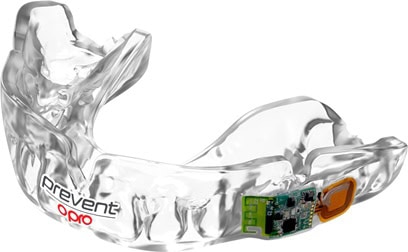
The mouth guards detect hard impacts as an early warning of possible concussions. [Photo: Prevent Biometrics]
“To draw any kind of meaningful analysis, you need to have hundreds of these [concussive] events, not tens,” said Falvey. “Our first priority at the moment is making sure the [impact] threshold is as clinically relevant as it should be.”
Prevent’s mouth guards trigger a Bluetooth alert upon registering a linear or angular acceleration above thresholds set by World Rugby, at which point the player is pulled from the game to undergo evaluation for a possible concussion. (Players can still be flagged for assessment based on observable clinical symptoms, independent of the mouth guard.)
“We’re not using this as a concussion detection device. We’re using it as a device that picks up a large impact,” Falvey said. “A concussion actually is a clinical diagnosis. There’s more to it than just an impact. There’s how the player is, what their previous exposure is, what their age is, what their concussion history is.
“It’s never going to be just about the impact. But that impact is putting the right players in front of us to have a look at.”
So far, unique alerts triggered solely by a mouth guard are adding an average of one extra stoppage every three games, he said. He added that 43% of total concussions logged across World Rugby competitions have triggered a mouth guard alert, and 35% of mouth guard alerts have ultimately correlated with a concussion diagnosis. According to Falvey, that 35% rate is in line with other individual subtests within the head injury assessment protocol, which include assessments of symptoms, memory and balance.
The hope is that having as many guardrails as possible in the protocol will continue to increase its overall accuracy and mitigate cases in which athletes continue to compete with a concussion. Citing research conducted by the University of Pittsburgh, Falvey noted that every 15 minutes a player continues playing after a concussive event, their recovery time is lengthened by three days. That comes with medical risks — for example, issues with non-resolving concussions — and, of course, the business impact that dovetails off player absences.
“None of the subtests on their own are fantastic, but the diagnostic accuracy of the HIA protocol [as a whole] is about 88%,” Falvey said. “That’s as good as an MRI for tendinopathy in your shoulder. When we are able to look back on this year, we feel this is going to have improved the accuracy above 88%. It’s another piece, which is as good as any of the other subtests so far.”
■ ■ ■ ■
Ultimately, World Rugby hopes to leverage the wealth of impact data it is collecting, high-impact and otherwise, to inform rule changes or best practices for competition and training. Falvey cited a dataset of 35 players who play the same position from a recent competition as an example.
“One player was getting nearly six times the number of impact events that a player in their position was getting in the same tournament,” he said. “It may be that they’re involved in more tackle events. But it also might be that their technique isn’t as good as it should be. Doing something about that can significantly improve that player’s health and welfare and make playing the game safer.”
Falvey will present findings from the first year of the mandate in early 2025 at a meeting of the International Collision Sport Group, a collection of collision sports medical leaders, including from the NFL and NHL.
“It’s a scenario where everybody helps everybody out in this space,” Falvey said. “It’s all about getting to the right answer as fast as we can.”
This article was brought to you by SBJ Tech, a Leaders Group company. As a Leaders Performance Institute member, you are able to enjoy exclusive access to SBJ Tech content in the field of athletic performance.
What we learned about turning underperformance into success at the Leaders Sport Performance Summit.
An article brought to you by our Event Partners


A rich seam of answers ran through both days of this month’s Leaders Sport Performance Summit at the Kia Oval in London.
We listened to speakers from various sports organisations discuss their responses to setbacks. Teams including Chelsea, Racing 92, Harlequins and the Sydney Swans laid it all on the table. Several explained how they managed to turn things around.
Stephan Lewies, for example, captained a Quins team to victory over Saracens in October; their 17-10 win ending a miserable run of eight consecutive defeats to their Premiership rivals.
“Coming off a record like that,” said the South African lock, “you often look for answers in the wrong place.” Lewies explained that season after season Quins would change their usual approach when facing Saracens. This season they stuck to their guns and it paid off.
“When the pressure came on in this game, [we turned to] something we’d done for the whole season, for years previously, versus something new in the pressured moment.”
Kudos to Quins, but neither they nor anyone in sport has dealt with the difficulty of landing a probe on Mercury or the conundrum of trying to thaw a microscopic strand of ice on the lens of a space telescope 1.5 million km from Earth.
For Carole Mundell, the Director of Science at the European Space Agency [ESA], such stories represent another day at the office. Crisis after celestial crisis is routinely averted on Mundell’s watch by some of the brightest minds in astrophysics.
Of ESA’s triumphant run-in with the intrusive ice, she said: “Data gives you information. Information gives you knowledge. Knowledge only gives you insight and wisdom for action if you really understand what it’s telling you and how to interpret it with your own experience on top of that.”
Mundell feared impostor syndrome when stepping onto the Oval stage but her words instantly resonated with an audience of coaches and practitioners.
They also lead us nicely back to our original question: how do you turn setbacks into springboards? We bring you six interrelated smart tips from across both days of the summit.
1. Find the right skills to help you in a crisis
How does it feel to be under the cosh in your role? What tools do you lack in those moments? Carole Mundell has allowed herself to be shaped both by the crises she’s confronted and the organisation she leads. Instinctively, she’s a creative scientist, a physicist with the urge to investigate independently. Yet her work at ESA requires her to think like an engineer and commit to the team; these newly acquired skills have proven crucial in moments of crisis.
Carole Mundell
2. Seek key allies above you
Racing 92 were treading water in France’s Top 14 league when they appointed Stuart Lancaster as Director of Rugby. Lancaster, whose tenure began in 2023, was hired to transform their fortunes, but faced considerable obstacles. Language was one, culture another; he also knew he’d be working under his predecessor, Laurent Travers. Nevertheless, Lancaster felt that he was “pushing on an open door” thanks to the quality of his coaching work with England (2011-2015) and, in particular, Leinster (2016-2023).
The big question he asked himself was: should he tiptoe in or smash down the door? As Racing’s revival required more than a cosmetic makeover, he opted for the latter. With the help of his French coaching staff, Lancaster introduced a new working week, a new playbook, and called time on Racing’s long lunch culture. He could disregard those who labelled him an ignorant ‘Anglo-Saxon’ thanks to the relationships he forged with Travers and the Racing board.
Stuart Lancaster
3. Who are your key influencers?
The Sydney Swans had to dust themselves off following their 2022 AFL Grand Final defeat. John Longmire, who this week stepped down as the Swans’ Senior Coach, led them back to the Grand Final again this year. Since leaving London, he has handed the reins to his assistant Dean Cox, who will renew the team’s fight for a first flag since 2012. The factors that propel a team one season will not necessarily apply the next, but Cox is sure to emulate Longmire in learning and applying the lessons from another painful defeat. In dealing with setbacks, Longmire always leaned heavily on the key influencers in his “ecosystem”.
John Longmire
4. Don’t be afraid to let the wrong people walk away
When Chelsea won the Champions League in 2021, the club would not have expected to slump to a 12th-place finish in the Premier League just two years later. Nor would they have predicted the organisation narrowly avoiding oblivion and a subsequent change of ownership. Bryce Cavanagh was hired as Performance Director in the summer of 2023 and, while he has long been considered one of the best in the business, an arduous task awaited him.
He admitted his presence created a sense of risk and vulnerability in some quarters, but he was fair in setting out his stall. Some relished the challenge of staying to help build a fresh performance strategy (a work in progress, he admitted), but others sought roles elsewhere. Cavanagh was willing to let them go.
Bryce Cavanagh
5. Have the difficult conversations quickly
As captain of Harlequins, Stephan Lewies regularly faces difficult conversations. They are of added importance when the chips are down and tempers are frayed. Time and again, as Lewies explained, he has been able to plot a path out of disharmony by being proactive, acting fast and ultimately putting the team first. A leader should also strive to understand multiple points of view without leaping to conclusions.
Stephan Lewies
6. Prioritise your stress and emotional responses
Success and failure both present psychological and emotional challenges. In 2021, the UK Sports Institute introduced its ‘Performance Decompression’ tool to help athletes and support staff transition back to daily life following intense competition periods. The tool consists of four phases: first there’s the post-event ‘hot debrief’ followed by ‘time zero’, which, as the UKSI website explains, focuses on ‘restorative care in a soothing place’; then it’s ‘process the emotion’ and, finally, a ‘performance debrief’.
The tool can be used anywhere. British 1,500m runner Jake Wightman, for example, chose a sofa in a Twickenham café to unpick his underperformance at the Tokyo Olympics. A year later he was world champion and, while there was much more to it, psychologist Sarah Cecil believes the tool helped Wightman to plot his comeback. She and the UKSI’s Head of Performance Psychology, Danielle Adams Norenburg, are also happy to teach their tool to any individual or organisation who may find it useful.
Sarah Cecil
The Leaders Performance Institute reflects on an afternoon of learning at the Tate Modern.
Clancy, a learning and development consultant with the Houston Texans and Director at The Nxt Level Group, was speaking at the October launch of his new book Essential Skills for Physiotherapists: a Personal and Professional Development Framework at London’s Tate Modern Gallery.
“Maybe this day will make you think a little bit more into that question,” he continued.
The gallery’s East Room, with its panoramic views of London, is a suitable backdrop for some of the brightest minds in sports science and medicine. Each of them knows there’s more to their success than talent.
“When we’re in college, we’re taught the technical, clinical, hard skills, but it’s the soft skills that make a difference,” said Clancy.
Essential Skills is an effort to address that reality, bringing together as it does experts who, in some cases, had never previously met in order to collaborate. “That’s the beauty of the book because it shows we can all get better together.”
The book’s proceeds will go to Children’s Health Ireland [CHI], a cause dear to Clancy and his family given the care they have provided to his four-year-old daughter Grace. “This way I can help people like my daughter and her friends.”
Clancy then introduced his roster of speakers – friends, collaborators and mentors – all of whom had wisdom to share.
Here, the Leaders Performance Institute picks out five thinking points to help you reflect on Clancy’s original question: are you doing what you want to be doing?
1. Define the behaviours that will take you from potential to peak
First onstage was James Kerr, the author of the renowned Legacy, who detailed the lessons leaders can take from New Zealand’s All Blacks.
He explained that the right behaviours are the real “force multiplier”. Good behaviours, whether you’re an athlete, coach or practitioner, will “take you from potential to peak more consistently”.
For the All Blacks, that may mean ‘sweeping the sheds’ but how does that look in your environment? What will enable you to show up more often and apply the right behaviours?
2. Seek to understand, find common ground
Behaviours shouldn’t be separated from your values, but how comfortable are you calling out poor behaviours? Any discomfort you feel may be amplified if you’re a woman trying to progress in a male-dominated environment.
Alicia Tang, the Head of Academy Medicine & Physical Performance at Derby County, recognises this “internal battle” well enough and believes the first step is to speak to the relevant stakeholders. “Seek to understand, find common ground, and then work on the resolution,” she said during the second session.
This view is shared by business consultant Michelle Carney, who said, “If you meet people where they are, you’ll find the right people”. They will not only be colleagues but allies.
“I think it’s definitely empowering when you have those people around you,” says Ashar Magoba, the Lead Academy Physiotherapist at Charlton Athletic, who is also starting to work with the club’s first team. “Perhaps those people can see something in you that you don’t quite yet see yet.”
3. Take a look over the fence
Where do you look for insights and inspiration? Jack McCaffrey, a six-time All-Ireland Senior Football champion with Dublin GAA, enjoys himself in his day job as a paediatric doctor at CHI at Temple Street in Dublin. “I get to hang out with kids all day; and kids are just great,” he told performance coach Ronan Conway during their fireside chat in session three.
In some ways, McCaffrey’s medical career is a sanctuary from his Gaelic football (particularly following a bad result). One could say the players of the strictly amateur Gaelic games in Ireland have a natural separation between the athlete and person that can often be lost in professional sports.
During his intercounty career, McCaffrey’s work also gave him lessons to take back to the Dublin panel, where the training environment was, to all intents and purposes, a professional setting.
“Most of my learning of dealing with high-pressure situations has come from work,” he said. “How to remain cool, how to have feedback loops, how to make sure you’re sticking to algorithms.”
4. Find the information in your trauma
In sport, we continually speak of ‘controlling the controllables’ and yet 95% of human brain activity is subconscious. It is a troubling thought for life coach Mark Whittle, the Founder of the Take Flight performance consultancy, as he told us during the fourth session.
His presentation returned to the question of behaviours, which he said are governed by both our drive towards pleasure and wish to avoid pain. Tied up in that avoidance of pain is fear, which can be born of trauma.
Consider a setback you’ve suffered: how can you learn from that event and respond appropriately? “What can you make it mean?” Whittle asked the audience.
5. Identify your gaps
It takes humility to recognise what it takes to excel in a new role. In the final session, Jeff Konin and Trevor Bates warn of the Peter Principle. The concept, devised by psychologist Laurence J Peter, states that people tend to be promoted to their ‘level of respective incompetence’. Think of the supreme technician who, upon promotion, finds themselves overwhelmed as a manager tasked for the first time with leading people.
For Konin, the important thing is finding your ‘where’ when looking five or ten years into the future. “What skills do you need that you don’t currently possess?” said the Clinical Professor from Florida International University.
Similarly, Bates may be the President & CEO of Mercy College in Ohio, but he has no problem with being the “pupil”. He said: “I might be the one who moves a programme forward, but intellectually I might be a pupil in that space.”

Essential Skills for Physiotherapists: a Personal and Professional Development Framework is available now from Elsevier.
In the second part of our miniseries, mental performance coach Aaron Walsh explains the importance of a vision, philosophy and framework.
Do we focus on increasing capability or reducing interference as a primary strategy?
In theory, most would agree with increasing capability but, in practice, our coaching models are often dominated by reducing interference.
There’s a time and a place for work-ons but, from a mental perspective, when we overfocus on weaknesses, players can become oversensitive to threats that could impact performance. Their thoughts drift towards what could go wrong and how those weaknesses could be exposed.
When we focus on their strengths, they are more likely to look for opportunities to express those positive points of difference. Rather than being anxious about performing, they are excited.
Your mental performance work should align with your overall performance philosophy and beliefs about how we get the most out of the people we leads, but once a team has decided on an approach to increasing its mental performance, there needs to be some strategy around the work. To do this, there are three questions to guide us:
Creating a vision for the work
Let’s start with the end in mind. What would success look like if we nail this work?
This question lets us capture something tangible and provides strategic direction with clear outcomes. It anchors us in reality while buffering us from the temptation to be reactive when various challenges arise.
Here is an example of a vision statement we can use:
‘We want to produce self-sufficient athletes who can embrace the demands of being a professional athlete while delivering their best when it matters the most.’
Success is clear. There is no ambiguity, and everyone involved in the program can align around this vision.
Capturing your philosophy
Secondly, having a philosophy about how we will achieve the vision is vital. This is more about ‘how’ we will approach the work and what will guide the delivery of the program. This should capture and reflect our broader high-performance beliefs around growth and development.
There is an equation we can use to help us define this.
High Performance = Capability – Interference
This definition poses a critical question for everyone in the performance space.
As asked above, when finding the most effective way to develop our people, do we focus on increasing capability or reducing interference as a primary strategy?
We can all think of coaches who start a review with clips about poor aspects of the team’s performance and it is normal for players to have those aforementioned work-ons at the beginning of each week.
This is not to say that there is no place for this, but we select players because of what they can do. It’s their strengths and their ability to impact the game that make them valuable members of a team. Furthermore, if all we give them are areas of their game to work on and if they change week by week depending on their game, then we endanger development through inconsistency.
Whatever your agreed approach to mental performance, it should align with our overall performance philosophy and beliefs about how to get the most out of the people we lead.
The right framework
With the vast nature of subjects and focus areas within sports psychology, it is often daunting for providers and teams to know where to start. However, a simple framework can create a strategic approach that brings clarity and direction to the work. This prevents the provider from bouncing around different subjects weekly and not building anything of substance.

The framework above is anchored in the philosophy introduced previously, which states mental skills exist to help people grow and maximise their capability. It intentionally starts with foundational subjects that build upon each other. The reason for this is linked to the growing prominence of the mental side of performance. With more discussions occurring, more articles being written, and the emergence of social media, there is a danger of replacing foundations with tools.
Here’s what I mean: subjects like mindfulness, breathing, and visualisation are helpful and, in some cases, necessary. However, they are just tools that can help under pressure. Dealing with pressure will be much more effective if these tools are married to other critical mental skills. This framework aims to introduce these skills systematically and purposely so the athlete is well equipped for the various challenges they will face. From experience, athletes who know how to grow themselves and their mindset find pressure, something they can face and overcome. Giving a few tools won’t accomplish that.
Grow yourself
The first aspect of the framework lays the foundation for mental performance. When discussing this with an athlete, we can introduce and define it by asking five questions.
Purpose: We want athletes connected to a purpose that fuels their performance. Every athlete will face challenging periods throughout their career, whether it’s injury, non-selection, or a loss of form; there are moments where doubt emerges that can potentially derail their journey. Being connected to why they play the sport and accessing that passion provides perseverance and focus during these difficult times.
Goals: Knowing what you are trying to accomplish is vital for any athlete. To understand this, here is a simple analogy. When we want to get somewhere in our vehicles, we set the destination in our GPS. We do this so we don’t get lost and waste time getting to where we want to. This is the same for an athlete; without clear goals, they can spend much time going in different directions and not get closer to their desired destination.
Planning: Once we know where we are going, we must understand how we will get there. This is where a good plan is invaluable. To continue the analogy above, a GPS provides clear steps so we arrive at the right place at the right time. Many athletes set goals and fail to determine what they must do to get there. A performance roadmap creates a focus on the right areas of development that will be critical to achieving what the athlete has set out to do
Ownership: I was recently asked what characteristics are shared among the best athletes I have worked with. Though there are many that they share, one sticks out. They take ownership of their careers. They drive the different aspects of performance and see those around them as key supporters. They don’t make excuses or play “victim” if things don’t go their way. One key aspect of this is how they use their time; they have a weekly schedule that is linked to the goals they have and the plans they have in place. They are purposeful and hold themselves accountable.
Support: The final aspect of growing yourself is about support. Throughout their career, athletes will have numerous and different perspectives offered by coaches, support staff, and agents. They need to be clear about what voices are essential. Having a clear support circle is critical so they stay on track and have the encouragement to get where they want to be.
Grow your mindset
The second aspect of the framework is grow your mindset. American psychologist Michael Gervais defines mindset as “how we see ourselves and the world we live in.” This is critical for athletes. Here are a few examples of the power of the mindset
Constant Improvement: Are athletes focused on getting better every day? Do they have a process in place to achieve this? Can they be consistent regardless of what happened the day or week before? Can they manoeuvre through the highs and lows of the game and remain anchored to their pursuit of being their best? They can reduce all the noise of competing by returning to a simple question: “How do I get better today?”
Opportunity-focused: Do they view themselves as competent, and is it an opportunity to express themselves? Or do they see themselves as imposters, and is the game a place where they get exposed? One mindset produces trust and excitement, while the other produces doubt and anxiety, both significantly impacting performance.
Antifragile: Author Nassim Nicholas Taleb defines antifragility ‘as something beyond resilience or robustness. The resilient resists shocks and stays the same; the antifragile gets better.’ This is particularly relevant for athletes, as adversity, disappointment, and failure are common obstacles they will face. Do they see this as something that destroys them or something they can learn from and be better than ever? Their mindset towards challenges is a significant indicator of future decline or growth.
Growing under pressure
The final aspect of the framework is how we deal with pressure. Most people see pressure as something to be avoided at all costs. Certain situations cause deeply uncomfortable feelings. Without the right strategy, pressure can feel unmanageable and, at times, paralysing. For athletes, there is no option to avoid pressure if they want to be successful. Therefore, they must have the tools to approach it confidently and believe it is a place where they can succeed.
As mentioned above, there are many practices and tools related to pressure. Once we have the foundations in place, they are valuable. For the sake of brevity, I won’t go into all the tools, but there is a clear outcome no matter what we use.
We want to be able to deliver our best when it matters the most.
Below are three things we can focus on to help our athletes be at their best in the big moments
1. Get calm: Under pressure, the nervous system can cause chaos. Our minds begin to race, and our bodies react. Our first port of call is getting calm so we can deal with the moment in front of us.
2. Get clear: Once we are calm, we need to manage our focus. Often, under pressure, there is a temptation to go to the outcome of a game or the consequence of getting things wrong. We want to eliminate that distraction and focus on the task at hand.
3. Let go: The final reality that can help us when pressure is present is letting go. This requires us to trust what we have at that moment and surrender. The more we try to control, the less instinctive we will become. Athletes are at their best when they are free, trust their skillset, and play what’s in front of them.
In conclusion, a mental performance program will only be effective if there is a clear strategy behind it. Here are a few questions to help stimulate this:
Further reading from Aaron Walsh:
Why the Upswell in Demand for Mental Skills Is Not Being Translated into Effective Work
In the first of a new miniseries, mental performance coach Aaron Walsh makes the case for greater integration.
It is almost impossible to listen to an interview with or watch a documentary about successful individuals and teams and not hear them refer to the role of mental skills and their significant impact on performance.
As this awareness has grown, we have seen roles created and resources dedicated to help drive and support this vital work.
But is this upswell in demand being translated into effective work? I was curious and began to ask other mental performance coaches I knew and enjoyed some valuable interactions.
From these conversations, something quite clear and surprising emerged: though the work had been normalised, it needed to be integrated better, and as a result, the impact that both these coaches and the teams they were engaged with was not occurring to the level they hoped.
This graphic from the 2016 Rio Olympics captures this perfectly:

Image: Aaron Walsh
I wanted to understand the perceived gap between value and impact and embarked on a research project, which I’ll discuss throughout this series.
Each article will build upon the next. Here, I will define my approach to mental skills; the second will examine the need to have a framework in place for delivery; the third will capture the content that needs to be in place; the fourth will address the actual delivery of the work; and the final instalment will help you to find the right person for your team.
The mental side of performance is not 90 per cent, but it’s not insignificant either
Where does the mental side sit within a team’s overall performance?
Many coaches and athletes say it is 90 per cent but I think the real figure is much lower and, in my view, we need to correct this discrepancy because it significantly shapes the work at hand.
To compete at the highest level, your athletes must be physically capable, possess the necessary skill level, and have an effective game plan. We can measure this for most teams and benchmark ourselves against the best we play against. Sports science as well as game film and analysis give us tremendous insight into this; and we can track the growth of our teams. You can’t outthink a lousy body, lack of skill and poor strategy.
However, when everything is equal, a mysterious performance aspect relates to your ability to deliver your best when it matters the most. It’s hard to measure and quantify at times, but we all know it makes a difference.
In the insanely competitive world of high performance, the mental aspect is a competitive advantage, and if you are not investing in it, you are leaving performance on the table.
My research
I contacted 35 head coaches and performance directors and asked three questions.
The first two were yes/no questions:
Do you think mental skills play an important role in the overall performance of your team?
Do you currently have a strategy to integrate this work into your team environment?
As you can imagine, 100 per cent answered ‘yes’ to the first question, but only four (11 per cent) answered ‘yes’ to the second question.
The responses I received showed that mental skills were acknowledged as necessary, yet integrating this work effectively remains challenging for many teams.
The last question was open-ended, and I wanted to know what prevented these teams from integrating this crucial work:
What major obstacles prevent mental skills from being integrated into your team?
From this question, four major themes emerged:
The research also revealed two critical realities:
Most organisations and teams, though genuine in their desire to equip their teams with mental support, did not know where to begin.
When a team did engage with a potential provider, the nature of that work was often unclear. The work could become random, misaligned, and therefore ineffective. As a result, the provider frequently felt siloed and isolated and usually lacked alignment with the core messages of others in the environment.
Alongside this, the lack of understanding, support and buy-in from key stakeholders (coaches, players, and support staff) created confusion about what the provider was there to do; in some cases, their role was reduced to fixing underperforming athletes, far from an ideal model and approach.
Secondly, a provider who engaged with a team without integration felt a lack of connection to the needs within the environment. This meant the information they presented to the team was only sometimes relevant. The theories were acceptable, but the ability to translate them into simple information for the athletes to apply was lacking. The failure to integrate meant providers, at times, were throwing darts at a board and hoping they’d hit the bullseye.
The research raised an important question: how can we integrate this work more effectively? After all, teams value the work but are unsure how it fits within their setting.
To better understand the challenges facing most teams, it is worth exploring the five broad approaches to mental skills services:
Recognition of the need is almost universal, but knowing how to address it is challenging. Some teams struggled to find the right person, to have a model that fits their needs or to have a budget to invest in mental skills. They would often conclude that no program is better than one without clarity, intent, and appropriate resources. They are right.
Someone engages with the environment intermittently. They may do a few workshops. The workshops may be helpful, but they must be more strategic and embedded into the environment with follow-up for impact to occur.
The danger with this approach is that it stirs up the possibility of growing in the mental side of performance but does not effectively answer the need.
What this looks like: someone in the environment 3-4 times a year for 1-2 days
This is the most common approach for teams who have begun some work. Mental skills are presented as something that is reserved for players/ teams that are struggling. This approach further drives the negative stigma associated with the mental side.
With this model, mental space can quickly become a performance scapegoat. If the team does not perform, it’s a mental issue, but the ability to address it and grow can’t occur with a deficit approach.
What this looks like: someone in the environment a few hours a week or when needs arise
A skill-based approach is when a team sees mental skills as something everyone needs to work on. The scope of the work consists of the team’s general mindset, providing tools to help people grow, and doing a lot of one-on-one work.
The result, however, can still be siloed from the rest of the coaching team; it is still person-dependent rather than program-dependent. Rather than having a strategy and model that shapes the provider’s work, the work relies on a person to come into a context and decide what needs to occur.
What this looks like: someone in the environment 2-3 days a week or on important tours/ fixtures etc.
This is the optimal scenario and most immersed model. There is a clear strategy that everyone agrees on, buys into, and drives. Mental skills are a critical pillar of performance, and financial resources and time reflect this. They work across the whole team. The focus areas would be coaching performance, coaching the other coaches, coaching the way culture is developed and lived, and coaching the leaders in the environment.
What this looks like: they are fully integrated into the team and viewed as critical to success as a skilled coach. They are part of the environment regularly, have genuine input, and are seen as a valuable resource.
Questions to ask yourselves:
Aaron Walsh is performance coach and consultant. He is currently the Mental Skills Coach for Chiefs Rugby in New Zealand and Scotland Rugby. If you would like to speak to him, please contact a member of the Leaders Performance Institute team.
What gets measured gets done, but charting the impact of mental skills has proven particularly tricky for teams across the world of sport.
A Human Performance article brought you by our Main Partners

Such is the desire to show impact and return on investment, we are indeed measuring much of what can be measured.
Nevertheless, it can be difficult to measure the impact of areas such as coach development work or, as discussed in a recent Virtual Roundtable for Leaders Performance Institute members, mental skills work.
A number of environments on the call were already in the process of measuring their mental skills work, some to a high success level, whereas others were closer to the start of their journey.
In any case, it is fair to say that there are no teams with all the answers, but here are some points to consider.
While it is easy to jump into the measuring process, it is important to first build some pre-requisites.
We can’t be trapped into the tendency to measure for measure’s sake. Have you defined and discussed what you are measuring and why? Is it and will it impact performance outcomes? On the roundtable, some members suggested positioning mental skills as a development tool to impact performance; it presents a more positive and forward-thinking narrative.
Make sure you are capturing the data and insights in a valid and reliable way. Also, make time to debrief and discuss results to understand how stake holders are interpreting data.
Does trust exist in the environment between staff, players and the coaches? When we think of the success of effective mental skills or sport psychology support, trust is a cornerstone of a well-functioning approach. Build up the trust before jumping into the measurement or else the data or insight you collate may lack purity. Involve the athletes early in the process as well – working with the athlete on a version of self-evaluation that can be trusted.
Additionally, how can you work through your coaches to get athlete buy-in while garnering their feedback on the athletes’ growth and improvement?
Separate the process from the outcome. There is a combination of quantitative and qualitative data in all evaluations of outcome or impact.
One member shared that they combine goal-setting information gleaned from their athletes and ‘progress’ notes within their athlete management system. As part of this process, there have group evaluations centred around athlete makeup twice a year.
Athletes need to have personalised baselines and, therefore, baseline profiling can enable teams to identify the individual’s unique characteristics. Athlete profiling can entail a battery of behavioural observations and group debriefs, which allow you to crowdsource your staff members’ insights into the key areas in which you are trying to measure impact. Psychometric tests may also prove a useful tool. A member at the roundtable outlined how their organisation has started to ask their coaches to provide feedback and rate their mental skills programme.
If you can identify patterns, then your programmes will be much easier to scale. An organisation at the roundtable, an environment with a large number of multisport athletes, has developed a custom in-house tool that enables them to highlight performance gaps, opportunities and focus areas.