A session brought to you by our Partners

We kicked off the second day of the 2022 Leaders Sport Performance Summit at London’s Twickenham Stadium with Joel Shinofield and Jatin Patel delving into how they are able to weave Inclusion & Diversity work into the fabric of their organisations.
Inclusion:
What are you doing to make your organisations inclusive?
Ken Lynch of Australian Sailing explains that efficiencies come from understanding the numerous factors behind what it takes to win.
“Not everybody will fit into ‘the box’ and there are many out there that comment negatively on sport ‘pathways’,” he tells the Leaders Performance Institute.
“While the term ‘pathways’ can be off-putting, looking beyond the concept and understanding that many sports are producing pathways that represent the many but are tolerant of the few is important. Getting clear on what ‘good’ looks like enables you to achieve this flexibility and offer time and resource to those with potential who may not quite fit the mould.”
Lynch argues that rigid, linear pathways are unlikely to be fit for purpose as a guide or for use as a selection tool. “Most performance pathways I have worked with are considerate of non-linear progression,” he adds. “They give athletes room to fail and learn and work with other athletes over extended periods to better understand athlete potential and how they respond to the various stimuli provided within the parameters of any well designed and applied framework.”
Can a performance model sustain both linear and non-linear progression? “I think that it has to if sustainable, repeatable success is the goal,” says Lynch, who explains that efficiencies come from an accurate understanding of the numerous factors behind what it takes to win.
“There are plenty of elements that contribute to sustainability that require attention and minimal resource to have impact in the first instance. For example, how are you succession planning your coach pool? How are you testing who has potential while adding capacity to your coach workforce?
“Many of these things can be achieved utilising existing platforms and, with the addition of a small level of investment, can become a significant contributor to your program. Even something as simple as how you treat your people can significantly increase the value proposition of being involved with your sport for no additional investment.”
This is the second of two instalments in which Lynch, a former teacher who has worked at sports organisations including the Irish Institute of Sport and High Performance Sport New Zealand [HPSNZ], discusses the space given to talent pathways in sport.
The first half of our interview explored long and short-term planning, as well as the need to be evidence-based in your practice and, in this second half, Lynch reflects on the need for patience and the need to ensure staff and athletes have ready support.
How important is patience in high performance and how can a performance manager buy themselves more time?
KL: Patience is extremely important in high-performance. When we think about how long it takes an athlete to achieve the required level to deliver an Olympic medal-winning performance or how long it took their coach to learn their trade, we start to understand the importance of patience and sustained, consistent support to be able to deliver these types of moments. The ‘flow’ of a system (insert link to part one) should see the right number of athletes and coaches on the right trajectory at the various phases of the High Performance [HP] pathway. Gaps in that athlete or coach population risk the ability to deliver the required consistency and performances over more than one athlete generation. This type of view and thinking should enable a system to identify and fill these gaps early and minimise the associated risks. Milestone targets and markers can support informing stakeholders and giving confidence that interventions are having an impact and that the progress towards pinnacle goals is on track.
How can you ensure that everyone is onboard when it comes to supporting your pathway?
KL: Building capability and effective system leadership takes time. When I arrived at HPSNZ there were three leaders in sports tasked with managing HP Pathways. Minimal direct investment into that area of the system required us to generate understanding in the value of the space to sustainability. Post generating understanding, we needed to build capacity and then develop capability. The system supported this movement by including HP Athlete Development as part of the annual review process, emphasising that demonstrating future potential was an important part of the investment process. Having people in various sports waking up in their sport every day thinking about development was a huge advantage – much better than an external probe or support dropping in periodically. These types of pathway roles are quite new to Olympic and Paralympic sport so the learning curve for many was quite steep. Very soon people shifted from managing the space to leading and driving it. This was a real turning point for many sports but it took six to eight years of consistent attention to achieve that. Rome wasn’t built in a day, but a lot of it still remains – not a bad effort!
What did you learn from that experience in New Zealand, where you worked for eight years?
KL: The learnings suggest that patience is required, as I believe it is, but there were many times in that six to eight years where we tried to move things a little too quickly or moved too far away from the capability build to be useful. Having built honest working relationships with those leaders their feedback helped us realign and move at a pace that was more appropriate. Bringing them with us was what enabled its success and was a good reminder to me around understanding tolerable pace and the intensity of leadership and support.
Surely tensions can emerge when the message is to be patient?
KL: It requires constant attention. Consider the markers that you lay down around the progression of something for the future. It’s important to be able to show progression. When you write a strategy across three cycles, the first four years of the cycle should see you working on all three strands:
All three areas of work should carry milestone markers and enabling the reporting of progress across each of them. Each will have projected targets to project against to understand how athletes and coaches are tracking against future performance targets rather than what it will take to deliver a performance in this cycle only. Previously, and perhaps currently in some systems or sports, perhaps those with less resource, only focus or can only focus on the current cycle and don’t turn their attention to the next one until they get to it.
How and in what ways can a performance manager support their staff?
KL: Another part of that constant, which I probably didn’t do in New Zealand well enough, is to continue to reiterate people’s understanding or support people’s understanding of the value and importance of what next cycle thinking is. Highlighting the progression so that people can see we’re having an impact and retain the interest and motivation to continue to support sustainability and the value of those with roles in this space. Most people are attracted up. Coaches are thinking: ‘how can I coach at the Olympics?’ Service providers may be thinking: ‘how can I work with the best athletes?’ There’s not many people in the world that place themselves in the high performance development space going ‘this is me. I don’t actually want to go up there. This is where my expertise is, this is where I can really deliver, this is where I can make a difference.’ Some that have lived in the ‘current cycle’ space have arrived at: ‘I’m better suited here, at this level.’ I think it requires a bit of system experience and guidance from people who lead in shepherding those with a real ability at this level to see their value to the system, the future and the repeatability of success. Quality professional development opportunities, effective planning and honest conversations are key ingredients to supporting coaches to realise their potential regardless of the level. The next step is ensuring we value and promote the work they do to highlight the important role they play in the system. These roles are critical to sustainability and have often been the forgotten ones in the past. Let’s value these people and these roles as they become a more prominent and important part of their sports.
Featuring insights from the Rugby Football Union, USA Swimming, Tottenham Hotspur and the Football Association among numerous others.
Session 1: From Grassroots to Elite: Inclusion at Every Stage brought to you by Science in Sport
Speakers:
Joel Shinofield, Managing Director, Sport Development, USA Swimming
Jatin Patel, Head of Inclusion & Diversity, Rugby Football Union
Moderator:
Shona Crooks, Head of Equity, Diversity & Inclusion, Management Futures
We kicked off Day 2 with an extremely insightful session where Joel Shinofield and Jatin Patel delved deeper into how they are able to weave Inclusion and Diversity work into the fabric of their organisations.
Inclusion:
What are you doing to make your organisations inclusive?
Session 2: Psychology and Purpose: Creating a Thriving Team Environment
Speakers:
Andrea Furst, Sport Psychologist, England Rugby and Surrey County Cricket Club
Helen Richardson-Walsh, Performance & Culture Coach, Tottenham Hotspur FC
For session two, we had a peer to peer interview between Andrea Furst and Helen Richardson-Walsh, who worked together as psychologist and athlete to win Rio 2016 Olympic Hockey Gold for Great Britain. The pair talked us through how they were able to create a winning team environment and the importance of the role psychology can play in performance.
GB Women’s Hockey Vision:
Individual mindset: Knowing your ‘A Game’
Session 3: When Sport Meets Culture: Lessons from the New Sports
Speakers:
Lorraine Brown, Head of Performance, GB Climbing
Rob Pountney, Chief Operating Officer, Breaking GB
Moderator:
Edd Vahid, Head of Academy Football Operations, The Premier League
The final session before the lunch break, we heard from Lorraine and Rob who have been at the forefront of two new sports, and how they preparing for Olympics whilst staying true to the culture of their sports.
Session 4: Culture and Collaboration: Learning Through an Interdisciplinary System
Speaker: Carl Gombrich, Academic Lead & Head of Teaching & Learning, London Interdisciplinary School
Moderator: Jeanette Kwakye
In this session we heard from Carl about why interdisciplinary education is so important, rethinking expertise, and finally Interactional expertise.
Interdisciplinarity:
Interactional Expertise:
Relationship to Interdisciplinarity:
Session 5: Case Study: England Lionesses
Speaker: Kay Cossington, Head of Women’s Technical, The FA
Moderator: Jeanette Kwakye
The final session of the day was one not to miss. We heard from Kay Cossington who took us through what it took to win European Gold.
Where the journey began:
Building their own Identity:
New Women’s Strategy:
“Play for the little girl inside of you who dreamt of being here one day” – Sarina Wiegman’s team talk ahead of the European Final.
Former England rugby international George Kruis discusses how he prepared for his post-playing career with a lot of help from his clubs.
Those 14 years spent at the thick end of the game have imbued him with a number of skills as he now turns his attention full-time to his CBD and wellness venture, Fourfive, which he co-founded with former Saracens teammate Dom Day in 2018.
Fourfive is the official wellness provider to a number of sports organisations and is going from strength to strength, yet Kruis saw himself at a disadvantage for all his talents away from the pitch.
“Most people who start a company, their background will be in finance, it will be marketing, it might be in product development, it won’t necessarily be in your ability to catch a ball in the lineout,” he tells the Leaders Performance podcast.
Kruis hung up his boots in June having ended his playing career with the Saitama Wild Knights in Japan and came into the Leaders studio to discuss how he prepared for his post-playing career while still at the top of his game.
During the course of our chat we discuss:
John Portch: Twitter | LinkedIn
Listen above and subscribe today on iTunes, Spotify, Stitcher and Overcast, or your chosen podcast platform.
9 Sep 2022
ArticlesPrevent Biometrics believes its data creates a more accurate depiction of the head impact risks associated with youth sports.

“We have really begun to restate what’s the correct amount and magnitude of head impacts in sports are [and] at young sports it shows they’re pretty safe,” Prevent Biometrics CEO Mike Shogren tells SportTechie. “We’ve shown that less than 1% of all impacts are over 50 gs [g-force] and 50g is big.”
Prevent’s mouthguards measure the g-force of each hit though its built-in accelerometers that collect data such as linear acceleration, rotational acceleration, location on head, direction of impact and total number of impacts.
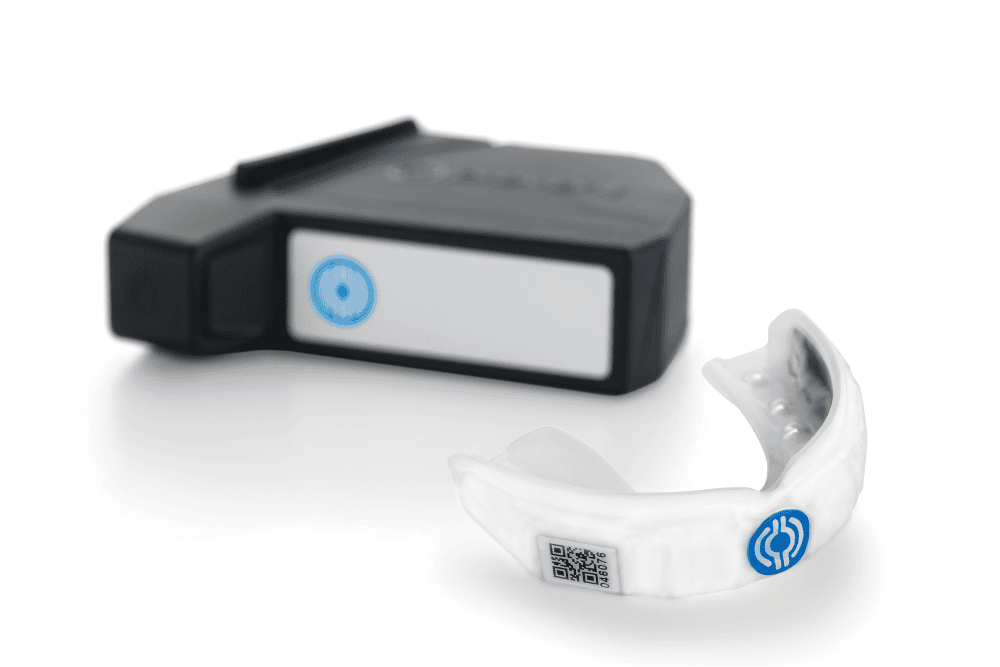
Prevent’s mouthguard’s tight-coupling to the skull is a newer (and possibly more accurate) method to measure head impacts.
“10g is what you do when you sit in a chair, you can stop really hard, and you’ll get five to 10g” Shogren explains. “Ten to 20g are a bump, you might not even know what happened to you, you might not contend you got hit the head, but you had some contact. 20-30g you realize you were hit, that’s a head to the facemask, a small trip and you bump your head. 40g is when you definitely know you got hit, and 50g is bad. And above 50 is we’ve almost shown all of them to be reflective of a person acting in ways you would typically remove someone from a game.”
Minnesota-based Prevent Biometrics is involved in several ongoing studies, including working with Indiana University to equip 160 high school football players with its mouthguards and another study with a suburban Minneapolis youth tackle football organization that equipped 400 players with Prevent’s mouthguard. The University of Nevada is entering year three of a study in which 50 players on the school’s D1 college football team have worn the mouthguard and has thus far collected data on 20,000 head impacts over the past two seasons.
“We’re seeing around an average of six impacts per player. And about 80% of those impacts are below 20g and 90% are below about 25g consistently in the schools that we look at. So less impacts that are smaller is the first finding in almost everything we do,” Shogren says.
Shogren is critical of past methods predominantly used in football to measure head impacts, such as the Head Impact Telemetry System (HITS) developed by Simbex that leading helmet manufacturer Riddell began adding to their helmets around the mid-2000s. That system saw accelerometers placed inside the helmet, but its impact data is less accurate than Prevent’s mouthguard because the helmet sensor system is more susceptible to moving out of place on each impact, effecting the measure of force.
The University of North Carolina at Chapel Hill equipped its football players with Riddel’s HITS-embedded helmet during practices and games from the 2004 to 2006 college football seasons. UNC released a study on the impact data in 2007 that found “In football, a hit can easily jerk the head, for milliseconds, at 50g, and hits above 100g are common,” adding that one player experienced a 168g hit.
“All of the football data you’ve ever seen about how dangerous football is, is about five times too many impacts and way too big. And it’s because the helmets systems they use move,” Shogren says. “All the way up to college and professional levels, we’ve showed that these games are nowhere near as dangerous as the studies have reported in the past. Hits equal to car accidents, this stuff is just not usually true.”
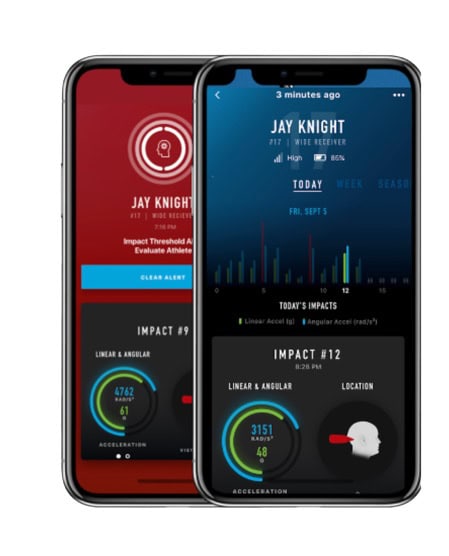
Prevent’s data can be accessed in real time and allows for multiple team users to monitor athletes.
Among the other support of Prevent Biometrics is Dr. Joseph Maroon, who is the Team Neurosurgeon for the Pittsburgh Steelers and medical director for the WWE. The NFL recognized Prevent Biometrics as a finalist at the league’s first and future pitch competition in 2017. Last year, the NFL expanded its impact-sensing mouthguard program from NFL teams to also include players on four college football programs, though that mouthguard device was developed with Virginia-based engineering firm Biocore.
“The data from the HITS system indicated there were 1,000s of hits and huge forces. And it was all erroneous, most of it was erroneous,” Maroon says. “The Prevent [Biometrics] system with fixing the mouthpiece to the upper teeth has been shown to be very accurate.”
Shogren says Prevent sells its mouthguard predominantly to teams with the price now around $300 to outfit an entire team in which each player gets their own device. The company’s biggest partnership to date has been with World Rugby, which began in 2021 with more than 700 youth players in New Zealand outfitted with Prevent’s mouthguards. The deal is now expanding to equip roughly 3,000 rugby players across the world, including players in the women’s Rugby World Cup.
Last month, World Rugby announced that it was extending its return-to-play window for players who got diagnosed with a concession to 12 days, meaning they likely would be forced to miss their next match after being diagnosed. Prevent is also working with World Rugby to establish a score of g-force that would signal when a player has reached an accumulation of impacts that would require evaluation for possible concussion.
“At some point in time, small impacts add up to a dangerous thing. We’re working with World Rugby now on with what we call a load calculation,” Shogren says. So figuring out this number where there will be some threshold where you would also say, ‘Hey, this guy in a football game, took 10 hits that added up to a number and that’s the threshold we want to assess him.’”
World Rugby’s collaboration with Prevent has also found that girl athletes at the youth level tend to sustain bigger head impacts than boys.
“We have seen differences in women, where we think because they start later in certain sports, they end up having more head to ground contacts and bigger impacts because they just don’t seem to go to the ground as well as boys,” Shogren says. We’ve confirmed that’s true that girls can have larger head impacts when they hit the ground, and it looks like it’s something to do with how they fall. So it’s immediately led to World Rugby developing some drills at the younger age for how you take a tackle and go to the ground.”
This article was brought to you by SportTechie, a Leaders Group company. As a Leaders Performance Institute member, you are able to enjoy exclusive access to SportTechie content in the field of athletic performance.
Jimmy Wright, Team Biokineticist at the Natal Sharks, reflects on why sport often teaches us the wrong values.
“It’s a simple African way of saying my existence is dependent on your success – me being well is dependent on you being well,” he told the Keiser Series Podcast in August.
“I think team sports should embrace that idea because there cannot be a single standout star in a team. You’ll never see a team succeed because of a single individual. In fact, individuals will rise to the top because of great teams.”
Wright spoke at length about his 23 years working with the Sharks – he was the first biokineticist to work full-time at a South African franchise – and how his role has evolved during that time.
“There’s more evidence to support what we do but, at the same time, there’s more perspective, but certain things don’t change,” he continued. “If you chase the science, if you purely chase the literature, and you forget about experience and what has traditionally delivered the results you might just miss the diamonds.”
Here, Wright reflects on his strengths and areas for future improvement.
Jimmy, what do you consider to be your greatest strength?
JW: It’s my ability to take perspective. Perspective helps cut through the stuff that can potentially distract and perspective is what is creating the future for us. If we can see things for how they can be and we can look back from that point to the present, and if we can tell the story of what created that reality, we will have the formula for success. But you need to be able to do a bit of future travel. Perspective is important, understanding that winning is not everything, losing is not final, but to focus on getting better – growth – and take whatever the business is going to give you year on year. Perspective for me is a good thing; I think it’s more beneficial than benching one and a half times my body weight.
What strength do you admire in others?
JW: I would say it’s putting up with me! On a good day, I can be very draining – you can ask my wife – but I think it’s not in a bad way. It’s passion. Our CEO once upon a time was a player here [Eduard Coetzee], he then went away, played in France, came back, and now happens to be the CEO of the Sharks. His go-to line is that he came back to fire me! The nice thing is that we’ve always been very good friends and we still our very good friends. It’s a respectful relationship. But I think I can be challenging. I follow the advice I would have given myself when I was younger, I push hard. If I want money, so to speak, I won’t go away until I can have what I want, and if I can’t have the money, I’ll find another way. But on a good day I’m a high performance manager’s worst nightmare.
What is the key to strong teamwork?
JW: It’s ubuntu. It’s very simply an unselfish mindset. It’s counter-cultural. Sport does teach us all the wrong values, it teaches us winning at all costs. You can’t take that idea into a marriage. If you take the idea into a marriage that it’s winning at all costs, you’re going to be single very quickly. To a lesser extent teamwork has to focus on that which I will benefit from only when the team wins. Therefore, my efforts have to be solely focused on what makes the team better because if the team doesn’t win then I’m not going to win. What makes a team better? Winning fixes a lot of problems, so I will do whatever I can to make this team win but it starts with me. It cannot start with anybody else.
How will you look to get stronger in your role?
JW: To keep that perspective I mentioned, to keep myself sharp mentally and physically. Obviously, we deliver a health service and I like to practise what I preach and I like to be respected. I’ll keep pushing myself physically and mentally, I will keep on valuing good relationships. If I can keep on doing that then when I eventually depart I will have made a difference. That’s the important thing: to say that when we leave we’ve done our best, the place is better than when I arrived, then I’ll be happy.
To hear more from Jimmy Wright, listen below:
Listen above and subscribe today on iTunes, Spotify, Stitcher and Overcast, or your chosen podcast platform.
Jarrad Butler of Connacht Rugby and Rory Sloane of the Adelaide Crows describe the main dynamics at their respective clubs.
The club, which draws its five-player leadership group from a list of 45 decided to give youth a chance in 2020.
“Couple of guys who have been part of the leadership group over the previous four years stepped aside to let some of these young kids develop,” said Sloane.
Adelaide finished bottom of the AFL ladder in 2020 – a fact that left Sloane, as captain, “stung” – and decided to turn to youth to renew their fortunes. In this context, it made sense to empower some of the younger players on the list.
“We’ve still got a lot of leaders without titles,” he continued, “But yeah, five official leaders.”
Sloane is joined onstage by Jarrad Butler, the captain of Connacht Rugby, where their eight-strong leadership group takes responsibility for driving standards and behaviours. Together, they explore the creation of leadership groups at Adelaide and Connacht and the main dynamics involved.
Democracy
Leadership groups tend to be elected by athletes from amongst their peers and neither Adelaide nor Connacht are any different. “At the start of the year there was a questionnaire on who do you think leads by example on the field, who do you think is the best communicator, the guy that holds the most people to account,” said Butler of the process that saw Connacht’s eight-person group appointed for the 2020-2021 season. “We kind of ticked boxes that we thought [represented] values that we wanted to have as a group, as a team, who do you think best kind of ticks that box. And we tried to put a group together that then covers a whole lot of those bases, so we didn’t want just a whole bunch of guys that are all maybe very good at the same areas, so that was important.”
Regular meetings
“What we’ve been trying to do is catch up at least once a fortnight just to get on the same,” said Butler. “I think where we fell short, especially when the seasons for us dragged on, you kind of get caught just going through the motions a little bit and you forget to catch up. “We’ve have a meeting where we all get together and these guys aren’t really on the same page, and you’re seeing that come out in the performances as well and you’re like, well we haven’t got together in four weeks [so] no wonder we’re not on the same page at the moment. So we found one of the first challenges I guess was being diligent and actually catching up with each other, and again it’s one of those things where Andy Friend, our head coach, he was like ‘well it’s up to guys if you want to get together, we’re not going to chuck something in your diaries for you – either you do it or you don’t,’ and we learnt early that if you’re not going to do, then everything else starts slipping by the wayside as well.”
Learning dynamics
Butler explained that leadership groups also have a vital role in ensuring learning and development of understanding because there are times when a coach’s impact can be limited. “It’s one of those things where you’re in a meeting and you’re getting – you know, the defence coach comes up, the head coach, and they’re showing clips and clips and clips – it’s easy for things to get watered down,” said Butler, who discussed the balance of challenge and support with Sloane in more depth here. “For the main session, we [often] get one of the players, usually one of the leaders, early on they would do the review of the session, and they would come up with the clips. This year, it’s been a little harder to have these meetings with Covid, but still, coming up with clips and sending them out because we’ve found that when you’re getting told by your peers, when they’re highlighting something I think it holds more weight than when you’re getting it from a coach for whatever reason.”
Spread the load
Butler also makes the point that their duties extend beyond performance or rugby and it is important that the playing group does not allow a mere handful of individuals manage tasks for the group. “I think the main thing is that we all took on something that wasn’t rugby-related,” he said, “so it wasn’t falling on the same guys. So one guy would link up with the team manager on if there was any issue around travel or things like that, someone else would link up with the kitman, if there were any issues; and it would just mean that we haven’t had the same conversations with a whole bunch of people unnecessarily. So it helped kind of disperse that load as well, so it wasn’t falling on the same blokes. Because imagine, you know, there’s all those guys that are happy to do everything if you ask them to, but it’s not fair to them as well. So it’s all about lightening the load.”
Jimmy Wright of the Durban-based Sharks discusses how biokinetics can create value for the players.
A Keiser Series Podcast brought to you by our Main Partners

“If you chase the science, if you purely chase the literature, and you forget about experience and what has traditionally delivered the results you might just miss the diamonds.”
Jimmy Wright, the Team Biokineticist at the Durban-based Sharks, who compete locally in the Currie Cup and internationally in the United Rugby Championship, is the first guest on the latest series of the Keiser Series Podcast.
Jimmy has been with the Sharks for 23 years – in fact he was the first individual to hold his position at a franchise in South Africa – and has seen both his role evolve as well as the needs of the game.
He discusses those developments and also touches upon:
John Portch: Twitter | LinkedIn
Listen above and subscribe today on iTunes, Spotify, Stitcher and Overcast, or your chosen podcast platform.
27 Jul 2022
ArticlesJarrad Butler of Connacht Rugby and Rory Sloane of the Adelaide Crows provide an insight as captains of their respective teams.
He was on the cusp of his 21st birthday, in 2012, when he joined the Queensland Reds on a short-term contract to help cover for a recent spate of injuries.
Leadership was not on his mind at the time. “When I was at the Reds, early doors, it was kind of hard to say because when you’re just fresh out of school and you’re just kind of getting in there you don’t really see what’s going on behind-the-scenes as much,” Butler told an audience at Virtual Leaders Meet: Evolution of Leadership in June 2021. “You don’t really see the conversations that are being had, you just kind of see what’s happening on the field, and I’m just wondering around trying to do my job, do it really well.”
The Reds had won the Super Rugby title the previous season and the training sessions were an eye-opener for the young Butler. “I remember some guys that were maybe my age now getting into me about something that I might’ve done on the training field and just how much that rattled me a little bit as well,” he continued.
“It’s one of those things where I reflect on it and [tell myself]: ‘actually, I think I did the right thing there, but what could I have done better?’ and then maybe have a conversation after the training session and kind of tease out what happened and get a positive from it.
Butler tries to bring this dynamic to his interactions as Connacht captain, a role he has held since 2018. “It’s one of those things where you don’t really notice at the time until you’re reflecting on it,” he added.
The scenario is familiar to session moderator Dan Jackson, the Leadership Development Manager at the AFL’s Adelaide Football Club. Of Adelaide, he said: “We talk about this model of care and candour, if you criticise people all the time and you’re just ruthless, then, yeah, you’re driving standards but people eventually are just going to turn a shoulder on you because they know that there’s no love there, but [after] showing that care and making sure there’s a standard of love, then you can be as candid as you need, because then it’s a gift rather than a slap.”
Two years later, in 2014, Butler joined the Canberra-based Brumbies, where he briefly played alongside the team’s captain, Ben Mowen. Butler described Mowen as a mentor, someone who was able to drive standards, while also being able to put the proverbial arm around a player’s shoulder.
“He just kind of nailed it somewhere in the middle,” said Butler. “I think that first and foremost, is he was just a really good guy, as he was someone that would come down to Canberra and he would help you move into your place and he would want to have a coffee with you, and, you know, that’s crazy when you’re 21 years old, you’re the new guy there and you have this guy wanting to genuinely meet you and be a friend.
“But then when he got onto the field, he was an animal and he was ruthless on the field, performed at a consistently high level. So being able to find that balance there I think was the most interesting for me, and seeing that there’s not just one way to skin a cat.”
Relationships enable difficult conversations
Joining Butler and Jackson is Adelaide captain and midfielder Rory Sloane. At the time, Sloane was in his third season as captain (including one as joint-captain alongside Taylor Walker) as the Crows embarked on a rebuilding project to restore the club to AFL prominence.
Sloane had fewer concerns about his on-field captaincy than he did his off-field abilities. “Off-field stuff has always been my challenge absolutely – that’s something that I’ve always had to work on massively over the years,” he said. “I wasn’t someone that loved confrontation at all, and that’s where I worked really hard over the years just on my relationships with people to be able to then have those conversations.”
He cites the influence of renowned American leadership specialist Brené Brown. “There was something she said: ‘Sit next to someone when you’re having those conversations rather than across’; because I reckon I used to always come across very aggressively, so sitting next to someone was something that really helped me just have those conversations.”
It is an attitude that Jackson promotes around the Crows’ enviroment. “We’ve spent a lot of time talking about connection, and it’s a theme I keep seeing across elite sport, and also across corporate organisations – great cultures are built on connection,” he said.
Sloane readily admitted that results were not good enough at the time, and the Crows remain a work in progress (Sloane himself suffered an ACL injury in April), but he explained to the virtual audience that it was important to get things back on track through building those team bonds.
“We finished on the bottom of the ladder last year [2020], for the first time at the club and, in my first year as captain that stung massively,” he said. “And we got some feedback from guys in our football club, in our leadership, where we [felt we had] lost our way, our identity as a football club, where everyone used to know that we trained hard and we had this ruthless edge as a footy club.”
The players convened, in their own free time during the off-season – Covid restrictions at the time prevented interstate and overseas travel – and trained three or four times per week. It consisted of activities such as practice games, Pilates, and boxing sessions. “We look for opportunities to be together,” he continued. “It’s everything that comes into that connection whether it be [socialising] or something as simple as [listening to] music.”
Jackson sheepishly commended Sloane for his work on himself as a leader, for accepting that he did not automatically know how to manage difficult conversations with teammates. “You’re humble in this space, Rory, and I know you keep accounts of when you’ve chatted to your teammates – and you’re not running an Excel spreadsheet – but you’re checking in with guys you haven’t checked in with in a while, just calling or sending a text and making sure they know that you care so that you can have those hard conversations.”
Butler is of a similar mindset and drew parallels between his time at the Brumbies and his current tenure at Connacht, where he arrived in 2017. Both are clubs based in relatively remote parts of the country, with smaller populations, and founded by their respective federations as ‘development’ teams – a home for players who were not as highly sought after by other teams but who retained significant potential. Yet the Brumbies are Australia’s most successful team in Super Rugby and Connacht were a particularly tough proposition for most opponents long before their 2015-16 PRO12 title.
He said: “You’re usually a bit further away from your family, you get better connection with each other just off the bat because you’re all there for the same reason – you’re there because you’re trying to prove people wrong. Maybe you have a little chip on your shoulder; and I’ve found that being on the other side of that, when you actually know somebody you get a better connection with them. It makes it easier to have those hard conversations.”
Player power
Both Butler and Sloane speak of leadership groups drawn from their playing groups. In Connacht’s case, it consisted of eight players; in Adelaide’s, five. Beyond their responsibilities for driving standards and behaviours, theirs is a vital role in ensuring learning and development of understanding because there are times when a coach’s impact can be limited.
“It’s one of those things where you’re in a meeting and you’re getting – you know, the defence coach comes up, the head coach, and they’re showing clips and clips and clips – it’s easy for things to get watered down,” said Butler.
“For the main session, we [often] get one of the players, usually one of the leaders, early on they would do the review of the session, and they would come up with the clips. This year, it’s been a little harder to have these meetings with Covid, but still, coming up with clips and sending them out because we’ve found that when you’re getting told by your peers, when they’re highlighting something I think it holds more weight than when you’re getting it from a coach for whatever reason.”
The impact of your peers can be multifaceted, as Sloane illustrated when discussing the culture that was developing under Adelaide’s Senior Coach Matthew Nicks, who took the team’s reins in 2020. “His whole philosophy around football is: how can you help someone else there?” said Sloane. “And that’s not just around football, that’s around life as well, and I think that’s the biggest shift in mentality I’ve seen in our players.”
Jackson encouraged the team to celebrate those moments of selflessness, which quickly became part of the Adelaide routine. “It’s literally nothing special,” said Sloane. “We’ve had a couple of sessions this year and, at the end of the year, we might recognise a few guys for what they’ve done to prioritise someone else. It literally just became something that’s picked up by other players now, and we’ve noticed it, and I think it’s something that’s starting to become infectious.
“I’ve spoken to DJ [Jackson] about this, [and the important thing] is actually to just reward someone for something that you’ve seen and making sure you’re still instilling those habits, because, yeah, if it goes unnoticed then at times it may not become engrained, so that’s something that I think goes down incredibly well.”
He asked Jackson to elaborate and the Adelaide Leadership Development Manager provided an apt summary.
“Anyone involved in elite sport knows that you can’t get to the elite level without systems,” he said. “I mean building in routines that become habits and then those habits just become natural, and that’s something that you guys are leading impeccably as a team.”
Members of the Leaders Performance Institute convened at St George’s Park to hear from pathways specialists at the Football Association, Wales Rugby Union and the Lawn Tennis Association.
In partnership with

Session 1: Performance Pathways Part 1: Creating Effective Transitions
Speakers:
John Alder, Head of Player Development, Welsh Rugby Union
Helen Reesby, Head of National Performance Pathway, Lawn Tennis Association
Transition experiences:
Effective transitions:
Session 2: Performance Pathways Part 2: The Different Stages of Psychological Safety
Speaker:
Tim Cox, Managing Director, Management Futures
Psychological safety:
Why it matters:
Social pain & the brain:
Four stages of psychological safety:
Inclusion safety – key concepts:
Learner safety – key concepts:
Contributor safety – key concepts:
Challenger safety – key concepts:
Six ways we can increase psychological safety:
Model openness & honesty
Make it easy to speak up
Session 3: Performance Pathways Part 3: An Insight into the FA’s Approach
Speaker:
Phil Church, Senior Coach Development Lead, The Football Association
Attendee takeaways: