Ian Walsh of Red Bull is renowned for his meticulous approach to tackling some of the biggest waves on the planet. Here he shares his wisdom with the wider sporting community.
Main Image: Fred Pompermayer / Red Bull Content Pool
“In every other part of my life there’s a million things going on. I feel like I always have ten balls in the air. Did I forget to take the laundry out? Did I put it in the dryer? I have bills to pay, groceries to buy. And surfing is one of the few places in the world where that all just drifts away.”
This level of focus may sound familiar to athletes, but the stakes of big wave surfing are something else entirely. One false move and Walsh risks serious injury every time he mounts his board.
Walsh has built a career on his coolness under pressure, which is why he was invited to share his insights at the Leaders Sport Performance Summit at Red Bull Media House in Santa Monica last year.
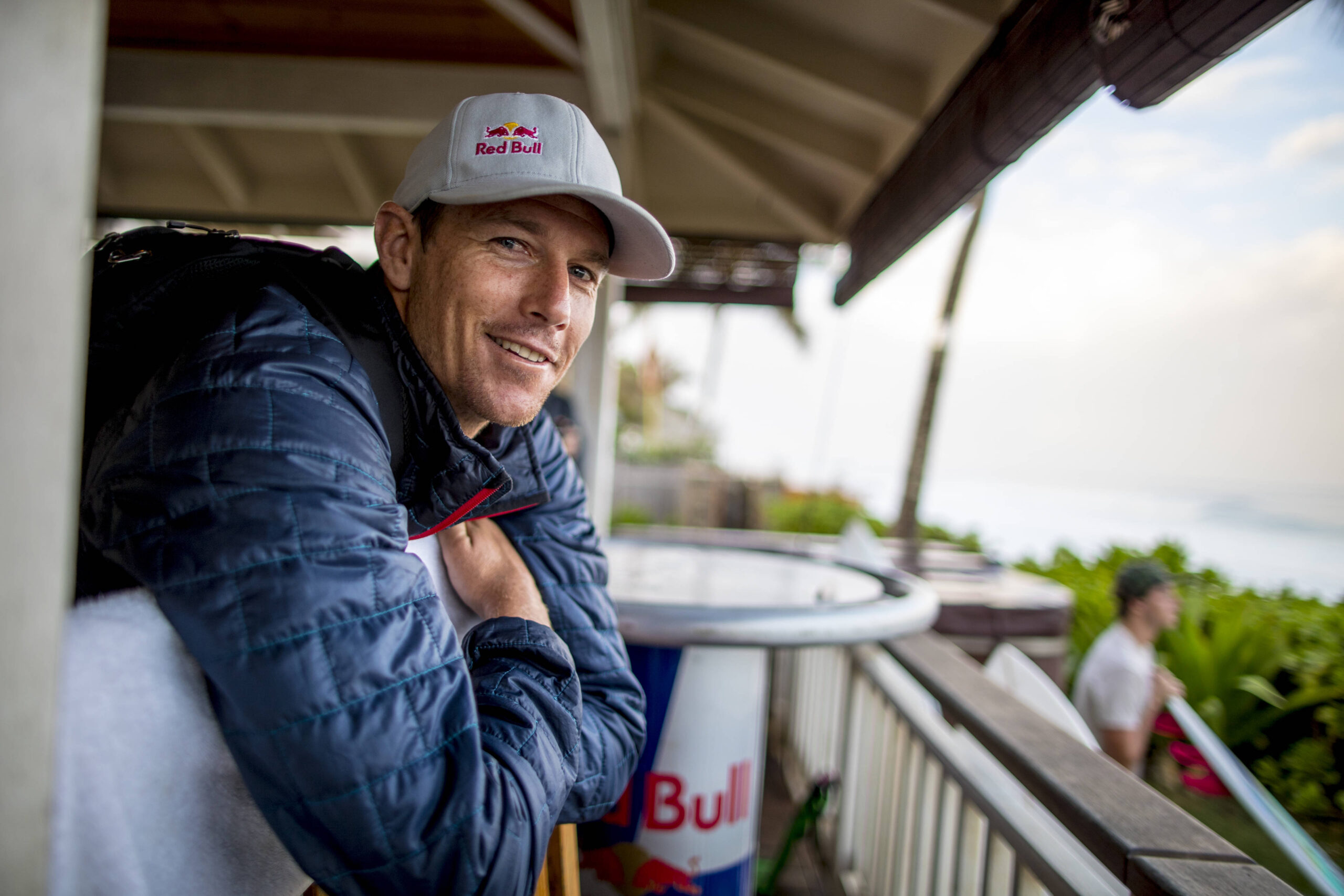
Ian Walsh poses for a portrait at the Volcom Pipe Pro on 4 February 2018, on the island of Oahu, Hawaii, USA. [Zak Noyle / Red Bull Content Poo]l
1. He acknowledges and harnesses his fear
“Those nerves and everything you fear are natural, and you can use that to elevate your performance,” said Walsh. “It commands every ounce of your being and your focus to deal with what’s coming at you and how you want to navigate it to try and finish on your feet.”
This ability comes with “repetitions and time”. Walsh was in town for a training block at Red Bull’s state-of-the-art Athlete Performance Center ahead of the northern hemisphere summer season. “I’m going to take full advantage of having this amount of time in a facility like this,” he added. “It gives me the chance to push myself in a controlled environment.”
2. He keeps his ‘smart brain’ online
Walsh can keep his ‘smart brain’ online under pressure. It is a term often used by high-performance specialist Rachel Vickery. “Have you got enough buffer in the system to absorb that natural increase in arousal state peaking?” she said on the Leaders Performance Podcast in 2023.
“Every human has a threshold that basically says if my arousal stays below my threshold or below my red line, I can perform in a way that I’ve got a lot more control of. If I’ve got more buffer in the system, so to speak, then when I get the normal increase in arousal it’s still under control and it’s not shooting me across the red line.”
In Walsh’s case, he de-escalates and grounds himself through the ‘breathe-up’ technique, which is a cycle of diaphragmatic breathing aimed at lowering his heart rate and preparing his body to stay relaxed underwater for an extended period.
Additionally, thanks to training alongside Red Bull freediver Kirk Krack, Walsh has learned to hold his breath underwater for up to five minutes. “It’s creating situations where I could elevate my heart rate and then get into a breath hold and understand how my body is going to react and eventually adapt to those scenarios.”
“It’s a skill in and of itself to then go, ‘how do I apply that once this physiological threat response kicks in? How well am I able to adapt and adjust and execute when all those changes happen?’” said Vickery, who would no doubt approve of Walsh’s strategies.
3. He already knows what to do when things go wrong
Walsh has long had a firm interest in meteorology and bathymetry [the study of the seabed, lakebeds and riverbeds]. He can pinpoint with reasonable accuracy when and where the most suitable swells will appear during both the northern and southern hemisphere surfing seasons. He said: “The reason it evolved to so much precision is to give myself as much of an opportunity on those special days as I can, because those days are rare and everything can change so fast on those mega swells.
He then readies his equipment and support team. “By having my preparation done, I can get absolutely smoked on a wave, break my board, everything gets washed onto the rocks, but I have everything ready to go again. I can go right to the boat or the jet ski, get my second board, catch my breath, make sure everything’s good and then get back into the lineup within 15-20 minutes.
“If you don’t have that ready, you could spend two hours dealing with it and it could be another month to six weeks or even the next season when you get another opportunity to push yourself in that calibre of surf.”
His meticulousness extends to listing and ranking restaurant menus in different locations. It drives his partner up the wall. “I take it into my normal life and my girlfriend can attest to how annoying those details are.”
Jokes aside, Walsh’s approach calls to mind the words of mountaineer Kenton Cool, who once told an audience at a Leaders Sport Performance Summit: “People often think of extreme adventure athletes as possessing a ridiculous appetite for risk, that we’re reckless, foolhardy and make illogical decisions. In reality, it’s quite the opposite.”
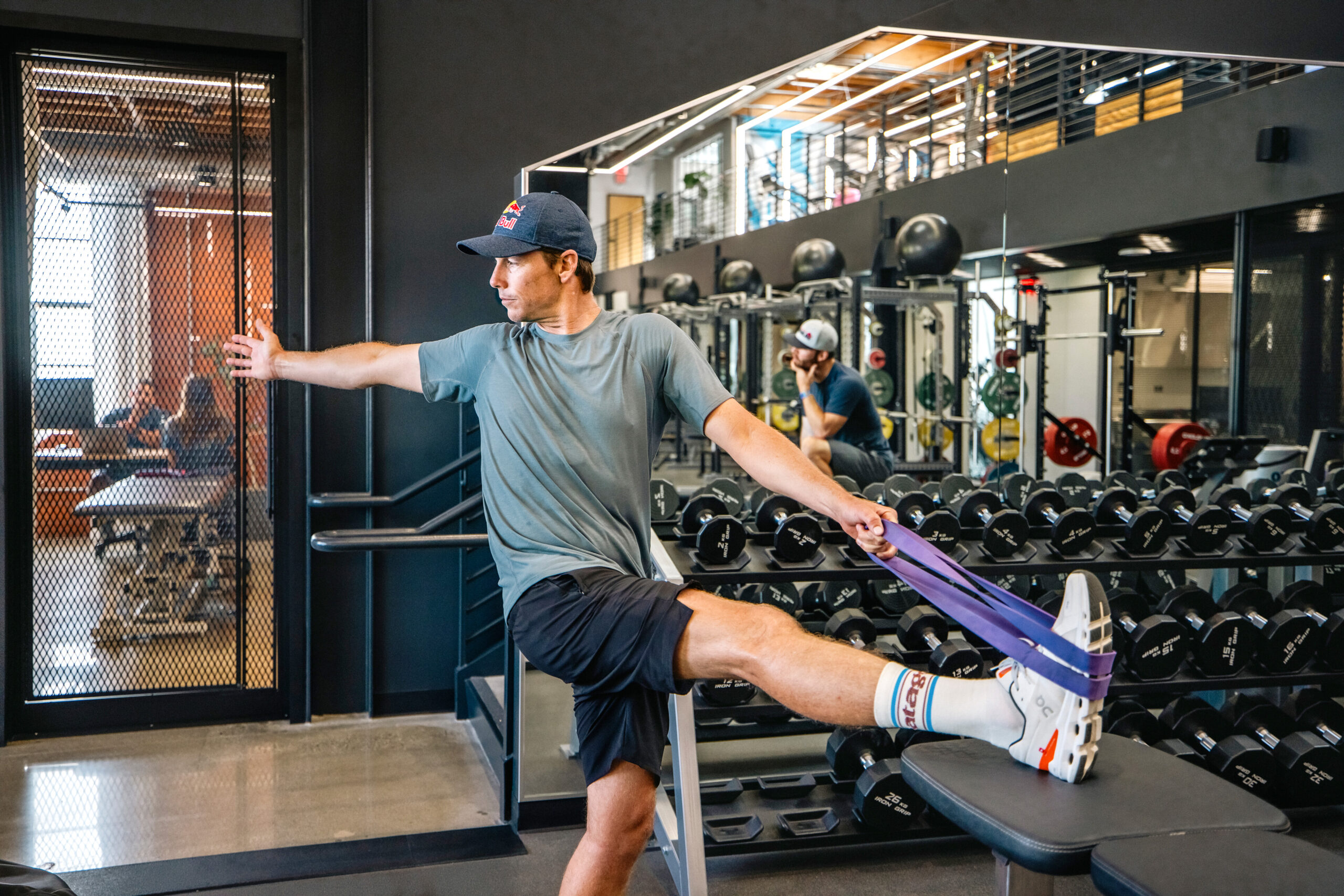
Ian Walsh photo session for The Red Bulletin, Los Angeles, 19 July 2024. [Maria Jose Govea / The Red Bulletin]
Walsh’s near-catastrophic failures have taught him to be humble when ironing out creases in his performance. “Letting go of some of your ego will create a lot more latitude for opportunities,” he said. “Maybe I did get annihilated on that wave, but I was also an eighth of an inch from making it.”
Walsh studies film of his efforts. He is also a comprehensive note-taker. “I can go back and be like ‘this swell angle, these winds, these tides are shaping up like January 10, 2004 [a date on which he suffered a severe injury – one of several throughout his career]’.” He can then tell himself “maybe I should have ridden this forward or tried those fins. Maybe our water safety protocol could have been a little more buttoned-up.”
What to read next
Adaptive growth sat at the heart of the Leaders Sport Performance Summit in Los Angeles. Discover the insights to propel you to greatness courtesy of the arts, academia and, of course, the world of sport.
An article brought to you by our Event Partners


“We choose to go to the moon in this decade and do other things, not because they are easy, but because they are hard,” said the US President at Rice University on 12 September 1962.
Those words, undiminished by six decades of distance, might have become a monument to presidential hubris had NASA’s Apollo program failed to land Neil Armstrong and Buzz Aldrin on the moon. Instead, Kennedy’s vision galvanised his nation and, allied to federal resource, gave the program the impetus it needed.
NASA’s ‘moonshot’ has since become a byword for ingenious and audacious projects that showcase adaptive growth. That is: being adaptable in the face of change and challenges, continuously striving for growth and improvement, learning from your experiences and making strategic decisions that drive progress and innovation.
Moonshots were a theme of the recent Leaders Sport Performance Summit at Red Bull in Santa Monica, with Jennifer Allum, who is part of the leadership team at Alphabet’s X, The Moonshot Factory, taking to the stage to discuss an environment where audacity is a prerequisite.
It was a marvellous start to proceedings on the morning of day one but, in truth, other themes discussed across both days, from talent and creativity to strategic thinking and resilience, just as readily point to adaptive growth.
Here, inspired by the worlds of sport, the arts and academia, we touch upon seven factors that can help to fuel your own moonshot, whether you’re taking your first small step, sustaining your early momentum, or looking to make a giant leap.
Harvard professor Clayton Christensen observed that large, established organisations do not always take advantage of potentially disruptive technologies and trends, while newer and less-established organisations often do. In his 1997 book The Innovator’s Dilemma, he explores the tension between sustaining existing products and embracing disruptive innovations.
Allum discussed the concept onstage in front of an audience where ‘failure’ is a common bedfellow. She understands that Alphabet, the parent company of Google, could easily fall prey to the Innovator’s Dilemma. So while X, The Moonshot Factory performs an instrumental role in delivering ‘moonshot technologies that make the world a radically better place’, there are myriad failures that pile high on their factory floor – and Alphabet wouldn’t have it any other way because they perceive failure as a learning opportunity rather than a threat.
Allum’s top tips for avoiding the Innovator’s Dilemma:
Jennifer Allum, leadership team, X, The Moonshot Factory
Long-established teams can all do better, but what of those just starting out, particularly in women’s sport? How can a beginner’s zeal be channelled into establishing a stable, long-term concern? Those are two of the questions currently facing NSWL expansion team Bay FC and their WNBA counterparts the Golden State Valkyries.
It is an exciting time for women’s sport but there are pitfalls to be avoided:
Lucy Rushton, General Manager, Bay FC
Ohemaa Nyanin, General Manager, Golden State Valkyries
Is yours a creative learning environment? Either way, you’d do well to listen to the Westside School of Ballet (LA’s most successful public ballet school) and the UCLA Herb Alpert School of Music – what can such schools teach the world of sport about the creation of learning environments that encourage improvisation, experimentation and intrinsic motivation?
It begins with a love for the art form and a welcoming ecosystem that allows the freedom to explore:
Adrian Blake Mitchell, Associate Executive Director, Westside School of Ballet
Eileen Strempel, Dean, UCLA Herb Alpert School of Music
As a leader, strategic thinking is in your remit, but do you ever include protecting your energy as part of the equation? “An organisation can’t outpace its leaders,” said author Holly Ransom onstage in Santa Monica. “So there’s nothing more important than working on ourselves as leaders.”
How to show up each day:
Holly Ransom, author, The Leading Edge
No matter your level of success or the smoothness of your systems, high performance can exact a large toll if your stakeholders are not resilient. As Red Bull US CEO Chris Hunt explained, a leader’s first job is to engender trust amongst their team. There’s no instant solution – you have to advocate for people and stand up for your values time and again.
How can people in high performance develop their resilience?
Chris Hunt, CEO Red Bull US, Red Bull
As a big wave surfer, Red Bull’s Ian Walsh is well-placed to discuss performance under pressure. He took to the stage to discuss the strategies that serve him well out on the surf.
Pressure points:
Ian Walsh, big wave surfer, Red Bull
Technology at its best can inform your decision making and, as Fabio Serpiello, a professor at the University of Central Queensland, told the audience at Red Bull, there are steps you can take to ensure you’re using the right technology and datasets.
Ensure you’re staying on top of tech innovations:
Fabio Serpiello, Director, Sports Strategy, University of Central Queensland